Testing Theory in Practice

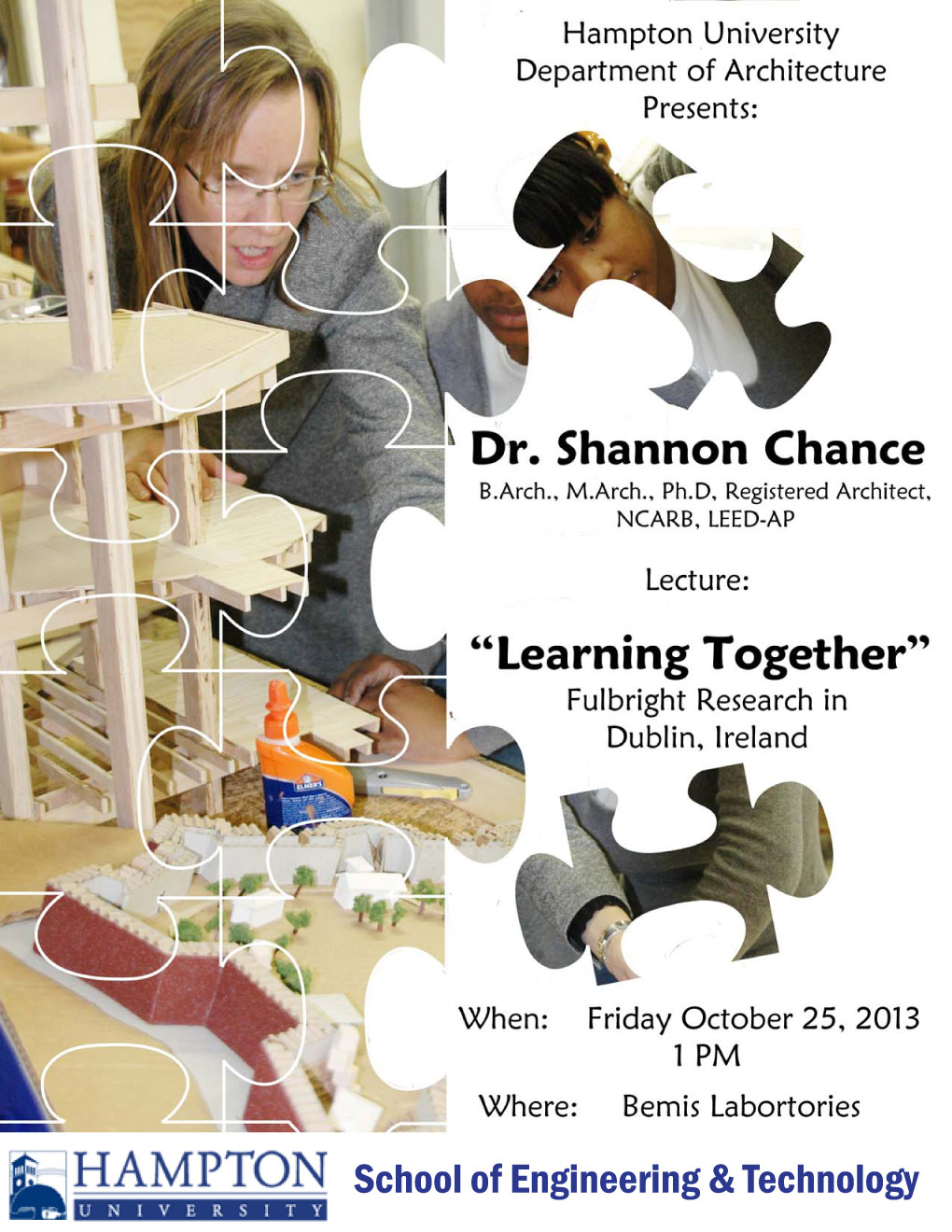
Yesterday I got to share some of my Fulbright research as part of the weekly lecture series hosted by the Hampton University Department of Architecture.  It was a great way to catch up with the advanced students and introduce myself to the first year group.

The students were highly attentive, very receptive to learning about epistemology and cognitive development theories, and interested in hearing about how I am using  data from student blogs  to test existing theories.

The faculty seemed genuinely interested, too.  At the end, though, there was no time for the faculty to ask questions… the students had so many questions that I finally had to cut things short and send them off to their studio classes.

At the start of the lecture, I had asked the students to pull out their smart phones and look up this blog site.  As a result, they had many questions about what I’ve found in applying the new methods in the second year studio and sustainability classes I teach.

I also passed around the catalog from my photography exhibition, so they could see some of the artwork I created in Ireland.  I also encouraged them to look up pages about my adventures in Greece, Portugal, Belgium (which I still need to post more about), France, and of course, Ireland.

Lecture poster (produced by HU student Samuel Morgan).

Lecture poster (produced by HU student Samuel Morgan).

Making the Mark as an Enterprise Rose Fellow

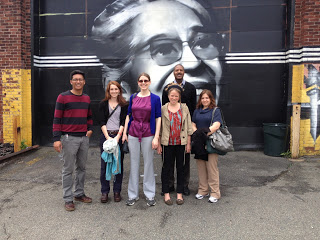
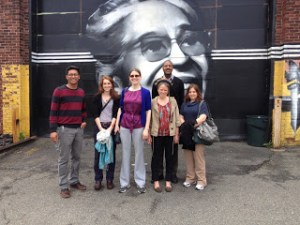
Mark (to the far left) with community members from Boston.

Mark Matel (to the far left) with community activists in Boston.

Thanks to a Facebook post by my (awesome) former student, Elbert Whitfield, I just discovered an article titled Enterprise Rose Fellowship Redefines Community Design at NeighborWorks Organizations, which features former student Mark Matel.

I’ve worked with many extraordinary students at Hampton University, like Elbert and Mark.

Today, I’m boasting of Mark Paulo Ramos Matel’ success.  I had the honor of teaching Mark in architectural design studios, study abroad, and environmental sustainability courses while he was working toward his Master of Architecture degree at HU.

Mark Matel (right) with fellow student Leon Peters presenting a second year design project at Hamtpon University.

Mark Matel (right) with fellow student Leon Peters presenting a second year design project at Hamtpon University.

Mark was an ideal candidate for the Enterprise Rose Fellowship, which the article explains is “a highly competitive and innovative program that places some of the nation’s finest early career architects in underserved communities across the country to team up with community development host organizations.”

Mark is intrinsically motivated to succeed, to help people, and to spearhead new initiatives.  His energy level, work ethic, creativity, self-direction, and ability to collaborate effectively were unparalleled among the students I have encountered in my 15 years of university-level teaching.

Mark was a major player in the formation of our department’s Studio Culture Policy and he represented our department impressively at the local and state level.
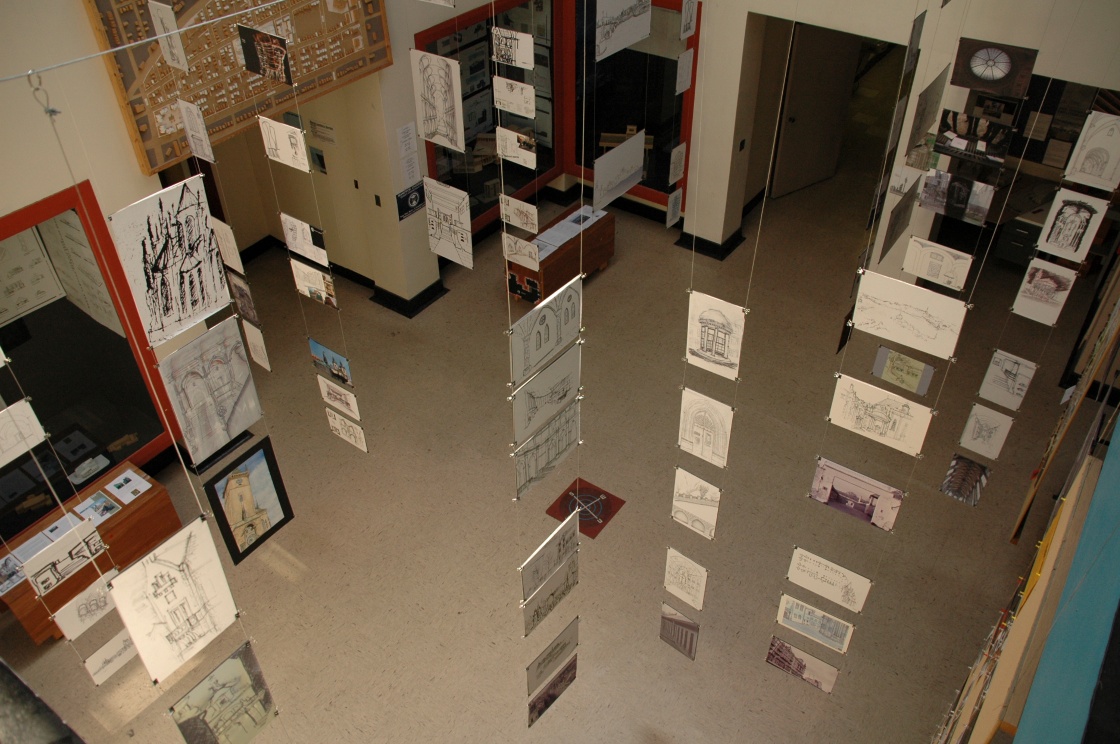
An exhibition that Mark and his colleagues Brandon Clarke, Smitty Lynch, coordinated along with other members of our spring break trip to Prague.

An exhibition that Mark and his colleagues Brandon Clarke, Smitty Lynch, coordinated along with other members of our spring break trip to Prague.

He is also a highly skilled designer, as is evidenced in design awards from Auburn and Hampton Universities.

Mark earned a NAAB-accredited degree from Hampton University – a program emphasizes urban planning as well as architectural design – and he then earned a design-build degree from Auburn University to boot.

To interview for the Enterprise Rose Fellowship, he went to Boston along with the two other candidates (both from top Ivy league schools).  After a rigorous multi-day interview, representatives from the community and the fellowship program voted, and then wholeheartedly extended the three-year fellowship to Mark.

During his time at HU, Mark’s research regarding water systems in the Philippines, and his work with the Virginia AIA’s Emerging Leaders in Architecture (ELA) program, were particularly relevant in preparing him for his work as an Enterprise Rose Fellow.
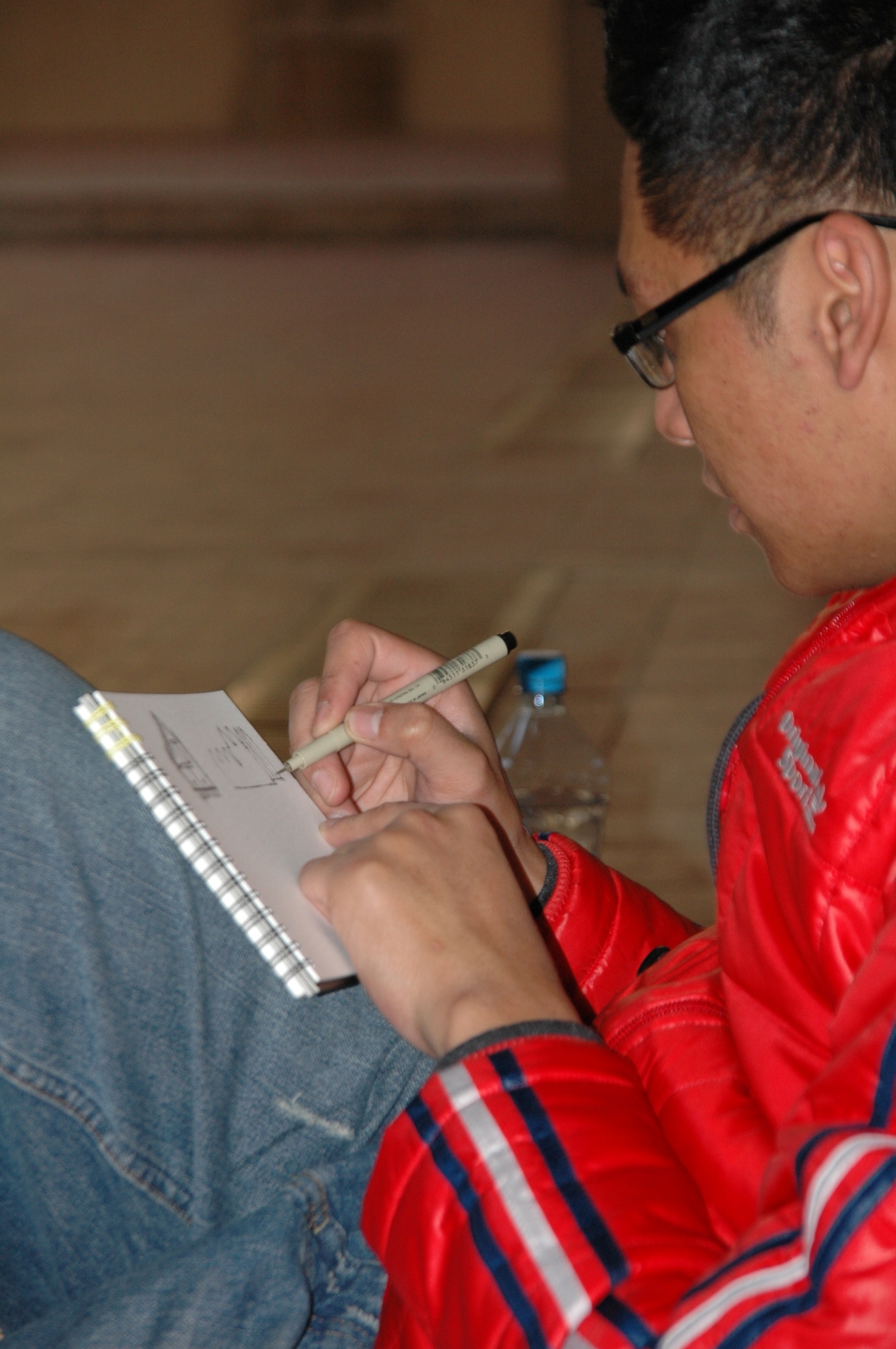
Mark sketching in Prague.

Mark sketching in Prague.

Marks’ activities all had an underlying theme of social activism related to the built environment.  He has always been able to think and work at multiple scales and with complex, inter-related issues.  His architectural studies enhanced these abilities.

Our department nominated Mark to represent Hampton University as part of Virginia AIA’s ELA program and his work with the organization exceeded our expectations.  The focus of the ELA program that year was on community revitalization and leadership.  Mark was highly engaged in his cohort’s project and he even defined the program for the subsequent year’s cohort.  (He identified specific conditions that needed to be addressed in Norfolk, Virginia and he helped get the new ELA group involved in fostering change where he knew it was needed.)

In his classes and teaching assistance-ships at Hampton University, Mark reflected a high level of engagement as well as what Daniel Goleman calls “emotional intelligence.”  Mark has the ability to share knowledge and to teach others techniques and strategies for improving themselves and their environments.

While he was at Hampton University, Mark was a very important part of defining a positive, learning culture within the academic context, as well as in the professional context (at the local and state levels) and in the larger community.

I couldn’t be prouder of Mark and all his many varied accomplishments.

You can see more of our trip to Prague in my archives.  My own presentation boards from Prague are also available for viewing.

Convocation Rituals

The William and Mary contingent in full regalia before the 2013 HU Convocation ceremony: Drs. Kianga Thomas, Shannon Chance, and Andrij Horodysky all graduated from W&M.  (Dr. Ralph Charleton was present, too, but sporting a regular black robe.)

The William and Mary contingent in full regalia before the 2013 HU Convocation ceremony: Drs. Kianga Thomas, Shannon Chance, and Andrij Horodysky all graduated from W&M. (Dr. Ralph Charleton was present, too, but sporting a regular black robe.)

The Honorable John Charles Thomas, retired Justice of the Supreme Court of Virginia, got a double standing ovation. And, he delivered an encore!

The Honorable John Charles Thomas, retired Justice of the Supreme Court of Virginia, got a double standing ovation. And, he delivered an encore!

Rituals are vitally important to any organization.  They help define the culture.

By participating in rituals, members of a community can come to understand what the organization is about, what it prides itself in, and what it wants to become.

Events like Hampton University’s annual convocation provide time to reflect, to express aspirations and share stories,  and to celebrate accomplishments.  Being that Convocation marks the start of the academic year, this particular event also prompts us to set goals that align with those held by others at “our home by the sea.”

This year, the historic Ogden Hall overflowed with families and with enthusiasm.  This event coincided with Parent’s Weekend  and so the crowd was particularly large.  The choir was amazing (as always)!  The students performed two different spirituals: Let the People Sing Praise Unto the Lord, and You Must Have that True Religion.  We also had lovely trumpet performances for the processional and recessional, with architecture alum Adam Davis on organ for the opener.

The university’s president, Dr. William R. Harvey addressed the crowd and recognized two members of the faculty (Drs. Francisco Cornell and Paula Barnes) with awards for outstanding teaching.

Then to top the festivities off, the Honorable John Charles Thomas, a retired Justice of the Supreme Court of Virginia, delivered a stirring keynote address.

And he received  TWO standing ovations.

I’ve never seen that happen before except at a rock concert!

Justice Thomas had ended his resounding speech with a poem, and he followed the ovations with an encore… reciting a second poem to an appreciative crowd of students, families, and faculty.

The entire HU faculty was present.  To tell the truth, it’s a contractual obligation to attend.  We’d also been required to attend the speech to parents the morning before, so we were all very happy to have such a motivational speaker.

This year the time in Ogden Hall was very well spent.  Justice Thomas, a life-long Hamptonian who sported HU t-shirts even as a toddler, reminded us of who were are and why we are here.  I, for one, appreciated the reminder because it was delivered in such a positive, lively, and engaging way.

Lunch with the Fowlks

Reconnecting with Hampton University’s Dr. Edison Fowlks is always great fun.  I’m perpetually intrigued by his radiance and his zest for learning and teaching.  For several years, our image anchored HU’s faculty page:

Hampton University _ Faculty

The three of us (pictured above) are all still going strong.  In fact, the third professor in the picture, Dr. Francisco Cornell, was just recognized with Hampton University’s highest teaching award.

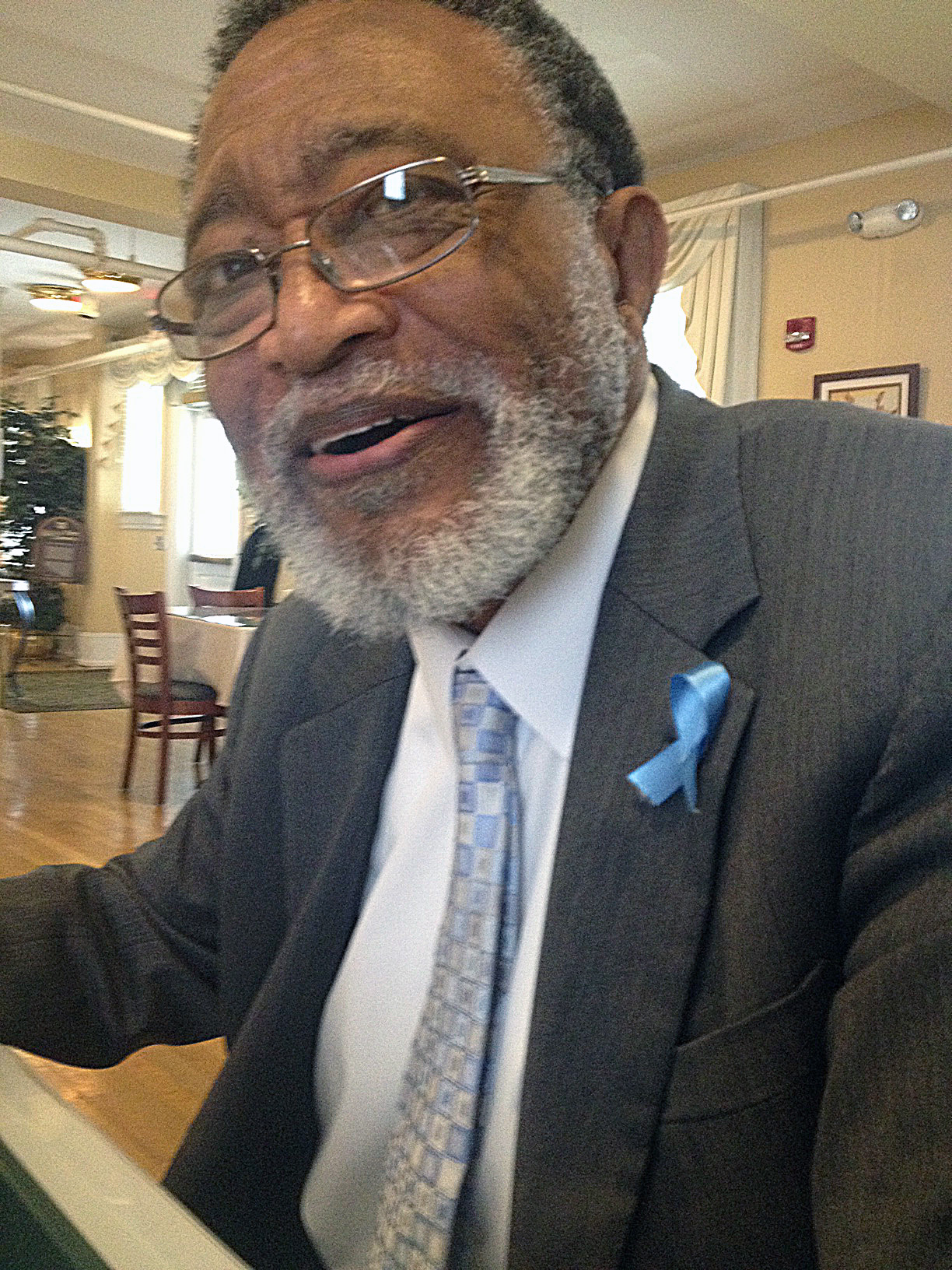
Dr. Edison Folks

Dr. Edison Folks

Recently, I had opportuity to share lunch time with Dr. Fowlks and to hear about his many new studies.  He’s teaching botany this semester, which he’s never done before.  His eyes sparkle and he radiates joy as he explains the new concepts he’s teaching and how he’s getting the students to learn.

“Problem-Based Learning” techniques are second nature to Dr. Fowlks.  Seems he’s always been a hands-on teacher.

Today, he’s teaching his students to isolate genes in soybeans and splice together new combinations.  He building new knowledge in genome sequencing and “synthetic biology.”

I recall he was once working to get cotton to grow blue so it wouldn’t need to be dyed.  I’ll have to remember to ask how that went.

Dr. Fowlks recently led a summer camp on synthetic biology. He took students to Yale for ten days last summer to work in a lab.  He’s also a member of the Genome Consortium.

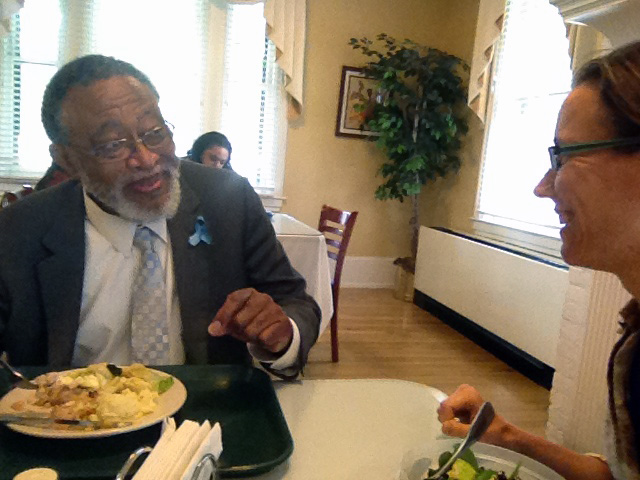
Fun over lunch.

Fun over lunch.

At lunch last week, we discussed bio-remediation and using living gardens to purify water.  I’ve been wondering if we could use the techniques to help an art professor who came to a sustainability lunch I held a few weeks back.

Over lunch on this particular day, Dr. Fowlks also introduced me to the concepts of “the new bio economy” and “metagenomics” which means “around genomics.”  One of his friends actually coined the term metagenomics.

I often remind myself how fortunate we are to have this genius and teacher extraordinare here at HU. He does his namesake (Edison) proud, and I’m certain he could be working anywhere he’d like.  A glance over his bio on the Hampton University’s website makes that much clear:

Dr. Fowlks received the Ph.D. degree in Plant Pathology from the Ohio State University. For four years he was a Postdoctoral Fellow in Plant Molecular Biology at Michigan State University and in Molecular Virology at the University of California at Berkeley. At Michigan State and UC Berkeley, he studied the primary structure of ribosomal and viral RNAs respectively. Later at Bishop College, research in his laboratory led to the development of a two-dimensional RNA fingerprinting technique for studying mammalian RNA viruses. At Hampton University, he and his students use the tools of genomics, metagenomics, bioinformatics, and synthetic biology to focus on some unanswered questions in biology and medicine. Moreover, he is establishing DNA Microarray and Bioinformatics labs to serve as models for teaching biology as an information science and organisms as networks or circuits, and blending computer science, mathematics, and genetics into the curriculum. Dr. Fowlks instructs Principles of Heredity, Bioinformatics and Genomics and Advanced Genetics and is the director of The Howard Hughes Medical Institute (HHMI) Undergraduate Education Program housed in the Department of Biological Sciences at Hampton University.

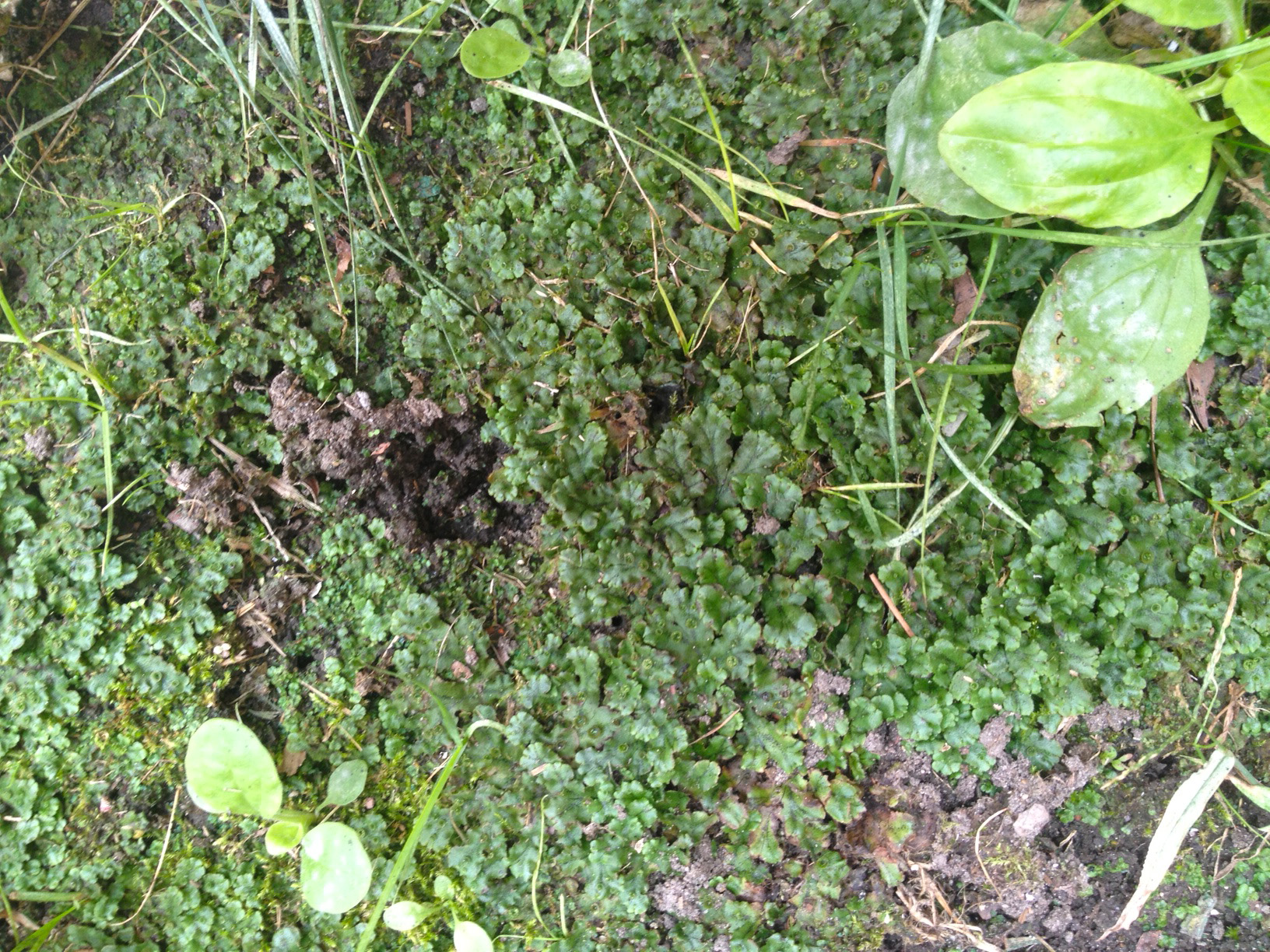
We made a special journey over to see the liverwort outside Armstrong-Slater Hall.  It's one of the oldest strains of plant anywhere.

We made a special journey over to see the liverwort outside Armstrong-Slater Hall. It’s one of the oldest strains of plant anywhere.

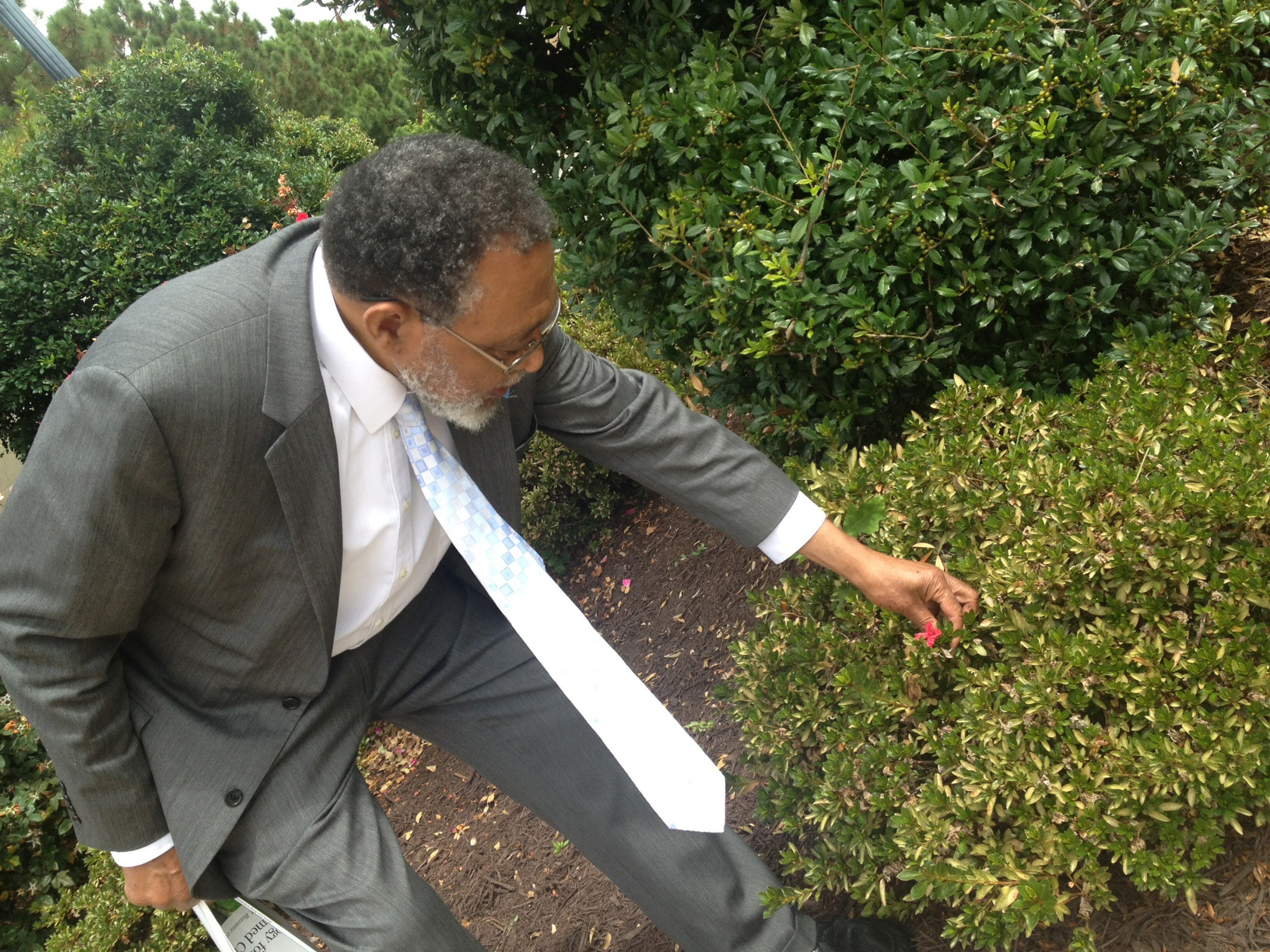
Walking back to our academic buildings, Dr. Fowlks and I stopped to investigate botanical wonders--like this bloom that sprouted out of season.

Walking back to our academic buildings, Dr. Fowlks and I stopped to investigate botanical wonders–like this bloom that sprouted out of season.

From Sustainability to Singapore

Learning together at the Holley Tree Inn.

Learning together at the Holly Tree Inn.

Every Tuesday, I hike across campus to the  Holly Tree Inn, Hampton University’s faculty restaurant, to share lunch with any professor who wants to share ideas over lunch.  At the start of the school year, I issued a very informal invitation to all faculty during the sustainability sessions my colleagues and I delivered to our colleagues at HU.  As a result, most of the Tuesday conversations focus on environmental sustainability.

Dr. Ralph Charlton and I graduated together from William and Mary's School of Education with PhD's in Educational Policy, PLanning and Leadership.

Dr. Ralph Charlton and I graduated together from William and Mary’s School of Education with PhD’s in Educational Policy, Planning and Leadership.

I’ve always enjoyed sharing ideas at the Holley Tree.  My first experiences were as a part-time professor and I enjoyed them so much that I decided to join the HU faculty full-time.  After the studio class I co-taught in 1999-2000, I’d walk over to the Holly Tree with the rest of the department faculty and we’d reflect on events and goals of the department.  Unfortunately, we haven’t been doing much of this lately (it has to be really enjoyable to get people to take time out of their busy schedules… and the cost of buying lunch has increased over the years).

Nevertheless, I was inspired by the vast amount of learning that I observed (and was part of) in the staff canteens at DIT last year.  So I made the effort to replicate DIT’s model–which I saw as a way to create new knowledge and integrate learning across the campus.

So far this year, I’ve enjoyed sharing ideas with 2-4  people at each Tuesday’s lunch.   I’ve learned a tremendous amount in these conversations.

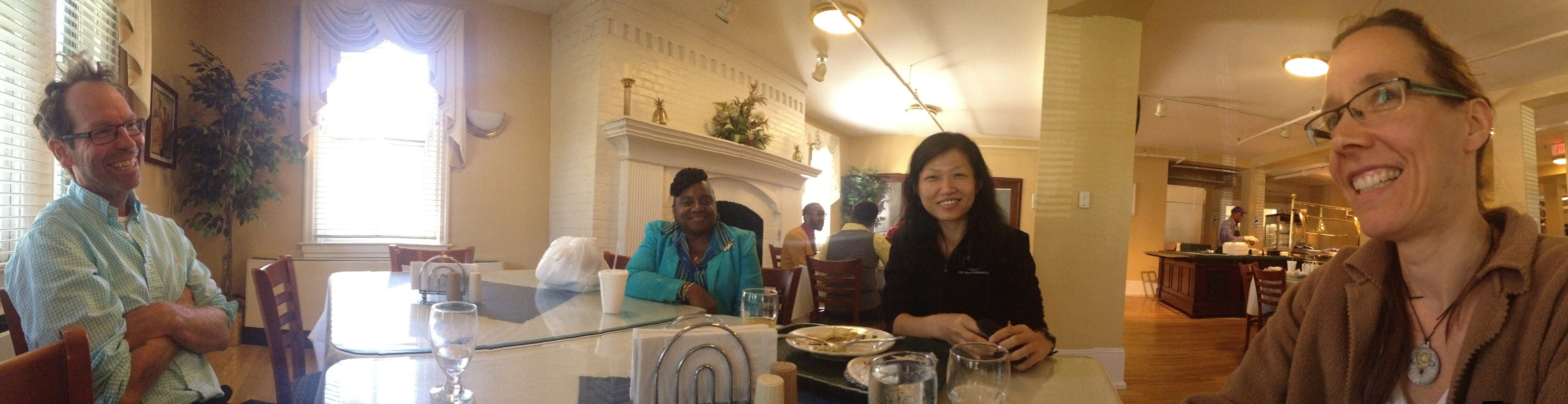
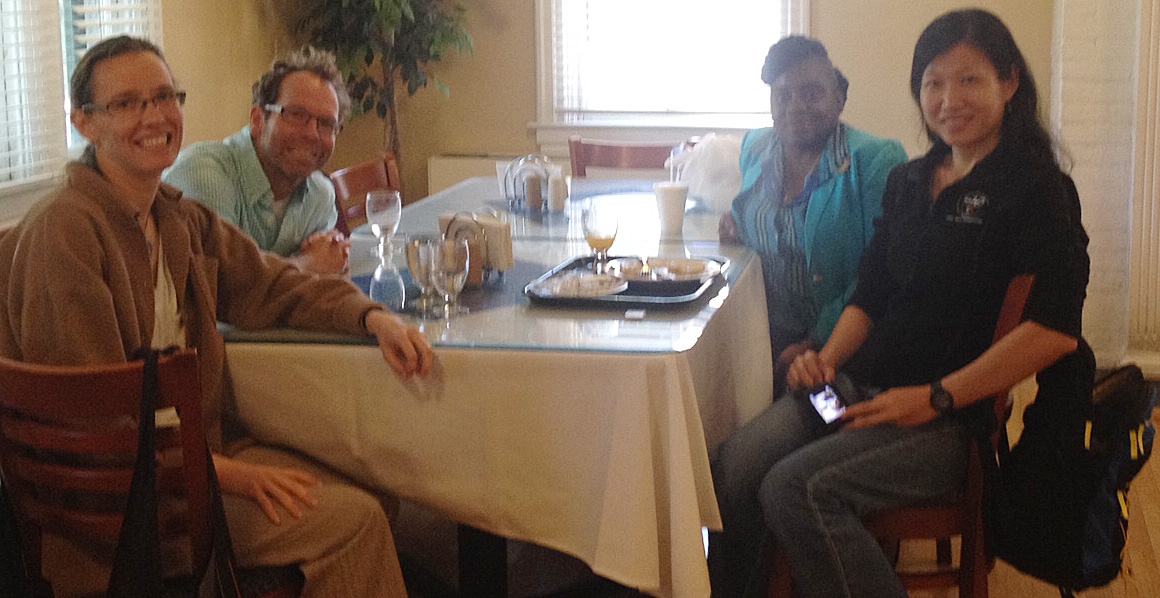
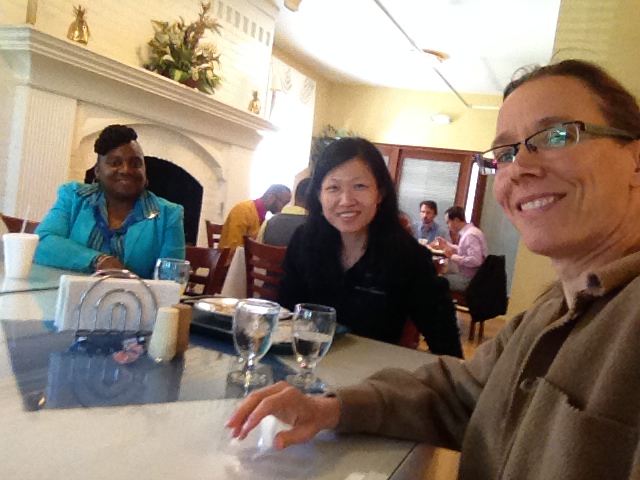
At the Holley Tree, I got to meet some people I'd normally not bump into.

At the Holley Tree last week, I got to meet some people I’d normally not bump into.

Last week, I dined with one HU professor, one HU administrative assistant, and a visiting professor from Singapore.  Our conversation focused on cultural similarities and differences and the opportunities that international exchange offers.

We didn’t stick exclusively to sustainability in our discussion this week, although we usually do.  Much of our conversation focused on cultural expectation and higher education policy.  In this realm, I learned that Singapore makes a big investment in reaching out the rest of the world.  It provides funding for its faculty members to travel internationally to learn new things and connect to scholars elsewhere.  (A few years back, I met a pre-K school leader from Singapore who had received funding to travel through the US for several weeks, on a similar program also funded by the national government in Singapore).

The folks I ate with last Tuesday were experts in sports management and in teaching college students about that topic.

Incidentally, the Holly Tree is a bit of an icon.  Rosa Parks worked here for a brief time–not so very long ago.

Reflections on Water, Light, Time & Teams

Discovering time in ordinary and extraordinary objects.

Discovering time in ordinary and extraordinary objects.

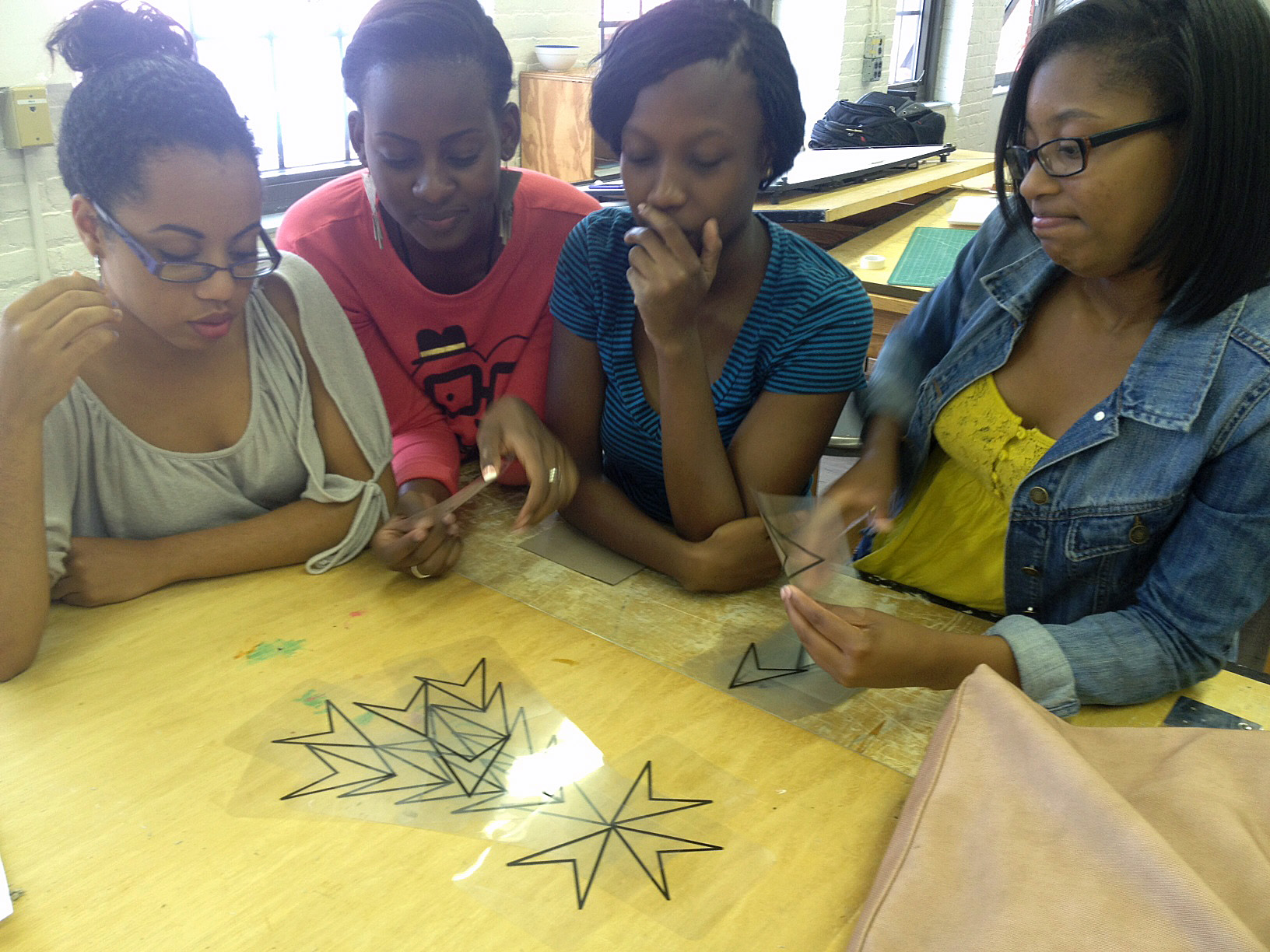
Janine, Khadjia, Shanice, and Sheldyn in a team-building activity lead by MIT grad student Derek Ham.

Janine, Khadjia, Shanice, and Sheldyn in a team-building activity lead by MIT grad student Derek Ham.

My students’ teamwork skills are improving by leaps and bounds.   The group of students pictured to the left makes teamwork and design look like so much fun.   In this photo they were doing a team-building exercise under the direction of Derek Ham.  Derek earned a Bachelor of Architecture degree at Hampton University in 2001. He went on to each a Master’s of Architecture at Harvard and teach at HU and FAMU. Today, he’s a PhD student at MIT. He came to talk with our students about overlaps between design and computation.

SELF-DIRECTED LEARNING

The overall goal of all this team work is to master skills in design, collaboration, and self-directed learning. In self-directed learning a (person or) group can identify what it needs to learn and how to learn it. It’s even better when the (person or) group simultaneously identifies what it wants to learn as well. That’s when learning gets to be really fun!

Members of this particular group did a nice job answering the question posted on this blog 1.5 weeks ago by prof. Steven Temple from the University of Texas at San Antonio. He asked if we’d posted findings of our water study yet.  Finally, here some are….

We’d done five studies in studio to date.  We’ve explored properties of water, light and time.  And, we’ve drawn our project site and studied/documented various monuments that use/express time/sun.  The images posted represent a few of the items this team has made in studio this semester.

So: What has the studio found that’s unique to water, light, and time?  Last weekend I asked my students to summarize their findings in words.  Here’s the response provided by Janine, Khadjia, and Sheldyn.

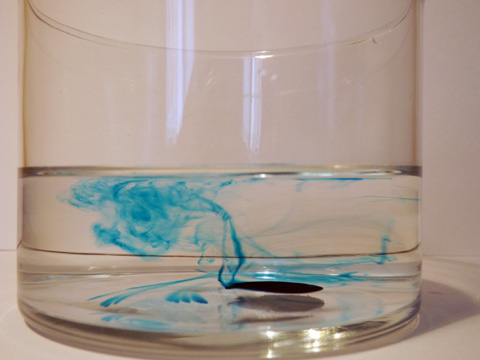
Capturing the essence of water.

Capturing the essence of water.

ONE TEAM’S FINDINGS FROM VIGNETTES

Water Vignette:

For this project, we decided to explore the way water moves. We wanted to highlight the seemingly random and beautiful motion of water and that other liquids also exhibit when placed in water. We used different colored dyes to show this. We observed that water and other liquids interact with each other in different ways, and that the density of the liquids mainly governed their behavior with each other. We observed a beautiful, smoke-like motion of the ink until it diffused and all the water became a diluted color of the dye. We also noted the way that water takes the shape of whatever vessel it is contained in, and that at any angle the water level will always stay perpendicular to the pull of gravity.

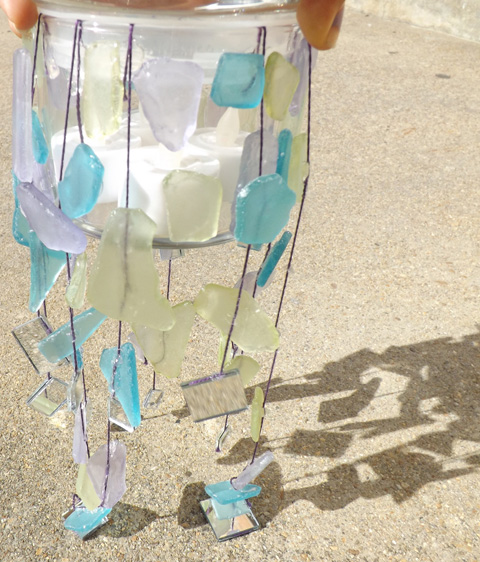
Capturing the essence of light.

Capturing the essence of light.

Light Vignette:

We wanted to highlight the behavior of light in terms of shadow and through different media. We mainly focused on shadows or the fact that light travels in straight lines and does not bend around objects. We also explored the reflection and absorption of light and how it filters through translucent media. We discovered that the effects of all these things differ with natural and artificial light. We also wanted to exhibit movement through light and observed this through the way light bounced off the mirrors and made shadows when our hanging objects moved.

Time Vignette:

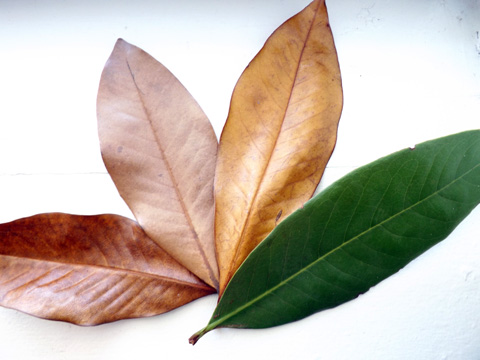
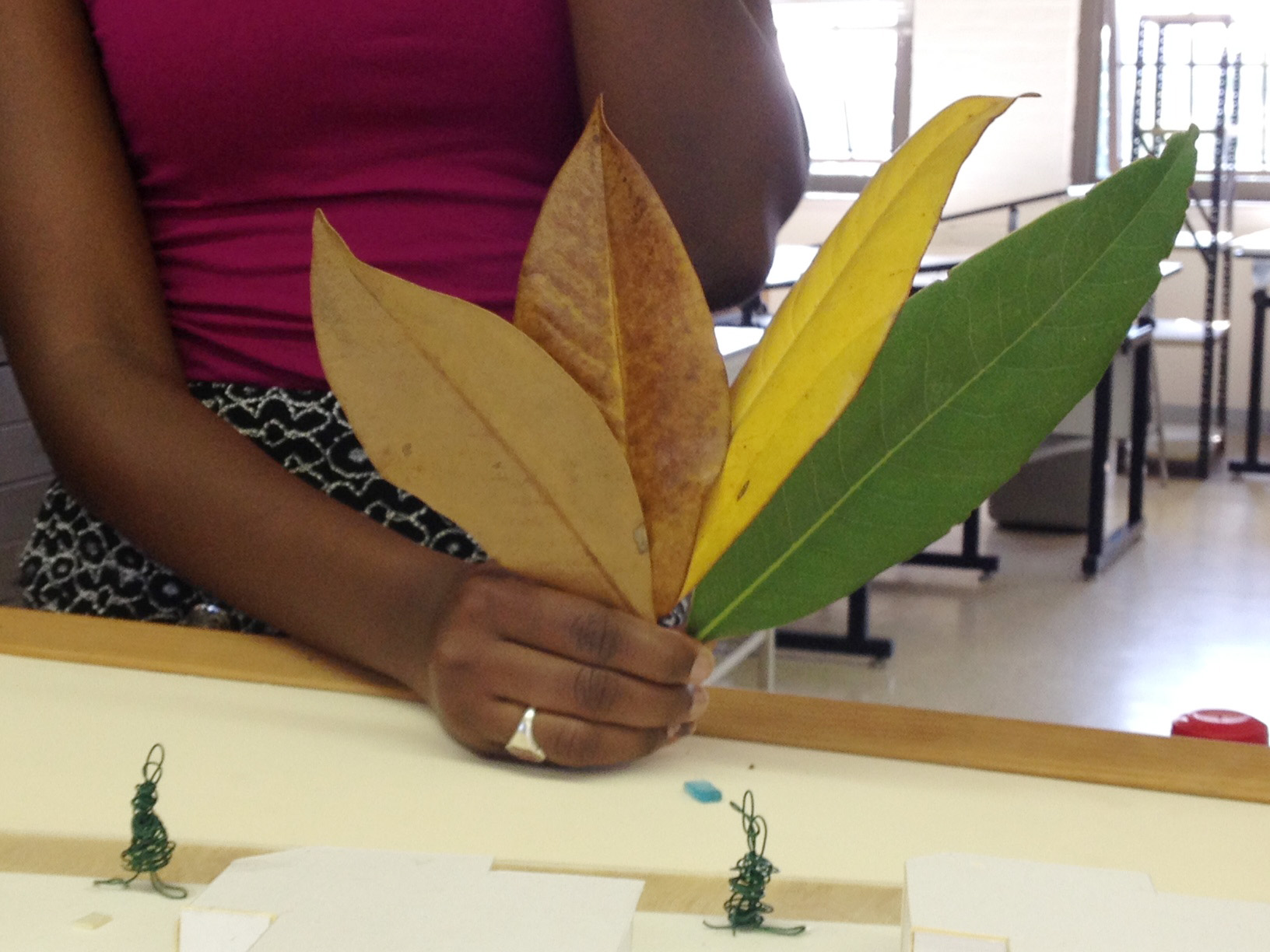
We wanted to focus on decay as a major indicator of time. We chose leaves that clearly indicated a full life cycle. They showed the progression from a rich green, whole sturdy leaf all the way to a brown, crinkled leaf. Age was indicated in the color, texture, size and shape of the leaf. We discovered that they also showed a sense of hierarchy in the appearance of the leaf. The youngest, freshest leaf was also the largest and had a strong, durable presence whereas all the other leaves got progressively smaller, duller and more brittle. They seemed to fade and disintegrate before our eyes.

Capturing the essence of time.

Capturing the essence of time.

How They Relate:

The water project exhibited all three concepts or elements. It showed water and its behavior with other liquids, it showed the behavior of light in water and also time, through the motion and eventual diffusion of the dye over time. The light project mainly exhibited light and time. It showed the behavior of the objects at different times, as they looked different during the day and at night. It also subtly exhibited time and wind as the positions of the objects and their shadows and reflections were constantly moving and changing. The time project also incorporates all three elements because with the passage of time, light is reflected differently off the leaves, shown by their color and texture, as the younger leaves shine because of their smooth texture and the older leaves don’t because they are dry and crinkled. Water was also shown in this project because the absence and presence of water within the leaf indicated its age. Younger leaves had more water and smoother, more elastic textures and older leaves were dryer and contorted with the absence of water to hold their shape.

Fleeting Glimpses

I’ve been so bogged down in grant- and conference-writing that I haven’t gotten to update you on the architecture studio’s progress.  I’m hoping to share some of the students’ findings soon. In the meantime, here are a few photos I snapped early last week.

It’s typically difficult to get our students interested in discussions of meaning and philosophy.  These are generally seen as esoteric.  But so far the group-based format seems to be eliciting a  higher level of engagement in fuzzy issues than I’ve witnessed here in recent years.

Interestingly, when I was in school, a professor might to give us just a word or two to explore.  S/he would expect us to invest a week or two of time to contemplate, make things, and refine our knowledge and skills.  Most of us were quite happy to oblige.  We’d make things without much prompting at all and find a lot of joy in it.  Today, students have to drive for hours to gather decent materials. And, in today’s digital milieu, making beautiful, physical things seems to be an alien concept.

Dreaming Big over BBQ

‘Tis the season for summer cook outs and barbeques all across the Western hemisphere.  Yesterday, I went to two.  One at Drs. Pam Eddy and Dave Pape’s house in Williamsburg, and another at the home of John and Tammy Lifsey in Portsmouth.

The main difference in these events is what we call them:  John and Tammy had a “porch party” while Pam and Dave had a “Higher Ed picnic”.  These reminded me of the “BBQ” I recently enjoyed in Dublin that was hosted by Mike and Mai Murphy (I’ve posted photos of the event).  My sister, Heather, came along with me.

On this particular night we were discussing our dreams of setting up a new research center.  I’ll keep you posted on the progress we make with that.

Whatever the name and wherever the place, it’s nice to have friends to visit and to share ideas with!

Liquid Essence

The best design responses for the water assignment due today, I think, revealed “the essence of liquid” a bit more than “the essence of water”.   I’ve included photos of the students’ favorite responses.  We also looked around our surroundings for examples of beautiful things.

Ecology Rocks! (Especially in a Flipped Classroom)

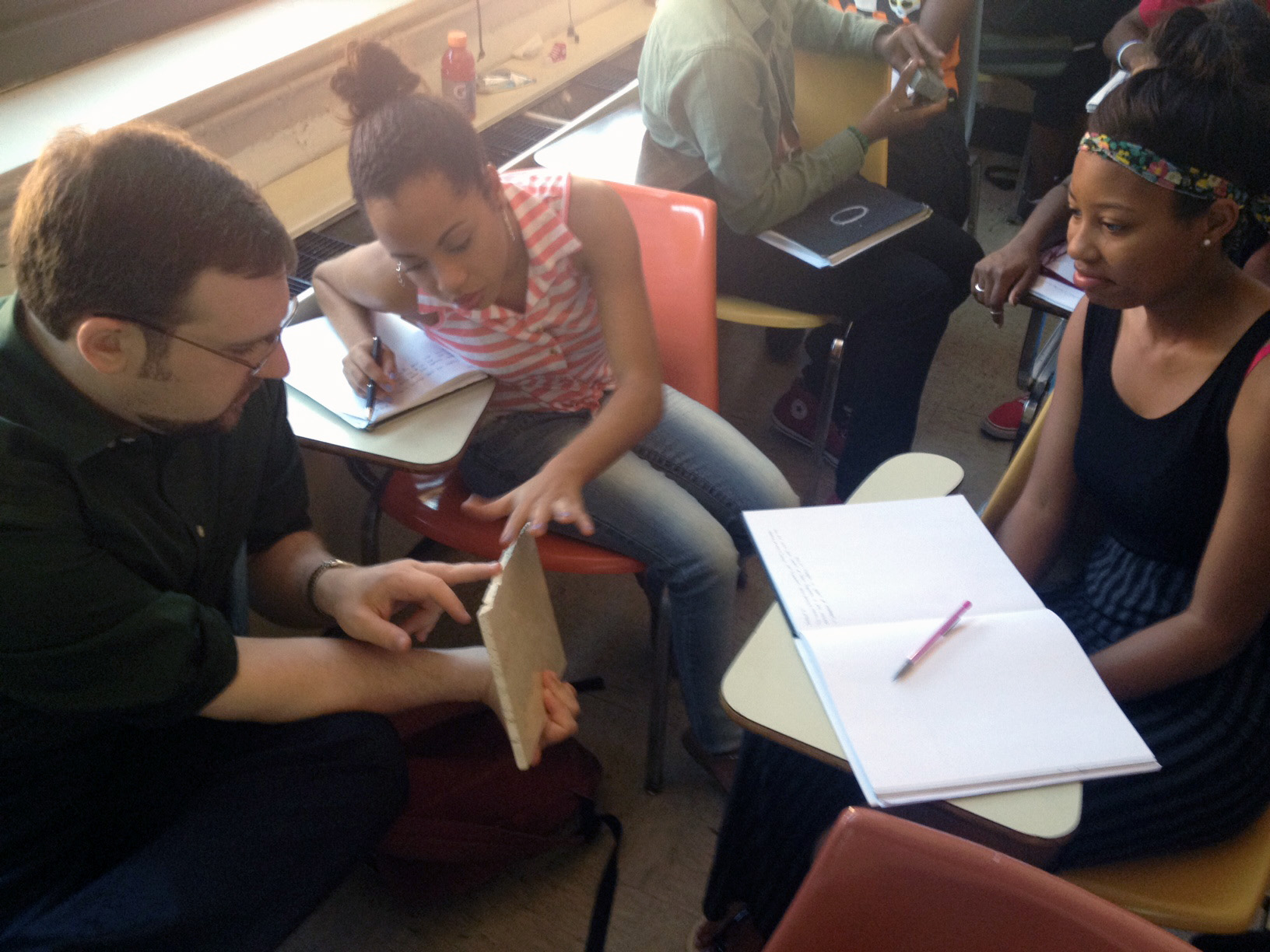
This group realized there was a fill material in the crevices of their "Roman Travertine" tile sample.

This group realized there was a fill material in the crevices of their “Roman Travertine” tile sample.

Today we discussed “natural factors” that affect architectural design, such as rock and soil composition. This tied directly to yesterday’s studio class on the HU Point. Today, I was using a technique known as the “flipped classroom” to teach Architectural Ecology. I learned about this technique during my Fulbright fellowship at DIT.

I had assigned my students to read a chapter before class. When they arrived, we started class with ten minutes of journaling.  I asked them to write about the aspect of the chapter they thought was most important to them regarding our site at the Hampton University Point, and to explain why.  I also asked them to identify a topic in the chapter that they didn’t fully understand and explain why/what they didn’t understand about it.

Journaling is my own way of assessing students’ level of understanding of the content.  After ten minutes, I collected journal papers then “flipped the classroom”.  Each student joined the other members of his/her learning group, discussed the issues of confusion they’d each identified, explained to each other what they understood (this is known as “peer teaching”), and researched information on line using their laptops and smart phones.

I circulated around the room, listening, observing,  pointing them in the right direction where necessary,  and making sure they were achieving accurate interpretations.

It became clear that soil and rock composition was the major topic of confusion, so I went ahead and distributed the rock samples I have on hand.  Each group got their own unique rock type to analyze, research, and introduce to the rest of the class. The students did a great job of staying on topic in their discussions, learning, and teaching leach other.

They made sense of sedimentary, igneous, and metamorphic rock. They began to understand issues of texture, particle size, expandability, drainage, and bearing capacity while they were talking among themselves with my guidance.

A member of each group presented findings to the class and we discussed overarching issues.

Then I projected the Prezi file on the screen, which I’d formatted using a table of contents so we could zoom directly into whichever specific issues were causing confusion. In this case, we needed to go over the soil classification pyramid a bit, but they had already developed pretty strong understanding through the group discussions and rock presentations.

Amazingly, everyone stayed engaged for 1.25 hours!

I didn’t have to nag students to pay attention.

By the end, they seemed to have very good understanding of all the content of the chapter.  I found I had ten minutes to spare at the end to bush on topics of my choice (ones I thought a student or two might still have misconceptions about).

I am loving this new, more interactive, way of teaching.

It’s called “flipping the classroom” because the content is delivered before class (in this case, through a reading), and class time is used to gauge accuracy and depth of understanding and to build upon that base.  It seems to be a much better us of time than presenting everything with equal emphasis, before assessing if the students already understand it!

Not everyone came into the class having read, unfortunately. This problem should correct itself in the future because each student gets a grade for each journal entry. They have to show basic understanding of the reading in order to earn points. They generally start seeing the importance of this after a day or two.