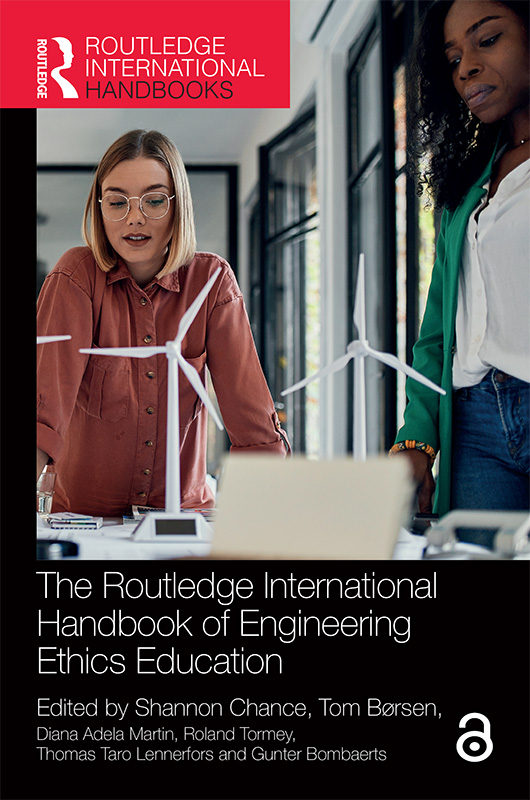
The Routledge International Handbook of Engineering Ethics Education, chock full of helpful research on teaching engineering students about ethics, will be published on December 4, 2024!
Over the past two years, I have edited this book in collaboration with five outstanding ethics scholars. Seeing it through to completion is one of the proudest achievements of my professional life.
The project involved 105 authors from around the globe. I led it alongside Tom Børsen, who immediately embraced the idea of a handbook.
The digital version of the book is already available at: https://www.taylorfrancis.com/books/oa-edit/10.4324/9781003464259
We paid the publication fee so that you can read it for free! We wanted to give everyone with a digital device an equal chance, regardless of where they live.
Of course, you are also welcome to order a hard-back print copy of the book from the link above. A discount is currently available. Moreover, a paperback version will be available in 18 months.
The book has six sections:
SECTION 1: Foundations of engineering ethics education (7 chapters)
SECTION 2: Interdisciplinary contributions to engineering ethics education (6 chapters)
SECTION 3: Ethical issues in different engineering disciplines (5 chapters)
SECTION 4: Teaching methods in engineering ethics education (7 chapters)
SECTION 5: Assessment in engineering ethics education (6 chapters)
SECTION 6: Accreditation and engineering ethics education (5 chapters)
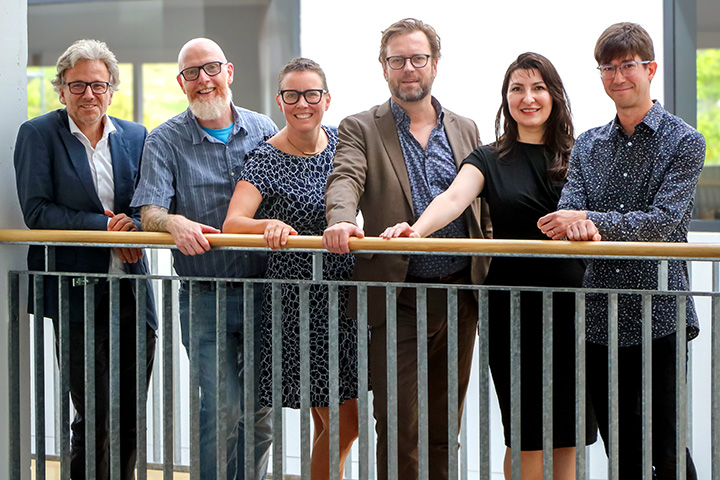
The editorial team is pictured below (left to right): Gunter Bombaert, Roland Tormey, Shannon Chance, Tom Børsen, Diana Adela Martin, and Thomas Taro Lennerfors. It’s been a dream team!
This handbook was a project of the Ethics Special Interest Group (SIG) of the European Society for Engineering Education (SEFI). SEFI members made it possible by contributing to their transcontinental networks of colleagues.
We editors started by sending out a survey, as far and wide as possible, to find out who was working in the field and might be interested in authoring a chapter. We held online workshops to identify what topics should be included and structured them into chapters. We invited a lead author for each chapter and asked the lead to invite three others to co-write the chapter. We asked that the chapter team have people from different places on it, and we aimed for transcontinental teams where feasible. We also asked the lead to consider specific people who had expressed interest in the topic. Our team ultimately included people of diverse levels and fields of experience and good geographical distribution. The people on many of the teams had not worked together before. Many lead authors served as mentors for early career researchers. We held numerous meetings online with the led authors of each section to cross-check, coordinate, and challenge our own thinking. The editorial team met weekly throughout most of the process, and the final result reflects the strong and knowledgeable engagement of many leaders in the field. Our team conducted a rigorous internal peer review, and the publisher conducted its own peer review twice during the process. Here’s what the reviewers said about our proposal:
“I believe this is a state-of-the-art milestone.”
“The lead authors are the key people in this vibrant community, and they have recruited a veritable ‘Who’s Who’ of international authors for the handbook. This is the right time and the right people. It’s the dream team.”
“This would become the resource in this field.”
The final result is a true masterpiece, and I hope you’ll read at least some of it because the content is quite fascinating!
The Ethics SIG also hosts a Spring School around Easter every year, and this year, the theme of the Spring Symposium is “Growing the Field of Engineering Ethics Education and Research as a Community.” I am the local host for this March 2025 event, and we will spend the three days celebrating, applying, and extending the handbook’s content. Learn more about the Symposium and submit your interest in attending at this link: https://forms.gle/WngZ3DMi97FLtQaZ8
Date: 24-26 March 2025 (9:00-17:30 each day)
Location: Royal Marine Hotel, Dún Laoghaire, Ireland
Organiser: Shannon Chance (shannon.chance@tudublin.ie)
Capacity: 50 participants maximum
Whether or not you can join us in Dún Laoghaire, I hope you’ll peruse the content of this outstanding new resource and reach out to the editors and authors if you’d like more information or to get involved in what we do!
I am confident that this handbook will make a significant global contribution to engineering education. I therefore urge all engineering and architecture educators to become more explicitly involved in learning and teaching about ethics.
 Ireland by Chance