Scholarly, useful research is the name of the game in Europe!
These are the standards for research published in the European Journal of Engineering Education (EJEE), and they serve as a good guide for researchers in general.
This post sheds light on what makes a conference paper stand out. It shares the story of soon-to-be-Dr Sandra Ieri Cruz Moreno, who won the top research award from the European Society for Engineering Education (SEFI) in 2025.
SEFI’s special interest group on Engineering Education Research featured the work Sandra and I have done last week, in an online workshop, and the information is worth sharing more broadly — so here it is!
Workshop overview
Last week, Sandra (my PhD supervisee) and I presented this workshop as part of the SEFI@work learning series. We reported on one strand of Sandra’s PhD thesis research.
During the workshop, Sandra engaged the audience with questions about their own research to help transfer the successful part of our experience to the researchers who attended.
The workshop was great practice for Sandra’s viva voce (called a ‘dissertation defense’ in the USA), scheduled for March 10.
Unfortunately, vivas are closed-door events in Ireland. That means our colleagues can’t attend, so this online workshop was the main way to let our SEFI community know about the amazing work Sandra has done.
Research award
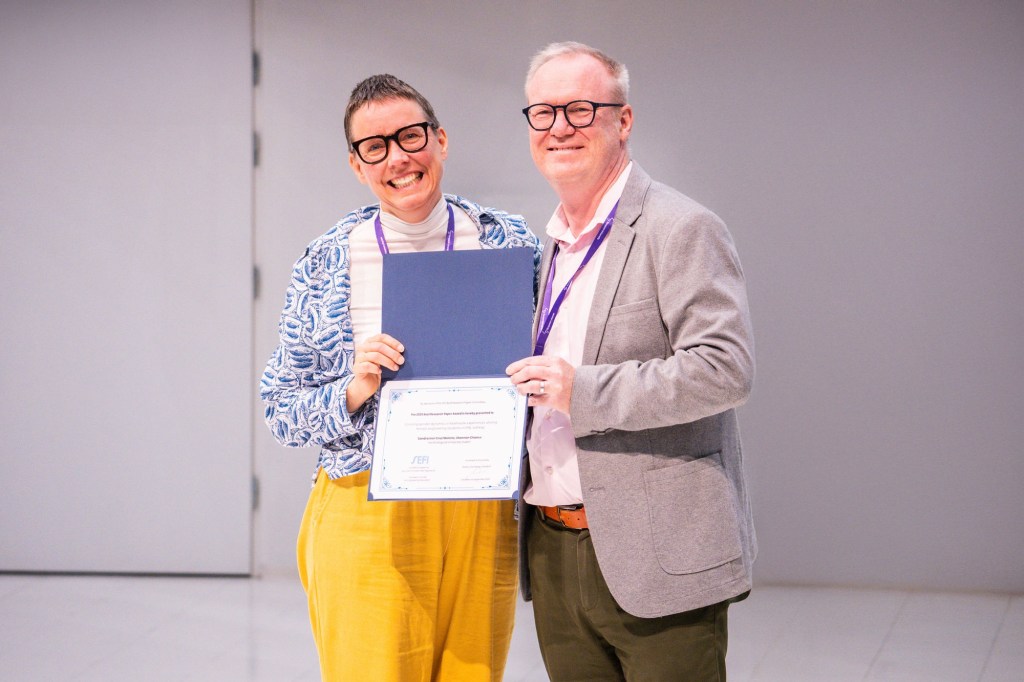
At the annual SEFI conference in Tampere, Finland, this past September, our paper Evolving gender dynamics in teamwork experiences among female engineering students in PBL settings was recognized with the sole “Best Research Paper” award.
I reported on the overall SEFI conference and my surprise and elation at winning this award in a September blogpost.
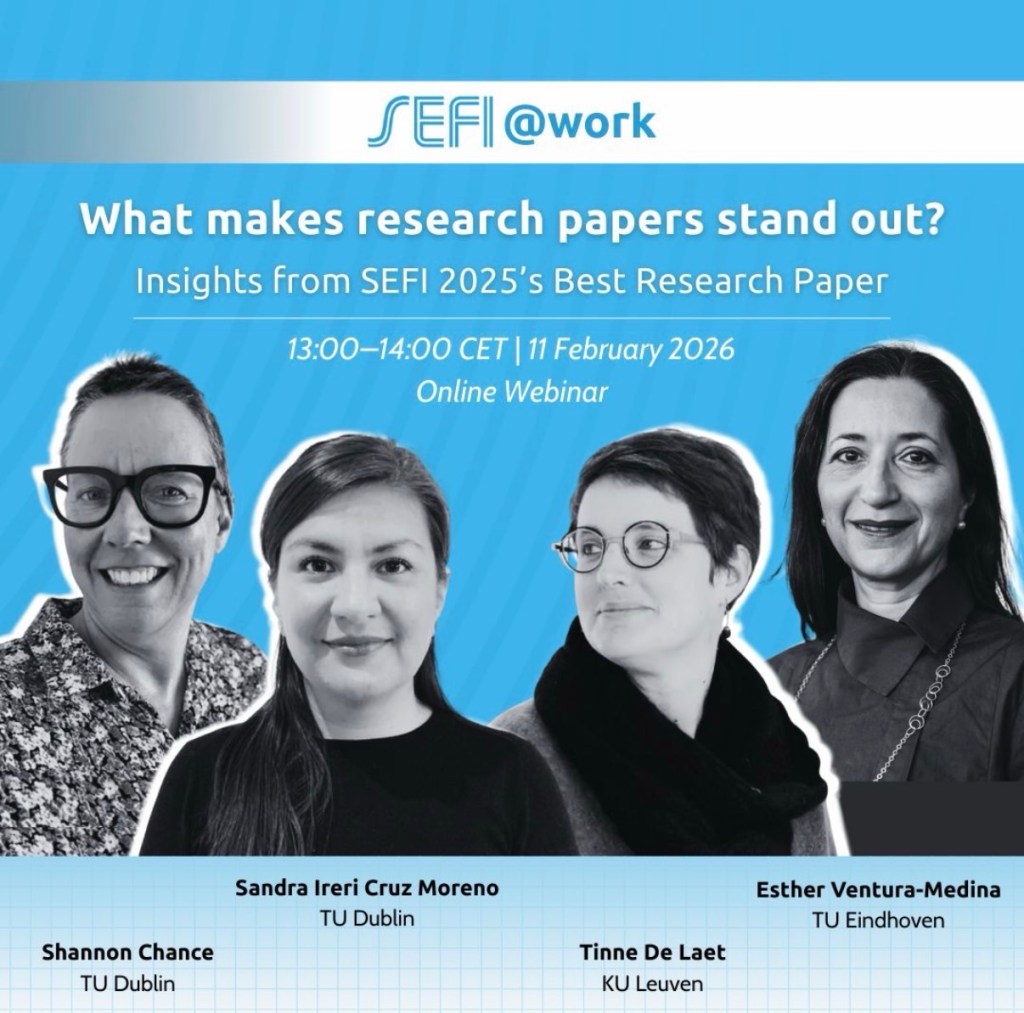
Now, the organizers of the online workshop asked us to share some secrets to our success. That was tricky!
We hadn’t set out to win an award, just to make a scholarly summary of part of Sandra’s thesis study!
Although it felt intimidating to explain how to win, we went in with the confidence that the paper had been nominated in all three categories it was eligible for last year, and each category has a separate panel of judges.
We were beyond delighted — and completely surprised — to win.
It helped reassure us that the thesis research was ready to wrap up and report.
Workshop content
You can watch a video of the workshop, to hear in Sandra’s own words what is most interesting and valuable about her work and her research process:
And you’re able to download Sandra’s slides, to jump straight into the content, by clicking here:
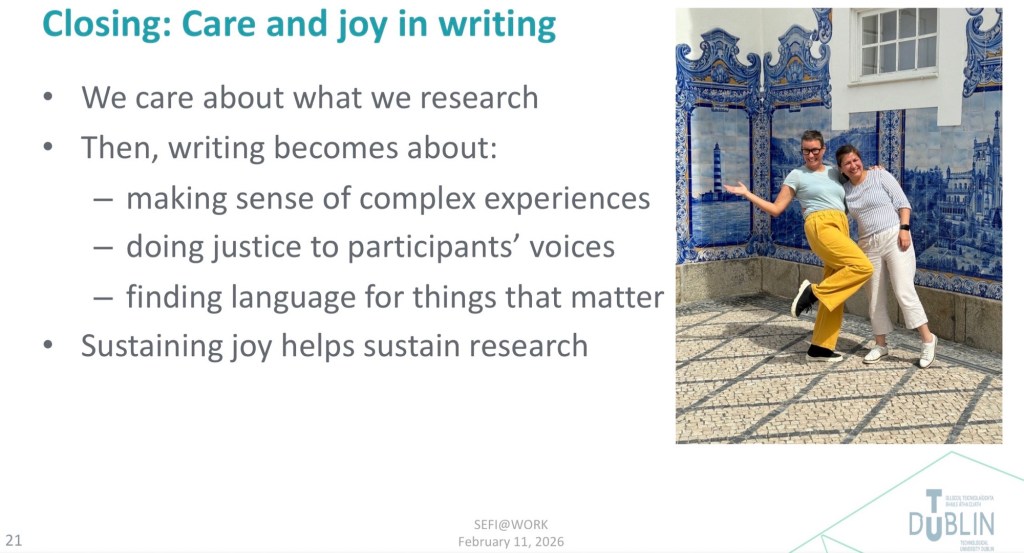
Sandra’s achievements
I couldn’t be prouder of Sandra and all she has accomplished in four short years. Since starting her doctoral studies in January 2022, she has delivered two babies into the world and developed an award-winning research study and a fully written thesis.
Sandra’s special contributions include introducing sociological techniques and perspectives into engineering education research. She has broadened the focus of our discourse on the usefulness and applicability of phenomenology as a research method, and she has shed valuable new light regarding the experiences of female students in our engineering courses at Technological University Dublin.
The findings of her PhD research hold applicability well beyond TU Dublin, however. They show us how the social dynamics of teamwork evolve over time — how students develop meaningful friendships that help them personally and professionally.
Sandra used the “Gender at Work” framework to better understand students’ experiences with Problem-Based Learning and other collaborative learning approaches. Using this framework, she found that the 22 women I’d interviewed (longitudinally over a period of four years):
- had experienced uneven access to engineering content before entering university,
- lacked female engineers in their families who could serve as role models,
- experienced some biased team dynamics that influenced what jobs got assigned to whom by the team, and that the need to prove themselves on teams grew less but nonetheless persisted across their four-year matriculation, and
- received increased recognition for their credibility over time, which helped them challenge stereotypes and shift team dynamics in a favorable direction.
Sandra’s SEFI 2025 paper complemented papers we’ve published and presented at earlier conferences, including:
- Review of the education policy to reduce the gender gap in engineering education in Ireland at the Research in Engineering Education Symposium (REES 2024) in January 2024 in Hubballi, India.
- Exploring women’s teamwork experiences in engineering education: A phenomenological analysis at SEFI 2023.
- An argument for incorporating sociological approaches into phenomenological analyses in engineering education research at SEFi 2022.
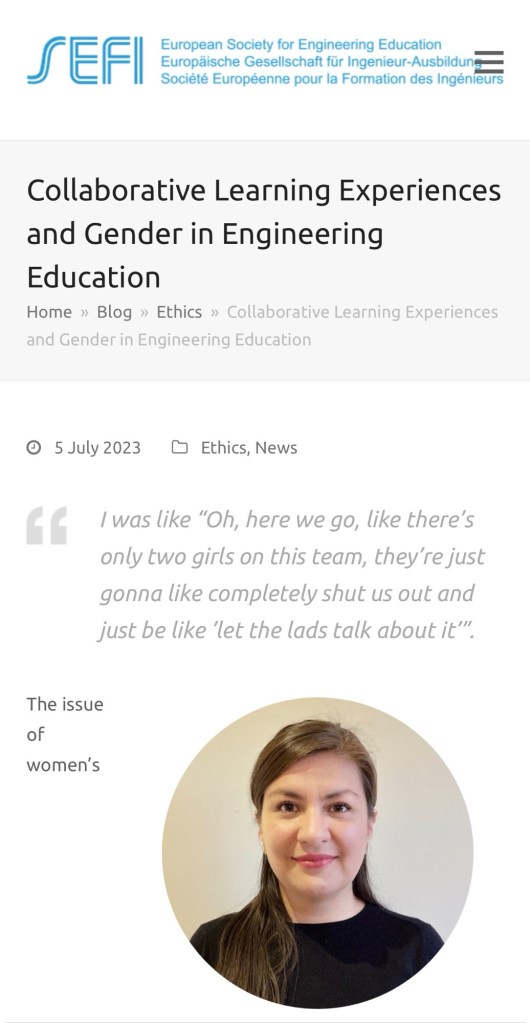
You can learn more about Sandra’s work in a blog SEFI posted in 2023:
Soon, you’ll be able to read Sandra’s final thesis and learn about the impressive contributions she has made to the literature and to the engineering education research community.
I am honored to call Sardar Cruz Moreno a friend and colleague. I look forward to calling her “Dr” and to watching her flourish in the coming years!
 Ireland by Chance