Loving Westport

A canal runs through downtown Westport.

This is the “octagon” in Westport.

A favorite archway… Glen McClure brought us here last month.


The Protestant church in Westport.

A contemporary sculpture next to the IshSko Center.

Reflections on news

It never ceases to amaze me that the Irish serve lasagna with a side of fries (which they call “chips” or “wedges”). Here, potato chips are called “crisps.”

High Tech in Kilkenny

A vist to the Rothe House in downtown Kilkenny, with Mom.

We learned a bit about technology over the centuries during our visit to Kilkenny’s Rothe House this weekend… everything from timber frame construction, to cooking techniques, to fashion.

The Rothe House also provided a diagram of the garderobe, to help you understand the toilet system used throughout Europe from the medieval ages until the Industrial Revolution.  Unlike this one, in most of the castles around Kilkenny, the garderobe was inside the wall and accessed through a corridor in the wall. They hung clothes in this corridor, because the acid in the air deterred mites and bugs.

Of course, there’s always been the option of a chamber pot.  I’ve provided a reflection shot of an antique shop that has two chamber pots for sale.

Westport

The canal running through downtown Westport.


It never ceases to amaze me that they serve lasagna with fries (called chips or wedges). Here, potato chips are called “crisps”.


The Protestant church in Westport.

.

.

A contemporary sculpture next to the IshSko Center.

.

Reflections on news.

.

.

The “octagon” in Westport.

.

A favorite archway… Glen McClure brought us here last month.

.

This is a “Achill salmon salad plate”. Many thanks to Glen McClure for helping me figure out what a “salad plate” is.

.

.

.

The train knew I was coming. All the train cars are brand-spanking new.

.

.

The Cullan brothers sat across from me on the train. Our Macs communed. (And my iPhone distorted their heads… live and learn!)


Cooling our Heels at a Round Tower House

Dave and Shannon at Coolhill Castle. Photo by Seán O’Brien.

Gaining entree into a castle that’s closed to the public is a thrilling event.  During our stay in Kilkenny, Dave and I visited the Office of Public Works (OPW) and borrowed the keys to Clare and Burnchurch Castles.

Imelda, Shannon, and Seán talk with Lima about conservation work underway at the castle. Photo by Dave Chance Photography.

Since we seemed so interested, the OPW staff invited us to visit Coolhill Castle as well, which is currently under renovation. The highlight of our visit to this particular Castle was meeting a couple of photography enthusiasts (Seán O’Brien and his neighbor, Imelda Maguire) where we left our cars to head across a field to the castle.

Since Dave and I had an appointment to go into the castle, we invited Seán and his Imelda to join us.

Inside the castle, we all had a fun time visiting with Liam and his colleagues from the OPW who were doing conservation work there.

The photos I am posting from our visit to Coolhill Castle were taken by Dave Chance and Seán.  You can see some of Seán’s workImelda’s work, and of course Dave’s work online.

Imelda, Liam, Shannon, and Dave enjoying views of the landscape around Coolhill Castle. Photo by Seán O’Brien.

Hats Off to Grafton Architects

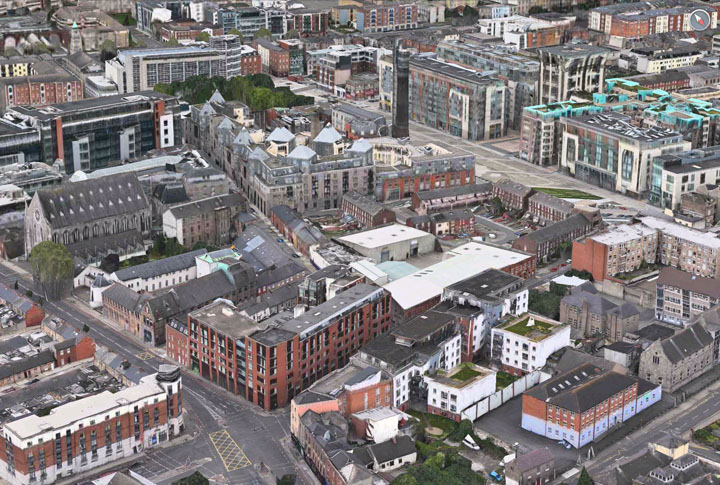
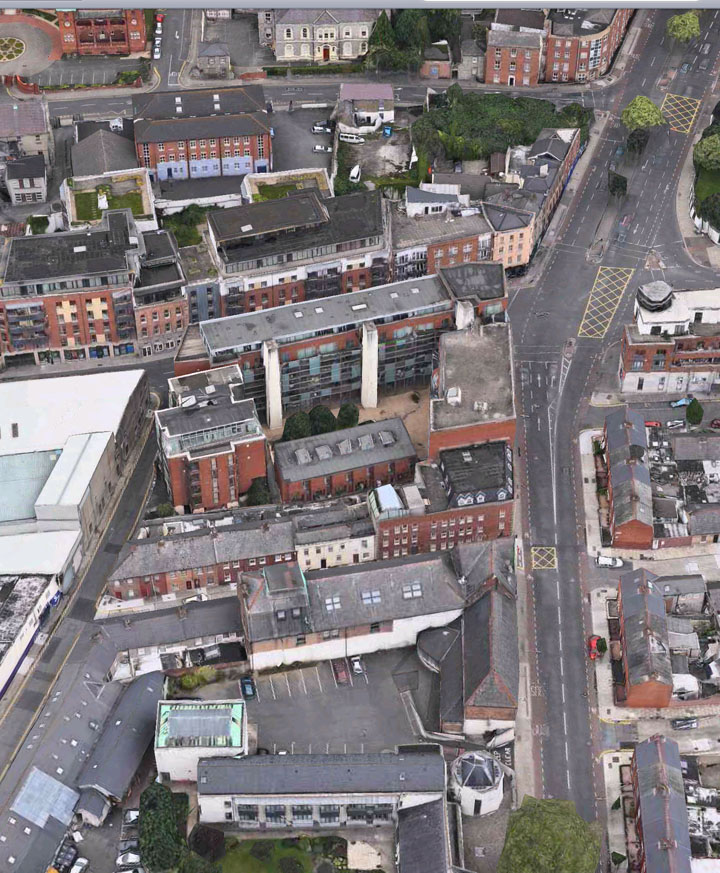
Looking toward the southwest, with the smokestack of the Jameson Distillery and in the background. Smithfield Lofts is in the lower center of the image. (Photo from Apple Maps.)

Joan Calahin, an architect I met on the Open House Dublin tour of Smithfield, told me that the building where we live was the result of a design competition.  The site was blighted and a competition was held to fill it in a skillful way.  The wood used on the exterior hadn’t been weathering well (raising the ire of the public), and it was recently treated and stained. Today the wood looks great!
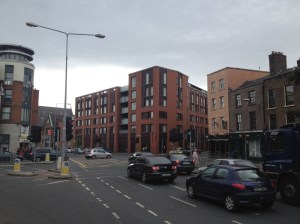
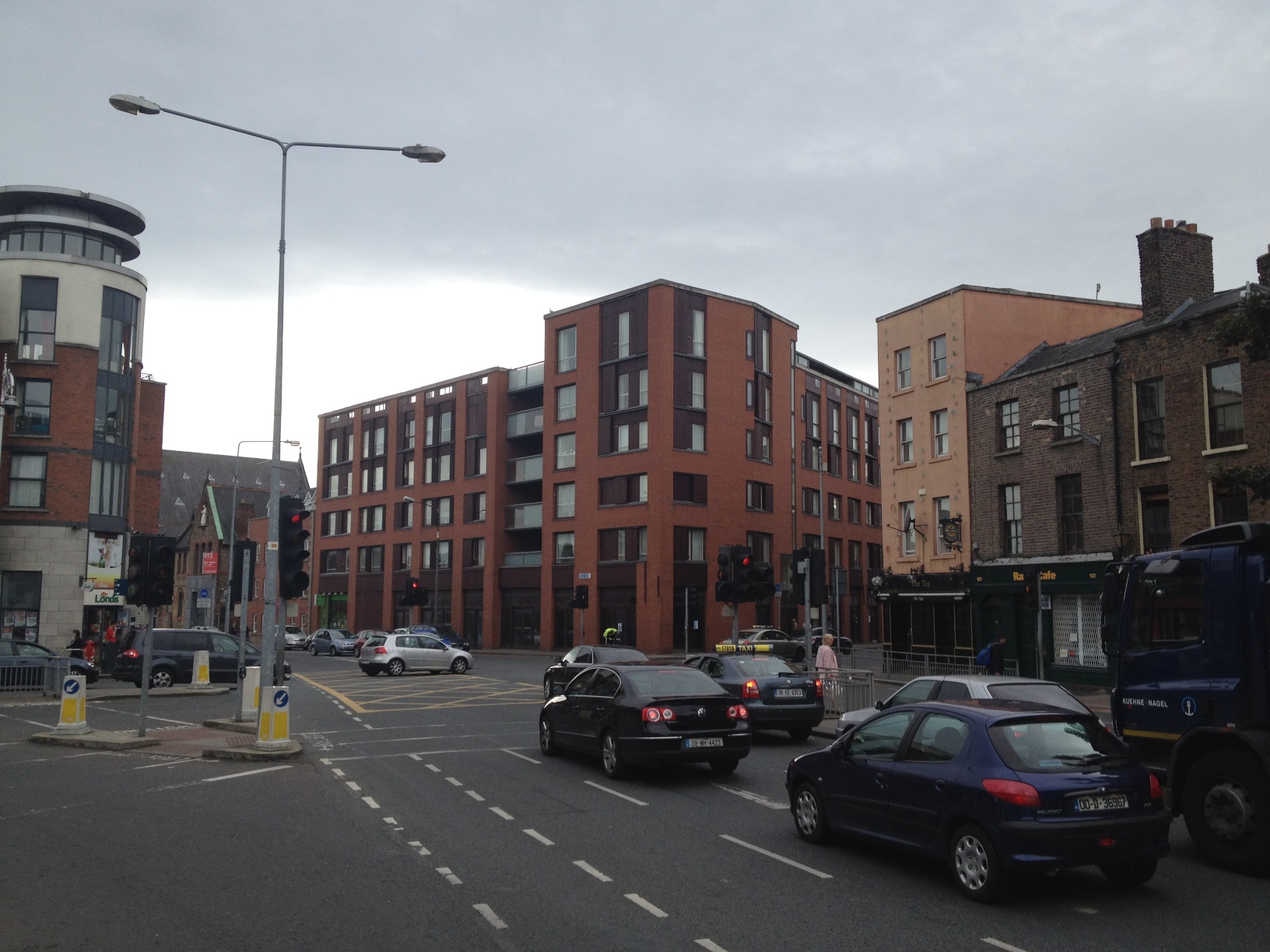
Smithfield Lofts, designed by Grafton Architects.

The architects were Yvonne Farrell and Shelley McNamara of the firm Grafton Architects. Their webpage about the project could really use Dave’s photographic prowess (the photos of this project really don’t do it justice).  But I assure you, the design is worthy of an award.  I could tell that from several thousand miles away (on the property rental site, Daft.ie).

Sima says Grafton Architects is her favorite firm in Ireland, but notes that fact they haven’t had this project professionally photographed shows that they’re not all that proud of it.

They would have had that done if they had entered it for a design award, for instance.  And, the firm’s list of design awards is quite impressive, so they know what they’re doing in many regards.

Although this building reflects quality design, it’s not Grafton Architects’ very best work. I have a number of critiques despite the fact that I enjoy the quality of life it affords me.

And, it has gotten an enthusiastic response from many people (including my apartment-hunting self).

In February 2007, The Irish Times stated “This smart looking building… is situated in the city centre on a landmark site on the corner of Dublin’s Church Street and North King Street. Striking design by Grafton Architects marks it out as one of the more well-thought out, visually appealing apartment schemes.”

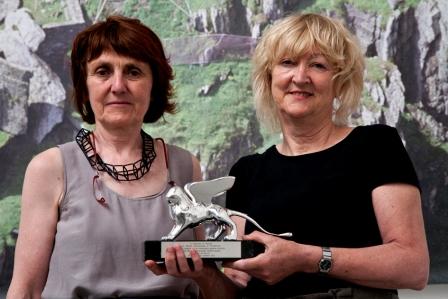
Shelley McNamara and Yvonne Farrell accepted the Silver Lion award at the Venice Bienaale on 29 August 2012. (Photo from the RIAI website.)

In April that year, the same paper featuredthe two designers:

“Carrying the international standard for Ireland’s architects are McNamara and Farrell, who founded Grafton Architects in Dublin in 1977. If you want a university campus sketched up, they’re the people to go to — but these days, sadly, they’re hard to commission when it comes to designing one-off homes.  Farrell and McNamara have been at the forefront developing Ireland’s architectural reputation abroad — in 1999/2000, they won the design competition for Luigi Bocconi University in Milan, a project set to be completed at the end of this year.  In 2003 they were honoured with the European Union’s Mies van der Rohe award for their civic offices in Dunshaughlin, Co Meath. McNamara was the first architect to be elected to Aosdana, Ireland’s academy of artists, and both she and Farrell lecture at UCD.  Between the civic and cultural buildings that have become their hallmark, they still occasionally design the odd private home — but such projects are unusual.  They have designed and built houses and apartments in Dublin, Mayo, Galway and Clare, winning numerous awards from the RIAI and AAI. McNamara built her own mews home, where she lives with her husband, the painter Michael Kane, which incorporates a studio.  In 1999, the firm’s Hall House, a stacked structure on a corner site in Ranelagh, and Dix House, in Howth, were exhibited by the RIAI. But it was Grafton’s Two Mews Houses on Clyde Lane that garnered the most honours, winning AAI and RIAI awards in 1993 and gaining a special commendation at The Sunday Times Irish Building of The Year award ceremony in 1994.”

Looking from the south. (Photo from Apple Maps.)

Open House Dublin

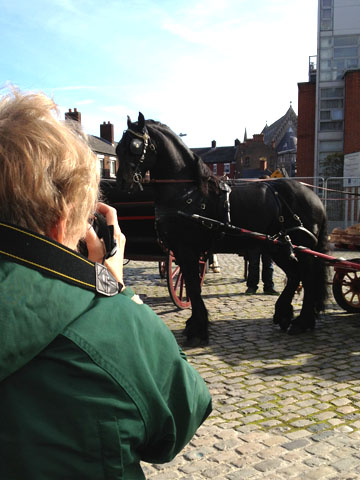
Mom admiring the horses at the plaza in  Smithfield, historically  used as a livestock market.

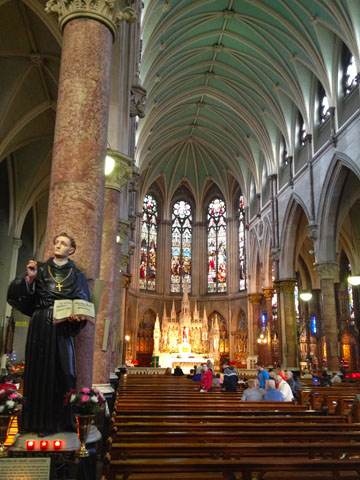
Visiting Saint Francis at St. Augustine and St. John’s Catholic Church (built in 1874) with my mom.

I almost missed out.  Open House Dublin ran Thursday to Sunday, and I didn’t realize it was going on until late on Saturday.  But I made the most of the offerings on Sunday.

Before they started, I spent some time with Mom, Mary, and Tim.  They headed off for the fabulous Beatty Library and I for several Open House tours.

This annual event is hosted by the Irish Architecture Foundation. In one day, I got to attend three tours:

  1. Everyday Landmarks, conducted by Lisa C. who authors the blog Built Dublin.
  2. Dublin Docklands, conducted by Mairtin D’Alton of the firm GCA.
  3. Busarus bus station’s panoramic roof cafe.

I was exhausted by the end of the day, and so thankful that Tim and Mary showed me the ropes of ordering take out.  That’s something I’ve only ever done twice before in my life… I’ll definitely be doing that again. It was so easy using Takeaway Dublin.

Lisa describing the former Richmond Surgical Hospital, recently used as a courts building. (Good buildings can support all kinds of uses!)

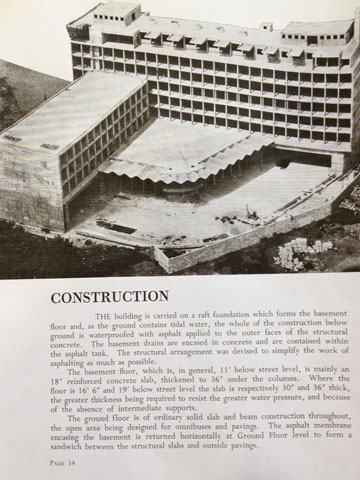
The bus station’s concrete structure.

Mairtin describing cutting edge techniques used in Dublin’s 1940s bus terminal.

A view from the top. Every piece of the building was custom-detailed.

A view through the penthouse cafe, reflecting Dublin’s eclectic skyline.

Through the Oculus (Rome Church 1)

The Pantheon by night.

I have a favorite set of churches in Rome that I like to visit in succession. They are close to each other and seeing them together in on day provides a nice little chronology of changes that happened in architecture over the past 200 years.

In the coming days, I’ll tell you a little about each of these four churches:

1) The Pantheon

2) Santa Maria Sopra Minerva

3) Il Gesu

4) San Ignazio

Today, I’m showing you the first. It’s my all-time favorite building, the Pantheon. It was built 1900 years ago and the technology it includes is simply amazing.  The walls are 6 meters thick at the base and the dome spans 142 feet.

Looking up into the coffers (hollowed out squares) and oculus (opening) in the dome.

Can you see the blind arches in the wall behind the columns? This is a hollowed out space, where the wall isn’t as think and they need to carry a lot of weight with a thinner wall.

The Romans used blind arches (arches without windows below) to help carry the weight down to the ground in places where they wanted to make the walls thinner than 6 feet.  They coffered (or hollowed out) areas in the ceiling help reduce the weight of the roof.

The oculus (opening) at the tip was never closed over… it’s open to the sky even today.  There are holes in the floor to drain rain water that falls thorough it.

The Pantheon has been operated as a religious facility continuously for nearly 2000 years.  The Romans used it as a one-stop shop to worship many different (pan) gods (theon) but it’s been operating as a Catholic church since, I guess, about the time Constantine legalized Christianity.

Blind arches seen from the outside of the building — these would have been covered by marble in Roman times.

At that time, Istanbul was renamed Constantinople, in honor of him.  (The Hagia Sofia is located I that city.  I posted pictures of a baptism being held in its smaller sibling, the Agia Sophia, that I took during my visit to Thessaloniki.)

People’s aesthetic tastes changed over time, and you can see a clear example in the band at the base of the dome.  Most of what’s there today is from a renovation done during the Renaissance, but along the way the owners of the Pantheon (i.e., the Roman Catholic church) replaced part of the band to show what woudl have been there in Roman times.
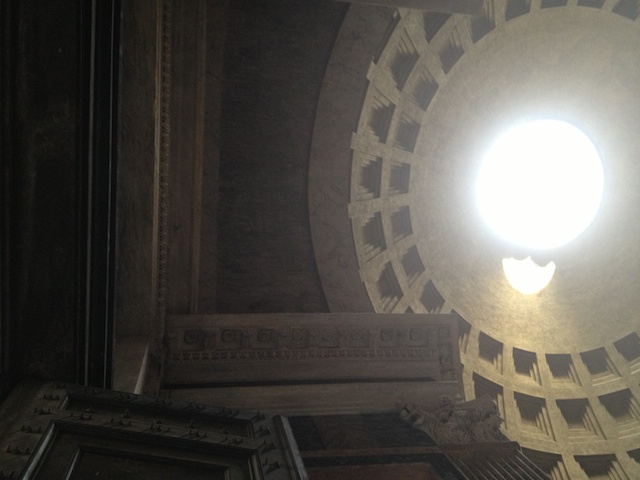
Can you see a difference?  Which part is Renaissance?  Which is Roman?

Band showing Renaissance and Roman detailing.

Drawing that shows the thickness of the wall.

Looking up from the entry vestibule, you can see and “feel” the thickness of the wall

A Parting Glimpse of Greece

Timber cross-bracing supports a central dome.

Here’s one last, spectacular Byzantine church.  I was lucky to find it in my last moments in Thessaloniki.

It is a UNESCO World Heritage Site, and is located just beside the old city wall, in the northwestern quadrant of the city.

Exterior brick work.

Here’s the name of the church.

A unique system for venting candle smoke to the outside.

Beautiful frescos.

Lighting system.

Jettisoned into Architecture

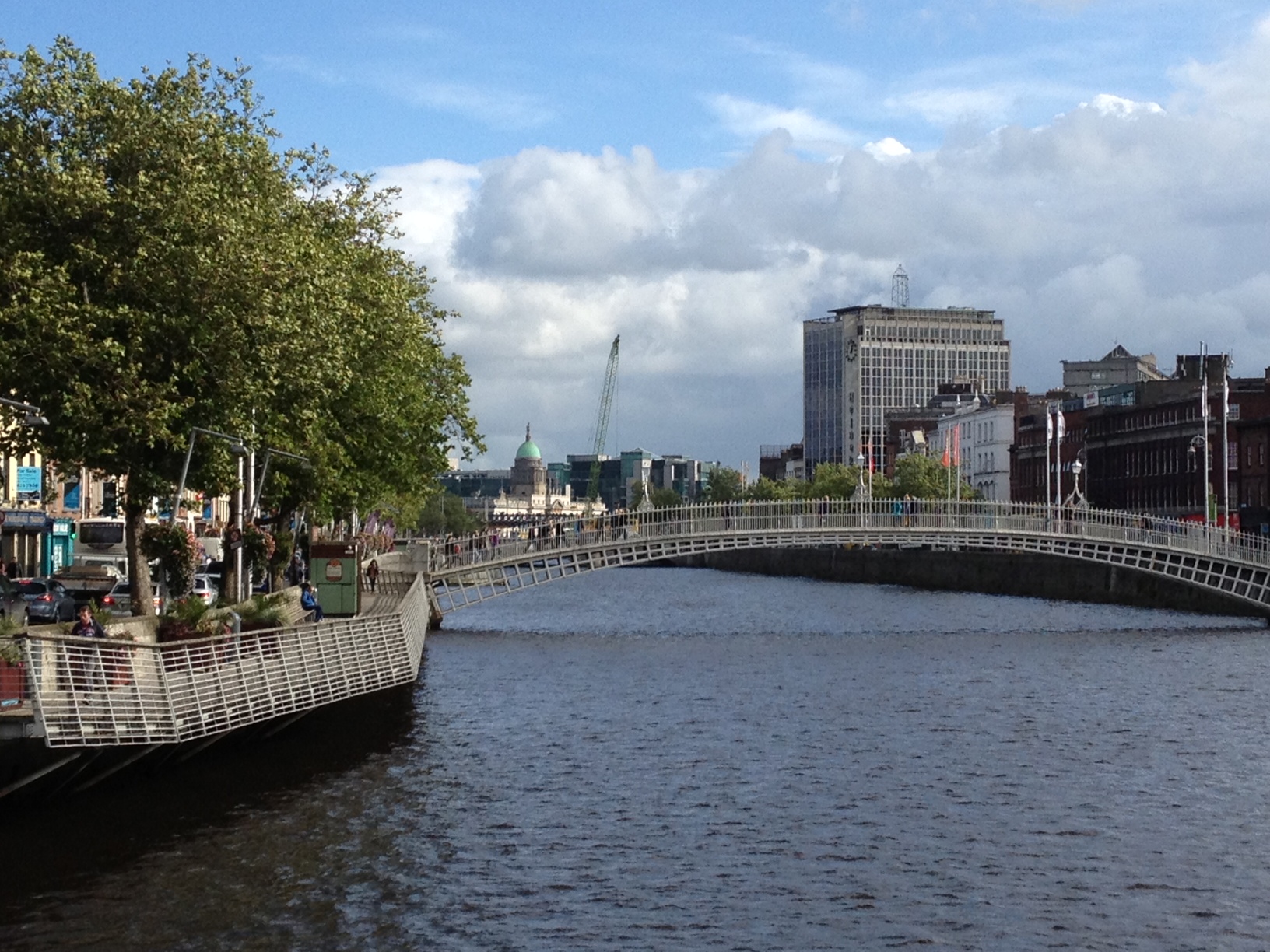
View eastward on the Liffey, looking toward the Ha’penny Bridge. Taken walking to my 10 am meeting….

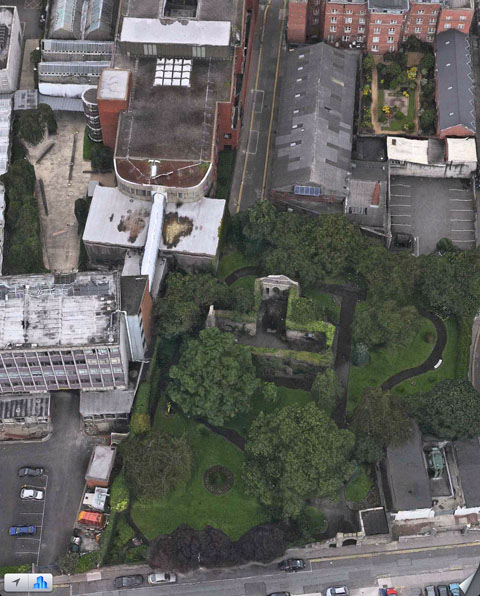
Everything started peacefully enough.  I arrived to my research meeting with a few minutes to spare and stopped in to see the church ruins located beside my office in the electrical engineering department.  Up until now, I’ve been working almost exclusively with engineers here at the DIT.  During this morning’s meeting with an engineer and a physicist, Sima called and asked me to lunch….

And then, quite suddenly, everything sprang forward into warped speed. The day melted into a slew of events and activity — lunch with Sima at the Hungarian place, rapid discussion of construction and philosophy with newfound colleagues, a new place to work (a second office, located in the architecture building).  I got slurped into the excitement of it all.
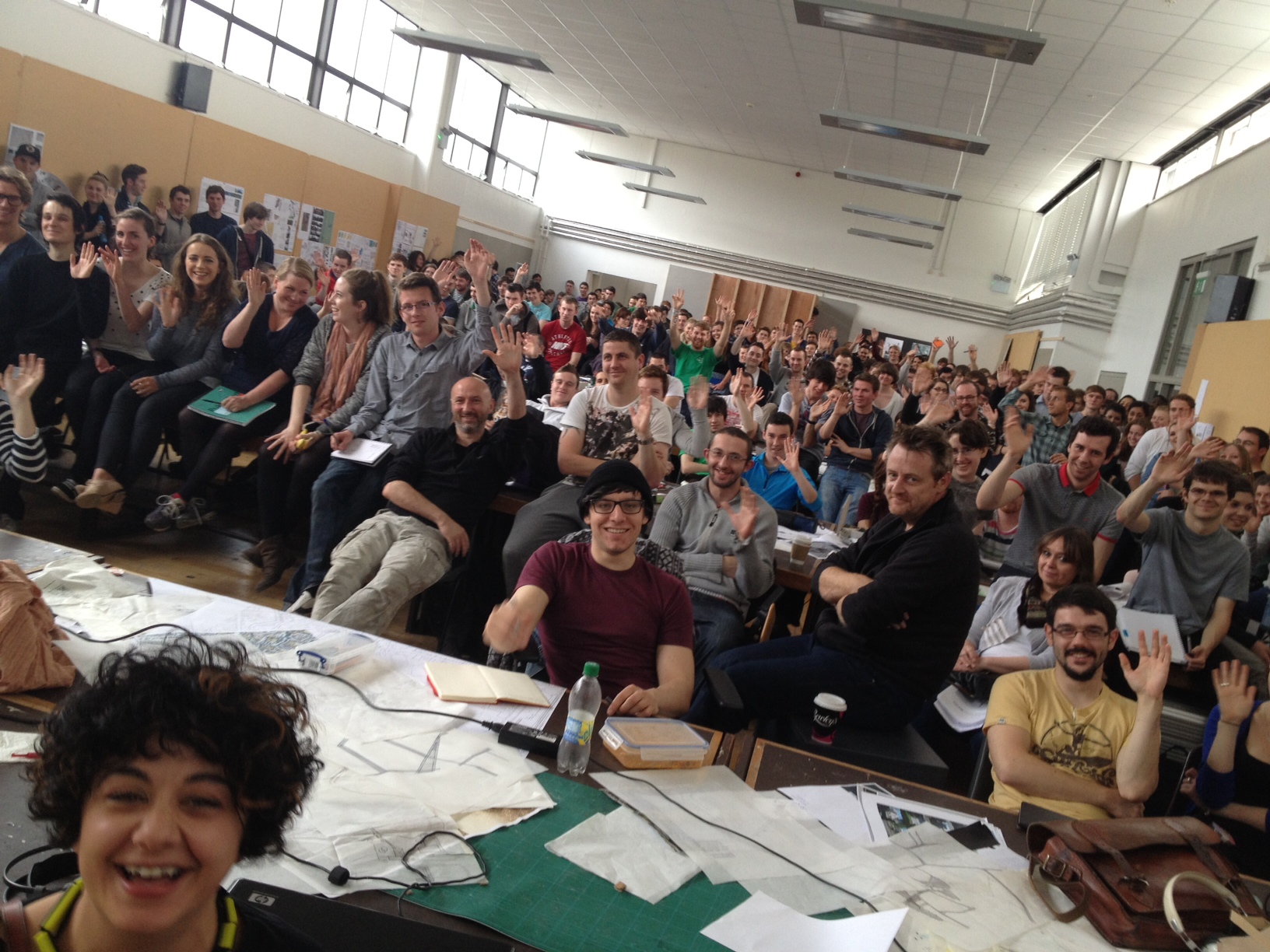
I wound up, midday, at the opening meeting of the whole School of Architecture at the Dublin Institute of Technology.  I was formally introduced at the very first all-school meeting they have ever held!  I asked them to wave “hi” to you, which caught them completely off guard.

This School is part of the College of Engineering and the Built Environment. It offers degrees in architecture, architecture technology, and construction.  It has, in Architecture alone, 457 students.  That’s huge.  And there are another 200+ architecture students at the nearby University College Dublin.

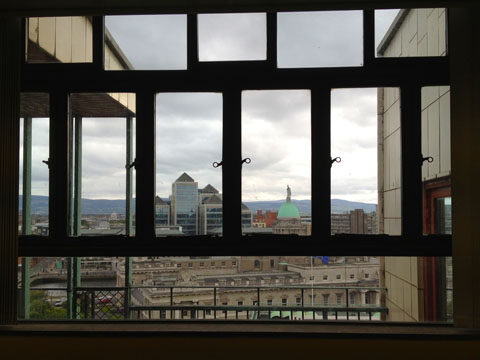
View towards Four Courts (the round dome to the right), which is Ireland’s version of the US Supreme Court.

This School just got its own newly renovated building (mostly complete), called Linenhall. They are using all of this as an opportunity to redefine themselves.

My office in the electrical engineering department is just north of the church. The building is referred to as “Church Street” and now I know why! The desk man at Ireland’s Higher Education Administration (HEA) office, where the Fulbright staff work, told me to look for the church in the park….

As such, they are discussing issues of social relevance, identity of the building professions, and the purpose of education. So, I ended up attending a lecture tonight that was part of their “Schools of Thought” lecture series on “critical practices.”
The speaker, from the arts program at DIT, shared a global perspective on trends in education and knowledge-making world-wide. It’s so interesting to look at the events of the world from a perspective where Ireland is at the center, and we’re looking over at the US, observing what is going on there, and comparing that to other places in the world.  I’m so used to looking “out” at the world from a point of view centered in the USA.  It was fascinating and I’ll definitely be back for next week’s lecture.
I came home, finally spun up the juicer, and reflected on the day’s events.
It feels great to be alive!  And, my mom arrives in the morning!

The DIT School of Architecture says “Hi!”