PBL at the Polytechnic School of Águeda

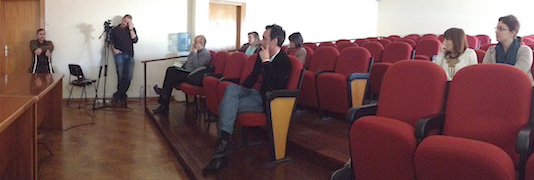
The audience was composed of experts and students in engineering and education.

The audience was composed of experts and students in engineering and education.

Visiting Portugal’s University of Aveiro some weeks ago provided me opportunities to speak with doctoral students and professors of engineering and education.

After I delivered a formal presentation to a small but enthusiastic group at the University of Aveiro’s Department of Education, my host, José Manuel Nunes de Oliveira drove me to the University’s satellite campus, known as the Polytechnic School of Águeda (or Escola Superior de Tecnologia e Gestão de Águeda, Universidade de Aveiro) where he teaches engineering.

Jose and his colleagues use Problem-Based Learning to teach engineering students.  They have formatted their classrooms to support group-based learning.  (My DIT colleague, Gavin Duffy, visited Jose and his campus earlier in the year to see how they use space. He wanted their advice to help in the programming phase of DIT’s new engineering facilities.)

What impressed me most in touring the buildings and grounds of the Águeda campus, though, was that the students were all working in groups–and that they seemed to be doing so on every type of project.

Jose says that after the teachers introduce the group-learning approach in the first year, students embrace it and want to do everything this way.

I thought that Jose said that students receive credit for their topic courses (i.e.,those with specific engineering content), but not for their project work (I was wrong, as I explain in my subsequent blog). In architecture we refer to these technical/topic classes as “support courses.”

All the courses a students take in a semester at the Escola Superior de Tecnologia e Gestão de Águeda help support the project they have been asked to do in groups. They are able to apply what they learn in the projects they design… but they don’t get formal credit for the design activities. In architecture in the USA, the design activities are assigned the most credit (typically 5-6 credit hours per semester) while each support course is generally worth just 3 credits. The architecture community tends to value the project or “design studio” work above all else.

My Interview about the Fulbright Inter-Country Lecturing Program

The Fulbright staff in Belgium interviewed me during my visit.  They asked me to describe some of my experiences with the program and explain how I got involved in it.

I hope the interview is helpful to other Fulbright scholars and to academics who would like to invite Fulbright scholars to speak at their institutions.

And, I hope my friends will enjoy hearing about what I was up to during my recent travels in Portugal and Belgium as well.

Student-Centered and Urban: Architectural Education at IST

The second stop of my Fulbright Inter-Country Lecturing visit was to the Instituto Superior Técnico (IST). One of the organizers of the day, José Figueiredo, explained to me that IST “is the biggest and oldest engineering school in Portugal.”

Professor Teresa Heitor lined up all kinds of fascinating events for me.  The 60 first year architecture students presented their work to me (in English!).  Then, they came along as their professors gave me a tour of all the architecture studios.  We got a glimpse of what these particular students will encounter in the coming years, as they progress through the five-year architecture program at IST.

Their architectural education will be structured very, very much like ours in the USA.

Their design assignments will be quite similar as well, although the projects students encounter here do tend to have more of an urban focus than most programs I’ve visited in the US.  (I serve on architectural accrediting teams and have visited many different schools in the US through conferences as well as accreditation visits.  I have to say, however, that my home institution–Hampton University–has done a noteworthy job over the past decade of integrating urbanism into the curriculum.  Of that, I have been proud.)

At IST, I was particularly impressed with what I learned from the first year professors.  They’re doing a great job overcoming what I see as a big weakness in architectural education today.  So many teachers around the globe focus on teaching students to make “signature buildings” and “modernist masterpieces” that other architects will love.

These teachers, instead, endeavor to draw out their students’ unique interests and abilities.  Unlike the many teachers who seemingly want to “wipe the slate clean”, these professors seek to help students draw from the wealth of experience and knowledge they bring to the first year design studio.

Problem-Based Learning — Live in Setúbal

In Problem-Based Learning, participants work in groups to: explore a problem, determine what they need to know to understand the problem, identify sources they can use, formulate hypotheses, and begin designing responses to the “problem” they’ve been presented.

In the PBL workshop Bill Williams and I conducted in Setúbal, there were three teams working to address the “problem” of how to integrate PBL into one of the institutions’ engineering programs.

These photos show the groups working together.  Participants in this workshop included engineering students, engineering teachers, and members of the central administration.

A Warm Welcome to Lisbon at the Casa do Alentejo

One of the very best things about the Fulbright program is meeting knowledgable, energetic, and talented people like Bill Williams. He is a teacher at the Escola Superior de Tecnologia do Barreiro – Instituto Politécnico de Setúbal who is clearly dedicated to his students and to the craft of teaching.  He’s the kind of guy who works at the university all day then goes home and works on his research.

He’s even completing a PhD — for fun.  Can you believe anyone would do a thing like that?   😉

Nearly as soon as I hit the ground in Portugal, Bill provided me a short orientation complete with dinner at Casa do Alentejo — a place that epitomizes Lisbon. This restaurant is where Bill and his wife invited all their friends to celebrate their marriage.

The night Bill and I went there, a group of men was wandering through the halls singing traditional Portuguese songs.

So to give you a taste of my time in Lisbon, I’ve uploaded photos from that night… including the area around the Casa do Alentejo, some rooms of  the Casa itself, and others of the singing group that made it shine for our visit.

Refining PBL in Setúbal, Portugal

Setubal logoI’ve been away from blogging to focus on my mini lecture tour.  I spent a week in Portugal and a week in Belgium visiting universities, meeting with students and educators, and sharing ideas about how to teach and learn effectively.

My first stop in Portugal was to an engineering program located a ferry ride from Lisbon.

My colleague Bill Williams teaches there. I had met Bill at the European Society for Engineering Education (SEFI) conference in Greece last September. Bill was born in Cork, Ireland. He teaches English to engineers, is working on a PhD, and does high-quality engineering education research. He helped coordinate my trip in a way that allowed me to visit five different campuses while I was in Portugal.  Bill seems to know everyone in Portugal who is doing research about how to educate engineers.

Bill hopes to get more people using active learning approaches in the classrooms at Escola Superior de Tecnologia do Barreiro – Instituto Politécnico de Setúbal so the two of us conducted a two-hour workshop on Project-Based and Problem-Based Learning.  Thirteen people came to learn about PBL, hear about methods in use at Dublin Institute of Technology and about research I’ve been doing at DIT, and work together to develop ideas for implementing PBL across one program at the institute in Setubal.

Bill and I hope those ideas will move from hypothetical to actual someday soon.

Today, I’m posting images that the institute’s photographer took of the event.  I have many more of the participants working in groups to explore the “problem” of how to implement PBL in Setubal.  I was thrilled to receive email from participants after the event via Bill — I was really impressed that they took time to say they enjoyed the workshop.

International Lecture Tour

In less than two days, I fly out of Dublin for a two-week “lecture tour”.  I’m being sponsored though Fulbright Portugal next week and Fulbright Belgium the week after.  This is part of the larger Fulbright Inter-Country Lecturing program.

We have an exciting, action-packed schedule outlined.

In addition to speaking and learning about how other people teach architecture, engineering, and education, I’ve also got a heavy load of homework to carry along.

While I’m away, I’ll hopefully find time to write three conference abstracts, finalize and submit a funding proposal, and prepare for the class I’m co-teaching in May.

Wish me luck!

Lisbon

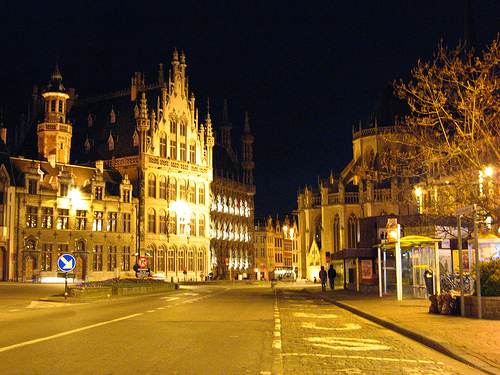
Lisbon (photo downloaded from Cunard Cruise line)

PORTUGAL 

Wednesday, April 10

Visit to Escola Superior de Tecnologia do Barreiro of the Instituto Politécnico de Setúbal.

Thursday, April 11

Round-table talk at Setubal Polytechnic Institute (IPS).

Friday, April 12

Presentation on Tools for Assessing Design Students’ Cognitive Development to Architecture PhD students at Instituto Superior Técnico (IST). 

Monday, April 15

Presentation on The Use of Staff Learning Groups to Transform Engineering Education at the Dublin Institute of Technology to the Department of Education at the University of Aveiro and engineers from the Polytechnic School of Águeda.  I’ll also meet some of the students and teachers using Problem-Based Learning at the Polytechnic School in Aveiro and/or Águeda (25km away).

Tuesday, April 16

Meet with engineering teachers at the Universidade do Minho engineering campus in Guimarães.

Leuven

Leuven (photo downloaded from KU-Leuven website)

BELGIUM

Wednesday, April 17

Meet with the president of the European Society of Engineering Educators (SEFI), an engineering professor at Katholic University of Leuven who also directs KU-Leuven’s Teaching and Learning Department.

Thursday, April 18

Deliver a presentation 7-9 PM on Research Paradigms: Filtering What We See and Know to the architecture school (I will discuss major research paradigms and then provide examples of studies I’ve done that used methods aligned with positivism, interpretivism, constructivism, and critical realism.  Presentation includes examples of work I’ve done in Africa).

Monday, April 22

Presentation on Tools for Assessing Design Students’ Cognitive Development to members of the LESEC (the Teaching and Learning Department) at KU-Leuven.

Tuesday, April 23

Interview with Fulbright Belgium for use on their websites.

Group-Based Learning in Action

I’m becoming a bigger and bigger believer in collaborative learning!  Last semester I did lot of research about how engineering professors (i.e., lecturers) here at Dublin Institute of Technology worked together to develop new ways of teaching electrical engineers.  I was amazed to discover how incredibly much they learned by working together.

Such impressive knowledge gain is the premise behind Project-Based Learning and other group-based learning formats.

Orla and Shannon in the throws of course planning.

Orla and Shannon in the throws of course planning.

My day today was filled with meetings about collaborative research and teaching projects.

With the help of five different tech guys, I got SPSS up and running so that I will be able to help analyze data on that Mike Murphy and I collected from engineering and engineering technology students. We asked them what they saw themselves doing in the future, how well prepared they feel to start work, and what kinds of things they’ve focused their efforts on over the past few years.

After lunch I met with Orla Hanratty of DIT’s Learning, Teaching and Technology Centre (LTTC) and introduced her to Brian Bowe. She’ll be co-teaching a course (i.e., module) with us in May.  We aim to increase the usage and visibility of Problem-Based Learning at DIT by teaching more teachers to use Problem-Based Learning in their own classrooms.

And now, tonight, I’ve been working on a proposal for funding with Ted Burke and Damon Berry.  It’s an opportunity that the college’s head of research, Marek Rebow, told me about yesterday and it has to be completed immediately.

I rallied the troops. Ted drafted some text. Then Damon and I were adding our own contributions to it using Google Docs.  It was so strange… Damon and me editing the same document at the same time.  It turned into a bit of an academic chat session.  We tossed ideas back and forth, discussing budget, objectives, and ways to improve what we’ve already got in place.

We’ll do more of that tomorrow, when the three of us meet to hash this out… and have some fun learning in the process.

Curiosities of “Good to Great”

Good to Great 1I really enjoy the book Good to Great by Jim Collins.  It’s a book about business. I found it compelling but, even after having read 2/3 of it some years ago, I still often wonder: what does it all mean?

Perhaps I will never fully know.

An M.D. friend of mine told me about the book.  He found that it applied to multiple contexts. Another colleague of mine has been reading it, and I’ve flipped through it several times lately while visiting in his office.

As for myself, I think I’m better at achieving greatness in some contexts than others. In business I’ve little idea of how greatness looks or feels. In work and in life, I’ve achieved things that seem pretty great to me.

Beryl Markham provided the opening quote Collins used in his book: “That’s what makes death so hard — unsatisfied curiosity.”  Of course, we have all heard that curiosity is also what killed the cat.  Striking the right balance isn’t easy.

Defining new goals has always been the biggest challenge for me.  And I see I’m not alone. Defining appropriate goals for achieving greatness requires curiosity and experience.  So many companies are limited by their own success, Collins asserts, that they don’t flourish because they limit themselves to tried and tested approaches that they don’t realize are outdated.  If they do realize it, they usually are unable to shift to new approaches anyway.

Achieving those goals requires skill, perseverance, and steadfast determination.

Good to Great 2

RoboSlam

My engineering colleagues, Drs. Ted Burke and Damon Berry, hosted a brilliant RoboSlam last Friday.  They had recruited a diverse crowd of participants to help them refine the way they teach kids to build robots.  You can see the basic method (which is being tweaked for use with a new group of kids in May) on their RoboSlam website.  I’ve attempted to capture the excitement (and my confusion) in the images below.

Before the event, Ted sent me this:

Hello All,

You’re receiving this because you’re on our list of participants for the upcoming RoboSlam workshop. Hopefully you’re still willing and available! If so, please reply to let us know so that we can confirm our numbers.

The details are:

  • Date: Friday 22nd March
  • Time: 2-6pm
  • Location: DIT Kevin St, room TBC

What happens over the course of the afternoon is this:

  1. We give each of you a bag of carefully selected low-cost components and a link to some online instructions.
  2. You build and program a small autonomous robot.
  3. Damon and I hover around offering friendly guidance.
  4. We all try out our robots!

We previously ran this workshop as a public event in the MAKESHOP which is part of the Science Gallery at Trinity College. It was a resounding success and it convinced us that this has real potential for a wide audience. Our next workshop with ordinary participants is with a larger group of transition year school students who will be visiting Kevin St in May. What you (extraordinary participants) will be doing on March 22nd is basically the same activity that the participants normally do, but what we’re trying to achieve in this session is slightly different:

  • Improvement: We want your ideas on how we can refine the RoboSlam recipe. You have been selected for your expertise, wisdom and creativity. Experience the workshop, then think carefully about how we can make it better.
  • Promotion: We want to recruit mavens. Makers clubs and workshops are emerging as a critically important channel for getting talented people with a natural interest in technology involved in engineering. We think RoboSlam is a good recipe, so we’re eager to bring it to a wider audience.

Once we get the robots working, we may wish to reward ourselves with a visit to e.g. Ryan’s for some scholarly reflection on all that we have learned. Naturally, this part is optional.

Ted