If you’d like to know a bit about the presentations I’m making here in Dublin, you can view the Prezi I used for the DIT Teaching Fellowships awards ceremony.
One of the award winners, the School of Business’ Joe Dennehey, was so enthusiastic about the presentation and wanted to see it again that I decided to open it for public access.
I’ve included an outline (below the picture) of what I said at that event. If you borrow any of the images, ideas, or words for your future work, please cite the source:
CHANCE, S. M. (2012). Transformational Education at the DIT: Potentials of Your 2012-13 Teaching Fellowship. Keynote lecture for the kickoff of Teaching Fellowships hosted by the Learning, Teaching and Technology Center (LTTC) on 1 November 2012 at the Dublin Institute of Technology in Ireland.

Click here to see the slides for the 2012 DIT Teaching Fellowship awards ceremony.
Transformational Education at the DIT
A twenty-minute keynote presentation
by Shannon Chance
for the kickoff event of the
2012-13 Teaching Fellowship Awards
hosted by DIT’s
Learning, Teaching and Technology Centre
Thank you, Jen. Welcome and congratulations to the Teaching Fellowship award winners.
We are witnessing something extraordinary happening at DIT. This extraordinary thing is something that helps shape you and that you help shape.
It is a culture of learning from each other.
It is a culture of continually improving over time.
It is a culture that is about learning and teaching well.
It became evident to me in March 2011, and it forms the basis of my research today. What I am learning is of great interest back in the States and across Europe as well.
Today I’d like to share ideas about
- Scholarships as opportunities
- Path to Fulbright
- An outsider’s view
- Global implications
- Support available
- Potential of learning groups
- Be the change you wish to see
SCHOLARSHIPS AS OPPORTUNITIES FOR LEARNING [LTTC page with last year’s winners]
Fellowships and scholarships like yours (LTTC) and mine (Fulbright) offer unique opportunities to learn, grow, and change things for the better.
I encourage you to make the most of the opportunity that is before you and then to consider extending your reach by applying for a Fulbright scholarship to teach and/or conduct research in the US.[Fulbright page]
This year, there are 35 Irish Fulbrighters going to the US, and 17 Americans coming here to Ireland. They include students, teachers, and professionals in various fields.
Let me step back a moment and tell you about how I came to find something extraordinary happening. Then, I’ll tell you what I think is special here. I hope that this will help encourage you to make the most of your teaching fellowships, and for those of you not winning an award today, to make the most of your efforts at the DIT to build upon and enhance this important movement.
PATH TO FULBRIGHT [path sequence]
I’m an architectural educator who visited Ireland on a vacation in 2003. My husband and I went and poked around the School of Architecture at UCD, and realized that with my current credentials—a BArch and MArch—I was qualified to teach architecture in Ireland.
I made it a central goal of my career to return to Ireland to teach and conduct research for at least a year.
When I returned home and looked up the Fulbright program, I realized that having a PhD would increase my chances of earning a Fulbright. I wanted to learn better research methods, anyway. I firmly believe that the architecture profession has left itself behind the ball by not developing a PhD sooner. We’ve failed to develop a shared research agenda or refine our research techniques (beyond the case study). As a result, we kept building the same mistakes (like unsuccessful government-subsidized high-rise housing, known as “the projects”) over and over again.
PhD programs in architecture are very rare in the States, so I found a great one in a nearby School of Education. The program is somewhat similar to your LTTC offerings, although it focuses on Educational Policy, Planning, and Leadership.
I took the route that focuses on educational research, and went about studying change theory, strategic thinking and planning, and the way students who are learning to design understand ‘KNOWLEDGE’ and their role in creating knowledge (i.e., how their epistemologies change over time).
I don’t know how hard your Fellowship was to obtain, but my first application to Fulbright was rejected at the US level because I hadn’t established strong enough ties to DIT. Fulbright has a three-phase selection process and I got shot down at the beginning of the first stage.
To address this problem, my husband, Dave, and I headed over here during spring break 2011 to find connections and develop relationships at the DIT.
I called the US Fulbright Office a few weeks before I came over and the Program Officer for Ireland suggested I look into the highly tailored calls for proposals, because the “all disciplines” grants have so many applicants. I wasn’t certain if I fit the position DIT lists for Engineering Education Research, and my goal in coming over was to find where I best fit. When I got here, I met with people in the LTTC and various Colleges at DIT.
I came back again during spring break 2012 to get the ground work in place–even though I wasn’t certain I’d be awarded the grant for this year. I was determined to keep trying until it worked out. At the end of this past March I got notification I’d been selected for this year. I packed my bags, and have been here for two months now.
AN OUTSIDER’S VIEW OF DIT [HU webpage]
- Great innovation and research (regarding outcomes) in DIT’s Electrical Engineering and Physics programs [Robo Sumo]
- Positive outcomes accruing from the LTTC [LTTC logos]
-
- The PGCert requirement is extending the benefits that accruing for students
-
- shared vocabulary
- active learning communities
- evidence of formative feedback, engagement, and group learning
- Many did PGCert voluntarily and they’re making a visible different in the quality of education students receive here [zoom in on collage]
-
- Many continued on, to doctoral level studies
- High quality educational research emerging
- I’m glad to see you here, showing interest in extending these proven innovations into more programs
On my March 2011 visit, I discovered:
· Research going on here in area of my interest
· Evidence that the changes NSF wants are happening here in engineering and physics
· Incredibly warm and enthusiastic scholars all across the institute who are working hard to get things done and who have a sense of optimism about the future
I also discovered something very special—the requirement for all incoming faculty members to earn a qualification in learning and teaching. Your staff has to learn to teach! That’s remarkable.
And I see clear evidence that it’s making a positive difference. People are using innovative methods. They are talking about good teaching practice over coffee every day (in some cases).
They share a common vocabulary and a common set of concerns about teaching – such as how to provide students with the most helpful feedback in ways that work where the staff have such heavy teaching loads (similar to my home institution). The institution has a similar mission and an ongoing conversation about good teaching. And, engineers and architects are housed in the same College, so I can do everything I love while I’m here!
HOW THIS IS OF INTEREST BEYOND DIT
- NSF [existing mandate sequence]
-
- JEE article fortcoming [JEE mag and logo]
- At HU — my Dean and Associate Dean of the School of Engineering and Technology at HU [HU title]
-
- want to use DIT as a precedent for improving our program and building a common philosophy
- across all our programs (engineering, architecture, and aviation) [Duffy charts > sequence]
- Eternal reviewer at various levels have cited PBL courses and LTTC program outcomes as unique and positive. I came in with this sort of perspective since I serve on external review boards for the National Architectural Accrediting Board in the USA. [Barrie chart > zoom in]
- What we learn from studying successful examples at DIT can help improve the way engineering, science, and architecture are taught far and wide. [zoom again]
This is of interest because, we can use what Gavin and his colleagues are doing at DIT to help improve science, engineering, and architecture education everywhere.
The National Science Foundation says there’s a problem with the way engineering has been taught for the past 50 or so years. Programs in the US are starting to change …but many aren’t changing fast enough.
DIT is among those using innovative pedagogies—to help students develop both disciplinary knowledge and personal skills like collaboration—in order to create flexible learners who can address address pressing issues—using higher order thinking skills. They have to be able to create a bright new tomorrow, not just remember, understand, and apply what people already know how to do.
The NSF says “engineering education must change in light of changing workforce and demographic needs.” It’s leadership board recommends hands-on activities, collaborative work, real-life applications that have social relevance, and working at various scales. The Electrical Engineering program at DIT is doing all this in the Project-Based Learning modules embedded across the four-year curriculum.
These PBL modules are helping students reach what the NSF wants to see in the US: effective communication, critical thinking, creativity, self-awareness, ethics, and skills for “self-directed life long learning.”
I’ve presented ideas I got at the DIT to the faculty at my university, to national conferences of architecture professors, and at education conferences in the US and Greece.
Right now, we’re researching how they’ve achieved this for the Journal of Engineering Education. The top journal in the world in the field of Engineering Education is interested in publishing our study about how DIT’s electrical engineering staff managed to change the way they teach by using the formal peer learning groups that Gavin organized during his Teaching Fellowship.
SUPPORT AVAILABLE AT DIT FOR INNOVATIVE TEACHING
- Existing culture — balancing challenge and support imp. for students & staff [Computer Science lecturer; Duffy papers]
-
- A community of people with experience doing this
-
- from in and outside of the College
- who want to help you do it
- Gavin’s paper on restructuring the EE program
- Coffee time and the art of chat
- Good teaching is an overarching value [balancing chart]
-
- our schools are somewhat similar
- traditionally teaching-focused, non doctoral-level, non-research funded
- you’re in the classroom a lot, but you also get to decide how you’ll spend your research time
- LTTC programmes [logos, Gavin and Sima]
-
- Some availability of funding for taking LTTC modules
- Some availability of timetable adjustments for taking LTTC modules
- LTTC Teaching awards [zoom to Sima]
-
- Ability to earn public recognition for your work through Teaching Awards
- Sima won
- Project Grants [webpage]
-
- Gavin and I got one this year for €2400 to fund transcribing
- Teaching Fellowships [webpage]
-
- Can have far reaching effects
- Gavin’s case highlights two opportunities
-
- Ability to form staff learning groups
- A lot of curious, motivated colleagues who share a sense of purpose and optimism
- I’m speaking at 2012-13 kickoff on Thursday
- Ability to align activities with what the institution seems to value — this is where there’s lot of opportunity
- College Heads of Learning Development [Brian and Mike]
-
- Brian Bowe really knows educational research and how to apply it [zoom to Brian]
- has the active support of his Dean
- Knowledgeable and supportive leaders [zoom to Mike at SEFI]
-
- Mike Murphy is recognized for excellence in engineering education
- genuinely interested in learning about
- Fulbrighters who here each year to contribute to the conversation [zoom to Colleen, Pam, SMC]
- A comprehensive library [Bolton Street library]
-
- on Bolton Street
- incredibly helpful and knowledgeable librarians
- Internet resources [zoom to ARROW logo]
-
- good access to databases
- DIT ARROW database
- Many outlets for sharing [SEFI conference pictures]
-
- presentations
- publications [zoom]
- Availability of travel funding to network and attend conferences
- LTTC and LIN [logos]
-
- workshops / webinars
- experts in Teaching and Learning available by phone and in person)
POTENTIAL OF STAFF LEARNING GROUPS [panorama]
I am getting to work everyday with a lecturer who earned one of these Teaching Fellowships in 2009. As part of his Fellowship, he organized a peer learning group. They met formally through the year to discuss how to implement Hands-On, Group-Based learning in electrical engineering – in addition to their regular informal meetings over coffee to discuss issues they each brought to the table.
During his Fellowship year, Gavin also wrote two position papers to clarify what he thought needed to be done to improve DIT’s Electrical Engineering program. So, he invariably had new ideas to offer up for discussion.
- JEE interest in how this was achieved at DIT
- The sessions included Brian Bowe who brought in
-
- research
- experience with implementing this in Physics
- understanding of the way the institution works
- Informal sessions are ongoing… they happen at coffee on a daily basis
- Easy to set up and fun for participants
- Highly motivational — participants cite increase confidence
- They appreciate having a sounding board and knowing they’re not alone
- Having a group keeps the momentum going, especially where there’s a champion
- The book Learning by Design by Noel Fitzpatrick and Jen Harvey [book cover]
-
- explains how learning groups have made a difference across the ITs
- DIT formed the template
And his colleagues were keen on hearing his thoughts. Several of them had, like Gavin, opted to take the Post-Graduate programs in Teaching and Learning even before these became mandatory.
Many of those “volunteers” have gone on to study at the doctoral level—thus bringing a more informed level of discourse to the DIT.
Today, Gavin is working on a dissertation. He and I put in an application for support on his project and received a grant for this year to help fund transcription of the interviews we’re doing.
His work caught the attention of the Dean while we were at the SEFI conference, and his line managers asked him to put together a seminar for the while College to learn about how to implement Student-Centered teaching into more programs.
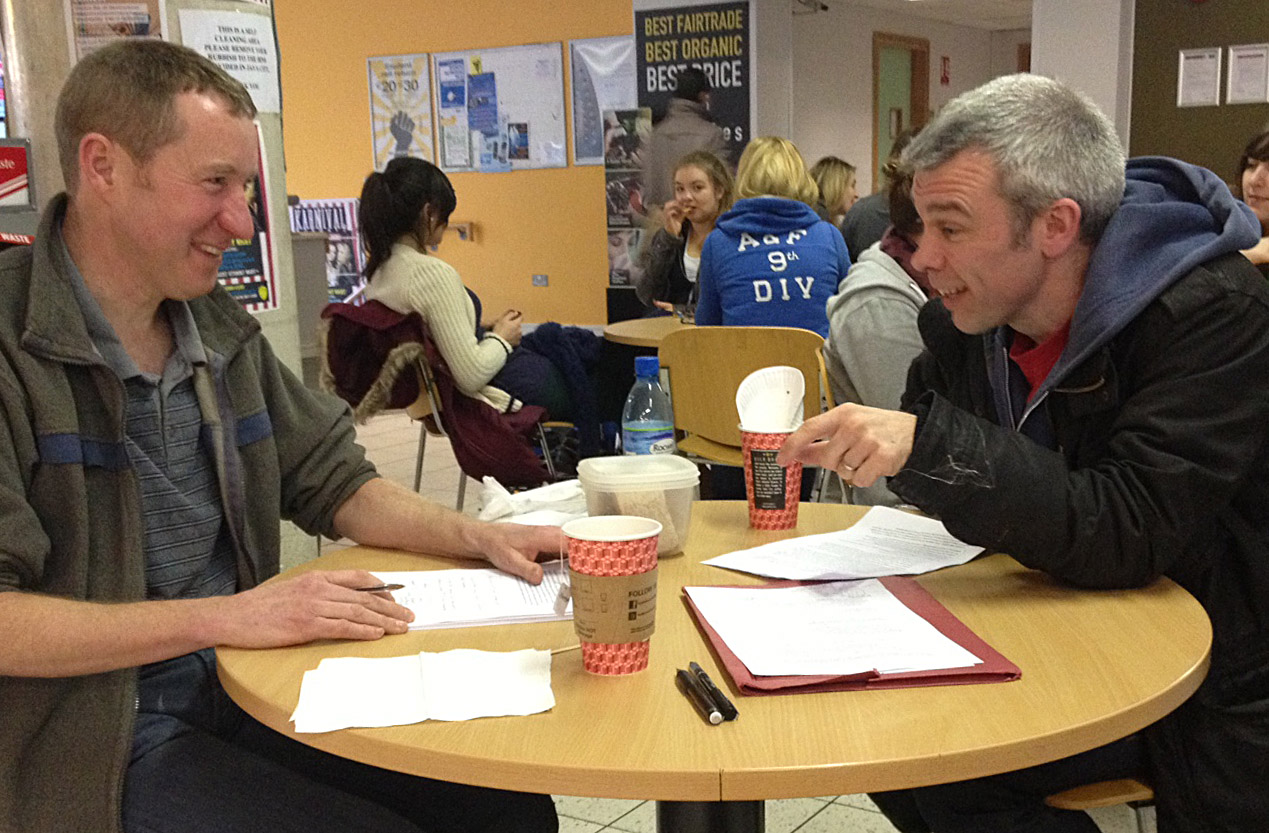
He and I discuss this everyday, and often include his teaching colleagues in our learning process.
I’ll be presenting these ideas to the School of Architecture next week, at a symposium called “Schools of Thought” that’s being organized by architecture students. I will encourage teachers in that school to use more Student-Centered approaches.
BE THE CHANGE YOU WISH TO SEE
The book Learning by Design by Noel Fitzpatrick and Jen Harvey [book cover]
- explains how learning groups have made a difference across the ITs
- DIT formed the template
Evidence of successful models being used at CEBE
- Fullan [chart]
- Prochaska and DiClemente [chart]
- Behavior change [chart]
CONCLUSION
As you can see, one little Teaching Fellowship can have a very, very long reach. I encourage you to make the most of your Fellowship… the LTTC knows how to pick ‘em and I feel certain that you’re up to the challenge!








 Ireland by Chance