We’re Talking Mojo!

The Society of College and University Planners just sent out this email:

In four days there have been more than 500 downloads of this week’s featured Planning for Higher Education article. If you haven’t gotten yours yet, it’s available here for a limited time.We are already seeing some great Mojo discussion and blogging in response to Shannon Chance’s feature article “Learning from LEED & USGBC.” Chance is a registered architect and associate professor of architecture at Hampton University. Chance offers her insights on LEED & USGBC a model systems approach to sustainability for higher education planning. Like many other environmental and design professionals, she also recognizes its limitations.

Arlen Solochek agrees that “LEED and the resultant sustainability movement has been an absolute game changer for everyone.”  But while LEED has definitely “raised environmental consciousness,” it is not necessarily as “nimble and responsive” as it should be.  He also notes that LEED standards are becoming compulsory according to institutional and governmental regulation. Other limits include inflexible point system and the expense of soft costs and certification. Both Solochek and Chance agree that “the bigger issue is not just stopping at more sustainable buildings.  How many of our institutions are trying to infuse sustainable concepts into their academic courses, into their students’ and staff’s lives and habits outside LEED?” (Solochek).

According to Michael Haggans, Chance’s article “…balances criticism of the LEED ‘gaming-for-points’ process that many have seen in practice, with a well documented account of the evolutionary improvements that are now underway.” Alexandria Stankovich offers a student perspective on LEED & USGBC in relation to higher education planning on the Mojo blog.

If you’re going to 2012 GreenBuild, please pass this article around. And, please share in the Mojo what you learn.

Thanks.

Visit SCUP’s Planning for Higher Ed Mojo at: http://mojo.scup.org/?xg_source=msg_mes_network

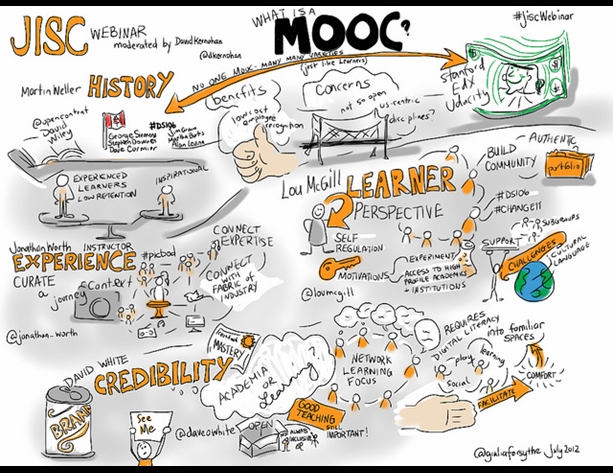
What’s a MOOC? (And can it help us save humanity?)

A diagram from Dave Cormier’s video.

I’ve been scratching my head, wondering “what’s a MOOC?”

Someone at SCUP sent me a helpful link to a succinct four-minute video by Dave Cormier that describes MOOCs and explains that the acronym stands for “Massive Open On-line Course.”  I also found a helpful blog posted by Lou Mcgill titled  What is a mooc? Massive Online Open Course and the learner perspective.

SCUP is using a MOOC to facilitate communication among its members.  I’ve been visiting SCUP’s MOOC for weeks now but I haven’t been able to “see the forest for the trees.”  I haven’t understood what’s going on all around me.  I find my way to some places that seem like classrooms and other places where discussion is going on, but I don’t yet understand how to navigate effectively.

Thanks to Dave and Lou I can finally stop scratching my head!  And, once I understand how the platform works, I can start using it to generate knowledge about planning and sustainability — rather that just about how to use MOOCs and the internet more effectively.

In any case, I believe that this on-line communication platform (i.e., SCUP’s MOOC) is the reason that my article got so many downloads so quickly after it went “live” on the internet.  The splash page for the article was viewed 644 times between November 9 and November 12.

To be honest, up until now I didn’t actually think people read the academic articles I’d published.  But now that I think about it, several people did contact me regarding an article I published with SCUP in 2010 titled Strategic by Design: Iterative Approaches to Educational Planning.  So perhaps SCUP’s audience reads and communicates more about its publications than is the case with many other organizations!

MOOCs provide a platform for learning that can help communities develop new knowledge quickly.  SCUP’s is aimed toward generating knowledge about how universities run and how they can improve their approaches over time.

Perhaps humanity will develop viable paths to achieving sustainability by using tools like MOOCs to share and build knowledge.  That’s part of the focus of my article just published by SCUP and something I think society MUST focus on if we are to persist on this planet.

But I’m quite interested in knowing more about how people work together to generate new knowledge.  The research project I’m conducting right now with Gavin Duffy and Brian Bowe (as part of my Fulbright) investigates how a group of teachers here at the DIT (i.e., a learning community) has been able to implement changes in the way DIT teaches Electrical Engineering.  These are topics I learned a lot about in the Ph.D. program I completed at The College of William and Mary on educational policy, planning, and leadership.

And interestingly, so many of the women I’ve bumped into recently–Esther, Joan, Máirtín’s wife, and myself–have been studying topics of leadership and change management.  Now that I’ve joined SCUP’s MOOC, I have found a whole new community discussing change, strategy, and the university’s role in addressing social and environmental issues. I hope we can elicit the types of sweeping change that this world needs, and do it fast enough to save ourselves.

Fulbrighters Sharing Ideas

I just received great news about my article from one of the editors of Planning for Higher Education.  Terry Calhoun left me this comment:  “Shannon, as of this morning, we have 345 article/summary downloads. So, people are reading, even if not yet commenting.”

I have to say: that’s a truly amazing number of downloads.  It’s a testament to the quality of the organization (the Society of College and University Planners) and its new platform for sharing ideas.
——–

Erin Eife and I discussed the ins and outs of applying to grad schools in between programmed sessions at the Fulbright Orientation.

On another note, Fulbright Ireland just posted a piece on taking the GRE in Dublin that was written by Erin Eife who is a recent college graduate who is conducting research on recidivism among females who have been jailed.

Erin and I sat next to each other at the Fulbright Orientation in September.  We got to talking about grad school and I answered some of her questions about degree paths and about selecting and applying to grad schools.
Erin has since written to thank me for the advice and let me know that she’s following through!  I love getting this type of feedback!  It’s not often that you hear you’ve made an important difference simply by sharing your experiences.
 Erin has got big dreams and I have every confidence that she’ll succeed with the applications she’s submitting this fall.

Mister Rodgers Remix

I grew up watching Mister Rodgers on TV–in black and white, of course!

The Public Broadcasting Station (better know as PBS) is keeping him up-to-date with this Mister Rodgers Remix.

It shows a true slice of our American Pie.  I’m listing this entry as “Education Research” since Mr. Rodgers was such a big contributor to US education in the 1970s.

Learning from LEED

The Society of College and University Planners (SCUP) just published an article about my dissertation research.  It describes how campuses have contributed to and gained from the Leadership in Energy and Environmental Design (LEED) program. You can download the paper or a brief synopsis using the links below.

Perhaps one of the USGBC’s greatest contributions to higher education lies in the model it providesas a large-scale learning organization.  This week SCUPers can enjoy reading Shannon Chance‘s 39-page article for Planning for Higher Education titled “Planning for Environmental Sustainability: Learning from LEED and USGBC.”  Because this is a long article, we’ve created a “Mojo Summary Guide” to the article. The guide doesn’t replace the article, but … well, you tell us what you think the Mojo Summary Guide does for you. Is it worth assembling?

What can SCUPers learn from LEED and from USGBC? Chance reports on her analysis of how institutions have used LEED, how the use of campus LEED has changed over time, and exhorts colleges and universities to both support USGBC and also learn from its structure as a learning organization.

Now, it is time for colleges and universities to step up their game. They should become leaders in green construction—not just followers that use a system designed, for the most part, by others. They must generate and apply new knowledge to help society achieve lasting sustainability. They must create buildings that do more to model good behavior, impart environmental values, and teach students about the environment. And, finally, they must re-design their funding mechanisms to facilitate comprehensive approaches to sustainability.

They should take cues from the USGBC about how to learn from experience and integrate feedback. Perhaps one of the USGBC’s greatest contributions to higher education lies in the model it provides as a large-scale learning organization. As an organization that monitors its own progress and continually revamps its systems, the USGBC has been able to achieve a visible and much-needed shift in American culture. American colleges and universities need to follow suit and become more proactive in the areas of environmental research and green construction.(emphasis added)

Visit SCUP’s Planning for Higher Ed Mojo at: http://mojo.scup.org/?xg_source=msg_mes_network
Focus on the Student

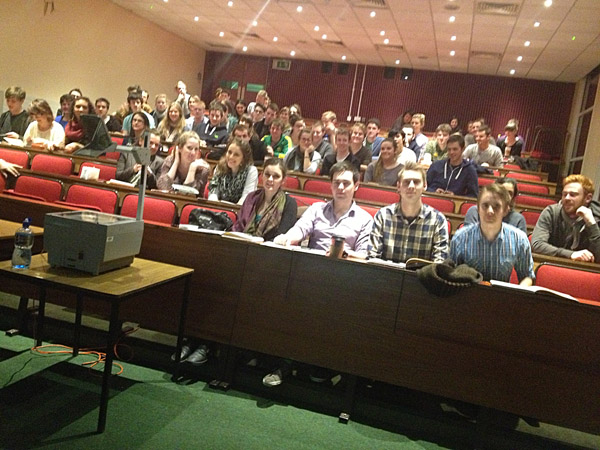
All these students voluntarily attended two back-to-back lectures last night–isn’t that amazing?

The Architecture Student Association got a great turn out for its symposium on the architecture student last night!  I’ve posted a photo of the crowd that made it all the way to the end of the two lectures… pretty amazing.  They came straight out of a day of classes into the lecture hall!

Maxim Laroussi of Architecture Republic talked about growing up in Morocco as well as what he learned about architecture by living in France, England, Scotland, Brazil, and Ireland.  Very interesting indeed!

Then I talked about “Learning Together” and how we can/should improve the way we teach architecture.  The main idea is that we need to focus more on understanding how students learn rather than on what content teachers deliver (i.e., what they say in class).

The speakers and organizers for last night’s ASA symposium: Andrew Ó Murchú, Shannon Chance, Colin Mac Suibhne, and Maxim Laroussi.

Supporting African Cultures talk

I’m going to be giving a lecture today–November 6 at 5:30pm, Room 281 Bolton Street, Dublin 1–on “Supporting African Cultures through Architecture.” This is part of the lecture series for 4th and 5th year architecture students but the topic should be of interest to others as well and all are welcome to attend.  A description of the talk is below the photos.

Images from Tanzania (copyright Shannon Chance).

Supporting African Cultures through Architecture

Knowledge of Africa’s heritage and accomplishments is woefully lacking in the media today. The tendency to leave Africa out of the literature on architecture and planning hinders designers everywhere. It denies them access to specialized information that could help construct better environments. Their failure to understand the subtleties of various African cultures often results in modern construction – particularly that funded by foreign donors – that does not effectively meet the needs and interests of the people. Even architects, spatial planners, and policy makers who live in Africa lack access to research that could help them make better choices.

This trend presents a quandary: How can one contribute to improving quality of life around the world, without imposing values that harm others? A poor response is to avoid getting involved. Doing nothing only perpetuates inequities of health, wealth, and personal freedom.

This presentation discusses the work of Livin Mosha and Shannon Chance, two scholars working to generate this type of information. As architects and educators, Chance and Mosha share an interest in: understanding the heritage of African places, constructing a cross-cultural dialogue, developing a vision for the future, and translating the voices of Africa to others. Their goal is to promote cultural-specific architecture, planning, and policy in East Africa and beyond. This talk describes their findings and their recommendations for the future.

Rites of Passage

A reflection I passed on the way to the retirement event.

Rituals help an organization determine and reinforce its collective values.  The stories that are told convey what’s most important. They help pass core ideas from one generation to the next.

The things that are said and the places where these rituals are held are embedded with symbols that suggest what is central and important to the community.

The DIT has few rituals as an institution– the Institute is a collection of long-standing colleges that came together not so very long ago (1992, to be exact). It hasn’t had much time for such rituals to develop institute-wide.

The schools and departments within the DIT, however, maintain a number of very important rituals that help reinforce what these units stand for and communicate what the people in them cherish.

Speeches in Kevin Street’s penthouse “canteen.”

I got to attend one such ritual Friday evening. It was the retirement celebration for three Lecturers from the Electrical Engineering program. For each retiree, a colleague reminisced, sharing thoughts and telling stories. Each retiree spoke as well.

As an outsider, this was a very interesting event to behold. I learned much more about the community here.

After the formal reception and the speeches, most of us headed to a nearby pub.  The photos show faculty deep in discussion and others hamming it up.

It’s important for an organization to take time to reflect in this way–to celebrate what it considers to be accomplishments and to recognize contributions of its members.

Dave’s retirement speech thanked the family who donated a heart to him. His transplant was so successful that he could ham it up with “Father” Ted after the formal events.

Kevin Street colleagues deep in discussion.

Schools of Thought–Lecture Announcement

The Architecture Student Association (ASA) at DIT has announced the first of its Schools of Thought events. The ASA has two lectures focusing on the Architecture Student planned for this week.

  • Maxim Laroussi of Architecture Republic will be speaking about his culturally diverse education as well as the importance of a year out at some point in your education.
  • Shannon Massie Chance, DIT’s 2012 Fulbright Scholar in Engineering and Design Education, will be giving a talk about her research work–broad investigation into the workings, flaws, and triumphs of architecture schools.

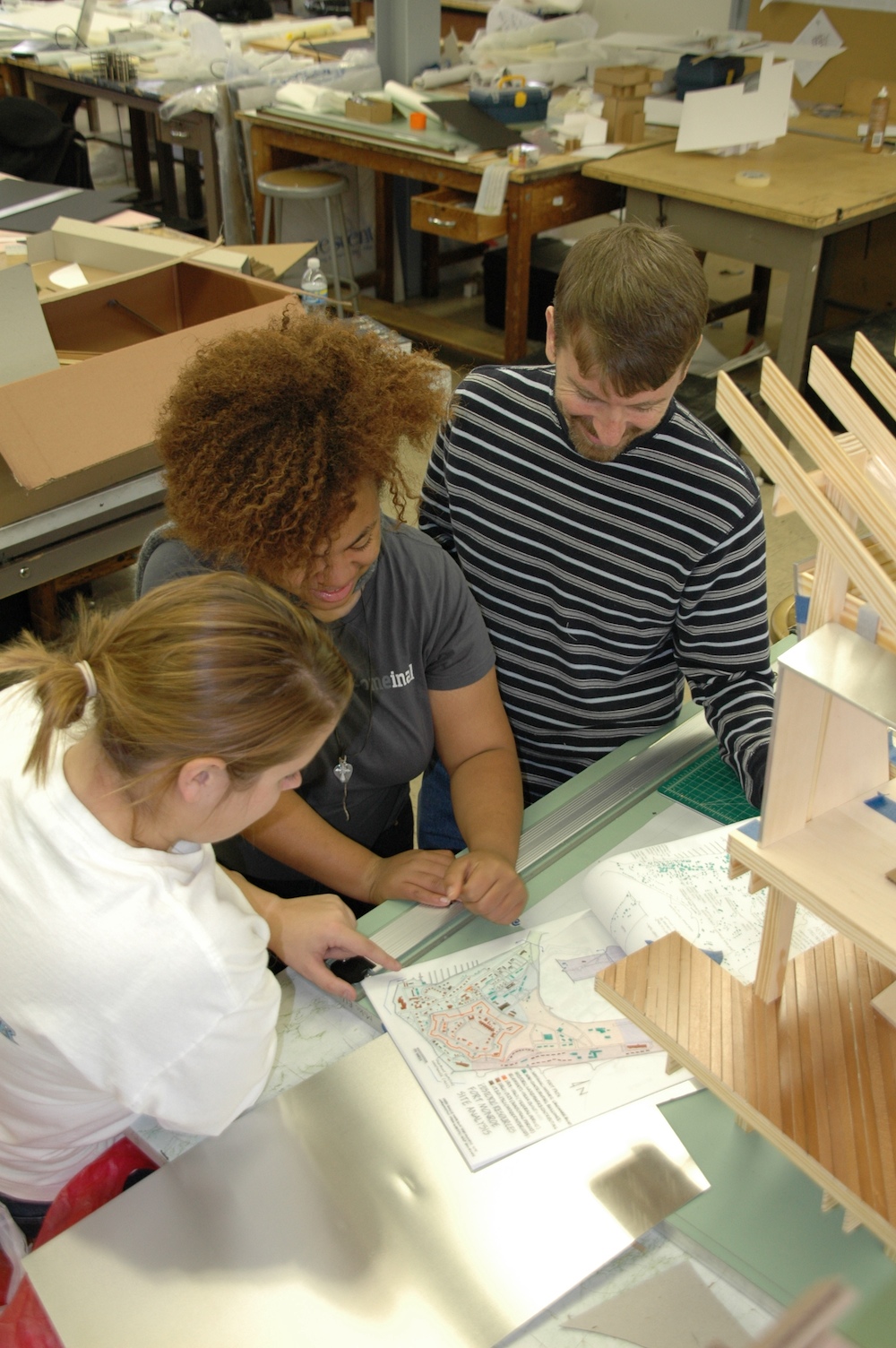
An image from Shannon Chance’s upcoming lecture on student-centered teaching. The students pictured are Hampton University’s Dana Cook, Danielle Dunn, and Mike Ellingson.

5pm
Wed 7th November
Room 281 Bolton Street (Dublin, Ireland)

The event is free and open to the public.

Putting this Wonk to Work

Discussing organizational change theory and its applicability to the College of Engineering and the Built Environment with Drs. Brian Bowe and Mike Murphy.

I’m such a wonk!

I’m elated that I got to put my training in “educational policy, planning and leadership” to work today!

I met over lunch with the Head of Learning Development and the Dean and we discussed possible strategies for helping adopt Student-Centered, Inquiry-Driven teaching practices college-wide. Our intent is to shift the focus in the classroom from the teacher to the learner.

It’s almost everyday that I get to use the research and the educational theory parts of my PhD studies.  But it’s rare that I get to contribute an educational planning and change-theory perspective to actually helping develop strategy.

I’m thrilled to be able to contribute to this important effort. And proud I’m that I can bring what I learned at William and Mary to the discussion table.

I’ll also get to discuss these ideas next Wednesday, when I speak at a student-organized seminar in the School of Architecture.

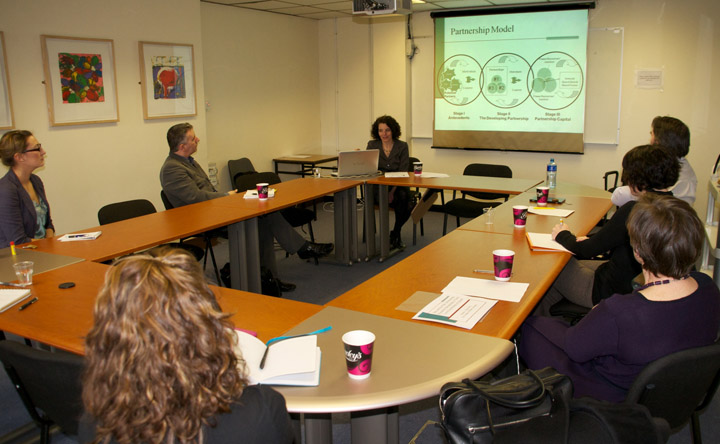
Dr. Pam Eddy’s lecture on Partnerships in Third-Level Education in Ireland. Delivered March 2011.

Today, I’m posting a photo of lunch and another of the biggest “policy wonk” I know:  W&M professor Pamela Eddy.

This blog goes out in her honor.

Thanks, Pam, for cluing me in to levers for change (Fowler, 2009). I was able to put that on the table for discussion today–all due to you.

Pam’s work includes the books Partnerships and Collaboration in Higher Education and International Collaborations: Opportunities, Strategies, Challenges and Community College Leadership: A Multidimensional Model for Leading Change. There’s an interview with her posted on Vimeo.

I should also acknowledge Drs. Leslie and Finnegan.  I used  a great deal of what I learned from David Leslie, emeritus professor at W&M, today.  And, in my discussions with Gavin over the past few days, I’ve drawn heavily from the paper I wrote in Dot Finnegan’s Cross-Disciplinary Perspective class.

W&M professor Dot Finnegan.

W&M emeritus professor David Leslie.