What do the terms thesis and final year project mean?

During my summer holiday, I managed to help get a new article published with my co-author, Dr. Rahman Tafahomi, from the University of Rwanda.

The article, “Comparing the meaning of ‘thesis’ and ‘final year project’ in architecture and engineering education” was published in the European Journal of Engineering Education (EJEE) at the beginning of August.

It was no easy feat, as the concepts in this paper are both theoretical and applied.

Rahman and I worked closely together for a year and a half, refining a manuscript he had drafted. Together, we crafted sections to link the topic of architecture education to the journal’s main readership, comprised of engineering education researchers. We had to translate many ideas to make them readily understandable to teachers of engineering and architecture alike.

We also perfected every sentence of the manuscript, seeking to communicate ideas as effectively as possible to EJEE’s broad audience.

I’m extremely proud of this work, and realized only after publishing it that we’d hit a sweet spot, as described by a scholar Deborah Gill from the UK, by helping shed light on these two terms and the types of education they imply.

I tend to agree with Deborah’s assessment that many people have an interest in this question and that conversations around this topic arise frequently on university campuses everywhere, because the article has been available on the publisher’s website only since August 10th, 2023, and in just six weeks it’s been downloaded 435 times. That only shows part of the picture, though, because it’s also been downloaded from ResearchGate 47 times.

Rahman developed a very valuable series of diagrams depicting:

  • Figure 1. Final year project studio relationships in architecture.
  • Figure 2. Thesis process in undergraduate architecture.
  • Figure 3. The process of science research.
  • Figure 4. The process of the engineering research.
  • Figure 5. Bauhaus and Beaux Art (and Polytechnique) educational approaches.
  • Figure 6. Integrated approach to mitigate the problem.

You can download the paper to see the diagrams, from https://www-tandfonline-com.tudublin.idm.oclc.org/doi/epdf/10.1080/03043797.2023.2244441?needAccess=truehttps://www.tandfonline.com/doi/full/10.1080/03043797.2023.2244441

I hope that many people read it, use the content in their teaching practice, and cite the article in their own future publications.

Rahman Tafahomi holds a Ph.D. in Architecture and Urban Design from the University of Technology Malaysia. He works at the University of Rwanda in the Department of Architecture as an associate professor. Over the summer, he earned promotion from senior lecturer to associate professor — well deserved! Rahman’s research interests include architecture, landscape design, urban design, heritage, architecture education, teaching and learning in higher education, and behavioral patterns.

Gravitational Pull

cabins 2

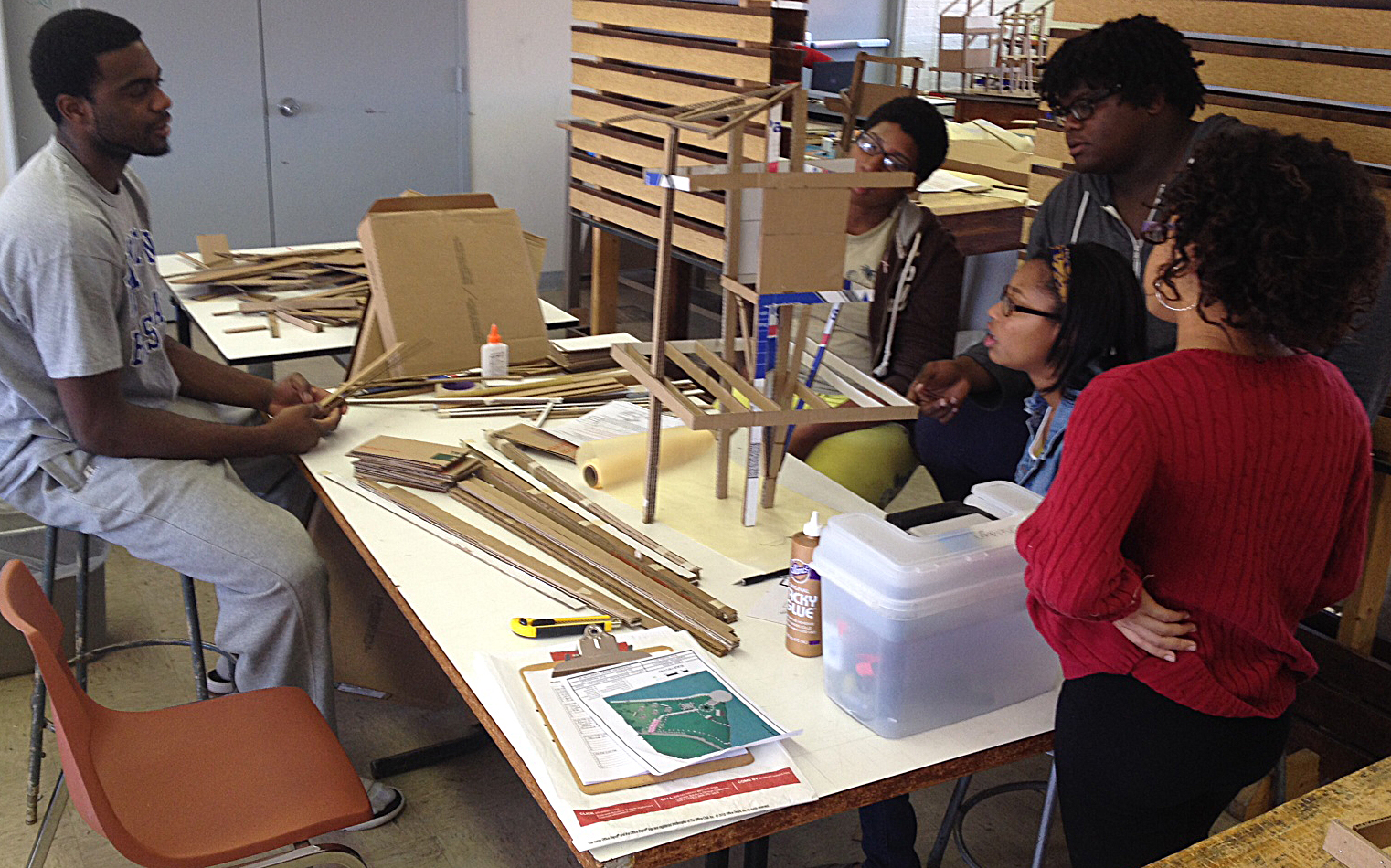
Hampton University’s second year architecture students are learning about gravitational forces and lateral loads by designing post and beam structures using a simple kit of parts (and adhering to a lot of fairly complicated rules).

The intention of the assignment is for students to learn about cantilevering, stacking, and hinging.  They also have to respond to environmental factors and work together in groups to enhance the site design concept developed by another student in the studio.  You can see one of the site design models in the photos below.  The cardboard frames you see represent the structural systems of small cabins that nestle into the site design.

I’ve asked them to build the structures at such a large scale (1″=1′) so they can really get the feel of what the various structural components are capable of doing.  Once they achieve suitable concepts, they will model their frames in wood.

Fingers cross that that will happen by Wednesday!  Thanksgiving is just around the corner… only three weeks of classes left to go this semester… so much to learn, so little time.  They still have to have the interior space, design building skins, and illustrate their designs with diagrams and measured drawings.  All that, in addition to completing their Physics, Architectural Representation, Architecture History, and Architectural Ecology course work.  Whew!

Student-Centered and Urban: Architectural Education at IST

The second stop of my Fulbright Inter-Country Lecturing visit was to the Instituto Superior Técnico (IST). One of the organizers of the day, José Figueiredo, explained to me that IST “is the biggest and oldest engineering school in Portugal.”

Professor Teresa Heitor lined up all kinds of fascinating events for me.  The 60 first year architecture students presented their work to me (in English!).  Then, they came along as their professors gave me a tour of all the architecture studios.  We got a glimpse of what these particular students will encounter in the coming years, as they progress through the five-year architecture program at IST.

Their architectural education will be structured very, very much like ours in the USA.

Their design assignments will be quite similar as well, although the projects students encounter here do tend to have more of an urban focus than most programs I’ve visited in the US.  (I serve on architectural accrediting teams and have visited many different schools in the US through conferences as well as accreditation visits.  I have to say, however, that my home institution–Hampton University–has done a noteworthy job over the past decade of integrating urbanism into the curriculum.  Of that, I have been proud.)

At IST, I was particularly impressed with what I learned from the first year professors.  They’re doing a great job overcoming what I see as a big weakness in architectural education today.  So many teachers around the globe focus on teaching students to make “signature buildings” and “modernist masterpieces” that other architects will love.

These teachers, instead, endeavor to draw out their students’ unique interests and abilities.  Unlike the many teachers who seemingly want to “wipe the slate clean”, these professors seek to help students draw from the wealth of experience and knowledge they bring to the first year design studio.