The European Society for Engineering Education (SEFI) announced the results of recent voting. I’ve been elected to serve on this prestigious organization’s Board of Directors for three years! Many thanks to Mike Murphy, former SEFI President and TU Dublin Dean, for prompting me to run, and to Una Beagon (TU Dublin), Inês Direito (UCL), and Tom Børsen (Aalborg University) for formally endorsing my candidacy. This post gives you a peek into my:
I met several other candidates at an August orientation meeting organized by the SEFI Director General, Klara Ferdova, including incoming Board members Stefan Krusche (who created a really inspiring candidate video!) and Annoesjka Cabo.
Darren Carthy, from Engineers Ireland, who earned his PhD at TU Dublin and has been part of TU Dublin’s CREATE research group with me, was also elected.
Helena Kovacs, an author of a chapter in the handbook I recently edited, was too.
I’ll serve under the leadership of the effervescent Nagy Balázs (President) and the energetic and accomplished Emanuela Tilley and Greet Langie (Vice Presidents). Sitting SEFI Board members who I look forward to collaborating with include Inês Direito and Roland Tormey.
Shannon Chance facilitating a workshop at SEFI 2024
Motivation to Serve
I first joined this community in 2012 at the SEFI conference in Thessaloniki, where I enjoyed a welcome so warm and enthusiastic that I decided to stay in Europe and embrace engineering education research (EER). I left behind a tenured professorship in the United States to join this vibrant community dedicated to enhancing learning and teaching engineering across Europe, and indeed influencing how engineering is taught far beyond Europe’s borders.
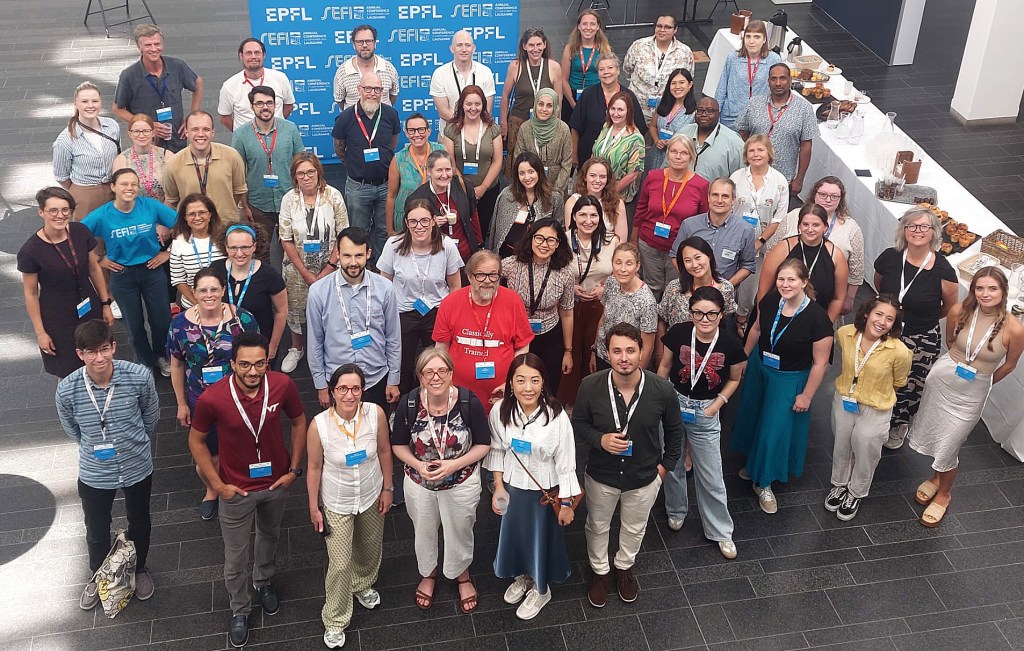
Group photo of participants (mentors and mentees) at the 2024 SEFi Doctoral Symposium, organized by Jonte Bernhard, Kristina Edström, Tinne de Laet, and Shannon Chance.
In my letter of motivation for this role, I highlighted three recent experiences that helped me prepare for the Board:
Chairing REEN – as part of the Research in Engineering Education Network’s Governing Board and its Chair for multiple years, I grew new skills and made positive contributions by significantly expanding REEN’s geographic representation, leading capacity-development initiatives (spawning EERN-Africa and organizing a series of capacity-building workshops for the nascent organization), supporting the delivery of REES (our bi-annual Symposium), and co-organizing events like the Big-EER Meet Up at the outset of the pandemic.
Cultivating our community’s publication skills by serving SEFI’s European Journal of Engineering Education as Deputy Editor, organizing and delivering workshops and doctoral symposia to the SEFI community to support newcomers to EER, guest editing special issues of IEEE Transactions on Education and the Australasian Journal of Engineeirng Educaiton (AJEE), and mentoring emerging scholars (as an individual and via SEFI and JEE).
Engaging with SEFI as a participant and leader – serving on the steering boards of the special interest groups for Ethics, Diversity and Inclusion, and Research Methods, helping organize the SEFI 2024 conference at TU Dublin, attending and presenting at Spring Schools, and – most recently – serving as co-editor of the forthcoming RoutledgeInternational Handbook of Engineering Ethics Education.
I sought to join the Board to:
Nurture collaboration and facilitate more mentoring and capacity-building programmes for teachers and researchers in engineering education.
Help educators infuse ethics and sustainability across engineering curricula.
Enhance diversity and inclusion in SEFI – for instance by developing additional channels for bringing people from Eastern European countries into SEFI and supporting SEFI members from low-income countries in participating fully in SEFI activities.
With my collaborative, can-do spirit — and my keen passion for supporting students’ design, epistemological, and identity development — I will use the EER projects I have underway on these topics to inform and enhance my work with the SEFI Board.
Candidacy Video
You can view my candidacy video, which I recorded between conferences in Mexico during summer 2024:
This blog provides the first sub-section of the Excellence section, on “Quality, innovative aspects and credibility of the research” of a grant proposal I submitted for an MSCA Individual Fellowship in 2015. This submission was NOT successfully in 2015, but I revised it based on evaluators’ comments provided in a previous blog.
I note that, in social sciences, it is likely that your methodologies and your research design will evolve while you are conducting the work. They will change based on what you are finding as you are collecting data and working in-situ. Nevertheless, it’s crucial that your proposal convey sa solid understanding of your field, its literature base, and the methods used to study it. The plan you propose has to be realistic, respond to the most cutting-edge knowledge in your field, and also explain how your proposed work is innovative–and needed by Europe.
The reviewers took off points for this proposal being too ambitious, lacking specificity regarding methods, and not integrating specific enough info on cutting edge research on the topics within my specific sub-field of engineering education research. I also lost points for mentioning a secondment but not having a clear enough secondment plan. I addressed those criticisms in my application the following year. The revision was funded in the 2016 call.
1.1 Quality, innovative aspects and credibility of the research
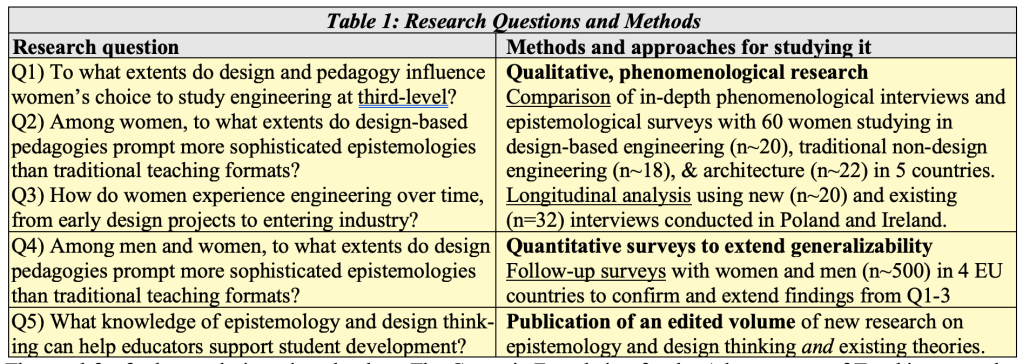
Over the two-year period of the MSCA European Fellowship (EF), Prof./Dr. Shannon Chance’s research and training efforts will be based at the new Centre for Engineering Education (CEE) at University College London (UCL). Dr. Chance intends to complete a 3-month secondment during the fellowship—if an appropriate partnership can be arranged with Houghton Mifflin Harcourt, Science|Business, Creative Industries Federation or similar—so as to maximize and exploit her research. Her primary research project will investigate overlaps between epistemology (which asks: What is knowledge?) and design thinking (How is knowledge created and used in the process of design?). Her research will evaluate the role of design projects in the learning, retention, and epistemological development of engineering students, particularly women. She will collect qualitative and quantitative data in Ireland, Poland, Portugal, the UK and USA. Simultaneous outreach in these places will promote Science, Engineering, Technology, and Mathematics (STEM) research and careers. Creating and pilot testing new activities for 2nd, 3rd, and post-graduate students will provide Dr. Chance another important avenue to exploit her research findings. Overall, Dr. Chance’s research will address grand societal challenges, specifically the lack of diversity and the ominous shortfall of engineers in Europe. Overarching research objectives are to: (1) develop and promote better ways to teach/support engineering students, (2) help transform engineering into a more diverse and creative field, and (3) track results via five primary research questions (Table 1) surrounding the theme: To what extents do design projects influence the cognitive and epistemological development of undergraduates in engineering and architecture?
The interdisciplinary approach draws from Dr. Chance’s unique skill set and synthesizes state-of-the-art in three realms: (1) practices from architecture education, (2) research on engineering education, and (3) theories on college student development. Architecture education provides a long-standing focus on pedagogy (through immersive, active design-based education). Innovators in engineering education are creating new ways to facilitate group learning and are slowly shifting the focus from teacher to student in the engineering classroom. Dr. Chance believes leveraging theories on student development can provide new opportunities in reforming/transforming engineering education. Such work can make engineering more attractive to students in design and creative fields—a category of students who may never have considered engineering as a field of study or career. Scholars of student development provide ways to conceptualize and monitor student learning, particularly with regard to contextual and generative ways of thinking and knowing. Dr. Chance’s initial investigations at the intersection of these three realms (which have involved exploratory analysis of students’ blogs) yielded encouraging preliminary results. Even though the findings were extremely tentative, they were solicited for a peer-reviewed journal1. To derive extensive benefit, we must strike while the iron is hot. She needs to pursue promising leads immediately, while momentum is strong.
Table 1: Research Methods and Methods
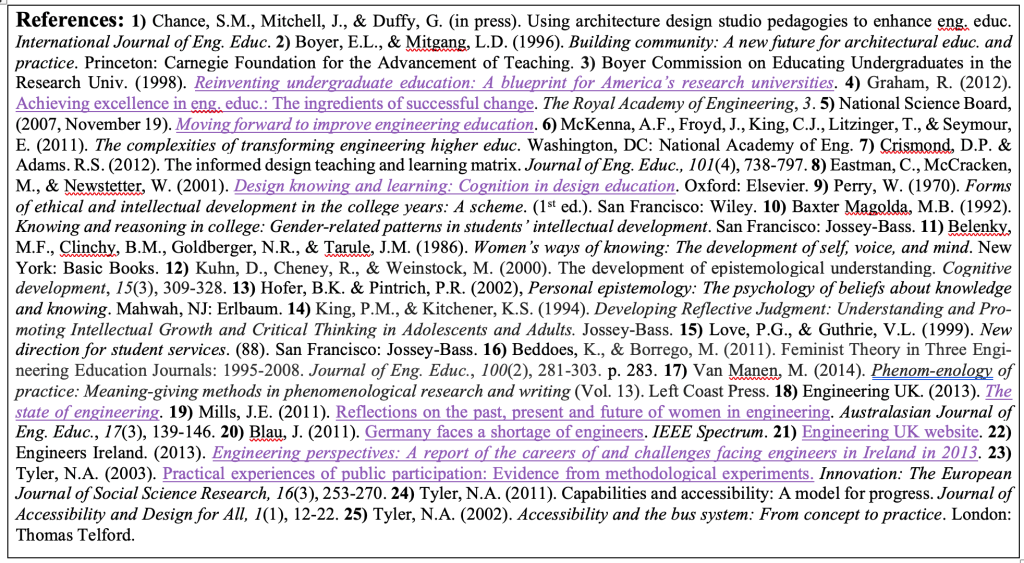
The need for further study is eminently clear. The Carnegie Foundation for the Advancement of Teaching argued that architecture’s design-based model should be incorporated into curricula to improve the teaching of engineering2, 3. The UK Royal Academy of Engineering4 and the US National Science Board5 demanded engineering schools do more to cultivate creativity and flexibility among graduates. Yet, very little has changed6. At UCL, however, Prof. Nick Tyler’s department accrued success by integrating design projects into civil engineering—dramatically increasing its enrollment and graduation numbers, particularly among women, as is documented in a case study by the UK Royal Academy and MIT4. Outcomes of their work deserve additional analysis via this project. Two primary resources on the overlap of design thinking and engineering education are a 2014 article on how to prompt informed thinking among novice designers7 and a 2001 book on Design Thinking and Cognition8. Contemporary student development theory stems from Perry’s 1970 schema of ethical and intellectual development of (male) college students9. Refinements to Perry’s work include gender-related investigations10, 11, ways to assess epistemology12, 13 and reflective judgment14, and synthesis across theories15. Dr. Chance believes applying these theories can make engineering education more effective. She aims to provide educators with the necessary tools to do so—and to disseminate them widely. Her cross-cultural project utilizes novel concepts (overlapping theories on development and design), novel methods (phenomenology along with surveys and field tests), and novel approaches (new project applications and a new guidebook to help revolutionize teaching and shift the knowledge frontier).
Dr. Chance’s EF study is being carefully designed to address criticism that “engineering education scholarship is still characterized by a lack of explicit and consistent theoretical engagement.”16 Her innovative mixed-methods study will start with cutting-edge qualitative methods for collection and analysis of in-depth phenomenological interviews with 60 women in 5 countries—a very large and diverse sample. Phenomenology provides means to investigate structures of consciousness and to explore how specific phenomena (in this case, design and engineering education) are experienced from a first-person point of view. Dr. Chance will use Van Manen’s interpretive, hermeneutic method for analyzing data17 and will help adapt phenomenology for widespread use in the emerging field of engineering education research (EER). To extend and magnify the impact of her qualitative findings, Dr. Chance will follow up with confirmatory surveys. Guided by Prof. Tyler, she will gain mastery of advanced statistical analysis procedures. She will use ANOVA, multiple regression, and other statistical modeling tools, to study results of surveys with 500+ women and men in 4 different EU countries. This will help achieve generalizability across EU engineering education. The proposed work is unique in scale, because no other engineering education researcher in Europe has collected such extensive data from participants from such diverse countries.
Such work is crucial to address today’s social and economic challenges. All over the world, there is a realization that engineering education is not working effectively—that engineering graduates are not equipped to handle ill-defined problems or address grand societal challenges—but no one is sure what the solution is. Even in places where the educational system is conservative (like Japan, Singapore, China, France, and Germany) it is widely realized that things must change, but exactly how to change them is unchartered territory and entirely up for grabs. The way engineering is conceived and taught simply isn’t attractive enough to students. Of all learners entering higher education in the UK in 2010, just 4.8% applied in engineering or technology18. Globally, half of all students who enter engineering drop out by the end of their first year19. These are problems for the engineering profession of course, but also for individual nations and for Europe as a whole.
The EU urgently needs more engineers, particularly ones who can work collaboratively and creatively. The EU is suffering an enormous deficit of engineers. In 2011, Germany alone fell short by 76,400 engineers20. Failure to attract women exacerbates the crisis. Today, women comprise 26% of engineering professionals in Sweden, 20% in Italy, 18% in Spain, but just 9% in the UK21. In Ireland, there are nine times more male than female engineers21. In the UK in 2010, applications to study engineering from women represented 0.58% of the overall applicant pool and were outnumbered by those from by men more than 7:118. Even in countries like Australia, where women who enter engineering now outperform men in persistence-to-graduation, half of all female engineering graduates still choose to leave the profession within ten years after graduating. This suggests a need to shift the educational and professional cultures of engineering. To address shortfall and diversify perspectives, the EU must find ways to attract and retain female students in engineering—as this study seeks to do.



 Ireland by Chance