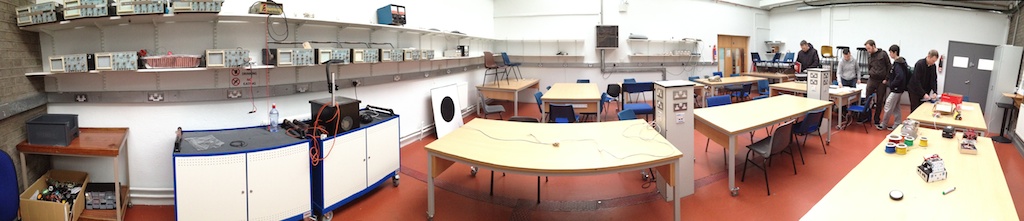
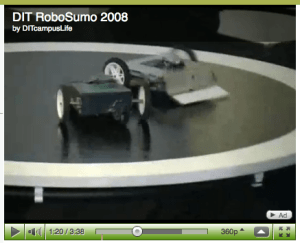
My engineering colleagues, Drs. Ted Burke and Damon Berry, hosted a brilliant RoboSlam last Friday. They had recruited a diverse crowd of participants to help them refine the way they teach kids to build robots. You can see the basic method (which is being tweaked for use with a new group of kids in May) on their RoboSlam website. I’ve attempted to capture the excitement (and my confusion) in the images below.


Before the event, Ted sent me this:
Hello All,
You’re receiving this because you’re on our list of participants for the upcoming RoboSlam workshop. Hopefully you’re still willing and available! If so, please reply to let us know so that we can confirm our numbers.
The details are:
- Date: Friday 22nd March
- Time: 2-6pm
- Location: DIT Kevin St, room TBC
What happens over the course of the afternoon is this:
- We give each of you a bag of carefully selected low-cost components and a link to some online instructions.
- You build and program a small autonomous robot.
- Damon and I hover around offering friendly guidance.
- We all try out our robots!
We previously ran this workshop as a public event in the MAKESHOP which is part of the Science Gallery at Trinity College. It was a resounding success and it convinced us that this has real potential for a wide audience. Our next workshop with ordinary participants is with a larger group of transition year school students who will be visiting Kevin St in May. What you (extraordinary participants) will be doing on March 22nd is basically the same activity that the participants normally do, but what we’re trying to achieve in this session is slightly different:
- Improvement: We want your ideas on how we can refine the RoboSlam recipe. You have been selected for your expertise, wisdom and creativity. Experience the workshop, then think carefully about how we can make it better.
- Promotion: We want to recruit mavens. Makers clubs and workshops are emerging as a critically important channel for getting talented people with a natural interest in technology involved in engineering. We think RoboSlam is a good recipe, so we’re eager to bring it to a wider audience.
Once we get the robots working, we may wish to reward ourselves with a visit to e.g. Ryan’s for some scholarly reflection on all that we have learned. Naturally, this part is optional.
Ted





 Ireland by Chance