Architecture educators in India

The architecture teachers at KLE Tech are really enthusiastic about teaching and about learning to do educational research. A number of them attended the engineering education conferences held at their institution in January — the IUCEE conference on engineering teaching and REES, the Research in Engineering Education Symposium, which focuses on research about engineering teaching.

KLE Tech’s lovely Dipanwita Chakravarty was the most enthusiastic among them, delighted as she was to find an architect speaking on a panel at REES.

That architect was me! 🙂

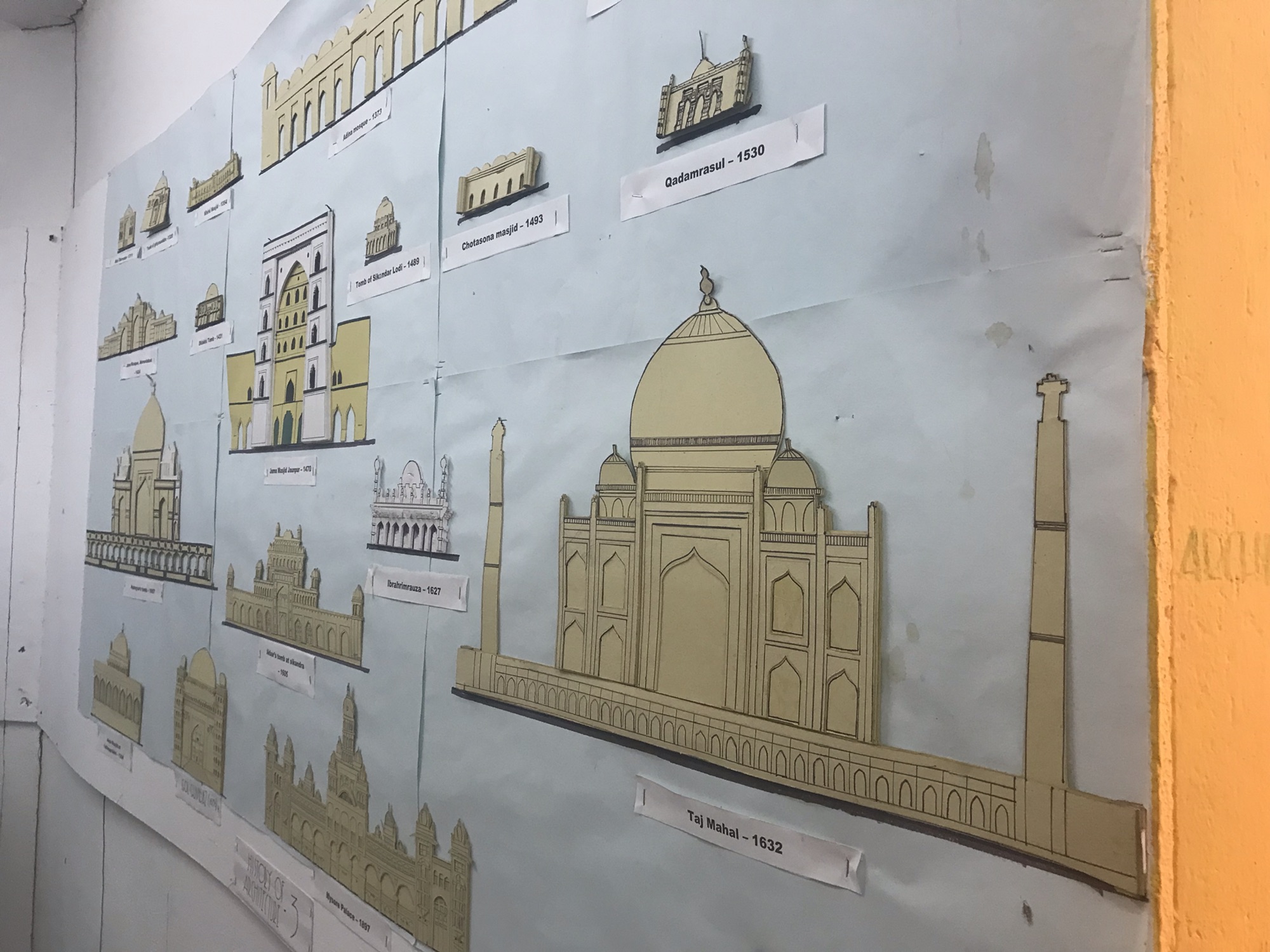
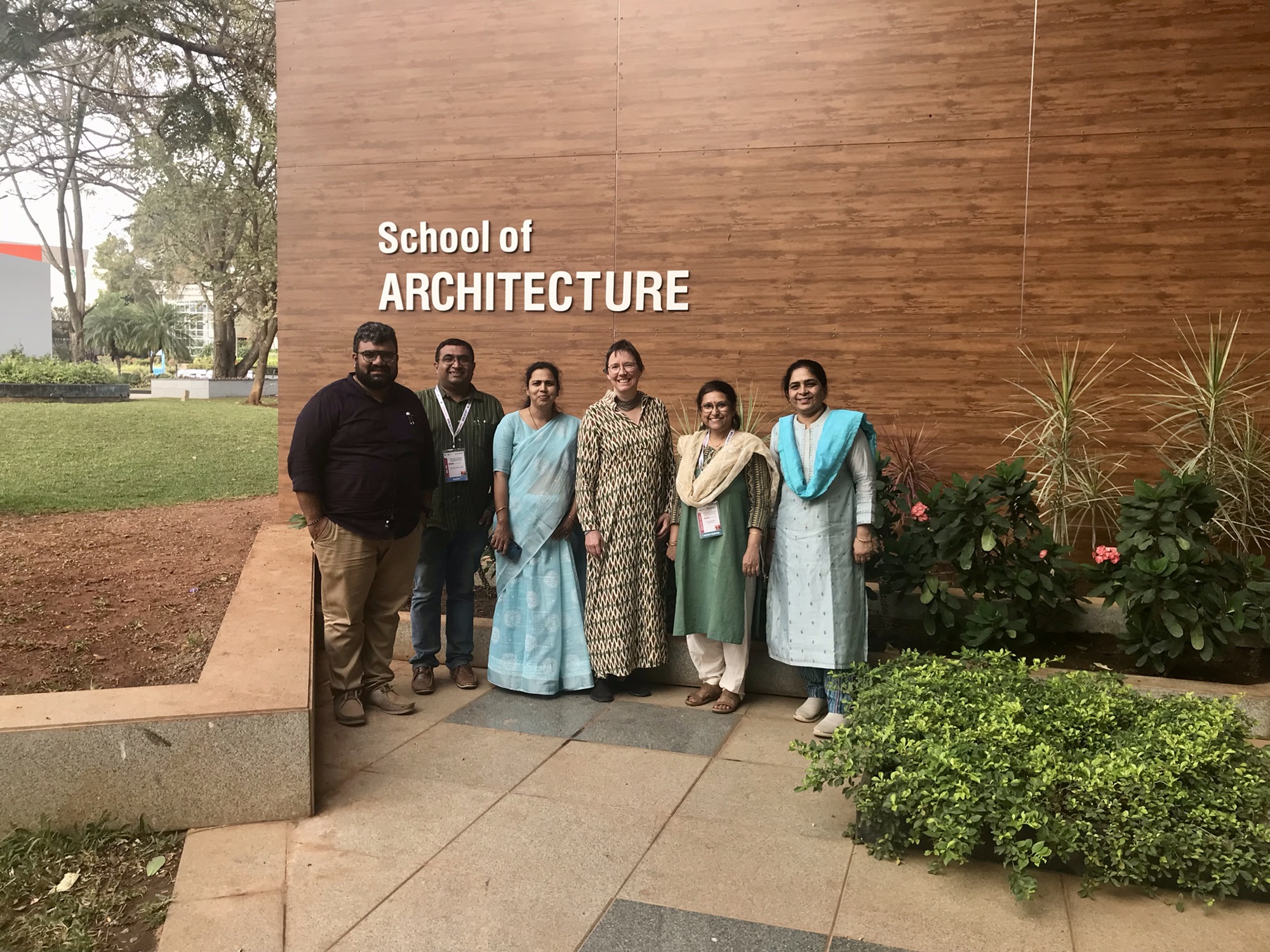
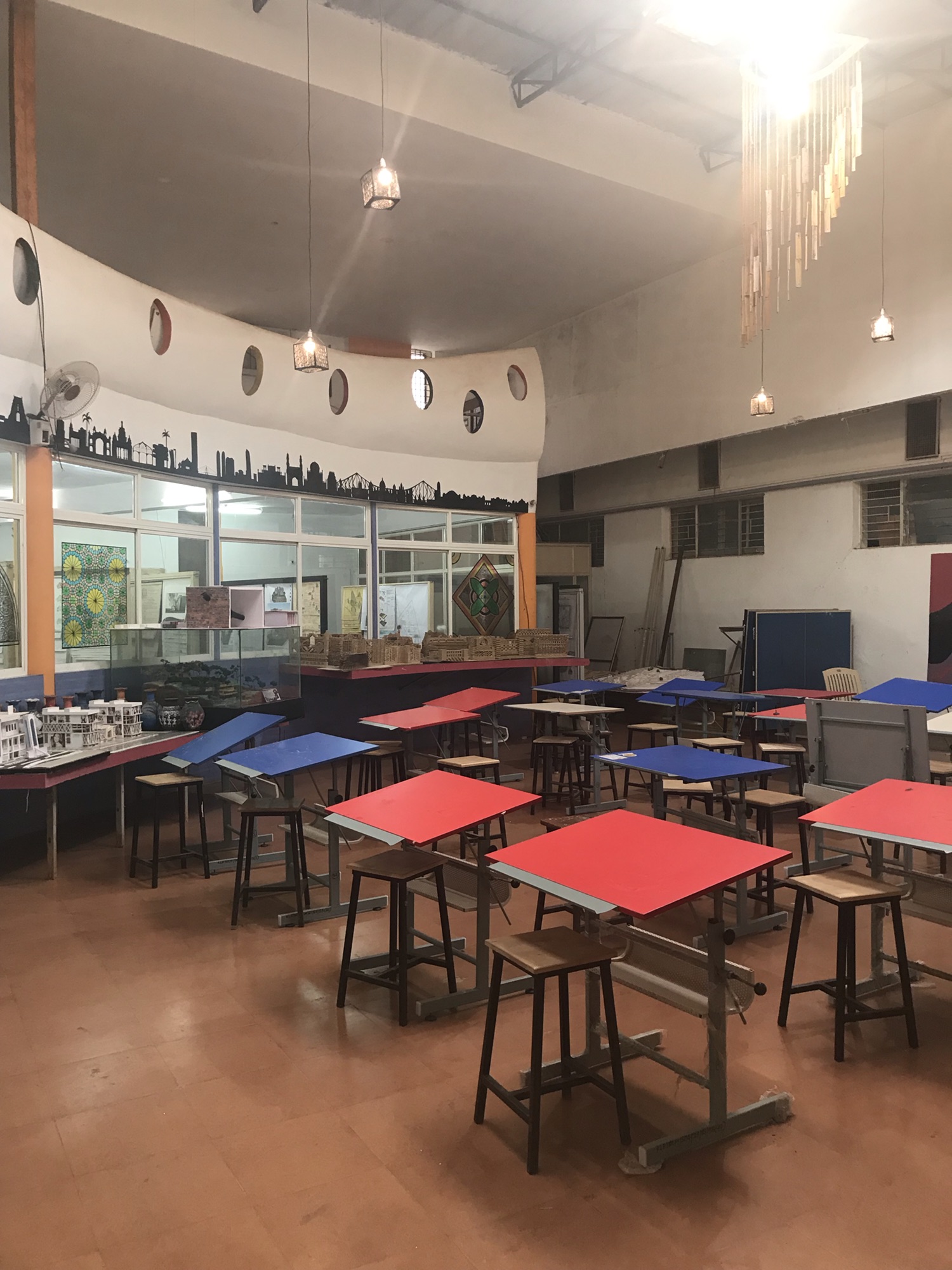
Dipanwita found me soon after I presented, asking me to meet her architecture colleagues. She spirited me away from the events at REES, to meet Deepa Mane and Rohini Mligi, tour a room archiving their architecture students’ work, and then meet even more colleagues for an animated chat about research and curriculum design. And tea! Such excellent tea!

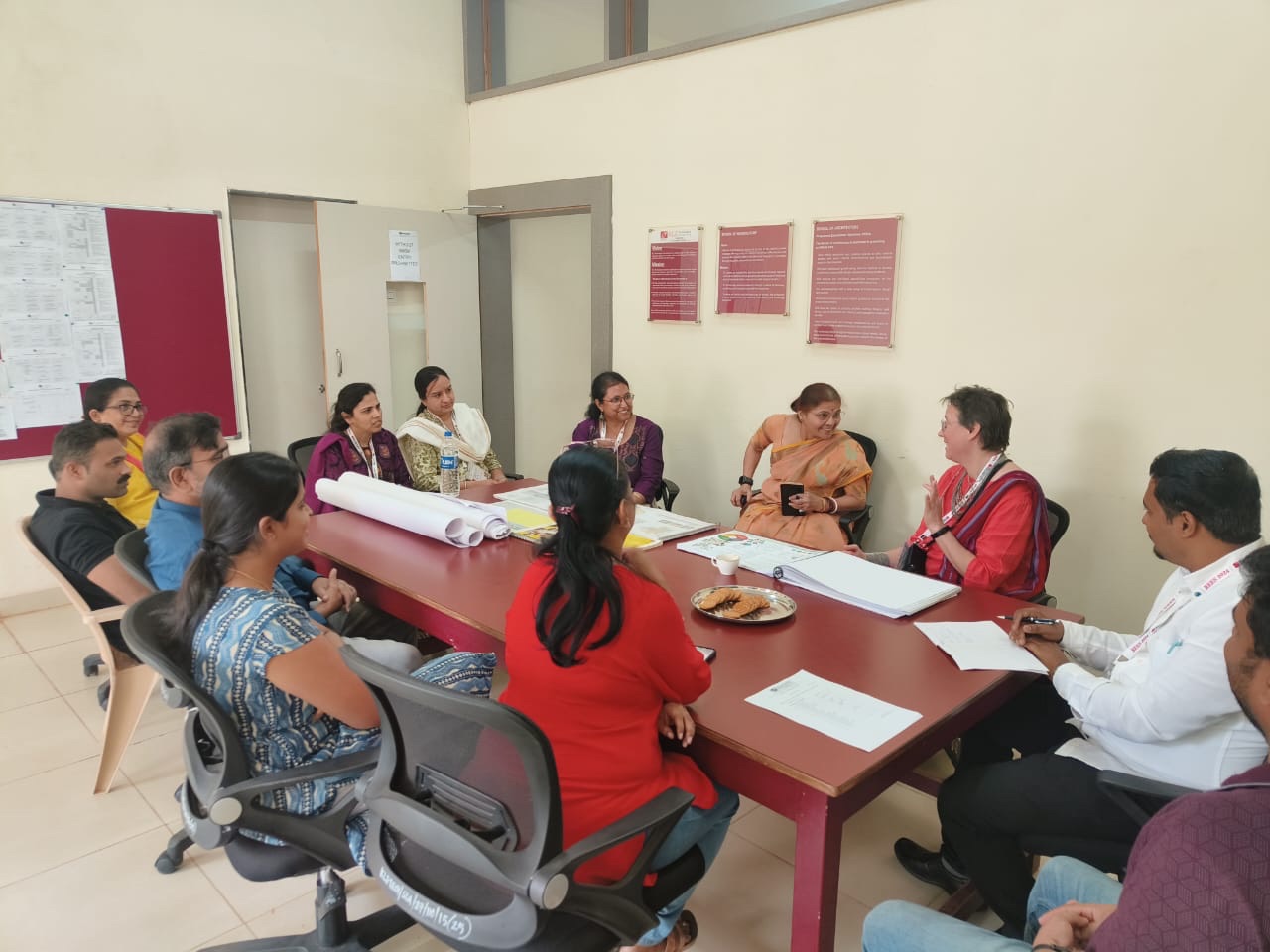
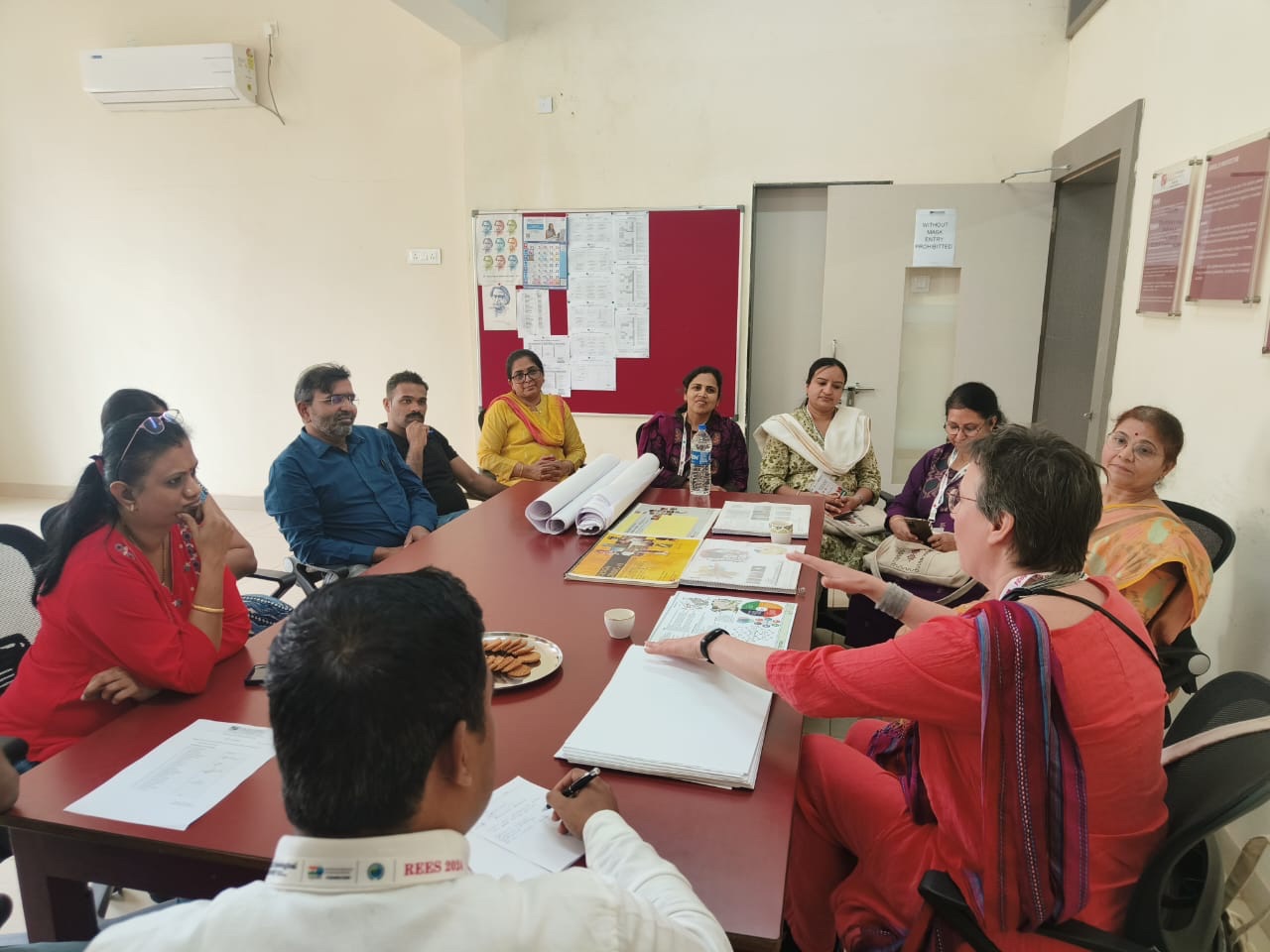
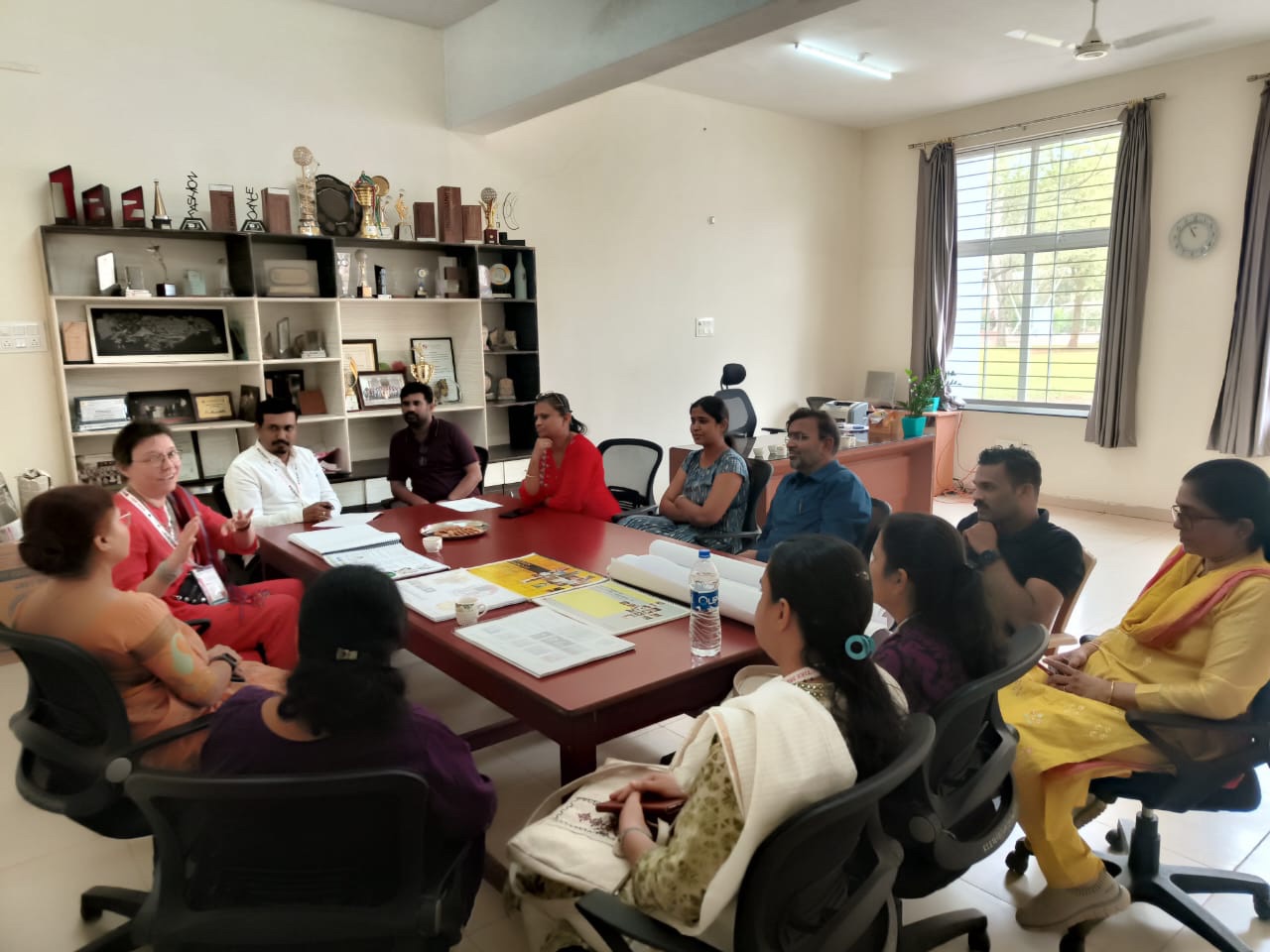
Here’s a glimpse of that afternoon’s tour and interactions:
In that initial discussion in their faculty boardroom, we talked about different types of research they are doing and their interests surrounding architectural accreditation.

They asked me to help them build momentum and capacity to do education research, as they were enjoying seeing work presented at REES but were not quite sure how this type of research would look in the context of architecture rather than engineering.

We decided we needed a group identity. We envisioned collaborating with the engineering education research center on their campus (which has its own building, as it’s the leader in this realm in India). We also envisioned becoming active members of India’s IUCEE (the corollary of ASEE or SEFI for India).

As a step forward, we asked Dr/Prof Vijayalakshmi M., one of the main organizers of IUCEE and this event, if we could start a special interest group for architecture (and design?) within IUCEE. She was supportive. She gave us the Indian head shake and said: sure, just get started, and let’s see how it grows!
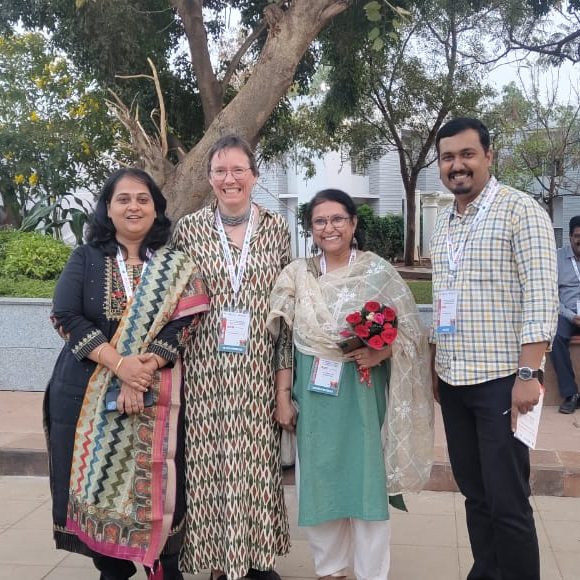
Meeting with Dr/Prof Vijayalakshmi M. about setting up a special interest group in IUCEE.

It was a very satisfying exchange, and I returned to REES for the day, happy and energized. I toured KLE Tech’s building for technical engineering later that day alongside the always-smiling, always-energetic Dipanwita Chakravarty and my colleagues from near and far.
The next morning, the architecture staff spirited me away again!

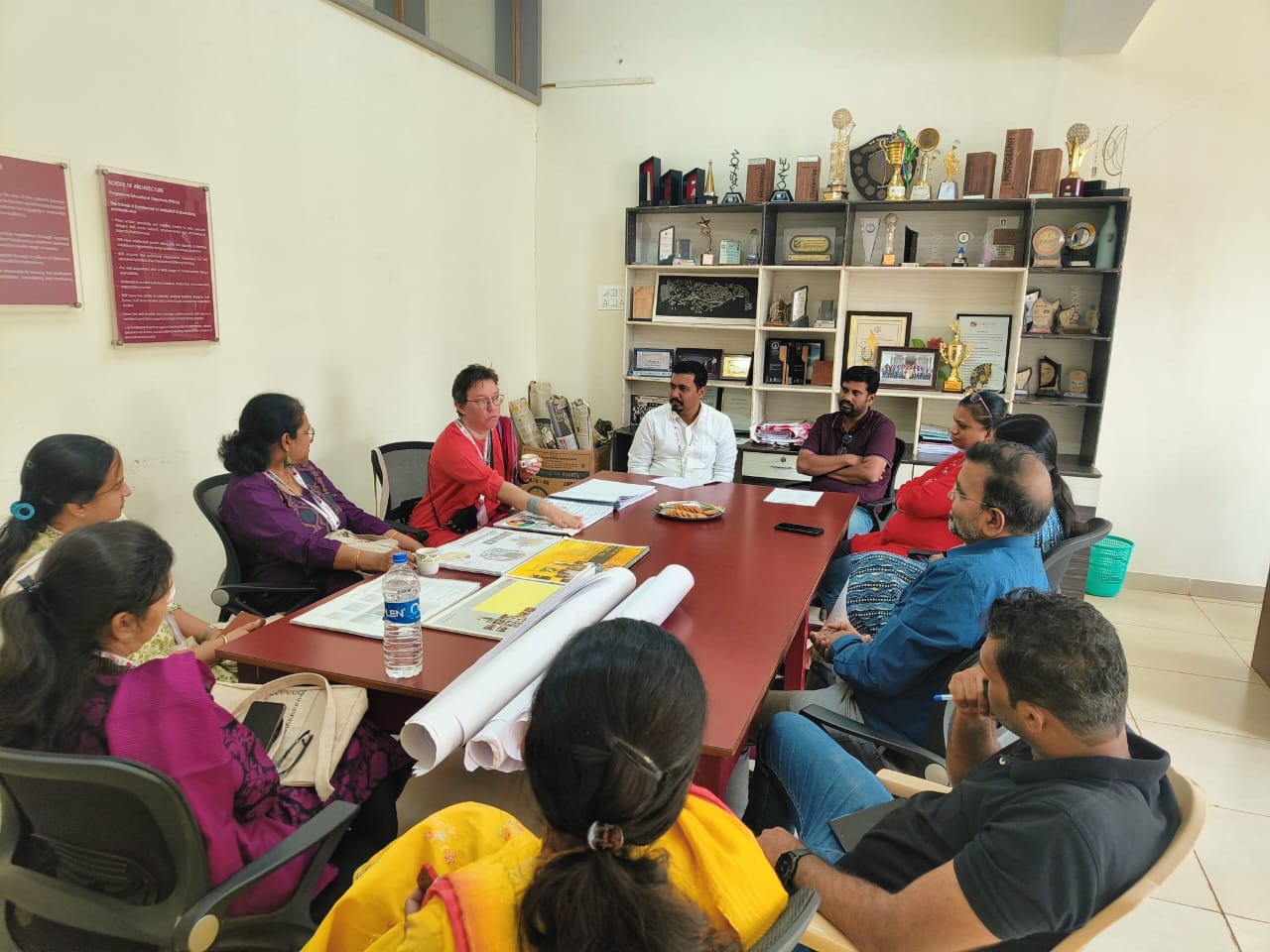
They’d assembled an even larger group to discuss what education research is, how education research differs from technical research on architecture and engineering (like the work they are already doing on thermal comfort and architectural heritage conservation), and how they can get started doing this new type of research.

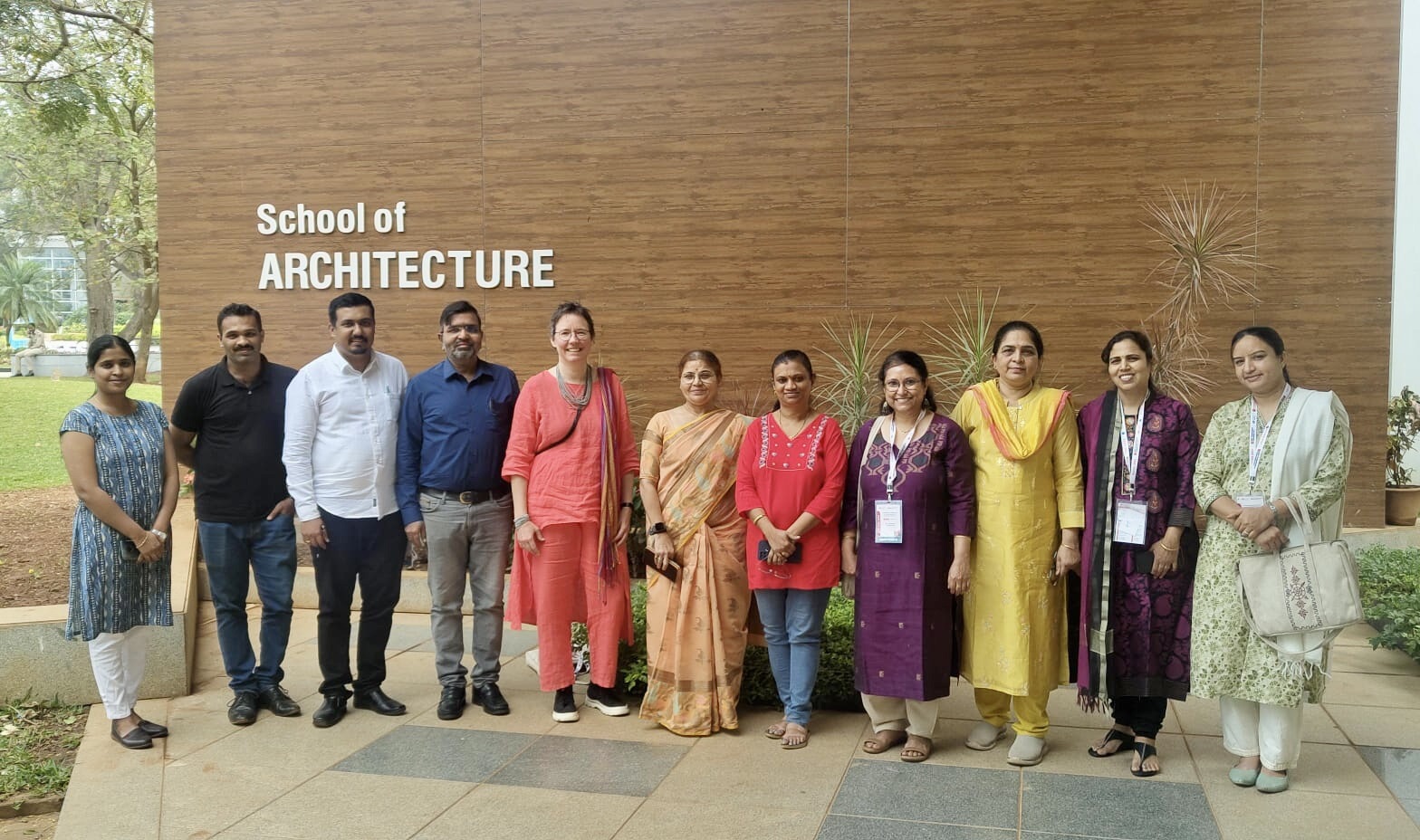
Here are the lovely photos they took of that impromptu seminar along with a photo of our whole group after that meeting.

You can see they made me feel like a rock star! The meeting was so much fun.
We’ve had a gap in communication since the conference ended, because I was on the lecture circuit (lol!) and then getting caught up back home and inducting a new cohort of BIM BSc students.

But my KLE architecture colleagues and I plan to hold online meetings in the near future to discuss examples of educational research in architectural education. I’ve agreed to help them envision, plan, and get started conducting education research.

One of the architects in the group emailed me later, asking me to share my own examples.

Reflecting on this request, I fear my own examples in this realm pale in comparison to my engineering education research. Architecture teachers tend to publish conference papers showing how they taught their class, and of these, my favorite among my papers reporting what might (optimistically) be called research-informed teaching or the Scholarship of Teaching and Learning (SoTL) would probably be Writing Architecture: The Role of Process Journals in Architectural Education and Beginning with Site in Architectural Education.

However, engineering education research is more rigorous than SOTL.

Although ‘engineering education’ conferences will allow the publication of reports on ‘how I taught my class’, the ‘engineering education research’ journals want empirical research studies. You have to collect and analyze data in a rigorous way. An example of this type of work is the book chapter Designing the Identities of Engineers, for which I collected surveys and compared results statistically between ‘engineering’ and ‘engineering technology’ students. The biggest difference I found, and my team reported, was that the ‘engineering’ students envisioned themselves as designers, whereas the ‘engineering technology’ students did not.

Another worthwhile example is my conference paper, where I first reported the design of the study as the Background and Design of a Qualitative Study on Globally Responsible Decision-Making in Civil Engineering and then published the results in a few different ways. The journal article Above And Beyond: Ethics And Responsibility In Civil Engineering reports what the civil engineers I spoke with discussed about ethics, whereas Opportunities and barriers faced by early-career civil engineers enacting global responsibility provides a more holistic report of what we found overall. The official ‘industry’ report of the study is called the Global Responsibility of Engineering Report and it was published by Engineers without Borders UK.

My primary research group, the European Society for Engineering Education (SEFI), embraces architects as if they are engineers, which is a reason I identify so strongly with SEFI. Yet, SEFI doesn’t have a special interest group in architecture or architectural engineering, even though the American Society for Engineering Education (ASEE) does have an Architectural Engineering division. ASEE’s Journal of Engineering Education rarely publishes research on architecture education.

In contrast, SEFI’s European Journal of Engineering Education, for which I am Deputy Editor, has been reviewing an increasing number of articles on architecture and construction-related topics in education. I suspect that’s partially because I have the interest, capacity, and collegial networks to help support such articles’ review, refinement, and publication. But I also have amazing mentors in my Editor-in-Chief, Dr. Kristina Edström, and co-Deputy Editor, Dr. Jonte Bernhard. They are encouraging me to build capacity in this realm. And they understand that building the cadre of reviewers with expertise in this area takes time, patience, and much enthusiasm!

Our merry band of editors has ample patience and enthusiasm!
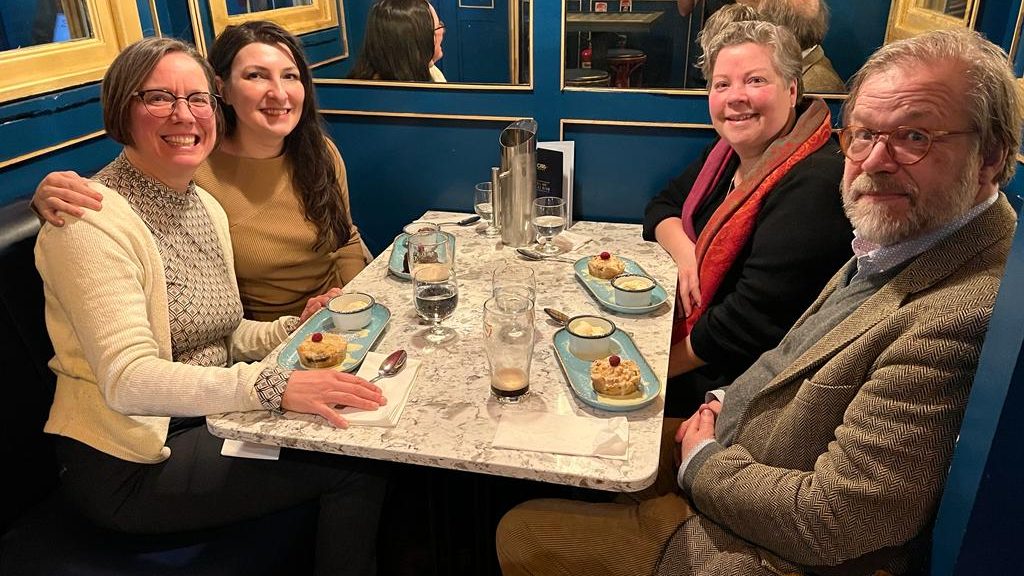
A past EJEE editors’ dinner in Dublin, with Dr. Kristina Edström and Dr. Jonte Bernhard (right), me and Diana Martin (soon to be appointed Associate Editor after impressing Kristina and Jonte!).

[Edit after posting: SEFI just launched a new journal that does publish SOTL papers, see: https://sefi-jeea.org/index.php/sefijeea/announcement/view/1! It says, “The SEFI Journal of Engineering Education Advancement offers a route to share ideas, emerging research, practice experience and innovations in the engineering education field.”]

In reflecting on what publications I have of my own that truly relate to architecture, I have identified Using Architecture Design Studio Pedagogies to Enhance Engineering Education as a favorite of mine. Unfortunately, it isn’t easy to find on search engines and the platform to download it is far from user-friendly. It doesn’t get the attention it deserves, but you can download it by clicking the title and see how you like it!

Another relevant work of which I am very proud is Comparing the meaning of ‘thesis’ and ‘final year project’ in architecture and engineering education. Yet this paper is more conceptual than empirically based and, thus, isn’t the best place to start the discussion with my colleagues at KLE Tech. I am delighted to report that it’s garnered nearly 1300 views since it was published, just 5.5 months ago.

A good place to start our discussion might actually be Comparing Grounded Theory and Phenomenology, an article I think is one of my best but has a very long and obscure title that I haven’t bored you with here!

My KLE Tech colleagues have a keen interest in architecture accreditation. These days, I am more engaged with engineering accreditation than with architecture accreditation (having uploaded a conference paper earlier today on engineering ethics accreditation, in fact). But in the past, I’ve been quite involved with the USA’s National Architectural Accrediting Board (NAAB), and my colleagues at KLE Tech are using NAAB’s guidelines to help them structure their programs. One day, they may seek affiliate designation from NAAB.

Near the end of REES, I found myself again spirited away to the now-familiar meeting room of KLE Tech’s architecture building to discuss accreditation options with Sharan Goudar and another colleague.
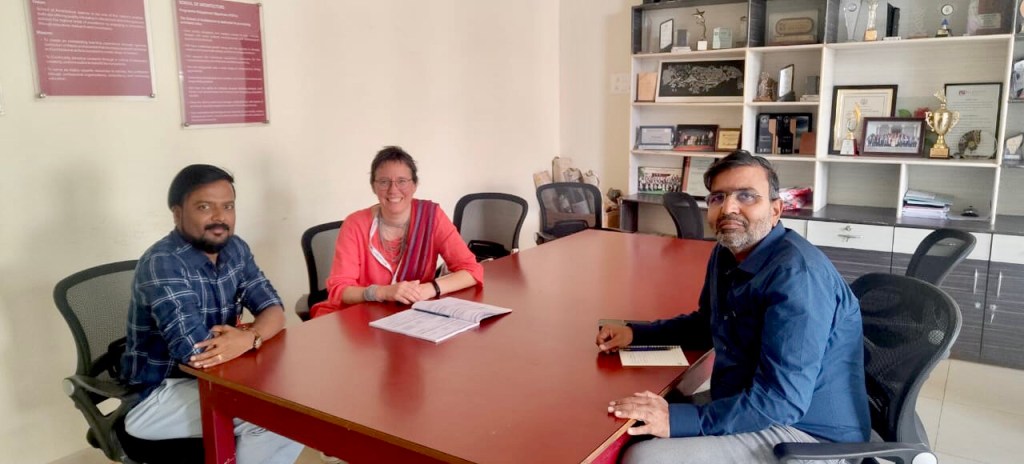
Discussing accreditation with Sharan Goudar (right) and colleague.

A text from Sharan encouraged me to finally craft this blog post, in fact. He responded to my recent blog Why India? Inspired by IUCEE and KLE Tech with a request for me to remember the architects:

Like Sharan, I, too, cherished the moments were shared in Hubli and I look forward to opportunities for more such moments, and a bit of hard (but fun and rewarding) research work, to boot!

My work with VIT Chennai and Dr. Nithya Venkatesan of the Internationalization Office may enable another trip to India, and I will make every effort to include a flight across to KLE Tech’s architecture department while I’m there.

These KLE architecture teachers are lovely, lovely people, and I look forward to getting to know them better and collaborating with them in both research and teaching.

Recap on SRHE: Eye-opening research on highly productive researchers and the history of higher ed

img_3054-1

I presented on the first day of the 2018 SRHE Conference in Newport, Wales.

The Society for Research in Higher Education (SRHE) met last week for its 2018 conference. On Day 1, I delivered a summary report on national education policies in relation to what female engineering students told me about school experiences that led them to study engineering.

SRHE is a UK-based organization and its annual meeting is held each December in Wales at the Celtic Manor near Newport, a high-end golf resort where the organization has garnered good deals by assembling mid-week, off-season. The place was decorated beautifully for Christmas and I got a room on the tenth/top floor, with views of the nearby hills. Because I’m a genuine geek, I attended seminars straight through and missed out on the facility’s lovely pool, ice skating rink, and challenge course. Despite missing those thrills, I found the seminars delightful. In this blog, I can’t describe all the fascinating things I learned at the conference, but I’ll share some overarching thoughts and impressions.

img_3140

View from my tenth-floor room of Celtic Manor.

The opening and closing keynote speeches were very interesting, and they bookended the conference by taking opposite approaches to study international trends in higher education.

Prof. Marek Kwiek delivered the opening keynote. He described how his mixed-methods research study was conducted. He collected over 17k surveys and 500 interviews across 11 European countries, and he identified eye-popping results that did not sit well with some conference attendees. Essentially, top earners in higher education in Europe are more research-oriented, they publish much more than other academics but they also work quite hard, spending more time than others on *all* aspects of academic work–including teaching, research, service, and administration. This goes against commonly held beliefs, and prior research, that suggests researchers successfully avoid work other than research.

Prof. Kwiek said the top 10% of researchers produce 50% of all journal articles.

Prof. Kwiek found that the top 10% of researchers produce 50% of all journal articles. Top-producers work a full two months per year more than most university teachers. They also collaborate with many others internationally when they publish. But what visibly agitated the audience was the demographics Prof. Kwiek identified with regard to these top performers: they are predominantly male, middle-aged, full professors, with a mean age of 47. Being that I’m 48, I am already behind–but more than willing to catch up!

I’m a quick learner, and now I have the code for success. In this case, Prof. Kwiek highlighted an inherent problem: that the variables that mean the most to promotions/progression, salary, and prestige consistently favor men. This is not a problem of Prof. Kwiek’s making, but it is a situation his data clearly showed.

img_3166

Meeting with my phenomenography mentor, Dr. Mike Miminiris and his US-based friend Marquis Moore.

The other bookend presentation, the closing keynote by Prof. Louise Morley of the Centre for Higher Education and Equity Research in Sussex, would highlight several relevant and important points in response.

One interesting point Prof. Morley raised was that the person who identifies a problem often comes to be seen *as* the problem. Another interesting topic she raised was that bias built into the system of higher education ties to our overall economic-political model called “neo-liberalism” and this makes it nearly impossible to escape. It’s like trying to avoid air. How can we step outside this model to properly credit diverse contributions, when all the measures of performance inherently favor mainstream versions of excellence and productivity?

To help me come to terms with much of this–and excel despite being culturally different–I bought Prof. Kwiek’s book “Changing European Academics: A comparative study of social stratification, work patterns and research productivity.” If you’re interested in the details he presented, you can buy the book. I’ve also included some slides of his presentation directly below, followed by more commentary and photos of other presentations:

img_3123

An extremely informative panel with Profs. Ellen Hazelkorn and Vikki Boliver and Kalwant Bhopal.

Although I am not a positivist (similar to Prof. Kwiek), I also haven’t adopted the critical perspectives that Prof. Morley uses. I haven’t entirely rejected the neo-liberal framework, and most of my research takes an interpretivist and/or constructivist stance in that I study the status quo prior to suggesting ways to change it. I do incorporate some aspects of critical feminism and critical race theory, but these are underlying principles, not the core paradigm I use.

With regard to neo-liberalism, back during my Ph.D. studies, I really enjoyed the class I had at William and Mary called “Finance of Higher Education.” My teacher, Prof. David Leslie, studied economic trends in USA higher ed and he identified patterns like this. He exampled that in the States, there’s a direct correlation between the discipline you teach in, the pay you’ll receive teaching in that discipline, and how traditionally male- or female-dominated the profession is. This means that in the USA, I can get paid more by teaching in an architecture or engineering department than in an education department. I did look this up and found it shockingly true.

img_3178

Dr. Maryam Al-Mohammad presenting on “global citizenship” alongside Dr. Neil Harrison, both from UWE.

Fortunately, in European higher ed, the pay grades are less inherently tied to gender. On the whole, there seems to be better pay equity among disciplines in the European academy. Despite the fact that there is more equitable pay for equal work, men still reach the top echelons of higher education management/administration (and research) at much, much higher rates than women. Ireland, for example, is far behind the US where many university and community college (the US equivalent of the Irish IoT) presidents are female.

So, yes, bias regarding gender, ethnicity, physical ability, etc., etc., etc. is still extremely pervasive. Understanding bias, and visualizing why and how it happens, can help us remedy the problems.

So, even though the findings Prof. Kwiek presented were gloomy overall, he did provide me with helpful ideas for accelerating my career. I’ve been trying to break into publishing in a new discipline (I’ve moved from publishing in architecture education and education planning journals to publishing in engineering education) and the findings Prof. Kwiek reported will help me set, and meet, my goals faster. For me, having a road map of what it takes to succeed under current conditions is an important step in moving ahead and I thank Prof. Kwiek for providing such a guidebook.

A later speaker during Day 1 of the conference, Dr. Rachel Handford, noted that “possible selves” “can only include those selves that it is possible to perceive (Stevenson & Clegg, 2011; 233)” meaning that we learn what we might become and consider options before we act, but we need to see examples of possibilities first. I’ve always found this to be true, and I try to expose myself to many different people with different ways of working and seeing the world. They help me figure out what I want to be, learn, do and accomplish. There are photos of Dr. Handford’s presentation below, as well as presentations by Prof. Ming Cheng (on Chinese students studying abroad) and Drs. Cecelia Whitechurch and William Locke (on academic staff members’ techniques for gaining promotion).

I need to wrap up, though I would like to mention other highly-notable moments: three presentations on higher ed in South Africa, one presentation on low-income UK students studying abroad at elite US institutions, a fascinating panel that included Profs. Ellen Hazelkorn and Vikki Boliver and Kalwant Bhopal, a presentation by Drs. Maryam Al-Mohammad and Neil Harrison on “global citizenship”, and talks by historians Prof. John Tyler and Dr. Mike Klasser.

Prof. John Tyler delivered a keynote on the impact of WWI on higher education in Europe and his presentation was insightful. In the US, the aftermath of the Civil War and WWII were turning points for higher education. I’d say the Morrill and Hatch Acts which established the Land Grant institutions in the US mark the birth of the modern university in North America. These facilitated providing higher education to the masses. The federal government became involved in funding higher education. These funds expanded after WWII when our country needed to re-train returning vets and decided to provide money to send them to university. The US government also decided to fund research via universities, as it had worked well for the US to have Harvard run the top-secret Manhattan Project that developed the A-bomb and helped end the war. These are all things I learned in the “History of Higher Education” course I took at Old Dominion University in 2009. At SRHE, Prof. Tyler explained that the dawn of the modern university in the UK came after WWI.

In a paper presentation, Dr. Mike Klassen discussed his research on “the academization of engineering education in the United States and the United Kingdom: A neo-institutional perspective.” Dr. Klassen recently visited UCL (for our recent CEE strategy meeting) but I hadn’t learned what he was studying other than higher ed policy. At SRHE, I got to hear him present on the history of engineering education. I’m hoping that someday he’ll want to study overlaps between engineering and architecture education history and pedagogy development–again comparing North American and European traditions–and that the two of us can work together on this.

I left SRHE having forged many new contacts. I met so many people I’d like to keep in contact with and learned so many new ideas and research findings. I look forward to attending SRHE 2019 and speaking at an SRHE workshop, to be organized by Ann-Marie Bathmaker, in spring 2019.