The Elegant Archeology Museum of Ireland

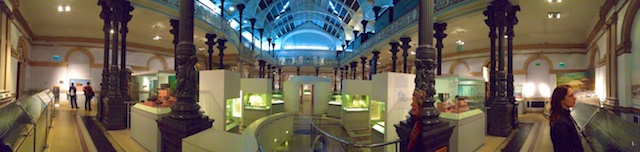
The Archeology gallery of the National Museum of Ireland is a chock full of fascinating treasures.  The building itself is also remarkable.  I’ve enjoyed visiting this place with both Esther Sterchi and Amanda Bernhard (the famous Fulbright student).  Of particular interest at this museum: numerous bog bodies, “prehistoric” relics, the Viking exhibition, and the unimaginably long wooden boat that was carved from a single tree trunk (see the panorama below).

I love the design of the Museum.  I wish I could see it without the skylight blocked out, though.

I love the design of the Museum. I wish I could see it without the skylight blocked out, though.

Snowy Sunrise

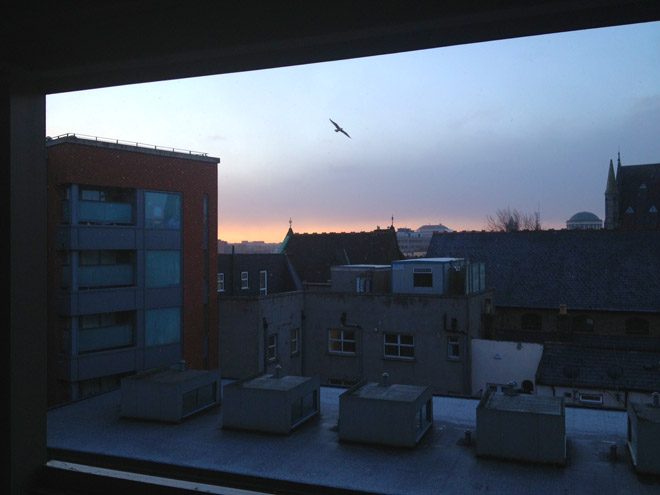
Snowflakes this morning… what a rare sight in Dublin.  It was just a light dusting of flakes, floating peacefully to the ground.  They’re mostly gone now.

snowy sunrise February 5

snowy sunrise February 5

Whisked Away

Clouds were rolling in under the setting sun in Dublin at 5:31 PM. By 5:35, the sky was gray.

20130203-173501.jpg

Defining the Street in Dublin and Ballsbridge

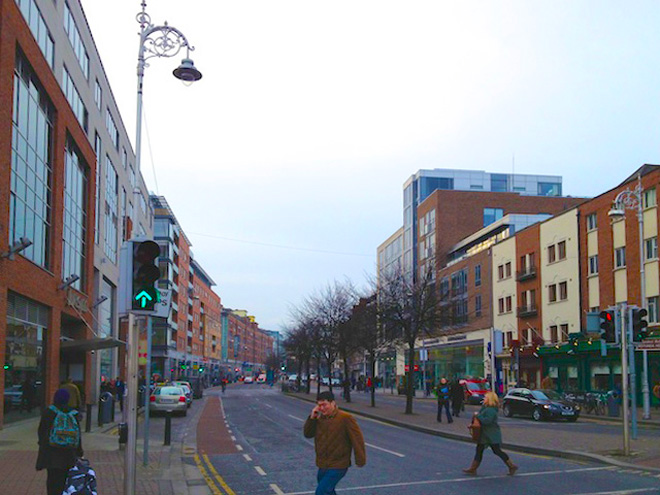
Parnell Street

Parnell Street

In my opinion, good city buildings touch each other and define the street. They don’t have to be glamorous to make good urban fabric. When building work together, they create good spaces for people to enjoy.

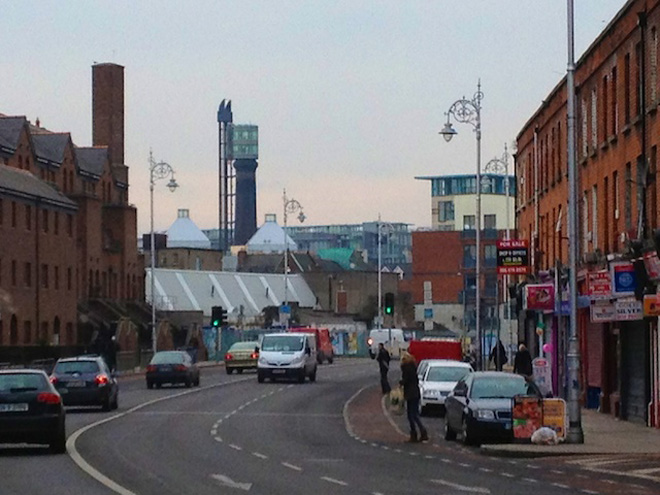
I’ll give two quick examples of clearly defined streets. These two streets are near my apartment in Dublin. Unfortunately, they are both designed for cars–not people.  Nevertheless, the buildings work together to define space. On Parnell Street, the buildings support a good mix of uses and are close enough together to provide the density of population needed to support ground-floor retail. Residential density is lower a few blocks away, on North King, and ground-floor business are fledgling.

North King Street -- view toward the Jameson Distillery smokestack -- where density breaks down.

North King Street — view toward the Jameson Distillery smokestack — at the point where density breaks down.

Simply put, a proper mix of residential and office space is necessary to support ground floor restaurants and retail. By providing residential as well as working space, mixed-use districts are active throughout the day. Businesses can draw customers morning, noon, and night.

Having the right mix in your district ensures you’ll be able to get the services you need without getting in a car. (Oh, that we’d build this way in the States! Walkability is so rare in cities back home.)

I was reminded of all this last Thursday, when I travelled to the Fulbright office in Ballsbridge to help interview Fulbright applicants. It’s in the outskirts of Dublin. Although this is a suburban neighborhood, it is still dense by US standards. Notice that there’s more space between buildings in Ballsbridge than in Dublin city center, but that there’s still a good mix of uses/services. Nevertheless, some buildings contribute much more to the life of the street than others!

Why Winter is Comfy in Dublin

The red dots on this map show the locations of Portsmouth (left) and Dublin (right). (Base map was downloaded from a Regnum Christi blog post.)http://live.regnumchristi.org/2011/07/where-are-you-from/

The red dots on this map show the locations of Portsmouth (left) and Dublin (right). (Base map was downloaded from a Regnum Christi blog post.)

Winter weather in Dublin is often much like that in the costal region of Virginia where my house is.  The nearby water helps mitigate temperature extremes in each location.  (That’s partly because water heats up during the day and releases that energy slowly at night — keeping costal areas warmer than inland areas during winter.)

Like Portsmouth, Dublin rarely sees snow.  When a dusting comes, it quickly dissolves.

Both places near the brink of calamity with the slightest hint of ice or snow. The cities and drivers simply aren’t prepared to deal with it.

What’s interesting about all this is that Dublin is so very far north. It’s much farther north than, say, Fargo, North Dakota, where my friends have reported recent wind chills of minus 50 degrees Fahrenheit!?!! Yet it never gets that cold here!

In summer, however, Dublin doesn’t get nearly as warm as Portsmouth.

In 2003 Dave and I were in Ireland for the extended “heat wave” where temperatures reached 75 degrees Fahrenheit for at least two weeks.

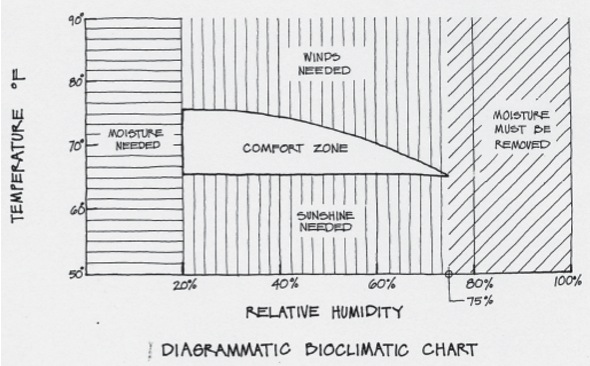
This chart shows the blend of temperature and humidity that most people in the States find comfortable. (Image from Shiller, M. (2004). Mechanical and electrical systems. Chicago: Dearborn Financial Publishing.)

This chart shows the blend of temperature and humidity that most people in the States find comfortable. (Image from Shiller, M. (2004). Mechanical and electrical systems. Chicago: Dearborn Financial Publishing.)

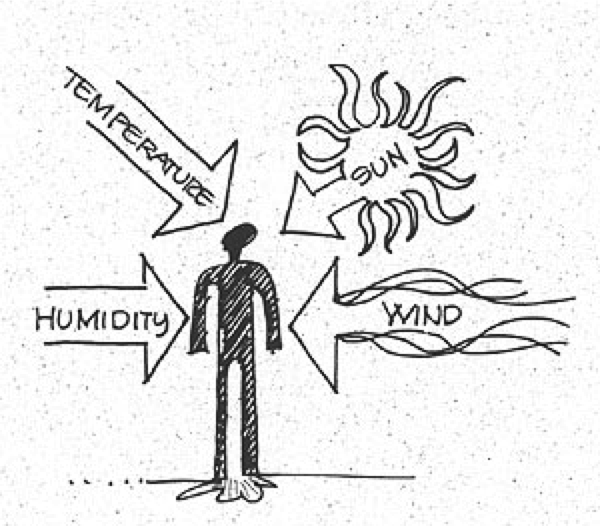
These factors affect human thermal comfort. (Image from the book Shiller, M. (2004). Mechanical and electrical systems. Chicago: Dearborn Financial Publishing.)

These factors affect human thermal comfort. (Image from the book Shiller, M. (2004). Mechanical and electrical systems. Chicago: Dearborn Financial Publishing.)

The humidity is terrible at home in the summer.  But here, the level of humidity is always quite comfortable.  The air doesn’t tend to hold a lot of water.  When it reaches the point of saturation that would be uncomfortable to most people, it drops the water in the form of rain.  So, Dublin gets some rain most days, but the shower doesn’t usually last long.  I don’t carry an umbrella because a lightweight coat and hat do a fine job keeping me dry.

Based on the chart above (that I use in the Architectural Ecology classes I teach at Hampton University), the humidity level in Dublin must stay between 20-75%.  Mother Nature must naturally remove the water as rain when humidity reaches a point over 75% here.  How generous of her!

Overall, Dublin enjoys a pretty good balance of the factors show in the drawing to the right (humidity, temperature, sun, and wind).

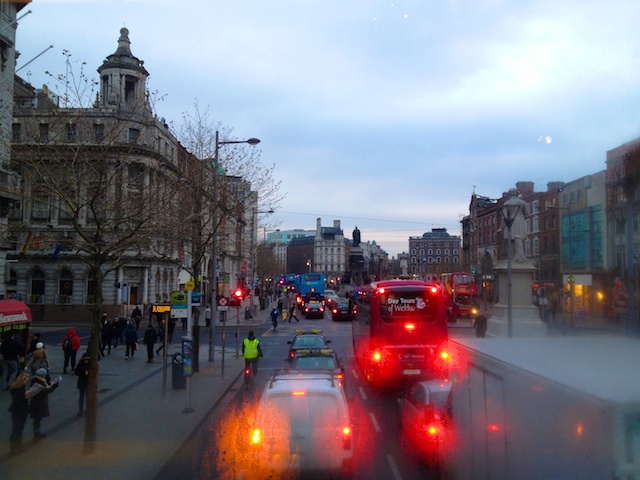
The weather was chilly this morning as I boarded the bus at O'Connell Street to go interview potential Fulbrighters -- but it was much warmer than in much of the USA!

Incidentally, the humidity in this picture is from the warm, wet breath of people riding the bus this chilly morning. The wet air tends to get trapped inside the bus.  And, it seems to be a bit more humid up top on the double deckers, perhaps because heat rises.

A great benefit of all this is that my laundry almost always dries within the day when I hang it inside the apartment — I have a clothes dryer here, but thankfully no need for it!  The air is dry enough here to absorb the water in the clothes as soon as I hang them.  It takes much longer for laundry to dry in my house in Portsmouth, even when the air conditioner is running overtime to such the water form the air.

Here, there’s no need for AC (except, of course, in buildings that were designed without regard for climate… who would overlook that!?!).

Fulbrights at “Work”

Because I blog about the experiences I’m having much more often than about than the research I’ve been doing, people sometimes ask me if I’ve been getting any work done at all.  The answer is, emphatically, YES!

The Fulbright program IS about doing scholarly work.  But it’s also about learning. It’s about making the space in our lives to get to know other people and how they do things… to remove ourselves from the ordinary humdrum long enough to learn something that’s radically new to us as Americans, but not new at all in other places.

Fulbright scholars DO have lectures to give, papers to write, and projects to conduct.  But in the end, the most valuable part of our experiences overseas rests in the friendships we make and the respect we build for each other’s culture.  That, I see, as my primary mission.

This type of cultural give-and-take is evident in the images I brought back from Tanzania — so I’ve decided to share a few here. Most are from the 2005 Fulbright-Hays program I conducted for college students from the US and Tanzania. You can also read about a lecture I gave on the topic of African architecture.  I’ll be delivering that lecture again in Belgium this spring….

Dedication and Perseverance Galore

Prof. Mason Andrews finally taking a minute away from her work.

Prof. Mason Andrews finally taking a minute away from her work.

Carmina Sanchez and Mason Andrews -- two amazing teachers!

Carmina Sanchez and Mason Andrews — two amazing architecture teachers!

I’m blessed to work with some incredibly talented and dedicated people at Hampton University.  Carmina Sanchez and Mason Andrews, with whom I teach architecture, are two of the hardest-working people I have ever known (and that, my friends, is really saying something!).

Carmina, Mason, and I are sincerely dedicated to the mission of our Historically Black College/University (HBCU).  We  work long hours to help our students master the craft of architecture.

And students in our program have achieved many amazing feats.  Much of their success is a result of professors like Mason and Carmina believing in them, working overtime again and again, introducing new ideas and new challenges, and opening doors for them along the way.

My colleagues’ work usually goes under-recognized, although Carmina has won a national-level teaching award from ACSA as well as one (that I nominated her for) from Hampton University.  She has also been a national officer of the Association of Collegiate Schools of Architecture (ACSA) and an international officer of the Association for Computer Aided Design (ACADIA). Carmina runs our thesis program and oversees our digital resources.  She’s at school all hours of the night and day.

Mason tends to work non-stop, too.  Prior to joining HU, she authored several books (one on Aldo Rossi). She also headed an architecture firm in NYC for many years before returning to her hometown in Norfolk. She felt the tug of family:  Her dad, after whom she is named, was once the mayor of Norfolk.  He led the effort to found the Eastern Virginia Medical School (EVMS).  I believe he also delivered the first in-vitro baby in the USA and helped fund the lawsuit that ended racial segregation in Norfolk Public Schools.  He was a truly remarkable man and passed many exceptional qualities on to his daughter.

Carmina also had exceptional parents who were dedicated to helping others.  Mason and Carmina both learned from their parents how to serve others.  Not a day goes by that they don’t.

I first met Mason through the Marilyn and Ray Gindroz Foundation.  I had asked the Gindrozes to support our department’s travel program and they enthusiastically agreed — providing time and money and even re-writing their foundation’s bylaws to include HU.  Mason was the president of their board.  (To this day, the three of them travel with our students in the summer as part of the study abroad program that each HU student must complete in order to earn a degree in architecture.)

The year I met Mason, I asked her to consider teaching with us… although I never dreamed she’d accept.

But she did!

And she’s brought so many opportunities to our students.  She’s connected us to a number of prestigious scholarships and internship opportunities.  She sees possibilities others don’t and makes possibilities where none seem to exist. She typically teaches 1-2 more courses each semester than required, just because she wants students to have opportunities to learn a comprehensive range of subjects.

This usually includes writing for architects and a travel-prep class.  One year, it also included courses on construction and solar technologies.

In 2009, she took the lead in getting HU teamed up with Old Dominion University so we could enter the 2011 Solar Decathlon.  She co-led the team that constructed a net-zero house.  The group hauled their house to Washington DC and reassembled in a handful of days so it could compete (in 10 areas, while being toured by thousands of people every day, for 10 days).

Hundreds of universities all around the world apply for the opportunity, but only 20 are accepted each go around.  Our team garnered 14th place overall in its first attempt — which is truly remarkable given the level of resources other universities have.

The Decathlon happens every two years, and HU is competing again in 2013 under the direction of professor David Peronnet who was also instrumental in our 2011 success.

I am honored to work with Carmina, Mason, and David.

And, Dave and I are fortunate to count Mason among our dearest friends.  Dave and I can drop by the home of Mason, Bill (her husband), and Alston (their son) any time and find open arms, stimulating conversation, and often a creative meal to boot!

I’ve included photos from the pre-Christmas, drop-by dinner that Dave and I enjoyed with Mason.

Mason's home on Norfolk's gorgeous Mobray Arch.  (In 1998, I lived in an apartment in the yellow house to the left of the tutor house.)

Mason’s home on Norfolk’s gorgeous Mobray Arch. (In 1998, I lived in an apartment in the yellow house to the left of the tutor house. Mason, Bill, and Alston moved in just as we were moving out, and I didn’t get to know them until years later.)

Revising and Rewriting

Gavin's curious five year old...

Gavin’s curious five year old…

Writing can be such a painful process. A few hours ago, I received critique from my two co-authors.  They recommended an entirely new structure; so I feel as if I’ve got to start over from *zero* with just two weeks until our deadline.

Such is the life of an academic.  The rug always disappears from under you at some point when you’re writing a journal article.  You just never see it coming in the way the way it actually arrives.  When it does, you have to I hang on for dear life — by whatever threads are left — in hopes that someday that paper will be good enough for people to want to read.

The notes I received were a bit cryptic, so I rang up Gavin, using Skype.

The best part of the call was that was I got to meet Gavin’s five-year-old son — yay!  Seeing how curious this little guy was reminded me that I can’t wait to see my five nephews next week!

…It’s just that I’ll just have to squeeze in lots and lots of paper writing in the meantime….

...interested in hearing about our work.

…interested in hearing about our work.

Full Tilt Sun Arriving at a Place Near You!

My friends Jonathan and Amanda are staying at my apartment in Dublin for a few days.  Their flight from Dublin to Germany leaves tomorrow morning.  Today, Jonathan posted this image on Facebook, to remind me of my second home.

In just three days, the sun will rise at its lowest position in the sky.  In other words, the closer we get to the winter solstice (which happens on December 21), the farther south of east the sun will rise.  This is true for all places in the northern hemisphere.

My balcony faces due south (although Jonathan took this picture facing southeast). So, normally, the sun rises behind the building that is pictured to the left in his photo.  Near December 21, the sun peeks up between the buildings in this view.

He framed the sun for me on at this significant time of year.

Sunrise at my Dublin abode, December 18, 2012.

Sunrise at my Dublin abode, December 18, 2012.  (Photo by Jonathan Kennedy.)