Sites and Sounds of Galway

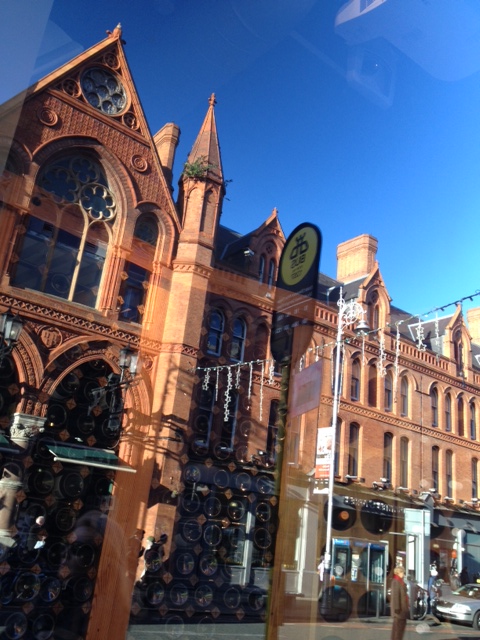
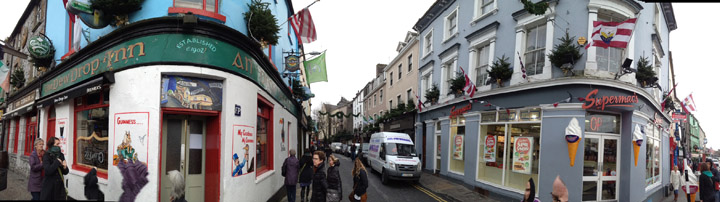
The Dew Drop Inn… ah, the memories!  It’s the namesake of this pub in Galway (the brightly colored building to the left).  My grandfather (Layton McCarthy Massie) worked with the real Pa Walton once once a time, in Virginia. If you watched the show, you’ll recall Pa had to travel to find work a few times.  It was one of those times.  The family (upon which the TV series was based) lived in Skylar, Virginia, whereas my grandpa lived closer to the West Virginia line.

I had a ball in Galway this weekend, visiting Amanda Bernhard and her husband Jonathan Kennedy.  Here’s a glimpse of some of the things we did.

We attended the Fulbright Association’s Thanksgiving Banquet on Friday and the Irish Music Club’s singing event on Saturday.

.

Electric Storage Heat

The bricks in my electric storage heater.

Electricity costs a lot in Europe.  Years ago I’d heard the cost was generally six times as high as in the USA.  As a result, the Europeans are more careful about the way they use energy.  They try not to waste it.

Many Irish homes use electric storage heat.  The system mimics adobe construction of the southwestern United States.  It uses “thermal mass” (in the form of bricks) to soak up heat when it’s free (from the desert sun) or cheaper (at night when purchased from the utility company in Ireland).

The bricks hold the heat until the air on the outside gets colder than they are, and then they release the heat they are holding into the air to warm it.

I’ve posted photos of Keith, the maintenance guy for my apartment building, checking one of my electric storage heaters. They’re a bit difficult to get started at the beginning of the winter season.  Mine needed extra attention because a toddler who used to live in this apartment stuffed small plastic items into the heating units. Keith had to clean them out.

In any case, I hope this technology keeps getting used and improved, as it’s a system that makes a lot of sense environmentally.

Get heated at night (when electricity costs less) and absorb the heat energy to release it during the day.

Thanksgivings Long, Long Ago

Here’s to memories of giving Thanks long, long ago.

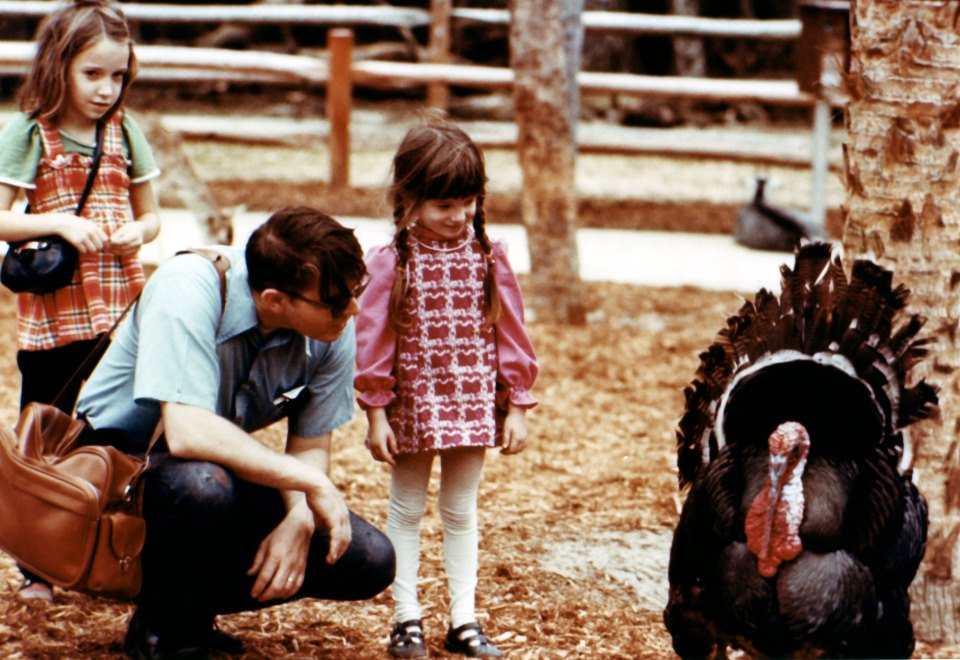
In the photo below my dad, my younger/only sister Heather, and I were admiring the glory of a wise, old, wild turkey.  Heather couldn’t bear to eat fellows like him, and became vegetarian by the age of 15.  See the genuine respect she has for him?  Remarkable, really!

She posted this photo on Facebook last night — to celebrate Thanksgiving — and I thought I’d pass it along so you can see a fall day in Virginia in the late 70s with two young kids in awe of the natural world.

Shannon and Don and Heather Massie admiring a fine wild turkey.

Upcoming Lectures

I’ve been asked to deliver two lectures at the DIT School of Architecture next week.

At 11 AM on Monday I will talk about How an Architect’s Material Palette Can Enhance Student Learning.

At 1:30 PM on Friday I’ll present What Can the LEED Green Building Rating System Do For You?

Both lectures will be held in DIT’s Linenhall. Please contact me via engineeringfulbright (at) dit.ie for information about how to attend.

Photo from Ireland, copyright Dave Chance Photography.

Blue Moon Today

The Post Office was holding a package for me and I was thankful for the opportunity to get out in the sunshine and walk.  I’ve sequestered myself in an attempt to get some work done on this research project.  I’m up to my eyeballs in coding and making good, but slow, progress.

The sky was glorious and the neighborhood interesting to see.  I’m posting a reflection just exactly as my camera saw it.

Blue Moon in Phibsborough. Copyright Shannon Chance 2012.

The Twinkle on Grafton Street

Christmas lights as seen in panorama from the corner of Grafton and Wicklow.

Frank McNally listed “23. Christmas lights in early November” as something he hates about Dublin (Irish Times, 15 November 2012).

Now, normally I bemoan Christmas selling creeping into every moment of fall, too.  But I have to admit that I’m taken by the holiday lights on Grafton Street.

Henry Street (the bustling pedestrian shopping avenue in Dublin that I’ve posted pictures of so many times before) isn’t yet illuminated. And it seems quite dreary by ten 0’clock in the evening. Not so on Grafton!

In these dark days of fall–when the Dublin sun sets around 4:30 pm–it’s fun to bask in the glimmer of lights on Grafton and Wicklow.

Third Spaces of Smithfield

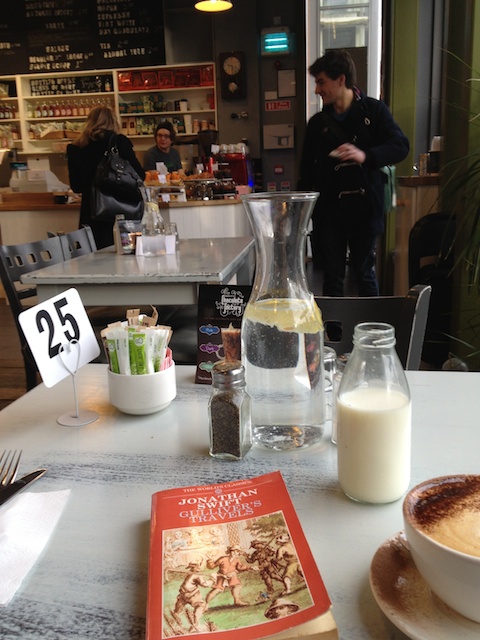
Browse the bookshelf.

A good “third space” helps fill the gap left between your home (your first space) and your workplace (your second space).  It should be a place where everyone feels welcome and equal–regardless of income or social status.

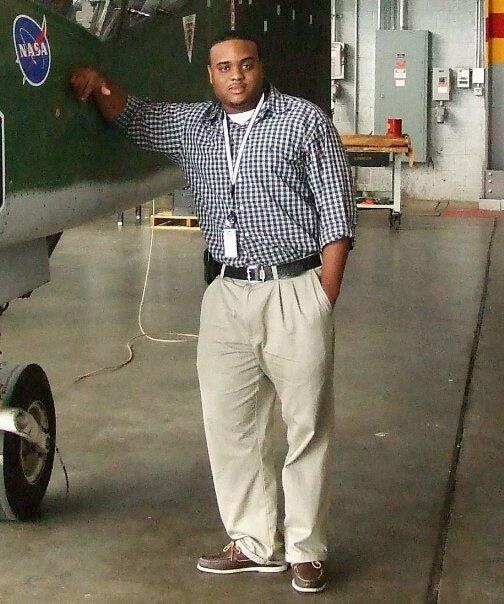
I learned about third spaces from one of my thesis advisees at Hampton University, Ryan Kendall, who asserted that we lack adequate third spaces in the USA.  He proposed to transform our beautiful (but increasingly vacant) Post Office buildings into vibrant spaces. He wanted them to be used for socializing, learning, developing physically, and yes, mailing things (in old- and new-fashioned ways). Prior to his thesis year, Ryan worked at NASA Langley. That happened the summer after he completed the Comprehensive Design Studio that I taught alongside Robert Easter. Ryan was a smashing success with NASA.  And the NASA folks have kept coming back, asking for more and more HU interns and for our department’s help on various design projects.

Ryan Kendall in his job at NASA Langley.

Ryan’s main point?

In the States we often neglect our third spaces… or fail to create them all together.

I’ve found that fostering “third space” is a core tradition in Ireland.  The pub has long served this purpose.

When Dave and I visited Ireland in 2003, we saw entire families spend their evenings engrossed in meaningful conversations with neighbors and friends at the various pubs we visited.  Kids ran in and out and people of all ages mingled happily and comfortably.  Although pub culture is not as strong today (the smoking ban took a tool on the pubs), it’s something you can still find in many places.

I’m fortunate to have several great third spaces very close to my apartment here in Dublin’s Smithfield neighborhood, a district also known by its postal code, “Dublin 7.”

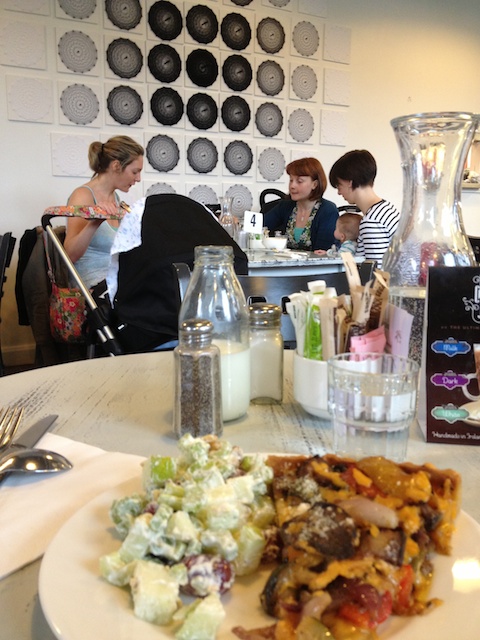
My favorite third space is the Cobblestone pub.  Another–where I’m starting to spend more and more time–is aptly called Third Space.

Third Space: changing the city around the table.

Bring some friends. Enjoy the art.

A webpage for the Third Space restaurant explains:

Our story starts in the changes Dublin saw in the “noughties”. Lots of new apartment blocks, lots of new offices and retail units – no gathering places. Living space and working space but no “third space”.

Third spaces are neighbourhood places where people can gather regularly, easily, informally and inexpensively.

Re-introducing such places into areas that lacked them became a passion for a small group of people. And so was born Third Space. It is a social business venture to open and run eating and meeting places in the areas of Dublin that lack community hubs. With a simple and great menu and an informal friendly environment, they will have a creative buzz that connects into the varied life of a modern Dublin neighborhood.

Third Space 1 opened in Smithfield on February 14th 2012.

I had an interesting encounter at both of my “third spaces” this week.  I’ll post them,  so you can see what I mean. Stay tuned! (Click here to read the sequel.)
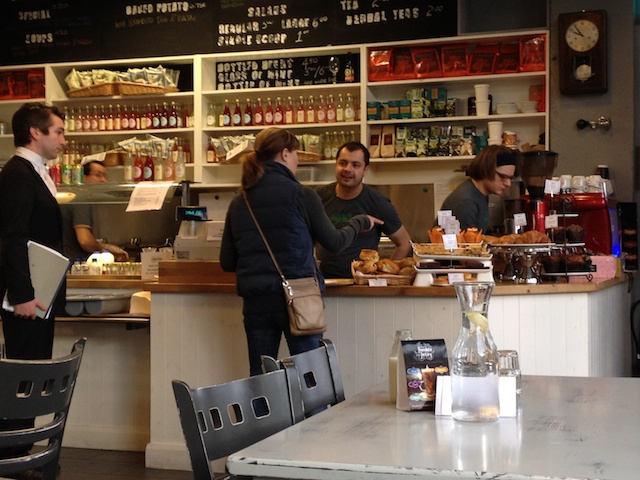
Grab a lunch. Everyone’s welcome and they’ll make you feel at home… even a barrister (i.e., lawyer, shown to the left) can find a quite place to reflect on the day, away form the busy halls of the Four Courts.
We’re Talking Mojo!

The Society of College and University Planners just sent out this email:

In four days there have been more than 500 downloads of this week’s featured Planning for Higher Education article. If you haven’t gotten yours yet, it’s available here for a limited time.We are already seeing some great Mojo discussion and blogging in response to Shannon Chance’s feature article “Learning from LEED & USGBC.” Chance is a registered architect and associate professor of architecture at Hampton University. Chance offers her insights on LEED & USGBC a model systems approach to sustainability for higher education planning. Like many other environmental and design professionals, she also recognizes its limitations.

Arlen Solochek agrees that “LEED and the resultant sustainability movement has been an absolute game changer for everyone.”  But while LEED has definitely “raised environmental consciousness,” it is not necessarily as “nimble and responsive” as it should be.  He also notes that LEED standards are becoming compulsory according to institutional and governmental regulation. Other limits include inflexible point system and the expense of soft costs and certification. Both Solochek and Chance agree that “the bigger issue is not just stopping at more sustainable buildings.  How many of our institutions are trying to infuse sustainable concepts into their academic courses, into their students’ and staff’s lives and habits outside LEED?” (Solochek).

According to Michael Haggans, Chance’s article “…balances criticism of the LEED ‘gaming-for-points’ process that many have seen in practice, with a well documented account of the evolutionary improvements that are now underway.” Alexandria Stankovich offers a student perspective on LEED & USGBC in relation to higher education planning on the Mojo blog.

If you’re going to 2012 GreenBuild, please pass this article around. And, please share in the Mojo what you learn.

Thanks.

Visit SCUP’s Planning for Higher Ed Mojo at: http://mojo.scup.org/?xg_source=msg_mes_network

What’s a MOOC? (And can it help us save humanity?)

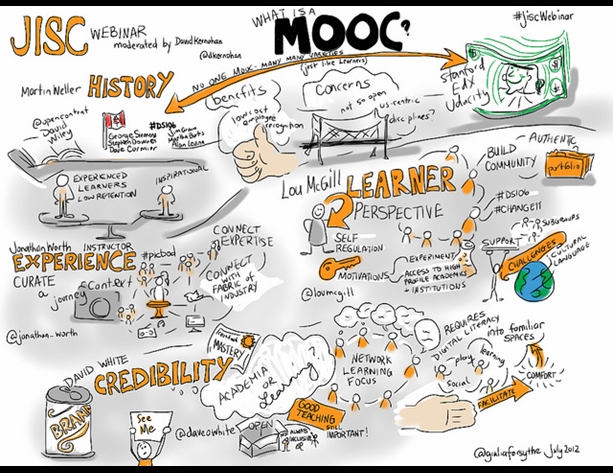
A diagram from Dave Cormier’s video.

I’ve been scratching my head, wondering “what’s a MOOC?”

Someone at SCUP sent me a helpful link to a succinct four-minute video by Dave Cormier that describes MOOCs and explains that the acronym stands for “Massive Open On-line Course.”  I also found a helpful blog posted by Lou Mcgill titled  What is a mooc? Massive Online Open Course and the learner perspective.

SCUP is using a MOOC to facilitate communication among its members.  I’ve been visiting SCUP’s MOOC for weeks now but I haven’t been able to “see the forest for the trees.”  I haven’t understood what’s going on all around me.  I find my way to some places that seem like classrooms and other places where discussion is going on, but I don’t yet understand how to navigate effectively.

Thanks to Dave and Lou I can finally stop scratching my head!  And, once I understand how the platform works, I can start using it to generate knowledge about planning and sustainability — rather that just about how to use MOOCs and the internet more effectively.

In any case, I believe that this on-line communication platform (i.e., SCUP’s MOOC) is the reason that my article got so many downloads so quickly after it went “live” on the internet.  The splash page for the article was viewed 644 times between November 9 and November 12.

To be honest, up until now I didn’t actually think people read the academic articles I’d published.  But now that I think about it, several people did contact me regarding an article I published with SCUP in 2010 titled Strategic by Design: Iterative Approaches to Educational Planning.  So perhaps SCUP’s audience reads and communicates more about its publications than is the case with many other organizations!

MOOCs provide a platform for learning that can help communities develop new knowledge quickly.  SCUP’s is aimed toward generating knowledge about how universities run and how they can improve their approaches over time.

Perhaps humanity will develop viable paths to achieving sustainability by using tools like MOOCs to share and build knowledge.  That’s part of the focus of my article just published by SCUP and something I think society MUST focus on if we are to persist on this planet.

But I’m quite interested in knowing more about how people work together to generate new knowledge.  The research project I’m conducting right now with Gavin Duffy and Brian Bowe (as part of my Fulbright) investigates how a group of teachers here at the DIT (i.e., a learning community) has been able to implement changes in the way DIT teaches Electrical Engineering.  These are topics I learned a lot about in the Ph.D. program I completed at The College of William and Mary on educational policy, planning, and leadership.

And interestingly, so many of the women I’ve bumped into recently–Esther, Joan, Máirtín’s wife, and myself–have been studying topics of leadership and change management.  Now that I’ve joined SCUP’s MOOC, I have found a whole new community discussing change, strategy, and the university’s role in addressing social and environmental issues. I hope we can elicit the types of sweeping change that this world needs, and do it fast enough to save ourselves.