The Only in Ireland Facebook page is a hoot. These two pics are sure to make you smile. They are relevant and true!

Irish life in the city. (Photo from Only in Ireland.)

Irish life in the country. (Photo from Only in Ireland.)
The Only in Ireland Facebook page is a hoot. These two pics are sure to make you smile. They are relevant and true!
Irish life in the city. (Photo from Only in Ireland.)
Irish life in the country. (Photo from Only in Ireland.)
Snowflakes this morning… what a rare sight in Dublin. It was just a light dusting of flakes, floating peacefully to the ground. They’re mostly gone now.
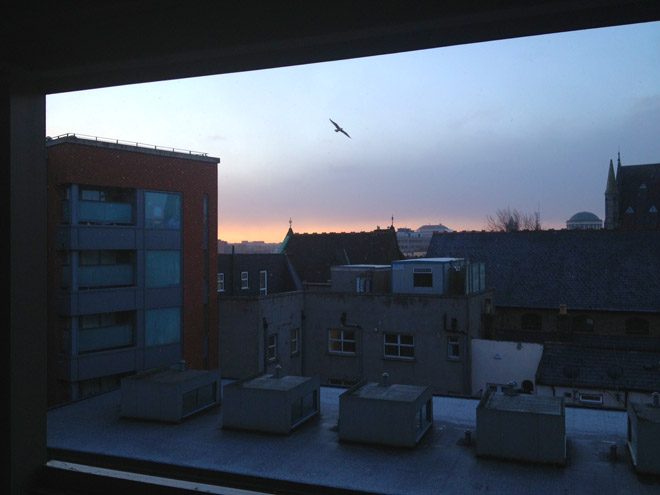
snowy sunrise February 5
You can read Fulbrighter Amanda Burnhard’s description of events this past weekend, by visiting her blog. Remember, it’s in Irish up top and English down below.
A chairde,
Beannachtaí oraibh ar an mhaidin ghalánta seo, ón bhaile eile atá againn i bhFal Corrib, Co. Dhún na nGall. Tá muid suite in aice leis an fharraige gharbh, agus tá an ghaoth thar a bheith láidir, ag corraí an fharraige agus ag cruthú tonnta ollmhór ar na carraigeacha. Seo an áit is fearr linn in Éirinn, agus cuireann sé solas inár gcroí a bheith anseo arís, ar feadh cúpla lá.
Tháinig muid go Tír Chonaill ó Bhaile Átha Cliath an uair seo, mar bhí orm bheith páirteach i dtionscadal físeain ag Fulbright. Bhí mé thar a bheith neirbhíseach leis an fhísean agus, i ndáiríre, níl mé cinnte dearfa cad é a dúirt mé os comhair an cheamara, ach tá súil agam go raibh sé ceart go leor agus go léirigh mé na buntáistí Fulbright mar is cuí. Taobh amuigh den fhísean, chaith muid cúpla lá iontach sa chathair…
View original post 648 more words
Last week’s impromptu visit by (Fulbright student) Amanda Bernhard and her husband Jonathan Kennedy was a most welcome excuse to visit the Cobblestone!
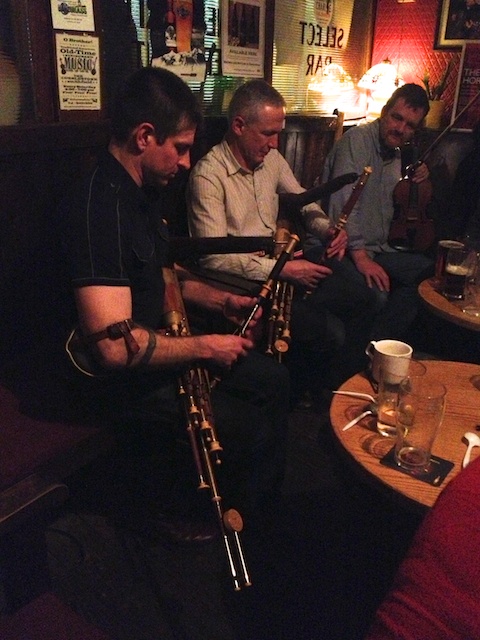
Jonathan Kennedy playing uilleann pipes with an Irish man he has played pipes with the United States.
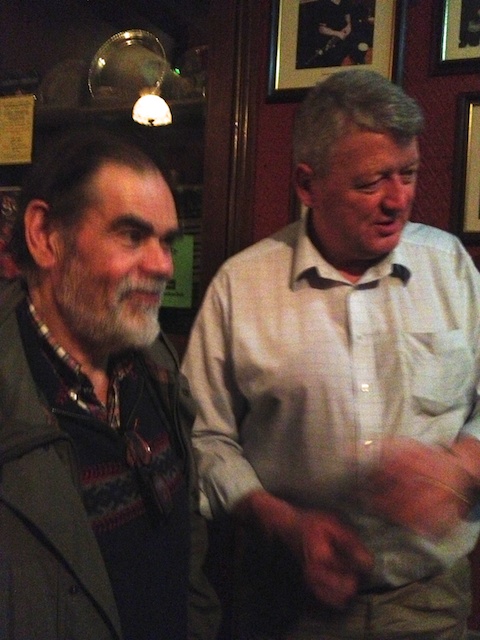
A casteen player with Tom Mulligan. Tom’s doing his best to keep Irish traditions alive and thriving here in Dublin.
My friends arrived late in the evening Thursday after a day of Irish classes followed by a cross-country drive.
They took me out for dinner at L. Mulligan. Grocer then we popped back to my apartment to fetch their instruments and retraced our steps one block to Tom Mulligan’s Cobblestone pub.
The last two times Jonathan and Amanda went to the Cobblestone I wasn’t with them (they were staying at my apartment while I was away). They went on weekends and the musicians’ corner was already full. They didn’t play then, although they did introduce themselves to Tom.
Last Thursday, however, they found space to play alongside the Irish musicians. We had a great time and enjoyed meeting new people, seeing Tom, and catching up on recent events.
After talking with Tom, I finally understand how Fergus Whelan came to have close friends on both sides of the “Troubles.” He is/was both Protestant and Republican (though today he’s a peacemaker as per my earlier blog). Protestants are typically associated with the other side — usually sticking with the Queen, so to speak — while Fergus apparently supported the unification of Ireland and Irish rule for the entire island. See how much like the American Civil War it all was? As a Virginian, I too had family on both sides of a bitter conflict. And some tensions run high on that conflict even today….


Clouds were rolling in under the setting sun in Dublin at 5:31 PM. By 5:35, the sky was gray.


Dave Dorran working with students at the mid-semester trials for RoboSumo, March 2012. (Photo by Shannon Chance.)
Regarding my prior RoboSumo blog, Ted did read it and he wrote back:
Hi Shannon,
Thanks for writing about RoboSumo on your blog – that was a very pleasant surprise!!
As you anticipated, I do have an updated list of people currently tutoring on RoboSumo:
Although Damon Berry isn’t currently tutoring on the module, he remains closely involved in the broader DIT RoboSumo enterprise. For example, he and I travelled to Galway with the DIT student team on Saturday 19th January to take part in the National Intervarsity RoboSumo competition. And of course, Damon and I are still developing our “RoboSlam” begginers’ workshop for promoting engineering/programming/robotics, which we will hopefully be running again soon within DIT with an assorted cohort of guinea pigs (engineers, teachers, non-engineers, regular people, etc). Expect a call.
Ted

Richard Hayes leading the 2012 RoboSumo trials. (Photo by Shannon Chance, March 2012.)
_______________

Damon Berry advising a student at RoboSumo. (Photo by Shannon Chance, March 2012.)
_______________
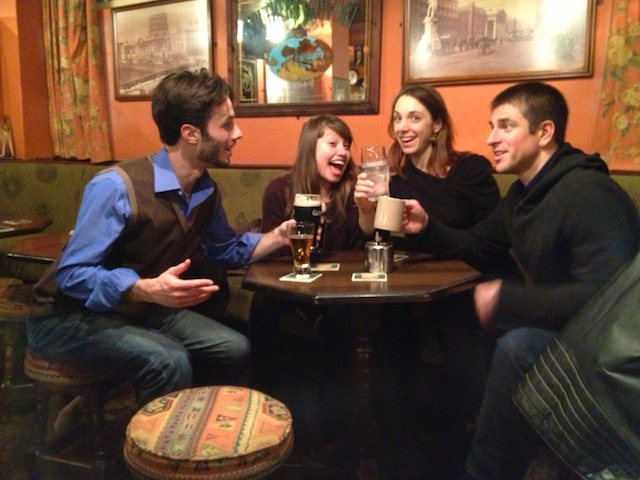
Fulbright Alexander MacDonald, his friend Nora Rodriguez, Fulbright Amanda Bernhard, and her husband Jonathan Kennedy at Hughes Pub last night.
Several of this year’s Fulbright Students to Ireland were invited to Dublin to be interviewed for a Fulbright video. They shared advice for others who want yo apply for student programs to Ireland. Fulbright was reimbursing their travel expenses but we were able to save them some money on housing; Amanda and her husband Jonathan stayed with me instead of a hotel.
After the interviews, two of the students, their significant others, and I went out to chat about our Fulbright experiences.
We found Jack Nealons pub too loud for easy conversation last night, so we skipped down the way to M. Hughes Pub. (Their names don’t have apostrophes in them. I’ve aimed for accuracy here….)
Hughes pub has the added benefit of being a late night venue. Last call is 2 AM at least on weekends, I do believe, while many other pubs stop serving hours earlier.
Hughes pub was perfect for the talking we wanted to do — the regular Friday night musicians were playing in the snug. Last night we sat outside the snug but we could still hear the music in the background. The level was very comfortable for talking and laughing. And that we did!
So what’s a snug? It’s an enclosed room, where in the distant past women were allowed to gather and drink. Back then, they weren’t allowed to be in the main (men’s) part of the pub. You’ve seen pictured of the snug before (It’s where brothers Gavin and Aidan Duffy play on Monday nights — I’ve attached a photo here in case you didn’t see that post).
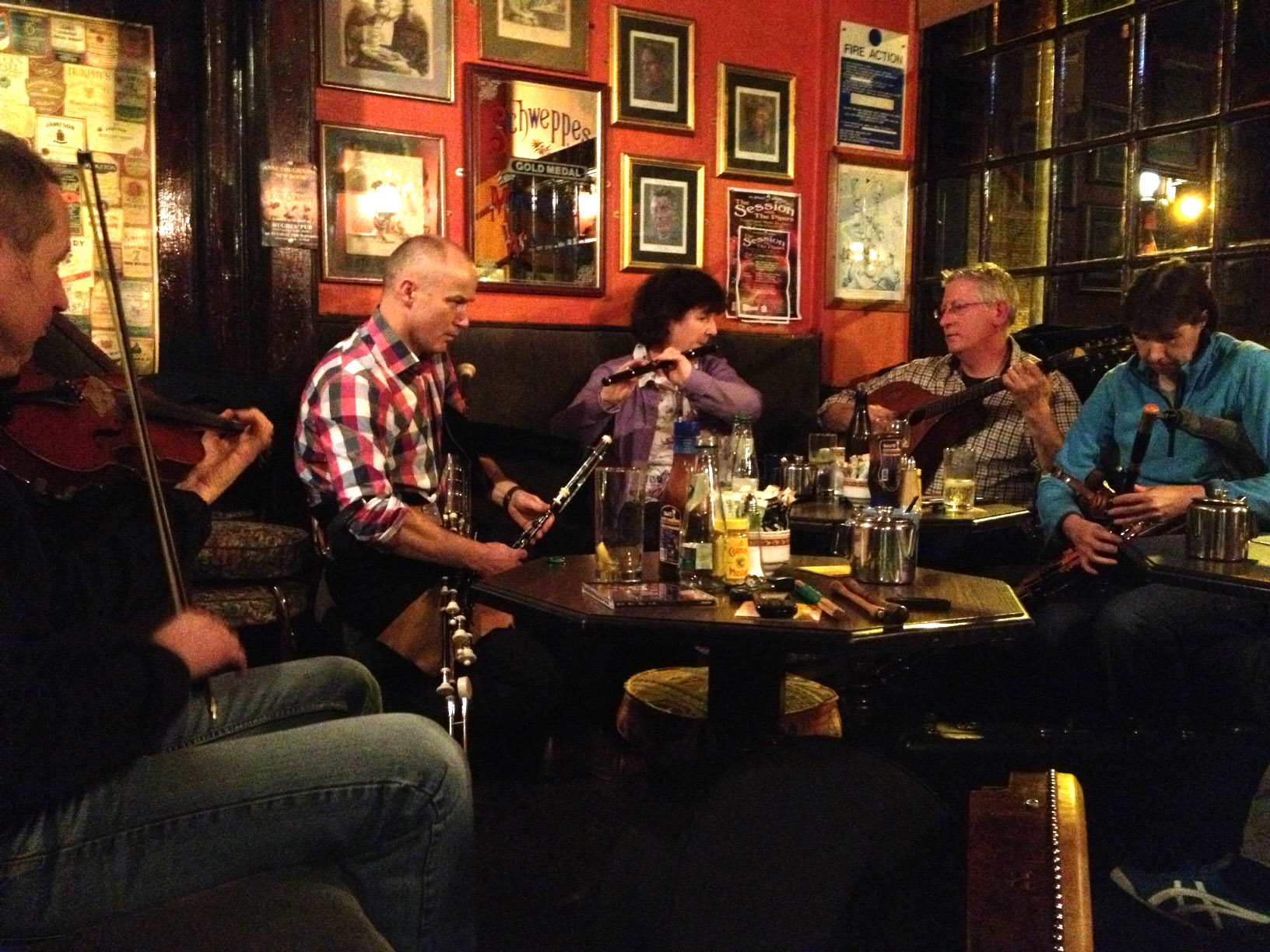
The Duffy brothers (to the left) playing in the snug at Hughes Pub last fall.
I learned all this from Saul Golden who teaches at the University of Ulster and whom I met at the All Ireland Architecture Research (AIARG) last weekend. You didn’t get to her Saul’s description, so I searched on line for a defnintion.
snug 2 (sn g)
g)
n. Chiefly British
We asked the bar man about the snug (to confirm my suspicions that that little room actually was one). We talked theory. We joked around. And, we had some fun with the camera. A little about the characters of the night:
Alexander MacDonald is a highly accomplished tap dancer who hails from New York City. He is currently working on a Master’s degree at the University of Limerick. He is studying enthochoreology (which is the history of choreography in various cultures). He’s got two tapping videos on line, one improv and one from a party.
His friend Nora Rodriguez is from Mexico. She is working on a Master’s degree in contemporary dance performance. It was the first time Amanda, Jonathan, and I got to meet Nora, and we enjoyed out time with her immensely.
If you’ve followed this blog, you already know that Amanda Bernhard is a Fulbright who is working on a Master’s degree in Irish at the University of Galway. Her husband Jonathan is enrolled int the same degree program. They are very excited about the dialectology (theory and study of dialects) course they are taking this semester.
Immersion experiences like the one we’re in prompt reflection. We’ve all be soul-searching. Our evening at Hughes’ gave us an opportunity to share our thoughts and experiences — and to consider them in new ways.

I wanted to get in the photo, too, so we all had to be very still while I took a panorama. In this photo Shannon Chance, Alexander MacDonald, Nora Rodriguez, Amanda Bernhard, and Jonathan Kennedy contemplate the photographic procedure.
Nora was fascinated by the story Amanda, Jonathan, and I told of the car fire we’d just witnessed beside my apartment building. She was captivated by the story but, just having seen Quentin Terintino’s newest flick, though the photo didn’t live up to the image our story had painted in her head. Nevertheless, I assure you the events were dramatic. Jonathan had insisted on taking a closer look, and as a result, we witnessed a lorry (i.e., truck) driver speed up to help. He jumped from his truck cab, extinguisher in hand, ran to the car and valiantly fought the blaze. The driver and her son had fled the vehicle after it burst into flames.
Amanda and I each recalled that time went into slow motion as we watched these event. We noticed many interesting details. We found the event to be quite dramatic!


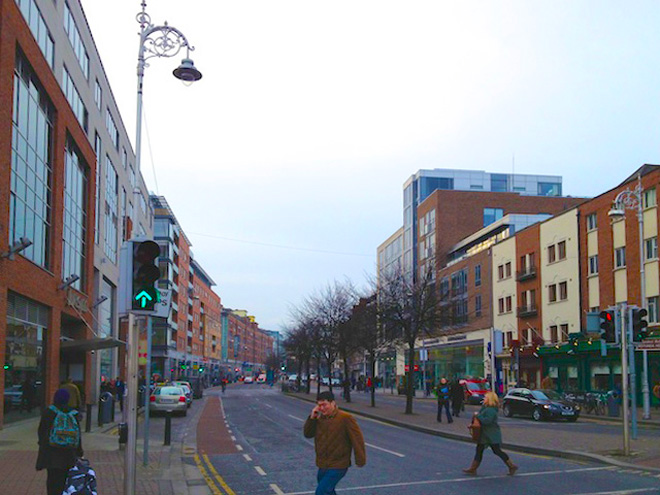
Parnell Street
In my opinion, good city buildings touch each other and define the street. They don’t have to be glamorous to make good urban fabric. When building work together, they create good spaces for people to enjoy.
I’ll give two quick examples of clearly defined streets. These two streets are near my apartment in Dublin. Unfortunately, they are both designed for cars–not people. Nevertheless, the buildings work together to define space. On Parnell Street, the buildings support a good mix of uses and are close enough together to provide the density of population needed to support ground-floor retail. Residential density is lower a few blocks away, on North King, and ground-floor business are fledgling.
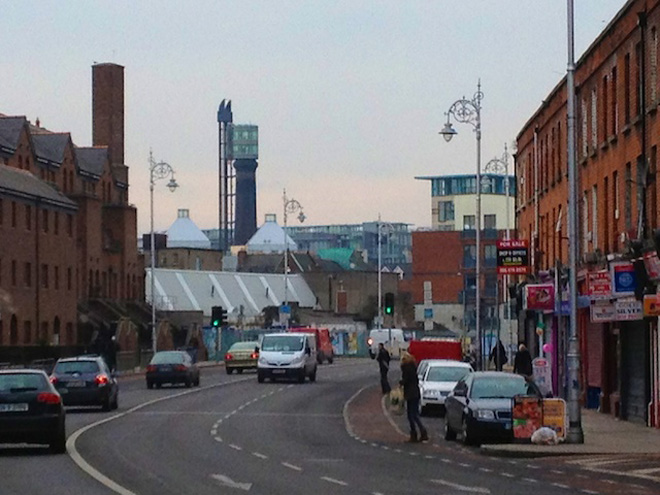
North King Street — view toward the Jameson Distillery smokestack — at the point where density breaks down.
Simply put, a proper mix of residential and office space is necessary to support ground floor restaurants and retail. By providing residential as well as working space, mixed-use districts are active throughout the day. Businesses can draw customers morning, noon, and night.
Having the right mix in your district ensures you’ll be able to get the services you need without getting in a car. (Oh, that we’d build this way in the States! Walkability is so rare in cities back home.)
I was reminded of all this last Thursday, when I travelled to the Fulbright office in Ballsbridge to help interview Fulbright applicants. It’s in the outskirts of Dublin. Although this is a suburban neighborhood, it is still dense by US standards. Notice that there’s more space between buildings in Ballsbridge than in Dublin city center, but that there’s still a good mix of uses/services. Nevertheless, some buildings contribute much more to the life of the street than others!



The red dots on this map show the locations of Portsmouth (left) and Dublin (right). (Base map was downloaded from a Regnum Christi blog post.)
Winter weather in Dublin is often much like that in the costal region of Virginia where my house is. The nearby water helps mitigate temperature extremes in each location. (That’s partly because water heats up during the day and releases that energy slowly at night — keeping costal areas warmer than inland areas during winter.)
Like Portsmouth, Dublin rarely sees snow. When a dusting comes, it quickly dissolves.
Both places near the brink of calamity with the slightest hint of ice or snow. The cities and drivers simply aren’t prepared to deal with it.
What’s interesting about all this is that Dublin is so very far north. It’s much farther north than, say, Fargo, North Dakota, where my friends have reported recent wind chills of minus 50 degrees Fahrenheit!?!! Yet it never gets that cold here!
In summer, however, Dublin doesn’t get nearly as warm as Portsmouth.
In 2003 Dave and I were in Ireland for the extended “heat wave” where temperatures reached 75 degrees Fahrenheit for at least two weeks.
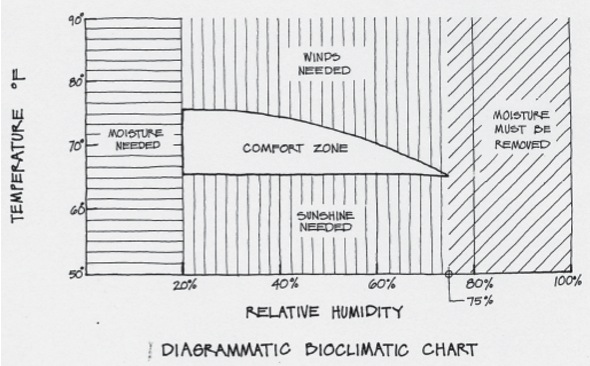
This chart shows the blend of temperature and humidity that most people in the States find comfortable. (Image from Shiller, M. (2004). Mechanical and electrical systems. Chicago: Dearborn Financial Publishing.)
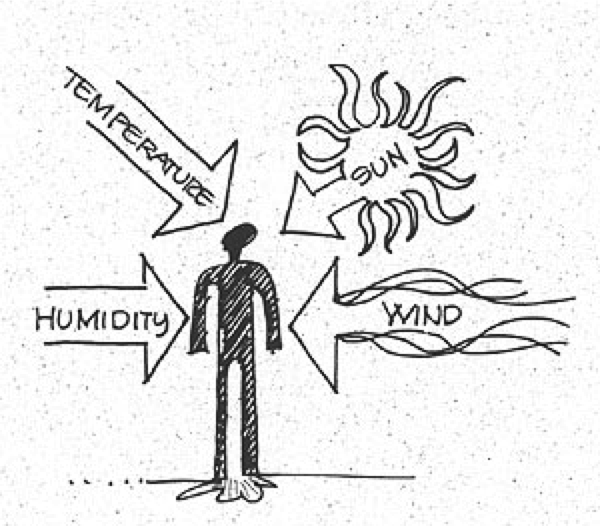
These factors affect human thermal comfort. (Image from the book Shiller, M. (2004). Mechanical and electrical systems. Chicago: Dearborn Financial Publishing.)
The humidity is terrible at home in the summer. But here, the level of humidity is always quite comfortable. The air doesn’t tend to hold a lot of water. When it reaches the point of saturation that would be uncomfortable to most people, it drops the water in the form of rain. So, Dublin gets some rain most days, but the shower doesn’t usually last long. I don’t carry an umbrella because a lightweight coat and hat do a fine job keeping me dry.
Based on the chart above (that I use in the Architectural Ecology classes I teach at Hampton University), the humidity level in Dublin must stay between 20-75%. Mother Nature must naturally remove the water as rain when humidity reaches a point over 75% here. How generous of her!
Overall, Dublin enjoys a pretty good balance of the factors show in the drawing to the right (humidity, temperature, sun, and wind).
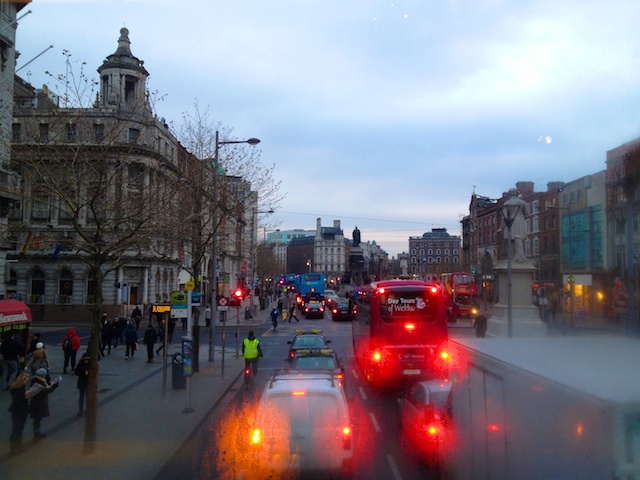
Incidentally, the humidity in this picture is from the warm, wet breath of people riding the bus this chilly morning. The wet air tends to get trapped inside the bus. And, it seems to be a bit more humid up top on the double deckers, perhaps because heat rises.
A great benefit of all this is that my laundry almost always dries within the day when I hang it inside the apartment — I have a clothes dryer here, but thankfully no need for it! The air is dry enough here to absorb the water in the clothes as soon as I hang them. It takes much longer for laundry to dry in my house in Portsmouth, even when the air conditioner is running overtime to such the water form the air.
Here, there’s no need for AC (except, of course, in buildings that were designed without regard for climate… who would overlook that!?!).

I’d never noticed this beautiful weathering panel on the Quay just east of the Four Courts. Lovely, isn’t it?
I’d snuck in one last trip to see the nephews this past weekend while I was back in the States. It was such fun, but I caught a bug that kept me in bed all day Monday. That prevented me from wrapping up my writing in a timely fashion and packing for my return to Dublin. I had to lean on my colleagues for help and then throw my bags together in the wee hours before my flight.
The resulting overweight bag set me back $200. And, I arrived in Dublin sans Irish credit card, bus pass, et cetera. I suppose those documents are at home in some very safe location. Dave has been in bed with the bug today and hasn’t yet located them. I spent the day pulling myself back together.
The sliver lining in this cloud is that a new bankcard is on the way. And on my walk to withdrawal cash I discovered wonderful new delights of Dublin.


 Ireland by Chance