Finding Gavin Duffy

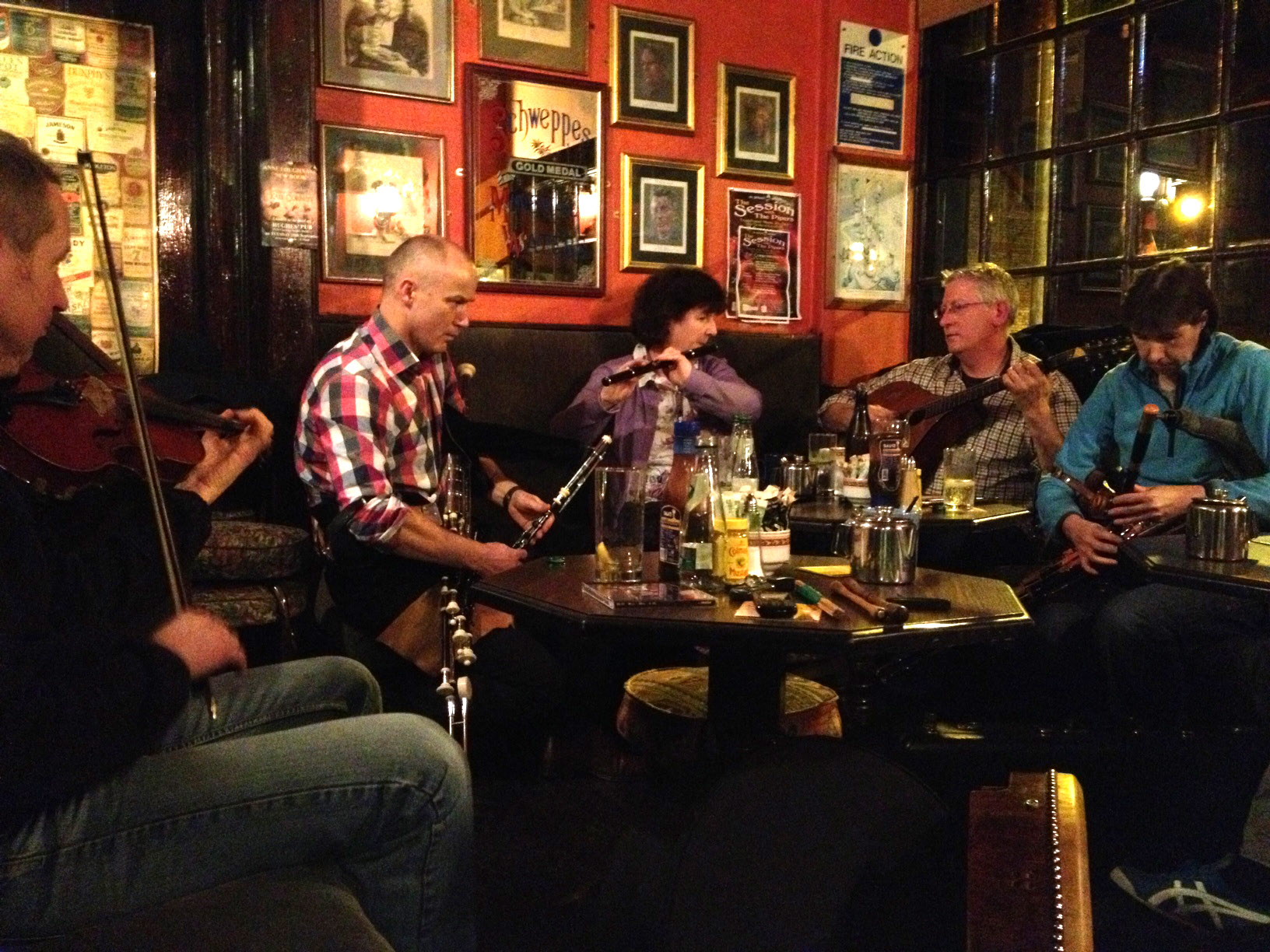
Gavin (left), his brother Aidan, and the Monday night musicians at Hughes Pub.

Finding Gavin Duffy has been a challenge lately.  This case is much different from finding Kevin Donleavy, but this story also ends in a pub.

November is notoriously hectic in the university world, and Gavin works so hard and teaches so many hours that he doesn’t have much time for lunch chatter these days.  In addition, he’s got his hands full at home with three growing kids and another (surprise!) on the way.  (Congrats are in order to Gavin and Carmel and their three very-happy-to-have-a-new-sibling kids!)

But I also want to do my job here, which is to help Gavin progress with his dissertation.  I want to make sure we’re ready to meet with his dissertation advisor Thursday.  We really need to have something new to say.  We need to show some progress — so as to use Rob’s (and our) time well.

In any case, I know I can track Gavin down in my own neighborhood once a week, when his group of musicians gathers to play at Hughes Pub.

We shared our research progress, quickly between songs last night, and had some fun in the meantime.

I’ve spent more than a little time at Hughes Pub this week.  Saturday night I went in at ten o’clock not knowing a soul.  I left at two in the morning with three new friends: Dubliners Kathleen, Sean, and Mick.

Paddy Woodward described the feel at Hughes as a fine suburban-style pub, if I remember correctly. I didn’t understand until I visited the back part last Saturday. I arrived with the tourist crowd…
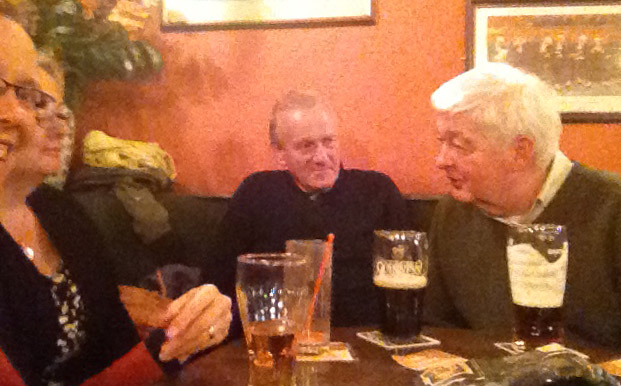
…and left with the locals. Thanks for tons of laughs Kathleen, Sean, and Mick!

Blue Moon Today

The Post Office was holding a package for me and I was thankful for the opportunity to get out in the sunshine and walk.  I’ve sequestered myself in an attempt to get some work done on this research project.  I’m up to my eyeballs in coding and making good, but slow, progress.

The sky was glorious and the neighborhood interesting to see.  I’m posting a reflection just exactly as my camera saw it.

Blue Moon in Phibsborough. Copyright Shannon Chance 2012.

The Song Collector

Researchers help define and preserve culture. Last night, I got to hear Len Graham (a researcher and collector of Irish ballads) sing songs he has collected over the decades. Here’s a YouTube video of Len performing “at the Big Muddy Folk Festival in Boonville, Missouri on April 4, 2008.”

Len called last night’s performance “It’s of my Rambles… Recollections of Singers and Songs from the Ulster Tradition.” He prefaced each song with an explanation of how and where it was collected and which demographic group claimed to have originated the song (Ulster, the Travellers in Ireland, etc.). He explained some of the meanings behind each song.

Len spends his life singing and tracking down songs and singers.  He transcribes and archives words and melodies so that they aren’t lost to humanity. He’s travelled to Australia to find people who know rare songs and to Arkansas to record missing verses to a known song. These are just a couple of the many travel stories he told.

Len Graham singing at Na Píobairí Uilleann. The placard to the left lists Alfie Mulligan, who I’ve posted a snippet of on this blog (playing uilleann pipes at his brother’s Cobblestone pub).

Here you can see what the uilleann pipes look like (photo downloaded from an online blog).  (There are lots of YouTube videos available of uilleann pipers.)

Len spoke of a time not so long ago when there were just ten or so uilleann pipers in all of Ireland. Today, he says, more than a thousand people play these pipes.

He’s part of a vibrant oral tradition of storytelling that’s alive in Ireland today. But the songs have also been recorded and archived in important libraries–such as the one here in Dublin and another at Brown University. A researcher from Harvard (named Child) did a lot of important research into Irish ballads back in the 1800s.

I especially enjoyed Len’s songs involving heather (the name of a flower that became the name of my sister).  I also found “When Irish men throughout this world are brothers one and all” to be quite catchy.

This event was part of Na Píobairí Uilleann’s monthly Notes & Narratives lectures, which the organization describes as a series of “performance-based lectures on traditional music, song and dance by some of Ireland’s finest traditional artists.” Last night’s event was held at the Na Píobairí Uilleann hall on Henrietta Street.

Thanks, Jonathan Kennedy, my fully-bright friend, for the heads up about this event. Hope you’re putting your uilleann pipes to good use out there in Western Ireland this weekend!

Presidential Acclaim

USDA Photo by Bob Nichols of Dr. William R. Harvey, President of Hampton University.

My university president made news today in an article in the Huffington Post.

Earlier today I received a letter from him, congratulating me for the article in Planning for Higher Education.  I realize that it’s fairly standard text, but it’s nice to be remembered… particularly after a long day of manuscript writing!

The paper I’m writing now won’t be published until 2014!?!  That’s par for the course in the land of academe.

We’re Talking Mojo!

The Society of College and University Planners just sent out this email:

In four days there have been more than 500 downloads of this week’s featured Planning for Higher Education article. If you haven’t gotten yours yet, it’s available here for a limited time.We are already seeing some great Mojo discussion and blogging in response to Shannon Chance’s feature article “Learning from LEED & USGBC.” Chance is a registered architect and associate professor of architecture at Hampton University. Chance offers her insights on LEED & USGBC a model systems approach to sustainability for higher education planning. Like many other environmental and design professionals, she also recognizes its limitations.

Arlen Solochek agrees that “LEED and the resultant sustainability movement has been an absolute game changer for everyone.”  But while LEED has definitely “raised environmental consciousness,” it is not necessarily as “nimble and responsive” as it should be.  He also notes that LEED standards are becoming compulsory according to institutional and governmental regulation. Other limits include inflexible point system and the expense of soft costs and certification. Both Solochek and Chance agree that “the bigger issue is not just stopping at more sustainable buildings.  How many of our institutions are trying to infuse sustainable concepts into their academic courses, into their students’ and staff’s lives and habits outside LEED?” (Solochek).

According to Michael Haggans, Chance’s article “…balances criticism of the LEED ‘gaming-for-points’ process that many have seen in practice, with a well documented account of the evolutionary improvements that are now underway.” Alexandria Stankovich offers a student perspective on LEED & USGBC in relation to higher education planning on the Mojo blog.

If you’re going to 2012 GreenBuild, please pass this article around. And, please share in the Mojo what you learn.

Thanks.

Visit SCUP’s Planning for Higher Ed Mojo at: http://mojo.scup.org/?xg_source=msg_mes_network

What’s a MOOC? (And can it help us save humanity?)

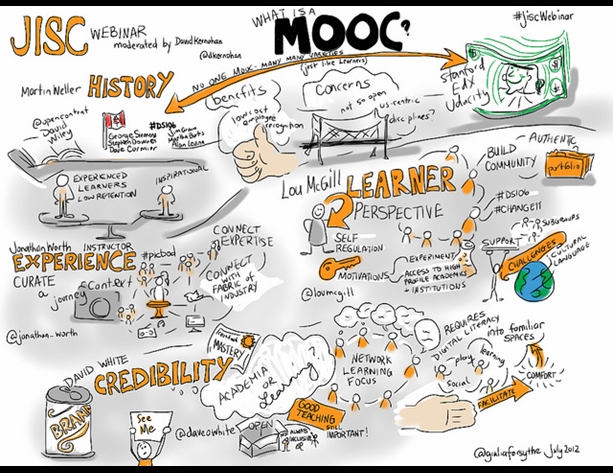
A diagram from Dave Cormier’s video.

I’ve been scratching my head, wondering “what’s a MOOC?”

Someone at SCUP sent me a helpful link to a succinct four-minute video by Dave Cormier that describes MOOCs and explains that the acronym stands for “Massive Open On-line Course.”  I also found a helpful blog posted by Lou Mcgill titled  What is a mooc? Massive Online Open Course and the learner perspective.

SCUP is using a MOOC to facilitate communication among its members.  I’ve been visiting SCUP’s MOOC for weeks now but I haven’t been able to “see the forest for the trees.”  I haven’t understood what’s going on all around me.  I find my way to some places that seem like classrooms and other places where discussion is going on, but I don’t yet understand how to navigate effectively.

Thanks to Dave and Lou I can finally stop scratching my head!  And, once I understand how the platform works, I can start using it to generate knowledge about planning and sustainability — rather that just about how to use MOOCs and the internet more effectively.

In any case, I believe that this on-line communication platform (i.e., SCUP’s MOOC) is the reason that my article got so many downloads so quickly after it went “live” on the internet.  The splash page for the article was viewed 644 times between November 9 and November 12.

To be honest, up until now I didn’t actually think people read the academic articles I’d published.  But now that I think about it, several people did contact me regarding an article I published with SCUP in 2010 titled Strategic by Design: Iterative Approaches to Educational Planning.  So perhaps SCUP’s audience reads and communicates more about its publications than is the case with many other organizations!

MOOCs provide a platform for learning that can help communities develop new knowledge quickly.  SCUP’s is aimed toward generating knowledge about how universities run and how they can improve their approaches over time.

Perhaps humanity will develop viable paths to achieving sustainability by using tools like MOOCs to share and build knowledge.  That’s part of the focus of my article just published by SCUP and something I think society MUST focus on if we are to persist on this planet.

But I’m quite interested in knowing more about how people work together to generate new knowledge.  The research project I’m conducting right now with Gavin Duffy and Brian Bowe (as part of my Fulbright) investigates how a group of teachers here at the DIT (i.e., a learning community) has been able to implement changes in the way DIT teaches Electrical Engineering.  These are topics I learned a lot about in the Ph.D. program I completed at The College of William and Mary on educational policy, planning, and leadership.

And interestingly, so many of the women I’ve bumped into recently–Esther, Joan, Máirtín’s wife, and myself–have been studying topics of leadership and change management.  Now that I’ve joined SCUP’s MOOC, I have found a whole new community discussing change, strategy, and the university’s role in addressing social and environmental issues. I hope we can elicit the types of sweeping change that this world needs, and do it fast enough to save ourselves.

Fulbrighters Sharing Ideas

I just received great news about my article from one of the editors of Planning for Higher Education.  Terry Calhoun left me this comment:  “Shannon, as of this morning, we have 345 article/summary downloads. So, people are reading, even if not yet commenting.”

I have to say: that’s a truly amazing number of downloads.  It’s a testament to the quality of the organization (the Society of College and University Planners) and its new platform for sharing ideas.
——–

Erin Eife and I discussed the ins and outs of applying to grad schools in between programmed sessions at the Fulbright Orientation.

On another note, Fulbright Ireland just posted a piece on taking the GRE in Dublin that was written by Erin Eife who is a recent college graduate who is conducting research on recidivism among females who have been jailed.

Erin and I sat next to each other at the Fulbright Orientation in September.  We got to talking about grad school and I answered some of her questions about degree paths and about selecting and applying to grad schools.
Erin has since written to thank me for the advice and let me know that she’s following through!  I love getting this type of feedback!  It’s not often that you hear you’ve made an important difference simply by sharing your experiences.
 Erin has got big dreams and I have every confidence that she’ll succeed with the applications she’s submitting this fall.

Mister Rodgers Remix

I grew up watching Mister Rodgers on TV–in black and white, of course!

The Public Broadcasting Station (better know as PBS) is keeping him up-to-date with this Mister Rodgers Remix.

It shows a true slice of our American Pie.  I’m listing this entry as “Education Research” since Mr. Rodgers was such a big contributor to US education in the 1970s.

Learning from LEED

The Society of College and University Planners (SCUP) just published an article about my dissertation research.  It describes how campuses have contributed to and gained from the Leadership in Energy and Environmental Design (LEED) program. You can download the paper or a brief synopsis using the links below.

Perhaps one of the USGBC’s greatest contributions to higher education lies in the model it providesas a large-scale learning organization.  This week SCUPers can enjoy reading Shannon Chance‘s 39-page article for Planning for Higher Education titled “Planning for Environmental Sustainability: Learning from LEED and USGBC.”  Because this is a long article, we’ve created a “Mojo Summary Guide” to the article. The guide doesn’t replace the article, but … well, you tell us what you think the Mojo Summary Guide does for you. Is it worth assembling?

What can SCUPers learn from LEED and from USGBC? Chance reports on her analysis of how institutions have used LEED, how the use of campus LEED has changed over time, and exhorts colleges and universities to both support USGBC and also learn from its structure as a learning organization.

Now, it is time for colleges and universities to step up their game. They should become leaders in green construction—not just followers that use a system designed, for the most part, by others. They must generate and apply new knowledge to help society achieve lasting sustainability. They must create buildings that do more to model good behavior, impart environmental values, and teach students about the environment. And, finally, they must re-design their funding mechanisms to facilitate comprehensive approaches to sustainability.

They should take cues from the USGBC about how to learn from experience and integrate feedback. Perhaps one of the USGBC’s greatest contributions to higher education lies in the model it provides as a large-scale learning organization. As an organization that monitors its own progress and continually revamps its systems, the USGBC has been able to achieve a visible and much-needed shift in American culture. American colleges and universities need to follow suit and become more proactive in the areas of environmental research and green construction.(emphasis added)

Visit SCUP’s Planning for Higher Ed Mojo at: http://mojo.scup.org/?xg_source=msg_mes_network

Focus on the Student

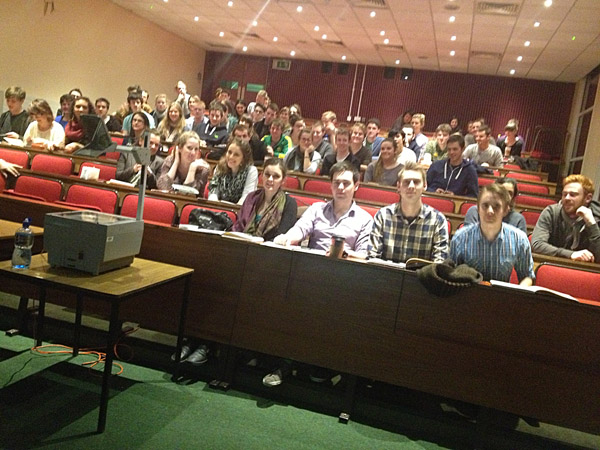
All these students voluntarily attended two back-to-back lectures last night–isn’t that amazing?

The Architecture Student Association got a great turn out for its symposium on the architecture student last night!  I’ve posted a photo of the crowd that made it all the way to the end of the two lectures… pretty amazing.  They came straight out of a day of classes into the lecture hall!

Maxim Laroussi of Architecture Republic talked about growing up in Morocco as well as what he learned about architecture by living in France, England, Scotland, Brazil, and Ireland.  Very interesting indeed!

Then I talked about “Learning Together” and how we can/should improve the way we teach architecture.  The main idea is that we need to focus more on understanding how students learn rather than on what content teachers deliver (i.e., what they say in class).

The speakers and organizers for last night’s ASA symposium: Andrew Ó Murchú, Shannon Chance, Colin Mac Suibhne, and Maxim Laroussi.