Please visit our RoboSlam website for new photos about Body Building!
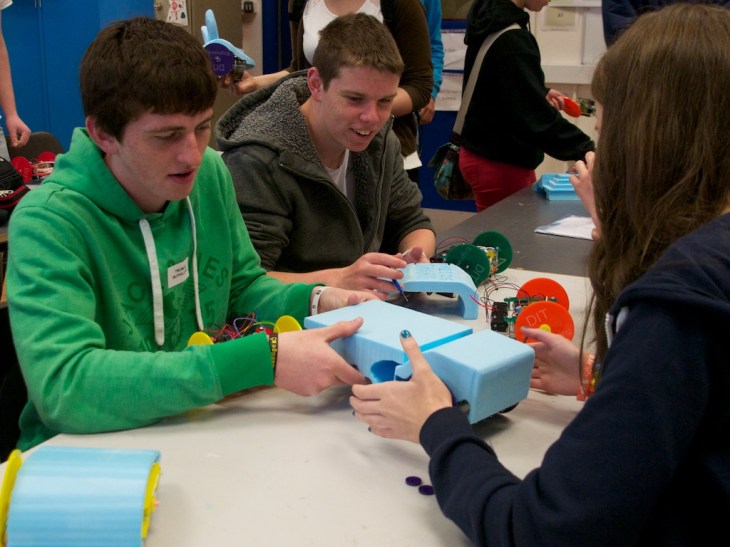
Please visit our RoboSlam website for new photos about Body Building!

Seminar with engineering teachers from the University of Minho who use PBL. (It was very cold in the room; everybody is huddled for warmth!)
These photos are from my trip to the Guimarães campus of the University of Minho — to visit engineering professors and tour the Department of Production Systems, at the university’s Engineering School.
My primary host there, Natascha van Hattum-Janssen, has been working as a Senior Researcher, Research Centre in Education. She has amassed quite an impressive record of publications. Her husband, Ferrie van Hattum, is a Polymer Engineer and has been serving as the Course Director of the Product Design degree program of the University of Minho, although both of them are now relocating to an institute in the Netherlands.
Natascha and her colleagues organize the annual PAEE symposium. The PAEE website explains:
The Department of Production and Systems of the University of Minho, the Research Centre for Education of the University of Minho, the Iberoamerican Association of Engineering Education Institutions (ASIBEI) and the Curriculum Development Working Group of SEFI – the European Society for Engineering Education – aim to join teachers, researchers on Engineering Education, deans of Engineering Schools and professionals concerned with Engineering Education, to enhance active learning approaches in Engineering Education through workshops and discussion of current practice and research.
The Fifth International Symposium on Project Approaches in Engineering Education PAEE 2013 will take place in the Netherlands and is hosted by the Eindhoven University of Technology.
I served as a paper reviewer for this year’s conference and I hope to attend an PAEE event in coming years.


Robert Beichner, a professor at North Carolina State University, delivered a fascinating lecture at DIT’s Learning, Teaching and Technology Centre (LTTC). He discussed the way he teaches large groups of math students using hands-on approaches.
His approach is called “SCALE-UP” and is being used today at many universities — including MIT, Virginia Tech, and Old Dominion University (just miles from my Portsmouth home).
SCALE-UP stands for “student-centered active learning environment with upside-down pedagogies.”
Dr. Beichner tracks the learning that accrues using this format and has identified impressive results. For instance, using this approach, the top students actually reflect the biggest learning gains. Evidently, by teaching their peers as their teams work to figure out complex problems together, all the students learn a great deal. The top students seem to make the most new connections in their brains, however, which runs counter to common belief that top students get pulled down by “wasting time” explaining things to students who lack understanding.
Dr. Beichner teaches in classrooms of 99 students, he lectures for just ten minutes at the start of each class then gives the students a problem to work out for the following week. The students work in teams of three, and he always makes sure a student from the top 1/3 of the class is in each group. He compares learning gains of the students in the SCALE-UP classes with students in traditional lecture courses.
The SCALE-UP website explains:
Rigorous evaluations of learning have been conducted in parallel with the curriculum development effort. Besides hundreds of hours of classroom video and audio recordings, we also have conducted numerous interviews and focus groups, conducted many conceptual learning assessments (using nationally-recognized instruments in a pretest/posttest protocol), and collected portfolios of student work. We have data comparing nearly 16,000 traditional and SCALE-UP students. Our findings can be summarized as the following:
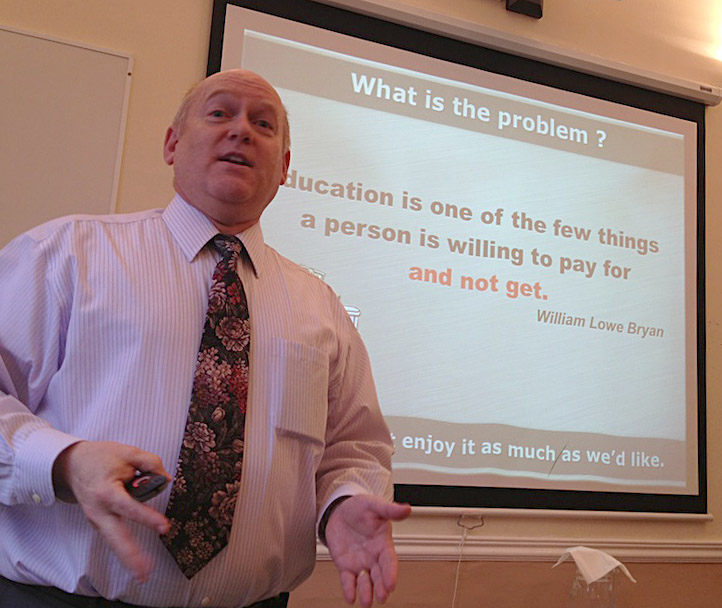
Dr. Robert Beichner from NC State
Please visit the RoboSlam blog to see the newest photos of our recent robot programming and testing activities. Here’s one of the featured photos form that post:

Engineering lecturers Frank Duignan and Mick Core explaining concepts to two Transition Year students at our May RoboSlam.
I’ve still got dozens upon dozens of images to post of robot building, but for now I’ll skip to the end and show you how things shaped up….
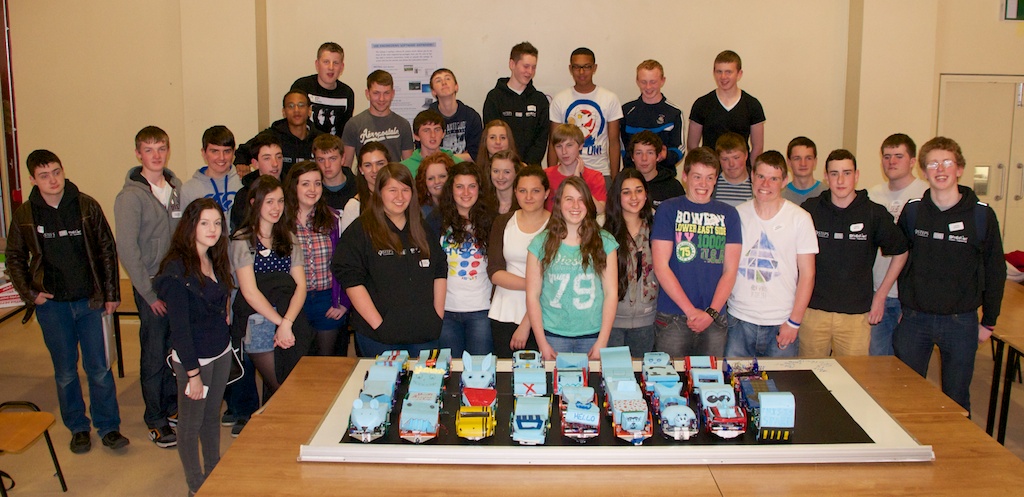
RoboSlam Group Photo
A huge “thank you” to the 37 amazing students who participated in RoboSlam last week… your enthusiasm for robot-building and dedication to learning made the week a success for us all!

Final Robots
Here are some of the lecturers who facilitated RoboSlam activities last Tuesday. What a wonderful group of people!

I’ve uploaded more RoboSlam photos at http://roboslam.wordpress.com/2013/05/21/just-getting-started/.
Here are a few of my favorites from this post–just to whet your whistle:


Please check out my newest RoboSlam post:
http://roboslam.wordpress.com/2013/05/19/learning-to-teach-bot-building/

Emma and Ryan with a their working robot.
 Ireland by Chance