Drawing (on) Gravity

Sometimes gravity is an architect’s friend.

In fact, architects can use gravity to human advantage in all sorts of ways.  In Ecology class today, I showed some diagrams of systems that use “thermosiphoning.”  That’s a fancy word referring to gravitation pull that moves fluids (like air or water).

The idea is that warm air (or water) rises and cold air (or water) sinks… because a  liquid is heavier and more dense when it is cold.

So, we can let gravity do the work if we think a system through.  Sometimes we need to move liquids in directions they don’t naturally want to go, and then we need to add electric pumps or fans to our systems.

Today, I showed my second year architecture students a tromp wall system as well as a diagram of an open loop solar hot water system.  In that type of system, you let the sun heat the same water that you will use to shower, wash dishes, or drink.

I also showed a few diagrams of basic heat exchangers… like the one in a car.  That one takes the heat from the combustion process and uses it to warm the air in the car without bringing in the “smog.”

The students were seeming to “get” the ideas, but they didn’t seem particularly jazzed up about them.  (I knew that because they were fidgeting and clearly wanted to text.)

To get them involved, I turned posed a problem for them to solve.

I asked them to pull out a sketchbook and combine the solar collector and the heat exchange into a single diagram.  They needed to figure out how you could use water with water with glycol (i.e., antifreeze) in it to collect the sun’s heat and then use that same liquid to warm the water for someone’s shower.

The challenge was to transfer the warmth into potable water without tainting it.  A couple of students caught on fast. After everyone had given it a try, I let them help each other.  More and more people got it.

At about the same time, I asked a four of the students who caught on quickly to draw their diagrams on the board and then explain how they worked to the class.  We all put our heads together to analyze the designs.

Gravitational Pull

cabins 2

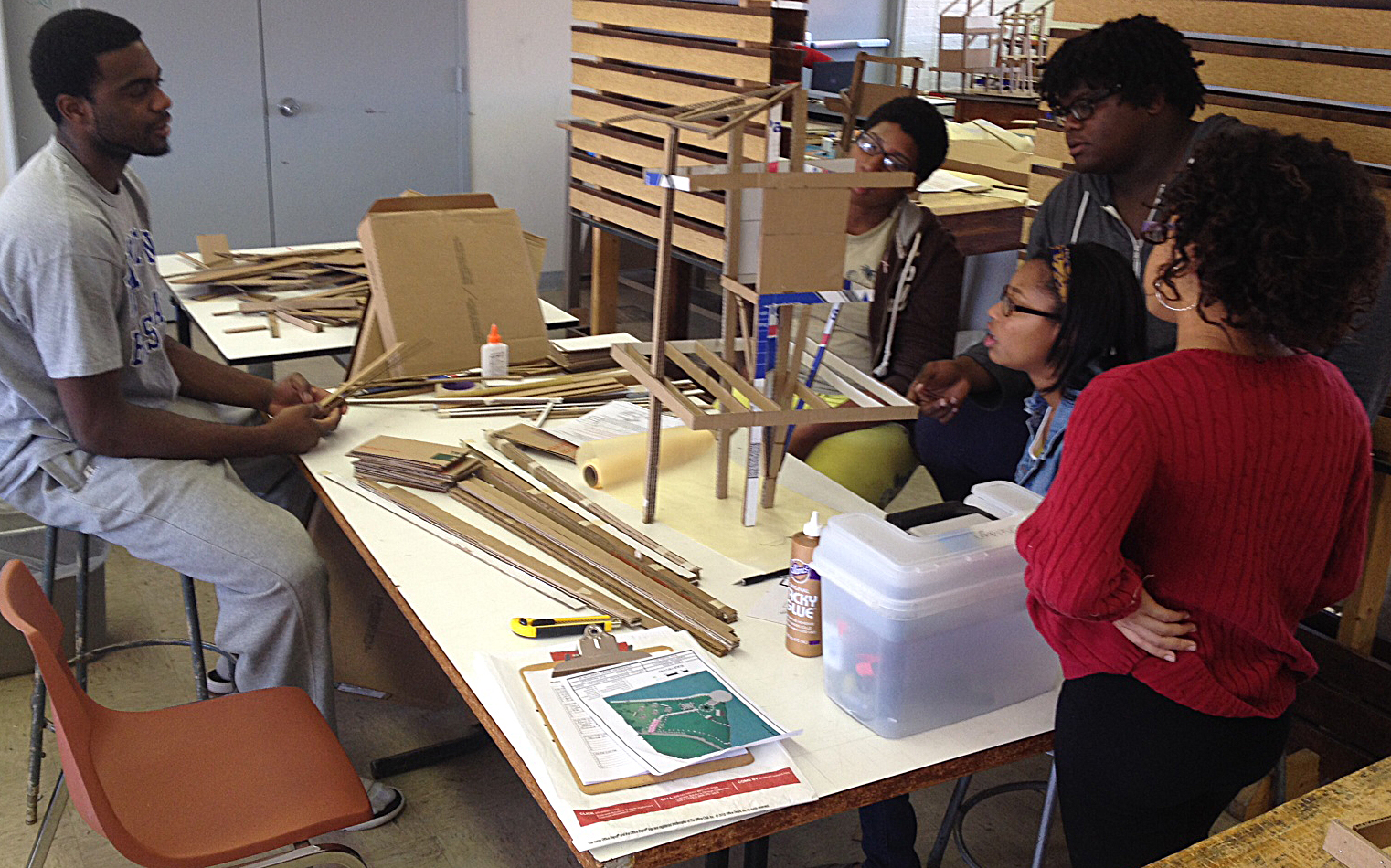
Hampton University’s second year architecture students are learning about gravitational forces and lateral loads by designing post and beam structures using a simple kit of parts (and adhering to a lot of fairly complicated rules).

The intention of the assignment is for students to learn about cantilevering, stacking, and hinging.  They also have to respond to environmental factors and work together in groups to enhance the site design concept developed by another student in the studio.  You can see one of the site design models in the photos below.  The cardboard frames you see represent the structural systems of small cabins that nestle into the site design.

I’ve asked them to build the structures at such a large scale (1″=1′) so they can really get the feel of what the various structural components are capable of doing.  Once they achieve suitable concepts, they will model their frames in wood.

Fingers cross that that will happen by Wednesday!  Thanksgiving is just around the corner… only three weeks of classes left to go this semester… so much to learn, so little time.  They still have to have the interior space, design building skins, and illustrate their designs with diagrams and measured drawings.  All that, in addition to completing their Physics, Architectural Representation, Architecture History, and Architectural Ecology course work.  Whew!

Full STEAM Ahead, Virginia!

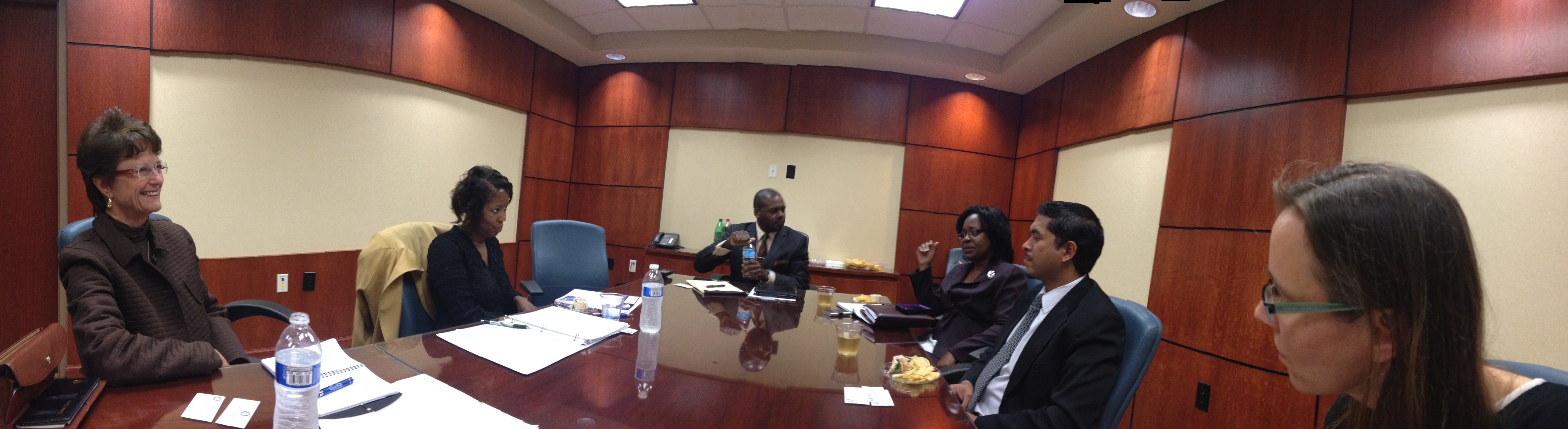
Discussing STEAM subjects: Caroline Martin, Dr. Judy Stewart, Orlando Robinson, Dr. Michelle Claville, Romdon Roopchan, and Dr. Shannon Chance.

Discussing STEAM subjects: Caroline Martin, Dr. Judy Stewart, Orlando Robinson, Dr. Michelle Claville, Romdon Roopchan, and Dr. Shannon Chance.

Big things are happening in the world of STEM education in Virginia.  Two enterprising educators, Caroline Martin and Dr. Judy Stewart, have founded the Virginia STEAM Academy.  Their public, 4-year residential program in Science, Technology, Engineering and Applied Mathematics is set to open for its inaugural cohort of students in the fall of 2015.  Last summer, Judy and Caroline conducted a summer program to get the ball rolling.

They have been working on the Virginia STEAM project since November 2010, and I’m happy to say that I’ve had some level of involvement since February 2011.  Although I took a year away during my Fulbright fellowship, a Wednesday meeting  on Hampton University’s campus helped me catch back up.

I’m fascinated by two specific aspects of the planning Caroline and Judy are doing: (1) securing and preparing facilities on the former Ft. Monroe that will house 1000 high school students and 75 teachers (who will live on-site with the students) and (2) designing the curriculum to support quality learning and innovative teaching.  They are such innovative thinkers and they know how to get things done!

Their vision for the school is remarkably aligned with the research I’ve been doing on integrating design thinking into engineering curricula and on tracking learning outcomes that accrue as a result of hands-on, problem- and project-based learning.

This Academy is going to open a while new world of possibilities for Virginia and her citizens.  My sister, Heather , was lucky enough to attend the Governor’s School for Science and Technology in Roanoke when she was in high school.  However, the daily commute — an hour each way — was a real strain on her and the other three students from our county who attended with her.  This new residential school will take the burden of daily commuting away, allowing the students and teachers focus on learning and generating new knowledge.

I am thrilled  the school will be here in Hampton Roads, and just a stone’s throw from Hampton University’s campus.

This Academy offers an ideal setting for the study of history as well as STEAM subjects.

A Tasty Bite of Elephant

Last night I met with the class on Student Development Theory at The College of William and Mary.

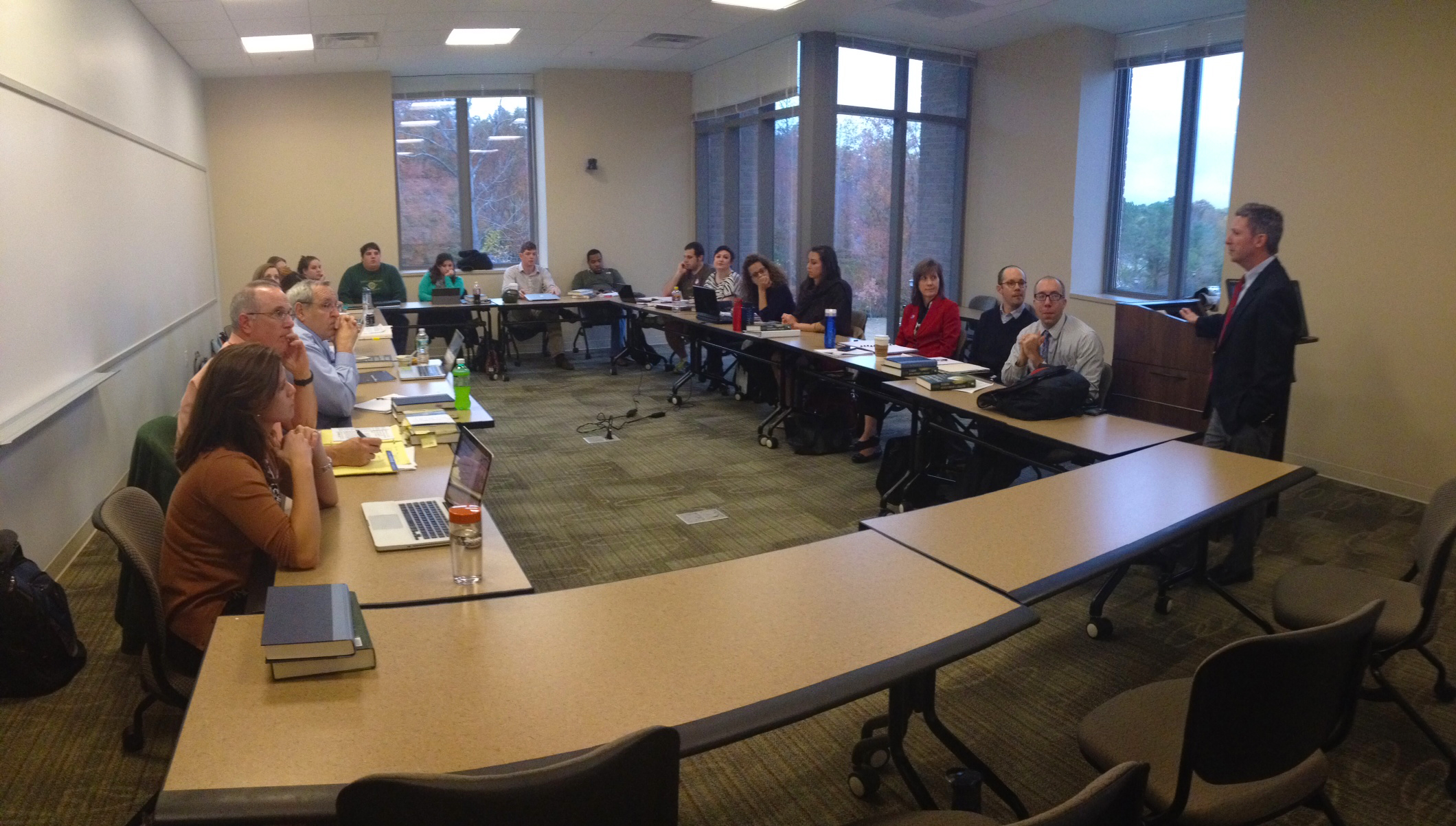
The class on Student Development Theory at The College of William and Mary.

I visited alma mater last night, The College of William and Mary, to speak about cognitive development theories developed by William Perry, Marcia Baxter Magolda, King and Kitchener, and the like.  I was asked to highlight how I incorporate these theories in my research and teaching.

This was an optimal time to give such a talk, because I’m gearing up to conduct a phenomenological study of students’ experiences of collaborative, trans-disciplinary, problem-based learning.  Last night’s talk got my mind moving in that direction.

The people in the picture above are working on graduate degrees in Higher Education; several of them shared  ideas and recommendations for the design of my proposed project.  At least two of them are using phenomenological methods for their dissertation work.  Their enthusiasm for my plan raised my own energy level and got me psyched to start work.

I’d had some nagging questions about how to best protect my research participants (i.e., “subjects”); the W&M students helped address my concerns.

I’d also had difficulty making time for this project because of its sheer scale.  I was trying to do too much at once.

I devised a workable plan during my drive to Williamsburg and got good response to my idea.  In essence, I’m now following the rule that if you want to eat an elephant, you’ve got to proceed one bite at a time….

I’d been completely overwhelmed by trying to analyze data from 30+ participants.  So, I’ve determined to focus in on one group.  I can extend the work over time, but a group of six is appropriate for a phenomenological study (and a more reasonable way to digest this elephant).

So, I’ll look closely at one group of six students who worked together as a team with impressive results.  Each of these students documented the team’s design process in writing across the course of a semester.

I’ve already done quite a bit of analysis on what they wrote, and that allowed me to make a purposeful selection.  In this case, I know that more than one team member experienced  powerful (pivotal or seminal) instances of learning.  I want to find out what factors caused those changes.  I’ll be looking at how the six team members experienced the collaborative design process in the period leading up to significant “a ha” moments.

I hope that the results will help educators (including me) prompt that type of “deep learning” more often.

I can extend the work to look at other groups later.  And, as Dr. Jim Barber (the instructor of record for last night’s course) pointed out, I can also extend the study in the future (to make it “longitudinal”) by tracking down members of the group and conducting follow-up interviews.

I always enjoy visiting the W&M School of Education and yesterday was no exception.  After arriving at the School of Education’s brand new LEED-Gold building, I admired the fall colors and gabbed with a former classmate (Sharon Stone) and my mentor (Dr. Pam Eddy) before heading into Dr. Barber’s class.

Can’t wait to visit again!

Constructing our Reality

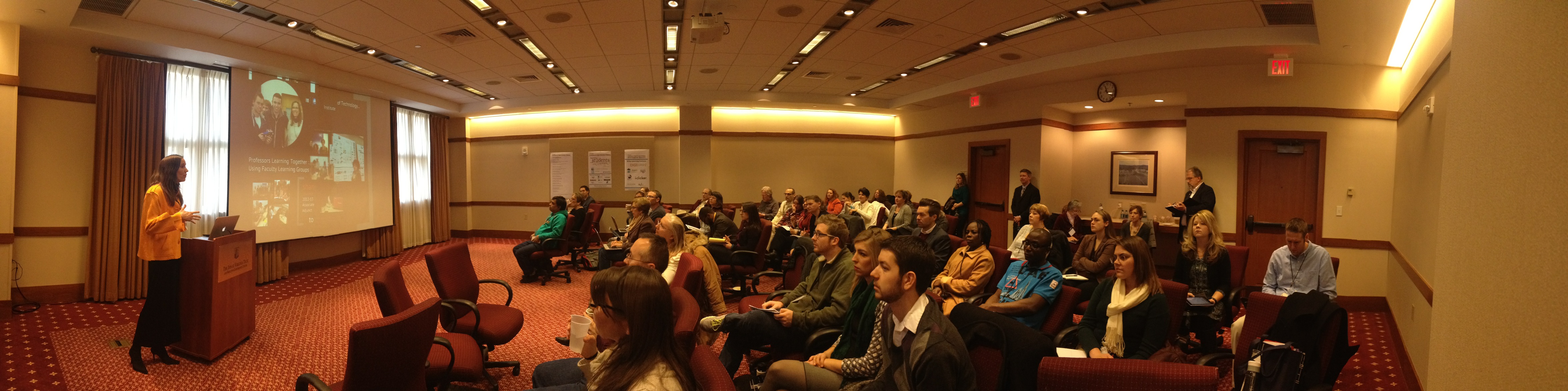
Last week I got to talk with a group of 60+ architecture students and faculty about design thinking, student development theory, and my Fulbright research… as well as how they connect to what we do in our department at Hampton University.  Moments like these help us reflect on what we are.  I hope they will also encourage my compatriots to explore ideas about what we want to become.

My current research is situated in the constructivist paradigm.  What does that mean?

Well, my research ideas and techniques are founded on the principle that we humans construct the world around us — including the things we see and touch, how we know, and what we know — and that we are able to generate new knowledge.

By discussing such topics, and considering collectively what it means to “design” and to “know” and to “learn,” we can become more international, purposeful, and effective in the things we do each day.

One of our students, Rhama Mohammed, snapped some photos during the talk and loaded them into our Facebook page (I’m posting copies here).  This provides a little glimpse of our department’s reality… surrounded by teachers (unfortunately, we don’t have images of any students in the crowd)… and a highly animated presenter.

Closing a Chapter

In preparation for our chapter, Tim Cole updated me on VBCPS's sustainability strategies.

Last month, while working on our chapter, Tim Cole and I discussed VBCPS’s sustainability strategies.

I’m celebrating a moment of success here before I hit the sack for the night.

I just submitted a full draft of a chapter called “Designing School Buildings to Enhance Performance and Learning” for a book called Marketing the Green School: Form, Function, and the Future that will be part of the Advances in Educational Marketing, Administration, and Leadership (AEMAL) Book Series.  To make that project more fun, I enlisted Virginia Beach City Public School’s Director of Sustainability, J. Timothy Cole, as my supporting author.

This chapter provides a way for me to share some of the research I did for my dissertation and to extend my knowledge — I got to learn from Tim’s successes in Virginia Beach.  Tim has helped create 8 LEED-quality school facilities (5 are certified and 3 are in process to become certified). He even helped pilot LEED v1 in the 1990s.

This is the second chapter I have completed in the two months since I’ve been home.  The other chapter is called “Bringing it all Together Through Group Learning.” It is for a Wiley publication called New Directions for HIgher Education. That project was fun because I got to work with the book’s editor, the illustrious Dr. Pamela Eddy.

Since returning home on August 23, I’ve also managed to compile and submit a dossier to my University, submit a grant proposal asking for funding to help  conduct future research, spend a good amount of time with my students, implement some new teaching techniques, and — this week — get my midterm grades in on time and prep to advise students.

Oh, yes, and tonight I also had a lovely dinner with my dad and step-mom, Joyce, who are in town on business!  It was a real treat to spend a few hours with them.  Joyce is the Director of Admissions for the Vet School at Virginia Tech and she is recruiting at Hampton University in the morning.

All this is  pretty typical in the day of a professor… but I will sleep well tonight, knowing that I’m doing the best job I can possibly be doing right now, despite all the odds I’ve stacked against myself.

It is really nice to step back, take a deep breath, and be thankful for work and health and a ray of happiness every now and then.

And now, to sleep.   There’s much more to do in the morning….

Testing Theory in Practice

Yesterday I got to share some of my Fulbright research as part of the weekly lecture series hosted by the Hampton University Department of Architecture.  It was a great way to catch up with the advanced students and introduce myself to the first year group.

The students were highly attentive, very receptive to learning about epistemology and cognitive development theories, and interested in hearing about how I am using  data from student blogs  to test existing theories.

The faculty seemed genuinely interested, too.  At the end, though, there was no time for the faculty to ask questions… the students had so many questions that I finally had to cut things short and send them off to their studio classes.

At the start of the lecture, I had asked the students to pull out their smart phones and look up this blog site.  As a result, they had many questions about what I’ve found in applying the new methods in the second year studio and sustainability classes I teach.

I also passed around the catalog from my photography exhibition, so they could see some of the artwork I created in Ireland.  I also encouraged them to look up pages about my adventures in Greece, Portugal, Belgium (which I still need to post more about), France, and of course, Ireland.

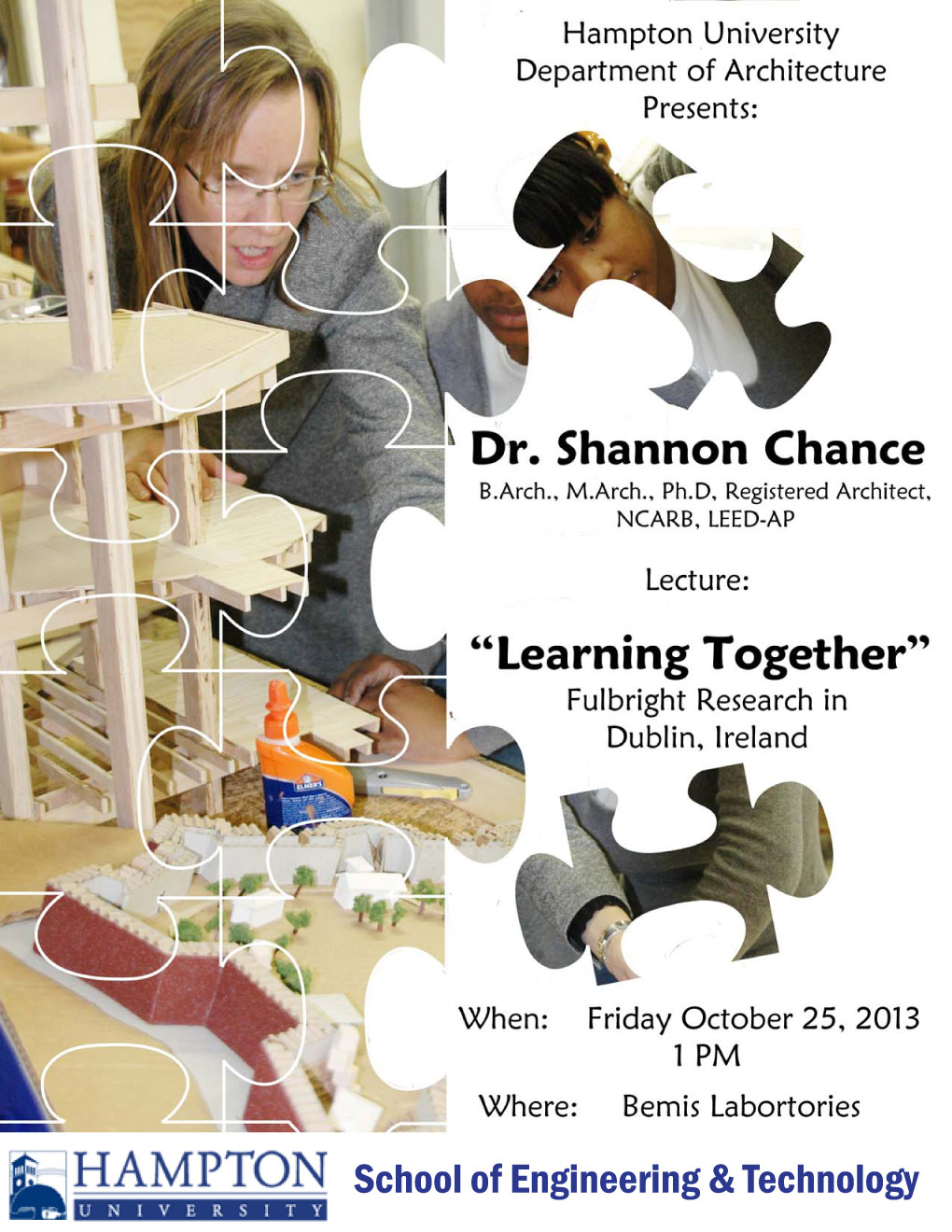
Lecture poster (produced by HU student Samuel Morgan).

Lecture poster (produced by HU student Samuel Morgan).

Making the Mark as an Enterprise Rose Fellow

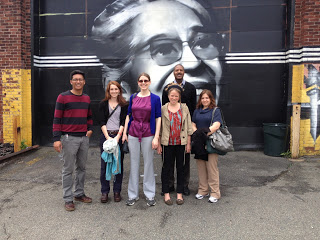
Mark (to the far left) with community members from Boston.

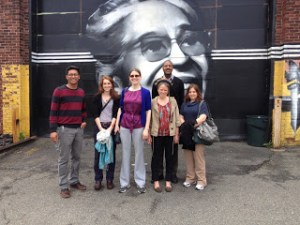
Mark Matel (to the far left) with community activists in Boston.

Thanks to a Facebook post by my (awesome) former student, Elbert Whitfield, I just discovered an article titled Enterprise Rose Fellowship Redefines Community Design at NeighborWorks Organizations, which features former student Mark Matel.

I’ve worked with many extraordinary students at Hampton University, like Elbert and Mark.

Today, I’m boasting of Mark Paulo Ramos Matel’ success.  I had the honor of teaching Mark in architectural design studios, study abroad, and environmental sustainability courses while he was working toward his Master of Architecture degree at HU.

Mark Matel (right) with fellow student Leon Peters presenting a second year design project at Hamtpon University.

Mark Matel (right) with fellow student Leon Peters presenting a second year design project at Hamtpon University.

Mark was an ideal candidate for the Enterprise Rose Fellowship, which the article explains is “a highly competitive and innovative program that places some of the nation’s finest early career architects in underserved communities across the country to team up with community development host organizations.”

Mark is intrinsically motivated to succeed, to help people, and to spearhead new initiatives.  His energy level, work ethic, creativity, self-direction, and ability to collaborate effectively were unparalleled among the students I have encountered in my 15 years of university-level teaching.

Mark was a major player in the formation of our department’s Studio Culture Policy and he represented our department impressively at the local and state level.
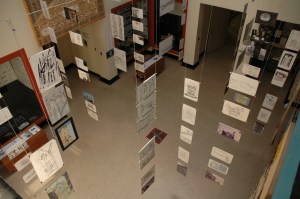
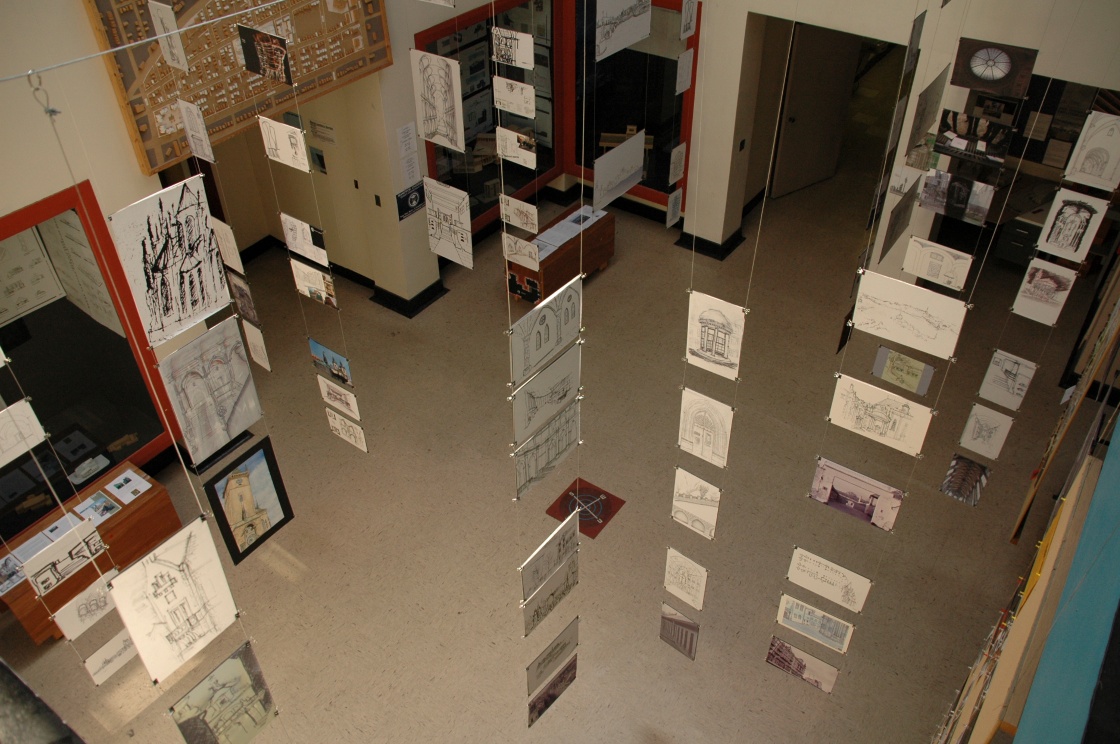
An exhibition that Mark and his colleagues Brandon Clarke, Smitty Lynch, coordinated along with other members of our spring break trip to Prague.

An exhibition that Mark and his colleagues Brandon Clarke, Smitty Lynch, coordinated along with other members of our spring break trip to Prague.

He is also a highly skilled designer, as is evidenced in design awards from Auburn and Hampton Universities.

Mark earned a NAAB-accredited degree from Hampton University – a program emphasizes urban planning as well as architectural design – and he then earned a design-build degree from Auburn University to boot.

To interview for the Enterprise Rose Fellowship, he went to Boston along with the two other candidates (both from top Ivy league schools).  After a rigorous multi-day interview, representatives from the community and the fellowship program voted, and then wholeheartedly extended the three-year fellowship to Mark.

During his time at HU, Mark’s research regarding water systems in the Philippines, and his work with the Virginia AIA’s Emerging Leaders in Architecture (ELA) program, were particularly relevant in preparing him for his work as an Enterprise Rose Fellow.
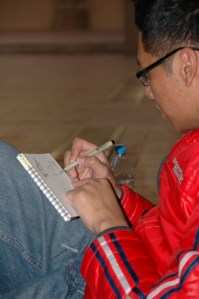
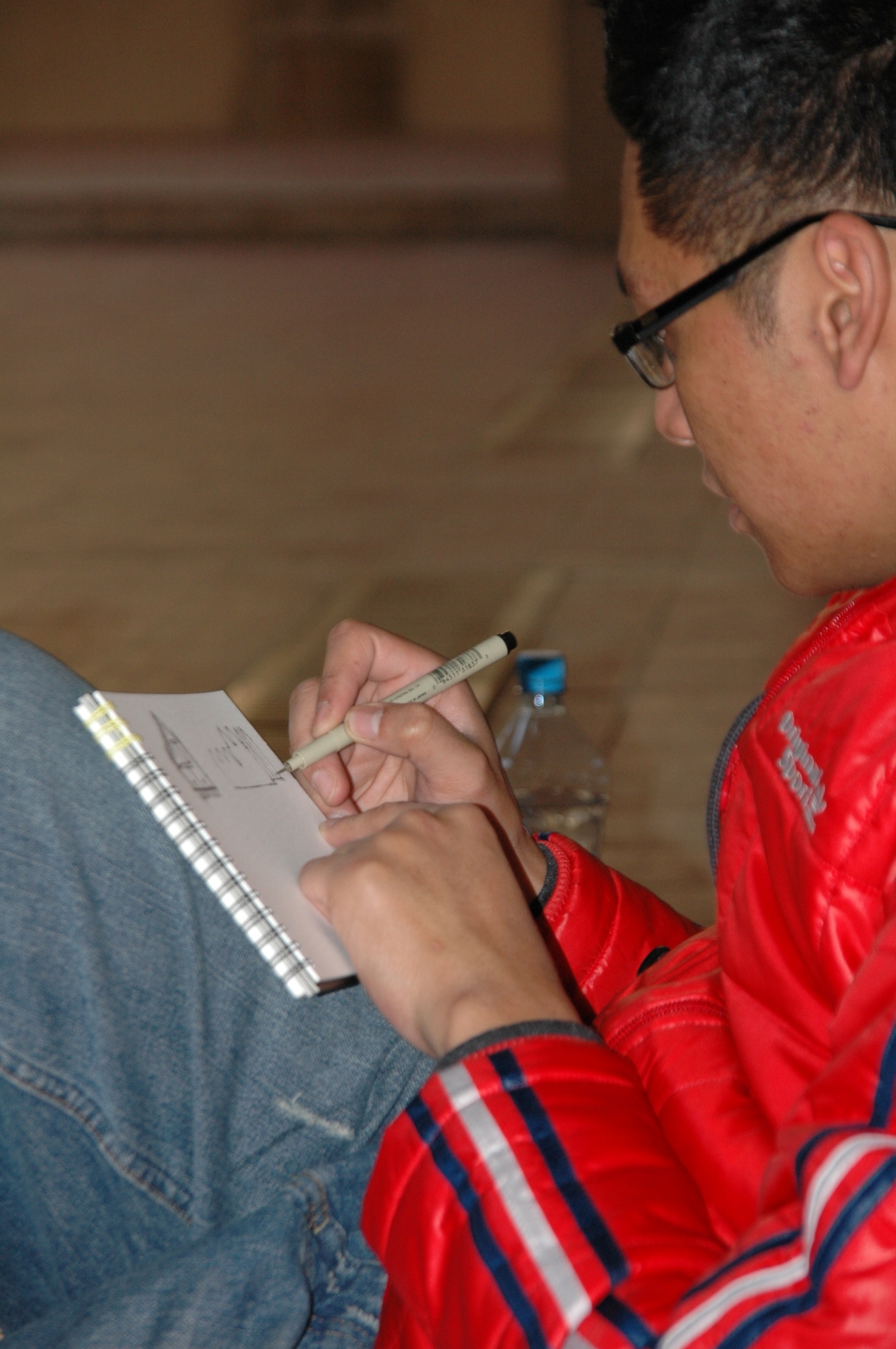
Mark sketching in Prague.

Mark sketching in Prague.

Marks’ activities all had an underlying theme of social activism related to the built environment.  He has always been able to think and work at multiple scales and with complex, inter-related issues.  His architectural studies enhanced these abilities.

Our department nominated Mark to represent Hampton University as part of Virginia AIA’s ELA program and his work with the organization exceeded our expectations.  The focus of the ELA program that year was on community revitalization and leadership.  Mark was highly engaged in his cohort’s project and he even defined the program for the subsequent year’s cohort.  (He identified specific conditions that needed to be addressed in Norfolk, Virginia and he helped get the new ELA group involved in fostering change where he knew it was needed.)

In his classes and teaching assistance-ships at Hampton University, Mark reflected a high level of engagement as well as what Daniel Goleman calls “emotional intelligence.”  Mark has the ability to share knowledge and to teach others techniques and strategies for improving themselves and their environments.

While he was at Hampton University, Mark was a very important part of defining a positive, learning culture within the academic context, as well as in the professional context (at the local and state levels) and in the larger community.

I couldn’t be prouder of Mark and all his many varied accomplishments.

You can see more of our trip to Prague in my archives.  My own presentation boards from Prague are also available for viewing.

Convocation Rituals

The William and Mary contingent in full regalia before the 2013 HU Convocation ceremony: Drs. Kianga Thomas, Shannon Chance, and Andrij Horodysky all graduated from W&M.  (Dr. Ralph Charleton was present, too, but sporting a regular black robe.)

The William and Mary contingent in full regalia before the 2013 HU Convocation ceremony: Drs. Kianga Thomas, Shannon Chance, and Andrij Horodysky all graduated from W&M. (Dr. Ralph Charleton was present, too, but sporting a regular black robe.)

The Honorable John Charles Thomas, retired Justice of the Supreme Court of Virginia, got a double standing ovation. And, he delivered an encore!

The Honorable John Charles Thomas, retired Justice of the Supreme Court of Virginia, got a double standing ovation. And, he delivered an encore!

Rituals are vitally important to any organization.  They help define the culture.

By participating in rituals, members of a community can come to understand what the organization is about, what it prides itself in, and what it wants to become.

Events like Hampton University’s annual convocation provide time to reflect, to express aspirations and share stories,  and to celebrate accomplishments.  Being that Convocation marks the start of the academic year, this particular event also prompts us to set goals that align with those held by others at “our home by the sea.”

This year, the historic Ogden Hall overflowed with families and with enthusiasm.  This event coincided with Parent’s Weekend  and so the crowd was particularly large.  The choir was amazing (as always)!  The students performed two different spirituals: Let the People Sing Praise Unto the Lord, and You Must Have that True Religion.  We also had lovely trumpet performances for the processional and recessional, with architecture alum Adam Davis on organ for the opener.

The university’s president, Dr. William R. Harvey addressed the crowd and recognized two members of the faculty (Drs. Francisco Cornell and Paula Barnes) with awards for outstanding teaching.

Then to top the festivities off, the Honorable John Charles Thomas, a retired Justice of the Supreme Court of Virginia, delivered a stirring keynote address.

And he received  TWO standing ovations.

I’ve never seen that happen before except at a rock concert!

Justice Thomas had ended his resounding speech with a poem, and he followed the ovations with an encore… reciting a second poem to an appreciative crowd of students, families, and faculty.

The entire HU faculty was present.  To tell the truth, it’s a contractual obligation to attend.  We’d also been required to attend the speech to parents the morning before, so we were all very happy to have such a motivational speaker.

This year the time in Ogden Hall was very well spent.  Justice Thomas, a life-long Hamptonian who sported HU t-shirts even as a toddler, reminded us of who were are and why we are here.  I, for one, appreciated the reminder because it was delivered in such a positive, lively, and engaging way.

Lunch with the Fowlks

Reconnecting with Hampton University’s Dr. Edison Fowlks is always great fun.  I’m perpetually intrigued by his radiance and his zest for learning and teaching.  For several years, our image anchored HU’s faculty page:

Hampton University _ Faculty

The three of us (pictured above) are all still going strong.  In fact, the third professor in the picture, Dr. Francisco Cornell, was just recognized with Hampton University’s highest teaching award.

Dr. Edison Folks

Dr. Edison Folks

Recently, I had opportuity to share lunch time with Dr. Fowlks and to hear about his many new studies.  He’s teaching botany this semester, which he’s never done before.  His eyes sparkle and he radiates joy as he explains the new concepts he’s teaching and how he’s getting the students to learn.

“Problem-Based Learning” techniques are second nature to Dr. Fowlks.  Seems he’s always been a hands-on teacher.

Today, he’s teaching his students to isolate genes in soybeans and splice together new combinations.  He building new knowledge in genome sequencing and “synthetic biology.”

I recall he was once working to get cotton to grow blue so it wouldn’t need to be dyed.  I’ll have to remember to ask how that went.

Dr. Fowlks recently led a summer camp on synthetic biology. He took students to Yale for ten days last summer to work in a lab.  He’s also a member of the Genome Consortium.

Fun over lunch.

Fun over lunch.

At lunch last week, we discussed bio-remediation and using living gardens to purify water.  I’ve been wondering if we could use the techniques to help an art professor who came to a sustainability lunch I held a few weeks back.

Over lunch on this particular day, Dr. Fowlks also introduced me to the concepts of “the new bio economy” and “metagenomics” which means “around genomics.”  One of his friends actually coined the term metagenomics.

I often remind myself how fortunate we are to have this genius and teacher extraordinare here at HU. He does his namesake (Edison) proud, and I’m certain he could be working anywhere he’d like.  A glance over his bio on the Hampton University’s website makes that much clear:

Dr. Fowlks received the Ph.D. degree in Plant Pathology from the Ohio State University. For four years he was a Postdoctoral Fellow in Plant Molecular Biology at Michigan State University and in Molecular Virology at the University of California at Berkeley. At Michigan State and UC Berkeley, he studied the primary structure of ribosomal and viral RNAs respectively. Later at Bishop College, research in his laboratory led to the development of a two-dimensional RNA fingerprinting technique for studying mammalian RNA viruses. At Hampton University, he and his students use the tools of genomics, metagenomics, bioinformatics, and synthetic biology to focus on some unanswered questions in biology and medicine. Moreover, he is establishing DNA Microarray and Bioinformatics labs to serve as models for teaching biology as an information science and organisms as networks or circuits, and blending computer science, mathematics, and genetics into the curriculum. Dr. Fowlks instructs Principles of Heredity, Bioinformatics and Genomics and Advanced Genetics and is the director of The Howard Hughes Medical Institute (HHMI) Undergraduate Education Program housed in the Department of Biological Sciences at Hampton University.

We made a special journey over to see the liverwort outside Armstrong-Slater Hall.  It's one of the oldest strains of plant anywhere.

We made a special journey over to see the liverwort outside Armstrong-Slater Hall. It’s one of the oldest strains of plant anywhere.

Walking back to our academic buildings, Dr. Fowlks and I stopped to investigate botanical wonders--like this bloom that sprouted out of season.

Walking back to our academic buildings, Dr. Fowlks and I stopped to investigate botanical wonders–like this bloom that sprouted out of season.