Energy Cube — Build Day

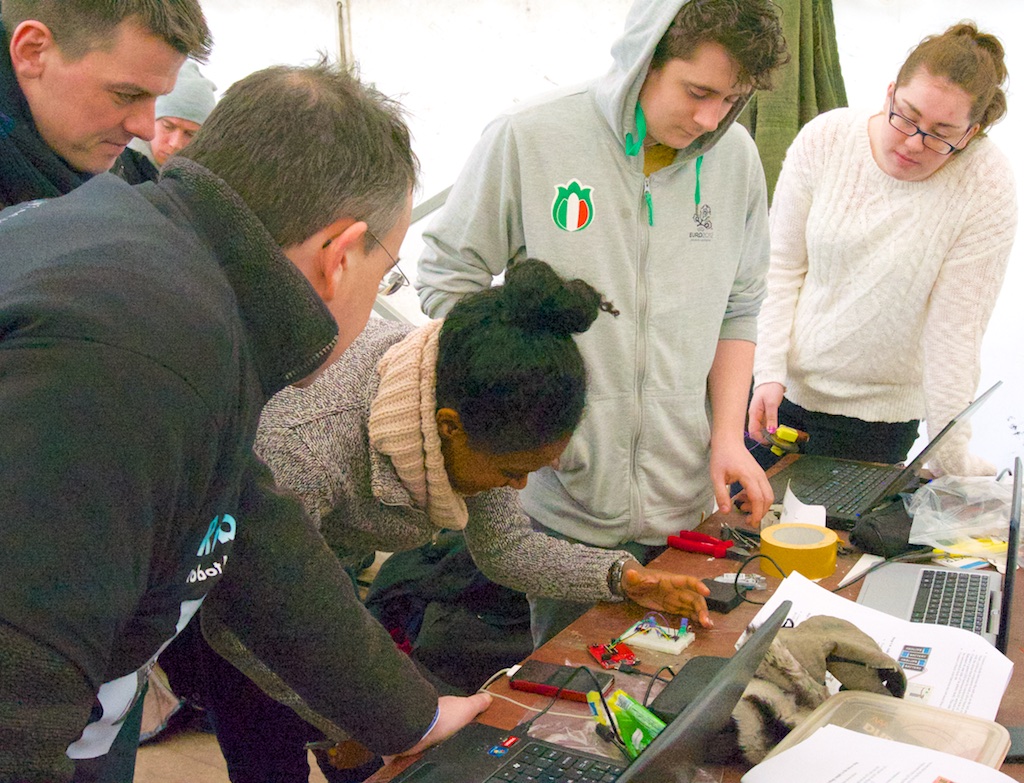
Fionnuala advising an Energy Cube team.

Fionnuala advising an Energy Cube team.

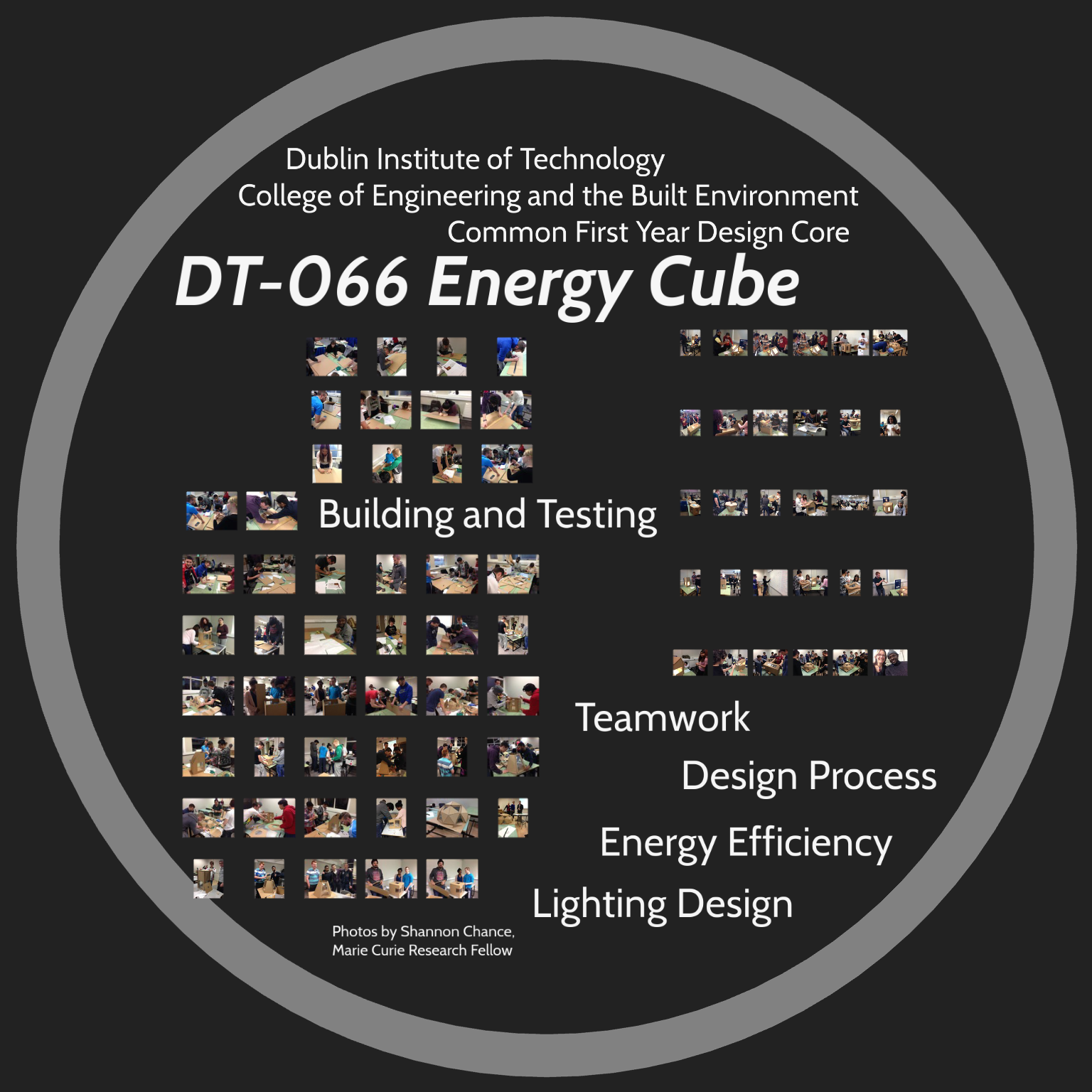
Nowadays when you arrive in DIT’s four-year engineering program, you will complete three group-based design projects prior to selecting a specific engineering major: a bridge design project (to familiarize you with civil and structural engineering), a RoboSumo project (to learn about robotics, electrical, and electronic engineering, and programming), and an “Energy Cube” project (as an introduction to mechanical, product, and building services engineering).

The Energy Cube project is currently coordinated by a diverse and multi-disciplinary group of teachers. Fionnuala Farrell is a product design and manufacturing engineer, John Nolan is an expert in engineering drawing, and Micheal O’Flaherty is a building services engineer. 
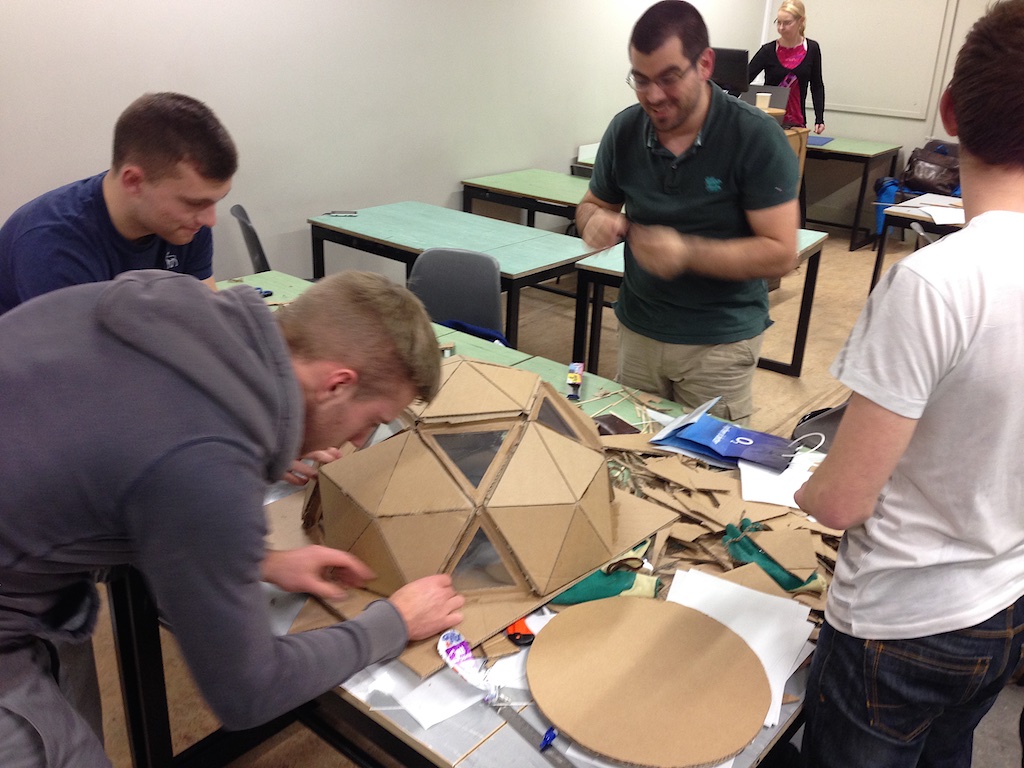
This team built a geodesic dome for their Energy Cube.

This team built a geodesic dome for their Energy Cube.

I’ve been assisting them and contributing the perspective of an architect. I’m not involved in grading, since I’m interviewing some of the students for my research, but I attend classes to better understand what it’s like to learn and teach engineering. 

Fortunately, I know how to do all the parts involved in this project: designing buildings, identifying client needs, defining product evaluation criteria, collaborating, calculating volumes, making scale translations, predicting thermal performance using mathematical calculations, designing the lighting scheme, building models, testing performance, keeping records, and presenting work in writing as well as verbally.

For the students, though, this combination is a tall order!  They have a total of six sessions, four hours each (on Friday afternoons!?!!) to design, build, test, and present their Energy Cubes. Whew!
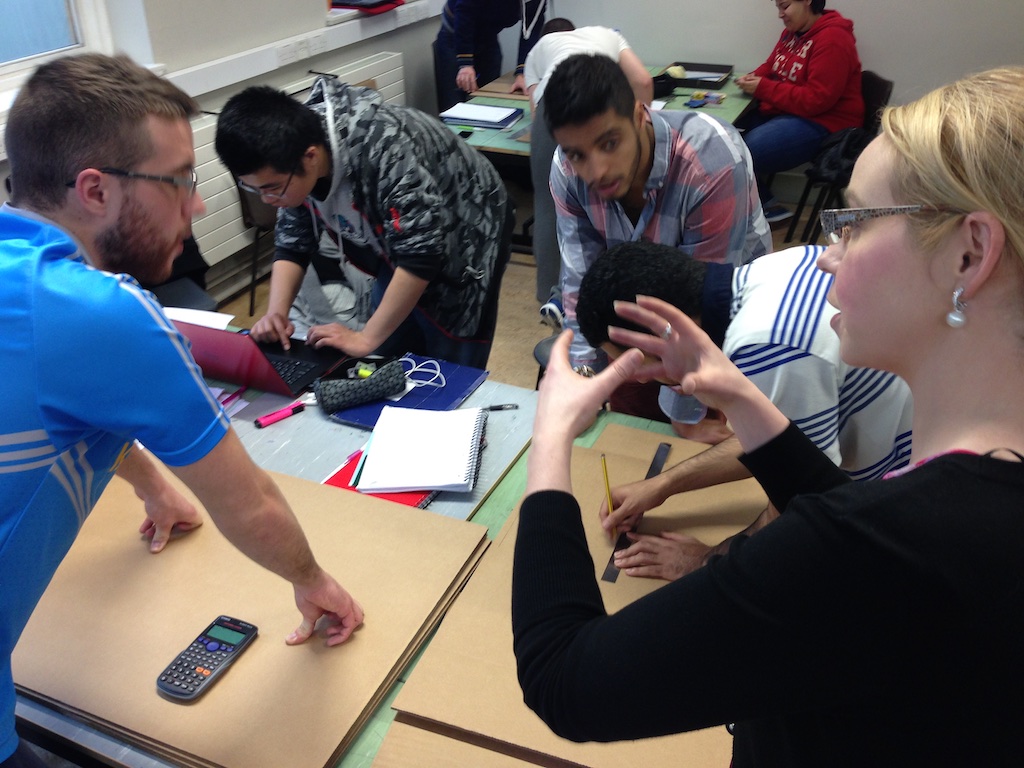
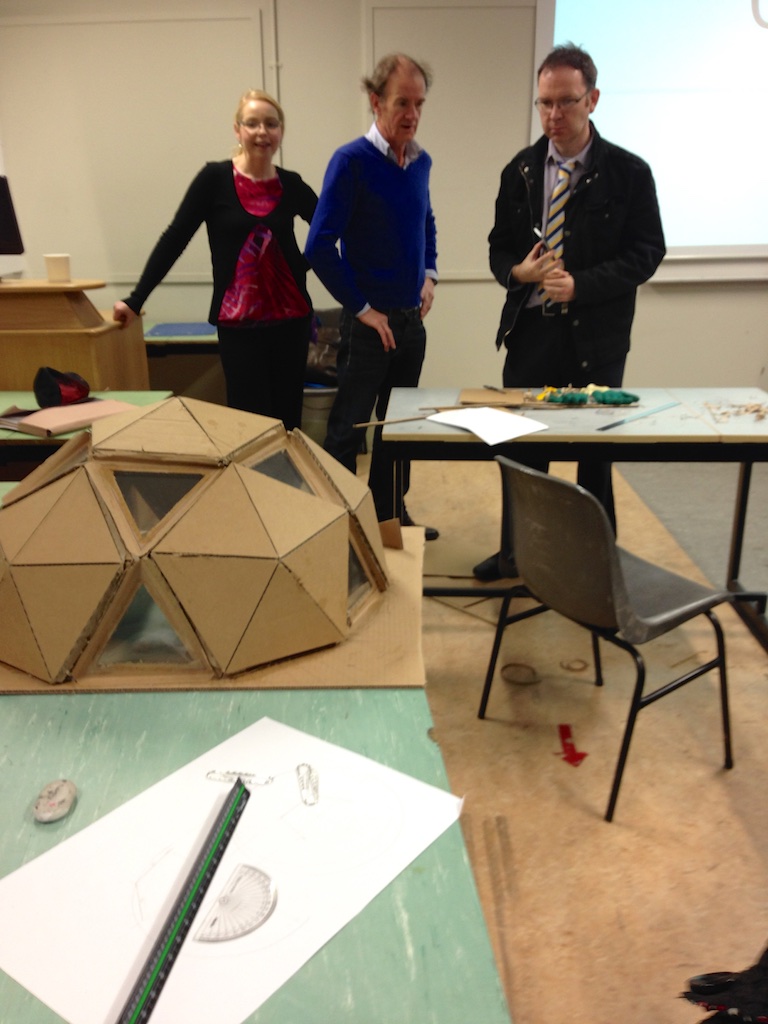
Lecturers Fionnuala Farrell, John Nolan, and Michael O'Flaherty surveying results of "the build."

Lecturers Fionnuala Farrell, John Nolan, and Micheal O’Flaherty surveying results of “the build.”

Moreover, they are working in assigned (rather than self-selected) groups of four. Learning to work with strangers isn’t always easy. They’ve done an admirable job.

Our second of four sets of students will test their cubes later today. I’ve posted photos of what the Energy Cube build looked like last week.
Tip-Top Design Skills

I meant to publish this on Ireland by Chance, but it ended up on RoboSlam.

shannonchance's avatarRoboSlam

Meeting with John McGrory, Fionnuala Farrell, Una Beagon, and Ted Burke to discuss teaching design. Meeting with John McGrory, Fionnuala Farrell, Una Beagon, and Ted Burke to discuss teaching design.

What does a skilled designer do? How does she act? How does he know what will work? 

My colleagues at Dublin Institute of Technology and I want to know. 

We all have design and teaching experience. We have a feel for what good design practice looks like. 

But we aim to be more precise. We want to explain this well to our students. 

So a group of us — who are teaching design on the new “common first year” course that all engineering students in DIT’s four year honors engineering program are now taking — got together Wednesday morning to mull it over. Before meeting, we all read an excellent and comprehensive article by David Crismond and Robin Adams that was published in the Journal of Engineering Education. It is called The Informed Design Teaching…

View original post 264 more words

Sunnyday in Edinburgh

€14.99 flight to Edinburg. Thanks for a lovely day, Ryanair! My hip architect friend, Tarrah Beebe, and I truly enjoyed the Sunday sunshine.

And to think she arrived in Dublin from LA just yesterday….

IMG_8618.JPG

IMG_8634.JPG

IMG_8633.JPG

IMG_8642.JPG

IMG_8655.JPG

IMG_8660.JPG

IMG_8646.JPG

IMG_8666.JPG

IMG_8683.JPG

IMG_8686.JPG

Shifting Powers

My colleague from William and Mary, Dr. Jim Barber, bought the Qualitative Research book I recommended to his students.

IMG_8451.JPG

Yesterday I learned that the EU wants to support interdisciplinary research by including qualitative researchers on science and technology research teams.

IMG_8488.JPG

Here’s an example of one of the panelist’s interdisciplinary research.

IMG_8489.PNG

This information session was held at the art museum, IMMA, which is housed in the former Kilmainham Royal Hospital. The facility is beautiful.

IMG_8468-0.JPG

IMG_8469-0.JPG

Colleen Dube, the executive director of Fulbright Ireland–who has been a strong supporter of my work–moderated a panel discussion.

IMG_8490.JPG

IMG_8479.JPG

I enjoyed the transfer of power underlying the picture posted above. The royalty no longer hold the power to shape society’s future: those researcher on the floor do!

Likewise, quantitative research has reigned central in the sciences, but this session provided evidence that qualitative work is gaining credibility. It’s being seen, more often, as an important perspective that is an essential part of good research.

Stepping Back in Time at Sweny’s Chemist Shop

A colleague suggested I stop in at Sweny’s, an old chemist shop (what we in the States call a pharmacy) just to see the architecture.

Sweny’s hosts readings of texts authored by famous Dubliners. It also displays old books and artifacts as they would have been a hundred years ago.

The place reminds me of the old general store my parents photographed in, I think, Virginia’s Giles County, when I was a kid. (It may have even been near Dublin, Virginia — which would be a fun coincidence!)

Their clients were building a detailed model of the general store, to scale. I loved perusing the shelves and investigating the old-time shoes, not yet sold, looking for a home.

IMG_8334.JPG

IMG_8335.JPG

IMG_8330.JPG

IMG_8342.JPG

IMG_8339.JPG

IMG_8337.JPG

IMG_8338.JPG

IMG_8340.JPG

Focus on European Research

I’m going to try giving you a panoramic view of life here, working and living as a researcher in Dublin. I’ll make a stab at posting a panorama or reflection shot every few days. As a Fulbright, I tried to catalog my experiences. These days, I have to reserve my computer time for solid work. But a quick post from my phone shouldn’t take much time….

Today I’m learning about programs and achievements of the European Research Council (ERC). The organization’s president has been speaking at the Royal Irish Academy (RIA).

The RIA headquarters includes a lovely library about property ordinance surveys and the history of Ireland and Irish architecture. Before the event, I was flipping through a book and happened across a house that I think I’ve seen next to the Joyce Tower.

IMG_8379.JPG</a

IMG_8375.JPG

IMG_8358.JPG

IMG_8353.JPG

IMG_8357.JPG

IMG_8356-0.JPG

Discussing Development… of College Students

I just made my annual appearance at the class on theories about college students’ development taught by Dr. Jim Barber. Last year I got to be there in person, but this year it was back to Skype.

Fortunately, the new version of Skype allows for screen sharing. It is always a bit disorienting for me to deliver guest lectures online, but I don’t think it was too painful for the audience tonight — on account of this new technology.

Presentation to W&M SoE

Today at DIT, my research project is fully underway, and every day I’m drawing from the theories I learned in this very informative class that I had the good fortune to take, way back in 2006, at The College of William and Mary.

Tonight, I discussed two research methods I’ve been using — the first using template analysis and the second using descriptive phenomenology. If you’d like to view the Prezi I presented, you can click here.

The best part of the evening was that the William and Mary grad students — 22 in all — had lots and lots of questions. I couldn’t gauge exactly how well I was connecting with the folks in the back row (who contributed lots of great questions) because the resolution was only so/so, but I have been loving that the fact that my Skype/Messenger/iMessage/MagicJack technology has been improving every day!

It’s five hours later in Dublin than back in Virginia, so the evening is quite well worn here. And since I’ve got a researcher “media training” workshop in the morning, I’d better hit the sack now…. Adieu, Adieu, To you and you and yo-u!

Prezi cover shot

Raising Fellows

Pam and Don at the countdown, dotting every i and crossing every t.

Pam and Don at the countdown, aligning all the parts one last time. Attention to detail can make a world of difference.

My loft apartment is buzzing with activity. Fortunately, Prof/Dr Pam Eddy (my former dissertation advisor) arrived just in time to help with a big project.

Last night my flat-mate, Don, was in the final stretch of submitting a grant application for a prestigious fellowship. Don, Pam, and I had all hands on deck.

Winning these prestigious fellowship requires rigor, passion, and attention to detail. It often requires applying multiple years and continually refining one’s approach. The difference between winning and losing often comes down to how much critique an applicant can gather and address (plus more than a pinch of luck!).

All this, Don well knows. And he’s giving it all he’s got.

For more than a decade Don has methodically established a network of contacts across Ireland. He has continually generated new understanding of the issues immigrant children face in coming to Ireland.

With years of preparation under his belt, Don is well poised to research how Nigerian children who have immigrated to Ireland establish a sense of identity — how they come to feel they belong here, how they deal with being different, and what they think it means to be or become Irish, for instance. And, with a spike in immigration to Ireland underway, the time is ripe for Don’s study.

As soon as Pam arrived in town Sunday, we headed out for coffee with a Professor Emerita from William and Mary who is traveling in Ireland, Dr. Dorothy Finnegan.

As soon as Pam arrived in town Sunday, we headed out for coffee with a Professor Emerita from William and Mary who was traveling in Ireland, Dr. Dorothy Finnegan. Dot taught me in a class on Cross-Disciplinary Perspectives and another in Comparative International Education.

What Don learns can potentially help teachers deliver content more effectively in their increasingly-diverse classrooms. It can also help Irish policy makers understand issues that are central in education today.

A couple weeks ago, Don arrived for a three-month stint to collect interview data at a primary school in the nearby district of Tallaght. I had a spare room in my place just the right size for an up-and-coming research fellow.

Don and I first met at one of the 2012 photography events sponsored on my behalf by Fulbright Ireland and the University of Notre Dame’s center in Dublin. I’ve been fascinated by his topic and his emerging findings ever since.

Since his arrival this year, Don and I have convened daily to discuss our research projects. These informal conversations help us both because we are both researching diversity, education, and identity and we are both building qualitative research skills.

Thankfully, I have an excellent mentor in Pam Eddy. And thankfully, she arrived for a visit just in time to help put the final touches on Don’s grant application.

It takes a village, I think they say, to raise a fellow!

A few days before Pam’s arrival, I’d had the chance to publicly thank the team who helped carry my Marie Curie fellowship application across the finish line.  Dr Jennifer Brennan, Jean Cahill, Dr Marek Rebow, and Dr Nancy Stenson went above and beyond for me and my project — editing, polishing, critiquing and lending ideas. I could not have won the EU’s International Incoming Fellowship without them! And the reference letters from Colleen Dube, Dr Mike Murphy, and Dr Pam Eddy helped seal the deal!

I’m grateful that these knowledgable mentors are willing to share their time and energy with emerging researchers like Don and me!

I also presented at last week's seminar for researchers on Bolton Street who are members of CREATE (Contributions to Research in Engineering and Applied Technology Research).

I also presented at last week’s seminar for CREATE (Contributions to Research in Engineering and Applied Technology Research). Our research group is lead by Dr. Brian Bowe.

Equal Chances? Not Today in the USA. Not on Your Life.

Today, I mourn for my country. A place where systematic, institutionalized racism reigns strong. 

I’ve always been thankful that I was born after the 1960s racial-awareness raising events that precipitated the 1968 Fair Housing Act, the proclamation in Virginia that interracial marriages were finally legal, and laws that enabled kids of all colors to attend the same public schools.

Incidentally, I was born just after we landed on the moon and after my alma mater, Virginia Tech, started admitting women into fields like architecture. (UVA started this the year I was born.) 

I benefitted from ALL these American achievements and civil rights. 

I was allowed to attend desegregated schools and learn from and with people from all walks of life.

We, as Americans, achieved all this but then we stopped short. We let ourselves believe all things had become equal. We actually kid ourselves into believing that any American-born person can succeed equally based on merit. That we all have an equal chance at birth. 

It simply isn’t true. And we can’t stop trying until it is.

Framing My View

Over time, various artists have provided layers of meanings along this street in Kilkenny, Ireland. Small windows in the graveyard painting let viewers select their own vantage points and help them view what's happening on the other side of the wall. The photographer (Frank Daly) selected his own frame of reference, capturing an entertaining yet  chilling portrayal of the phenomenon of Western burial.

Over time, various artists have provided layers of meanings along this street in Kilkenny, Ireland. Small windows in the graveyard painting let viewers select their own vantage points and help them view what’s happening on the other side of the wall. The photographer (Frank Daly) selected his own frame of reference, capturing an entertaining yet chilling portrayal of the phenomenon of Western burial.

Phenomenology and constructionism are two outlooks for understanding and describing human experience in ways that can help humans (especially educators, designers, and makers) shape a better/more purposeful future. They are well aligned with engineering and architecture because both paradigms both have to do with human creation. Without human creation, architecture and engineering are not possible. In this blog, I’m attempting to summarize my understanding of the two in a way that might be of use to other researchers.

Phenomenology is a philosophy as well as a method of doing research. It focuses on experiences people have, and on how individuals understand and describe their experiences. Education researchers have been working hard to refine this method of research, although it is still in its infancy as a research methodology. On the other hand, phenomenology has been central to architectural thought since at least the mid 1900s.

Today, I am striving to understand distinctions and techniques involved with three specific variants of phenomenology: transcendental phenomenology, hermeneutic/interpretive phenomenology, and phenomenography. These differ in how they view objectivity and subjectivity, and this aspect intrigues me.

Construction is a fundamental aspect of architecture, architectural design, and architectural education. Two distinct paradigms deal explicitly with “construction,” although I see quite a bit of overlap between the two, so I’m placing them under a common heading.

These two construction-related outlooks are called constructivism and social constructionism.

The book Qualitative Research: The Essential Guide to Theory and Practice, written by Maggi Savin-Baden and Claire Howell Major (2013), is helping me better understand the distinctions between these two ways of thinking about and conceptualizing being, knowing, and researching.

I’ll attempt to explain what I’ve found using their book and integrating it into what I learned in school: 

Constructivism is the more subjective of the two construction-oriented paradigms. This paradigm asserts that knowledge exists in the human mind and that researchers can understand it by “unpacking individual experiences” (Savin-Baden & Major, p. 56). “Reality,” in this view, is what individuals think it is. To understand the world, we (as educators, architects, and/or researchers) need to assess how individuals know, understand, and indeed construct the world in their minds.

Constructionism is a more collective. This paradigm is often referred to as “social constructionism” and it posits, “Reality and knowledge are socially constructed” (p. 56). In this view, groups of people decide collectively – and quite often unconsciously – what things (phenomena, people, places, ideas, etc.) they will recognize and how they will understand and name them. In inverse fashion, groups also decide what things they will not see/understand/name. Researchers who adopt this way of seeing the world study how groups of people collectively see/interpret/create/construct the world around them. Today, constructionism appears in only in a few publications on engineering education (specifically, on teaching robotics or materials engineering).

I’ve been planning to use phenomenology in my upcoming work, yet I believe constructionism also hold great value for engineering education research. Perhaps I’ll help introduce this way of seeing to the EER community.