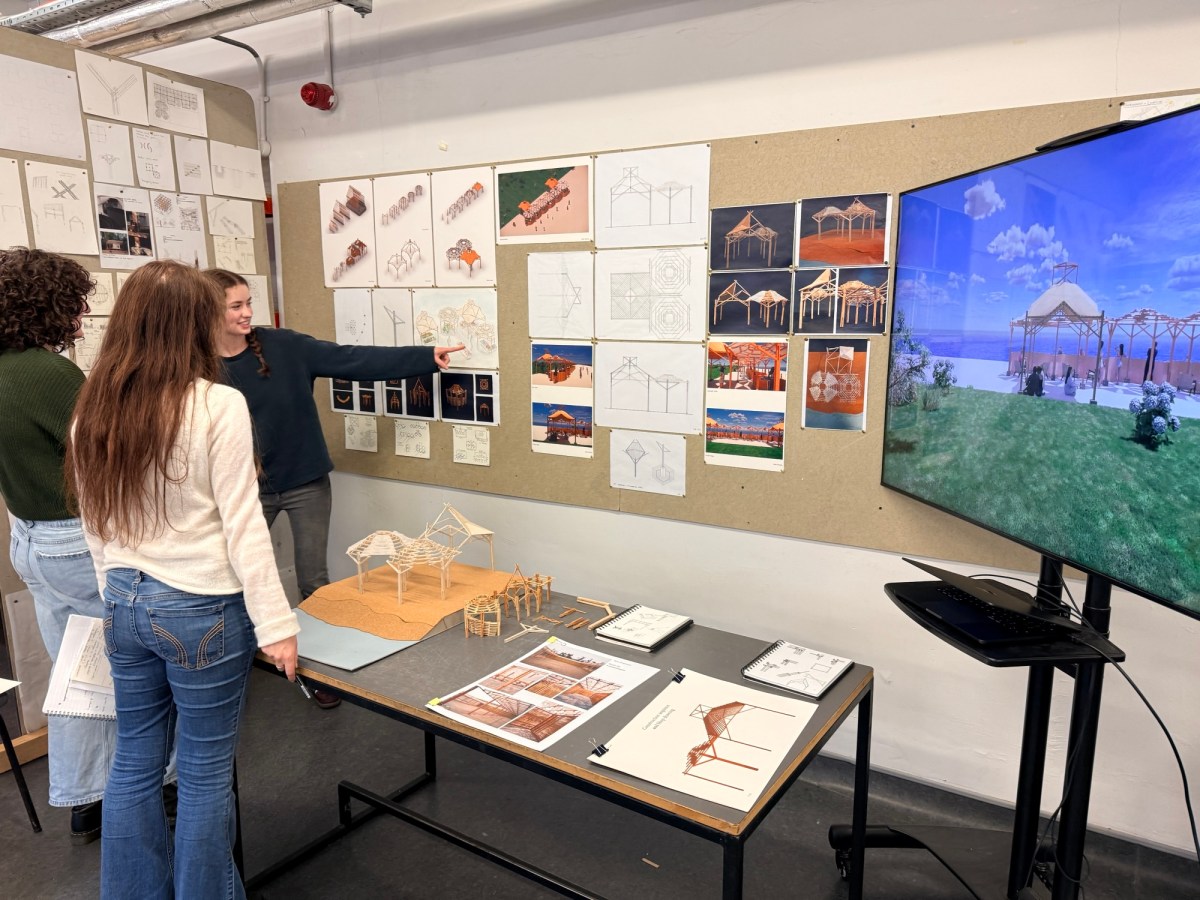
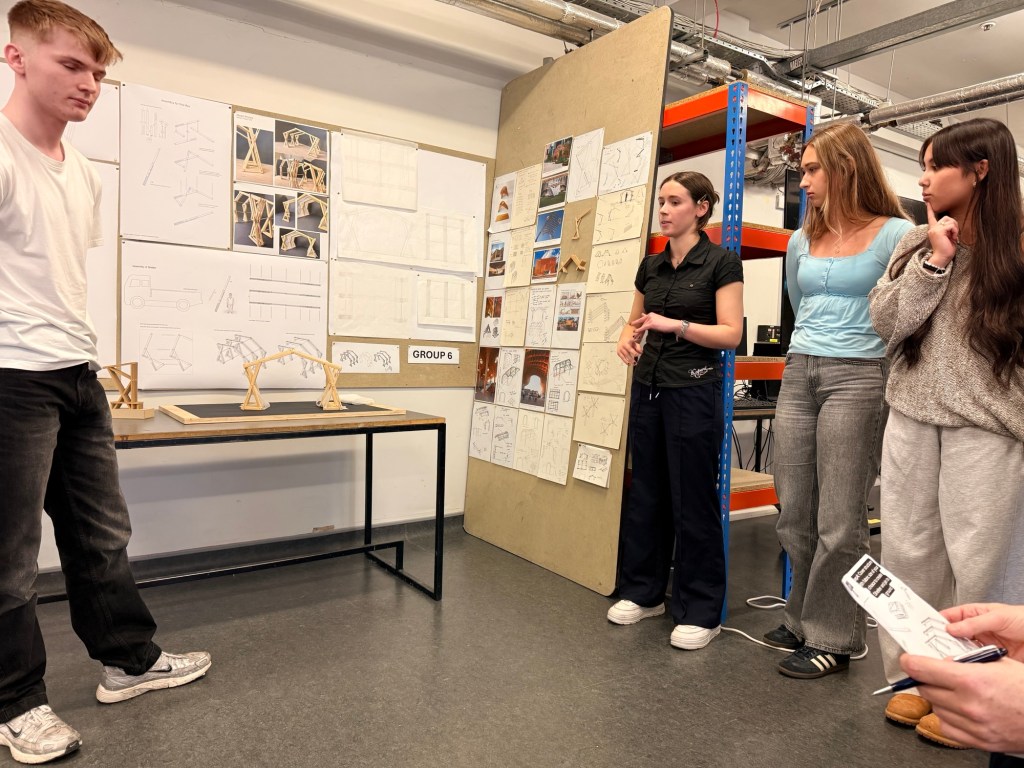
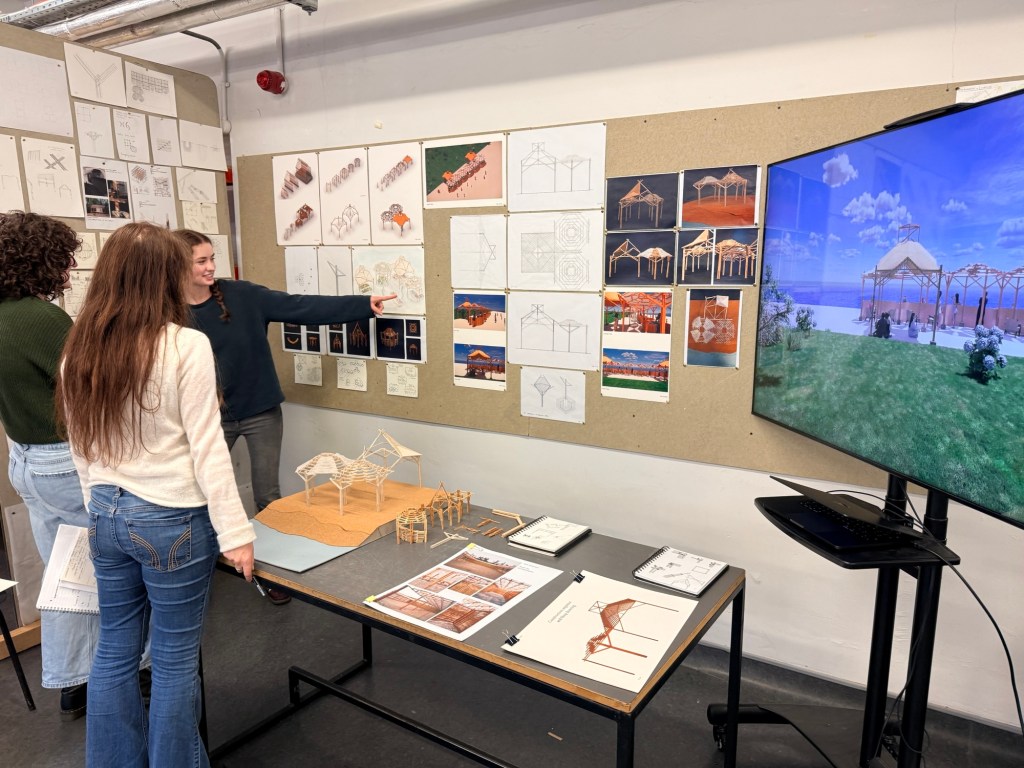
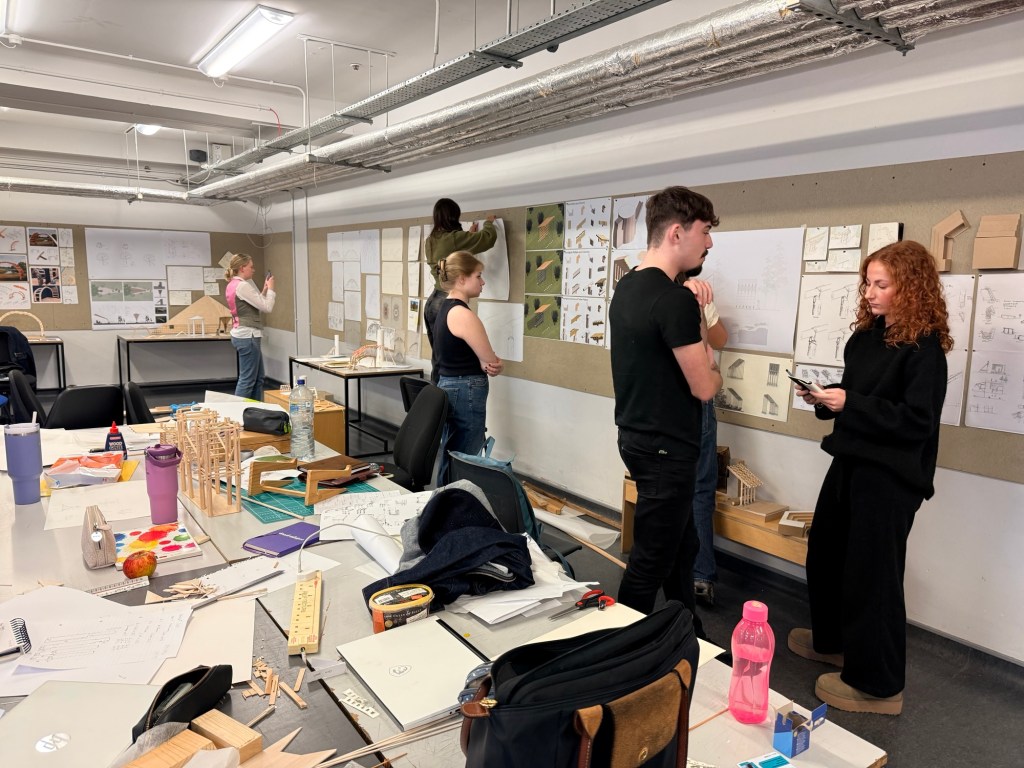
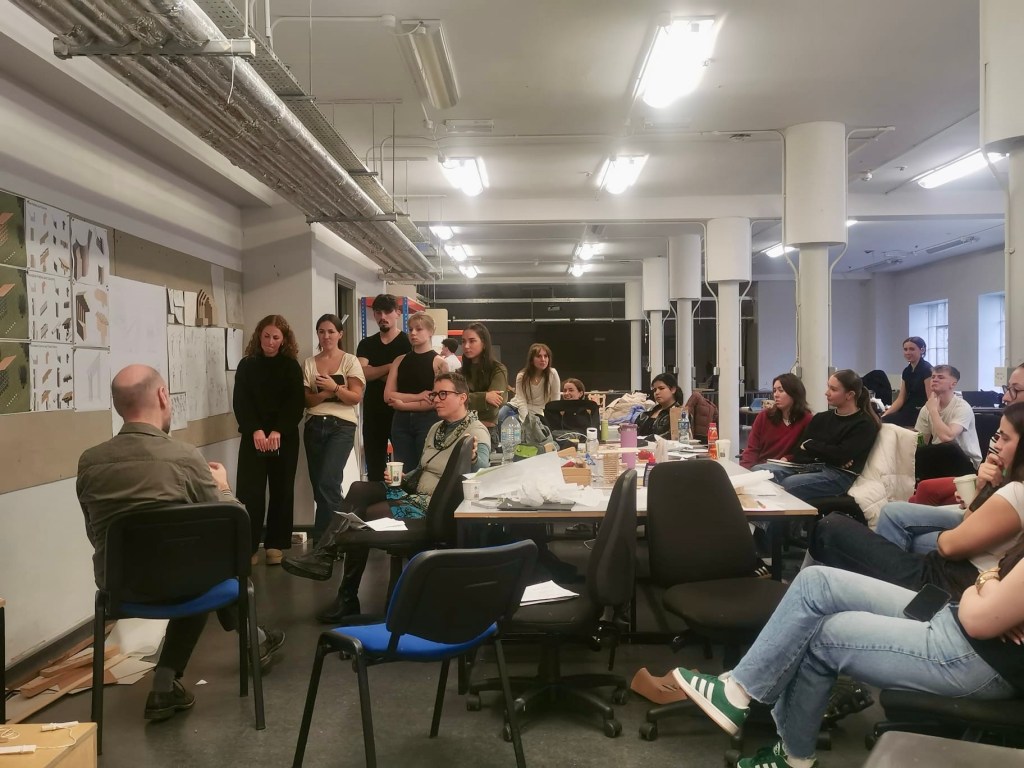
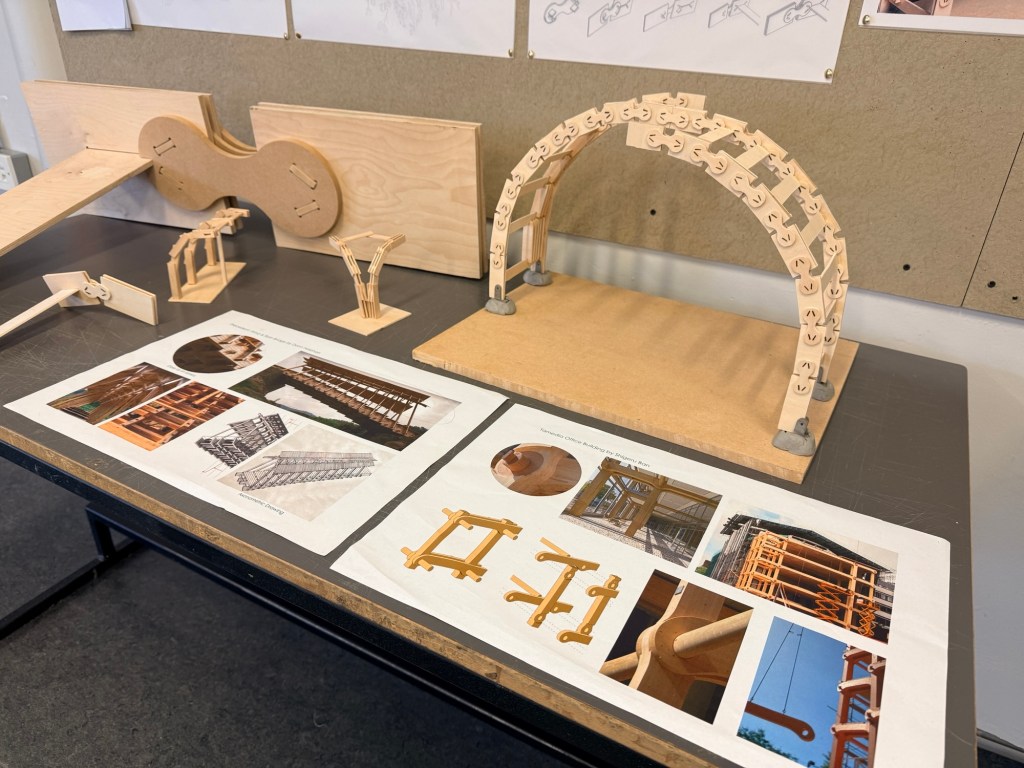
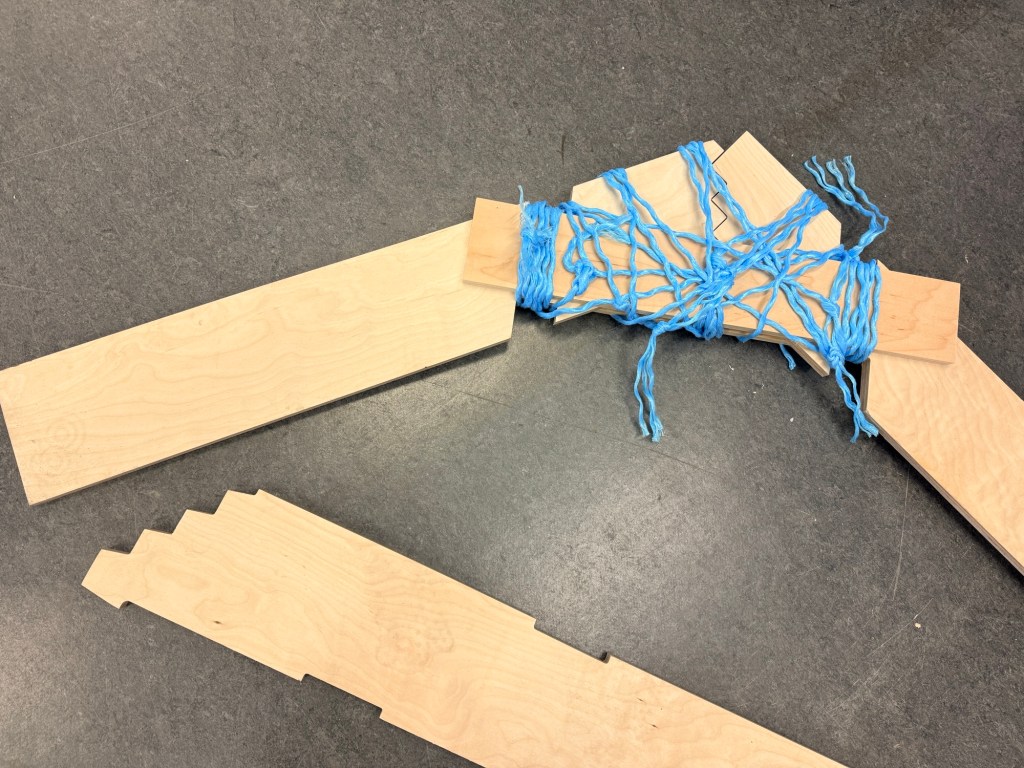
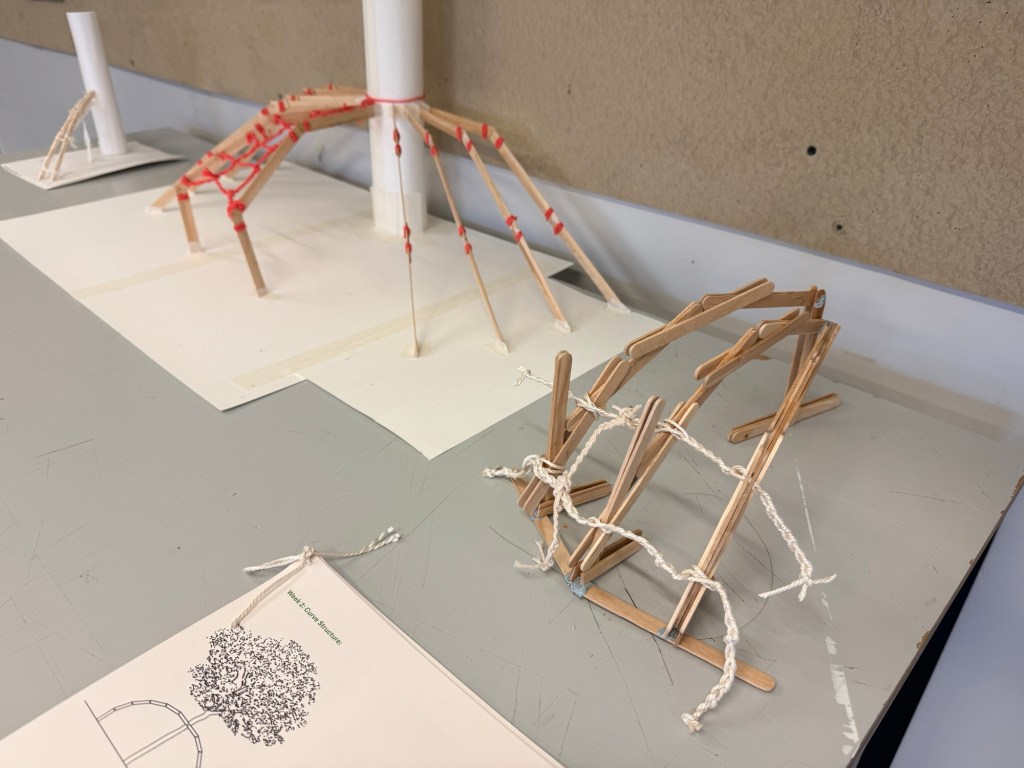
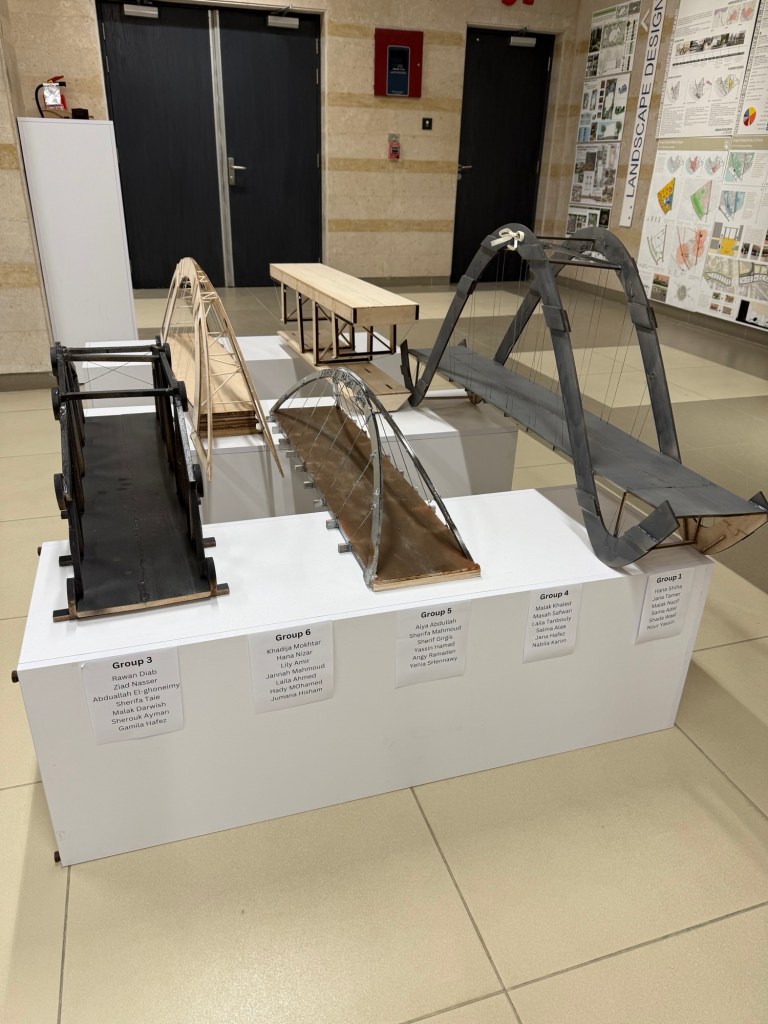
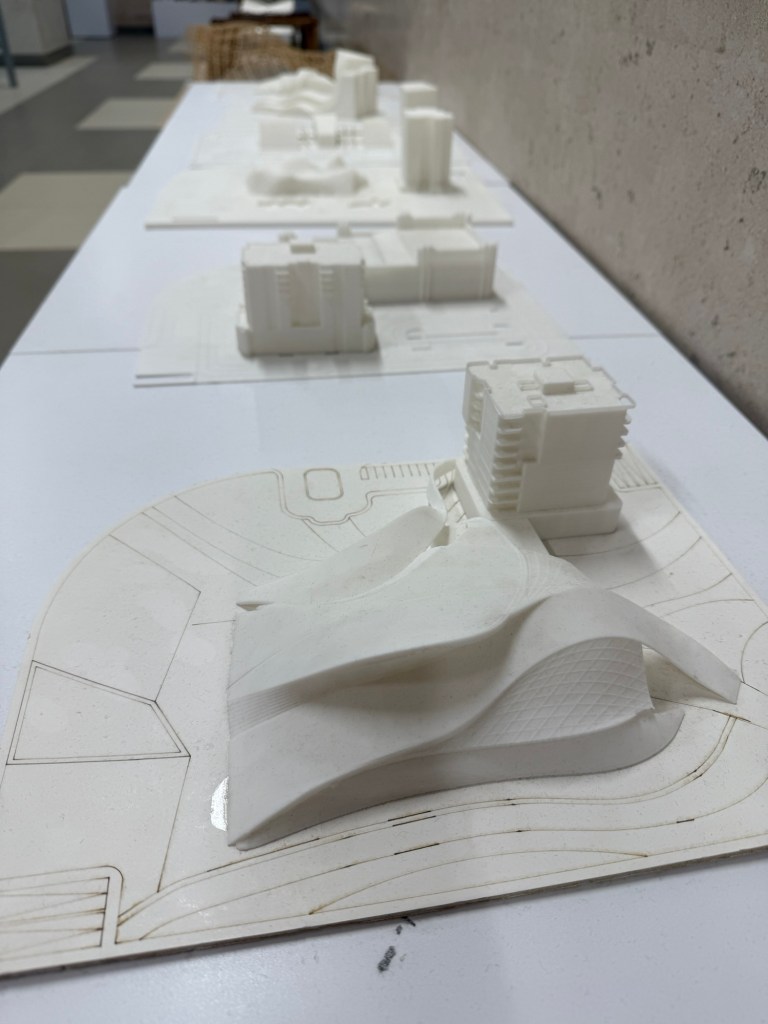
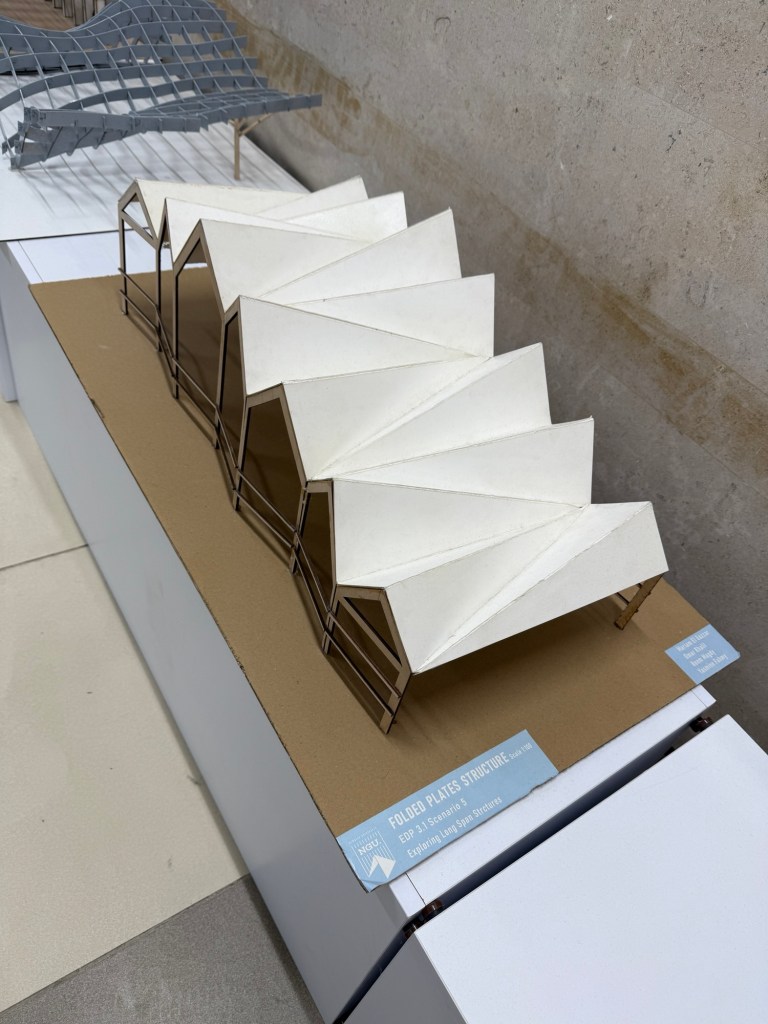
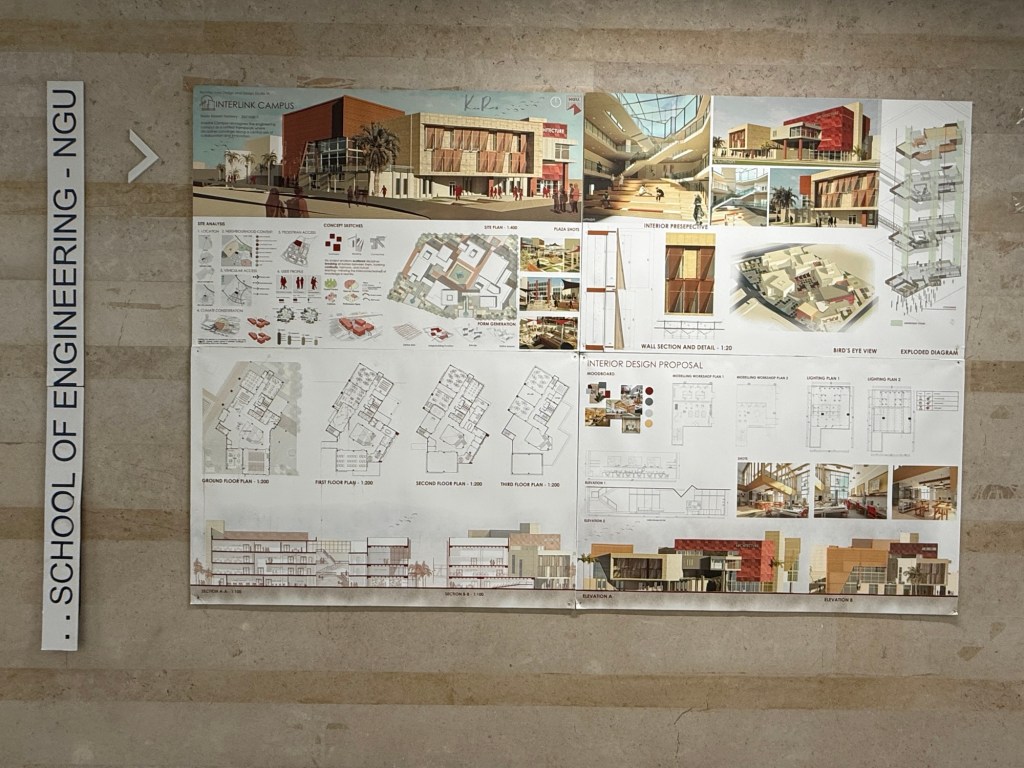
This past Friday, I had the distinct pleasure of reviewing studio work and giving architecture students feedback on prototypes they have been developing to reuse scrap materials from the woodworking shops at the School of Architecture, Building and Environment (SABE) at TU Dublin.
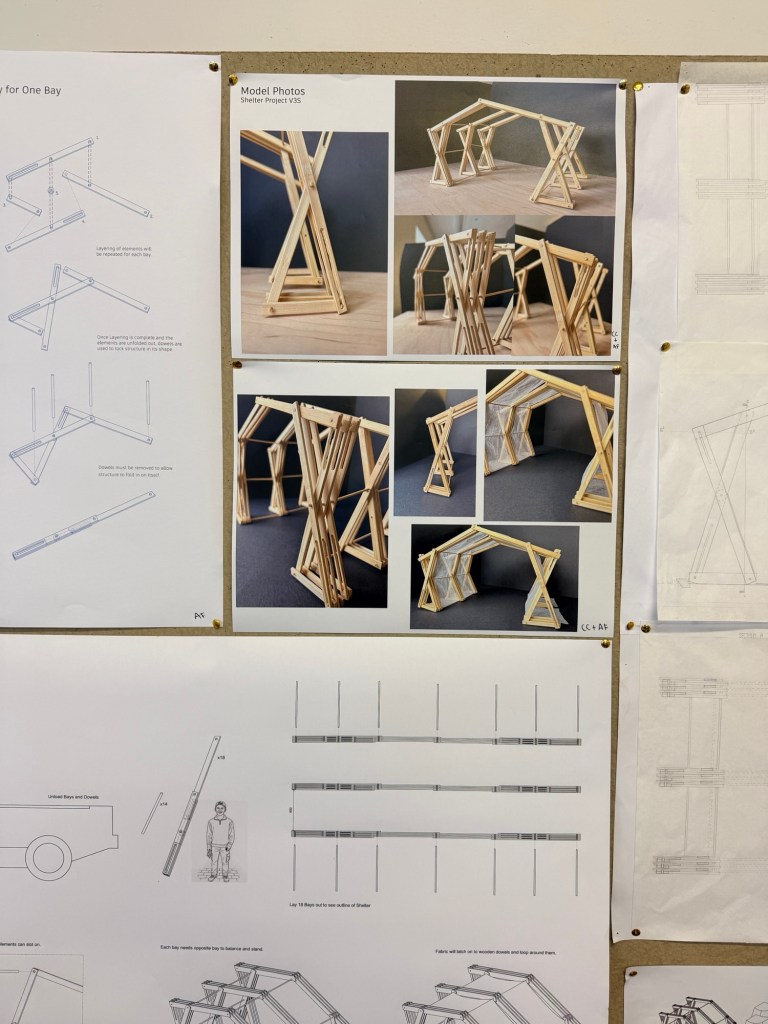
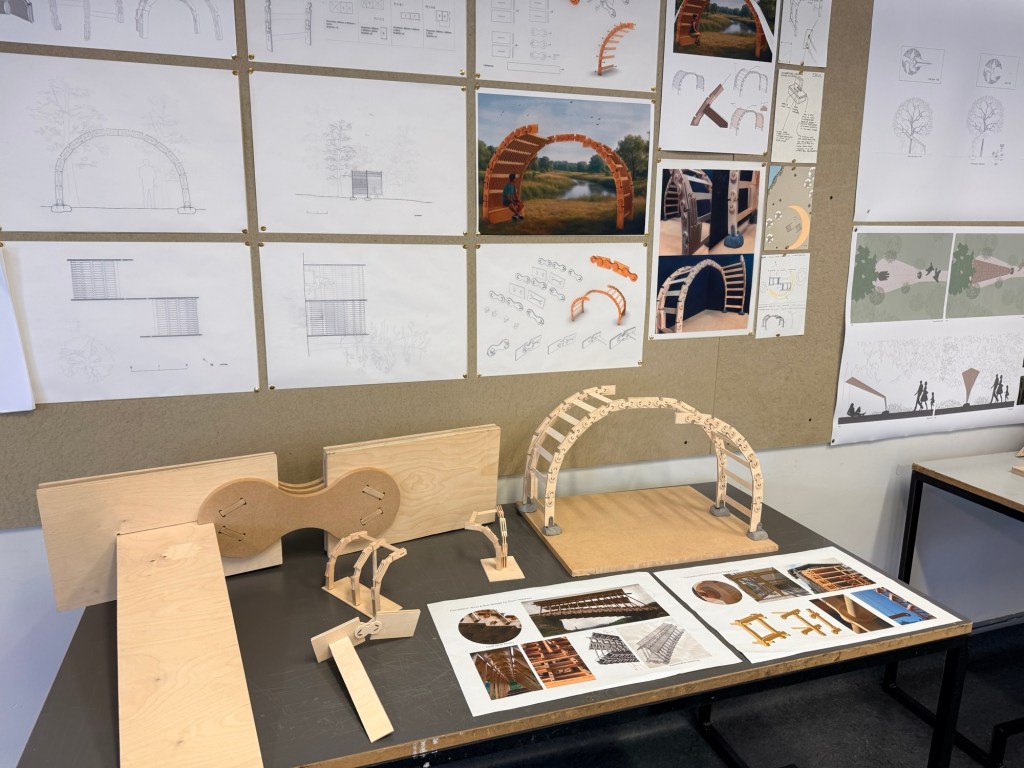
A cool transformer-type system that can be moved and easily set-up.
The students are helping support the circular economy, and learning to work together.
This is a vertical architecture studio, comprised of second and third year students.
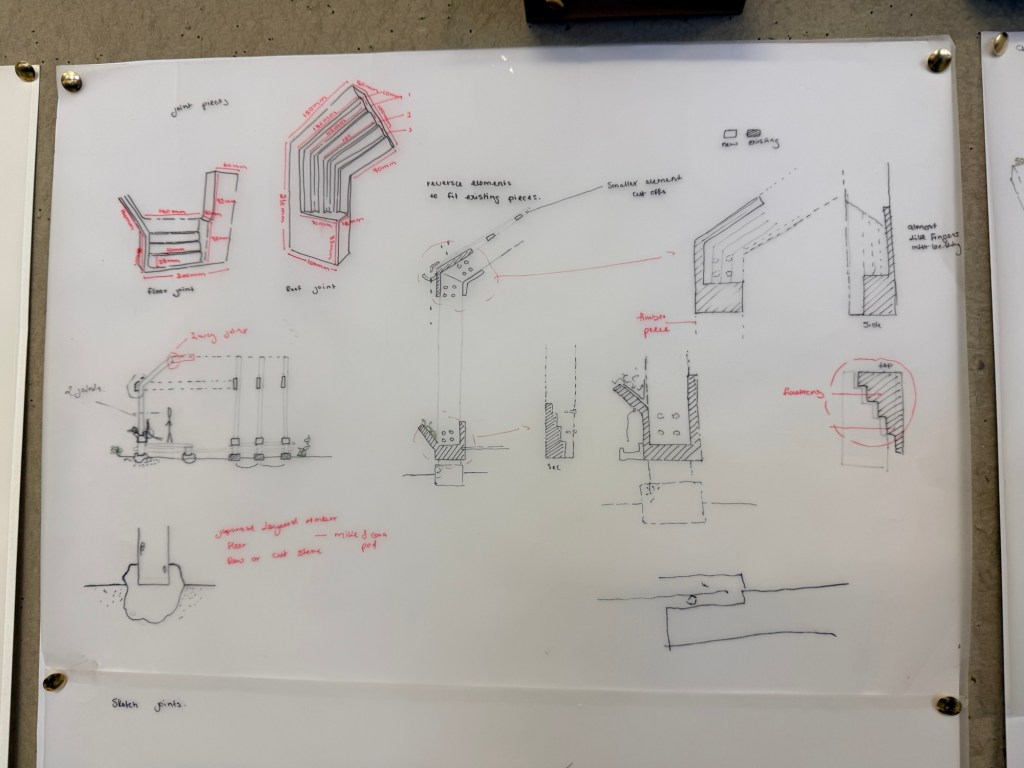
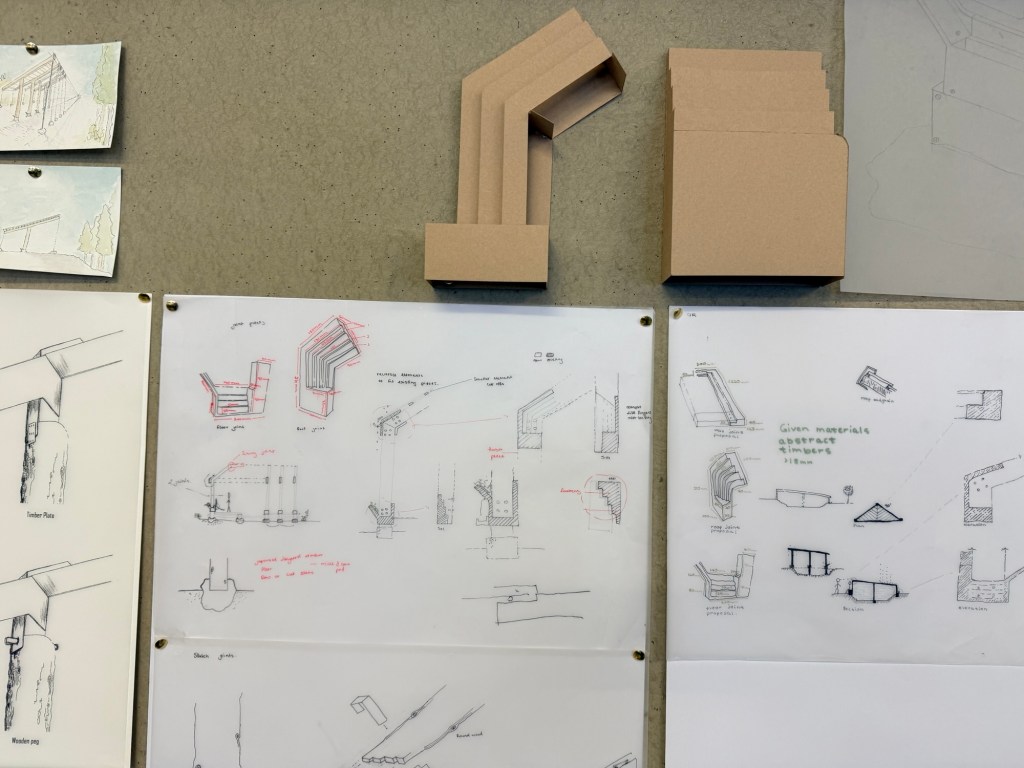
A corbelled system that can be reconfigured dozens of ways.
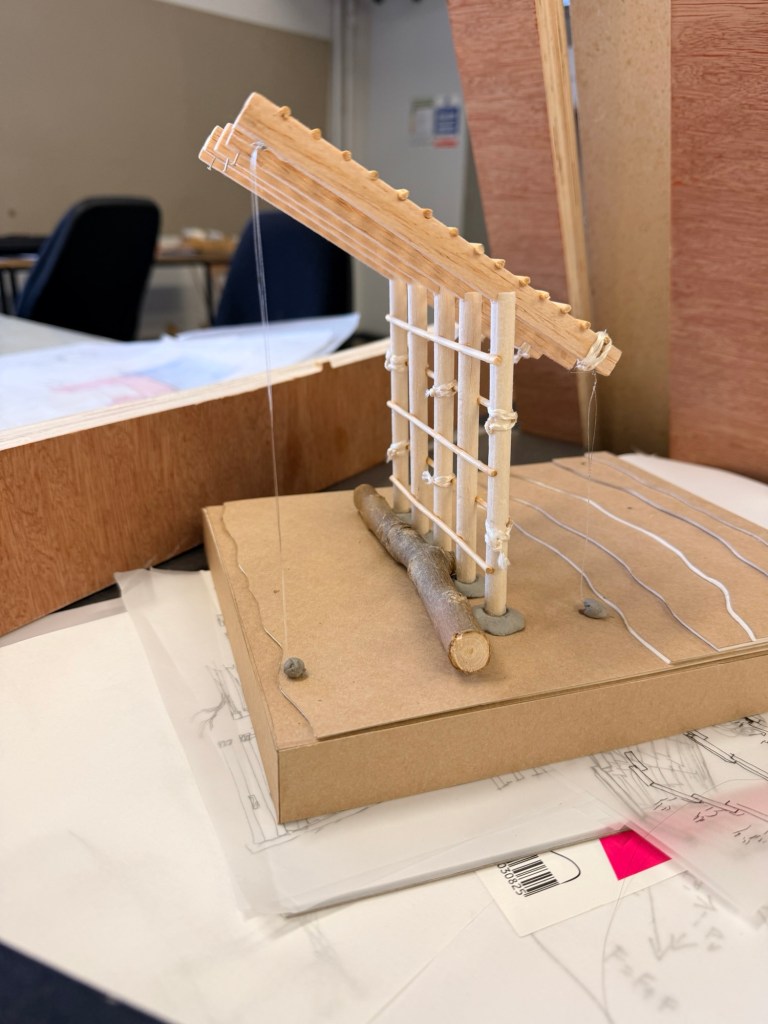
Each team as allocated a collection of cast-off wood sheets or wood planks to use to make a small structure. The structure needed to be at least 3 meters in at least one direction.
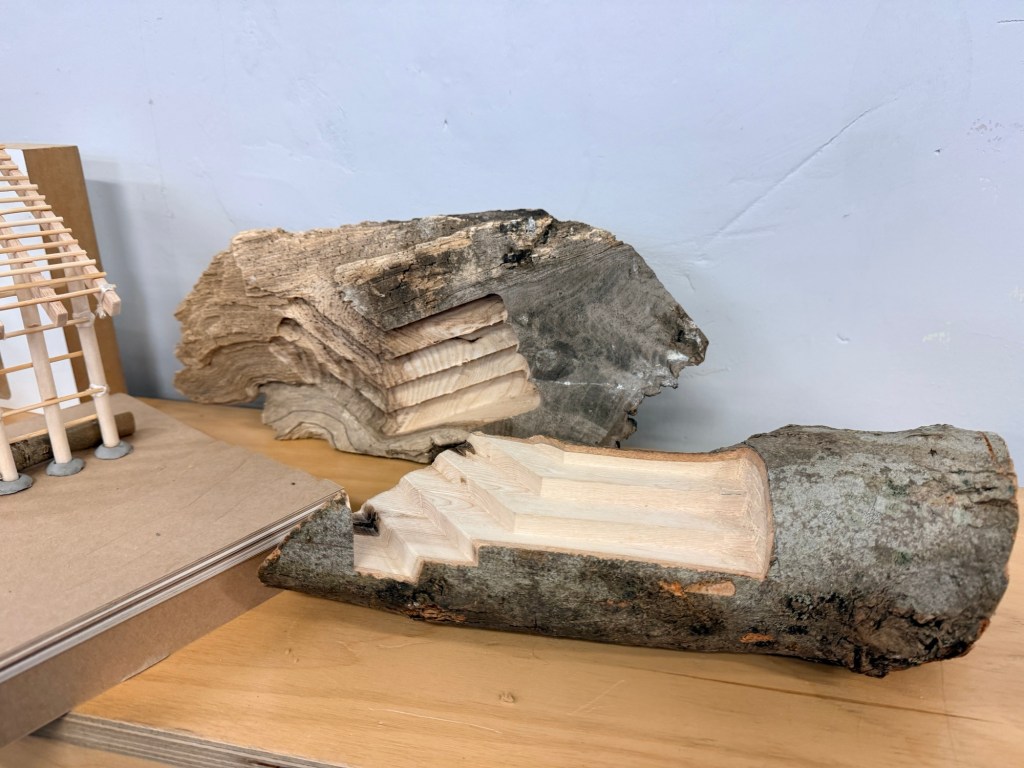
From the reminders of CNC routing
This architecture studio is led by Marcin Wojcik and Kevin Donovan. The project is also tied to a grant from Ireland’s Housing Authority to study how to modularize materials brought to construction sites, but never used to allow them to be reused elsewhere. Marcin and Kevin are doing the grant-funded project with Noel Brady.
And I am an enthusiastic observer, doing what I can to help my colleagues get more involved in research.
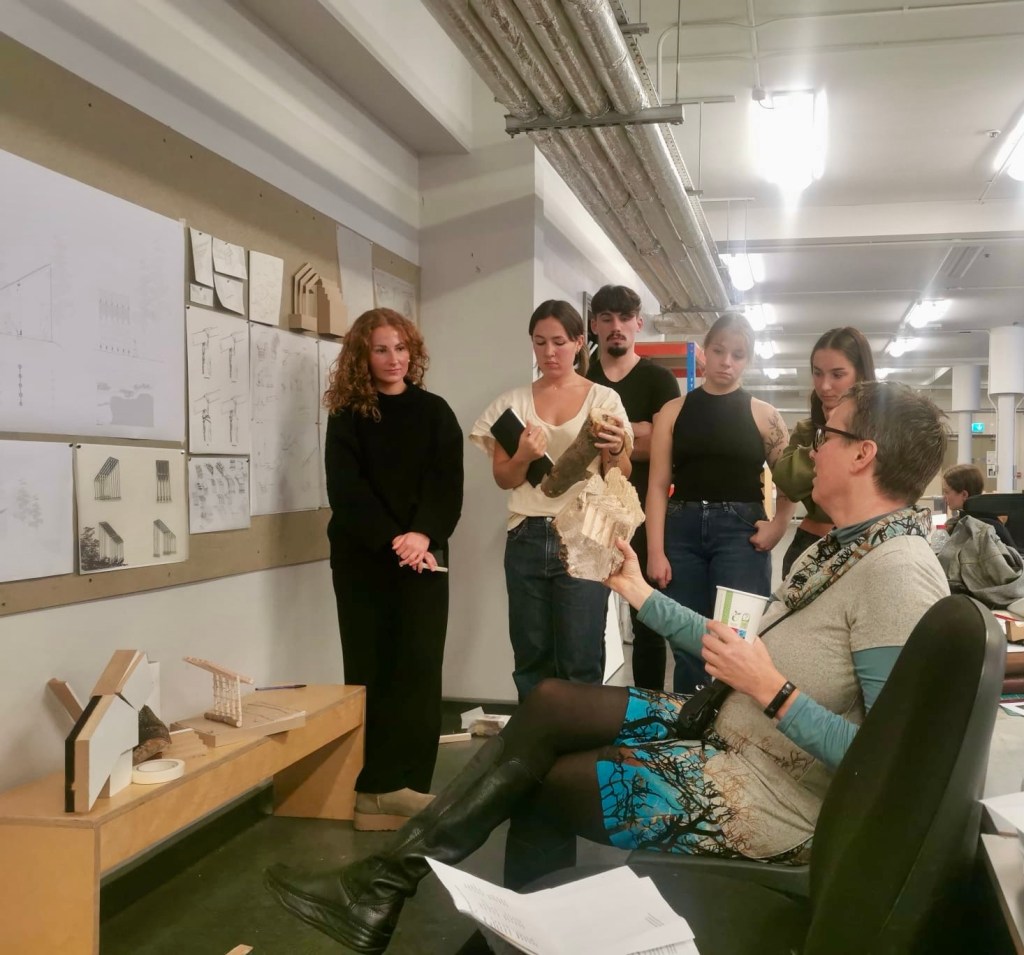
Reviewing the proposal by Group 4.
Overall, the work I saw presented and the level of attentiveness and collegiality among the students were all highly impressive! They have done all this in just three weeks. 
A pavilion for bird watching; intriguing lessons in tension and compression.
I was excited enough about the work I saw to convince Marcin to draft a short conference paper, which he accomplished over the weekend. It’s about the outcomes of this three-week assignment, how it has evolved over the years, and the implications of Friday’s presentations for the grant-funded project.
Kevin and I are editing Marcin’s draft today, so I’d better get to it!
Hope you have enjoyed seeing the students’ collaborative work! I was thrilled they agreed to let me post photos of them and what they designed and constructed.
NewGiza University (NGU), located on the outskirts of Cairo, just released a video of me discussing the Architectural Engineering curriculum that I co-designed with Professor Emanuela Tilley, starting back in 2020: https://www.instagram.com/reel/DMVKR4HvVQ0/?igsh=MWo1dDE3cTB4Y2cxeQ== (opens in Instagram):
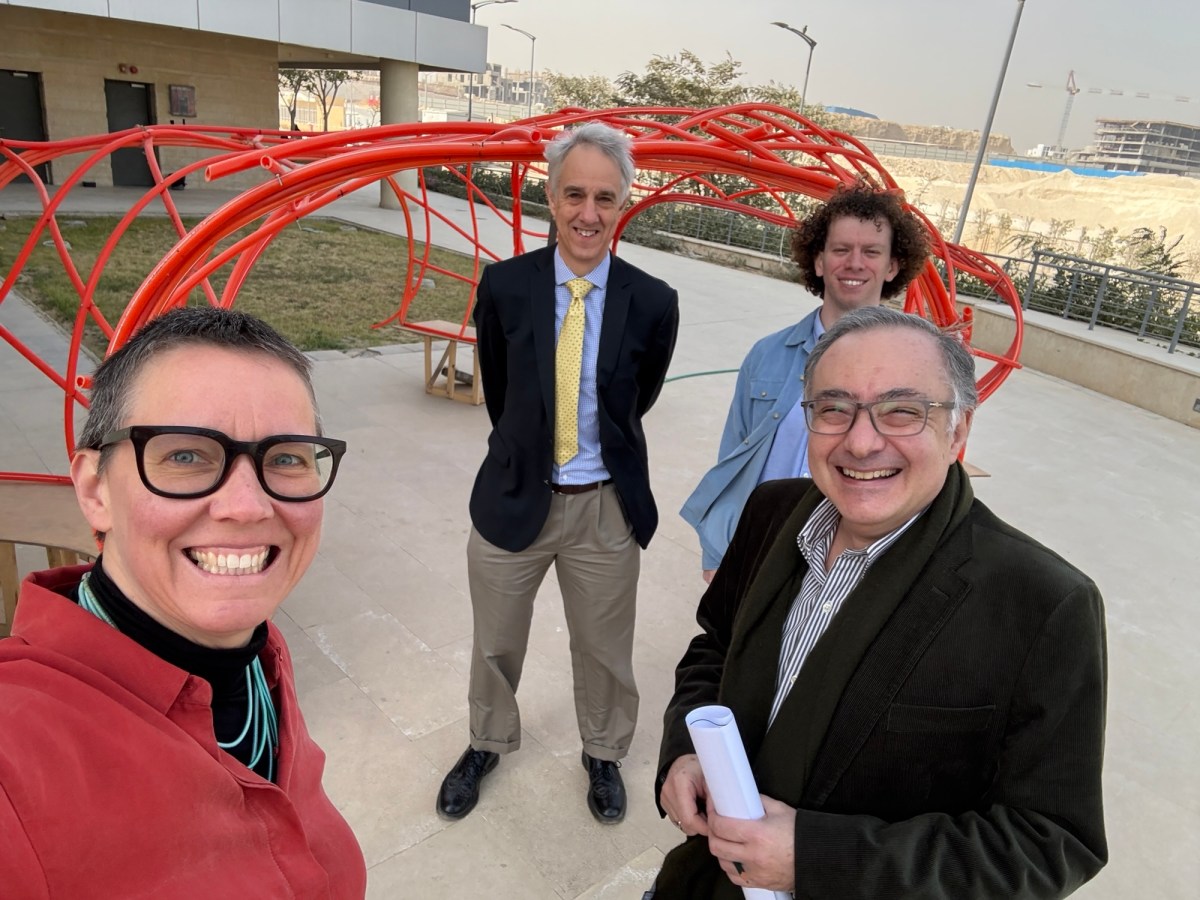
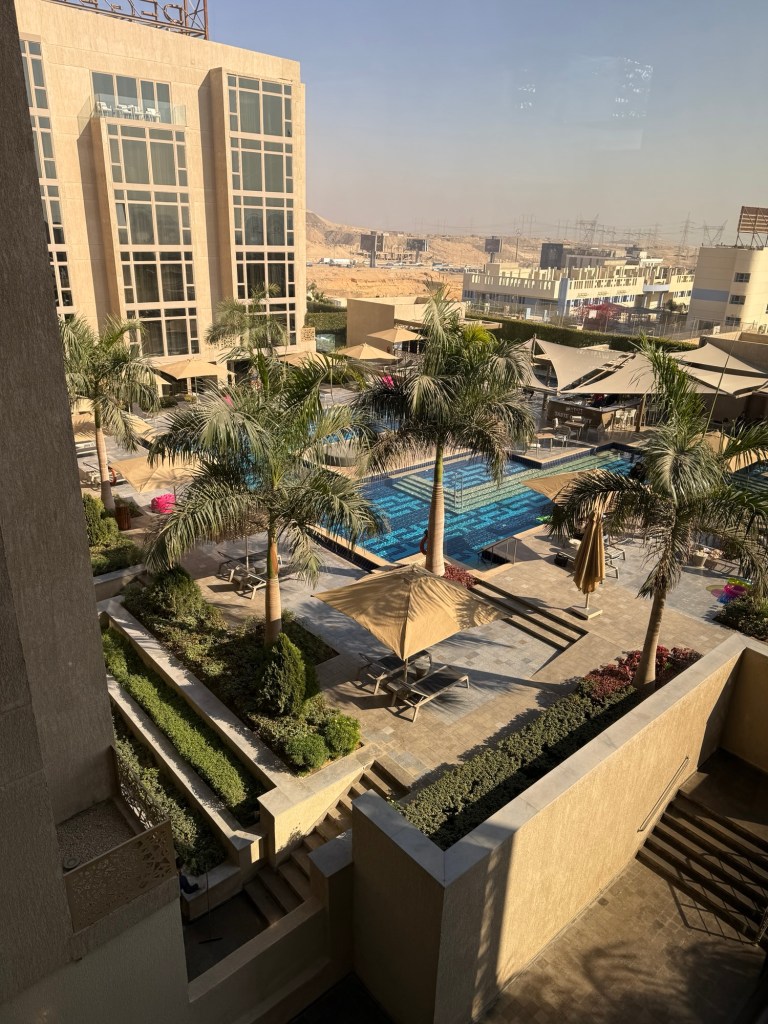
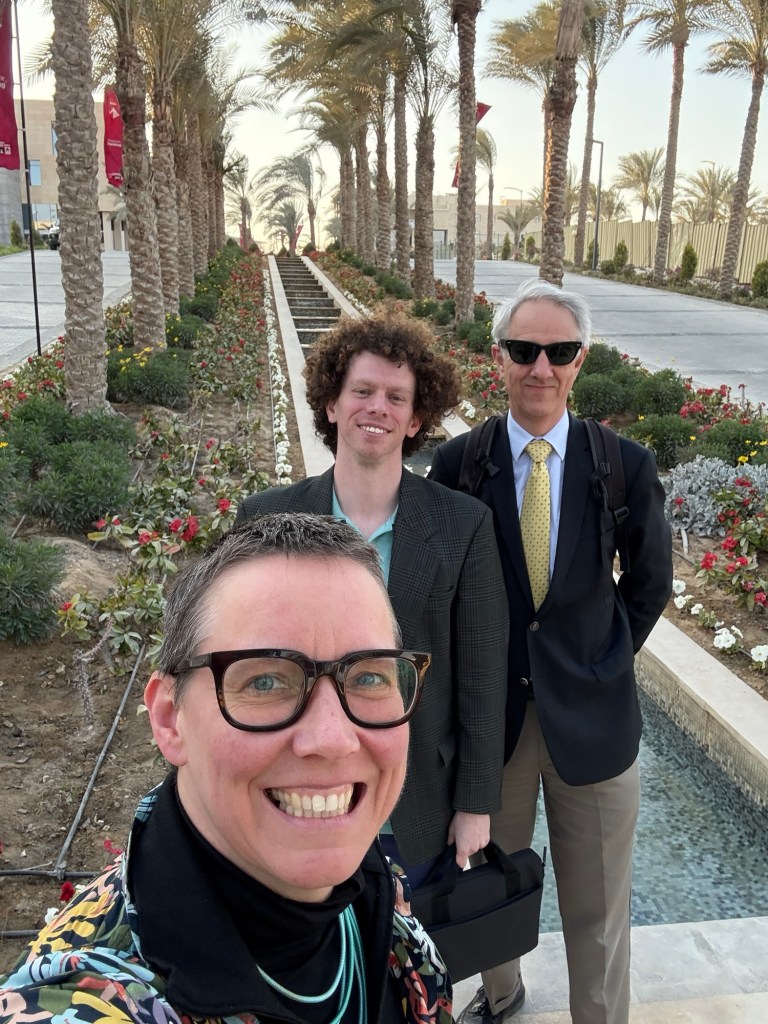
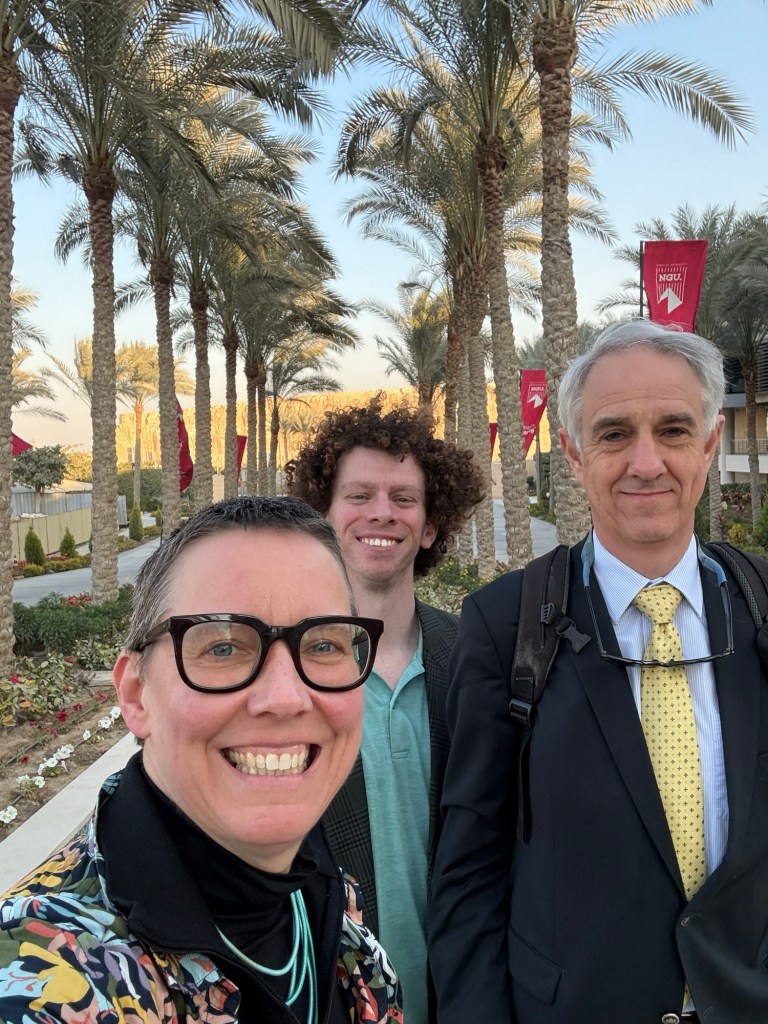
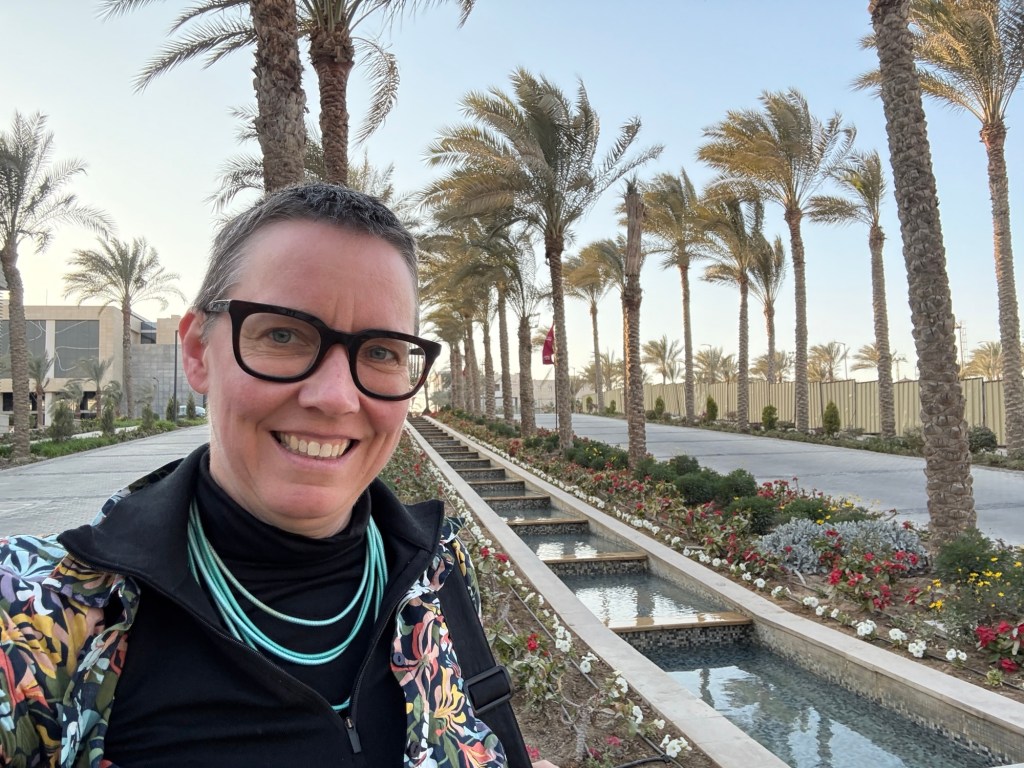
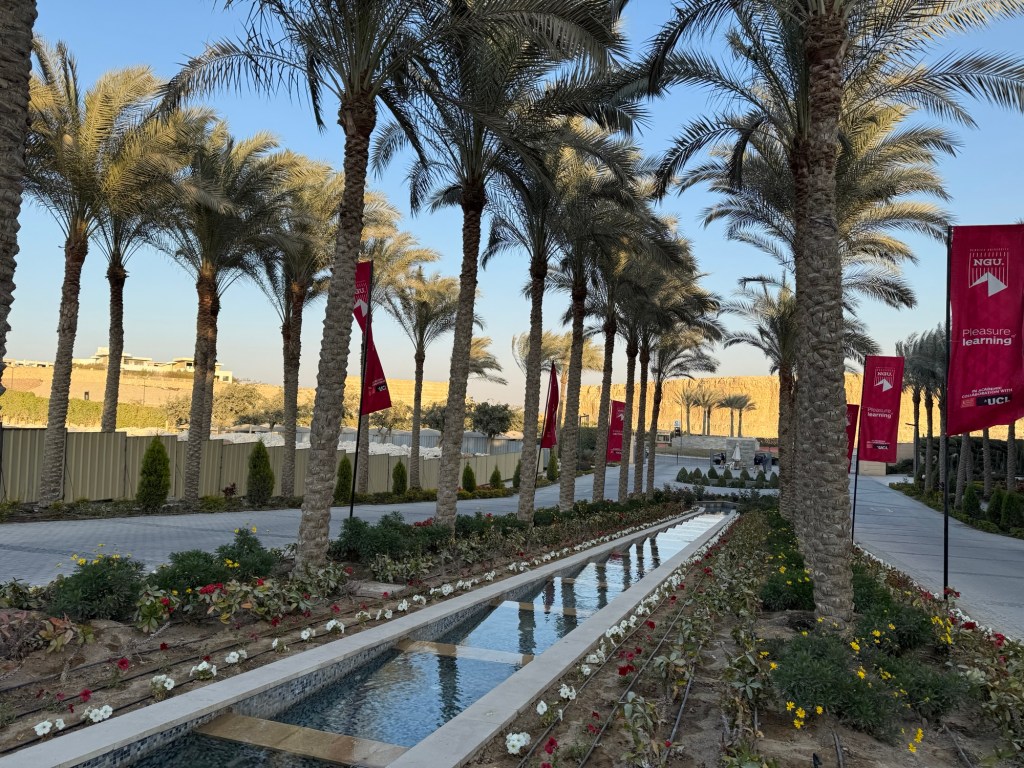
Because of the pandemic, I did not have a chance to visit NGU before we started designing the curriculum. In fact, I didn’t get to visit until this past February, 2025, when I travelled over with two staff from UCL to provide feedback on the quality of the program’s delivery.
It was a whirlwind tour, considering that I arrived a day later than expected due to a British Airline delay.
In my two working days there, I got to observe the program the public relations folks at NGU captured the footage on this video.
Designing this curriculum, via a contract between Technological University Dublin (TU Dublin) and University College London Consultants (UCLC) which pays for hours out of my timetable each semester, has been a real joy. It has required me to stretch, been , and develop new communication skills to explain complex concepts to people from a culture and language much different from my own.
Visiting the program and meeting the people who are delivering the content and the amazingly dedicated studentswho are forging the way by implementing a brand new curriculum has definitely been a highlight of 2025.
Many tanks to Dean Aly and the programme staff for welcoming us and helping us feel at home!
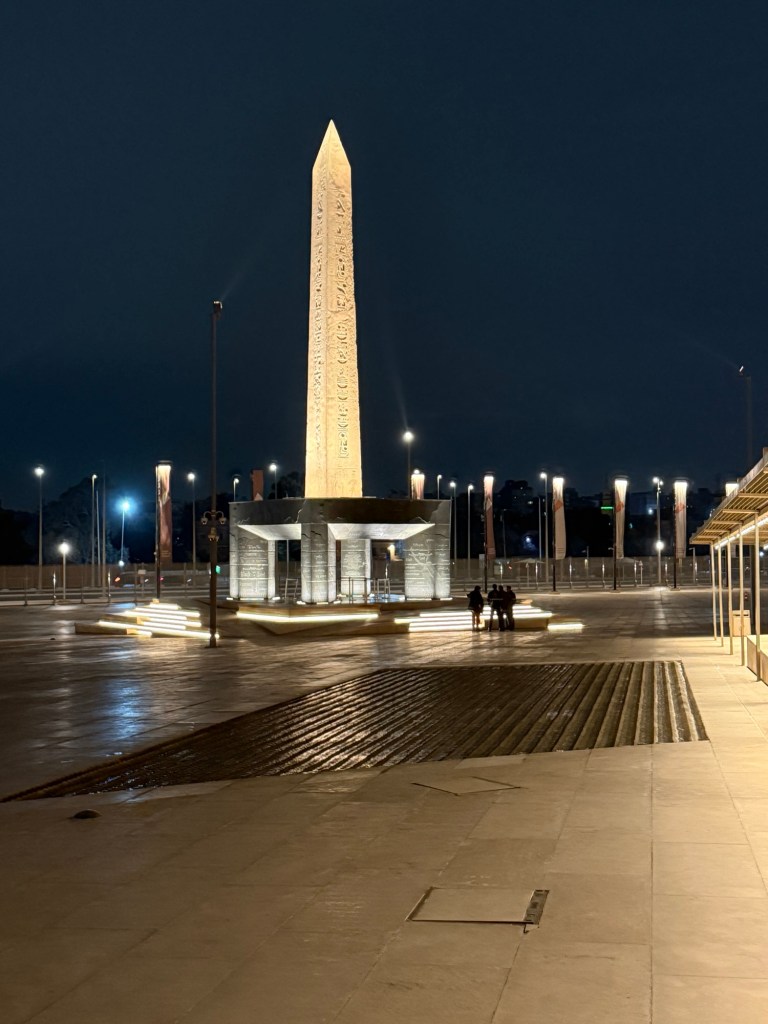
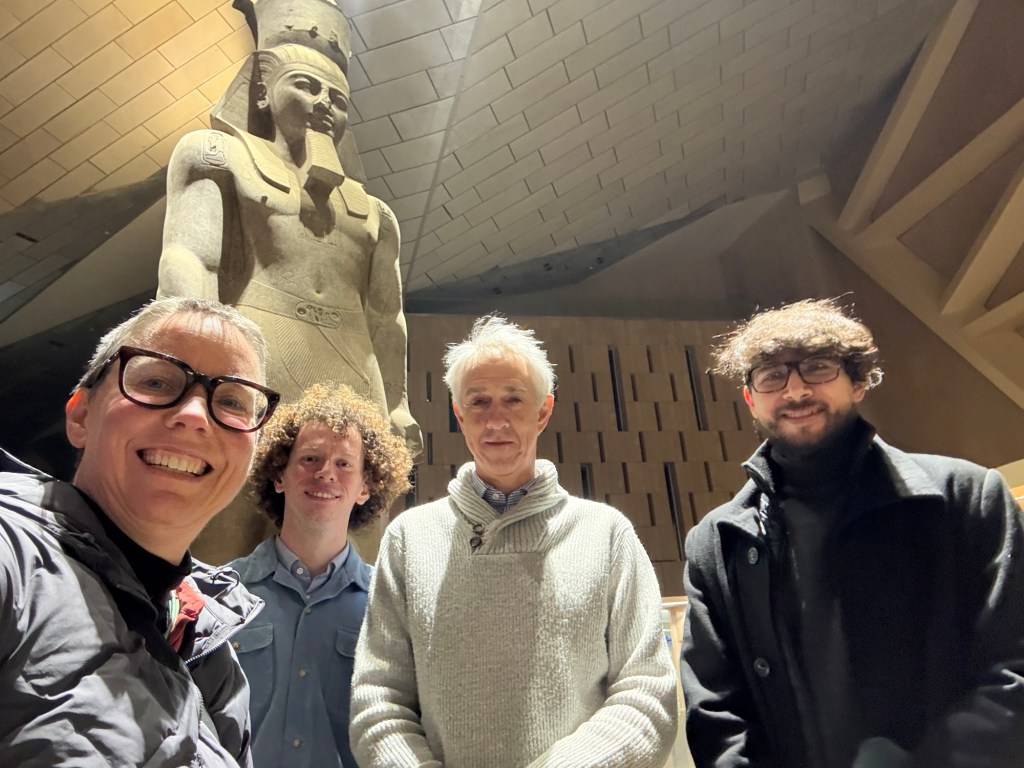
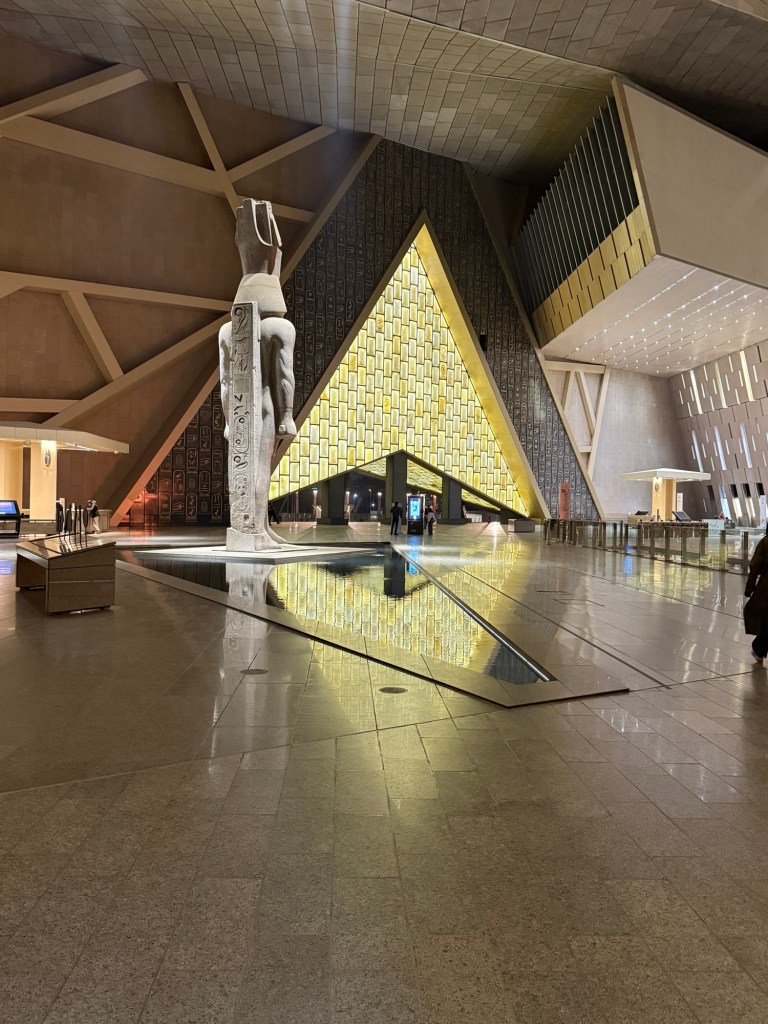
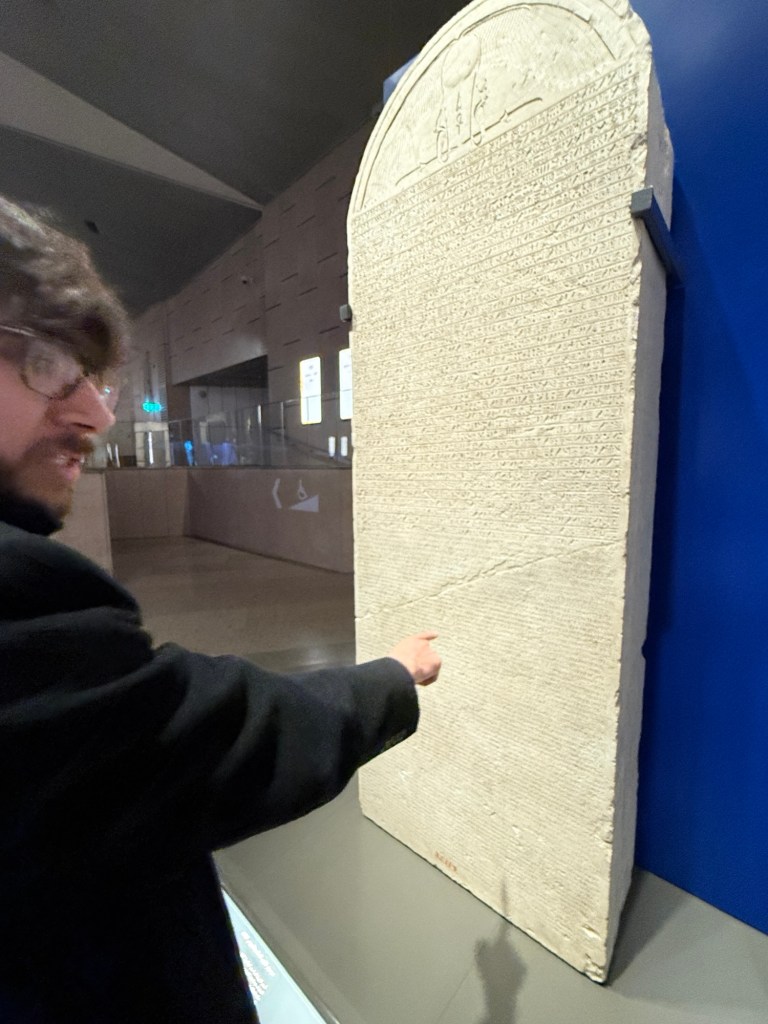
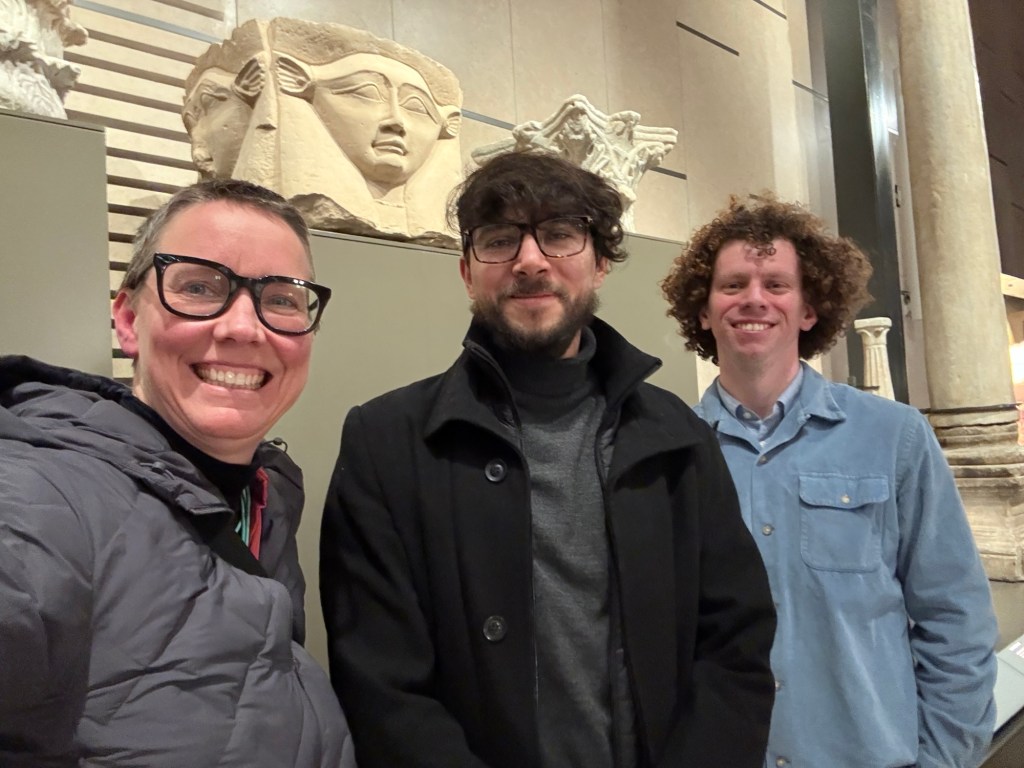
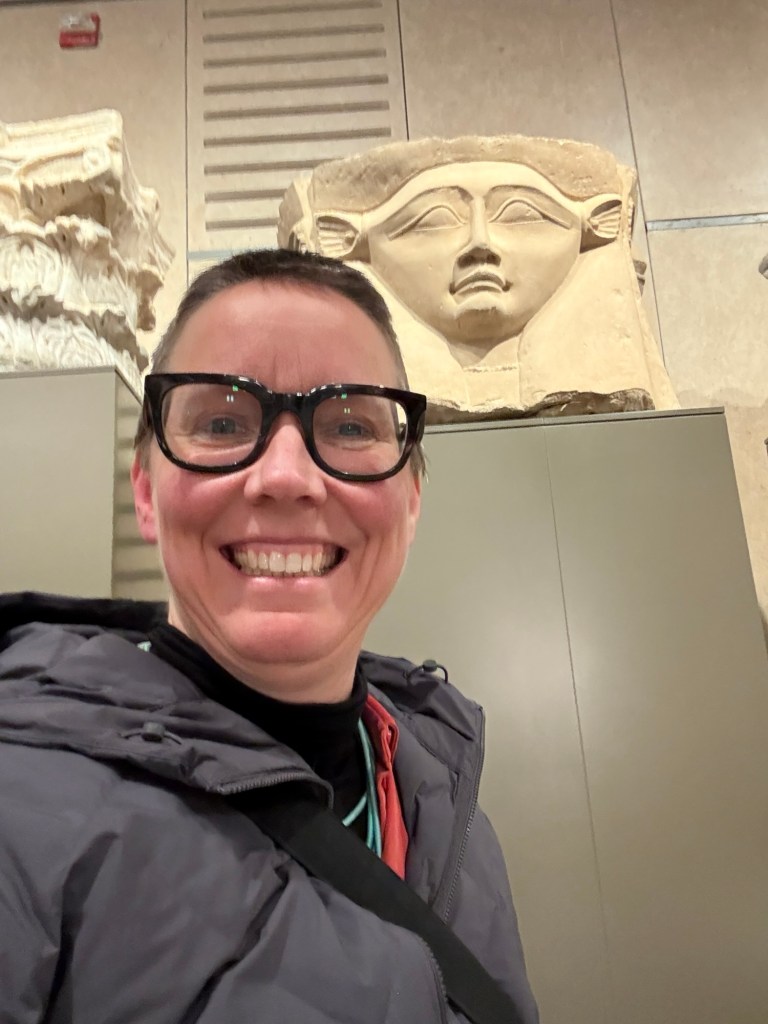
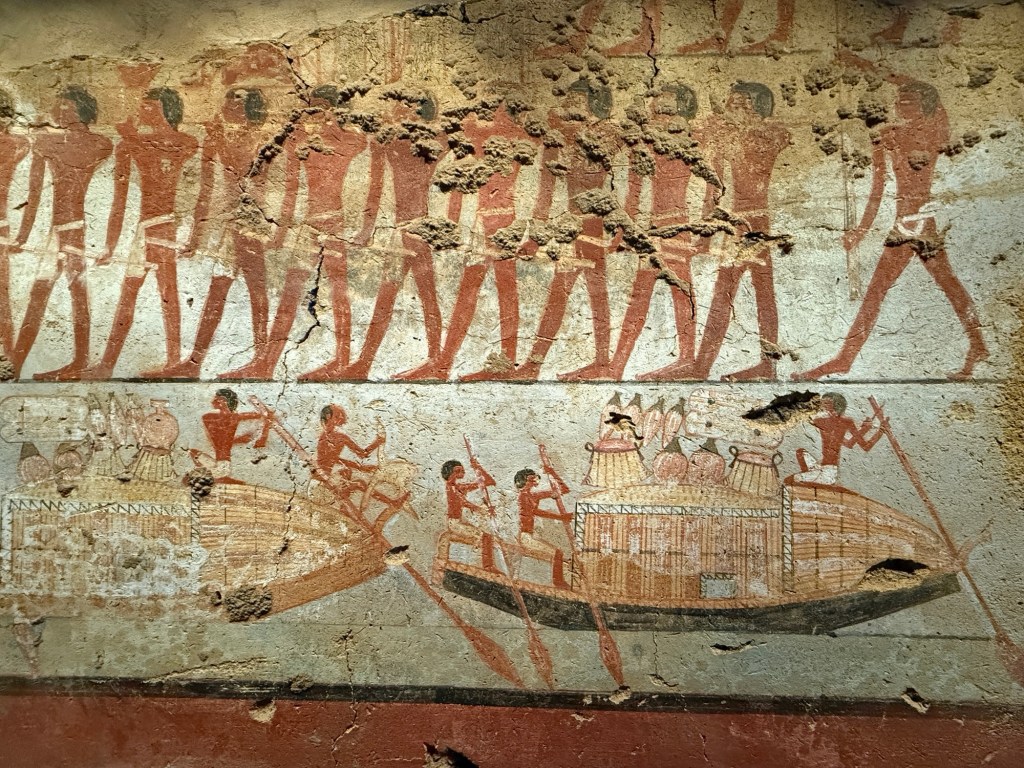
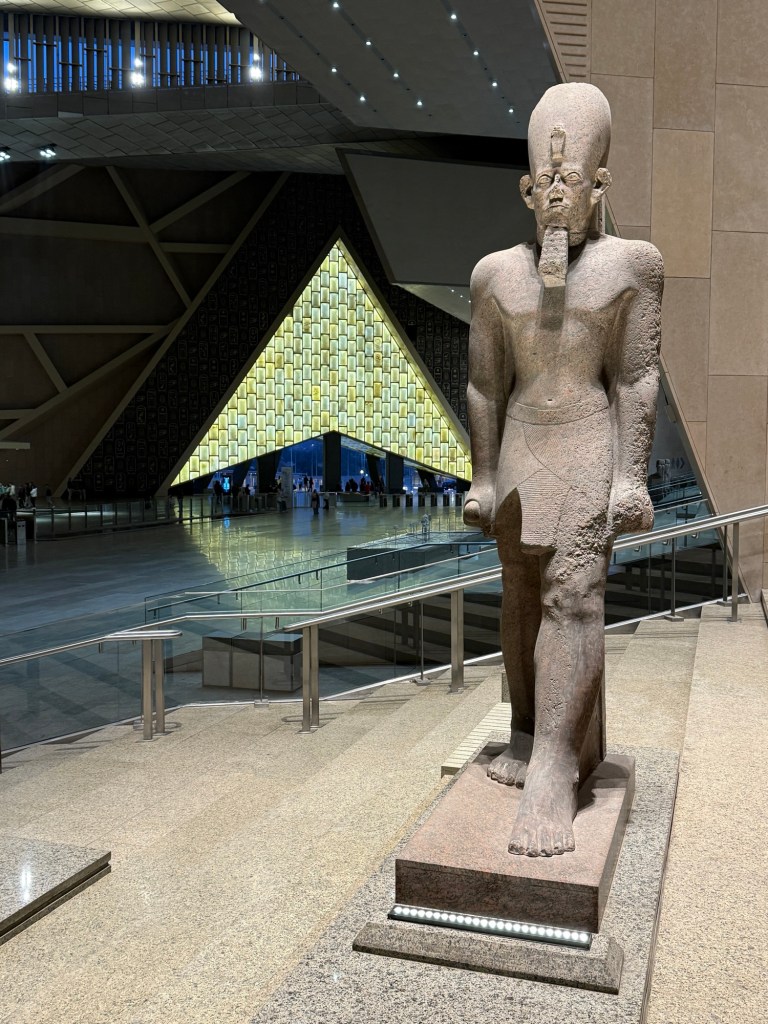
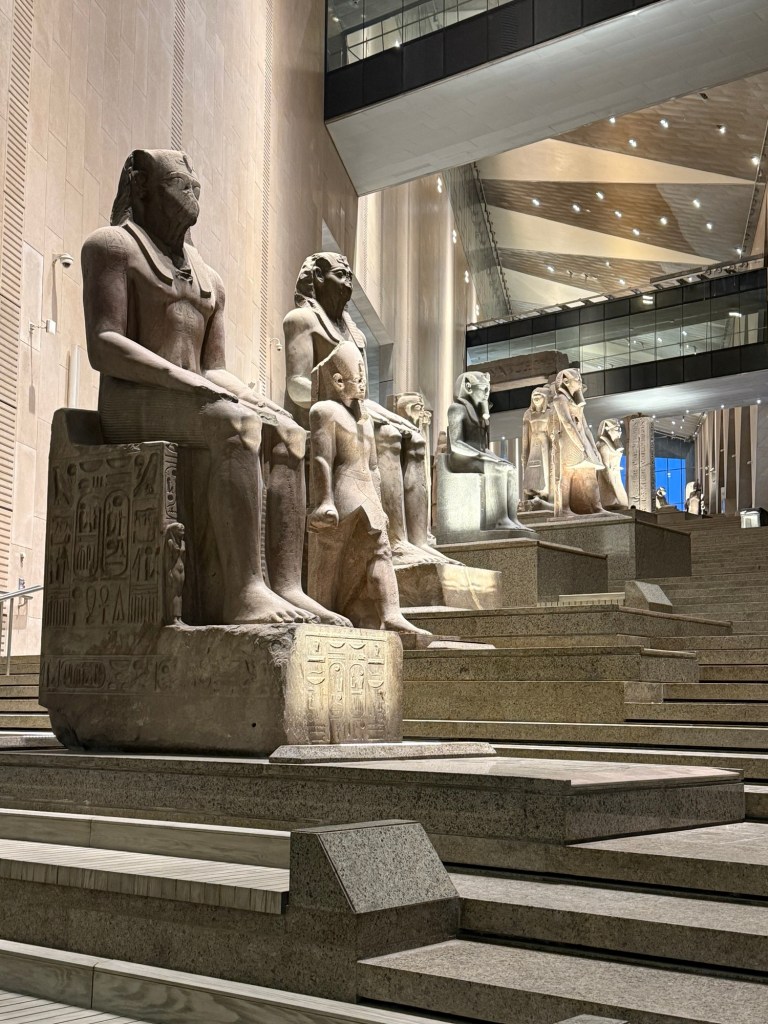
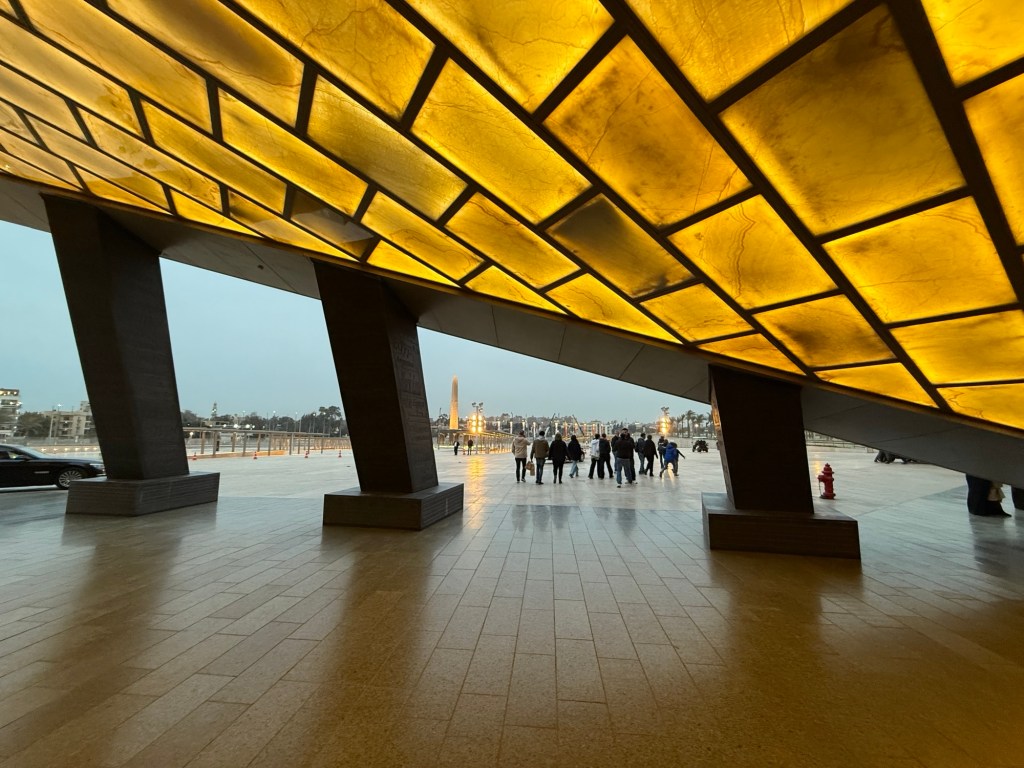
We three visitors also got a chance to tour the brand new Egyptian museum, lead by NGU’s architectural history, teacher. The experience was truly eye-opening and full of intrigue.
I look forward to a chance to visit NGU and Egypt again soon!
I have to say, none of this would’ve been possible without the Marie Curie fellowship I got to spend 2018 and 2019 working at UCL. The bonds I made with the folks at UCL in the Centre for Engineering Education have made such a difference in my and personal and professional life.
Being part of UCL has been so incredibly good for me, and good also for my employer, TU Dublin.
I am so honored to have had the chance to build an architecture program in Egypt and work with the people there who seek to build a stronger community of architects in Egypt. Thank you so much John Mitchell and Emanuela Tilley, for including me in this incredible project!
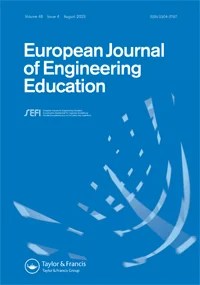
It was no easy feat, as the concepts in this paper are both theoretical and applied.
Rahman and I worked closely together for a year and a half, refining a manuscript he had drafted. Together, we crafted sections to link the topic of architecture education to the journal’s main readership, comprised of engineering education researchers. We had to translate many ideas to make them readily understandable to teachers of engineering and architecture alike.
We also perfected every sentence of the manuscript, seeking to communicate ideas as effectively as possible to EJEE’s broad audience.
I’m extremely proud of this work, and realized only after publishing it that we’d hit a sweet spot, as described by a scholar Deborah Gill from the UK, by helping shed light on these two terms and the types of education they imply.
I hope that many people read it, use the content in their teaching practice, and cite the article in their own future publications.
I’ve never met Rahman in person, but I am choosing to believe LinkedIn and ResearchGate that these images feature him.
Rahman Tafahomi holds a Ph.D. in Architecture and Urban Design from the University of Technology Malaysia. He works at the University of Rwanda in the Department of Architecture as an associate professor. Over the summer, he earned promotion from senior lecturer to associate professor — well deserved! Rahman’s research interests include architecture, landscape design, urban design, heritage, architecture education, teaching and learning in higher education, and behavioral patterns.
As mentioned in my last post, the change of pace caused by the pandemic has had some silver linings – I’ve gotten better connected with global communities discussing and influencing architecture and construction and how we teach it. In this post, I’ll discuss architectural highlights of the past few weeks.
Pivot to Online learning with the ACSA
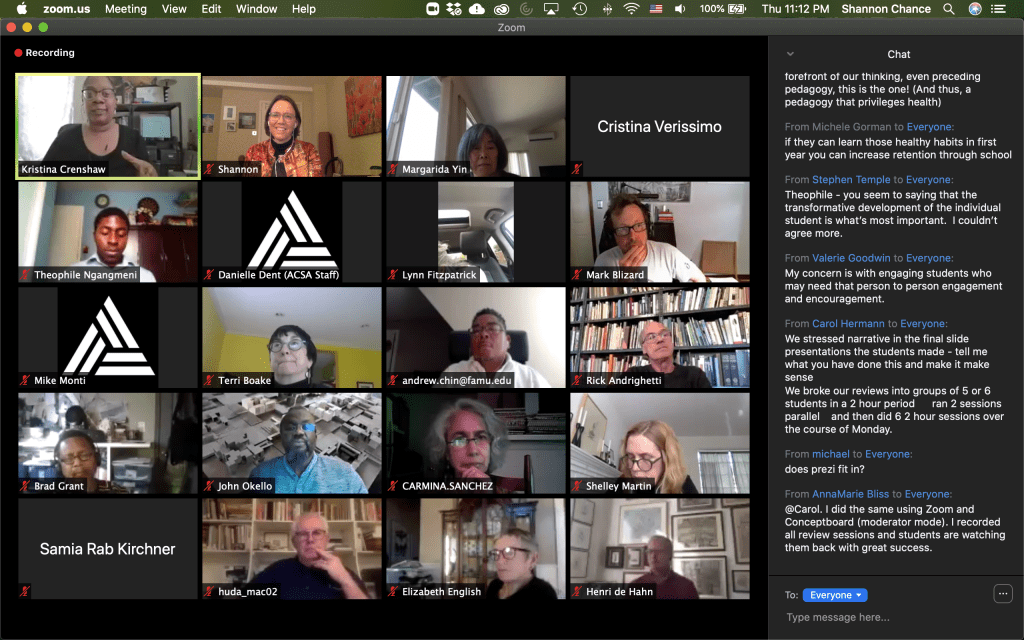
On May 7th, I was part of the online discussion series “Pivot to Online Learning” being hosted by the Association of Collegiate Schools of Architecture (ACSA) across North America. This organization has an odd name, but is a rough equivalent of the Engineers Professors Council in the UK.
The topic of the night was “New Possibilities for 1st Year Design Studio.” Video of the event is available online and you can also download the chat (by clicking here).
As the evening’s lead facilitator, Brad Grant, explained in the session’s abstract, “1st Year Design Studio is an especially challenging class to shift from the traditional teaching environment to remote and online teaching. Introducing the design process, skill building and studio culture to beginning students remotely requires us to transform our traditional teaching practices in novel and in a variety of ways. In this session we will discuss and look to the ways used and imagined to make this leap from the physical studio setting to the online setting for the 1st year design curriculum.”
The ASCA session was 90 minutes long and we had 100 participants the entire time — the maximum number the Zoom room would hold! In fact, attendees started logging in and sharing ideas up to half an hour before the official start, and the ACSA organizers were hard pressed to wrap up after 90 minutes.
Participants were really jazzed up about sharing ideas. I was, too, and it was 2 AM Dublin time when we finished! It was truly a dialogue among peers, following very short presentations by:
Bradford Grant, Professor, Howard University
Kristina Crenshaw, Adjunct Assistant Professor, Howard University
Dr. Shannon Chance, Lecturer and Programme Chair, Technological University Dublin
Margarida Yin, Lecturer, Cal Poly State University, San Luis Obispo
Theophile Ngargmeni, 1st year student, Howard University
This was an amazing experience for me. The 100 participants included so many of my past teachers and teaching colleagues. On the screen above, you can see a few — Brad Grant, Carmina Sanchez, and Ronald Kloster who I taught with at Hampton University. Mark Blizard and Shelly Martin who taught me at Virginia Tech. Andrew Chin, who I’ve been in contact with ever since I chaired the 20th National Conference on the Beginning Design Student at Hampton University in 2004. So many other familiar faces and names were in the audience — Steven Temple, Bob Dunay, Jori Erdman, Norma Blizard….
It was touching to be in a virtual room full of people who have shaped my life. As I told them, one of my biggest passions in life is Second Year Architecture. I don’t get to teach it these days, and I miss it! Those couple hours are forever in my memory. A true honor and privledge.
Over the past months, I’ve also been working on a project with University College London, where we’re designing two new engineering programs — one in architectural engineering and a second in electrical engineering. Our curriculum development team is coming together and we’ve started meeting fortnightly (that’s every other week for those of us who speak American English!). I’m currently focused on designing the AE.1.1 “Introduction to Architecture, Environment and Construction” laboratory module. The curriculum is for a new university in Cairo, Egypt.
NAAB service and NCARB studies
Just before the lockdown, I did a little work for the National Architectural Accrediting Board (NAAB), reviewing a university’s proposal to modify its course requirements. Serving the NAAB on visiting teams as well as smaller projects like this keeps me up-to-date with policies and procedures surrounding accreditation of architecture programs in North America and beyond (via substantial equivalency).
The lockdown has provide they type of slowing down I needed to wrap up my periodic Continuing Professional Development as an Architect as well. Although I constantly attend architecture programs and lectures, the Commonwealth of Virginia requires Registered Architects to complete learning units structured and monitored for quality in very specific ways. This isn’t so easy to achieve while living in Europe.
The easy way to earn CDP units is to attend big conference and check in at the sessions. I’d hoped to attend the AIA Europe conferences this year in Porto or Cork, but the pandemic put those plans on hold. Instead, I completed over 16 hours of study using monographs from NCARB (the National Architectural Accrediting Board) and completing online tests.
The NCARB short monographs are good quality, but the tests leave something to be desired — they don’t really assess understanding of critical concepts. Rather they often test on nit-picky wordings using multiple choice designs. But I know well that writing test questions requires skill — skill I’ve learned slowly and deliberately over time. In writing assessment instruments now, I seek to help students lock their new understandings into place as they reflect upon, write about, or calculate answers. A test, if well composed, becomes a mechanism for more robust learning.
By the end of this testing experience, I was frustrated enough that I emailed NCARB my concerns — they agreed with my assessment and fixed both problems I’d flagged. They even asked me to let them know about issued I’d found in other tests I’d taken. So now, I need to dig through my notes and send them info to help fix a couple other items.
Fulbright birthday call
In the days just after I’d completed architectural license, I attended my first AIA (American Institute of Architects) convention in LA alongside Tarrah Beebe who provided me a place to stay. I’d met Tarrah at an accreditation visit to USC, the University of Southern California. She was representing the student voice as a student leader. I told her about the Fulbright-Hays programm I was planning — bringing 25 architecture students from the USA to Tanzania to study for five weeks. She was enthusiastic, and asked her new employer for a delayed start date.
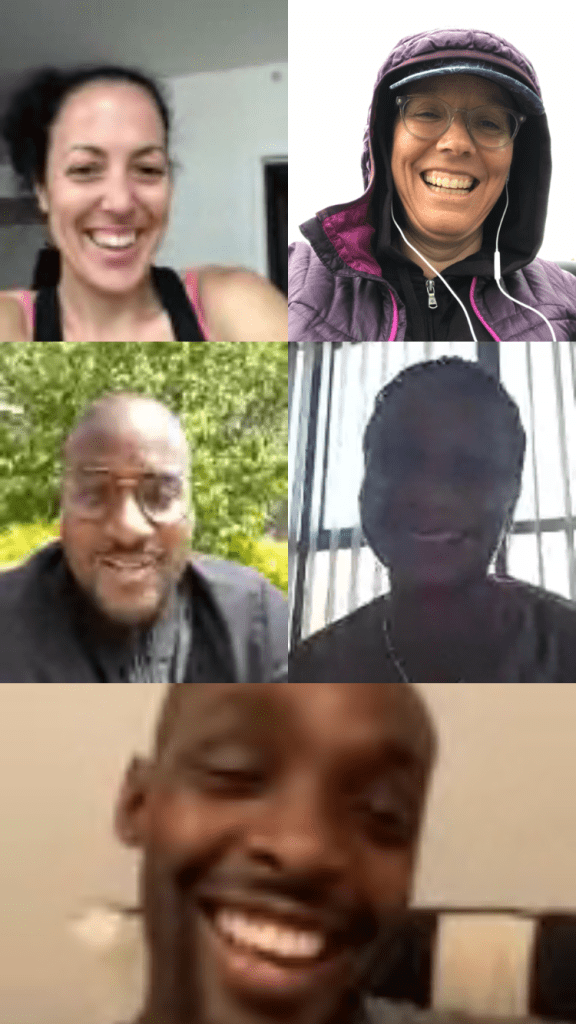
Tarrah had a birthday this past Sunday, and she invited five of us from that trip to an online birthday party. Zoom was down, but Facebook Messenger did the trick! As we are a global group of architects, Tarrah had to dial in at 7AM Pacific time. It was 3 PM Dublin time, so I tuned in from Sandymount after cycling to the far edge of my 5km radius, the extent to which we’re allowed from home for exercise. It was overcast and a bit cool outside, but I needed some sun and weekends afford the time!
Round-the-world Birthday Celebration with: Tarrah in LA; Shannon in Dublin, Ireland; Donald in Brooklyn, NY; Violet in Dar es Salaam, Tanzania; and Thomas in Bangkok, Thailand.
Why so early a call for Tarrah? You see, our colleague Thomas A. Allen, AIA, MSRE, LEED AP is currently over in Bangkok, Thailand. He’d earned a travel Fellowship from the University of California and has been able to set himself up working as an architect from a laptop. Today he’s able to serve his existing clients from anywhere in the world, and his client base is growing. He doesn’t expect to go home anytime soon. In fact, he’s waiting for the borders of Australia to re-open; in the meantime he may well visit Singapore or Malaysia.
The lovely and talented architect Violet Mafuwe tuned in from Dar es Salaam. Violet recently made a week-long series of posts on @beyondthebuilt on Instagram. She is the Creative Designs Director at Space Consult Architects in Tanzania.
A photo of Violet with students, showing them her project for a bank. She works daily on site 3D (interior and outside). The project will be completed late this year (2020).
Several of the birthday participants have been featured on Instagram’s @beyondthebuilt, including Tarrah and Thomas. In one of her posts, Tarrah wrote:
The experience that I am most grateful for was a 5 week long Fulbright-Hayes trip to Dar Es Salaam. I was asked to apply in my last semester of grad school by @shanchan7 and I said no, that I had just accepted my job at @kfalosangeles. I couldn’t even locate Tz on a map. Then a little voice told me I needed to do this. Along with architecture students mainly from Kansas State and Hampton University, I got on that plane, knowing no one with no idea what to expect. Our project was to work with Tanzanian architecture students at Ardhi University to come up with a vision of the informal settlement of Keko Magurumbasi. This settlement was slated for demolition and redevelopment. We were trying to help the residents show the government that it was a better option to provide infrastructure to what was already there rather than rebuild from scratch. Besides the incredible experience of working with students from Tanzania, the collaboration among American students was a complex and powerful experience as well. There were such valuable lessons in urban design but also race, tolerance, diversity, and above all, listening. I am still friends with many people from this trip, American and Tanzanian. One of my Tanzanian friends @vaimafuwe even came to the US to visit me! I have been back to Tanzania a few times since then, which I will get into in my second Tz post. Every time I get off the plane, I feel a little bit of home. So I can say, hands down, this trip changed my life.
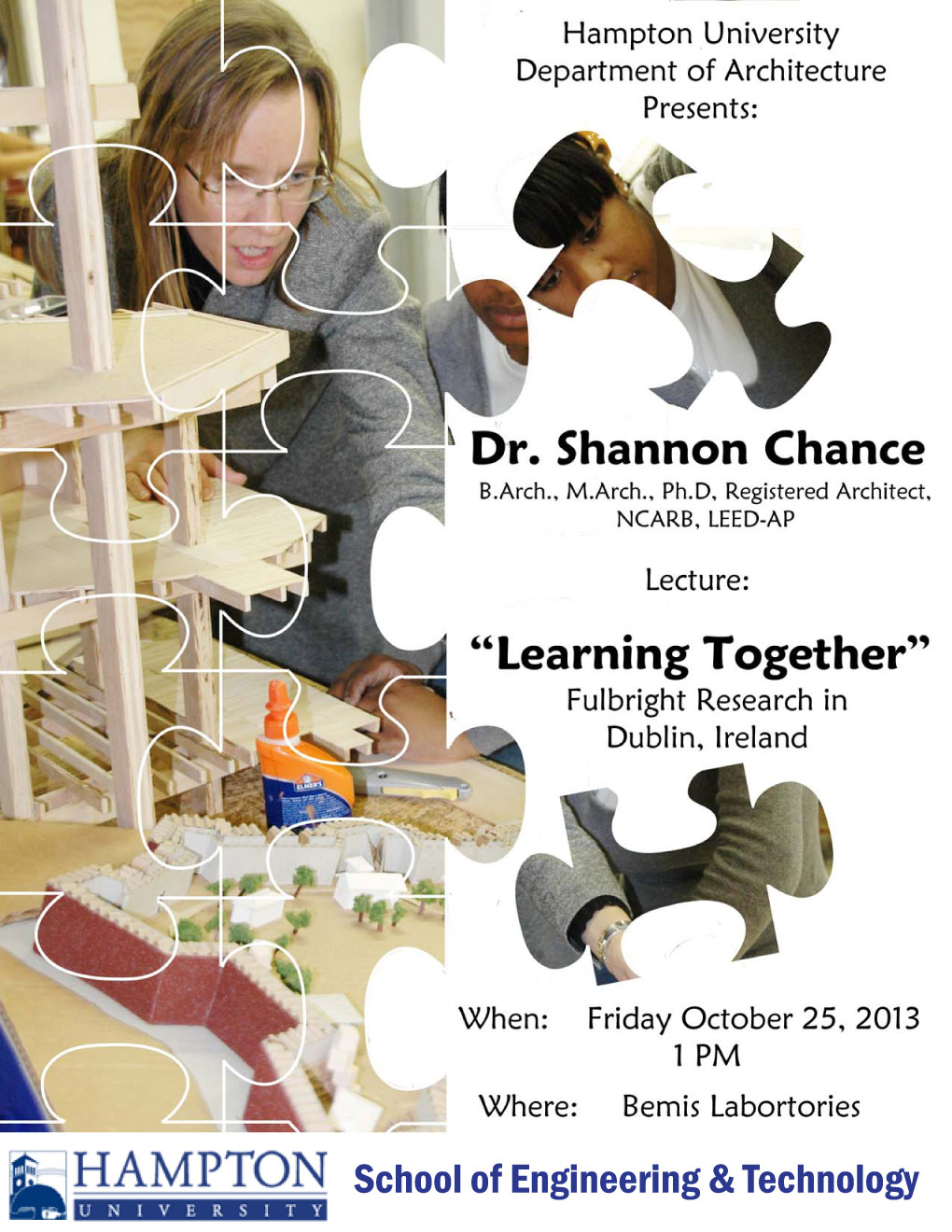
Tarrah posted many photos, including the flier I’d made to publicize the trip:
Another smiling face on our call, Donald Roman, is Project Manager at LIGHTING WORKSHOP INC. in Brooklyn, NY. Donald and his wife, Fabiola, were featured in the New York Times for their design flair. Donald was my student at Hampton University and addition to traveling to Tanzania on this program, we spent a lot of time together during his five years at Hampton University. These days Donald specializes in lighting design and business is booming, despite the pandemic.
Though not in the snapshot above, our friend Kelly Thacker also joined the birthday call for a few minutes, dialing in from a car in Detroit, with the help of her sister who she was driving to the airport. Kelly is Associate Director Housing Operations at Wayne State University; she wasn’t studying architecture when we travelled to Tanzania but was learning to support students via university programs. In 2005, Kelly was working on her MSc in Counseling and Student Development, and she completed a PhD in the subject in 2012.
It was a great experience for us all — the trip and the birthday call — and we hope for a repeat soon!
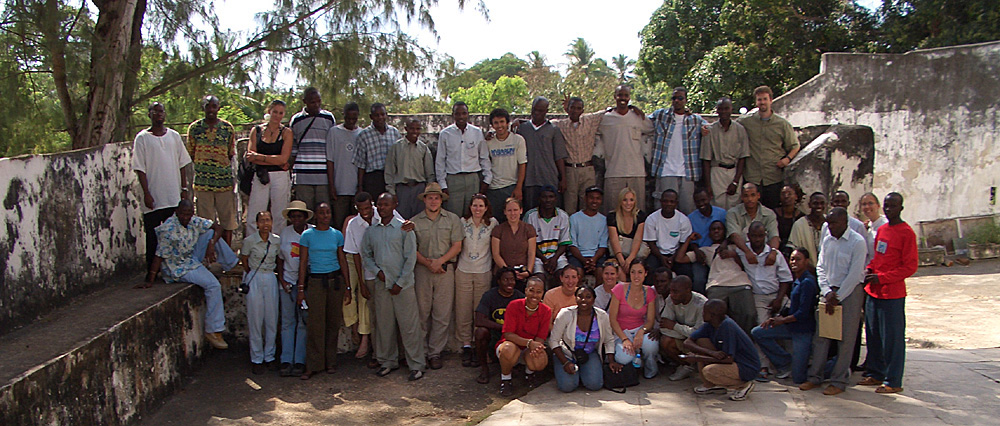
Photo of the US and Tanzanian students and teachers together in 2005, visiting Bagamoyo. Kelly and Tarrah are center front. I’m second from the right. Donald is top row, third from the right, and Thomas it the top row, second from the left. Our photo is missing Violet, though she was with us that day.
My Friday visit to the architecture school of the Instituto Superior Técnico (IST) was icing on the cake after a week of engineering interviews, conducted across the bay from Lisbon at Escola Superior de Tecnologia do Barreiro (a branch of the Instituto Politécnico de Setúbal, where I had interviewed students their experiences as engineering students as part of my Marie Curie research project).
For a little more fun on my last day in Lisbon on this trip, I took the Metro over to IST. There, I visited the first year studio to hear student teams present their urban analyses of Lisbon districts. I toured the 2nd-5th year studios with my gracious faculty hosts and I wrapped up the afternoon discussing recent work with PhD students from the Architecture Research Group who I’d met on my previous trip to Portugal. The doctoral students — Maria Bacharel Carreira, Luisa Cannas da Silva, Mafalda Panheco, and Sajjad Nazidizaji — and thier professor Teresa Valsassina Heitor took me for a beer at the end of the day.
Many thanks to my colleagues at IPS, Bill Williams and Raquel Barreira, who helped arrange and conduct interviews. Thanks also to the ISP students who provided interviews and the IST teachers and students who shared their work with me. I can’t wait to visit again!
First year architecture presentation at ISP.
Lots of group work!
Second year work.
Fourth year projects in progress, also done in groups.
Fourth year projects at IPS.
Fourth year projects at IPS.
Fourth year projects at IPS.
Fourth year projects at IPS.
Fourth year projects at IPS.
Fourth year projects at IPS.
Fourth year projects at IPS.
Fifth year work.
PhD students Maria Bacharel Carreira, andLuisa Cannas da Silva.
Last week I got to talk with a group of 60+ architecture students and faculty about design thinking, student development theory, and my Fulbright research… as well as how they connect to what we do in our department at Hampton University. Moments like these help us reflect on what we are. I hope they will also encourage my compatriots to explore ideas about what we want to become.
My current research is situated in the constructivist paradigm. What does that mean?
Well, my research ideas and techniques are founded on the principle that we humans construct the world around us — including the things we see and touch, how we know, and what we know — and that we are able to generate new knowledge.
By discussing such topics, and considering collectively what it means to “design” and to “know” and to “learn,” we can become more international, purposeful, and effective in the things we do each day.
One of our students, Rhama Mohammed, snapped some photos during the talk and loaded them into our Facebook page (I’m posting copies here). This provides a little glimpse of our department’s reality… surrounded by teachers (unfortunately, we don’t have images of any students in the crowd)… and a highly animated presenter.
Times are changing. Demographers tell us that younger set is shirking automobile ownership and moving closer into American cities.
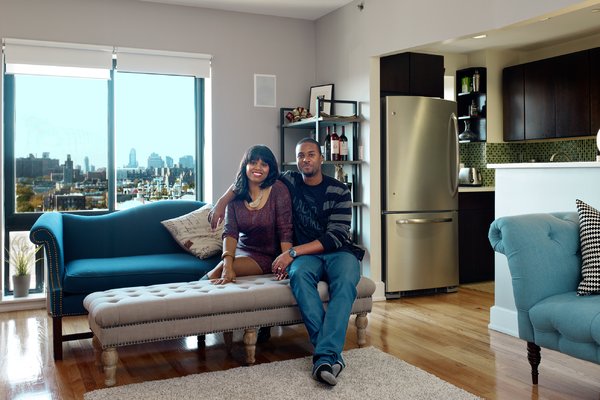
I’m proud to say that one of my former Hampton University architecture students, Donald Roman, is among them. He and his wife, Fabiloa, recently chose a condo in Brooklyn over the now-faded suburban dream. And, the New York Times just celebrated their accomplishment with a feature story.
If I recall correctly, Donald was never a fan of the car.
I’m happy to say that the heavy urban design emphasis of our architecture degree program served to strengthen his understanding of the benefits of population density and walkable city design.
I’m immensely proud that Donald and Fabiloa, who met in an Upward Bound program when they were in high school, planned well and chose carefully. They overcame tremendous odds to become homeowners under the age of 30. And, they had the good sense to recognize that living in a densely settled area means shorter commutes and quick access to a huge range of services.
During his time at Hampton University, Donald travelled with me to Tanzania on the 2005 Fulbright-Hays Group Project Abroad program I conducted. It was a true joy to have Donald among the 23 American students and 65 Tanzanian students on the program. He was immensely popular with the entire group and his soft-spoken but optimistic spirit uplifted our group every day.
Our 2005 Fulbright-Hays group in Tanzania.
Donald also made a big difference in my life when he introduced me to Malcolm Gladwell. He even handed me a copy of The Tipping Point as we were leaving Sunset Beach on our last day in East Africa.
The Tipping Point is about “how little things can make a big difference.” Interestingly, the NYT feature ends with a quote from Fabi about little things that make a big difference in one’s quality of life (like a dishwasher — and I totally agree!!!).
Thanks, Donald, for sharing with me your reflections on Gladwell’s ideas when we were beginning our trek home. Your insights got me interested enough to invest time in cracking the cover, and I had almost finished reading the book by the time my plane landed in Norfolk.
Since then, I’ve read each of Gladwell’s new releases cover to cover. A new one, about David and Goliath, just hit the shelves and beacons me to read.
There are interesting TED talks by Gladwell on David and Goliath and “choice, happiness and spaghetti sauce” to help get you started if you haven’t yet cracked the mystic of Gladwell’s storytelling ability… or if you just want to have some fun learning about the break through discovery of vegetable chunks.
A stunning photo of Donald, taken by Loran Doran, who was then a landscape architecture student at Virginia Tech.
Donald Roman and Joy Outlaw on one of the information-gathering outings for our urban design project.
On safari in the Ngorongoro Crater, near Arusha.
Donald chilling at Dar es Salaam’s Sunset Beach the day after the program ended.
Yesterday I got to share some of my Fulbright research as part of the weekly lecture series hosted by the Hampton University Department of Architecture. It was a great way to catch up with the advanced students and introduce myself to the first year group.
The students were highly attentive, very receptive to learning about epistemology and cognitive development theories, and interested in hearing about how I am using data from student blogs to test existing theories.
The faculty seemed genuinely interested, too. At the end, though, there was no time for the faculty to ask questions… the students had so many questions that I finally had to cut things short and send them off to their studio classes.
At the start of the lecture, I had asked the students to pull out their smart phones and look up this blog site. As a result, they had many questions about what I’ve found in applying the new methods in the second year studio and sustainability classes I teach.
I’ve worked with many extraordinary students at Hampton University, like Elbert and Mark.
Today, I’m boasting of Mark Paulo Ramos Matel’ success. I had the honor of teaching Mark in architectural design studios, study abroad, and environmental sustainability courses while he was working toward his Master of Architecture degree at HU.
Mark Matel (right) with fellow student Leon Peters presenting a second year design project at Hamtpon University.
Mark was an ideal candidate for the Enterprise Rose Fellowship, which the article explains is “a highly competitive and innovative program that places some of the nation’s finest early career architects in underserved communities across the country to team up with community development host organizations.”
Mark is intrinsically motivated to succeed, to help people, and to spearhead new initiatives. His energy level, work ethic, creativity, self-direction, and ability to collaborate effectively were unparalleled among the students I have encountered in my 15 years of university-level teaching.
Mark was a major player in the formation of our department’s Studio Culture Policy and he represented our department impressively at the local and state level.
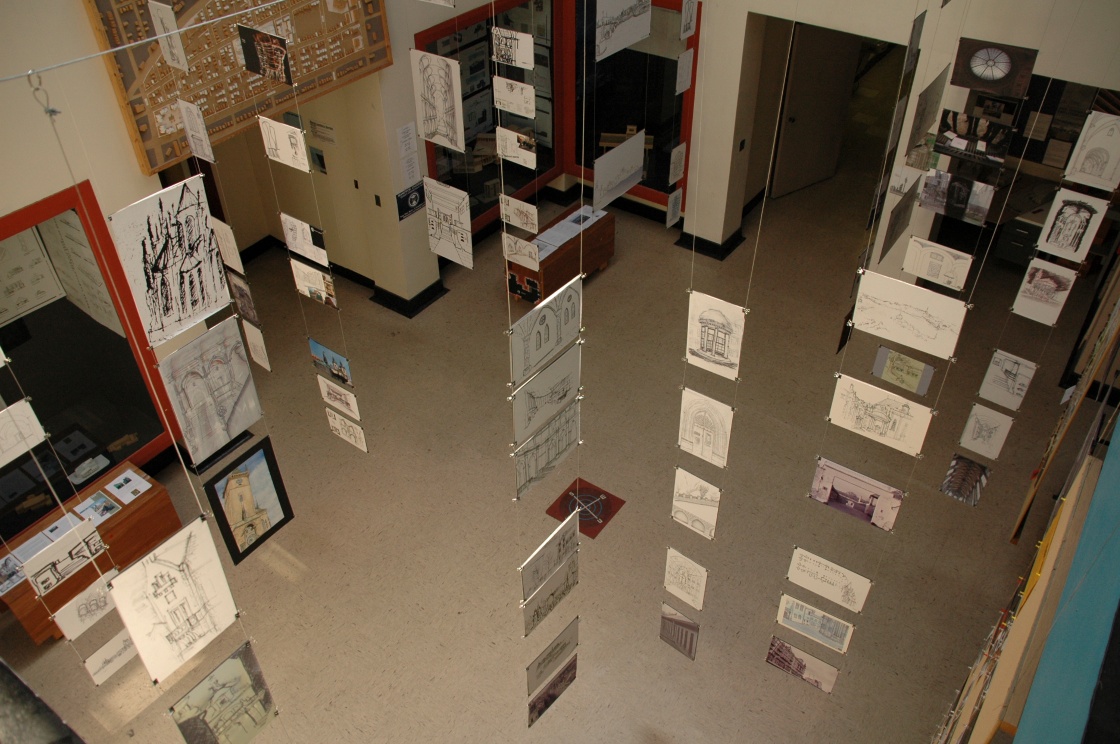
An exhibition that Mark and his colleagues Brandon Clarke, Smitty Lynch, coordinated along with other members of our spring break trip to Prague.
He is also a highly skilled designer, as is evidenced in design awards from Auburn and Hampton Universities.
Mark earned a NAAB-accredited degree from Hampton University – a program emphasizes urban planning as well as architectural design – and he then earned a design-build degree from Auburn University to boot.
To interview for the Enterprise Rose Fellowship, he went to Boston along with the two other candidates (both from top Ivy league schools). After a rigorous multi-day interview, representatives from the community and the fellowship program voted, and then wholeheartedly extended the three-year fellowship to Mark.
During his time at HU, Mark’s research regarding water systems in the Philippines, and his work with the Virginia AIA’s Emerging Leaders in Architecture (ELA) program, were particularly relevant in preparing him for his work as an Enterprise Rose Fellow.
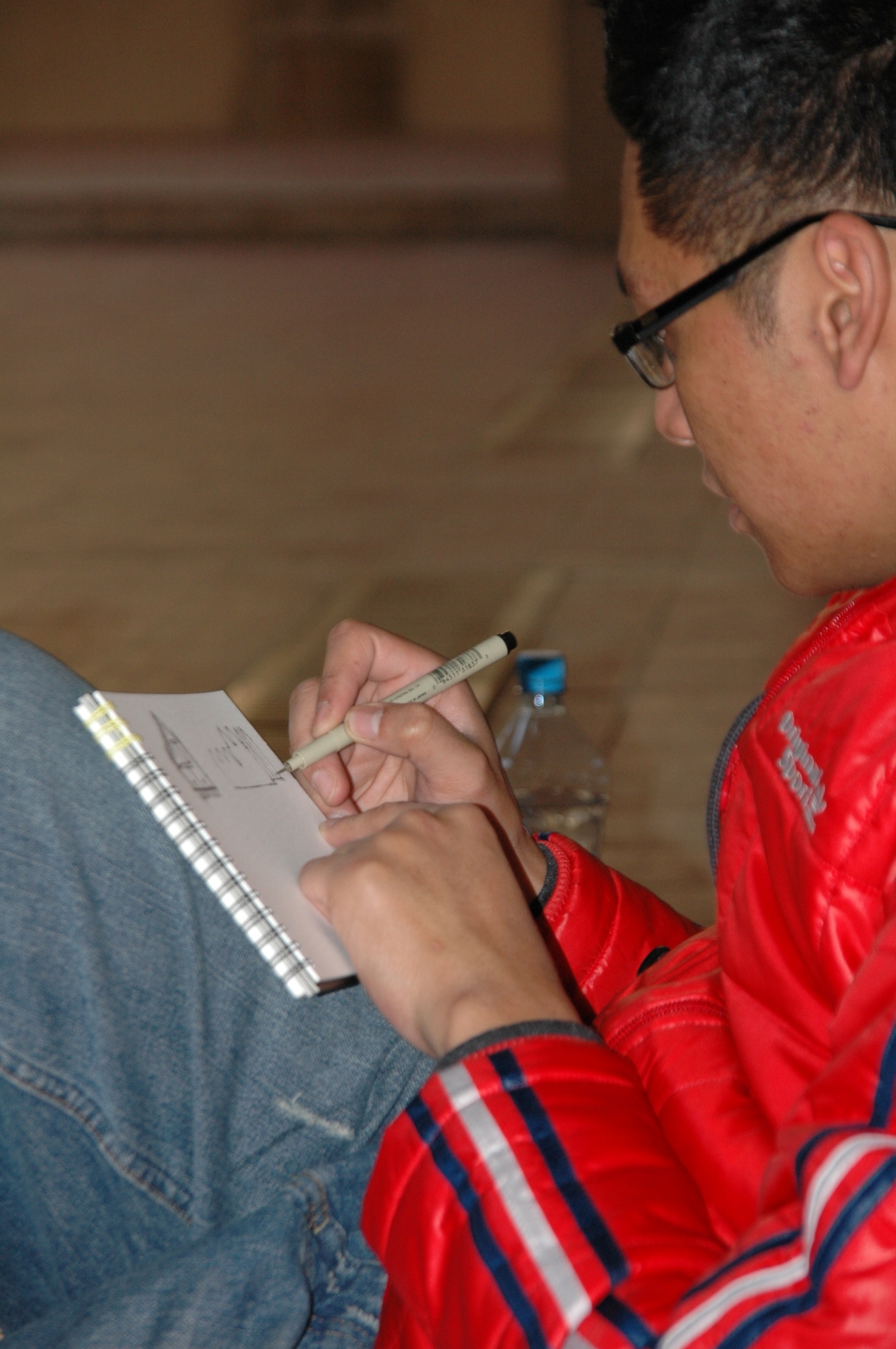
Mark sketching in Prague.
Marks’ activities all had an underlying theme of social activism related to the built environment. He has always been able to think and work at multiple scales and with complex, inter-related issues. His architectural studies enhanced these abilities.
Our department nominated Mark to represent Hampton University as part of Virginia AIA’s ELA program and his work with the organization exceeded our expectations. The focus of the ELA program that year was on community revitalization and leadership. Mark was highly engaged in his cohort’s project and he even defined the program for the subsequent year’s cohort. (He identified specific conditions that needed to be addressed in Norfolk, Virginia and he helped get the new ELA group involved in fostering change where he knew it was needed.)
In his classes and teaching assistance-ships at Hampton University, Mark reflected a high level of engagement as well as what Daniel Goleman calls “emotional intelligence.” Mark has the ability to share knowledge and to teach others techniques and strategies for improving themselves and their environments.
While he was at Hampton University, Mark was a very important part of defining a positive, learning culture within the academic context, as well as in the professional context (at the local and state levels) and in the larger community.
I couldn’t be prouder of Mark and all his many varied accomplishments.
Discovering time in ordinary and extraordinary objects.
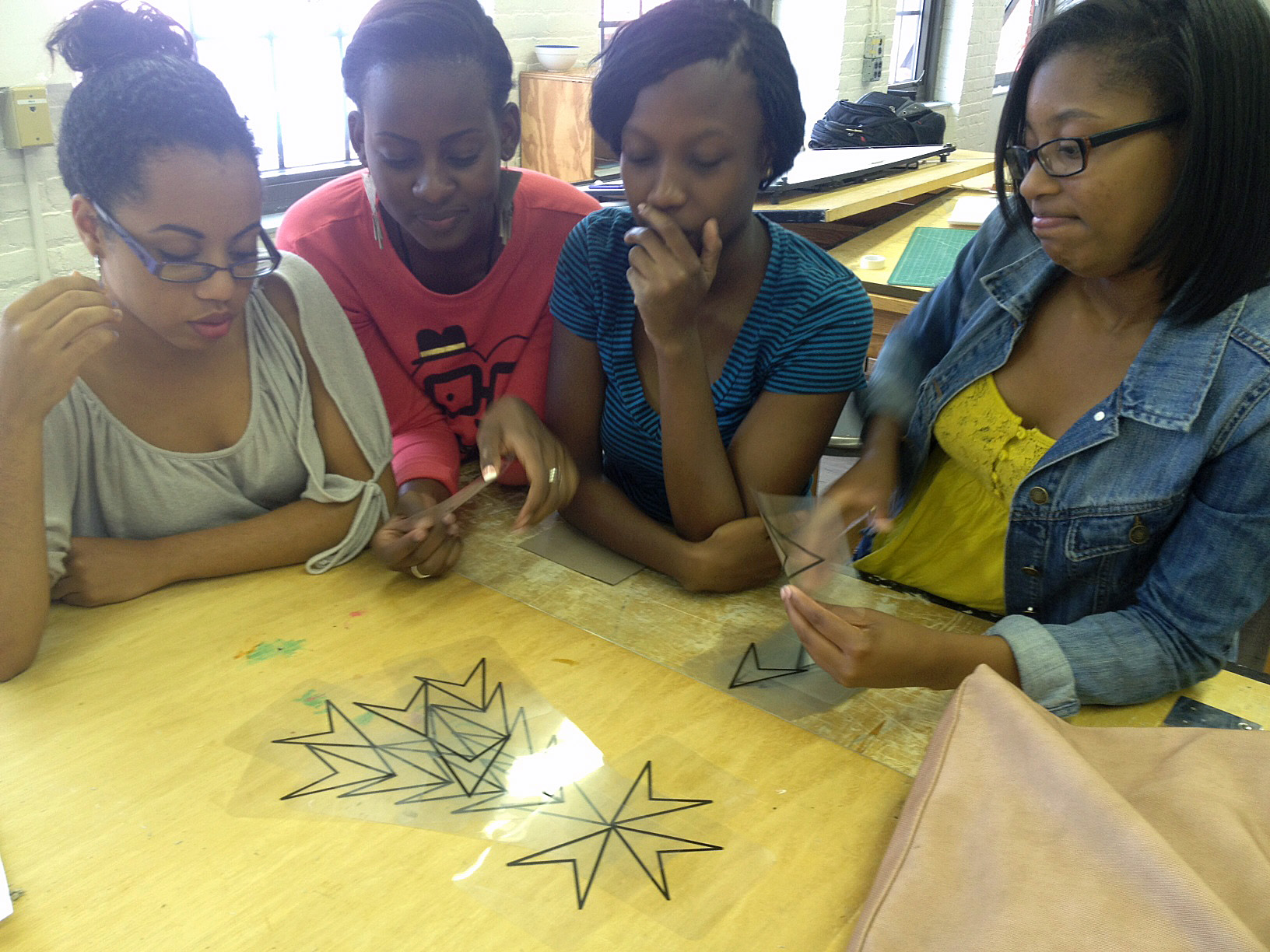
Janine, Khadjia, Shanice, and Sheldyn in a team-building activity lead by MIT grad student Derek Ham.
My students’ teamwork skills are improving by leaps and bounds. The group of students pictured to the left makes teamwork and design look like so much fun. In this photo they were doing a team-building exercise under the direction of Derek Ham. Derek earned a Bachelor of Architecture degree at Hampton University in 2001. He went on to each a Master’s of Architecture at Harvard and teach at HU and FAMU. Today, he’s a PhD student at MIT. He came to talk with our students about overlaps between design and computation.
SELF-DIRECTED LEARNING
The overall goal of all this team work is to master skills in design, collaboration, and self-directed learning. In self-directed learning a (person or) group can identify what it needs to learn and how to learn it. It’s even better when the (person or) group simultaneously identifies what it wants to learn as well. That’s when learning gets to be really fun!
Members of this particular group did a nice job answering the question posted on this blog 1.5 weeks ago by prof. Steven Temple from the University of Texas at San Antonio. He asked if we’d posted findings of our water study yet. Finally, here some are….
We’d done five studies in studio to date. We’ve explored properties of water, light and time. And, we’ve drawn our project site and studied/documented various monuments that use/express time/sun. The images posted represent a few of the items this team has made in studio this semester.
So: What has the studio found that’s unique to water, light, and time? Last weekend I asked my students to summarize their findings in words. Here’s the response provided by Janine, Khadjia, and Sheldyn.
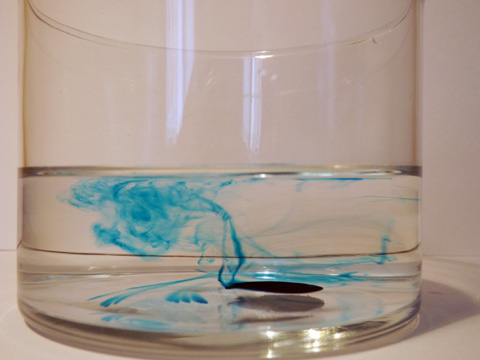
Capturing the essence of water.
ONE TEAM’S FINDINGS FROM VIGNETTES
Water Vignette:
For this project, we decided to explore the way water moves. We wanted to highlight the seemingly random and beautiful motion of water and that other liquids also exhibit when placed in water. We used different colored dyes to show this. We observed that water and other liquids interact with each other in different ways, and that the density of the liquids mainly governed their behavior with each other. We observed a beautiful, smoke-like motion of the ink until it diffused and all the water became a diluted color of the dye. We also noted the way that water takes the shape of whatever vessel it is contained in, and that at any angle the water level will always stay perpendicular to the pull of gravity.
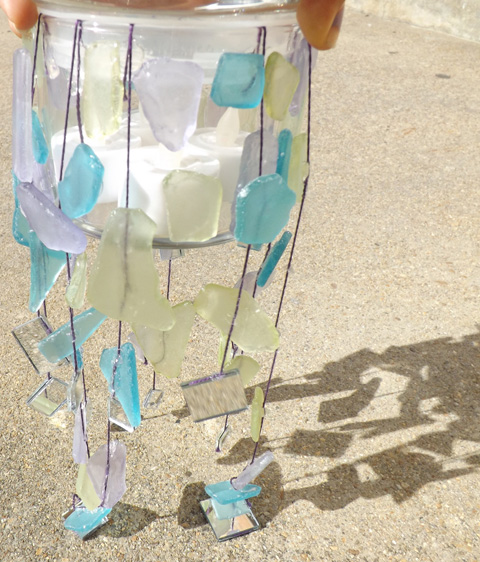
Capturing the essence of light.
Light Vignette:
We wanted to highlight the behavior of light in terms of shadow and through different media. We mainly focused on shadows or the fact that light travels in straight lines and does not bend around objects. We also explored the reflection and absorption of light and how it filters through translucent media. We discovered that the effects of all these things differ with natural and artificial light. We also wanted to exhibit movement through light and observed this through the way light bounced off the mirrors and made shadows when our hanging objects moved.
Time Vignette:
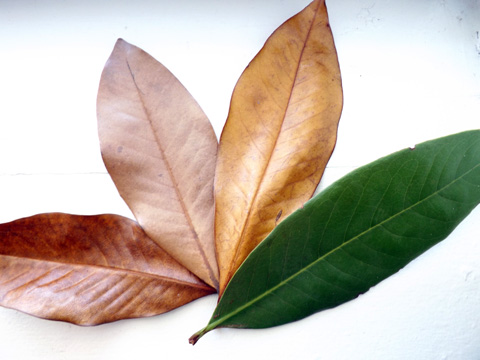
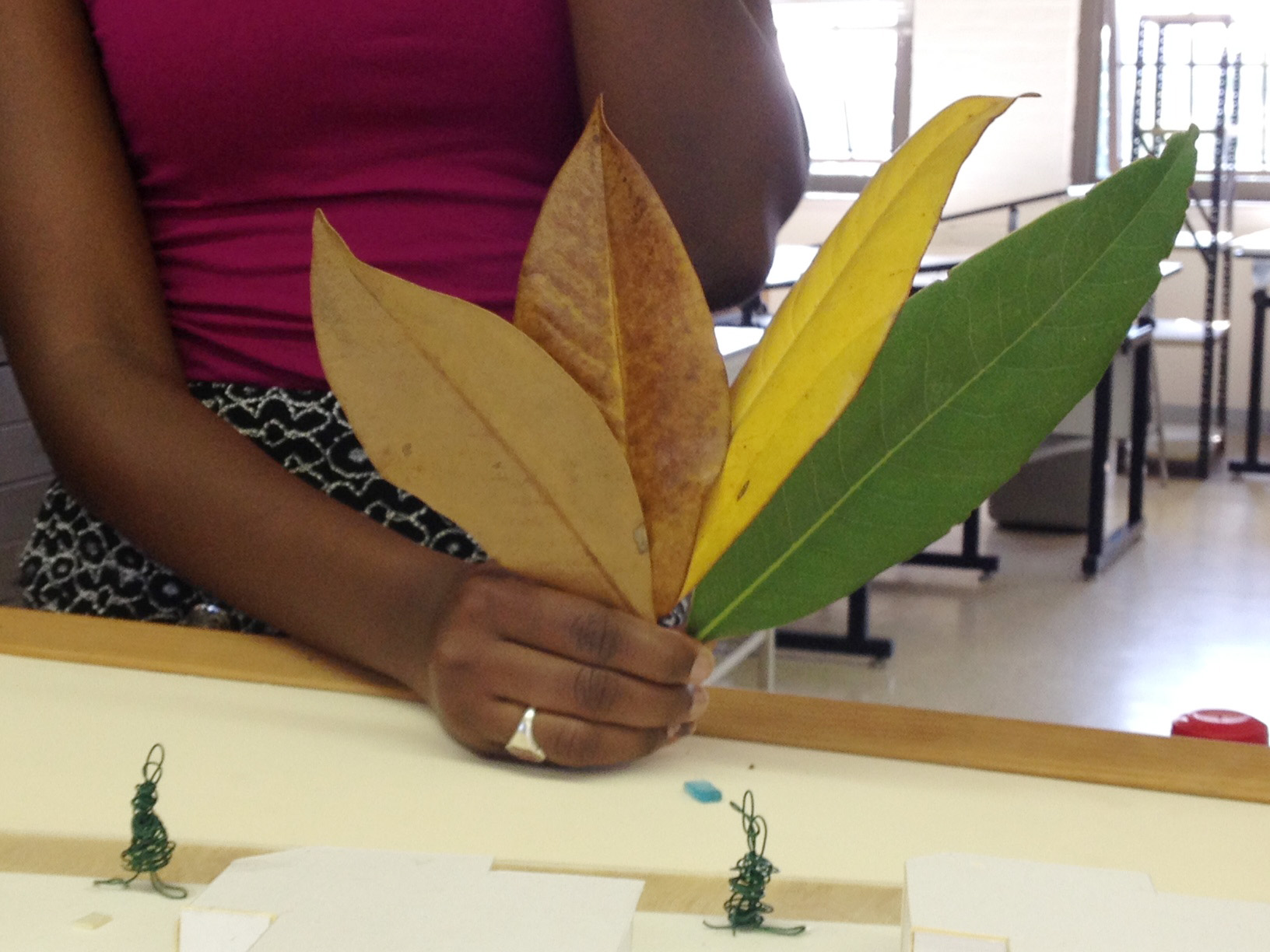
We wanted to focus on decay as a major indicator of time. We chose leaves that clearly indicated a full life cycle. They showed the progression from a rich green, whole sturdy leaf all the way to a brown, crinkled leaf. Age was indicated in the color, texture, size and shape of the leaf. We discovered that they also showed a sense of hierarchy in the appearance of the leaf. The youngest, freshest leaf was also the largest and had a strong, durable presence whereas all the other leaves got progressively smaller, duller and more brittle. They seemed to fade and disintegrate before our eyes.
Capturing the essence of time.
How They Relate:
The water project exhibited all three concepts or elements. It showed water and its behavior with other liquids, it showed the behavior of light in water and also time, through the motion and eventual diffusion of the dye over time. The light project mainly exhibited light and time. It showed the behavior of the objects at different times, as they looked different during the day and at night. It also subtly exhibited time and wind as the positions of the objects and their shadows and reflections were constantly moving and changing. The time project also incorporates all three elements because with the passage of time, light is reflected differently off the leaves, shown by their color and texture, as the younger leaves shine because of their smooth texture and the older leaves don’t because they are dry and crinkled. Water was also shown in this project because the absence and presence of water within the leaf indicated its age. Younger leaves had more water and smoother, more elastic textures and older leaves were dryer and contorted with the absence of water to hold their shape.
The team reported their water, light, and site findings in studio 1.5 weeks ago.
























 Ireland by Chance