Bringing Prague Home

Inside Outside Spaces

You can view the whole set of boards I produced after our one-week trip by clicking here.

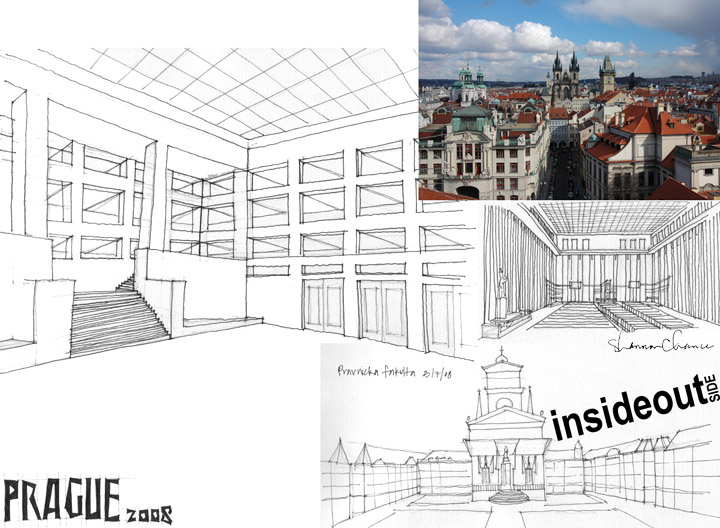
Here are some photos of the exhibit that my Hampton University architecture students assembled after our 2008 spring break trip to Prague.  In addition to the exhibit, we also delivered a lecture on campus and another for the local chapter of the American Institute of Architects (AIA).  Those talks were about the urban issues each of us studied on our one-week trip.

With the help of Lenka Schulzova, an alumna of our program who was born in the Czech Republic, I’d planned an itinerary that included lots of warm spaces inside where we could draw (Prague is chilly in March) as well as outside spaces.

It was truly amazing how this group came together during this trip.  Everyone on the trip embraced the challenge to practice sketching as much as possible.  Daisy Williams (a truly amazing teacher who is now working at the University of Oregon) provided instruction on drawing before and during the trip.

Each day of our trip, the students eagerly explored the city.  They frequently asked to stop to make sketches.  And they enthusiastically discussed and critiqued each other’s work.  We developed so much skill and knowledge during this trip!  And we brought what we learned home to share with others.

Prague is remarkable in that so many grand, public spaces are available indoors.  It also has lovely courtyards embedded inside the blocks of streets.  This is the case in many cities, but in Prague the courtyards are often accessible to the general public — which is a great treat for visitors and residents alike!

Discovering all this, I titled my series of boards “insideout|side spaces” and described different qualities of these Czech spaces on each board.

Learning from Prague

Jože Plečnik

The modernism of Jože Plečnik.

Cubism is one of the aspects that makes Prague’s skyline so energetic.  I’ve uploaded a gallery of boards I made following the week-long study abroad program I organized to the Czech city.

The travel group was energetic, too.  We had such fun sketching and learning.  I asked each traveller study one specific aspect of the urban environment.  My own assignment was to capture characteristics unique to Prague.

I made these boards for the exhibit our group posted in Hampton University’s Bemis Laboratories building.  We also presented the work at the Hampton Roads AIA Pecha Kucha Night.

Art Event in Dublin Today (and Beyond)

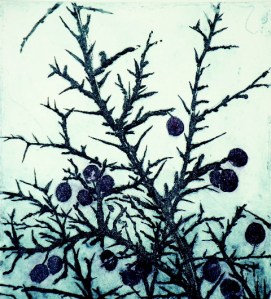
Graphic Studio Dublin & Graphic Studio Gallery -- image from invitation to the art show.

Graphic Studio Dublin & Graphic Studio Gallery — image from invitation to the art show that starts Thursday.

Susan Early, the architect friend of Joan Cahalin’s who I met at the Cobblestone, sent a message in response to the blog about missing Glen’s art party.  I’m not letting myself out of the apartment today until I’ve made major progress on this paper.  I’ll have to attend the show at a later date.  But perhaps you’d like to go?

Joan just sent me a link for today’s blog about the print fair which you are missing in Virginia and I think I can offer you an alternate event here! 
If you recall, I am a printmaker with the Graphic Print Studio (also an architect….) and today/tomorrow, Sat 01 December, we are having a fundraising event for the studio called ‘Sketchbooks’ in the graphic studio gallery on Cope St in temple bar, from 10till 6pm. The features pages from sketchbooks from our own printmakers and other invited artists including many of the top Irish artists, all for sale for €50 a piece. There are about 350 sketches for sale! 
I will be in the gallery in the morning and would live you to come along, sorry about the short notice! 
 
Our members Christmas show contains just prints and etchings which opens on Thursday in the same gallery.  I should be at that one also so feel free to drop in! 
 
Hope to see you at one or other or both! 
 
Susan
Location of the show that starts Thursday.

Location of the show that starts Thursday.

Green Know-How

Simon McGuinness asked me to speak about LEED with his Architectural Technology class.

Simon McGuinness asked me to speak about LEED with his Architectural Technology class.

65% of Ireland’s architects are unemployed today.  Shocking.  And sad.

Today, I got to speak to a room-full of these architects and architectural technologists.  They come to DIT once a week — from all over Ireland — to learn about sustainability.

To be eligible to take this course, a person has to be receiving some form of unemployment assistance.  The government funds this program as a way to infuse knowledge about green building into the community and help re-train this group so they can help address pressing social needs.

And what a fantastic audience!  I was so caught up in the dialogue that I forgot to take a picture for you.  I believe everyone in the room was older than me and likely had much more field experience.

And they were fully engaged, interested, and attentive!  Full of energy and questions!

The teacher of the course, Simon McGuinness, had asked me talk about the nuts and bolts of documenting projects using the LEED Green Building rating system.  That can be a very dry subject.  But they took it in with enthusiasm.

During the one-hour talk, I got the chance to share some of the findings of my dissertation and the recommendations I made in the article I just published in Planning for Higher Education.  I’ve included a gallery of those slides, below.  Please see the article for details.  (It got over 800 downloads!)

Dramatic Smithfield

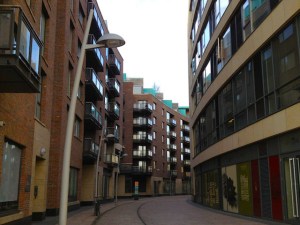
Mix-use complex built during the economic boom known as the Celtic Tiger.

An impressive canyon-like space within a mix-use complex that was built during the economic boom (known as the Celtic Tiger).

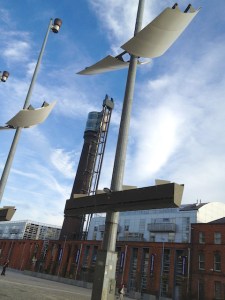
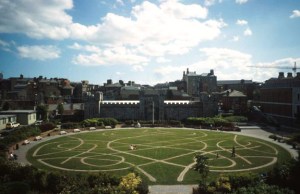
Smithfield is home to some dramatic public spaces.  Most notably, there’s Europe’s largest cobblestone-paved plaza. Bordering this are circular spaces that make Swiss cheese of the Jameson Distillery (where the courtyards are even painted yellow) and the dramatic canyon opposite the plaza from it (see photo).

A lot of development happened in Smithfield during the economic boom known as the Celtic Tiger.  Today the apartments of Smithfield appear t be filled with residents — but many of the cultural, retail, and office spaces of Smithfield are vacant or under used.

Nevertheless, there are enough restaurants, attractions, businesses, and services here to keep the place feeling alive enough.

I haven’t yet been to many of the highlights (such as the Lighthouse Cinema, the Smithfield Art Tunnel, the Generator Hostel, or the Maldron Hotel). But I have enjoyed my time at a number of the eateries as well as the Jameson Distillery, the Cobblestone, the Elbowroom (which is one of Smithfield’s many guys), and the Fresh Market.

Smithfield really doesn’t deserve the bad wrap it gets.  But as long as people have the perception that there might be something scary here, the rents will stay reasonable. And that part is fine by me!

The old smokestack of the Jameson Distillery.

The old smokestack of the Jameson Distillery.

Dave’s Handiwork

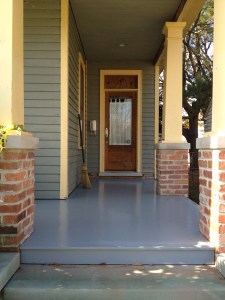
Our new porch floor!

Dave has made a lot of progress installing a new floor for our porch back home.  What a wonderful gift it will be to return to this at Christmas!

This is the most recent phase in our very extended porch renovation project.

Previously, Dave installed a new foundation and then hired bricklayers to install an entirely new brick foundation and new brick pillars.  He placed new limestone steps and limestone caps for the piers.  Then he framed in a new structural system for the porch floor, and primed, painted, and installed the tongue-and-groove floorboards.

Much earlier in the renovation process, we replaced the dilapidated front door with one we bought at Caravati’s Architectural Salvage in Richmond. It got a new limestone threshold. And someday, we may actually install a window in the transom opening.

The green wood siding and the yellow wood columns are original. At this point, they need quite a bit of scraping and painting.  I was in charge of the scraping the first time and I did much of the painting as well.  This go around should be much easier.  The last time we had 100 years worth of paint to remove!

Under the porch roof, we found a piece of lumber signed by the builder and dated 1896.  That’s quite old for a house in the USA.


Cubism under a Chilly Sky

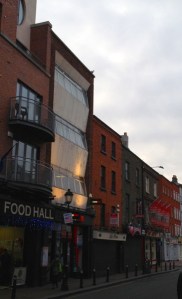
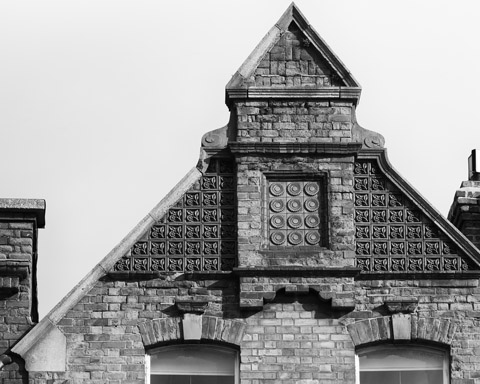
I noticed this cubist-inspired building facade this morning, while walking down Liffey Street in Dublin.

After the dazzling sunrise Thursday morning, a covering of clouds had rolled in.  This cover suspended the melting process, extending the pre-dawn frost into the morning.

I was scurrying along en route to an all-day seminar.  The topics being covered (leadership and change) are central to the paper I’m writing at the moment.  So I’d signed up to attend this event hosted by DIT’s Learning, Teaching, and Technology Centre to see how Irish folks talk about the topic and frame the issues.

On this particular morning the sidewalks — which the Irish refer to as footpaths — were still slick.  A thin layer of frozen mist remained.

This distracted me from capturing images for the first few blocks of my walk.

It wasn’t too long, however, before a facade that I’d never-before noticed captured my gaze.  I dug around for my camera and started to compose.  I was eager to show you this built example of cubism.

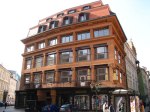
The Cublist Museum in Prague, a built example of cubist. Photo downloaded from Portal of Prague.

The Cublist Museum in Prague, a built example of cubist. The building is known as the House of the Black Madonna. Photo downloaded from Radio Prague website.

Unlike most styles of art, cubism never really flourished in architecture.  It’s rare to find built expressions of cubism most anywhere but Prague.  Portal of Prague explains, “Prague is the Mecca of Cubism lovers. This is not only because some of the Prague pre war art collectors were in favour of this style but mainly due to the fact that Prague is the only city with so many cubist buildings. The worlds unique buildings were build within four years from 1911 until the beginning of the First World War.”

I speak from experience when I say that the sky in Prague is often chilly.  I visited with a group of Hampton University students one chilly week in March several years ago.

Here in Dublin on this particular morning, the lights on this facade brought the building to life.  The cubist facade glowed warmly against the steel-grey sky.

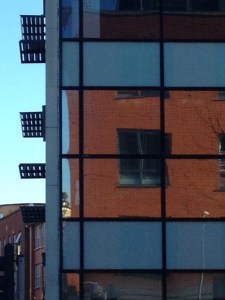
The chilly sky actually helped me to see something I’d overlooked many times before.

Juxtaposed buildings.

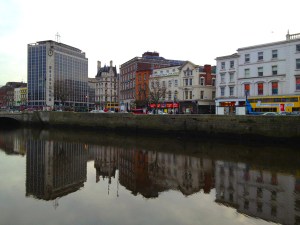
Reflection of skyline in the Liffey River.

Brushes with Great Museums

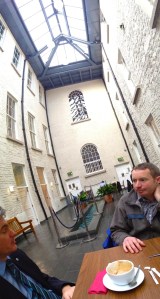
Meeting with Brian Bowe and Gavin Duffy at the Beatty Library’s cafe.

The cafe at the Chester Beatty Library serves up a fine selection of Middle Eastern, North African, Mediterranean, and vegetarian entrees and gluten-free desserts.  We met there for lunch Tuesday since it’s halfway between Gavin’s base on Kevin Street and ours on Bolton Street.

Mom and her neighbors (Tim and Mary) spoke highly of this “Silk Road Cafe.”  The Dean had heard its praises sung as well.  Unfortunately, he was called to a more urgent meeting and couldn’t join us after all.

The Beatty Library’s sun-filled, glass-covered courtyard was a lovely setting for our discussion of student-centered learning, research, and publication strategy.

Shockingly, neither of my colleague had ever been to this incredible museum before!  Yet it houses one of the world’s most astounding collections of religious artifacts.  It represents all the world’s major religions and was donated by the American collector Chester Beatty.  And, amazingly, admission is completely free! (Lunch, however, is not.)

Although I didn’t get Gavin and Brian into the actual exhibit halls, at least they got to experience the covered courtyard and the stunning “Castle garden.” It’s surrounded by a high wall and feels very much like a secret garden. During my childhood, I dearly loved the book The Secret Garden.

Castel Garden, behind Dublin Castle. (Photo borrowed from W&L travel log.)

A few hours after our lunch, I had another brush with great museums when Seán Rainbird lectured at the DIT School of Architecture.  He’s the new director of the National Gallery of Ireland. He has also worked at the Tate in London and the Stattsgallerie in Stuttgart (designed by James Stirling’s office).

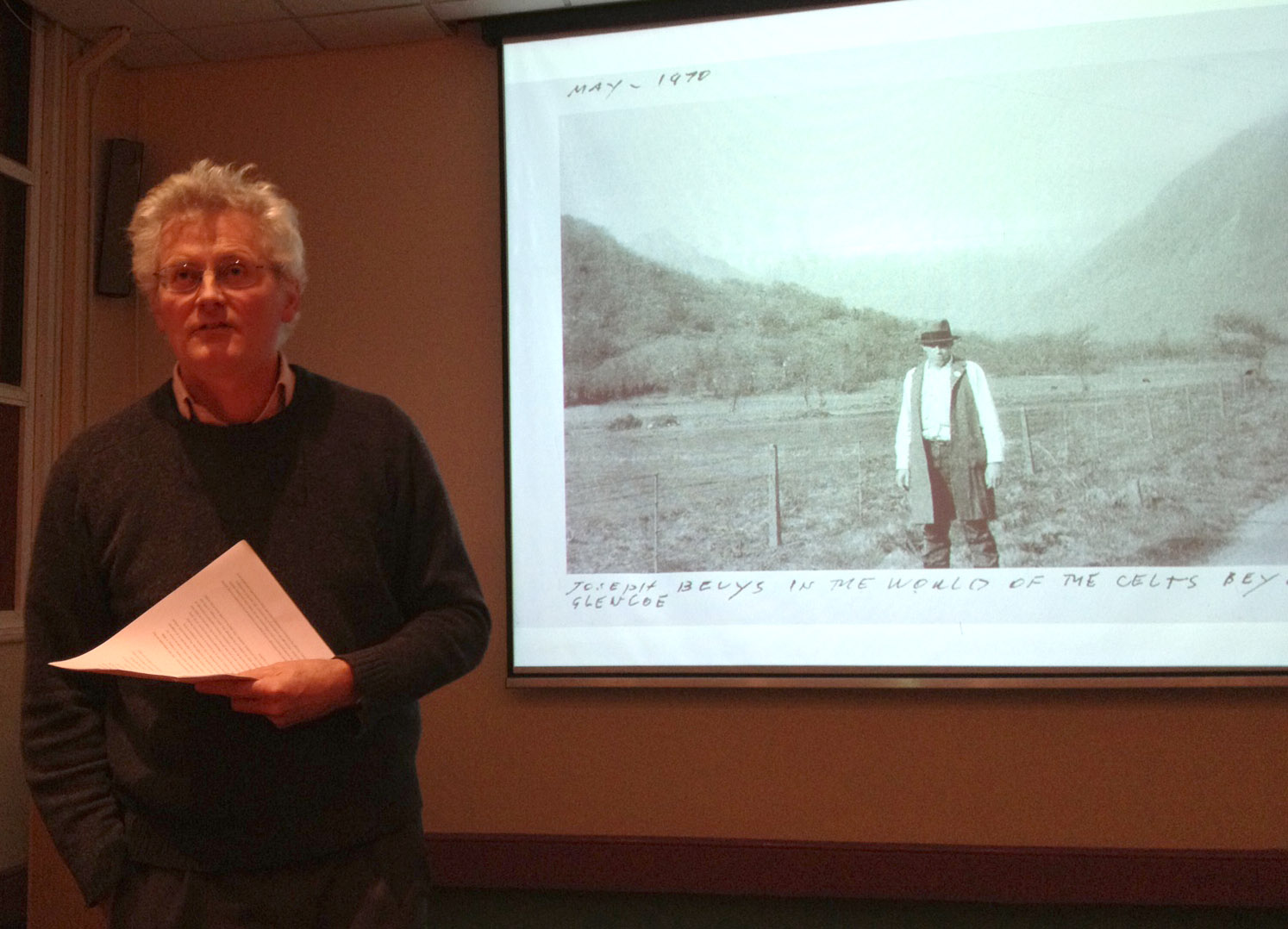
Seán Rainbird talked about Joseph Beuys’ fascination with all things Celtic when he spoke at the DIT School of Architecture.

Can you imaging that I delivered a lecture in the same “Schools of Thought” lecture series with such an accomplished person?  Wow!

Seán talked about Joseph Beuys and the Celtic World, the topic of a book he wrote.  He said he had just three weeks to write it!  Can you imagine being so knowledgeable about a topic that you could produce a press-worthy document in just three weeks?  Truly amazing.

They say everyone wants to “be like Mike.”  I’d rather “be like Seán” myself!

Exploring Material Ethics

A progress review in Patrick’s 4th year studio at the DIT. Patrick, Shannon, and Connor are clearly captivated by this student’s presentation.

I asked the architecture students to tell me what interested them most from the lecture on Materials that I gave today in the studio coordinated by Patrick Flynn.  They said Dave Chance’s images!

I’d been asked to talk about materials in a way that would help students with designing schools.  So I started by downloading pages from Dave’s website.  He travels the world photographing materials in relation to light.

To prepare for this lecture I also attended a review of the class’s proposed designs last Friday.  Patrick invited me as a guest critic, but my primary goal was to find out how I could tailor today’s presentation to their needs and interests.

A slide using Dave Chance’s photograph from the American Cemetery at Omaha Beach in Normandy. (Copyright Dave Chance Photography.)

I decided to present my thoughts using: (1) Dave’s images to provide inspiration and (2) images of schools as a tool for conveying more pragmatic content.

I structured the talk around themes of Material Ethics, Teaching Capacity of materials, the need to Generate Knowledge regarding materials, Authenticity, and Sustainability.  I titled it “How an Architect’s Material Palette Can Enhance Student Learning” with the subheading “Cultivating an Ethics of Materiality.”

Upcoming Lectures

I’ve been asked to deliver two lectures at the DIT School of Architecture next week.

At 11 AM on Monday I will talk about How an Architect’s Material Palette Can Enhance Student Learning.

At 1:30 PM on Friday I’ll present What Can the LEED Green Building Rating System Do For You?

Both lectures will be held in DIT’s Linenhall. Please contact me via engineeringfulbright (at) dit.ie for information about how to attend.

Photo from Ireland, copyright Dave Chance Photography.