The Fulbright Student program is now taking applications!
Click here to get started on your application.
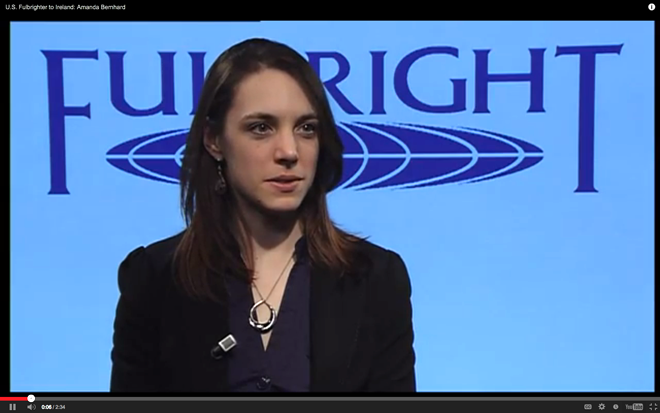
My colleague Amanda Bernhard is in Ireland this year on the Fulbright Student program. She is studying Irish Language.
The Fulbright Student program is now taking applications!
Click here to get started on your application.
My colleague Amanda Bernhard is in Ireland this year on the Fulbright Student program. She is studying Irish Language.
My former dissertation advisor, Dr. Pamela Eddy, is here visiting me in Dublin this week. She was a Fulbright to Ireland in 2009 and she helped me make valuable connections when I started applying for my own Fulbright experience here.
So far, we’ve spent a lot of time at our computers! Although it’s her Spring Break, she’s answering emails, reviewing dissertations, and grading papers. Oh, and advising me!
She helped me prepare for the meeting I had today with DIT’s president, Prof. Brian Norton. I’ve attached a photo of us working from my home yesterday. She was still sitting the same seat when I Skyped her from my office on Kevin Street just now to “debrief” on the meeting.
We do stop for exercise, food, and meeting… but little else!



If you’d like to become a Fulbright Scholar, now is the time to start your application! Don’t put it off another minute….
This year’s competition opens February 1. Applications for the core scholars program are due August 1. Other deadlines are listed on the Fulbright website. This page has information for US and non-US scholars. (Information on Fulbright Student programs is available here.)
Andrew Riess <ariess@iie.org> of the Fulbright Scholar Program emailed the following note today. He’s offering a Webinar about how to prepare your application. I took part in one of his Webinars while I was preparing my second application (which met with success).
| Dear MyFulbright Community Member,
Please join us for a Webinar on preparing to apply for your Fulbright from 2:00 pm to 3:00 pm (Eastern Standard Time) on Wednesday, January 16. The competition opens February 1 and now is a good time to think about what is needed to apply. This Webinar will include a discussion of what is involved in the process of finding an appropriate program and the materials that will be needed for application. Reserve your Webinar seat now at https://www1.gotomeeting.com/register/427536544. |
You’ll want to review the Catalogue of Awards for this year. The Catalogue of Core Scholar Awards may be what you need, although there are also specialized programs for Specialists, Distinguished Chairs, and the like.

Prof. Mason Andrews finally taking a minute away from her work.

Carmina Sanchez and Mason Andrews — two amazing architecture teachers!
I’m blessed to work with some incredibly talented and dedicated people at Hampton University. Carmina Sanchez and Mason Andrews, with whom I teach architecture, are two of the hardest-working people I have ever known (and that, my friends, is really saying something!).
Carmina, Mason, and I are sincerely dedicated to the mission of our Historically Black College/University (HBCU). We work long hours to help our students master the craft of architecture.
And students in our program have achieved many amazing feats. Much of their success is a result of professors like Mason and Carmina believing in them, working overtime again and again, introducing new ideas and new challenges, and opening doors for them along the way.
My colleagues’ work usually goes under-recognized, although Carmina has won a national-level teaching award from ACSA as well as one (that I nominated her for) from Hampton University. She has also been a national officer of the Association of Collegiate Schools of Architecture (ACSA) and an international officer of the Association for Computer Aided Design (ACADIA). Carmina runs our thesis program and oversees our digital resources. She’s at school all hours of the night and day.
Mason tends to work non-stop, too. Prior to joining HU, she authored several books (one on Aldo Rossi). She also headed an architecture firm in NYC for many years before returning to her hometown in Norfolk. She felt the tug of family: Her dad, after whom she is named, was once the mayor of Norfolk. He led the effort to found the Eastern Virginia Medical School (EVMS). I believe he also delivered the first in-vitro baby in the USA and helped fund the lawsuit that ended racial segregation in Norfolk Public Schools. He was a truly remarkable man and passed many exceptional qualities on to his daughter.
Carmina also had exceptional parents who were dedicated to helping others. Mason and Carmina both learned from their parents how to serve others. Not a day goes by that they don’t.
I first met Mason through the Marilyn and Ray Gindroz Foundation. I had asked the Gindrozes to support our department’s travel program and they enthusiastically agreed — providing time and money and even re-writing their foundation’s bylaws to include HU. Mason was the president of their board. (To this day, the three of them travel with our students in the summer as part of the study abroad program that each HU student must complete in order to earn a degree in architecture.)
The year I met Mason, I asked her to consider teaching with us… although I never dreamed she’d accept.
But she did!
And she’s brought so many opportunities to our students. She’s connected us to a number of prestigious scholarships and internship opportunities. She sees possibilities others don’t and makes possibilities where none seem to exist. She typically teaches 1-2 more courses each semester than required, just because she wants students to have opportunities to learn a comprehensive range of subjects.


This usually includes writing for architects and a travel-prep class. One year, it also included courses on construction and solar technologies.
In 2009, she took the lead in getting HU teamed up with Old Dominion University so we could enter the 2011 Solar Decathlon. She co-led the team that constructed a net-zero house. The group hauled their house to Washington DC and reassembled in a handful of days so it could compete (in 10 areas, while being toured by thousands of people every day, for 10 days).
Hundreds of universities all around the world apply for the opportunity, but only 20 are accepted each go around. Our team garnered 14th place overall in its first attempt — which is truly remarkable given the level of resources other universities have.
The Decathlon happens every two years, and HU is competing again in 2013 under the direction of professor David Peronnet who was also instrumental in our 2011 success.
I am honored to work with Carmina, Mason, and David.
And, Dave and I are fortunate to count Mason among our dearest friends. Dave and I can drop by the home of Mason, Bill (her husband), and Alston (their son) any time and find open arms, stimulating conversation, and often a creative meal to boot!
I’ve included photos from the pre-Christmas, drop-by dinner that Dave and I enjoyed with Mason.
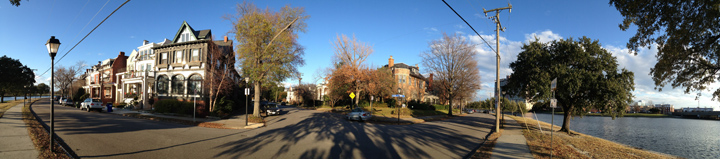
Mason’s home on Norfolk’s gorgeous Mobray Arch. (In 1998, I lived in an apartment in the yellow house to the left of the tutor house. Mason, Bill, and Alston moved in just as we were moving out, and I didn’t get to know them until years later.)

Shannon Chance, Ron Daniel, and Kim McGrath in Dublin last week.
Amazing teachers transform lives. That’s what they did for me at least!
Last week, one of the very best teachers I’ve had in my life–Ron Daniel–visited Dublin with his colleagues from Webster University. Ron is the Director of Academics at Webster’s Geneva campus.
While they were here, we got together twice to reminisce and talk about higher ed.
I didn’t post about this topic right away, because some things are difficult to express into words. This morning, I’m allowing myself to just cover the tip of the iceberg of what I’d like to say….
The best teachers I’ve experienced in life actually just put a good framework in place in for me. Then, they stepped back and let me explore the issues.
The best learning experiences I’ve had in life have happened under the astute guidance of Ron as well as:
I am particularly indebted to Ron Daniel (my second year architecture professor and the person who gave me my first architecture teaching job) and Wilma Brown (my fifth grade teacher who gave me my first official teaching assistant role). These two used a Montessori / Bauhaus sort of approach.
They put relevant materials in front of me and let me do my thing.
Wind me up and I’m like the Energizer bunny!
Thankfully, Bridget Arvold was there at precisely the right moment in time as well. In ninth grade, I was struggling through geometry because I had initially been assigned a very poor teacher. Thankfully, I met Bridget and had the sense to change instructors. She made geometry seem fun and logical. Without her, I don’t think I’d have has a solid foundation for becoming an architect.
Teachers like these make learning fun. They gave me the challenge and sense of support needed for me to start learning to explore this big, wonderful world. I thank my lucky stars to have known them.
If you’d like to know a bit about the presentations I’m making here in Dublin, you can view the Prezi I used for the DIT Teaching Fellowships awards ceremony.
One of the award winners, the School of Business’ Joe Dennehey, was so enthusiastic about the presentation and wanted to see it again that I decided to open it for public access.
I’ve included an outline (below the picture) of what I said at that event. If you borrow any of the images, ideas, or words for your future work, please cite the source:
CHANCE, S. M. (2012). Transformational Education at the DIT: Potentials of Your 2012-13 Teaching Fellowship. Keynote lecture for the kickoff of Teaching Fellowships hosted by the Learning, Teaching and Technology Center (LTTC) on 1 November 2012 at the Dublin Institute of Technology in Ireland.

Click here to see the slides for the 2012 DIT Teaching Fellowship awards ceremony.

USDA Photo by Bob Nichols of Dr. William R. Harvey, President of Hampton University.
My university president made news today in an article in the Huffington Post.
Earlier today I received a letter from him, congratulating me for the article in Planning for Higher Education. I realize that it’s fairly standard text, but it’s nice to be remembered… particularly after a long day of manuscript writing!
The paper I’m writing now won’t be published until 2014!?! That’s par for the course in the land of academe.


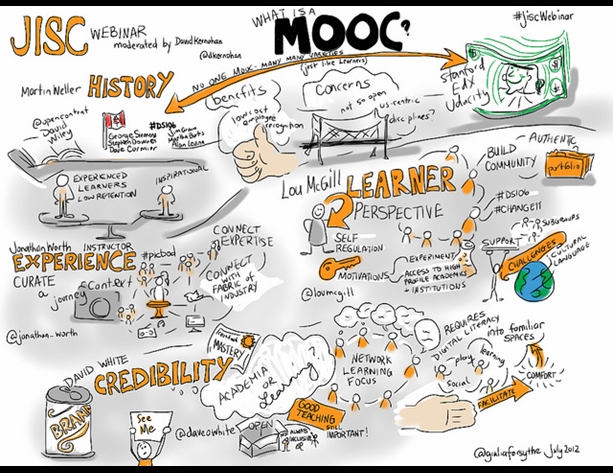
A diagram from Dave Cormier’s video.
I’ve been scratching my head, wondering “what’s a MOOC?”
Someone at SCUP sent me a helpful link to a succinct four-minute video by Dave Cormier that describes MOOCs and explains that the acronym stands for “Massive Open On-line Course.” I also found a helpful blog posted by Lou Mcgill titled What is a mooc? Massive Online Open Course and the learner perspective.
SCUP is using a MOOC to facilitate communication among its members. I’ve been visiting SCUP’s MOOC for weeks now but I haven’t been able to “see the forest for the trees.” I haven’t understood what’s going on all around me. I find my way to some places that seem like classrooms and other places where discussion is going on, but I don’t yet understand how to navigate effectively.
Thanks to Dave and Lou I can finally stop scratching my head! And, once I understand how the platform works, I can start using it to generate knowledge about planning and sustainability — rather that just about how to use MOOCs and the internet more effectively.
In any case, I believe that this on-line communication platform (i.e., SCUP’s MOOC) is the reason that my article got so many downloads so quickly after it went “live” on the internet. The splash page for the article was viewed 644 times between November 9 and November 12.
To be honest, up until now I didn’t actually think people read the academic articles I’d published. But now that I think about it, several people did contact me regarding an article I published with SCUP in 2010 titled Strategic by Design: Iterative Approaches to Educational Planning. So perhaps SCUP’s audience reads and communicates more about its publications than is the case with many other organizations!
MOOCs provide a platform for learning that can help communities develop new knowledge quickly. SCUP’s is aimed toward generating knowledge about how universities run and how they can improve their approaches over time.
Perhaps humanity will develop viable paths to achieving sustainability by using tools like MOOCs to share and build knowledge. That’s part of the focus of my article just published by SCUP and something I think society MUST focus on if we are to persist on this planet.
But I’m quite interested in knowing more about how people work together to generate new knowledge. The research project I’m conducting right now with Gavin Duffy and Brian Bowe (as part of my Fulbright) investigates how a group of teachers here at the DIT (i.e., a learning community) has been able to implement changes in the way DIT teaches Electrical Engineering. These are topics I learned a lot about in the Ph.D. program I completed at The College of William and Mary on educational policy, planning, and leadership.
And interestingly, so many of the women I’ve bumped into recently–Esther, Joan, Máirtín’s wife, and myself–have been studying topics of leadership and change management. Now that I’ve joined SCUP’s MOOC, I have found a whole new community discussing change, strategy, and the university’s role in addressing social and environmental issues. I hope we can elicit the types of sweeping change that this world needs, and do it fast enough to save ourselves.

I just received great news about my article from one of the editors of Planning for Higher Education. Terry Calhoun left me this comment: “Shannon, as of this morning, we have 345 article/summary downloads. So, people are reading, even if not yet commenting.”

Erin Eife and I discussed the ins and outs of applying to grad schools in between programmed sessions at the Fulbright Orientation.
On another note, Fulbright Ireland just posted a piece on taking the GRE in Dublin that was written by Erin Eife who is a recent college graduate who is conducting research on recidivism among females who have been jailed.
The class I taught this past summer at The College of William and Mary is being featured by the university’s public relations department for helping students move ideas into action and spurring environmental change. Check it out at:
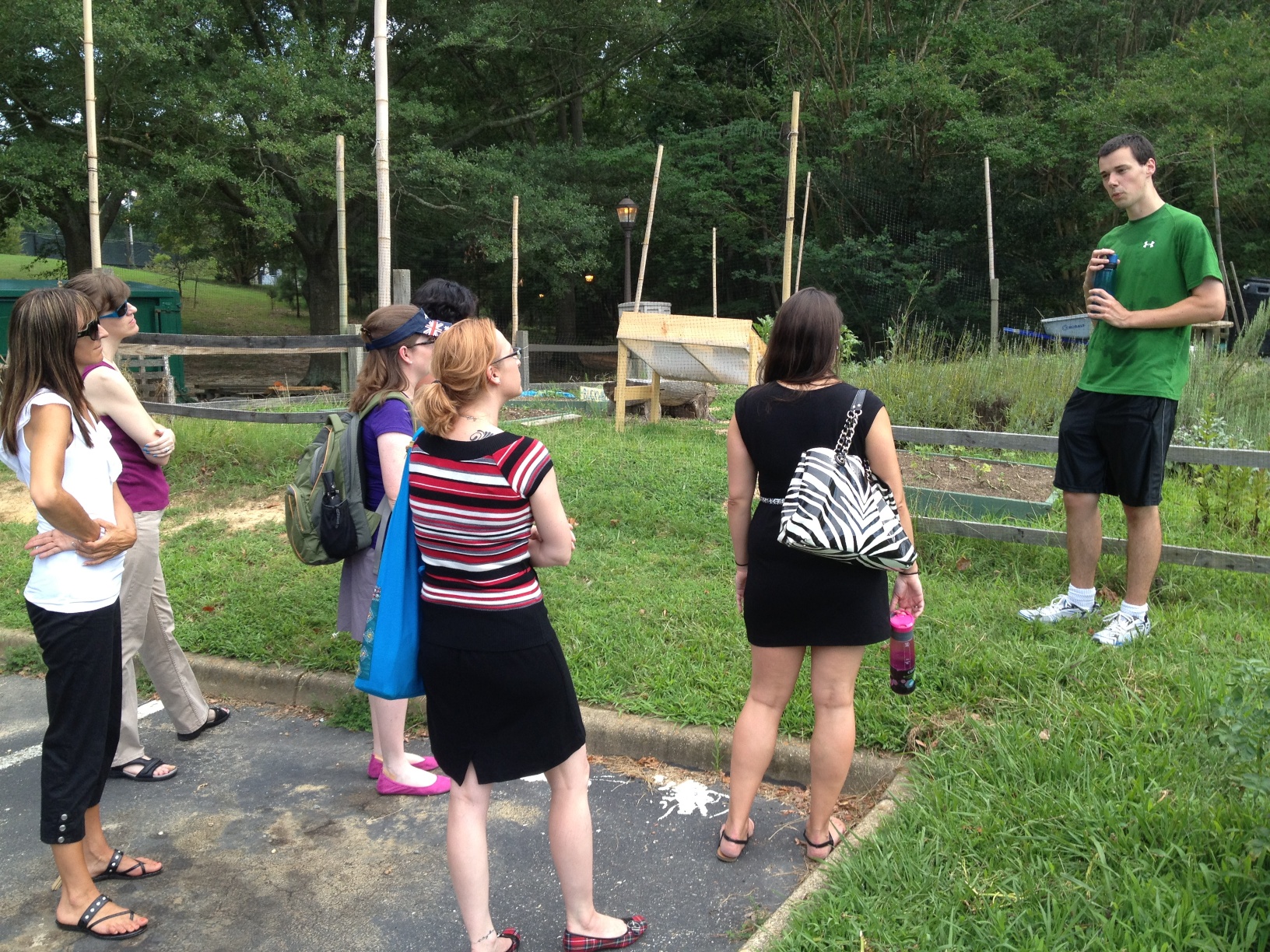
One of our many field trips in the summer “Educational Planning for Environmental Sustainability” class at William and Mary. This one, to the campus herb gardens, was coordinated by student Justine Okerson and led by W&M’s current Sustainability Fellow, Patrick Foley. The cafeterias at W&M get all the herbs they use from these gardens.
 Ireland by Chance