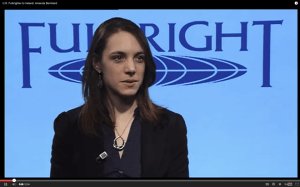
In the linked YouTube video, US Fulbright student Amanda Bernhard explains how she discovered the Fulbright program, why she decided to pursue a grant to let her study the Irish language in Ireland, and what the Fulbright program has offered in addition to financial support.
Tag / Fulbright
Eating in Church with Pam
Pam and I are managing to have some fun and also get some things accomplished. She’s going to try to write a book chapter or two while she’s here… after she finish grading papers and reviewing dissertation chapters. Whew!
I’m loving my break from grading. I don’t have to grade papers until May! This Fulbright scholarship is such an incredible blessing.

Don’t I have the cutest professor? Dr. Eddy knows her way around this town. Here she’s setting out for a quick errand without me.

After my meetings yesterday (morning and lunch), I attended a school faculty meeting…

…and then grabbed coffee (i.e., OJ for me) with some colleagues.

Pam and I headed to the Church restaurant/bar for dinner…

…we’d both had it on our list of places to eventually eat.

The food was delicious. Unfortunately, they seated us in a very busy corner… practically in the kitchen.

After dinner, we headed to the Cobblestone…

…we got to hear Pat Goode, Mick O’Grady, and crew (including Fergus Wheelan who sings from time to time). When we got home, Pam curled up with his fascinating book “Dissent into Treason.”

Fergus’ wife joined us at the pub last night, too.

And a musician Kitty Lee, Patty, and I heard play at Palace Bar joined in the merrymaking at the Cobblestone last night.
How Professors Have Fun
My former dissertation advisor, Dr. Pamela Eddy, is here visiting me in Dublin this week. She was a Fulbright to Ireland in 2009 and she helped me make valuable connections when I started applying for my own Fulbright experience here.
So far, we’ve spent a lot of time at our computers! Although it’s her Spring Break, she’s answering emails, reviewing dissertations, and grading papers. Oh, and advising me!
She helped me prepare for the meeting I had today with DIT’s president, Prof. Brian Norton. I’ve attached a photo of us working from my home yesterday. She was still sitting the same seat when I Skyped her from my office on Kevin Street just now to “debrief” on the meeting.
We do stop for exercise, food, and meeting… but little else!

Shannon and Pam working. Notice our twin workstations!

Skype debrief…

…we thought it was fun!
Upcoming Photo Exhibition in Dublin
I’ve got an exhibition of reflection photographs in the works for spring. It’s to occur during May at Notre Dame’s O’Connell House on St. Stephen’s Green. Tuesday, I met to plan with Notre Dame’s Lisa Caulfield and Joseph Stranix as well as Fulbright’s Joanne Davidson. I showed them some examples of my work and, thankfully, got enthusiastic response. 🙂
It’s a big, beautiful space and I look forward to filling it with images. It’s so much space, in fact, that I am hoping to include my two favorite photographers in the show. (I’m seeking final approval for that.) I’ll keep you posted as plans progress.
It’s a gorgeous space, and I though you might enjoy seeing it pre-show:

Lisa and Joanne reviewing my photos from a past exhibition.

The view toward O’Connell House (it’s on the right, Marrion Square is to the left.)

Plaque inside the O’Connell House.

The fabulous and welcoming O’Connelll House.

I can hang photos in the entry hall…

…and the two large rooms on the first floor (that’s the second floor in American terminology).

A view of the two rooms.

View from the back room.

I’m not using this room, but I wanted to show it to you. So beautiful. The back wall is hung in “salon style.”
Blog Tips 1: Why Blog about your Fulbright Experiences?
The Communications Director at the Fulbright Commission in Ireland asked me to provide some tips on blogging to share with other Fulbrighters. I’ve created a series of four blog posts on the subject:
- Why Blog about your Fulbright Experiences?
- Choosing and Adapting to your Blog Platform
- Finding your Blogging Niche
- Publicizing your Fulbright Blog

Header from a CIES webpage.
So then, why blog?
Blogging experts say the main challenge is to continually generate new content that’s of interest to others. With blogging, they say, you have to stay very active and load new content regularly or you’ll lose the attention of your audience.
We’ve all seen stale, dormant blogs. That is a viable way to go… if you simply want to meet your grantor’s wish that you blog about your experiences without investing much of yourself in the process.
I’ll admit I wasn’t thrilled at the request to blog when it arrived. I’ve never followed blogs and didn’t see the merits or the potential for growth.
As a Fulbright, you have content that’s of great interest to others. Blogging provides a quick and fun way to share this content. It can provide an opportunity to learn more from your own experience and also learn about writing for a real live audience. You can track your statistics to see what interests people in different parts of the world, for instance.
So, who’s your audience? My own has grown over time. It includes people I’ve known a long time and the folks I’m meeting here each day. It includes regular visitors from across the US and Europe, and occasional visits from people in Africa, Asia, and South America. Watching the statistics page on WordPress gives me some idea of who I’m reaching and how often they visit.
The notion of sharing in this way comes fairly naturally to me.
When I lived in Switzerland in 1997, I emailed many dozen friends and relatives each day. They were interested to know about what I did, saw, and thought while living alone in a foreign land. They’d send questions and encouragement. That helped me feel support during a challenging time in my life.
Blogging is an even better platform for me to do what I was attempting then. It lets me share photos and ideas with many more people, and do this very quickly. Most of all, it lets me address the goals of the Fulbright program by promoting the work that I’m doing and the cultural exchange I’m experiencing.
My cousin lived in Paris for a year in 1993. She wishes she had Internet tools then. They make staying in touch AND growing your social network so much easier.
A few parting thoughts for this introductory blog:
- Choose your blogging platform and template carefully. Some are easier to use than others.
- Watch tutorials about your platform so you can learn the tools quickly. You’ll need to develop your own set of approaches over time, so that blogging doesn’t consume too much of your time.
- Craft a catchy title and consider purchasing an easy-to-recall domain name for yourself.
- Determine your level of desired privacy so you can adapt your activities accordingly. You can keep your URL under wraps and share it with select friends, or you can go public and connect in to search engines like Google and Bing.
- Learn to keep some content in reserve (saved in draft form) to pull out when you don’t have time to generate text but you want to get something fresh posted.
If you’re determined to do this well, then you might as well learn to enjoy blogging and to see it as a way to document, reflect, and share. Just think: in the end you’ll have a beautiful log of your experiences. It will help you remember and record all you’ve done. Best of all, it will help you stay connected with people back home as well as those you’ve just met.
Ag dul siar ar na seachtainí – Update of the last few weeks
Ag dul siar ar na seachtainí – Update of the last few weeks.
The piece Amanda wrote yesterday evening while we we blogging in her living room….
Upcoming Talks
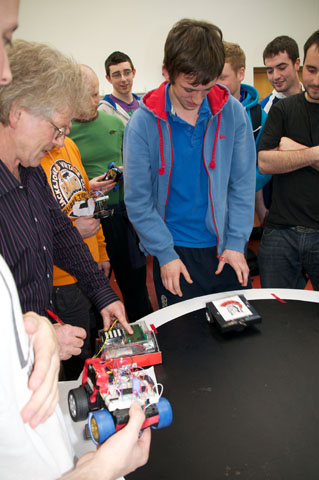
Richard Hayes engaged with students in a hands-on course at the Dublin Institute of Technology. (Copyright Shannon Chance, March 2012).
I’m giving two talks next week that you’re welcome to attend.
Tuesday I’ll discuss “A View from the Outside: Transforming Pedagogy at the DIT.” It’s part of a College Education Seminar entitled “Building a Student-Centred Programme – A College Case Study.”
Thursday I’ll discuss “Transformational Education at the DIT” to help celebrate the launch of DIT’s 2012-13 Teaching Fellowship program.
The photo I’ve attached shows the types of hands-on learning experiences electrical engineering students get at the DIT these days.
Fulbright Ireland website’s includes full details about the talks.
Mixing Soup Under a Fine Dublin Sky
Fulbrighting is in full gear here!
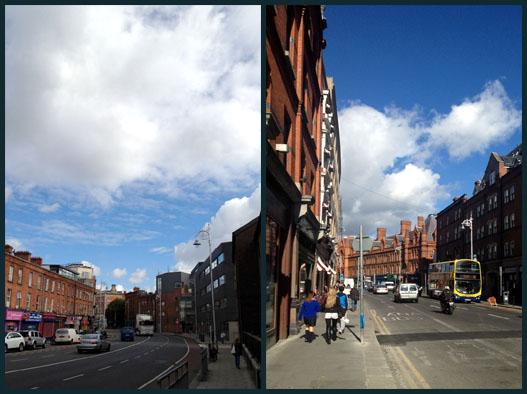
The weather is grand — chilly but sunny. And, surprisingly, it was a day without rain. That hardly ever happens. We usually get at least a few drops every day. As they say, “if you don’t like the weather, just wait five minutes” … it’s certain to change. They also say Ireland has four seasons in a day. Dave and I have definitely experienced that.
I’ve learned never to leave the apartment without a small umbrella and a waterproof jacket of some sort. There’s little humidity in the air here in Dublin. Gavin joked yesterday that humidity tends to fluctuate between 0% and 100%. (Scientifically speaking it’s probably more like 30% and 100% since 0% would be unGodly dry, but the idea is right on. A hundred percent is, of course, when the air can no longer hold the water and it rains or snows.) I’ll include a few random photos of the Dublin sky, snapped as I walked to various buildings at DIT today (the buildings are spread out all over town).
In the past couple of days, Sima, Gavin, Brian Bowe (their doctoral supervisor), and I have been trading articles on design theory, design process, and qualitative research methods in preparation for our work. We’re exploring differences and similarities between phenomenology and phenomenography. Fascinating, eh!? Well, fortunately, we think so! (I’m trying to make time to read a stack of articles and chapters while also preparing to give a conference presentation next week and making final reviews of the article that will be published next month by SCUP, the Society of College and University Planners.)
Among other activities today, I met with Gavin to discuss definitions of “design” and their relationship to epistemology (the way individual understand “knowledge” and what it means “to know”).
Computer Science lecturer Damien Gordan walked past and joined the conversation (see photo). I’m looking forward to talking with him again soon. So energetic!
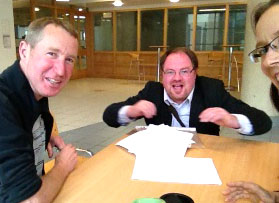
Chatting with Damian Gordon from Computer Science, who, like us, also does educational research.
Everyone here is amazingly welcoming. Gavin’s office-mate, Kevin, gave me a his own personal HP printer (his wife has just purchased a new one). The librarian at Bolton Street, Brian Gillespie, checked me out a book using his library card, since mine’s in the works. The Head of Mechanical Engineering and Product Design asked me to submit a paper for his upcoming conference.
I could go on… but there’s even more exciting news.
In a few days, Gavin, the Dean of the College, and I will all fly to Thessaloniki, Greece for a conference sponsored by SEFI (the society of European engineering educators). Gavin will be presenting two papers and I will be presenting two as well. One of the papers we wrote together, so we’ve got a total of three presentations to deliver between the two of us. Strangely, all three of these presentations fall in the same time block. We’ll get to see exactly how many places we can each be at one time!
When the conference ends, Gavin will zip back to Dublin mid-week to teach classes. I don’t have to be in a specific class next week, and my flight choices all required a lengthy stop-over. So… I took full advantage of the opportunity. I chose Rome as my through destination and I scheduled a stop over for three nights on the way back. I’ll return to Dublin in time to work Saturday and Sunday.
I have a huge amount of homework to complete for the following week (the same week my Mom and her two neighbors are arriving for a visit). But I can’t fall behind in my work. Gavin and I must stay on our toes in order to complete our study in time for the January 7 journal deadline.
Oh, yes, Sima phoned today to discuss lecturing schedules and research plans. She’s been following the blog and she called with a very excited tone. She’d not noticed the BYOF sandwich board right outside their building, and neither had the other lecturers. They learned about it from my blog and got a big laugh.
I should have taken a photo in the window of that pub yesterday. The students were just back and they hadn’t packed lunches either. So, there were plenty of students in the pub, but few had BTOF (Brought Their Own Food).
On a parting note, I also had to stop for some produce today and I leave you with the following delightful image+thought=idea. The veggie assortment pictured below was labelled as “soup mix.” How cool!
‘Course I’m gonna steam my veggie assortment instead… and I think I’ll do that right now! Apologies for any typographical errors… but I need to go eat… and work on that SEFI presentation… YIKES!

Soup Mix — Irish Style!
Always Learning to Teach
I love teaching students to design! I’m also fascinated by theories about how students learn. At the Dublin Institute of Technology (DIT) , I’m going to be researching:
- How students’ ideas about “knowledge” and “knowing” mature over time.
- How DIT professors are helping students become more flexible problem-solvers.
- How DIT’s faculty has transformed its electrical engineering curriculum using a hands-on approach to education known as “student-centered, problem-based learning.”
I’m happy to report that these topics are of interest to the engineering education community… DIT’s Gavin Duffy and I have already been invited to present our work in Greece this September and to publish an article in the Journal of Engineering Education.
You can read more about the Fulbright in press releases by William and Mary and Hampton University.

Electrical Engineering students prepare to compete in the mid-semester round of “Robo Sumo,” March 2012.
Is Fulbright for you?
Each year, the US government sends thousands of people abroad. These “Fulbrighters” do advanced research, teach (at the elementary, secondary, or college level), or study at the graduate level. Fulbrighers include:
- teachers, professors, scholars
- students and recent graduates
- professionals (e.g., journalists, attorneys, artists)
- administrators
Fulbright programs vary in length (2 weeks to 12 months) and location (there are 155 countries participating today). They also vary on the level of funding they provide and the subject areas hosted by each country. The core Fulbright Scholar Program, in which I am participating, “sends 800 U.S. faculty and professionals abroad each year. Grantees lecture and conduct research in a wide variety of academic and professional fields.” My position is for a full academic year.
The overall point of the Fulbright program is to increase mutual understanding among nations and help build knowledge as well. It dates back to 1946 when Senator J. William Fulbright asserted that nations could avoid future wars by simply getting to know other. Today’s Fulbright programs are sponsored by the US State Department’s Bureau of Educational and Cultural Affairs. These programs bring foreign students and scholars to the USA in addition to sending US citizens abroad.
You can identify which programs fit you by visiting the Institute of International Education’s (IIE’s) Fulbright page. As you dig down, you’ll be able to find out what countries host scholars in your areas of expertise and interest, how much funding they provide, and what skills they require. Some positions are much more competitive than others — some require specific credentials while others are open to scholars in any discipline. Some positions require that you can speak your host’s native language.
It’s worth your while to spend a little time today looking over the possibilities… it’s never too early to start planning your own Fulbright adventure!
 Ireland by Chance