Ecology Rocks! (Especially in a Flipped Classroom)

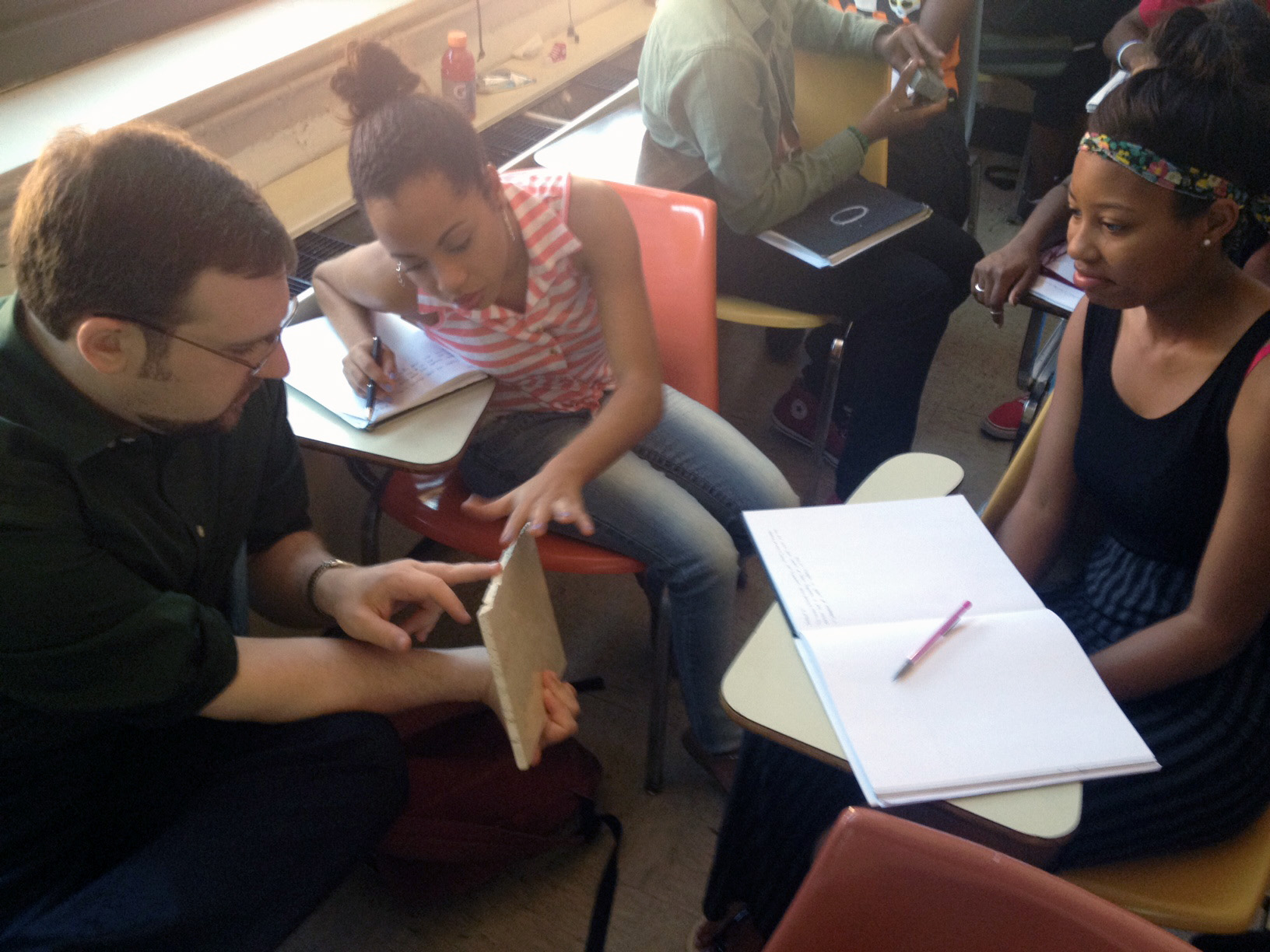
This group realized there was a fill material in the crevices of their "Roman Travertine" tile sample.

This group realized there was a fill material in the crevices of their “Roman Travertine” tile sample.

Today we discussed “natural factors” that affect architectural design, such as rock and soil composition. This tied directly to yesterday’s studio class on the HU Point. Today, I was using a technique known as the “flipped classroom” to teach Architectural Ecology. I learned about this technique during my Fulbright fellowship at DIT.

I had assigned my students to read a chapter before class. When they arrived, we started class with ten minutes of journaling.  I asked them to write about the aspect of the chapter they thought was most important to them regarding our site at the Hampton University Point, and to explain why.  I also asked them to identify a topic in the chapter that they didn’t fully understand and explain why/what they didn’t understand about it.

Journaling is my own way of assessing students’ level of understanding of the content.  After ten minutes, I collected journal papers then “flipped the classroom”.  Each student joined the other members of his/her learning group, discussed the issues of confusion they’d each identified, explained to each other what they understood (this is known as “peer teaching”), and researched information on line using their laptops and smart phones.

I circulated around the room, listening, observing,  pointing them in the right direction where necessary,  and making sure they were achieving accurate interpretations.

It became clear that soil and rock composition was the major topic of confusion, so I went ahead and distributed the rock samples I have on hand.  Each group got their own unique rock type to analyze, research, and introduce to the rest of the class. The students did a great job of staying on topic in their discussions, learning, and teaching leach other.

They made sense of sedimentary, igneous, and metamorphic rock. They began to understand issues of texture, particle size, expandability, drainage, and bearing capacity while they were talking among themselves with my guidance.

A member of each group presented findings to the class and we discussed overarching issues.

Then I projected the Prezi file on the screen, which I’d formatted using a table of contents so we could zoom directly into whichever specific issues were causing confusion. In this case, we needed to go over the soil classification pyramid a bit, but they had already developed pretty strong understanding through the group discussions and rock presentations.

Amazingly, everyone stayed engaged for 1.25 hours!

I didn’t have to nag students to pay attention.

By the end, they seemed to have very good understanding of all the content of the chapter.  I found I had ten minutes to spare at the end to bush on topics of my choice (ones I thought a student or two might still have misconceptions about).

I am loving this new, more interactive, way of teaching.

It’s called “flipping the classroom” because the content is delivered before class (in this case, through a reading), and class time is used to gauge accuracy and depth of understanding and to build upon that base.  It seems to be a much better us of time than presenting everything with equal emphasis, before assessing if the students already understand it!

Not everyone came into the class having read, unfortunately. This problem should correct itself in the future because each student gets a grade for each journal entry. They have to show basic understanding of the reading in order to earn points. They generally start seeing the importance of this after a day or two.

Constructing a Student-Centered Studio

The incoming second year architecture studio cohort at Hampton University.

The incoming second year architecture studio cohort at Hampton University.

Today I applyed what I learned about problem-based learning (PBL), group learning, and student-centered pedagogies while I was on my Fulbright fellowship at Dublin Institute of Technology. I met the students in my second year architecture studio for the first time. Studio looked unlike Day One of this class (ARC201) ever looked before!

We started outside, with team building activities and a name game. Then we formed the teams (i.e., learning groups) that we’ll use for the first five weeks of this semester.

Next, we conducted initial site analysis in a way that was much more engaging than normal. We held a “scavenger hunt” to identify qualities of our project site (the Hampton University Point) that have to do with water.  The students managed to generate a much more interesting list of factors than I’ve ever been able to get them to achieve before; 63 about water alone!

For Friday, each team (of three students) has two assignments due.

Assignment 1 is to draw a plan of our project site to an architectural scale to fill an 18″x24″ sheet of paper.

This problem prompt is pretty specific (close-ended), but it still leaves a number of variables for students to consider and make choices about.  I hope they’ll get a bit competitive and prove they have pride in their work!  I asked the groups to follow a standard PBL format in starting work on this assignment. I asked them to figure out:

  1. What is this assignment asking?
  2. What will we need to know to do this?
  3. What do we already know about this?
  4. What will we need to learn/find out?
  5. What resources will we need?
  6. Who will do what and when?
  7. How will we check for accuracy before it’s due?

Assignment 1 is more straightforward than you might expect for an architecture studio. However, it will lay groundwork for upcoming activities, and it will help me assess where the students are skills-wise and with regard to collaboration. The second assignment is much more open-ended.

Assignment 2 is to make a beautiful object that reveals the essence of water.

I asked the groups to start by watching one of the YouTube videos listed below, and assume that the astronaut/scientist had made the video in response to this assignment. I asked the students to consider the questions above (which are intended to foster “self-direcetd learning”) and to bring to our next studio meeting a final, beautiful object as well as at least three study models that investigating the “essence of water”.  I’ve got my fingers crossed!

The students were more  active, engaged, and enthusiastic about learning than is typical on Day One of this course and I have high hopes for this new method of teaching.

NASA: Amazing Experiments with Water in Zero Gravity – YouTube

NASA: Amazing Experiments with Water Balloons in  – YouTube

Promoting Sustainability at HU

HU Faculty Institute 2014-1-Shannon ChanceToday was a busy first day back at Hampton University.  The dean re-introduced me to the faculty with a big “welcome home!”  I have to admit,  my colleagues’ enthusiastic greetings made me feel like a superstar all day.

After the morning keynote sessions, the whole faculty headed over to the HU waterfront for our annual picnic. This year’s weather was amazing and the jazz ensemble sounded lovely.

The faculty wrapped up the afternoon with information sessions, one of which I helped facilitate.  My colleagues and I encouraged our peers to integrate environmental topics into the courses they teach.

You can view my Prezi online:  I showed a few images of how we integrate sustainability into architecture courses at HU.  I also discussed the “Educational Planning for Environmental Sustainability” course I teach in the summer at William and Mary.  I took the opportunity to promote student-centered pedagogies (which I studied at Dublin Institute of Technology) and the importance of getting students to generate new knowledge (a core idea in W&M’s School of Education).

The Good News

The Good News is, I got my grant proposal submitted.  Because I’m pretty new to the field I’m researching, my chances are probably below the 13.2% success rate. On the other hand, I’m hoping the fact that I was so careful and spent so much time will boost my odds.  Sometimes the best you can do is try.

The Bad News is, I haven’t had time to blog.  There’s still so much to show and tell.  But since I’m headed home in less than a week,  I am up to my elbows in packing instead of showing and telling.

In the meantime, I’ll upload an intriguing map posted on Facebook by my brilliant and talented former student from Hampton University, Lanre Ajibola. The size and shape of the USA is shown in dark purple.  Lanre was born in Nigeria and he says:

Quick Geography lesson: next time anyone talks about Africa like it’s a country, present this map – you are welcome!

Seeing as how I directed a Fulbright-Hays program to Tanzania in 2005, it makes sense for me to post this on my Fulbright blog even though it has nothing to do with my trip to Ireland. 🙂

Speaking of relative sizes, I’d better get back to seeing how much I can stuff into my suitcases without going over the weight limits….

Relative size of Africa

Relative size of Africa

Drawing with Daisy

Daisy drawing class 1

My former colleague at Hampton University, Daisy Williams, is teaching two different classes in Rome this summer in addition to being the director of University of Oregon’s study abroad program in the ancient city. One is architecture studio and the other is a drawing course, pictured here.

Tomorrow, I’ll join the drawing course for a morning outing… so I’d better hit the sack now!

Perusing Paris

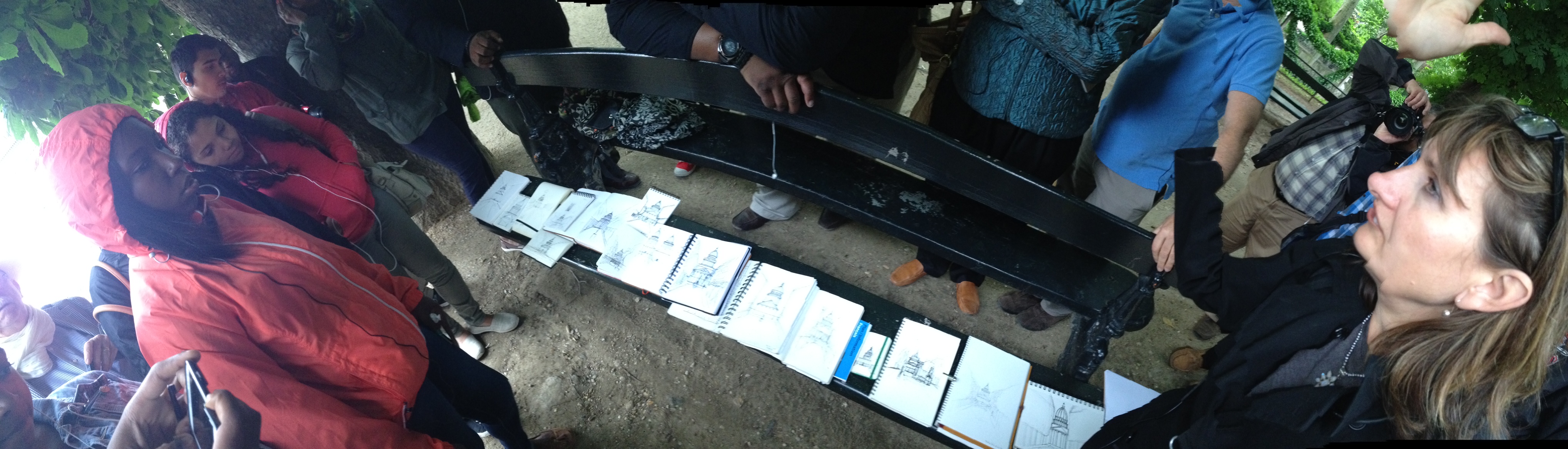
Hampton University sketches of Paris.

Hampton University sketching in Paris, on a rainy day.

Spent a lovely week in Paris, much of it with Hampton University’s architecture program.  I’ve attached a few of the pics I snapped with my iPhone.  I’m back in Dublin now, and  getting around to downloading the photos from my Nikon.  The photos will help me reminisce of my travels once I head back to the States.  I might even have time to write something meaningful on my blog once again….

For now, pictures will have to do!

Passage in Toulon

I’d forgotten how much I love Toulon, France. It’s a naval town, and the sister city of Norfolk, Virginia, where I live in the States.

The little plazas–scattered throughout Toulon–are amazing. Full of character and life. And, they are so close together that you’re never more than half a block from a lively public space.

Our Hampton University architecture program has worked with officials and urban planners in Toulon each summer since 2010 to develop design strategies for revitalizing the city using architecture and urban design.

Discovering Uzes, France

I’d never been to Uzes, France even though some of my Hampton University architecture students had.  Uzes is home of the famous urbanist, Leon Krier, though we didn’t get to meet him there this year.  We often use his book, The Architecture of Community, in my Urban Theory class.

Visiting Uzes made for a wonderful day of learning and exploring.  I even wrapped with two decent sketches of my own.

Arriving in Nimes

Nimes is a beautiful town in southern France that is chock full of Roman artifacts. It’s where I met the Hampton University architecture students, mid-way through their study abroad program in France. I typically organize one of these trips each summer. This year, Prof. Mason Andrews had the whole cohort of third-year architecture students on the trip to France–some years we offer two different trips.

Another Hampton University Success Story

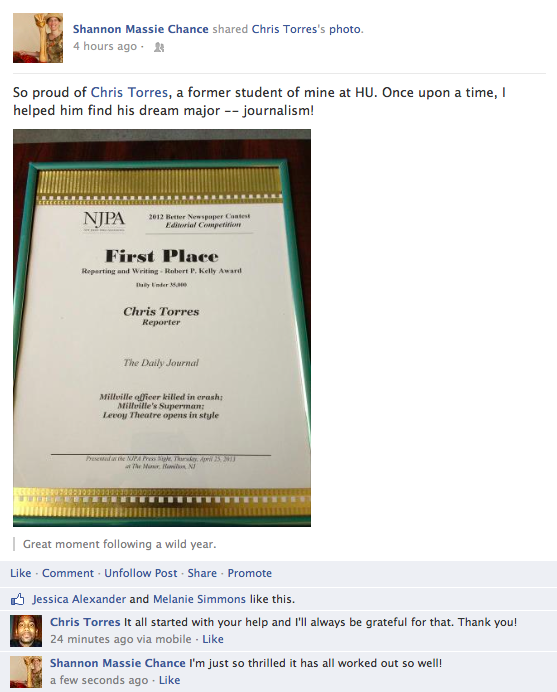
I’d also meant to share a Facebook post Chris Torres made several weeks ago.  He won an impressive award for journalism.  I’m thrilled to find I advised him well!

Facebook post by Christopher Torres.

Facebook post by Christopher Torres.