Planning to Make Your School Green?

IMG_1206

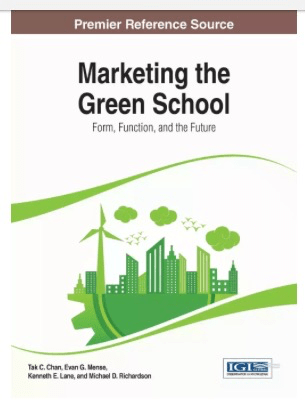
A colleague from Virginia Beach, J. Timothy Cole, and I published a chapter in the recently-released textbook called:

Marketing the Green School: Form, Function, and the Future

Our chapter is called:

Enhancing Building Performance and Environmental Learning: A Case Study of Virginia Beach City Public Schools

This abstract summarizes the article so you can tell if you’d like to read it:

“School buildings directly affect their natural and socio-cultural environments. They do this through their construction, maintenance, operation, and demolition. Most of the school buildings we have in stock today drain natural resources and inadvertently perpetuate a culture of environmental, social, and long-term economic ignorance and misuse. When approached thoughtfully, however, the design of school buildings can help inform and enrich society. Well-designed buildings can impart environmental knowledge and values. They can foster more effective behaviors among the people who learn in and from them. Effectively designed buildings can also conserve natural resources and—at their best—even help replenish the natural environment. For many school leaders today, participation in green certification programs represents one important step toward improved building and learning performance. This chapter provides a case study of successful learning approaches developed by Virginia Beach City Public Schools (VBCPS).”

Here’s the introduction:

“Aimed toward educators and school administrators, this chapter provides a broad overview of design issues related to sustainability. It proffers concrete examples drawn from Virginia Beach City Public Schools (VBCPS) to enhance performance at the level of the building, classroom, district, and region. VBCPS’s environmental approach integrates educational planning with facilities planning. Its facilities department has been driving change in school design, classroom pedagogy, purchasing, transportation, and even regional design standards.

The examples in this chapter provide a snapshot of one moment in an ongoing process. They illustrate how one innovative school system is generating and applying new knowledge for the benefit of its buildings’ users, the local public, the wider education community, and the world. Overall, VBCPS strives to provide the best possible environments for learning teaching and living. Its efforts include:

• Integrating environmental issues throughout the curriculum
• Preparing students to bring new knowledge into the community and share it with their families and employers
• Introducing new construction techniques to the region
• Encouraging architects and builders to reach for higher standards
• Monitoring the division’s environmental performance and continually seeking to improve
• Disseminating their research and techniques for broad adaption
• Monitoring its own (and its community’s) energy and waste flows
• Striving to achieve net-zero carbon emission
In this chapter, we provide rationale and theoretical underpinnings for green school design, and we share successful practices developed by VBCPS. Knowledge in the realm of environmental design and education is continually evolving. As such, any list of “best practices” is in constant flux. In writing this chapter, we seek to provide a description of some of the best practices we have discovered and/or created up to this point in time.

Most environmentalists have adopted the World Commission on Environment and Development’s (1987) definition of sustainable development as that which “meets the needs of the present without compromising the ability of future generations to meet their own needs” (p. 43). The “green building” movement fosters new strategies to help overcome outdated construction practices that require vast material resources and cause tremendous waste and pollution. Today, North America’s over-reliance on cheap energy has reached crisis proportions (Steffen, 2008; Wackernagel & Rees, 1996). All told, buildings consume 65% of the electric power used in the United States (Landsmark, 2008). They use 36% of all energy used and 30% of all raw materials. Buildings are responsible for half of greenhouse emissions from the US (Gifford, n.d.; Udall & Schendler, 2005). Educational facilities have been among the worst, although higher education buildings seem to waste more energy than K-12 because control systems are looser (Leslie & Fretwell, 1996).

Recently, VBCPS analyzed all sources of emissions within its control, using data from 2006-2010. It found that even though its overall energy consumption had steadily declined across the five-year period, its building-related activity still accounted for 65% of VBCPS’s overall emissions. Its second largest source of emissions related to transporting people and goods. Its calculations considered electricity use, combustion from paper/stationary waste, and losses related to the transmission and distribution of electrical power. School leaders are working to address the division’s primary sources of emissions, through integrated strategies that involve enhanced building performance, revised vehicle fleet policies, and more informed commuting habits of students and employees. Leaders are also creating strategies to control the 1% of its green house gas emissions that resulted from solid waste, refrigerants, chemicals, and wastewater.”
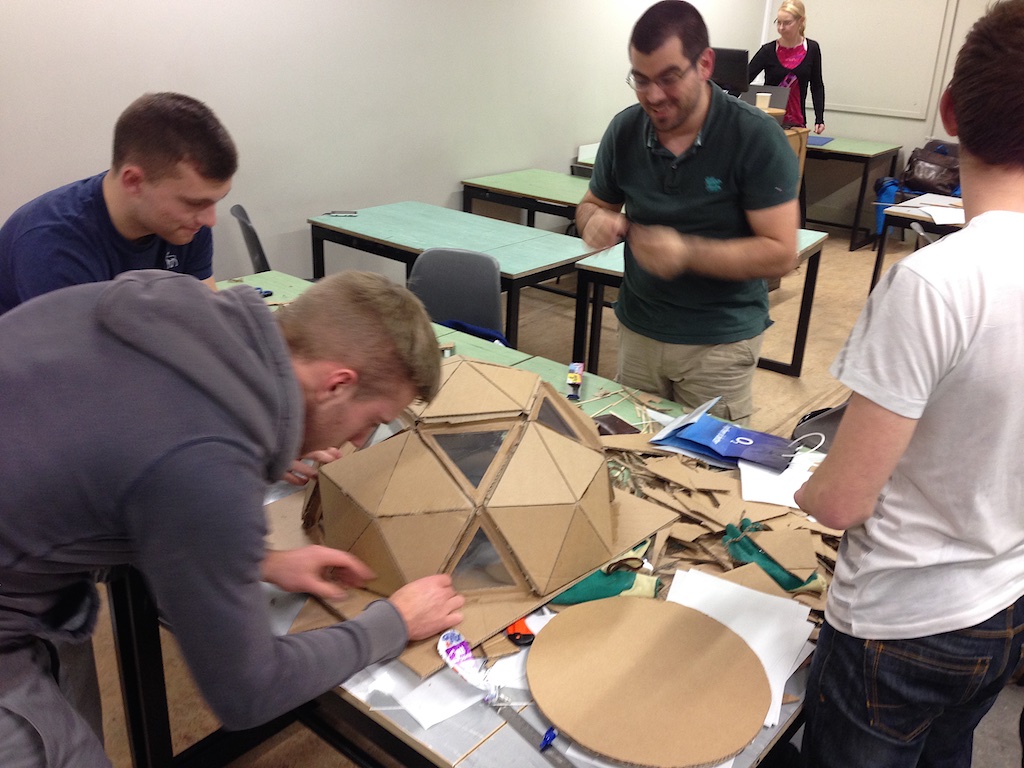
Energy Cube — Build Day

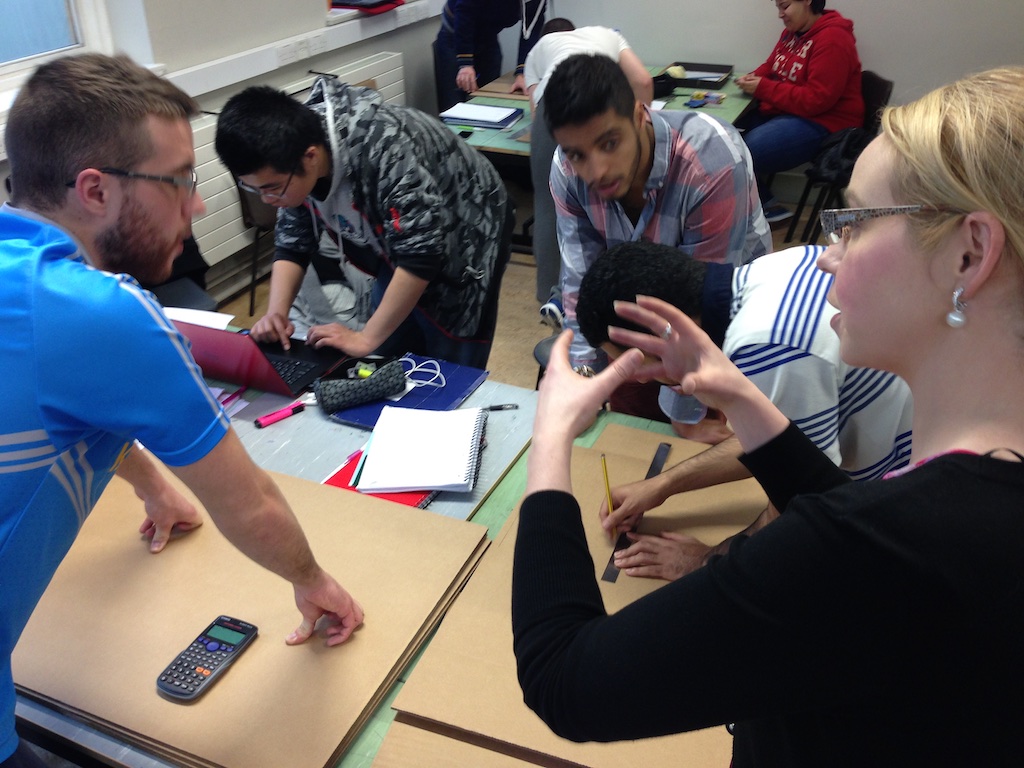
Fionnuala advising an Energy Cube team.

Fionnuala advising an Energy Cube team.

Nowadays when you arrive in DIT’s four-year engineering program, you will complete three group-based design projects prior to selecting a specific engineering major: a bridge design project (to familiarize you with civil and structural engineering), a RoboSumo project (to learn about robotics, electrical, and electronic engineering, and programming), and an “Energy Cube” project (as an introduction to mechanical, product, and building services engineering).

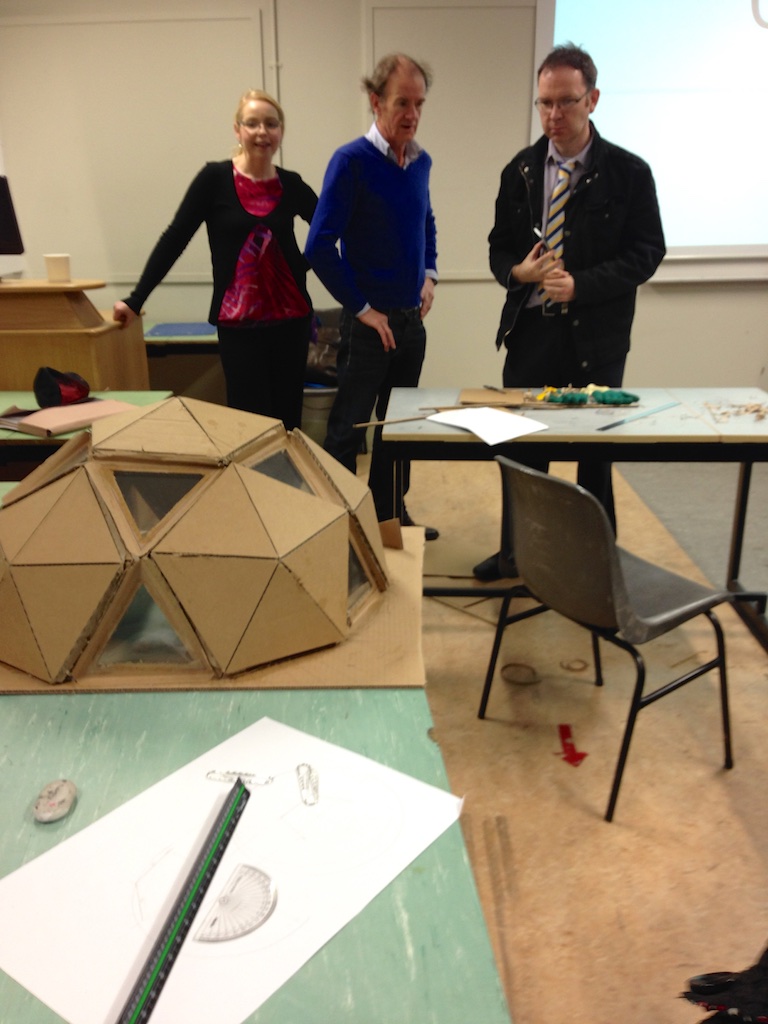
The Energy Cube project is currently coordinated by a diverse and multi-disciplinary group of teachers. Fionnuala Farrell is a product design and manufacturing engineer, John Nolan is an expert in engineering drawing, and Micheal O’Flaherty is a building services engineer. 

This team built a geodesic dome for their Energy Cube.

This team built a geodesic dome for their Energy Cube.

I’ve been assisting them and contributing the perspective of an architect. I’m not involved in grading, since I’m interviewing some of the students for my research, but I attend classes to better understand what it’s like to learn and teach engineering. 

Fortunately, I know how to do all the parts involved in this project: designing buildings, identifying client needs, defining product evaluation criteria, collaborating, calculating volumes, making scale translations, predicting thermal performance using mathematical calculations, designing the lighting scheme, building models, testing performance, keeping records, and presenting work in writing as well as verbally.

For the students, though, this combination is a tall order!  They have a total of six sessions, four hours each (on Friday afternoons!?!!) to design, build, test, and present their Energy Cubes. Whew!

Lecturers Fionnuala Farrell, John Nolan, and Michael O'Flaherty surveying results of "the build."

Lecturers Fionnuala Farrell, John Nolan, and Micheal O’Flaherty surveying results of “the build.”

Moreover, they are working in assigned (rather than self-selected) groups of four. Learning to work with strangers isn’t always easy. They’ve done an admirable job.

Our second of four sets of students will test their cubes later today. I’ve posted photos of what the Energy Cube build looked like last week.

Framing My View

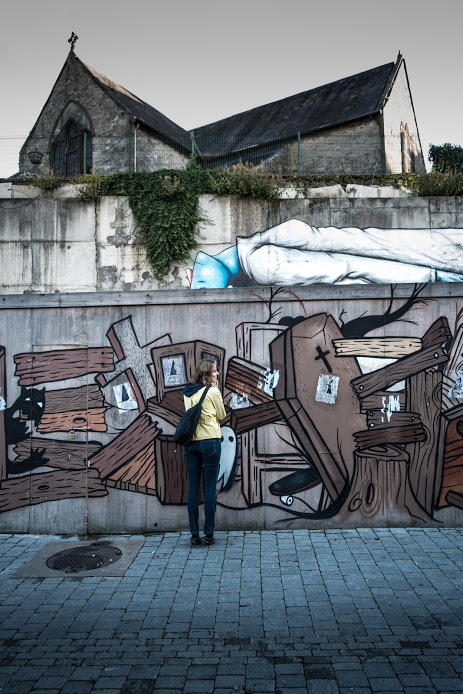
Over time, various artists have provided layers of meanings along this street in Kilkenny, Ireland. Small windows in the graveyard painting let viewers select their own vantage points and help them view what's happening on the other side of the wall. The photographer (Frank Daly) selected his own frame of reference, capturing an entertaining yet  chilling portrayal of the phenomenon of Western burial.

Over time, various artists have provided layers of meanings along this street in Kilkenny, Ireland. Small windows in the graveyard painting let viewers select their own vantage points and help them view what’s happening on the other side of the wall. The photographer (Frank Daly) selected his own frame of reference, capturing an entertaining yet chilling portrayal of the phenomenon of Western burial.

Phenomenology and constructionism are two outlooks for understanding and describing human experience in ways that can help humans (especially educators, designers, and makers) shape a better/more purposeful future. They are well aligned with engineering and architecture because both paradigms both have to do with human creation. Without human creation, architecture and engineering are not possible. In this blog, I’m attempting to summarize my understanding of the two in a way that might be of use to other researchers.

Phenomenology is a philosophy as well as a method of doing research. It focuses on experiences people have, and on how individuals understand and describe their experiences. Education researchers have been working hard to refine this method of research, although it is still in its infancy as a research methodology. On the other hand, phenomenology has been central to architectural thought since at least the mid 1900s.

Today, I am striving to understand distinctions and techniques involved with three specific variants of phenomenology: transcendental phenomenology, hermeneutic/interpretive phenomenology, and phenomenography. These differ in how they view objectivity and subjectivity, and this aspect intrigues me.

Construction is a fundamental aspect of architecture, architectural design, and architectural education. Two distinct paradigms deal explicitly with “construction,” although I see quite a bit of overlap between the two, so I’m placing them under a common heading.

These two construction-related outlooks are called constructivism and social constructionism.

The book Qualitative Research: The Essential Guide to Theory and Practice, written by Maggi Savin-Baden and Claire Howell Major (2013), is helping me better understand the distinctions between these two ways of thinking about and conceptualizing being, knowing, and researching.

I’ll attempt to explain what I’ve found using their book and integrating it into what I learned in school: 

Constructivism is the more subjective of the two construction-oriented paradigms. This paradigm asserts that knowledge exists in the human mind and that researchers can understand it by “unpacking individual experiences” (Savin-Baden & Major, p. 56). “Reality,” in this view, is what individuals think it is. To understand the world, we (as educators, architects, and/or researchers) need to assess how individuals know, understand, and indeed construct the world in their minds.

Constructionism is a more collective. This paradigm is often referred to as “social constructionism” and it posits, “Reality and knowledge are socially constructed” (p. 56). In this view, groups of people decide collectively – and quite often unconsciously – what things (phenomena, people, places, ideas, etc.) they will recognize and how they will understand and name them. In inverse fashion, groups also decide what things they will not see/understand/name. Researchers who adopt this way of seeing the world study how groups of people collectively see/interpret/create/construct the world around them. Today, constructionism appears in only in a few publications on engineering education (specifically, on teaching robotics or materials engineering).

I’ve been planning to use phenomenology in my upcoming work, yet I believe constructionism also hold great value for engineering education research. Perhaps I’ll help introduce this way of seeing to the EER community.

Expanding the Engineers’ Box

Fergus Whelan commented that I need to think outside this box....  Thanks to Frank Daly for the fabulous photo.

Fergus Whelan commented on this image that I need to think outside this box!  Many thanks to Frank Daly for the fabulous photo. My students, having sent his look many times before, certainly empathize with you!

In all corners of the globe today, companies are clamoring for skilled engineers. They want a larger pool of applicants who are creative, flexible thinkers prepared to address complex, emerging questions riddled with interrelated unknowns. Like industry, the sectors of healthcare, education, and government also have great need for well-rounded thinkers with strong engineering acumen.

Simply put: the world needs more people who can think across systems and see how things relate at multiple scales. We need people who can identify problems and create new solutions from the ground up. People who aren’t so closely bound to existing systems, ideas, and protocols that they can’t construct entirely new schemes for thinking and behaving.

Today, governmental organizations (like Science Foundation Ireland and the National Science Foundation in the USA) are working hard to address the shortfall in the number of engineers by generously funding education of, as well as research by, engineers and scientists. They seek better ways to teach and think about engineering and science.

The blogs I will be posting in the near future have to do with:

  • the way we think about and conceptualize engineering
  • how I think this needs to change
  • how architects and education researchers can help

Please note: I’m going to be explaining things that I’m trying to work out in my head and do this as if I’m speaking to a friend or relative who knows little about research. That means I may not be “100% right” in every explanation. But as you’ll see, that is a risk that must be taken for the sake of building knowledge. (It’s all part of this new “paradigm” for working and thinking that engineering needs to implement more widely… more on that to come!)

I do hope you’ll follow along on this research adventure, where I’m working to bring qualitative, social science research and design thinking into more facets of engineering education.  Yes, these are gutsy claims I’m making — particularly since I’m new to research and new to engineering.  Let’s see if I can live up to such promises….

Exotic Familiarity

I feared that somehow things wouldn’t seem as new and fresh on my return to Dublin as they were before.  During my Fulbright fellowship, I spent 365 days in this vibrant city — but even a vibrant city can become overtly familiar, I would have thought.

And yet, as I happily rediscovered many familiar comforts this past week (like Beef and Guinness Pie at Pieman in Temple Bar), I also uncovered a plethora of new adventures here.

On Saturday, during Fergus Whelan’s history tour, I met a researcher from Fordham University.  She said how much she’d enjoyed finding this blog while she was preparing for her trip here.  Her words encouraged me to get back to posting.  I hope you find something interesting and informative in my little picture gallery of highlights of the past week.

Well, it’s 10:20 PM and the sun has just set.  It will be up again by 5 AM or so, and I’d best get ready to hit the sack. I’ve another big week ahead!

Architects’ Pot Luck

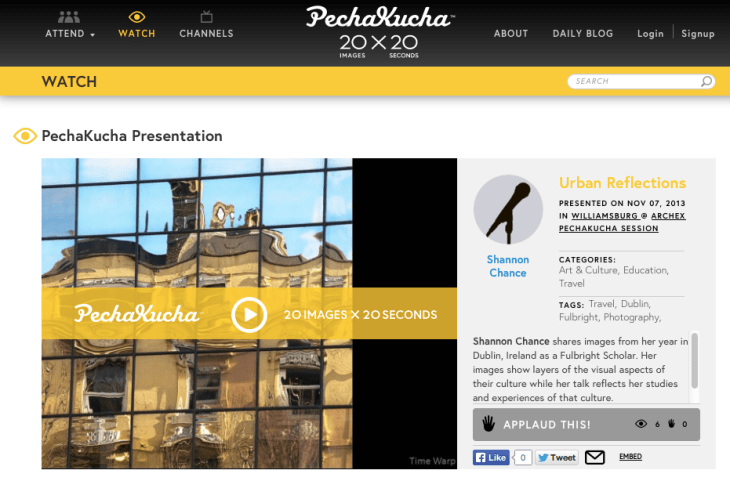
These days, wild, crazy fun among architects involves Pecha Kucha style presentations.  This is a high-speed format for sharing images and ideas.  With Pecha Kucha, each presenter selects/provides 20 images.  At the Pecha Kucha event, the slides are projected on a large screen in sequence for 20 seconds each.  The presenter talks, and the slides move on wether or not the speaker is ready.  It’s entertaining — in part because it’s actually quite difficult for the speaker to stick to the 20 second window.

This format keeps the speaker from droning on too long and it leaves time for more people to present.  It’s pot luck: everyone brings something to share and you can almost always find something you hadn’t expected but quite enjoy.

An architect from Williamsburg, Dale Weiss, organized a Pecha Kucha event at ArchExchange East last November and he has uploaded the representations to his (very elegant) website.

You can view my Pecha Kucha presentation, of urban reflections from Ireland, by clicking here.

ArchExchange

The Virginia chapter of the America Institute of Architects hosts a conference every November that is called “ArchExchange East.”  It’s a fabulous learning experience for me and my students.  Most of our department attends the event.  I’ve included photos of some highlights.

wiehr

Drawing (on) Gravity

Sometimes gravity is an architect’s friend.

In fact, architects can use gravity to human advantage in all sorts of ways.  In Ecology class today, I showed some diagrams of systems that use “thermosiphoning.”  That’s a fancy word referring to gravitation pull that moves fluids (like air or water).

The idea is that warm air (or water) rises and cold air (or water) sinks… because a  liquid is heavier and more dense when it is cold.

So, we can let gravity do the work if we think a system through.  Sometimes we need to move liquids in directions they don’t naturally want to go, and then we need to add electric pumps or fans to our systems.

Today, I showed my second year architecture students a tromp wall system as well as a diagram of an open loop solar hot water system.  In that type of system, you let the sun heat the same water that you will use to shower, wash dishes, or drink.

I also showed a few diagrams of basic heat exchangers… like the one in a car.  That one takes the heat from the combustion process and uses it to warm the air in the car without bringing in the “smog.”

The students were seeming to “get” the ideas, but they didn’t seem particularly jazzed up about them.  (I knew that because they were fidgeting and clearly wanted to text.)

To get them involved, I turned posed a problem for them to solve.

I asked them to pull out a sketchbook and combine the solar collector and the heat exchange into a single diagram.  They needed to figure out how you could use water with water with glycol (i.e., antifreeze) in it to collect the sun’s heat and then use that same liquid to warm the water for someone’s shower.

The challenge was to transfer the warmth into potable water without tainting it.  A couple of students caught on fast. After everyone had given it a try, I let them help each other.  More and more people got it.

At about the same time, I asked a four of the students who caught on quickly to draw their diagrams on the board and then explain how they worked to the class.  We all put our heads together to analyze the designs.

Gravitational Pull

cabins 2

Hampton University’s second year architecture students are learning about gravitational forces and lateral loads by designing post and beam structures using a simple kit of parts (and adhering to a lot of fairly complicated rules).

The intention of the assignment is for students to learn about cantilevering, stacking, and hinging.  They also have to respond to environmental factors and work together in groups to enhance the site design concept developed by another student in the studio.  You can see one of the site design models in the photos below.  The cardboard frames you see represent the structural systems of small cabins that nestle into the site design.

I’ve asked them to build the structures at such a large scale (1″=1′) so they can really get the feel of what the various structural components are capable of doing.  Once they achieve suitable concepts, they will model their frames in wood.

Fingers cross that that will happen by Wednesday!  Thanksgiving is just around the corner… only three weeks of classes left to go this semester… so much to learn, so little time.  They still have to have the interior space, design building skins, and illustrate their designs with diagrams and measured drawings.  All that, in addition to completing their Physics, Architectural Representation, Architecture History, and Architectural Ecology course work.  Whew!

Strolling Freemason

Hampton Roads is lovely this time of year!  Here are some snippets from my quick post-yoga walk through Norfolk’s historic Freemason district.