Group- and Project-Based Learning

We've got 19 shining faces in the Problem-Based Learning module we are conducting on Tuesdays in May.

We’ve got 19 shining faces in the Problem-Based Learning module we are conducting on Tuesdays in May. (Not to mention three shiny teachers!)

In the Fulbright application I submitted two Augusts ago, I promised to co-teach a class at DIT that used Problem-Based Learning.  At the time I applied, I anticipated that I would co-teach an architecture course.  But in the course of the interviews I conducted, I discovered it had been quite a while since DIT’s Learning, Teaching and Technology Centre (LTTC) had offered a module for faculty/staff on how to implement Problem-Based Learning.

I’ve witnessed such remarkable results that seem to have accrued as a result of the topic having been offered in the past–by Terry Barrett and Brian Bowe.

So, I recruited some folks (Orla Hanratty, Brian Bowe, and Gavin Duffy) to help and 19 students enrolled in the course.  Here are some photos from Day One….

Starting with Circuitry

shannonchance's avatarRoboSlam

RoboSlam starts with an introduction to the overall robot-building process and then delves into assembling the electronic components (i.e., building the circuitry).  The photos below track the progress of several groups of participants in the “Engineering Your Future” event held the week of May 13-17 at DIT.

These photos were all taken by DIT’s current Fulbright Scholar in Engineering Education, Dr. Shannon Chance.  Participants are welcome to download them and share them with others.  Shannon will post images of the rest of the week in the days to come….

View original post

DIT in Top 1% in the World for Engineering Research!

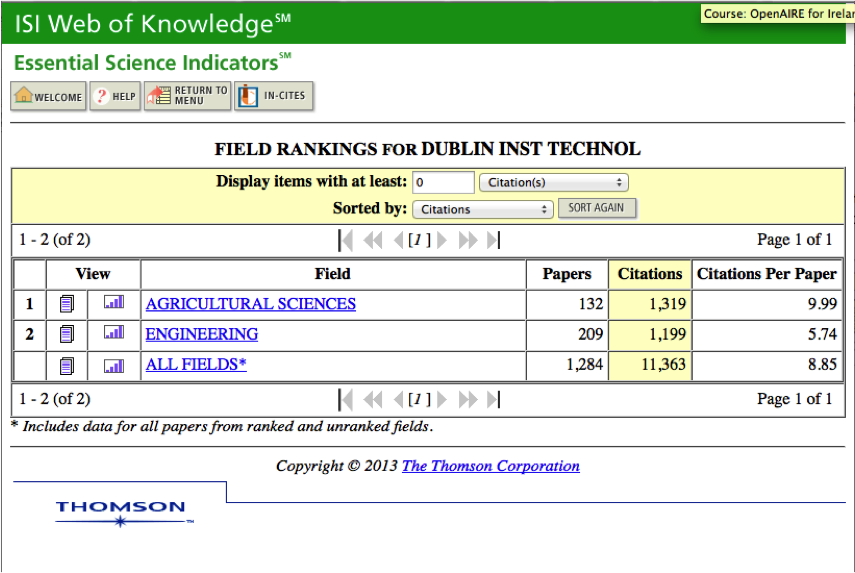
For the first time ever Dublin Institute of Technology (DIT) has been listed in Essential Science Indicators. More impressively, the institution achieved a listing in the top 1% in the world in the areas of Engineering and Agricultural Sciences (which includes Environmental Science)!

I’m hoping that my efforts here contributed in some small way to this achievement — I’ll have to see if any of the conference papers I’ve authored with DIT colleagues while I have been a Fulbright Scholar here at DIT  counted in this ranking.

Apparently, DIT now outranks Trinity College Dublin with regard to Engineering research!

DIT research ranking, May 2013

DIT research ranking, May 2013

A Week in the Life of a Fulbright

This past week has been fairly typical of what I do as a Fulbright Scholar here in Ireland.  I thought you might be interested to see what a typical week is like, work-wise:

RoboSlam–Extended Version

Yesterday the students who built robots with the crew coordinated by Drs. Ted Burke and Damon Berry headed over to DIT’s Bolton Street location to learn about mechanical, industrial, and product design. Thanks to Kevin Delaney, Ger Reilly, Susan O’Shaughnessy and crew for a fascinating day! I’ll be posting lots more photos of RoboSlam in the days to come.  It’s been such fun!

Another Hampton University Success Story

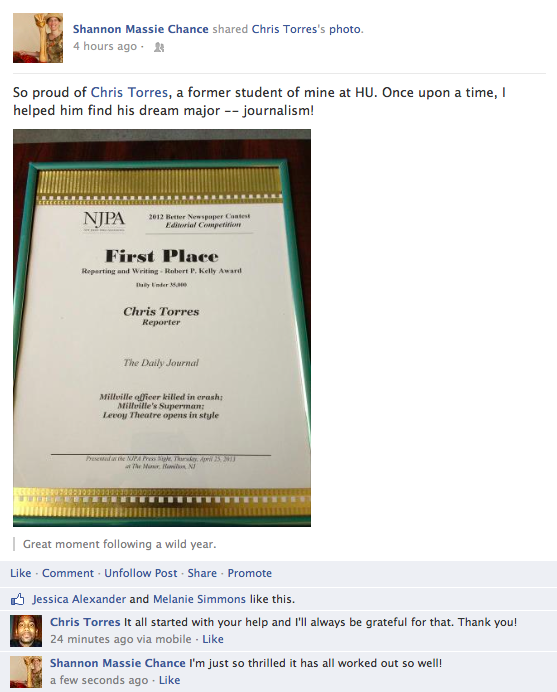
I’d also meant to share a Facebook post Chris Torres made several weeks ago.  He won an impressive award for journalism.  I’m thrilled to find I advised him well!

Facebook post by Christopher Torres.

Facebook post by Christopher Torres.

Photo Show and Lecture — Please Attend

I have a lecture and photo showings that you’re most welcome to attend:

I will be giving a talk at Arcadia University in Dublin tonight (May 15) at 4:00PM.  The address is:

Arcadia University, College of Global Studies
20 Fishamble Street
1-4 The Courtyard
Temple Bar
Dublin 8

Tomorrow night (May 16) I’ll host an open house of my photo exhibit from 5-7 at  Notre Dame’s O’Connell House.  That address is:

58 Merrion Square
Dublin 2

You can visit the photo show any weekday 9-5 through May 31 — it’s free and open to the public!  If you want to view it with me, I’ll also be in from 12-2 on May 22 and 27.  Moreover, you can email me (shannonchance at wm dot edu) to let me know if you’d like me to meet you there at another time that’s convenient for you.

"Essence of Beauty" is one of the photos on display at Notre Dame's O'Connell House now through May 31.

“Essence of Beauty” is one of the photos on display at Notre Dame’s O’Connell House now through May 31. Copyright Shannon Chance.


Luanna’s New Master’s

It’s such a joy to keep in touch with people back in the States on Facebook.

Yesterday, Luanna Jendrey, who took the “Planning for Sustainability” course I offered in the summer of 2011, posted a picture from her recent graduation.  The photo was taken with former Fulbright Dr. Pam Eddy, who you’ll recall visited me here in March.

Luanna’s kind caption made my day even more special!  Kristina Neuhart took the 2011 class, too, and also offered kind words.

Congratulations to Luanna on her new Master’s degree in Higher Education!

Luanna's very sweet Facebook post.

Luanna’s very sweet Facebook post.

Slammin’

We are running a RoboSlam robot hacking workshop with high school (transition year) students here in Ireland. Having great fun and learning circuitry, programming, and lots more!

20130514-121651.jpg

PBL Credits in Águeda

Past projects made by students...

Projects that students made in past years at the engineering school in Agueda.

I misunderstood the credit allotment for projects at Escola Superior de Tecnologia e Gestão de Águeda.  As it turns out, the project design courses carry credits in keeping with architecture design courses in the States.  Jose sent me this explanation:

Hi Shannon, 

Good to hear from you, and thanks for sharing your blogpost.
I am afraid, though, that you didn’t get the project dynamics right. Projects are awarded, on average, 6 ECTS, which is more than they get for each of the supporting courses (we call them that, too), which tend to have 3ECTS each. At the end of the semester, the groups of students have to write a report and there’s a public discussion of their work, before a panel that includes the project supervisor and, usually, an external member (from another HE institution or from industry). Students get individual grades for their project work. 
 
In fact, the number of credits associated with project work (exclusively, not including the supporting courses) in the program is roughly 30% of the total number of credits.
 
Cheers,
 
José