Fulbrighting at Glasnevin Cemetery

Hanging out with Daniel O'Connell.  My photography exhibition was held in the house where he used to live, on Merrion Square.

Hanging out with Daniel O’Connell. My photography exhibition was held in the house where he used to live, on Merrion Square.

Our Fulbright shin dig included a visit to Glasnevin Cemetery.  I’d spent about an hour here, just outside the gate, one evening near Halloween when Esther was visiting. That was part of the (very worthwhile and historically accurate) Ghost bus tour and we followed it up with a visit to John Kavanagh’s “Gravediggers” pub.

The cemetery itself was started outside the city, at the same time the same thing was happening all over the USA. The American cemetery movement actually sparked the American park movement, believe it or not.  The historian J. B. Jackson explains that people found they loved going to the suburban cemeteries — which were new and had wide open (corpse-free) spaces.  These early cemeteries were well-designed and had beautiful architectural features, as you can see on the home page for Thornrose Cemetery where my grandparents lay today.  In any case, in the ten year period of the Civil War, nearly every American city built a “central” park, and Frederick Law Olmstead’s office designed many of them… and many college campuses too.

Wikipedia has some of the most interesting info online regarding this particular cemetery:

Glasnevin Cemetery (Irish: Reilig Ghlas Naíon), officially known as Prospect Cemetery, is the largest non-denominational cemetery in Ireland with an estimated 1.5 million burials.[1] It first opened in 1832, and is located in GlasnevinDublin.

The stories I heard on our tour of the cemetery brought to life for me the history of Michael Collins and Daniel O’Connell, two of Ireland’s most important political figures. Éamon de Valera and Countess Markievicz are also buried here.

Porto — Obrigado!

One last glimpse of my beautiful Porto and my Fulbright trip there, just before I introduce you to Problem-Based Learning in Belgium….

Day-tripping to Glendalough

Glendalough 13

Glendalough boasts a beautiful natural landscape and a religious site constructed during medieval times.  It provides an ideal day trip from Dublin.

The Wikipedia site is full of interesting information about the place.  It starts by explaining:

Glendalough or Glendaloch (/ˌɡlɛndəˈlɒx/ glen-də-lokhIrish: Gleann Dá Loch, meaning “glen of two lakes”) is a glacial valley in County WicklowIreland. It is renowned for its Early Medieval monastic settlement founded in the 6th century by St Kevin, a hermit priest, and partly destroyed in 1398 by English troops.

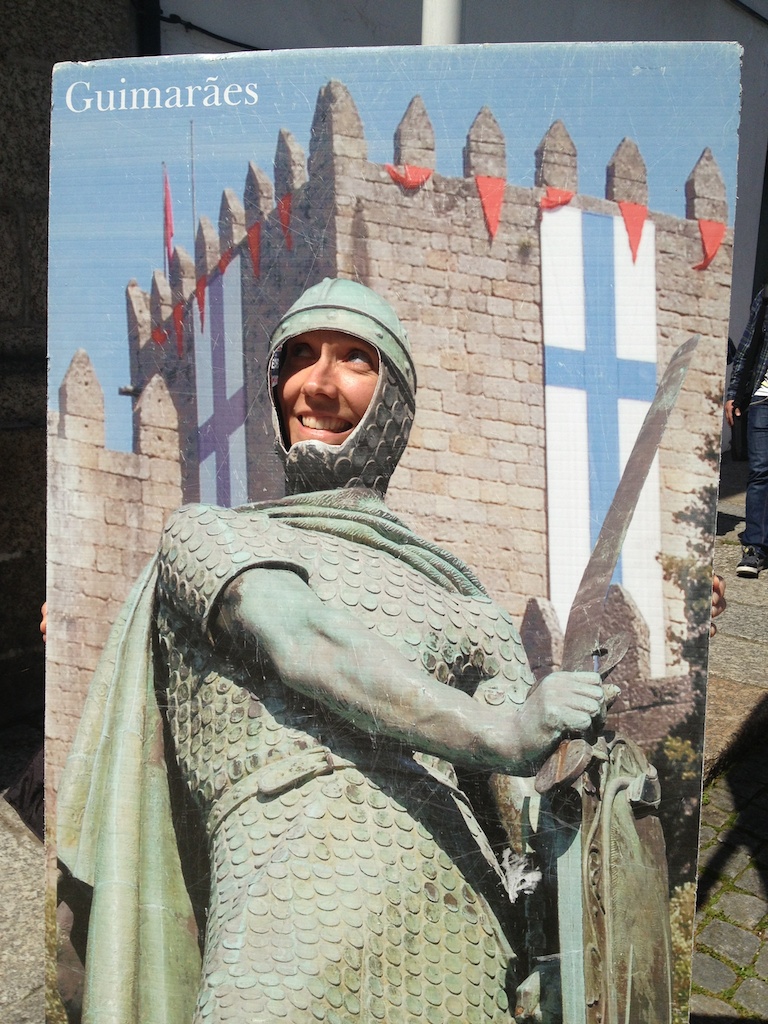
Guimarães: Birthplace of Portugal

Hamming it up!

Helping with the founding back in 1111 AD. 😉

Guimarães is an architecturally stunning town, and it is the place Portugal was born in the year 1111. Following my visit to the engineering program at the University of Minho and my Fulbright lecture/workshop, my hosts took me to visit the historic center and enjoy lunch in one of its very fine outdoor plazas.

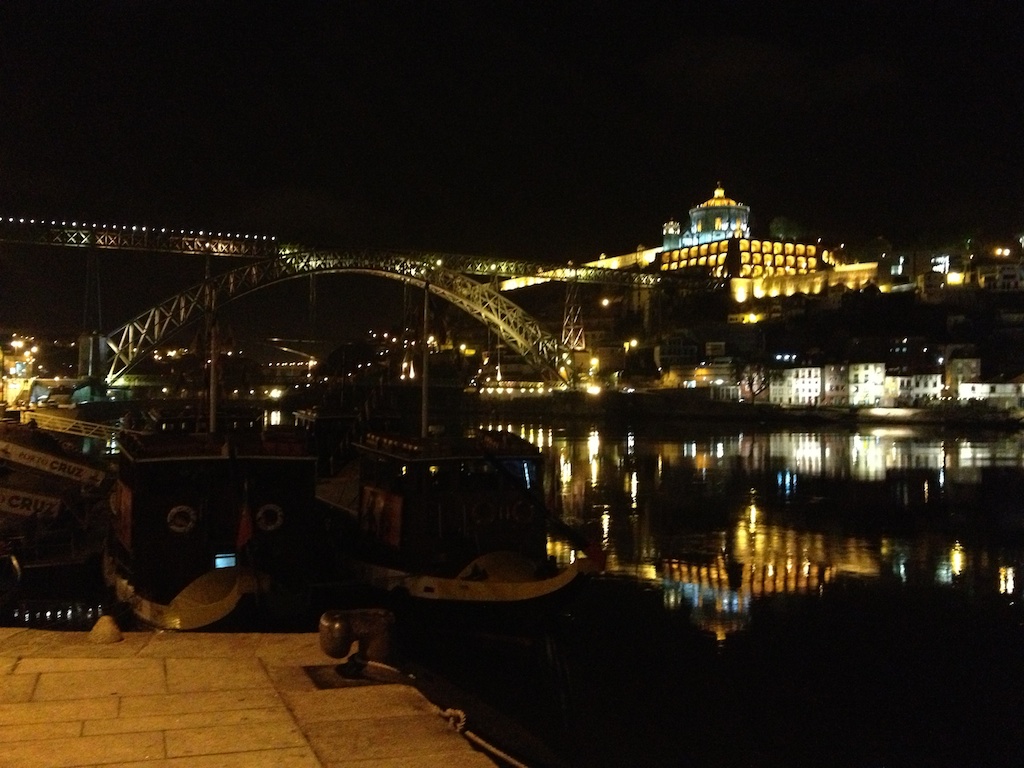
Exotic Porto

Porto's water front -- the perfect place for dinner and an evening stroll!

Porto’s water front — the perfect place for dinner and an evening stroll!

After speaking in Setabul, Lisbon, and Aviero, I packed up bag and hopped on the train to Porto.  It’s a lovely port city with steep topography and — surprise — more of Portugal’s stunning architecture!

I’ve been uploading the photos I took using my iPhone, so, unfortunately, I’m only providing a fleeting glimpse of these gorgeous places.  I hope someday you’ll have the chance to visit them for yourself.

Picking Back Up in Portugal

I dropped the ball telling you about my trip to Portugal and Belgium… I still have lots to show you!  When I last wrote about my Fulbright Inter-Country Lecturing adventures, we were in Aviero and Agueda with  José Manuel Nunes de Oliveira.

Here are a couple more of the modernist buildings at the University of Aviero.

Reflections on Francis Hutcheson

This is the plaque that Fergus Whelan posted on the stair tower at the Church on Mary Street (a religious building now operated as a bar and restaurant). The plaque honors Francis Hutcheson, “Father of the Scottish Enlightenment,” whose ideas made their way into the US Declaration of Independence.

The plaque’s coverings catch refections of the buildings across the intersection, at the west end of Henry Street. Here you see Primark’s world headquarters (the lovely red brick building with the patina-ed copper dome) to the right of Francis’ likeness.

Francis Hutchenson plaque

Around Aveiro

Modernist architecture abounds in Portugal.  This is particularly true on college campuses, since most were built after the mid 1970s.

Although the population is just 10.6 million, there are 24 schools of architecture!

I’ve included a few photos of buildings at the University of Aviero campus below.

PBL at the Polytechnic School of Águeda

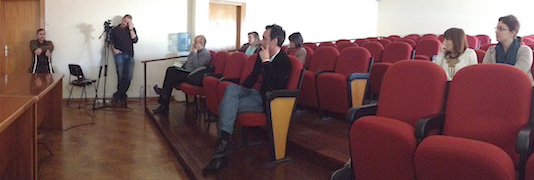
The audience was composed of experts and students in engineering and education.

The audience was composed of experts and students in engineering and education.

Visiting Portugal’s University of Aveiro some weeks ago provided me opportunities to speak with doctoral students and professors of engineering and education.

After I delivered a formal presentation to a small but enthusiastic group at the University of Aveiro’s Department of Education, my host, José Manuel Nunes de Oliveira drove me to the University’s satellite campus, known as the Polytechnic School of Águeda (or Escola Superior de Tecnologia e Gestão de Águeda, Universidade de Aveiro) where he teaches engineering.

Jose and his colleagues use Problem-Based Learning to teach engineering students.  They have formatted their classrooms to support group-based learning.  (My DIT colleague, Gavin Duffy, visited Jose and his campus earlier in the year to see how they use space. He wanted their advice to help in the programming phase of DIT’s new engineering facilities.)

What impressed me most in touring the buildings and grounds of the Águeda campus, though, was that the students were all working in groups–and that they seemed to be doing so on every type of project.

Jose says that after the teachers introduce the group-learning approach in the first year, students embrace it and want to do everything this way.

I thought that Jose said that students receive credit for their topic courses (i.e.,those with specific engineering content), but not for their project work (I was wrong, as I explain in my subsequent blog). In architecture we refer to these technical/topic classes as “support courses.”

All the courses a students take in a semester at the Escola Superior de Tecnologia e Gestão de Águeda help support the project they have been asked to do in groups. They are able to apply what they learn in the projects they design… but they don’t get formal credit for the design activities. In architecture in the USA, the design activities are assigned the most credit (typically 5-6 credit hours per semester) while each support course is generally worth just 3 credits. The architecture community tends to value the project or “design studio” work above all else.

Inter-Changes: Reflections from Dublin and Beyond

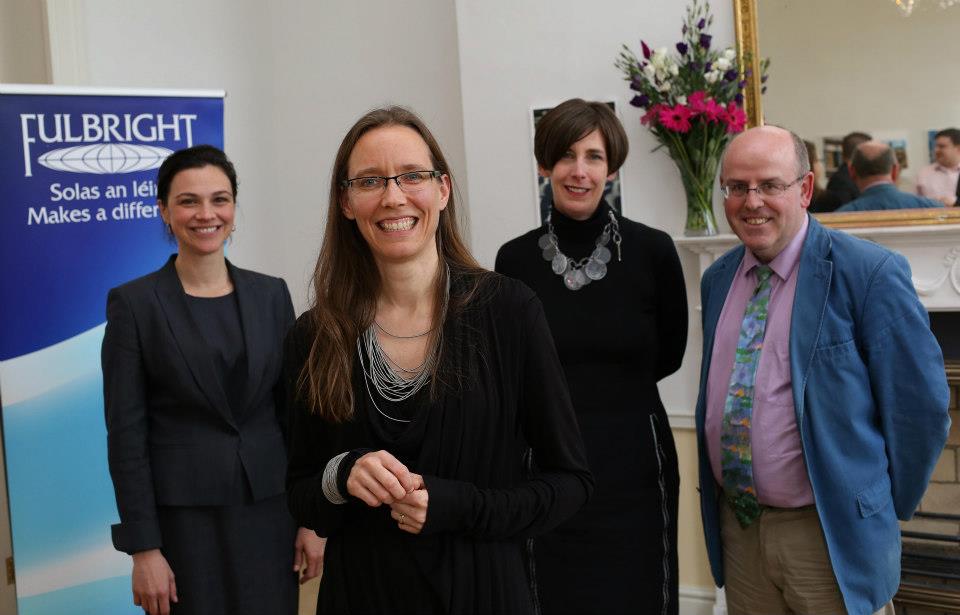
Lisa Caulfield, Shannon Chance, Colleen Dube, and Kevin Whelan

Lisa Caulfield, Shannon Chance, Colleen Dube, and Kevin Whelan

Shannon Chance, Cynthia Mara, and Dave Chance

Shannon Chance, Cynthia Mara, and Dave Chance

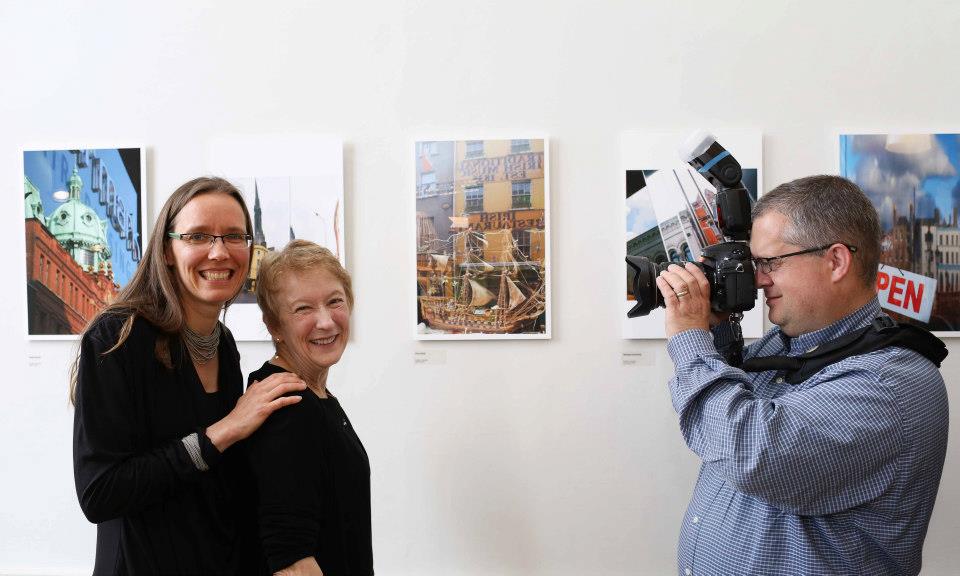
The staff of Fulbright Ireland and Notre Dame’s O’Connell House organized a spectacular event for last night. The opening of the photography exhibition was a highlight of my year here in Dublin.  So many people were there who have been instrumental in making this year a success.

Fulbright hired Conor McCabe Photography to document the event, and purchased the photos posted on this page.  I hope you’ll enjoy the photos as much as I do!