My Interview about the Fulbright Inter-Country Lecturing Program

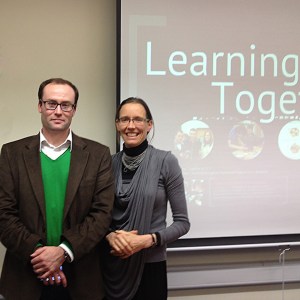
The Fulbright staff in Belgium interviewed me during my visit.  They asked me to describe some of my experiences with the program and explain how I got involved in it.

I hope the interview is helpful to other Fulbright scholars and to academics who would like to invite Fulbright scholars to speak at their institutions.

And, I hope my friends will enjoy hearing about what I was up to during my recent travels in Portugal and Belgium as well.

American Students: Want to Become a Fulbright?

The Fulbright Student program is now taking applications!

Click here to get started on your application.

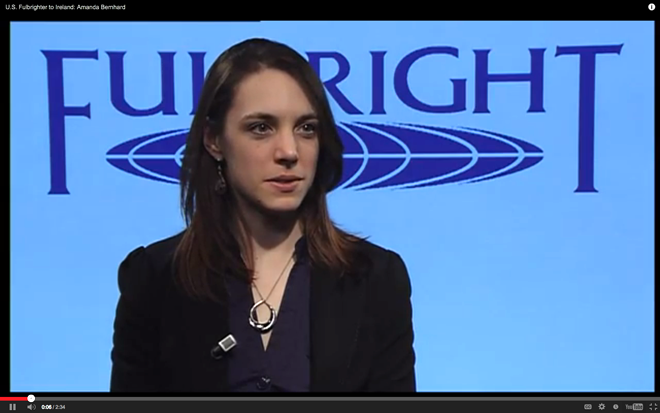
Amanda Bernhard explains why and how she became a Fulbright student.

My colleague Amanda Bernhard is in Ireland this year on the Fulbright Student program. She is studying Irish Language.

Problem-Based Learning — Live in Setúbal

In Problem-Based Learning, participants work in groups to: explore a problem, determine what they need to know to understand the problem, identify sources they can use, formulate hypotheses, and begin designing responses to the “problem” they’ve been presented.

In the PBL workshop Bill Williams and I conducted in Setúbal, there were three teams working to address the “problem” of how to integrate PBL into one of the institutions’ engineering programs.

These photos show the groups working together.  Participants in this workshop included engineering students, engineering teachers, and members of the central administration.

Refining PBL in Setúbal, Portugal

Setubal logoI’ve been away from blogging to focus on my mini lecture tour.  I spent a week in Portugal and a week in Belgium visiting universities, meeting with students and educators, and sharing ideas about how to teach and learn effectively.

My first stop in Portugal was to an engineering program located a ferry ride from Lisbon.

My colleague Bill Williams teaches there. I had met Bill at the European Society for Engineering Education (SEFI) conference in Greece last September. Bill was born in Cork, Ireland. He teaches English to engineers, is working on a PhD, and does high-quality engineering education research. He helped coordinate my trip in a way that allowed me to visit five different campuses while I was in Portugal.  Bill seems to know everyone in Portugal who is doing research about how to educate engineers.

Bill hopes to get more people using active learning approaches in the classrooms at Escola Superior de Tecnologia do Barreiro – Instituto Politécnico de Setúbal so the two of us conducted a two-hour workshop on Project-Based and Problem-Based Learning.  Thirteen people came to learn about PBL, hear about methods in use at Dublin Institute of Technology and about research I’ve been doing at DIT, and work together to develop ideas for implementing PBL across one program at the institute in Setubal.

Bill and I hope those ideas will move from hypothetical to actual someday soon.

Today, I’m posting images that the institute’s photographer took of the event.  I have many more of the participants working in groups to explore the “problem” of how to implement PBL in Setubal.  I was thrilled to receive email from participants after the event via Bill — I was really impressed that they took time to say they enjoyed the workshop.

International Lecture Tour

In less than two days, I fly out of Dublin for a two-week “lecture tour”.  I’m being sponsored though Fulbright Portugal next week and Fulbright Belgium the week after.  This is part of the larger Fulbright Inter-Country Lecturing program.

We have an exciting, action-packed schedule outlined.

In addition to speaking and learning about how other people teach architecture, engineering, and education, I’ve also got a heavy load of homework to carry along.

While I’m away, I’ll hopefully find time to write three conference abstracts, finalize and submit a funding proposal, and prepare for the class I’m co-teaching in May.

Wish me luck!

Lisbon

Lisbon (photo downloaded from Cunard Cruise line)

PORTUGAL 

Wednesday, April 10

Visit to Escola Superior de Tecnologia do Barreiro of the Instituto Politécnico de Setúbal.

Thursday, April 11

Round-table talk at Setubal Polytechnic Institute (IPS).

Friday, April 12

Presentation on Tools for Assessing Design Students’ Cognitive Development to Architecture PhD students at Instituto Superior Técnico (IST). 

Monday, April 15

Presentation on The Use of Staff Learning Groups to Transform Engineering Education at the Dublin Institute of Technology to the Department of Education at the University of Aveiro and engineers from the Polytechnic School of Águeda.  I’ll also meet some of the students and teachers using Problem-Based Learning at the Polytechnic School in Aveiro and/or Águeda (25km away).

Tuesday, April 16

Meet with engineering teachers at the Universidade do Minho engineering campus in Guimarães.

Leuven

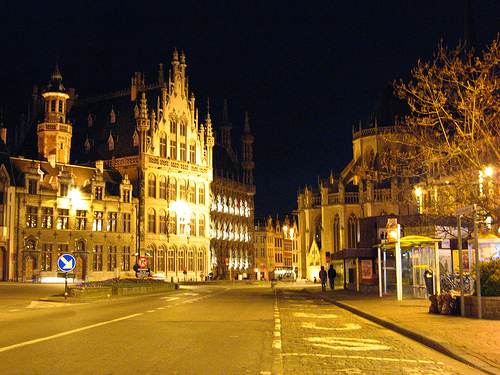
Leuven (photo downloaded from KU-Leuven website)

BELGIUM

Wednesday, April 17

Meet with the president of the European Society of Engineering Educators (SEFI), an engineering professor at Katholic University of Leuven who also directs KU-Leuven’s Teaching and Learning Department.

Thursday, April 18

Deliver a presentation 7-9 PM on Research Paradigms: Filtering What We See and Know to the architecture school (I will discuss major research paradigms and then provide examples of studies I’ve done that used methods aligned with positivism, interpretivism, constructivism, and critical realism.  Presentation includes examples of work I’ve done in Africa).

Monday, April 22

Presentation on Tools for Assessing Design Students’ Cognitive Development to members of the LESEC (the Teaching and Learning Department) at KU-Leuven.

Tuesday, April 23

Interview with Fulbright Belgium for use on their websites.

Group-Based Learning in Action

I’m becoming a bigger and bigger believer in collaborative learning!  Last semester I did lot of research about how engineering professors (i.e., lecturers) here at Dublin Institute of Technology worked together to develop new ways of teaching electrical engineers.  I was amazed to discover how incredibly much they learned by working together.

Such impressive knowledge gain is the premise behind Project-Based Learning and other group-based learning formats.

Orla and Shannon in the throws of course planning.

Orla and Shannon in the throws of course planning.

My day today was filled with meetings about collaborative research and teaching projects.

With the help of five different tech guys, I got SPSS up and running so that I will be able to help analyze data on that Mike Murphy and I collected from engineering and engineering technology students. We asked them what they saw themselves doing in the future, how well prepared they feel to start work, and what kinds of things they’ve focused their efforts on over the past few years.

After lunch I met with Orla Hanratty of DIT’s Learning, Teaching and Technology Centre (LTTC) and introduced her to Brian Bowe. She’ll be co-teaching a course (i.e., module) with us in May.  We aim to increase the usage and visibility of Problem-Based Learning at DIT by teaching more teachers to use Problem-Based Learning in their own classrooms.

And now, tonight, I’ve been working on a proposal for funding with Ted Burke and Damon Berry.  It’s an opportunity that the college’s head of research, Marek Rebow, told me about yesterday and it has to be completed immediately.

I rallied the troops. Ted drafted some text. Then Damon and I were adding our own contributions to it using Google Docs.  It was so strange… Damon and me editing the same document at the same time.  It turned into a bit of an academic chat session.  We tossed ideas back and forth, discussing budget, objectives, and ways to improve what we’ve already got in place.

We’ll do more of that tomorrow, when the three of us meet to hash this out… and have some fun learning in the process.

How Professors Have Fun

My former dissertation advisor, Dr. Pamela Eddy, is here visiting me in Dublin this week.  She was a Fulbright to Ireland in 2009 and she helped me make valuable connections when I started applying for my own Fulbright experience here.

So far, we’ve spent a lot of time at our computers!  Although it’s her Spring Break, she’s answering emails, reviewing dissertations, and grading papers. Oh, and advising me!

She helped me prepare for the meeting I had today with DIT’s president, Prof. Brian Norton.  I’ve attached a photo of us working from my home yesterday.  She was still sitting the same seat when I Skyped her from my office on Kevin Street just now to “debrief” on the meeting.

We do stop for exercise, food, and meeting… but little else!

Shipping Out from Cobh

My cousin Roland Ouellette and his spouse Rebecca Allen located the ship log for our great grandmother’s 1911 voyage from Cobh, Ireland to Ellis Island.  Roland and Rebecca have been doing a lot of research on ancestry.com and growing our family tree.  Great sleuth work, cuz — I’m thrilled to have this document!

ship log

1911 ship log

Envisioning the Future of Education with Brian MacCraith

The president of Dublin City University (DCU), Prof. Brian MacCraith, delivered  a lively and informative lecture Monday night at St. Patrick’s College. His topic was Envisioning the Future of Education. And what a visionary President MacCriath is — I learned so much from his talk! I’ve not got time enough to explain all I learned; I’ll include snapshots of some interesting slides at the end of this post. I’ll explain a little in each caption.

I did look up one of the sources he used, as it ties to my map-tracking.

Internet usage by continent.

Internet usage by continent (downloaded from Internet World Statistics).

One chart he showed (above) helped explain why my blog gets fewer visitors from Africa than Europe and North America. In Africa, just 15.6% of people have Internet access. In Asia, though, there are more people with Internet than on any other continent, so why is my Asia map so blank? Still no one from China…. and of the world population of Internet users, most are in Asia.

Internet distribution

Internet distribution

The population of North America  (shown in blue on the pie chart) is tiny. As you can see above, not that many people live in North America, even though 78.6% of them use the Internet.

Expanding your Learning Styles

Iroda Karimova said in earnest that she misses my crits! (!?!!??)

As per my prior post, Iroda Karimova said in earnest (while I was visiting the Hampton University Department of Architecture two weeks ago) that she misses my crits! (!?!!??)

Because I’m an active blogger I’m forever getting the question, “Do you ever work?”

The answer is yes; here’s a quick example.

My former student int he Department of Architecture at Hampton University, Iroda Karimova, emailed this to me from her smart phone today:

It was also nice to talk to you too. We haven’t see you for a while. I hope you are enjoying your oversea experience. I sometimes read your blogs, to see how you we doing.

Yes sometimes I wish I could hear your critiques, especially when I did good :). Your critiques were short, to the point, emphasizing important accomplishments, and sometimes not too enjoyable but helpful.
 
 Thank you for sending me this post.
 See you soon.
____
Whew! It sounds like I was doing my job correctly. Part of that  job is to help students learn to evaluate their strengths and weaknesses. I’ve got to challenge them to address weaknesses I see. Effective teaching requires a careful balance of challenge and support (Sanford, 1962). I aim to provide that and to help students reach just a bit farther than they are comfortable doing (this is called a “plus-one” approach to teaching).
Good students, like Iroda, recognize that challenges are presented to help them grow and that the professor’s main role is to help guide them in their own learning. Receiving critique is never pain free, but it is necessary for growth and development.
Here’s the very quick reply I dashed off:
Thanks for your note, Iroda!  

 
You always do excellent work.  I wanted to make sure to help you reach for the stars, though.  You’re really terrific at technical ways of thinking.  As a second-year instructor, my job is to try to help students develop fluency in multiple ways of thinking… particularly the ways they find foreign or uncomfortable.

 
I’ve attached a chart to explain (it’s from a paper I was working on Tuesday). Most students come to college very good at one corner/quadrant of the chart. You were exceptionally good at Convergent thinking. I’d say you left second year with new skills in that realm, but more importantly, with new skills in the other three quadrants as well.
 
Cheers,
Shannon
_____
Below is a chart I made to describe Kolb’s (1984) theory. It is based on a similar chart published by Evens, Forney, and Guido-DiBrito (1998). You can read more in the paper I created for the National Conference on the Beginning Design Student (MADE Proceedings Chance Writing Architecture). If you reference it, please cite the source. The citation for the paper is:

CHANCE, S.M. (2010).Writing architecture: The role of process journals in architectural education. MADE: Design education and the art of making (160‐170). Charlotte, NC: College of Arts + Architecture. Presented at the 26th National Conference on the Beginning Design Student in Charlotte, NC.

Kolb chart by Shannon Chance