Sandra Cruz’s doctoral milestone

I have an exceptional PhD supervisee at TU Dublin, Sandra I. Cruz Moreno. She is an internally motivated, self-driven learner who needs little to no prompting from me. Supervising her for the past two years has been pure joy.

I am extremely pleased to report that Sandra achieved a major milestone yesterday because she very successfully “defended her Ph.D. proposal” (the term we use in the USA). Here, it’s called a confirmation examination to confirm that a student is on track and suitable to continue onward.

Sandra needed to submit an extensive report. The report is a bit more elaborate than a proposal back home, as it must include the work plan in addition to the first three chapters of the dissertation. She also included preliminary analyses of existing interview data.

TU Dublin is funding Sandra’s PhD so that she can analyze extensive interview data I collected from women studying engineering over the years since 2015. It’s such an enormous amount of data that I’ve never been able to wrap my arms around it fully. Sandra, a sociologist who has worked as a research consultant on rural development for the United Nations and similar organizations, is well-prepared to handle this large dataset. She has embraced the challenge and has made great strides forward.

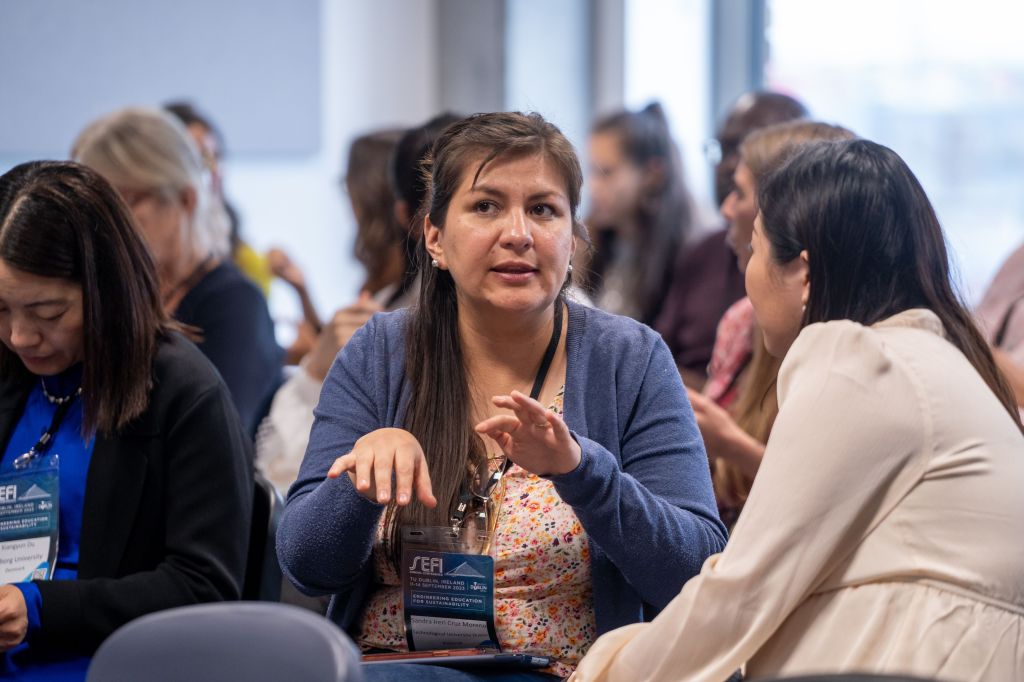
Sandra’s study is titled “Exploring Women’s Experiences on Collaborative Learning in Engineering Education: A Phenomenological Analysis.” She submitted written reports of the coursework she has done to date, as well as a five-chapter document presenting her research. Both of Sandra’s supervisors, as well as our college’s head of research and the external examiner from the Swiss Federal Institute of Technology Lausanne (EPFL), all read and critically analyzed Sandra’s submission.

The result of this review and of yesterday’s two-hour oral examination concluded that her “Proposed research and progress [are] suitable for [Sandra] to remain on the higher register” and proceed into the final stage of her doctoral research. That’s fancy talk for “It’s a go!” and “Full speed ahead!”
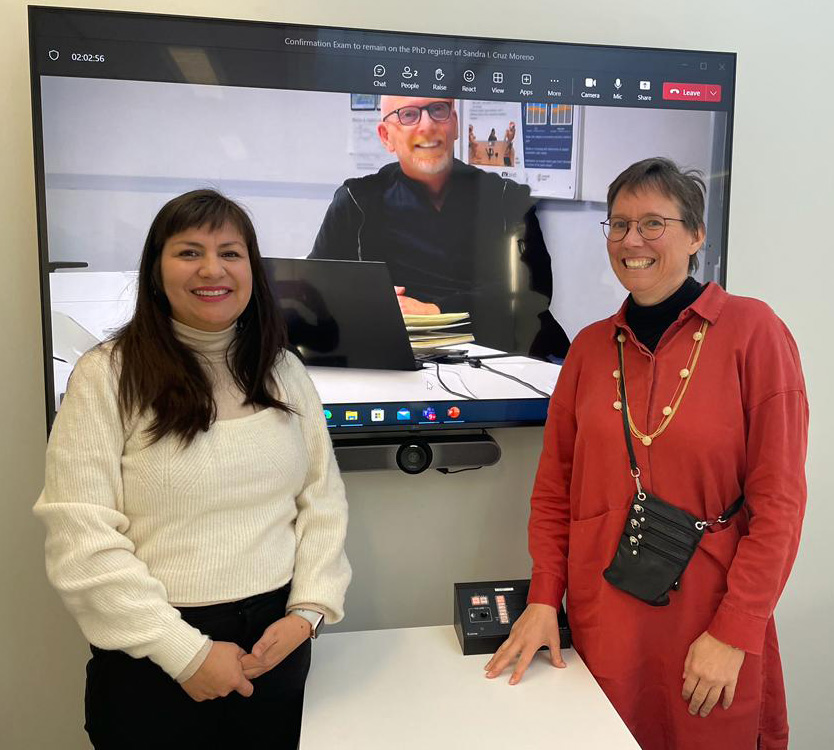
Sandra Cruz with her external examiner, Dr Roland Tormey and lead supervisor, Prof/Dr Shannon Chance, on the day of examination.

Regarding the research Sandra has produced to date, the external examiner’s evaluation states:

The report is very well structured and extremely well written. It demonstrates a high degree of scholarship in dealing with quite a few challenging concepts while, at the same time, managing to make them accessible. There is a very good balance between methodology and methods in chapter three in particular. 

The data available is suitable for completing of the PhD and the initial analysis carried out shows quite a lot of promise. 

-External Examiner Roland Tormey, PhD

Our advisory supervisor, Prof/Dr Brian Bowe, couldn’t attend the examination (he’s the university registrar, after all, and the end of Semester 1 is an extremely busy time of year). Nevertheless, his guidance to Sandra and me has been essential throughout the process. The advice he provides is targeted and highly applicable. Sandra and I have benefited from having him on the team.

I was delighted, but not at all surprised, to hear about the successful outcome. Congratulations, the result reflects your hard work and dedication.

–Prof/Dr Brian Bowe, Head of Academic Affairs at TU Dublin

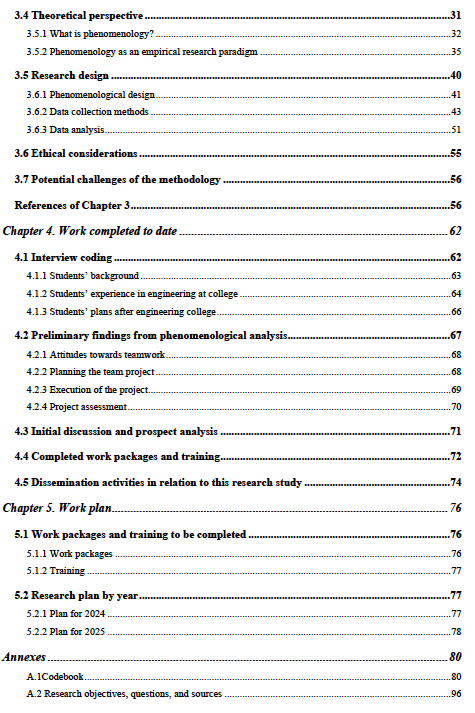
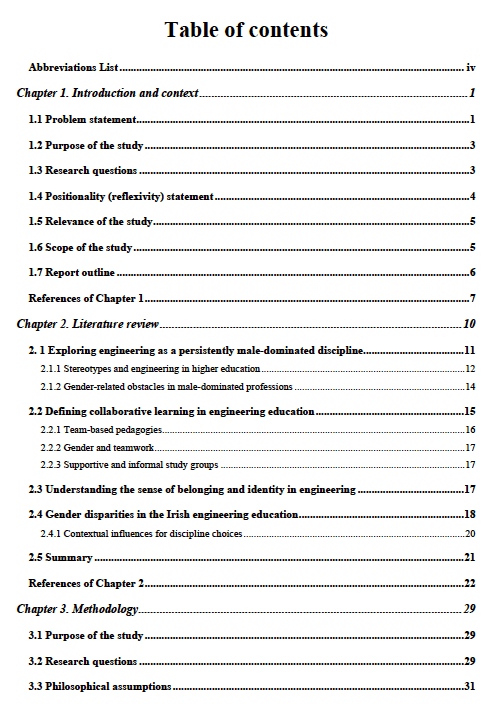
I have included the cover and table of contents of Sandra’s report so you can see the level of detail required. The report is 96 pages long. While Sandra was rehearsing for the examination, I was off in India delivering a paper she authored on policy to address gender gaps in engineering — policy at the European and Irish levels. The policy paper generated great interest and will form part of the PhD study, although it wasn’t a major component of the confirmation report. In fact, there were a number of topics she researched that didn’t need to be explained in detail at this point, such as critical feminism, which will inform her work going forward.

Working with and learning with and from Sandra is an honor and a privilege. I am grateful to TU Dublin for providing the grant to fund Sandra’s research activity. I am grateful to Brian, Roland, and Marek for the support they have lent Sandra and me. And most of all, I am grateful to Sandra for her diligence, perseverance, openness, and sincerity. I have learned so much from her and from working with her!
New EER Meet Up: June 23

I’m delighted to announce a new EER Meet Up Tuesday 23rd June 3pm UTC for International Women in Engineering Day! It’s been organized by University College London (UCL) with support from the Research in Engineering Education Network (REEN).

Info and link for registration: https://sway.office.com/6ADiAvKVyCcvJl59?ref=Link

Keynotes:

  • Prof. Dr. Petra Lucht on De-Entangling Gender & Engineering Education Through Research-Based Learning and Teaching
  • Anika Gupta with Analysis of students’ ratings of teaching quality to understand the role of gender and socio-economic diversity in higher education
  • Robin Fowler and Trevion Henderson presenting There are many “I”s in TEAM: Considering gendered experiences in team-based pedagogy

Plus breakout discussions:

  • Gender Inclusive Student Teamwork
  • Gender implications of improving students’ spatial visualization skills
  • Moving forward, planning for change – a discussion on the “ASEE & SEFI Joint Statement on Diversity, Equity, and Inclusion: A Call and Pledge for Action.”

Please register and join us on the 23rd. Everyone interested in engineering, STEM, teaching, and/or education research is welcome! And it’s free!

Research Methods of Forensic Engineers

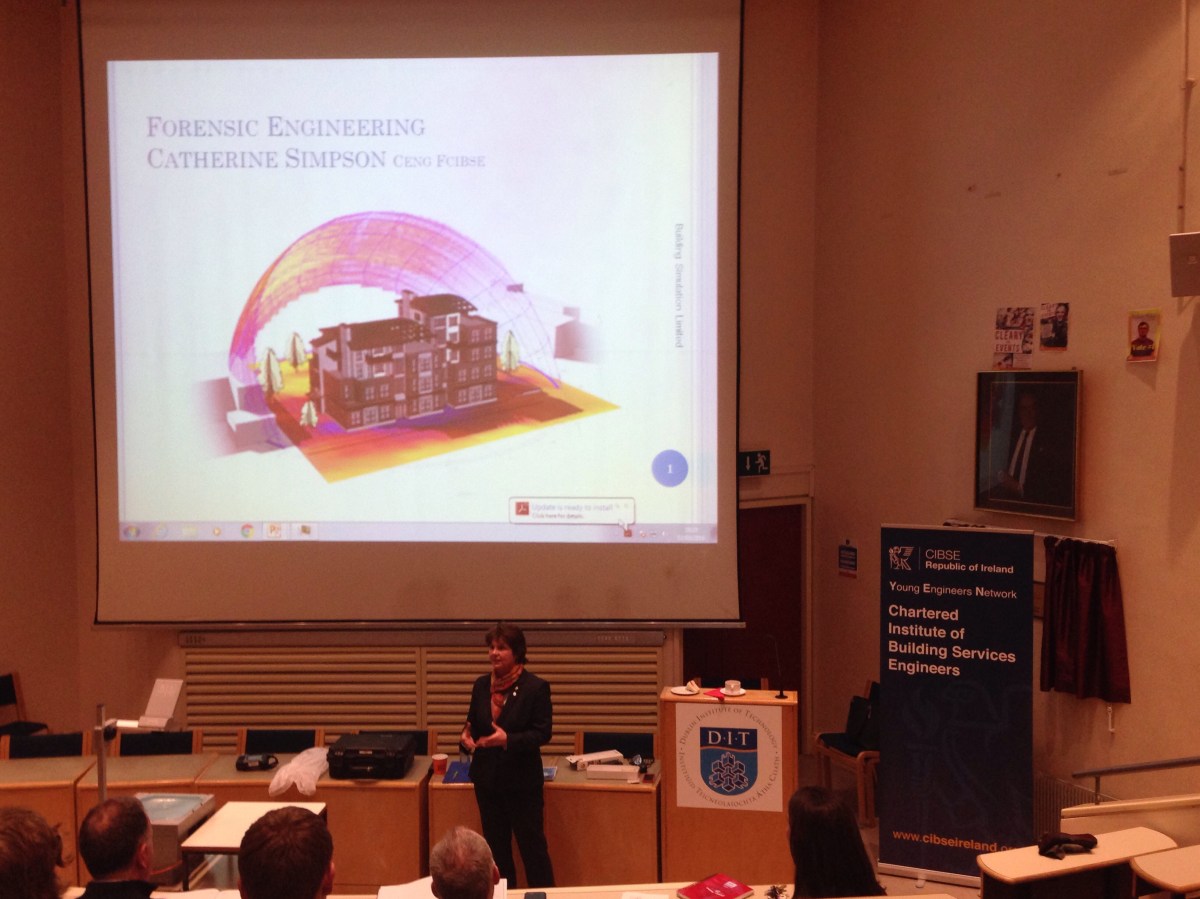
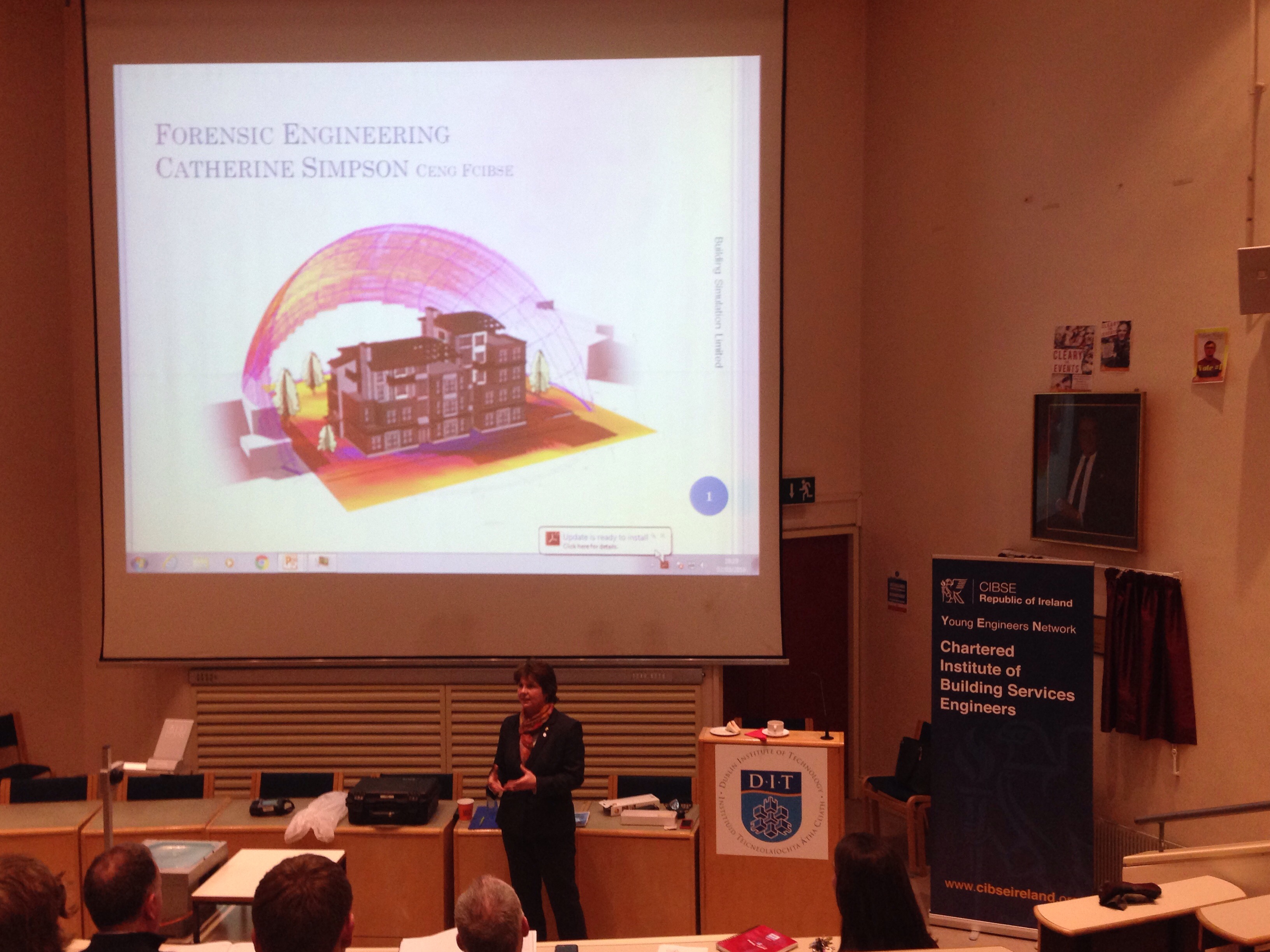
 Catherine Simpson is here at DIT tonight describing the research she does as a Forensic Engineer. You can also call her an expert in thermal modeling and a Building Services Engineer.

She can make digital models of buildings and predict their future energy performance. She can also go into a functioning building to identify, analyze, and rectify errors in thermal performance. She says that very often, buildings do not end up performing the way experts predicted. These are skills she uses:

IMG_0684


Catherine says Forensic Engineers must avoid using clues as if they were actual evidence (of the problem and its causes). These are clues: complaints, anecdotes, consultant reports, BMS data, ad hoc solutions, staff theories, and staff observations. On the other hand, these are useful forms of evidence:

IMG_0686

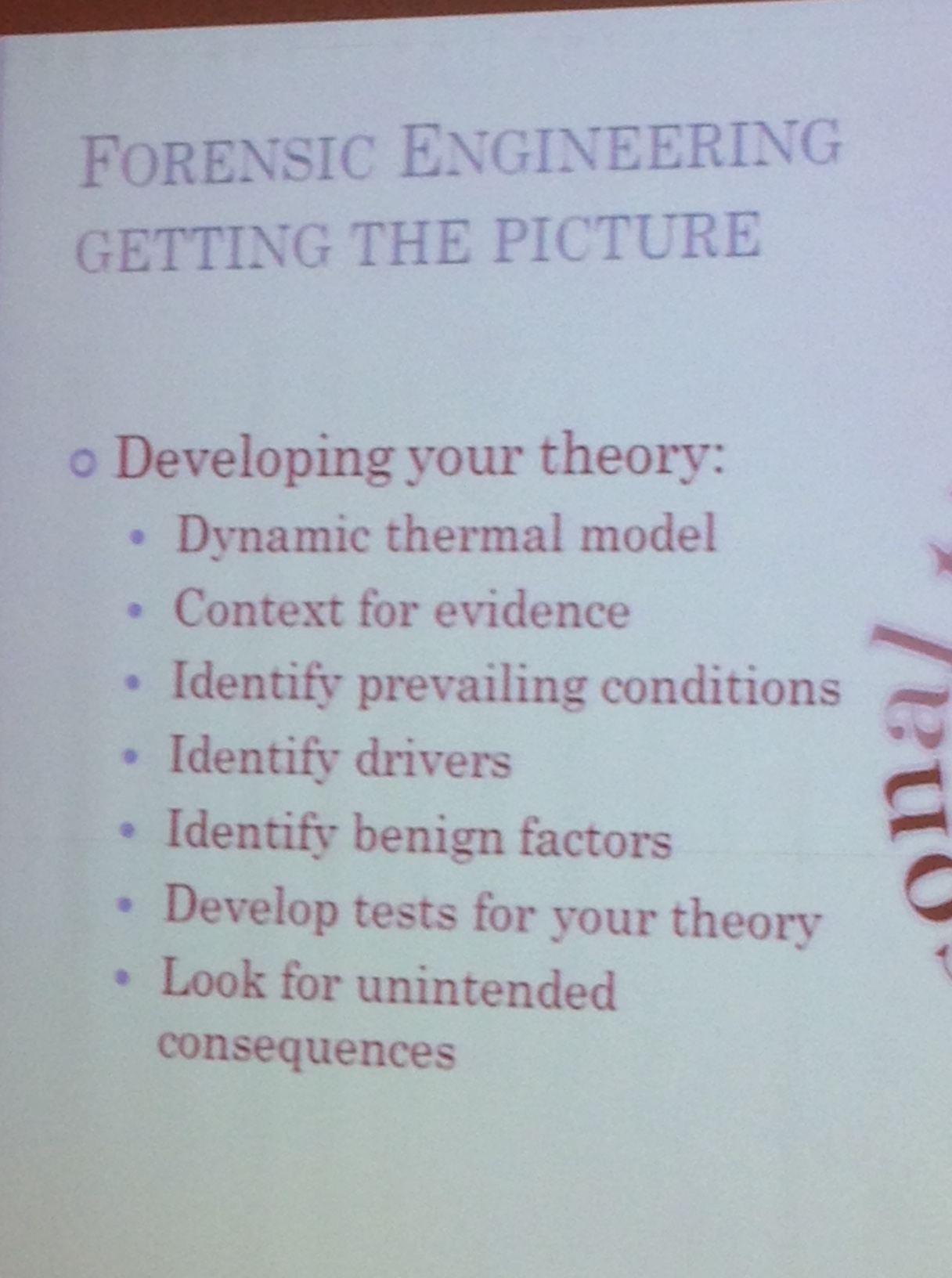
Catherine models problems digitally and physically. She also develops theories that she can combine to test her theories:

IMG_0687

Catherine gave an example of a shopping mall that had a very windy atrium and a very steep heating bill. No one could identify the causes of these problems. But after six years experiencing these problems, the owners called her in.

With careful analysis of data she collected (using dozens of different routes, including studying air flow by blowing bubbles in crowded spaces where smoke tests couldn’t be used) she identified a number of problems. One was a poorly placed rotisserie oven that was triggering vents to open. Another problem was that the building controls “thought” the building’s vents were completely closed when many were only partially closed.

Catherine devised a £50k solution to closing the vents in winter that is saving the owner £60k every month, in heat alone. There were reduced wind drafts and reduced tenant complaints. She says it saved about £500k in capital and restored people’s confidence in the facility.

Here’s one tool she uses to measure air speed:

IMG_0688
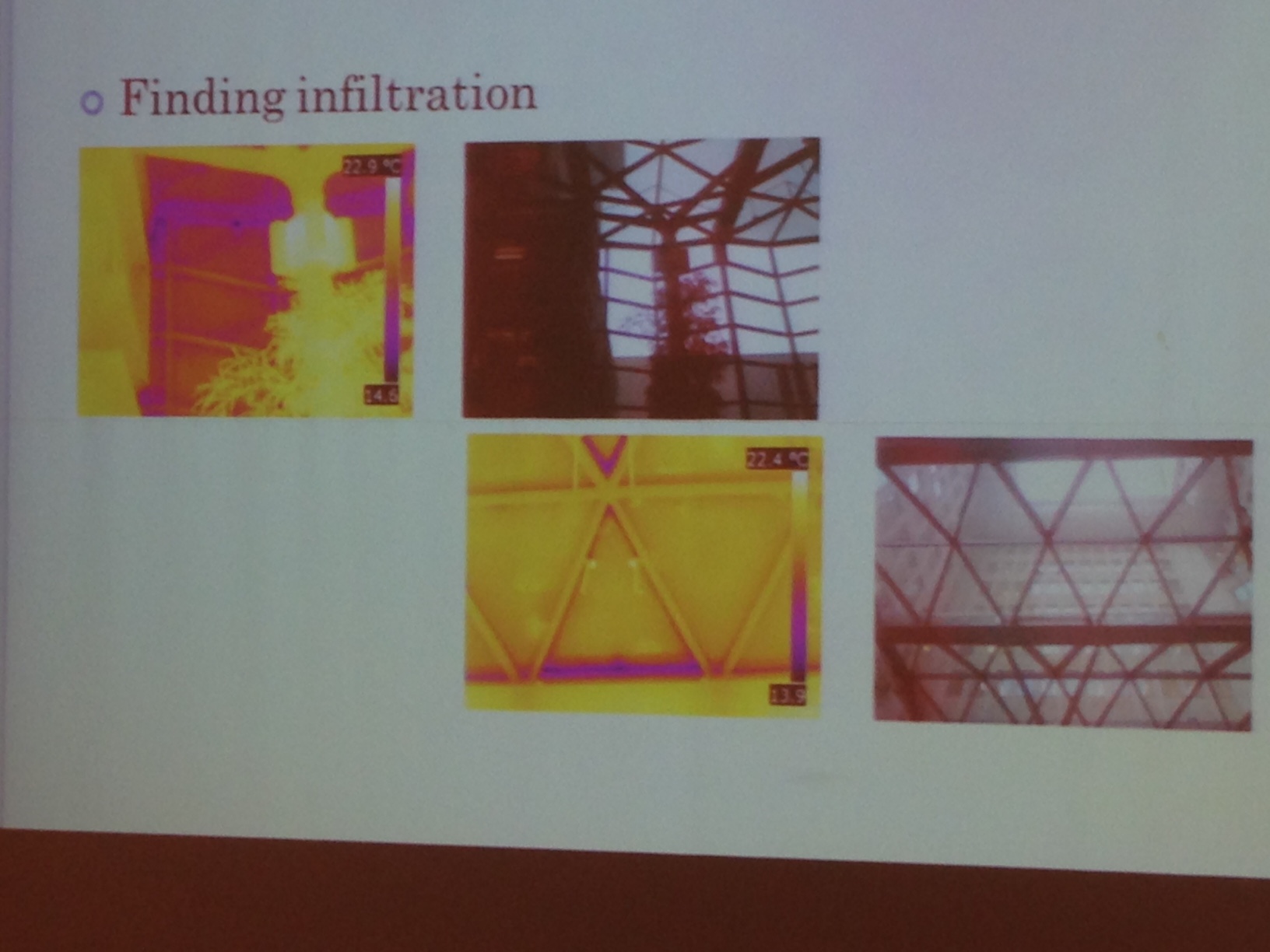
She also uses thermal imaging to study air infiltration, like so:

IMG_0690

IMG_0701

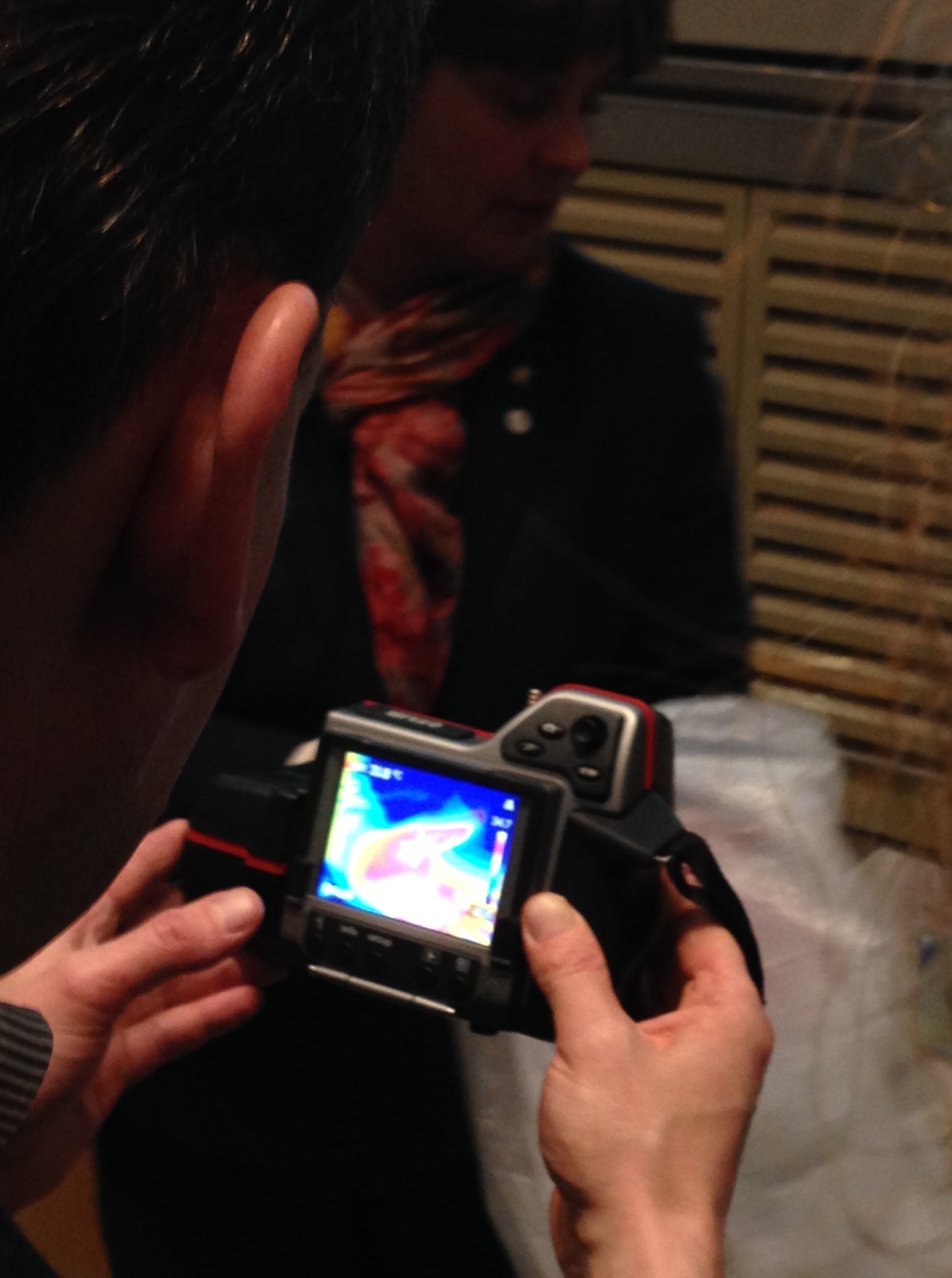
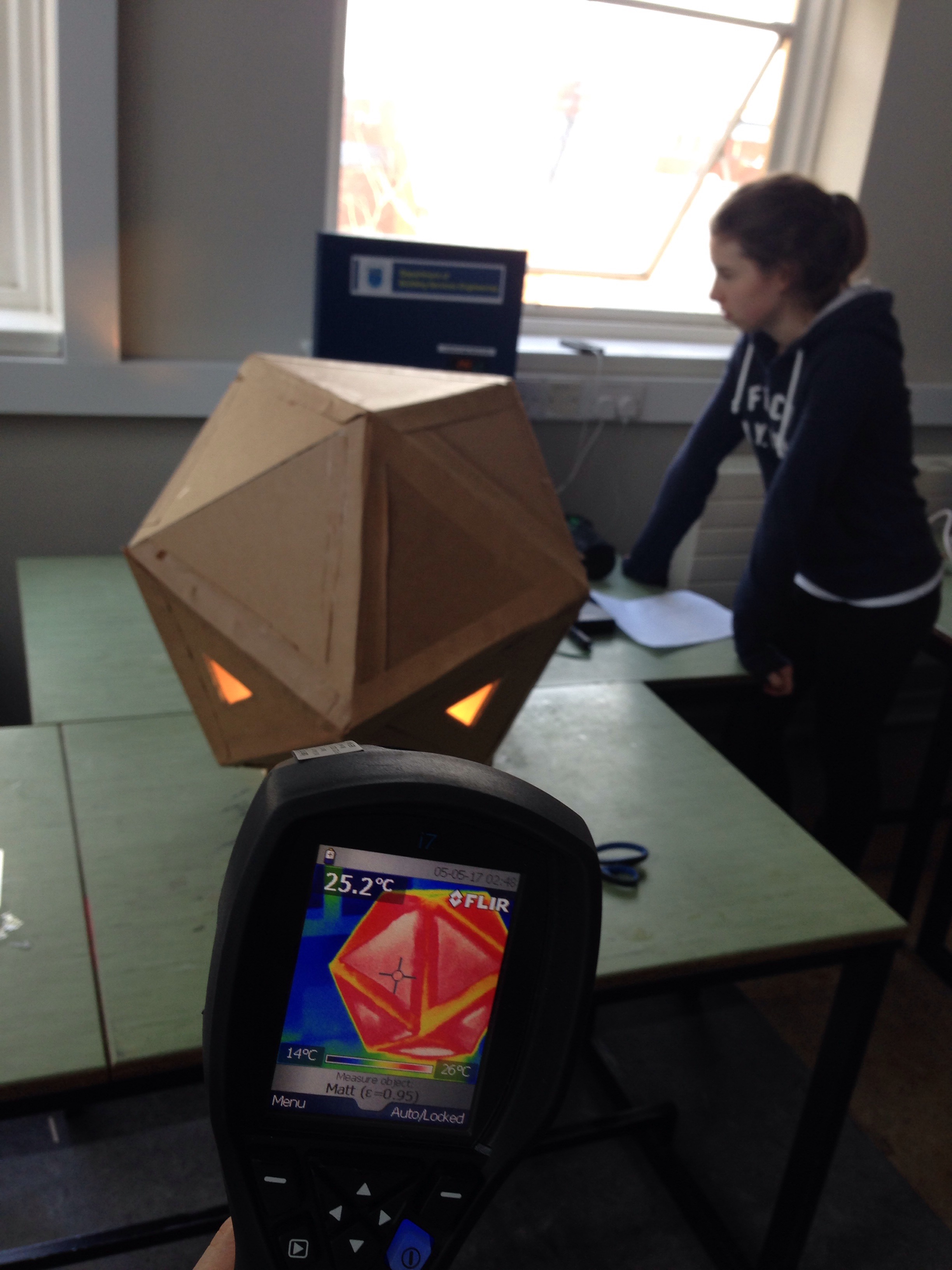
We use this kind of technology in our Energy Cube project. This is a picture from that class last week:


Catherine’s work involves fixing problems and also providing expert witness testimony. Forensic engineering seems fascinating! Catherine is a veritable Nancy Drew.

Forensic engineering, she says, is like a jigsaw. You’re given clues, you find evidence, simulation gives context, you test theories, and ultimately prove a solution. She obviously loves her job!

Sheryl Sorby Spotlights Spatial Skills

Dr. Sheryl Sorby‘s groundbreaking research on spatial visualization brought awareness of spatial reasoning to engineering education worldwide.  Sheryl’s work highlights the importance of educational research and illustrates how applied research can make a real difference in the way we learn and teach.

Sheryl is a pioneer in engineering education research — the area where I’m now working to establish myself.  She was doing this type of research long before Engineering Education Research (EER) was recognized as a distinct field of study.  As such, she helped pave the way for all of us who are working to understand how people learn engineering and design today.  Today, she’s actively leading research teams on this topic.

Last year, Sheryl served as Ireland’s Fulbright Scholar in Engineering Education (that’s the post I held the year before) and she made noteworthy contributions. Whereas I applied for the Fulbright position when I was a “baby doc” (straight out of grad school), Sheryl brought the wealth of experience of a professor emerita (which essentially means she retired with academic kudos).  Awards she has received include the 2011 Sharon Keillor Award for Women in Engineering Education bestowed by the American Society for Engineering Education (ASEE).

Recently, Sheryl delivered a TED talk at the 2014 TEDxFulbrightDublin event organized by the Fulbright Commission in Ireland, an event pictured above.  The TEDx talk, “Recruiting Women for Science, Engineering, Technology and Maths,” is available on YouTube. YouTube also features her webinar presentation on “The Importance of Spatial Skills.”

Her TEDx talk describes ways spatial-thinking skills correspond to academic performance in engineering. Her research has identified gender-related discrepancies in spatial visualization skills and, as a result, she has developed and implemented programs to help alleviate students’ weaknesses in this area. Her work has made a clear and measurable difference!  (I hope someday, I can say the same of mine!)

Sheryl researches other engineering topics as well.  Michigan Tech’s website explains she “is known for preparing engineering students and middle school students to think like engineers. Her research interests include advanced composite materials for use in civil infrastructure and 3-D computer graphics for visualization of complex behaviors.”

The National Science Foundation has supported many of her projects, and she even worked (or, “did a rotation”) at the NSF headquarters, as Program Director in NSF’s Division of Undergraduate Education.

I’m proud to walk in Sheryl’s footsteps, and thankful for the work she’s done!