 The article Improving Engineering Students’ Design Skills in a Project-Based Learning Course by Addressing Epistemological Issues that Gavin, Brian, and I wrote for the SEFI conference in Greece is available for download on DIT’s ARROW database. Check it out!
Month / December 2012
Memories of Kilkenny
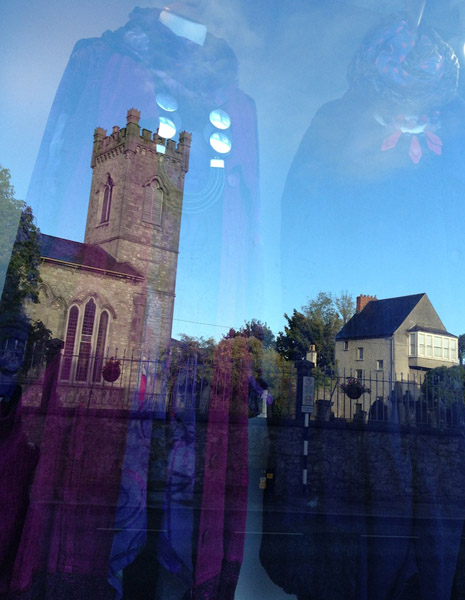
Reflection from Upper John Street, Kilkenny.
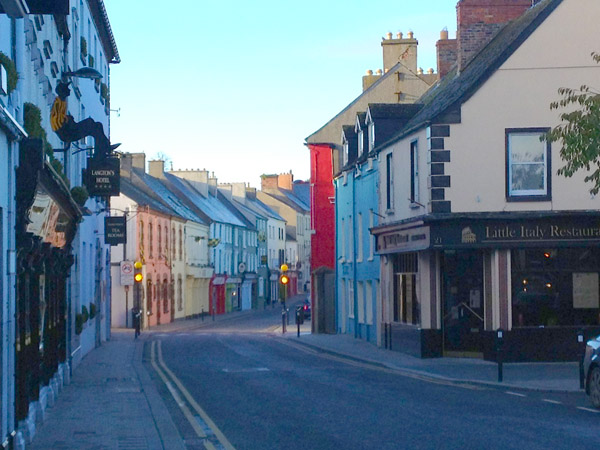
Early morning view south, as seen from Kilkenny’s Upper John Street.
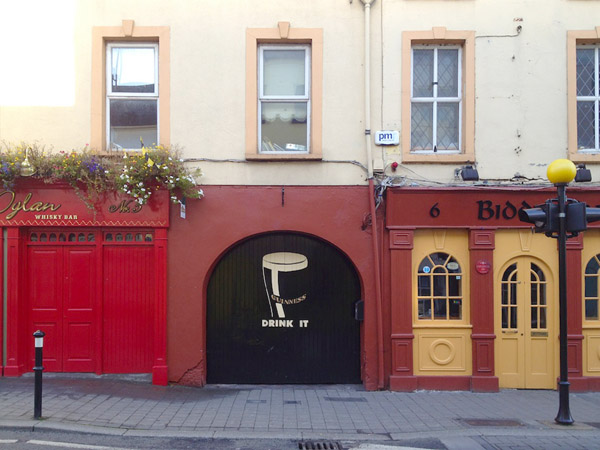
Door to a courtyard beer garden along Lower John Street, Kilkenny.
Sima’s Emerging Manifesto

Sima’s teaching philosophy, drawn from the Bauhaus.
Sima Rouholamin delivered an energetic, thoughtful, and inspirational lecture at the DIT School of Architecture last night. One of the culminating speakers for this semester’s Schools of Thought lecture series, Sima discussed her dissertation work. A facet of her literature review involves the Bauhaus — a natal fit with the theme of the lecture series (Schools of Thought).
Sima brings such energy and vibrancy to everything she does. She’s so very engaged and engaging.
Alongside her dissertation, she’s developing a vision for what DIT’s School of Architecture is and what it can become. Last night’s event provided a way for her to get some feedback on that vision from the community here, and that community replied with keen interest and resounding support.
Regarding the Bauhaus, Sima discussed the emphasis on making and craft — and the connection between play and design. She’ll soon be conducting phenomenographical interview designed to identify the various different ways architects conceptualize design. I hope to help her collect data for the study this spring.

A little about the Bauhaus.

Sima’s emerging manifesto.
Peace for the World
Yesterday on Facebook my friend from home, Lynda Laliberte, shared a letter that her son Brian wrote Santa in 1987. Immediately impressed, I reviewed the incoming comments.
Evidentially, Brian is still hopeful. As am I.

Brian Burke’s 1987 letter to Santa.

Brian Burke’s 2012 post to Santa.
Years Ahead in Recycling
The Irish are hipper with recycling than we are in most places in the States. The Dublin Institute of Technology, for instance, provides some bins that are clearly labelled and located in sensible places.
Recycle bins at the train station “guarantee to recycle 70% of the contents” deposited into them. That beats us by leaps and bounds!
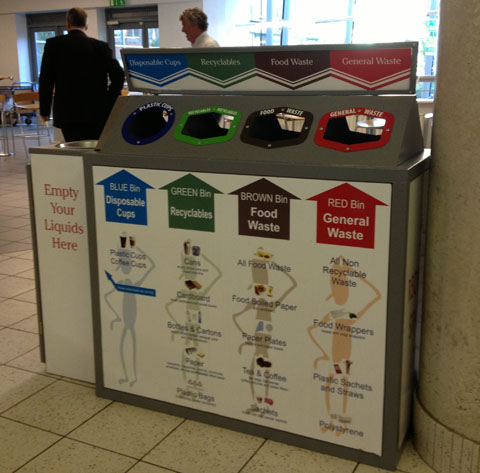
Recycling at DIT’s headquarters on Aungier Street.

Recycling at Heuston Station.
Of Politics, Tragedy and Tractors

A fascinating discussion at the Embassy tonight.
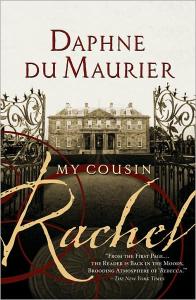
An action-packed evening here in Dublin. After a fascinating discussion from an editor of Politico, I dashed across town in time to snag a seat at the Gate Theater for the play My Cousin Rachel.
It’s a stirring tale of that reminds us of the tragedy of assuming the worst in others when they’ve given no real reason for skepticism. It’s so beautifully written that you struggle along with the protagonist until the very end.
Fortunately for me, it’s easy to find one unclaimed seat even in a full theater house. On Monday nights at the Gate, all seats are bargain priced at €25. More than I usually pay for a seat in Dublin, but an opportunity to visit another famous play house and experience theatrical delight. Oh, and tragedy. Plenty of tragedy.
The highlight of my evening was meeting the folks from London who sat next to me–Diane and Lawrence Hanlon. Their family is Irish, dropped the O’ in front of Hanlon at some point, and must be related to Tom Mulligan. And thus me! 🙂
Gotta love the three degrees of separation in the isles!
Please take a moment to admire Lawrence’s beautiful tractor tie, which evidentially references Hertfordshire, an agricultural county, in some way. What it references for me is Dave’s dad, the late Gordon Chance, tractor mechanic extraordinary, who loved tractor memorabilia and travelled the world with his photographer son. Good memories.
A tragic play, showing at Dublin’s Gate theater.

My theater mates, Diane and Lawrence Hanlon. What a fabulous tie!!!!
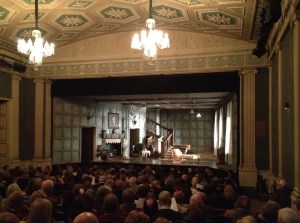
Scene design for the second half.
Nutrition and Bone Health

Cure Tooth Decay bookcover.
Incidentally, in the midst of the issues I discussed earlier about bone alignment and health, I found this book to be quite helpful….
Blog Tips 1: Why Blog about your Fulbright Experiences?
The Communications Director at the Fulbright Commission in Ireland asked me to provide some tips on blogging to share with other Fulbrighters. I’ve created a series of four blog posts on the subject:
- Why Blog about your Fulbright Experiences?
- Choosing and Adapting to your Blog Platform
- Finding your Blogging Niche
- Publicizing your Fulbright Blog

Header from a CIES webpage.
So then, why blog?
Blogging experts say the main challenge is to continually generate new content that’s of interest to others. With blogging, they say, you have to stay very active and load new content regularly or you’ll lose the attention of your audience.
We’ve all seen stale, dormant blogs. That is a viable way to go… if you simply want to meet your grantor’s wish that you blog about your experiences without investing much of yourself in the process.
I’ll admit I wasn’t thrilled at the request to blog when it arrived. I’ve never followed blogs and didn’t see the merits or the potential for growth.
As a Fulbright, you have content that’s of great interest to others. Blogging provides a quick and fun way to share this content. It can provide an opportunity to learn more from your own experience and also learn about writing for a real live audience. You can track your statistics to see what interests people in different parts of the world, for instance.
So, who’s your audience? My own has grown over time. It includes people I’ve known a long time and the folks I’m meeting here each day. It includes regular visitors from across the US and Europe, and occasional visits from people in Africa, Asia, and South America. Watching the statistics page on WordPress gives me some idea of who I’m reaching and how often they visit.
The notion of sharing in this way comes fairly naturally to me.
When I lived in Switzerland in 1997, I emailed many dozen friends and relatives each day. They were interested to know about what I did, saw, and thought while living alone in a foreign land. They’d send questions and encouragement. That helped me feel support during a challenging time in my life.
Blogging is an even better platform for me to do what I was attempting then. It lets me share photos and ideas with many more people, and do this very quickly. Most of all, it lets me address the goals of the Fulbright program by promoting the work that I’m doing and the cultural exchange I’m experiencing.
My cousin lived in Paris for a year in 1993. She wishes she had Internet tools then. They make staying in touch AND growing your social network so much easier.
A few parting thoughts for this introductory blog:
- Choose your blogging platform and template carefully. Some are easier to use than others.
- Watch tutorials about your platform so you can learn the tools quickly. You’ll need to develop your own set of approaches over time, so that blogging doesn’t consume too much of your time.
- Craft a catchy title and consider purchasing an easy-to-recall domain name for yourself.
- Determine your level of desired privacy so you can adapt your activities accordingly. You can keep your URL under wraps and share it with select friends, or you can go public and connect in to search engines like Google and Bing.
- Learn to keep some content in reserve (saved in draft form) to pull out when you don’t have time to generate text but you want to get something fresh posted.
If you’re determined to do this well, then you might as well learn to enjoy blogging and to see it as a way to document, reflect, and share. Just think: in the end you’ll have a beautiful log of your experiences. It will help you remember and record all you’ve done. Best of all, it will help you stay connected with people back home as well as those you’ve just met.
Hunchback of Laptop Land
Hunching over my laptop has been killing me! I was glued to this screen 16/7 during my four years of PhD work. In those years I was also teaching full-time and had plenty of course prep and record-keeping to do on top of research and writing.
Now that I’m transcribing, writing, and blogging everyday, the laptop is taking it’s revenge once again.
Starting in February, I had random pains shooting up the back of my neck. I looked for an osteopath in Hampton Roads, but found I would have to commute a long distance to obtain such service.
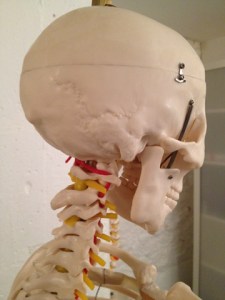
Skeleton model for demonstrating correct alignment.
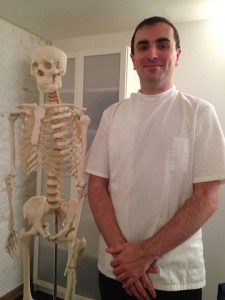
Dr. Jonathan Wills, osteopath.
An osteopath has more training than a chiropractor and typically uses a more holistic, long-term approach.
Here in Dublin, an awesome osteopath was just two blocks away, at the Elbowroom Clinic. Jonathan Wills is a Doctor of Naturopathic Medicine (ND) as well as a Doctor of Osteopathic Medicine (DO).
The Elbowroom website explains that Jonathan “studied at the world renowned British College of Osteopathic Medicine which takes a naturopathic, whole-body approach to osteopathy.”
I’ve visited him a number of times to treat the issues he identified on my first visit: (1) poor posture that resulted in part from hunching over my laptop to view a tiny screen way down at finger-tip level, (2) tightened muscles on one side of my body that effectively made one leg shorter than the other, (3) slightly low blood pressure that is one culprit in keeping my fingers and toes freezing cold (there’s not much we can do here short of insulating the right places with warm fabric), and (4) shallow breathing (that I’ve been correcting through yoga).
Unfortunately, I’d also been clenching my teeth in my sleep and that lead to all kinds of horrific problems that I’m still sorting my way through. I put an immediate end to much of the teeth gnashing because I realized that it generally happens when I sleep face-down. So I stopped sleeping face down — cold turkey — and voila, 95% less gnashing. A great deal of damage has already been done, though, and I’ll try to resolve some of those problems while I’m home for Christmas.
A peer of mine in the States cracked a tooth as a direct result of gnashing her teeth while under stress from her PhD work. As personally embarrassing as all this might be, I decided to post a blog on the topic to help others who might be suffering from similar conditions.
I told Jonathan when I asked to take his photo that I wanted to “extol the virtues of osteopathy.” Well-executed osteopathy has helped me a great deal and I know that the benefits will follow me far into the future. I’ll have better health when I’m old because of the investment I’m making today.
The neck pain is gone and I’ve come a long way toward developing good posture.
And so my laptop hasn’t quite beaten me yet! We’re still trying to resolve our relationship problems and learn to play well together….
Peace in Ireland

Musicians Jerry Crilly, Frank Cullen, and Pat Goode playing in the back room of the Cobblestone.
Tom Mulligan said I was witnessing history last night.
I’m not aware of all the subtleties of the situation but, essentially, a group of folks from Northern Ireland was in Dublin for the unveiling of a monument. A friend of the group — a regular at the Cobblestone who hails from Dublin — invited the group over to Tom’s pub after the formal event to hear traditional Irish music. [Note: I’ve posted more on this topic since. See Making History with Fergus and Francis.]
Quite by chance, Jerry Crilly, Frank Cullen, and I happened to be there. We were celebrating Kevin Donleavy’s radio program that happened earlier in the day. It had featured quite a few songs from Jerry’s CD. Jerry rang us up (as in, called us on the phone) because he wanted to give us copies of the CD.
And while we were at the Cobblestone my musical friends / drinking buddies got invited to the back to sing.
Because I was there with these musical stars, I got to enjoy an evening full of song! I actually had a seat front and center and felt completely, 100% included.
As much as I love instrumentals, it’s the singing that moves me most. So this was an incredible find for me — I really lucked out last night!
I sat cozily in a room full of people who, not so long ago, took up arms against each other.
Here, in the shelter of a unified Ireland and the warm embrace of the Mulligans’ pub, men from north and south sang together and reveled in the island’s newly found peace.
When Dave and I visited Ireland in 2003, the tone was much different from today. Political tensions still ran deep and pub songs recounted strife.
I feel honored to have been part of this event that helped promote peace among nations. I am proud that an American president helped negotiate the peace accord that paved the way for this evening’s events. (In The Journal of Conflict Studies, Rodger MacGinty noted “that the American influence on the peace process, both from influential Irish-Americans and the Clinton administration, has been profound.”)
I will remain eternally grateful that our nation supports Fulbright programs designed to promote cultural understanding and celebrate — and grow — human knowledge. We do many things that don’t make sense. And we fight all too often. But in the name of Senator Fulbright, we do have programs designed to help us do better.
I take the cultural understanding part of my Fulbright very seriously. I thank you for sharing in the effort by reading along.
It was amazing to be part of a cultural healing process last night and watch stale old tensions dissolve into the night air. As an added bonus, I also got to meet Jerry’s and Tom’s significant others for the first time. This place feels more and more like home every day.
Incidentally, Tom has taken to introducing me as a long-lost cousin, and that term’s growing on me. It’s much nicer than wee-distant relation, or third cousin twice removed….

Men from Belfast and Dublin playing side by side.

Susan and Pat sharing a tune.

There’s always a warm welcome from the Mulligans!
 Ireland by Chance