Dublin Castle and Chester Beatty

None of my guest have been able to get into Dublin Castle, although I had the chance to see it last September, on Culture Night.  I’ve finally figured out why it’s closed to tourists.  This year Ireland is the president of the EU.   The Castle is being used for all sorts of formal ceremonial event.  Therefore, it’s closed to the public until June 30.

A tourist to Dublin will find the best view of the castle from the mort side, looking south from the garden in the front of the Chester Beatty Library.

The Chester Beatty is still open and offers one of the most fascinating places to visit in Dublin.  To access it, you have to go around the west wall of the castle and through the side gate.

Patty, Kitty Lee, and I visited the Chester Beatty Library and saw fragments of the Bible that date back to 150 AD.  These are some of the oldest pieces of the document in existence in the world. While at the Beatty Library, we also saw a temporary exhibition of paintings including one that Patty has always admired, The Gleaners.  It was painted by Jules Adolphe Aimé Louis Breton in 1854.  It’s from the period when artists were trying to record the daily life of laborers and the hard reality they faced in the mid-1800s. We could have spent much longer in the exhibits as we had very little time in the non-Christian collections on this particular visit.

The Library’s website explains:

Described by the Lonely Planet as not just the best museum in Ireland, but one of the best in Europe, the Chester Beatty Library, Dublin is an art museum and library which houses the great collection of manuscripts, miniature paintings, prints, drawings, rare books and some decorative arts assembled by Sir Alfred Chester Beatty (1875-1968). Its rich collections from countries across Asia, the Middle East, North Africa and Europe opens a window on the artistic treasures of the great cultures and religions of the world. Chester Beatty Library was named Irish Museum of the year in 2000 and was awarded the title European Museum of the Year in 2002.

Egyptian papyrus texts, beautifully illuminated copies of the Qur’an, the Bible, European medieval and renaissance manuscripts are among the highlights of the collection. In its diversity, the collection captures much of the richness of human creative expression from about 2700 BC to the present day.

Admission to the Chester Beatty Library is free!

The Impressive National Library of Ireland

You’ll recall that the National Library was on the blog post I made for Kitty Lee.  It was among the things I wanted to see but hadn’t yet.

My recent visitor, Pam Eddy, used to enjoy going there when she was a Fulbright scholar to Ireland in the spring of 2009.  She knew the ropes of getting in and around the place, and that made it easier for me to jump in and enjoy being there.  (I’ll admit I’d been a bit intimidated by the place before going there with her.)

We viewed an exhibition of W. E. B Yeats, stowed our bags in the handy (all glass) lockers, and proceeded into the grand reading hall.  I’ve posted a host of images to show you the grandeur or the hall and the entry procession leading to it.

Irish Roots

Image of Cobh downloaded from the Visit Cobh website.

Image of Cobh downloaded from the Visit Cobh website.

Recently, I’ve uncovered more and more roots to my family tree in Ireland.

For me, it starts with my great grandmother, Teresa Neenan. She was a smart, spry, and energetic woman who was a dear part of my early life. We called her “Nanny” and spent a number of holidays with her.  I vividly recall images from an Easter she spent in Staunton, Virginia (my parents’ home town).

My great grandmother was born in Astee and christened in Ballybunnion (in Co. Kerry) in 1890. She left Cobh (in Co. Cork) in 1912. Like so many others, my great grandmother left Ireland when times were very hard, and opportunities limited.

Nanny left Ireland as Bridget Neenan and emerged from Ellis Island as Teresa Neenan. (There seems to be a data entry error in the records at Ellis Island, as someone translated the into n into an M somewhere along the way.  Fortunately, it’s spelled properly on the wall at Ellis Island.)

In the States, Teresa married “Beppie” O’Mara who owned a taxicab company in Millburn, New Jersey.  They had four girls, including my grandmother Alice who was born in 1916.  That was a pivotal year in history when Ireland began its final quest for independence….

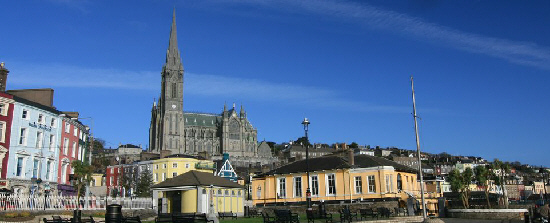
I visited Cobh recently and saw the breathtaking neo-Gothic cathedral that marks the summit of the town.  I have enjoyed my visits to Cobh immensely.  It’s amazing to realize that this Fulbright scholarship brought me back to Nanny’s homeland. It’s a land that has become my spiritual home.  The welcome I have received here has been inspiring and heartwarming.  I hope Nanny would be proud.

My mom and I look forward to visiting our “cousins” in Kerry in May.  We’ll get to retrace more of our roots then and meet even more family!

More Palace Bar

These pictures are from our evening downstairs at the Palace Bar:

Palace Bar downstairs.

Palace Bar downstairs.

Saturday Market in Meeting House Square

We weren’t blessed with the best weather during Patty and Kitty’s visit to Ireland but we did manage to see quite a few sites. We even made it to the Saturday market in downtown Dublin….

Four Courts by Night

Ireland’s Four Courts building is so photogenic. The River Liffey sparkles with its reflections at night.  How I love this place!

The Elegant Archeology Museum of Ireland

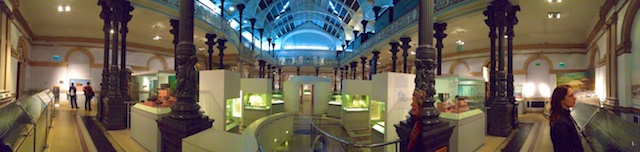
The Archeology gallery of the National Museum of Ireland is a chock full of fascinating treasures.  The building itself is also remarkable.  I’ve enjoyed visiting this place with both Esther Sterchi and Amanda Bernhard (the famous Fulbright student).  Of particular interest at this museum: numerous bog bodies, “prehistoric” relics, the Viking exhibition, and the unimaginably long wooden boat that was carved from a single tree trunk (see the panorama below).

I love the design of the Museum.  I wish I could see it without the skylight blocked out, though.

I love the design of the Museum. I wish I could see it without the skylight blocked out, though.

Pondering St. Stephen’s Green

Here’s a quick glimpse into St. Stephen’s Green.  The squares and greens in Dublin are separated from the street by dense vegetation and high wrought iron fences.  That technique doesn’t work it the States, where such separations tend to yield dangerous spaces.  But here they seem safe enough (at least for me to occasionally pass through by myself at mid-day).

Due to the separation, the squares and greens are peaceful, quiet, and serene.  They offer respite from the hustle and bustle of the city.  Like New York’s Central Park, St. Stephen’s walled off Green was designed to be seen, not heard.  The views were designed to be “scenic” in the tradition of English landscape design (i.e., they were carefully composed for the visitor’s viewing pleasure).  St. Stephen’s Green is not a park for playing football/soccer or dodge ball.  Frederick Law Olmsted would probably not be pleased with all the sport that’s been carved into Central Park (it runs counter to his original intentions for serenity, visual perfection, and individual contemplation).

St. Stephen’s Green is often quite still.  And far fewer people go in than if the edges were transparent, “perforated,” or “porous.”

The Green is fine (and at times quite delightful) but I do quite prefer bustling, noisy, stone-paved plazas myself.  Dubliners, too, want urban spaces like that and many hope for the addition of new piazze (Italianate plazas) in the center of town.  They have only three to my recollection: Meeting House Square, Temple Bar Square, and Smithfield Plaza. The first two are quite small and the third is very large. It is, I’ve been told, the largest cobbled plaza in all of Europe.  (Or perhaps, just the longest?)

What Dublin lacks in piazze though, it makes up for in bustling pedestrian-only shopping streets. Dublin clearly has the corner on the market with regard to streets, with some of the finest pedestrian shopping streets to be found in the world (Grafton Street and Henry Street, for instance).

A Dubliner of All Trades

Today, I needed to purchase a new external hard drive so I could download photos for you.  On the way to the computer store, I ran into Brendan Lynch.  He ran the musical performances I attended at the Arlington Hotel with Esther, Kitty Lee and Patty.  He also owns The Horse Shoe, located where Capel runs into Bolton Street.

Brendan had the door to his shop open and the sounds of an Irish banjo filled the air.  I stepped into the tiny space, introduced myself, and learned a bit about Brendan’s past and present work.

Turns out Brendan is an artist, photographer, musician, performer, music teacher, instrument trader, city planner, conservation expert, and business owner… a Renaissance man in my book.  As he’s also a history buff, I told him about Fergus Whelan’s book, the planners I’d come across when visiting the former parliament building, and the tour I took recently with DIT’s Gavin Buggy.

Worth the Long Wait at Muckross House

Kitty Lee, Patty, Shannon, and Tony at the lovely Muckross castle/house.

Bundled up and ready to tour Muckross House!

Muckross house is located near the town of Kilarney in southwestern Ireland.  We went there — twice — last week.  We had to work hard to see inside of the house, but I knew my three traveling companions would enjoy seeing the place.  Dave and I had been there in 2003 and had a splendid time and other friends of ours mentioned this as a highlight.

So we scurried there after seeing the Ring of Kerry, checking the official website for opening times. It indicated the house was open 9-5:30, seven days a week, in winter.  But although we arrived at about 4:20, the place was shut tight.  There was absolutely no sign of life inside the ticket booth or house and there were no signs posted with the tour times of opening hours.

However, the restrooms and grounds were still open and the park ranger assured us the house would reopen at 9 the next morning.  So we headed back to Cork for the night — an 1.5 hour drive — and hurried to the house again early the next morning.  We attempted to phone the Muckross office starting at 9 AM, but no one would answer the phone.  When we arrived at 9:30, the two ticketing agents told our host, Tony Duggan, that the first tour would be given at 11:30.  They said to visit the grounds until the tour started.  He let them know we already had!

Fortunately for us, the man is a CEO and knows how to get things done.  After all, we had other sites to see on our last day to the region. He managed to finagle a tour at around 10.  We experienced a fairly curt delivery of information with little opportunity to ask questions, but nevertheless, we enjoyed seeing the house.

I hope when you go to visit this fine building and learn its interesting history (it was last owned by an American family who gave it to the Irish people) you have better luck with scheduling than we had!