Learning London: Science Museum

IMG_7290

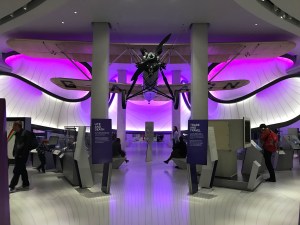
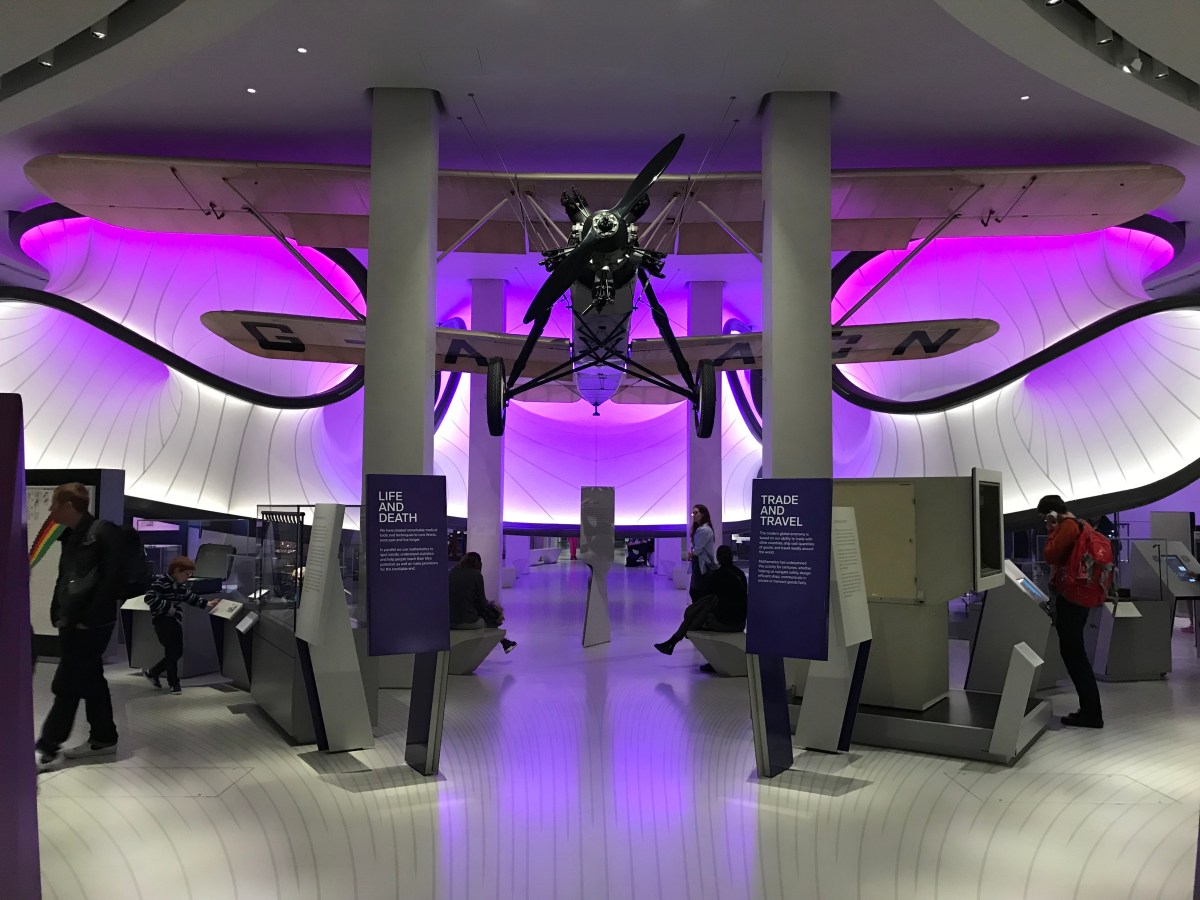
The Mathematics gallery, designed by Zaha Hadid and partners.

London’s Science Museum is so interesting that we went two days in a row. We hadn’t had our fill after just one visit, so we woke up Sunday morning and said “Let’s go back!” Incidentally, entry is by donation, so you can give what you like.

In the photo gallery below, you’ll see the Science Museum’s spacious entry hall and some images on the display about space exploration. You’ll see images from other parts of the museum that cover technological developments over time (related to transportation, homes, and appliances).

There’s special exhibit on Mathematics that includes visualization of air flow around a small aircraft (a display designed by the late/great architect Zaha Hadid) and there are displays about bridge and tower design.

I’ve included a few images from the special exhibition on technology in India–feeding my fascination with step wells. We also visited the exhibit on “Superbugs” to better understand the evolution of bacteria resistant to antibiotics.

Learning London: Tower Bridge Museum

IMG_7793

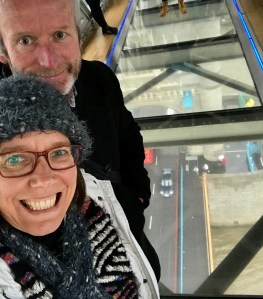
Defying gravity at Tower Bridge.

Tower Bridge is well worth a visit. A long visit at that!

Last weekend’s weather was dreary in London and we almost passed on the activity–a result of not knowing what we’d see inside and an entry fee of nearly 10 pounds sterling each. Missing this experience would have been quite a mistake!

Our visit to Tower Bridge and the museum that spans the overhead walkways and plunges into the engine rooms far below, lasted far longer than we’d expected.

Aongus and I explored had the surrounding area a bit first, after walking to Tower Bridge from Shoreditch. We’d found Dead Man’s Hole but had failed, for the time being, to locate the entrance to the “subway” that, once upon a time, facilitated walking by foot under the Thames from the north to the south bank.

The bridge lured us away from that pursuit.

We’d read about its gear system and, well frankly, at least one of us is a gear-head. Although we had expected see a steam engine, we had not expected to walk along the top of the bridge–the part that stay stationary when the drawbridge below is opened. But, happily, both sides of that walkway are part of the museum and open for exploring.

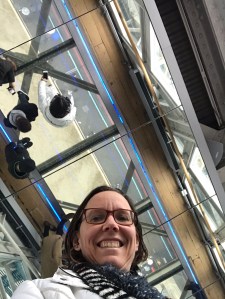
We spent a couple of hours studying the signs about bridge design and construction, this bridge’s history, and famous bridges from around the world (many of which I’ve visited). The mirror above the glass floor (of the walkway soaring high above the river and street) proved to be a delight. It’s a great source of entertainment and photo fun.

The museum also provides a short historic film, an animation of this bridge’s construction, and many alternative bridge designs that didn’t make the cut. There are informative plaques and drawings of the design that was ultimately constructed. There are also plaques and taped interviews with folks who built and operated the bridge.

The tour ended in the engine room on the south bank, where we learned about the giant steam engine that once powered lifts and lowerings of this formidable drawbridge.

We had hoped to visit the bascule chamber and witness the gigantic gears ourselves, even though we knew the drawbridge would not be opening that day. Unfortunately, the chamber isn’t open to the general public, so I’ll have to investigate how to get in with a group some day. It seems you can book in for a group to visit, but I’ll probably look for a group of engineers to join.

The photo gallery shows the surrounding area and parts of the museum itself.

Learning London–one month in!

img_7845

Tower Bridge selfie in the mirror above to the bridge floor and Thames River, far below.

Learning the lay of the land in London—the best way to spend the cold, wet month of January. I’ve been in my new position as a Marie Curie Research Fellow at University College London’s Center for Engineering Education for one month.

In this time, I’ve also settled into a new apartment, where I’m flat-sitting for some friends. They travel quite a bit, so it all works fine.

I’ve been getting to know Shoreditch and its surrounding areas. Turns out, Shoreditch is one of London’s hippest addresses and my place is surrounded by local markets, many dozen vintage clothing stores, and Boundary Estate, the world’s first social housing community, which is architecturally stunning. I’ve joined Nuffield Gym and have been enjoying its pool and yoga classes. I got a wonderfully positive health screening when I joined and will soon meet with a personal trainer to get anti-aging tips!

img_7905

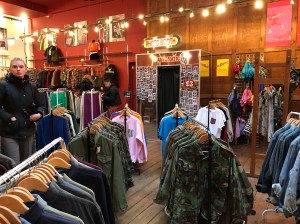
One of the many vintage shops off Brick Lane, buzzing on Sunday afternoon. Surprises at every turn–here a photo booth at the back of the shop and selling vintage clothes by the kilo downstairs.

Mostly, though, I’ve focused on making headway with my fellowship work. In the four weeks I have been working at UCL, I have:

Completed UCL induction/orientation

  • Got my employment contract, work visa, and bank account set up and obtained my British Residency Permit
  • Completed including face-to-face and on-line training and earned certificates in (1) Safety, (2) Green Awareness, and (3) Green Champion
  • Updated my research profiles, including UCL Engineering, IRIS, and LinkedIn

Contributed to peer reviewed conferences

Provided leadership in evaluation

Made two research trips to Dublin

  • Conducted four research interviews, and successfully scheduled five more for February
  • Was invited to collaborate on a policy project with 6 civil service professionals in Dublin
  • Met with several dozen DIT colleagues about current and future projects
  • Transcribed two interviews
  • Was invited to present at DIT research event on March 2nd
img_7923

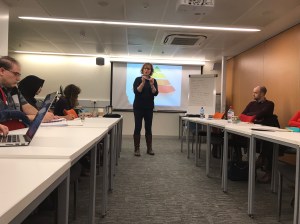
UCL workshop on “Leading Collaborative Projects.”

Completed researcher development workshops at UCL

img_7562

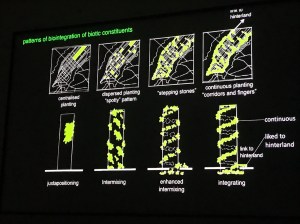
A slide from architect Ken Yeang’s lecture on eco-architecture, delivered at the Bartlett.

Attended lectures at the Bartlett School of Architecture

Scoped research funding programs

  • Attended an information session on opportunities to collaborate with UK-based researchers, hosted in Dublin by the Irish Research Council
  • Identified promising funding program for gender studies and downloaded guidance materials

Reviewed literature pertinent to my research projects

  • Three PhD dissertations using phenomenology
  • Seminal texts in epistemological development
img_7337

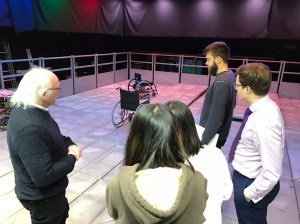
Professor Nick Tyler (left) at PAMELA (Pedestrian Accessibility Movement Environment Laboratory) aiming to improve transport and access to transport for people with barriers to mobility.

Studied art and design

  • Met twice with Kindall Brantley, NYU grad student in sustainable urbanism
  • Attended transportation design class at PAMELA, UCL’s transportation research hub
  • Joined the Tate and visited three times
  • Studied the special exhibition on Modigliani
  • Studied the special exhibition on “Impressionists in London” at Tate Britain
  • Studied bridge design topics at Tower Bridge Exhibition
  • Studied transportation and product design topics in two visits to London’s Science Museum
  • Even learned a bit of history by watching The Post at the RichMix cinema near my home, with a new membership to help support local culture and arts.
img_7774

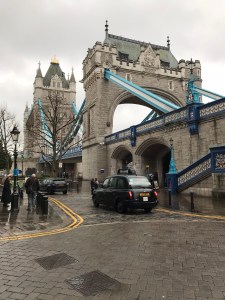
Tower Bridge as see from below. The glass-floored walkway joins the two, tall middle tower (nearly visible to the left of this image).

Met with colleagues at UCL

I’ll say that of all this, the interviews I conducted in Dublin were probably the most fun. Two of the participants provided two-hour interviews that were chock full of insight. These are follow-up interviews with students I’ve previously interviewed. They are women studying engineering at DIT and hearing how their stories unfold from year to year is fascinating.

img_7399

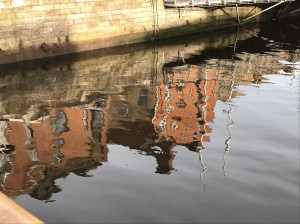
A reflection from the Liffey River in downtown Dublin, taken during one of my two January overnights to the city.

I’m working hard to get participants in Dublin scheduled for follow up interviews in February — before the final-year students get too busy with final exams and graduation.

Stay tuned for more work photos from the places I visited this past month.

IMG_7183

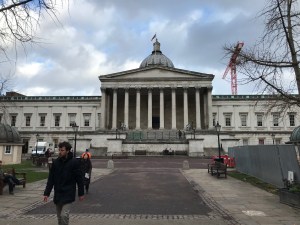
UCL’s central library building.

Getting to Know London

img_5553The time has come to start moving over to London since my new research fellowship starts with the new year, so I flew across last weekend to finalize our apartment choice and leave some luggage with friends for safekeeping.

Aongus ended up having to work all weekend back in Dublin so I transported two 20 kilo bags and a little weekend knapsack to London myself. Rolled the bags from my flat to work to the taxi stand, into Dublin airport and out at Gatwick, to the train, into the tube, down a few block to the hotel, into a cab, and up four flights to our new home. I only had to carry them five flights in all–escalators can be a blessing! Note of advice: when transporting two big bags, it surely helps if one has four wheels. It makes the job much easier as you can push or pull, and easily change direction. You don’t have to carry all the weight in your hand, as it can rest on the wheels.

On Saturday morning, with the transport job behind me, I had the rest of the weekend free to visit friends, tour museums (Whitechapel Gallery, the British Museum and the National Gallery), wander the city from Shoreditch to the West End, enjoy good food, and take in a play.

img_5565-1The weather was delightfully sunny and the city felt festive. London was celebrating Armistice Day with a parade hosted by the city’s Lord Mayor. The people wore poppies on their lapels and little parades sprung up here and there in addition to the main event that covered the entire central city Saturday.

And *fall* was in the air! The only drawback to this is that people on this side of the Atlantic insist on calling the season “autumn.” To me, using this two-syllable word is quite a drag.

Loved ones back in the States, do enjoy the colorful falling leaves gracing your streets and lawns at this time of year, the brilliant red maple leaves 🍁🍁🍁, and bask in using the apt term “fall!”

For the flights in both directions, I enjoyed Aongus’ window seat, but await his return to my side for the next trip across. I get a big kick that he’s like a kid in a candy store when he sits by the window–viewing in anticipation whatever delightful new adventure awaits us on the ground. Life gets exponentially better over time and he amplifies my enjoyment of visiting new places.

London, we can’t wait to return!


Down the Rabbit Hole, from Bath to London

20171028_155655

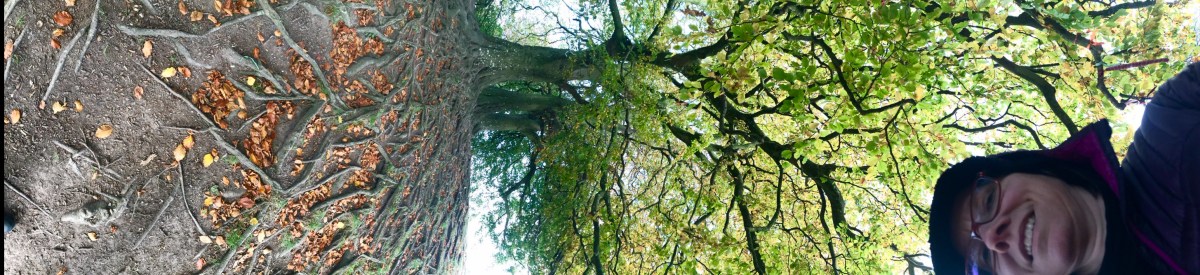
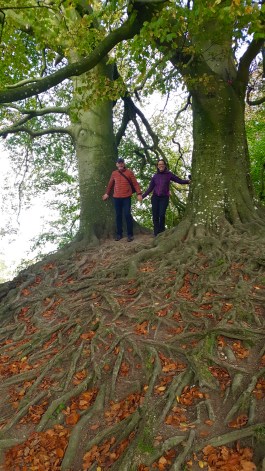
Beautiful “ferry” trees at Avebury in the UK’s Wiltshire region.

Last week I crossed the threshold into a brave new world. I traveled over to the UK, my soon-to-be home, twice to learn more about the place.

First, to celebrate Ireland’s bank holiday weekend, my partner Aongus and I flew to Bath. We rented a car so we could visit Stonehenge, the flight of locks at Devizes (the Caen Hill flight of the Kennet and Avon canal), Avebury which is similar to Stonehenge but larger, and the picturesque village of Castle Combe. In the city of Bath, we toured the ruins of the old Roman baths, the bell tower of Bath Abbey, Royal Crescent and the townhouse museum at One Royal Crescent, and weir and the Putney Bridge, as well as getting Watsu treatments and a night time soak with spectacular views from the rooftop pool at the Thermal Spa.

Stonehenge was spectacular, but Avebury had an even more mystical feel. The majestic old fairy trees with their thick boughs and knotted roots make it feel as if you’re stepping foot into C.S. Lewis’ Narnia or the Wonderland Lewis Carroll created for Alice. (Both of these were English writers, who could well have stood beneath the same magical trees we found here.) Wikipedia provides a quick reference to the meaning of ferry trees: “Many types of trees found in the Celtic nations are considered to be sacred, whether as symbols, or due to medicinal properties, or because they are seen as the abode of particular nature spirits. Historically and in folklore, the respect given to trees varies in different parts of the Celtic world.”

img_5227

Meeting with UCL’s Professor Nick Tyler.

After flying home, I flew back to London on short notice for four meetings on Wednesday–because my new colleagues at University College London had time to meet me and it was “review week” at DIT.

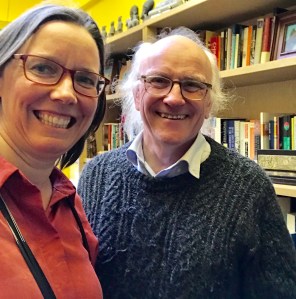
These meetings were in preparation for the start of my new Marie Curie research fellowship in January. The EU is providing funding for me to work at UCL for two years, to further upgrade my skills in educational research. During my short visit, I met with my primary supervisor Professor Nick Tyler who has an amazing record of research in transportation engineering and educational innovation. I also met with my secondary supervisor, Professor John Mitchell, who directs UCL’s Centre for Engineering Education (CEE). I also got to meet with the newest member of CEE’s research team, Dr. Inês Direito, who I’ll get to collaborate with in projects. All this in addition to visiting UCL’s European Office and quick chats with two other colleagues, Emanuela Tilley and Dr. Arnie McKinley, both originally from my own side of the Atlantic.

Overall it was a very productive day, and I even got two grant proposals read in route.

Across the span of the week, I had great experiences at work and at play. I can’t wait to get back to London, Bath, and the Wiltshire region of England for more learning, and more novel adventures.


Researcher in Motion, in Portugal

Europe’s research framework encourages researchers to move around. The principle  “Researchers in Motion” underlies most of research funded by the European Union through its individual fellowship and its international training networks. For instance, all Marie Curie fellows must move to a country where they have not been living (for at least 24 months of the 36 months proceeding their application date). The EU offers support to researchers in motion through EURAXESS. This includes a database of fellowship and job openings.

Although I am not currently funded by a Marie Skłodowska-Curie actions (MSCA) research fellowship, I am still benefiting from support received through my prior MSCA Individual Fellowship (2014-2016) and networks I first established as Fulbright Fellow (2012-2013). These professional relationships help me conduct research and share (or “disseminate”) my results and findings. For both of these fellowships, I moved from my home in the USA to Ireland to conduct research full-time.

My first trip to Portugal occurred during my Fulbright in 2013, when Bill Williams, a colleague I had met at a conference in Greece, helped me secure support from Portugal for Inter-Country Lecturing. Bill organized an itinerary for me where I visited five universities and delivered four lectures and workshops. During that trip, I fell in love with the country.

Now, whenever I have reason to visit Portugal, I find a way to tack on a weekend before or after my business meetings. I’ve also booked an upcoming summer holiday there. Please see my prior post about the research meetings and ASIBEI conference I attended in Portugal during my recent visit.

I research engineering and design education, and I now teach introductory engineering and architecture technology in Ireland. It’s important for me to keep current and build new knowledge related to engineering, architecture, art, and urban design — as well as educational theory and practice. Here are some images of relevant sites in and around Lisbon, taken during my recent trip to the Iberian peninsula:

The following photos were taken at the newly-opened MAAT (Museum of Arts, Architecture and Technology) in Lisbon:

Next to MAAT is the Tejo Power Station museum (a former thermoelectric power plant that once supplied power to Lisbon and its surrounding region):

The Calouste Gulbenkian Museum is another highlight of Lisbon:


Research Follies in Portugal

Screen Shot 2017-06-08 at 1.59.29 PM

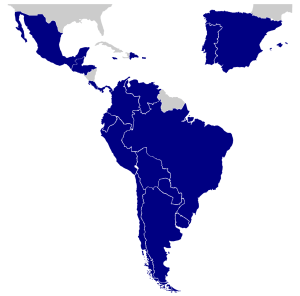
ASIBEI member countries.

Last week I plunged into the warm, sunny weather of Portugal. I’d been invited to present about interactions between higher education and the business sector, at an ASIBEI conference. The president’s office of Instituto Politécnico de Setúbal invited me and sponsored my attendance at the conference.

ASIBEI is the Ibero-American Association of Engineering Teaching Institutions. It involves the Portuguese and Spanish-speaking world. The organization’s “official languages ​​are Spanish and Portuguese, which can be used interchangeably” in all meetings. I was the linguistic outsider, requiring  my own translator. I was also the only person to present in English; I spoke slowly and the audience followed along enthusiastically.

With the support of my Head of School, I arrived a couple days early to meet with colleagues about research projects and grant proposals. On Monday before the conference, I met with lecturers and researchers from Instituto Superior Técnico, as picuted below:


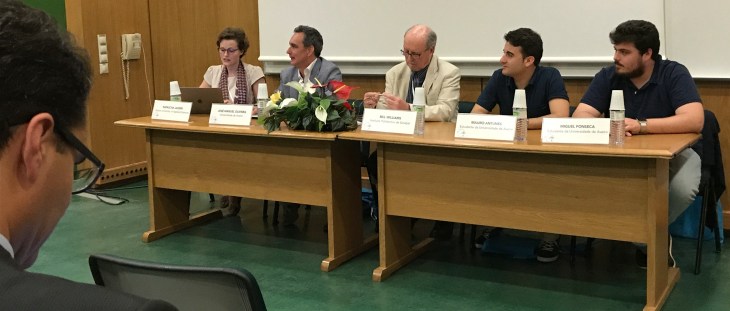
Later that day, I met with Dr. Bill Williams. Bill has been working with me on gender in engineering research studies. He has published conference papers with me and has also been working with me as co-editors of a special focus IEEE issue. Here’s a photo of Bill during the ASIBEI conference, where he moderated a panel session:
IMG_7710

Dr. Bill Williams is seated in the middle, moderating a panel discussion at the ASIBEI conference.

On Tuesday morning, I traveled from Lisbon to Cascais to meet with the Chair of the Ireland Portugal Business Network, who provided a great deal of support for a grant proposal I submitted this past January. After meeting with him, I got to spend a couple hours on the beach in this resort town where he and his family live. They escaped the cold weather of Ireland for sunnier skies. I loved these sunny skies and I rented a lounge chair and umbrella for the afternoon on the small but beautiful “Queen’s Beach” of Cascais.

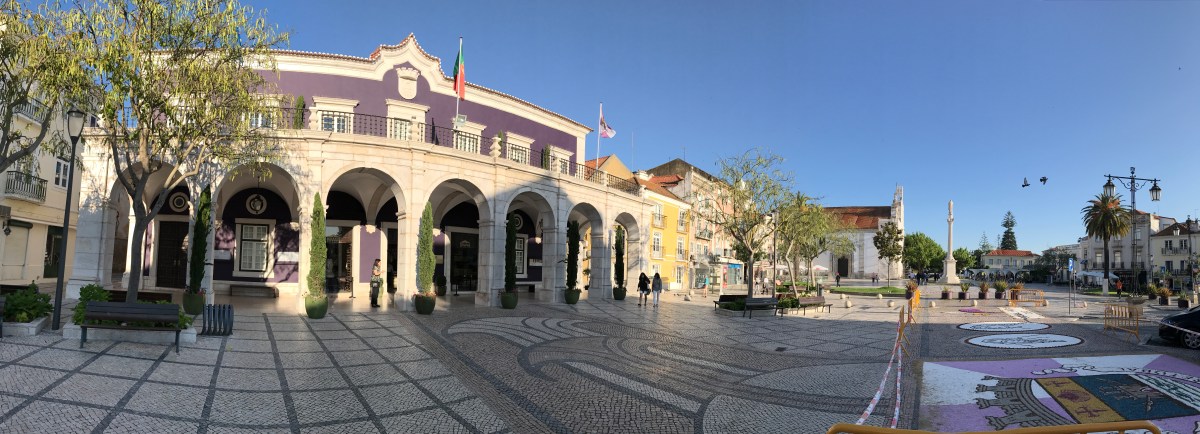
On Wednesday and Thursday, I joined the ASIBEI conference for work sessions, panel discussions, a visit to Setúbal’s city hall, and a tour of the Lauak factory that produces parts for Airbus, Honeywell, and many other well known companies. I was fascinated to learn about the production of the airplane parts, since my dad and I have done our fair share of airplane construction in the past.

I made a presentation on “The Business of Higher Ed: Research Skills for a Prosperous Future” that you can view on Prezi. Aiming to provide the audience with useful knowledge that would interest them and help them in the future, I discussed the intention of Marie Skłodowska-Curie actions. I described two different MSCA programs that support researchers and help equip them to work with and within industry.

I had to hurry back to Dublin immediately following my panel presentation, to participate in our School’s program review Friday. The discussions with our evaluation panel were valuable and interesting, making the mid-night trip back to Ireland worthwhile.

Here are photos of the panel sessions:

And photos of the reception at City Hall:

Photos from the factory tour:

While in portugal, I also had a chance to visit the Calouste Gulbenkian Museum, the new MAAT (Museu de Arte, Arquitetura e Tecnologia), and the Tejo Power Station museum (a former thermoelectric power plant that once supplied power to Lisbon and its surrounding region). See my next post for more images of the beautiful sites in and around Lisbon.
Brussels sprouts Christmas

img_5541Brussels is a buzz with the look and feel of Christmas, and the festive smell of spiced wine, waffles, and even Raclette sandwiches. Since I’m here for the week to evaluate grant proposals for the European Commission, all hours of the day have been quite full. Fortunately, though, the schedule provided several evenings to wander the streets at will and soak in the holiday cheer.

The set of photos I’ve attached all came from a two-hour journey though the city center, which is lovely and bright and cheery. This week, it teems with the best life has to offer, but other elements lie below the surface. Quietly keeping us safe though it all, almost unnoticed, are hundreds of uniformed men cradling rifles. A solemn reminder of troubles festering in this world around us. My sincere thanks go out to the officers keeping this plaza and the surrounding pedestrian shopping streets open for the public to enjoy.

Tonight, my last in this lively city for the year, I caught the Christmas light show in the Grand Plaza (the square with the highly ornate Baroque buildings and steeple). As if it weren’t festive enough with the classical lights shown below, the Plaza pulsed with contemporary music and a festive, choreographed wash of lights dancing from building to building. The lights in this plaza I’ll not ever forget; I’ll look to return in future years.

Yes, the best of times these are. Yet, I fear, the worst of days are soon to come. US politics and world news lay heavy in my heart. I keep my chin up and aim to do my own part in the world as best I can.

Exper-tease in the capital of the EU

I’ve been in Brussels this week, evaluating grant proposals for the European Commission’s Research Executive Agency (REA). It’s the second time I’ve worked for the EU in this capacity–the first was during last fall’s lockdown in Brussels. This year’s event was much more pleasant, and we got to make our deliberations face-to-face, rather than using the Internet.

In my book, it’s important work. We’re determining which proposals will be funded and which research projects will proceed. Specifically, this week, we’re considering which PhD programs the EU will be co-financing. For successful applicants, the EU will pay a significant portion of the costs to hire early stage researchers to travel to another country in the EU to do their doctoral studies.

An intriguing aspect of the week has been being called “expert” everywhere I turn as I arrive at work in Covent Gardens every morning. I’m enjoying the novelty, although the sights have been the same day after day. The rooms in Covent Garden are very comfortable, in any case, and the other experts on the panel are friendly, knowledgeable, and polite. It’s been a great experience and I’ve gotten to learn a lot.


What we can learn from architecture studio pedagogy, a guest lecture at KTH in Stockholm

img_5492

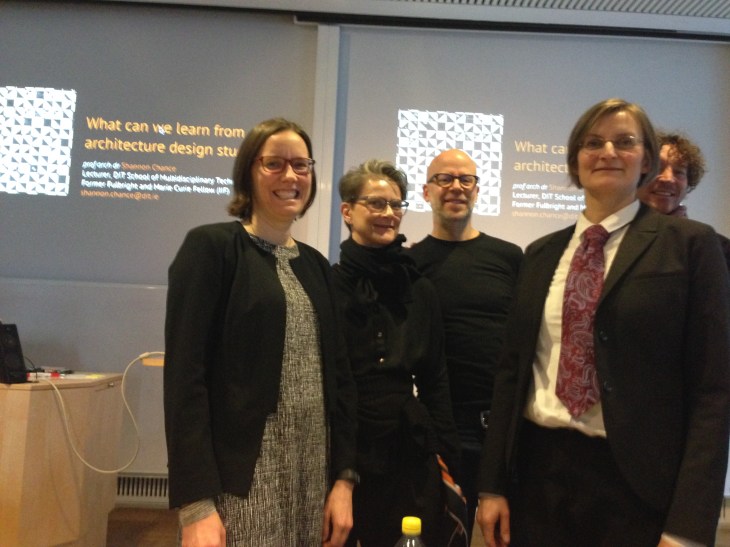
After the lecture at KTH, with two librarians and two architecture profs, including my former classmate from Virginia Tech, Eric Stenberg.

Professor Jonte Burnhard invited me to KTH in Stockholm to deliver a guest lecture on what we–as education specialists, architecture educators, and researchers of engineering education–can learn from each other and from the pedagogical models used to teach architecture. Jonte had read a recent article, “Using Architecture Design Studio Pedagogies to Enhance Engineering Education,” that I’d published along with John Marshall and Gavin Duffy in IJEE. You can access the article at: http://arrow.dit.ie/engscheleart2/102)

The learning and teaching center at KTH hosts this type of lecture/workshop every couple weeks, to get the institution’s staff thinking about and discussing good ways to teach. In addition to classroom educators, quite a few of KTH’s librarians also attended the event, as well.

While at KTH, I enjoyed a dozen small-group discussions on pedagogical topics, toured the brand new architecture building, and caught up with a former classmate, Eric Stenberg,  from Virginia Tech’s architecture program. I’m hoping to visit KTH again soon, since we have so many overlapping interests.

I stayed though the weekend, before heading to Brussels on Sunday evening, and I’ve attached photos of the Christmas sights.