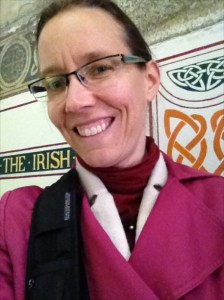
Hanging out with Daniel O’Connell. My photography exhibition was held in the house where he used to live, on Merrion Square.
Our Fulbright shin dig included a visit to Glasnevin Cemetery. I’d spent about an hour here, just outside the gate, one evening near Halloween when Esther was visiting. That was part of the (very worthwhile and historically accurate) Ghost bus tour and we followed it up with a visit to John Kavanagh’s “Gravediggers” pub.
The cemetery itself was started outside the city, at the same time the same thing was happening all over the USA. The American cemetery movement actually sparked the American park movement, believe it or not. The historian J. B. Jackson explains that people found they loved going to the suburban cemeteries — which were new and had wide open (corpse-free) spaces. These early cemeteries were well-designed and had beautiful architectural features, as you can see on the home page for Thornrose Cemetery where my grandparents lay today. In any case, in the ten year period of the Civil War, nearly every American city built a “central” park, and Frederick Law Olmstead’s office designed many of them… and many college campuses too.
Wikipedia has some of the most interesting info online regarding this particular cemetery:
Glasnevin Cemetery (Irish: Reilig Ghlas Naíon), officially known as Prospect Cemetery, is the largest non-denominational cemetery in Ireland with an estimated 1.5 million burials.[1] It first opened in 1832, and is located in Glasnevin, Dublin.
The stories I heard on our tour of the cemetery brought to life for me the history of Michael Collins and Daniel O’Connell, two of Ireland’s most important political figures. Éamon de Valera and Countess Markievicz are also buried here.

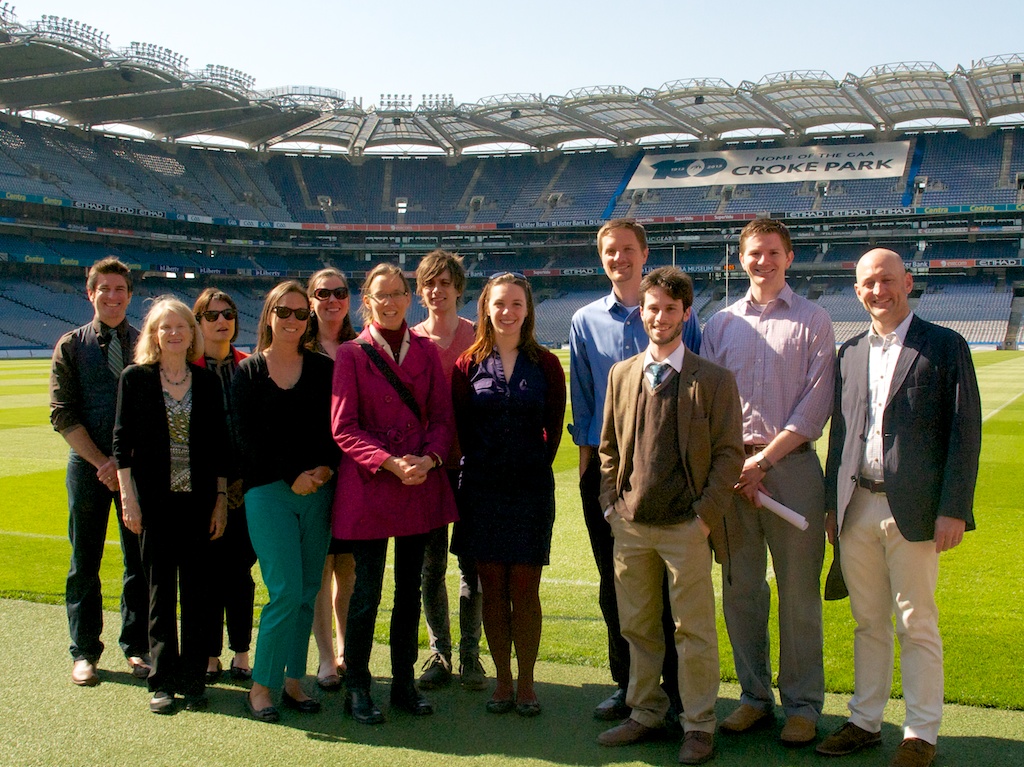
The 2012-13 Fulbright Ireland crew…

…visiting Michael Collins grave…

…at the famous Glasnevin Cemetery.

Michael Collins grave…

…draws a crowd and is visited…

…each and every day of the year.

There’s also a monument here…

dedicated to Daniel O’Connell.

Although he was a pacifist…

..his monument was bombed by Loyalists.

And today there is still no stair to the top.

We learned about the man…

..and the history of this place.

In times of disease, they sealed coffins like these carefully to keep illness from spreading.

Countess Markevicz, the first elected female minister, is buried here.

We learned about mass graves…

..and famous writers.

We visited the oldest grave…

…and learned how they’d bought remains of a famous person from the UK here, to convince people to use this cemetery.

Today there’s massive restoration work…

…being done…

…to rectify the lack…

…of proper foundations.










 Ireland by Chance