
© Shannon Chance 2012
© Shannon Chance 2012
© Shannon Chance 2012
© Shannon Chance 2012
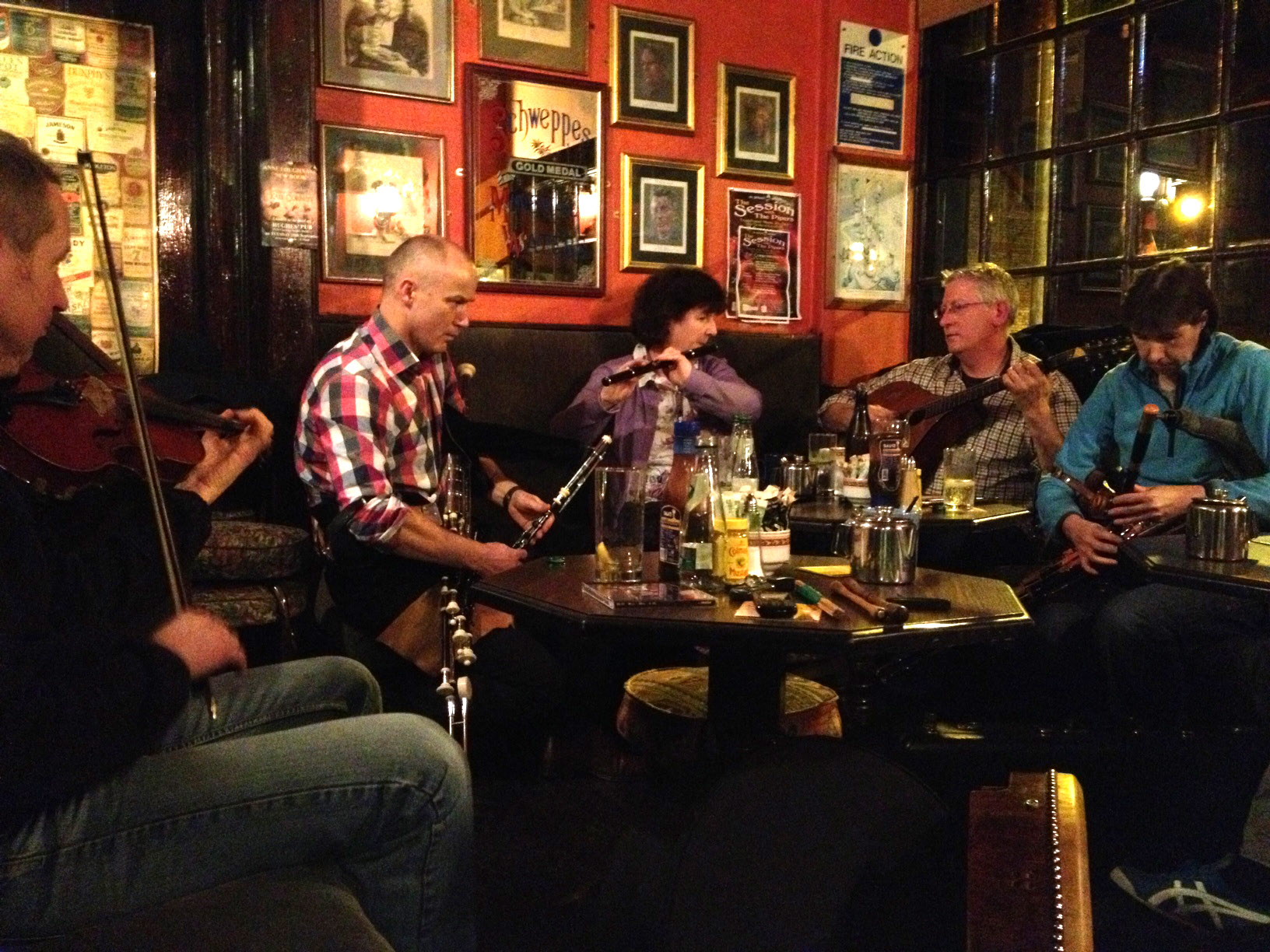
Gavin (left), his brother Aidan, and the Monday night musicians at Hughes Pub.
Finding Gavin Duffy has been a challenge lately. This case is much different from finding Kevin Donleavy, but this story also ends in a pub.
November is notoriously hectic in the university world, and Gavin works so hard and teaches so many hours that he doesn’t have much time for lunch chatter these days. In addition, he’s got his hands full at home with three growing kids and another (surprise!) on the way. (Congrats are in order to Gavin and Carmel and their three very-happy-to-have-a-new-sibling kids!)
But I also want to do my job here, which is to help Gavin progress with his dissertation. I want to make sure we’re ready to meet with his dissertation advisor Thursday. We really need to have something new to say. We need to show some progress — so as to use Rob’s (and our) time well.
In any case, I know I can track Gavin down in my own neighborhood once a week, when his group of musicians gathers to play at Hughes Pub.
We shared our research progress, quickly between songs last night, and had some fun in the meantime.
I’ve spent more than a little time at Hughes Pub this week. Saturday night I went in at ten o’clock not knowing a soul. I left at two in the morning with three new friends: Dubliners Kathleen, Sean, and Mick.

Paddy Woodward described the feel at Hughes as a fine suburban-style pub, if I remember correctly. I didn’t understand until I visited the back part last Saturday. I arrived with the tourist crowd…
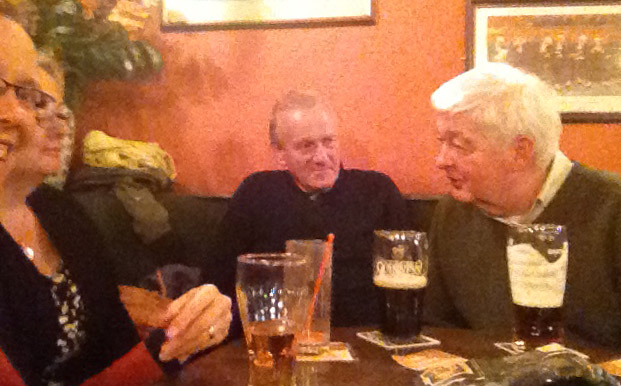
…and left with the locals. Thanks for tons of laughs Kathleen, Sean, and Mick!

At Trim Castle with the 2012-13 Fulbrights to Ireland and their families (on 7 September 2012). Try playing “where’s Waldo?” and find Dave, Heather, and me. You’ll also see the pipers (Jonathan and Amanda), Erin Eife, and many other folks I’ve blogged about.
There are so many things I meant to share but haven’t had the time to post. This is one of them.
These are photos that Fulbright Communications Officer, Joanne Davidson collected during our September 2012 Fulbright orientation events.
I hope they’ll give you the feel for some of what we learned.

Colleen Dube, the Head of the Fulbright Commission in Ireland, orienting us all (on 6 September 2012).

Learning Irish with Sioban, a former Fulbright to the USA and the niece of the Cobblestone pub’s proprietor, Tom Mulligan. (Photo from 6 September 2012.)

Ann and Bob Trumble from Williamsburg, Virginia. Bob teaches at VCU and he used to work at NIH and NSF. I’ve enjoyed spending time with them — they have been living here in Dublin. (Photo from 6 September 2012.)
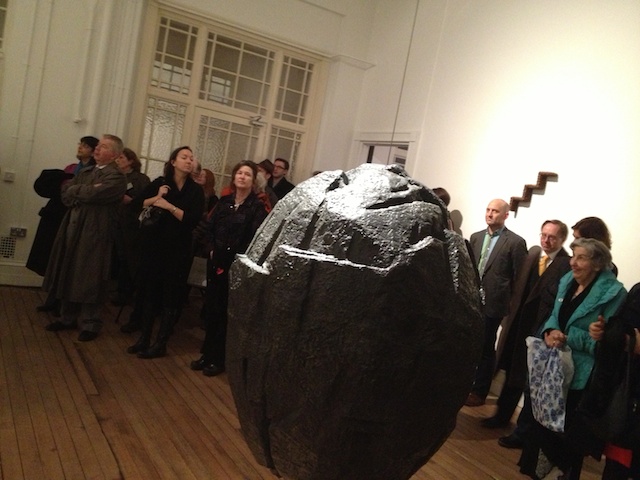
The crowd mulling over meanings posited by the curator of Alice’s retrospective exhibition, titled Becoming.
The Irish artist Alice Maher was once a Fulbright to California. She has accomplished enough over the years to be featured in the “Prominent Alumni Lecture Series” event held last week.
The event (coordinated by the Ireland United States Alumni Association and hosted by the US Embassy in Dublin) highlighted Alice’s exhibition, Becoming.
The exhibit is currently on display at the Irish Museum of Modern Art on Earlsfort Terrace. (If you want to visit it, please note that it is not located at the Royal Hospital site–which is closed for renovation. Alice’s work is across town in the rear of the National Concert Hall.)
During last week’s event, the curator of the exhibition walked guests around the museum. He shared his thoughts about Alice’s work and explained how the various pieces were selected and displayed.
I particularly enjoyed hearing Alice talk about the context of her work. I also enjoyed meeting the museum’s Head of Education and Community Programmes (Helen O’Donoghue) and catching up with the staff of Fulbright Ireland (Colleen and Joanne) and the current Fulbright scholars who attended (Bob Trumble and his wife Ann, Scott McDonald, and Matthew Baker).
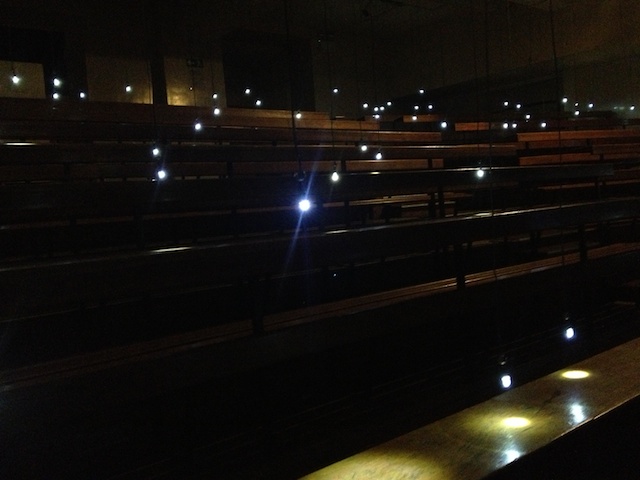
Since the actual home of the Irish Museum of Modern Art is under renovation, the exhibit is housed in the former classroom area behind the National Concert Hall.
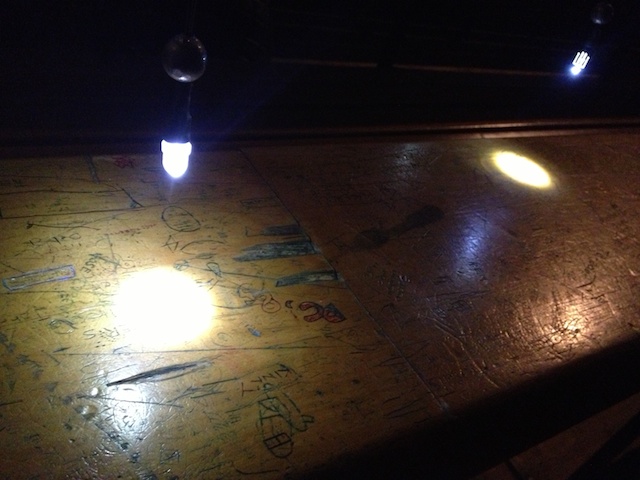
This is a close up view of an installation Alice created to highlight decades of graffiti on the old University College Dublin (UCD) desks.
Researchers help define and preserve culture. Last night, I got to hear Len Graham (a researcher and collector of Irish ballads) sing songs he has collected over the decades. Here’s a YouTube video of Len performing “at the Big Muddy Folk Festival in Boonville, Missouri on April 4, 2008.”
Len called last night’s performance “It’s of my Rambles… Recollections of Singers and Songs from the Ulster Tradition.” He prefaced each song with an explanation of how and where it was collected and which demographic group claimed to have originated the song (Ulster, the Travellers in Ireland, etc.). He explained some of the meanings behind each song.
Len spends his life singing and tracking down songs and singers. He transcribes and archives words and melodies so that they aren’t lost to humanity. He’s travelled to Australia to find people who know rare songs and to Arkansas to record missing verses to a known song. These are just a couple of the many travel stories he told.

Len Graham singing at Na Píobairí Uilleann. The placard to the left lists Alfie Mulligan, who I’ve posted a snippet of on this blog (playing uilleann pipes at his brother’s Cobblestone pub).

Here you can see what the uilleann pipes look like (photo downloaded from an online blog). (There are lots of YouTube videos available of uilleann pipers.)
Len spoke of a time not so long ago when there were just ten or so uilleann pipers in all of Ireland. Today, he says, more than a thousand people play these pipes.
He’s part of a vibrant oral tradition of storytelling that’s alive in Ireland today. But the songs have also been recorded and archived in important libraries–such as the one here in Dublin and another at Brown University. A researcher from Harvard (named Child) did a lot of important research into Irish ballads back in the 1800s.
I especially enjoyed Len’s songs involving heather (the name of a flower that became the name of my sister). I also found “When Irish men throughout this world are brothers one and all” to be quite catchy.
This event was part of Na Píobairí Uilleann’s monthly Notes & Narratives lectures, which the organization describes as a series of “performance-based lectures on traditional music, song and dance by some of Ireland’s finest traditional artists.” Last night’s event was held at the Na Píobairí Uilleann hall on Henrietta Street.
Thanks, Jonathan Kennedy, my fully-bright friend, for the heads up about this event. Hope you’re putting your uilleann pipes to good use out there in Western Ireland this weekend!

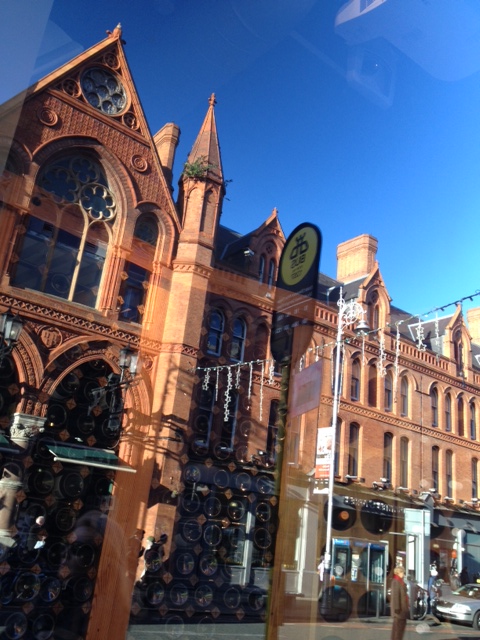
Christmas lights as seen in panorama from the corner of Grafton and Wicklow.
Frank McNally listed “23. Christmas lights in early November” as something he hates about Dublin (Irish Times, 15 November 2012).
Now, normally I bemoan Christmas selling creeping into every moment of fall, too. But I have to admit that I’m taken by the holiday lights on Grafton Street.
Henry Street (the bustling pedestrian shopping avenue in Dublin that I’ve posted pictures of so many times before) isn’t yet illuminated. And it seems quite dreary by ten 0’clock in the evening. Not so on Grafton!
In these dark days of fall–when the Dublin sun sets around 4:30 pm–it’s fun to bask in the glimmer of lights on Grafton and Wicklow.
Dear Shannon,
From today’s Irish Times. Thought you’d like it.
Máirtín
FRANK McNALLY
Things I love about Dublin:
1. The boardwalk.
2. The view westwards along the Liffey at sunset.
3. The bike scheme.
4. Walking through Trinity’s front square at night.
5. Church bells ringing on a Sunday morning.
6. Kilmainham Gaol.
7. There being a Hilton Hotel across the road from Kilmainham Gaol.
8. Architecture with a sense of humour.
9. Raglan Road on an autumn day.
10. The canyon-like street that runs through Guinness’s Brewery.
11. The walled garden of the Royal Hospital Kilmainham.
12. Italianate grandeur and the poetry-inscribed gravestone of a horse.
13. Walking through the Liberties and suddenly smelling horse manure from a yard.
14. Kids play hurling against the walls of Guinness’s.
15. Extensive use of the nation’s favourite adjective in place-names. Even one of the canals in Dublin is Grand. It has a Grand Parade running alongside it. And there’s a hotel in Malahide that’s Grand too.
16. The Beckett Bridge.
17. Most of the other bridges.
18. Fawning season in Phoenix Park.
19. Signs warning about “fawning season”, while foreign dignitaries are being entertained at Farmleigh and Áras an Uachtaráin.
20. Environmental management with a sense of humour.
21. That circular railing around the Central Bank. Yes, it’s ugly, but it’s always reassuring to see money ring-fenced.
22. The first smell of burgers when you approach Lans-downe Road on match day.
23. Ditto the first smell of home-made ham sandwiches near Croke Park.
24. The pedestrian traffic light outside the Dáil. It always works.
25. The surprising and still growing number of people who clean up after their dogs.
26. Cobblestone streets (except when you’re on a bike).
27. Chinatown.
28. Charles Stewart Parnell proclaiming that “no man has the right to fix the boundary to the march of a nation” just beside the fast-growing Chinatown.
29. Swans on the canal.
30. Barges on the canal, occasionally.
31. The Chester Beatty Library and that Celtic snake thing in the garden outside that children love running around.
32. The politeness of Dublin gurriers who, even while indulging in gratuitous verbal abuse, call you “mister”.
33. Georgian doors.
34. Harry Clarkian windows.
35. Merchant’s Arch.
36. The arch that crosses the road at Christchurch.
37. People in shirtsleeves outside pubs and cafes every time the air temperature climbs above 10 degrees celsius.
38. A crowd of several hundred drinking outside the Barge pub in Portobello on a summer’s evening.
39. Rivers that sound like characters, or oul’ fellas, or both: The Camac. The Poddle. The Dodder.
40. Sweny’s chemist.
41. Joycean plaques in the footpath, like literary manhole covers on underground works.
42. Seeing the names of exotic, far-flung destinations you’ve never heard of before on Dublin buses.
43. Wondering what life must be like there. Where is “Ongar” anyway?
44. Place-names you just enjoy saying: Fishamble Street. Stoneybatter. The Longmile Road.
45. The intensely colourful Zone 3 of the Luas Red line: Goldenbridge. Blackhorse. Bluebell. Red Cow.
Things I hate about Dublin:
1. Hawkins House.
2. Just about every other house built between 1958 and 1980.
3. The state of the footpaths when it doesn’t rain for a while.
4. The part of the boardwalk that every seagull in the city seems to crap on.
5. Panhandlers at ATM machines.
6. Panhandlers everywhere else.
7. Clampers lurking around every corner.
8. The loop-line bridge.
9. The lights on the tip of the Spire that were supposed to glow softly but instead look like a strip of tinsel sellotaped to the outside.
10. The city’s habit of building phallic monuments that, unlike other cities’ phallic monuments, tourists can’t climb.
11. Chain stores taking over Grafton Street.
12. Being expected to call the Grand Canal Theatre the Bord Gais Energy Theatre. Ugh.
13. Having to walk the wrong way up the footpath in Westland Row at 5.30pm, with four lanes of fast-moving pedestrians coming the other way.
14. All those buses heading out of town to the teeming suburb of “As Seirbhis”.
15. Men urinating in doorways.
16. People who don’t clean up after their dogs.
17. Percussive leakage from ear-phones on public transport.
18. You’re strolling along Dawson Street, all chilled out. Then an amphibious bus-load of tourists pretending to be Vikings suddenly passes and roars at you. Very annoying.
19. It’s not even a real roar. They have it recorded, because the tourists are too polite to do it themselves.
20. Grattan’s Parliament being occupied by a bank.
21. And what’s worse, Grattan’s Parliament being occupied by a bank we had to bail out at vast expense.
22. The East-link toll bridge. Only one lane in each direction. No room for anything but cars. Ugly as sin. Had paid for its inadequate self many times over and is still charging.
23. Christmas lights in early November.
24. Ditto Christmas music.
25. Walking through Trinity’s front square at night. Then, realising the feckers have locked the door again, you have go back out by the Nassau Street entrance, where you came in.

Jerry Crilly, Frank Cullen, and Shannon Chance craic-ing it up at the Cobblestone.
Thanks to an awesome third space, we’ve located Jerry Crilly’s long lost friend, Kevin Donleavy. I met Jerry when I was in the Cobblestone with my mom last month, and he asked me to help him locate a guy he’d met here in Dublin in 1985. He knew the guy lived in Virginia–somewhere near Ivy–so he considered me an expert.
That night at the Pub, I Googled Kevin and found that he’s taught at UVA and the University of Richmond. He plays traditional Irish music, and is a scholar of all things Irish.
I had some trouble locating him, though. It seems there are NO free phone look up services on line anymore. What a terrible shame!
I tried sending a message to his UVA email address, and waiting patiently. But, probably since Kevin has been retired for a while, I got no reply.
Jerry was persistent. He followed up a couple of times, just as I had asked him to do.
Last Saturday, he phoned me while I was sitting in a barber’s chair. He was headed to the Cobblestone to hear bluegrass. Could I come?
When I (finally!) got out of that chair, I hightailed it home to do some more searching. I found Kevin’s home address and even the first six digits of his phone number. I signed up for a people search service (the “free trial” type that has to be cancelled or will automatically draw monthly payments). Nerve wrackingly, the company must have lifted those six digits from some other similar service (like Spokeo). It failed to provide the four we’d need to place a call.
Frustrated and hungry, I phoned Dave for help and headed to the pub.
When my call came in to Dave, he was on our front porch in Virginia installing new floor boards. (What an awesome Christmas present! My baby knows how to do things right!)
A couple of hours later–after I’d grabbed some food around the corner and then some pints with Jerry and his friend–a text rolled in from home.
With a stroke of genius, Dave thought to Google “Kevin Donleavy” along with the six digit I’d found. Dave then texted me a screen shot of the reaming digits.
I passed them on to an elated (and somewhat inebriated) Jerry
I soaked in a little more craic, and then headed for home. It appears this is a good time to introduce you to the term craic, which is pronounced “crack” and has been described by a helpful soul on UK Ask as:
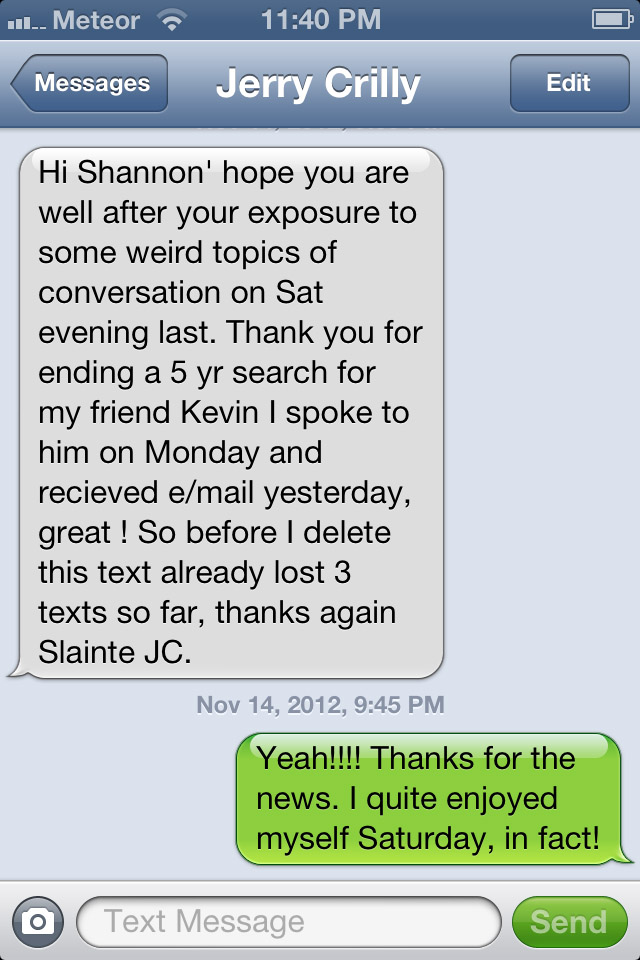
Jerry’s text.
Best Answer – Chosen by Asker
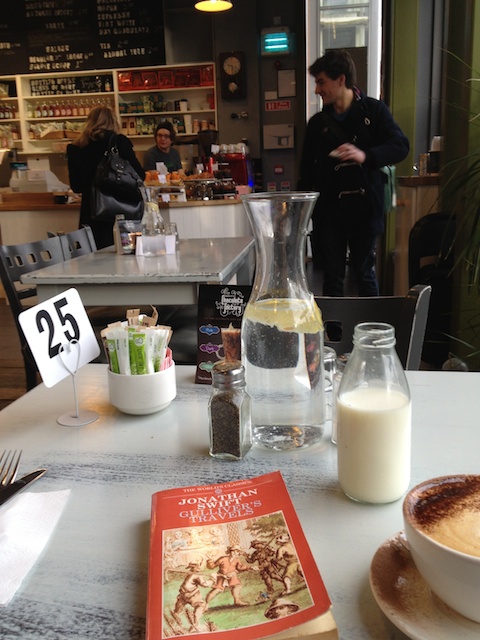
Browse the bookshelf.
A good “third space” helps fill the gap left between your home (your first space) and your workplace (your second space). It should be a place where everyone feels welcome and equal–regardless of income or social status.
I learned about third spaces from one of my thesis advisees at Hampton University, Ryan Kendall, who asserted that we lack adequate third spaces in the USA. He proposed to transform our beautiful (but increasingly vacant) Post Office buildings into vibrant spaces. He wanted them to be used for socializing, learning, developing physically, and yes, mailing things (in old- and new-fashioned ways). Prior to his thesis year, Ryan worked at NASA Langley. That happened the summer after he completed the Comprehensive Design Studio that I taught alongside Robert Easter. Ryan was a smashing success with NASA. And the NASA folks have kept coming back, asking for more and more HU interns and for our department’s help on various design projects.
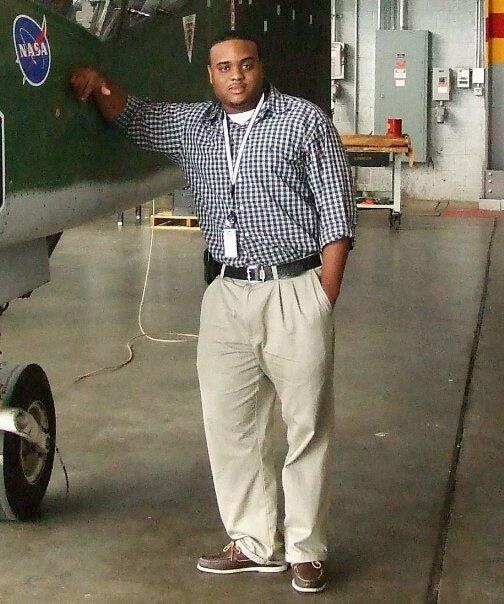
Ryan Kendall in his job at NASA Langley.
Ryan’s main point?
In the States we often neglect our third spaces… or fail to create them all together.
I’ve found that fostering “third space” is a core tradition in Ireland. The pub has long served this purpose.
When Dave and I visited Ireland in 2003, we saw entire families spend their evenings engrossed in meaningful conversations with neighbors and friends at the various pubs we visited. Kids ran in and out and people of all ages mingled happily and comfortably. Although pub culture is not as strong today (the smoking ban took a tool on the pubs), it’s something you can still find in many places.
I’m fortunate to have several great third spaces very close to my apartment here in Dublin’s Smithfield neighborhood, a district also known by its postal code, “Dublin 7.”
My favorite third space is the Cobblestone pub. Another–where I’m starting to spend more and more time–is aptly called Third Space.
Third Space: changing the city around the table.
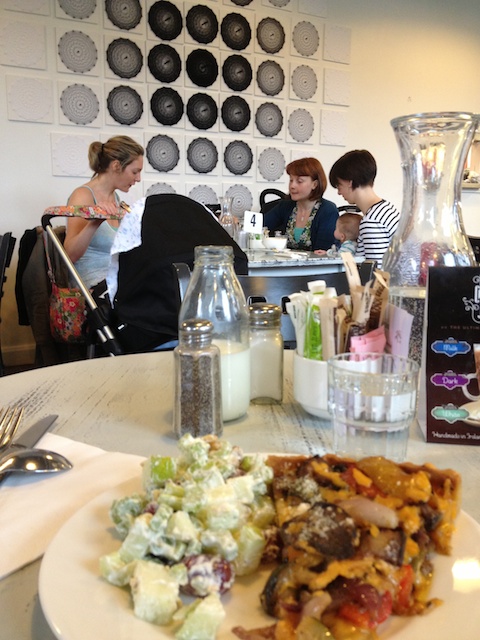
Bring some friends. Enjoy the art.
A webpage for the Third Space restaurant explains:
Our story starts in the changes Dublin saw in the “noughties”. Lots of new apartment blocks, lots of new offices and retail units – no gathering places. Living space and working space but no “third space”.
Third spaces are neighbourhood places where people can gather regularly, easily, informally and inexpensively.
Re-introducing such places into areas that lacked them became a passion for a small group of people. And so was born Third Space. It is a social business venture to open and run eating and meeting places in the areas of Dublin that lack community hubs. With a simple and great menu and an informal friendly environment, they will have a creative buzz that connects into the varied life of a modern Dublin neighborhood.
Third Space 1 opened in Smithfield on February 14th 2012.
I had an interesting encounter at both of my “third spaces” this week. I’ll post them, so you can see what I mean. Stay tuned! (Click here to read the sequel.)
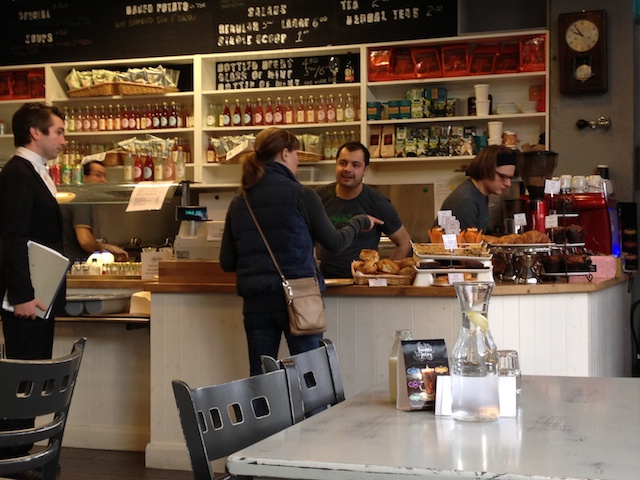
Grab a lunch. Everyone’s welcome and they’ll make you feel at home… even a barrister (i.e., lawyer, shown to the left) can find a quite place to reflect on the day, away form the busy halls of the Four Courts.

Billboard next to the Fresh Market.
Really Coke?
This is what you think will appeal to Dublin?
Because nothing says “Christmas” quite like tractor trailer trucks.
Were you trying to make us think “yum”? Because I’m not.
But then, I guess I don’t represent your target market.
I’ve posted a photo of what I purchased just after walking past your tantalizing billboard in Smithfield plaza. The produce in the photo was already at my apartment (because I keep a collection of fresh fruits and veggies), but the muesli, aloe, and salmon I bought after passing your ad.

My bounty from Fresh Market, Centra, and several local produce vendors.
 Ireland by Chance