Geography – February 4

Screen Shot 2013-02-04 at 10.34.33 PM

Screen Shot 2013-02-04 at 10.34.33 PM

Yesterday’s geography lesson was a hit, so let’s see what we can learn from today’s visitors. It’s hardest if you cover the map above and try to picture each country on the list. For a much easier exercise, try to match each country name with its location on the map. Some of the answers are shown below.


Missing Margaret, My Second Mom

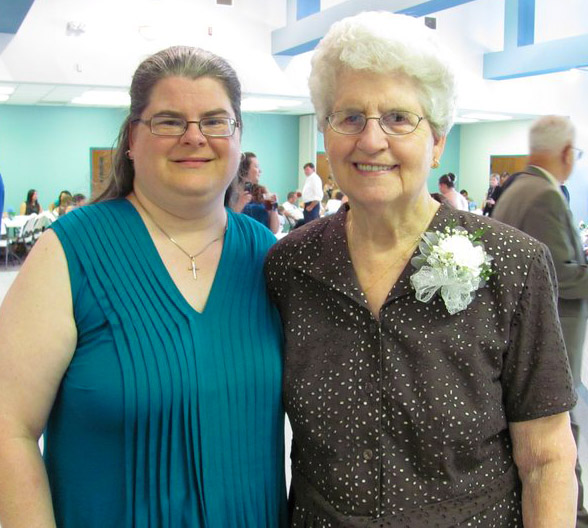
My dear friend Mary Sullivan and her mother, Margaret Sullivan.

My dear friend Mary Sullivan and her mother, Margaret Sullivan.

I’ve been at a loss for words to describe the passing of another very important person in my life. Margaret Sullivan, the mother of my dear friend Mary Kay and grandmother of my BFF (Best Friend Forever) Katie Sullivan Booth, passed away just after I left Virginia last week. Dave travelled to Blacksburg for her funeral, but unfortunately I missed the event.

Margaret was like a second mother to me. She lived less than a mile away and she did her best to take good care of my sister and me. I remember the day we met vividly. She was the dietician for Price’s Fork Elementary School. We’d just moved onto a new place that was close to the school.

It was August 1979 and I was nine years old. Margaret was selling lunch tickets and when I got to the front of the line, she said how glad she was that we’d moved there. She and Mary Kay attended the same church as my family, she said, and she hoped we could car pool to CCD. Answers.com explains that CCD is the name for:

The Confraternity of Christian Doctrine [and it] was an association established in 1562 in Rome for the purpose of providing religious education. In its more modern usage, CCD is the religious teaching program of the Catholic Church. These classes are taught to school age children to learn the basic doctrines of their faith.

As a result, I spent a great deal of time with Margaret.

Over the years, she always encouraged me and praised me for setting a good example for my friends. (Mary Kay, Katie, and the rest of our group were all younger than me.) It was difficult at times, living up to the role she’d cut out for me, but I took it quite seriously. I remember have the gumption to say, “No!” more than once in tenuous circumstances. I felt that the fate of more than me rode on my decisions. All those times I was behind the wheel with them in tow on the way to some 4-H event or other, I surely was in an important position.

In earlier years, our little group spent most New Year’s Eves at the Sullivan house, playing cards and sipping ginger ale in our pajamas at the midnight hour.

Margaret and her husband Richard (a native West Virginian who served in the Army Air Corp in Europe during WWI) were highly active in the local grange hall, where our 4-H club met. They helped raise money for me to study abroad through the International 4-H Youth Exchange (IFYE) program in 1994. (That’s when I met Esther.) A contributor on geocashing.com’s ground speak forums explains: “The grange was a movement/organization started by farmers in the late 19th century (in the northern midwest, I think). It started out as a social organization and later got involved in politics. Grange halls can be found all over the US.

Over the years, Margaret was there to give me helpful advice in areas where I needed it. For instance, when CCD didn’t explain the essentials of life, Margaret lent me books (like those by Judy Blume). Thank goodness for that! I might still be in the dark on life otherwise!!!!! She was an avid reader, as her obituary asserts.

And Margaret stuck by me in my darkest hour of life. When I found I couldn’t be a stellar specimen of humanity in everything I did, she was there to help; she went to bat for me at a critical moment. For that, and for everything she did to help raise my sister and me, I remain eternally grateful.

God bless you, my dear Margaret. May you find peace and joy watching over your proud Sullivan (and Massie) lineage.

Amanda’s Account of the Weekend

You can read Fulbrighter Amanda Burnhard’s description of events this past weekend, by visiting her blog.  Remember, it’s in Irish up top and English down below.

jhohlkennedy's avatarFrom Montague to Galway

A chairde,

Beannachtaí oraibh ar an mhaidin ghalánta seo, ón bhaile eile atá againn i bhFal Corrib, Co. Dhún na nGall. Tá muid suite in aice leis an fharraige gharbh, agus tá an ghaoth thar a bheith láidir, ag corraí an fharraige agus ag cruthú tonnta ollmhór ar na carraigeacha. Seo an áit is fearr linn in Éirinn, agus cuireann sé solas inár gcroí a bheith anseo arís, ar feadh cúpla lá.

Tháinig muid go Tír Chonaill ó Bhaile Átha Cliath an uair seo, mar bhí orm bheith páirteach i dtionscadal físeain ag Fulbright. Bhí mé thar a bheith neirbhíseach leis an fhísean agus, i ndáiríre, níl mé cinnte dearfa cad é a dúirt mé os comhair an cheamara, ach tá súil agam go raibh sé ceart go leor agus go léirigh mé na buntáistí Fulbright mar is cuí. Taobh amuigh den fhísean, chaith muid cúpla lá iontach sa chathair…

View original post 648 more words

Uncovering History at the Cobblestone Pub

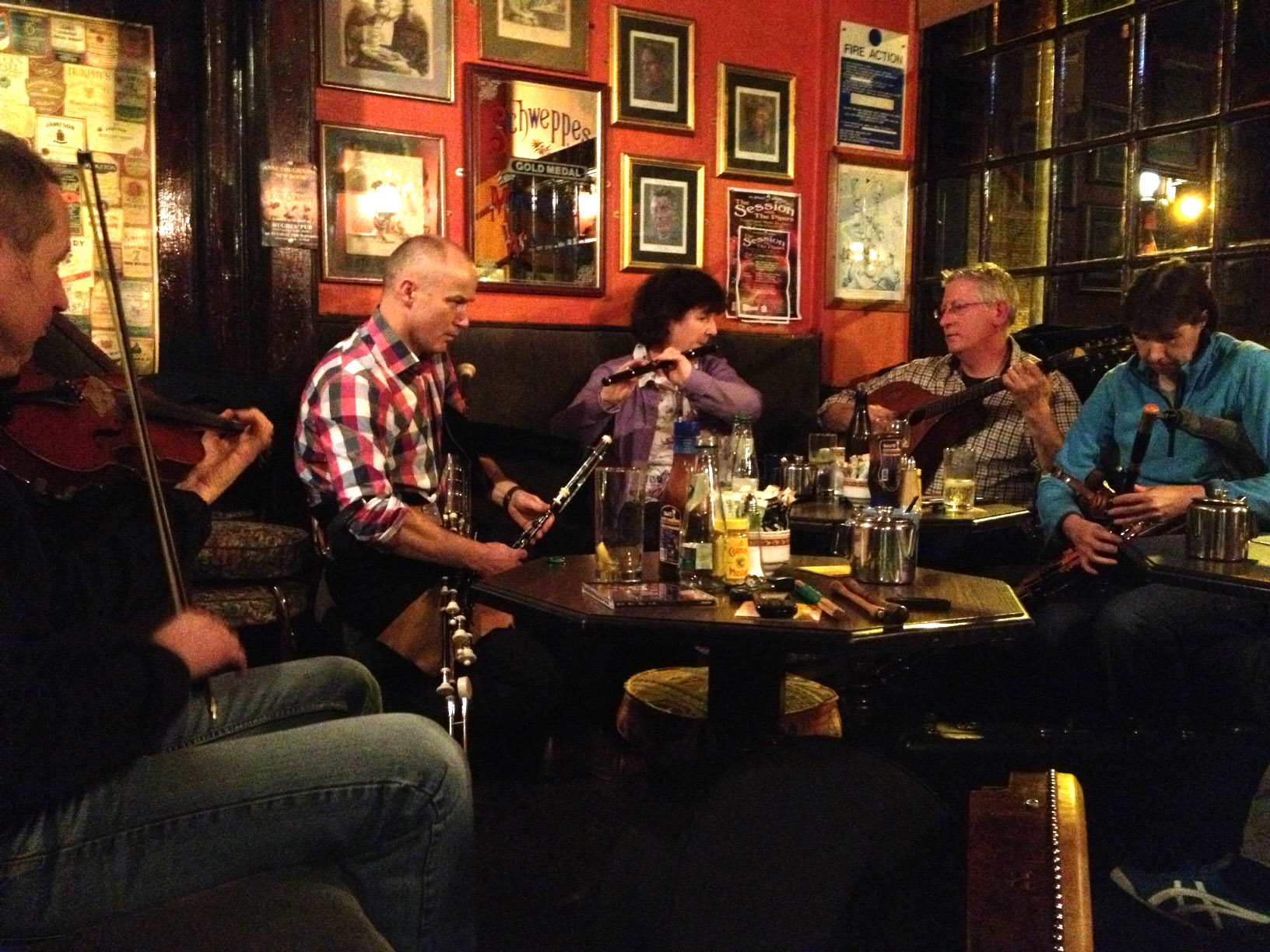
Last week’s impromptu visit by (Fulbright student) Amanda Bernhard and her husband Jonathan Kennedy was a most welcome excuse to visit the Cobblestone!

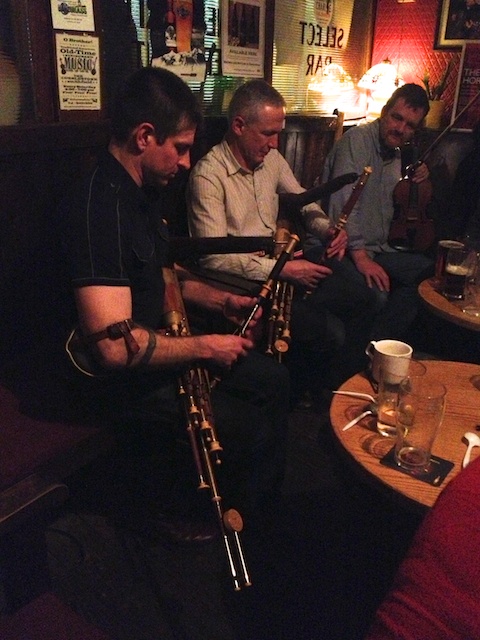
Jonathan Kennedy playing uilleann pipes with an Irish man he has played pipes with the States.

Jonathan Kennedy playing uilleann pipes with an Irish man he has played pipes with the United States.

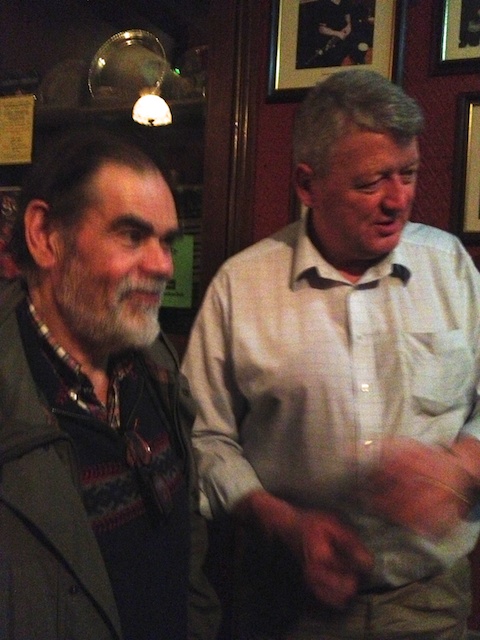
A casteen player with Tom Mulligan.

A casteen player with Tom Mulligan. Tom’s doing his best to keep Irish traditions alive and thriving here in Dublin.

My friends arrived late in the evening Thursday after a day of Irish classes followed by a cross-country drive.

They took me out for dinner at L. Mulligan. Grocer then we popped back to my apartment to fetch their instruments and retraced our steps one block to Tom Mulligan’s Cobblestone pub.

The last two times Jonathan and Amanda went to the Cobblestone I wasn’t with them (they were staying at my apartment while I was away). They went on weekends and the musicians’ corner was already full. They didn’t play then, although they did introduce themselves to Tom.

Last Thursday, however, they found space to play alongside the Irish musicians. We had a great time and enjoyed meeting new people, seeing Tom, and catching up on recent events.

After talking with Tom, I finally understand how Fergus Whelan came to have close friends on both sides of the “Troubles.” He is/was both Protestant and Republican (though today he’s a peacemaker as per my earlier blog). Protestants are typically associated with the other side — usually sticking with the Queen, so to speak — while Fergus apparently supported the unification of Ireland and Irish rule for the entire island. See how much like the American Civil War it all was? As a Virginian, I too had family on both sides of a bitter conflict. And some tensions run high on that conflict even today….

Today’s Geography Lesson

Most recent map for today.

Most recent map for today.

Sitting at home, working on the computer, and listening to nearby church bells ring. Meanwhile my mom sent an email that mentioned:

Had to look up one of the countries on the list!  Everyone’s getting a geography lesson!

I decided a geography lesson wasn’t a bad idea.

I’ve included maps of the places most Americans probably can’t find on an unlabeled map.  I realize that the names of several of these countries have changed in the lifetimes of both my mom and me.  We learned different names when we were in school — so now is a great time to brush up!

I’d had to look up Burundi myself this morning. It boarders Tanzania (where I’ve been twice!?!). It’s to the northwest of TZ. It’s just below Rwanda and is very small.

Map-wise

Exciting additions.

Exciting additions for today.

Cool! I awoke this morning to find two new countries added to my WordPress visitors map: Burundi and Kazakstan.

Look at the size of Kazakstan–it covers a huge area.

Hello Sri Lanka!

Welcoming my first visitor from Sri Lanka today!  The holes in the WordPress map for my blog are starting to fill in.  I was happy to add Peru and a number of countries in Africa recently.  I hope you all will want to keep coming back to read my Fulbright stories….

Screen Shot 2013-02-02 at 4.05.40 PM

Screen Shot 2013-02-02 at 4.05.40 PM

Fulbright Joy at Hughes Pub

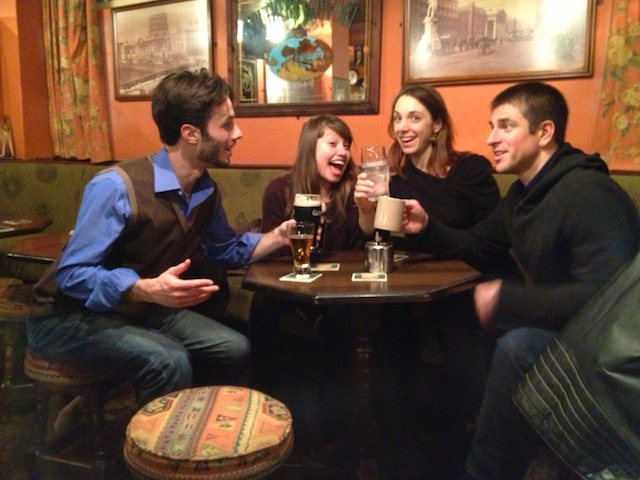
Fulbright Alexander MacDonald, his friend Nora, Fulbright Amanda Bernhard, and her husband Jonathan Kennedy at Hughes Pub last night.

Fulbright Alexander MacDonald, his friend Nora Rodriguez, Fulbright Amanda Bernhard, and her husband Jonathan Kennedy at Hughes Pub last night.

Several of this year’s Fulbright Students to Ireland were invited to Dublin to be interviewed for a Fulbright video. They shared advice for others who want yo apply for student programs to Ireland. Fulbright was reimbursing their travel expenses but we were able to save them some money on housing; Amanda and her husband Jonathan stayed with me instead of a hotel.

After the interviews, two of the students, their significant others, and I went out to chat about our Fulbright experiences.

We found Jack Nealons pub too loud for easy conversation last night, so we skipped down the way to M. Hughes Pub. (Their names don’t have apostrophes in them. I’ve aimed for accuracy here….)

Hughes pub has the added benefit of being a late night venue. Last call is 2 AM at least on weekends, I do believe, while many other pubs stop serving hours earlier.

Hughes pub was perfect for the talking we wanted to do — the regular Friday night musicians were playing in the snug. Last night we sat outside the snug but we could still hear the music in the background. The level was very comfortable for talking and laughing. And that we did!

So what’s a snug? It’s an enclosed room, where in the distant past women were allowed to gather and drink. Back then, they weren’t allowed to be in the main (men’s) part of the pub. You’ve seen pictured of the snug before (It’s where brothers Gavin and Aidan Duffy play on Monday nights — I’ve attached a photo here in case you didn’t see that post).
the Duffy brothers playing in the snug at Hughes Pub last fall.

The Duffy brothers (to the left) playing in the snug at Hughes Pub last fall.

I learned all this from Saul Golden who teaches at the University of Ulster and whom I met at the All Ireland Architecture Research (AIARG) last weekend. You didn’t get to her Saul’s description, so I searched on line for a defnintion.

 The Free Dictionary offers this explanation:

snug 2 (sng)

n. Chiefly British

A very small private room in a pub.
[Short for snuggery.]

We asked the bar man about the snug (to confirm my suspicions that that little room actually was one). We talked theory. We joked around. And, we had some fun with the camera. A little about the characters of the night:

Alexander MacDonald is a highly accomplished tap dancer who hails from New York City. He is currently working on a Master’s degree at the University of Limerick. He is studying enthochoreology (which is the history of choreography in various cultures). He’s got two tapping videos on line, one improv and one from a party.

His friend Nora Rodriguez is from Mexico. She is working on a Master’s degree in contemporary dance performance. It was the first time Amanda, Jonathan, and I got to meet Nora, and we enjoyed out time with her immensely.

If you’ve followed this blog, you already know that Amanda Bernhard is a Fulbright who is working on a Master’s degree in Irish at the University of Galway. Her husband Jonathan is enrolled int the same degree program. They are very excited about the dialectology (theory and study of dialects) course they are taking this semester.

Immersion experiences like the one we’re in prompt reflection.  We’ve all be soul-searching.  Our evening at Hughes’ gave us an opportunity to share our thoughts and experiences — and to consider them in new ways.
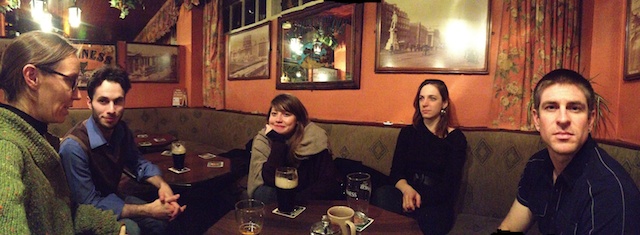
I wanted to get in the photo, too, so we all had to be very still while I took a panorama.  (Shannon Chance, Alexander MacDonald, Nora, Amanda Bernhard, and Jonathan Kennedy at Hughes Pub last night.)

I wanted to get in the photo, too, so we all had to be very still while I took a panorama. In this photo Shannon Chance, Alexander MacDonald, Nora Rodriguez, Amanda Bernhard, and Jonathan Kennedy contemplate the photographic procedure.

Nora was fascinated by the story Amanda, Jonathan, and I told of the car fire we’d just witnessed beside my apartment building. She was captivated by the story but, just having seen Quentin Terintino’s newest flick, though the photo didn’t live up to the image our story had painted in her head. Nevertheless, I assure you the events were dramatic. Jonathan had insisted on taking a closer look, and as a result, we witnessed a lorry (i.e., truck) driver speed up to help. He jumped from his truck cab, extinguisher in hand, ran to the car and valiantly fought the blaze. The driver and her son had fled the vehicle after it burst into flames.

Amanda and I each recalled that time went into slow motion as we watched these event. We noticed many interesting details. We found the event to be quite dramatic!

Expanding your Learning Styles

Iroda Karimova said in earnest that she misses my crits! (!?!!??)

As per my prior post, Iroda Karimova said in earnest (while I was visiting the Hampton University Department of Architecture two weeks ago) that she misses my crits! (!?!!??)

Because I’m an active blogger I’m forever getting the question, “Do you ever work?”

The answer is yes; here’s a quick example.

My former student int he Department of Architecture at Hampton University, Iroda Karimova, emailed this to me from her smart phone today:

It was also nice to talk to you too. We haven’t see you for a while. I hope you are enjoying your oversea experience. I sometimes read your blogs, to see how you we doing.

Yes sometimes I wish I could hear your critiques, especially when I did good :). Your critiques were short, to the point, emphasizing important accomplishments, and sometimes not too enjoyable but helpful.
 
 Thank you for sending me this post.
 See you soon.
____
Whew! It sounds like I was doing my job correctly. Part of that  job is to help students learn to evaluate their strengths and weaknesses. I’ve got to challenge them to address weaknesses I see. Effective teaching requires a careful balance of challenge and support (Sanford, 1962). I aim to provide that and to help students reach just a bit farther than they are comfortable doing (this is called a “plus-one” approach to teaching).
Good students, like Iroda, recognize that challenges are presented to help them grow and that the professor’s main role is to help guide them in their own learning. Receiving critique is never pain free, but it is necessary for growth and development.
Here’s the very quick reply I dashed off:
Thanks for your note, Iroda!  

 
You always do excellent work.  I wanted to make sure to help you reach for the stars, though.  You’re really terrific at technical ways of thinking.  As a second-year instructor, my job is to try to help students develop fluency in multiple ways of thinking… particularly the ways they find foreign or uncomfortable.

 
I’ve attached a chart to explain (it’s from a paper I was working on Tuesday). Most students come to college very good at one corner/quadrant of the chart. You were exceptionally good at Convergent thinking. I’d say you left second year with new skills in that realm, but more importantly, with new skills in the other three quadrants as well.
 
Cheers,
Shannon
_____
Below is a chart I made to describe Kolb’s (1984) theory. It is based on a similar chart published by Evens, Forney, and Guido-DiBrito (1998). You can read more in the paper I created for the National Conference on the Beginning Design Student (MADE Proceedings Chance Writing Architecture). If you reference it, please cite the source. The citation for the paper is:

CHANCE, S.M. (2010).Writing architecture: The role of process journals in architectural education. MADE: Design education and the art of making (160‐170). Charlotte, NC: College of Arts + Architecture. Presented at the 26th National Conference on the Beginning Design Student in Charlotte, NC.

Kolb chart by Shannon Chance

RoboSumo at DIT

RoboSumo video is available to view at by clicking here.

A video of a past RoboSumo competition is available to view at by clicking here. The competition is just getting underway now for this year… in fact, there’s still time to register for the DIT class!

One of the things I have been studying here in Dublin is the use of hands-on projects to teach engineering. One example is a very popular electrical engineering course at DIT called RoboSumo.

People who teach this course include Ted Burke, David Dorran, and Damon Berry. Richard Hayes tends to show up at RoboSumo events, too, as do many of the other lecturers. (Ted’s probably going to read this and he’ll likely send me and update of who’s teaching “on the module” this semester so I can tweak my list — I know mine isn’t complete. By the way, I appreciate having you in my audience, Ted!)

Suffice it to say, the whole program gets jazzed up about RoboSumo events. Even the Dean (Dr. Mike Murphy) can be seen in the video of the final competition.

There’s a bit of information about the class on line. The General Rules page explains:

Two robots compete in each bout, each trying to stay in the arena longer than the other robot. Robots are encouraged but not obliged to actively push their opponent out of the arena. … The bout ends either when a robot leaves the arena or once 1 minute has elapsed, whichever occurs first. If only one robot remains in the arena at the end of the bout, that robot is the winner.