Defining the Street in Dublin and Ballsbridge

Parnell Street

Parnell Street

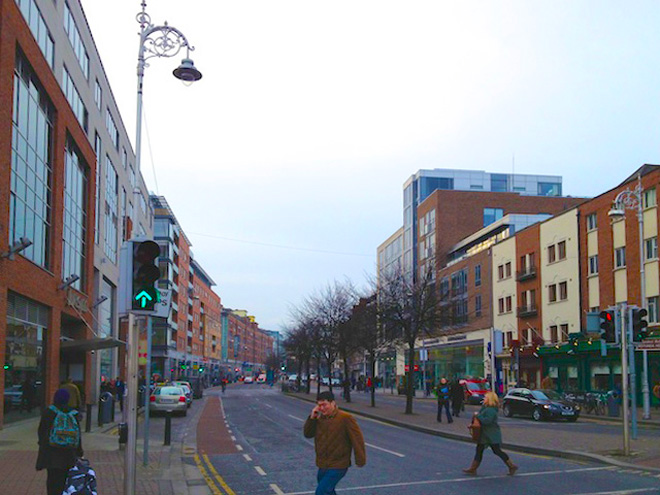
In my opinion, good city buildings touch each other and define the street. They don’t have to be glamorous to make good urban fabric. When building work together, they create good spaces for people to enjoy.

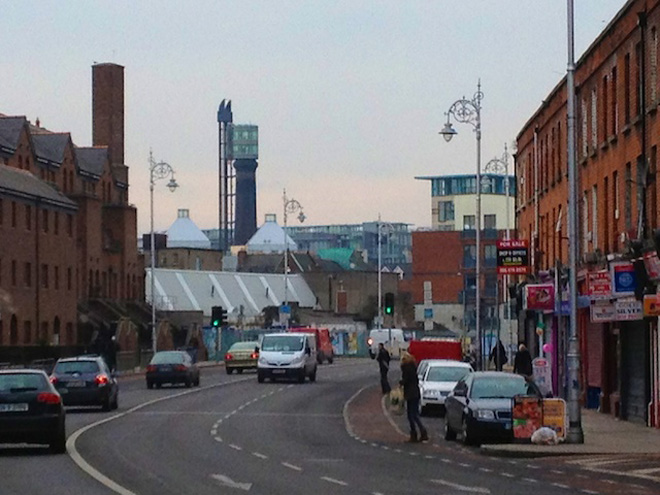
I’ll give two quick examples of clearly defined streets. These two streets are near my apartment in Dublin. Unfortunately, they are both designed for cars–not people.  Nevertheless, the buildings work together to define space. On Parnell Street, the buildings support a good mix of uses and are close enough together to provide the density of population needed to support ground-floor retail. Residential density is lower a few blocks away, on North King, and ground-floor business are fledgling.

North King Street -- view toward the Jameson Distillery smokestack -- where density breaks down.

North King Street — view toward the Jameson Distillery smokestack — at the point where density breaks down.

Simply put, a proper mix of residential and office space is necessary to support ground floor restaurants and retail. By providing residential as well as working space, mixed-use districts are active throughout the day. Businesses can draw customers morning, noon, and night.

Having the right mix in your district ensures you’ll be able to get the services you need without getting in a car. (Oh, that we’d build this way in the States! Walkability is so rare in cities back home.)

I was reminded of all this last Thursday, when I travelled to the Fulbright office in Ballsbridge to help interview Fulbright applicants. It’s in the outskirts of Dublin. Although this is a suburban neighborhood, it is still dense by US standards. Notice that there’s more space between buildings in Ballsbridge than in Dublin city center, but that there’s still a good mix of uses/services. Nevertheless, some buildings contribute much more to the life of the street than others!

Putting a Spring in Tommy’s Step

I’m sitting at my computer in Dublin today, working on papers for two different conferences. A video just appeared on my Facebook feed to brighten my day! My nephews Christopher and David are helping their little brother Tommy shore up his walking skills. Tommy took his first steps just about an hour after we left their house one week ago. Interestingly, Christopher did the same thing two years earlier–taking his first steps while we were in transit home.

The boys are clearly delighted with Tommy’s new accomplishment! Lucy sent me a copy of the video so I could share it with you:

Error
This video doesn’t exist

The boys also wanted to say ‘Hi!”

Error
This video doesn’t exist

My Sis Celebrating the Innaguration

Although I spent Monday in bed, I lived vicariously through my sister. Heather drove from New York to DC to witness another historic inauguration and hear Mr. Obama’s address. Thanks for representing our little branch of the family, Sis!

20130125-210405.jpg

Counting Time

Amanda and Jonathan at Cobblestone. (Copyright Dave Chance Photography, 2012.)

Amanda and Jonathan at Cobblestone, from an earlier blog post. (Copyright Dave Chance Photography, 2012.)

I’m sitting here counting time, waiting for my co-authors to send updates and Dave to finish editing some pictures so we can head off to see the nephews one last time before I fly out.

Meanwhile Jonathan and (Fulbright student) Amanda are visiting Dublin, and getting my apartment broken back in for living. Jonathan has just posted on Facebook the praises of the IKEA Poang chair (that I bought using Adverts.ie). I highly recommend buying it with the matching footstool.

Amanda and Jonathan are heading off to play at the Cobblestone pub tonight… I’d love to be there to hear them play!  I’m living vicariously through the photos Dave took last time they played there.

Blog Tips 4: Publicizing your Fulbright Blog

We're not in Kansas anymore, Toto! (Image posted onFlickr by James Clark -- http://www.flickr.com/search/?w=all&q=james+clark&m=text)

We’re not in Kansas anymore, Toto! Let’s tell our story…. (Image posted on Flickr by James Clark.)

This is the final installment of a four-part series on blogging. The full set includes:

  1. Why Blog about your Fulbright Experiences?
  2. Choosing and Adapting to your Blog Platform
  3. Finding your Blogging Niche
  4. Publicizing your Fulbright Blog

Fulbright’s sponsors encourage the students and scholars who receive Fulbright grants to blog about their experiences. They want to publicize the Fulbright program, the work we (their Fulbrights) are doing, and the cultural nuances we are discovering. They want us to share who we are and what we learn. Why not generate as much good publicity as we can?

If you’ve gotten your Fulbright blog up and running, you are ready to publicize your work. (If, on the other hand, you haven’t gotten started blogging because you’re still feeling overwhelmed by technical issues, you may want to check out Daniel Piechnick’s Website Setup Guide 2013: The Dummies’ Guide to Setting Up a Website.)

Based on past blog tips I’ve posted, you may have determined what level of privacy you desire. This matters because everyone in the world will be able to see what you post on a public blog site.

You may have shied away from being very open or very public about events in your life, but even if you don’t want to be highly public about everything you do, you will probably want to your friends and family know about your blog. In one fell swoop, you can notify them of the blog’s existence and invite them to receive automatic emails of everything you post. (If you are using WordPress, you can find the tools on your Dashboard — just look for the “users” button and then “invite new.”)

If you’re feeling ambitious, you may want to invite everyone in your contacts list.

Today we've got new technologies. (Image downloaded from Tumblr -- http://www.tumblr.com/tagged/telephone%20game)

Today we’ve got new technologies. (Image downloaded from Tumblr.)

And if you’ve decided to “go for the gold,” and to use your blogging efforts to full affect, you can generate a wide audience. The following tips can help:

  • Register with Google, Bing, and other search engines so you show up when people use them to search the web (WikiHow can help, as can the WordPress “Publicize” page).
  • Sign up to receive automatic mailings of your own postings (in other words, invite yourself to be a “user” so that the system will automatically email you a copy of each post). This is a good way to keep records for your files. Doing so can help when you go to compile formal Fulbright grant reports.
  • Once you receive an email about a post that mentions a person, organization, or business, forward a copy of it to those people. Doing so helps people know they’re appreciated and it increases interest in your site.
  • Forward a copy to other people you think would be interested.
  • Set your blog platform to automatically load notification of each blog post to Facebook, Linked In, Twitter, and the like. (I’ve chosen to upload to Facebook manually, because I want the option to select which photo Facebook posts.)
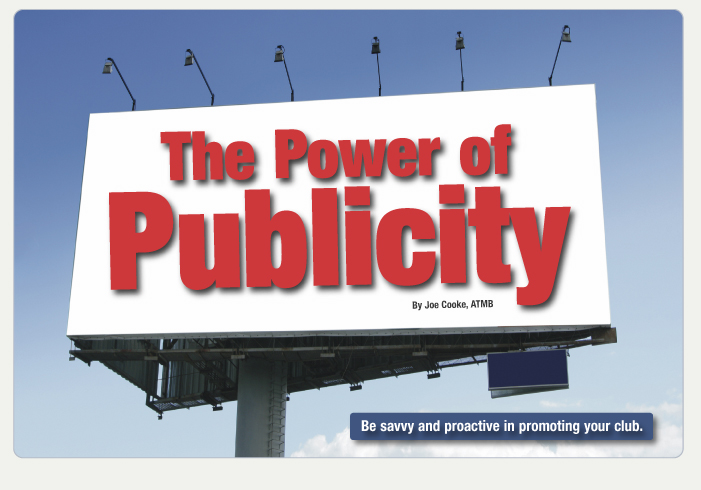
And they can help us spread the word. (Image downloaded from Toastmasters -- http://www.toastmasters.org/ToastmastersMagazine/ToastmasterArchive/2008/September2008/ThePowerofPublicity.aspx)

And they can help us spread the word. (Image downloaded from Toastmasters.)

You can load notifications to your personal page in Facebook, or you can set up a Fan page for your blog. You’ll need the Fan page if you want to enable visitors (to a WordPress blog) to click “like.” Keep in mind that only people who have “liked” your page will see posts you stream to that Facebook page. As a result, I chose to stream posts to my own personal Facebook page which has far more “friends.” (And, thus, I’ve not yet made good use of my Fan page.)

Jonathan Kennedy (the spouse of a Fulbright) clued me into the value of using Facebook “likes” to tag businesses and organizations you want to become more involved with in your new Fulbright home. I subsequently realized that I could increase interest in my blog by posting links on the Facebook pages of those businesses and organizations when I mention them in a post.

WIth today's Internet you are always "On Air." (Image from National Publicist -- http://www.nationalpublicist.com)

WIth today’s Internet you are always “On Air.” (Image from National Publicist.)

There are many good sources of help on line. For instance, WikiHow has a post about using social media to create interest in your blog. It recommends (and explains how) to:

  1. Interact with other blogs.
  2. Cross blog! (As in, posts links to your past blogs in your new blogs, which I frequently do.)
  3. Submit your posts and links to your blog on tools like forums, discovery engines, peer-sourced news feeds and social networking sites.
  4. Write great headlines and subject lines.
  5. Step back and analyze your blog as objectively as possible.
  6. Stay consistent. (As in, post frequently.)

Regarding search engine optimization, WikiHow discusses:

  1. Research “Search Engine Optimization” which is also known as SEO.
  2. Consider manipulating your content to include more key words.
  3. Link to popular blogs you like and websites relevant to your topic.

In signing out, I’ll mention one last, critical point about Fulbright blogging:

It goes without saying that in everything you do as a Fulbright, and particularly on the on the Internet, you’re a cultural envoy. Your job as a Fulbright is to facilitate and grow cultural understanding and respect. That means, of course, that you need to consider what you post from multiple perspectives and stay positive in what you post about your hosts.

Flimerz explains "you can draw viewers by connecting with your audience." (Image form Flimerz -- http://blog.filmerz.com/producing/?target=209&entry=Drawing+Viewers+By+Connecting+With+Your+Audience)

Flimerz explains “you can draw viewers by connecting with your audience.” (Image from Flimerz.)

Anil Dash provides "A Blog About Making Culture." (Image from Anil's blog site -- http://dashes.com/anil/2010/02/the-power-of-the-audience.html)

Anil Dash provides “A Blog About Making Culture.” (Image from Anil’s blog site.)

Starting your Fulbright Scholar Application

Fulbright logo

If you’d like to become a Fulbright Scholar, now is the time to start your application! Don’t put it off another minute….

This year’s competition opens February 1. Applications for the core scholars program are due August 1. Other deadlines are listed on the Fulbright website. This page has information for US and non-US scholars. (Information on Fulbright Student programs is available here.)

Andrew Riess <ariess@iie.org> of the Fulbright Scholar Program emailed the following note today.  He’s offering a Webinar about how to prepare your application. I took part in  one of his Webinars while I was preparing my second application (which met with success).

Dear MyFulbright Community Member,

Please join us for a Webinar on preparing to apply for your Fulbright from 2:00 pm to 3:00 pm (Eastern Standard Time) on Wednesday, January 16.  The competition opens February 1 and now is a good time to think about what is needed to apply.

This Webinar will include a discussion of what is involved in the process of finding an appropriate program and the materials that will be needed for application.

Reserve your Webinar seat now at https://www1.gotomeeting.com/register/427536544.

You’ll want to review the Catalogue of Awards for this year. The Catalogue of Core Scholar Awards may be what you need, although there are also specialized programs for Specialists, Distinguished Chairs, and the like.

Mapping the Moving Dream

Venetikidis's dream for Dublin. (Image downloaded from http://www.theatlanticcities.com/commute/2012/10/confusing-and-nonsensical-grandeur-dublin-transport/3657/)

Aris Venetikidis’ dream for Dublin transport. (Image downloaded from The Atlantic Cities.)

For an architect/urban theorist/planner like myself, Dublin’s transportation system seems to defy logic. I lack the adjectives to describe it.

But Eric Jaffe depicted the situation effectively in his October 2012 article in The Atlantic Cities.

His piece, titled “The ‘Confusing and Nonsensical Grandeur’ of Dublin Transport,” highlighted solutions posed by Aris Venetikidis, a skilled and clairvoyant graphic designer.

Apparently when Venetikidis arrived in Dublin, he was as perplexed as my sister and I about the lack of a comprehensive transportation network map. It’s a guide we look to in other cities when we want to travel around. We consider it essential.

Venetikidis let this frustration blossom into beauty. Like Colin Broderick, he too created a map of existing routes.

And then Venetikidis took this work a step farther.  He researched the history of past proposals. And he designed several new maps. They illustrate how various moves could improve transportation by making the network more coherent.

Jaffe’s article on the topic is worth a read… I thank Fulbrighter Amanda Burnhard for send it my way!

Blog Tips 3: Finding your Blogging Niche

An image downloaded from Blogging Help http://cpd.nottinghamhighblogs.net/2011/02/07/blogging-help/

An image downloaded from Blogging Help.

This is the third of a four-part series on blogging. The full set includes:

  1. Why Blog about your Fulbright Experiences?
  2. Choosing and Adapting to your Blog Platform
  3. Finding your Blogging Niche
  4. Publicizing your Fulbright Blog

Blogging can be a daunting task. Fortunately, it’s not too hard to get your self on track to a successful — and rewarding — Fulbright-blogging career. You can lay a strong foundation by considering: what niche your work can fill, what voice you will develop, what look and feel your site will have, and how you can get the most intellectual payback out of your own work. This blog discusses how.

Niche / Topic

Is there some subject you love to tell others about — or a unique perspective you can offer the world? (As your dissertation advisors would have said: is there a hole in the on-line knowledge base that you can help fill?)

If you’re a Fulbright, you likely have a specific area of expertise that you can help others understand!

There is a group of blog-writing Fulbrighters in Ireland this year. We all started by saying we’d describe our year-long experience. That alone is something of a niche… but being event more specific can give a blog more ump. We all sensed that and we each defined some sort of focus: design and photography (for me), language prowess (for Amanda Burnhard), and family growth (for the McDonald family).

An important consideration in defining your niche is that the straightforward diary approach necessitates posting a good deal of personal information (that is, if it is to intrigue a soul). So, when you think about it, you may decided you are more comfortable blogging about the subject you are teaching or studying during your Fulbright.

Know that if you’re teaching as a Fulbright, you’re already practicing the art of explaining ideas to a new audience. Why not break it down a little farther still, and post some intriguing concepts in a way that a general audience can understand?

If you’re researching as a Fulbright, this experience can help you learn to write in more interesting ways.

A cartoon about blogging, posted on the blog Ghost Stories and Haunted Placeshttp://ghoststoriesandhauntedplaces.blogspot.com/2010/12/year-of-blogging-and-time-for-me-to.html

A cartoon about blogging, posted on the blog Ghost Stories and Haunted Places.

In case you’re still puzzled about how to find your niche, the ETSY Blog Team recommends these simple steps:

  1. Follow your Passion! Write down topics that you would like to talk about, grab a pen and paper and list 20 or so activities and Hobbies that you like {Crafts,Photography,Cooking}.
  2. Narrow down your List! Would you be happy if working on this was your daily job? Do you have any particular skills or knowledge in that field? For Me, Love to write! It makes me happy! So I will write on my blogs for as long as I can.
  3. Access your Competition! As a mom Blogger myself, I can assure you that there are a lot of other “Mom bloggers our there”. That doesn’t get me down, It just make me want to succeed more and more with my blog. It makes me want to be Unique! To Write my own content and in my own way. I advise you to do the same!
  4. Know the Purpose of your blog! Is this your personal blog? Or Business? Are you wanting to make money from your blog? Or do you plan on making money in the future? {Coming soon a post about how to make money blogging}.
  5. Still Don’t have a Niche? Not a problem! I know a lot of successful blogs that write about something different everyday! There is nothing wrong with that! It’s your Blog so make it yours and write about what you are passionate about.

Voice / Tone

It’s important to identify who your audience is likely to be so you can work to engage them.  For me, knowing who I am talking “to” helps make the writing more fun. And, as The Blog Maven rightly asserts, “If you sit down to write a post and you leave your personality at the door, you’re selling yourself – and your readers – short.” I completely agree!

Note that your audience may grow and change over time (your blog’s stats feature can help you determine if it’s changing). That’s much of the fun of being a Fulbright. In the past couple months I’ve run into dozens of people — both in Dublin and at home — who have read my blog and want to know more about some topic or other that I introduced on it. As I said before: that helps me know I’m doing my (cultural-exchange) job!

By blogging regularly, adjusting your tone and pace, and determining what you and your audience most enjoy, you’ll find your own blogging voice. Will you, for instance, “speak” slowly and precisely or quickly and casually on your blog?

Tony Teegarden posted the following helpful advice, saying If you want loyal readers:

  1. Stand for something
  2. Provide good, quality content (helpful & useful)
  3. Be unique in your voice (delivery)

Some benefits of a unique voice are:

  • You attract readers of like mind
  • You become more engaging
  • You build more trust with your audience
  • You have a higher chance of turning readers into customers
  • You have a lot more fun doing it (enjoy the process)

Look / Format

Once you have determined your tone and favored subject matter, you can chose a blog template to match. Some template are designed for words — others for video, photography, or visual portfolios. This is your opportunity to coordinate the look, feel, and content of your site. I felt lucky to find a weathered looking template in green and blue that reflected the title I’d chosen, Ireland by Chance.

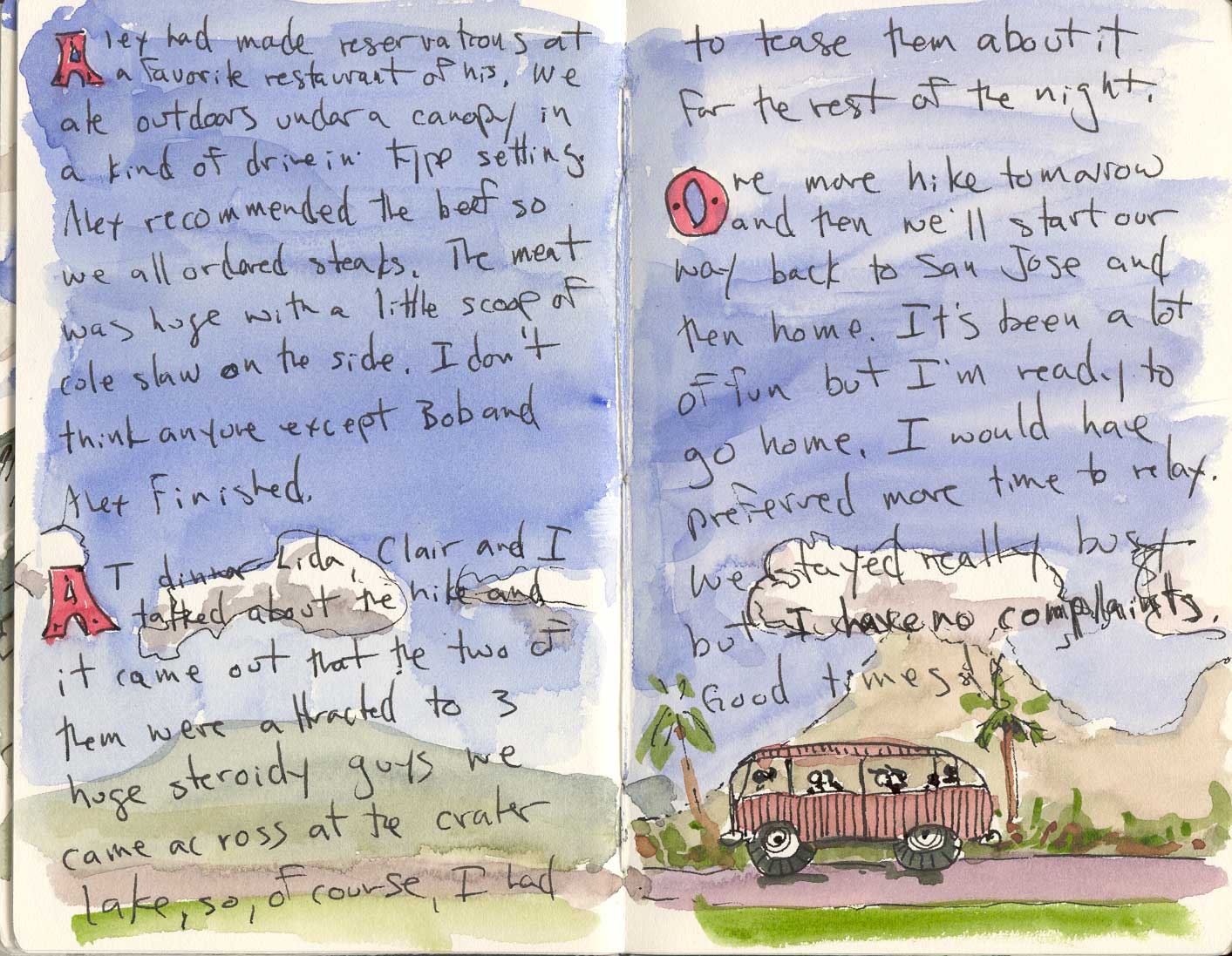
Old fashioned travel diary posted on Bill Sharp's blog http://billsharp.files.wordpress.com/2007/04/cr-journal-page-16.jpg

Old fashioned travel diary posted on Bill Sharp’s blog.

Get More Mileage

Clearly, as a Fulbright, you’re an extremely busy person! You’ve got to find ways to get the most mileage possible from your time. I reiterate: You simply must get more out of this task than just meeting CIEE’s expectation that you build a blog.

It’s too good an opportunity to waste!

Please take the time to ask yourself upfront:  What do you want to learn?

I wanted to learn about writing for a popular audience. I also wanted to share what I’d be seeing, doing, and thinking with family and friends. I wanted to have a colorful record of my adventures — and perhaps a legacy of sorts.

Other Fulbrigters are at work creating their won legacies. One is using her Irish blog to practice their language skills and another to record her family’s development….

Amanda Burnhard‘s blog is called From Montague to Galway: A Blog about Our Year in Ireland, Studying the Irish Language. It gives her a venue to practice writing in the Irish language. She posts everything in Irish and then, below that, in English.

Amanda’s blogging helps her connect to the people she’s meeting in Galway. It also helps people back home understand her experiences living abroad. But more importantly — in the big scheme of things — Amanda and her husband Jonathan are helping preserve use of Irish language and knowledge of traditional music. Amanda’s blog thus represents a contribution to humanity’s knowledge base about the Irish-speaking parts of Western Ireland. How cool is that?

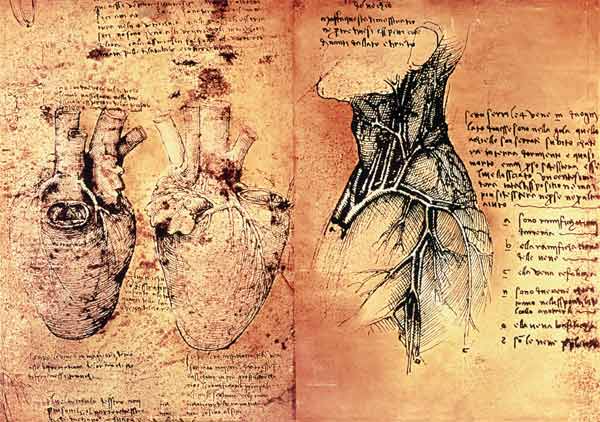
Leonardo da Vinci "Anatomical drawing of hearts and blood vessels from Quaderni di Anatomia vol 2; folio 3v"     http://www.art-prints-on-demand.com/kunst/leonardo_da_vinci/Anatomical_drawing_of-hearts_and_blood_Leonardo_da_Vinci-1.jpg

Leonardo da Vinci’s “Anatomical drawing of hearts and blood vessels from Quaderni di Anatomia vol 2; folio 3v” (Image downloaded from Art Prints on Demand.)

Another interesting thing we can learn from Amanda (the Fulbright) and Jonathan (her husband) is how to use a team approach. Jonathan is active on Facebook and he brings their Fulbright-related experiences to that venue.  Amanda has chosen a more reflective working environment. She limits her social media activity to the blog. (Incidentally, Amanda posted a blog about staying at my apartment while I was out of town before Christmas, and an earlier entry that included a photo of Dave and me.)

Scott and Christine MacDonald developed yet another approach. Christine (the spouse of a Fulbright) is the one blogging about their Fulbright experience. Her blog is called A Year in Ireland. Christine’s blog provides a glimpse of what it is like to bring a family along on the Fulbright journey — something Fulbright Ireland encourages and endeavors to support.

In parting, I’d like to note that Leonardo da Vinci made regular practice of journaling. What an incredible legacy he left us in his journals!

So let us proceed boldly in our blogging adventures, my Fulbright friends, in hope that journaling will help us create a better world and inspire others to do the same.
A page from Leonardo DiVinci's journal, downloaded from Ashley Foden's blog http://ashleyfodendesigns.blogspot.com/2011/10/sketchbook-examples.html

A page from Leonardo da Vinci’s journal (downloaded from Ashley Foden’s blog).

Fulbrights at “Work”

Because I blog about the experiences I’m having much more often than about than the research I’ve been doing, people sometimes ask me if I’ve been getting any work done at all.  The answer is, emphatically, YES!

The Fulbright program IS about doing scholarly work.  But it’s also about learning. It’s about making the space in our lives to get to know other people and how they do things… to remove ourselves from the ordinary humdrum long enough to learn something that’s radically new to us as Americans, but not new at all in other places.

Fulbright scholars DO have lectures to give, papers to write, and projects to conduct.  But in the end, the most valuable part of our experiences overseas rests in the friendships we make and the respect we build for each other’s culture.  That, I see, as my primary mission.

This type of cultural give-and-take is evident in the images I brought back from Tanzania — so I’ve decided to share a few here. Most are from the 2005 Fulbright-Hays program I conducted for college students from the US and Tanzania. You can also read about a lecture I gave on the topic of African architecture.  I’ll be delivering that lecture again in Belgium this spring….

Hello to Africa!

Welcoming new visitors from Africa.

I’m excited to welcome new visitors from Africa.

I’m happy to report that people from three different countries in Africa have found their way to this blog in the past few days.

It appears that some places in the world are more difficult to reach via blog than others: the region around China, the Sahara, and Greenland are still missing from my map.  Perhaps that says something about the distribution of population (Greenland and parts of Africa), resources and Internet access (parts of Africa and China), and restricted freedom of information (China)?

In any case, I’ve enjoyed sharing ideas with my African friends ever since my first visit to Tanzania (in 2003).  Since then I’ve returned to Tanzania and visited South Africa and Tunisia (all with students) as well.

A highlight of my life experience has been the Fulbright program I conducted in Tanzania in 2005, though I am still working to make sense of many things I saw and experienced.

Fulbright-Hays flier. Program conducted by Shannon Chance (PI) on behalf of Hampton University and the US Department of Education.

This is a flier for the Fulbright-Hays program I conducted on behalf of Hampton University and the US Department of Education.  (I wrote a grant proposal that was accepted, and I served as Principle Investigator of the grant and also as director of the program.)  In the group photo, I’m standing second from the right.  Many people in this photo are my friends on Facebook still today.