UO Studio Review

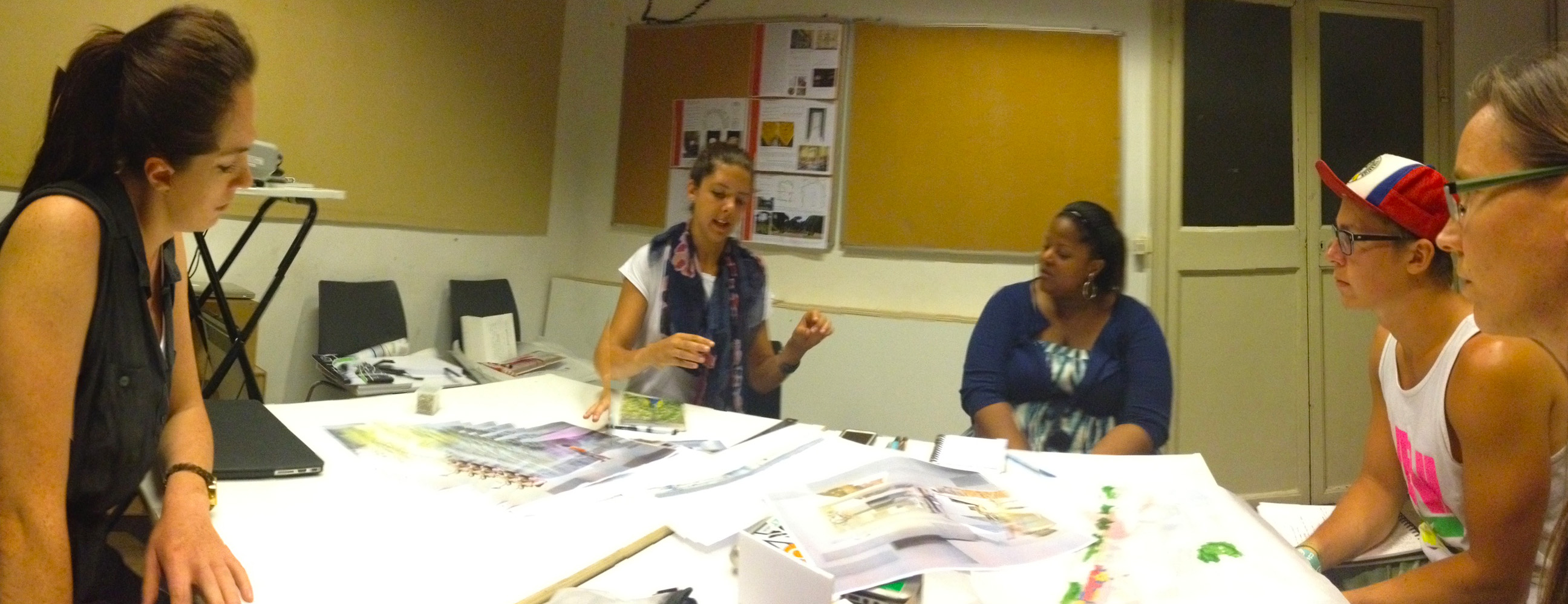
Taylor, Katie, Daisy, Cody, and me deep in conversation over a design proposal.

Taylor, Katie, Daisy, Cody, and me deep in conversation over a design proposal.


On Tuesday, I delivered a lecture to the University of Oregon architecture students here in Rome.  Daisy made me feel like a million bucks with her introduction!  We worked together at Hampton University from 2005-2010 and got to know each other well.  I miss her, but I’m thrilled that she’s doing so well for herself!

In the talk, I shared examples of the research I’ve been doing and  discussed the need for architects to expand their research abilities.

After the lecture, three of the students presented their design progress. Daisy, the other students, and I gave feedback and ideas for further development.

Drawing Conclusions in Paris

Sketching in Luxembourg Gardens

Sketching in Luxembourg Gardens

Pam Eddy and I attended the World Academy of Science, Engineering and Technology (WASET) International Conference on Higher Education yesterday. We each presented a paper. When the activities wound up, we headed out in different directions. Pam went to hear a lecture at UNESCO that she’s received a special invitation to attend and I went to study the architecture of Paris.

I sketched in the Luxembourg Gardens and in a church that I’d discovered two days before.

Pam and I met back up for dinner with Pam’s husband Dave. After dinner, we strolled through central Paris–discussing things we’d concluded about the city on our earlier explorations.

MOOCs, TED, and Online Courses

I’ve been following the development of online education and MOOCs, in part because I hope someday soon there will be a way for me to earn a certificate or degree in structural engineering using an online format.  I’d love to learn from the very best professors in the field! The tools for assessment are developing beautifully.

Salman Khan’s TED talk, about the Khan Academy, blew my mind. What this man is achieving and offering to society is absolutely amazing.

I’ve been intrigued to learn, also by watching TED videos, about Corsera‘s new achievements. Five of Corsera’s programs were recently endorsed for meeting the standards of university coursework.

The image below illustrates what I’d already heard: college costs six times more than it did the day I started.  This spike began while I was in college, and I faced mid-year tuition hikes. How do students in the US manage to repay their loans?

TED’s website explains:

Daphne Koller is enticing top universities to put their most intriguing courses online for free — not just as a service, but as a way to research how people learn. With Coursera (cofounded by Andrew Ng), each keystroke, quiz, peer-to-peer discussion and self-graded assignment builds an unprecedented pool of data on how knowledge is processed.

I recently received a request via email to share some images with you — I’ve included a thumbnail below that you can click to view.

Hi Dr. Chance,

I wanted to reach out to connect with you about a graphic that I helped create which takes a closer look at MOOCs and their recent growth in the education space.

I came across this post on your site: shannonchance.net/2012/11/13/whats-a-mooc-and-can-it-save-humanity/ – and given that you might have an interest in the topic, I wanted to see if you’d be interested in taking a look and/or sharing the piece with your readers. If so, let me know and I’d love to pass it along!

Thanks,
Allison M.

Finalizing and Testing

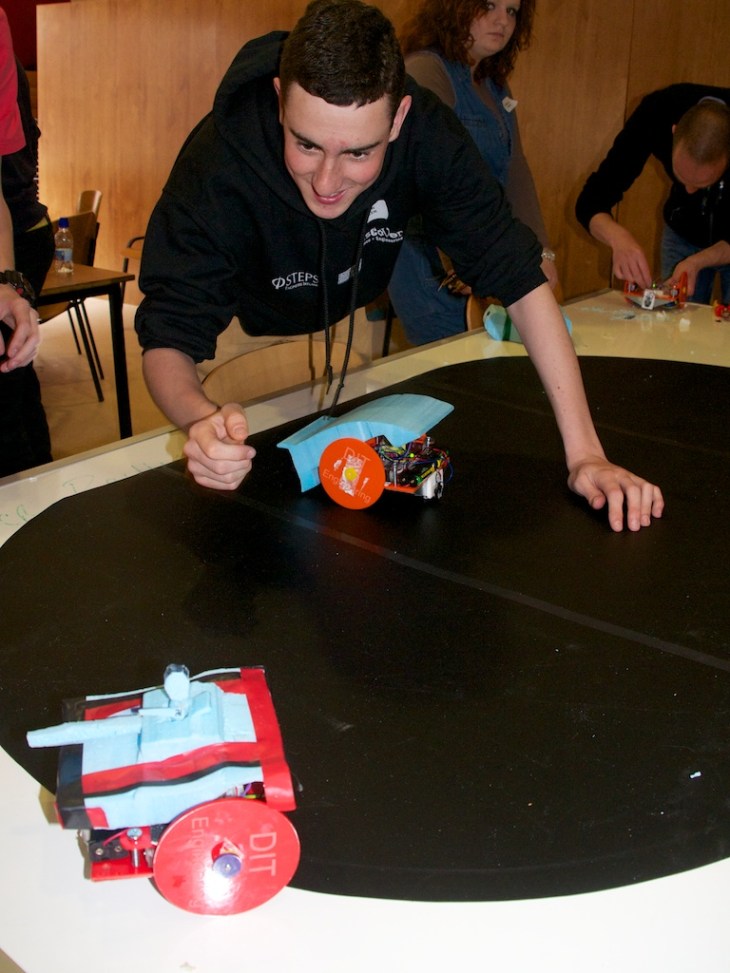
Things really got fun once all the circuitry, programing, structural components, and body casings all synched and we stared testing out our nearly-fully-functioning robots and working out the final kinks.  Success!

See more photos about finalizing and testing on the RoboSlam website.

RoboSlam finalizing robots 70

Engineering at Minho

Seminar with engineering teachers from the University of Minho who use PBL.

Seminar with engineering teachers from the University of Minho who use PBL. (It was very cold in the room; everybody is huddled for warmth!)

These photos are from my trip to the Guimarães campus of the University of Minho — to visit engineering professors and tour the Department of Production Systems, at the university’s Engineering School.

My primary host there, Natascha van Hattum-Janssen, has been working as a Senior Researcher, Research Centre in Education. She has amassed quite an impressive record of publications. Her husband, Ferrie van Hattum, is a Polymer Engineer and has been serving as the Course Director of the Product Design degree program of the University of Minho, although both of them are now relocating to an institute in the Netherlands.

Natascha and her colleagues organize the annual PAEE symposium. The PAEE website explains:

The Department of Production and Systems of the University of Minho, the Research Centre for Education of the University of Minho, the Iberoamerican Association of Engineering Education Institutions (ASIBEI) and the Curriculum Development Working Group of SEFI – the European Society for Engineering Education – aim to join teachers, researchers on Engineering Education, deans of Engineering Schools and professionals concerned with Engineering Education, to enhance active learning approaches in Engineering Education through workshops and discussion of current practice and research.

The Fifth International Symposium on Project Approaches in Engineering Education PAEE 2013 will take place in the Netherlands and is hosted by the Eindhoven University of Technology. 

I served as a paper reviewer for this year’s conference and I hope to attend an PAEE event in coming years.

SCALE-UP your Learning!

Robert Beichner, a professor at North Carolina State University, delivered a fascinating lecture at DIT’s Learning, Teaching and Technology Centre (LTTC). He discussed the way he teaches large groups of math students using hands-on approaches.

His approach is called “SCALE-UP” and is being used today at many universities — including MIT, Virginia Tech, and Old Dominion University (just miles from my Portsmouth home).

SCALE-UP stands for “student-centered active learning environment with upside-down pedagogies.”

Dr. Beichner tracks the learning that accrues using this format and has identified impressive results. For instance, using this approach, the top students actually reflect the biggest learning gains. Evidently, by teaching their peers as their teams work to figure out complex problems together, all the students learn a great deal. The top students seem to make the most new connections in their brains, however, which runs counter to common belief that top students get pulled down by “wasting time” explaining things to students who lack understanding.

Dr. Beichner teaches in classrooms of 99 students, he lectures for just ten minutes at the start of each class then gives the students a problem to work out for the following week. The students work in teams of three, and he always makes sure a student from the top 1/3 of the class is in each group. He compares learning gains of the students in the SCALE-UP classes with students in traditional lecture courses.

The SCALE-UP website explains:

Rigorous evaluations of learning have been conducted in parallel with the curriculum development effort. Besides hundreds of hours of classroom video and audio recordings, we also have conducted numerous interviews and focus groups, conducted many conceptual learning assessments (using nationally-recognized instruments in a pretest/posttest protocol), and collected portfolios of student work. We have data comparing nearly 16,000 traditional and SCALE-UP students. Our findings can be summarized as the following:

  • Ability to solve problems is improved
  • Conceptual understanding is increased
  • Attitudes are improved
  • Failure rates are drastically reduced, especially for women and minorities
  • “At risk” students do better in later engineering statics classes
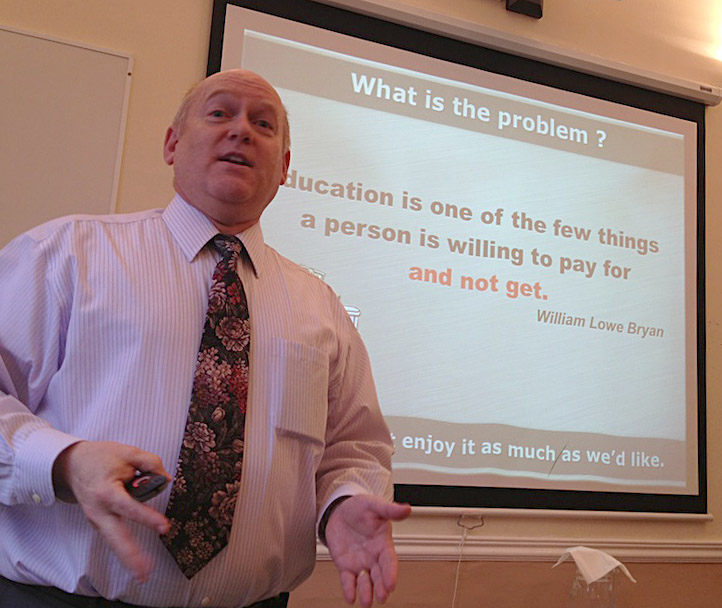
Dr. Robert Beichner from NC State
Dr. Robert Beichner from NC State

Robot Programming and Testing

Please visit the RoboSlam blog to see the newest photos of our recent robot programming and testing activities. Here’s one of the featured photos form that post:

Engineering lecturers Frank Duignan and Mick Core explaining concepts to two Transition Year students at our May RoboSlam.

Engineering lecturers Frank Duignan and Mick Core explaining concepts to two Transition Year students at our May RoboSlam.

Group- and Project-Based Learning

We've got 19 shining faces in the Problem-Based Learning module we are conducting on Tuesdays in May.

We’ve got 19 shining faces in the Problem-Based Learning module we are conducting on Tuesdays in May. (Not to mention three shiny teachers!)

In the Fulbright application I submitted two Augusts ago, I promised to co-teach a class at DIT that used Problem-Based Learning.  At the time I applied, I anticipated that I would co-teach an architecture course.  But in the course of the interviews I conducted, I discovered it had been quite a while since DIT’s Learning, Teaching and Technology Centre (LTTC) had offered a module for faculty/staff on how to implement Problem-Based Learning.
I’ve witnessed such remarkable results that seem to have accrued as a result of the topic having been offered in the past–by Terry Barrett and Brian Bowe.

So, I recruited some folks (Orla Hanratty, Brian Bowe, and Gavin Duffy) to help and 19 students enrolled in the course.  Here are some photos from Day One….

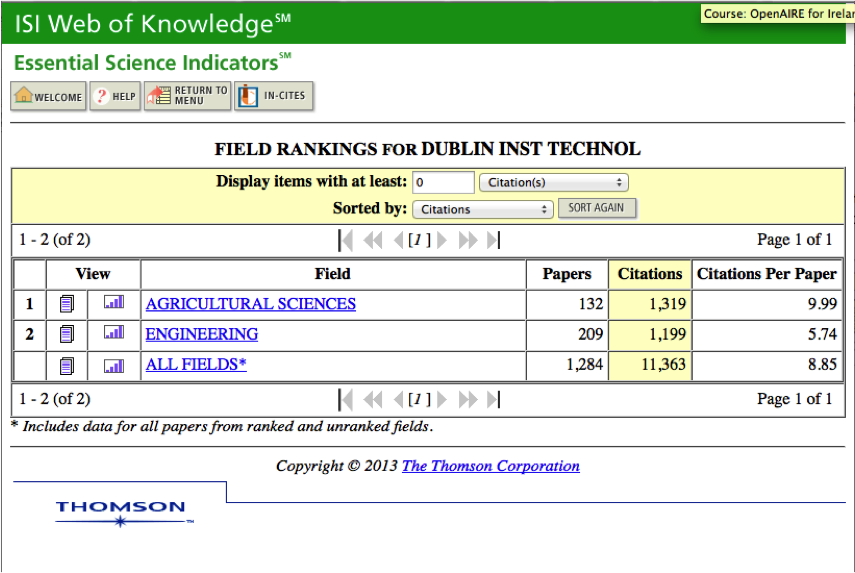
DIT in Top 1% in the World for Engineering Research!

For the first time ever Dublin Institute of Technology (DIT) has been listed in Essential Science Indicators. More impressively, the institution achieved a listing in the top 1% in the world in the areas of Engineering and Agricultural Sciences (which includes Environmental Science)!

I’m hoping that my efforts here contributed in some small way to this achievement — I’ll have to see if any of the conference papers I’ve authored with DIT colleagues while I have been a Fulbright Scholar here at DIT  counted in this ranking.

Apparently, DIT now outranks Trinity College Dublin with regard to Engineering research!

DIT research ranking, May 2013

DIT research ranking, May 2013

A Week in the Life of a Fulbright

This past week has been fairly typical of what I do as a Fulbright Scholar here in Ireland.  I thought you might be interested to see what a typical week is like, work-wise: