Fund your PhD in another country

Did you know that you could get full funding to complete a PhD in a foreign country?

The website FindAPhD.com might help you locate one in your area of interest. For my many of my friends that would be education or architecture and built environment.

You can also search on EURAXESS Jobs to find jobs and fellowships, which can include funding to complete PhDs.

Research Internship at DIT

Learning to train new and upcoming researchers, I recently welcomed an intern from the States. Allison “Allie” Wagner has been here at DIT since the start of January, as part of the Masters in Higher Education Administration she is completing at the Central Michigan University. She is working with me for a total of two months.

In her time here, Allie is learning about how we manage programs at DIT and what it is like for students to live and study here. She is also doing a research project with me. We have conducted phenomenological interviews with five female students from the Middle East, and we hope to interview 2-3 more. This adds a “longitudinal” component to my prior research, since I interviewed all five of these women two years ago. Allie and I are following up to see what new expediences these women have had and how things have changed for them.

Overall, we want to produce a journal article with findings to help teachers do a better job in supporting international students — and particularly Muslim women studying engineering in Western contexts.


Exper-tease in the capital of the EU

I’ve been in Brussels this week, evaluating grant proposals for the European Commission’s Research Executive Agency (REA). It’s the second time I’ve worked for the EU in this capacity–the first was during last fall’s lockdown in Brussels. This year’s event was much more pleasant, and we got to make our deliberations face-to-face, rather than using the Internet.

In my book, it’s important work. We’re determining which proposals will be funded and which research projects will proceed. Specifically, this week, we’re considering which PhD programs the EU will be co-financing. For successful applicants, the EU will pay a significant portion of the costs to hire early stage researchers to travel to another country in the EU to do their doctoral studies.

An intriguing aspect of the week has been being called “expert” everywhere I turn as I arrive at work in Covent Gardens every morning. I’m enjoying the novelty, although the sights have been the same day after day. The rooms in Covent Garden are very comfortable, in any case, and the other experts on the panel are friendly, knowledgeable, and polite. It’s been a great experience and I’ve gotten to learn a lot.


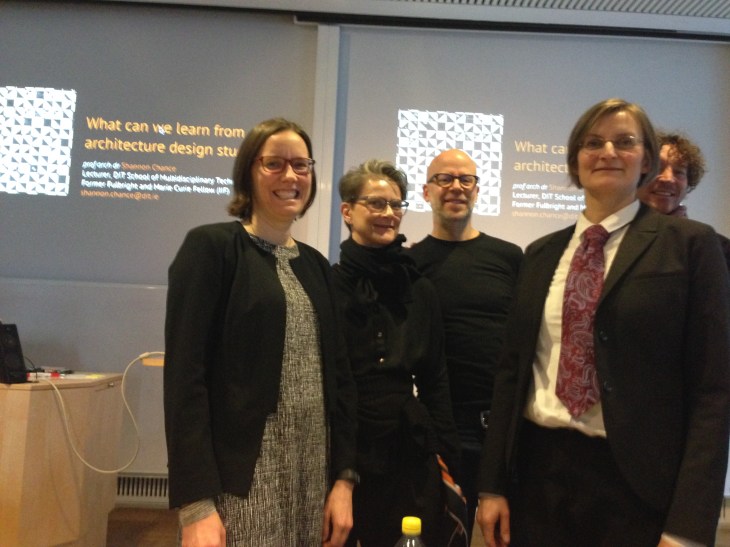
What we can learn from architecture studio pedagogy, a guest lecture at KTH in Stockholm

img_5492

After the lecture at KTH, with two librarians and two architecture profs, including my former classmate from Virginia Tech, Eric Stenberg.

Professor Jonte Burnhard invited me to KTH in Stockholm to deliver a guest lecture on what we–as education specialists, architecture educators, and researchers of engineering education–can learn from each other and from the pedagogical models used to teach architecture. Jonte had read a recent article, “Using Architecture Design Studio Pedagogies to Enhance Engineering Education,” that I’d published along with John Marshall and Gavin Duffy in IJEE. You can access the article at: http://arrow.dit.ie/engscheleart2/102)

The learning and teaching center at KTH hosts this type of lecture/workshop every couple weeks, to get the institution’s staff thinking about and discussing good ways to teach. In addition to classroom educators, quite a few of KTH’s librarians also attended the event, as well.

While at KTH, I enjoyed a dozen small-group discussions on pedagogical topics, toured the brand new architecture building, and caught up with a former classmate, Eric Stenberg,  from Virginia Tech’s architecture program. I’m hoping to visit KTH again soon, since we have so many overlapping interests.

I stayed though the weekend, before heading to Brussels on Sunday evening, and I’ve attached photos of the Christmas sights.

The Talented Don McClure Presenting at Maynooth University

As a young researcher, Don McClure lived in my Dublin flat while he was collecting data for his PhD. Now that he’s finished his project, and earned his doctoral degree, he’s working as an Assistant Professor at St. John’s University in New York.

Recently, Dr. McClure was selected to present his findings at a conference held at the School of Education at Maynooth University.   Today was the big day, so Aongus and I headed out to the institution bright and early to hear Don speak.

Both presentations in his session were superb, and afterward we had a chance to chat with Don over coffee.

As Don headed back to his sessions, Aongus and I went out into the day, to explore the campus.

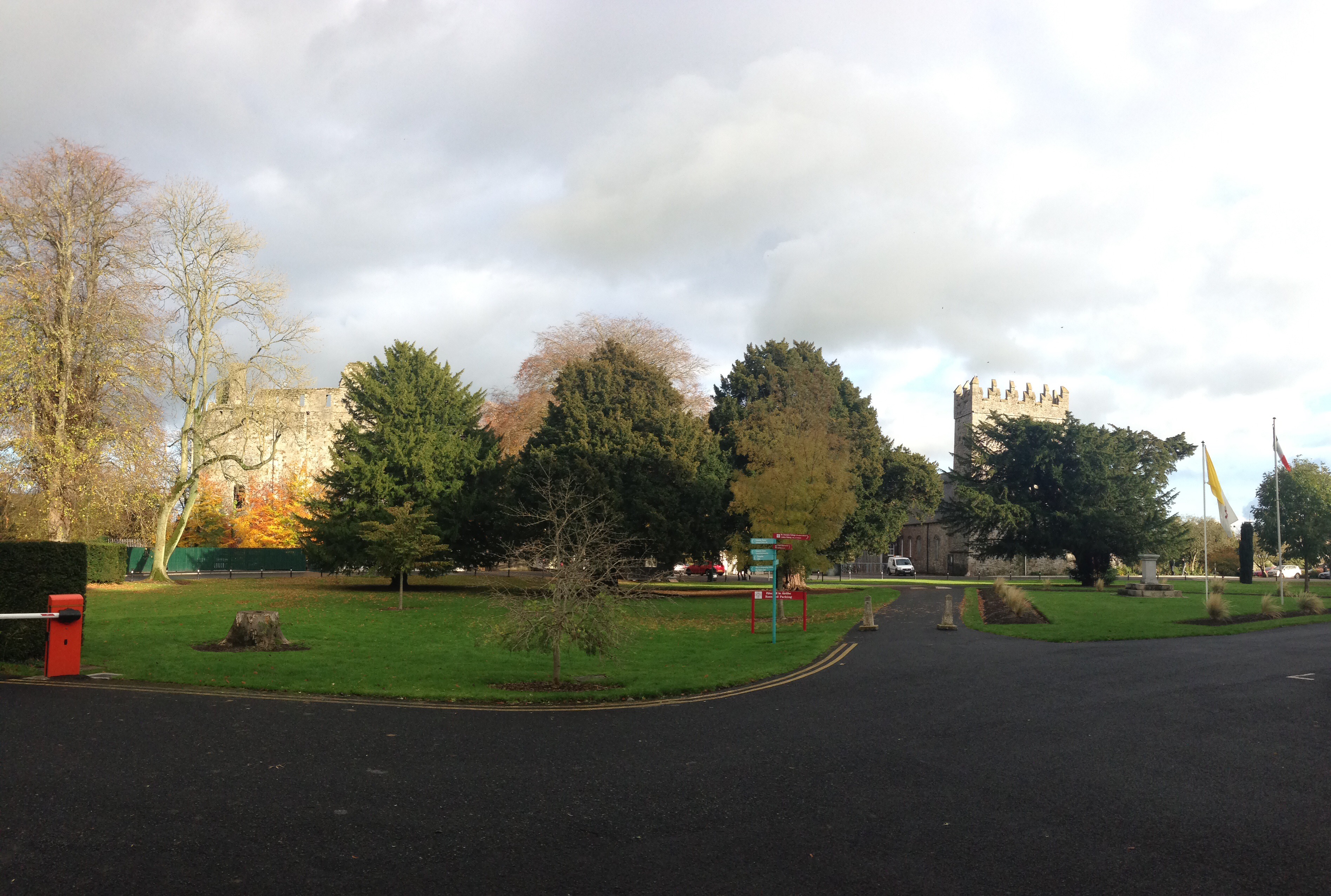
Turns out, it was graduation day and the chapel was open to the public. What an amazing site!

I realized immediately that this was a significant design. Turns out, indeed one of a kind. The University’s website states:

Built between 1875 and 1891, this Chapel has 454 carved stalls, making it the largest of its kind in the world. 

The place reminded me of the wooden theater in Parma, with a Hogwarts sort of mystique. What a treasure!

The webpage is well worth a read.

Two Eyes and an Arduino

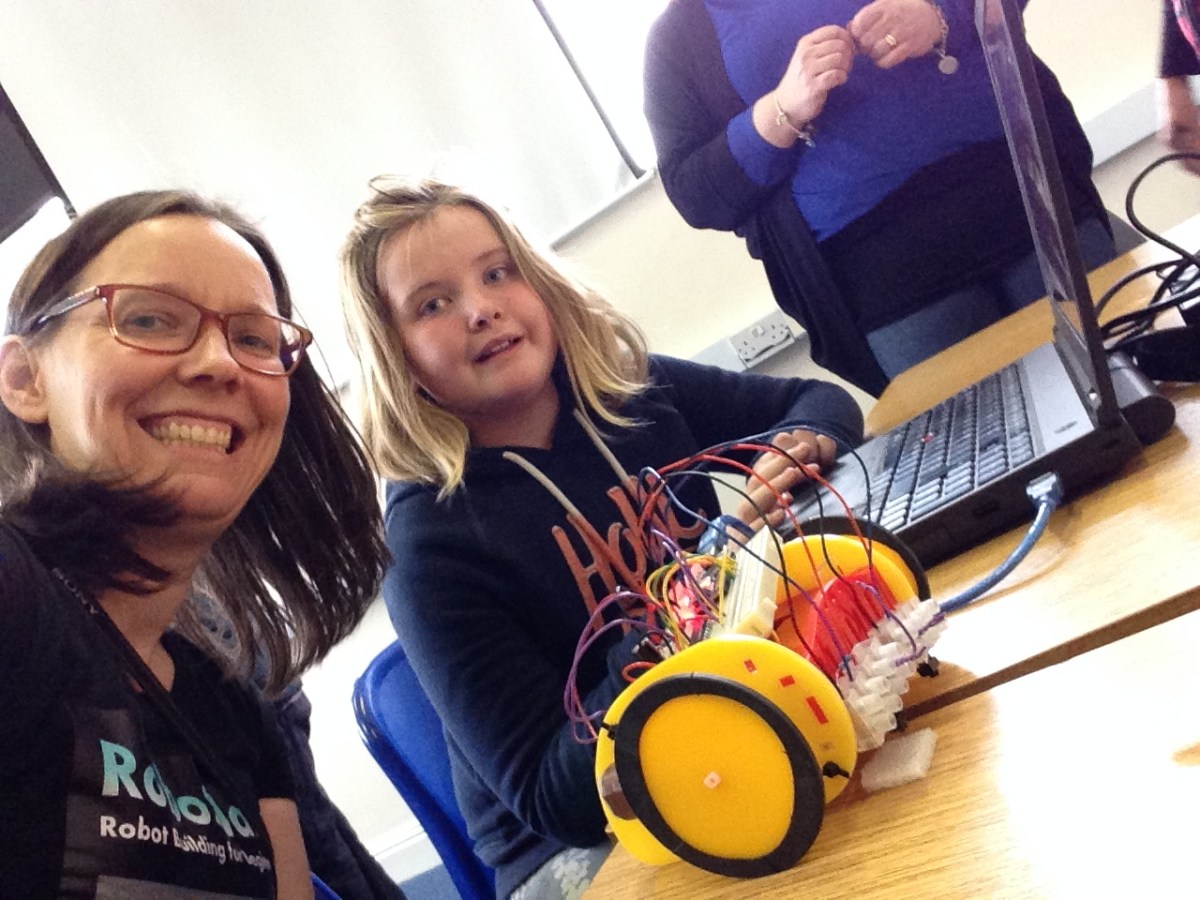
This past Saturday, the RoboSlam founders — Damon, Ted, Frank, and Shannon — travelled to “sunny southeast Ireland” to deliver a RoboSlam for 18 students (ages 7-14) in Enniscorthy, County Wexford. Many thanks to the local sponsor Taoglas and to the parents who stuck around to help. Extra special thanks for helping organize and host the event go out to John O’Connor at the Enniscorthy Enterprise & Technology Centre, the CoderDojo mentor Sam, and Charlie Pritchard. Thanks to Edith Pritchard for a delicious follow-up dinner.

We’re pleased to report that 18 functioning robots left for happy new homes at the end of the day. The new robot design uses an Arduino Nano, which is very easy for people to continue coding and re-coding at home, after the formal workshop concludes. Frank Duignan came up with dual sensor design he calls “Two Eyes” and uploaded the newest code to out RoboSlam blog.

I’ve posted a couple photos silly selfies below. More photos are available on the RoboSlam blog. I worked up such an appetite that the hotel brought me two full breakfasts the next morning, as captured by Frank’s stealthy camera phone.

Thanks to everyone there for a fun and successful event!

Research Methods of Forensic Engineers

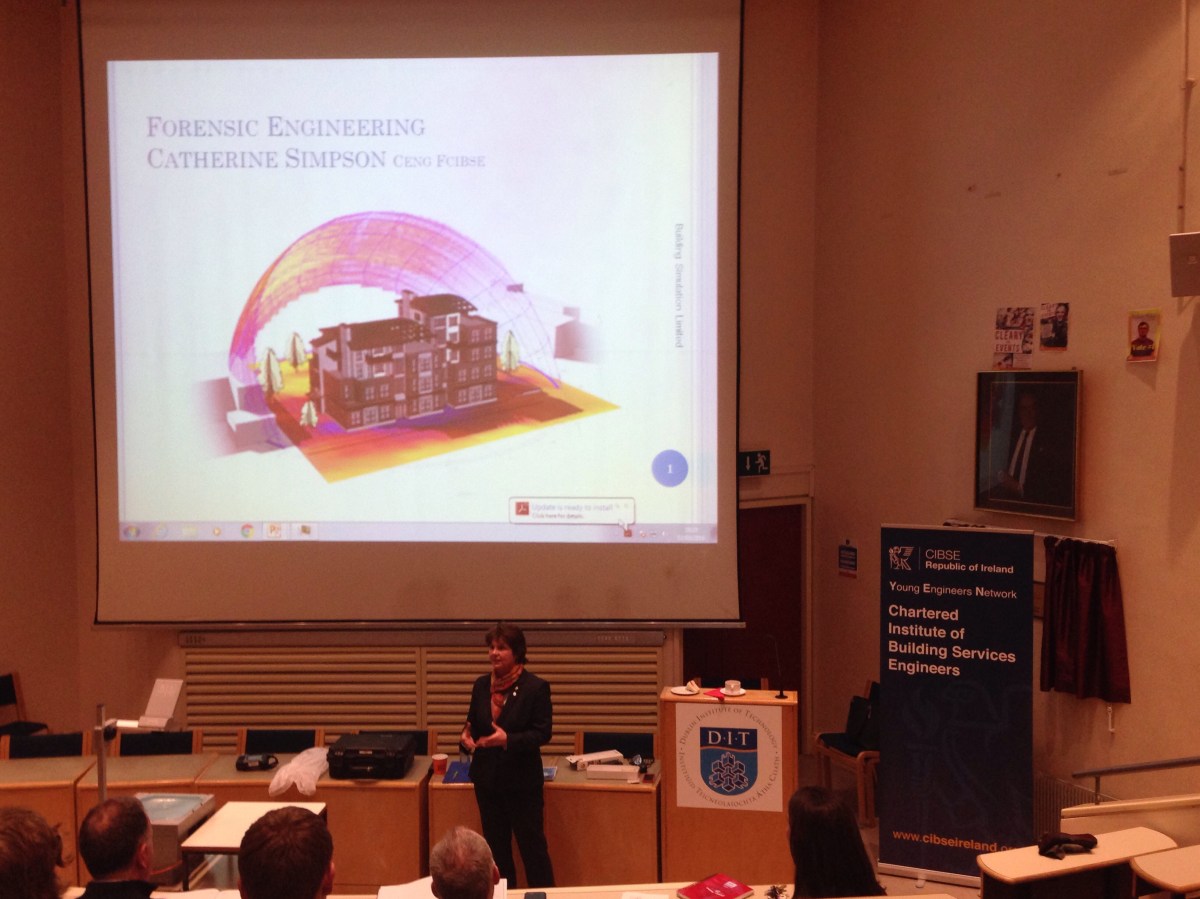
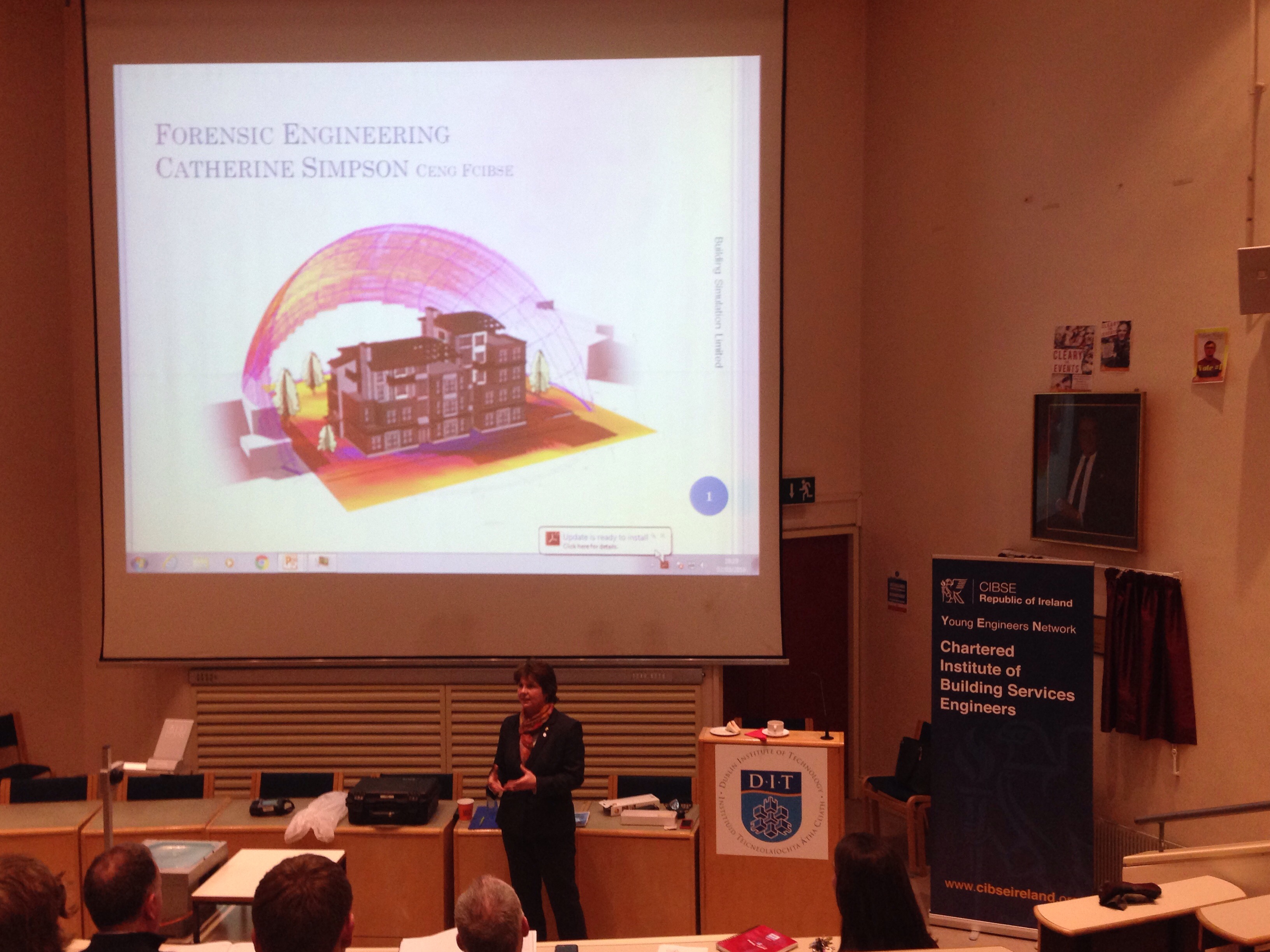
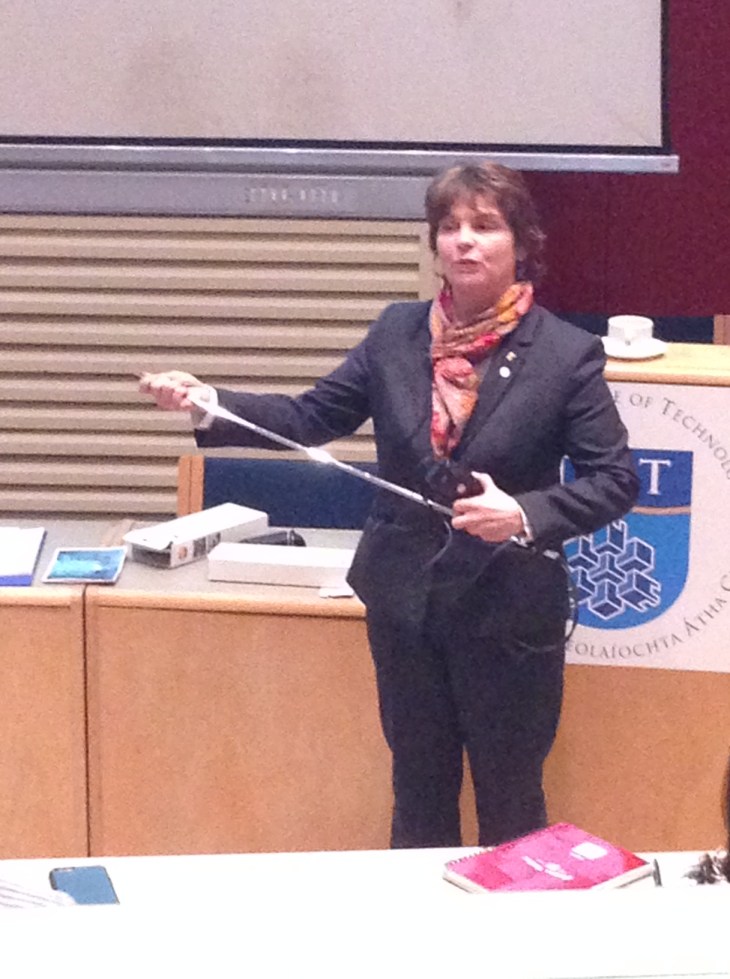
 Catherine Simpson is here at DIT tonight describing the research she does as a Forensic Engineer. You can also call her an expert in thermal modeling and a Building Services Engineer.

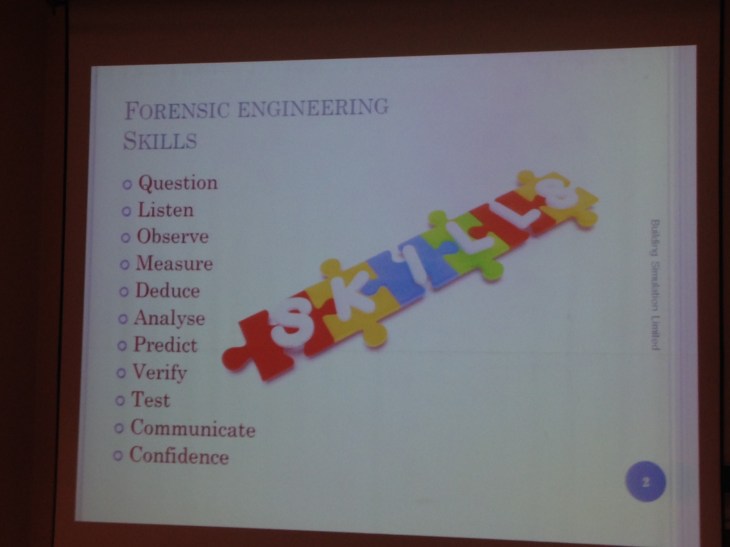
She can make digital models of buildings and predict their future energy performance. She can also go into a functioning building to identify, analyze, and rectify errors in thermal performance. She says that very often, buildings do not end up performing the way experts predicted. These are skills she uses:

IMG_0684


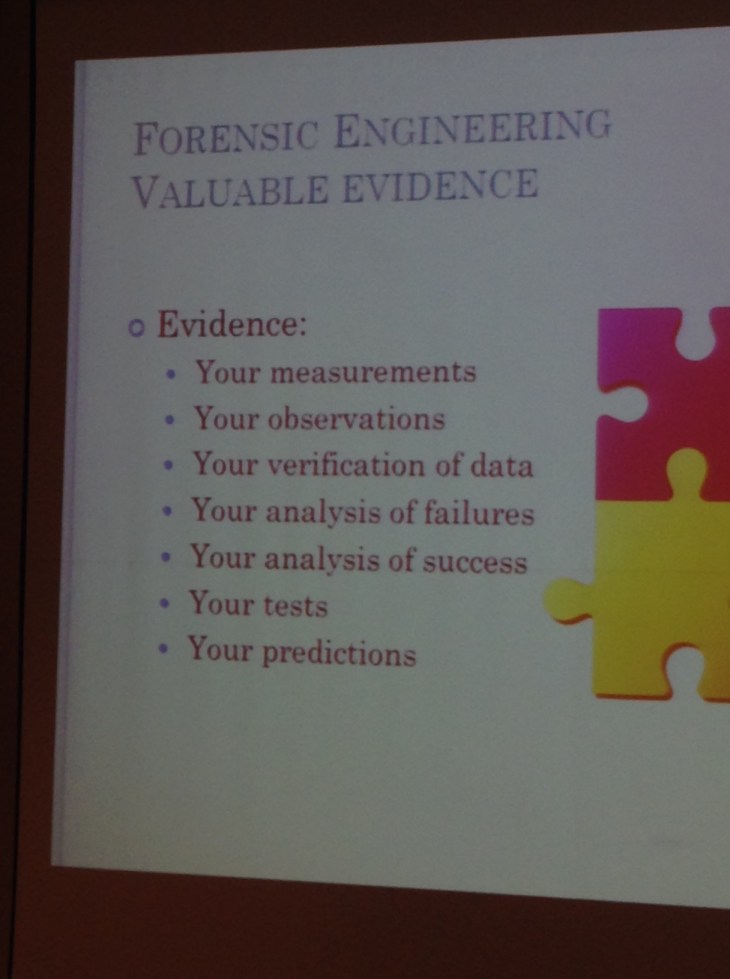
Catherine says Forensic Engineers must avoid using clues as if they were actual evidence (of the problem and its causes). These are clues: complaints, anecdotes, consultant reports, BMS data, ad hoc solutions, staff theories, and staff observations. On the other hand, these are useful forms of evidence:

IMG_0686

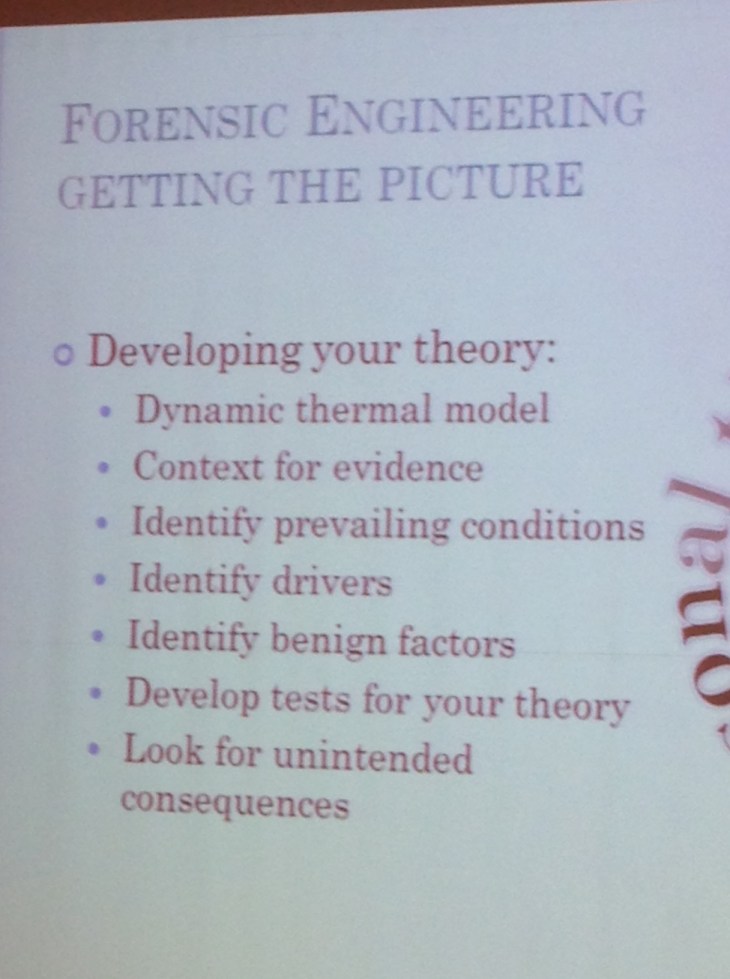
Catherine models problems digitally and physically. She also develops theories that she can combine to test her theories:

IMG_0687

Catherine gave an example of a shopping mall that had a very windy atrium and a very steep heating bill. No one could identify the causes of these problems. But after six years experiencing these problems, the owners called her in.

With careful analysis of data she collected (using dozens of different routes, including studying air flow by blowing bubbles in crowded spaces where smoke tests couldn’t be used) she identified a number of problems. One was a poorly placed rotisserie oven that was triggering vents to open. Another problem was that the building controls “thought” the building’s vents were completely closed when many were only partially closed.

Catherine devised a £50k solution to closing the vents in winter that is saving the owner £60k every month, in heat alone. There were reduced wind drafts and reduced tenant complaints. She says it saved about £500k in capital and restored people’s confidence in the facility.

Here’s one tool she uses to measure air speed:

IMG_0688
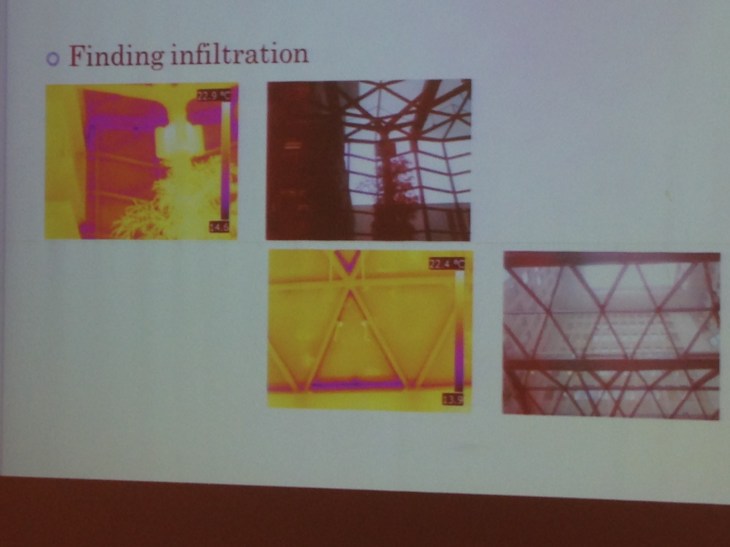
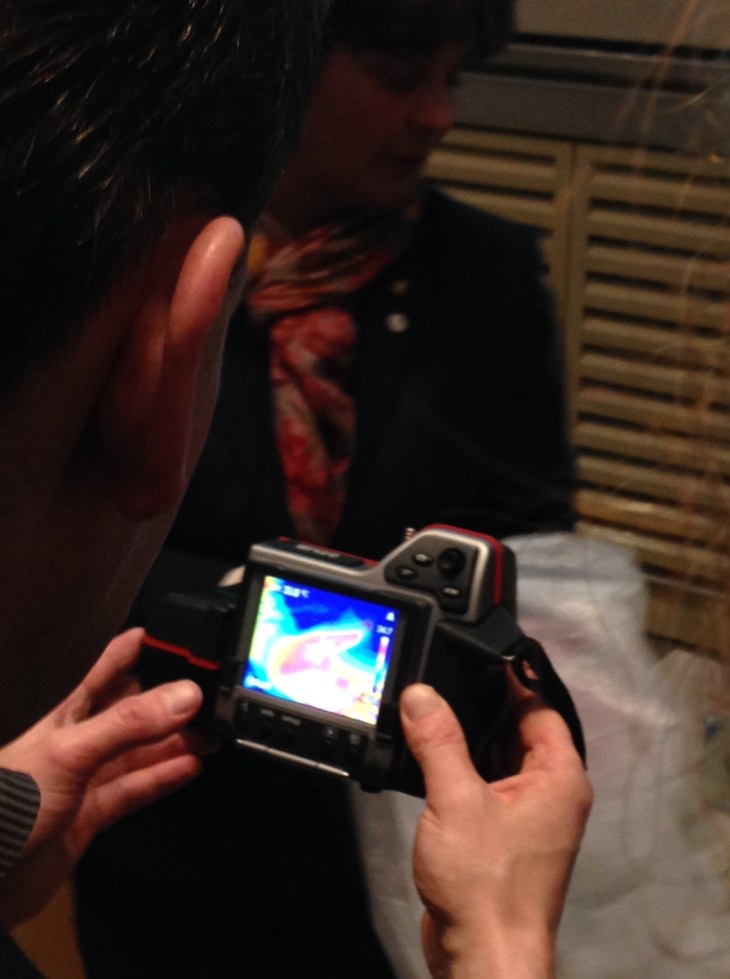
She also uses thermal imaging to study air infiltration, like so:

IMG_0690

IMG_0701

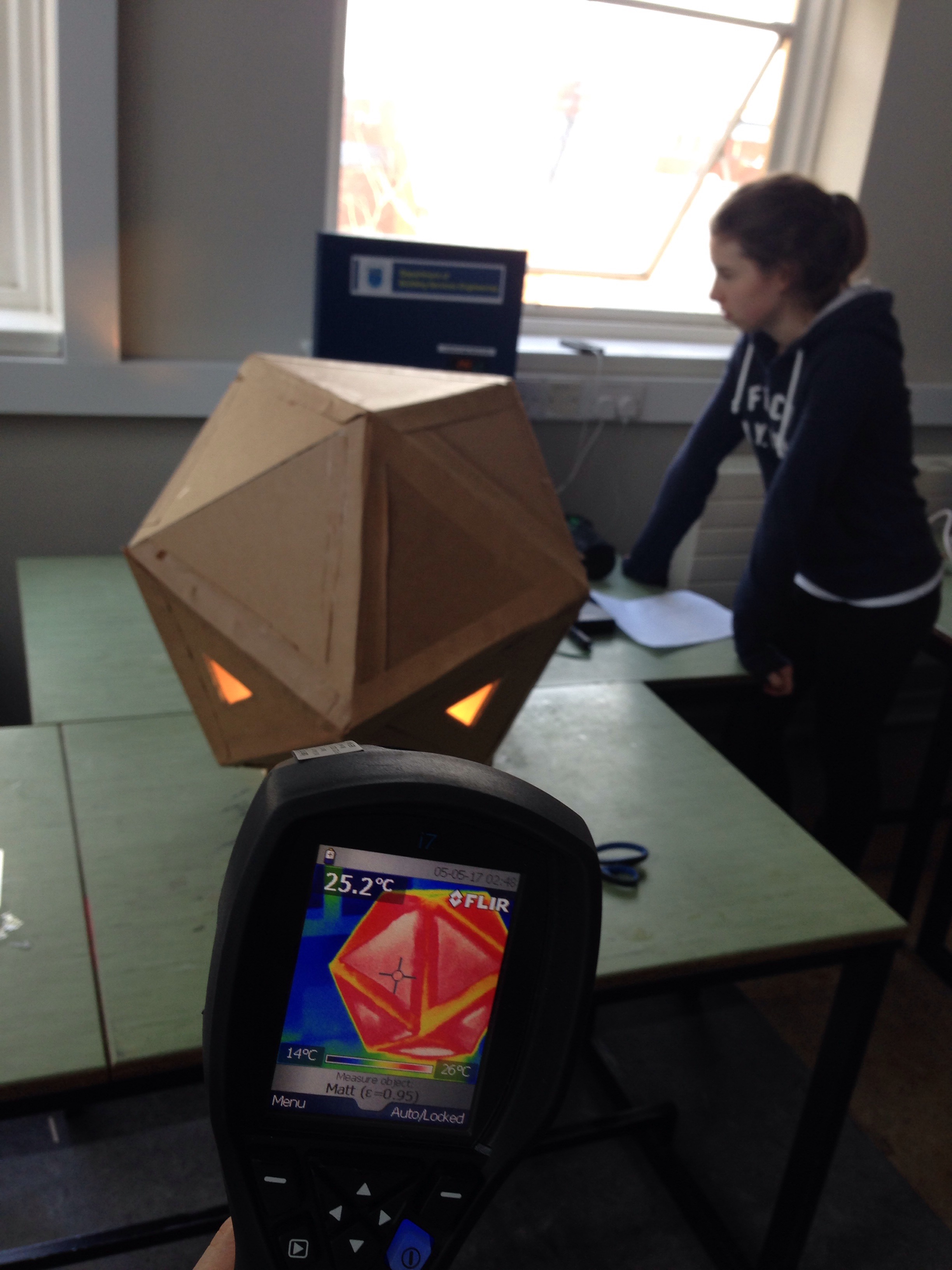
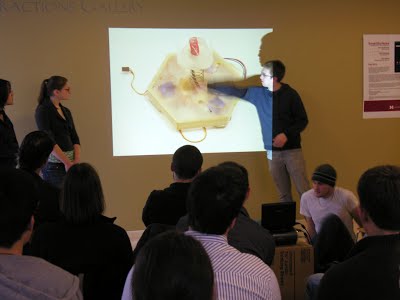
We use this kind of technology in our Energy Cube project. This is a picture from that class last week:


Catherine’s work involves fixing problems and also providing expert witness testimony. Forensic engineering seems fascinating! Catherine is a veritable Nancy Drew.

Forensic engineering, she says, is like a jigsaw. You’re given clues, you find evidence, simulation gives context, you test theories, and ultimately prove a solution. She obviously loves her job!

Research Methods of Philosophers

Philosophy symposium 1

Philosophers sometimes use primary documents in ways not much different from the historians I mentioned in my previous blog. According to Yale:

Primary sources provide first-hand testimony or direct evidence concerning a topic under investigation. They are created by witnesses or recorders who experienced the events or conditions being documented. Often these sources are created at the time when the events or conditions are occurring, but primary sources can also include autobiographies, memoirs, and oral histories recorded later. Primary sources are characterized by their content, regardless of whether they are available in original format, in microfilm/microfiche, in digital format, or in published format.

For historians, primary documents include photographs, letters, news clippings and the like. For philosophers, I’d say they could include original texts where an idea first appeared in written form. As a social science researcher, I myself am collecting audio-taped testimonies of female students who have first-hand experience of first-year engineering education. All three of these examples–philosophy, history, and social science research–involve high levels of interpretation of documents, ideas, and stories contributed by others.

Whereas my historian friend, Cecilia Hartsell, is investigating phenomena that include both the 1916 Uprising as well as the return of soldiers from WWI, my colleagues in philosophy spent a recent weekend discussing the phenomena of intentionality and normativity. These historians and philosophers seek to understand the context of events and ideas arising in the past, and what the authors of various documents meant at the time they spoke, or wrote.


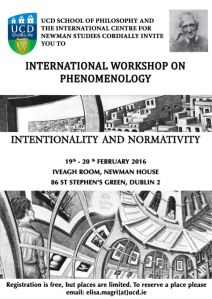
february-workshopI joined a group of philosophers for a February 19-20, 2016 seminar that explored various aspects of phenomenology. The event was hosted by the School of Philosophy at the University College of Dublin but held at Newman House, on Saint Stephen’s Green in Dublin.

Attending the seminar, I learned much more about phenomenology. I also learned more about the way philosophers think, study, generate new knowledge and new understandings, communicate with each other, test ideas, and seek to uncover the complex meanings embedded in writings by philosophers throughout the ages.

I am indebted to Prof. Dermot Moran and Dr. Elisa Magrì for inviting the public to their event so that I could attend, and to DIT’s new PhD student, Diana Adela Martin, for notifying me about the event.

Much of the discussion focused on phenomenology, which is both a philosophy and a social science research methodology. I’m currently using the methodology to study women’s experiences of STEM education, and will submit later this week a manuscript on another phenomenological research study of teachers’ experiences working together to implement Problem-Based Learning at Dublin Institute of Technology.

Related to experience, I must admit that visiting Newman House was an exquisite one. In this house, John Henry Newman founded University College Dublin (originally called the Catholic University of Ireland). I believe that he later became a cardinal and was beatified by the Catholic Church, despite the fact that his views did not always match the official sanctioned interpretations of the Church. Today, one can visit Newman Houses on campuses world wide, like the one I attended while a student at Virginia Tech. I’ve attached photos of the formal entry hall at UCD’s Newman House, for your enjoyment. I got so caught up in discussions at each coffee break that I never made it all the way to the lovely formal garden behind the house. Maybe next time!

Research Methods of Historians

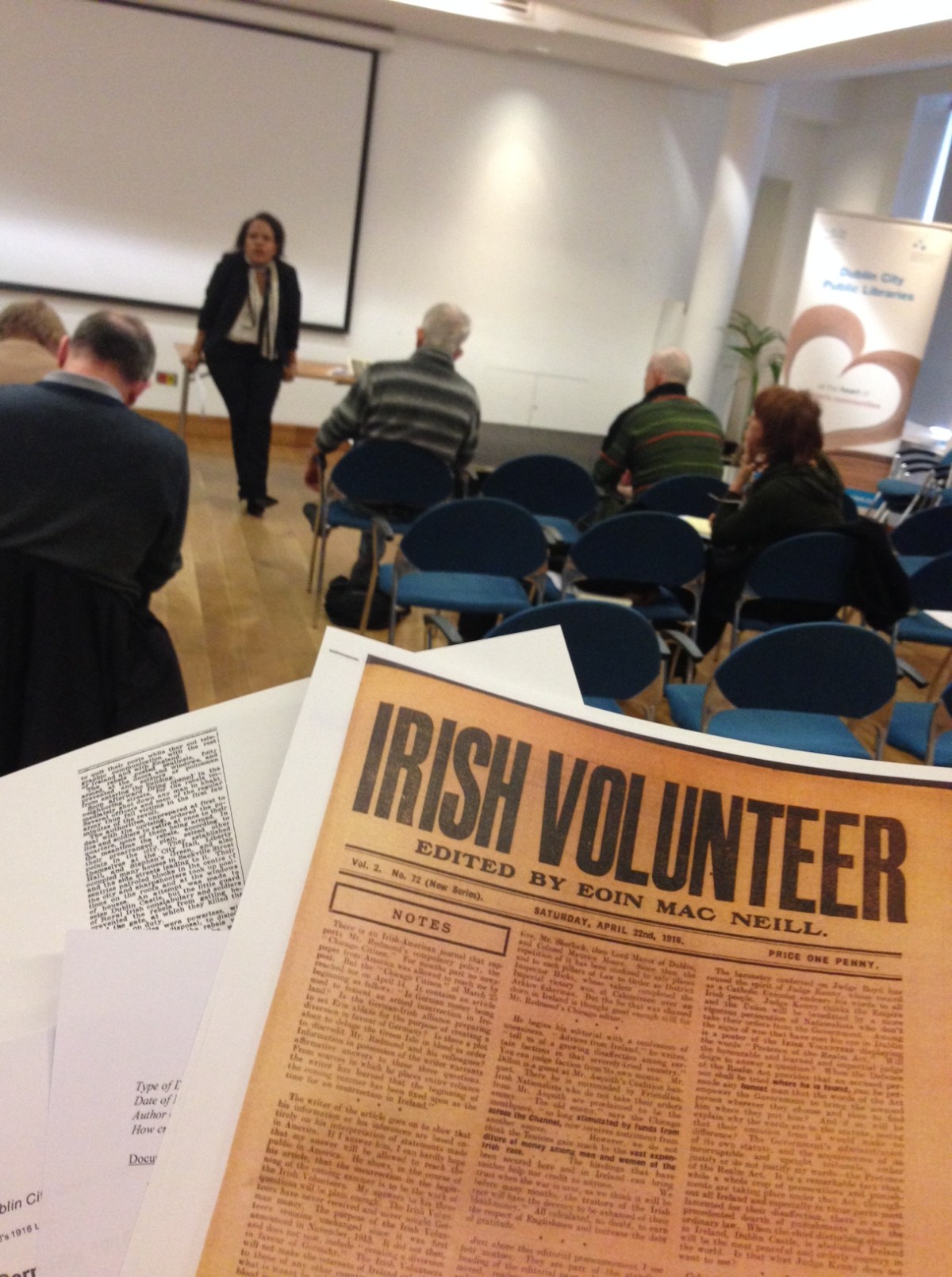
Cecilia Hartsell, an inspiring historian and PhD candidate conducting research here in Dublin, chaired a workshop on Saturday (February 27, 2016) to help people learn about the use of primary documents in research conducted by historians. This was one of six separate events Cecilia is organizing to celebrate the 100th anniversary of the 1916 Uprising that eventually garnered Ireland’s independence from British rule.

The event was held at the Pearce Street Library (a street named for one a hero of the 1916 Uprising) included a keynote lecture by a historian from Trinity College Dublin named Brian Hanley, tea and coffee, a short talk on the evaluation and usefulness of primary documents by Cecilia Hartsell, and time for participants to work in small groups to study primary documents related to the uprising. In the end, each group presented its findings and we discussed what we’d learned.

I’m looking forward to Cecilia’s upcoming events!

Using Architecture Design Studio Pedagogies to Enhance Engineering Education

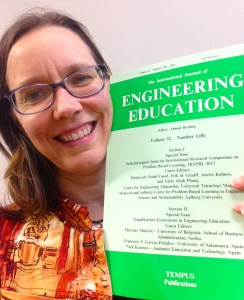
Shannon Chance IJEEI’m celebrating the publication of a new journal article today, with the help of Sally O’Neill. She’s one of the librarians here at DIT, and she secured permission and posted the article on DIT’s website, making it free for you and anyone else to download.

The publishing process is glacially slow. I submitted the paper in March 2014, based on a conference paper delivered in 2013. And here I am, in February 2016, with the final publication finally in hand.

Many time, in research, it takes time to see the results of your work. Seeing this in print helps make all these days, sitting at a computer analyzing text, feel more worthwhile. Once I can see that people are downloading it, and once I start getting feedback and citations in other people’s research papers, I’ll celebrate some more.

I know what I’ve learned through this research is useful, because I get to apply it in the classroom and in the design studio. The rewards of printed research are more slow to crystallize but also extremely important, especially for people who want to gain credibility in research and build a career around research.

This new article, written with the help of John Marshall in Michigan and Gavin Duffy here in Dublin, is about Using Architecture Design Studio Pedagogies to Enhance Engineering Education. Simply put, we believe that design education and hands-on forms of learning can help improve the quality and experience of learning in engineering and other STEM disciplines. The results reported in this paper provide support for that claim.

To give you a feel for what I’m describing, this is how we learn in architecture:

Above are pictures from design studios in Lisbon at IST and one for a study abroad program  offered by Hampton University. Very, very hands-on!

These days I’m helping promote similar ways of teaching engineering, which looks similar in many respects:

These are photos from electrical and mechanical engineering projects I’ve helped conduct at Dublin Institute of Technology.

This brand new article is about a specific design studio, conducted at the University of Michigan, that blurred the boundaries distinguishing art and science. It involved students and teachers from architecture, materials science engineering, and art+design working together to design and build “SmartSurfaces.” The paper reports learning outcomes — things the students learned in the  class — as illustrated by the blogs they posted during the semester. Here’s a glimpse of what that experience was like for those students:

For this new paper, I created a matrix to describe design behaviors in relationship to epistemological development (which has to do with how we view knowledge). I compared what the students wrote in their blogs to the definitions in my chart. Doing this, I was able to identify development of design skills as a result of students working in groups, and I even pinpointed some instances of epistemological development. John and Gavin helped check the work so that it would be more credible and reliable. They offered perspectives of insiders in the studio (John) and outsiders interested in group-based learning, Problem Based Leaning (PBL), engineering education, and epistemological development (Gavin).

This article should be of interest to any teacher who wants to help students develop new design, design thinking, or epistemological skills. Please feel free to read it and email me any questions you have, at irelandbychance [at] gmail [dot] com.

Chance, S., Marshall, J. and Duffy, G. (2016) Using Architecture Design Studio Pedagogies to Enhance Engineering EducationInternational Journal of Engineering Education Vol. 32, No. 1(B), pp. 364–383, 2016.