Bringing my Dad back into Focus

Losing a parent is emotionally difficult as I’m discovering each and every day. Others who have lost someone close provide the strongest sense of empathy–they know what we are going through and they offer shoulders on which to lean.

I truly appreciate all those who have sent a message or note, flowers, donations.

Those who gave their presence in these difficult days and made thoughtful gestures now hold a very special place in my heart. Those who made the kind effort to join us for Dad’s visitation, funeral, or interment helped provide a sense of confidence that tomorrow will be happier.

Through this blog post, I am bringing my Dad back into focus, if only for a moment. I aim to record my memories before they vanish.

Memories of our Dad

My dad, Donald Massie, truly loved to learn. This he passed to my sister (Heather) and me.
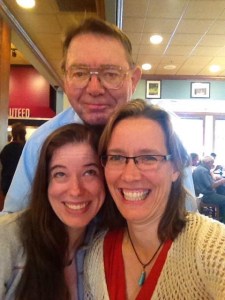
IMG_0947

Dad with Heather and me.

Dad always said Heather and I should try hard in school, for ourselves, not for him. “Your education,” he’d say, “is the only thing no one can take away.” …Bette Midler says it’s your dignity, but that actually can be taken, I believe!

Dad taught Heather and me many things, including how to guide our own learning—how to identify goals, determine what we wanted to know, and figure out how to accomplish learning it. Dad didn’t do our projects for us, as Heather pointed out at his funeral, but he was always there to help.

Dad was an extremely curious person, and he demonstrated his love of learning from the very start. As a small child, he read the Encyclopedia Britannica. This set of books occupied an entire shelf at my grandparents’ house, in all the years they owned it.
IMG_6750-1

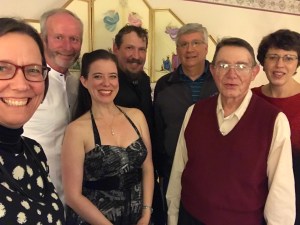
Christmas 2017 or 2018: Shannon, Aongus, Heather, Danny, Glen, Dad, and Kitty Lee.

Even before Dad could read, he’d pour over the pages, avoiding whatever he could from the illustrations, my aunt Kitty told us in Dad’s final days, as we three–Heather, Kitty and I–gathered around Dad’s bedside, supported by the phenomenal nursing staff at Showalter Center and end-of-life experts from Carillion Clinic Hospice. Those were precious days we had together, and a priceless gift provided by those caring medical experts. Showalter’s culinary and administrative folks worked with us and nursing to make the week we had there together full of love and laughter. Dad was truly funny in the moments he could communicate; it was clear he’d built rapport with staff of all ages and backgrounds, and some of the residents like Sharon who became a fast friend to us all. Many of them came to call in Dad’s final week, and Heather helped connect to family via phone and friends and former colleagues who came to visit.

But back to the story of Dad’s lust for learning: he particularly loved reading Popular Mechanics and Scientific American, and any flying magazine he could get his hands on!

Dad also loved trying things out for himself. We learned to learn by doing, just as he had.

At the age of two, he’d observed how a gear shift worked and he gave it a go himself. He climbed up in the driver’s seat of the family Jeep and kicked the manual transmission out of gear. The Jeep rolled down the hill, wrapping around a tree, totaled. He clung happily to the steering wheel.

He’d also as a toddler, we are told, remove the screws from the furniture with his bare hands—so curious was he about how the chairs and table were assembled.

Growing up in the family farm in Fishersville, Virginia, provided many adventures for a kid with curiosity. Dad observed how to use a flexible tube to siphon liquid from a barrel. “No,” the doctor told my grandma, “he isn’t sick,” just a little drunk! Evidentially, that barrel contained hard cider.

Dad wasn’t the only kid in the family stirring up trouble.

Dad’s brother, Phil, was a few years older than him. One day Phil tied Dad to a tree while playing cowboys and Indians. Unexpectedly invited into town by their dad, Phil disappeared. When Phil remembered about my Dad, tied up to that tree, Phil kept mum. No one wanted to earn the ire of my grandad.

Dad spent the day there, strung to that tree.

Their family moved off the farm and into the city of Staunton.

Dad had a newspaper delivery route and he got to know my mom’s brother while doing that job. Dad played clarinet in the school band. He made friends he kept until the very end.

In high school, he got drafted. He got a limited deferment. He married my mom; he hurriedly completed a Bachelor’s degree—starting in Engineering but having to wrap up quickly to meet the limits imposed by Uncle Sam and thus shifting to Business.
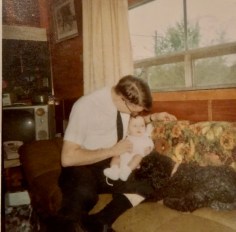
IMG_0567

Dad with a newborn, me!

He and Mom decided to have a child before he shipped out for Vietnam, and I was born while he was in boot camp.

My sister came along, like clockwork, not long after his return. There are two-and-one-half years between us. The four lives of my immediate family were indelibly marked by that (senseless) war, in so many ways. Night duty and Agent Orange were particularly treacherous. Of course, I’d wish the whole thing away if I could, but I also recognize that, without that bloody war, Heather and I would not exist.
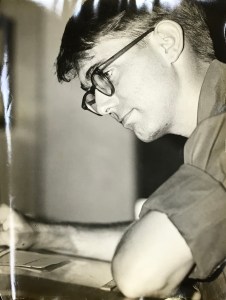
IMG_0560

Dad at work in Vietnam–so handsome!

In Vietnam, Dad served as an illustrator. In formation, fresh off the plane to Vietnam, his group of recruits was asked if anyone could draw. Hearing no other volunteers, dad put up his hand. Those years studying engineering made a clear difference.

Eventually, he combine that Business degree and illustrating experience, extending it with a Masters in Fine Art gained upon his return using the GI Bill. He subsequently worked as a photographer for the state of Virginia and then supervised the graphics department at the Vet School until his retirement, after 30 years with Virginia Tech.

I have to mention that Dad was the type of parent with kids in tow: he encouraged us to participate in clubs (especially 4-H where we learned so very much), band, and sports. He didn’t volunteer to run these events. He never attended a PTA meeting.

But he was in our corner nonetheless, cheering us on during every performance and award ceremony—and for those there were many.
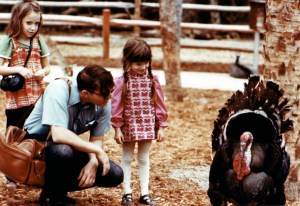
IMG_0530

I was the friady-cat!

During childhood, adolescence, and young adulthood, Heather and I spent many hours at Dad’s office—in the Annex during the 80s and the Vet School later on. We knew Dad’s colleagues well and we learned well from them. We were superbly advised and equipped for any art or photography project we could dream up. And dream we did.

I lived at home for university. Many lunchtimes during my Architecture studies were spent at the Ver School, surrounded by the professors and staff there–engaging in their enthusiastic lunch-time chat.

Many a night during my Bachelor’s and Master’s of Architecture programs were spent in the darkroom with Dad, rushing toward a deadline and/or creating photographic competition boards.

I adopted Dad’s drafting and jewelry equipment as my own. I learned 16mm film and to use 2.25 and 4×5 cameras. I passed on these skills, leading workshops and modules for Virginia Tech’s College of Architecture and Urban Studies across my years there.
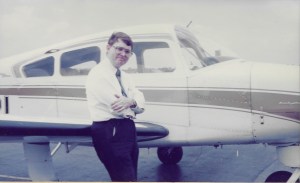
Scan_20191019 (3)

Dad’s beloved Musketeer.

He took us and just about everyone we knew up flying. A particularly poignant memory is flying to the site I’d chosen for my Bachelor’s thesis project on Outer Banks of North Carolina. Two friends from architecture school came along, and we timed our landing, two hours out, so that we’d touch down at sunrise. What a glorious day we had, documenting and exploring the island, walking into its town from lunch, splashing in the waves.

The year before in my fourth year of architecture school, Dad and I had rolled up our sleeves and started building a two-seat airplane. We commenced this project in our living room. Dad, my sister, mom, and I had built this house for ourselves.

Soon, the project got too big and we had to construct a large greenhouse on the side of the house.

Dad kept working on that project after I’d completed two Architecture degrees and left town for employment, first in Switzerland (1996-1997) and then in Hampton Roads (1998-2014). Unfortunately, Dad was diagnosed with carcinoid cancer in 1997. It was slow-growing but took its toll nonetheless. The vets doing research on cancer helped dad determine the right dose of Vitamin C to take throughout the day to extend his life as long as it did. Dad beat it for 22 1/2 years beyond his diagnosis.

We never finished that plane-building project, but last spring we donated all it, along with the materials we purchased to help finish the project, to Bototeourt Vocational high school (BTEC). Here’s hoping they can finish it or at least learn from what we’ve done!

These memories–all these memories. I must keep them alive.

My sister also wrote a beautiful and sincere tribute to Dad, and I want to share it as well.

My sister’s tribute to Dad

Image may contain: 1 person, suit and closeup

Photo of Donald Rae Massie – high school senior photo

Donald Rae Massie, my daddy, the world is different without you.
I could always rely on you when I had a question about anything.
I always said that you knew everything. One of the sharpest people I have ever known. With a memory I can only dream of having.
And ready to crack a joke to the very last. You liked to laugh.

When I was a kid and you were watching 60 Minutes, you would yell “Andy Rooney” and I would run through the house, to sit with you and watch and laugh.
When Jay Leno would do Headlines, you would yell “Headlines” and I would run through the house, to sit with you and watch and laugh.
At Christmas when we would give someone in the family a Jeff Foxworthy book, we would all sit and read and laugh until we cried, tears of joy.
Thank you for the love you gave me for irony and for a good laugh.

You were always ready to lend a hand, to help, to teach, to share.

Any project Shannon or I worked on was made better by your advice, your lending of tools, and your guidance on how to use them. We have heard from so many others who have said the same.
We learned to use cameras, compose photographs, develop prints, build our house, use power tools, solve problems, love people of all cultures and backgrounds, and have become strong independent women

I recently learned something that makes me very proud. While you were not keen to fight in Vietnam, you did not try to avoid serving, as those who were able to do so were those who came from wealth and privilege, and those who could not were poor, less advantaged, or of color, and you chose to stand with them and to serve. I thank you for this, even though this service caused so many of the health problems which you so valiantly battled.

Thank you for the love you gave me for nature and beauty – sunsets and oceans and mountains and wildlife and for living.
Thank you for my love of science – of light, of stars, of geology, of space.
Thank you for my love of art – light, color, image, composition,
Thank you for my love of photography – observing, composing, capturing, creating.
Thank you for my love of music – listening, playing, singing, creating.
Thank you for my love of telling a good story – a love which serves me every time I step on stage to embody a character, or when I set out to write a play.
Thank you for my love of the written word, the spoken word.
Thank you for my love of flight, and the joy you gave so many by taking each of us with you soaring through the skies.

What shall I do without you?
But to hold those good parts of me that you gave me and to nurture them.

You wanted every single second of life that God would give you, and your strength was a testament to everyone who had the honor of helping you in your last days. It shall stand for me as a light and way forward to value every minute that I have in this life.

Painting by Donald Rae Massie (Copywrite Donald Rae Massie, all rights reserved by Shannon and Heather)

As noted in Dad’s obituary, we welcome contributions to Warm Hearth Foundations, please designate to the Showalter staff appreciation fund. If you send direct, you can make the designation. The mailing address is: The Village Center • 2387 Warm Hearth Drive • Blacksburg, VA 24060 • (540) 552-9176
My Dad’s Passing: A Testimonial for Donald Rae Massie

IMG_0536
My sweet father, Donald Rae Massie, 73, of Blacksburg, VA passed away peacefully on 18 October 2019, surrounded by his daughters and sister, following a lengthy battle with service-related ailments and cancer.

Don was born on 27 November 1945 in Staunton, VA, son of the late Lillian Forsyth and Layton McCarthy Massie. His early life was spent on the family’s farm in Fishersville, VA; he attended Staunton public schools. Don earned a Bachelor’s Degree in Business Administration from Virginia Tech. Drafted into the military, he served at Ft. Lee, VA and then at USARV headquarters in Long Binh, Vietnam as a draftsman/illustrator. Later, Don earned a Master’s Degree in Art from Radford University. He was a gifted artist, taught photography at local colleges, reported New River Valley news for WSLS, and founded Massie Photography.

Don worked for Virginia Tech from 1979-2009, first as a staff photographer. His photographic images are part of the university’s archives today. He later served as Audio Visual Administrator at the Virginia-Maryland College of Veterinary Medicine, recording medical procedures sent throughout the state to educate practicing veterinarians on the latest techniques.

Beyond art, Don loved flying, reading, history, and airplane construction. He contributed generously to churches and charities. He always welcomed a chance to help others with their own art and photography projects. He found special joy in bringing people flying.

He is survived by two daughters, Shannon Chance (Aongus Coughlan) of Dublin, Ireland and Heather Massie (Dan Leary) of New York City, sister Kitty (Glen) Layman of Harrisonburg, VA, brother Phil (Linda) Massie of Brunswick, GA and many nieces, cousins and their families.

The family is deeply touched by the compassion of Showalter Center staff and Carillon Clinic Hospice. Contributions are welcome in lieu of flowers to Warm Hearth Foundation, designated to the Showalter employee appreciation fund. The mailing address is The Village Center • 2387 Warm Hearth Drive • Blacksburg, VA 24060 • (540) 552-9176.

The visitation for Don will be held at Horne Funeral Home in Christiansburg VA 5-7 PM on Tuesday, October 22 followed by a funeral service at 7 PM. Interment will be in Staunton, VA at Thornrose Cemetery on Thursday, October 24 at 11 AM.

Discovering Budapest with SEFI

Engineering teachers from all across Europe headed to Budapest last week for the annual SEFI conference to share state-of-the art research and cutting-edge teaching methods. SEFI is the European Society for Engineering Education and this was the fourth time I attended the group’s annual conference.

As the annual SEFI meeting is one of the most interesting, informative and welcoming conferences you can encounter, engineering teachers from many corners of the globe–notably Australia, China, and the USA– joined as well.  The conference program includes many workshops, paper presentations, keynote addresses and plenty of fun social events.

This year, I helped lead three workshops and one special interest group meeting. I’ve uploaded photos of the activities where I was most involved.

Physical Computing

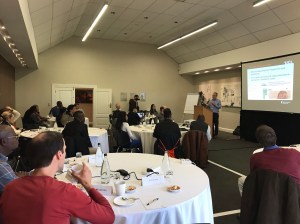
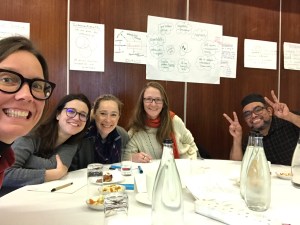
Here’s a glimpse of the workshop on Physical Computing I helped organize and run with my colleagues from TU Dublin–Paula Hannon, Damon Berry, and Mick Core. The title was “Physical Computing: A low-cost project-based approach to engineering education” and our abstract explained “One of the current trends in engineering education, often due to costs, is to use simulation software for the design and analysis of systems. However, using simulation packages as an alternative to real-world equipment may lead to a lack of student engagement and confidence, thereby reducing the impact of learning. This workshop presents an alternative mode of module delivery that facilitates practice-based learning, where students get hands-on practical computing using inexpensive, yet real-world equipment and technologies that can help transform notional self-directed learning to actual learning. In this workshop, participants will discuss the philosophy, rationale, and techniques used to teach Physical Computing at one Technological University.”

Phenomenography

The workshop UCL hosted on phenomenography, taught by Mike Miminiris, with assistance from Inês Direito and me was well attended and we all learned new techniques:

Engineering Education Research group

Here are a few pics of the special interest group meeting on Engineering Education Research, led by the EER WG  coordinator Tinne De Laet:

Being an Effective Peer Reviewer

We also held a workshop on reviewing manuscripts for journals as an effective peer reviewer, lead alongside the editors-in-chief of three of the top journals in engineering education worldwide–Kristina Edström, Lisa Benson, and John Mitchell–along with deputy editors Maartje van den Bogaard and Jonte Bernhard, and associate editors Adam Carbury and myself:

The delegation from UCL

Here’s a set of photos of the UCL crew at SEFI, and some of the other presentations UCL folks made:

Fun and learning combined

And now for some entertaining pics–some of the conference in general, and others featuring the very fun gala abroad a river cruise and the post-conference city sightseeing tour led by local architects:


Focus on Student Development

Our new special focus journal is out!

This is a major part of my Marie Curie fellowship, because I wanted (a) to learn more about publishing and (b) build the knowledge base regarding “student development” in engineering.

I’m particularly interested in identity development and epistemic cognition (how students think about knowing and what knowledge is). I am myself working on a major research project exploring these epistemic topics, but with this journal issue I helped provide other people who are working on similar topics a place to publish their work.

It’s a really nice set of papers–three on identity and five on epistemology, with an introductory statement up front which I wrote with the people I brought on board as guest editors. The editorial team spent the past 18 months on this project–getting authors invited, articles competatively selected then carefully reviewed and enhanced.

You may remember that we issued a call for papers about 18 months ago. We managed to keep the whole project on track schedule-wise and the final printed version came out in August 2019, a full four months before I’d promised the funders I’d deliver it!!!!! How often will I get to say something like that!? Delighted to have the chance now.

Here’s the introductory statement:

Practical Epistemic Cognition in a Design Project—Engineering Students Developing Epistemic Fluency

Jonte Bernhard Anna-Karin Carstensen Jacob Davidsen Thomas Ryberg

Teacher Learner, Learner Teacher: Parallels and Dissonance in an Interdisciplinary Design Education Minor

Desen S. Ozkan Lisa D. Mcnair Diana Bairaktarova

Here’s an official overview of the issue:

“This Special Issue of the IEEE Transactions on Education focuses on using enquiry-based design projects to spur engineering students’ development, so as to increase understanding and application of the relevant theories, foster higher rates of student development and achieve this in healthy and productive ways.

Each of the eight papers in this Special Issue focuses on a specific aspect, presenting an empirical research study on either epistemological or identity development among engineering students. Five of the papers are on epistemological development or ‘epistemic cognition,’ and three on identity development. The overall set of resources is presented so engineering educators can gain familiarity with existing theories on how students change and grow over their university years, and can consider the findings of empirical studies and what these might imply for their own teaching and for their students’ learning.”

https://ieeexplore.ieee.org/document/8786829

If you’ve got a manuscript you’d like to publish with this journal, you can find links on the website of the IEEE Education Societyhttp://ieee-edusociety.org/about/ieee-transactions-education. Or, feel free to drop me a line at <irelandbychance dot com> to ask advice–I’m an Associate Editor of this journal.

Fostering Inclusivity in Engineering Education in the South African Context

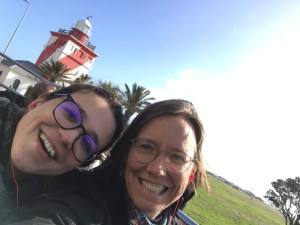
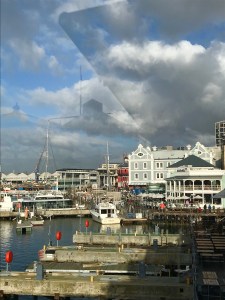
img_5642-1I spent the first week of July in South Africa, facilitating a two-day Master Class on “Fostering Inclusivity in Engineering Education in the South African Context” and then attending the Research in Engineering Education Symposium, REES 2019, which adopted the theme “Making Connections.” In this blog, I’ll tell you about the workshop and show you photos from the workshop and our travels to Cape Town, where my closest collegue, Inês, and I had a day to explore before heading out to the workshop location.

Fostering inclusivity in engineering education means creating learning environments that are welcoming to everyone, and where all members have equitable access to learning. We asked: How do we support the creation of inclusive environments for all engineering education stakeholders?

img_5752Our interactive Inclusivity workshop focused on supporting engineering educators wanting either to develop inclusive learning and teaching environments or to research the effectiveness of their interventions.

The workshop was facilitated by Shanali Govender from the University of Cape Town (UCT) alongside Inês Direito and myself from University College London (UCL). In addition, John Mitchell (from UCL) and Brandon Collier-Mills (from UTC) provided panel presentations and Mohohlo Tsoeu (UTC) was part of our planning sessions.

This was the eighth and last of a series of EEESCEP workshops. This one was held at Spier Wine Farm, Stellenbosch–a glorious place to visit even during South Africa’s winter!

img_5813-2Twenty-five engineering teachers from all over South Africa attended the workshop and the discussions were truly insightful.

As nervous as I had been leading up to the event–having visited South Africa previously to both study the history of Apartheid in the built environment and grow my understanding of the country’s tumultuous past–this workshop turned out amazingly well.

Participants came in with an endearing openness and desire to make engineering education more welcoming for all. They welcomed the facilitators warmly and openly as well. We all benefited from hearing new perspectives and giving serious thought to things we might do to improve the situation in engineering education, where white male norms predominate.

img_5831-1Drawing on participants’ own experiences with teaching and conducting research in engineering education, we encouraged participants to engage with contemporary and global issues related to inclusivity within engineering education and consider emerging research. Participants reflected upon their own practices and identified inclusivity aims and goals.

Discussions helped all of us identify barriers to inclusivity and develop ways to remove barriers in practice. A participant described the event this way:

The facilitators were excellent in their delivery of the doctrine of inclusivity to engender seeds for policy formulation, innovation, development and practice of engineering education in an ever-changing world.

It is worthy of note that the workshop has begun to provoke a silent revolution in teaching, learning, and research that will seek to enhance economic, social, scientific, infrastructural and holistic development of South Africa, and the world at large in line with the UN Sustainable Development Goals.

The discussion on Inclusivity seeped over into the REES activities, as many of the participants, facilitators, and presenters from the EEESCEP workshop continued on, from the workshop to REES, which started the day after our workshop ended. Being part of both events helped me build stronger ties to the engineering teachers in South Africa and I eagerly await more opportunities to work with them on projects.

Sightseeing in Cape Town

Inclusivity Master Class

Mighty Dublin Makers

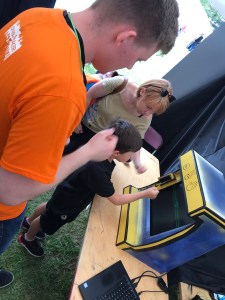
img_6580-1I took to the air, heading from London to Dublin to get trained up as a mentor in TU Dublin’s staff development program and also lend a hand at this year’s Dublin Maker fair in Merrion Square.

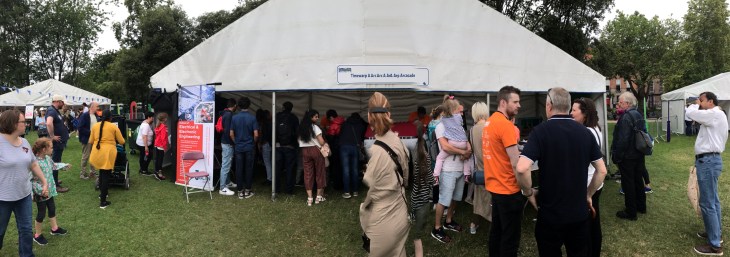
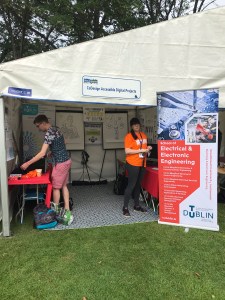
img_6473-1The School of Electrical and Electronics Engineering hosted two booths: one on Co-design for technologies to increase access to folks with varying capabilities, and the second on the theme “Timewarp Arcade.”

The Timewarp booth featured arcade games across the decades from Victorian Times up to the mid 1980s. An automated talking head (with moving eyes and jaws) was designed by Shane Ormond. The head could tell which card a visitor picked and interact with the visitor in real-time.

There was a Rock-Scissors-Paper machine designed to beat its human competitors.

img_6529-1A strength test demonstrated how those old-time hammer games were rigged. This display included a heart rate checker.

Frank Duignan contributed palm-sized arcade games and automated name badges.

Here are some images our colleague Paul Stacey, from Blanchardstown campus of TU Dublin, Tweeted of his sons at our booth:

Padraig built a large-scale early 80s arcade game.

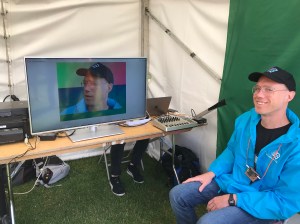
And finally, a photo booth that I helped run, designed by Ted Burke, created customized retro album covers, circa 1985. This display showed how green screen works. Visitors could dress in green to create the illusion that their heads were floating in mid-air.

img_6501All in all, it was an interesting, fun, and rewarding day. Until, of course, I got to the airport to find my evening Ryanair flight out of Dublin delayed multiple hours. Cheap but not so easy to use!

Publishing Discount for SEFI Members

img_2415

Good news shining through a rainy day in London.

I was on the bus from London South Bank University this morning, headed to University College London when good news arrived, shining through an otherwise cold and rainy day. The Editor-in-Chief of the European Journal of Engineering Education  (EJEE), Dr. Kristina Edström, forwarded me an email from the publishing house, Taylor and Francis, regarding costs for purchasing “Gold” level open access in the journal.


The change will enable SEFI members to save $500 off the cost of Gold access and the publishers will implement a change tonight–when they reboot their system. Information about the discount will then be included on the T&F web page for EJEE (although the T&F code for the journal is actually CEEE). Info about how to secure the discount will also be provided by the EJEE editors (Kristina, along with her deputy editors, Dr. Maartje van den Bogaard and Prof. Jonte Bernhard) when they send the formal acceptance email to authors.

SEFI–the European Society for Engineering Education—is the organising body behind EJEE. There are individual memberships available, but it’s more typical for an institution to join. Because I am affiliated with UCL and TU Dublin, which are both SEFI members, I am also a member of SEFI. There’s a full list of member organisation on the SEFI website.

Here’s what the publishers’ rep said:

Hi Kristina,

I hope that you are very well today.

I’m just picking up on your email to Rachel regarding the discounted APC for SEFI members and promoting this a bit more widely. I have added this information to the Instructions for Authors page under the Open Access heading, and to the Society Information page as below:

  • IFAs:image001
  • Society Informationimage002

These changes to the journal pages will go live overnight once our servers update. Do let me know if any tweaks to the wording are required. If it doesn’t appear already, it might be something worth advertising also somewhere on the SEFI website—do let me know if you would like T&F’s help with this.

For your reference, the relevant clause in the contract regarding this APC discount for SEFI members is screenshotted below:

image008

Please do not hesitate to get back in touch if there’s anything else I can help with.

All best wishes,
Jess

I’m glad I was able to help push this along, so SEFI members can realise savings. I stuck with this effort, first as a curious author, and second as a member of EJEE’s Editorial Board. I’m feeling today like I added a bit of value to the SEFI community.

Kristina celebrated with a Tweet letting the world know:

img_2414

img_2419As for my own article (the one I blogged about yesterday) I haven’t decided if I’ll upgrade to Gold. I’ve discovered there’s a 12-month embargo for the current access level I have (Green), and after 12 months I can post the official version of the paper. Perhaps the 50 free copies I’m allowed to give out will suffice until then, since most colleagues will have access to the article via their university libraries.

The full cost to obtain Gold access for my paper would be about €2395, according to an estimate I received from the platform a couple weeks ago. The $500 discount equates to €446, so the total cost for open access would still be head-spinning, at about €1950.

Yes, it’s true. Many people don’t know that authors typically must pay to publish their writing in top-notch journals. Fortunately, with EJEE, there’s no cost to authors if they go the Green route. However, for Gold (fully and immediately open) access to the public, there is a charge.

EJEE is pretty special in regard to offering Green access for free. The other top journals in the field of engineering education research (EER) charge. For the Journal of Engineering Education (JEE), organised by the American Society for Engineering Education (ASEE), it costs the author around $60 per page to publish (and there isn’t a free route other than requesting a special exception for extenuating circumstances). I hope I can figure out how to pay the fee when I get an article accepted there.

Today, I’m celebrating small victories.

New article published! Implementing PBL and comparing research methods.

My article, Comparing grounded theory and phenomenology as methods to understand lived experience of engineering educators implementing Problem-Based Learning, was just published by the European Journal of Engineering Education!

The abstract identifies the topic and its relevance to engineering education:

Getting lecturers/professors to implement pedagogical innovations is a central focus of university managers/administrators today. Convincing teachers to change is notoriously hard. This research project investigated the shift in pedagogical approach among a small group of faculty as they replaced traditional lecture-based methods with Problem-Based Learning projects. Interviews were conducted with eight of the most active drivers of this change, around the research question: What was it like to be part of a learning group focused on tangible change toward student-centered learning? Objectives of this study were: (1) to understand how pedagogical changed happened in an electrical engineering programme at a post-secondary institution in Ireland; (2) to analyse data using two different research methods to distill as much meaning as possible; (3) to describe the process, results, and findings achieved using each method; and (4) to compare and contrast the methods, asking: To what extents do the research methods of grounded theory and phenomenology fit our data and yield relevant and useful findings? Results of this mixed-methods approach show that fun, enjoyment, camaraderie, and a sense of ownership of the change at the ground level were essential to driving transformation. With regard to analysing this specific dataset, we found grounded theory to produce more helpful outcomes (including a graphic model of change). Because interviews had been conducted two years after the events under analysis, the interview comments were inherently reflective and, as it turns out, not as conducive to phenomenological methodologies which seek to understand raw, pre-reflective experience. This report should be of particular use to (a) teachers and administrators strategizing change and (b) engineering education researchers assessing the applicability of various methods.

I spearheaded the project but had assistance from Gavin Duffy in lining up interviews and conducting phenomenological analysis and enjoyed supervisory support from Brian Bowe.

You can access a pre-print here: Comparing grounded theory and phenomenology as methods to understand lived experience of engineering educators implementing Problem-Based Learning. I tried very hard to purchase an upgrade to “Gold” access so I could post the final published version online, and as a SEFI member, I am supposed to get a discount on this service from the publisher. Unfortunately, Taylor and Francis haven’t sorted out how to organize the discount yet, so I’m only able to post the text version I submitted to EJEE for peer review. The published version is available through most university libraries (using DOI: 0.1080/03043797.2019.1607826). However, if you’re interested in citing the published version but you lack access to it, please contact me. I am allowed to share the published version with a few dozen people, and T&F provided me a link for doing that.

This was a complex study and took quite a few years to bring to publication. I’d like to take this opportunity to thank everyone who supported this project–most especially my coauthors and the folks I interviewed at TU Dublin. I’d also like to thank the funders. First, data collection and transcription (conducted in 2012 and 2013) were supported by a grant provided by the Fulbright Commission in Ireland along with Dublin Institute of Technology. Second, data analyses were supported by a Marie Sklodowska-Curie Actions (MSCA) fellowship from the European Union (in 2014-2016) via Call identifier: FP7-PEOPLE-2013-IIF, Project 629388, Project acronym: REESP, Project title: Re-Engineering Europe’s STEM Pipeline. Finally, work to get this published with its unique slant of using two different methods and comparing the outcomes (conducted in 2018 and 2019) was supported via a second MSCA fellowship, Call identifier: H2020-MSCA-IF-2016, Project 747069, Project acronym: DesignEng, Project title: Designing Engineers: Harnessing the Power of Design Projects to Spur Cognitive and Epistemological Development of STEM Students.

This information can help if you want to cite the article:

Shannon Chance, Gavin Duffy & Brian Bowe (2019): Comparing grounded theory and phenomenology as methods to understand lived experience of engineering educators implementing problem-based learning, European Journal of Engineering Education, DOI: 0.1080/03043797.2019.1607826

Vivacious Vienna: Hundertwasser

I was an exchange student to Switzerland in 1994, and my first host “mom,” Esther Sterchi-Wyss, loved the architect Hundertwasser. I arrived at her home never having heard of the designer despite having more than six years of university-level architecture education.

Hundertwasser, you see, is self-made. A craftsman-turned-architect. His work wasn’t taught in modernist schools of architecture at the time, but he had certainly hit a chord with Esther, who had postcards and posters of his vibrant buildings posted in her Ferenberg kitchen.

It’s a bit odd not to have heard of him, as his work is in the same realm as Barcelona’s Gaudi, whose work I’d made pilgrimages to visit. Nevertheless, I had not.

While I was in Vienna this past February for the 2019 MCAA-General Assembly, I had the chance to visit three Hunderwasser creations.

It was just a brief encounter, but I enjoyed the joy and playfulness I found. And I finally understood Esther’s fascination. I hope you’ll enjoy seeing some of the images I collected during my brief visit.

Sites where you can see Hundertwasser’s work

Apartment block in Vienna

This slideshow requires JavaScript.

Hunderwasser Village 

Kunsthaus Wein

This slideshow requires JavaScript.


Vivacious Vienna: Exploring the City

During my February trip to Vienna for the MCAA General Assembly, I had the chance to look around the city center as well as some sectors not far from the center.

Vienna is an architect’s dreamland, full of beautiful spaces and artifacts old and new. In fact, the architect/urbanist/painter/historian Camillo Sitte documented many of the world’s most successful plazas in his quest to define what makes a public space beautiful. Many of his favorites plazas are located in Vienna. I often referenced his book “The Art of Building Cities”, published in 1945, when I was an architecture student and later an architecture professor.

Although I actually only had six hours to explore Vienna after the Assembly concluded, I took in plenty of sites. Below, I’ve posted my slide shows of spectacular architecture.

The slide shows start in Alservorstadt, with the Votive Church (Votivkirche), Hotel Regina, and University of Vienna. The slides proceed downtown and show visits to two more churches (Stephansdom and Der Graben), concluding with the Globe Museum. In other posts, I share photos from Hundertwasser and Otto Wagner ‘s Austria Post Headquarters or “Osterr Postparkasse” (blog forthcoming).

Votive Church (Votivkirche) 

This slideshow requires JavaScript.

Hotel Regina

This slideshow requires JavaScript.

The University of Vienna

This slideshow requires JavaScript.

Vienna City Center

This slideshow requires JavaScript.

Stephansdom

This slideshow requires JavaScript.

Der Graben

This slideshow requires JavaScript.

Globe Museum

This slideshow requires JavaScript.