Visitor Map

It’s always fun to see who is tuning in to Ireland by Chance.

Viewing my statistics map in WordPress helps me assess how well I’m doing my duty as a Fulbright scholar, which I view as helping build and share cultural understanding.

WordPress tracks the number of clicks onto the site shannonchance.net. It’s maps don’t include the people who have the blog delivered to their email boxes, however.

The past couple of weeks, I’ve had far more visitors from Ireland than from home.

Thanks TC, Laurie, and Sima for visiting so often from Germany, France, and UK!  I can thank Esther’s family and friends (like Heidi) for putting Switzerland high on the list, too.

To all of you I don’t know yet, I hope you enjoy your visits and that I’ll get to know you somehow, someday!

Visits to this site up until 10 November 2012.

Painting the Town Red

Esther loves musical productions.  Surprisingly, she wasn’t much interested in seeing plays while she was here.  That’s because English is her fifth language and she was worried she’d have trouble understanding.

You heard right.  She speaks five languages: (1) Swiss German (in Berne dialect), as well as (2) High German, (3) French, (4) as much Italian as I speak, and also (5) English.

Esther used to take in exchange students like me as a way of building her skills in English.  I was the  first in a long line of American exchange students to frequent her Ferenberg home.

And while she was here we painted the town red!  We soaked in all these musical performances during her one-week stay in Dublin:

  • The musical An American Idiot which, like so many musicals these days, has a plot contrived as a way to package a band’s album into a Broadway show. Wikapedia explains “American Idiot is the seventh studio album by the American punk rock band Green Day.”  Although the plot is understandably disappointing, Green Day’s “punk” music is actually quite festive.  The performance concluded with the whole company singing “It’s something unpredictable but in the end it’s right. I hope you have the time of your life!”  I’d been looking for an opportunity to visit the theater building itself, because it was designed by Studio Daniel Libeskind (the firm that designed the building to replace the World Trade Towers), and so I was perfectly happy that Esther actually asked to spend an evening immersed in American idiot-ry.  The theater is quite beautiful. However the knee-room was lacking where I sat and I determined once and for all that nose-bleed seats and traveling Broadway shows don’t mix.  The sound balance is often poor in the far upper corner when the show hits a new space.
  • Arlington Hotels Traditional Live Irish Music and Irish Dancing dinner show. The musicians sang “take me home country roads” (which is a favorite drinking song in Switzerland and pub song in Ireland). They also dedicated a song to Esther and me that was quite fitting.  Something about friends and traveling, if I recall correctly after this whirl-wind week. I was the only one in the place getting the host’s jokes. (He used to be a city planner, so perhaps we share some mental wiring?)
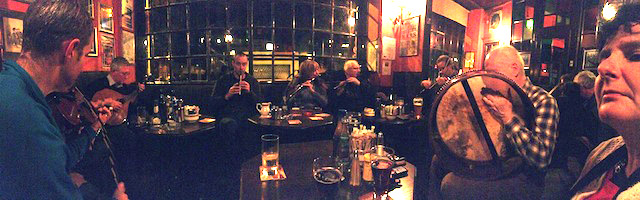
  • Gavin and his brother playing with other musicians at Hughes Pub. One of the guys in the band recognized the faces in Glen McClure’s photos from Achill Island (see my posts Leader of the Band and Drummer Girl).
  • The opera Hansel and Gretel, performed in the beautiful Gaiety Theater. I enjoyed this production more than any other opera I’ve ever seen. So I wasn’t too opposed when Esther asked to go see Disney on Ice for her last night in town. (It wasn’t my own top choice for the evening, but I gave in!)
  • Esther had never attended an ice-skating show in person and throughly enjoyed seeing Disney on Ice’s Passport to Adventure held at the Royal Dublin Society last night.
  • Two back-to-back visits to The Cobblestone pub. Thursday night we visited with Fulbright scholar Bob Trumble, his lovely wife Ann, and Ann’s her sister and brother-in-law.  When we’re in Virginia, Bob and Ann live in Williamsburg–just up the road from Dave and  me. On Thursday Tom gave Esther a copy of his CD.  She glowed with happiness.  Her eyes sparkled with excitement.  She’s so lovable!  We visited the pub again last night and got to hear Tom’s brother Neil (and Neil’s son) play.

Esther has just left for the airport, and things are now quiet and still. I’ve got mounds of work to do and yet hundreds of memories of this past week that I still want to share with you.  I hope to find time to post more for you in the coming days.

Gavin (far left) and his brother, Aidan, are among the musicians who play at Hughes Pub on Monday nights. Esther (far right) was soaking in the melodies.

Learning from LEED

The Society of College and University Planners (SCUP) just published an article about my dissertation research.  It describes how campuses have contributed to and gained from the Leadership in Energy and Environmental Design (LEED) program. You can download the paper or a brief synopsis using the links below.

Perhaps one of the USGBC’s greatest contributions to higher education lies in the model it providesas a large-scale learning organization.  This week SCUPers can enjoy reading Shannon Chance‘s 39-page article for Planning for Higher Education titled “Planning for Environmental Sustainability: Learning from LEED and USGBC.”  Because this is a long article, we’ve created a “Mojo Summary Guide” to the article. The guide doesn’t replace the article, but … well, you tell us what you think the Mojo Summary Guide does for you. Is it worth assembling?

What can SCUPers learn from LEED and from USGBC? Chance reports on her analysis of how institutions have used LEED, how the use of campus LEED has changed over time, and exhorts colleges and universities to both support USGBC and also learn from its structure as a learning organization.

Now, it is time for colleges and universities to step up their game. They should become leaders in green construction—not just followers that use a system designed, for the most part, by others. They must generate and apply new knowledge to help society achieve lasting sustainability. They must create buildings that do more to model good behavior, impart environmental values, and teach students about the environment. And, finally, they must re-design their funding mechanisms to facilitate comprehensive approaches to sustainability.

They should take cues from the USGBC about how to learn from experience and integrate feedback. Perhaps one of the USGBC’s greatest contributions to higher education lies in the model it provides as a large-scale learning organization. As an organization that monitors its own progress and continually revamps its systems, the USGBC has been able to achieve a visible and much-needed shift in American culture. American colleges and universities need to follow suit and become more proactive in the areas of environmental research and green construction.(emphasis added)

Visit SCUP’s Planning for Higher Ed Mojo at: http://mojo.scup.org/?xg_source=msg_mes_network

Focus on the Student

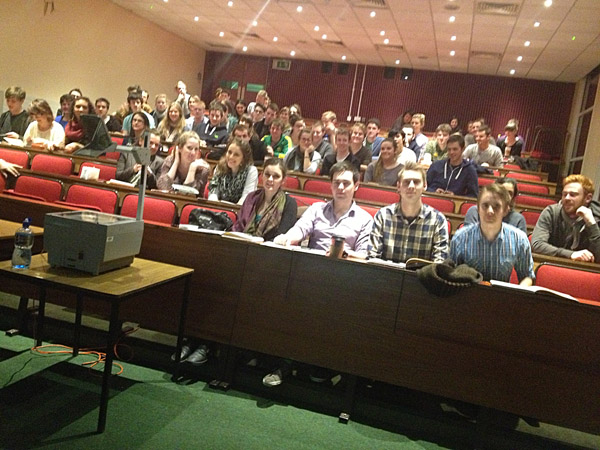
All these students voluntarily attended two back-to-back lectures last night–isn’t that amazing?

The Architecture Student Association got a great turn out for its symposium on the architecture student last night!  I’ve posted a photo of the crowd that made it all the way to the end of the two lectures… pretty amazing.  They came straight out of a day of classes into the lecture hall!

Maxim Laroussi of Architecture Republic talked about growing up in Morocco as well as what he learned about architecture by living in France, England, Scotland, Brazil, and Ireland.  Very interesting indeed!

Then I talked about “Learning Together” and how we can/should improve the way we teach architecture.  The main idea is that we need to focus more on understanding how students learn rather than on what content teachers deliver (i.e., what they say in class).

The speakers and organizers for last night’s ASA symposium: Andrew Ó Murchú, Shannon Chance, Colin Mac Suibhne, and Maxim Laroussi.

Supporting African Cultures talk

I’m going to be giving a lecture today–November 6 at 5:30pm, Room 281 Bolton Street, Dublin 1–on “Supporting African Cultures through Architecture.” This is part of the lecture series for 4th and 5th year architecture students but the topic should be of interest to others as well and all are welcome to attend.  A description of the talk is below the photos.

Images from Tanzania (copyright Shannon Chance).

Supporting African Cultures through Architecture

Knowledge of Africa’s heritage and accomplishments is woefully lacking in the media today. The tendency to leave Africa out of the literature on architecture and planning hinders designers everywhere. It denies them access to specialized information that could help construct better environments. Their failure to understand the subtleties of various African cultures often results in modern construction – particularly that funded by foreign donors – that does not effectively meet the needs and interests of the people. Even architects, spatial planners, and policy makers who live in Africa lack access to research that could help them make better choices.

This trend presents a quandary: How can one contribute to improving quality of life around the world, without imposing values that harm others? A poor response is to avoid getting involved. Doing nothing only perpetuates inequities of health, wealth, and personal freedom.

This presentation discusses the work of Livin Mosha and Shannon Chance, two scholars working to generate this type of information. As architects and educators, Chance and Mosha share an interest in: understanding the heritage of African places, constructing a cross-cultural dialogue, developing a vision for the future, and translating the voices of Africa to others. Their goal is to promote cultural-specific architecture, planning, and policy in East Africa and beyond. This talk describes their findings and their recommendations for the future.

Rites of Passage

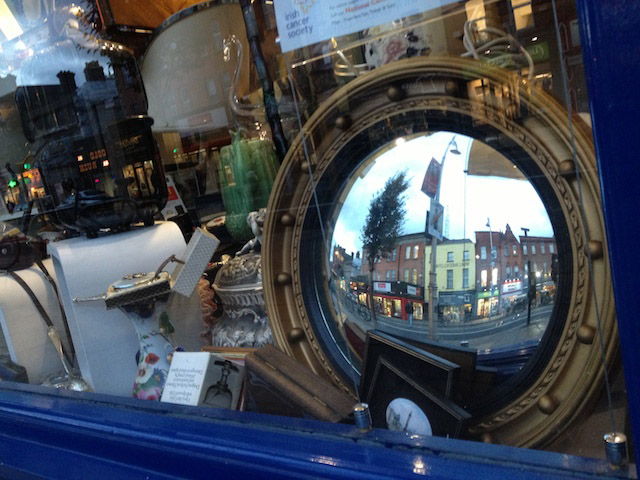
A reflection I passed on the way to the retirement event.

Rituals help an organization determine and reinforce its collective values.  The stories that are told convey what’s most important. They help pass core ideas from one generation to the next.

The things that are said and the places where these rituals are held are embedded with symbols that suggest what is central and important to the community.

The DIT has few rituals as an institution– the Institute is a collection of long-standing colleges that came together not so very long ago (1992, to be exact). It hasn’t had much time for such rituals to develop institute-wide.

The schools and departments within the DIT, however, maintain a number of very important rituals that help reinforce what these units stand for and communicate what the people in them cherish.

Speeches in Kevin Street’s penthouse “canteen.”

I got to attend one such ritual Friday evening. It was the retirement celebration for three Lecturers from the Electrical Engineering program. For each retiree, a colleague reminisced, sharing thoughts and telling stories. Each retiree spoke as well.

As an outsider, this was a very interesting event to behold. I learned much more about the community here.

After the formal reception and the speeches, most of us headed to a nearby pub.  The photos show faculty deep in discussion and others hamming it up.

It’s important for an organization to take time to reflect in this way–to celebrate what it considers to be accomplishments and to recognize contributions of its members.

Dave’s retirement speech thanked the family who donated a heart to him. His transplant was so successful that he could ham it up with “Father” Ted after the formal events.

Kevin Street colleagues deep in discussion.

Nephews!

Uncle Dave has been holding down the fort back in Virginia and spending plenty of time with the nephews we so dearly love. Here’s Dave with his Godson, David.

Dave and David

Today Dave also texted me photos of him with David’s brothers, Christopher and Tommy.

Dave and Christopher

Dave and Tommy

Tommy is growing up so fast.  Here’s a picture of me snuggling with him last winter. I really look forward to seeing all these boys at Christmas!

Shannon and Tommy, last winter.

Ornamental Hermits? Getting Ghoulish in Temple Bar!

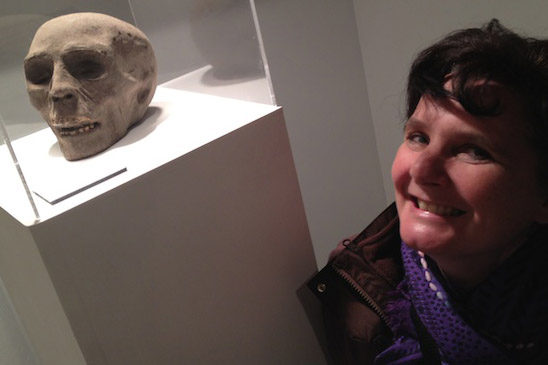
The head of a once-living ornamental hermit, that became petrified in a garden cave in Ireland.

My friend Esther arrived yesterday from Switzerland. She was my first host “mom” when I did a five-month exchange to Switzerland in 1994 with the International Four-H Youth Exchange (IFYE) program.

We’ve been fast friends ever since. She’s visited me twice in the US and served as a bridesmaid when Dave and I married.  My family has been to visit her family many times.

Since she’s here, it’s a great time to do fun tourist things.

Last night, we hit the art galleries in Temple Bar.

One exhibit had the petrified head of an actual “ornamental hermit.” Yes folks, the head of a once-live guy who posed as a garden hermit for the sake of earning cash.

Learning the art of gravedigging at the gate of Glasnevin Cemetery.

It was a fitting start for our evening aboard the Dublin Ghost Bus.  Tons of fun, and lots of fact-based ghost stories relayed by professional actors on the sits where they occurred. A bit pricey at 25 Euro per person, but fun nonetheless.

Between events, we hung out at the Palace Bar and window shopped on Grafton Street.  The Christmas displays are in full swing here.

Schools of Thought–Lecture Announcement

The Architecture Student Association (ASA) at DIT has announced the first of its Schools of Thought events. The ASA has two lectures focusing on the Architecture Student planned for this week.

  • Maxim Laroussi of Architecture Republic will be speaking about his culturally diverse education as well as the importance of a year out at some point in your education.
  • Shannon Massie Chance, DIT’s 2012 Fulbright Scholar in Engineering and Design Education, will be giving a talk about her research work–broad investigation into the workings, flaws, and triumphs of architecture schools.

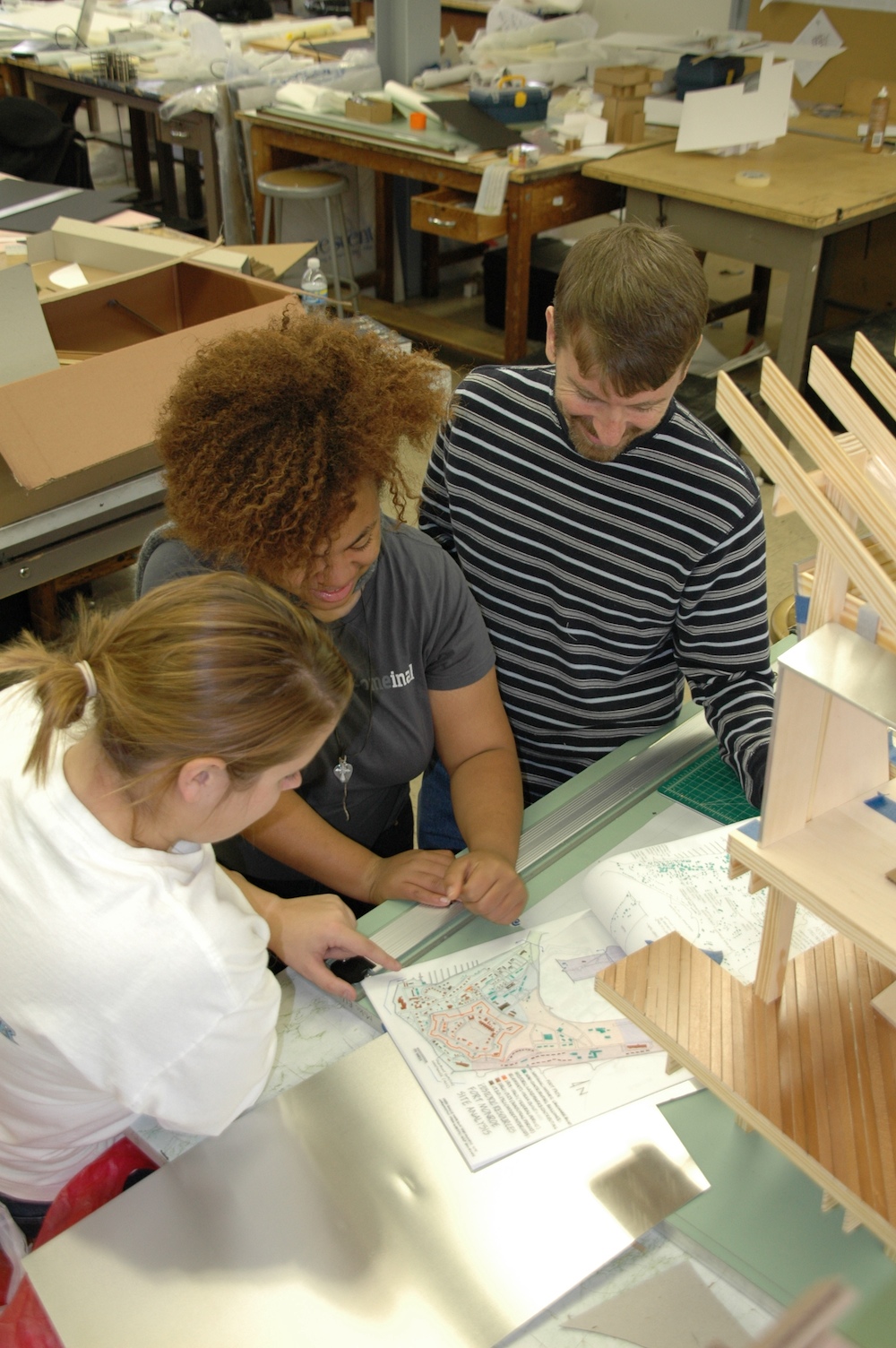
An image from Shannon Chance’s upcoming lecture on student-centered teaching. The students pictured are Hampton University’s Dana Cook, Danielle Dunn, and Mike Ellingson.

5pm
Wed 7th November
Room 281 Bolton Street (Dublin, Ireland)

The event is free and open to the public.

Putting this Wonk to Work

Discussing organizational change theory and its applicability to the College of Engineering and the Built Environment with Drs. Brian Bowe and Mike Murphy.

I’m such a wonk!

I’m elated that I got to put my training in “educational policy, planning and leadership” to work today!

I met over lunch with the Head of Learning Development and the Dean and we discussed possible strategies for helping adopt Student-Centered, Inquiry-Driven teaching practices college-wide. Our intent is to shift the focus in the classroom from the teacher to the learner.

It’s almost everyday that I get to use the research and the educational theory parts of my PhD studies.  But it’s rare that I get to contribute an educational planning and change-theory perspective to actually helping develop strategy.

I’m thrilled to be able to contribute to this important effort. And proud I’m that I can bring what I learned at William and Mary to the discussion table.

I’ll also get to discuss these ideas next Wednesday, when I speak at a student-organized seminar in the School of Architecture.

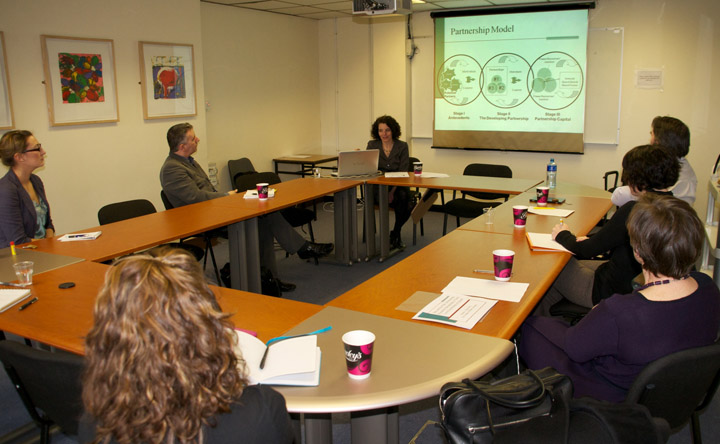
Dr. Pam Eddy’s lecture on Partnerships in Third-Level Education in Ireland. Delivered March 2011.

Today, I’m posting a photo of lunch and another of the biggest “policy wonk” I know:  W&M professor Pamela Eddy.

This blog goes out in her honor.

Thanks, Pam, for cluing me in to levers for change (Fowler, 2009). I was able to put that on the table for discussion today–all due to you.

Pam’s work includes the books Partnerships and Collaboration in Higher Education and International Collaborations: Opportunities, Strategies, Challenges and Community College Leadership: A Multidimensional Model for Leading Change. There’s an interview with her posted on Vimeo.

I should also acknowledge Drs. Leslie and Finnegan.  I used  a great deal of what I learned from David Leslie, emeritus professor at W&M, today.  And, in my discussions with Gavin over the past few days, I’ve drawn heavily from the paper I wrote in Dot Finnegan’s Cross-Disciplinary Perspective class.

W&M professor Dot Finnegan.

W&M emeritus professor David Leslie.