We are running a RoboSlam robot hacking workshop with high school (transition year) students here in Ireland. Having great fun and learning circuitry, programming, and lots more!

We are running a RoboSlam robot hacking workshop with high school (transition year) students here in Ireland. Having great fun and learning circuitry, programming, and lots more!
I’m becoming a bigger and bigger believer in collaborative learning! Last semester I did lot of research about how engineering professors (i.e., lecturers) here at Dublin Institute of Technology worked together to develop new ways of teaching electrical engineers. I was amazed to discover how incredibly much they learned by working together.
Such impressive knowledge gain is the premise behind Project-Based Learning and other group-based learning formats.

Orla and Shannon in the throws of course planning.
My day today was filled with meetings about collaborative research and teaching projects.
With the help of five different tech guys, I got SPSS up and running so that I will be able to help analyze data on that Mike Murphy and I collected from engineering and engineering technology students. We asked them what they saw themselves doing in the future, how well prepared they feel to start work, and what kinds of things they’ve focused their efforts on over the past few years.
After lunch I met with Orla Hanratty of DIT’s Learning, Teaching and Technology Centre (LTTC) and introduced her to Brian Bowe. She’ll be co-teaching a course (i.e., module) with us in May. We aim to increase the usage and visibility of Problem-Based Learning at DIT by teaching more teachers to use Problem-Based Learning in their own classrooms.
And now, tonight, I’ve been working on a proposal for funding with Ted Burke and Damon Berry. It’s an opportunity that the college’s head of research, Marek Rebow, told me about yesterday and it has to be completed immediately.
I rallied the troops. Ted drafted some text. Then Damon and I were adding our own contributions to it using Google Docs. It was so strange… Damon and me editing the same document at the same time. It turned into a bit of an academic chat session. We tossed ideas back and forth, discussing budget, objectives, and ways to improve what we’ve already got in place.
We’ll do more of that tomorrow, when the three of us meet to hash this out… and have some fun learning in the process.


DIT President Brian Norton with Fulbright Scholar Shannon Chance.
DIT’s graduation ceremony is an event to behold!
Today’s occurred at St. Patrick’s Cathedral (which is the largest church building in Ireland). You may recall that Kitty Lee, Patty, and I visited it last week.
At DIT exams for the fall semester occur in January, and winter graduation falls shortly after.
During the ceremony, each graduate’s name, degree title, and thesis topic is announced. Today’s list of topics highlighted valuable contributions DIT is making to society in areas such as physics, health and nutrition, energy, and computing.
For me, a true highlight of the ceremony was a performance by two students: a signer and a harpist. The talented duo really brought this grand space to life. (Kitty, Patty, and I missed Evensong in this church last night — by just a few sad minutes — and so I tried to live today’s event vicariously on their behalf while they soared above the Atlantic on their journey home.)
Today also presented my first opportunity to meet DIT’s president, Prof. Brian Norton in person. When the opportunity appeared, I stepped forward without hesitation, extended my hand, and introduced myself. I was truly dumbfounded when Dr. Norton said he knew who I was and that he had read my blog. Wow! I look forward to meeting him again soon.

Fergus Wheelan’s insightful book on Irish/Dublin history of the 1600 and 1700s.
At the reception, I also met a few members the electrical engineering faculty I haven’t yet gotten to know. I hope to have more to tell about their work soon.
I’ve included some photos of the day, including a snapshot of the English and Protestant flags hanging in St. Patrick’s (Protestant) Cathedral.
Upon returning to my apartment, I curled up with Fergus Whelan‘s book Dissent into Treason. In the first chapter, Fergus does a remarkable job of explaining the formative roots of various Western denominations. I’ve learned so much in just 20 pages… including distinctions between Unitarians, Presbyterians and Congregationalists, Quakers, Levelers, Catholics, and the like. I believe Dissenters were people whose supported the creation the Irish nation despite pressure from their larger brethren and/or religious underpinnings to support the English crown. I’ll gain clarity on that soon, I’m sure.
Have you ver wondered why more Protestants read the Bible today than Catholics (in the US at least)? I certainly have.
Fergus’ book explains that in Ireland in the 1600s, Catholics were only permitted to read scriptures in Latin or Greek. Protestants were given freedom to read in English. Hummmm.
In Ireland there’s so very much to discover. I’m trying to make the most of every moment, but there’s not nearly enough of time to do, see, and learn all I’d like….


This is a picture of a flexible lab for learning engineering. It is a space for group-driven problem-based learning, or a “PBL classroom.” A colleague of mine back in Virginia who is an expert in engineering education said she wasn’t familiar with this type of space, so I though I’d post it for others to see.
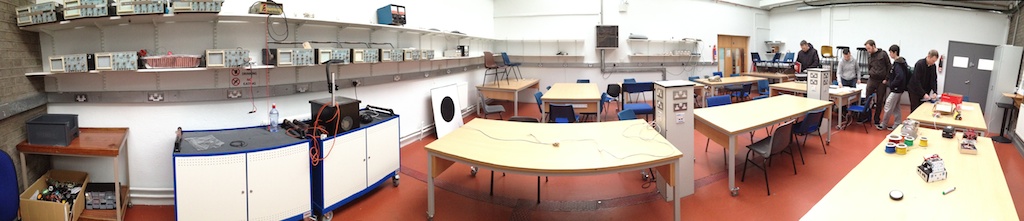
The flexible learning lab in the DIT electrical engineering program.
It was designed to promote team learning and provide access to materials and tools for building engineering projects. Above, Gavin’s Instrumentation class had just wrapped up for the morning.


Just down the street from Notre Dame’s O’Connell House, the DIT has its Learning, Teaching and Technology Centre (LTTC). The LTTC is housed in a building to the left in the photo below:

Upper Mount Street, home of DIT’s Leaning, Teaching and Technology Centre (LTTC).
The DIT has a fabulous and unique policy that every newly hired faculty member must complete a certificate program in Learning and Teaching in the first two years of employment at DIT. Their teachers actually study how to teach. Part of what I’ve been doing here is researching outcomes of this policy and of the LTTC’s work.
The LTTC has contributed in incredibly valuable ways to the learning that goes on at DIT as well as in Institutes of Technology all across Ireland (there are 14 in all, and DIT is the flagship among them). You can read about professional development programs in these Institutes in a (free) book by Fitzpatrick and Harvey called Designing Together.
In fact, I’ll be teaching a course in May at the LTTC. It’s about using PBL (as in hands-on, group-based, project-driven approaches to teaching) and it’s for people who teach at the college level. I’ll post more information about the course content soon.
I’ve included some photos from my recent visit to the LTTC to work on planning the class.


A video of a past RoboSumo competition is available to view at by clicking here. The competition is just getting underway now for this year… in fact, there’s still time to register for the DIT class!
One of the things I have been studying here in Dublin is the use of hands-on projects to teach engineering. One example is a very popular electrical engineering course at DIT called RoboSumo.
People who teach this course include Ted Burke, David Dorran, and Damon Berry. Richard Hayes tends to show up at RoboSumo events, too, as do many of the other lecturers. (Ted’s probably going to read this and he’ll likely send me and update of who’s teaching “on the module” this semester so I can tweak my list — I know mine isn’t complete. By the way, I appreciate having you in my audience, Ted!)
Suffice it to say, the whole program gets jazzed up about RoboSumo events. Even the Dean (Dr. Mike Murphy) can be seen in the video of the final competition.
There’s a bit of information about the class on line. The General Rules page explains:
Two robots compete in each bout, each trying to stay in the arena longer than the other robot. Robots are encouraged but not obliged to actively push their opponent out of the arena. … The bout ends either when a robot leaves the arena or once 1 minute has elapsed, whichever occurs first. If only one robot remains in the arena at the end of the bout, that robot is the winner.
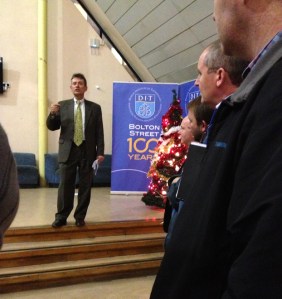
gathered together to hear the College Dean/Director, Dr. Mike Murphy.
Last week was a swirl of activity, with DIT’s College of Engineering and the Built Environment wrapping up fall classes and me getting ready to spend five weeks back home.
At an end-of-year College Forum, the college’s Dean recapped recent successes and helped crystallize a shared vision for the future of the College.
At the event, I caught up with a few friends (including my planner friend, Ela). And I made a few new acquaintances as well.
Than, I rushed out to do some last minute Christmas shopping. After succeeding in that endeavor, I was headed home laden with bags.
But I bumped into prof. Jim Roche on the sidewalk in front of the Black Sheep Inn. I accepted his invitation to hang out for a while with the students from his studio who were assembled there. I particularly enjoyed talking with Robert Burns, because he has a clear passion for photography and was excited to learn about the studio we’d just purchased for Dave.
I also got the chat with the Dean, who had passed us on the street and who we’d managed to rope into the Inn.
Shortly later I headed down the street a just few blocks, to Jack Nealons pub, where Ela was assembled with friends who I wanted to meet.
Low and behold, my friend Joan Cahalin was there. She’s been planning to go looking for me at the Cobblestone, but fate must have know to send her here instead!


Sima’s teaching philosophy, drawn from the Bauhaus.
Sima Rouholamin delivered an energetic, thoughtful, and inspirational lecture at the DIT School of Architecture last night. One of the culminating speakers for this semester’s Schools of Thought lecture series, Sima discussed her dissertation work. A facet of her literature review involves the Bauhaus — a natal fit with the theme of the lecture series (Schools of Thought).
Sima brings such energy and vibrancy to everything she does. She’s so very engaged and engaging.
Alongside her dissertation, she’s developing a vision for what DIT’s School of Architecture is and what it can become. Last night’s event provided a way for her to get some feedback on that vision from the community here, and that community replied with keen interest and resounding support.
Regarding the Bauhaus, Sima discussed the emphasis on making and craft — and the connection between play and design. She’ll soon be conducting phenomenographical interview designed to identify the various different ways architects conceptualize design. I hope to help her collect data for the study this spring.


The Irish are hipper with recycling than we are in most places in the States. The Dublin Institute of Technology, for instance, provides some bins that are clearly labelled and located in sensible places.
Recycle bins at the train station “guarantee to recycle 70% of the contents” deposited into them. That beats us by leaps and bounds!
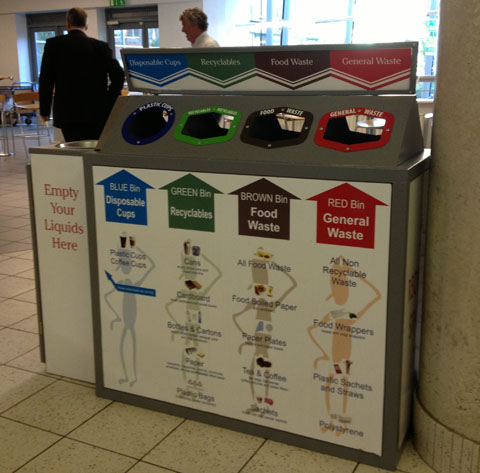
Recycling at DIT’s headquarters on Aungier Street.

Recycling at Heuston Station.
Simon McGuinness asked me to speak about LEED with his Architectural Technology class.
65% of Ireland’s architects are unemployed today. Shocking. And sad.
Today, I got to speak to a room-full of these architects and architectural technologists. They come to DIT once a week — from all over Ireland — to learn about sustainability.
To be eligible to take this course, a person has to be receiving some form of unemployment assistance. The government funds this program as a way to infuse knowledge about green building into the community and help re-train this group so they can help address pressing social needs.
And what a fantastic audience! I was so caught up in the dialogue that I forgot to take a picture for you. I believe everyone in the room was older than me and likely had much more field experience.
And they were fully engaged, interested, and attentive! Full of energy and questions!
The teacher of the course, Simon McGuinness, had asked me talk about the nuts and bolts of documenting projects using the LEED Green Building rating system. That can be a very dry subject. But they took it in with enthusiasm.
During the one-hour talk, I got the chance to share some of the findings of my dissertation and the recommendations I made in the article I just published in Planning for Higher Education. I’ve included a gallery of those slides, below. Please see the article for details. (It got over 800 downloads!)


 Ireland by Chance