Scholarly, useful research is the name of the game in Europe!
These are the standards for research published in the European Journal of Engineering Education (EJEE), and they serve as a good guide for researchers in general.
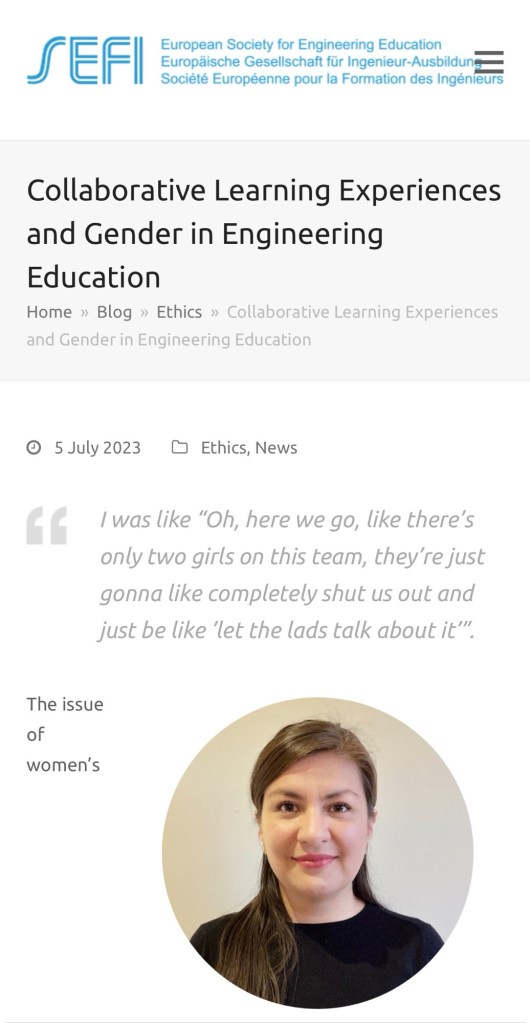
This post sheds light on what makes a conference paper stand out. It shares the story of soon-to-be-Dr Sandra Ieri Cruz Moreno, who won the top research award from the European Society for Engineering Education (SEFI) in 2025.
SEFI’s special interest group on Engineering Education Research featured the work Sandra and I have done last week, in an online workshop, and the information is worth sharing more broadly — so here it is!
Workshop overview
Last week, Sandra (my PhD supervisee) and I presented this workshop as part of the SEFI@work learning series. We reported on one strand of Sandra’s PhD thesis research.
During the workshop, Sandra engaged the audience with questions about their own research to help transfer the successful part of our experience to the researchers who attended.
The workshop was great practice for Sandra’s viva voce (called a ‘dissertation defense’ in the USA), scheduled for March 10.
Unfortunately, vivas are closed-door events in Ireland. That means our colleagues can’t attend, so this online workshop was the main way to let our SEFI community know about the amazing work Sandra has done.
I reported on the overall SEFI conference and my surprise and elation at winning this award in a September blogpost.
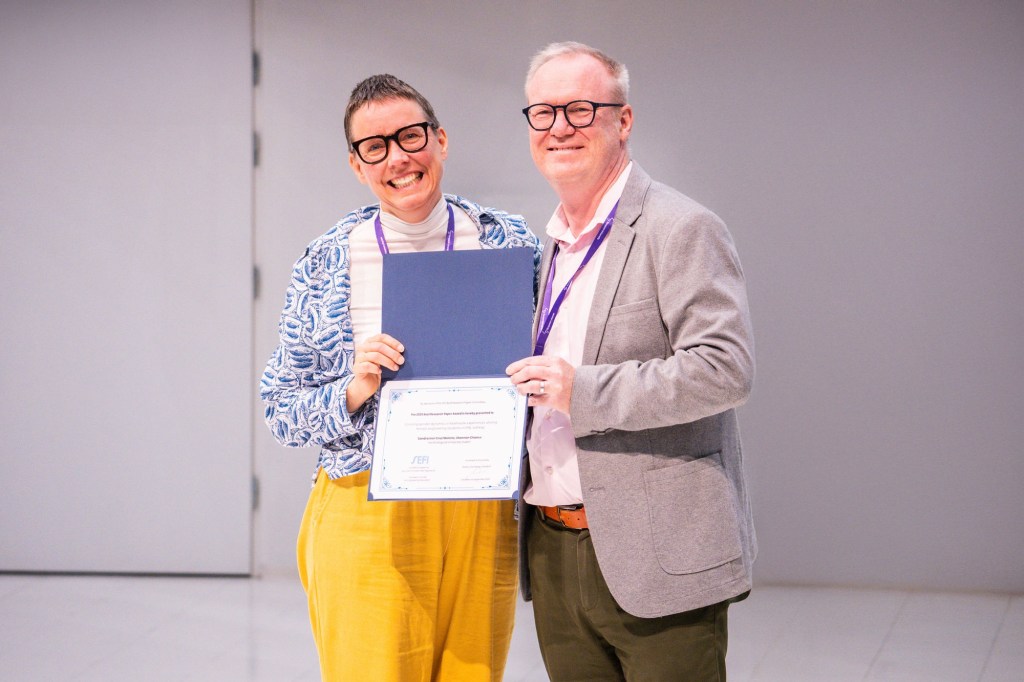
I accepted the award on Sandra’s behalf at SEFI 2025.
Now, the organizers of the online workshop asked us to share some secrets to our success. That was tricky!
SEFI advertised widely, and over 80 people registered to attend.
We hadn’t set out to win an award, just to make a scholarly summary of part of Sandra’s thesis study!
Although it felt intimidating to explain how to win, we went in with the confidence that the paper had been nominated in all three categories it was eligible for last year, and each category has a separate panel of judges.
We were beyond delighted — and completely surprised — to win.
It helped reassure us that the thesis research was ready to wrap up and report.
Workshop content
You can watch a video of the workshop, to hear in Sandra’s own words what is most interesting and valuable about her work and her research process:
And you’re able to download Sandra’s slides, to jump straight into the content, by clicking here:
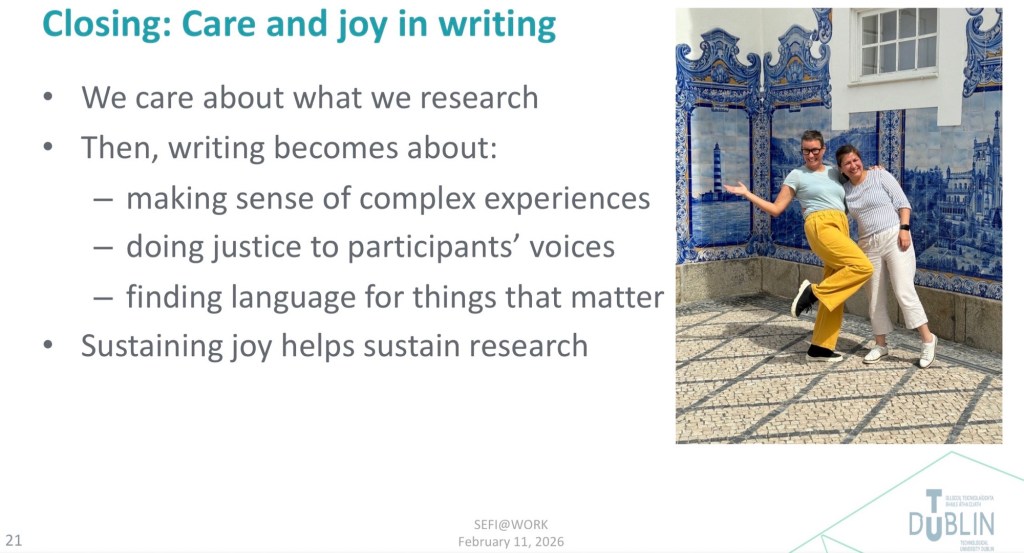
One slide from Sandra’s presentation.
Sandra’s achievements
I couldn’t be prouder of Sandra and all she has accomplished in four short years. Since starting her doctoral studies in January 2022, she has delivered two babies into the world and developed an award-winning research study and a fully written thesis.
Sandra’s special contributions include introducing sociological techniques and perspectives into engineering education research. She has broadened the focus of our discourse on the usefulness and applicability of phenomenology as a research method, and she has shed valuable new light regarding the experiences of female students in our engineering courses at Technological University Dublin.
The findings of her PhD research hold applicability well beyond TU Dublin, however. They show us how the social dynamics of teamwork evolve over time — how students develop meaningful friendships that help them personally and professionally.
Sandra used the “Gender at Work” framework to better understand students’ experiences with Problem-Based Learning and other collaborative learning approaches. Using this framework, she found that the 22 women I’d interviewed (longitudinally over a period of four years):
had experienced uneven access to engineering content before entering university,
lacked female engineers in their families who could serve as role models,
experienced some biased team dynamics that influenced what jobs got assigned to whom by the team, and that the need to prove themselves on teams grew less but nonetheless persisted across their four-year matriculation, and
received increased recognition for their credibility over time, which helped them challenge stereotypes and shift team dynamics in a favorable direction.
Sandra’s SEFI 2025 paper complemented papers we’ve published and presented at earlier conferences, including:
Soon, you’ll be able to read Sandra’s final thesis and learn about the impressive contributions she has made to the literature and to the engineering education research community.
I am honored to call Sardar Cruz Moreno a friend and colleague. I look forward to calling her “Dr” and to watching her flourish in the coming years!
I’d like to share recent social media posts by my colleagues/past students/friends — their perspectives on transcontinental collaboration are unique and valuable! Thanks to Mia Dukuly, Violet Maufuwe, Tarrah Beebee, and Shinya Takehara for taking the time to reflect, document, and publicly share your experiences.
Tanzania
The first three of these — Mia, Violet, and Tarrah — participated as students in a Fulbright-Hays Group Project Abroad that I led to Tanzania in 2005.
We spent five weeks in Dar es Salaam, studying alongside Tanzanian architecture students and teachers. Several of the students forged lifelong friendships (and some even marriages) with other members of our 63-person study group (25 students and teachers from the USA, 38 students and teachers from Tanzania).
I didn’t establish this blog (IrelandByChance.com) until 2012 (seven years after that trip, when I went on my own Fulbright fellowship to Ireland). Nevertheless, several of my past posts have mentioned aspects of that 2005 study abroad program:
Also of interest is the post Trend Shifters and Hip Young Urbanites, featuring Donald Roman, a student of mine from Hampton University who participated in the 2005 Fulbright-Hays trip as well.
Mia and Tara are two USA-based Fulbright alumnae who keep returning to East Africa — and sharing their adventures with others.
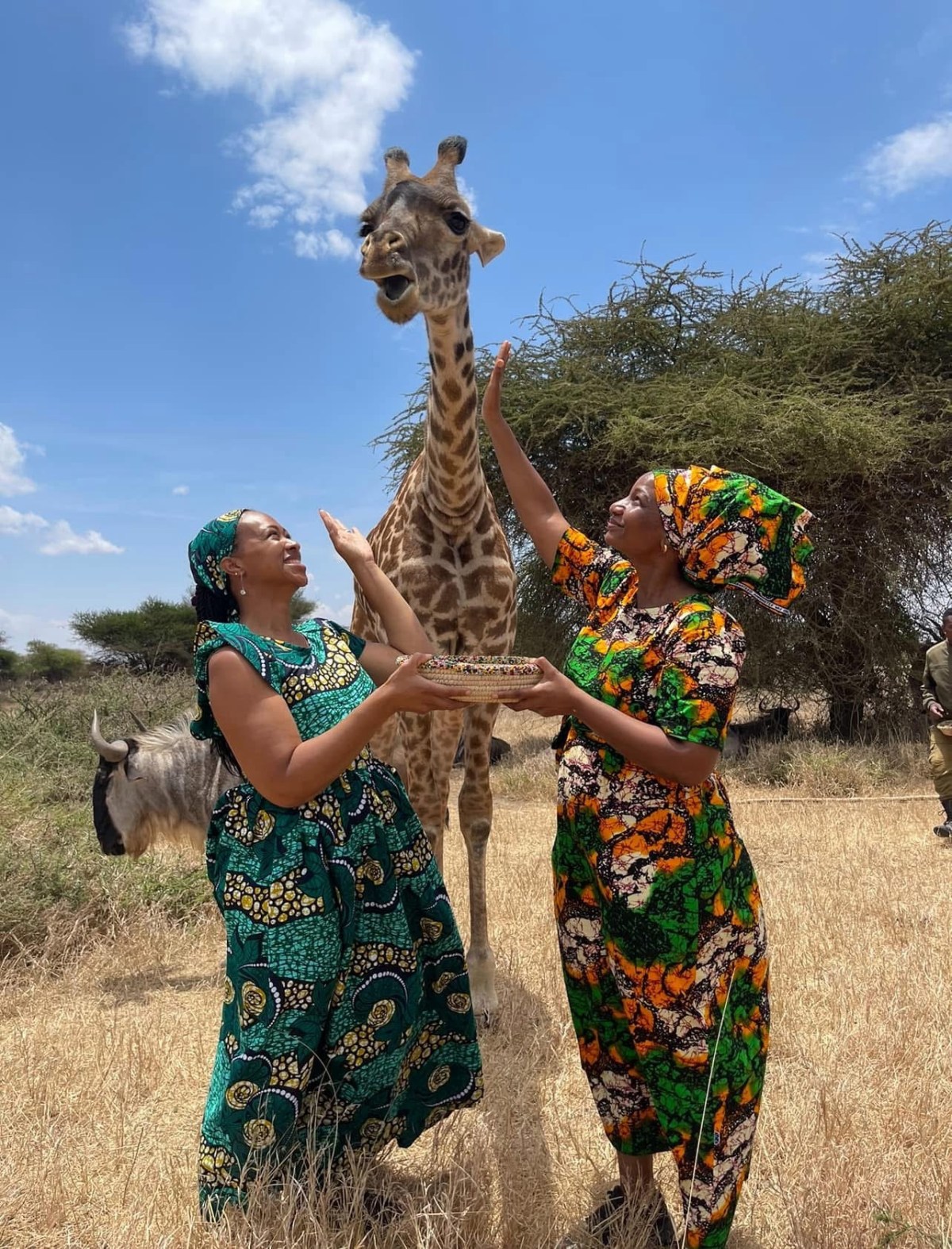
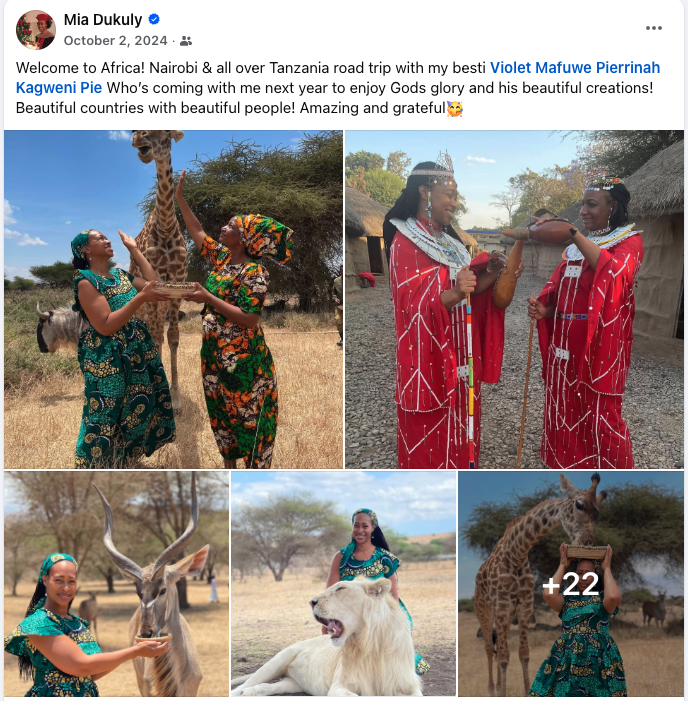
Here’s a taste of what Mia and her architect friend Violet Mafuwe have gotten up to recently:
A post shared by Mia Dukuly this past autumn.
Violet was one of the Tanzanian students participating in the 2005 study abroad program, and the only female among dozens of males.
The sisterly bond between these architects, Mia and Violet, is truly heartwarming.
Tarrah, Mia, and Violet are all actively engaged in social missions, continually reaching out and helping others, particularly vulnerable people in East Africa.
In this screenshot, Tara describes how she connects her teaching, architectural design, and outreach activities.
In fact, it was Tarrah’s February 3rd blog post that inspired me to share the treasure trove below. Tara is an architect living in Los Angeles.
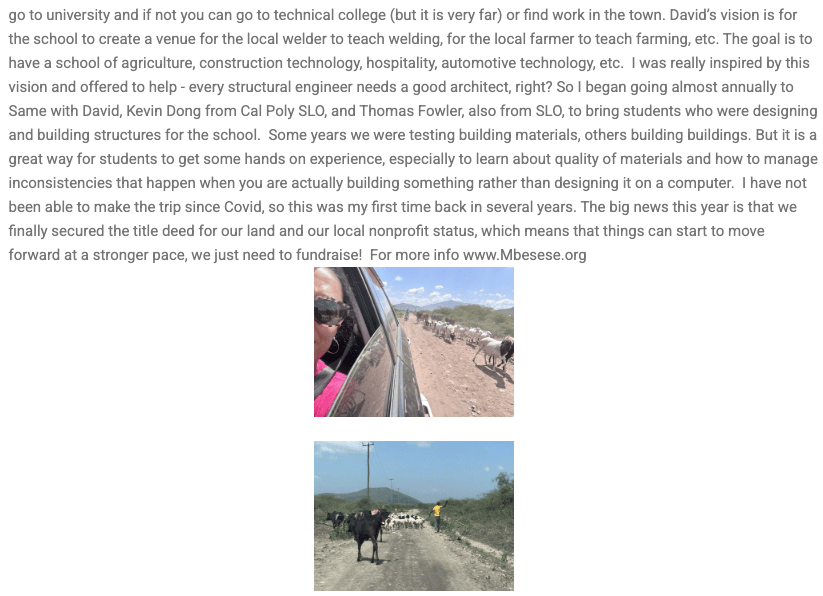
Tarrah mentioned me at the top of the blog, and it means a lot to me that I helped enable and inspire her to stay involved in Tanzania. She’s been helping build an educational complex for many years.
In this screenshot, Tara provides information on the educational facility.
Which brings me to the other recent post I’d like to share. Shinya Takehara isn’t a Fulbright fellow (yet!), but I feel I wouldn’t have met him without the entry I got into engineering education research as a Fulbright Fellow in Ireland.
I am deeply indebted to each of these wonderful people — Shinya, Tarrah, Mia, and Violet — for making my life brighter and more meaningful, and for always reaching out to help others and spread the ethics of care.
I also thank Shinya, Tarrah, and Mia for giving me permission to share their posts here. Sending that request brought more good news, as Mia has recently secured a new job and will be relocating with her family to Germany soon. She reports good progress with her Architecture Registration Examination — a grueling multi-part test that takes most of us years to complete. I am so excited to learn of her progress!
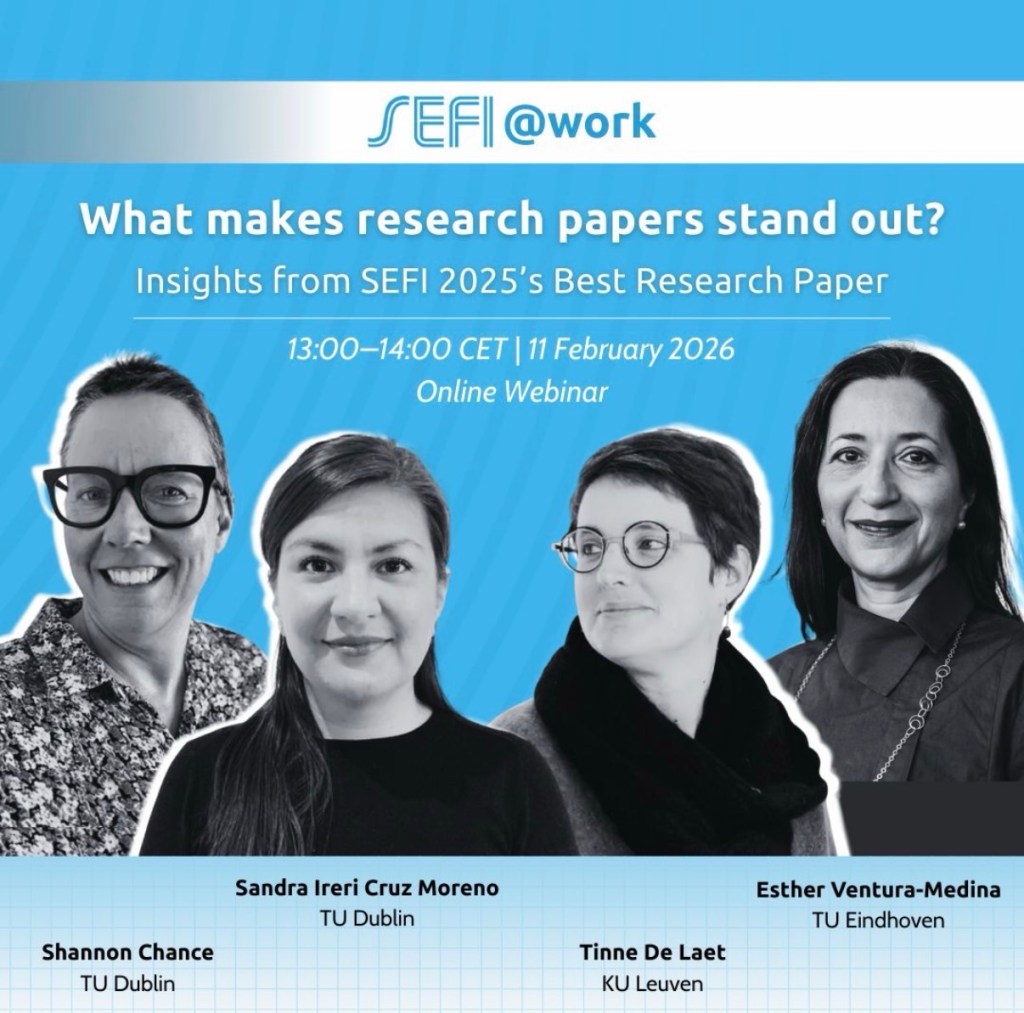
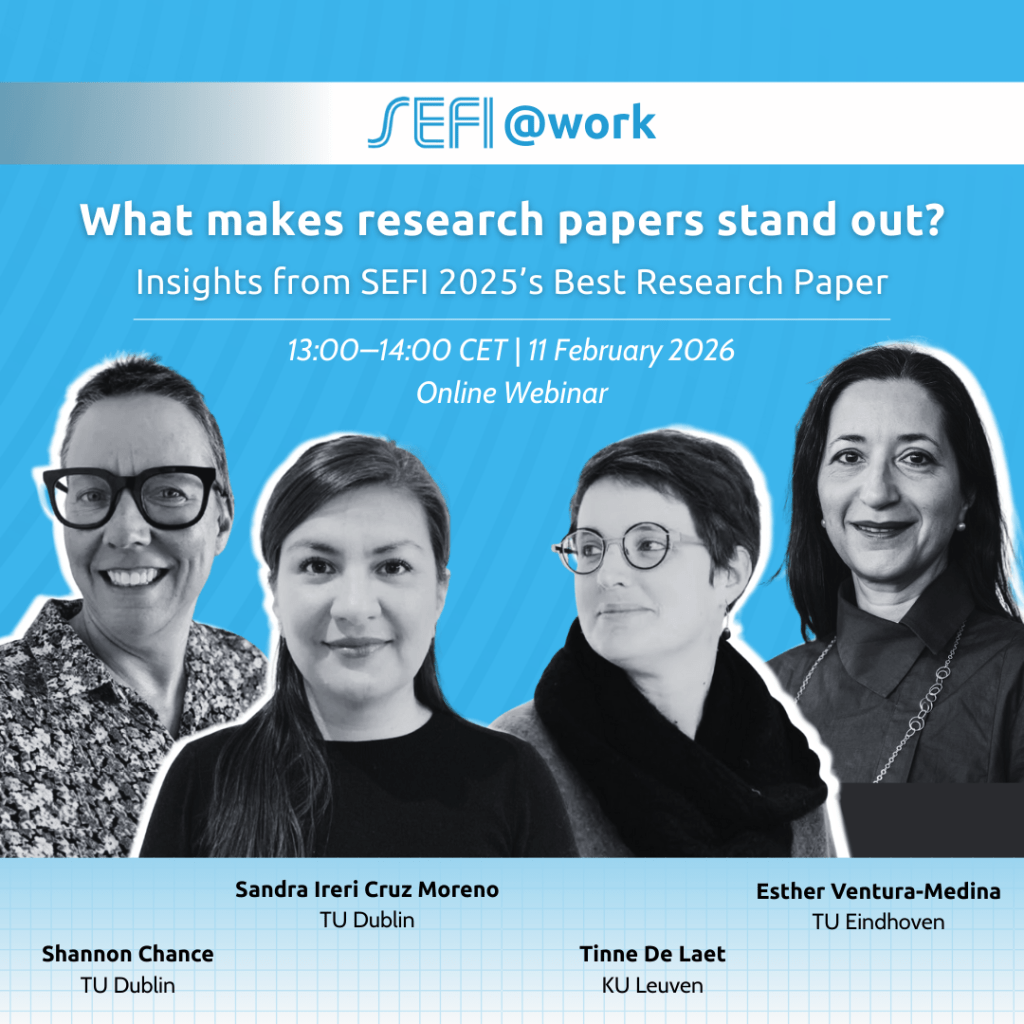
Sandra Cruz Moreno and I will be featured in a SEFI@work online workshop on Wednesday, 11 February 2026 13:00 PM – 14:00 PM CET.
The title is: What makes research papers stand out? Insights from SEFI 2025’s Best Research Paper
Sandra and I are hard at work preparing meaningful content about Sandra’s award-winning SEFI paper, which reports one part of her overall PhD thesis/dissertation work.
I am delighted to discover that about 80 people have registered so far, representing a wide diversity of organizations:
Many thanks to the SEFI Education Research Methods special interest group co-chairs, Dr. Tinne De Laet and Dr. Esther Ventura-Medina, for the invitation to deliver this session, which they will moderate. Thanks also to the SEFI Office, especially Alex Gliga and Klara Ferdova, for their support in organizing and hosting this event.
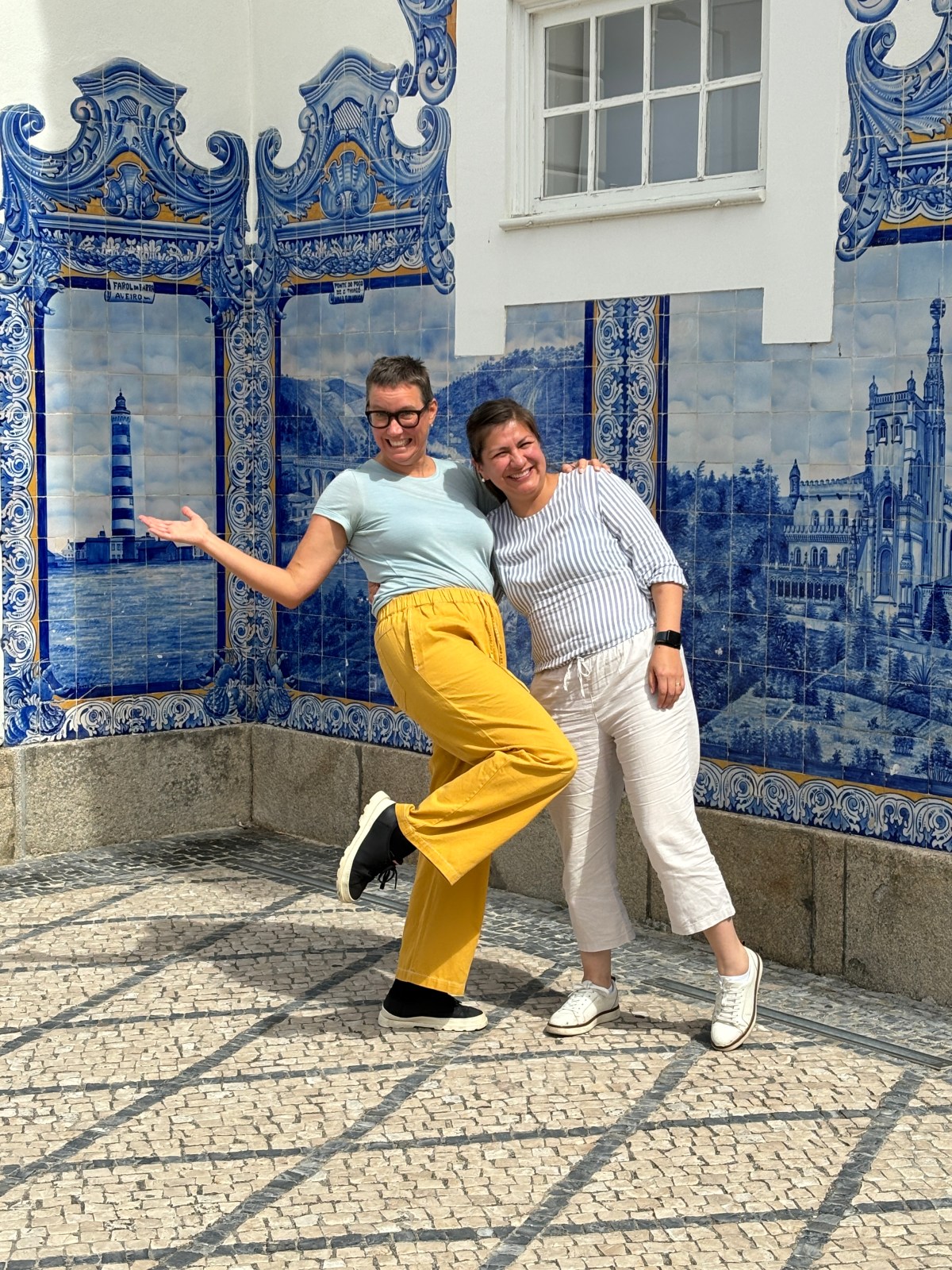
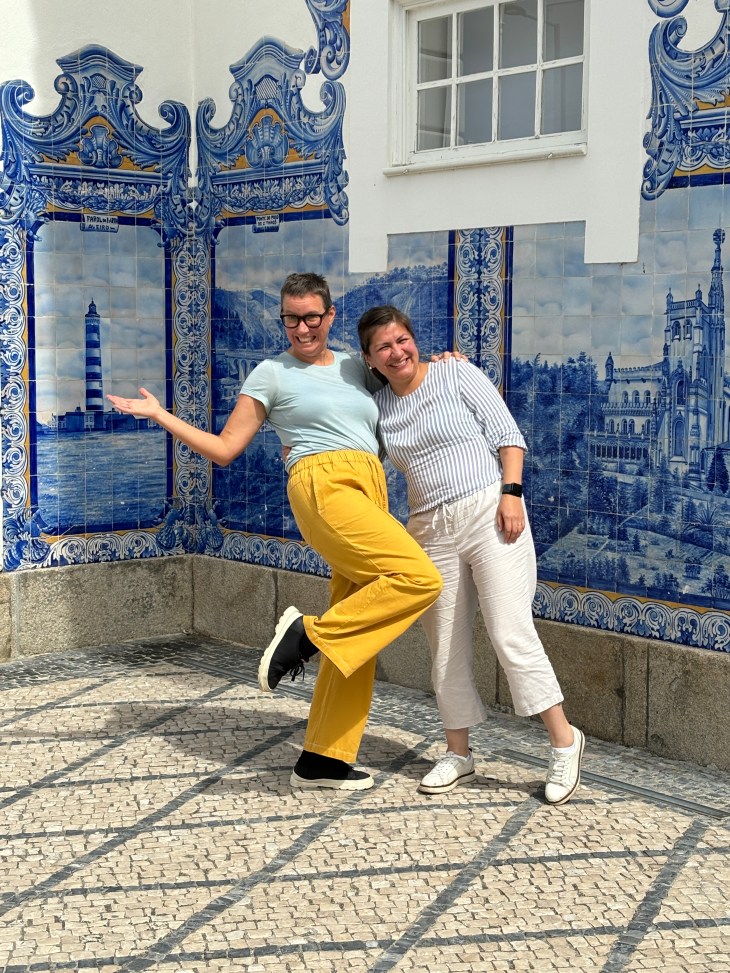
This photo of Sandra and Shannon in Portugal captures the tone of our upcoming presentation.
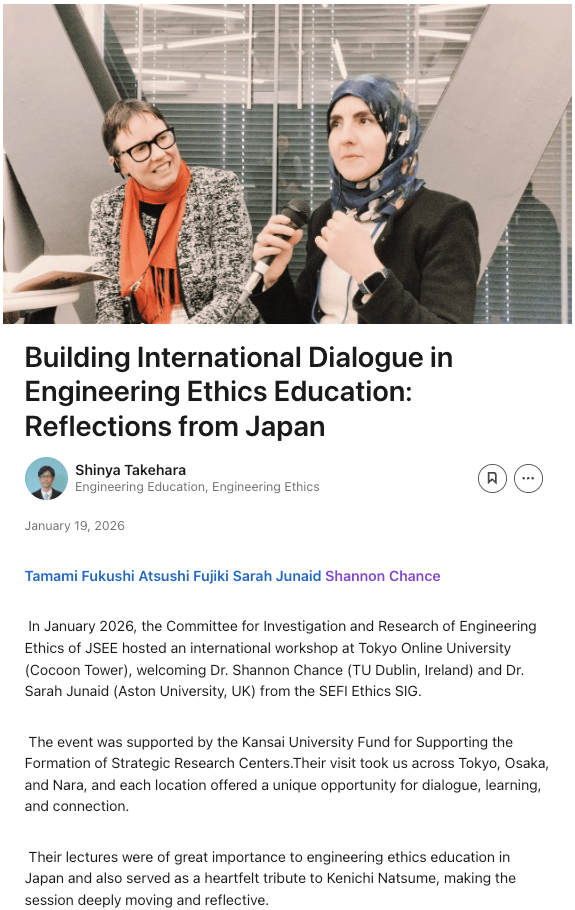
I had the immense honor of visiting Japan as a guest of the Japanese Society of Engineering Education, 6-16 January 2026.
This trip focused on engineering ethics, how it is conceptualized and taught, and how this differs between Eastern and Western cultures.
The purpose of the trip was to advance collaboration between Japan and Europe, expand professional networks, and better understand and ultimately improve how engineering ethics is described and taught to students.
The trip was significant because language differences, travel distances, and past cultural isolation mean there is still much to learn from each other.
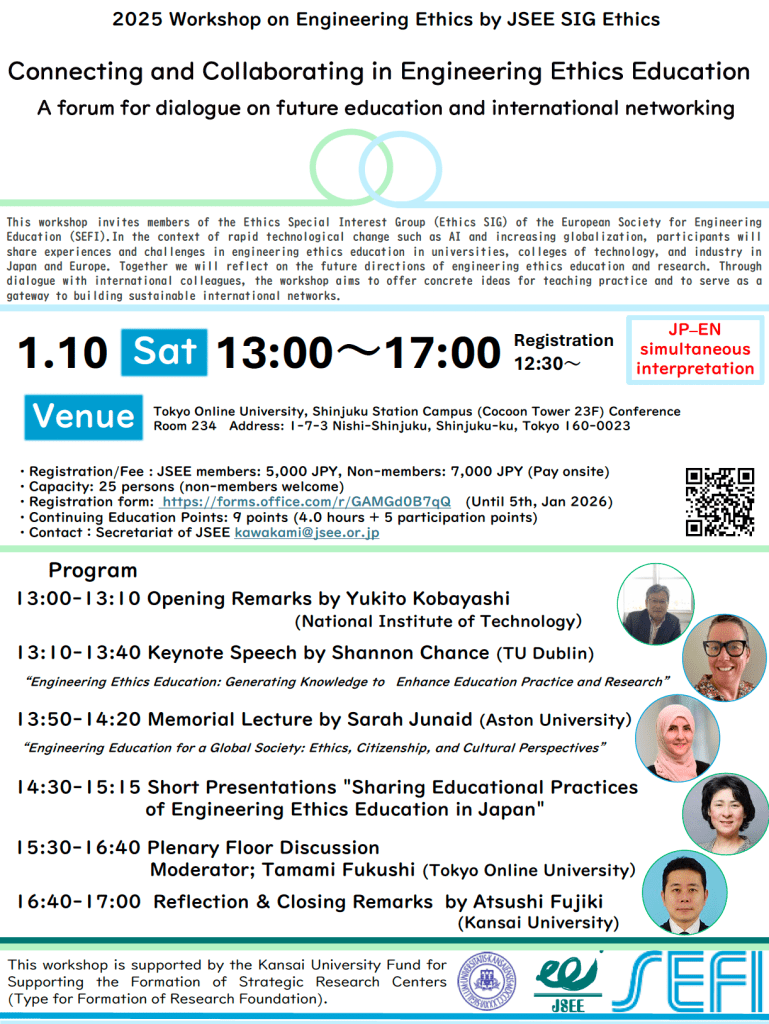
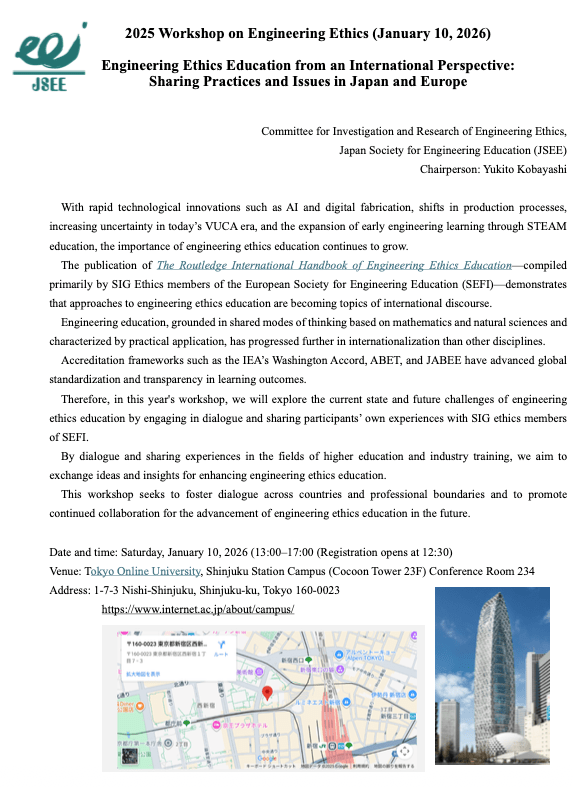
This was a collaboration between JSEE and SEFI, our European Society for Engineering Education. Practical info sent to JSEE members calling for participation at the conference.
For this ten-day trip around Japan, I represented the European Society for Engineering Education (SEFI) — to help build bridges connecting Japan, Europe, and the global engineering ethics education and engineering education research communities.
This blog post contains loads of detail and possibly a hundred photos. I felt it was important to document the activities for posterity and to help build greater cultural understanding.
This was only my second ever trip to Asia (the first being a 1999 conference in Seoul, South Korea).
On this trip, I met so many amazing people.
I want a chance to thank each of them and let them know how much the time together meant to me. Many of them are pictured below (from the main conference, which I’ll tell you more about below).
I have summarized the profound set of cultural and professional experiences as best I can.
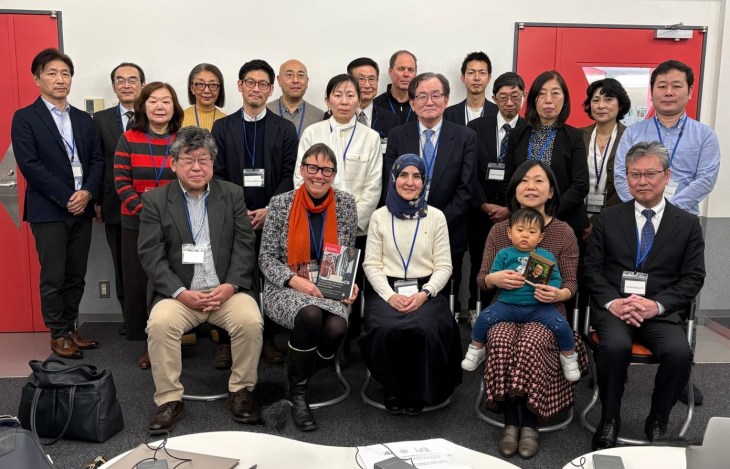
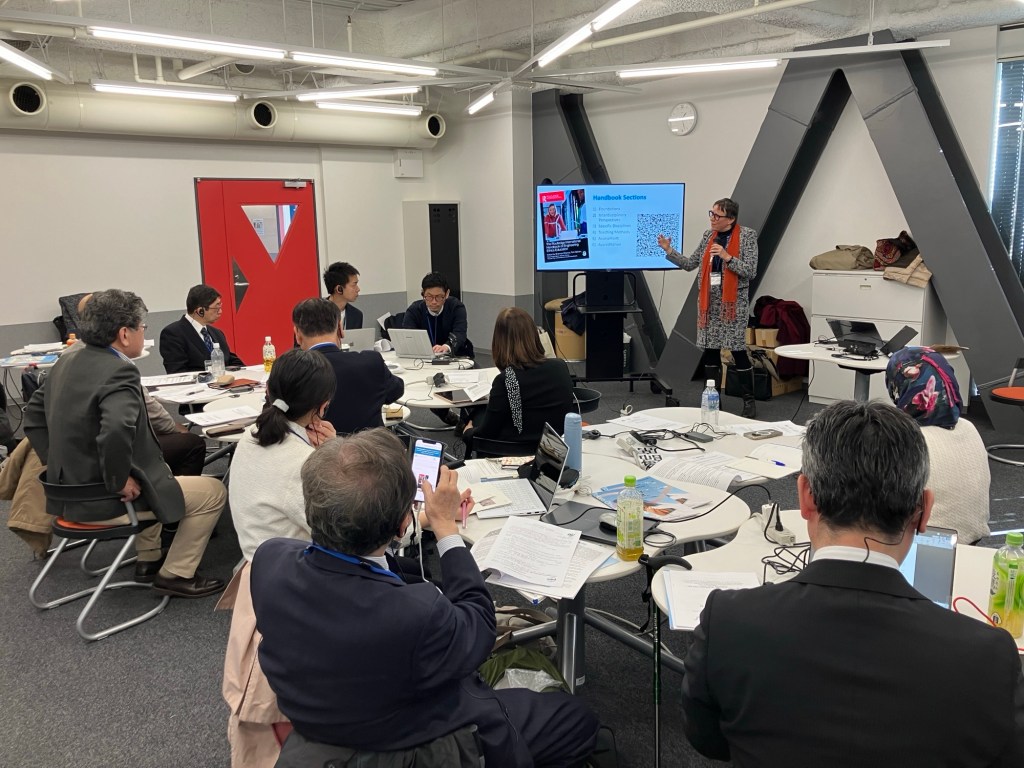
The participants of the main conference on engineering ethics education in Japan, from JSEE, with Sarah Junaid and Shannon Chance from SEFI.
I traveled alongside Dr. Sarah Junaid, a Reader in Biomedical Engineering at Aston University (Birmingham, UK). Sarah has travelled to Japan several times before, most recently as a Churchill Fellow, collecting data on engineering ethics education.
Sarah has cultivated a transcontinental team of academics who are researching the words used to describe ethics in engineering accreditation documents worldwide. This project has captivated me since I attended a paper presentation Sarah gave at the SEFI conference in Barcelona in September 2022.
Sarah’s efforts mirrored the focus on collaborative transcontinental capacity-building that I also cultivated as Chair of the global Research in Engineering Education Network (REEN).
Sarah served as a positive role model for me as I worked with the ethics handbook’s editorial team. When I explained this at the JSEE conference, I choked up; I don’t think I’d ever told Sarah how central she is to my worldview today.
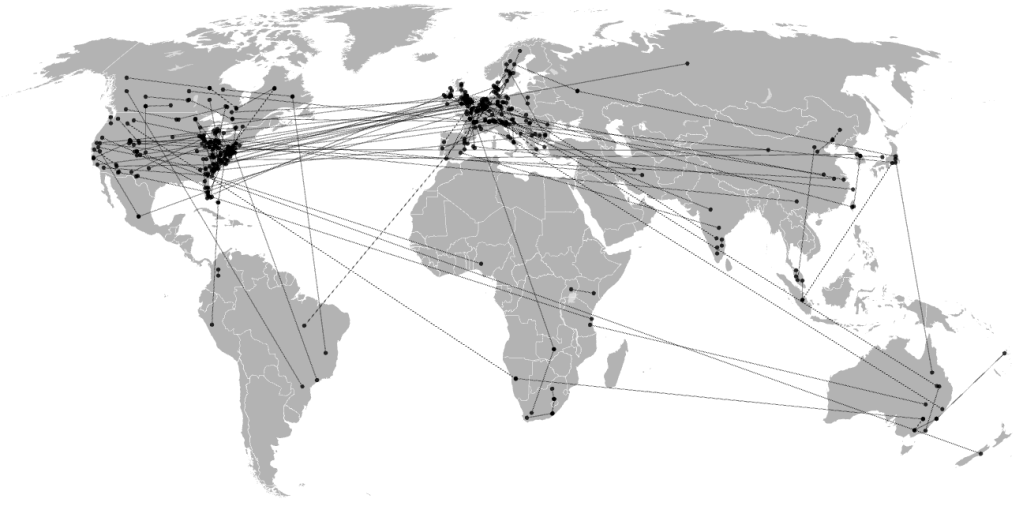
I made this map to show where the authors of our handbook have lived and/or worked. You can see we had some representation from Japan (Kenichi Natsumi and Fumihiko Tochinai), but could benefit from more collaboration in Asia and also across the global south.
In all. the presentations I delivered in Japan all emphasized the power of collaboration in enhancing the delivery of engineering education and our collective approaches to understanding, defining, learning, assessing, regulating, and expanding ethics.
I define engineering ethics as professional codes, laws, theories, and frameworks, as well as social and environmental sustainability, including equity, diversity, and inclusion, that underpin engineering practice and guide what we are and want to become.
It’s about making the best better, a motto I bring with me from my formative years in 4-H, empowered by life-long, hands-on, self-directed learning. I first dreamed of travelling to Japan through 4-H, but that never came to pass. Today, my work as an academic in engineering education research finally brought me to this exotic land.
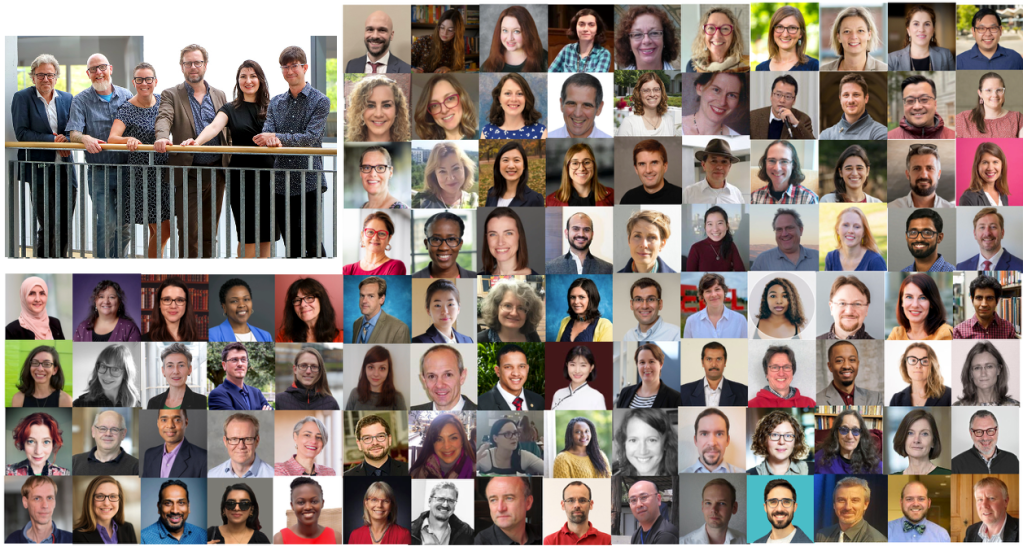
With 105 authors including 6 editors, our ethics handbook had impressive transcontinental representation.My keynote highlighted trancontinental aspects of the handbook and the need for collective action among engineers to reflexively define ethics and how to improve the way we deliver ethics education.
This team hosted us on behalf of the Committee for Investigation and Research of Engineering Ethics of JSEE; they were exceptional hosts during our visit.
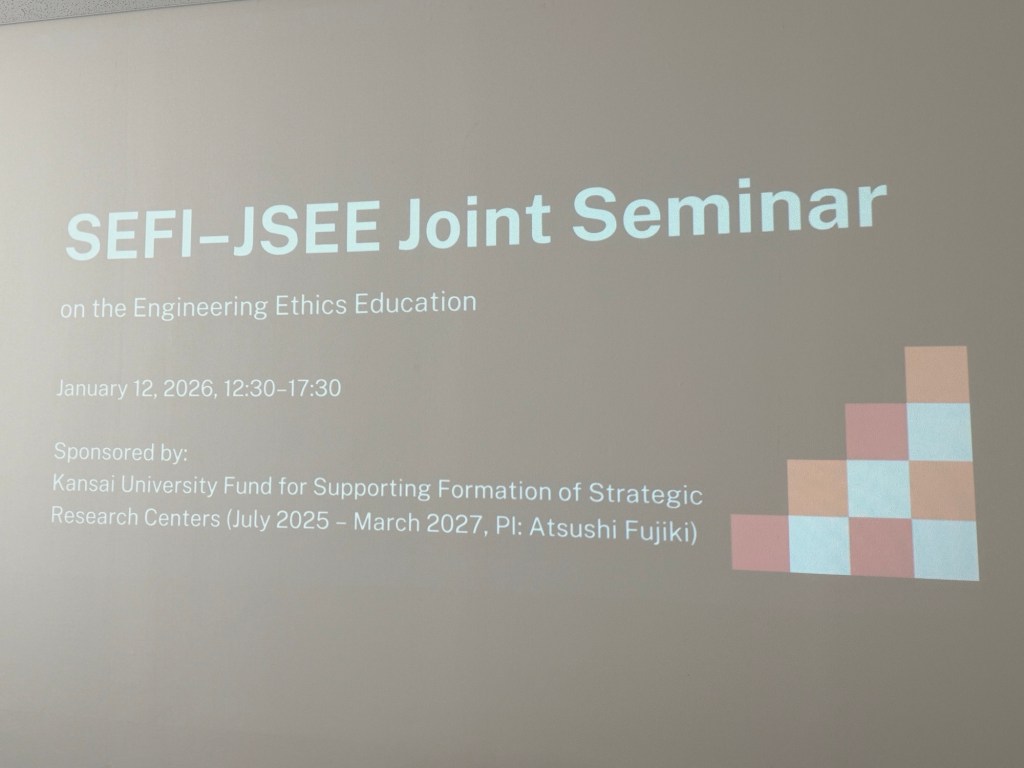
A grant from the Kansai University Fund for Supporting the Formation of Strategic Research Centers, which Atsushi holds, funded our travel.
We hope to work together in the future, also collaborating with Mary Nolan from ATU Sligo, on educational games and the ethics of care.
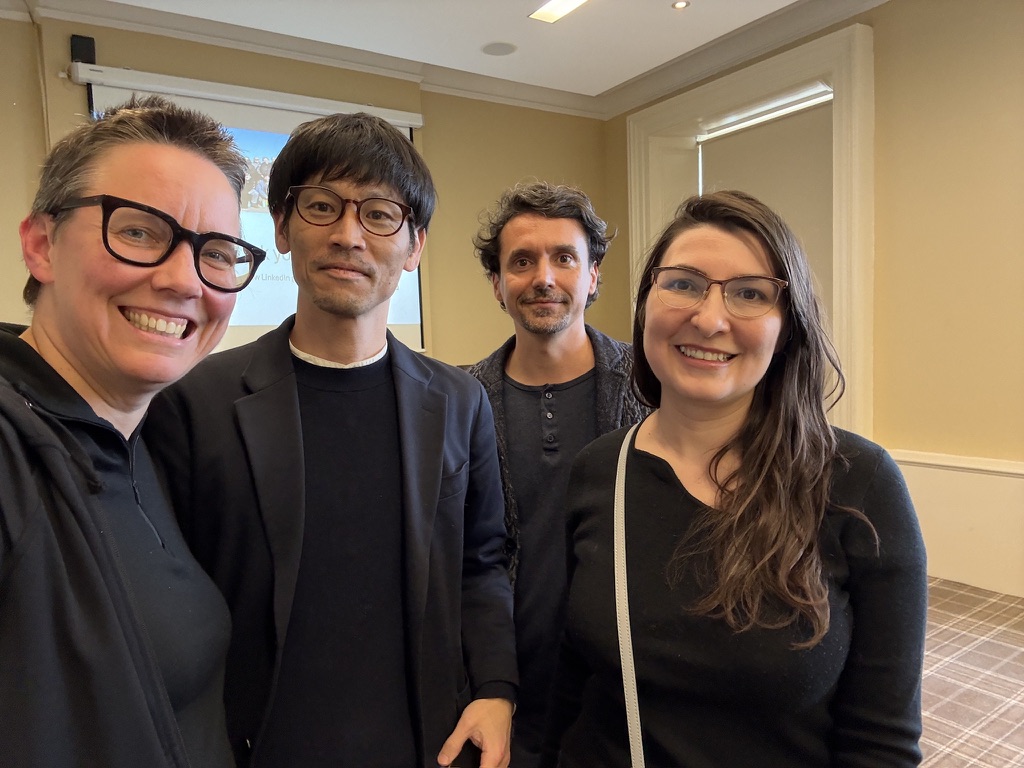
Shinya Takehara at the SEFI Ethics Symposium, March 2025, alongside SEFI Ethics co-chairs Mircea Tobosaru and Diana Adela Martin.Shinya Takehara setting up, surrounded by close colleagues from Japan.
Atsushi works in the College of Engineering Department of Engineering Science and Mechanics at Shibaura Institute of Technology and runs a laboratory where “students can deepen their consideration of ethical, legal, and social issues (ELSI) associated with the development of science and technology, mainly from the humanities and social sciences, such as applied ethics, philosophy of technology, and social theories of science and technology.”
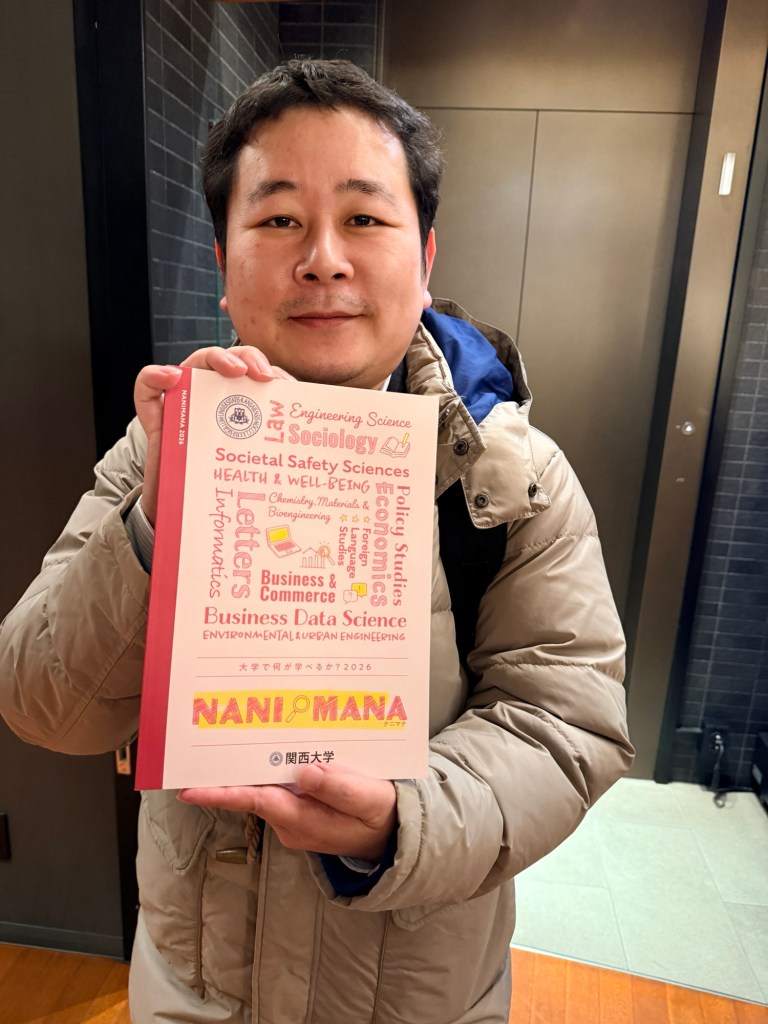
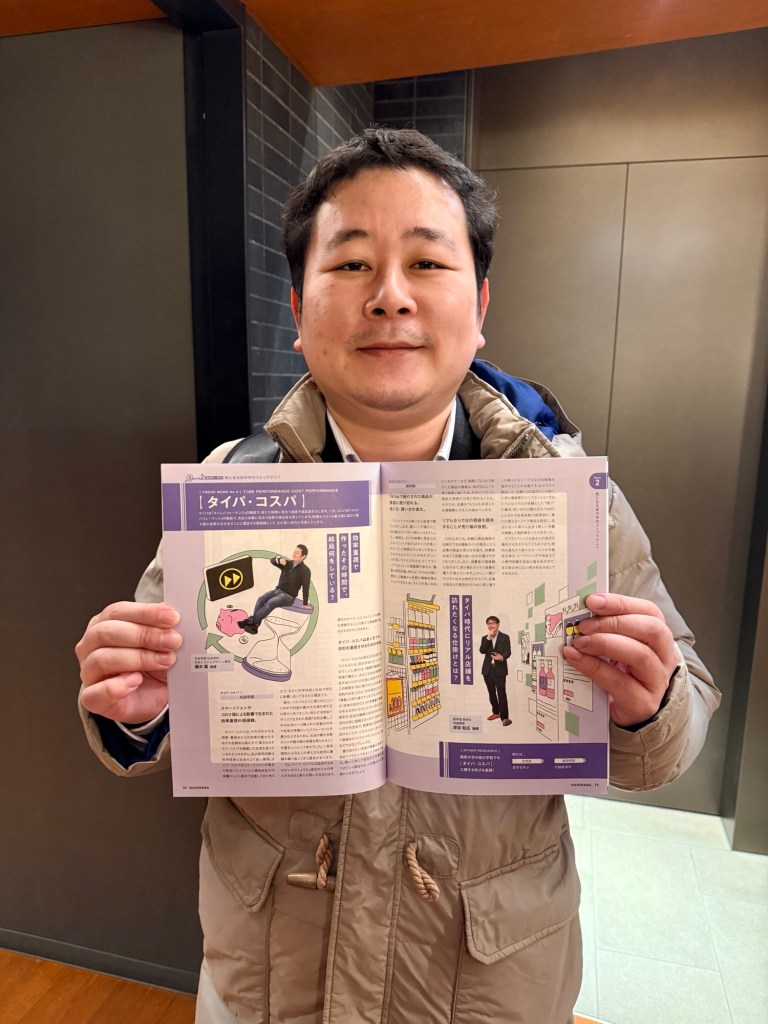
A publication we found in the University bookstore that featured Atsushi’s project.Atsushi is a social scientist.Atsushi was an amazing host. Here we see me, Shinya Takehara, Shinya Oie, Atsushi Fujiki, Stefané and Sarah.
Arriving in Japan
Flying into Japan from Europe, Sarah and I landed in Osaka.
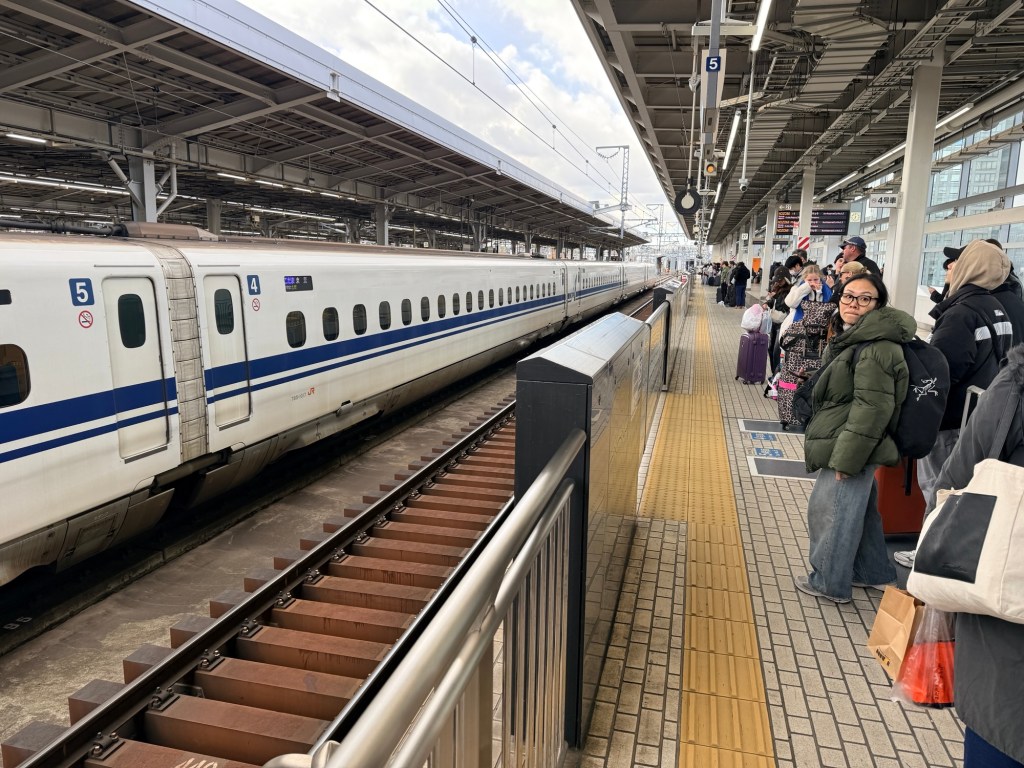
We met Shinya and Atsushi at the airport for a brief orientation, then took the train into Osaka for two nights, and onward via bullet train to Tokyo. Atsushi made sure we understood our way around and how to get food.
We used the first day to adjust to the dramatic time zone change and to explore Osaka a bit.
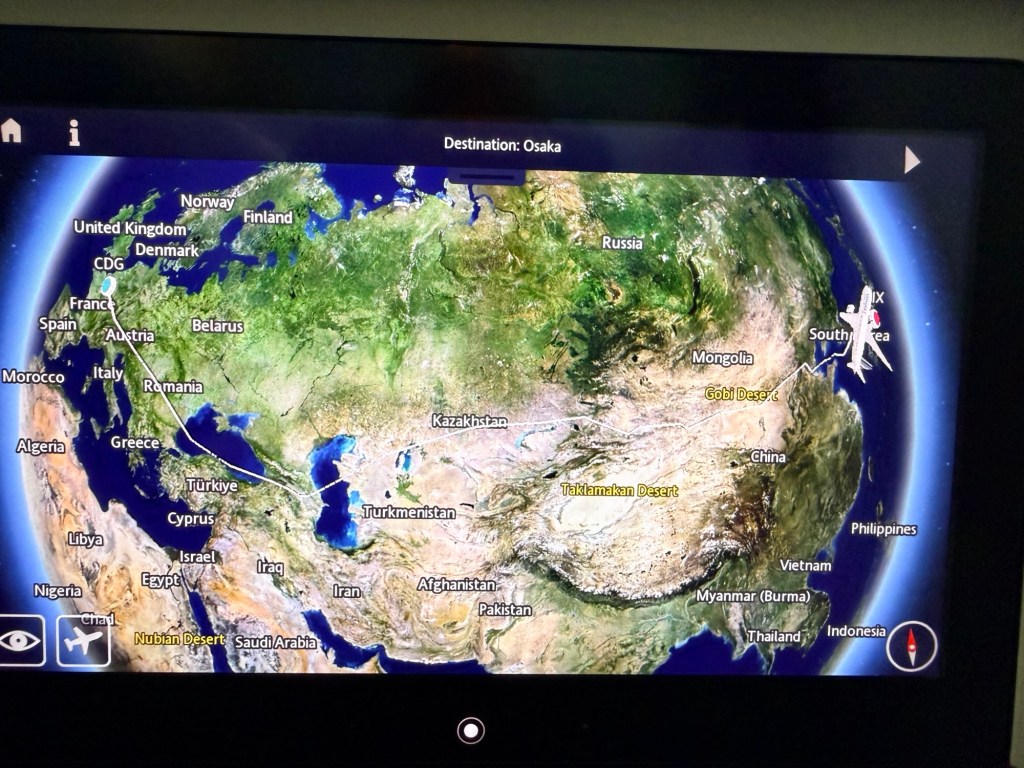
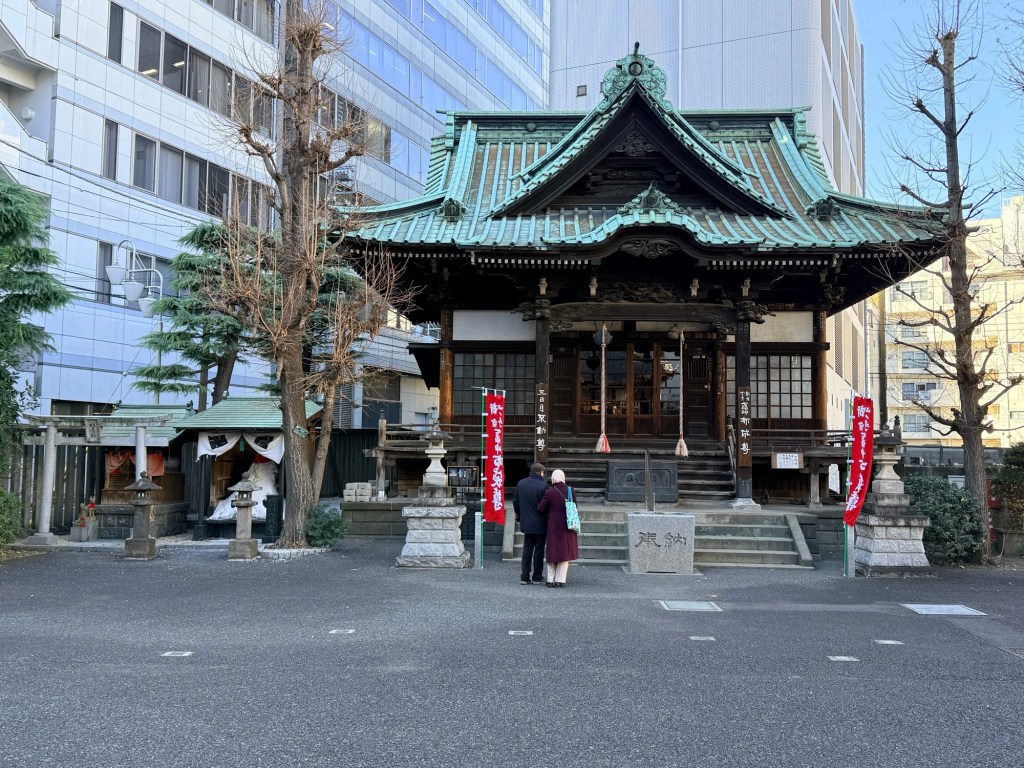
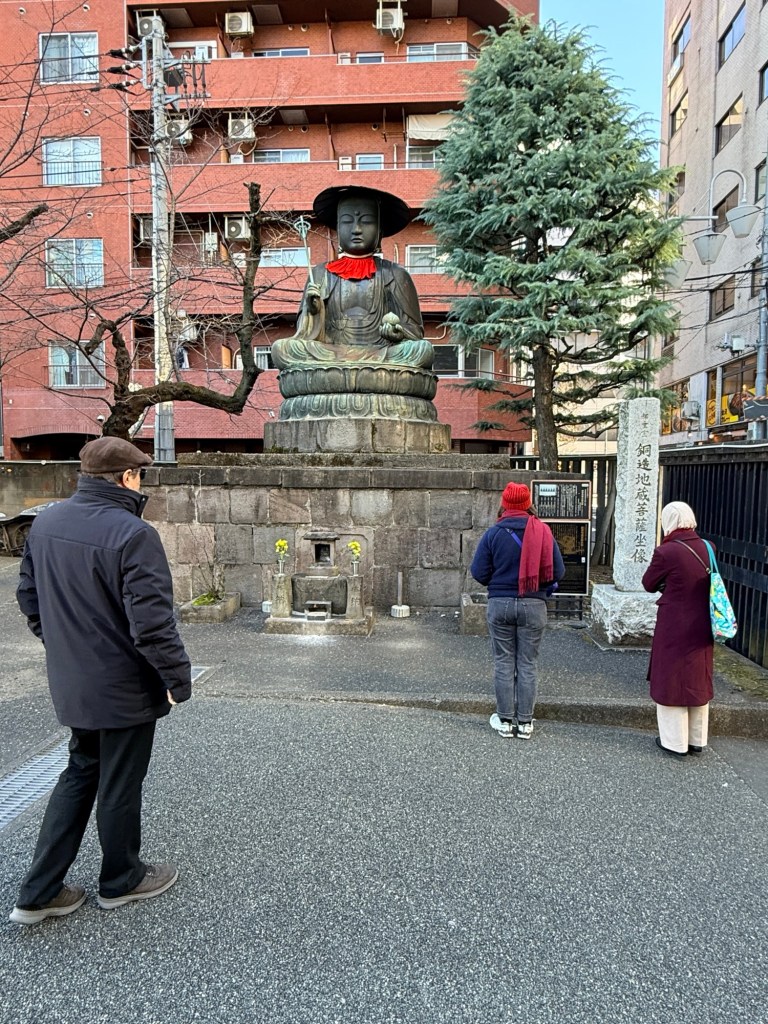
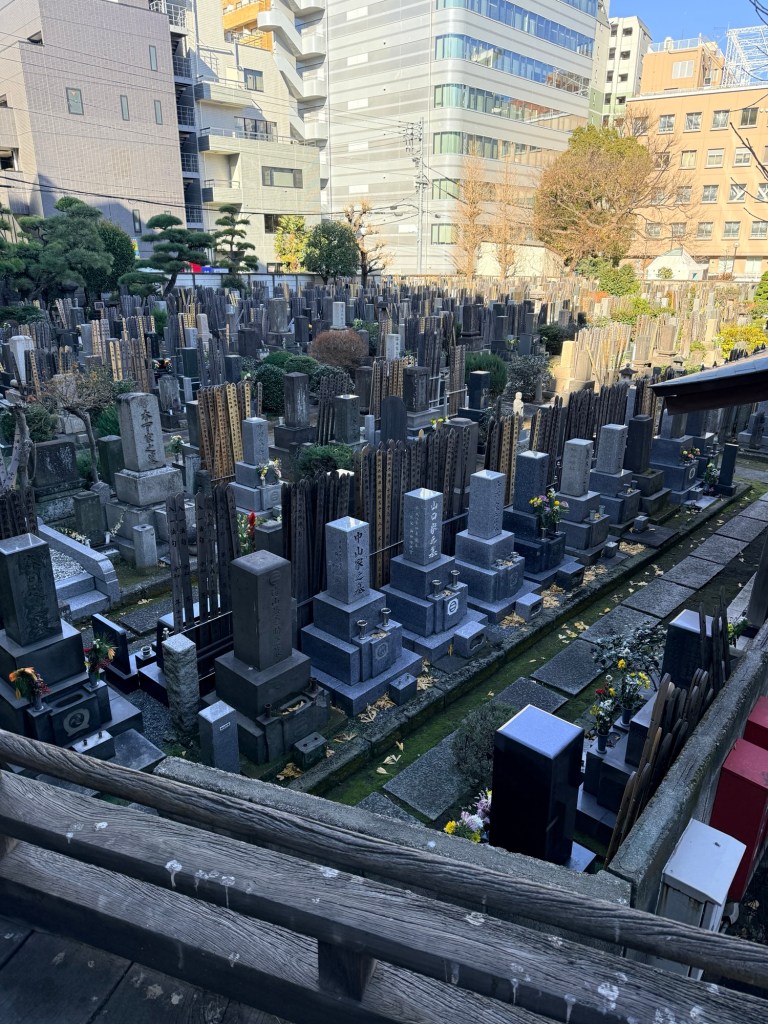
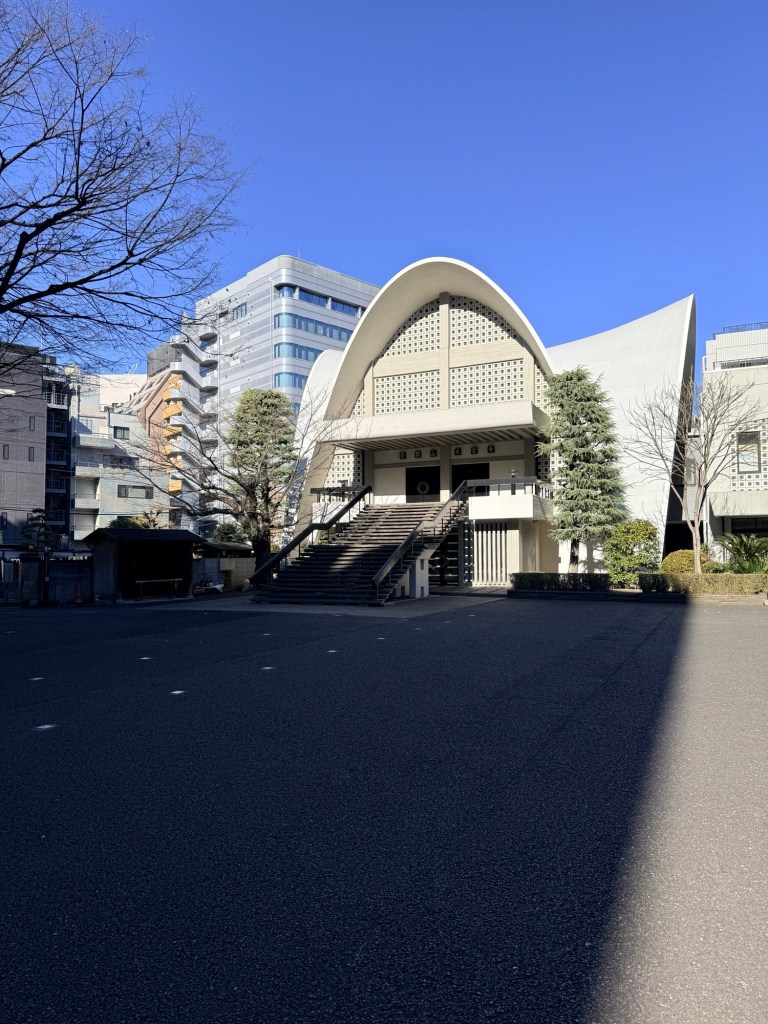
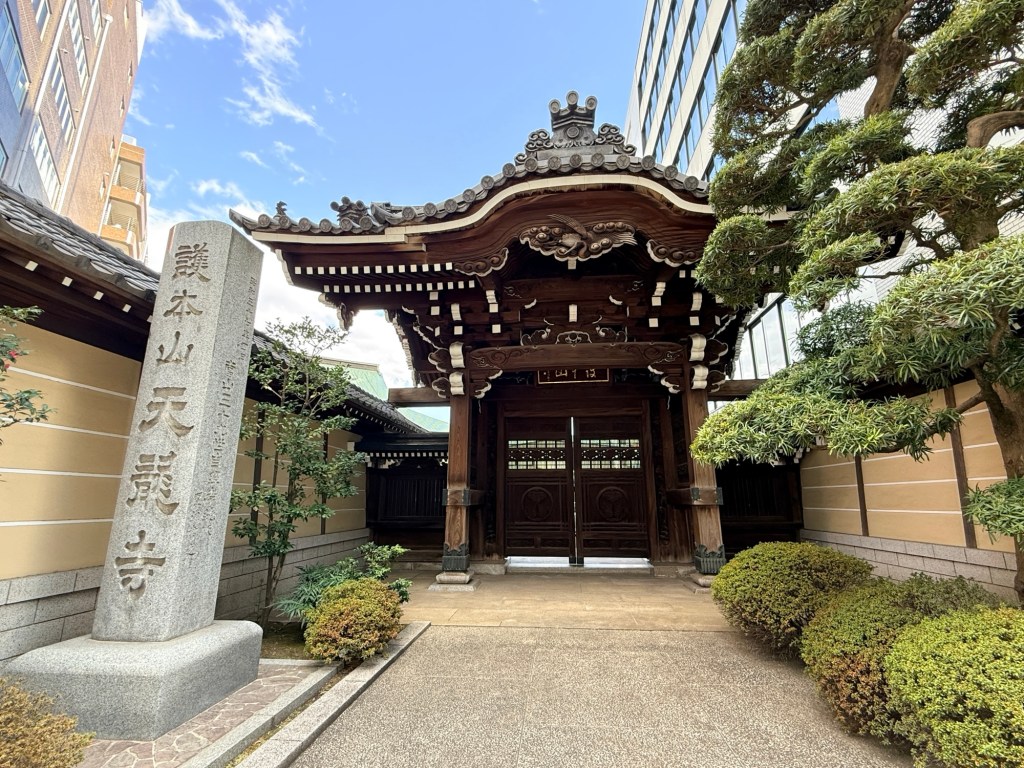
It was a long flight, and we changed nine time zones!In Osaka, we find sites like this shrine beside our hotel, which had traditoinal building forms,and statues,a cemetery, … and an unexpected architectural form. We took a bullet train to Tokyo. This shows only the back half of a bullet train!
Headline Event at the Cocoon Tower
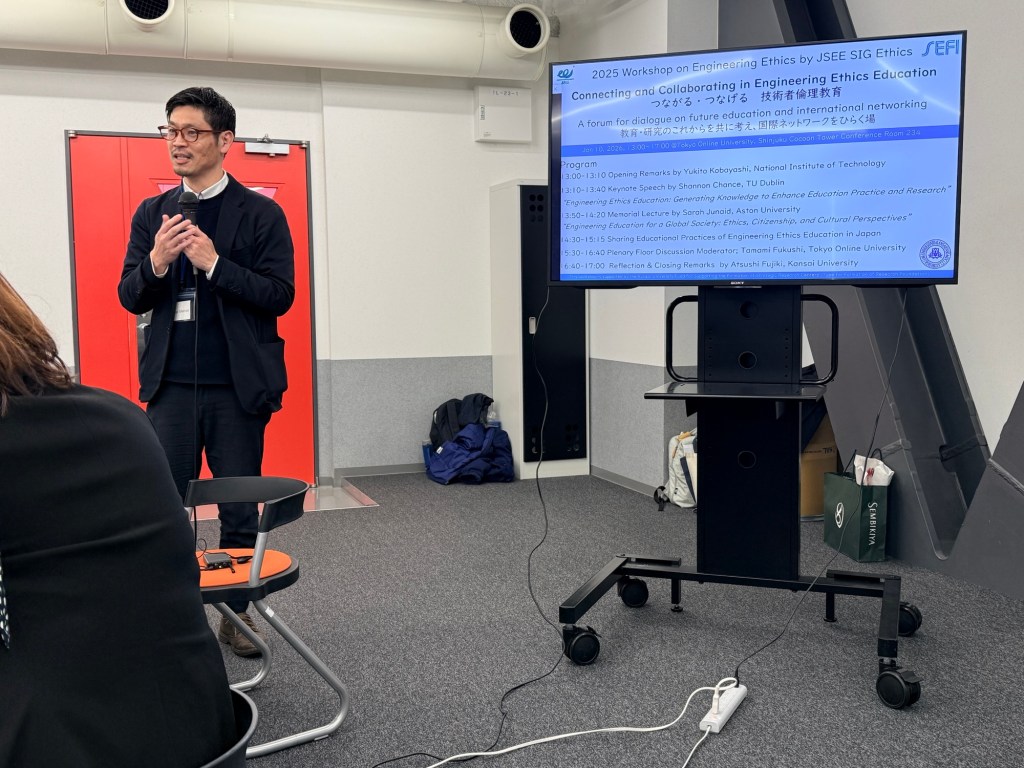
We got oriented for our first major activity of the week, an international workshop at Cocoon Tower, where Tokyo Online University operates. Our host, Tamami, teaches there.
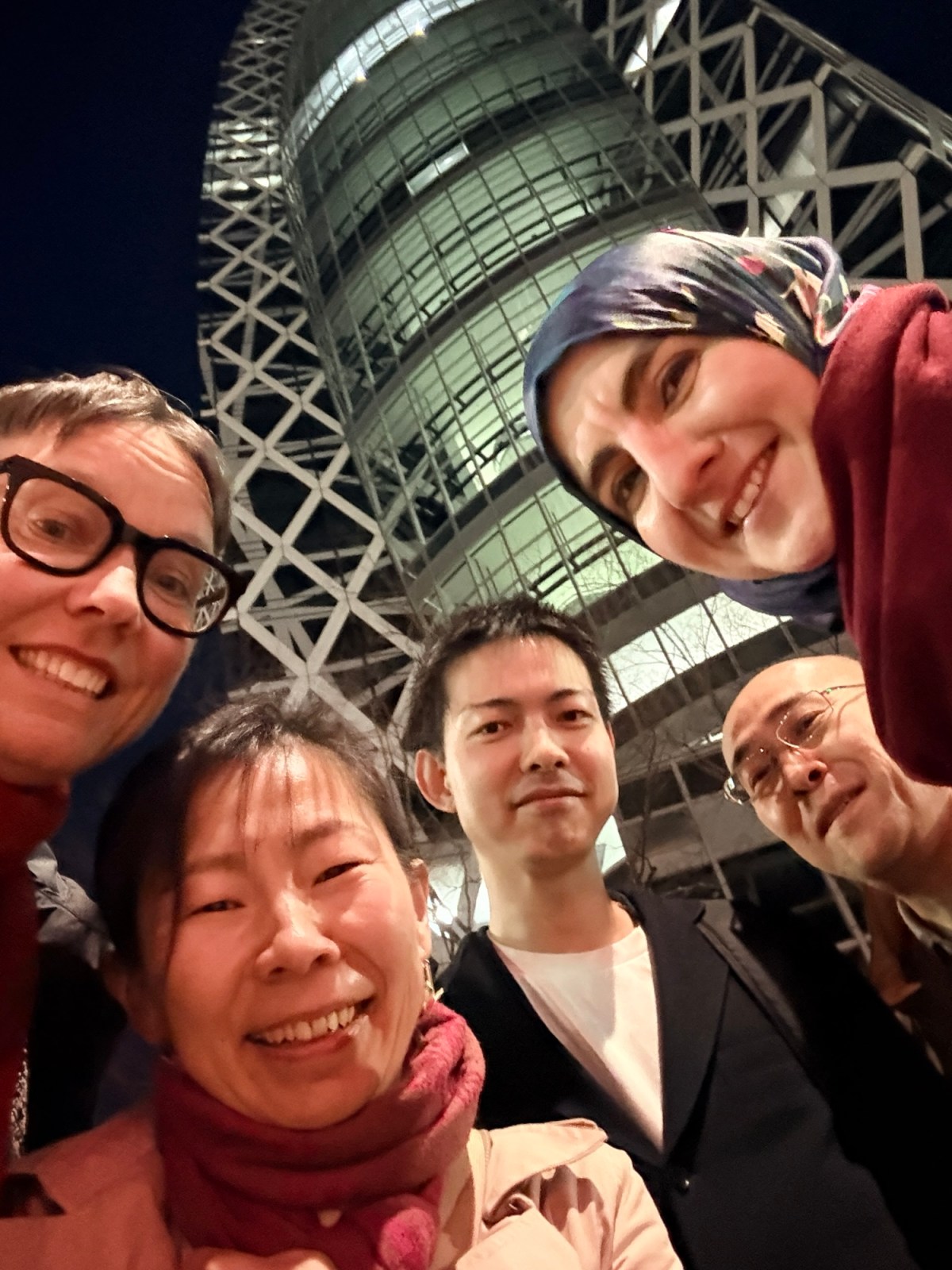
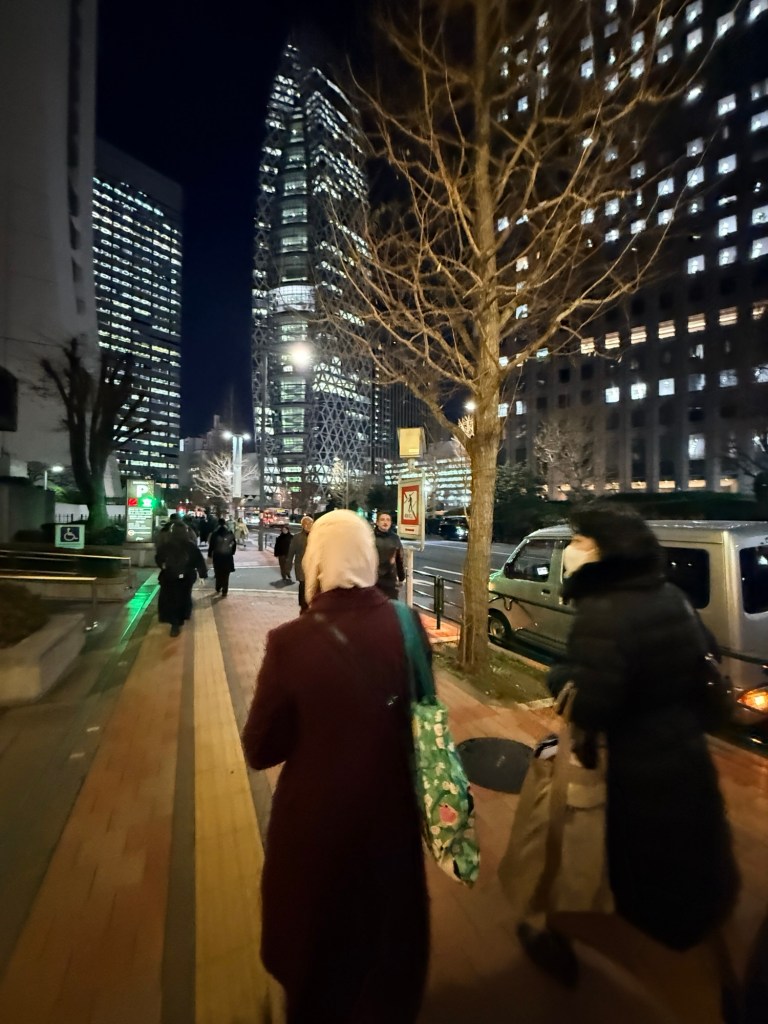
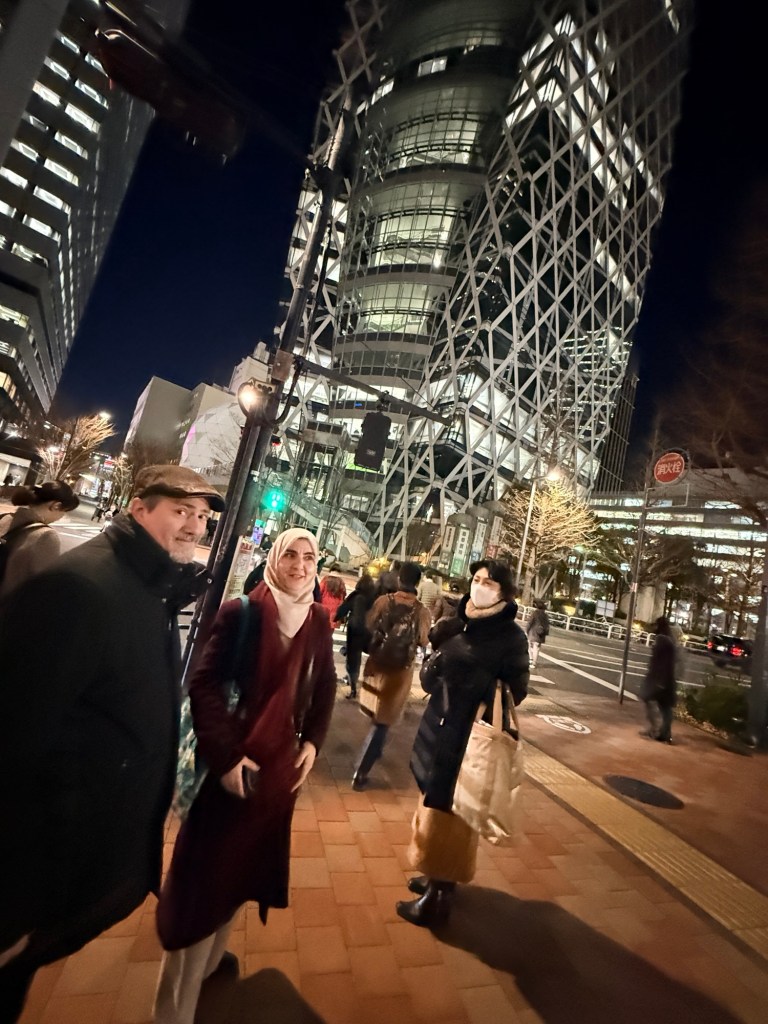
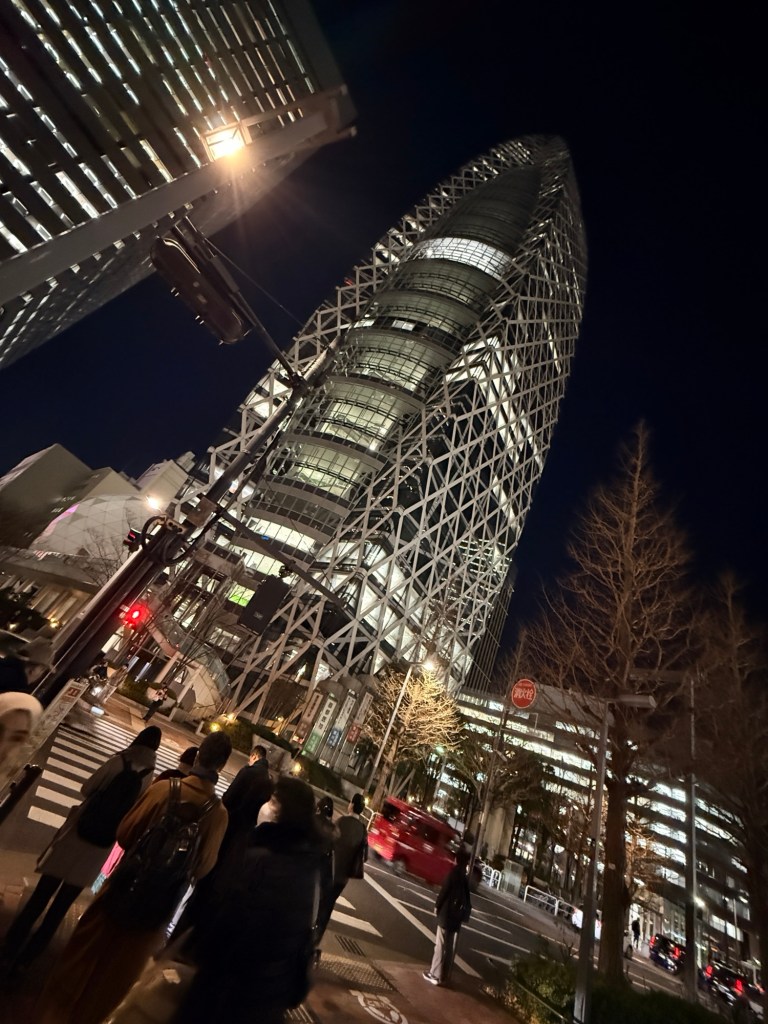
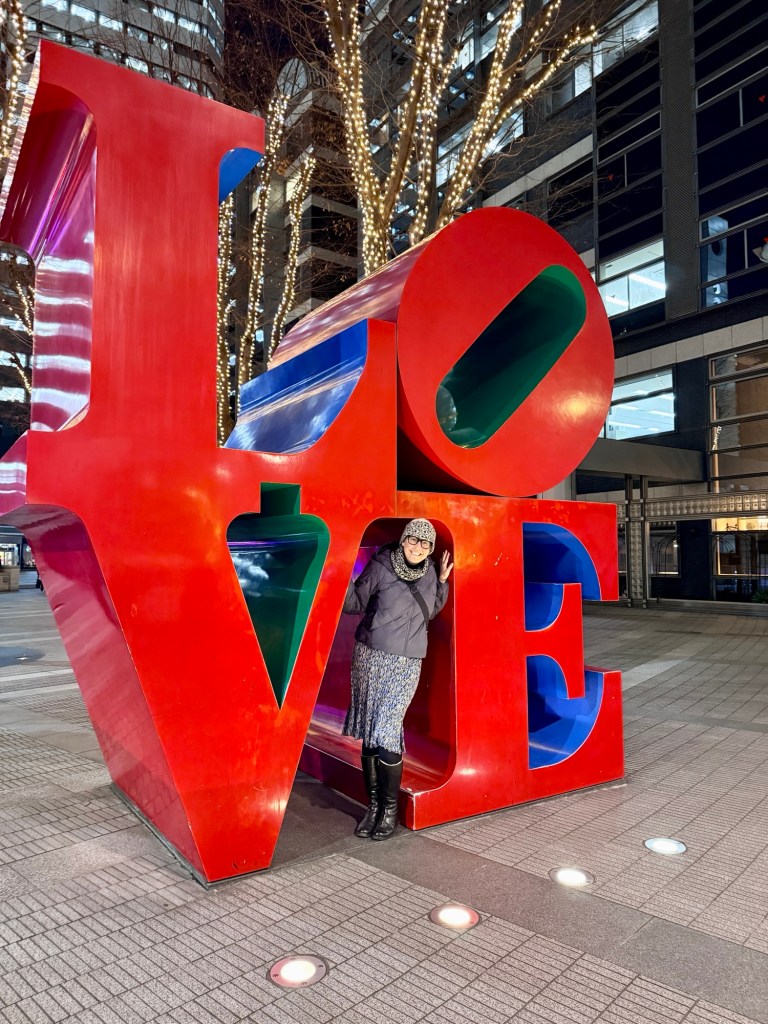
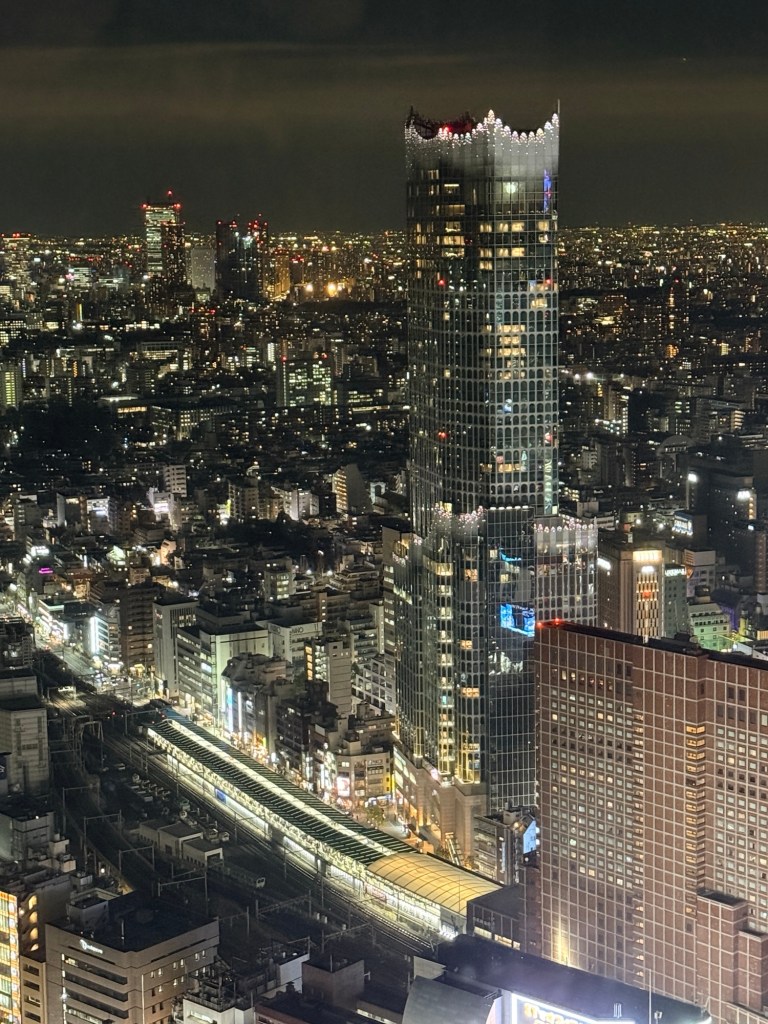
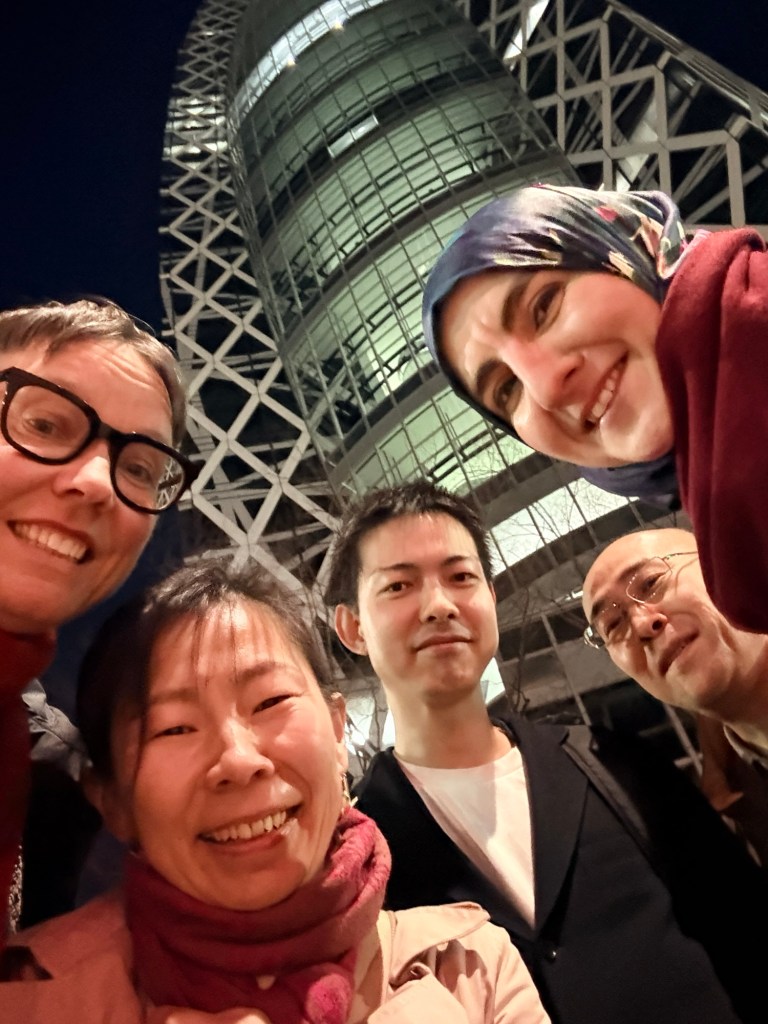
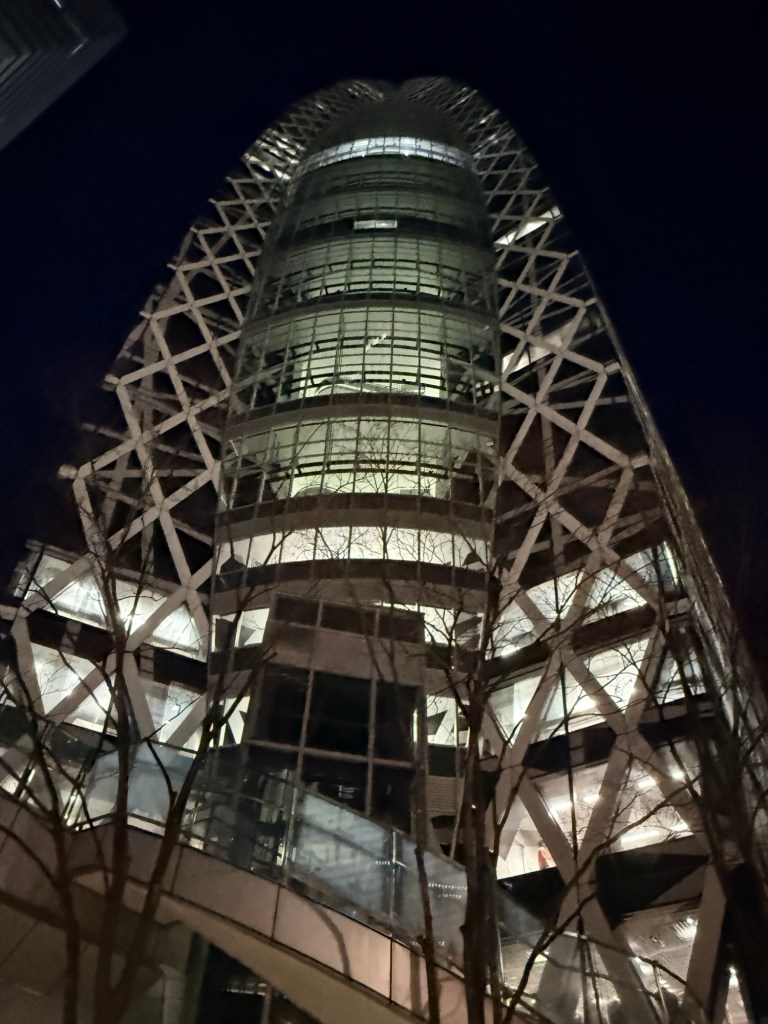
Headed to Cocoon Tower with Tamami.Stefané, Sarah and Tamami on the way.Lovely to view at night.With a quick stop at Tokoyo’s LOVE sign.
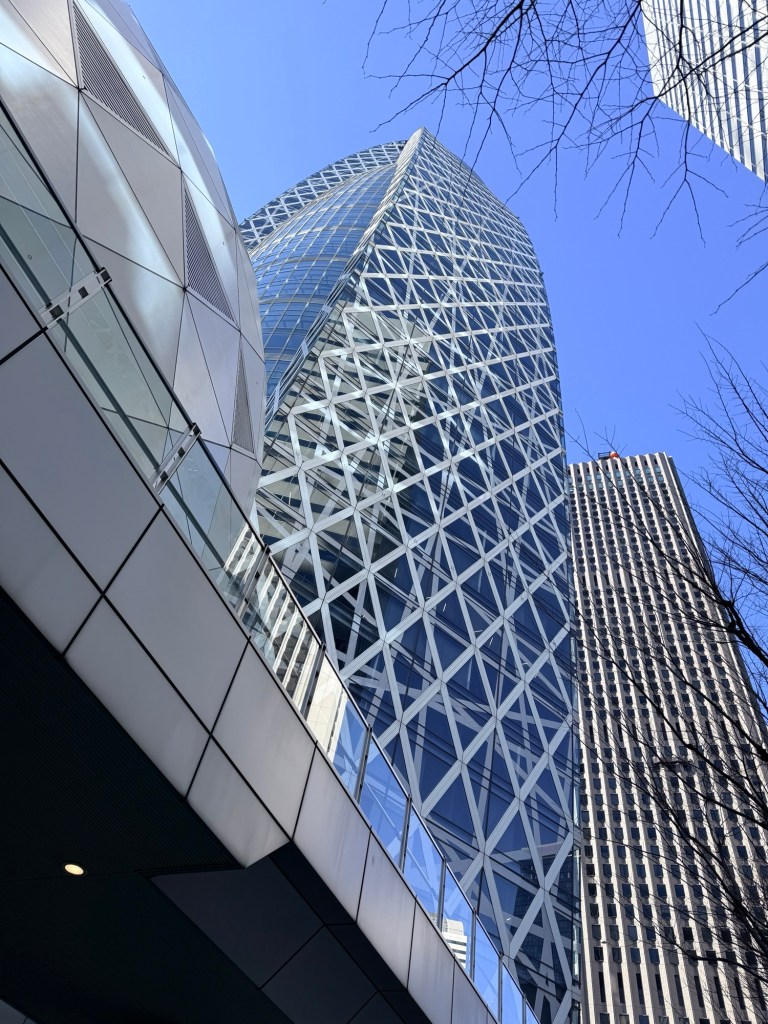
As an architect, I immediately recognized this building. It is quite famous and boy is it architecturally striking.
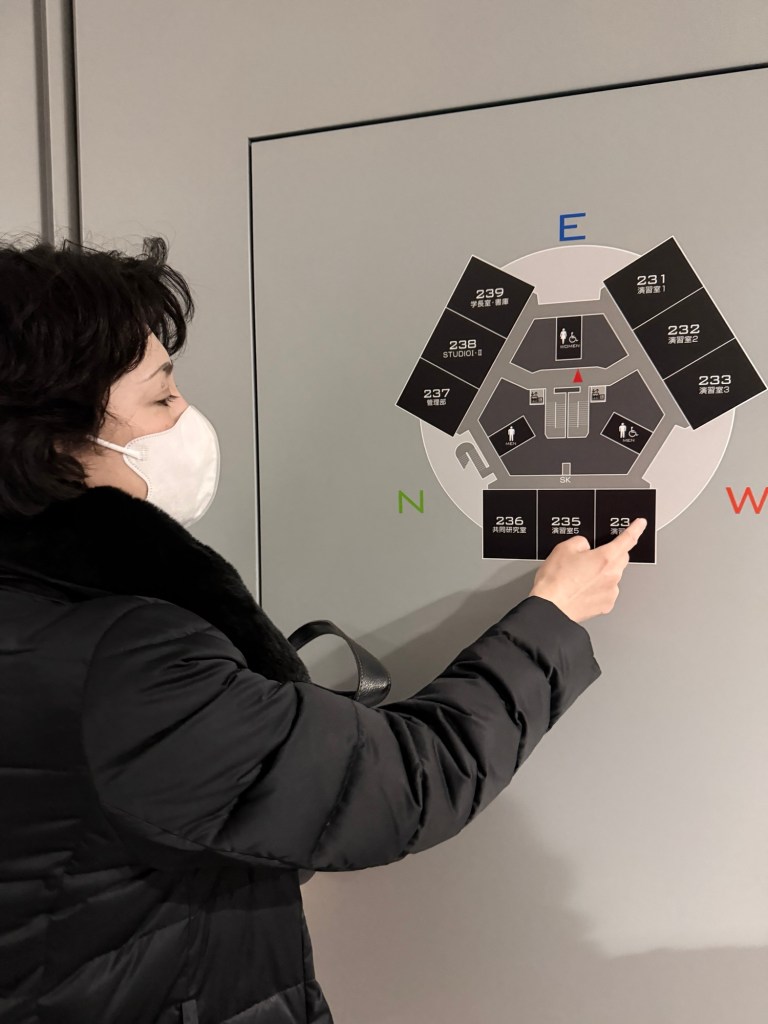
Tamami met us and gave us a tour of the building the night before the workshop.
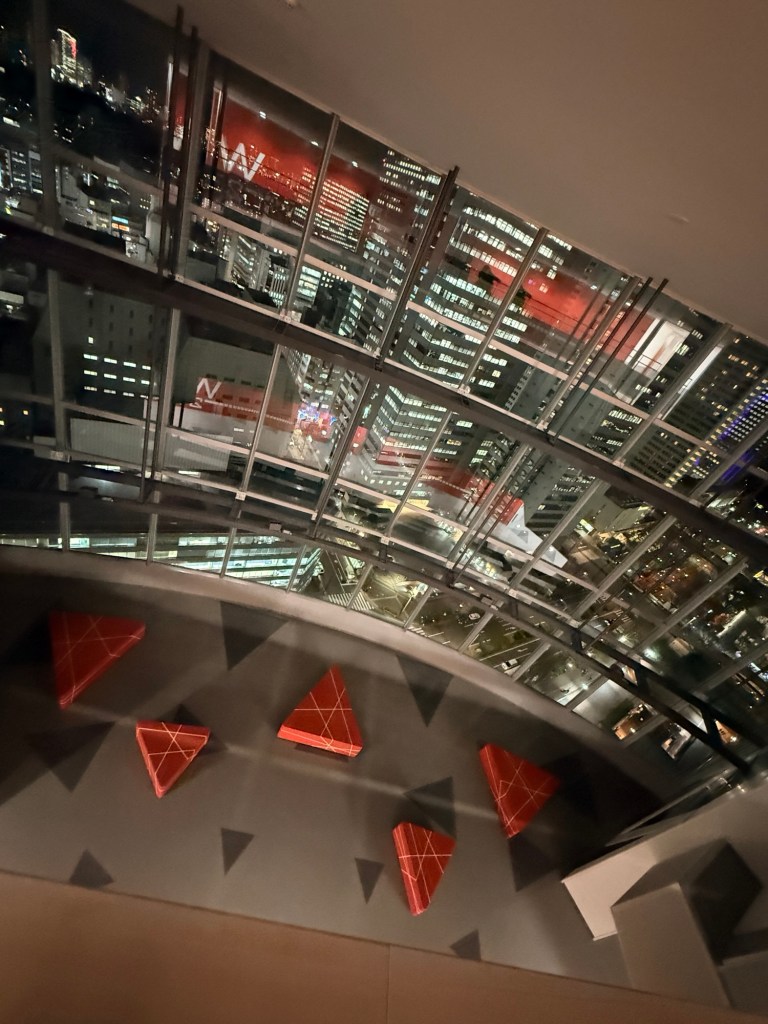
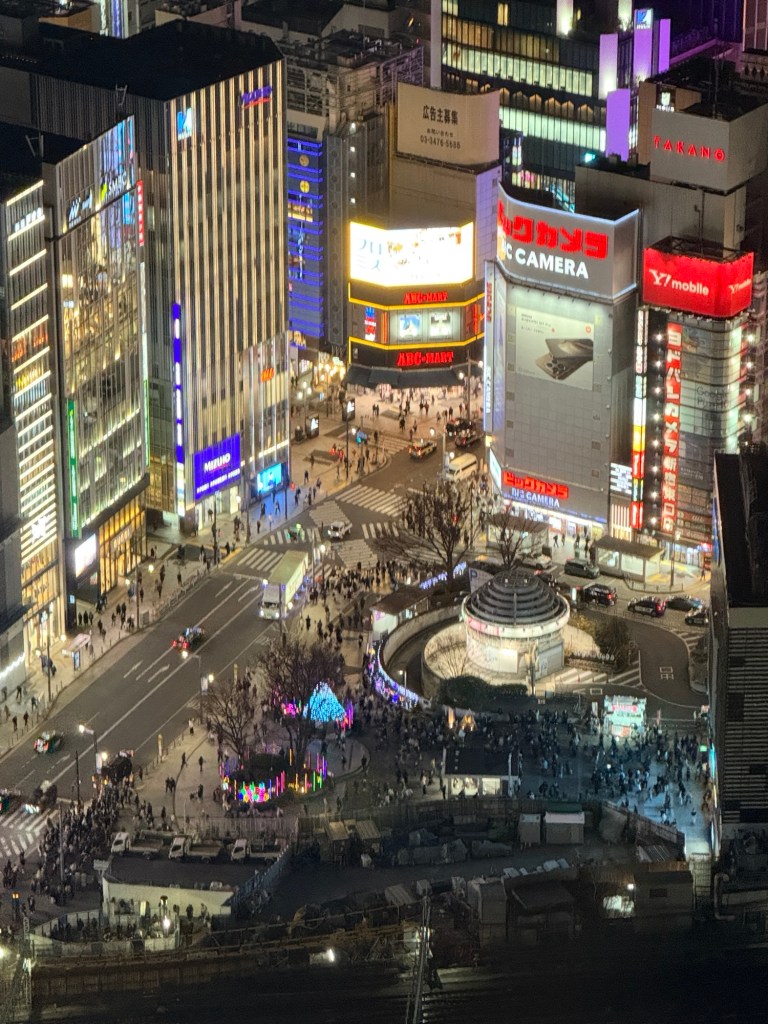
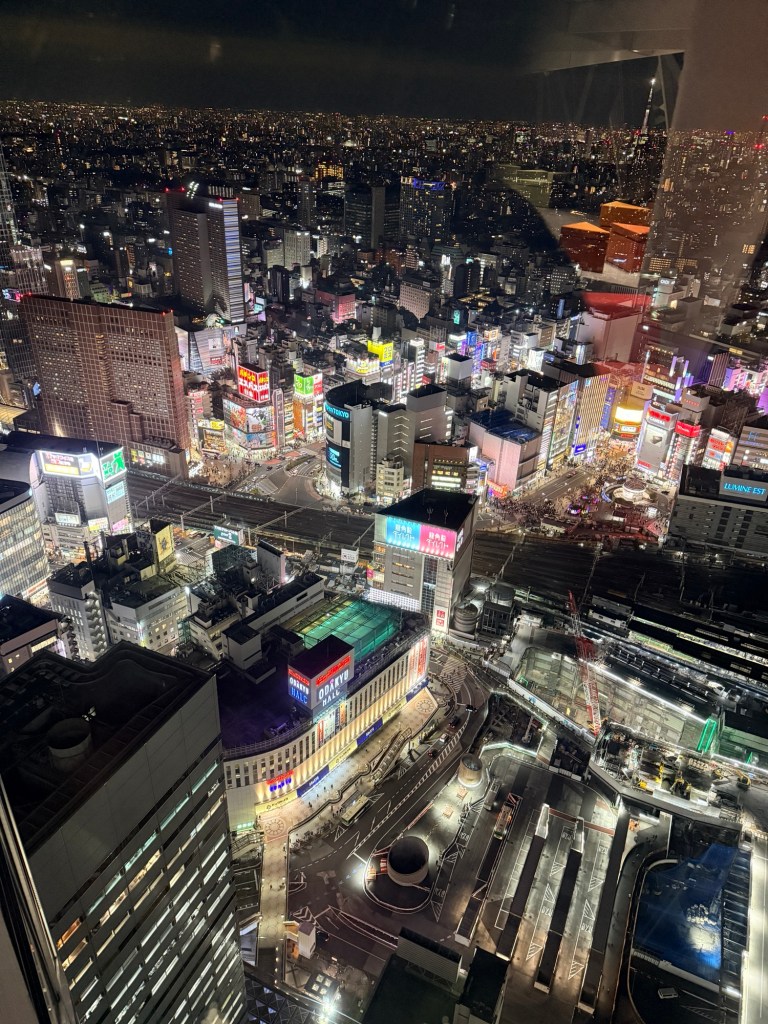
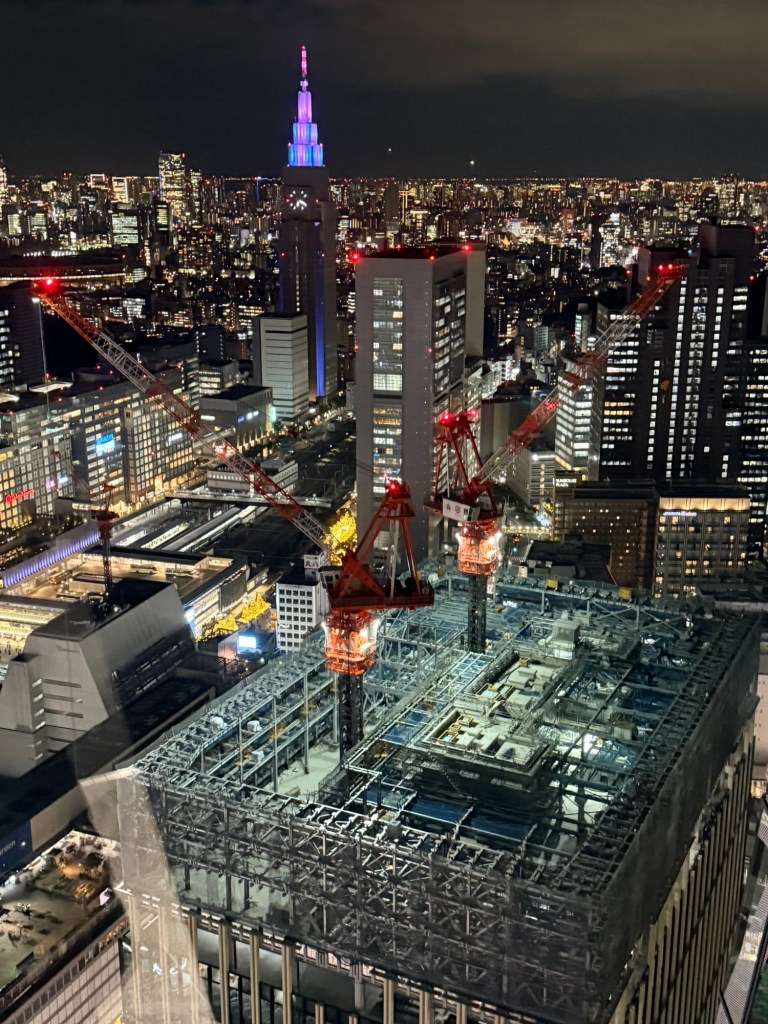
Tamami explaining the building’s organization. our event was to be held. These three-story high atriums offer sweeping views.But the best views are from teh top of the Cocoon Tower.A busy Tokoyo intersection. Buildings as far as the eye can see — the world’s biggest megalopolis!More buildings prinnign up that will block the views of and from the Cocoon Tower.
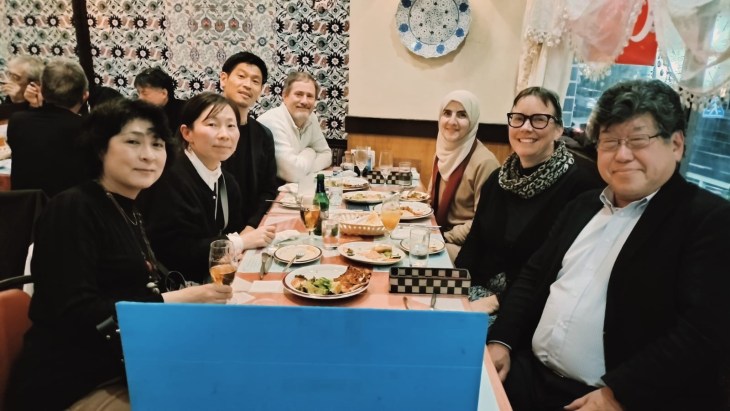
Following the tour, I enjoyed a lovely pre-conference dinner at a Turkish restaurant alongside Tamami, Dr. Asami Ogura (of the National Institute of Technology, KOSEN, branch in Hiroshima), Shinya, STefané, Sarah, Dr. Jun Fudano (whom I met last February in Virginia at the Association for Practical and Applied Ethics conference, as he helps lead APPE), and Misaki (a graduate of University College London’s Institute of Education, who helped translate several of our sessions) who took the photo below.
Preconference dinner with Tamami, Asami, Shinya, Stefané, Sarah, me, and Jun.
Sarah and I arrived at Cocoon Tower plenty early the next day and had breakfast near the venue. Eating so much for breakfast was a mistake with a big lunch on the horizon, but I didn’t want to risk being underprepared.
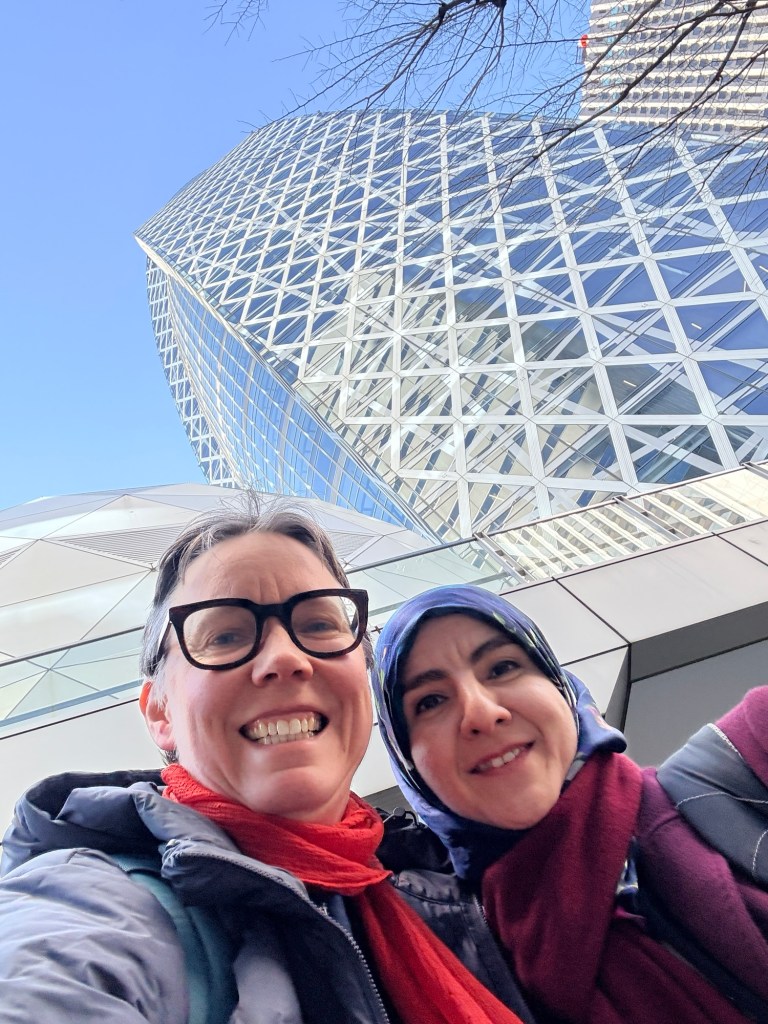
Sarah and me, headed to the venue the next day.The building is also lovely to view in the sunshine.
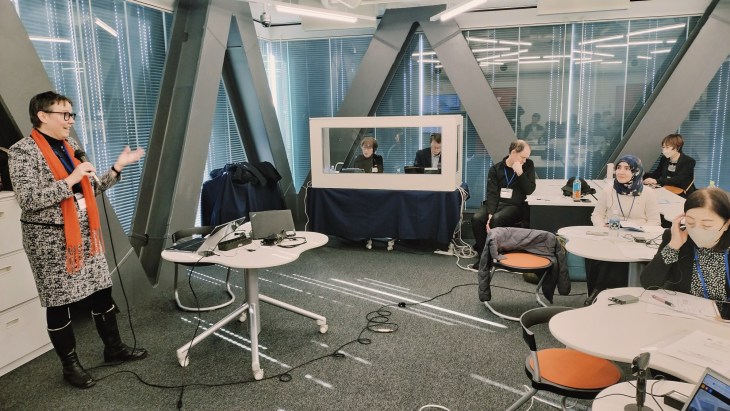
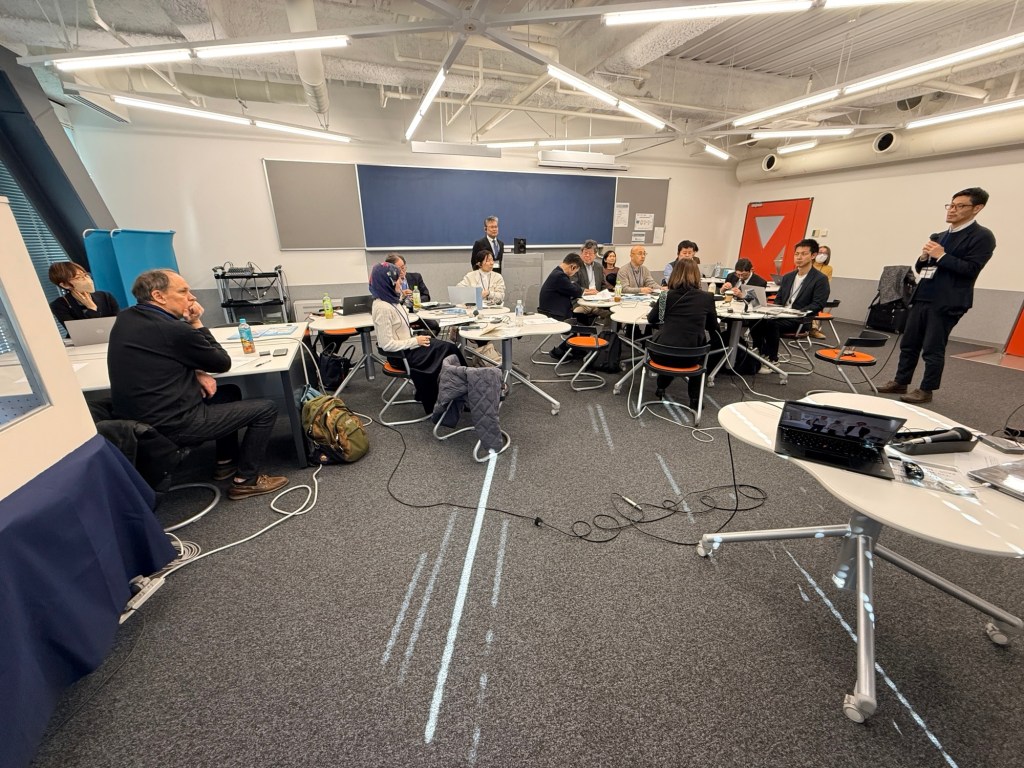
This was a spectacular event! So engaging. So well organized and translated.
The event included many interesting speakers and was well attended, with roughly two dozen colleagues travelling from all corners of Japan to participate.
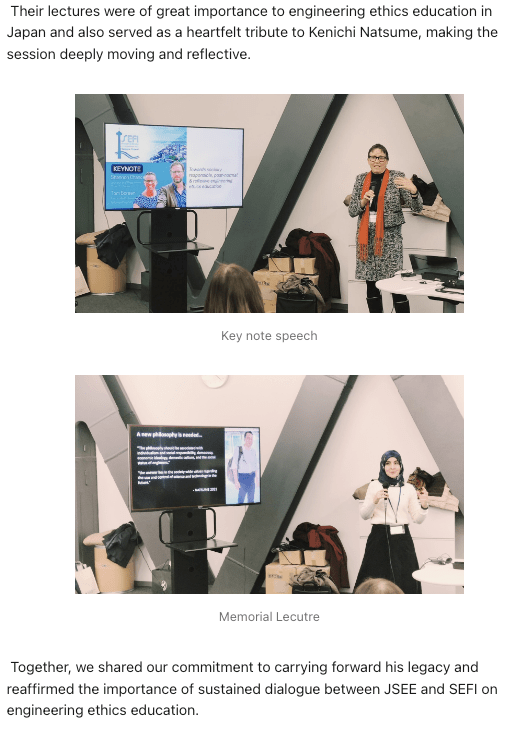
The event opened with a welcome from Shinya, followed by a keynote I delivered and a Memorial Lecture delivered by Sarah.
Atsushi’s grant paid for two professional translators, which made a world of difference in the quality and comfort of our day. We each had a headset so we could hear in real time what anyone in the other language was saying.
Translators hard at work!
This was an enormous support for effective communication — it represented a substantial investment but was essential to helping us understand and engage with each other in deeply meaningful ways.
Particpants ready to start the day!Shinya Takehara opening the event.
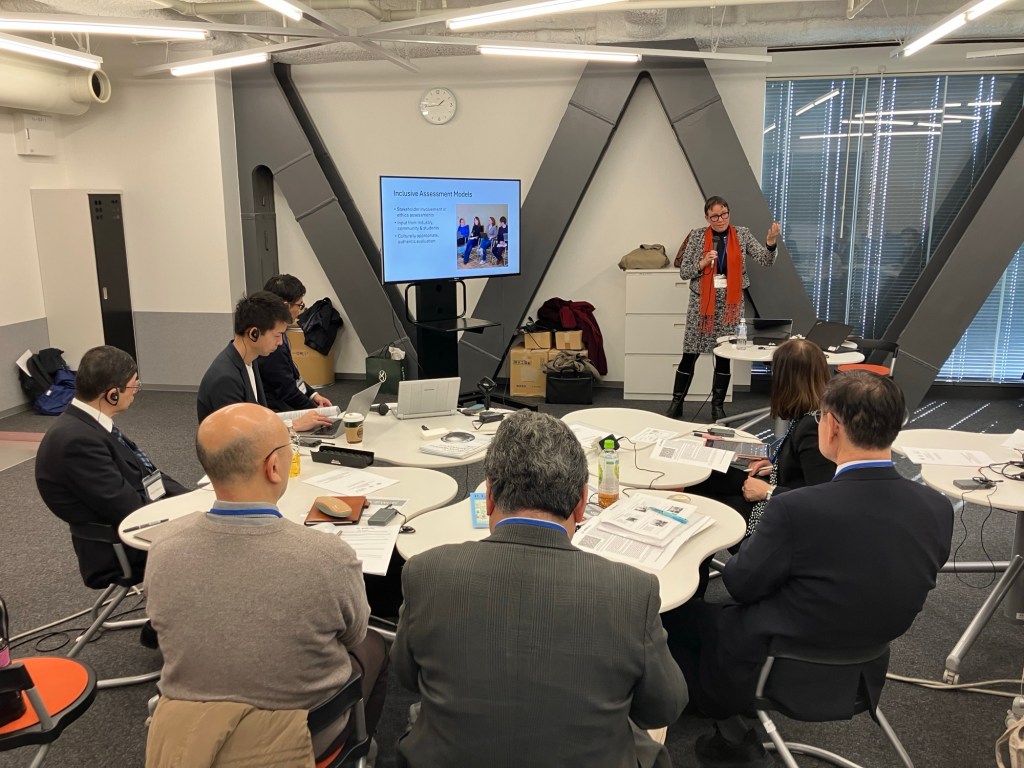
First up was my own keynote, a half-hour presentation summarizing topics that Tom Børsen and I presented at the SEFI conference last September. I helped the audience understand what SEFI is doing in engineering ethics education and invited our Japanese colleagues to join our SEFI Ethics projects and activities.
In the talk, I advocated for a shift from individual rule-following toward collective global responsibility and an “Ethics of Care” for the planet and future generations. I introduced some useful frameworks for navigating complex, high-stakes socio-technical challenges, including humble, reflexive dialogue and inclusive, culturally appropriate assessment models.
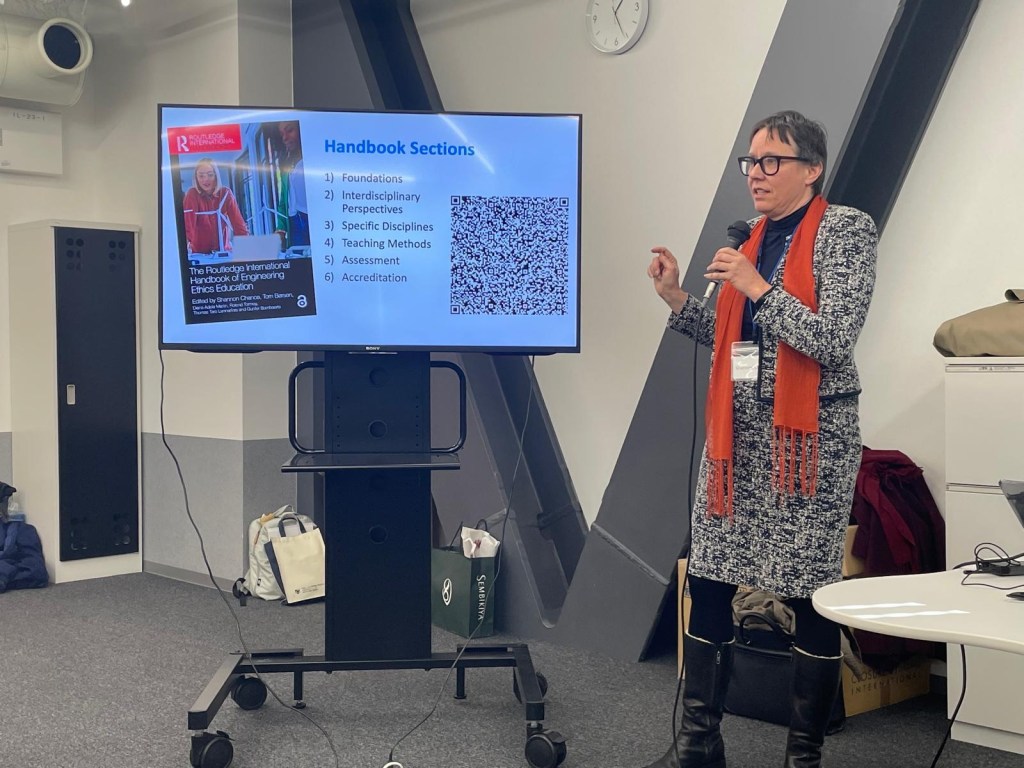
Discussing ways forward.Introducing the handbook.
I also honored the legacy of Japanese scholar Prof. Kenichi Natsume, calling on the international community to collaboratively integrate ethics into teaching to shape a more socially responsible future.
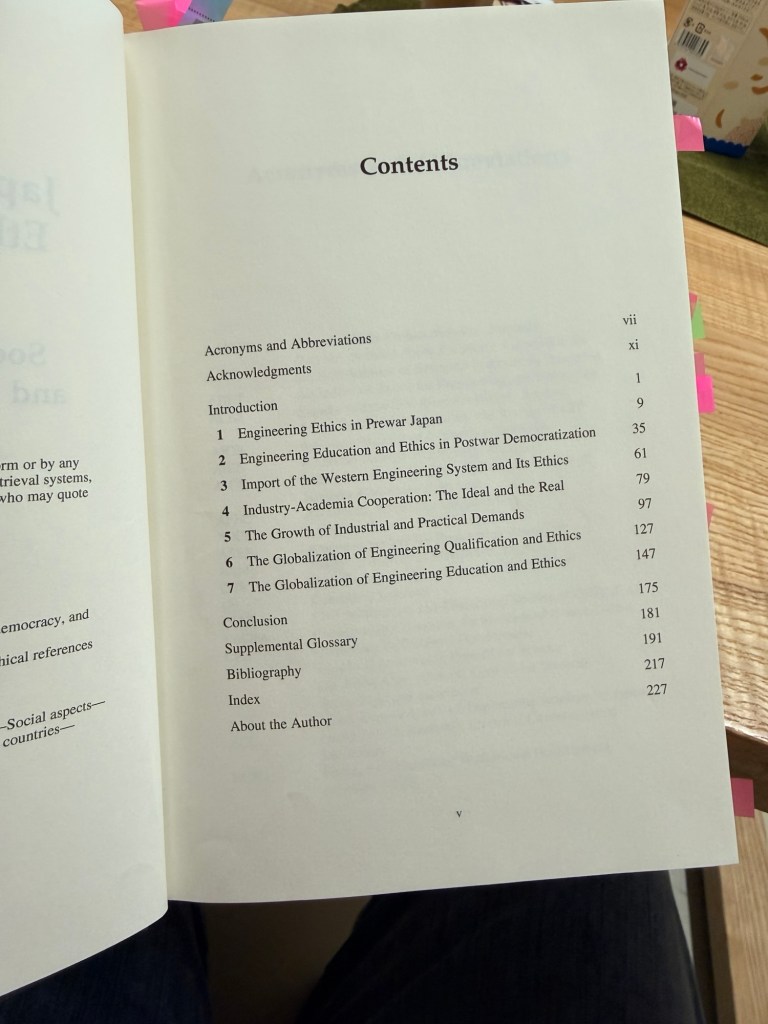
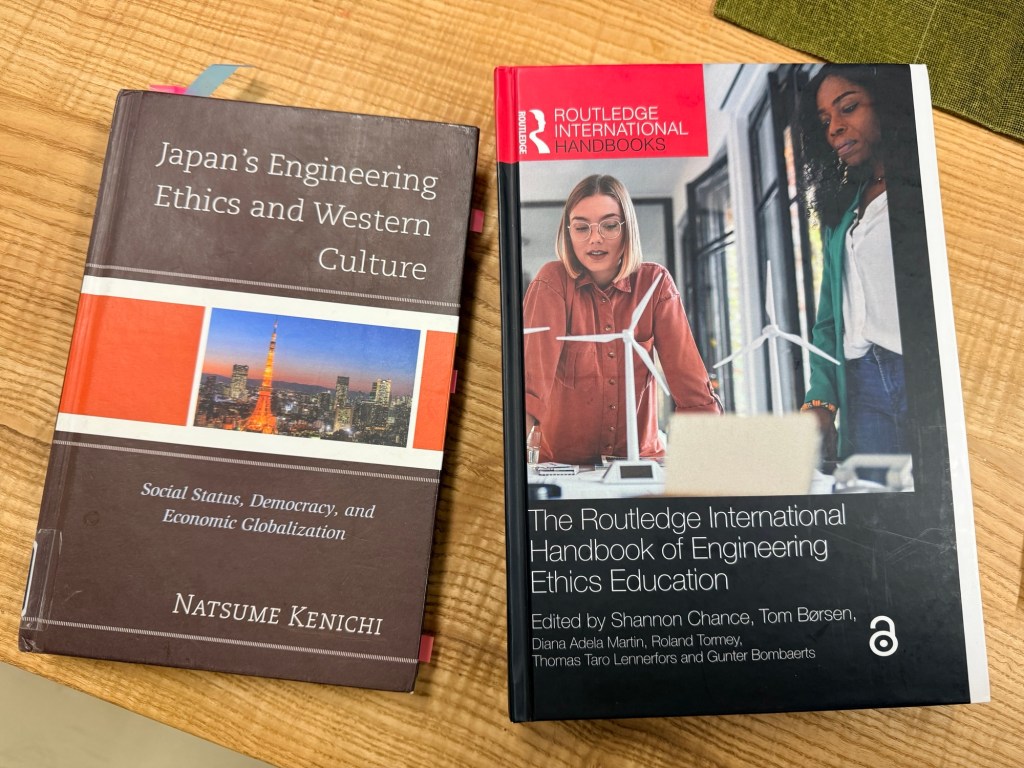
The next talk, the Memorial Lecture, presented by Sarah Junaid, paid tribute to Kenichi. He was a co-author on Sarah’s chapter of the engineering ethics handbook. The editors of the handbook dedicated it to Kenichi, in honor of the groundbreaking work he did bridging eastern and western perspectives on engineering ethics.
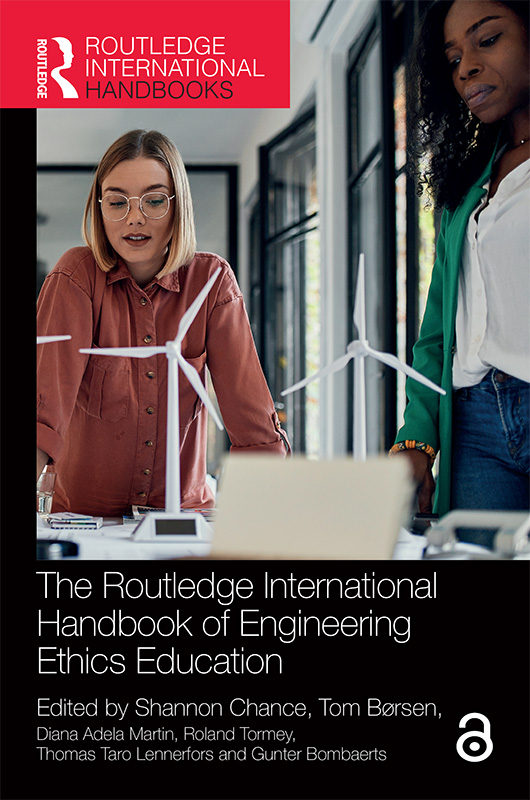
The table of contents of Kenichi’s book.The cover of Kenichi’s book and our co-authored handbook.
Sarah summarized Japan’s context as steeped in collective consciousness, a duty to others, and an embedded morality. The education system there has historically focused on ethics and morality in an intrinsic, embedded way, with a strong awareness and regard for others and loyalty to the group. There have been recent shifts to increase the focus on individual responsibility.
In contrast, Sarah described Western cultures as emphasizing individuality, liberalization, and challenges of social responsibility. Education has typically focused on capitalism and free markets, economies built on growth, individuality, and liberalization. Recently, there has been increased focus on social and collective responsibility, which was a major theme of my keynote as well.
“Global collaboration is needed,” Sarah asserted, “for shaping ethical engineers and global citizens.” During Sarah’s presentation, we learned that Kenichi was central in helping Sarah collect data at KOSEN institutes across Japan during her Churchill Fellowship, and the slides in her talk showed the two of them actively collaborating. Sarah and Kenichi exemplified the type of collaboration that is desperately needed.
Shinya noted that “together, we shared our commitment to carrying forward [Kenichi’s] legacy and reaffirmed the importance of sustained dialogue between JSEE and SEFI on engineering ethics education.”
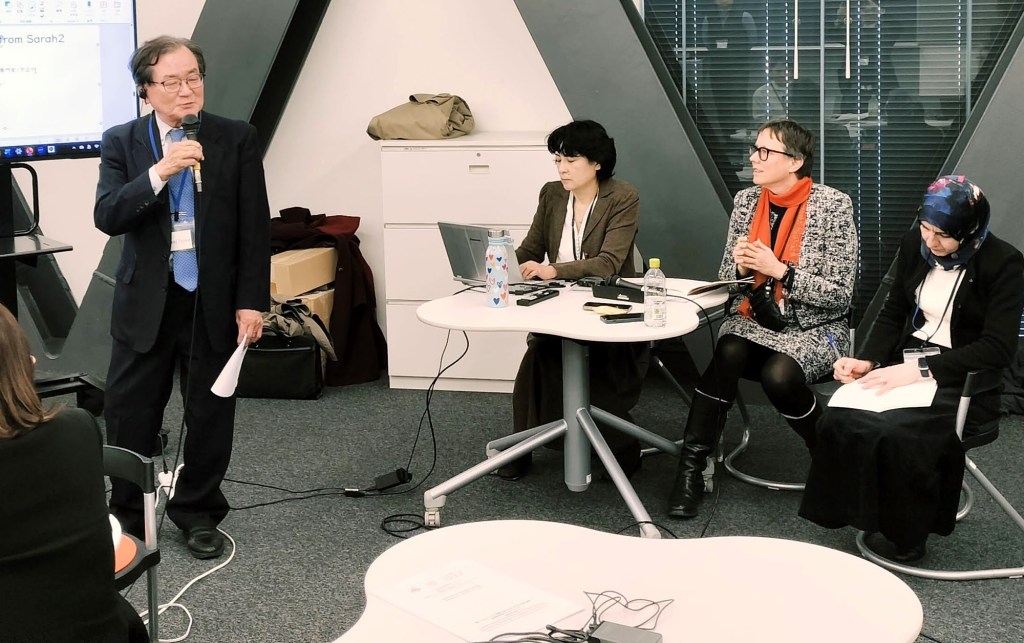
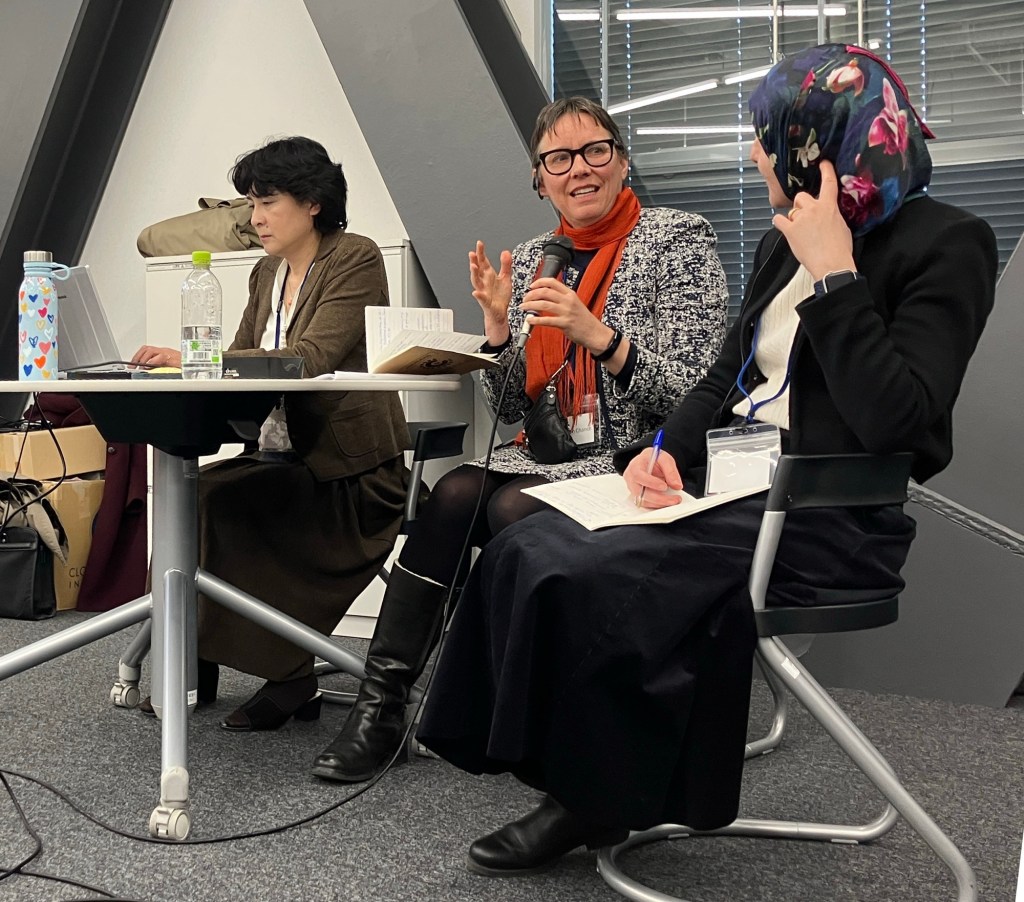
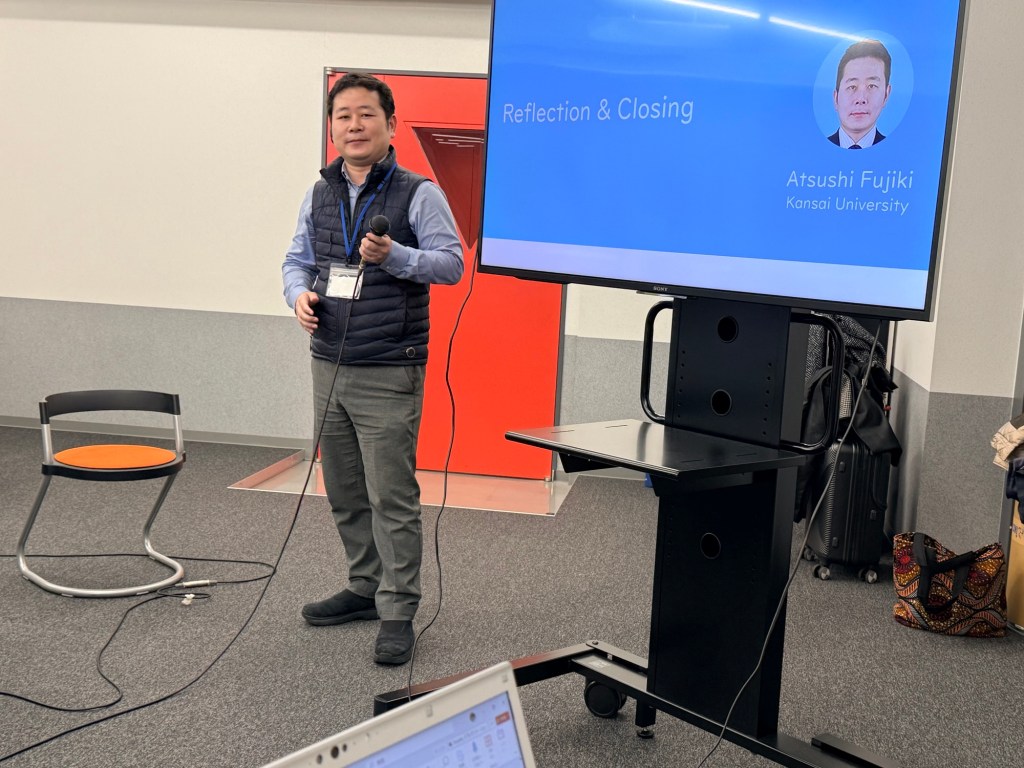
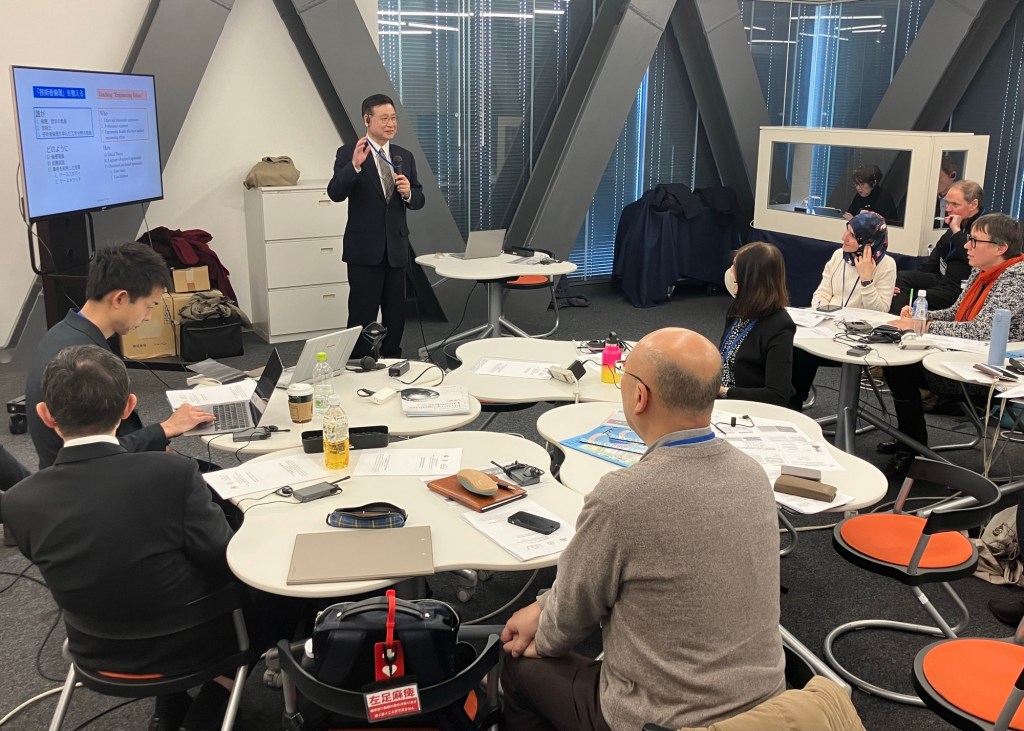
Participants posing questions to Sarah and me.Discussing questions posed.Atsushi summarizing the day’s discussions.
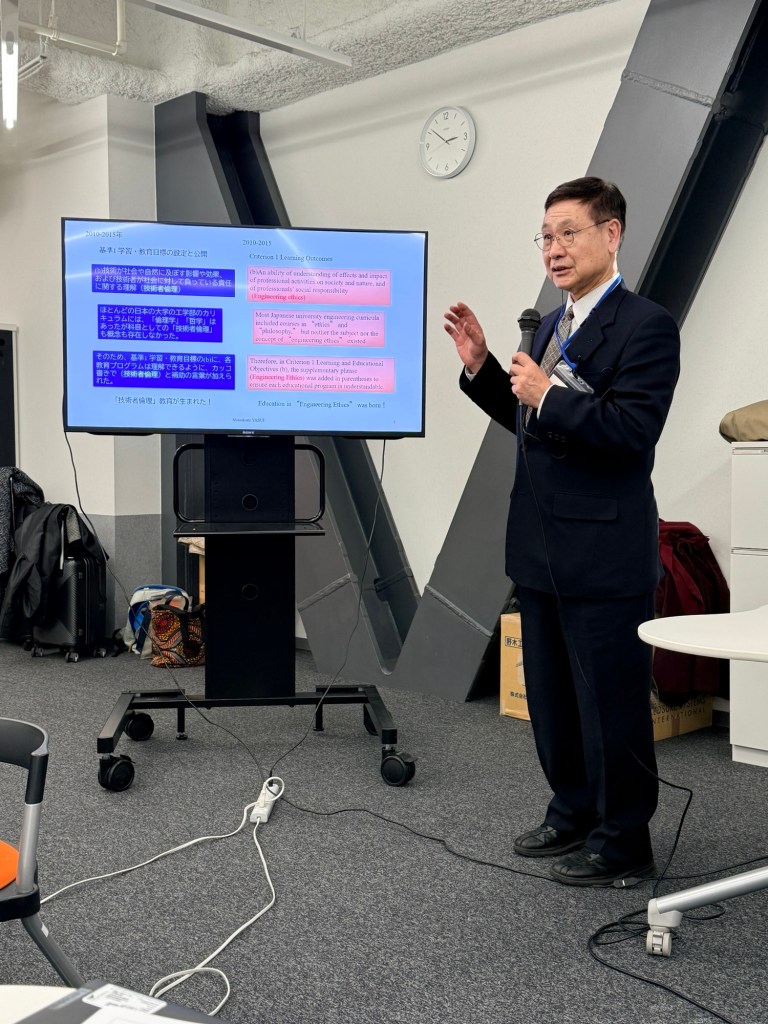
Following our talks, the first featured speaker from JSEE, Dr. Muraran Yasui (Department of Biology, Faculty of Science, Osaka University), discussed how engineering ethics is taught in Japan and how it aligns with global accreditation standards.
His group studies how this is done at many postsecondary institutions in Japan. He described Japanese efforts to foster “aspirational ethics” rather than just preventive ethics among future engineers. This concerns what engineers ought to do, not just what they are legally and professionally obligated to do.
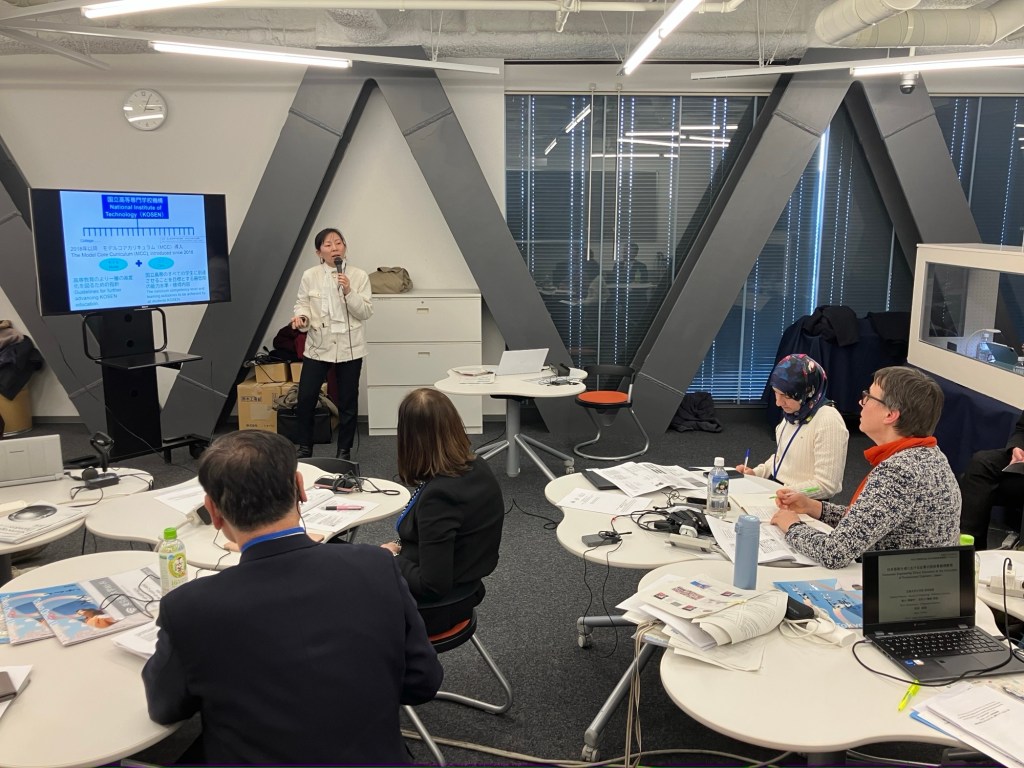
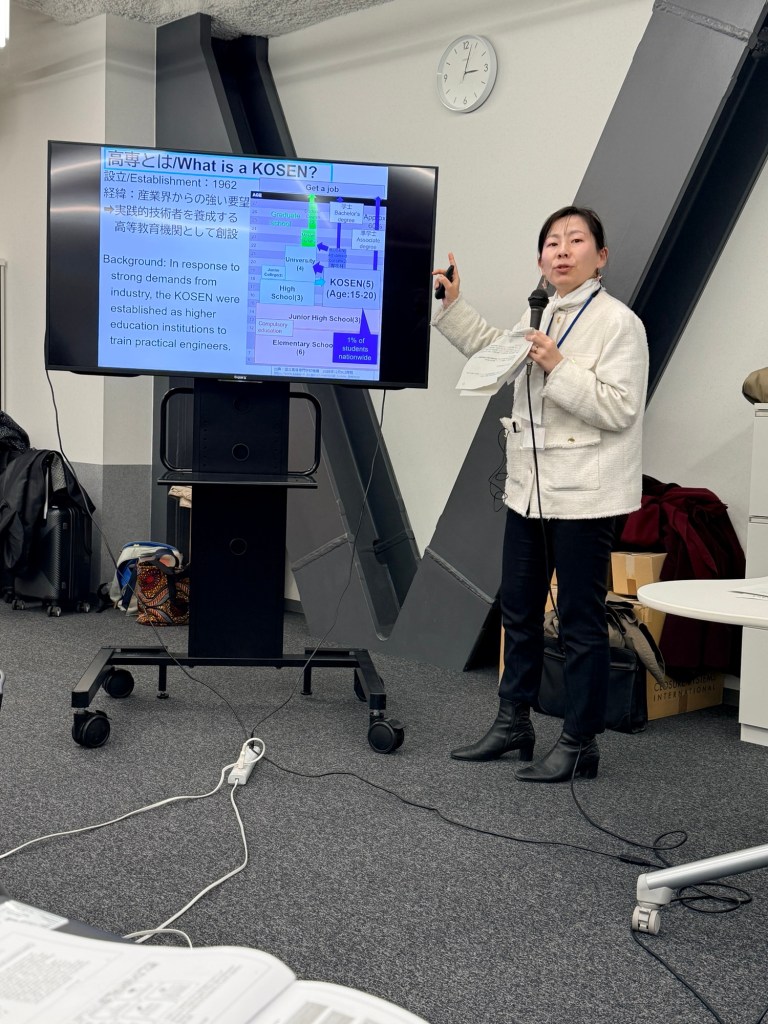
Next, Dr. Asami Ogura told us about KOSEN (the National Institute of Technology, with 51 colleges across Japan that teach students aged 15-20). Asami discussed how ethics is taught currently at KOSEN and how she believes that technology transfer can foster peace.
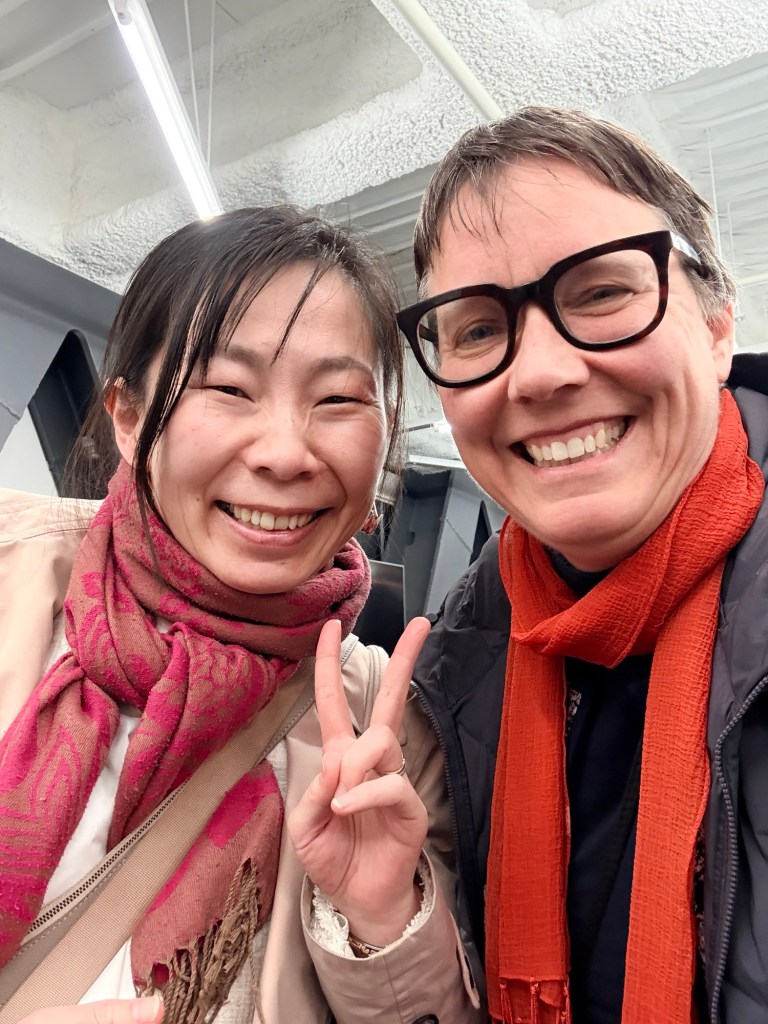
Dr. Asami Ogura
She also explained that KOSEN established a model core curriculum for ethics in 2018, identifying minimum competencies and learning outcomes, and providing guidance to teachers.
Asami’s work focuses on the overlap between environmental conservation, international understanding, and peacebuilding.
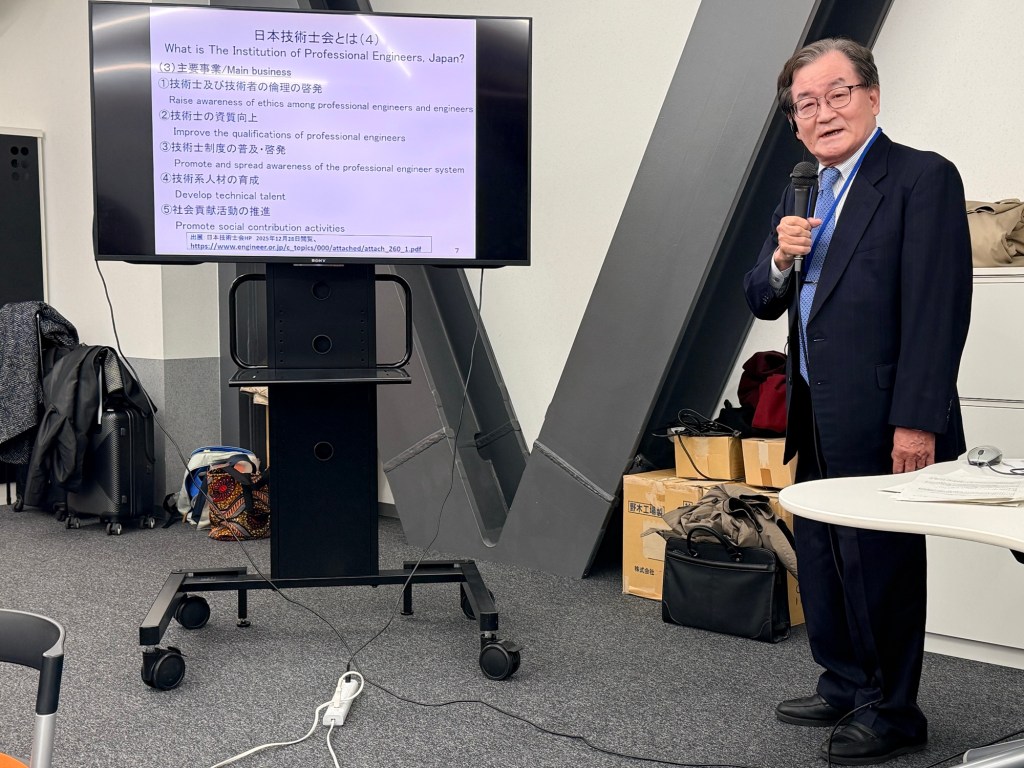
Third among the JSEE experts, Dr. Naoki Taoka discussed corporate engineering ethics. He is a leader in the Institution of Professional Engineers in Japan and a visiting professor at Hiroshima University.
Dr. Naoki Taoka
Naoki explained that the Institute’s main business is “to raise awareness of ethics among professional engineers and engineers,” as well as to improve their qualifications, promote and spread awareness of the professionalization system, develop technical talent, and contribute socially through activities.
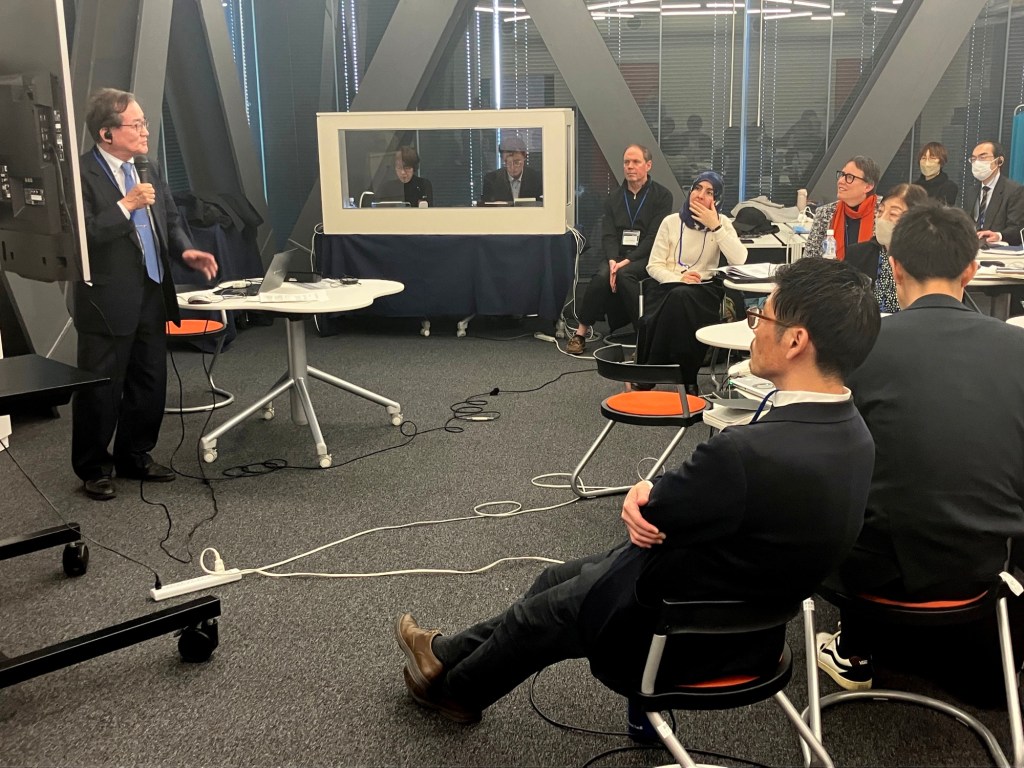
Following the three JSEE presentations, Dr. Yukito (Happyman) Kobayasi and Atsushi also provided overview comments and insights.
Sarah and I were listening attentively to it all and making detailed notes, as we’d been asked to respond to Tamami’s questions from our European perspective.
We also provided feedback on the other speakers’ presentations, and then addressed questions from the very engaged audience.
Social Side of Events at Cocoon Tower
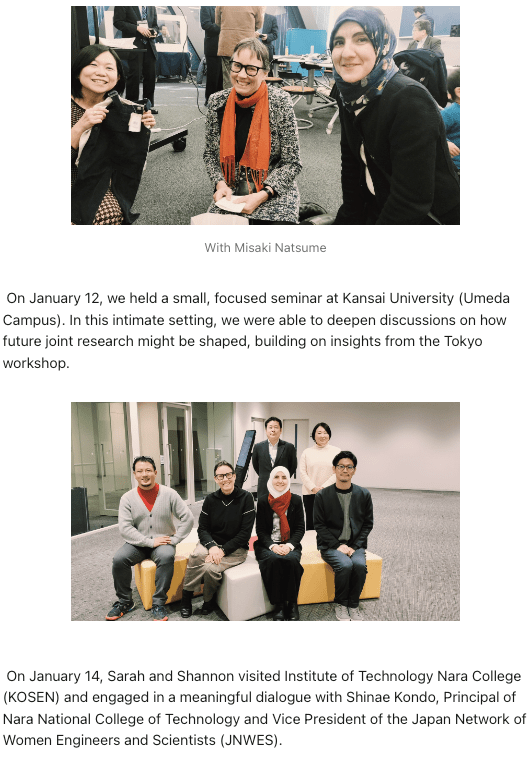
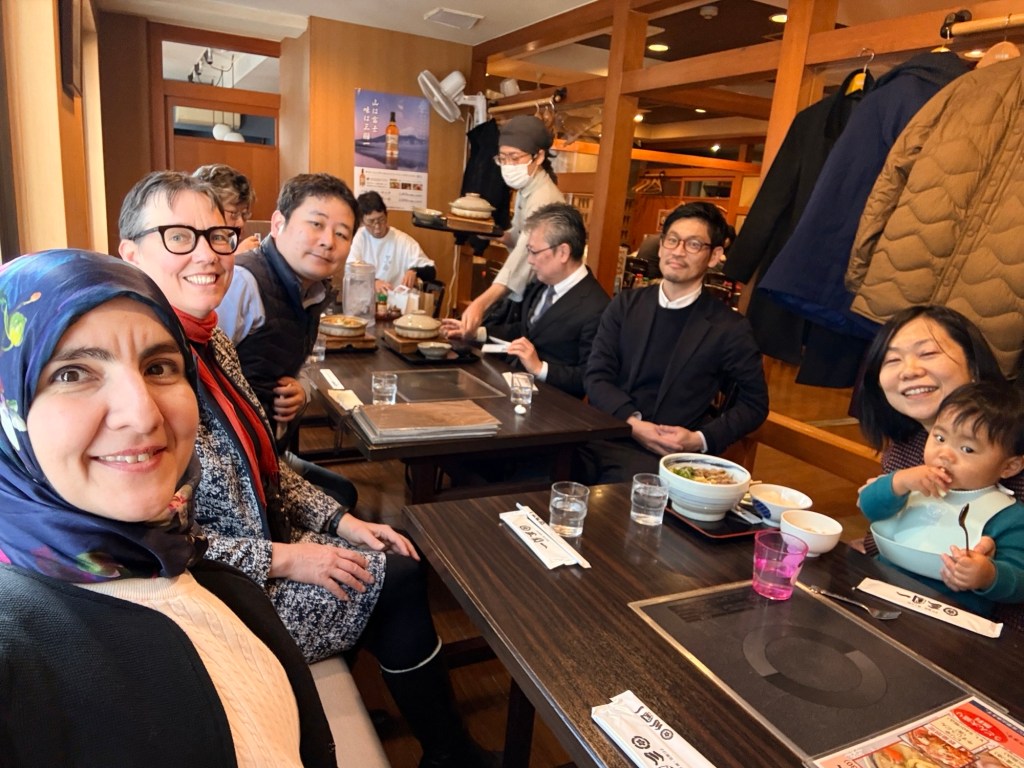
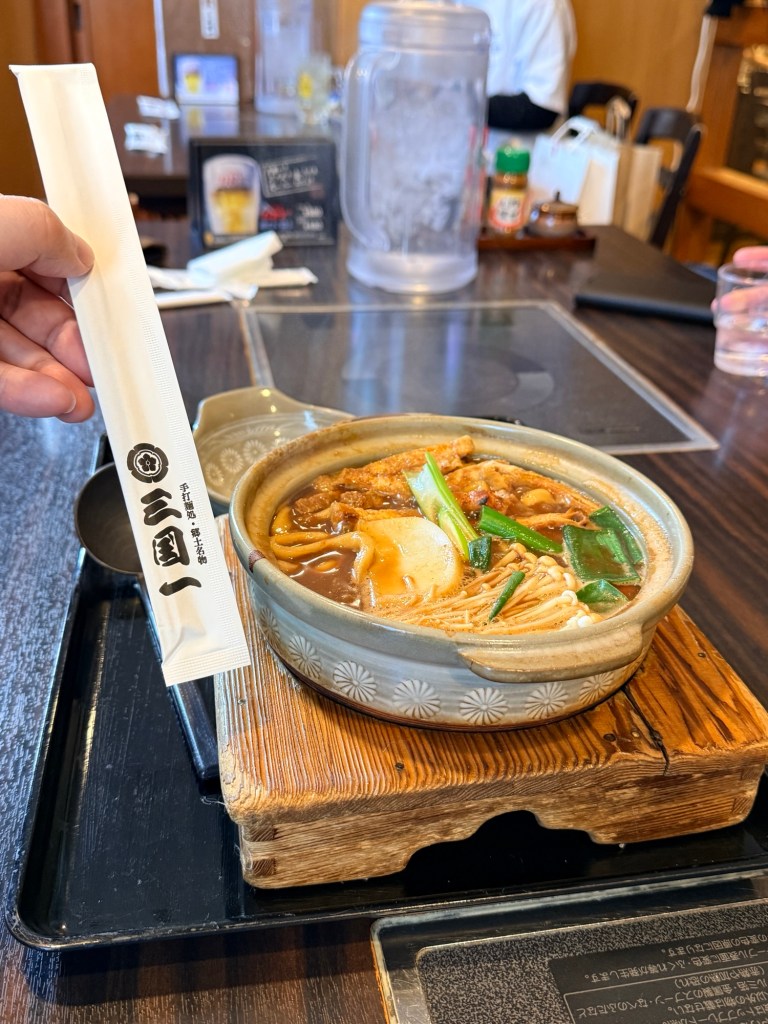
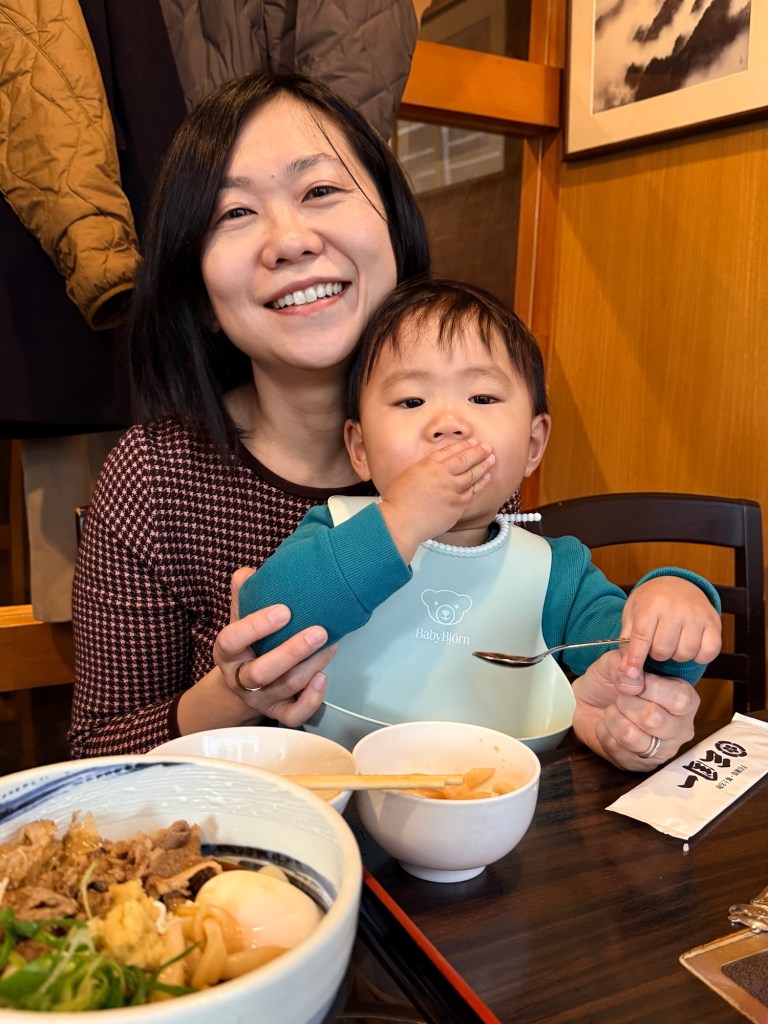
Overall, this was a very exciting day. Participants came from all over Japan, the event was held at the architecturally famous “Cocoon Tower”, and before the event, Sarah and I got to meet and enjoy lunch with the late Professor Kenichi Natsumi’s wife, Misaki Natsume, and son. We enjoyed a delicious ramen-type lunch with Misaki, Shinya, Atsushi, and some of the experts named above.
Invited speakers at lunch before the main event.A really yummy chicken soup.The Natsumis agree!
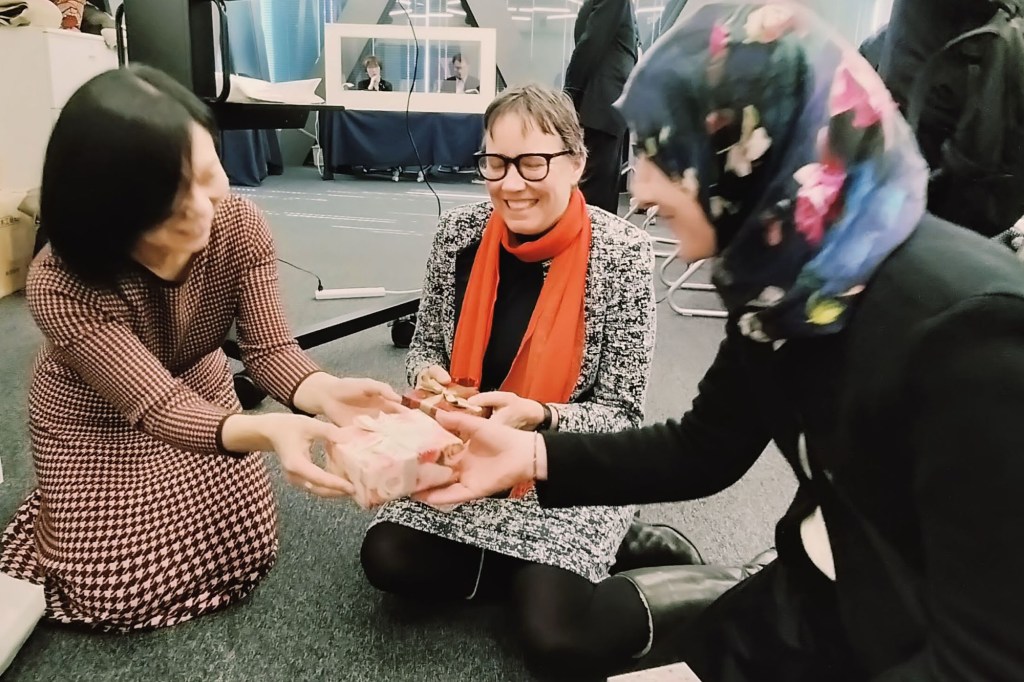
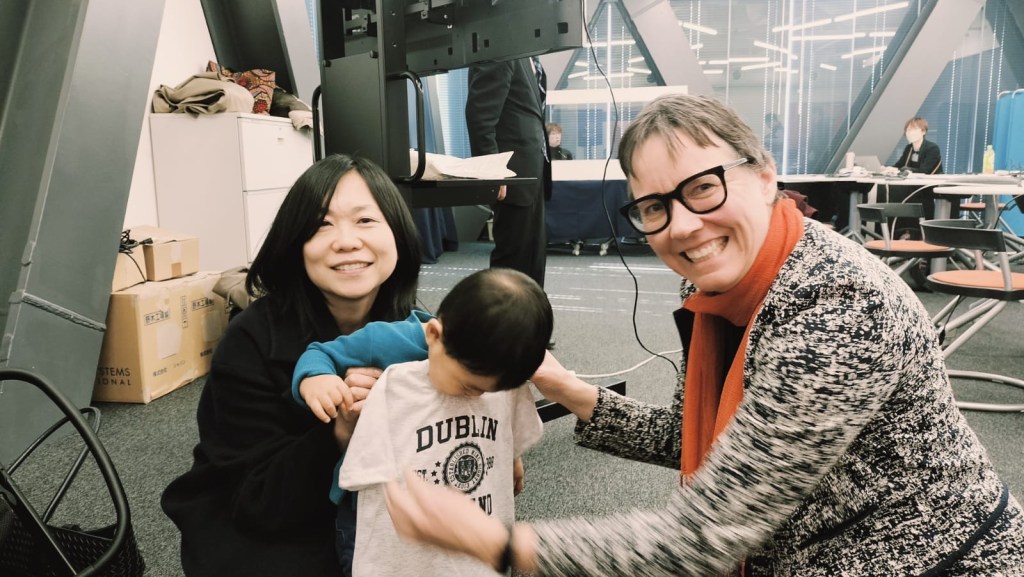
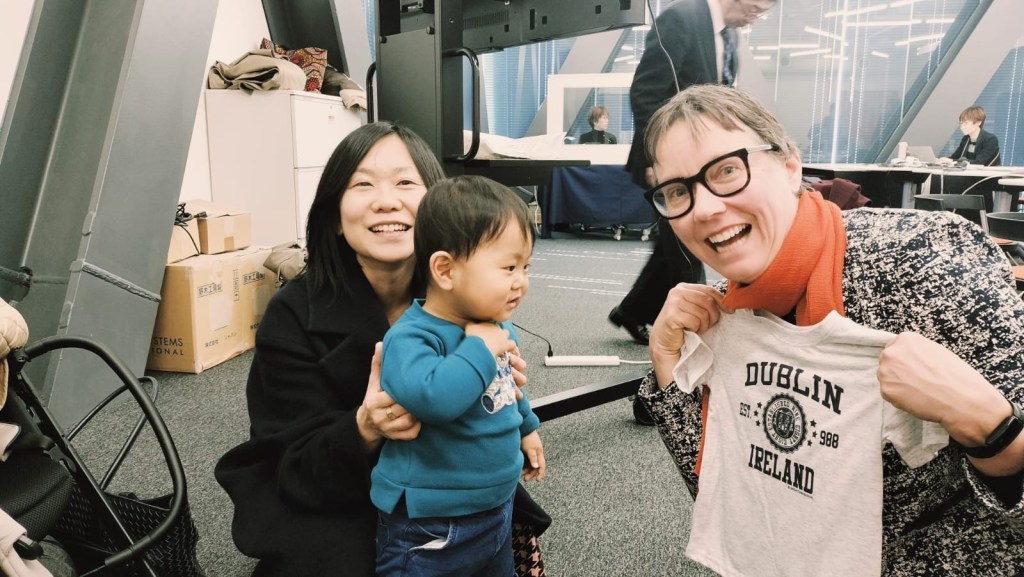
We also got to exchange gifts with Misaki and her son. She gave us the most sincere, heartwarming, handwritten notes describing, among other things, how much being part of the handbook project had meant to her husband.
We exchanged gifts with Misaki just before the main event.It’s not easy to find toddler-friendly gifts.But it looks like this t-short from Dublin will fit fine.
Dr. Fumihiko Tochinai also attended the event. He co-authored Chapter 30 of the ethics handbook, titled “Two criticisms of engineering ethics assessment,” with Rockwell Clancy, Xin Luo, and Chunping Fan.
Dr. Fumihiko Tochinai, co-author of handbook chapter 30, “Two criticisms of engineering ethics assessment,” attended the conference.
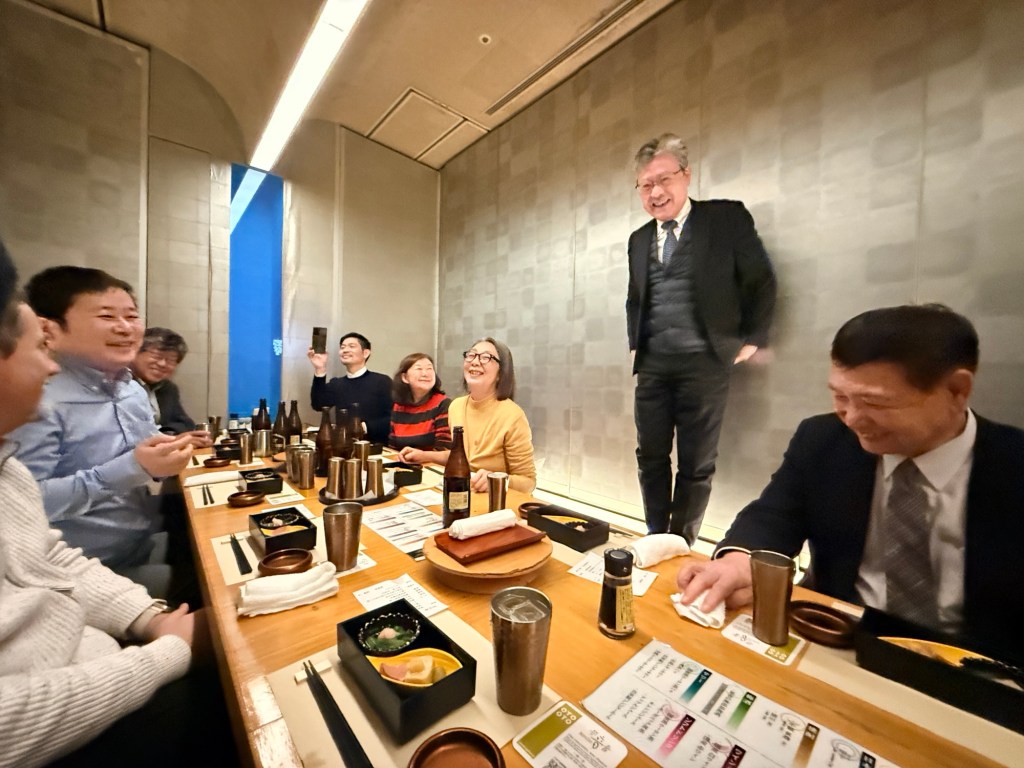
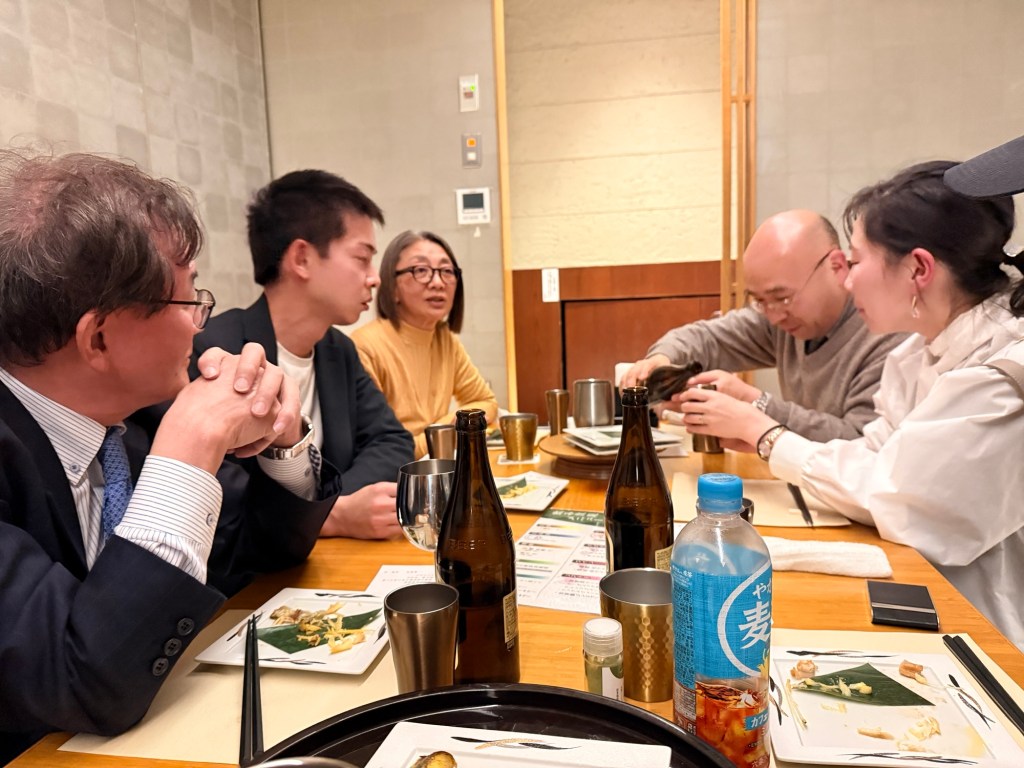
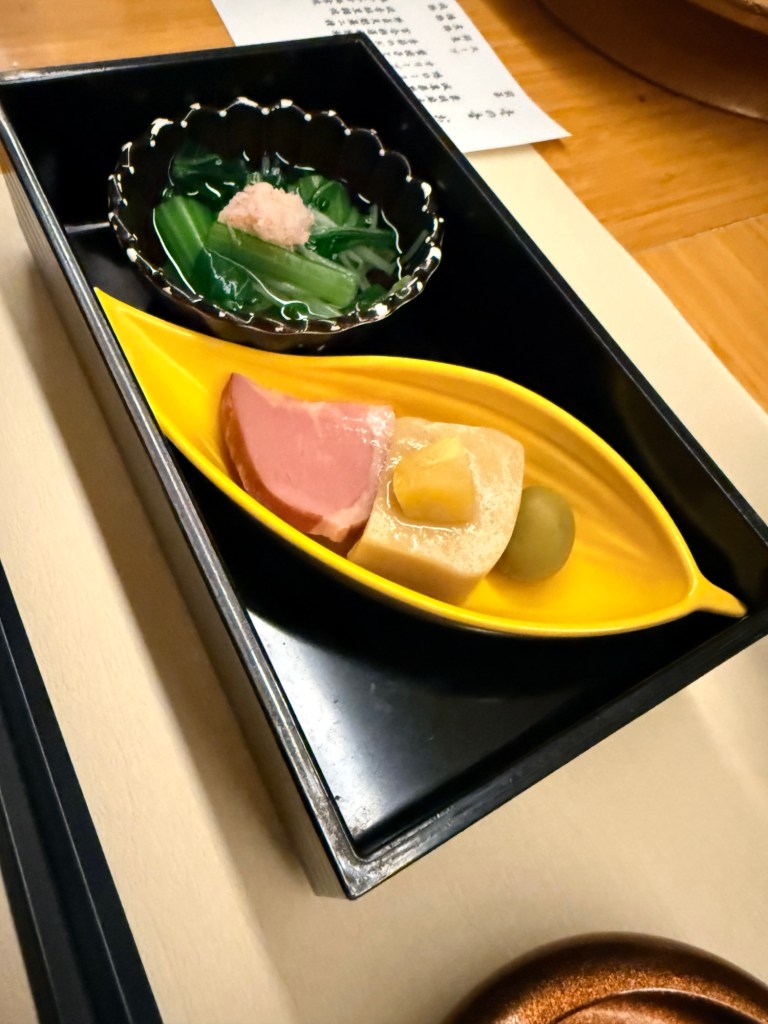
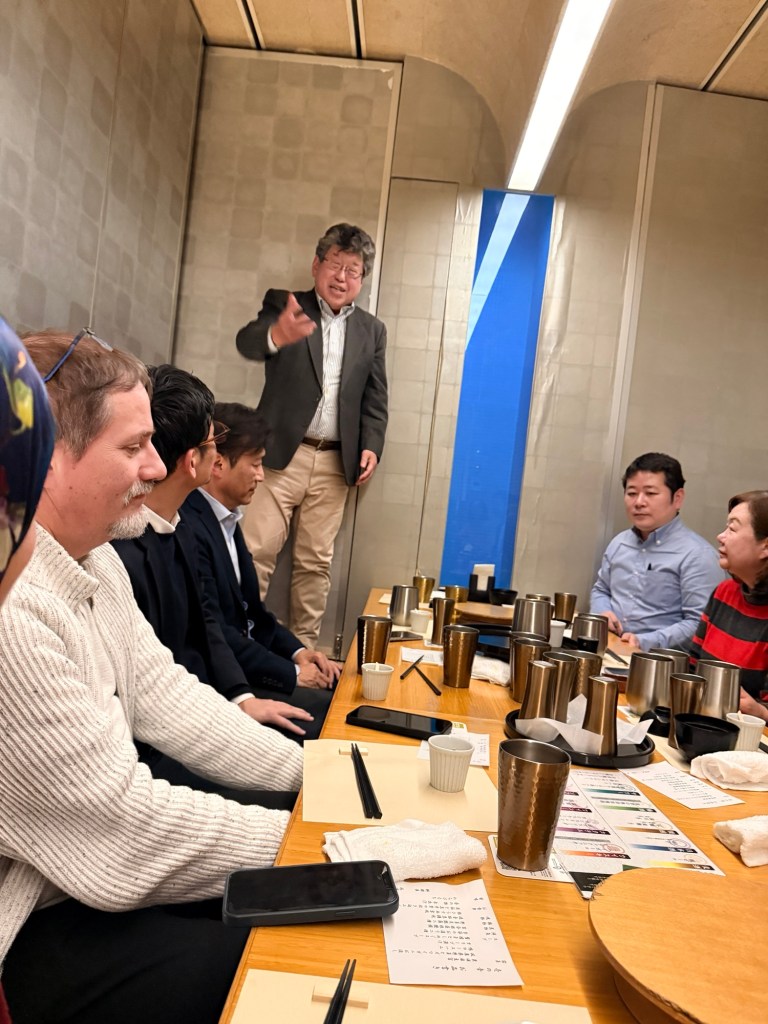
At the end of the event, we got a “family picture” and then headed off for a traditional Japanese meal together. It was a very special experience, and I learned some important cultural aspects (when and where to wear slippers versus socks only inside, how to pour beer for each other, and the like). One of the day’s attendees, Jeffrey S. Cross, an expat from the USA like me, helped me translate and explain nuances.
Headed out for a traditional Japanese dinner after the conference!Goodbye Cocoon!Dr. Yukito (Happyman) Kobayasi leading a toast at dinner after the event.Learning Japanese traditions.And about Japanese foods.A culminating toast by Jun.
Cultural Explorations
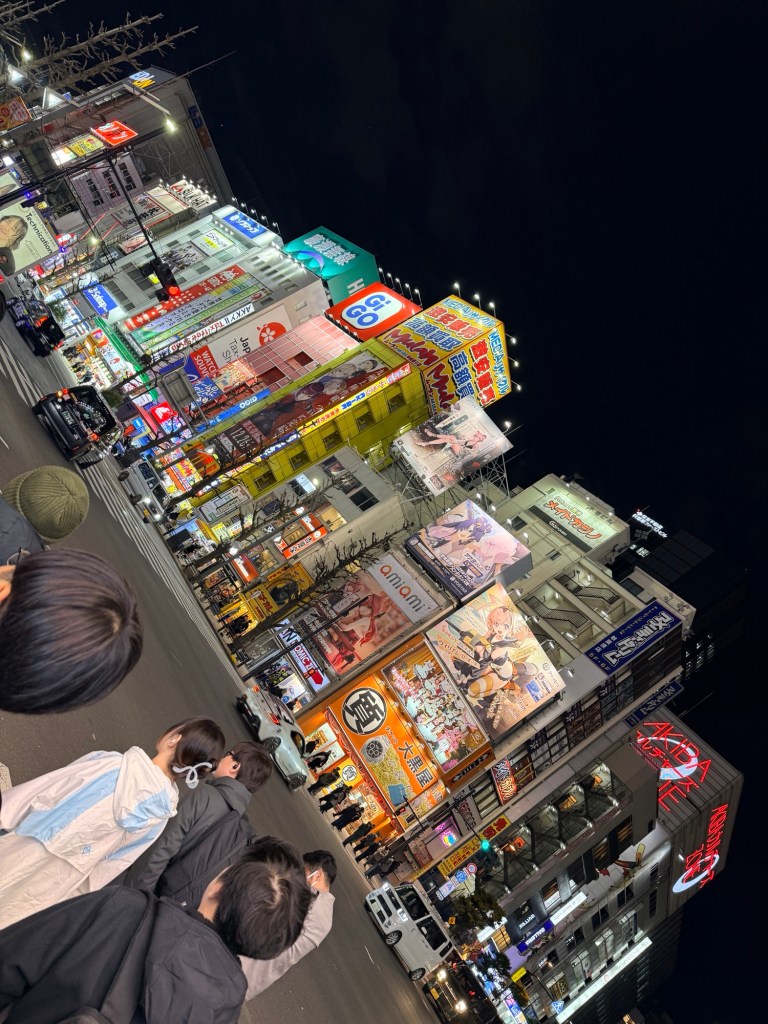
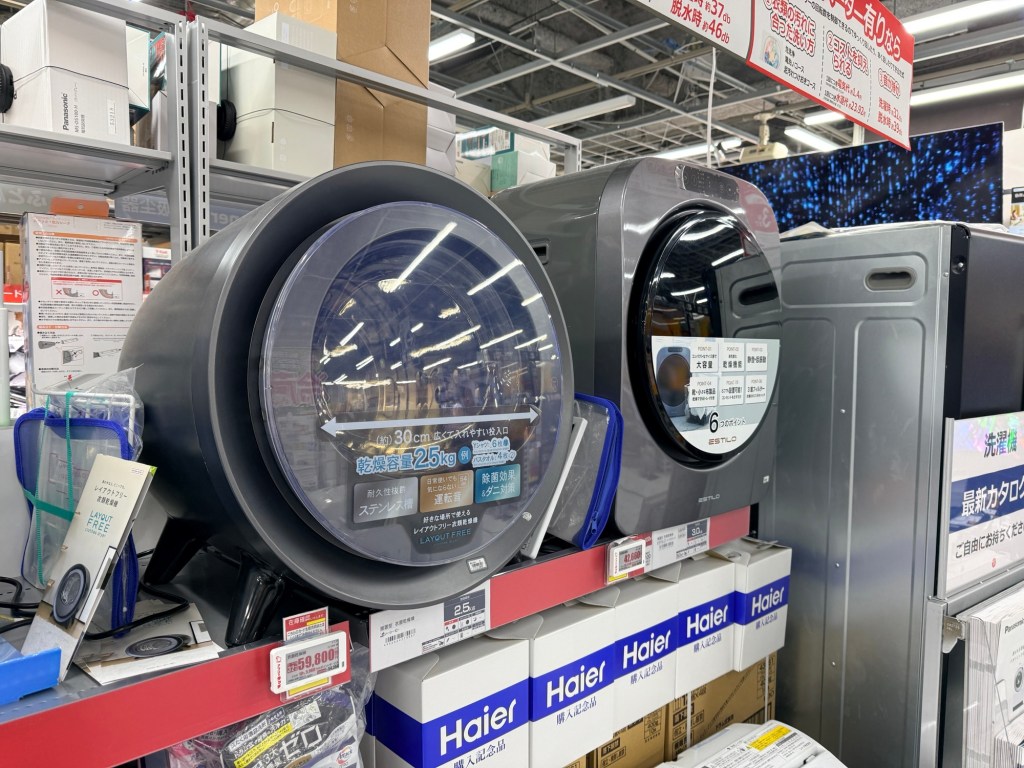
Following this big day of activity, Sarah and I, along with Sarah’s lovely newlywed husband, Stefané, who joined her for the trip, had a bit of time to explore Tokyo. We enjoyed exploring a huge electronics store together.
Getting to Tokyo…We explored an electronics store filled with all kinds of interesting gadgets, like these clothes washers. We had a special dinner, Sarah, her husband Stefané, and me.Sarah knew the ins and outs of getting around.In this arcade, we found delicious crepes and mochi balls.
On our last morning in Tokyo, I visited the Shinjuku Goyen National Garden, where at the tea house, I bumped into Asami and a friend of hers.
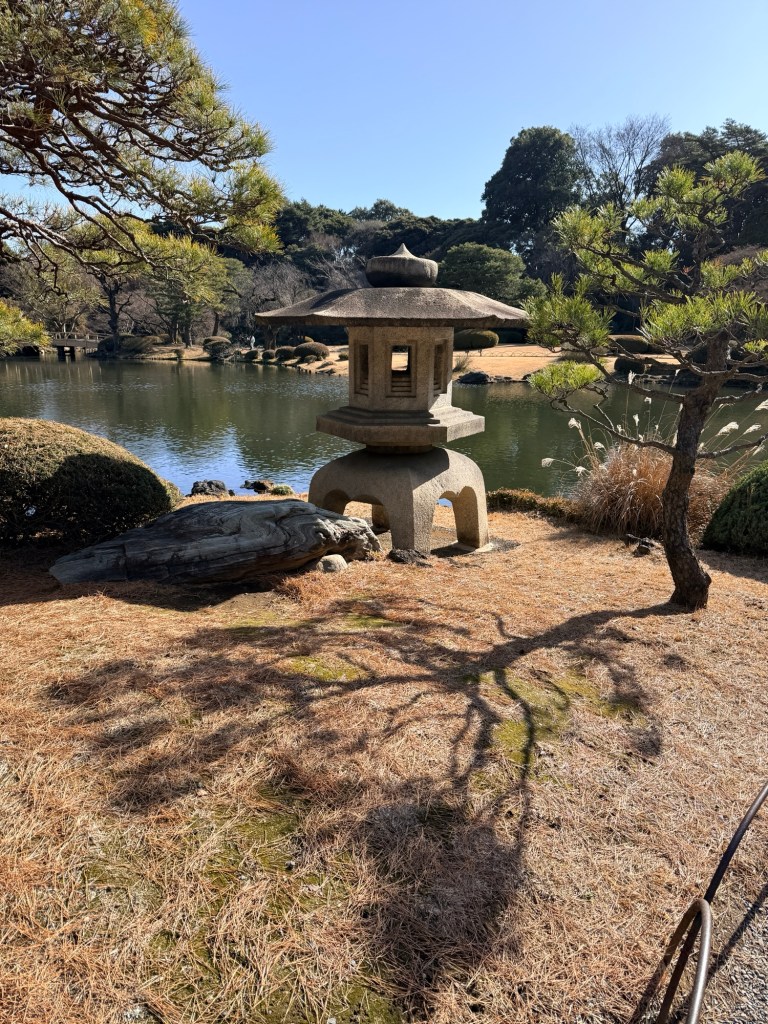
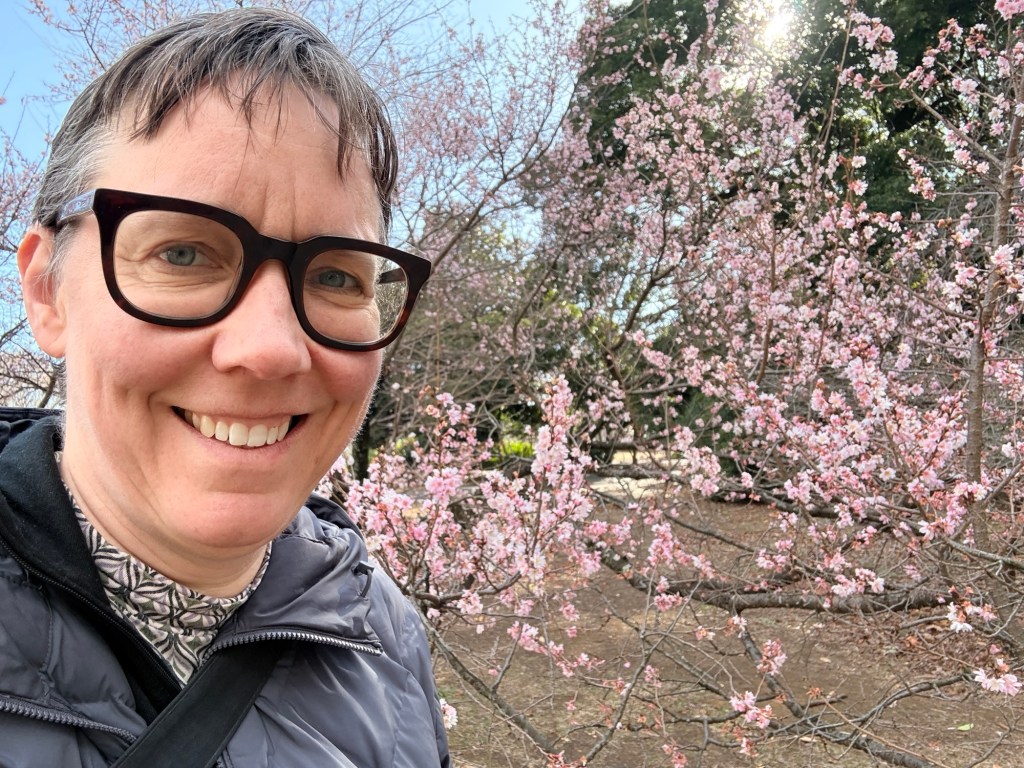
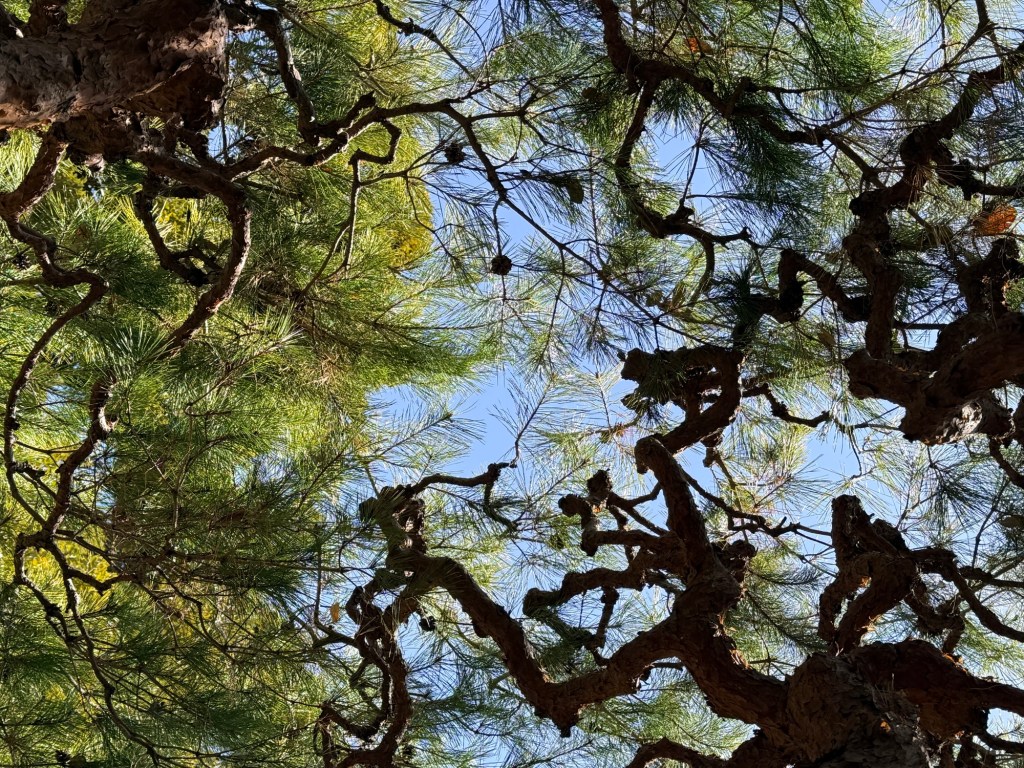
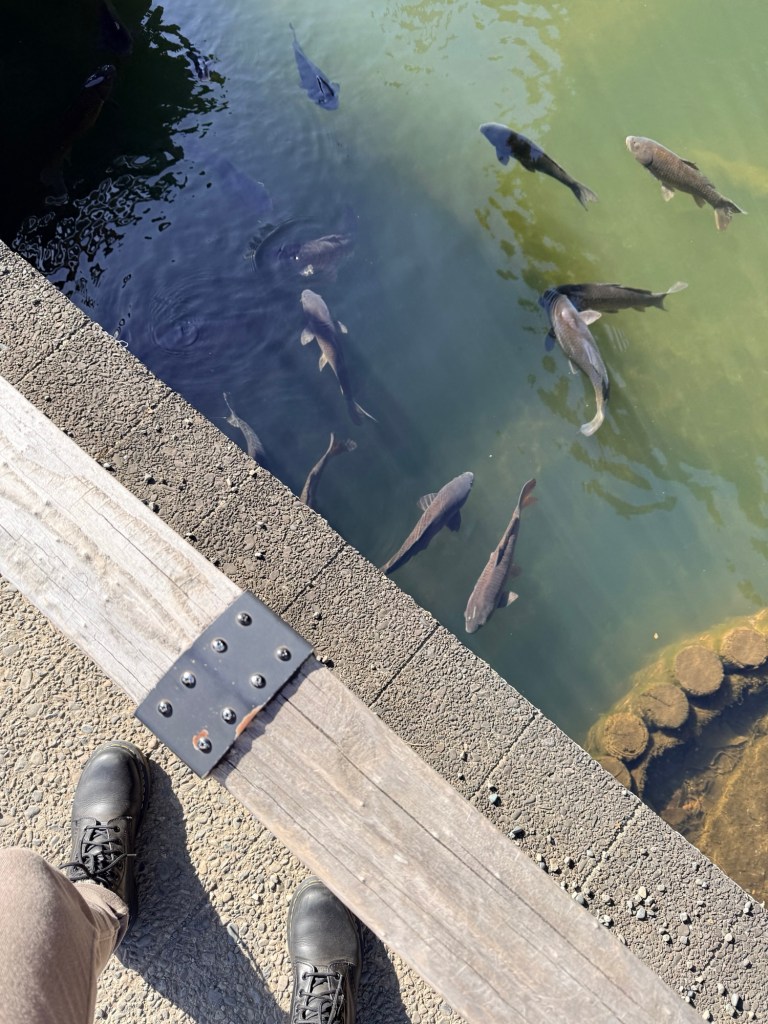
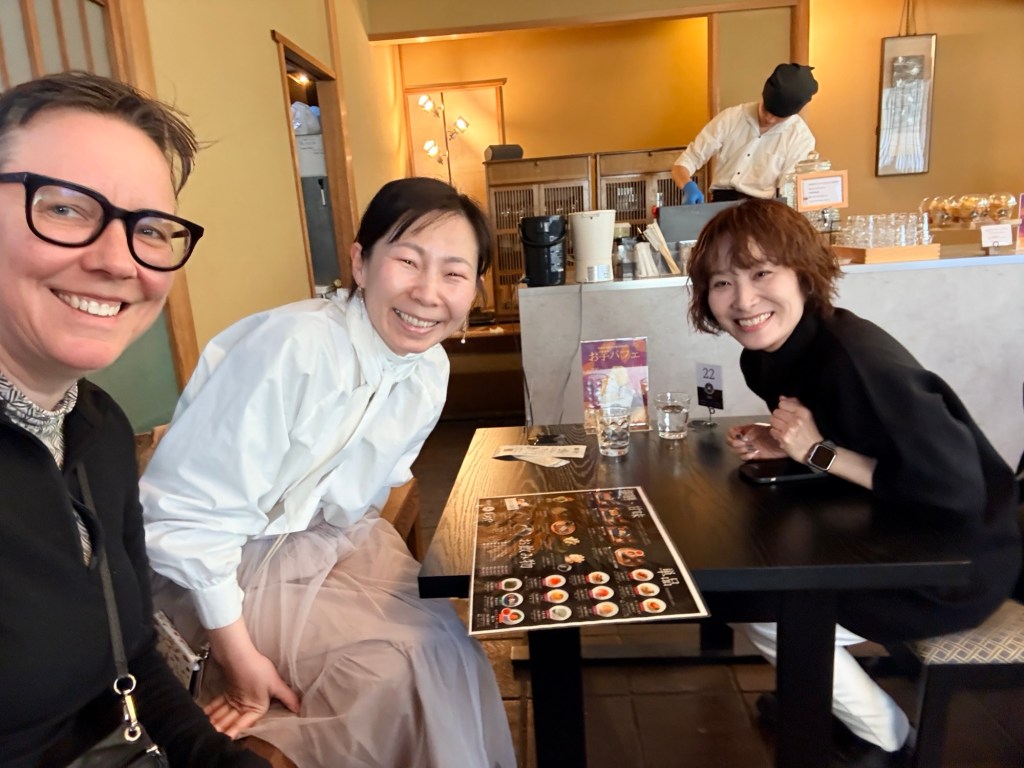
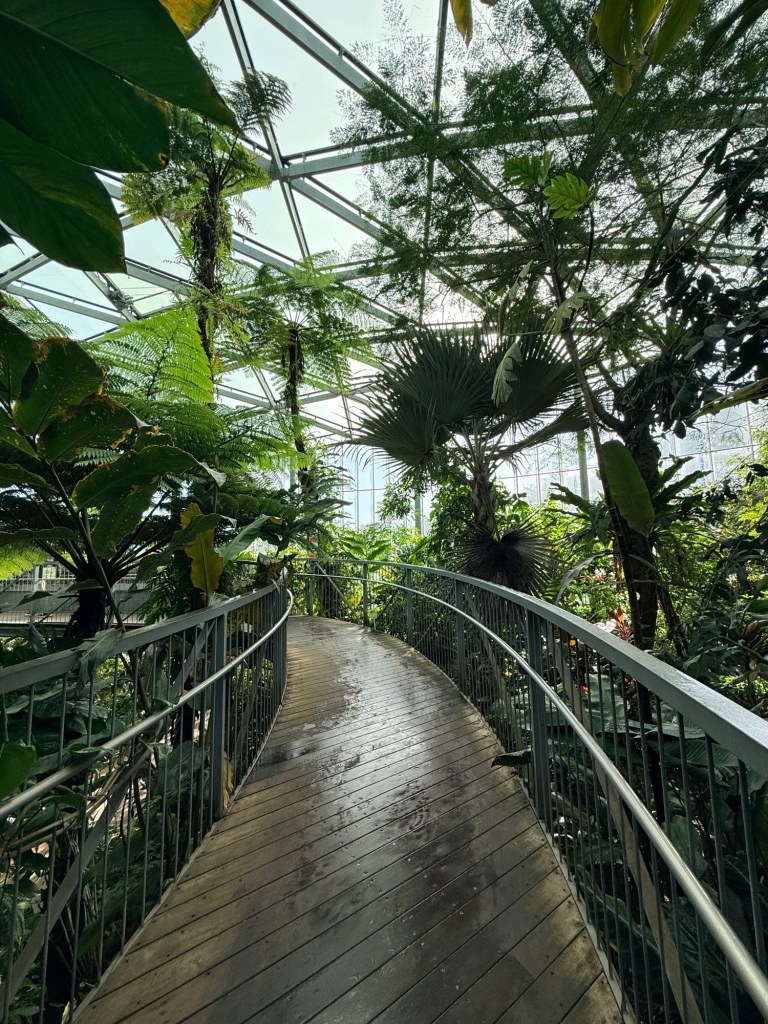
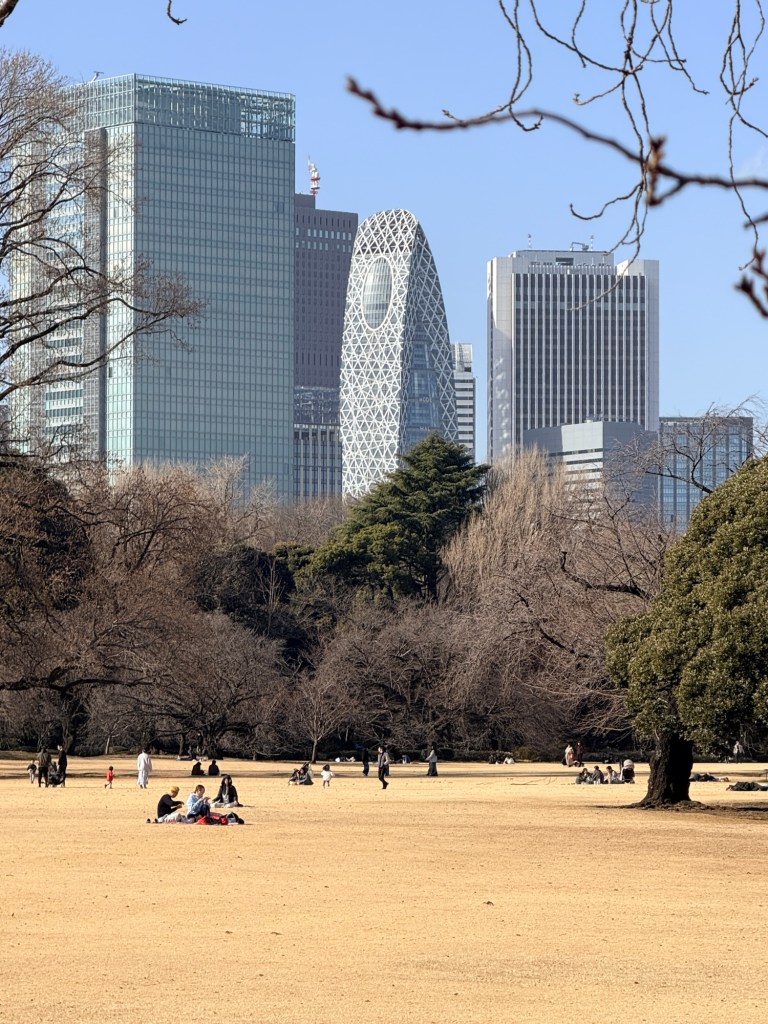
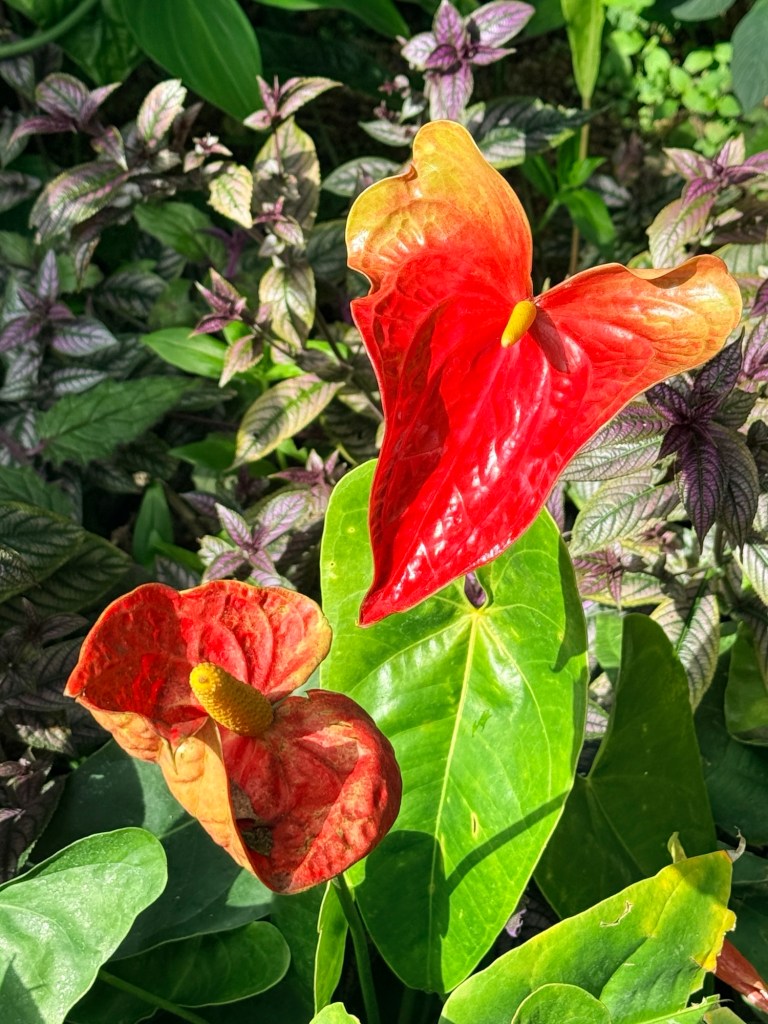
The Japanese garden.A few cherry blossoms left in the cold of winter.My favorite views are into the boughs.Enormous fish!A chance meet up with Asami at the tea house.The greenhouse.Views from the garden of Cocoon Tower.Colorful plants in the greenhouse.
Small-Scale Working Session
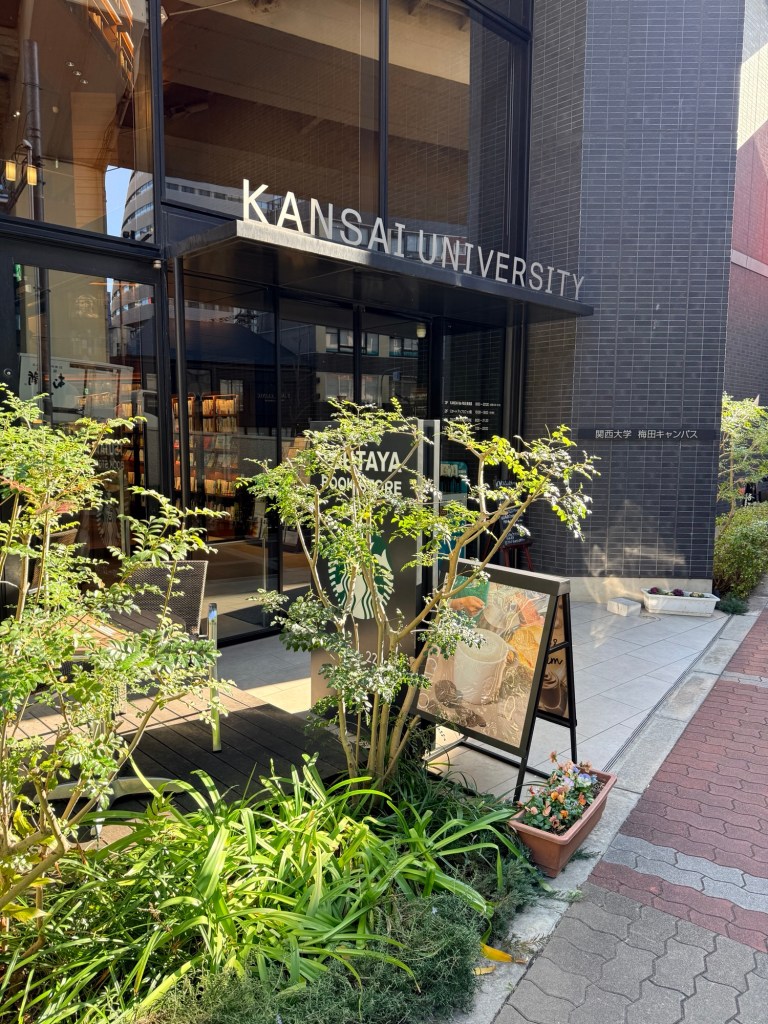
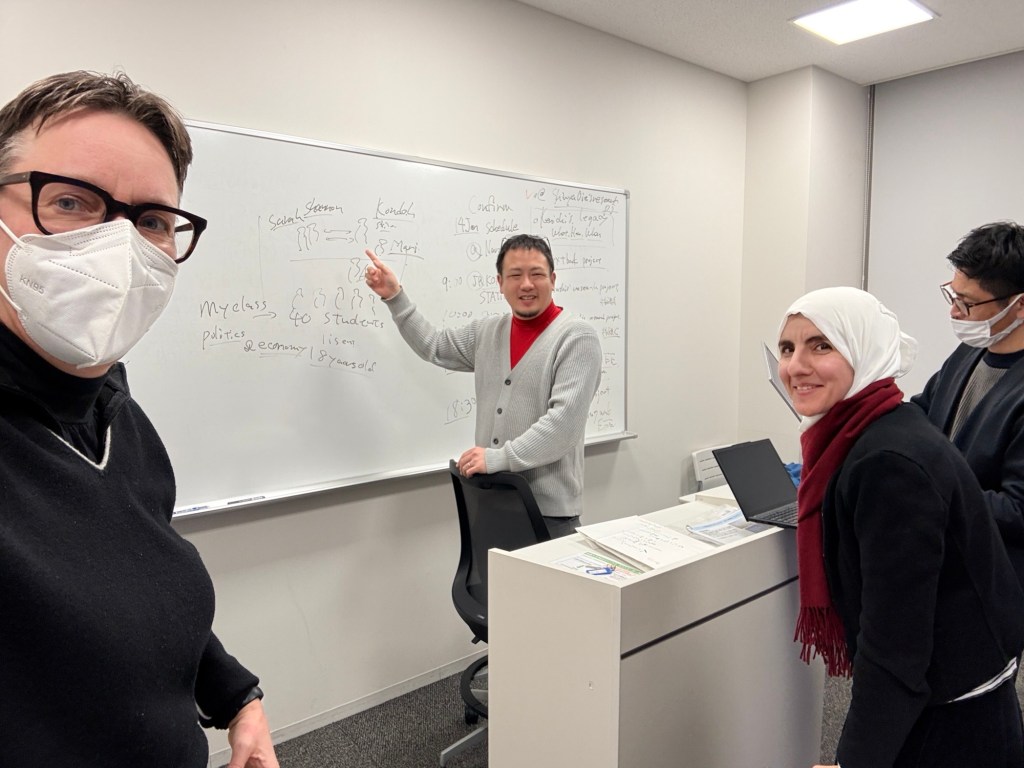
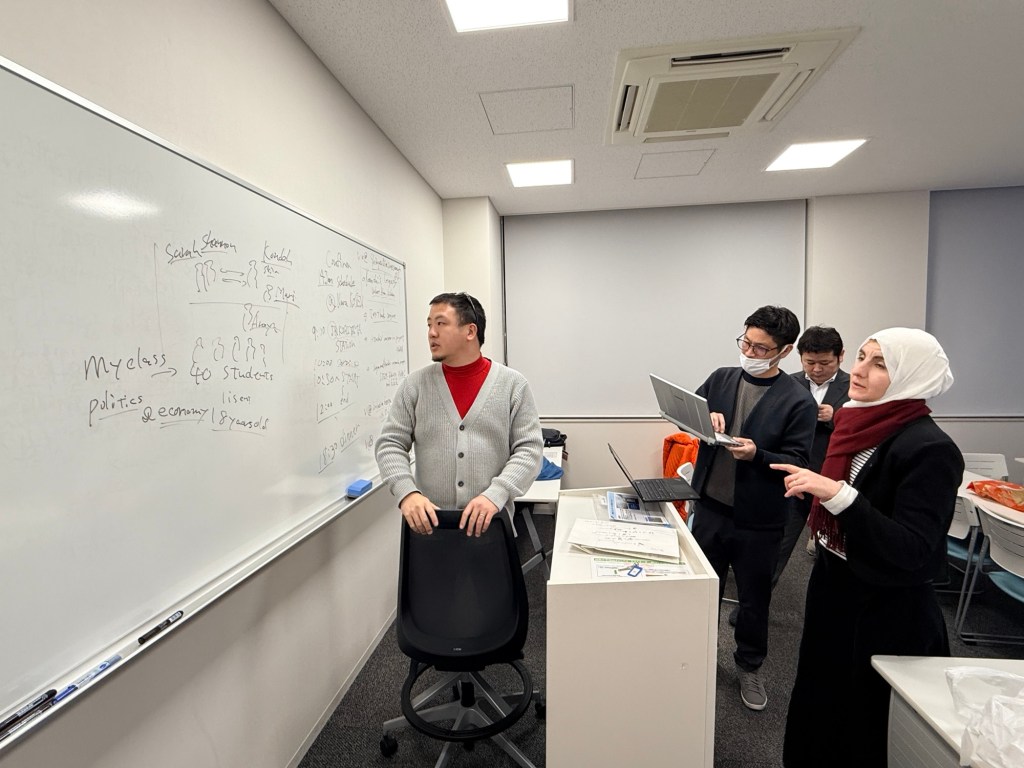
After I explored the greenhouses at the Garden, Sarah, Stefané, and I headed back to Osaka, where the following day we participated in a small-scale workshop to plan engineering ethics education activities for the future. The workshop was held at Kansai University’s Umeda Campus.
Mari Ito joined us as a language expert to help translate ideas between English and Japanese. She had also translated many of the written materials and slides for the full sequence of events during our trip.
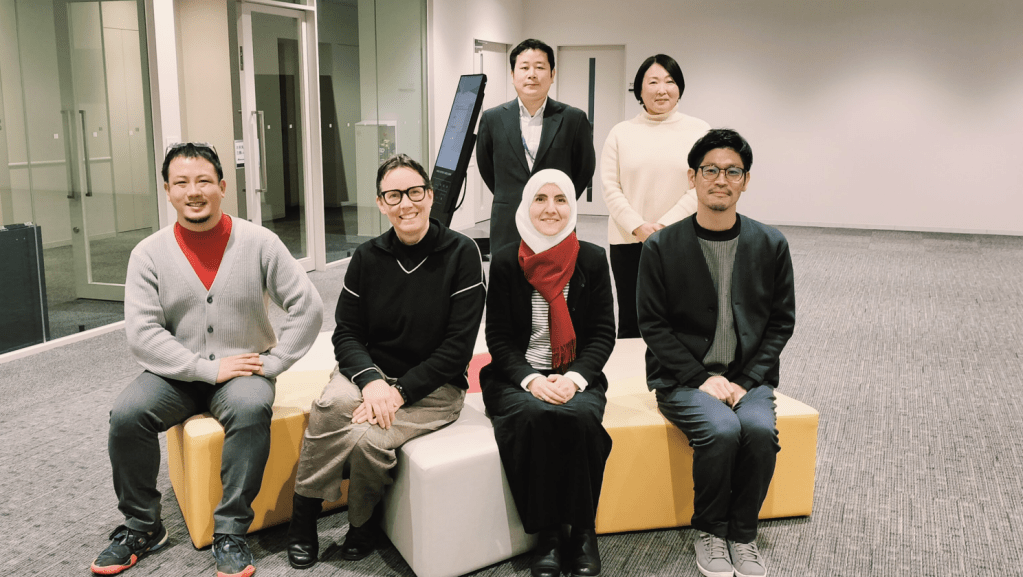
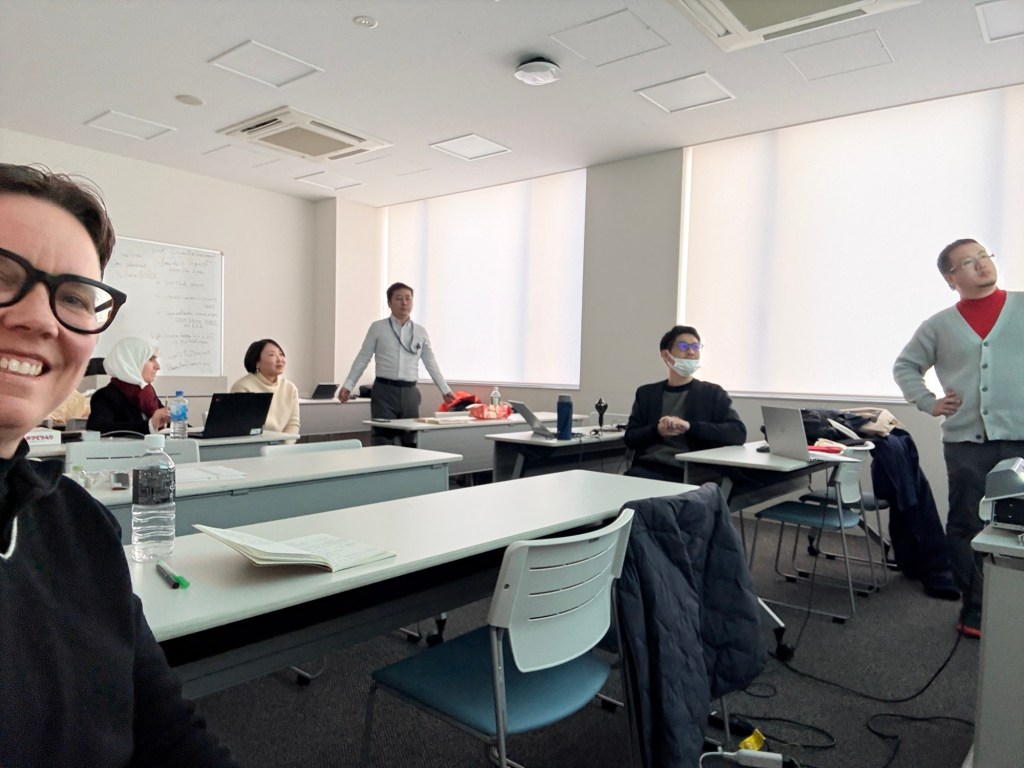
The whole group at the end of our working session.
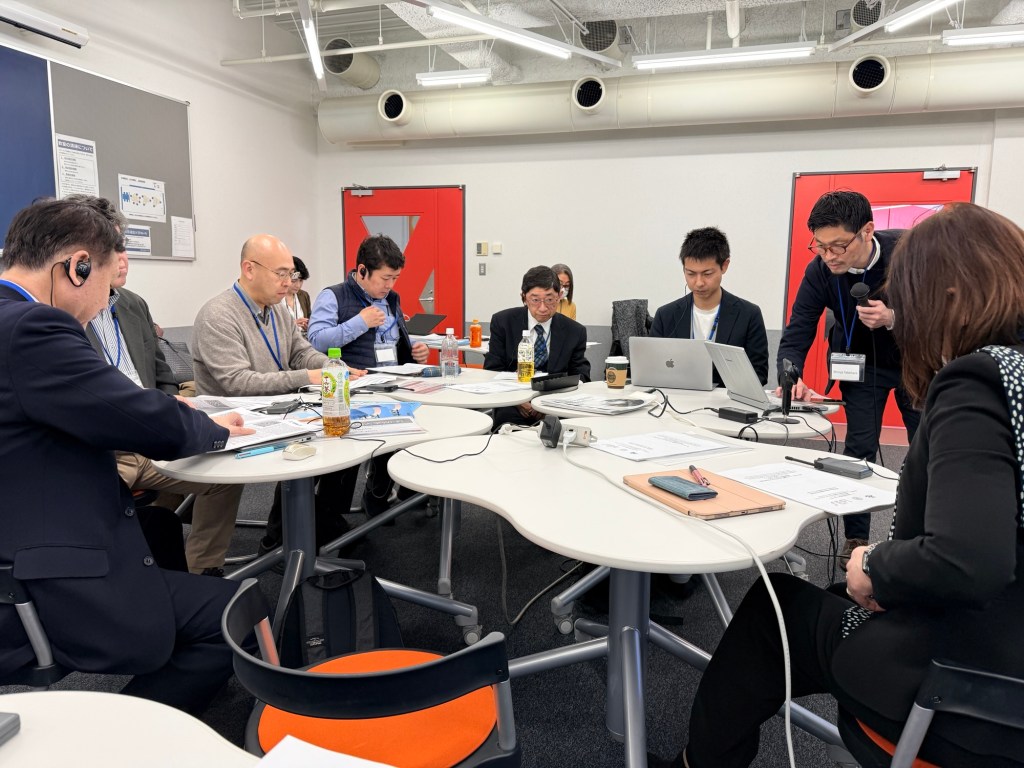
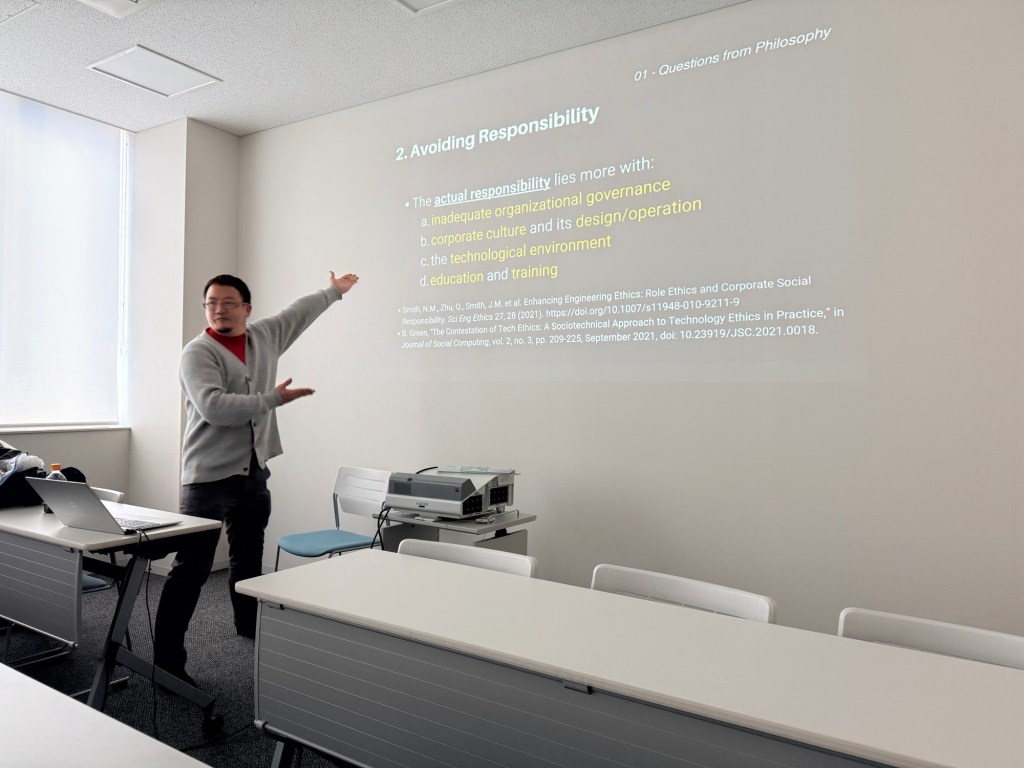
I really enjoyed the presentation that Dr. Shinya Oya delivered and the discussion of projects underway or envisioned in Japan where Sarah and I might be able to connect, ourselves and/or alongside our colleagues from Europe. “In this intimate setting,” Shinya explained, “we were able to deepen discussions on how future joint research might be shaped, building on insights from the Tokyo workshop.”
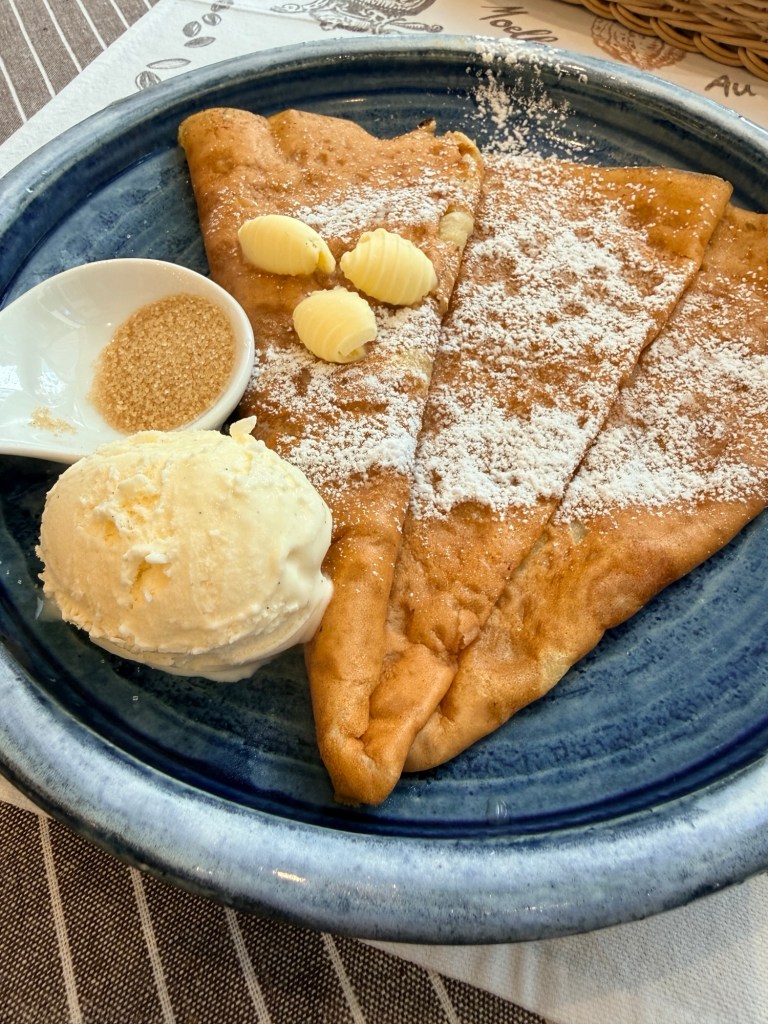
I enjoyed a (very popular) French crepe o the way to the workshop. KansaiThe opening of our Joint Seminar workshop. It was a small but hardworking group.Connecting Shinya Oie’s research to ours. He’s quite an energetic and demonstrative scholar! We had great discussion about his reserach.We discussed upcoming events and ideas for future projects together.
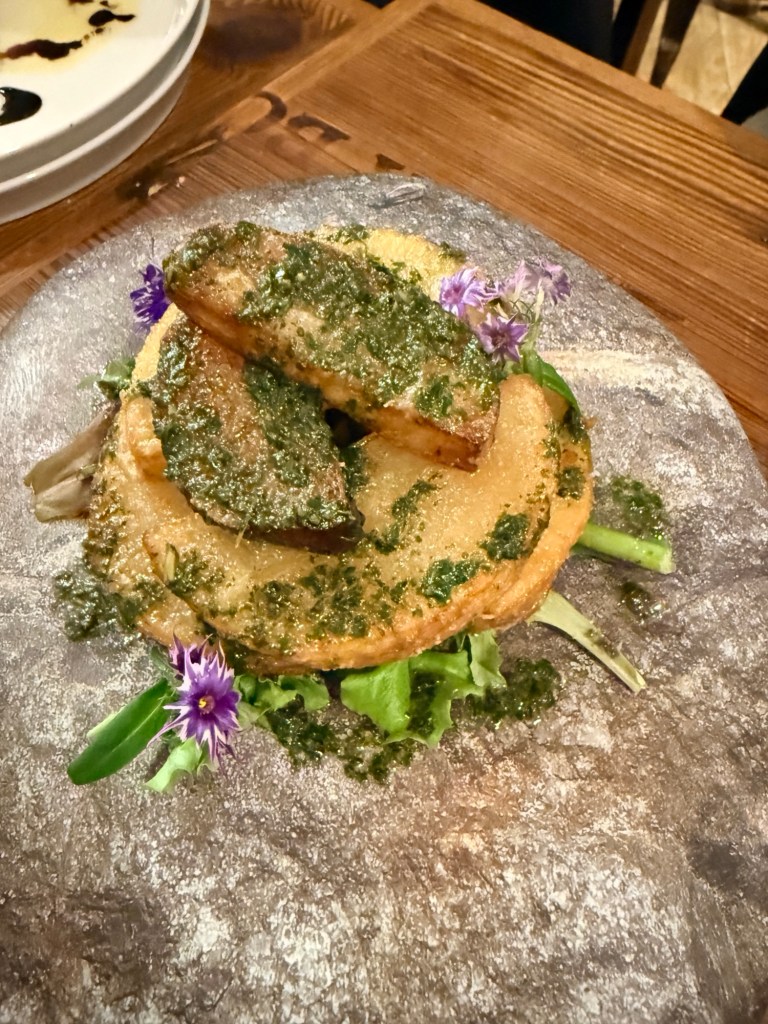
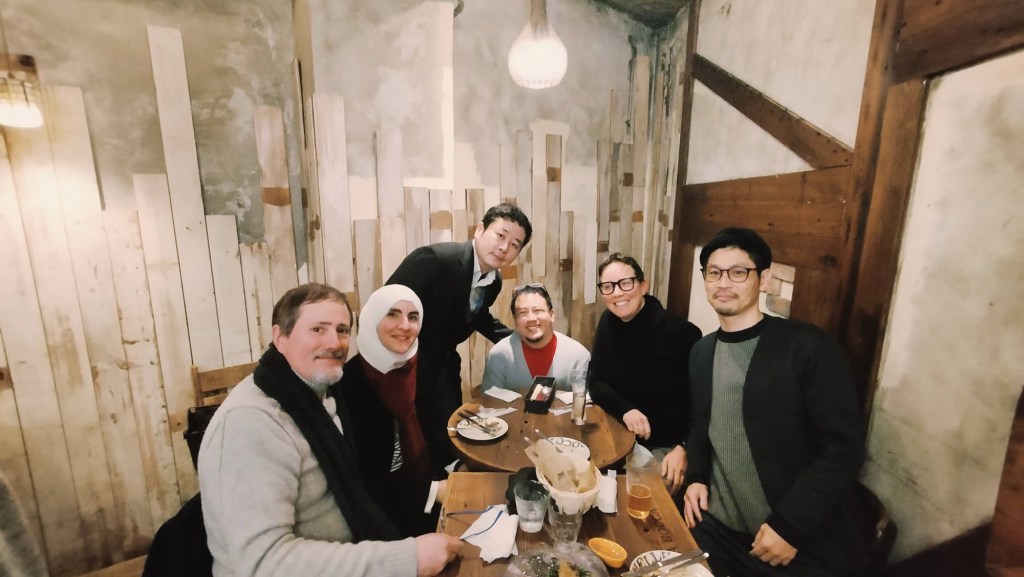
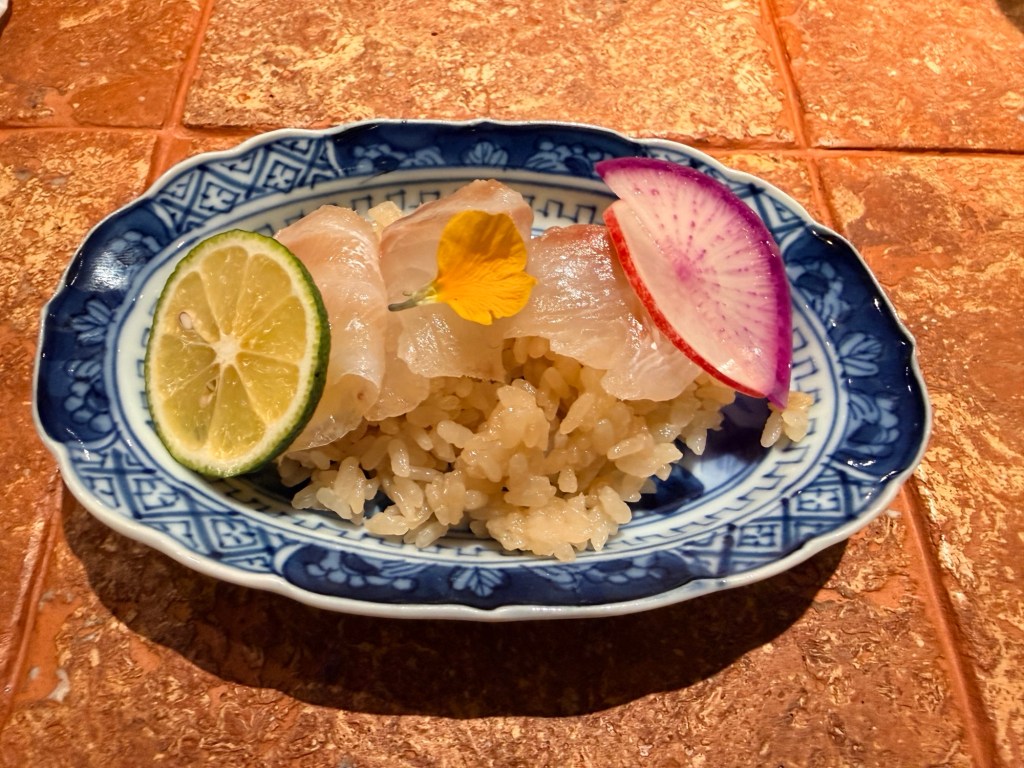
We all went out for Italian tapas together after the workshop. We each selected a couple of items from the menu and got a chance to taste a wide variety of foods. The presentation was beautiful!
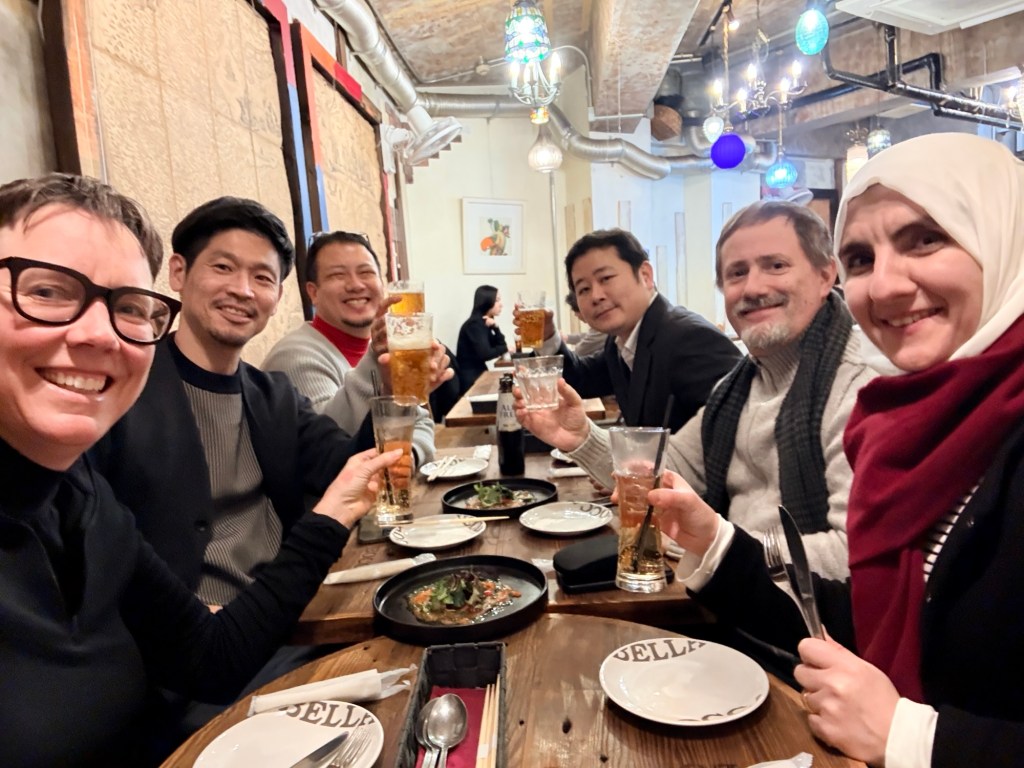
Tapas dinner with Shinya Takehara, Shinya Oie, Atsushi Fujiki, Stefané and Sarah.Such beautiful presentation!We each selected a couple of items from the menu.Still full of life after an intense day!
Visiting KOSAN Nara Campus
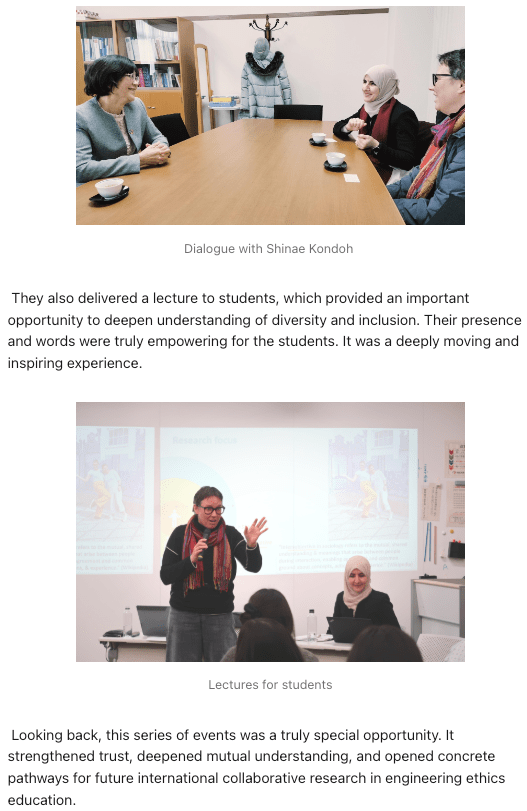
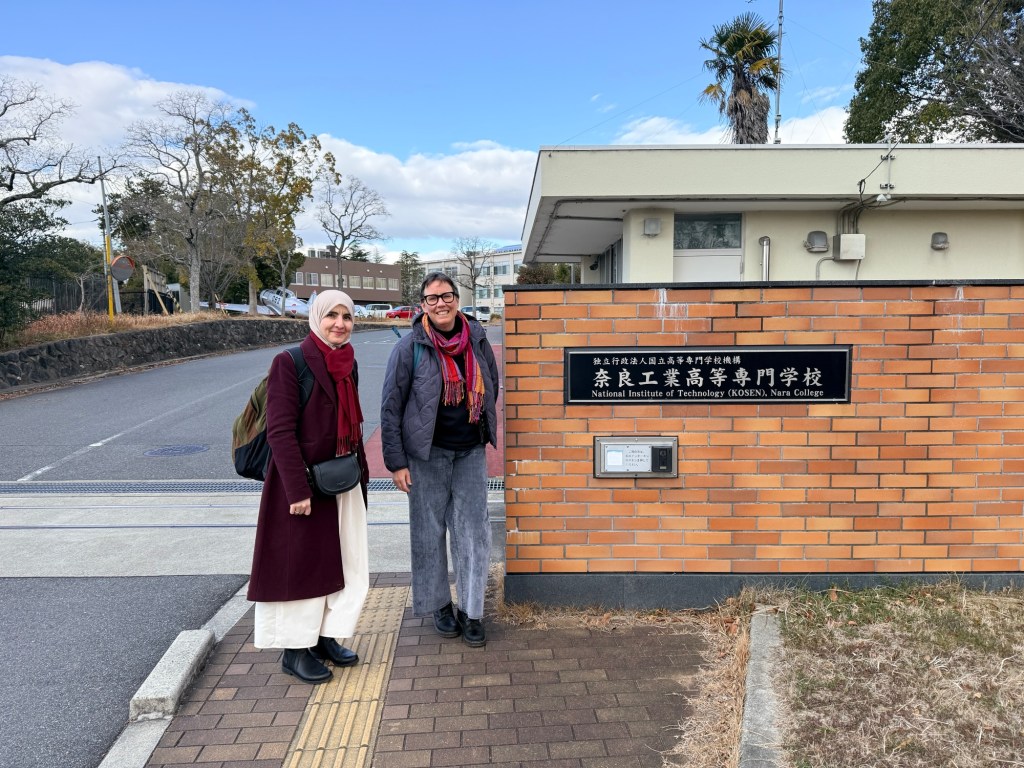
Leaving Osaka the next day, we headed to Nara to visit a branch of the Institute of Technology (KOSEN), where Shinya teaches. Sarah and I travelled with Shinya to his campus.
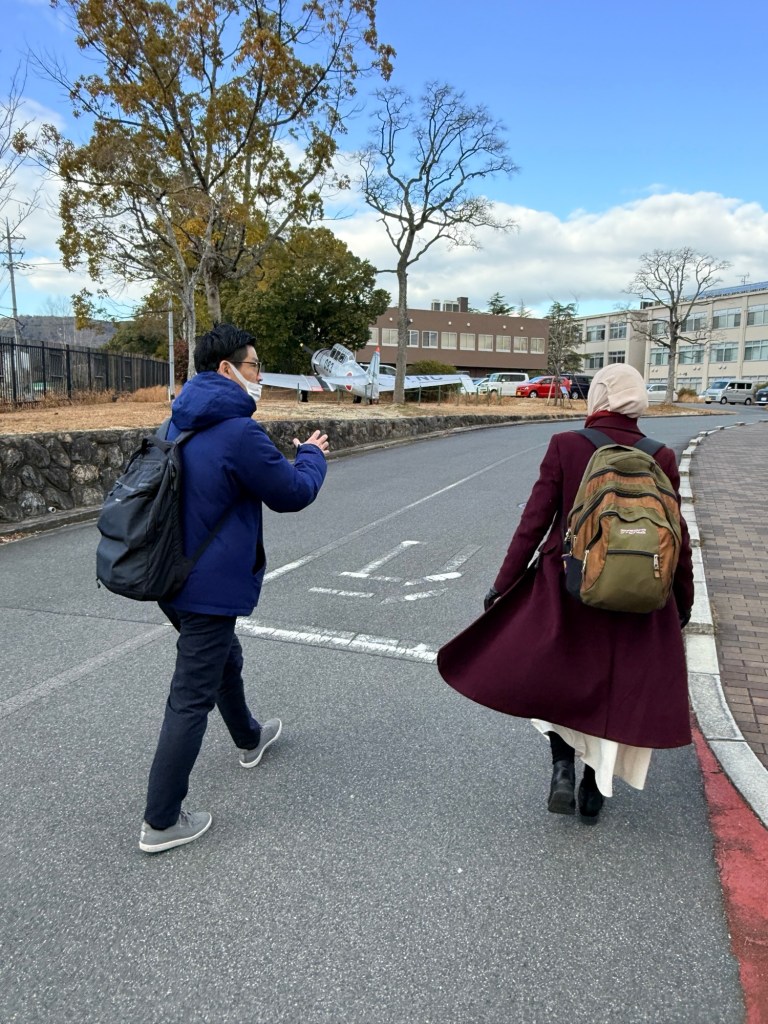
The walk from the train station to the campus was really beautiful. The town where the campus sits is a ‘castle town,’ still organized around the canal that looped the site and still with a castle on the hill.
Arriving on campus.A WWII airplane, which Shinya said was from the Allies.Entering the KOSAN Nara campus with Shinya.
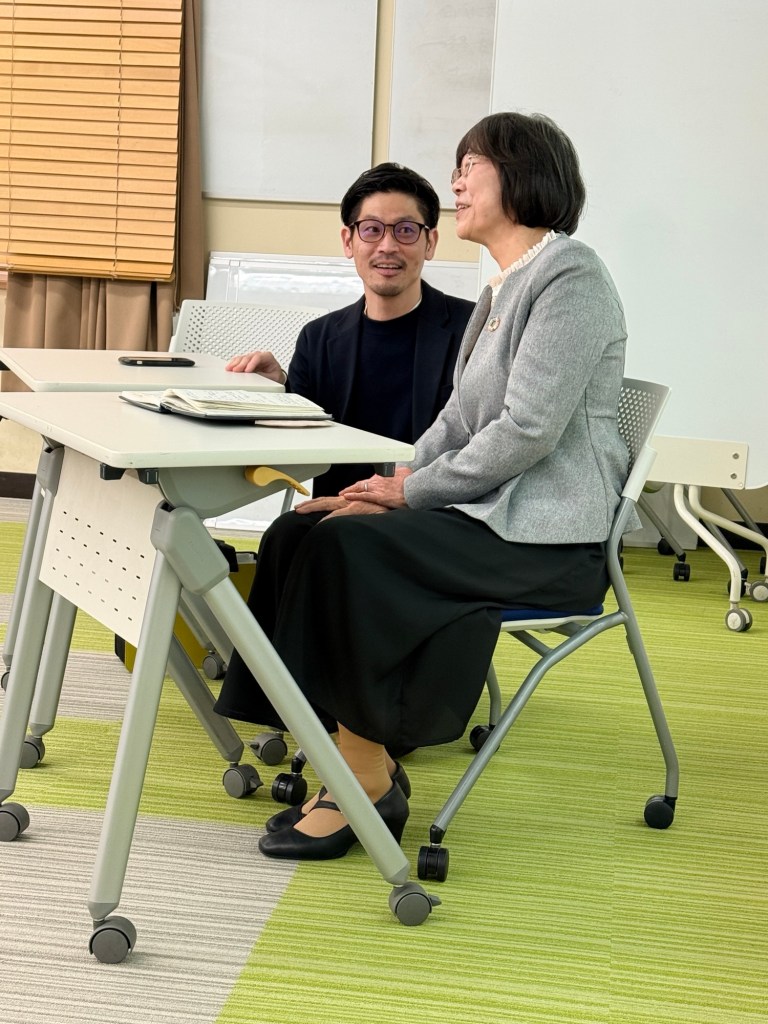
We had the immense honor of meeting Dr. Shinae Kizaka-Kondoh, a medical doctor and currently the Principal (president) of Nara National College of Technology.
She is also the Vice President of the Japan Network of Women Engineers and Scientists (JNWES).
Shinya Takehara with his university leader.
Shinae is a Japanese researcher, professor, and administrator known for her work in molecular imaging and tumor hypoxia, as well as her advocacy for women in STEM. She has published research on the challenges and solutions regarding the gender gap in science, technology, engineering, and mathematics (STEM) in Japan.
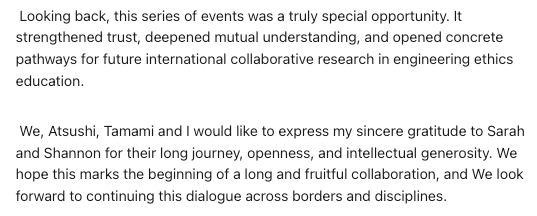
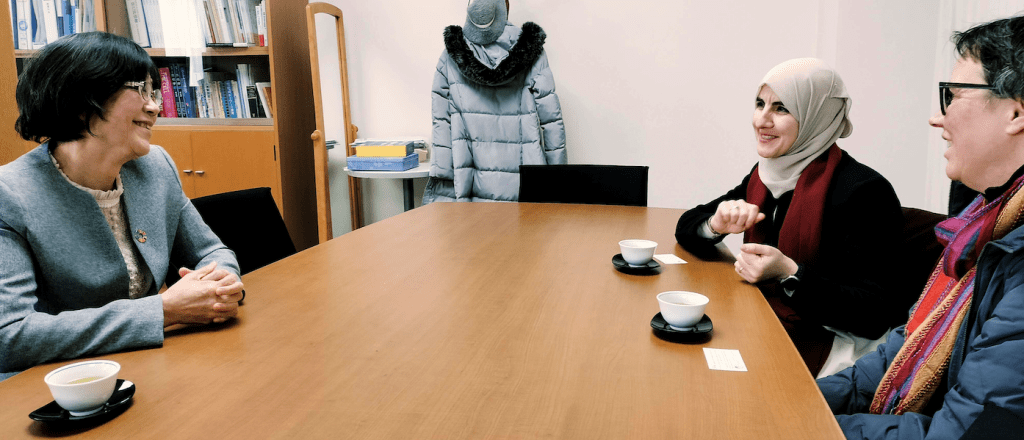
Tea with Dr. Shinae Kizaka-Kondoh
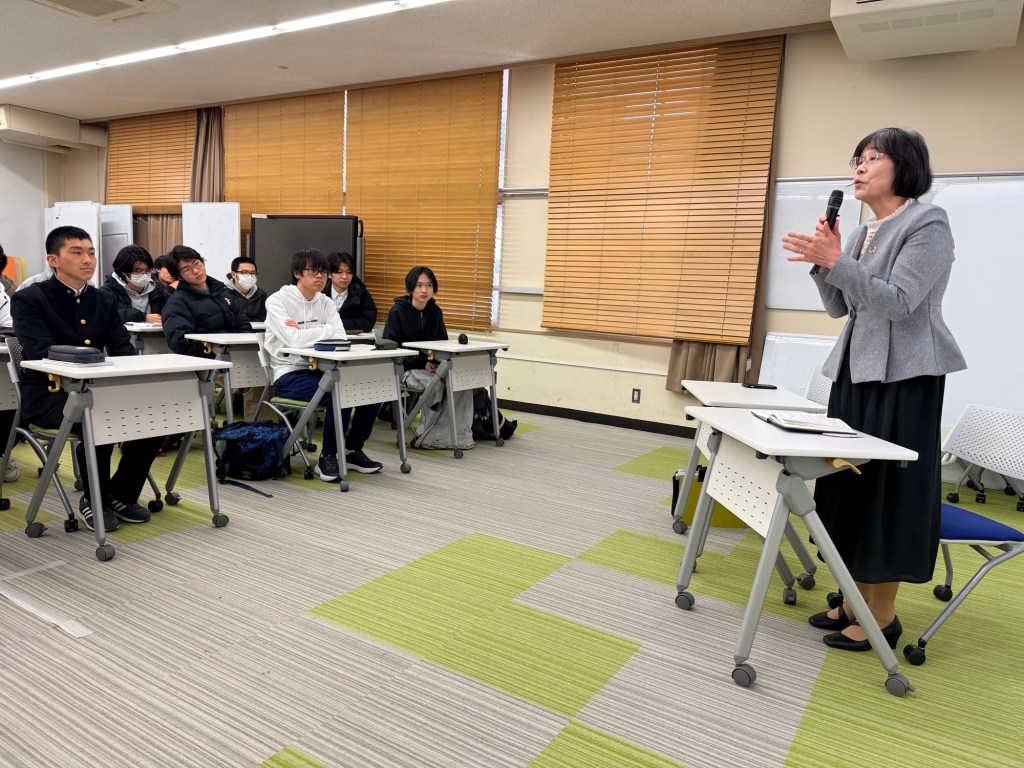
Shinae, Sarah, and I delivered talks to a class of about 40 Chemical Engineering students at KOSEN. The class is taught by Ryoko Uda. Chiyako Araya also spoke; she has done interesting research to quantitatively evaluate generic skills in active learning. She was also an important contributor to the event at the Cocoon Tower.
Dr. Shinae Kizaka-Kondoh and Chiyako Araya each presented their research.
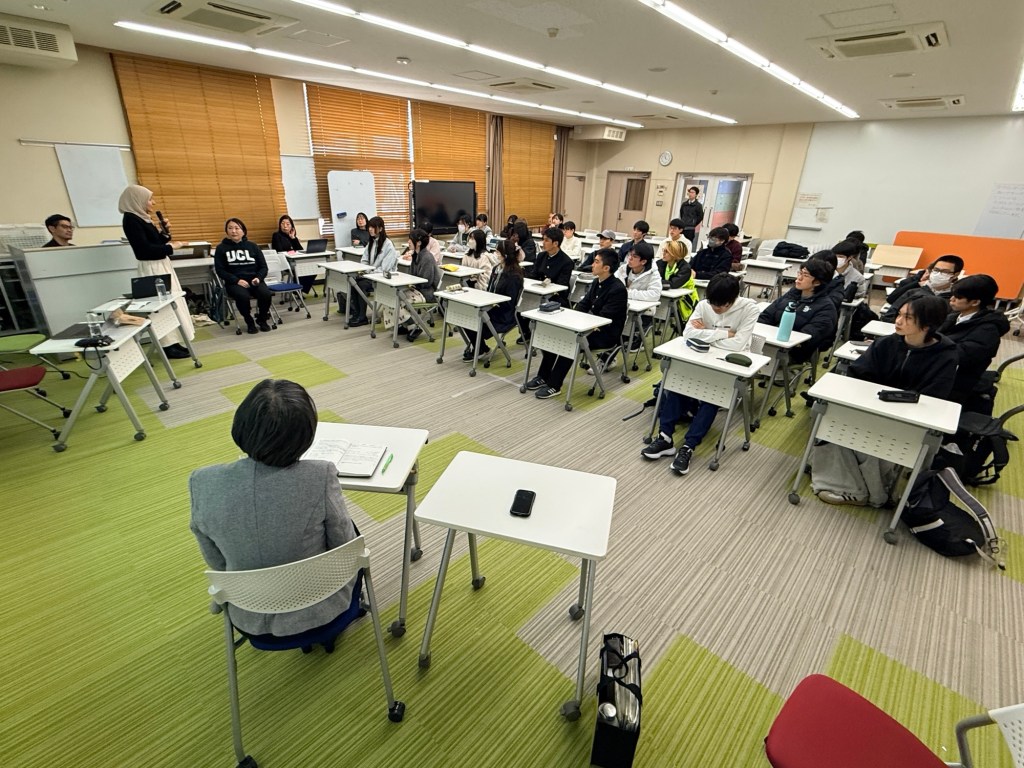
During the class, we discussed gender and diversity related to engineering ethics and engineering education research.
Sarah presented research on gender aspects developed by a student she supervised.
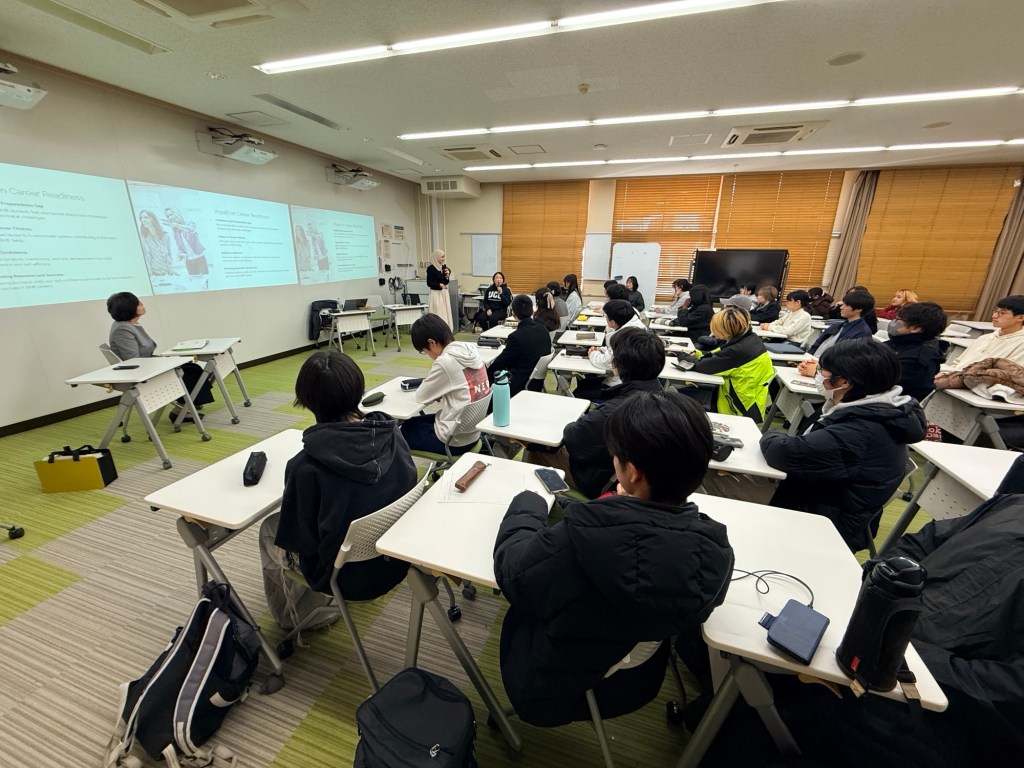
Students, spellbound by Sarah.It was a big audience of Chemical Engineering students. They loved the discussion questions that Sarah gave them.The students sat gender segregated, initially at the back fo the room. They willingly moved to the front when asked.
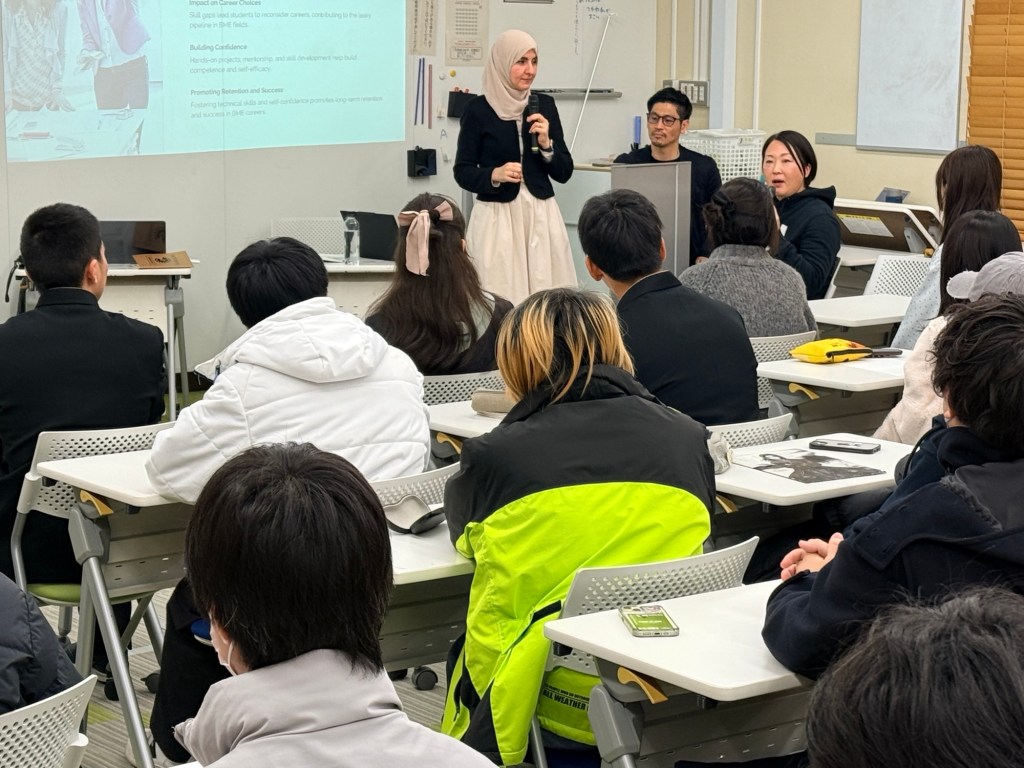
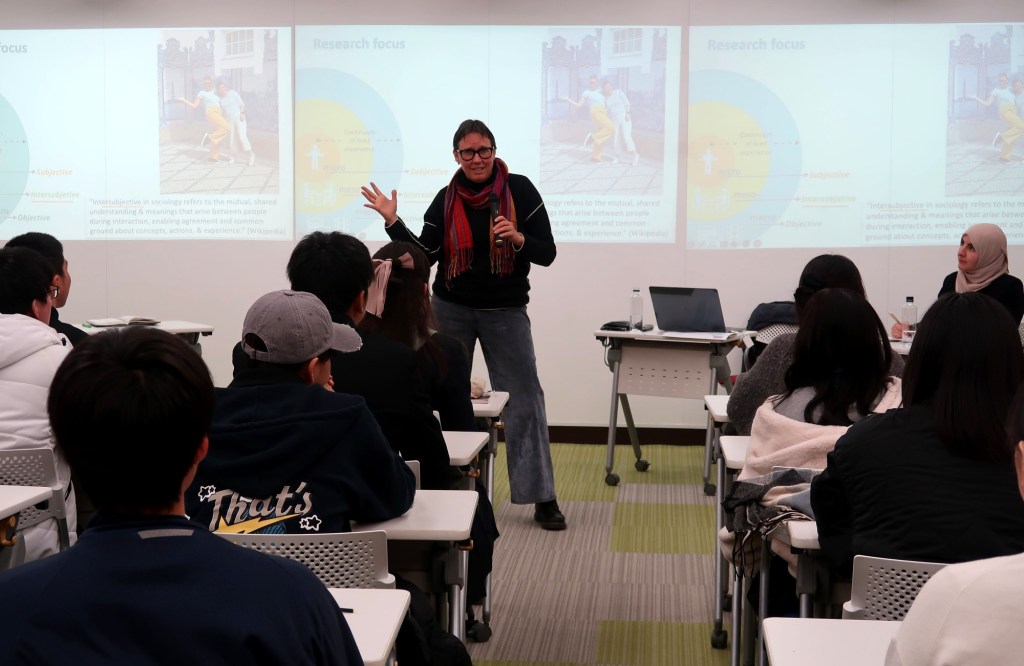
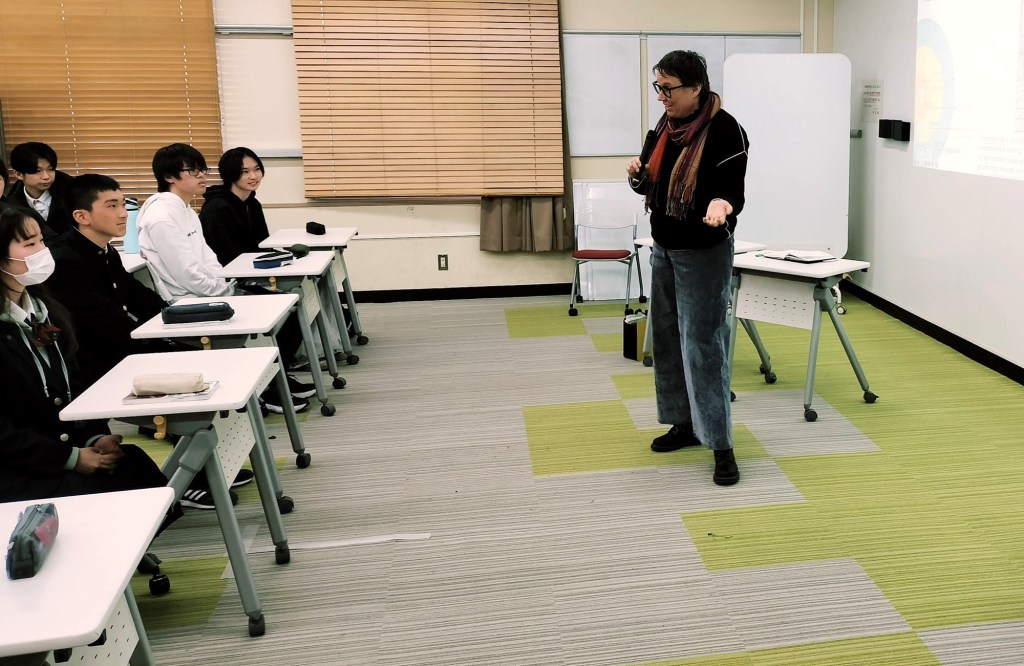
At the end of the class session, I had the opportunity to speak about the broader role of engineering education research. I also shared some of the research that Sandra Cruz Moreno and I have done together.
I presented our work in engineering education research to understand students’ experiences and assess how effectively students learn various engineering topics depending on how the content is delivered.
I spoke about the role of engineering education research more broadly. And I shared some of the research that Sandra Cruz Moreno and I have done together.
Touring Tanpopo, A Community of Disabled Artists
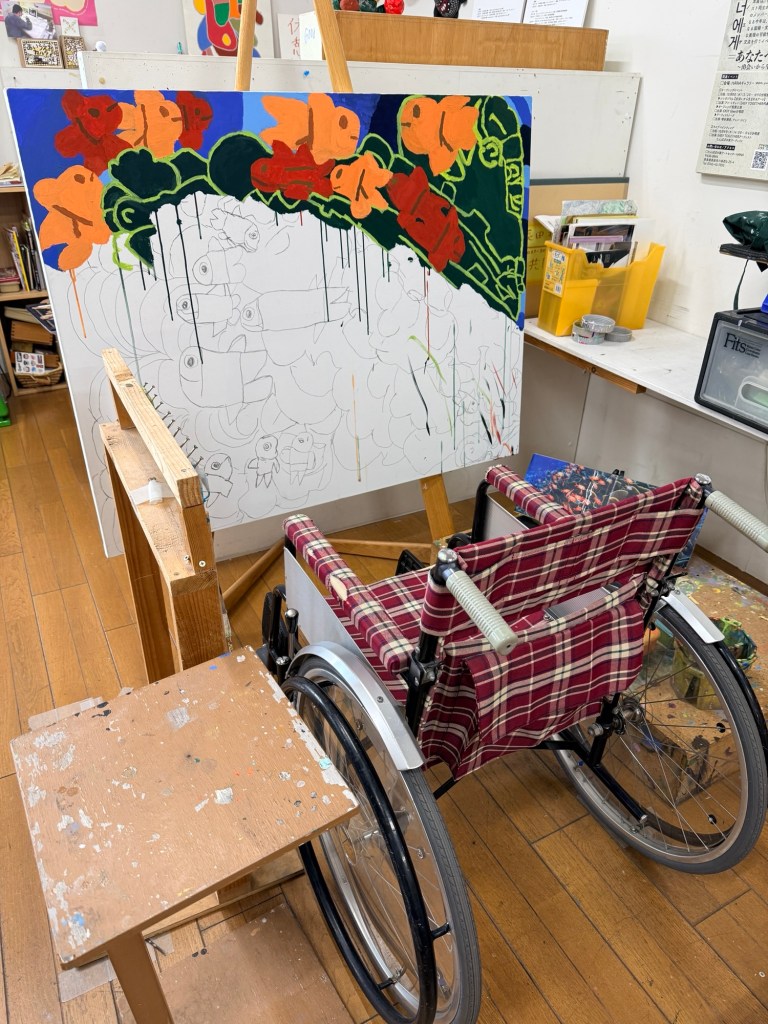
Leaving KOSAN, we (Shinya, Sarah, and I) stopped in at Tanpopo, a community center where disabled artists work and live.
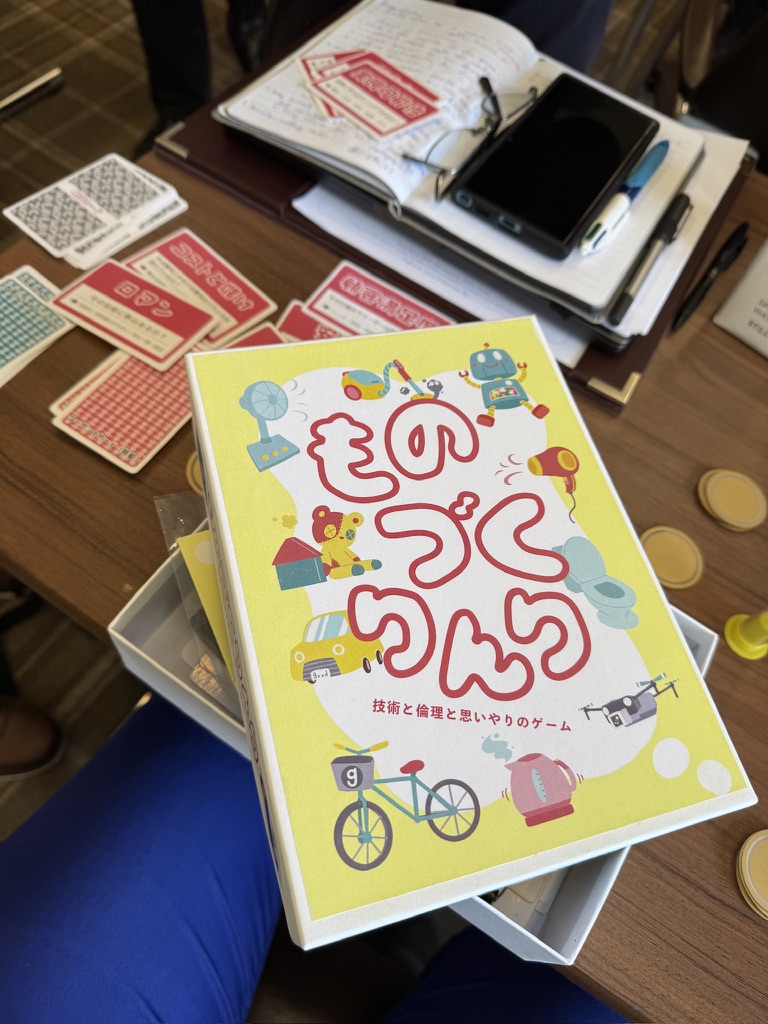
Artists there produced Shinya’s engineering ethics card game, which we hope to translate into English soon.
Shinya at the SEFI Ethics Symposium,showing us his ethics card game.
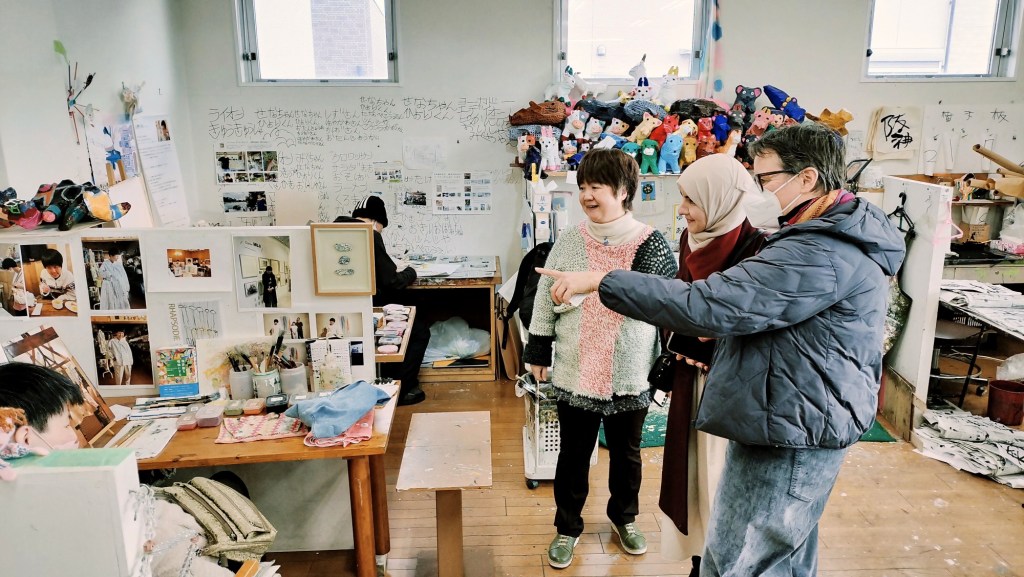
At Tanpopo, staff members Gian Miki and Masashi Yamano showed us around and explained how things work.
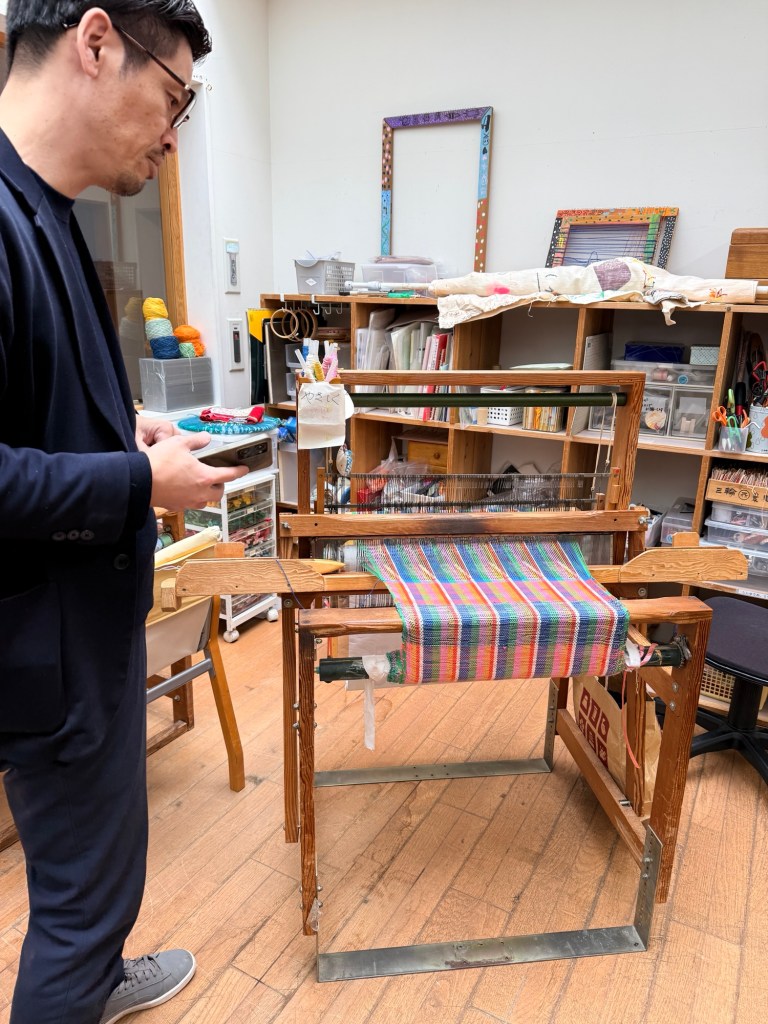
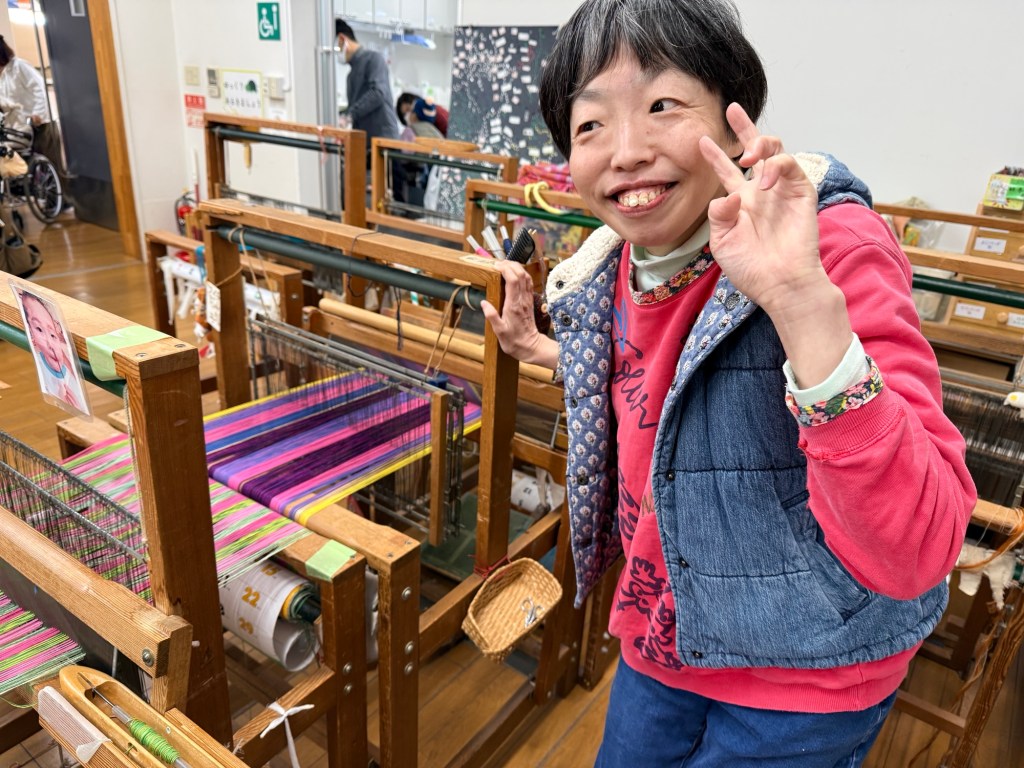
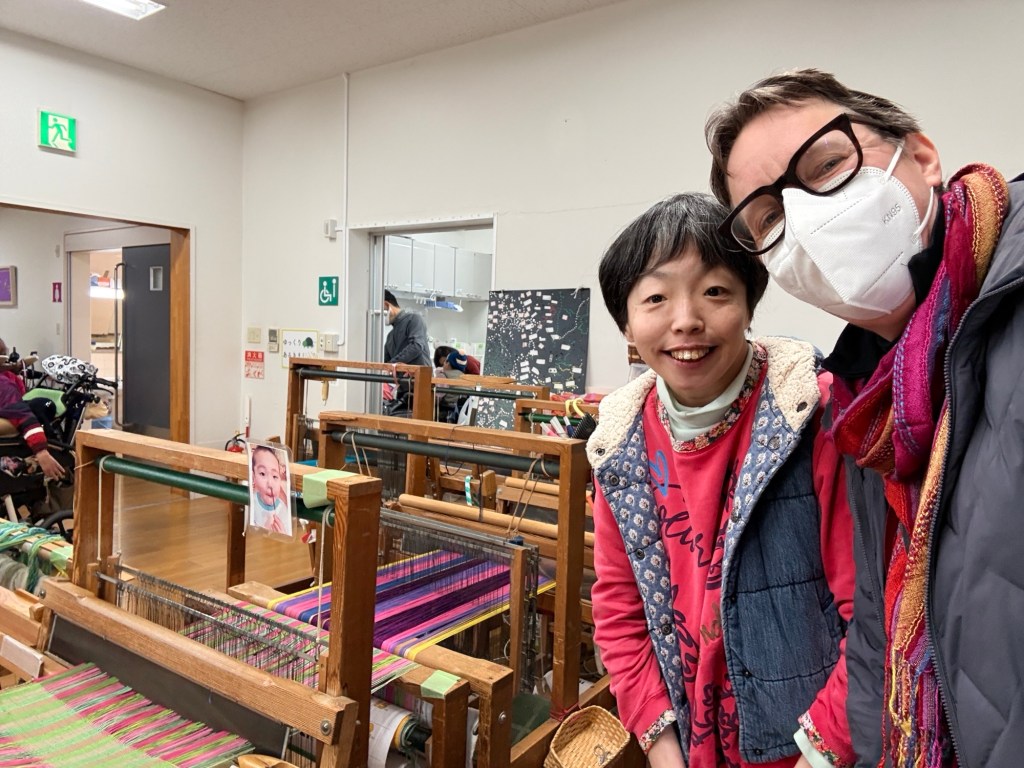
I bought two lovely scarves woven by members of the community. Proceeds go to the artists themselves, and the artist of one of the scarves I bought was there at the time. She expressed such pride and joy!
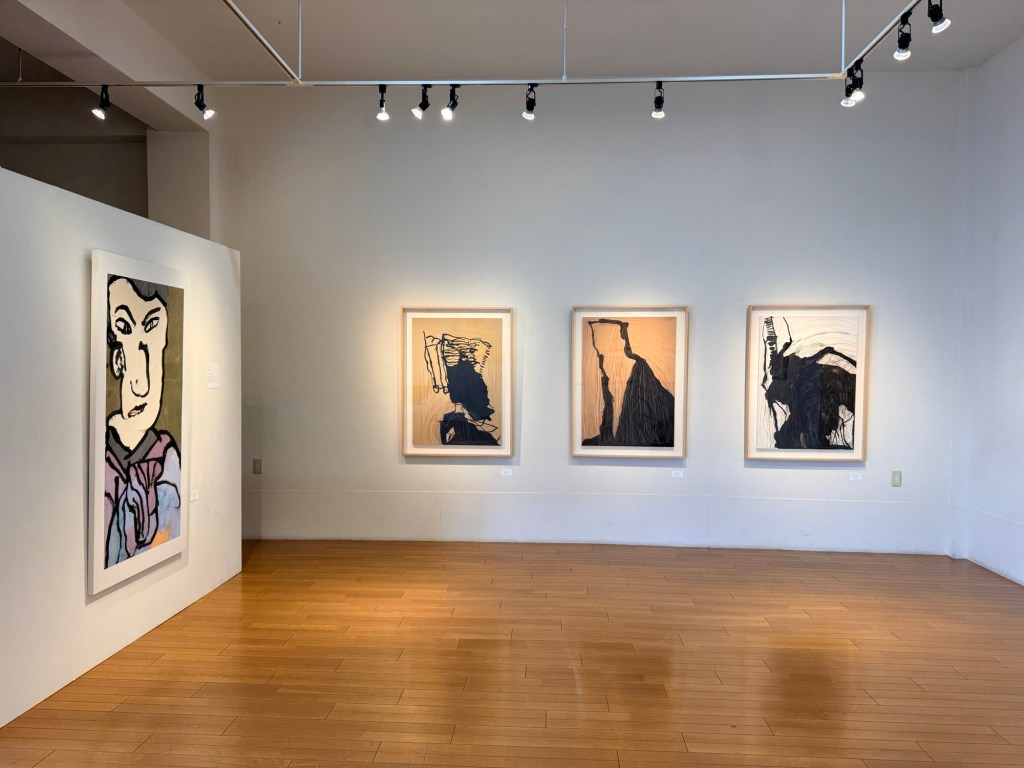
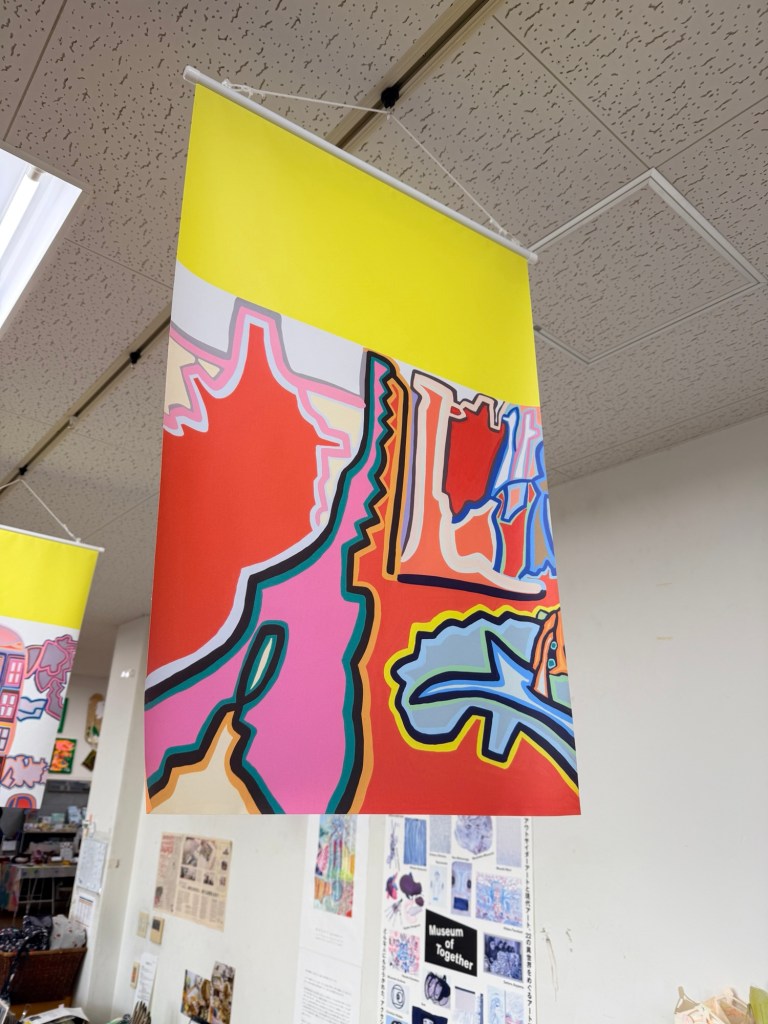
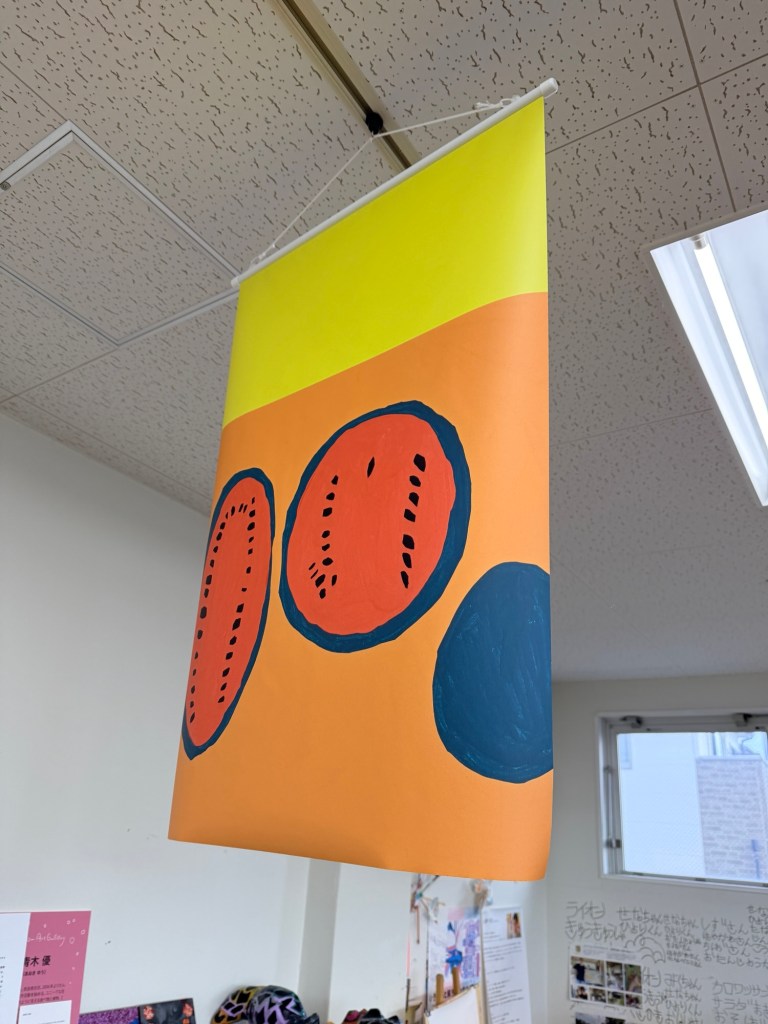
An artist’s workspace. The formal exhibition gallery.A tour from the director.Each person’s tools are customized to meet their own unique needs.Here’s the artist I bought a scarf from.She’s so vivacious and was happy to have her picture taken with me.There’s so much lovely artwork here. This artist’s work was some of my favorite. We also visited the community cafe and some residential spaces (some artists live here, others come for the day).
Visiting Yakushiji Temple
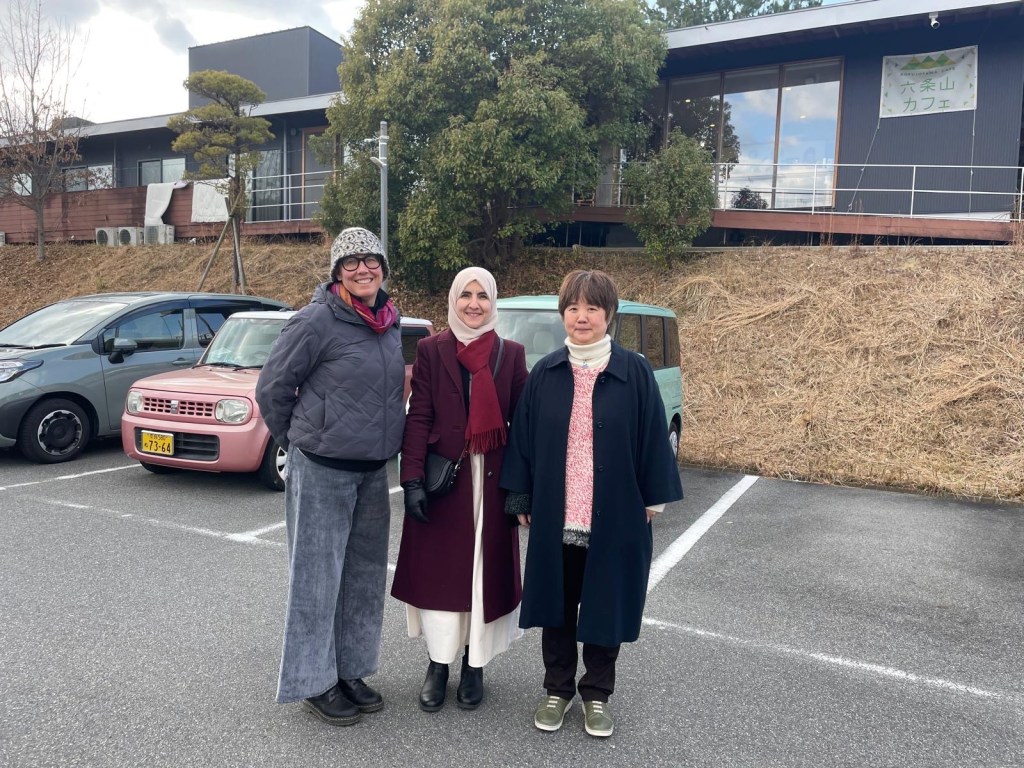
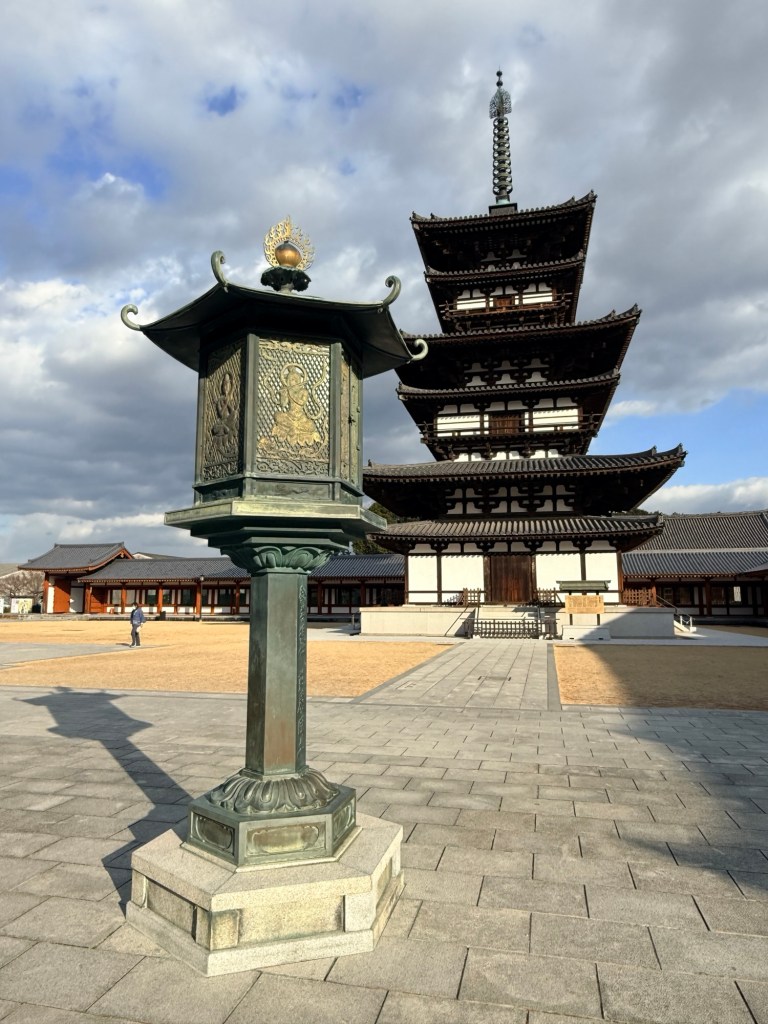
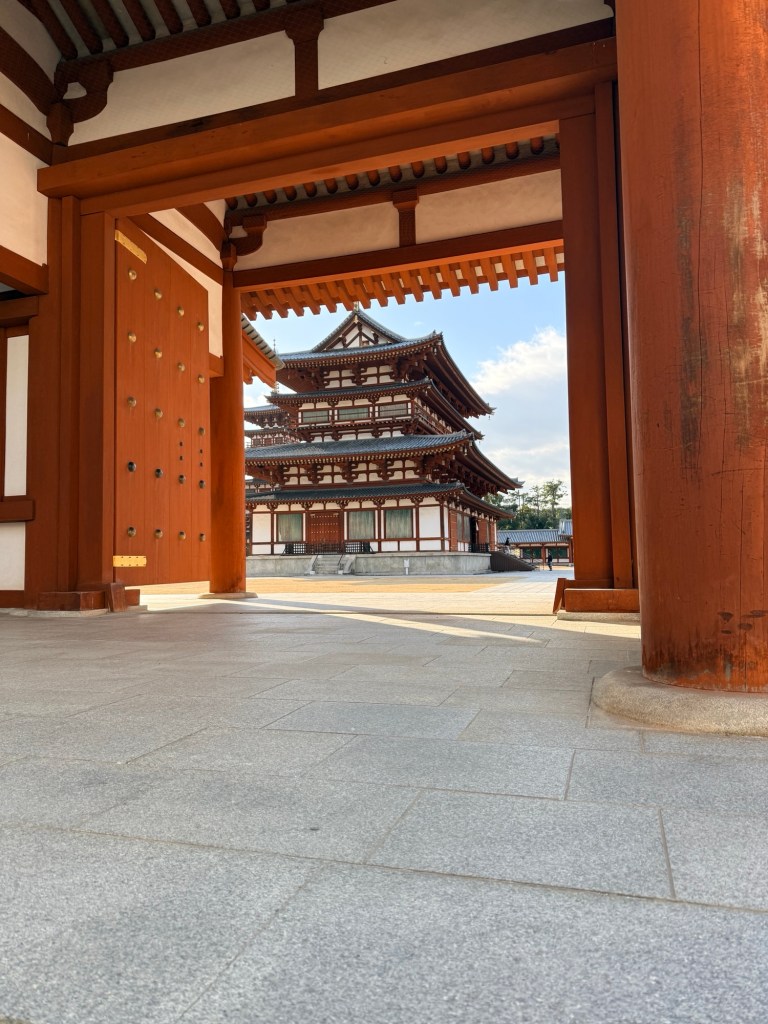
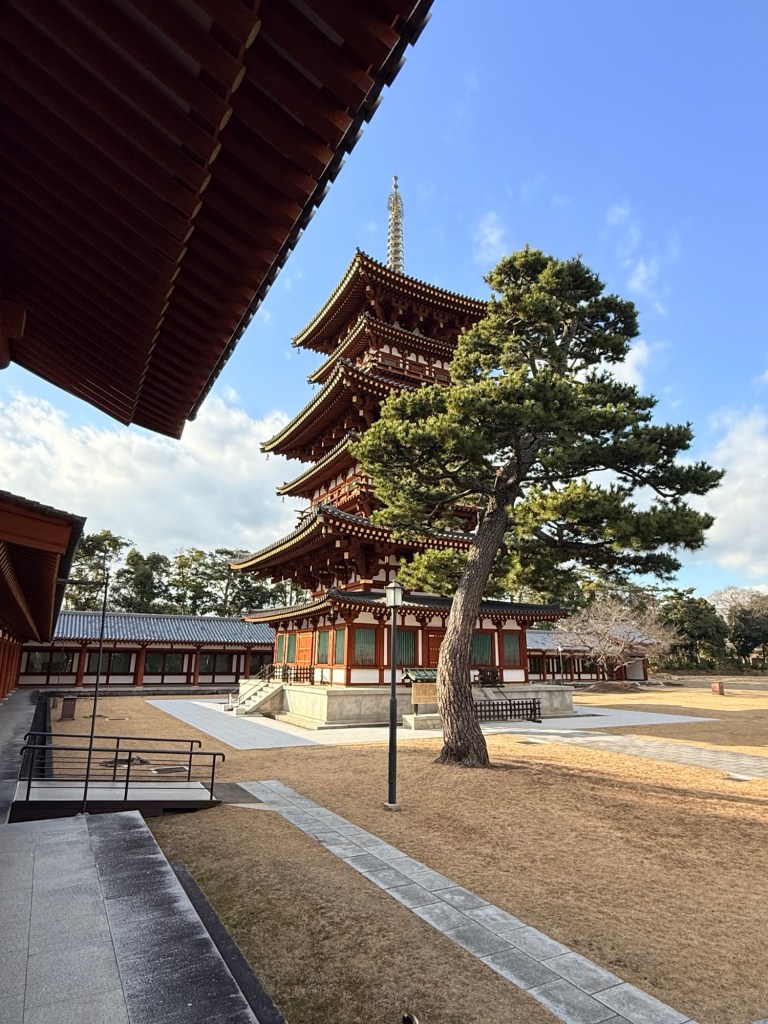
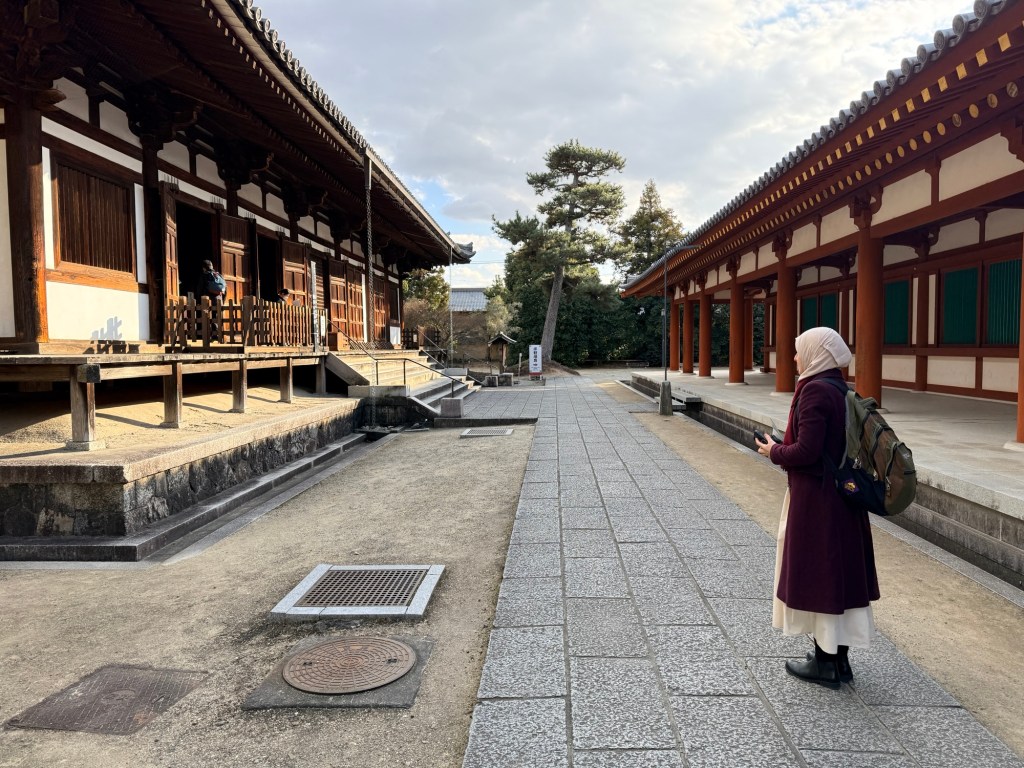
Then, Sarah and I had the chance to visit Yakushiji Temple, a UNESCO World Heritage Site.
This temple is of Chinese design, and artisans from China helped construct it. It was eye-opening to me how much exchange my colleagues described having with other Asian countries. Their politicians may not seem to collaborate, but their academics certainly do!
Earlier on this day, at KOSAN, I met a student who won an international competition in Chemical Engineering. The competition was held in the Middle East, but he said Vietnam and (I think) India were major competitors.
Yakushiji Temple
Dinner and Accomodations Celebraitng Japanese Traditions
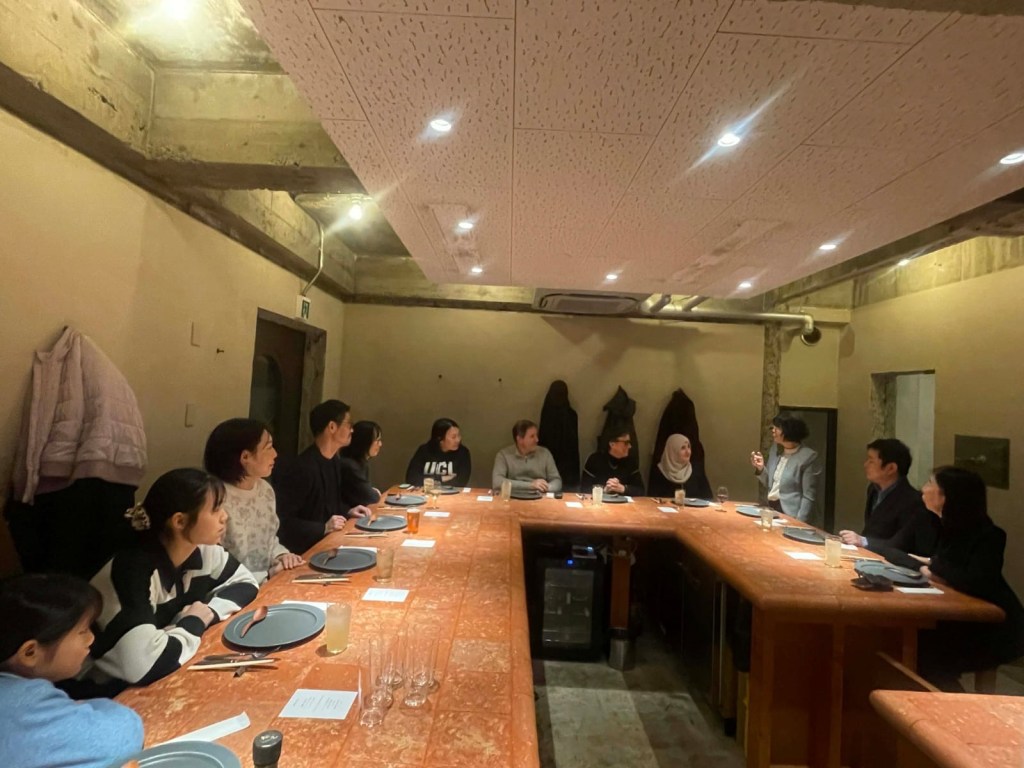
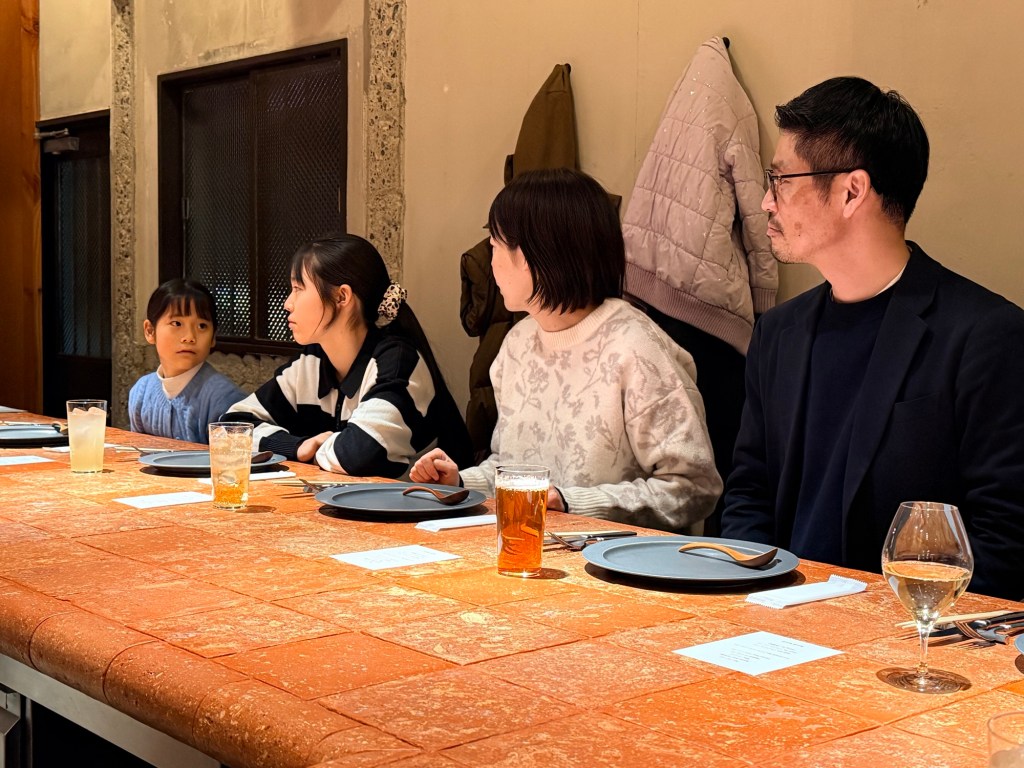
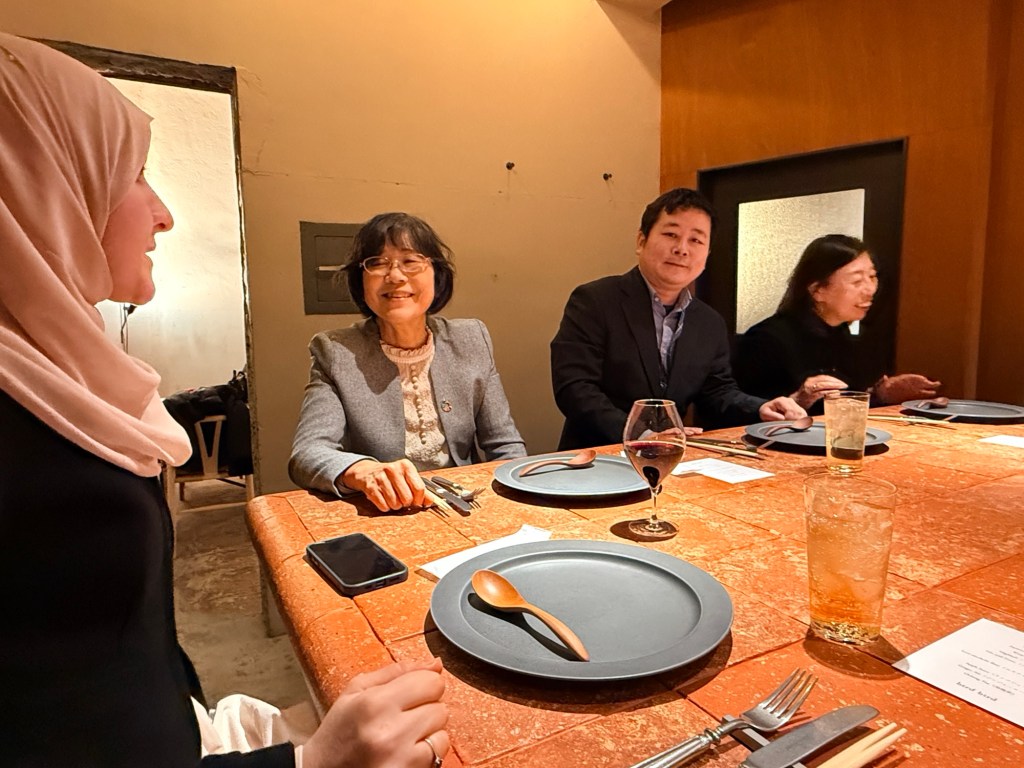
The evening after this event, we joined with Shinae, Chiyako, Mari Ito, Ryoko Una, Atsushi, Shinya, and his wife and daughters for a very special meal at ‘bird bird.’ The owner/head chef is an architect, and he runs this restaurant in addition to having restored the accommodation where we stayed.
Overall, bird bird (@birdbird_nara), operates as a community space offering coworking, a shared office, dining, and a rooftop sauna. It was created by architect Shunpei Fujioka and is located on the same block as the housing complex or ‘hotel’ where we stayed. We booked the place on Booking.com at Tamami and Shinya’s recommendation.
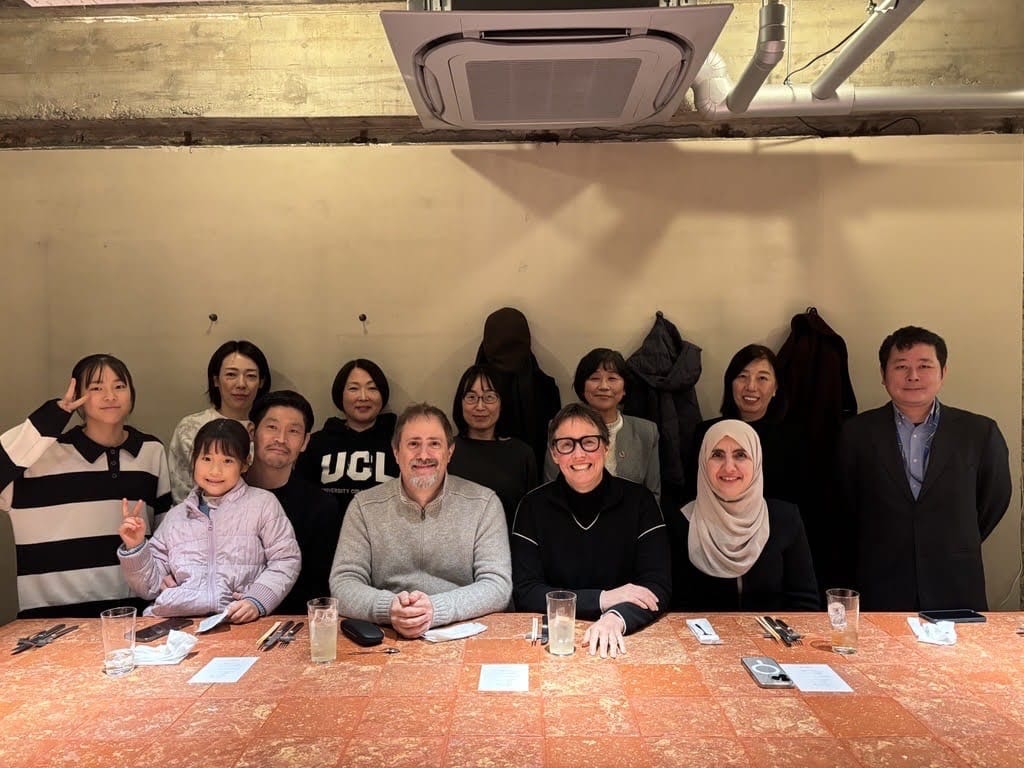
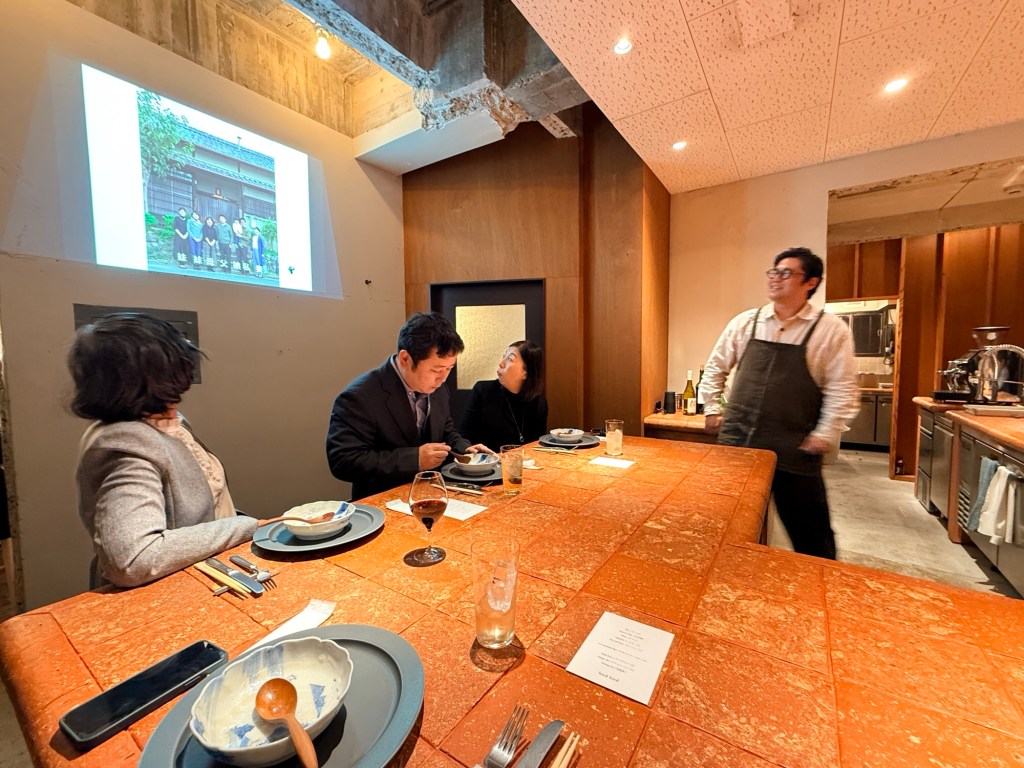
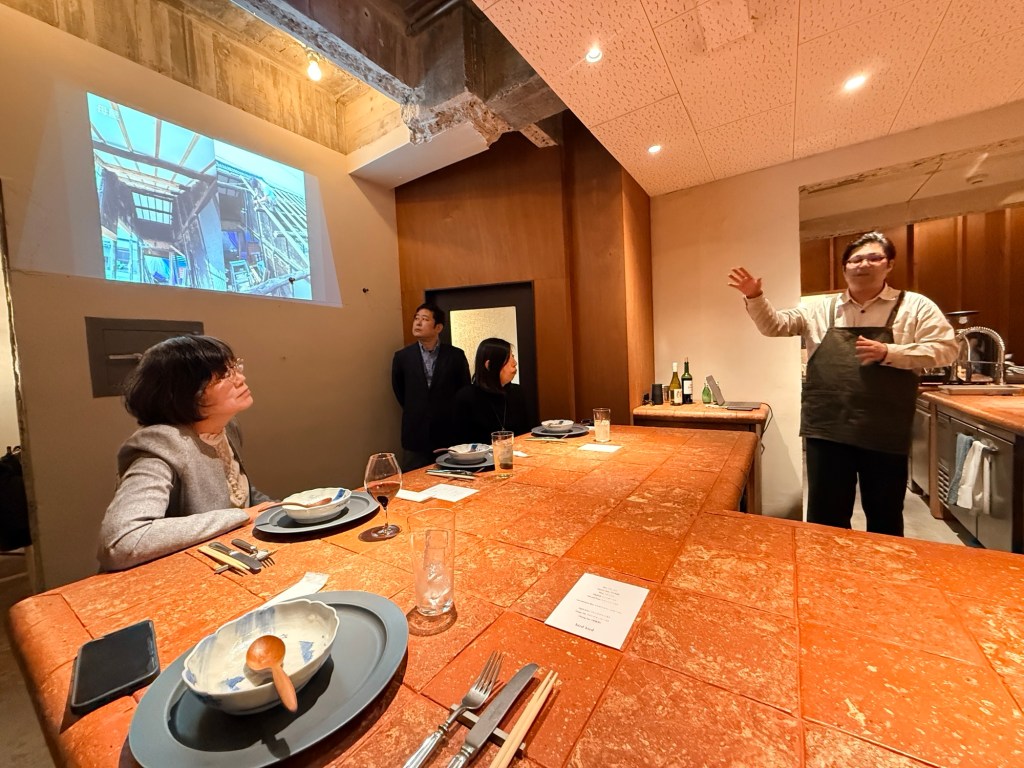
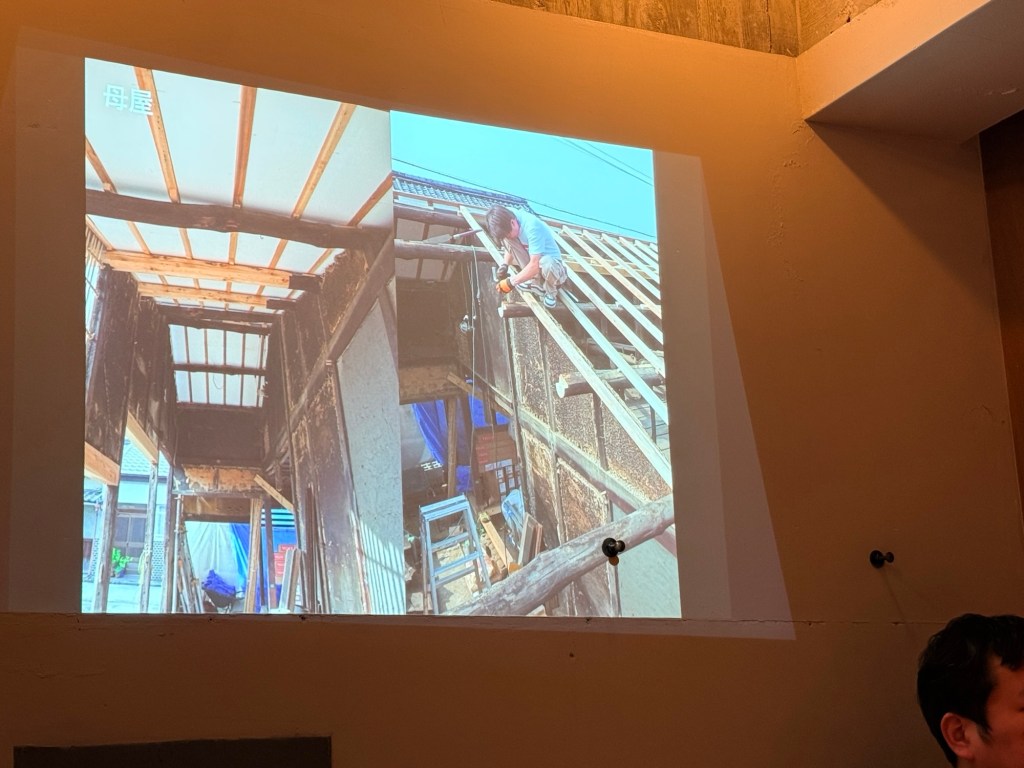
The chefs use the middle part, and serve each person directly from the kitchen.This is Shinya’s family. All the speakers from the day attended the meal, plus our hosts and translator.This. is one of the five courses we enjoyed.Here’s a photo of the whole dinner group.The chef/architect, Shunpei Fujioka, presented the reovation project. It was intriguing to hear the story of the reonvation and see before and after photos.The set of homes had been vacant for years before this architect renovated them.
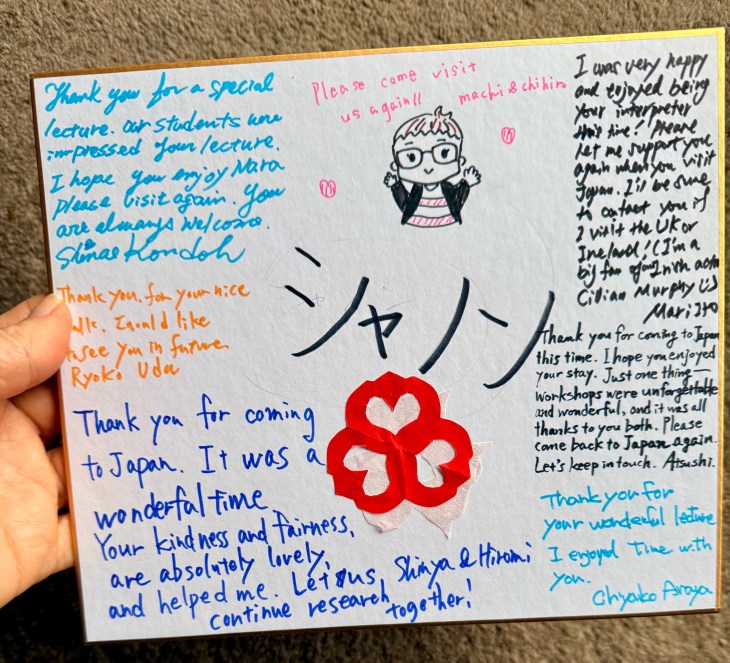
The dinner group made lovely cards for Sarah and me without us even suspecting. It was a project led by Shinya’s daughters, who also made many origami gifts for us. I saw the architect/chef, Shunpei Fujioka, helping with that!
A lovely card to memorialize our time together.
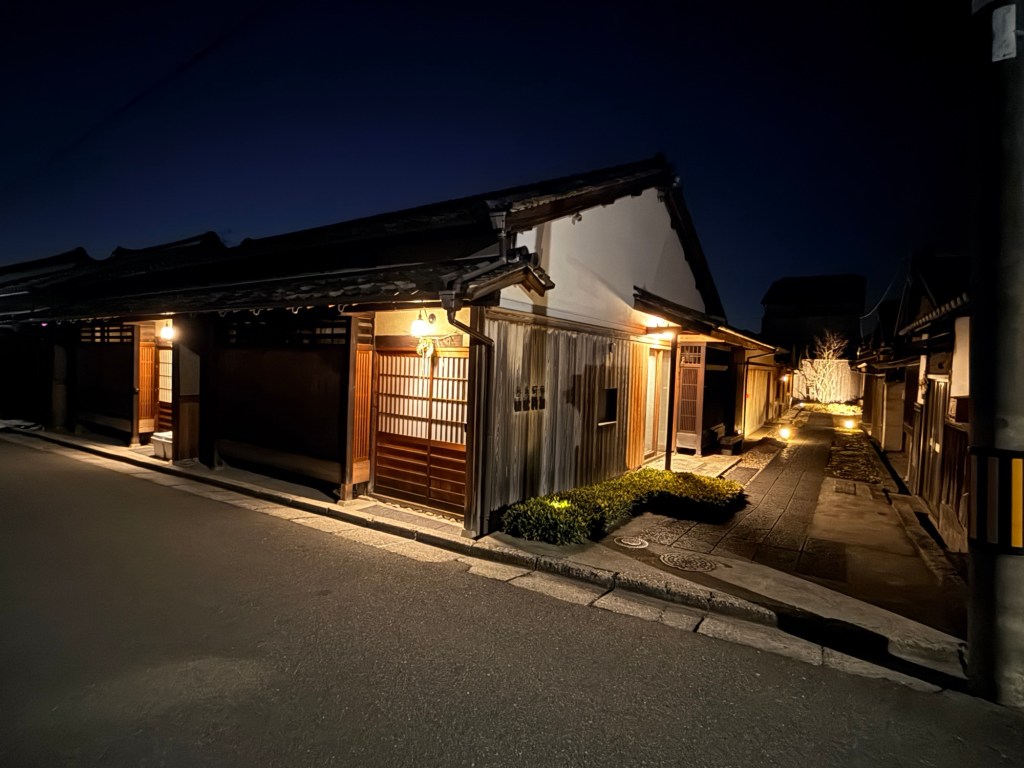
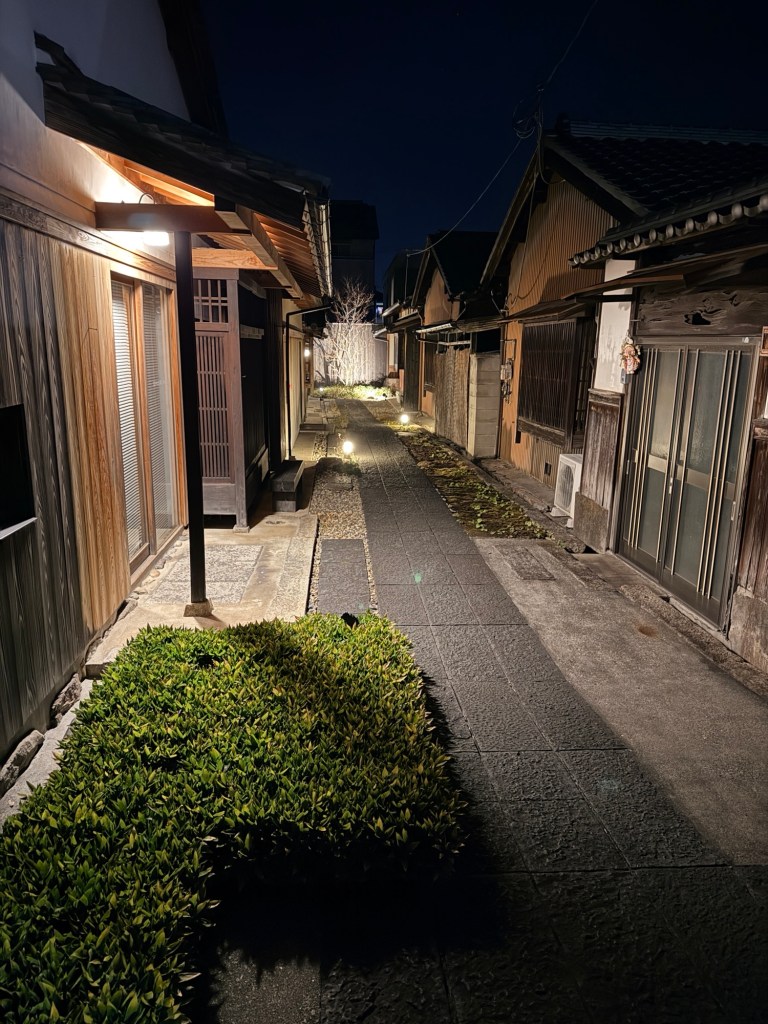
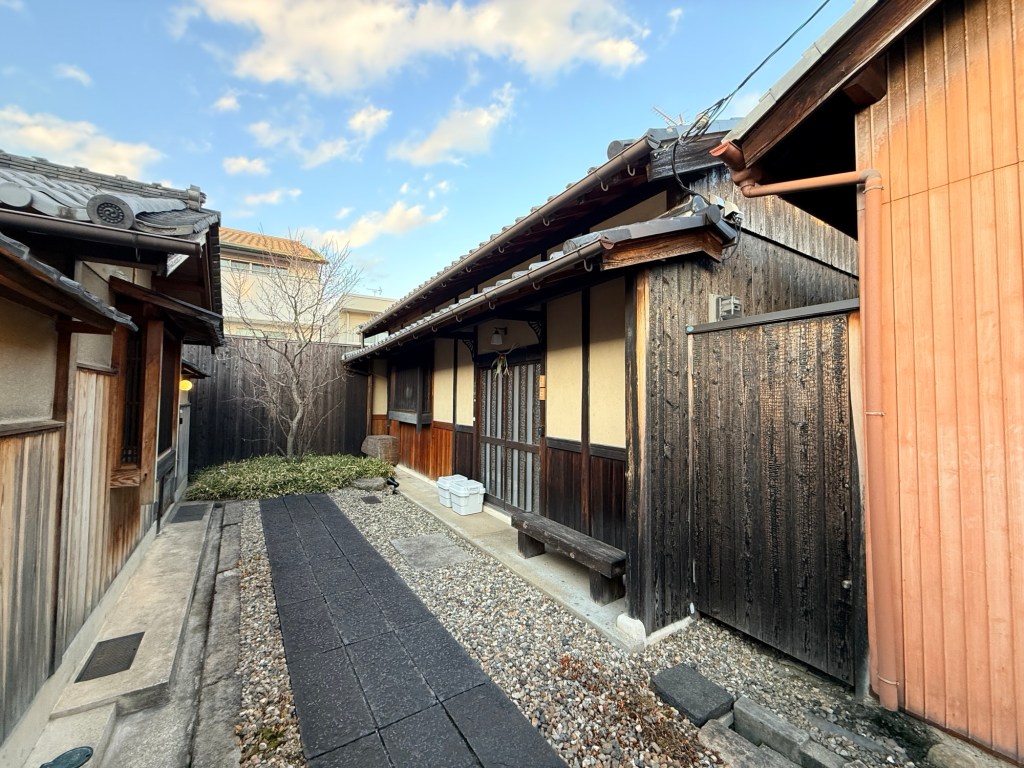
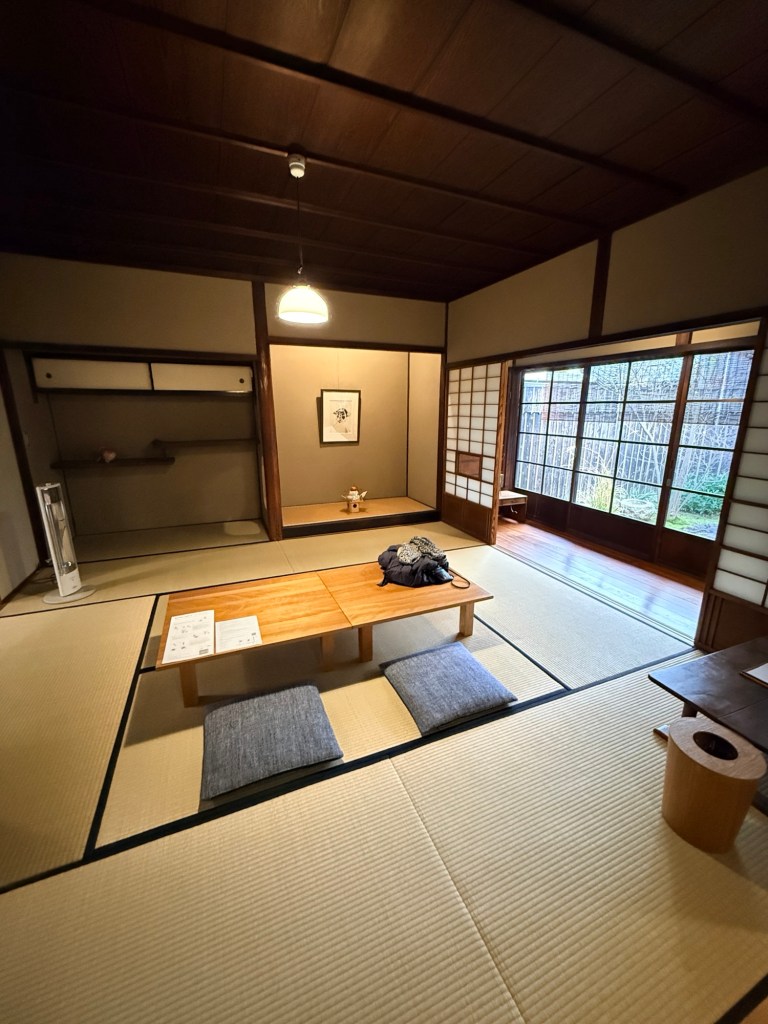
A major highlight of our visit to Japan was staying for three nights in a traditional Japanese house, part of a set of five adjacent homes that this architect has lovingly restored.
I have read about traditional Japanese houses and visited similar (Korean) ones in folk museums, but living in one for three days was an immense honor.
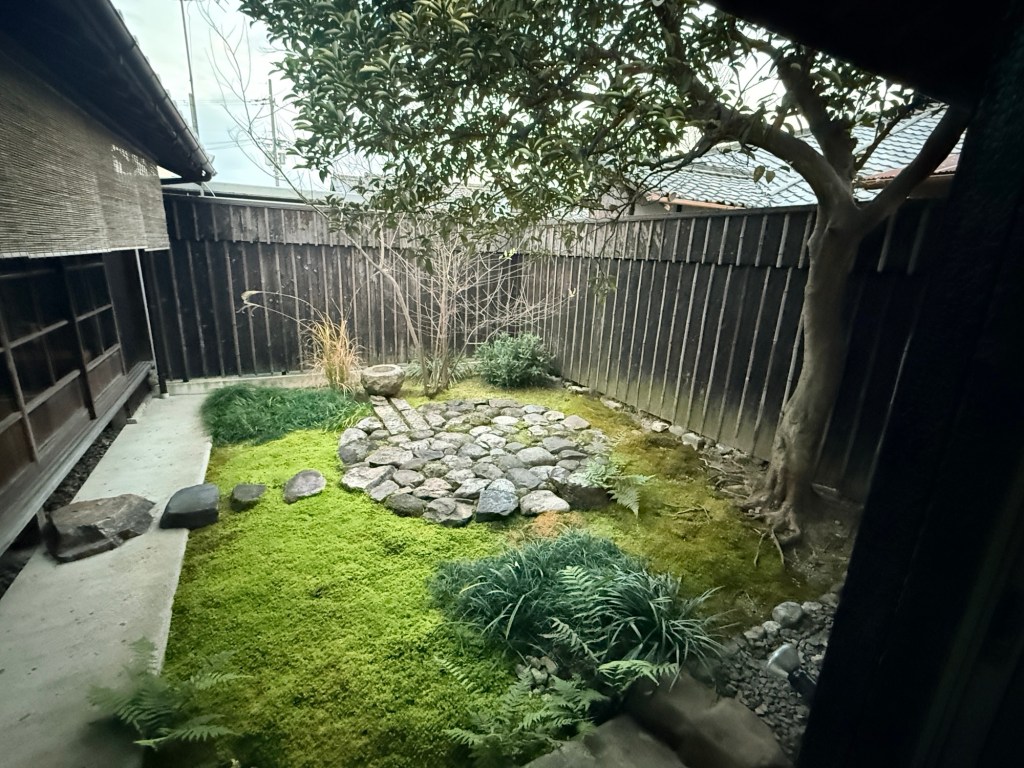
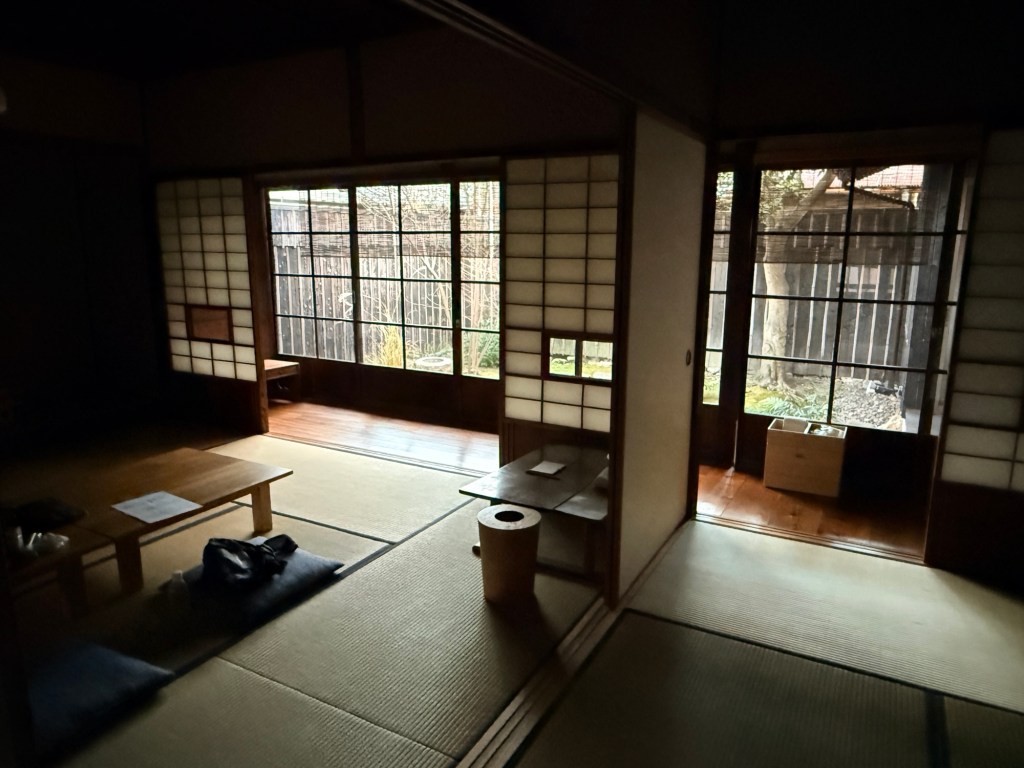
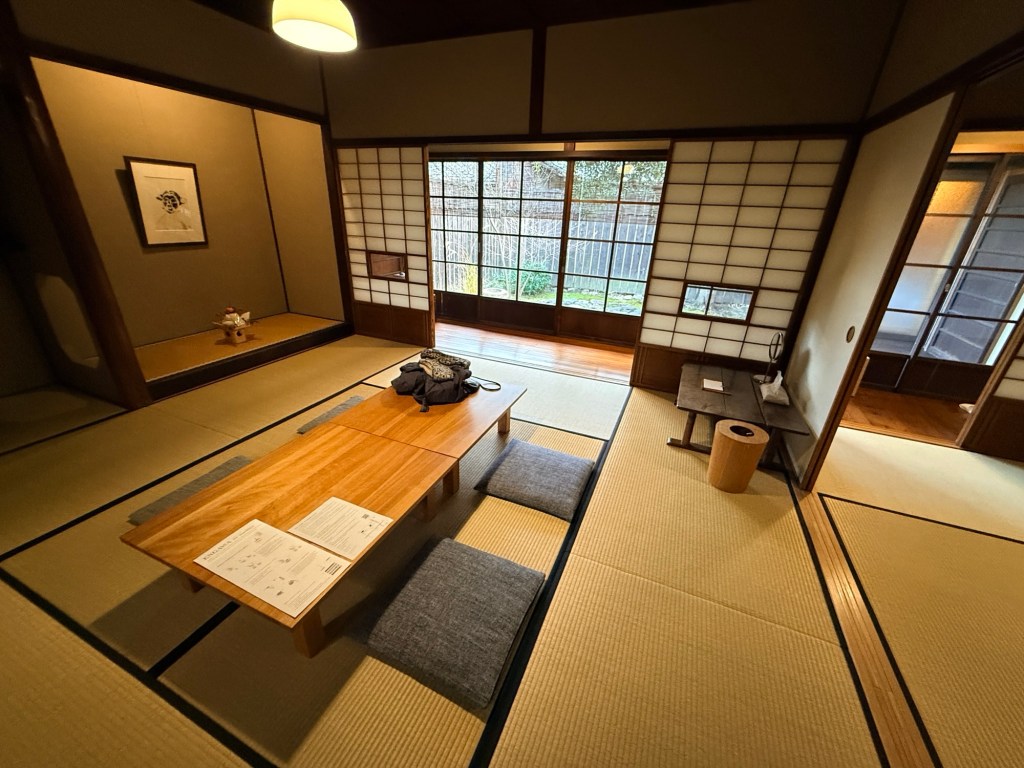
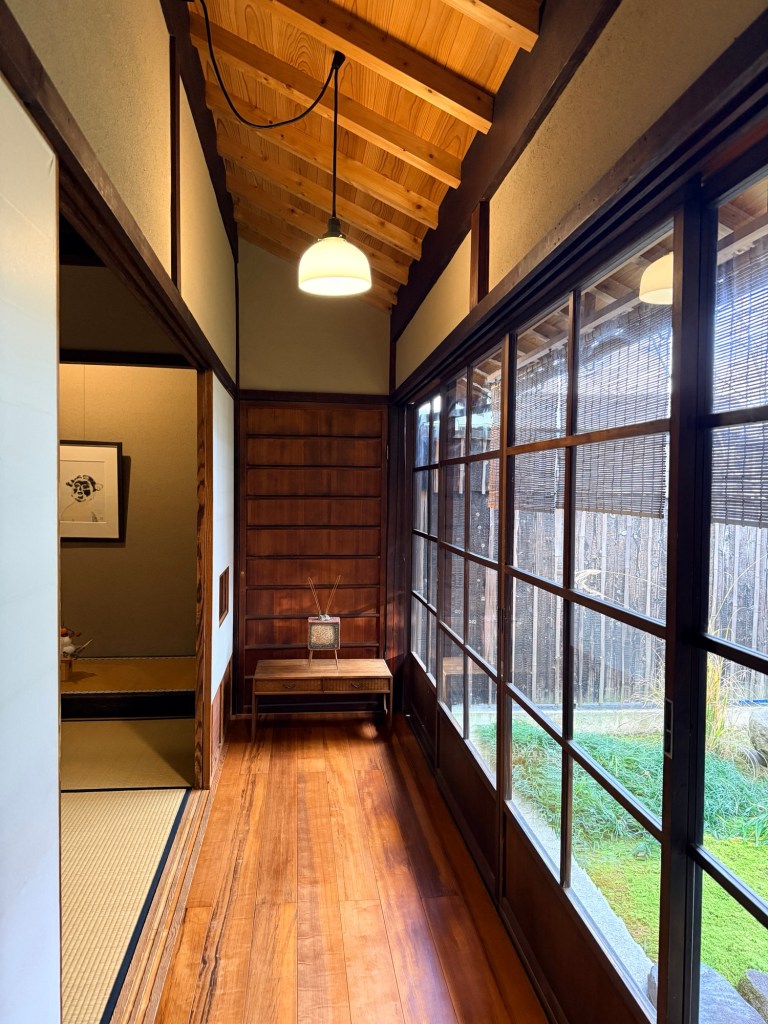
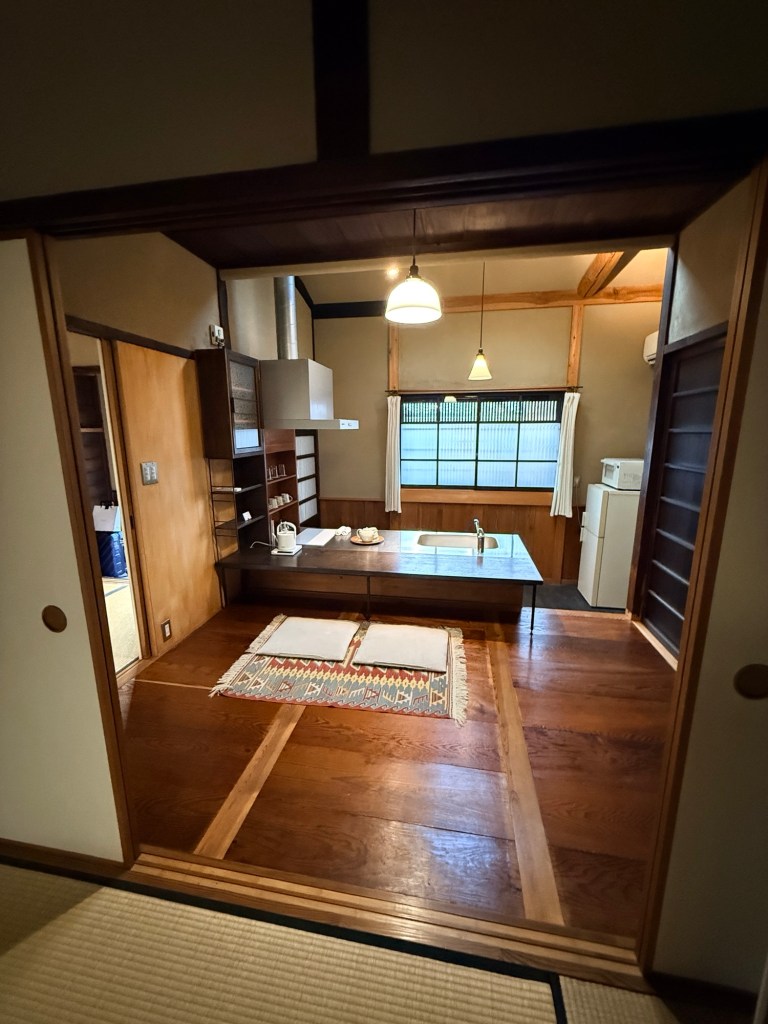
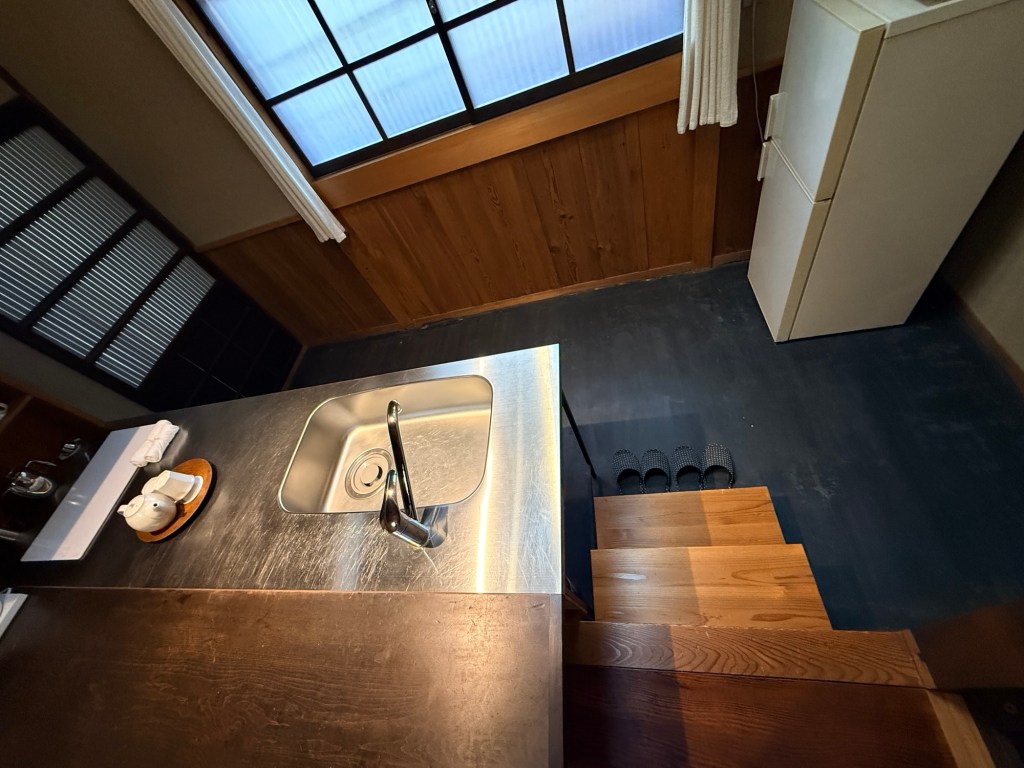
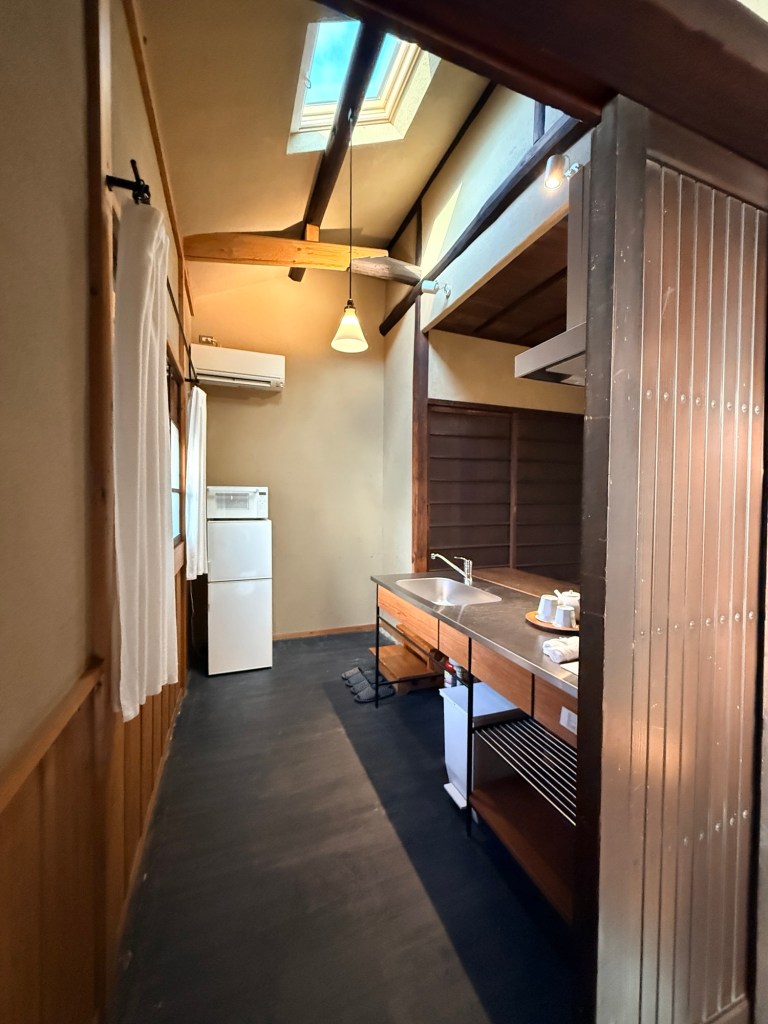
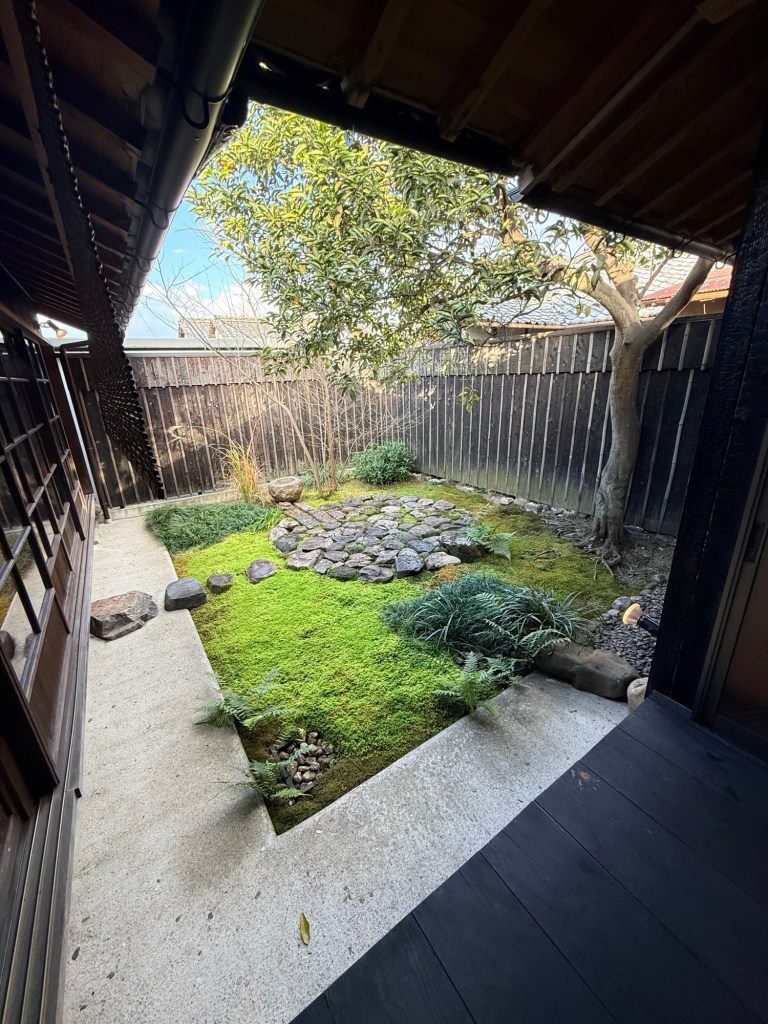
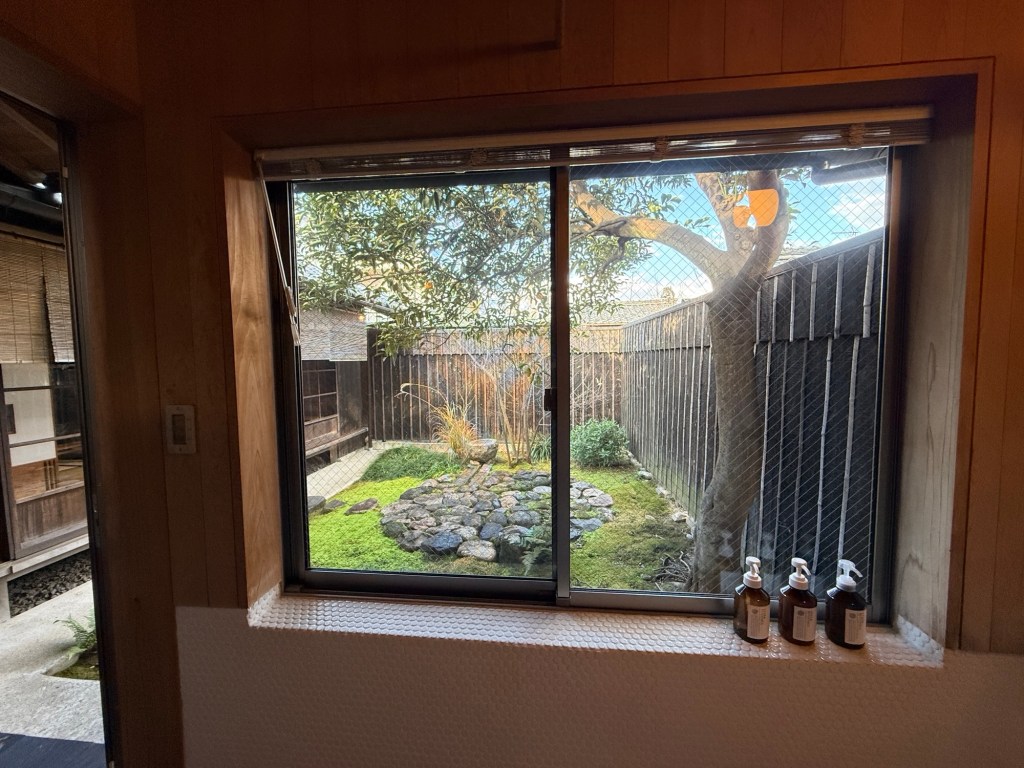
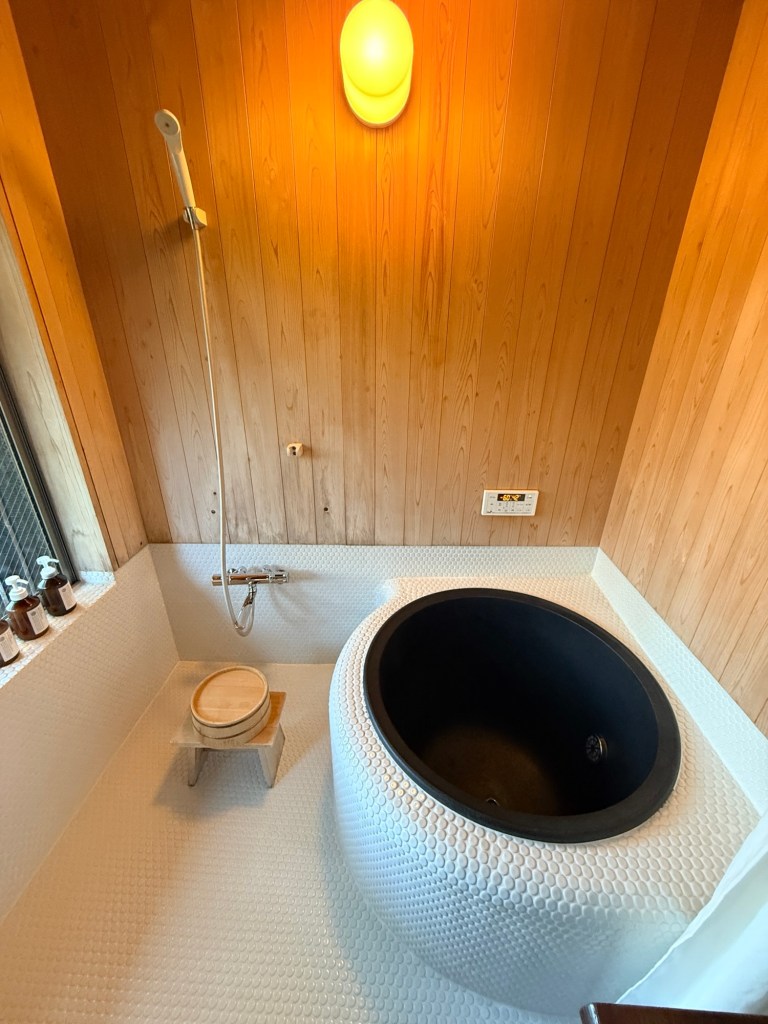
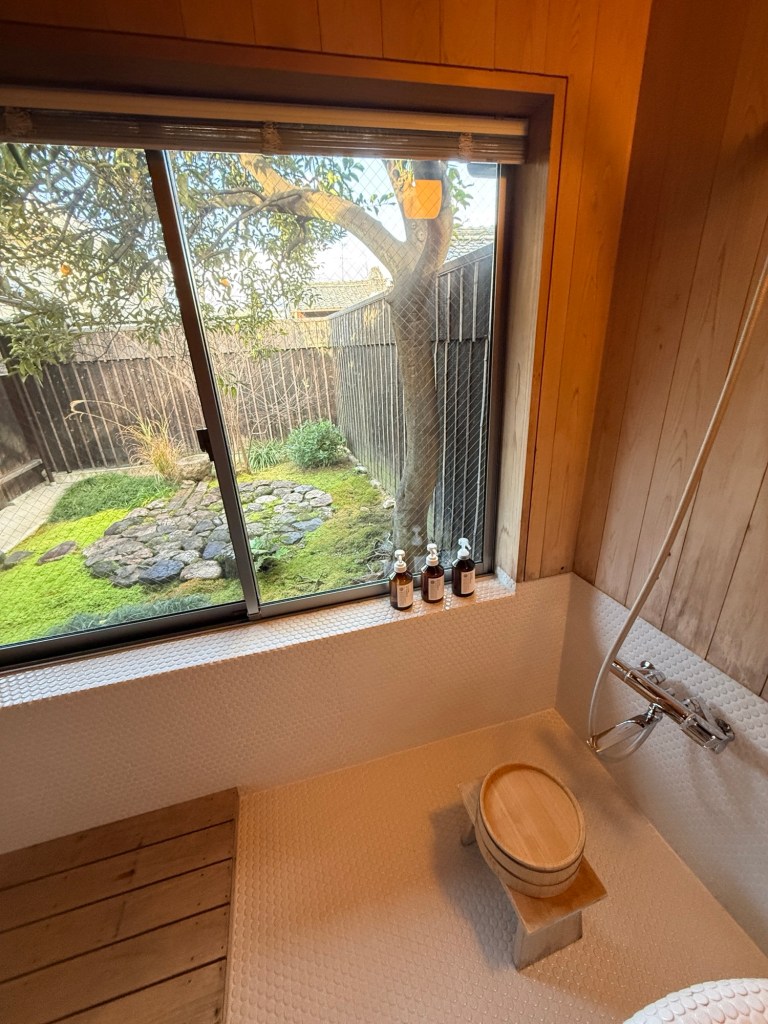
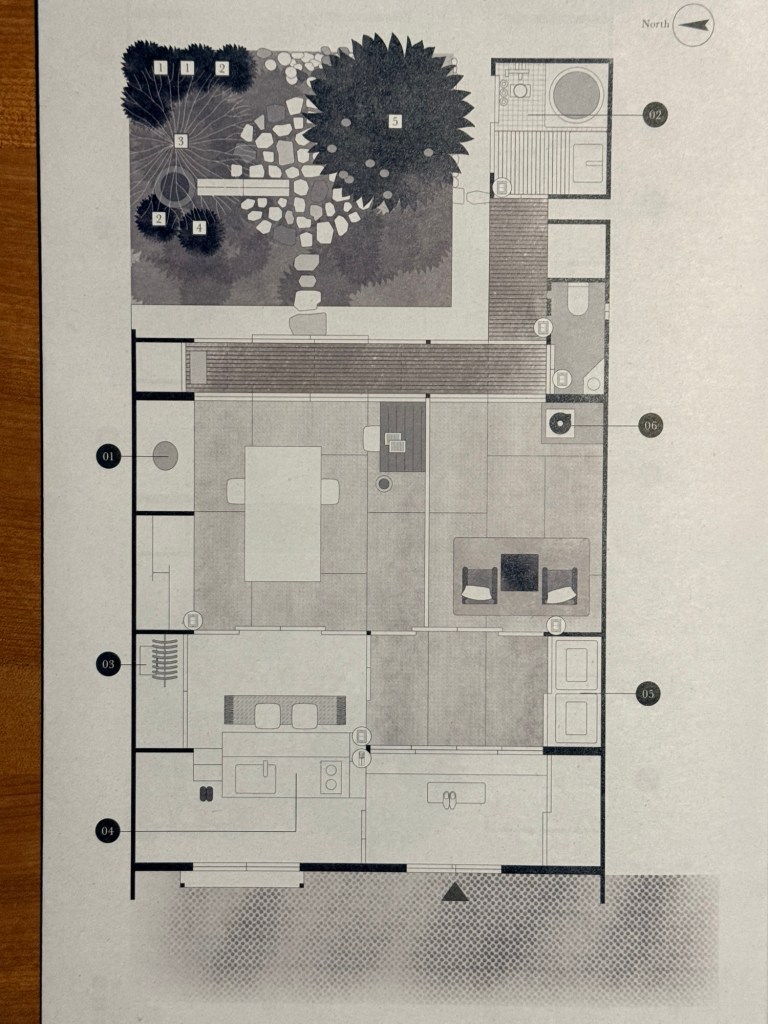
The set of restored houses at night.The alleyway where my house was.My house (the “Presidential Suite”).The house’s gorgeous private courtyard.Japanese “half-light” in the interiors.The dining area.They sit on the floor, and roll out futons when it’s time to sleep.The corridor between the living spaces and courtyard.The kitchen,with steps down from the seating area to the work space.The kitchen workspace. YOu can see renovation work (light wood) distinguished from the original (dark) wood. The covered (outside) walkway from the house to the bathroom. There’s a separate room with toilet and washbasin.View from the bathing space to the courtyard.The tub and shower.Hygiene is very important in Japanese culture.The plan of my house.
Overall, the bathing rituals were a highlight of my private time in Japan. The hotel in Tokyo had a public bath in the basement, which was an experience like no other. I love Turkish hammams (and even visited one in Malta over the Christmas holiday).
The traditional Japanese house also offered a unique and exquisite bathing experience.
But the most unexpected pleasure was that all but one of the toilet seats I used in Japan were heated and had a bidet function. The joy of a warm bum cannot be overstated.
Cultural Immersion with Collegial Friends
It was a privilege to get deeply acquainted with Shinya, Atsushi, Tamami, and all their colleagues.
For me, it was also a unique honor to travel with Sarah and Stefané; they treated me as family and never let me feel like a third wheel. Sarah skillfully guided Stefané and me through complex networks of trains, streets, alleyways, shops, and restaurants.
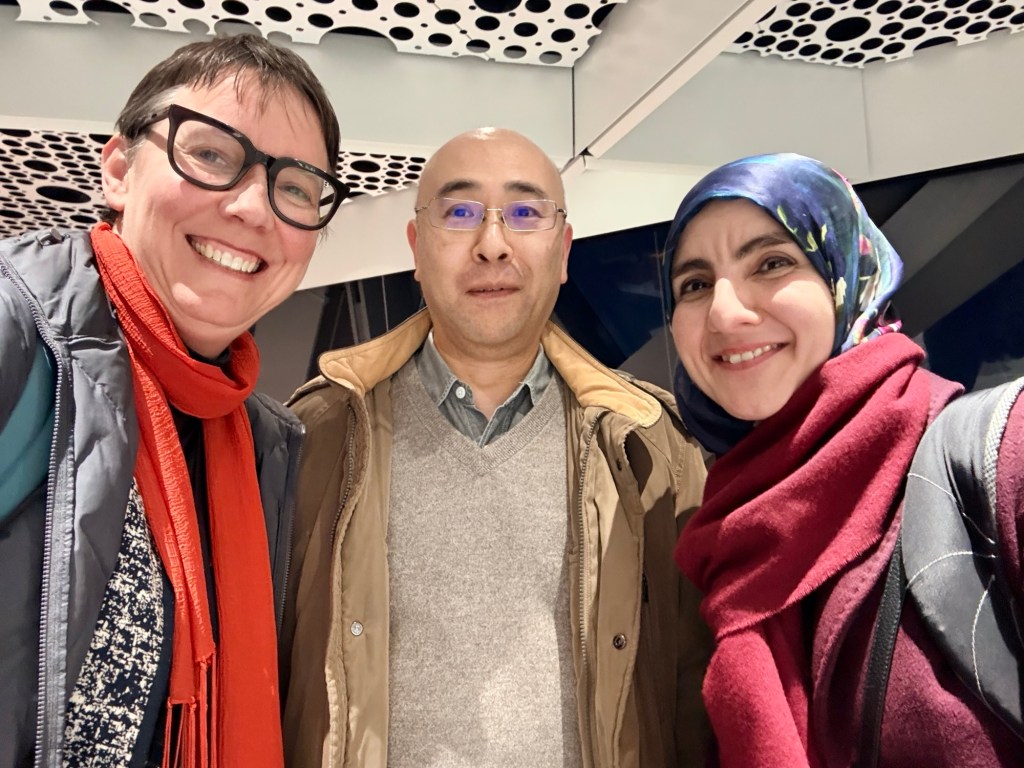
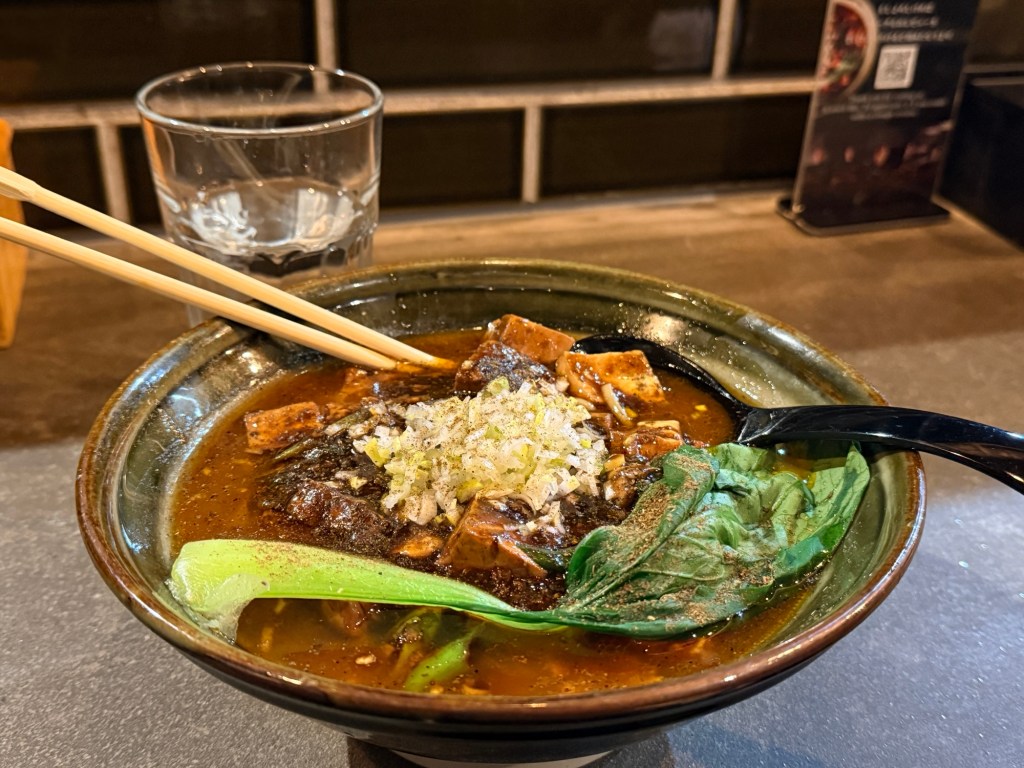
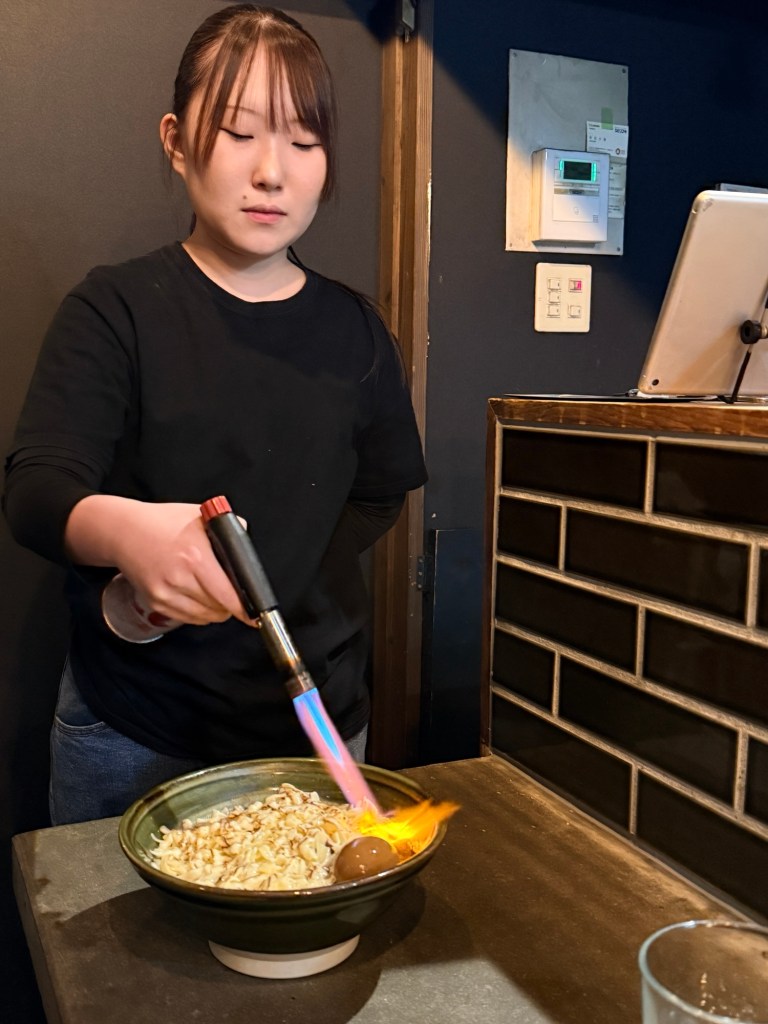
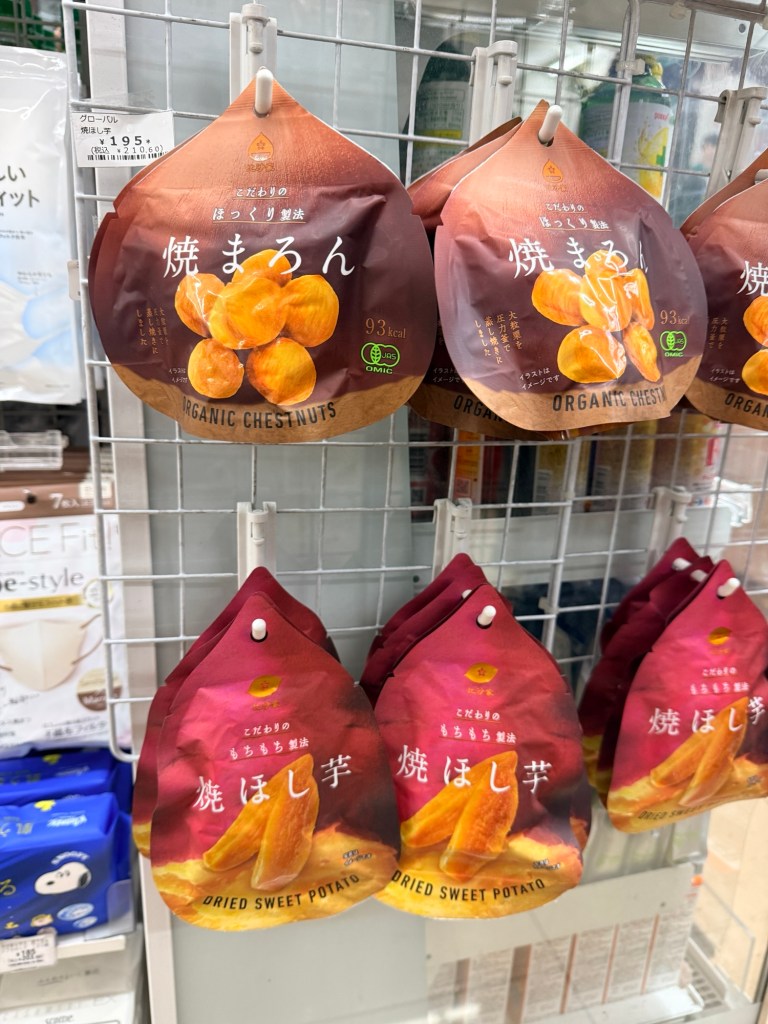
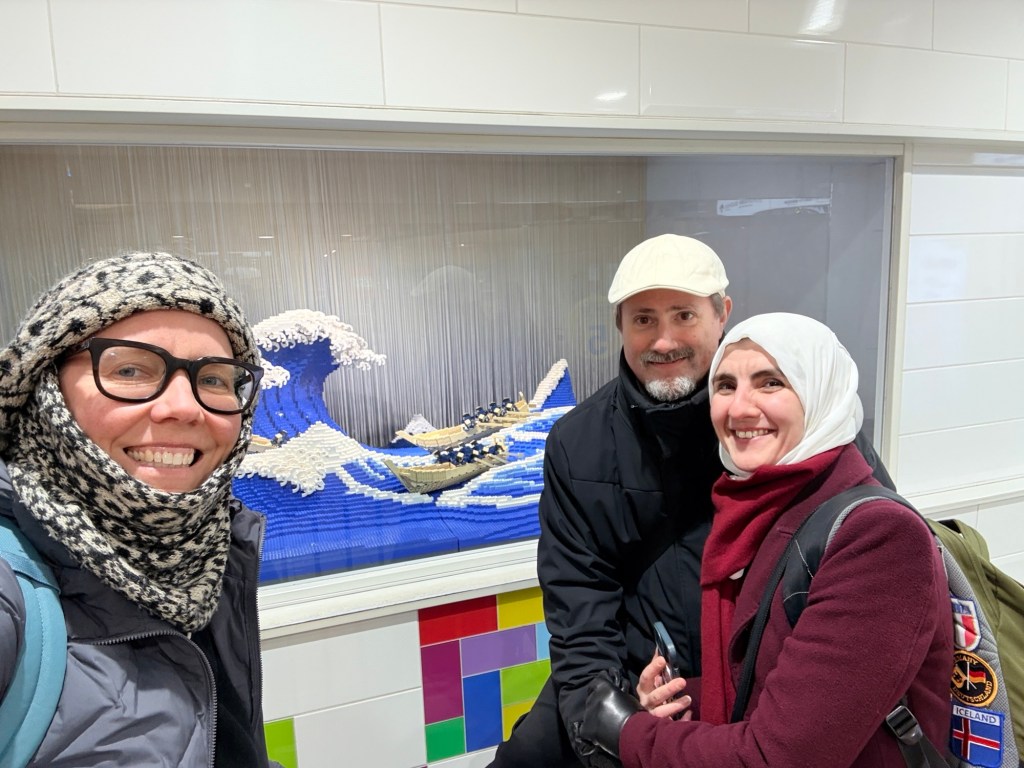
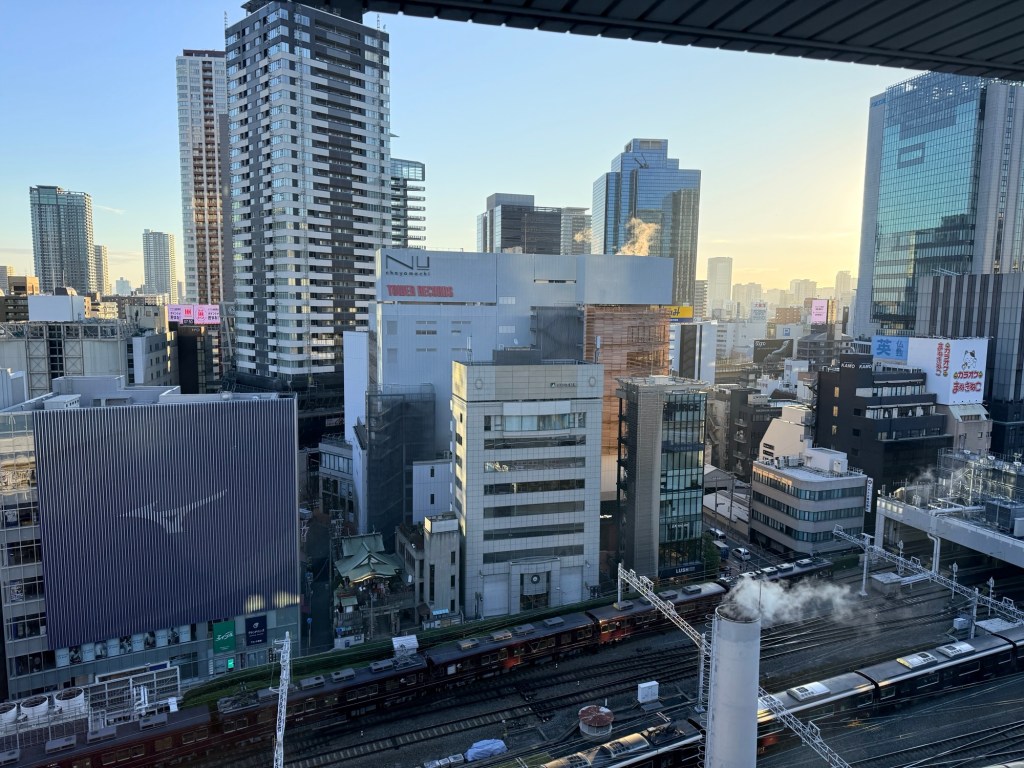
A halal ramen place.With dramatic effect.An official photoshoot — must be famous sicne security shooed me away.Aongus’ favorite, sweet potatoes!Lego of a famous paintitng (our colleague Inês’ favorite, so I had to take pictures!)View from my second hotel window in Osaka. Most hotels dont’ offere such a sweeping view — or any view at all!Refelctions seen from my hotel window.One of many shires I passed walking along the streets.I learned more about Islam from my travel companions and enjoyed several halal meals. I also got to explore Japanese culture and daily life alongside these lovely colleagues.
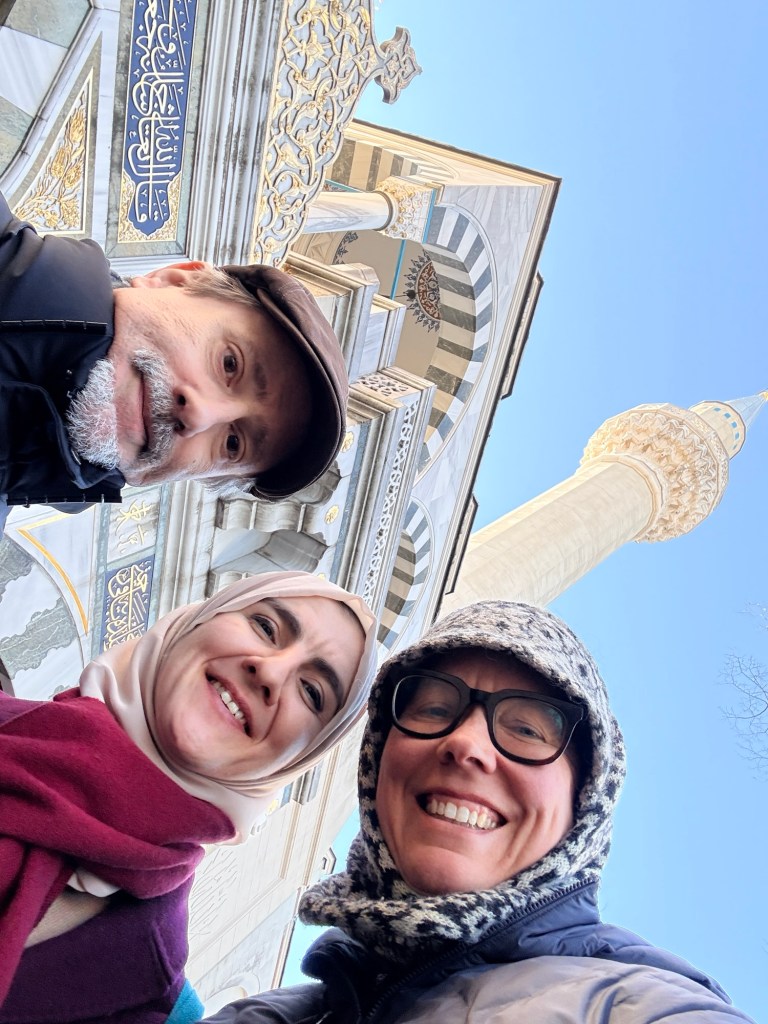
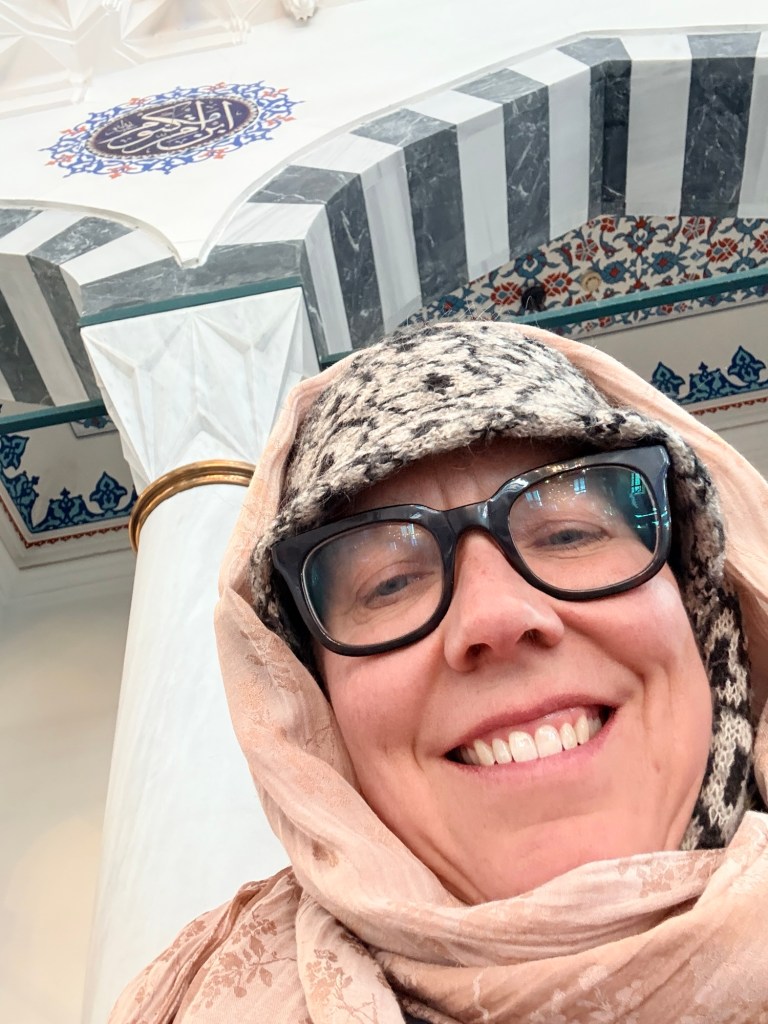
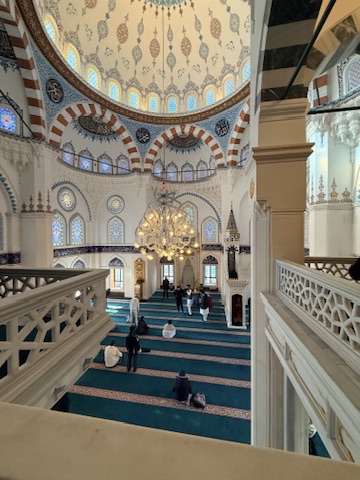
We visited a mosque at the Turkish Cultural Center in Tokyo, an experience I thoroughly enjoyed. We even had a meal at the mosque, prepared by the community for the worshippers.
Visiting the mosque.Inside the mosque. Views from the balcony.I learned more about Islam from my travel companions and enjoyed several halal meals. I also got to explore Japanese culture and daily life alongside these lovely colleagues.
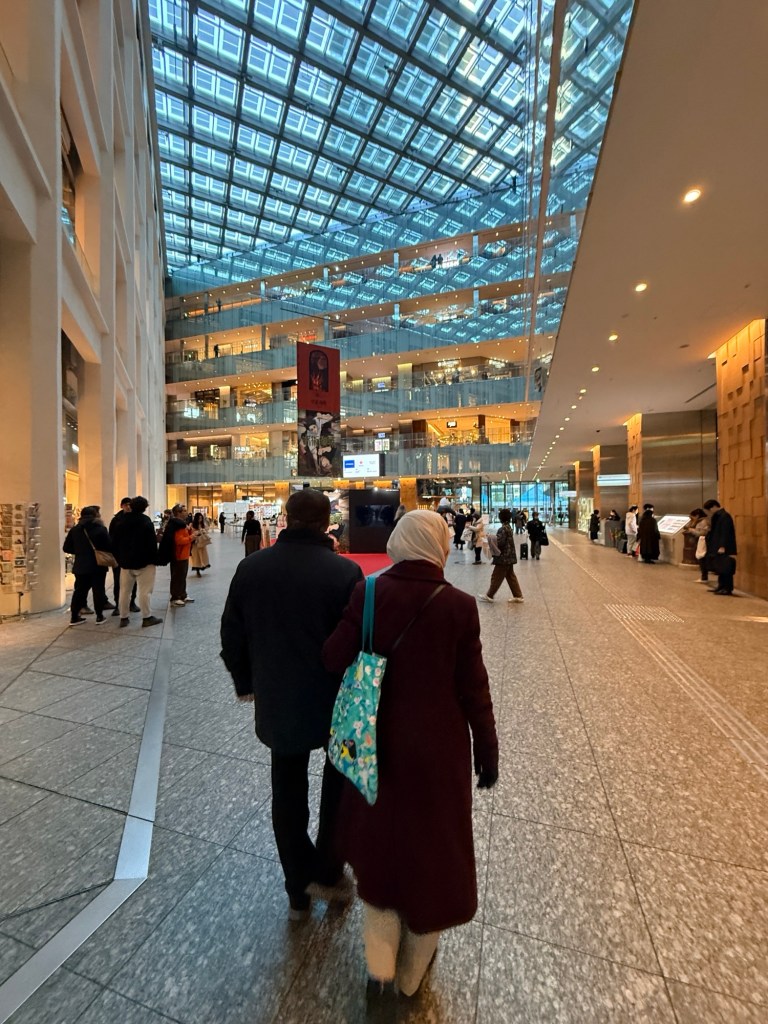
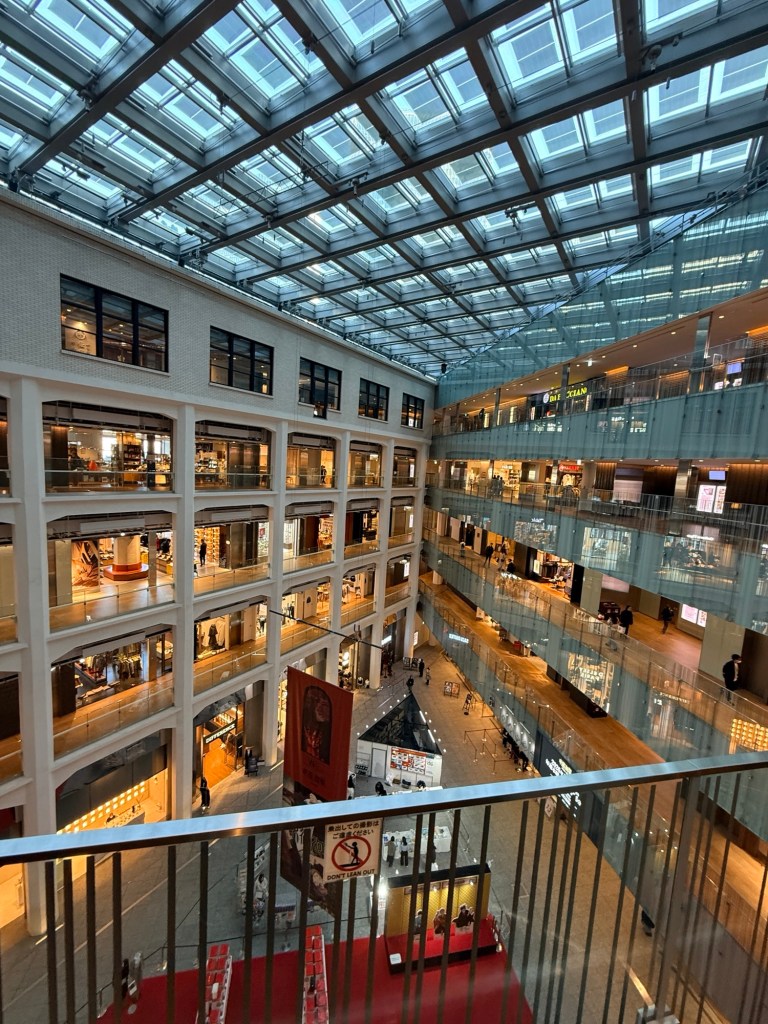
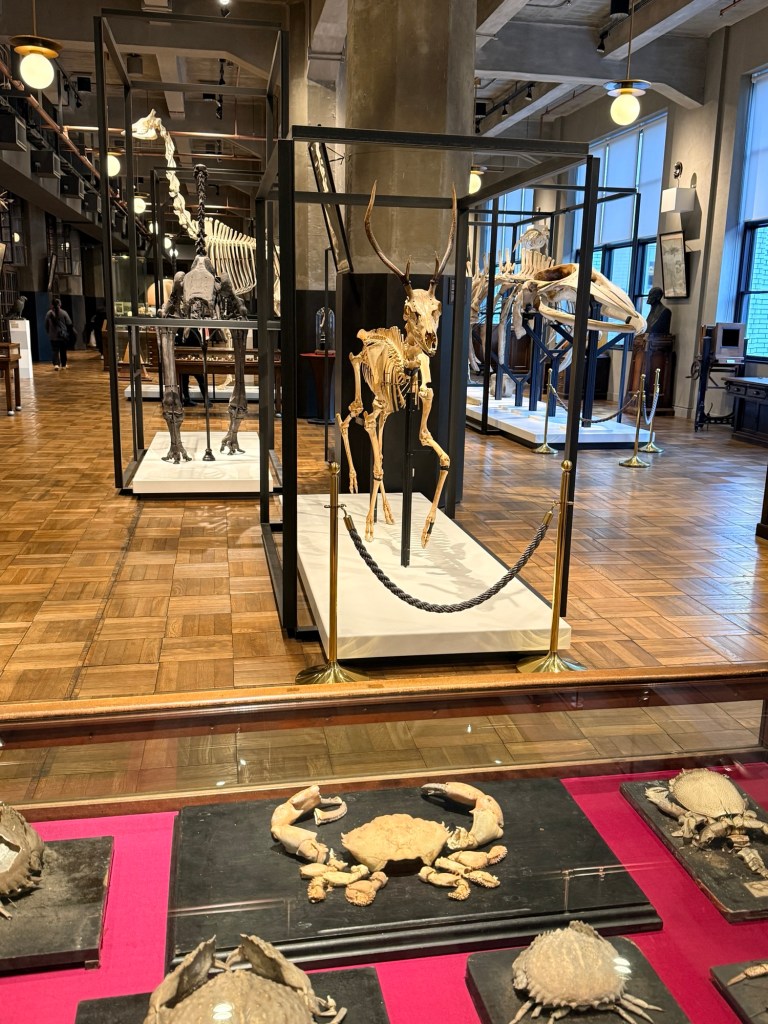
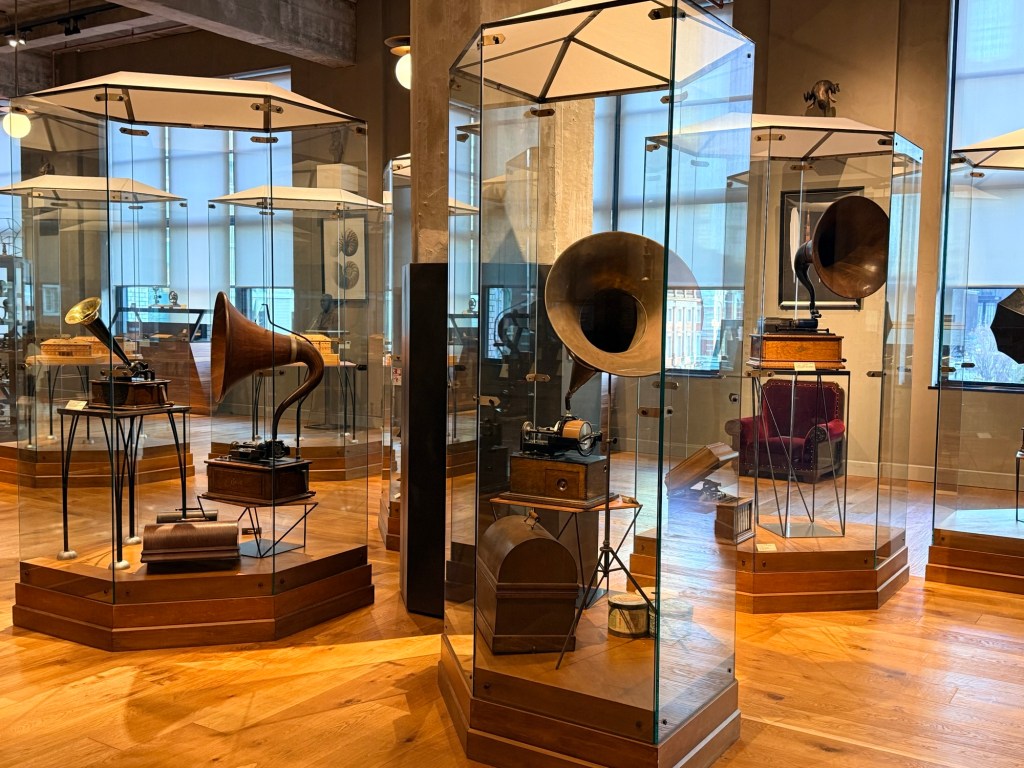
We also visited a museum with Japanese artifacts, located in a shopping center, presented in collaboration with a university, and located right beside the main train station in Tokyo.
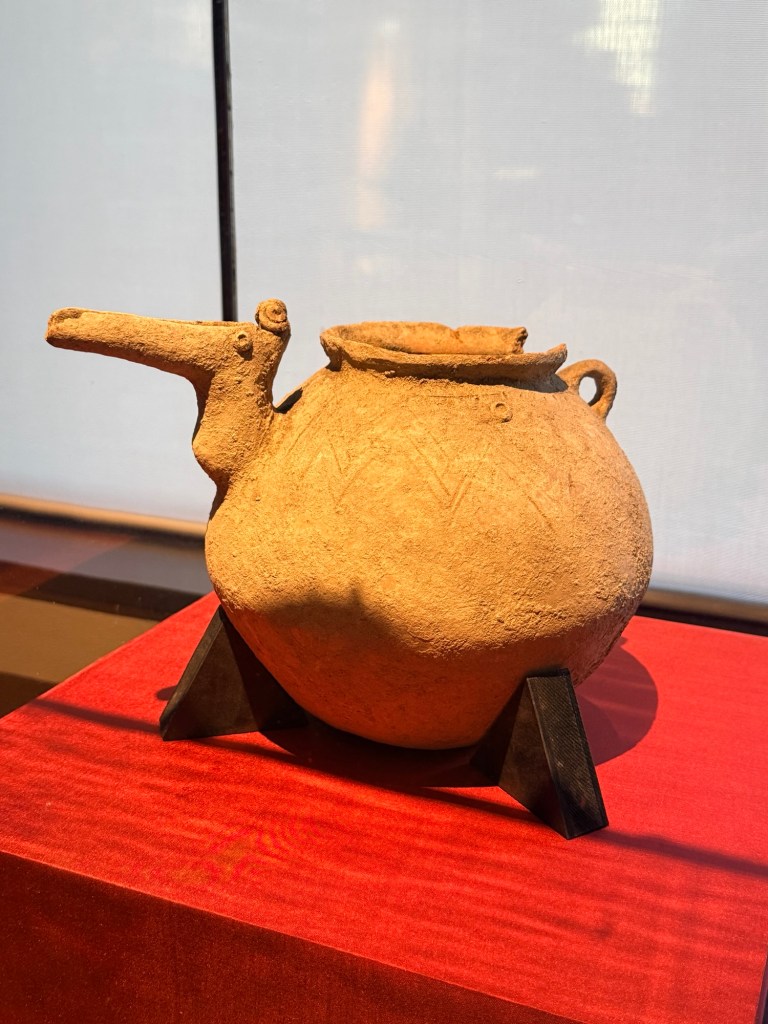
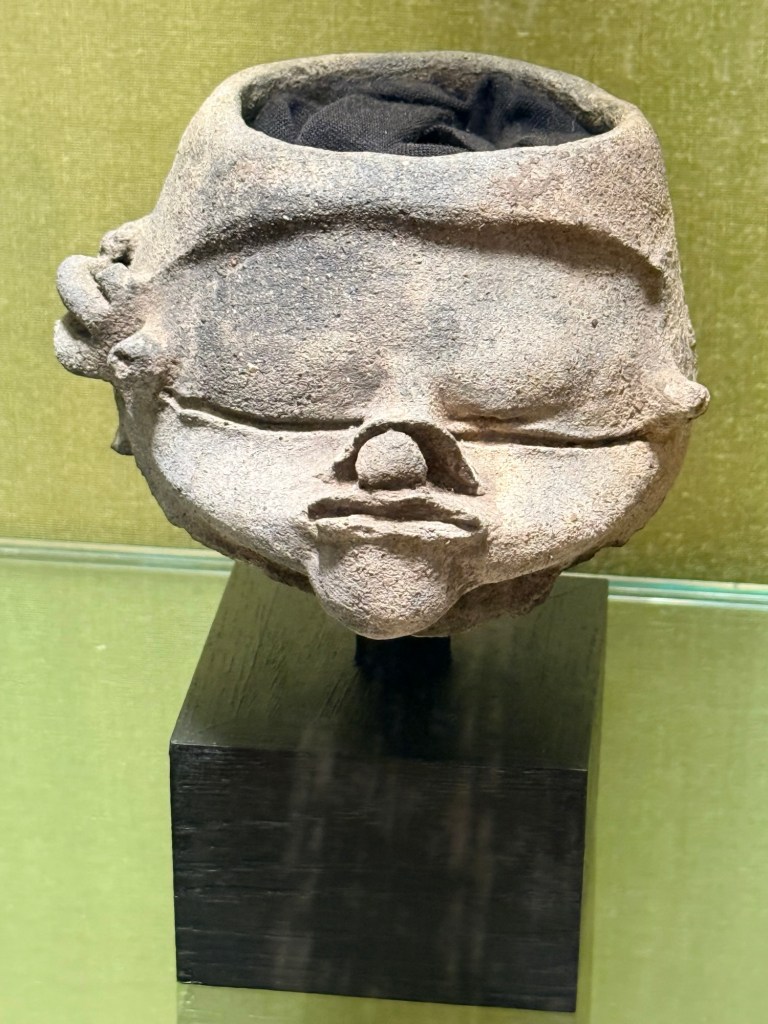
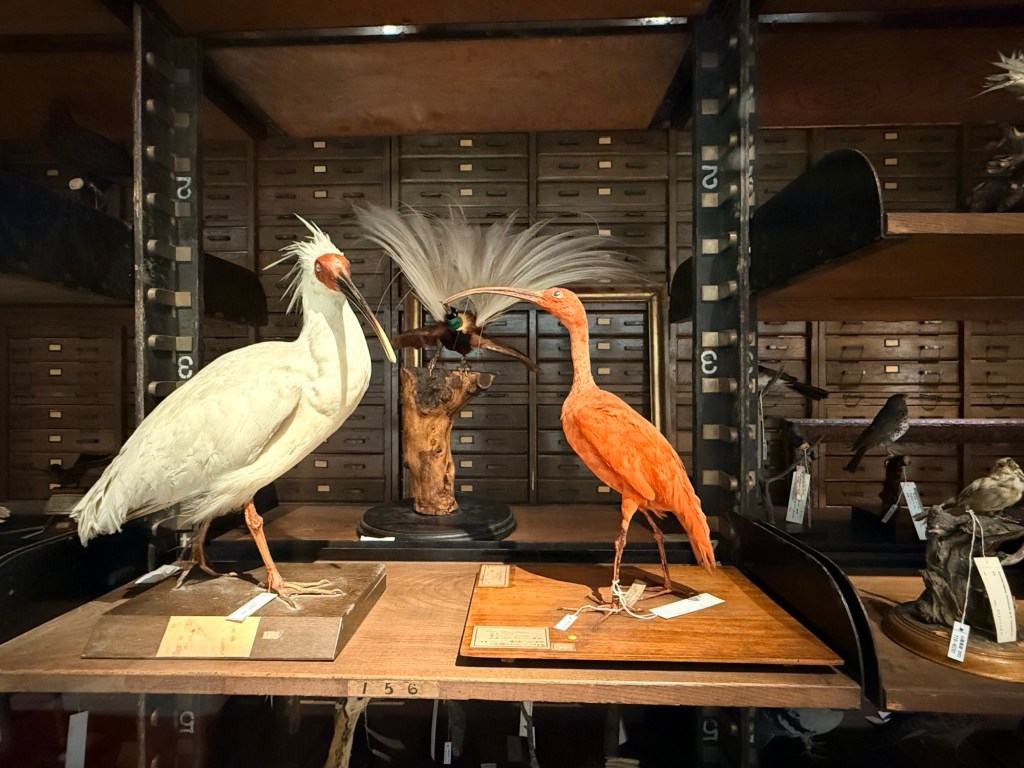
Entering the shopping mall with my friends.The grand artium.Artifacts from the museum.A collection of Thomas Edison’s phonographs. Japanese pottery.Japanese pottery.Japanese birds.Fun selfies.Reflections on the statues.Shopping mall with a cultural museum.
Heading Home
Our visit to Japan was full of unique and deeply meaningful experiences. I was sad to leave and, unfortunately, brought home a chest infection (travel sometimes has its challenges, but I’m now 95% recovered). Nevertheless, I also left Japan a treasure trove of new connections, memories that I will never forget, and opportunities to follow up on. My sincere gratitude goes to Atsushi, Shinya, Tamami, and all the wonderful colleagues who shared their time, talents, resources, and insights while we were in Japan.
I look forward to seeing you again soon and to working together to deliver workshops, translate games, test them with Western audiences, and collaborate on projects and research articles.
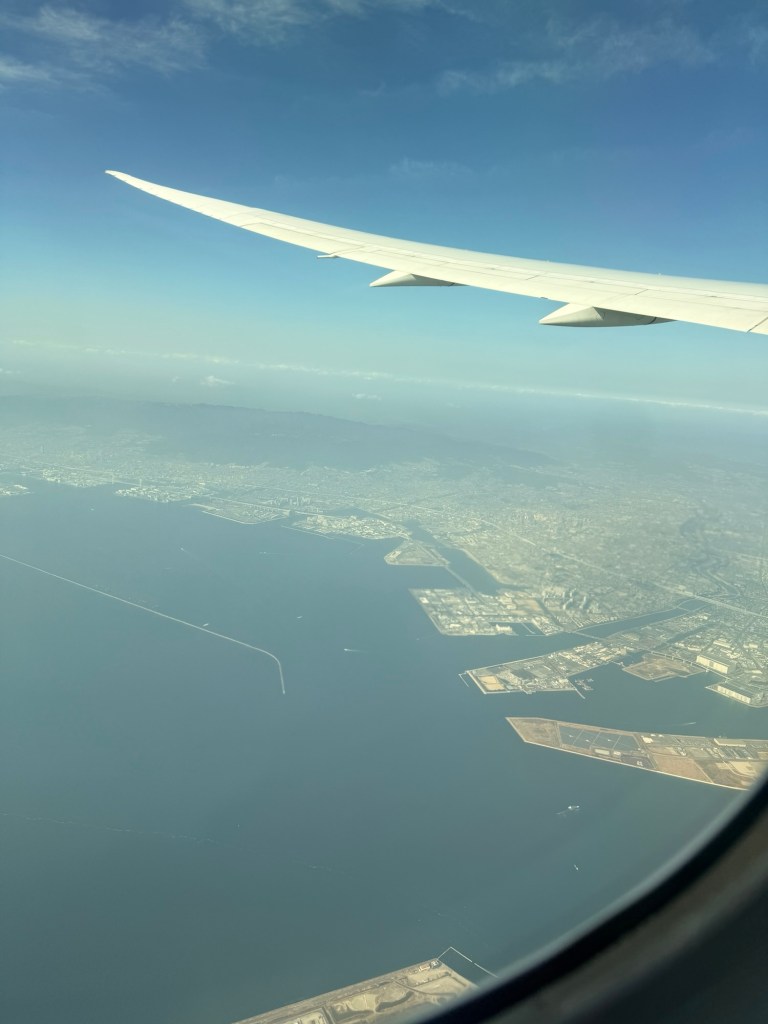
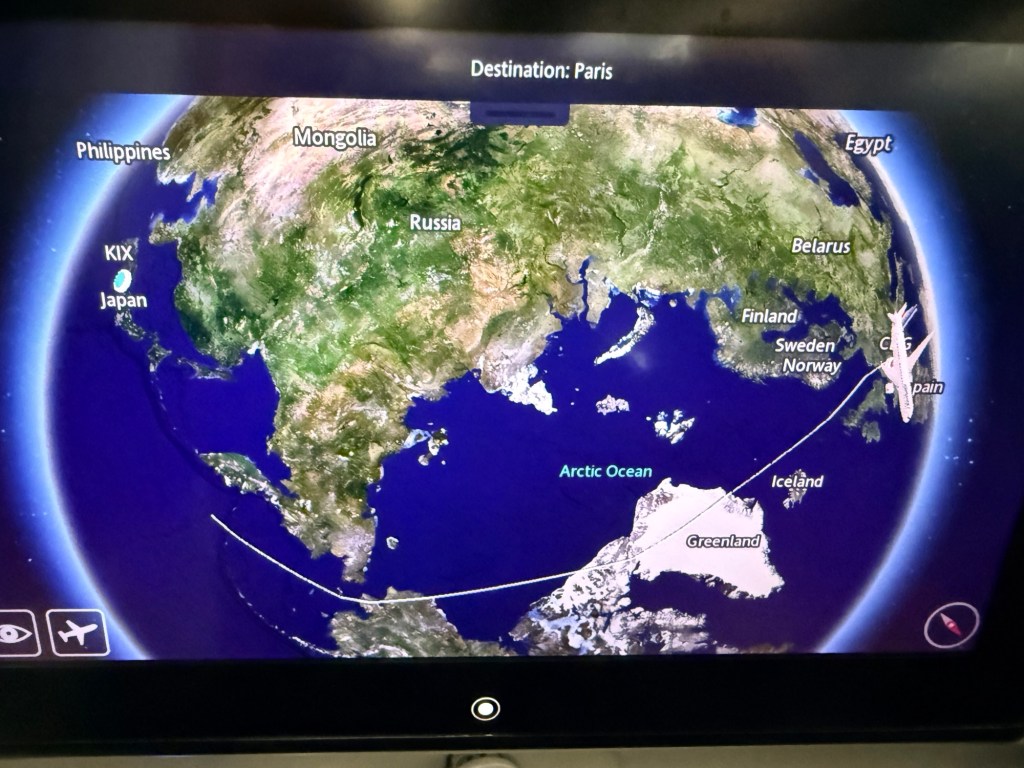
Last views of Japan.Flying over the Arctic Circle. We flew around the world on this trip!Leaving Japan, our plane flew east. We flew between Alaska and Russia, over Greenland, over Iceland, and to Charles de Gaulle airport. From there, I connected back to Dublin.
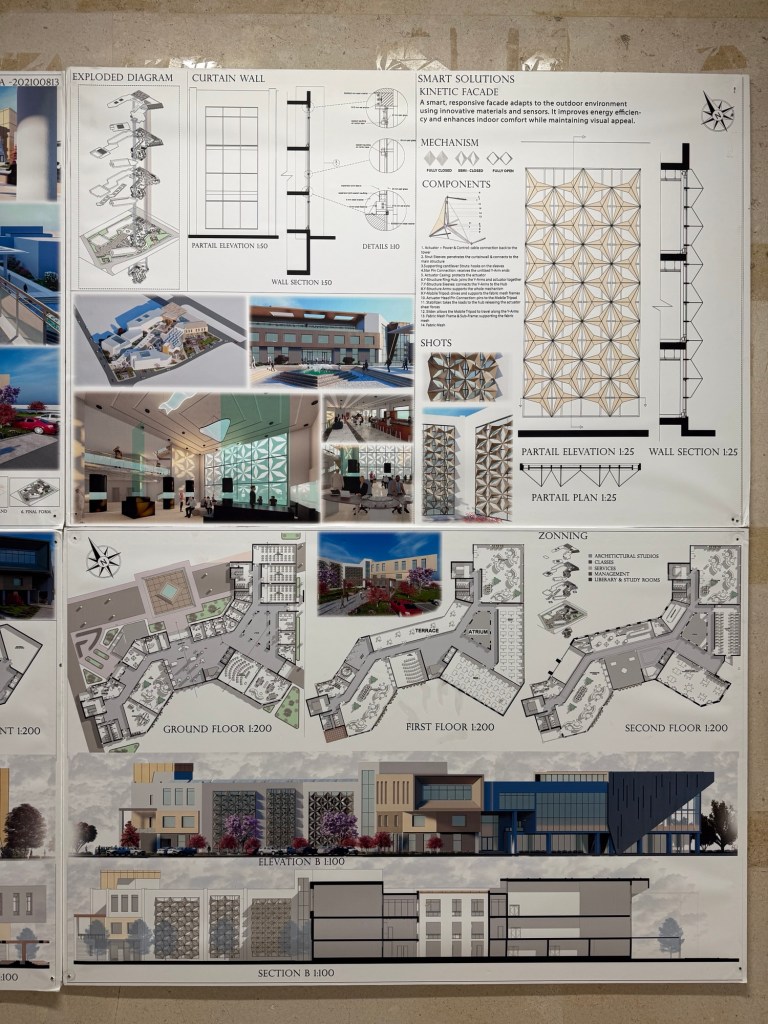
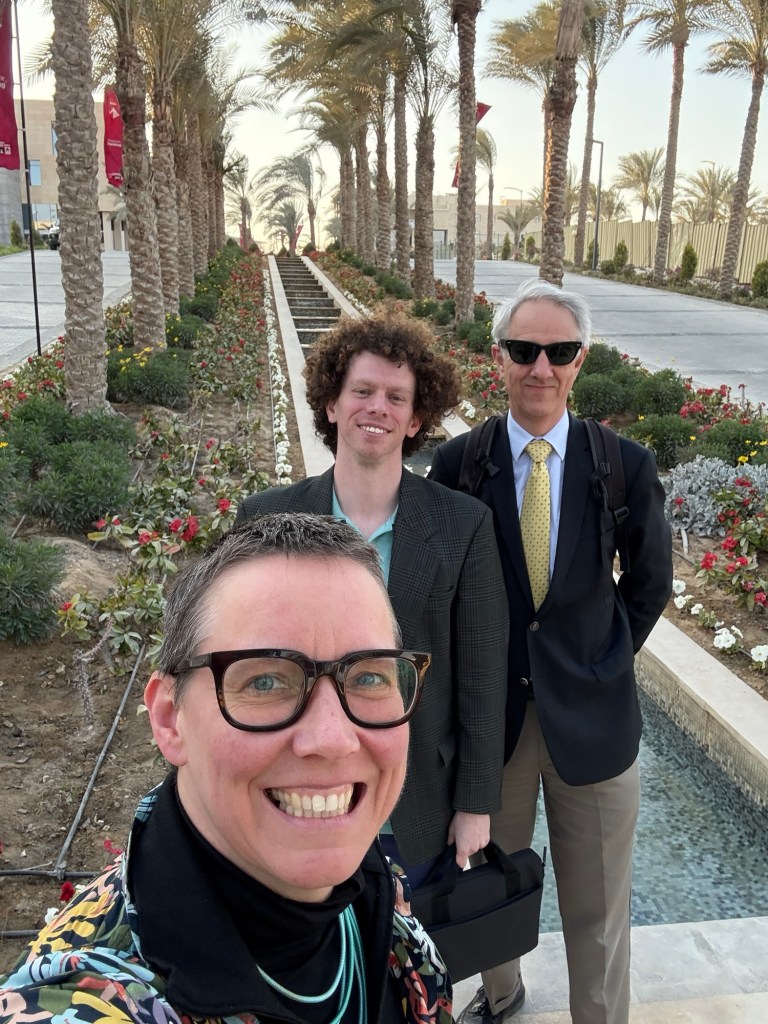
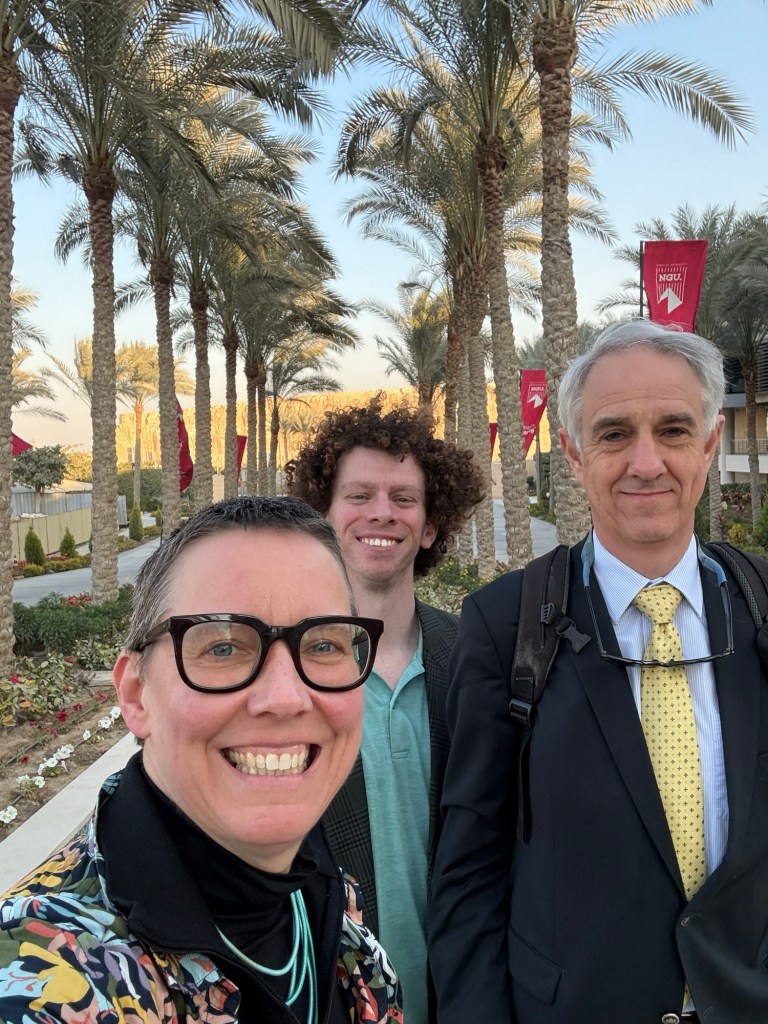
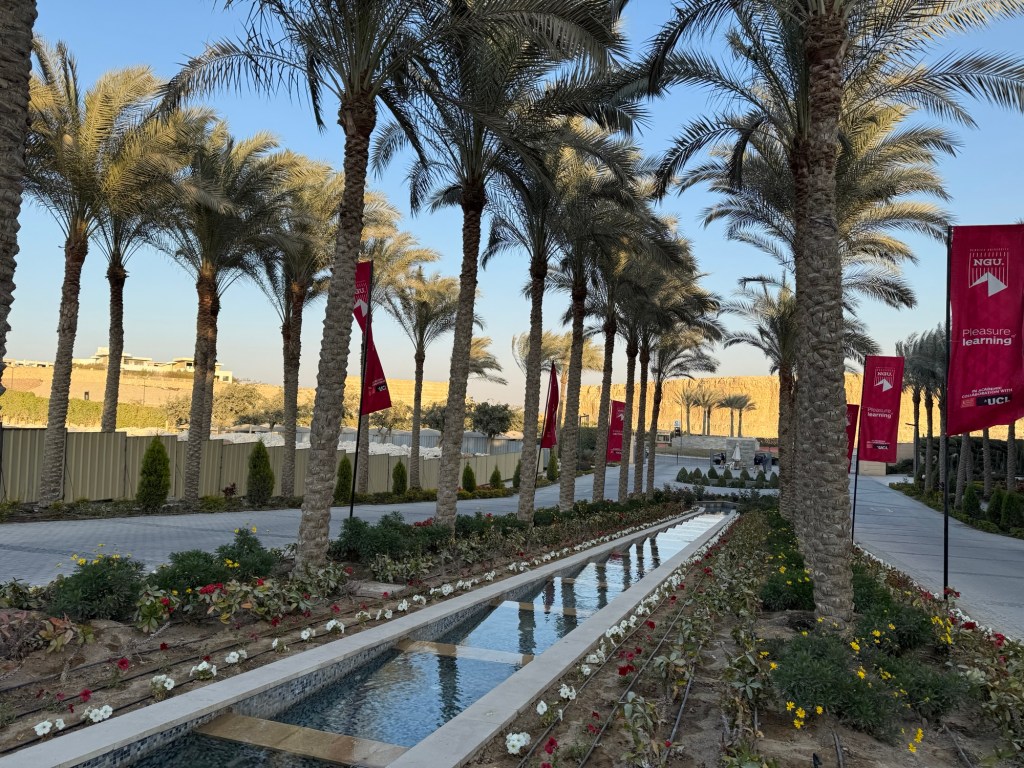
NewGiza University (NGU), located on the outskirts of Cairo, just released a video of me discussing the Architectural Engineering curriculum that I co-designed with Professor Emanuela Tilley, starting back in 2020: https://www.instagram.com/reel/DMVKR4HvVQ0/?igsh=MWo1dDE3cTB4Y2cxeQ== (opens in Instagram):
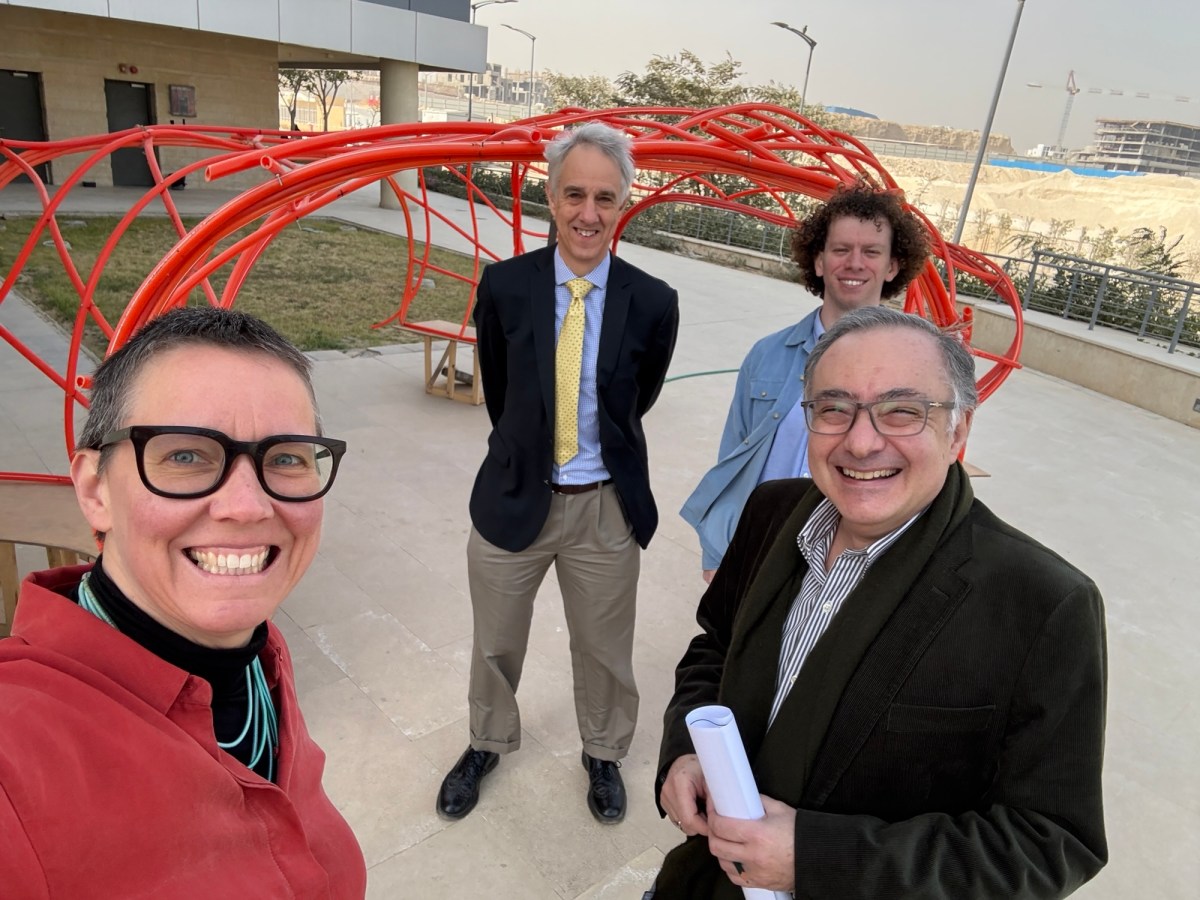
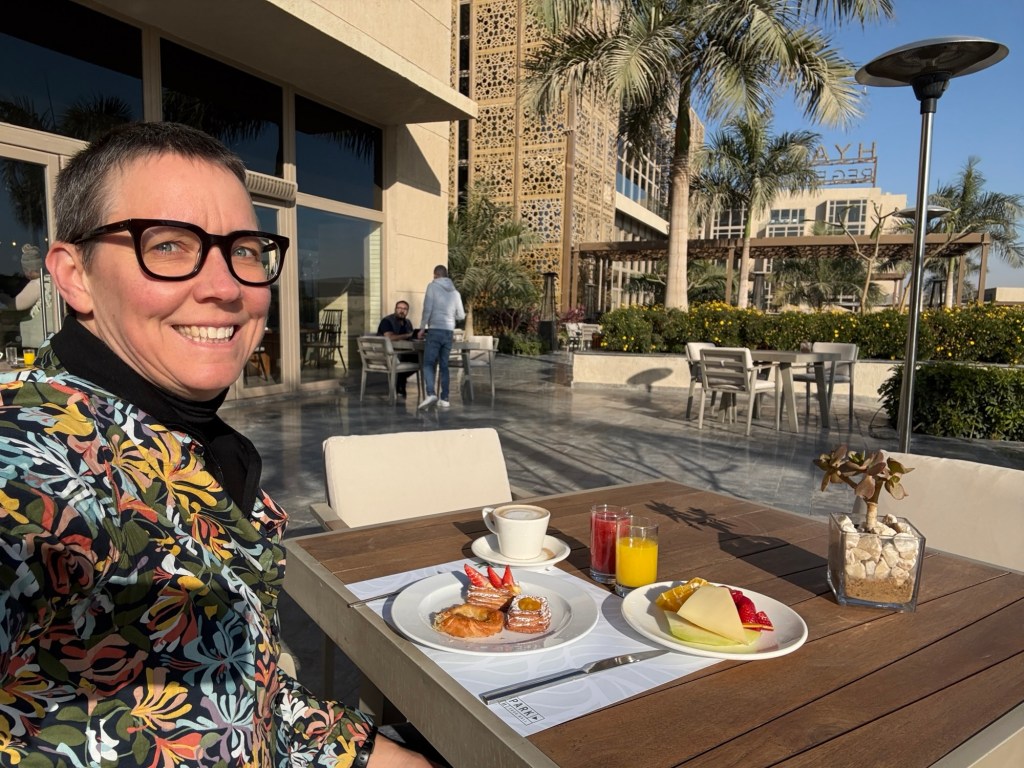
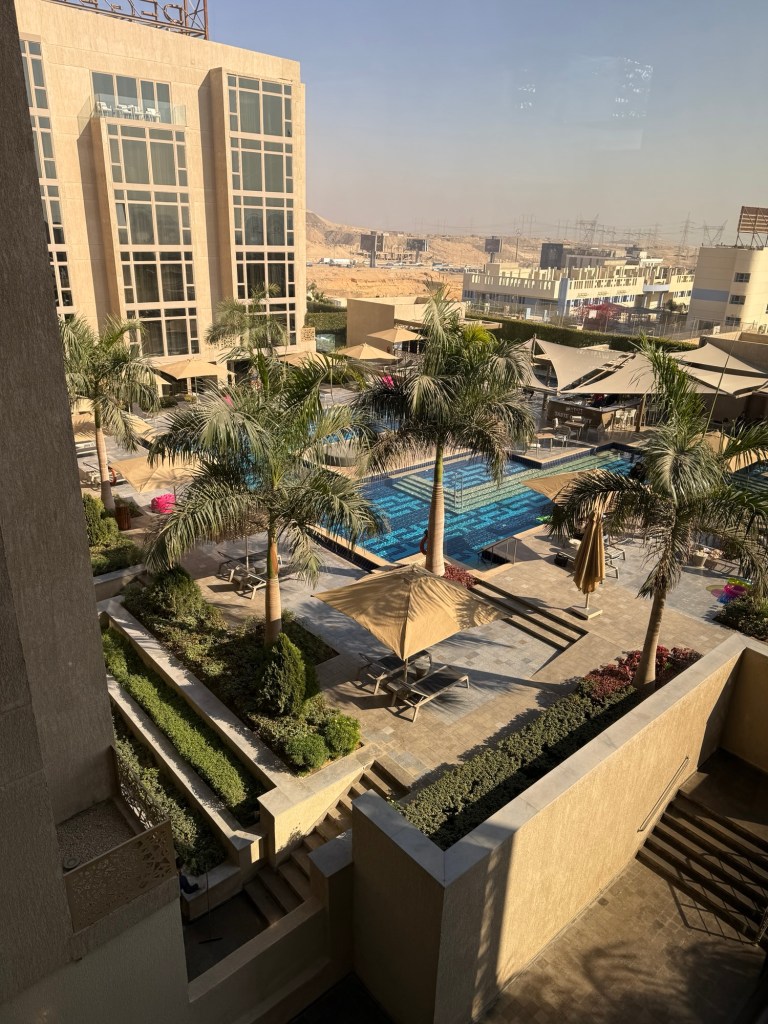
Because of the pandemic, I did not have a chance to visit NGU before we started designing the curriculum. In fact, I didn’t get to visit until this past February, 2025, when I travelled over with two staff from UCL to provide feedback on the quality of the program’s delivery.
It was a whirlwind tour, considering that I arrived a day later than expected due to a British Airline delay.
In my two working days there, I got to observe the program the public relations folks at NGU captured the footage on this video.
Designing this curriculum, via a contract between Technological University Dublin (TU Dublin) and University College London Consultants (UCLC) which pays for hours out of my timetable each semester, has been a real joy. It has required me to stretch, been , and develop new communication skills to explain complex concepts to people from a culture and language much different from my own.
Visiting the program and meeting the people who are delivering the content and the amazingly dedicated studentswho are forging the way by implementing a brand new curriculum has definitely been a highlight of 2025.
Many tanks to Dean Aly and the programme staff for welcoming us and helping us feel at home!
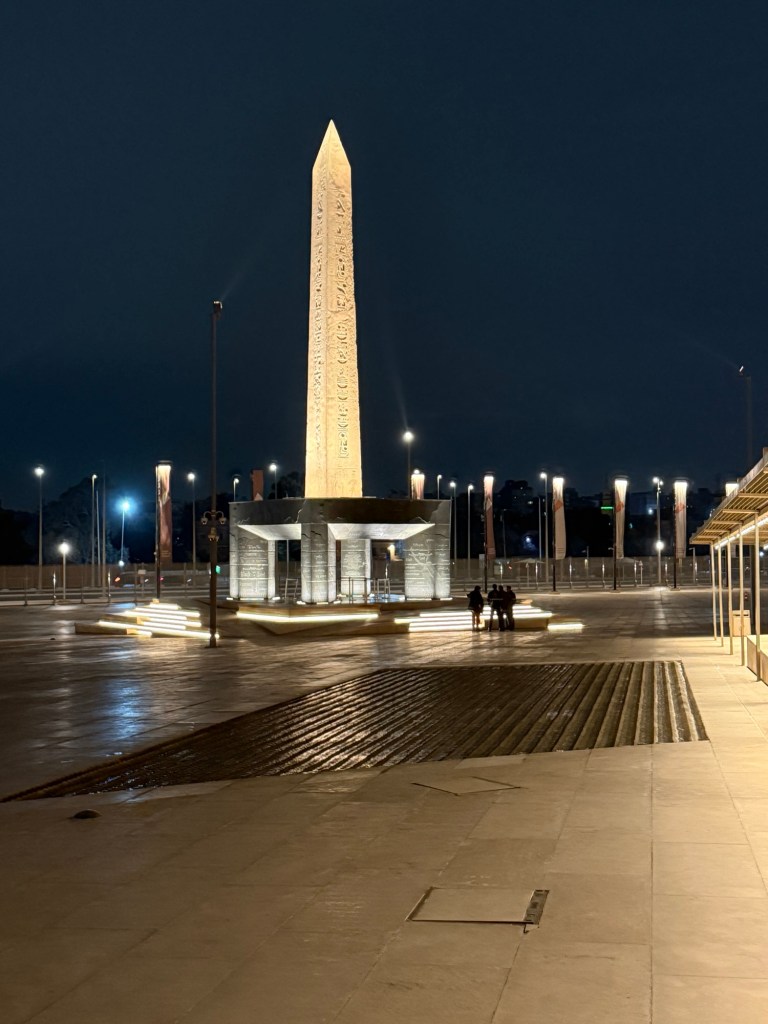
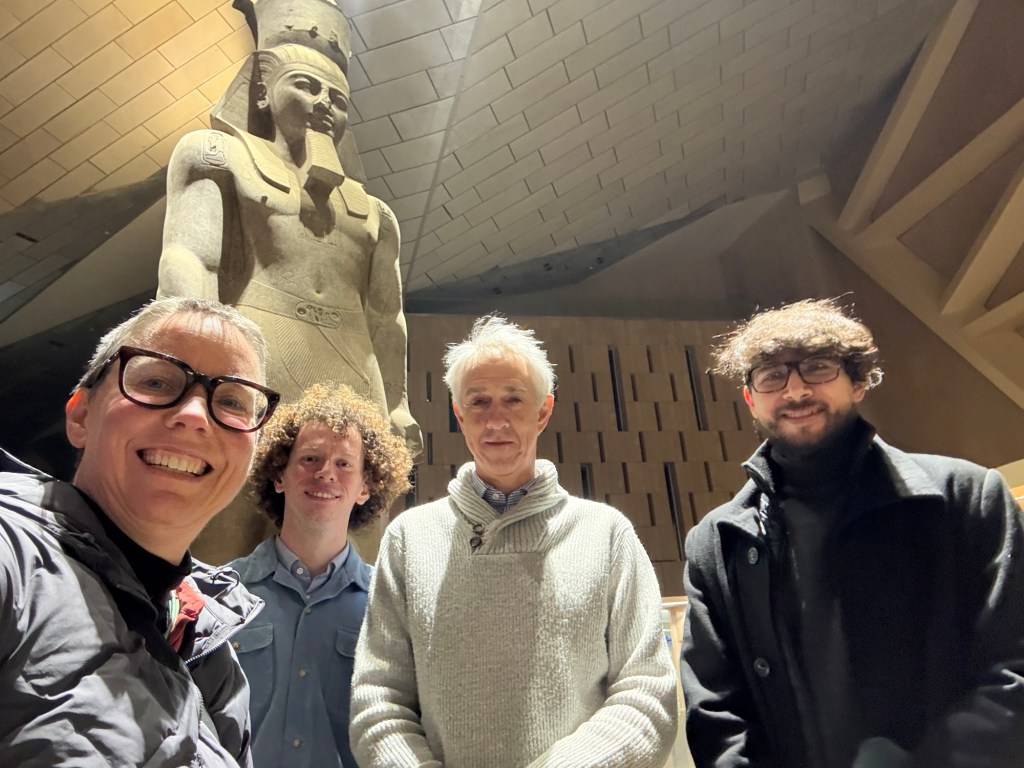
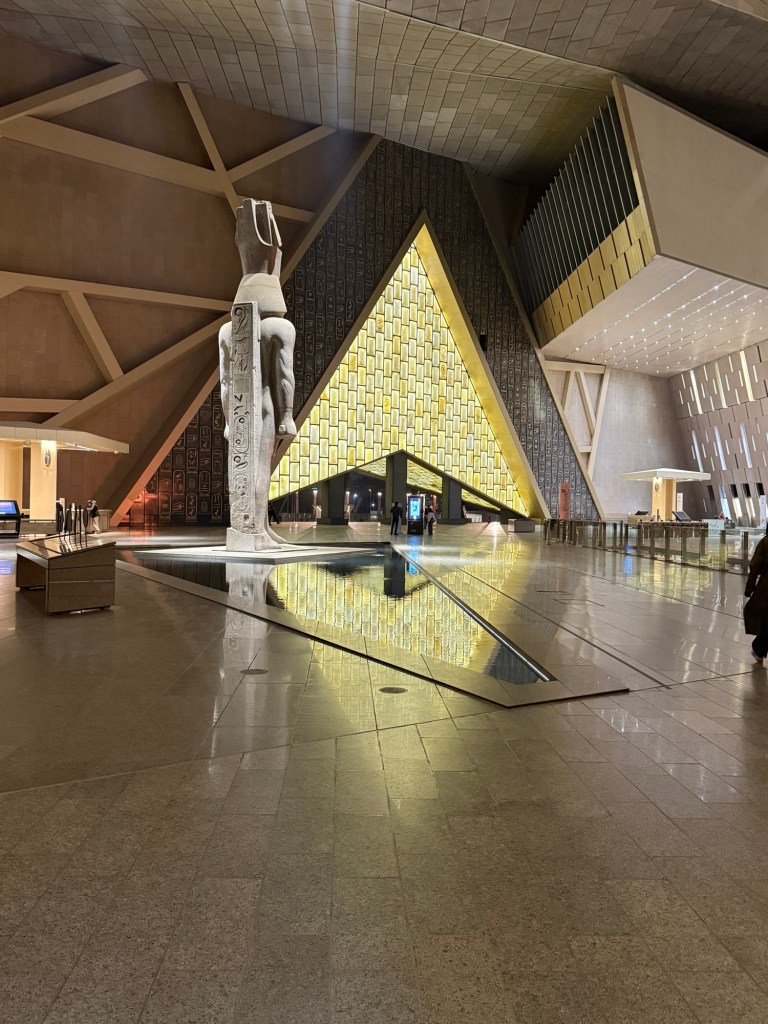
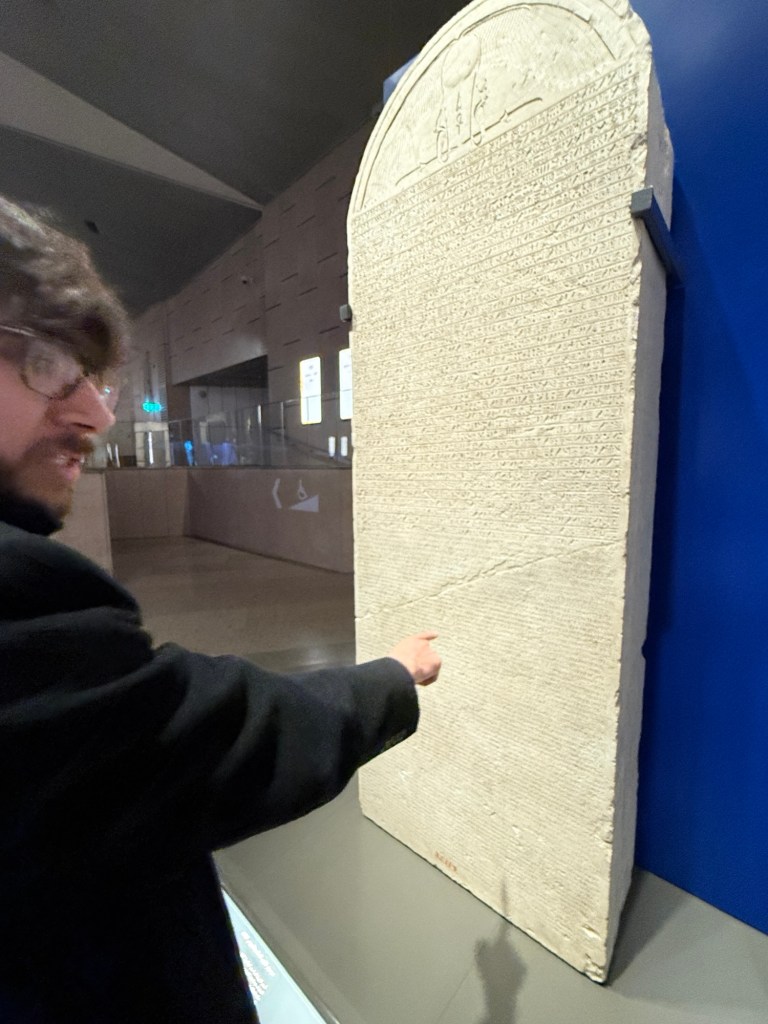
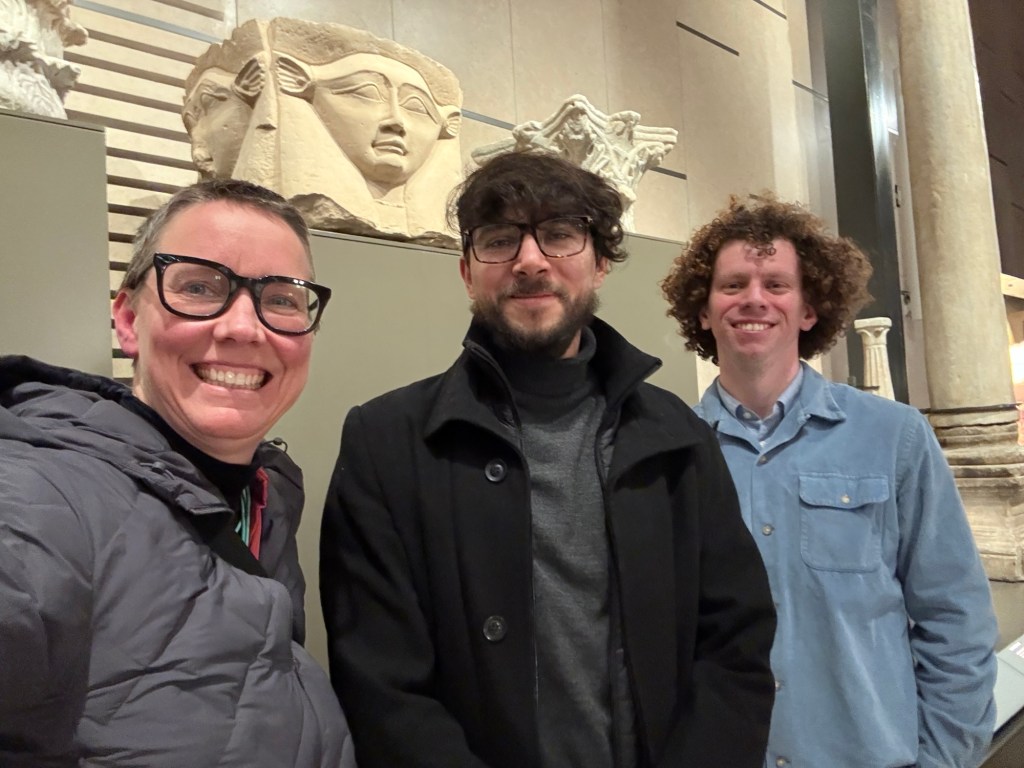
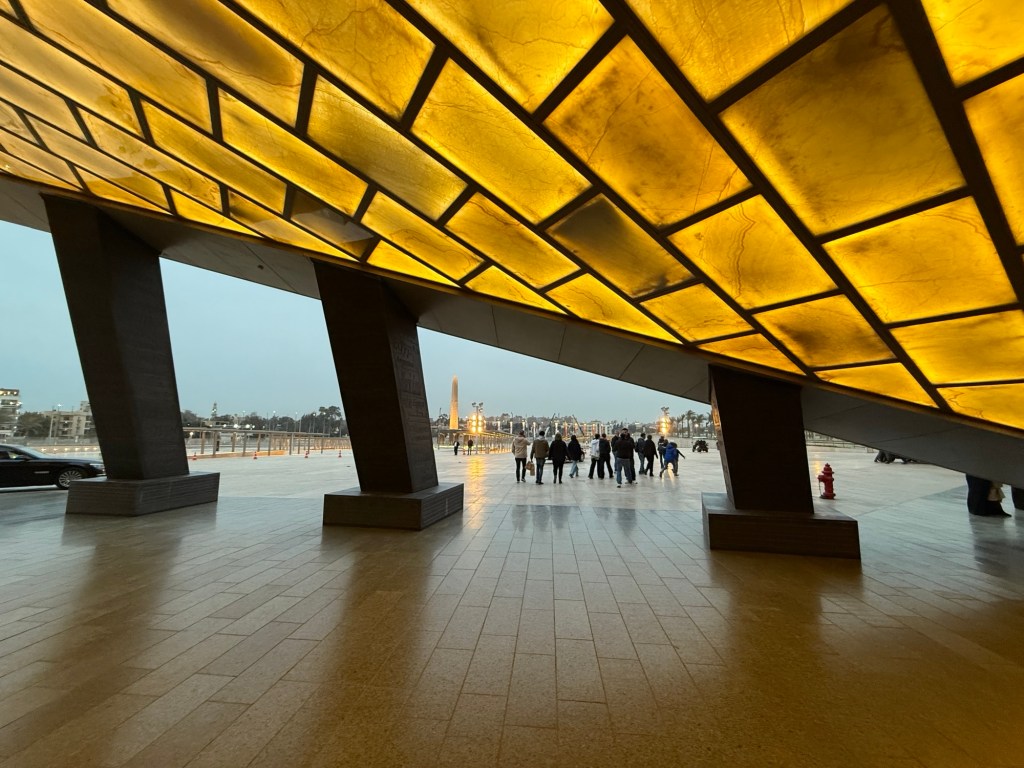
We three visitors also got a chance to tour the brand new Egyptian museum, lead by NGU’s architectural history, teacher. The experience was truly eye-opening and full of intrigue.
I look forward to a chance to visit NGU and Egypt again soon!
I have to say, none of this would’ve been possible without the Marie Curie fellowship I got to spend 2018 and 2019 working at UCL. The bonds I made with the folks at UCL in the Centre for Engineering Education have made such a difference in my and personal and professional life.
Being part of UCL has been so incredibly good for me, and good also for my employer, TU Dublin.
I am so honored to have had the chance to build an architecture program in Egypt and work with the people there who seek to build a stronger community of architects in Egypt. Thank you so much John Mitchell and Emanuela Tilley, for including me in this incredible project!
I’m honoured to have hosted a very successful 2025 SEFI Ethics Spring Symposium.
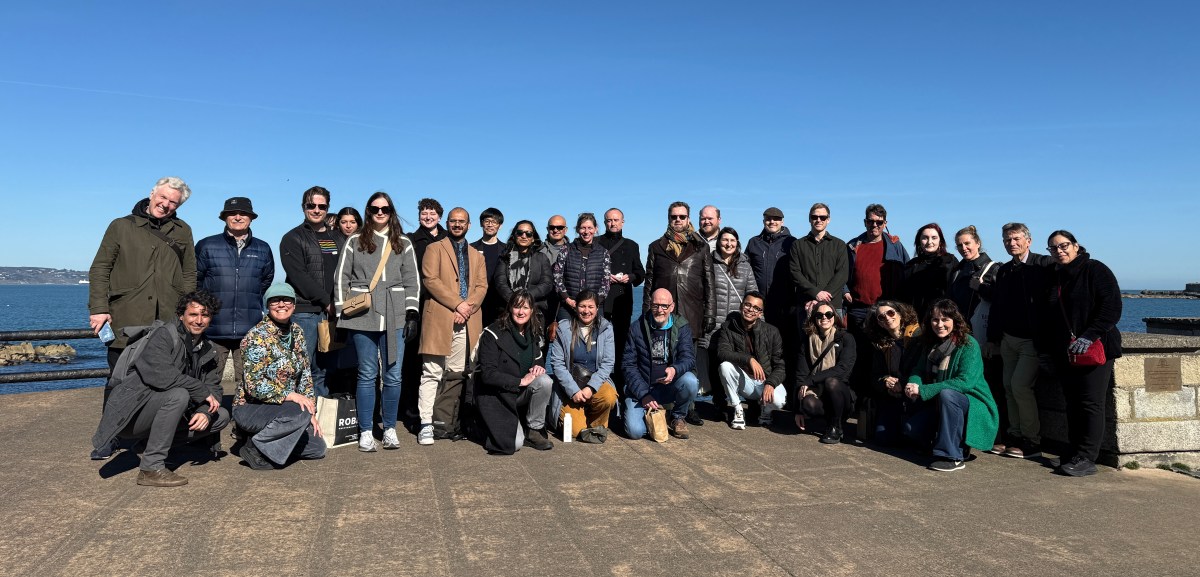
From March 24–26, my colleagues and I gathered at the Royal Marine Hotel in the charming seaside town of Dún Laoghaire, Ireland, for our small and cosy annual symposium. Mother nature blessed us with glorious weather, tasty and healthy food, gorgeous natural and architectural surroundings, an enchanting historic hotel, and new and renewed friendships.
Diana Martin, Mircea Tobosaru, and I organised the programme and all the details, demonstrating that collaboration is key to flourishing!
With 35 delegates from across the globe, this wasn’t just another academic conference—it was a meeting of minds and a celebration of our shared commitment to engineering ethics education.
Soaking in the surroundings, past and present, with a tour by Roland Tormey.
The symposium’s main goal? Strengthening our collective capacity to teach ethics to future engineers. A key focus was the Routledge International Handbook of Engineering Ethics Education (RIHEEE)—a major collaborative effort by the SEFI Ethics special interest group. We reflected on what is presented in the book and considered how to extend its themes, translate into impactful teaching practices, and generate discussion more broadly in the places we live and work.
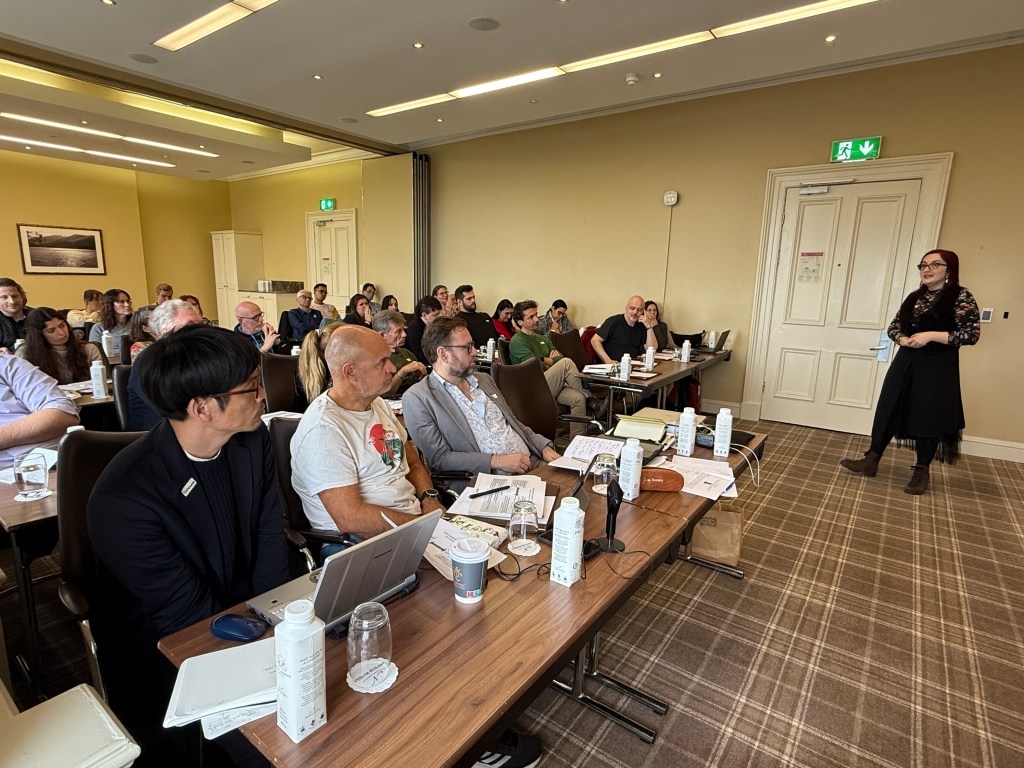
Opening the Symposium and introducing the handbook.
A Program Packed with Thought-Provoking Conversations
Over three days, we immersed ourselves in a mix of keynotes, workshops, and panels, tackling big questions from multiple angles:
Keynotes that Challenged and Inspired
Mary Nolan explored the role of care ethics in engineering, pushing us to think beyond traditional engineering thinking.
Paula Tomi examined the nature of truth, a concept that sits at the heart of both engineering and ethics.
Tom Børsen introduced us to techno-anthropology, showing how it intersects with engineering ethics education.
Keynote by Paula Tomi
Workshops that Sparked Debate and Collaboration
Care Ethics—How do we broaden engineers’ notion of responsibility?
AI Experimental Philosophy—How can philosophy guide us in using and developing artificial intelligence?
The Archimedean Oath—Should engineers take an ethical oath, much like doctors do?
Quantitative Methods & Ethics—How can we effectively describe and report ethical impact?
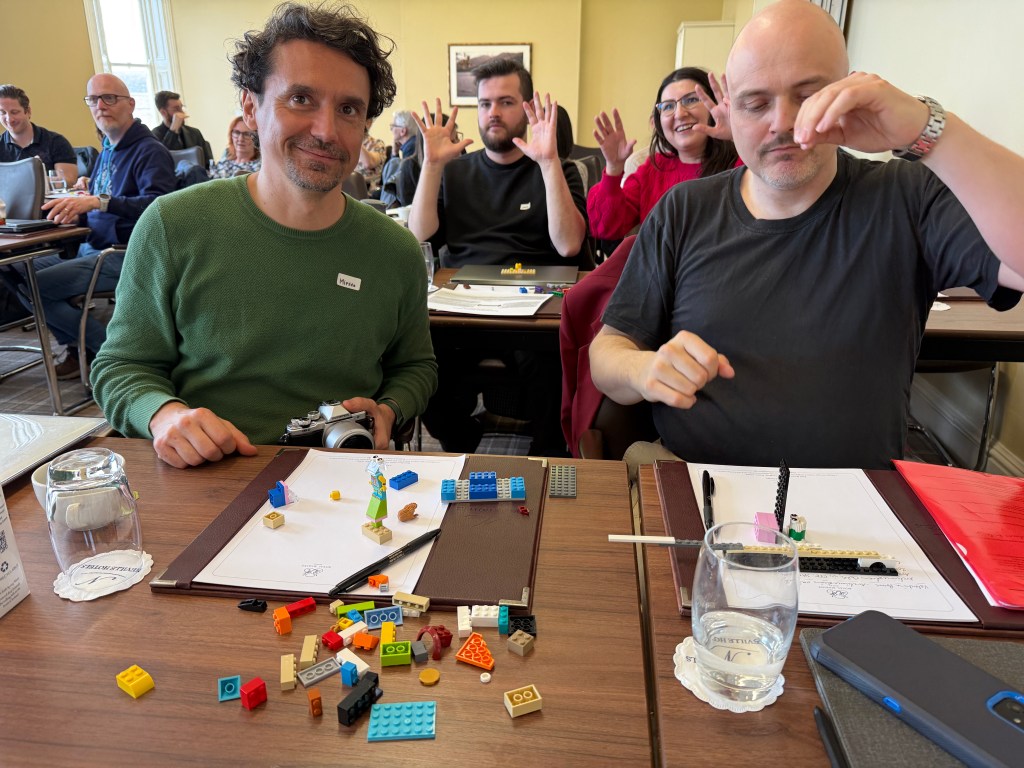
Peer-to-peer learning in action. Tom Børsen, to the right, was the co-lead editor of the handbook. Takehara joined us from Japan, and Miguel from Spain.
Panel Discussions: Making Ethics Education More Practical
Our panelists had a specific challenge: dive into a self-selected sections of RIHEEE and critically assess its themes. We asked: What patterns do you see across the set of chapters in your section? What’s missing? How can can educators make use of the content? How can we help them do that? Can we translate theoretical insights into tangible strategies that can be applied in classrooms and institutions worldwide yet still reflect local culture and values?
Panel with Rachel Harding, Aaron Johnson, Magnus Kahrs (and Valentina Rossi, not shown)Panel on engineering ethics accreditation Panel on Interdisciplinary Perspectives with Katherine Looby, Ronny Kjelsberg, Gaston Meskens, and Sandra Cruz Moreno.
There were so many very special aspects, including exploring care ethics in depth and applying care ethics, and the walking tour was truly spectacular.
A Literary and Cultural Interlude
Roland Tormey’s literary walking tour of Dún Laoghaire was a highlight for us all. We took a step back and immersed ourselves in the cultural richness of our surroundings. For many of us, this blend of intellectual and cultural exploration reinforced the broader ethical dimensions of engineering—how our work is always connected to society, history, and place.
Sunshine and good vibes galore!
Global Voices, Local Impact
The symposium truly reflected the international nature of engineering ethics education. We had voices from across Europe, North America, Africa, and Asia, with universities ranging from UCL and the University of Michigan to EPFL. At the same time, there was strong local representation, with a third of the attendees based in Ireland—TU Dublin, DCU, ATU, and Engineers Ireland all playing an active role. A special shoutout to my TU Dublin colleagues—Sandra Cruz Moreno, Marek Rebow, Rachel Harding, Mike Murphy, and recent PhD grads Diana Adela Martin and Darren Carthy—whose contributions helped everyone feel welcome.
What’s Next?
The energy and ideas sparked at the symposium will propel us forward onto new collaborations, where we apply what we discussed—via research and teaching and leadership and service—and continue building momentum and sharing what we’re learning with our colleagues back home, and indeed worldwide.
For those who couldn’t join us in person, the Routledge International Handbook of Engineering Ethics Education is freely available in an open-access digital format. Whether you’re new to the field or a long-time educator, it’s a must-read: 🔗 RIHEEE Handbook
For posterity’s sake, I am adding the symposium schedule as it was conducted:
Monday, March 24
09:00-09:30 Welcome and Icebreaker by host Shannon Chance
09:30-10:30 Handbook panel 1 (Foundations) moderated by Roland Tormey with panellists Mircea Tobosaru, Samia Mahé, and Mihaly Héder
10:30-10:50 Coffee break
10:50-11:30 Keynote on Care Ethics by Mary Nolan
11:30-13:00 Workshop on Care Ethics by Robert Irish, Ana Tebeanu, Sofia Duran, Vivek Ramachandran, Roland Tormey, & Alison Gwynne-Evans
13:00-15:30 Picnic Lunch & Walking tour of Dun Laoghaire led by Roland Tormey
15:30-16:00 Coffee break with snacks
16:00-17:00 Handbook panel 4 (Teaching Methods) moderated by Diana Martin with panellists Valentina Rossi, Aaron Johnson, Magnus Kahrs, and Rachel Harding
17:00-17:30 Wrap-up with synthesising activity
19:00 Dinner outing with colleagues departs from the hotel lobby
Tuesday, March 25
09:00-10:00 Handbook panel 6 (Accreditation) moderated by Shannon Chance with panellists Leah Ridgway, Louise O’Gorman, Alison Gwynne-Evans, and Marek Rebow
10:00-10:40 Keynote on Truth by Paula Tomi
10:40-11:00 Coffee break
11:00-12:15 Workshop on AI experimental philosophy by Krzysztof Sołoducha
12:15-13:00 Ethics SIG session led by Diana Martin and Mircea Tobosaru
13:00-14:00 Lunch
14:00-15:00 Handbook panel 3 (Specific Disciplines) moderated by Tom Børson with panellists Jacob Baneham, Miguel Romá, Mike Murphy, and Rhythima Shinde
15:00-15:20 Coffee break with snacks
15:20-16:40 Workshop on the Archimedean Oath by Valentina Rossi
19:00 Dinner outing with colleagues departs from the hotel lobby
Wednesday, March 26
09:00-10:00 Handbook panel 2 (Interdisciplinary Perspectives) moderated by Roland Tormey with panelists Sandra Cruz Moreno, Ronny Kjelsberg, Gaston Meskens, and Katherine Looby, with input from Riadh Habash
10:00-11:15 Workshop on Quantitative Methods & Ethics by Matheus de Andrade and Idalis Villanueva Alarcón
11:15-11:30 Coffee break
11:30-12:15 Keynote by Tom Børsen on “Techno-Anthropology and Engineering Ethics Education”
12:15-13:15 Ethics SIG session led by Diana Martin and Mircea Tobosaru
13:15-15:00 Lunch and physical activity
15:00-16:00 Handbook panel 5 (Assessment) moderated by Tom Børsen with panellists Takehara Shinya, Celina Leão, Ana Voichita Tebeanu, and Mary Nolan
16:00-16:20 Coffee break with snacks
16:20-17:30 Ethics SIG synthesis session led by Diana Martin and Mircea Tobosaru
19:00 Dinner outing with colleagues departs from the hotel lobby
Over the past two years, I have edited this book in collaboration with five outstanding ethics scholars. Seeing it through to completion is one of the proudest achievements of my professional life.
The project involved 105 authors from around the globe. I led it alongside Tom Børsen, who immediately embraced the idea of a handbook.
We paid the publication fee so that you can read it for free! We wanted to give everyone with a digital device an equal chance, regardless of where they live.
Of course, you are also welcome to order a hard-back print copy of the book from the link above. A discount is currently available. Moreover, a paperback version will be available in 18 months.
The book has six sections:
SECTION 1: Foundations of engineering ethics education (7 chapters)
SECTION 2: Interdisciplinary contributions to engineering ethics education (6 chapters)
SECTION 3: Ethical issues in different engineering disciplines (5 chapters)
SECTION 4: Teaching methods in engineering ethics education (7 chapters)
SECTION 5: Assessment in engineering ethics education (6 chapters)
SECTION 6: Accreditation and engineering ethics education (5 chapters)
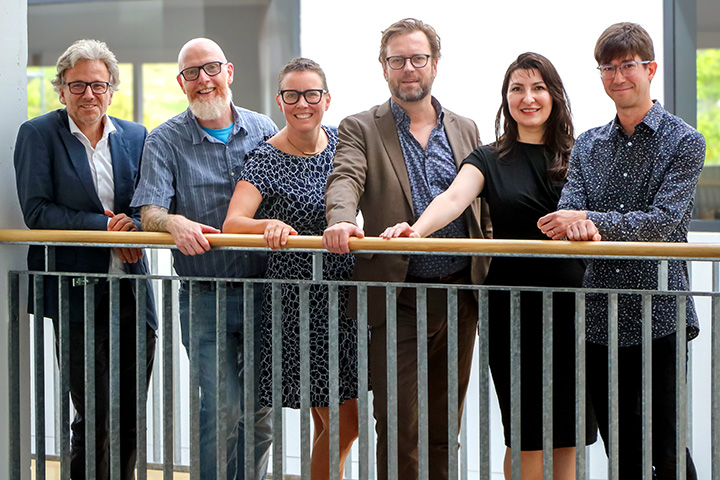
The editorial team is pictured below (left to right): Gunter Bombaert, Roland Tormey, Shannon Chance, Tom Børsen, Diana Adela Martin, and Thomas Taro Lennerfors. It’s been a dream team!
This handbook was a project of the Ethics Special Interest Group (SIG) of the European Society for Engineering Education (SEFI). SEFI members made it possible by contributing to their transcontinental networks of colleagues.
We editors started by sending out a survey, as far and wide as possible, to find out who was working in the field and might be interested in authoring a chapter. We held online workshops to identify what topics should be included and structured them into chapters. We invited a lead author for each chapter and asked the lead to invite three others to co-write the chapter. We asked that the chapter team have people from different places on it, and we aimed for transcontinental teams where feasible. We also asked the lead to consider specific people who had expressed interest in the topic. Our team ultimately included people of diverse levels and fields of experience and good geographical distribution. The people on many of the teams had not worked together before. Many lead authors served as mentors for early career researchers. We held numerous meetings online with the led authors of each section to cross-check, coordinate, and challenge our own thinking. The editorial team met weekly throughout most of the process, and the final result reflects the strong and knowledgeable engagement of many leaders in the field. Our team conducted a rigorous internal peer review, and the publisher conducted its own peer review twice during the process. Here’s what the reviewers said about our proposal:
“I believe this is a state-of-the-art milestone.”
“The lead authors are the key people in this vibrant community, and they have recruited a veritable ‘Who’s Who’ of international authors for the handbook. This is the right time and the right people. It’s the dream team.”
“This would become the resource in this field.”
The final result is a true masterpiece, and I hope you’ll read at least some of it because the content is quite fascinating!
The Ethics SIG also hosts a Spring School around Easter every year, and this year, the theme of the Spring Symposium is “Growing the Field of Engineering Ethics Education and Research as a Community.” I am the local host for this March 2025 event, and we will spend the three days celebrating, applying, and extending the handbook’s content. Learn more about the Symposium and submit your interest in attending at this link: https://forms.gle/WngZ3DMi97FLtQaZ8
Date: 24-26 March 2025 (9:00-17:30 each day)
Location: Royal Marine Hotel, Dún Laoghaire, Ireland
Whether or not you can join us in Dún Laoghaire, I hope you’ll peruse the content of this outstanding new resource and reach out to the editors and authors if you’d like more information or to get involved in what we do!
I am confident that this handbook will make a significant global contribution to engineering education. I therefore urge all engineering and architecture educators to become more explicitly involved in learning and teaching about ethics.
With a team of experts from four continents, I led the development of a newly published special issue of IEEE Transactions onEducation on the “Conceptual Learning of Mathematics-Intensive Concepts in Engineering.” The issue has nine articles covering three categories: assessment, instruction, and learning.
If you teach mathematics concepts to engineering students, you’ll definitely want to check it out!
I served as the organizational lead, and endeavored to support my team in learning journal-editing skills. Dr Farrah Fayyaz (working from Canada) served as the project’s conceptual lead. Dr Anita Campbell (South Africa), Dr Nicole Pitterson (USA), and Dr Sadia Nawaz (Australia) were also instrumental in producing such a high quality compilation.
As described in our guest editorial for this special issue, our leadership team implemented a range of innovative, collaborative models for capacity- and community-building while shepherding this project from conception to completion. My own focus was on cultivating these models, as mathematics education is not a primary focus of mine (although it is for the other four editors). The capacity-building model, and the recommendations for IEEE and other editors of special issues that are included in the guest editorial, were my primary contributions with this project, and a source of pride and joy for me.
I look forward to the future compilations that Farrah, Anita, Nicole, and Sadia will curate. Together, the editorial team hopes to read many more articles in this cutting-edge realm of research, and watch the ongoing success of the authors who participated in our capacity- and community-building activities.
The architecture teachers at KLE Tech are really enthusiastic about teaching and about learning to do educational research. A number of them attended the engineering education conferences held at their institution in January — the IUCEE conference on engineering teaching and REES, the Research in Engineering Education Symposium, which focuses on research about engineering teaching.
KLE Tech’s lovely Dipanwita Chakravarty was the most enthusiastic among them, delighted as she was to find an architect speaking on a panel at REES.
That architect was me! 🙂
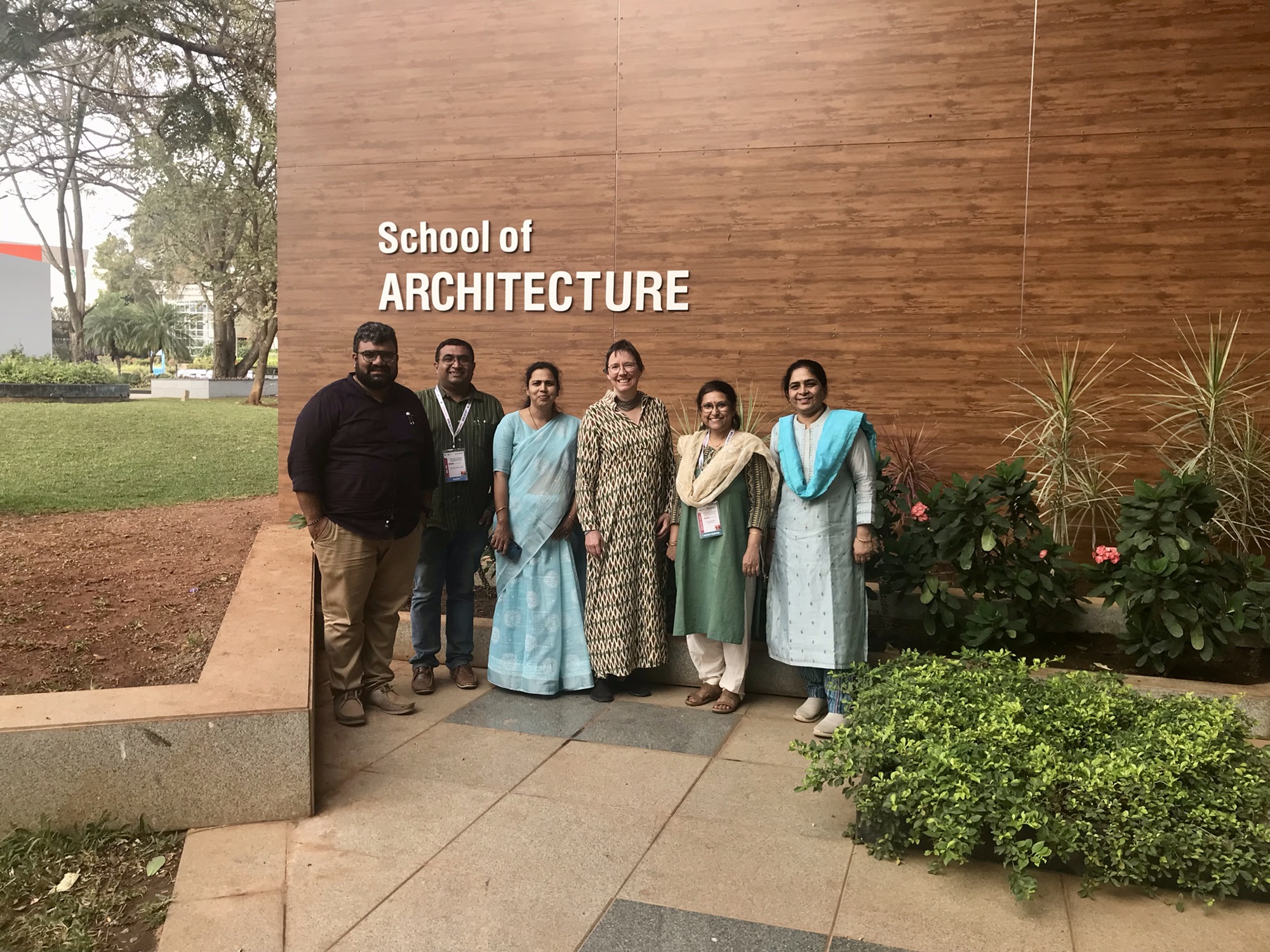
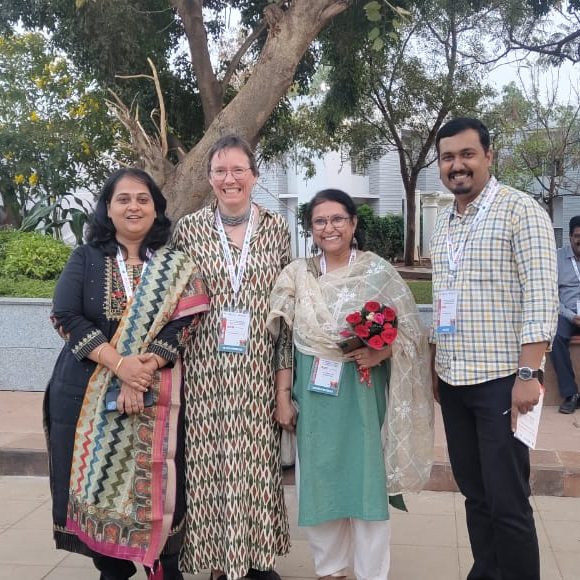
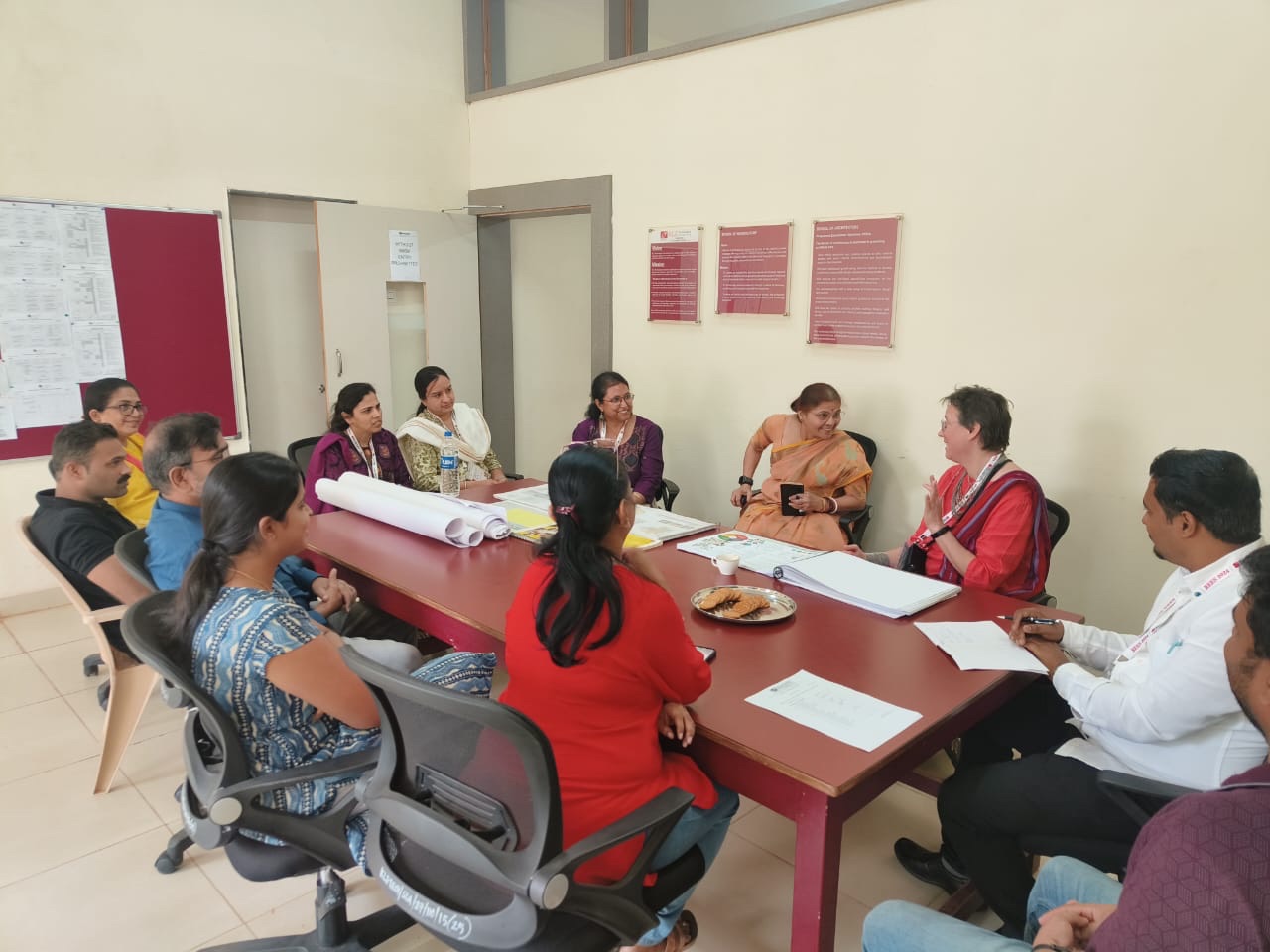
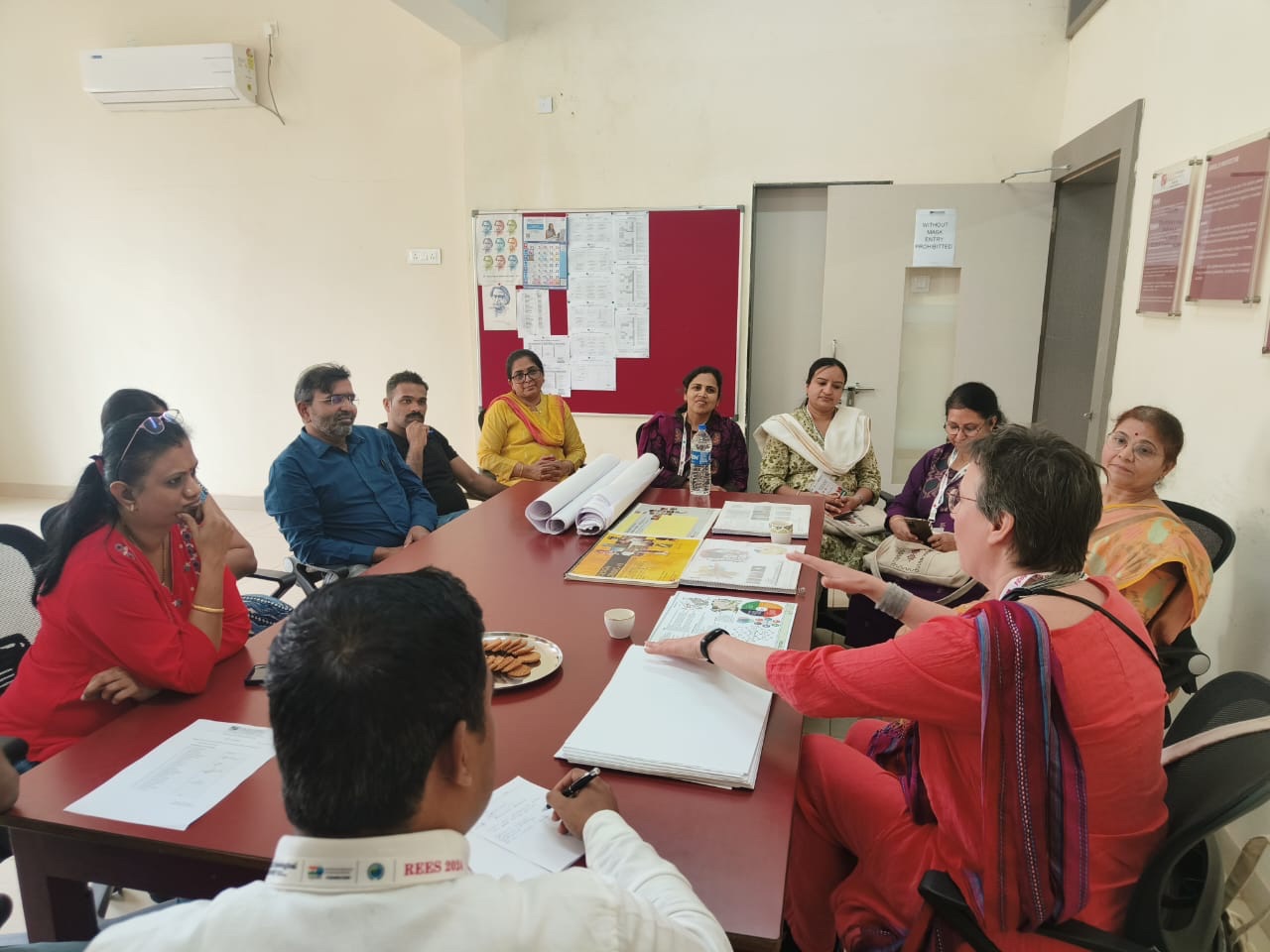
Dipanwita found me soon after I presented, asking me to meet her architecture colleagues. She spirited me away from the events at REES, to meet Deepa Mane and Rohini Mligi, tour a room archiving their architecture students’ work, and then meet even more colleagues for an animated chat about research and curriculum design. And tea! Such excellent tea!
Here’s a glimpse of that afternoon’s tour and interactions:
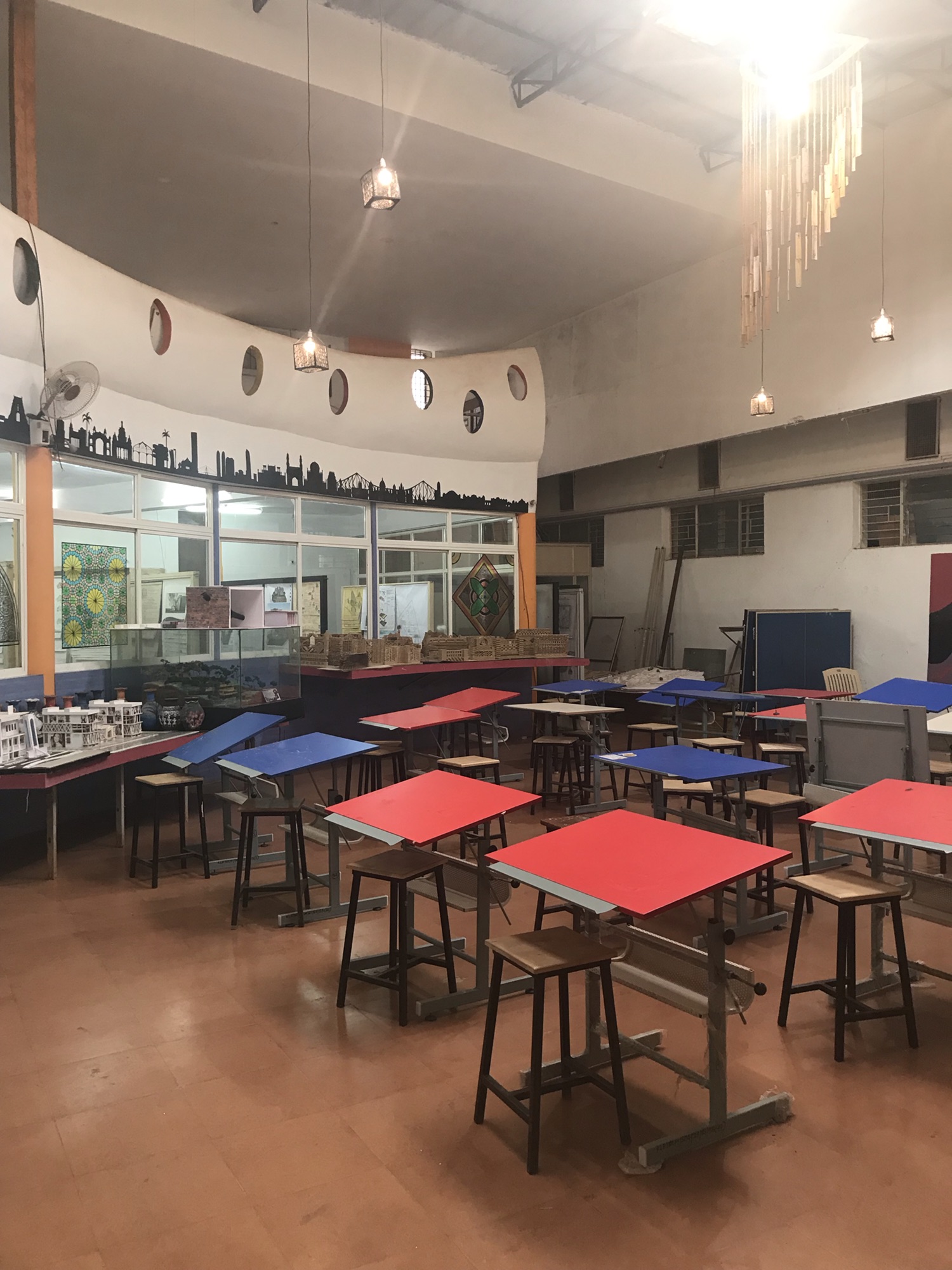
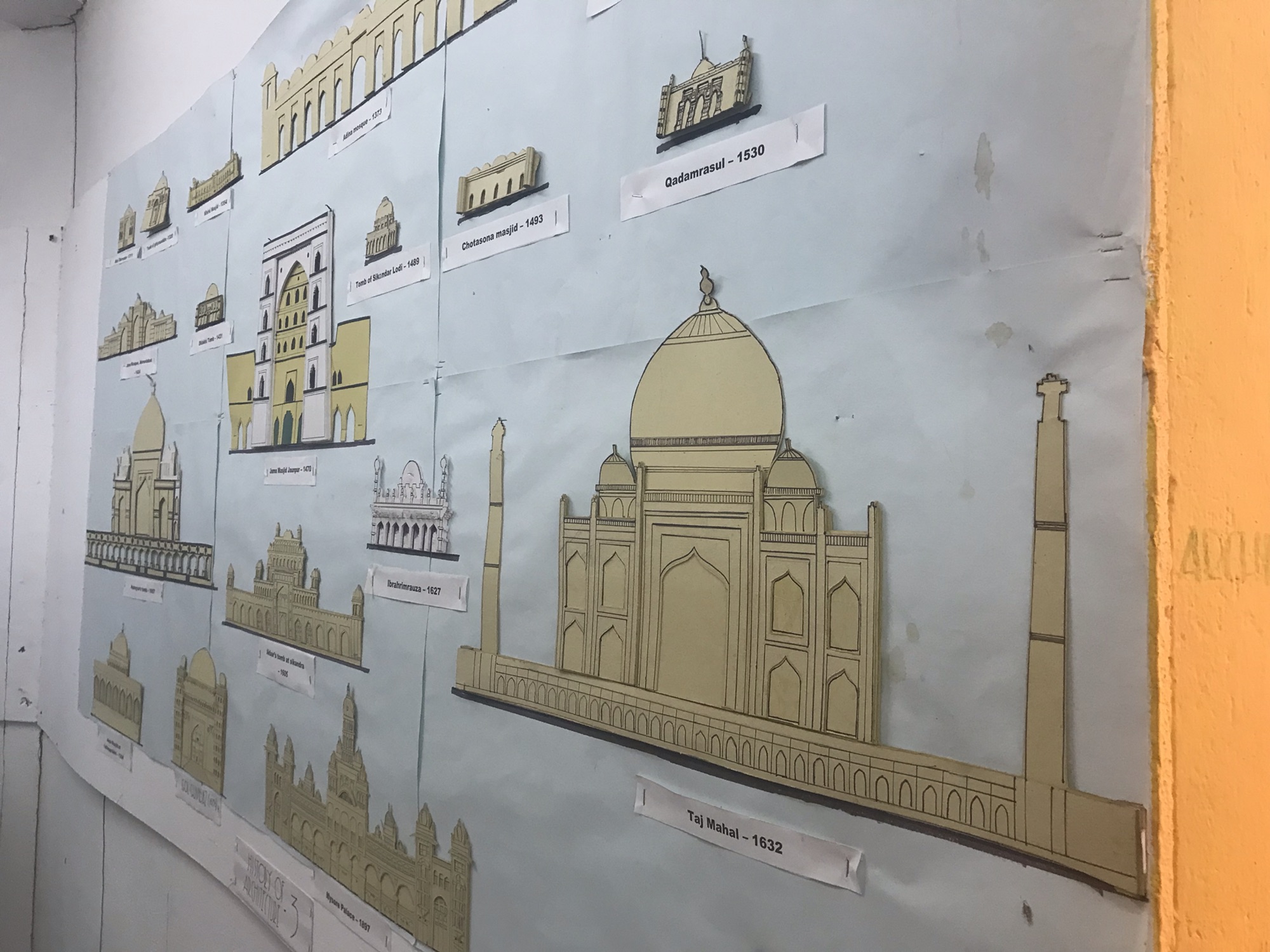
A classroom for hand drawing.It’s chock full of models and drawings by students.KLE Tech has an extensive archive of architecture students’ work.I found this size comparison of Indian temples very interesting!Seeing the work brought me to life!Rohini and I had a great chat.And Deepa took many photos of the tour with Dipanwita and Rohini.By the end of the afternoon, I’d exchanged ideas with architecture staff, including Rohini, Dipanwita, and Deepa.
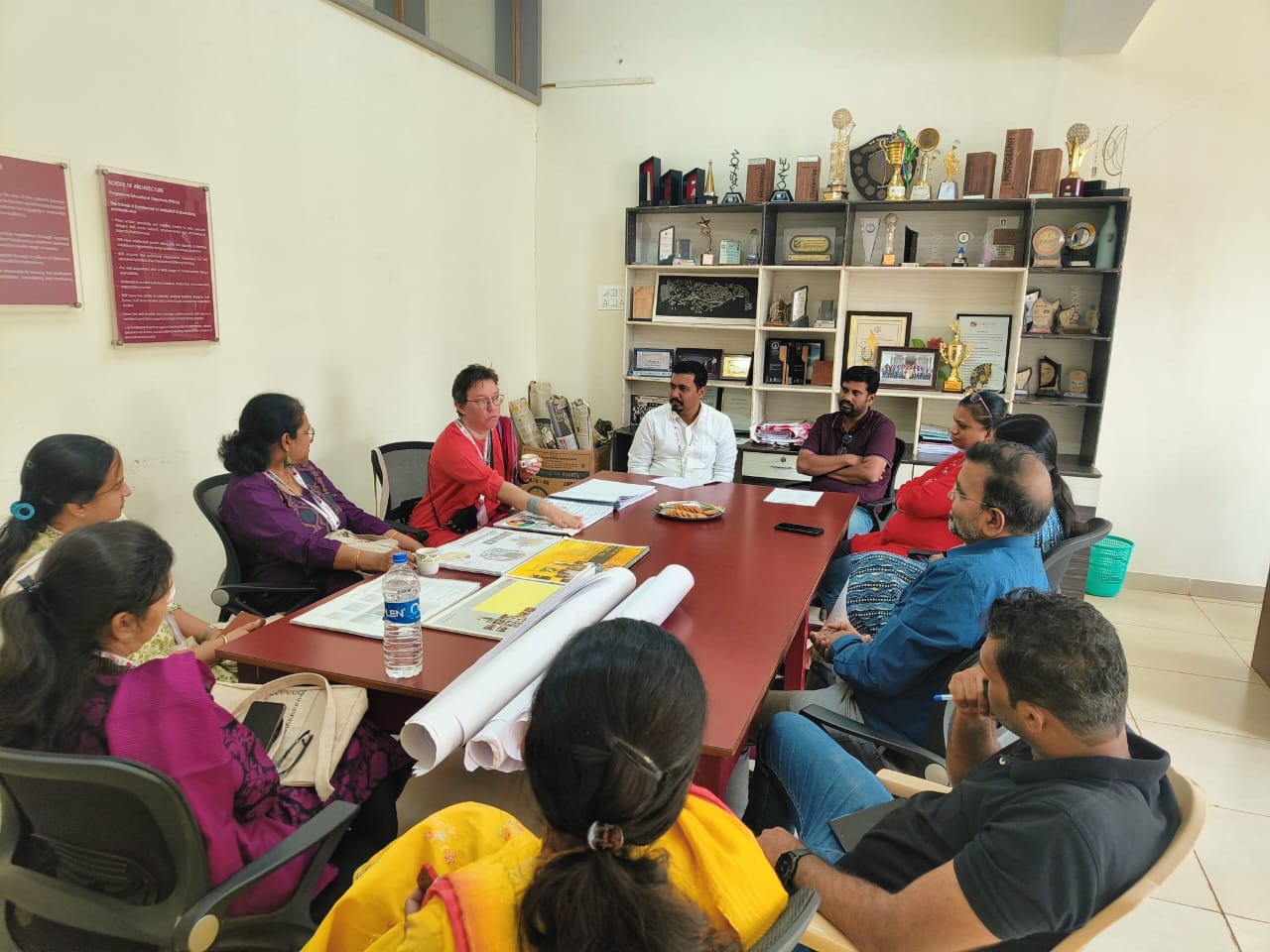
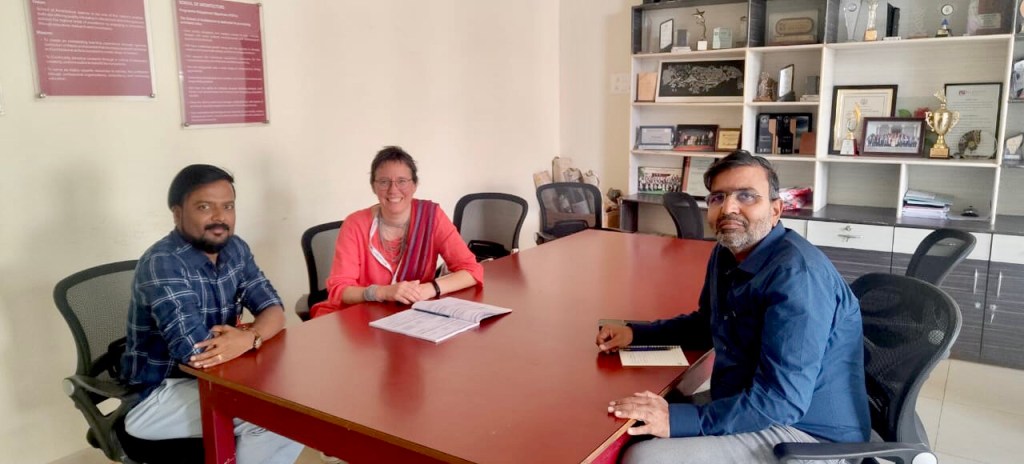
In that initial discussion in their faculty boardroom, we talked about different types of research they are doing and their interests surrounding architectural accreditation.
They asked me to help them build momentum and capacity to do education research, as they were enjoying seeing work presented at REES but were not quite sure how this type of research would look in the context of architecture rather than engineering.
We decided we needed a group identity. We envisioned collaborating with the engineering education research center on their campus (which has its own building, as it’s the leader in this realm in India). We also envisioned becoming active members of India’s IUCEE (the corollary of ASEE or SEFI for India).
As a step forward, we asked Dr/Prof Vijayalakshmi M., one of the main organizers of IUCEE and this event, if we could start a special interest group for architecture (and design?) within IUCEE. She was supportive. She gave us the Indian head shake and said: sure, just get started, and let’s see how it grows!
Meeting with Dr/Prof Vijayalakshmi M. about setting up a special interest group in IUCEE.
It was a very satisfying exchange, and I returned to REES for the day, happy and energized. I toured KLE Tech’s building for technical engineering later that day alongside the always-smiling, always-energetic Dipanwita Chakravarty and my colleagues from near and far.
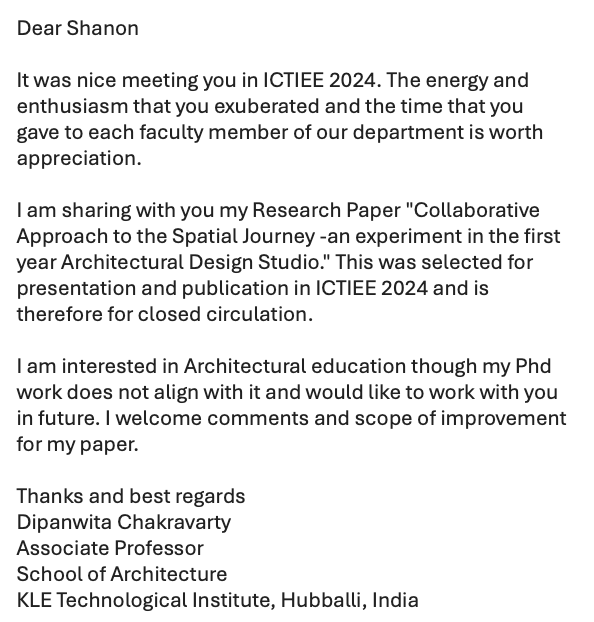
I received a welcome email from Dipanwita with a paper of hers that I am finally getting around to reviewing (there’s be so much to do since I returned home!).Dipanwita was an active participant throughout REES. Here, we were touring KLE Tech’s engineering research building during the Symposium.
The next morning, the architecture staff spirited me away again!
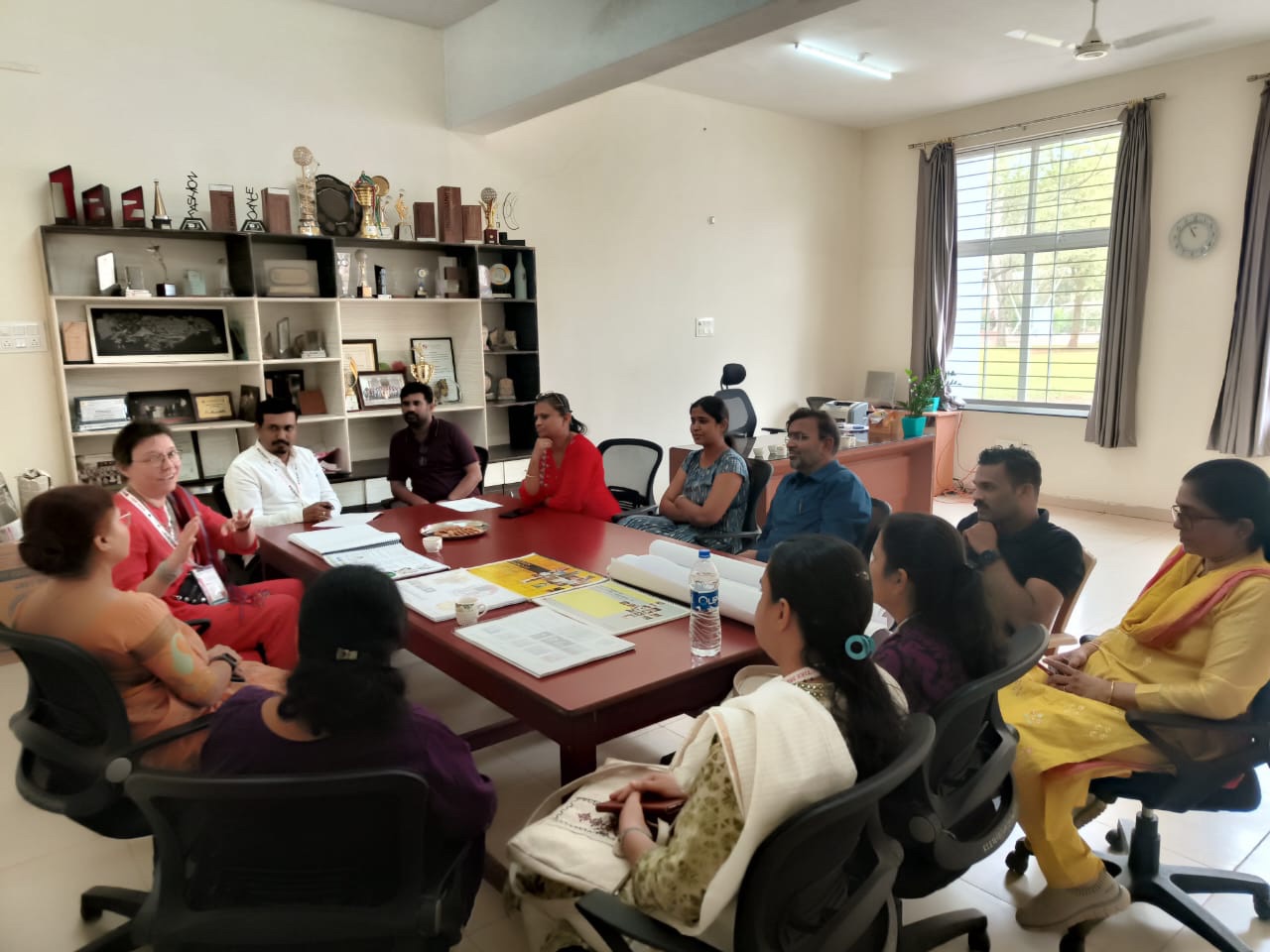
They’d assembled an even larger group to discuss what education research is, how education research differs from technical research on architecture and engineering (like the work they are already doing on thermal comfort and architectural heritage conservation), and how they can get started doing this new type of research.
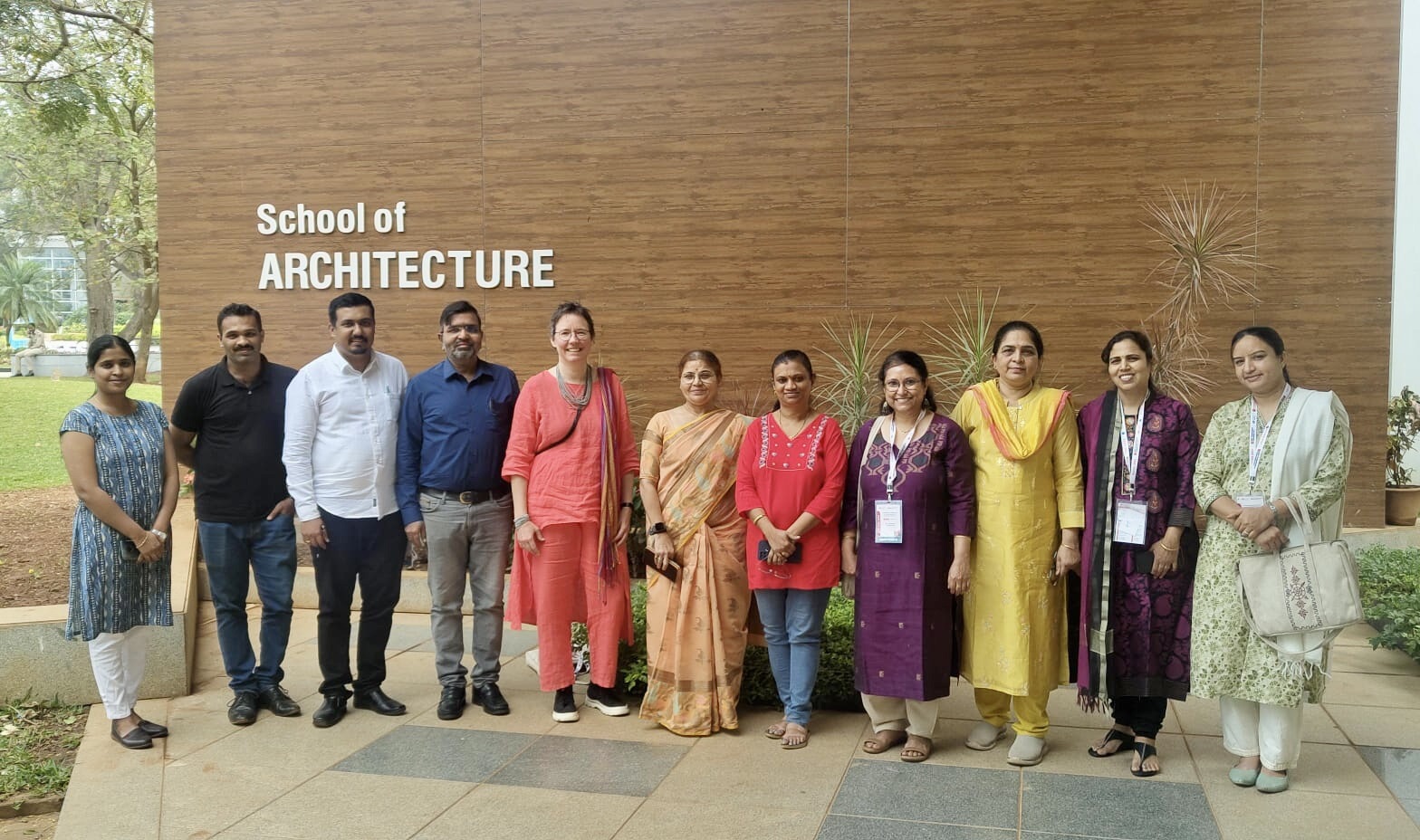
Here are the lovely photos they took of that impromptu seminar along with a photo of our whole group after that meeting.
You can see they made me feel like a rock star! The meeting was so much fun.
We’ve had a gap in communication since the conference ended, because I was on the lecture circuit (lol!) and then getting caught up back home and inducting a new cohort of BIM BSc students.
But my KLE architecture colleagues and I plan to hold online meetings in the near future to discuss examples of educational research in architectural education. I’ve agreed to help them envision, plan, and get started conducting education research.
One of the architects in the group emailed me later, asking me to share my own examples.
Reflecting on this request, I fear my own examples in this realm pale in comparison to my engineering education research. Architecture teachers tend to publish conference papers showing how they taught their class, and of these, my favorite among my papers reporting what might (optimistically) be called research-informed teaching or the Scholarship of Teaching and Learning (SoTL) would probably be Writing Architecture: The Role of Process Journals in Architectural Education and Beginning with Site in Architectural Education.
However, engineering education research is more rigorous than SOTL.
Although ‘engineering education’ conferences will allow the publication of reports on ‘how I taught my class’, the ‘engineering education research’ journals want empirical research studies. You have to collect and analyze data in a rigorous way. An example of this type of work is the book chapter Designing the Identities of Engineers, for which I collected surveys and compared results statistically between ‘engineering’ and ‘engineering technology’ students. The biggest difference I found, and my team reported, was that the ‘engineering’ students envisioned themselves as designers, whereas the ‘engineering technology’ students did not.
My primary research group, the European Society for Engineering Education (SEFI), embraces architects as if they are engineers, which is a reason I identify so strongly with SEFI. Yet, SEFI doesn’t have a special interest group in architecture or architectural engineering, even though the American Society for Engineering Education (ASEE) does have an Architectural Engineering division. ASEE’s Journal of Engineering Education rarely publishes research on architecture education.
In contrast, SEFI’s European Journal of Engineering Education, for which I am Deputy Editor, has been reviewing an increasing number of articles on architecture and construction-related topics in education. I suspect that’s partially because I have the interest, capacity, and collegial networks to help support such articles’ review, refinement, and publication. But I also have amazing mentors in my Editor-in-Chief, Dr. Kristina Edström, and co-Deputy Editor, Dr. Jonte Bernhard. They are encouraging me to build capacity in this realm. And they understand that building the cadre of reviewers with expertise in this area takes time, patience, and much enthusiasm!
Our merry band of editors has ample patience and enthusiasm!
A past EJEE editors’ dinner in Dublin, with Dr. Kristina Edström and Dr. Jonte Bernhard (right), me and Diana Martin (soon to be appointed Associate Editor after impressing Kristina and Jonte!).
[Edit after posting: SEFI just launched a new journal that does publish SOTL papers, see: https://sefi-jeea.org/index.php/sefijeea/announcement/view/1! It says, “The SEFI Journal of Engineering Education Advancement offers a route to share ideas, emerging research, practice experience and innovations in the engineering education field.”]
In reflecting on what publications I have of my own that truly relate to architecture, I have identified Using Architecture Design Studio Pedagogies to Enhance Engineering Education as a favorite of mine. Unfortunately, it isn’t easy to find on search engines and the platform to download it is far from user-friendly. It doesn’t get the attention it deserves, but you can download it by clicking the title and see how you like it!
Another relevant work of which I am very proud is Comparing the meaning of ‘thesis’ and ‘final year project’ in architecture and engineering education. Yet this paper is more conceptual than empirically based and, thus, isn’t the best place to start the discussion with my colleagues at KLE Tech. I am delighted to report that it’s garnered nearly 1300 views since it was published, just 5.5 months ago.
A good place to start our discussion might actually be Comparing Grounded Theory and Phenomenology, an article I think is one of my best but has a very long and obscure title that I haven’t bored you with here!
My KLE Tech colleagues have a keen interest in architecture accreditation. These days, I am more engaged with engineering accreditation than with architecture accreditation (having uploaded a conference paper earlier today on engineering ethics accreditation, in fact). But in the past, I’ve been quite involved with the USA’s National Architectural Accrediting Board (NAAB), and my colleagues at KLE Tech are using NAAB’s guidelines to help them structure their programs. One day, they may seek affiliate designation from NAAB.
Near the end of REES, I found myself again spirited away to the now-familiar meeting room of KLE Tech’s architecture building to discuss accreditation options with Sharan Goudar and another colleague.
Discussing accreditation with Sharan Goudar (right) and colleague.
A text from Sharan encouraged me to finally craft this blog post, in fact. He responded to my recent blog Why India? Inspired by IUCEE and KLE Tech with a request for me to remember the architects:
A friendly text from Sharan Goudar.
Like Sharan, I, too, cherished the moments were shared in Hubli and I look forward to opportunities for more such moments, and a bit of hard (but fun and rewarding) research work, to boot!
My work with VIT Chennai and Dr. Nithya Venkatesan of the Internationalization Office may enable another trip to India, and I will make every effort to include a flight across to KLE Tech’s architecture department while I’m there.
These KLE architecture teachers are lovely, lovely people, and I look forward to getting to know them better and collaborating with them in both research and teaching.
I have an exceptional PhD supervisee at TU Dublin, Sandra I. Cruz Moreno. She is an internally motivated, self-driven learner who needs little to no prompting from me. Supervising her for the past two years has been pure joy.
I am extremely pleased to report that Sandra achieved a major milestone yesterday because she very successfully “defended her Ph.D. proposal” (the term we use in the USA). Here, it’s called a confirmation examination to confirm that a student is on track and suitable to continue onward.
Sandra needed to submit an extensive report. The report is a bit more elaborate than a proposal back home, as it must include the work plan in addition to the first three chapters of the dissertation. She also included preliminary analyses of existing interview data.
TU Dublin is funding Sandra’s PhD so that she can analyze extensive interview data I collected from women studying engineering over the years since 2015. It’s such an enormous amount of data that I’ve never been able to wrap my arms around it fully. Sandra, a sociologist who has worked as a research consultant on rural development for the United Nations and similar organizations, is well-prepared to handle this large dataset. She has embraced the challenge and has made great strides forward.
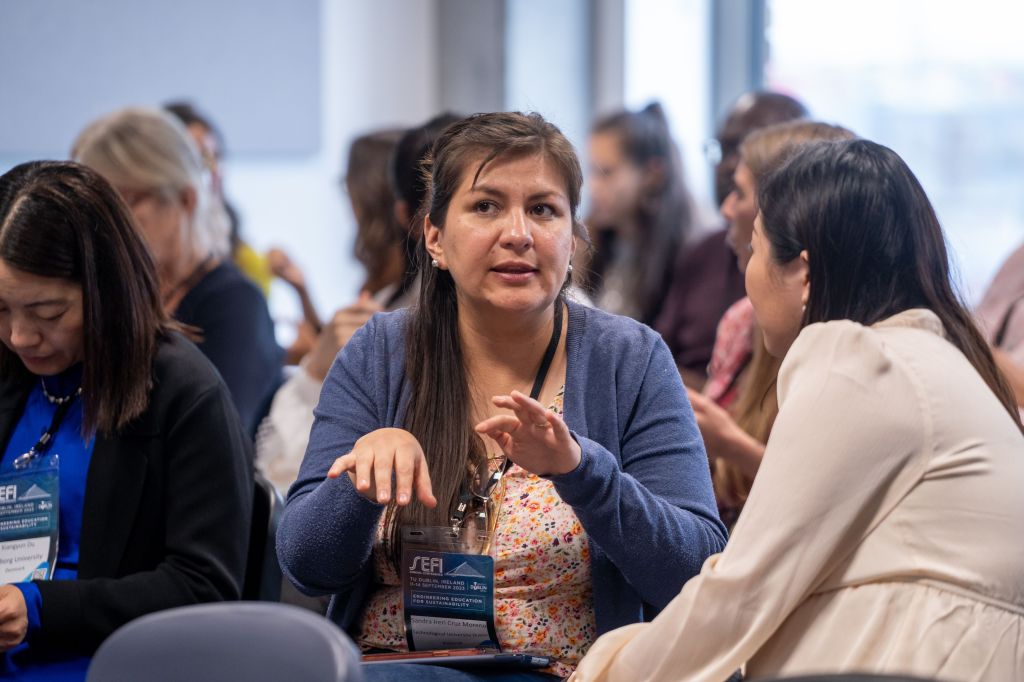
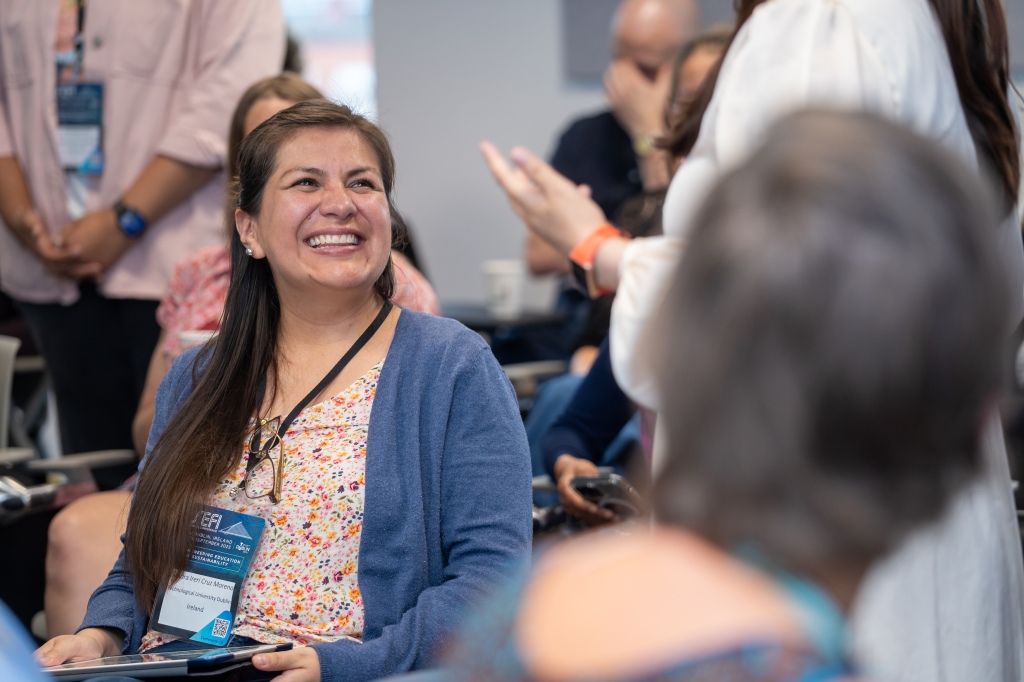
Sandra Cruz at SEFI 2023, where she presented her research (left) and engaged thoroughly in events like the pre-conference Doctoral Symposium (center and right).
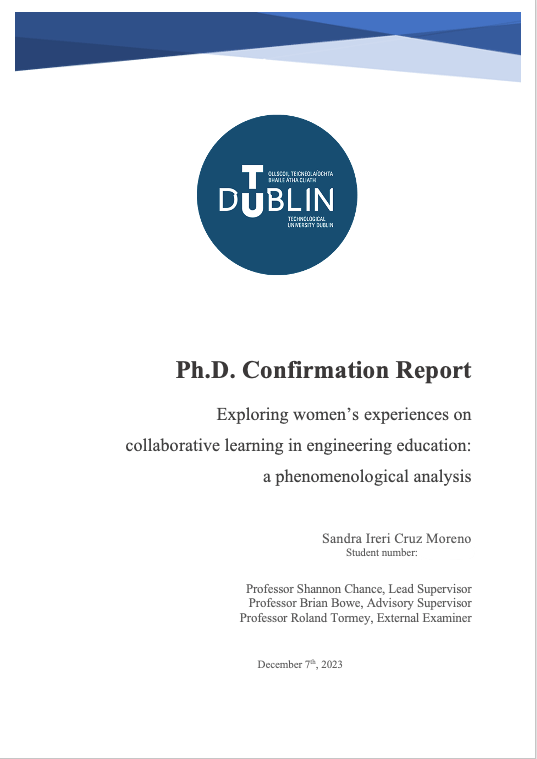
Sandra’s study is titled “Exploring Women’s Experiences on Collaborative Learning in Engineering Education: A Phenomenological Analysis.” She submitted written reports of the coursework she has done to date, as well as a five-chapter document presenting her research. Both of Sandra’s supervisors, as well as our college’s head of research and the external examiner from the Swiss Federal Institute of Technology Lausanne (EPFL), all read and critically analyzed Sandra’s submission.
The result of this review and of yesterday’s two-hour oral examination concluded that her “Proposed research and progress [are] suitable for [Sandra] to remain on the higher register” and proceed into the final stage of her doctoral research. That’s fancy talk for “It’s a go!” and “Full speed ahead!”
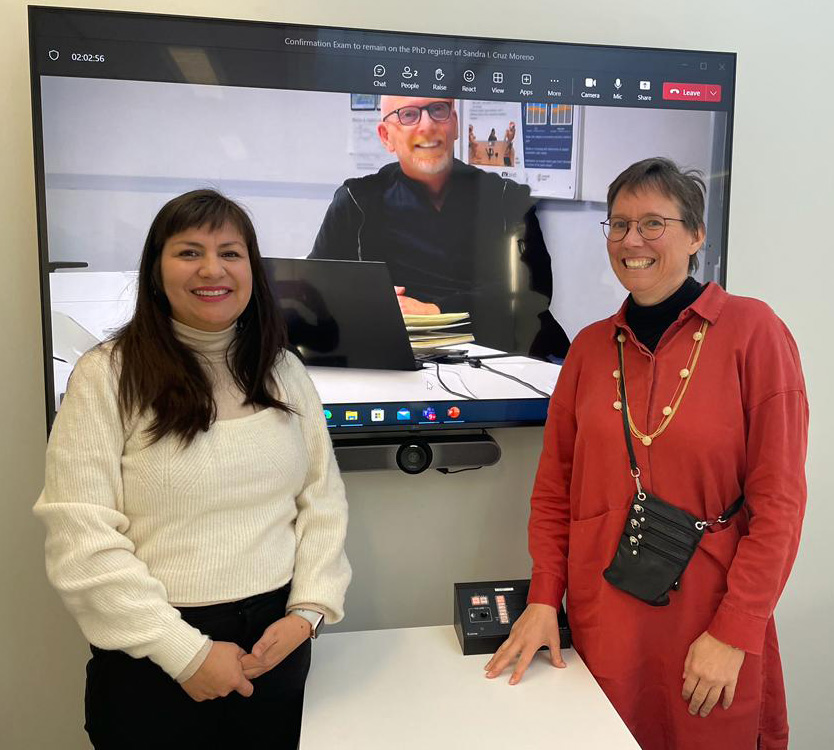
Sandra Cruz with her external examiner, Dr Roland Tormey and lead supervisor, Prof/Dr Shannon Chance, on the day of examination.
Regarding the research Sandra has produced to date, the external examiner’s evaluation states:
The report is very well structured and extremely well written. It demonstrates a high degree of scholarship in dealing with quite a few challenging concepts while, at the same time, managing to make them accessible. There is a very good balance between methodology and methods in chapter three in particular.
The data available is suitable for completing of the PhD and the initial analysis carried out shows quite a lot of promise.
-External Examiner Roland Tormey, PhD
Our advisory supervisor, Prof/Dr Brian Bowe, couldn’t attend the examination (he’s the university registrar, after all, and the end of Semester 1 is an extremely busy time of year). Nevertheless, his guidance to Sandra and me has been essential throughout the process. The advice he provides is targeted and highly applicable. Sandra and I have benefited from having him on the team.
I was delighted, but not at all surprised, to hear about the successful outcome. Congratulations, the result reflects your hard work and dedication.
–Prof/Dr Brian Bowe, Head of Academic Affairs at TU Dublin
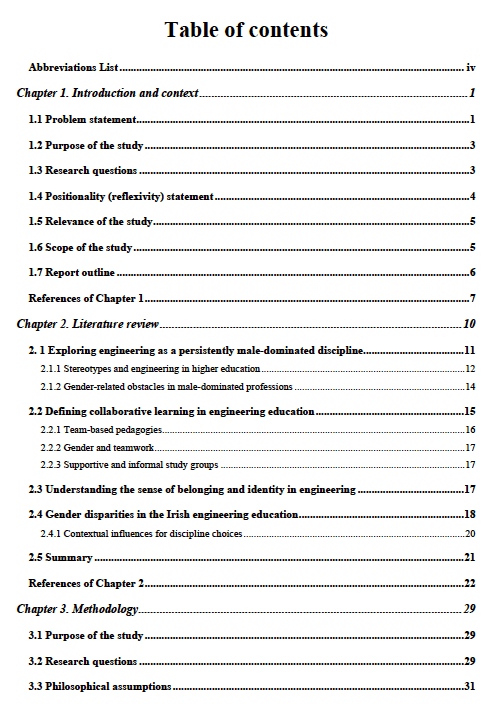
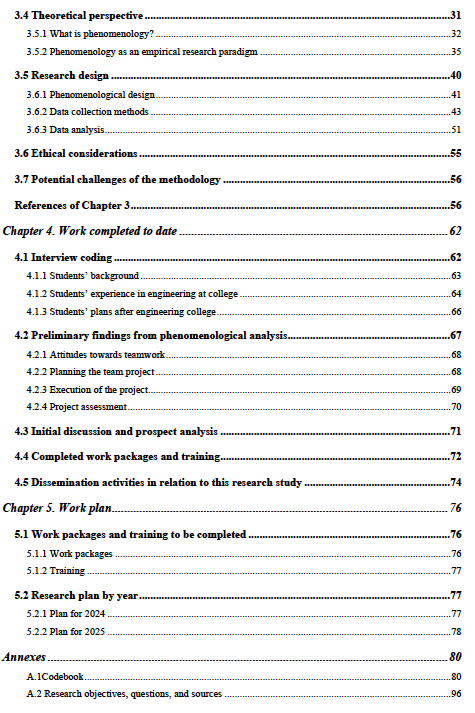
I have included the cover and table of contents of Sandra’s report so you can see the level of detail required. The report is 96 pages long. While Sandra was rehearsing for the examination, I was off in India delivering a paper she authored on policy to address gender gaps in engineering — policy at the European and Irish levels. The policy paper generated great interest and will form part of the PhD study, although it wasn’t a major component of the confirmation report. In fact, there were a number of topics she researched that didn’t need to be explained in detail at this point, such as critical feminism, which will inform her work going forward.
Working with and learning with and from Sandra is an honor and a privilege. I am grateful to TU Dublin for providing the grant to fund Sandra’s research activity. I am grateful to Brian, Roland, and Marek for the support they have lent Sandra and me. And most of all, I am grateful to Sandra for her diligence, perseverance, openness, and sincerity. I have learned so much from her and from working with her!






























 Ireland by Chance