Expand Your World

US State Department video “International Education Takes You Places.”.

Secretary Clinton’s Remarks on International Education.

The U.S. Department of State says “studying abroad changes lives” and “takes you places.”

Hillary Clinton says international exchange is the best form of diplomacy we have.

It has certainly changed mine… and always for the better!


My US friends who want to find an international exchange program can visit http://exchanges.state.gov.  My Irish friends interested in studying in the US can get information from Fulbright Ireland.

Places I’ve travelled as an official representative of the US:

(1994) Virginia, USA > Switzerland

(2005) Virginia, USA > Tanzania

(2012) Virginia, USA > Ireland

Official study abroad programs I’ve lead for students:

Virginia, USA > Italy

Virginia, USA > Tanzania

Virginia, USA > Tunisia

Virginia, USA > Czech Republic

Virginia, USA > Spain

Virginia, USA > South Africa

Virginia, USA > France
“Where will international education take you?”

An Irishman’s Diary

Dear Shannon,

From today’s Irish Times. Thought you’d like it.

Máirtín

An Irishman’s Diary

FRANK McNALLY

Things I love about Dublin:

1. The boardwalk.

2. The view westwards along the Liffey at sunset.

3. The bike scheme.

4. Walking through Trinity’s front square at night.

5. Church bells ringing on a Sunday morning.

6. Kilmainham Gaol.

7. There being a Hilton Hotel across the road from Kilmainham Gaol.

8. Architecture with a sense of humour.

9. Raglan Road on an autumn day.

10. The canyon-like street that runs through Guinness’s Brewery.

11. The walled garden of the Royal Hospital Kilmainham.

12. Italianate grandeur and the poetry-inscribed gravestone of a horse.

13. Walking through the Liberties and suddenly smelling horse manure from a yard.

14. Kids play hurling against the walls of Guinness’s.

15. Extensive use of the nation’s favourite adjective in place-names. Even one of the canals in Dublin is Grand. It has a Grand Parade running alongside it. And there’s a hotel in Malahide that’s Grand too.

16. The Beckett Bridge.

17. Most of the other bridges.

18. Fawning season in Phoenix Park.

19. Signs warning about “fawning season”, while foreign dignitaries are being entertained at Farmleigh and Áras an Uachtaráin.

20. Environmental management with a sense of humour.

21. That circular railing around the Central Bank. Yes, it’s ugly, but it’s always reassuring to see money ring-fenced.

22. The first smell of burgers when you approach Lans-downe Road on match day.

23. Ditto the first smell of home-made ham sandwiches near Croke Park.

24. The pedestrian traffic light outside the Dáil. It always works.

25. The surprising and still growing number of people who clean up after their dogs.

26. Cobblestone streets (except when you’re on a bike).

27. Chinatown.

28. Charles Stewart Parnell proclaiming that “no man has the right to fix the boundary to the march of a nation” just beside the fast-growing Chinatown.

29. Swans on the canal.

30. Barges on the canal, occasionally.

31. The Chester Beatty Library and that Celtic snake thing in the garden outside that children love running around.

32. The politeness of Dublin gurriers who, even while indulging in gratuitous verbal abuse, call you “mister”.

33. Georgian doors.

34. Harry Clarkian windows.

35. Merchant’s Arch.

36. The arch that crosses the road at Christchurch.

37. People in shirtsleeves outside pubs and cafes every time the air temperature climbs above 10 degrees celsius.

38. A crowd of several hundred drinking outside the Barge pub in Portobello on a summer’s evening.

39. Rivers that sound like characters, or oul’ fellas, or both: The Camac. The Poddle. The Dodder.

40. Sweny’s chemist.

41. Joycean plaques in the footpath, like literary manhole covers on underground works.

42. Seeing the names of exotic, far-flung destinations you’ve never heard of before on Dublin buses.

43. Wondering what life must be like there. Where is “Ongar” anyway?

44. Place-names you just enjoy saying: Fishamble Street. Stoneybatter. The Longmile Road.

45. The intensely colourful Zone 3 of the Luas Red line: Goldenbridge. Blackhorse. Bluebell. Red Cow.

Things I hate about Dublin:

1. Hawkins House.

2. Just about every other house built between 1958 and 1980.

3. The state of the footpaths when it doesn’t rain for a while.

4. The part of the boardwalk that every seagull in the city seems to crap on.

5. Panhandlers at ATM machines.

6. Panhandlers everywhere else.

7. Clampers lurking around every corner.

8. The loop-line bridge.

9. The lights on the tip of the Spire that were supposed to glow softly but instead look like a strip of tinsel sellotaped to the outside.

10. The city’s habit of building phallic monuments that, unlike other cities’ phallic monuments, tourists can’t climb.

11. Chain stores taking over Grafton Street.

12. Being expected to call the Grand Canal Theatre the Bord Gais Energy Theatre. Ugh.

13. Having to walk the wrong way up the footpath in Westland Row at 5.30pm, with four lanes of fast-moving pedestrians coming the other way.

14. All those buses heading out of town to the teeming suburb of “As Seirbhis”.

15. Men urinating in doorways.

16. People who don’t clean up after their dogs.

17. Percussive leakage from ear-phones on public transport.

18. You’re strolling along Dawson Street, all chilled out. Then an amphibious bus-load of tourists pretending to be Vikings suddenly passes and roars at you. Very annoying.

19. It’s not even a real roar. They have it recorded, because the tourists are too polite to do it themselves.

20. Grattan’s Parliament being occupied by a bank.

21. And what’s worse, Grattan’s Parliament being occupied by a bank we had to bail out at vast expense.

22. The East-link toll bridge. Only one lane in each direction. No room for anything but cars. Ugly as sin. Had paid for its inadequate self many times over and is still charging.

23. Christmas lights in early November.

24. Ditto Christmas music.

25. Walking through Trinity’s front square at night. Then, realising the feckers have locked the door again, you have go back out by the Nassau Street entrance, where you came in.

Finding Kevin Donleavy

Jerry Crilly, Frank Cullen, and Shannon Chance craic-ing it up at the Cobblestone.

Thanks to an awesome third space, we’ve located Jerry Crilly’s long lost friend, Kevin Donleavy.  I met Jerry when I was in the Cobblestone with my mom last month, and he asked me to help him locate a guy he’d met here in Dublin in 1985. He knew the guy lived in Virginia–somewhere near Ivy–so he considered me an expert.

That night at the Pub, I Googled Kevin and found that he’s taught at UVA and the University of Richmond. He plays traditional Irish music, and is a scholar of all things Irish.

I had some trouble locating him, though. It seems there are NO free phone look up services on line anymore. What a terrible shame!

I tried sending a message to his UVA email address, and waiting patiently.  But, probably since Kevin has been retired for a while, I got no reply.

Jerry was persistent. He followed up a couple of times, just as I had asked him to do.

Last Saturday, he phoned me while I was sitting in a barber’s chair. He was headed to the Cobblestone to hear bluegrass. Could I come?

When I (finally!) got out of that chair, I hightailed it home to do some more searching.  I found Kevin’s home address and even the first six digits of his phone number.  I signed up for a people search service (the “free trial” type that has to be cancelled or will automatically draw monthly payments).  Nerve wrackingly, the company must have lifted those six digits from some other similar service (like Spokeo).  It failed to provide the four we’d need to place a call.

Frustrated and hungry, I phoned Dave for help and headed to the pub.

When my call came in to Dave, he was on our front porch in Virginia installing new floor boards.  (What an awesome Christmas present!  My baby knows how to do things right!)

A couple of hours later–after I’d grabbed some food around the corner and then some pints with Jerry and his friend–a text rolled in from home.

With a stroke of genius, Dave thought to Google “Kevin Donleavy” along with the six digit I’d found.  Dave then texted me a screen shot of the reaming digits.

I passed them on to an elated (and somewhat inebriated) Jerry

I soaked in a little more craic, and then headed for home. It appears this is a good time to introduce you to the term craic, which is pronounced “crack” and has been described by a helpful soul on UK Ask as:

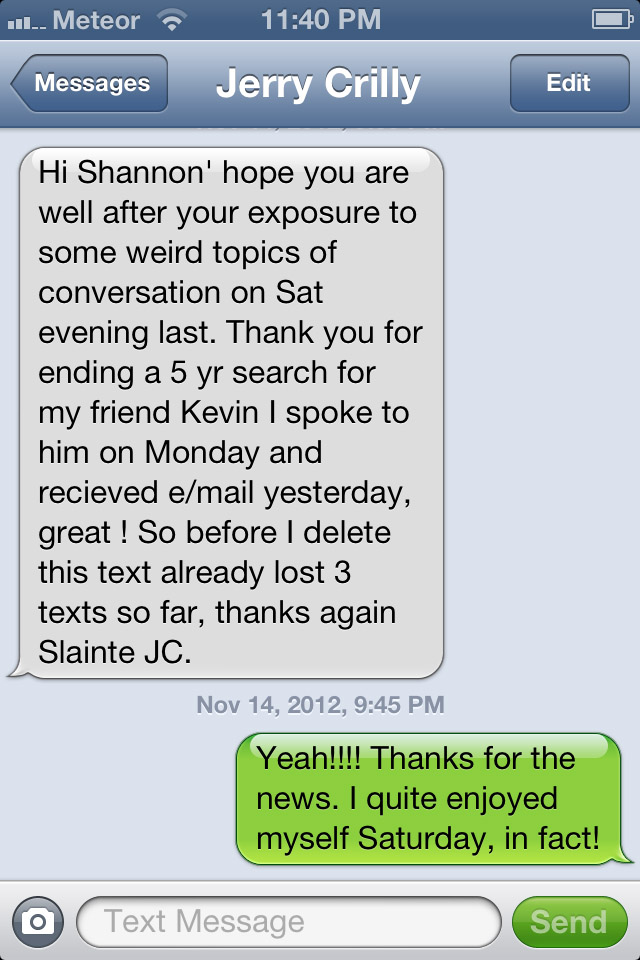
Jerry’s text.

Best Answer – Chosen by Asker

Irish word for fun/enjoyment that has been brought into the English language. usu. when mixed with alcohol and/or music. 
‘Bhi craic agus ceol againn’ : We had fun and music. 
Fun doesn’t really cut it though. General banter, good times had by all. 
Also, a person who is good fun/great company. 
It was great craic. 
She’s great craic when she gets going. 
He’s great craic when he has a few pints on him. 
What’s the craic? 
How’s the craic? 
The craic was mighty.
Note: Very tricky to get away with saying this in the US without getting strange looks for police officers.
After yoga tonight, I found a text waiting from Jerry. I’ve uploaded the text for you to see.  Feel free to celebrate by grabbing a pint of Guinness or Bulmer’s!
And that, friends, is part of the magic of third space!

Third Spaces of Smithfield

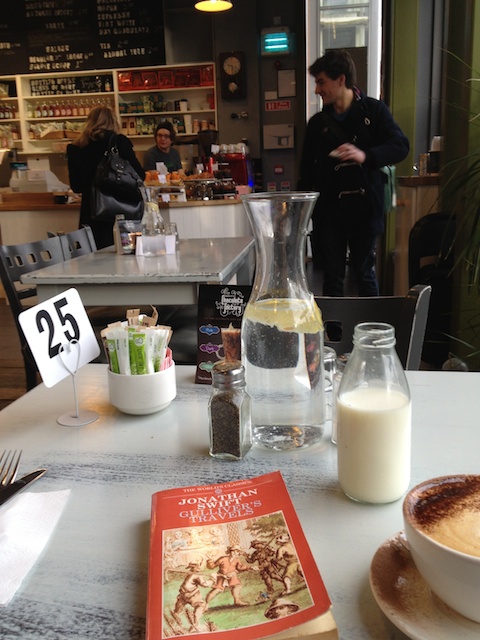
Browse the bookshelf.

A good “third space” helps fill the gap left between your home (your first space) and your workplace (your second space).  It should be a place where everyone feels welcome and equal–regardless of income or social status.

I learned about third spaces from one of my thesis advisees at Hampton University, Ryan Kendall, who asserted that we lack adequate third spaces in the USA.  He proposed to transform our beautiful (but increasingly vacant) Post Office buildings into vibrant spaces. He wanted them to be used for socializing, learning, developing physically, and yes, mailing things (in old- and new-fashioned ways). Prior to his thesis year, Ryan worked at NASA Langley. That happened the summer after he completed the Comprehensive Design Studio that I taught alongside Robert Easter. Ryan was a smashing success with NASA.  And the NASA folks have kept coming back, asking for more and more HU interns and for our department’s help on various design projects.

Ryan Kendall in his job at NASA Langley.

Ryan’s main point?

In the States we often neglect our third spaces… or fail to create them all together.

I’ve found that fostering “third space” is a core tradition in Ireland.  The pub has long served this purpose.

When Dave and I visited Ireland in 2003, we saw entire families spend their evenings engrossed in meaningful conversations with neighbors and friends at the various pubs we visited.  Kids ran in and out and people of all ages mingled happily and comfortably.  Although pub culture is not as strong today (the smoking ban took a tool on the pubs), it’s something you can still find in many places.

I’m fortunate to have several great third spaces very close to my apartment here in Dublin’s Smithfield neighborhood, a district also known by its postal code, “Dublin 7.”

My favorite third space is the Cobblestone pub.  Another–where I’m starting to spend more and more time–is aptly called Third Space.

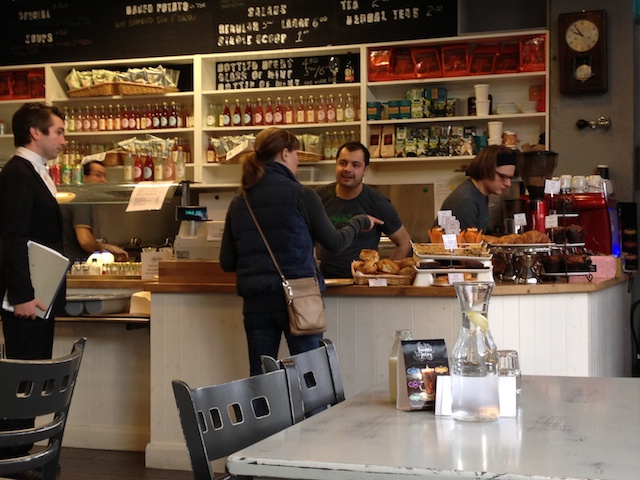
Third Space: changing the city around the table.

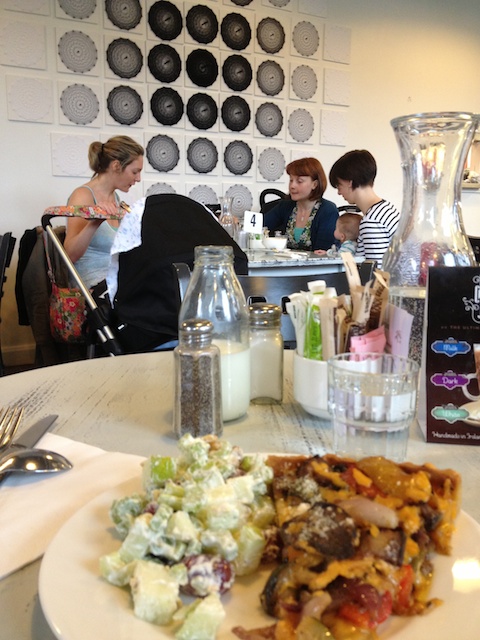
Bring some friends. Enjoy the art.

A webpage for the Third Space restaurant explains:

Our story starts in the changes Dublin saw in the “noughties”. Lots of new apartment blocks, lots of new offices and retail units – no gathering places. Living space and working space but no “third space”.

Third spaces are neighbourhood places where people can gather regularly, easily, informally and inexpensively.

Re-introducing such places into areas that lacked them became a passion for a small group of people. And so was born Third Space. It is a social business venture to open and run eating and meeting places in the areas of Dublin that lack community hubs. With a simple and great menu and an informal friendly environment, they will have a creative buzz that connects into the varied life of a modern Dublin neighborhood.

Third Space 1 opened in Smithfield on February 14th 2012.

I had an interesting encounter at both of my “third spaces” this week.  I’ll post them,  so you can see what I mean. Stay tuned! (Click here to read the sequel.)

Grab a lunch. Everyone’s welcome and they’ll make you feel at home… even a barrister (i.e., lawyer, shown to the left) can find a quite place to reflect on the day, away form the busy halls of the Four Courts.

We’re Talking Mojo!

The Society of College and University Planners just sent out this email:

In four days there have been more than 500 downloads of this week’s featured Planning for Higher Education article. If you haven’t gotten yours yet, it’s available here for a limited time.We are already seeing some great Mojo discussion and blogging in response to Shannon Chance’s feature article “Learning from LEED & USGBC.” Chance is a registered architect and associate professor of architecture at Hampton University. Chance offers her insights on LEED & USGBC a model systems approach to sustainability for higher education planning. Like many other environmental and design professionals, she also recognizes its limitations.

Arlen Solochek agrees that “LEED and the resultant sustainability movement has been an absolute game changer for everyone.”  But while LEED has definitely “raised environmental consciousness,” it is not necessarily as “nimble and responsive” as it should be.  He also notes that LEED standards are becoming compulsory according to institutional and governmental regulation. Other limits include inflexible point system and the expense of soft costs and certification. Both Solochek and Chance agree that “the bigger issue is not just stopping at more sustainable buildings.  How many of our institutions are trying to infuse sustainable concepts into their academic courses, into their students’ and staff’s lives and habits outside LEED?” (Solochek).

According to Michael Haggans, Chance’s article “…balances criticism of the LEED ‘gaming-for-points’ process that many have seen in practice, with a well documented account of the evolutionary improvements that are now underway.” Alexandria Stankovich offers a student perspective on LEED & USGBC in relation to higher education planning on the Mojo blog.

If you’re going to 2012 GreenBuild, please pass this article around. And, please share in the Mojo what you learn.

Thanks.

Visit SCUP’s Planning for Higher Ed Mojo at: http://mojo.scup.org/?xg_source=msg_mes_network

Is this Coke’s Idea of Targeted Marketing?

Billboard next to the Fresh Market.

Really Coke?

This is what you think will appeal to Dublin?

Because nothing says “Christmas” quite like tractor trailer trucks.

Were you trying to make us think “yum”? Because I’m not.

But then, I guess I don’t represent your target market.

I’ve posted a photo of what I purchased just after walking past your tantalizing billboard in Smithfield plaza.  The produce in the photo was already at my apartment (because I keep a collection of fresh fruits and veggies), but the muesli, aloe, and salmon I bought after passing your ad.

My bounty from Fresh Market, Centra, and several local produce vendors.

Applying for a Fulbright to go to the US

I’ve been promoting the idea of applying for a Fulbright to many people I have met here in Ireland.  Up until now, I wasn’t entirely clear on the specific types of awards available for Irish folks who want to be Fulbright-ers in the USA.  I’ve recently discovered that there are three types of awards offered.

  • Fulbright Student Awards: For up to one academic year for postgraduate study or research in the United States in any discipline, including the arts. Grants are a maximum of $20,000. Applicants may stay to complete their academic program if it is longer than one year.
  • Fulbright Scholar and Professional Awards: Grants available for up to €35,000 (Irish Language) and $20,000 (General Awards) for academics and professionals with more than five years’ experience to research and/or lecture in the US, lasting between and three and twelve months.
  • Fulbright Foreign Language Teaching Assistantship (FLTA) Awards: Ten-month Awards for Irish language teachers to refine their teaching skills in the US by teaching at a US college and taking classes at a post-graduate level. Grants are available for approximately €20,000.

The applications are due tomorrow (November 14) for travel in 2013-14, but this information can help my Irish friends as they plan for the future.  Additional information is available from Fulbright Ireland.

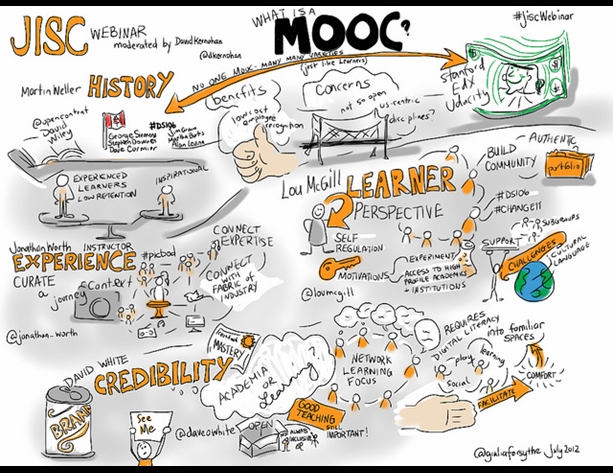
What’s a MOOC? (And can it help us save humanity?)

A diagram from Dave Cormier’s video.

I’ve been scratching my head, wondering “what’s a MOOC?”

Someone at SCUP sent me a helpful link to a succinct four-minute video by Dave Cormier that describes MOOCs and explains that the acronym stands for “Massive Open On-line Course.”  I also found a helpful blog posted by Lou Mcgill titled  What is a mooc? Massive Online Open Course and the learner perspective.

SCUP is using a MOOC to facilitate communication among its members.  I’ve been visiting SCUP’s MOOC for weeks now but I haven’t been able to “see the forest for the trees.”  I haven’t understood what’s going on all around me.  I find my way to some places that seem like classrooms and other places where discussion is going on, but I don’t yet understand how to navigate effectively.

Thanks to Dave and Lou I can finally stop scratching my head!  And, once I understand how the platform works, I can start using it to generate knowledge about planning and sustainability — rather that just about how to use MOOCs and the internet more effectively.

In any case, I believe that this on-line communication platform (i.e., SCUP’s MOOC) is the reason that my article got so many downloads so quickly after it went “live” on the internet.  The splash page for the article was viewed 644 times between November 9 and November 12.

To be honest, up until now I didn’t actually think people read the academic articles I’d published.  But now that I think about it, several people did contact me regarding an article I published with SCUP in 2010 titled Strategic by Design: Iterative Approaches to Educational Planning.  So perhaps SCUP’s audience reads and communicates more about its publications than is the case with many other organizations!

MOOCs provide a platform for learning that can help communities develop new knowledge quickly.  SCUP’s is aimed toward generating knowledge about how universities run and how they can improve their approaches over time.

Perhaps humanity will develop viable paths to achieving sustainability by using tools like MOOCs to share and build knowledge.  That’s part of the focus of my article just published by SCUP and something I think society MUST focus on if we are to persist on this planet.

But I’m quite interested in knowing more about how people work together to generate new knowledge.  The research project I’m conducting right now with Gavin Duffy and Brian Bowe (as part of my Fulbright) investigates how a group of teachers here at the DIT (i.e., a learning community) has been able to implement changes in the way DIT teaches Electrical Engineering.  These are topics I learned a lot about in the Ph.D. program I completed at The College of William and Mary on educational policy, planning, and leadership.

And interestingly, so many of the women I’ve bumped into recently–Esther, Joan, Máirtín’s wife, and myself–have been studying topics of leadership and change management.  Now that I’ve joined SCUP’s MOOC, I have found a whole new community discussing change, strategy, and the university’s role in addressing social and environmental issues. I hope we can elicit the types of sweeping change that this world needs, and do it fast enough to save ourselves.

Fulbrighters Sharing Ideas

I just received great news about my article from one of the editors of Planning for Higher Education.  Terry Calhoun left me this comment:  “Shannon, as of this morning, we have 345 article/summary downloads. So, people are reading, even if not yet commenting.”

I have to say: that’s a truly amazing number of downloads.  It’s a testament to the quality of the organization (the Society of College and University Planners) and its new platform for sharing ideas.
——–

Erin Eife and I discussed the ins and outs of applying to grad schools in between programmed sessions at the Fulbright Orientation.

On another note, Fulbright Ireland just posted a piece on taking the GRE in Dublin that was written by Erin Eife who is a recent college graduate who is conducting research on recidivism among females who have been jailed.

Erin and I sat next to each other at the Fulbright Orientation in September.  We got to talking about grad school and I answered some of her questions about degree paths and about selecting and applying to grad schools.
Erin has since written to thank me for the advice and let me know that she’s following through!  I love getting this type of feedback!  It’s not often that you hear you’ve made an important difference simply by sharing your experiences.
 Erin has got big dreams and I have every confidence that she’ll succeed with the applications she’s submitting this fall.

A Welcome Home with Designer Toast

Georgie, Peter, Jox, and Joan enjoying a crisp fall day in their Dublin home.

It’s not often you get the chance to visit other people’s home when you’re traveling the world.

In Ireland, I can recall being in the home of Elish and Con O’Hanlon in 2003 and, more recently, in the home of Glen’s friends Carol and Connor O’Malley (who run a B&B but treated us like family on our September 2012 visit).  I can’t remember visiting anyone else’s home here yet.

Joan’s beautiful entryway.

So today was a rare treat!  I had the pleasure of brunching with architect Joan Cahalin at her favorite cafe in the outskirts of Dublin and then visiting her family’s beautiful home.  I didn’t expect I’d be able to share photos of this visit, but the family didn’t seem to mind at all when I asked if I could take some photos for the blog.

Joan is currently studying business management at University College Dublin and she also has degrees in architecture, philosophy and linguistics (if I remember correctly). Her husband, Peter Twamley, is also an architect.

Their daughter, Georgie, is studying fashion design at the National College of Art and Design (NCAD). Georgie is a remarkably bright young woman who is full of insight into sociology and culture.  As I did every summer when I was in college, Georgie spent the warm months working on the staff of a summer camp in the USA. We’ve had many experiences in common, yet she seems so much wiser about the world than I was at 20. And she’s got a good sense of her many options for the future.

You can view the photo gallery to see Georgie’s method for making grilled cheese sandwiches using a regular toaster.

I really enjoyed discussing Dublin planning with Georgie, her two architect parents, and her younger brother, Jox who is in high school. He’s at the point in his studies where students spend a year learning subjects, in six-week blocks, that they haven’t covered before. In between these blocks, they have three periods where they are required to work in internship positions. With a bit of help from his mom, Jox found an internship at LinkedIn. It sounds like he has a truly outstanding mentor at LinkedIn.

The internship requirement seems like an great idea.  Many of my friends waited until after they earned college degrees to have the type of experience Jox is getting in high school. And unfortunately, so many of my friends discovered, after graduating, that they didn’t actually like the line of work they’d trained for in college!

After discussing Saturday’s edition of the Irish Times, Joan and Georgie and I jumped into the car. They dropped me at the apartment on their way to visit Joan’s mom in what was left of our daylight hours.