I’m so glad to have Facebook so I can stay connected with family, friends, colleagues, and past students. Several of the students I coached in a Disney design competition work as Disney Imagineers today. Nikk and Nicole Smith crafted this fine image of the Obama family (and yes, they had the blessing of Pixar).
The Obamas as Incredibles, copyright Nikkolas and Nicole Smith.
Carlton Copeland, who travelled to Italy with me last May, posted a reflection shot of his own last week, and acknowledged my contribution. 🙂
Carlton’s caption on Facebook for this shot was: “An addiction taught by @shannonchance — with Shannon Massie Chance.”
Kilkenny Castle’s lawn was full of crafts people last weekend. They demonstrated traditional building methods for visitors to see. I’ve included photos of a man operating a pole lathe and one of a man who thatches roofs.
When visiting County Kilkenny, Dave and I got to visit castles built in a couple of different styles. We did this with the help of the Office of Public Works (OPW) branch located in the industrial park outside Kilkenny.
Error
This video doesn’t exist
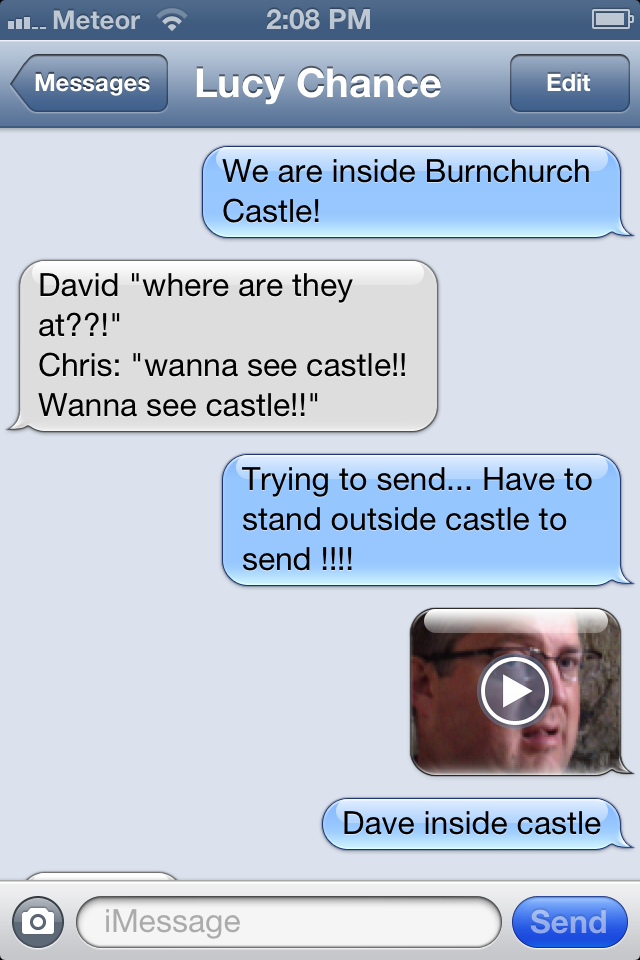
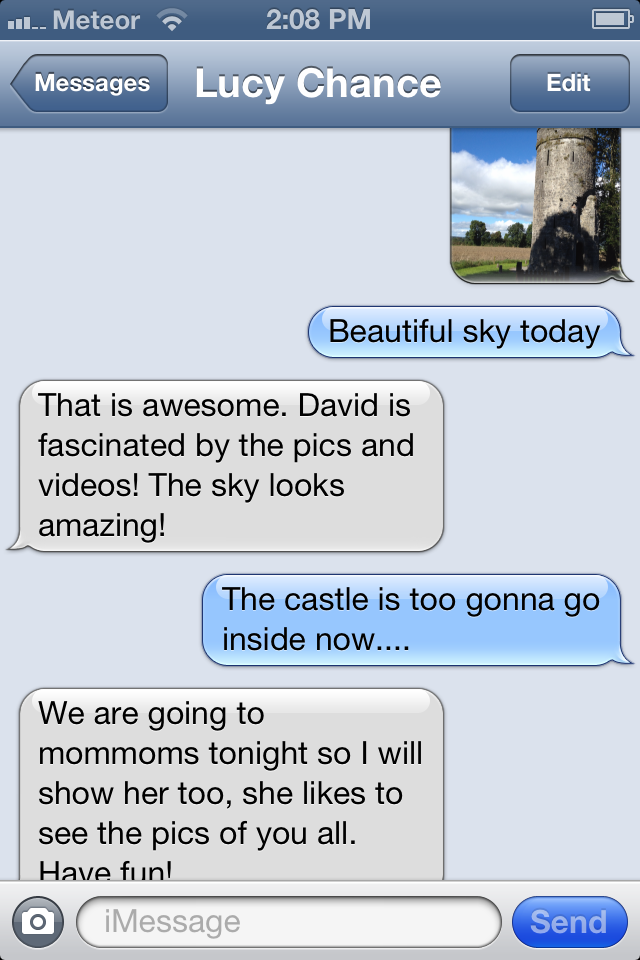
Just before we arrived at Burnchurch Castle, Dave had set me up for free iMessaging (iPhone texting) to his sister-in-law, Lucy. When she texted me a video of the kids chanting “Hi, Aunt Shannon!”, it finally dawned on me that I could easily share moving images with my friends and family back home.
As Dave and I explored the castle, I sent video clips back to the States and got immediate reactions from my beloved ones.
Both the castle and the family pow-wow were amazing.
“Many tower houses have an abundance of mural chambers and passages hidden away within their walls, though few have the number and complexity of those found in the early 16th-century castle of the Burncourt FitzGeralds,” explains Ireland’s Eye. “This well-preserved tower house, occupied until 1817, has four storeys beneath a vault with the principal chamber above, lying just below a gabled roof.”
Ireland’s Eye continues, “Apart from its mullioned windows, this chamber is noteworthy for its finely carved chimney-piece; it has a tall, round chimney, while the roof’s gable walls have been extended so that both ends of the tower are carried up an extra stage to provide high battlemented fighting platforms.”
“A great hall was formerly attached to the tower’s outside wall, but this has now vanished, as has most of the bawn. A curved outside staircase still provides access to the three upper floors of this little tower.”
“There is precious little material available about this pretty well preserved Irish tower. It was built sometime in the fifteenth century by the FitzGeralds of Burnchurch in County Kilkenny. It is known for being one of several Irish towers with the slightly narrower sides of the castle extending up an additional floor, creating in essense a pair of tower wide turrets.”
“This furnishes a natural gable at both ends of the roof as well as an additional defensive level of battlements. There are numerous narrow rooms in the walls, including a ‘secret room’ on the fourth floor. The rounded chimney may be a later improvement [that on the model is square], and the fireplace in the 5th floor Hall sports a ‘joggle voussoir arch’, whatever that is.”
“The castle originally had a bawn with a 41 foot tall tower at one corner. Though the old drawing, date unknown, shows remnants of buildings, only the round tower [see both below] appears to be standing in pictures I found on the internet and in a library book. Burnchurch was apparently last occupied in 1817, but it can be explored.”
At the end of the day, Dave and I celebrated with a trip to Kyteler’s Pub (establish 1324). Dave tortured Lucy (who was visiting his Mom at the time) by texting her this catchy little video.
The book Gavin and I discussed today. Thanks to my Mom for brining me the copy!
Yesterday, Gavin and I met for lunch as normal. We each bring new discoveries to discuss. So I brought the book Mom gifted me, “How to Write a Lot” by Paul Silvia. I found it very helpful–the chapter on group learning even ties directly to our JEE research project. I proposed that Gavin read the book, too, and we can use it to guide a learning group we’re thinking of getting started.
At the end of lunch, something interesting happened. A Muslim guy came into the restaurant, washed up and set up a little space to pray. He simply nudged one table aside and knelt down for a mid-day prayer. I was all ready to head out, so I quietly said thanks and bye to the guy working the counter, and slipped away.
I hoofed it up to Linenhall for a review of work by the third year students in the Architecture Technology program. DIT offers programs in Architecture as well as Architecture Technology.
These Technology are learning to with for and with architects. The teachers in the program (shown on the right hand side, below) do develop the basic design, and the students work in teams to detail the architect-designed building.
One team of Technology students explaining their work.
The teachers give feedback along the way, and make suggestions for refinement of the work. It’s really interesting for me to be able to learn about the construction methods used here in Ireland… which have similarities and differences to those used in the USA.
Glen brought us there in September, when I expressed interest in seeing ruins. It’s located just outside of Newport, which is where he favorite B&B, Seapoint House, is located. (Carol took such great care of us there!)
If you have family there, you can even check the Find a Grave website to locate their internment location.
The “Schools of Thought” lecture series is providing me lots of “food for thought.” It’s being conducted on Tuesday evenings by the fourth and fifth year Architecture studios at the DIT.
Last night Mark Price spoke. He teaches first year Architecture students to draw at University College Dublin (UCD). Create Ireland describes him as “an architect, teacher and writer. He works with the Save 16 Moore Street Committee, the Irish Anti-War Movement and the Irish Palestine Solidarity Campaign.”
At last night’s lecture, Mark spoke on the topic of the Architecture “Crit.” He discussed how unequal power relationships that are inherent in the Crit format both define and limit our profession.
Overall, he was quite critical of the way Crits are conducted.
I am fascinated by this particular topic–I’ve done some research on students’ view of assessment activities like the Crit. I did this work with Michael Seymour at the University of Mississippi, who just won a national teaching award. The paper we wrote, Assessment Formats: Student Preferences and Perceptionswas published in the International Journal of Learning. It even won a research award from the Mississippi Chapter of the American Society of Landscape Architects.
During Q&A session that followed Mark’s lecture last night, DIT lecturer Dominic Stevens argued in favor of the Crit format. I chimed in about what Michael Seymour and I had found. I was trying to contribute ideas for giving students feedback in more humane ways. These are techniques that my colleagues and I use at Hampton University–and that our students responded very positively about when surveyed for the Assessment Formats paper.
After the lecture wrapped up last night, a group of us headed to the Black Sheep Inn “for a pint” and to continue discussing philosophy, architecture, and revolutionary politics.
Mark Price, Dominic Stevens, and Jim Roche deep in discussion at the Black Sheep Inn. Brian Ward and I chimed in, too!
What I have found in Ireland is that the political center is quite farther left than at home in the States. This holds true off campus as well as on.
I also find that I enjoy hearing these divergent points of view. It’s a refreshing change to our two-party, little-choice state of affairs in the USA.
The biggest difference among those gathered over ale last night is that I typically conduct my research from the interpretivist (and sometimes constructivist) paradigm–an observational and participatory stance–whereas the other folks I met with are quite active politically. They are working hard to change things and make the world a more just place. They want to create big-scale change in the world and they are critical of the way things operate.
A professor at the University of Western Cape explains my stance: “Epistemologically, an interpretive researcher is empathetic in nature. The researcher would put him/herself in the shoes of the participant in order to comprehend more effectively. The researcher seeks to recognize the participant’s understanding of situations (Henning, 2005).” This is what I am trying to do in my research project for JEE.
Danna Carballo describes their stance: “Critical theories share some ideas of the interpretative paradigm, but what makes it different is that critical paradigm focuses on oppression. …They believe there are some groups who benefit from oppressing others, so their main jobs are to point out the existing contradictions, in order to help people be aware of what is really going on, and create new forms of language that will enable predominant ideology to be exposed and competing ideologies to be heard.” Mark definitely took this stance in his lecture. His point was that the Crit format oppresses students and reinforces traditionally-desired power arrangements.
I’ve been to Kilkenny three times now, and the place never ceases to inspire and amaze me. I’ll be posting videos soon of the adventures Dave and I had exploring castles/tower houses in the area.
Today, I’m posting some images from a day mom and I spent there this past weekend. We visited the town, its castle, and St. Canice’s Cathedral with one of the only two round towers in Ireland (I read) that’s open to the public for climbing a top.
St. Canice is part of the Church of Ireland… it’s a Protestant church of Anglican/Episcopalina heritage, as evidenced by the kneeling rail a front the altar and the Evening Song we observed.
A view from the bridge on St. John Street.
Kilkenny is the home of Smithwick’s brewery, but Guinness is popular here, too.
Mom and i visited Kilkenny Castle.
We visited the Cathedral Church of St. Canices. It was too wet that day to climb the Round Tower, but we enjoyed displays and singing inside the church.
Evening song at St. Canices.
Stained glass window from St. Canices. It was destroyed, but fortunately an Italian who had wanted to buy it had had it carefully documented, and they were able to produce another.
The impressive heating system in St. Canices. Now that, my friends, is a radiator! The pipes continue down, under the floor. Heat rises up through the ornate grates.
View back from the altar of St. Canices, toward the choir area.





 Ireland by Chance