We borrowed the keys to this castle and got to explore on our own — thank you Kilkenny Office of Public Works!
More stories and videos of Burnchurch Castle to come, as soon as I figure out how to rotate the image for WordPress….
We borrowed the keys to this castle and got to explore on our own — thank you Kilkenny Office of Public Works!
More stories and videos of Burnchurch Castle to come, as soon as I figure out how to rotate the image for WordPress….

The book Gavin and I discussed today. Thanks to my Mom for brining me the copy!
Yesterday, Gavin and I met for lunch as normal. We each bring new discoveries to discuss. So I brought the book Mom gifted me, “How to Write a Lot” by Paul Silvia. I found it very helpful–the chapter on group learning even ties directly to our JEE research project. I proposed that Gavin read the book, too, and we can use it to guide a learning group we’re thinking of getting started.
At the end of lunch, something interesting happened. A Muslim guy came into the restaurant, washed up and set up a little space to pray. He simply nudged one table aside and knelt down for a mid-day prayer. I was all ready to head out, so I quietly said thanks and bye to the guy working the counter, and slipped away.
I hoofed it up to Linenhall for a review of work by the third year students in the Architecture Technology program. DIT offers programs in Architecture as well as Architecture Technology.
These Technology are learning to with for and with architects. The teachers in the program (shown on the right hand side, below) do develop the basic design, and the students work in teams to detail the architect-designed building.

One team of Technology students explaining their work.
The teachers give feedback along the way, and make suggestions for refinement of the work. It’s really interesting for me to be able to learn about the construction methods used here in Ireland… which have similarities and differences to those used in the USA.

The team’s work in progress.
It turns out Burrishole Abbey was never actually an abbey. Although some people know it by that name, the more proper term is Burrishoole Friary.
Glen brought us there in September, when I expressed interest in seeing ruins. It’s located just outside of Newport, which is where he favorite B&B, Seapoint House, is located. (Carol took such great care of us there!)
If you have family there, you can even check the Find a Grave website to locate their internment location.


The “Schools of Thought” lecture series is providing me lots of “food for thought.” It’s being conducted on Tuesday evenings by the fourth and fifth year Architecture studios at the DIT.
Last night Mark Price spoke. He teaches first year Architecture students to draw at University College Dublin (UCD). Create Ireland describes him as “an architect, teacher and writer. He works with the Save 16 Moore Street Committee, the Irish Anti-War Movement and the Irish Palestine Solidarity Campaign.”
At last night’s lecture, Mark spoke on the topic of the Architecture “Crit.” He discussed how unequal power relationships that are inherent in the Crit format both define and limit our profession.
Overall, he was quite critical of the way Crits are conducted.
I am fascinated by this particular topic–I’ve done some research on students’ view of assessment activities like the Crit. I did this work with Michael Seymour at the University of Mississippi, who just won a national teaching award. The paper we wrote, Assessment Formats: Student Preferences and Perceptions was published in the International Journal of Learning. It even won a research award from the Mississippi Chapter of the American Society of Landscape Architects.
During Q&A session that followed Mark’s lecture last night, DIT lecturer Dominic Stevens argued in favor of the Crit format. I chimed in about what Michael Seymour and I had found. I was trying to contribute ideas for giving students feedback in more humane ways. These are techniques that my colleagues and I use at Hampton University–and that our students responded very positively about when surveyed for the Assessment Formats paper.
After the lecture wrapped up last night, a group of us headed to the Black Sheep Inn “for a pint” and to continue discussing philosophy, architecture, and revolutionary politics.

Mark Price, Dominic Stevens, and Jim Roche deep in discussion at the Black Sheep Inn. Brian Ward and I chimed in, too!
What I have found in Ireland is that the political center is quite farther left than at home in the States. This holds true off campus as well as on.
I also find that I enjoy hearing these divergent points of view. It’s a refreshing change to our two-party, little-choice state of affairs in the USA.
The biggest difference among those gathered over ale last night is that I typically conduct my research from the interpretivist (and sometimes constructivist) paradigm–an observational and participatory stance–whereas the other folks I met with are quite active politically. They are working hard to change things and make the world a more just place. They want to create big-scale change in the world and they are critical of the way things operate.
A professor at the University of Western Cape explains my stance: “Epistemologically, an interpretive researcher is empathetic in nature. The researcher would put him/herself in the shoes of the participant in order to comprehend more effectively. The researcher seeks to recognize the participant’s understanding of situations (Henning, 2005).” This is what I am trying to do in my research project for JEE.
Danna Carballo describes their stance: “Critical theories share some ideas of the interpretative paradigm, but what makes it different is that critical paradigm focuses on oppression. …They believe there are some groups who benefit from oppressing others, so their main jobs are to point out the existing contradictions, in order to help people be aware of what is really going on, and create new forms of language that will enable predominant ideology to be exposed and competing ideologies to be heard.” Mark definitely took this stance in his lecture. His point was that the Crit format oppresses students and reinforces traditionally-desired power arrangements.
With that, I can clearly agree!
When I texted this photo of St. Canice’s interior to my (awesome) sister-in-law Lucy she texted back:
Christopher (age 2) wouldn’t stop staring at the image on the screen.
David (age 4) asked, “When will we go in Ireland?” That’s exactly what I want to know! How I miss my nephews (and their parents).

St. Canice’s nave.
I’ve been to Kilkenny three times now, and the place never ceases to inspire and amaze me. I’ll be posting videos soon of the adventures Dave and I had exploring castles/tower houses in the area.
Today, I’m posting some images from a day mom and I spent there this past weekend. We visited the town, its castle, and St. Canice’s Cathedral with one of the only two round towers in Ireland (I read) that’s open to the public for climbing a top.
St. Canice is part of the Church of Ireland… it’s a Protestant church of Anglican/Episcopalina heritage, as evidenced by the kneeling rail a front the altar and the Evening Song we observed.


A canal runs through downtown Westport.

This is the “octagon” in Westport.

A favorite archway… Glen McClure brought us here last month.

The Protestant church in Westport.

A contemporary sculpture next to the IshSko Center.

Reflections on news

It never ceases to amaze me that the Irish serve lasagna with a side of fries (which they call “chips” or “wedges”). Here, potato chips are called “crisps.”
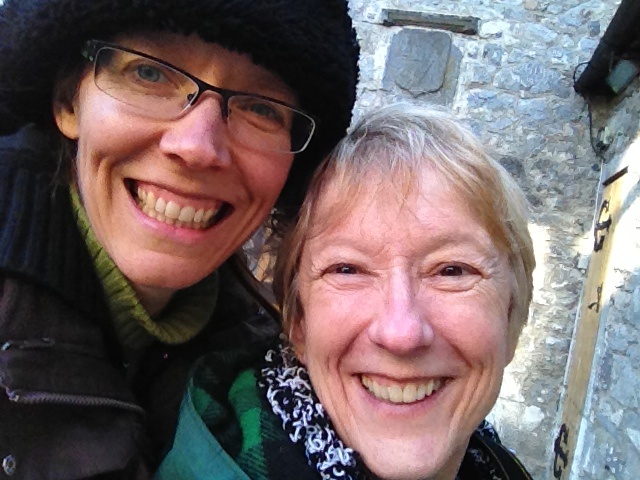
A vist to the Rothe House in downtown Kilkenny, with Mom.
We learned a bit about technology over the centuries during our visit to Kilkenny’s Rothe House this weekend… everything from timber frame construction, to cooking techniques, to fashion.
The Rothe House also provided a diagram of the garderobe, to help you understand the toilet system used throughout Europe from the medieval ages until the Industrial Revolution. Unlike this one, in most of the castles around Kilkenny, the garderobe was inside the wall and accessed through a corridor in the wall. They hung clothes in this corridor, because the acid in the air deterred mites and bugs.
Of course, there’s always been the option of a chamber pot. I’ve provided a reflection shot of an antique shop that has two chamber pots for sale.


There’s a wonderful article in today’s Roanoke Times about Glen McClure and the show he’s opening this weekend in southwestern Virginia (my birthplace). Dave will be attending the opening, along with Marshall McClure, Glen’s awesome wife.
Meanwhile, back at the Irish ranch, I’m pulling together a proposal in hopes of showing photographic work by Dave, Glen, and myself in Dublin. Fingers crossed!
This kind of cultural exchange is what the Fulbright program (and my job as a Fulbright Scholar) is all about. I’m trying to help people understand each other better, in so many respects. That’s also the point of the social science research I’m doing here.
Dubliners: If you know a gallery that might like to exhibit Landscapes of Mayo by Glen, Faces of Mayo by Glen, Vestiges of Ireland by Dave, and/or Reflections of Ireland by Shannon, please drop me a line!

The canal running through downtown Westport.
It never ceases to amaze me that they serve lasagna with fries (called chips or wedges). Here, potato chips are called “crisps”.
The Protestant church in Westport.
.
.
A contemporary sculpture next to the IshSko Center.
.
Reflections on news.
.
.
The “octagon” in Westport.
.
A favorite archway… Glen McClure brought us here last month.
.

This is a “Achill salmon salad plate”. Many thanks to Glen McClure for helping me figure out what a “salad plate” is.
.
.
.

The train knew I was coming. All the train cars are brand-spanking new.
.
.

The Cullan brothers sat across from me on the train. Our Macs communed. (And my iPhone distorted their heads… live and learn!)
 Ireland by Chance