Fulbright Programs in Europe/Euraisa — Upcoming Webinar

I received the following email announcement today, and thought you might be interested.  If you’ve ever considered applying for a Fulbright position, there’s no time like the present!

INVITATION TO JOIN US FOR A WEBINAR

Webinar Title: What’s New in Europe/Eurasia for 2015-2016
Date: Tuesday, March 11, 2014
Time: 2:00 PM – 3:00 PM EDT

Join CIES staff who work on the U.S. Scholar Program for a look at the large number of awards in the 2015-2016 competition available across Europe and Eurasia for scholars, professionals and administrators. Opportunities exist for teaching, conducting research or combining both.

Please be sure to register to reserve your seat for this webinar. The webinars are archived in order for you to review past sessions that you may have missed.

Sincerely,

Bill McShane
Program Officer, Fulbright U.S. Scholar Program
Institute of International Education (IIE)
Council for International Exchange of Scholars (CIES)
202-686-8665
wmcshane@iie.org

Fulbright Scholars Program: Calling New Applicants

Are you an aspiring Fulbright scholar?  This year’s call for applicants is open!

The competition for the Core Fulbright U.S. Scholar Program for the academic year 2015-2016 will be opening in a matter of days.  Be sure to consult the IIE/CIES website (www.cies.org) for complete award information.  Please also note that CIES will be opening its webinar series this Thursday (January 30) at 2:00 PM EST with “What’s Fulbright?,” a presentation on the Scholar Program in general [note from Shannon: you should be able to find this in the archives since it already happened]. That will be followed on Wednesday (February 5) at 2:00 PM EST with “What’s New?,” a presentation on 2015-2016 competition highlighting new awards, program innovations and other areas of interest.  As always, be sure to note that the competition deadline will be Friday (1 August 2014). We look forward to seeing you.
Best wishes,

Andy Riess, Ph.D.
Assistant Director, Outreach
Fulbright Scholar Program
Council for International Exchange of Scholars (CIES)
Institute of International Education (IIE)

Cheers from W&M

The William and Mary School of Education students I spoke with (about my Fulbright research) last week sent you a wave.  My iPhone was acting strangely and I captured only the tail end of their wave, but I assure it was wholehearted.

A sincere Virginia hello, from us to you!

WM SoE Wave

WM SoE Wave

Trend Shifters and Hip Young Urbanites

Donald Roman NYT feature

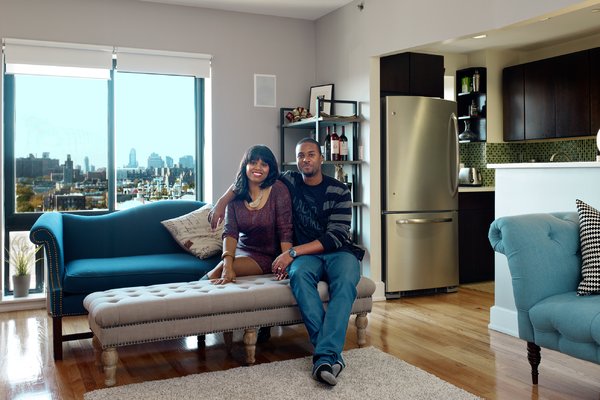
Fabiola and Donald Roman, as featured in the New York Time real estate section.

Times are changing.  Demographers tell us that younger set is shirking automobile ownership and moving closer into American cities.

I’m proud to say that one of my former Hampton University architecture students, Donald Roman, is among them.  He and his  wife, Fabiloa, recently chose a condo in Brooklyn over the now-faded suburban dream.  And, the New York Times just celebrated their accomplishment with a feature story.

If I recall correctly, Donald was never a fan of the car.

I’m happy to say that the heavy urban design emphasis of our architecture degree program served to strengthen his understanding of the benefits of population density and walkable city design.

I’m immensely proud that Donald and Fabiloa, who met in an Upward Bound program when they were in high school, planned well and chose carefully.  They overcame tremendous odds to become homeowners under the age of 30.  And, they had the good sense to recognize that living in a densely settled area means shorter commutes and quick access to a huge range of services.

During his time at Hampton University, Donald travelled with me to Tanzania on the 2005 Fulbright-Hays Group Project Abroad program I conducted.  It was a true joy to have Donald among the 23 American students and 65 Tanzanian students on the program.  He was immensely popular with the entire group and his soft-spoken but optimistic spirit uplifted our group every day.
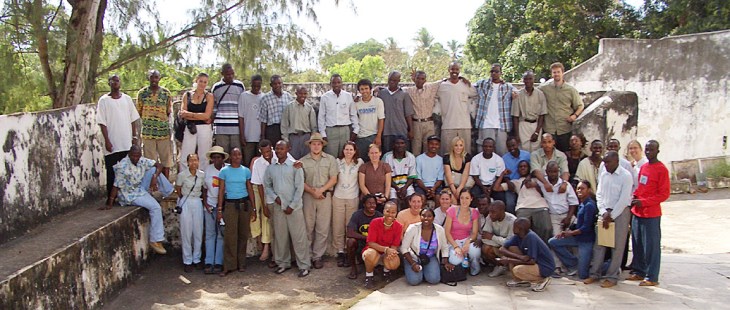
Our 2005 Fulbright-Hays group in Tanzania.

Our 2005 Fulbright-Hays group in Tanzania.

Donald also made a big difference in my life when he introduced me to Malcolm Gladwell.  He even handed me a copy of The Tipping Point as we were leaving Sunset Beach on our last day in East Africa.

The Tipping Point is about “how little things can make a big difference.”  Interestingly, the NYT feature ends with a quote from Fabi about little things that make a big difference in one’s quality of life (like a dishwasher — and I totally agree!!!).

Thanks, Donald, for sharing with me your reflections on Gladwell’s ideas when we were beginning our trek home.   Your insights got me interested enough to invest  time in cracking the cover, and I had almost finished reading the book by the time my plane landed in Norfolk.

Since then, I’ve read each of Gladwell’s new releases cover to cover.  A new one, about David and Goliath, just hit the shelves and beacons me to read.

There are interesting TED talks by Gladwell on David and Goliath and “choice, happiness and spaghetti sauce” to help get you started if you haven’t yet cracked the mystic of Gladwell’s storytelling ability… or if you just want to have some fun learning about the break through discovery of vegetable chunks.

Testing Theory in Practice

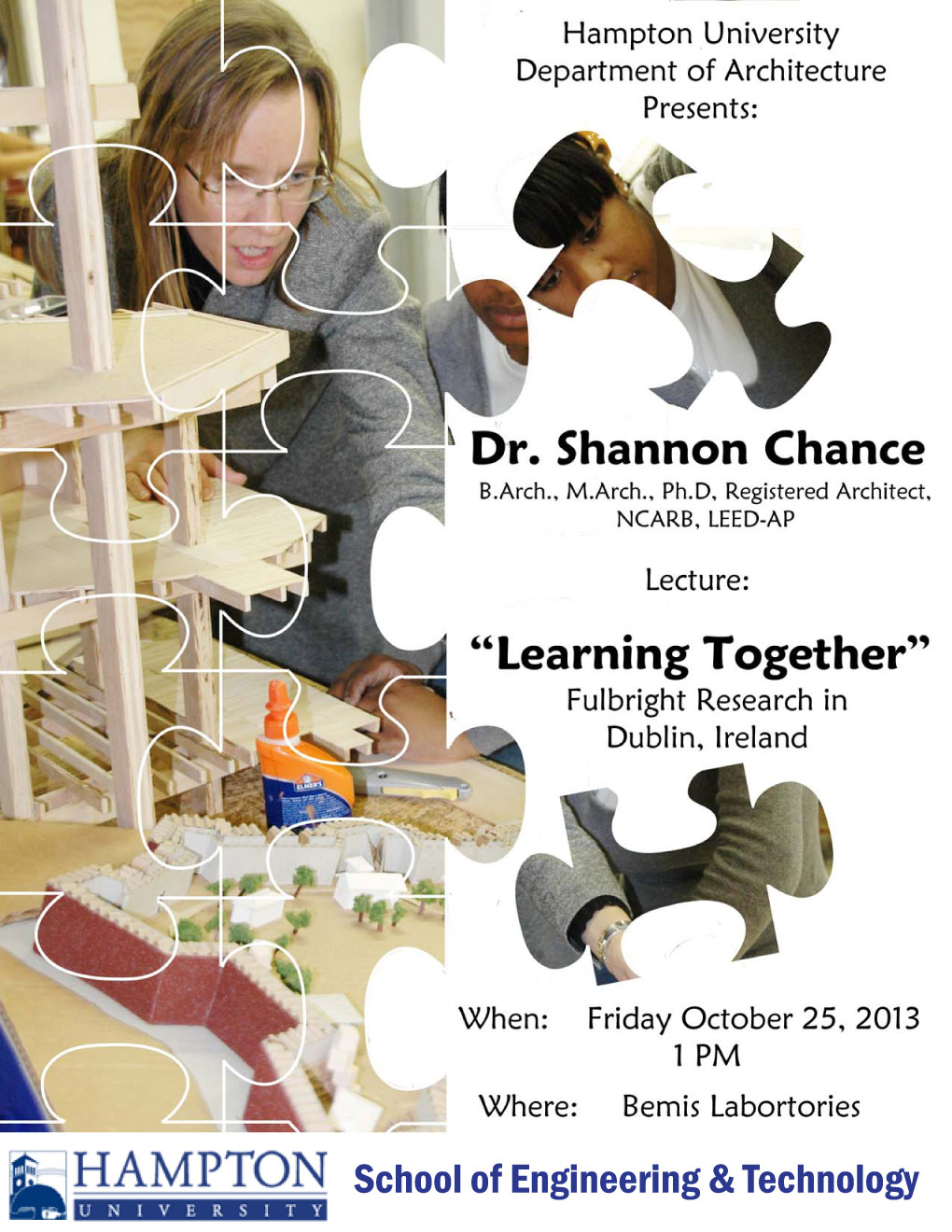
Yesterday I got to share some of my Fulbright research as part of the weekly lecture series hosted by the Hampton University Department of Architecture.  It was a great way to catch up with the advanced students and introduce myself to the first year group.

The students were highly attentive, very receptive to learning about epistemology and cognitive development theories, and interested in hearing about how I am using  data from student blogs  to test existing theories.

The faculty seemed genuinely interested, too.  At the end, though, there was no time for the faculty to ask questions… the students had so many questions that I finally had to cut things short and send them off to their studio classes.

At the start of the lecture, I had asked the students to pull out their smart phones and look up this blog site.  As a result, they had many questions about what I’ve found in applying the new methods in the second year studio and sustainability classes I teach.

I also passed around the catalog from my photography exhibition, so they could see some of the artwork I created in Ireland.  I also encouraged them to look up pages about my adventures in Greece, Portugal, Belgium (which I still need to post more about), France, and of course, Ireland.

Lecture poster (produced by HU student Samuel Morgan).

Lecture poster (produced by HU student Samuel Morgan).

Constructing a Student-Centered Studio

The incoming second year architecture studio cohort at Hampton University.

The incoming second year architecture studio cohort at Hampton University.

Today I applyed what I learned about problem-based learning (PBL), group learning, and student-centered pedagogies while I was on my Fulbright fellowship at Dublin Institute of Technology. I met the students in my second year architecture studio for the first time. Studio looked unlike Day One of this class (ARC201) ever looked before!

We started outside, with team building activities and a name game. Then we formed the teams (i.e., learning groups) that we’ll use for the first five weeks of this semester.

Next, we conducted initial site analysis in a way that was much more engaging than normal. We held a “scavenger hunt” to identify qualities of our project site (the Hampton University Point) that have to do with water.  The students managed to generate a much more interesting list of factors than I’ve ever been able to get them to achieve before; 63 about water alone!

For Friday, each team (of three students) has two assignments due.

Assignment 1 is to draw a plan of our project site to an architectural scale to fill an 18″x24″ sheet of paper.

This problem prompt is pretty specific (close-ended), but it still leaves a number of variables for students to consider and make choices about.  I hope they’ll get a bit competitive and prove they have pride in their work!  I asked the groups to follow a standard PBL format in starting work on this assignment. I asked them to figure out:

  1. What is this assignment asking?
  2. What will we need to know to do this?
  3. What do we already know about this?
  4. What will we need to learn/find out?
  5. What resources will we need?
  6. Who will do what and when?
  7. How will we check for accuracy before it’s due?

Assignment 1 is more straightforward than you might expect for an architecture studio. However, it will lay groundwork for upcoming activities, and it will help me assess where the students are skills-wise and with regard to collaboration. The second assignment is much more open-ended.

Assignment 2 is to make a beautiful object that reveals the essence of water.

I asked the groups to start by watching one of the YouTube videos listed below, and assume that the astronaut/scientist had made the video in response to this assignment. I asked the students to consider the questions above (which are intended to foster “self-direcetd learning”) and to bring to our next studio meeting a final, beautiful object as well as at least three study models that investigating the “essence of water”.  I’ve got my fingers crossed!

The students were more  active, engaged, and enthusiastic about learning than is typical on Day One of this course and I have high hopes for this new method of teaching.

NASA: Amazing Experiments with Water in Zero Gravity – YouTube

NASA: Amazing Experiments with Water Balloons in  – YouTube

The Good News

The Good News is, I got my grant proposal submitted.  Because I’m pretty new to the field I’m researching, my chances are probably below the 13.2% success rate. On the other hand, I’m hoping the fact that I was so careful and spent so much time will boost my odds.  Sometimes the best you can do is try.

The Bad News is, I haven’t had time to blog.  There’s still so much to show and tell.  But since I’m headed home in less than a week,  I am up to my elbows in packing instead of showing and telling.

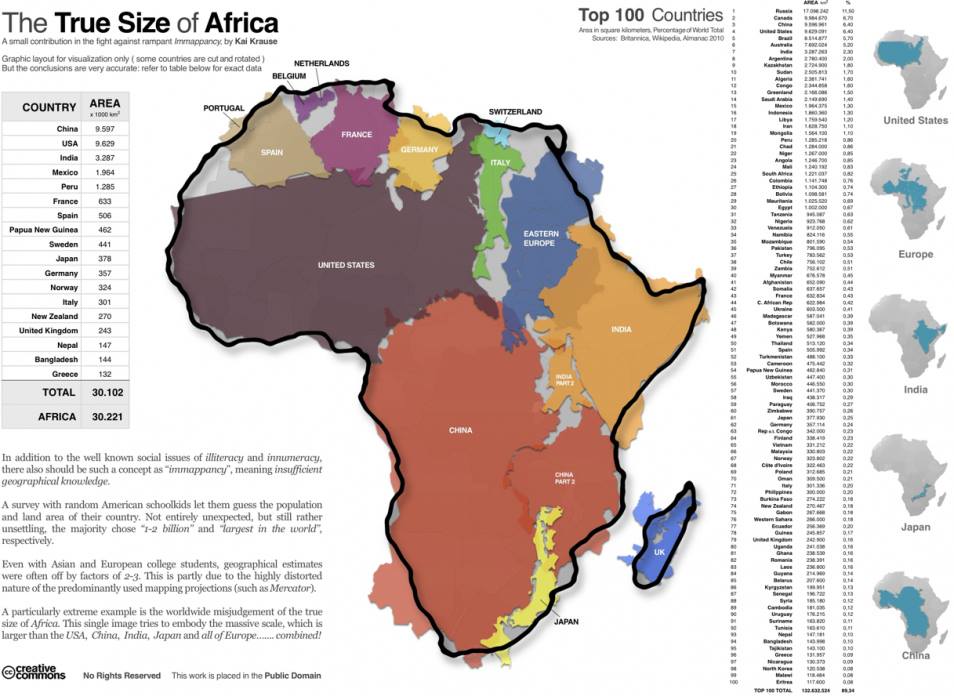
In the meantime, I’ll upload an intriguing map posted on Facebook by my brilliant and talented former student from Hampton University, Lanre Ajibola. The size and shape of the USA is shown in dark purple.  Lanre was born in Nigeria and he says:

Quick Geography lesson: next time anyone talks about Africa like it’s a country, present this map – you are welcome!

Seeing as how I directed a Fulbright-Hays program to Tanzania in 2005, it makes sense for me to post this on my Fulbright blog even though it has nothing to do with my trip to Ireland. 🙂

Speaking of relative sizes, I’d better get back to seeing how much I can stuff into my suitcases without going over the weight limits….

Relative size of Africa

Relative size of Africa

Dreaming of Birmingham

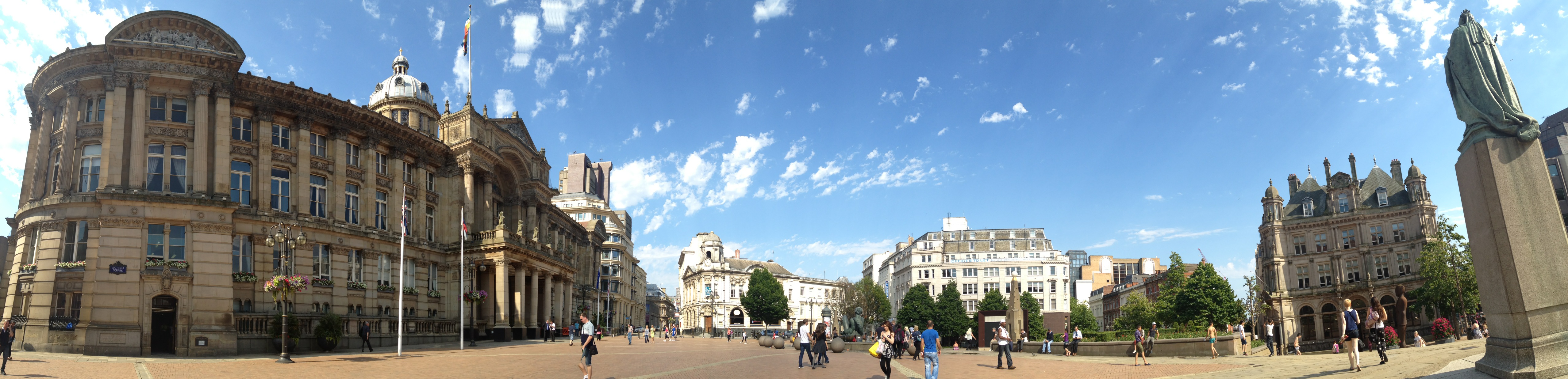
Birmingham UK 4

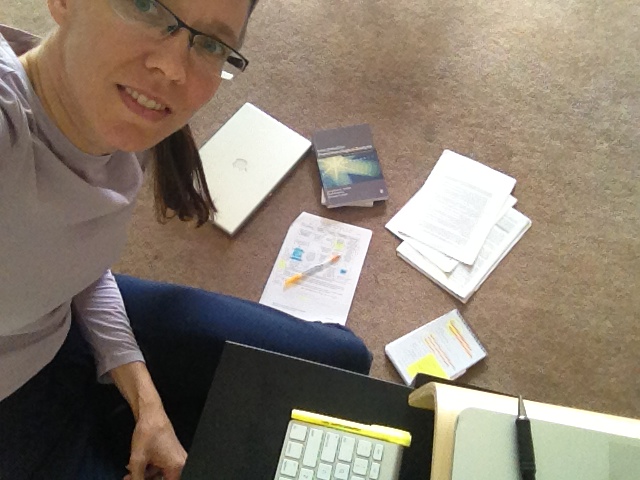
Shannon burried in books and papers.

Shannon swimming in books and papers.

I’ve been buried in books and papers for days.

I’m working overtime on a research proposal… trying to find funds to return to Dublin so that I can follow up on findings I’ve made and keep learning new research skills by working with experts and doc students here.

The last time I got to go outside and explore was last week in Birmingham.  Wikipedia explains that Birmingham is:

city and metropolitan borough in the West Midlandsof England. It is the most populous British city outside the capital London with 1,074,300 residents (2011 census), an increase of 96,000 over the previous decade.[2] … A medium-sized market town during the medieval period, Birmingham grew to international prominence in the 18th century at the heart of the Midlands Enlightenment and subsequent Industrial Revolution, which saw the town at the forefront of worldwide developments in science, technology and economic organisation, producing a series of innovations that laid many of the foundations of modern industrial society.[5] By 1791 it was being hailed as “the first manufacturing town in the world”.[6]

I’ll share pictures of that city today, in all its splendor….

Leading SEFI at the University of Birmingham, UK

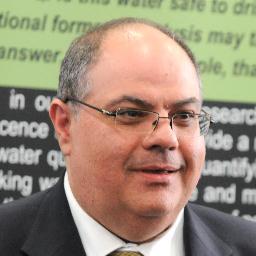
Prof. Kamel Hawwash

Prof. Kamel Hawwash

Last week I travelled over to the UK to visit professor Kamel Hawwash, the incoming president of the European Society for Engineering Education (SEFI).

Prof. Hawwash has done a great deal of  work in attracting and retaining diverse students in engineering, a topic known as “attractiveness” in the UK, and one in which I’m aiming to do more research.

Prof. Hawwash’s SEFI presidency will focus on two main topics:

1) employability and skills

2) attractiveness

We had much to discuss and we met for nearly two hours!  After our meeting, I had a chance to look around the University of Birmingham campus and then explore the city before flying back to Dublin via Ryanair.

New “RoboSlam for Facilitators” Workshop

Ted, Damon, and I have been gearing up for future RoboSlam workshops.   We have been looking for sponsors to help us continue and scale up our work.  For now, we’ll have to keep things fairly small and simple.  We’re not letting the lack of funds hold us back too much!  We’ve got to keep our momentum going!

During my Fulbright fellowship, I had several official projects. Along the way, I adopted a number of other projects–like RoboSlam–where I could learn and also contribute.

Ted and Damon are so talented and passionate about what they do that it’s impossible not to want to contribute to the success of their project.

While I was away studying in Rome, Ted and Damon hosted a workshop for people we hope will want to become facilitators of RoboSlam.  It’s part of our strategy for getting more people involved in the project.