What we can learn from architecture studio pedagogy, a guest lecture at KTH in Stockholm

img_5492

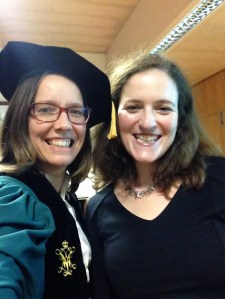
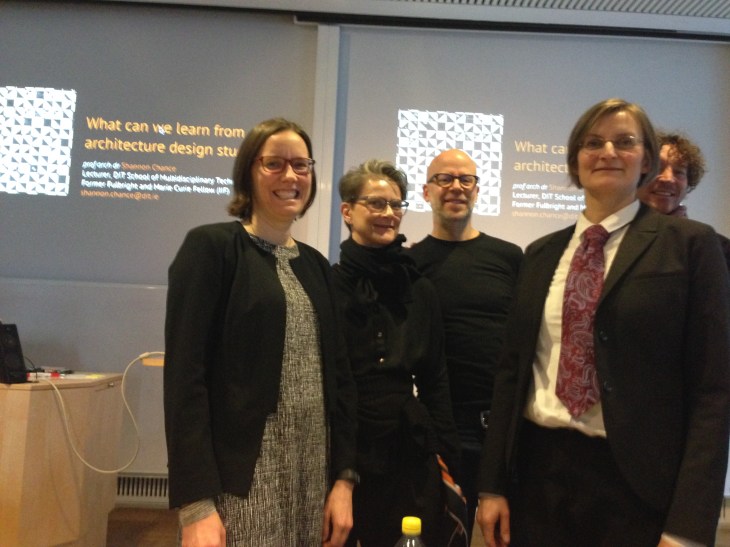
After the lecture at KTH, with two librarians and two architecture profs, including my former classmate from Virginia Tech, Eric Stenberg.

Professor Jonte Burnhard invited me to KTH in Stockholm to deliver a guest lecture on what we–as education specialists, architecture educators, and researchers of engineering education–can learn from each other and from the pedagogical models used to teach architecture. Jonte had read a recent article, “Using Architecture Design Studio Pedagogies to Enhance Engineering Education,” that I’d published along with John Marshall and Gavin Duffy in IJEE. You can access the article at: http://arrow.dit.ie/engscheleart2/102)

The learning and teaching center at KTH hosts this type of lecture/workshop every couple weeks, to get the institution’s staff thinking about and discussing good ways to teach. In addition to classroom educators, quite a few of KTH’s librarians also attended the event, as well.

While at KTH, I enjoyed a dozen small-group discussions on pedagogical topics, toured the brand new architecture building, and caught up with a former classmate, Eric Stenberg,  from Virginia Tech’s architecture program. I’m hoping to visit KTH again soon, since we have so many overlapping interests.

I stayed though the weekend, before heading to Brussels on Sunday evening, and I’ve attached photos of the Christmas sights.

The Talented Don McClure Presenting at Maynooth University

As a young researcher, Don McClure lived in my Dublin flat while he was collecting data for his PhD. Now that he’s finished his project, and earned his doctoral degree, he’s working as an Assistant Professor at St. John’s University in New York.

Recently, Dr. McClure was selected to present his findings at a conference held at the School of Education at Maynooth University.   Today was the big day, so Aongus and I headed out to the institution bright and early to hear Don speak.

Both presentations in his session were superb, and afterward we had a chance to chat with Don over coffee.

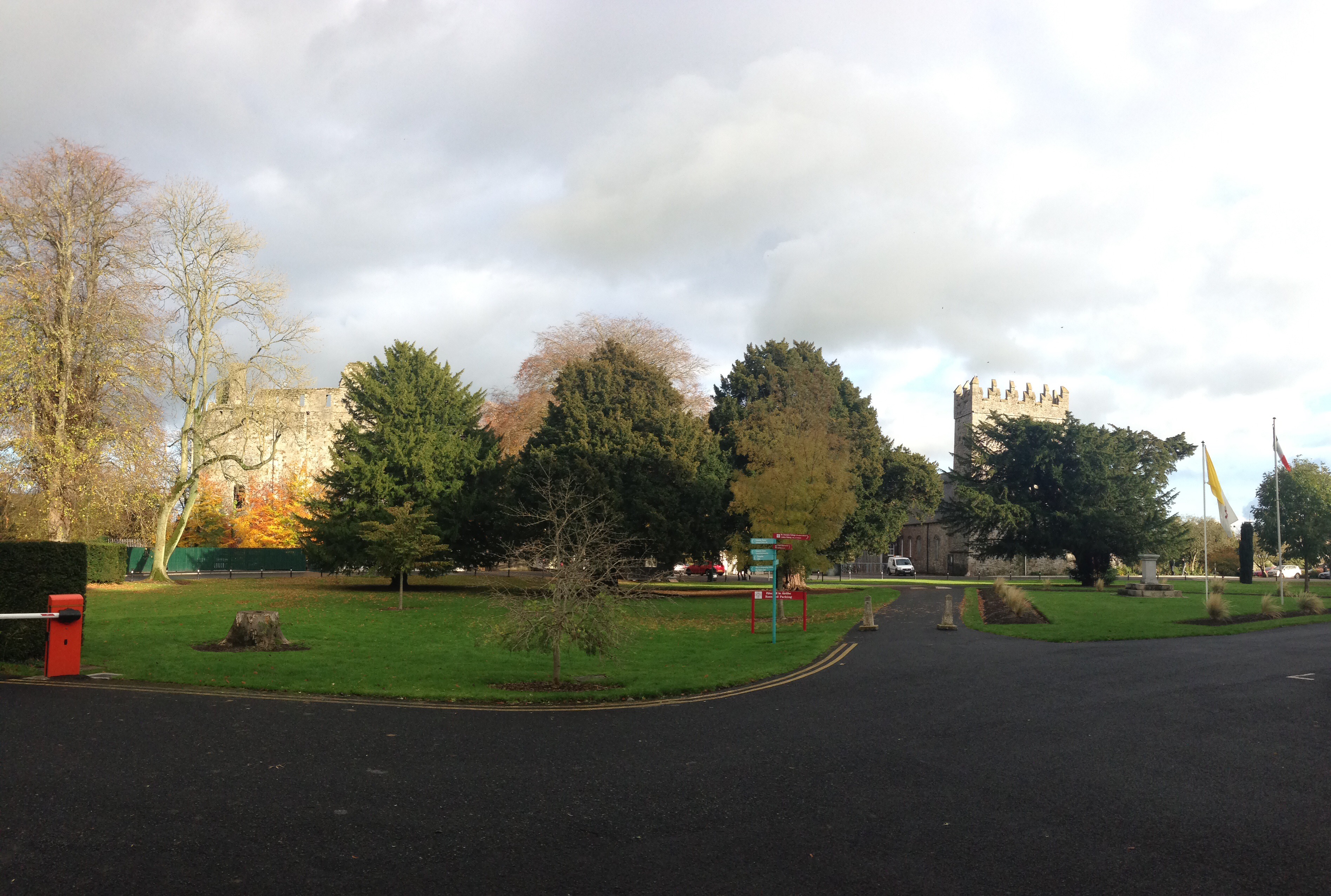
As Don headed back to his sessions, Aongus and I went out into the day, to explore the campus.

Turns out, it was graduation day and the chapel was open to the public. What an amazing site!

I realized immediately that this was a significant design. Turns out, indeed one of a kind. The University’s website states:

Built between 1875 and 1891, this Chapel has 454 carved stalls, making it the largest of its kind in the world. 

The place reminded me of the wooden theater in Parma, with a Hogwarts sort of mystique. What a treasure!

The webpage is well worth a read.

Research Methods of Philosophers

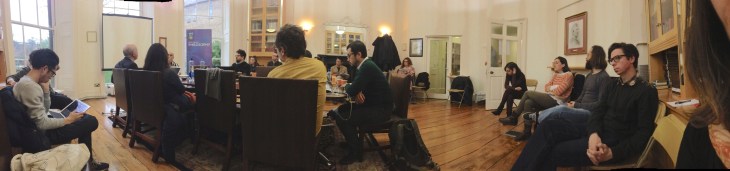
Philosophy symposium 1

Philosophers sometimes use primary documents in ways not much different from the historians I mentioned in my previous blog. According to Yale:

Primary sources provide first-hand testimony or direct evidence concerning a topic under investigation. They are created by witnesses or recorders who experienced the events or conditions being documented. Often these sources are created at the time when the events or conditions are occurring, but primary sources can also include autobiographies, memoirs, and oral histories recorded later. Primary sources are characterized by their content, regardless of whether they are available in original format, in microfilm/microfiche, in digital format, or in published format.

For historians, primary documents include photographs, letters, news clippings and the like. For philosophers, I’d say they could include original texts where an idea first appeared in written form. As a social science researcher, I myself am collecting audio-taped testimonies of female students who have first-hand experience of first-year engineering education. All three of these examples–philosophy, history, and social science research–involve high levels of interpretation of documents, ideas, and stories contributed by others.

Whereas my historian friend, Cecilia Hartsell, is investigating phenomena that include both the 1916 Uprising as well as the return of soldiers from WWI, my colleagues in philosophy spent a recent weekend discussing the phenomena of intentionality and normativity. These historians and philosophers seek to understand the context of events and ideas arising in the past, and what the authors of various documents meant at the time they spoke, or wrote.


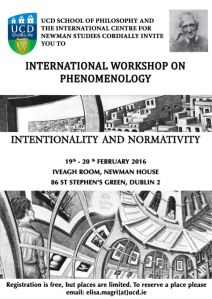
february-workshopI joined a group of philosophers for a February 19-20, 2016 seminar that explored various aspects of phenomenology. The event was hosted by the School of Philosophy at the University College of Dublin but held at Newman House, on Saint Stephen’s Green in Dublin.

Attending the seminar, I learned much more about phenomenology. I also learned more about the way philosophers think, study, generate new knowledge and new understandings, communicate with each other, test ideas, and seek to uncover the complex meanings embedded in writings by philosophers throughout the ages.

I am indebted to Prof. Dermot Moran and Dr. Elisa Magrì for inviting the public to their event so that I could attend, and to DIT’s new PhD student, Diana Adela Martin, for notifying me about the event.

Much of the discussion focused on phenomenology, which is both a philosophy and a social science research methodology. I’m currently using the methodology to study women’s experiences of STEM education, and will submit later this week a manuscript on another phenomenological research study of teachers’ experiences working together to implement Problem-Based Learning at Dublin Institute of Technology.

Related to experience, I must admit that visiting Newman House was an exquisite one. In this house, John Henry Newman founded University College Dublin (originally called the Catholic University of Ireland). I believe that he later became a cardinal and was beatified by the Catholic Church, despite the fact that his views did not always match the official sanctioned interpretations of the Church. Today, one can visit Newman Houses on campuses world wide, like the one I attended while a student at Virginia Tech. I’ve attached photos of the formal entry hall at UCD’s Newman House, for your enjoyment. I got so caught up in discussions at each coffee break that I never made it all the way to the lovely formal garden behind the house. Maybe next time!

Research Methods of Historians

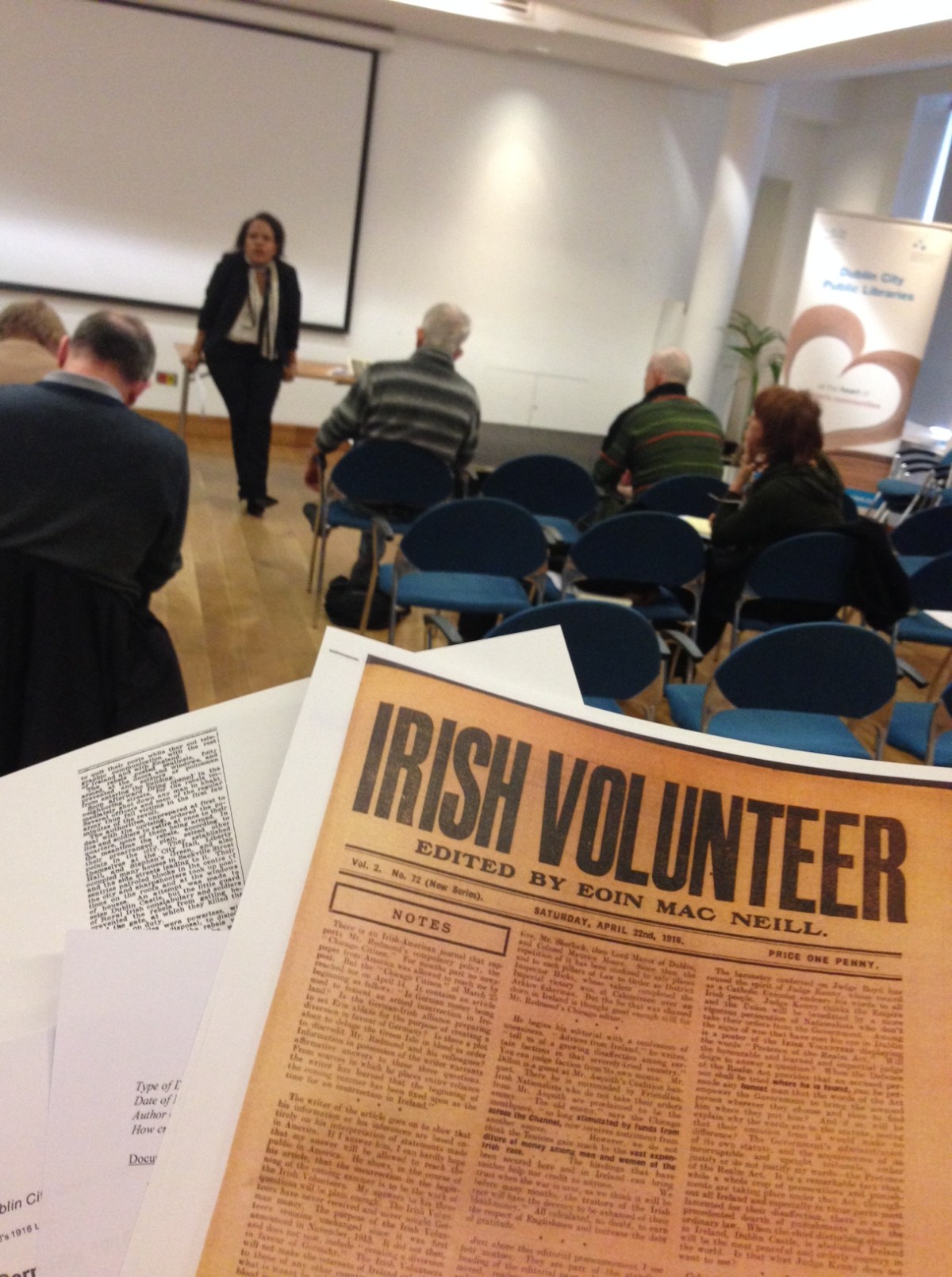
Cecilia Hartsell, an inspiring historian and PhD candidate conducting research here in Dublin, chaired a workshop on Saturday (February 27, 2016) to help people learn about the use of primary documents in research conducted by historians. This was one of six separate events Cecilia is organizing to celebrate the 100th anniversary of the 1916 Uprising that eventually garnered Ireland’s independence from British rule.

The event was held at the Pearce Street Library (a street named for one a hero of the 1916 Uprising) included a keynote lecture by a historian from Trinity College Dublin named Brian Hanley, tea and coffee, a short talk on the evaluation and usefulness of primary documents by Cecilia Hartsell, and time for participants to work in small groups to study primary documents related to the uprising. In the end, each group presented its findings and we discussed what we’d learned.

I’m looking forward to Cecilia’s upcoming events!

Using Architecture Design Studio Pedagogies to Enhance Engineering Education

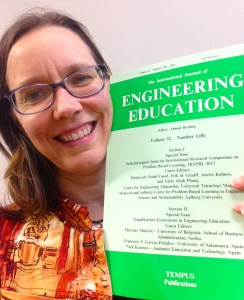
Shannon Chance IJEEI’m celebrating the publication of a new journal article today, with the help of Sally O’Neill. She’s one of the librarians here at DIT, and she secured permission and posted the article on DIT’s website, making it free for you and anyone else to download.

The publishing process is glacially slow. I submitted the paper in March 2014, based on a conference paper delivered in 2013. And here I am, in February 2016, with the final publication finally in hand.

Many time, in research, it takes time to see the results of your work. Seeing this in print helps make all these days, sitting at a computer analyzing text, feel more worthwhile. Once I can see that people are downloading it, and once I start getting feedback and citations in other people’s research papers, I’ll celebrate some more.

I know what I’ve learned through this research is useful, because I get to apply it in the classroom and in the design studio. The rewards of printed research are more slow to crystallize but also extremely important, especially for people who want to gain credibility in research and build a career around research.

This new article, written with the help of John Marshall in Michigan and Gavin Duffy here in Dublin, is about Using Architecture Design Studio Pedagogies to Enhance Engineering Education. Simply put, we believe that design education and hands-on forms of learning can help improve the quality and experience of learning in engineering and other STEM disciplines. The results reported in this paper provide support for that claim.

To give you a feel for what I’m describing, this is how we learn in architecture:

Above are pictures from design studios in Lisbon at IST and one for a study abroad program  offered by Hampton University. Very, very hands-on!

These days I’m helping promote similar ways of teaching engineering, which looks similar in many respects:

These are photos from electrical and mechanical engineering projects I’ve helped conduct at Dublin Institute of Technology.

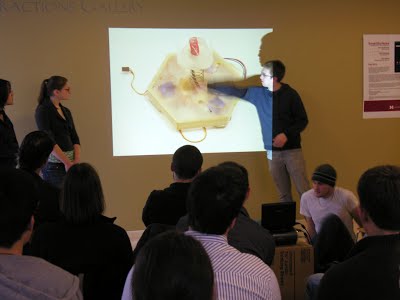
This brand new article is about a specific design studio, conducted at the University of Michigan, that blurred the boundaries distinguishing art and science. It involved students and teachers from architecture, materials science engineering, and art+design working together to design and build “SmartSurfaces.” The paper reports learning outcomes — things the students learned in the  class — as illustrated by the blogs they posted during the semester. Here’s a glimpse of what that experience was like for those students:

For this new paper, I created a matrix to describe design behaviors in relationship to epistemological development (which has to do with how we view knowledge). I compared what the students wrote in their blogs to the definitions in my chart. Doing this, I was able to identify development of design skills as a result of students working in groups, and I even pinpointed some instances of epistemological development. John and Gavin helped check the work so that it would be more credible and reliable. They offered perspectives of insiders in the studio (John) and outsiders interested in group-based learning, Problem Based Leaning (PBL), engineering education, and epistemological development (Gavin).

This article should be of interest to any teacher who wants to help students develop new design, design thinking, or epistemological skills. Please feel free to read it and email me any questions you have, at irelandbychance [at] gmail [dot] com.

Chance, S., Marshall, J. and Duffy, G. (2016) Using Architecture Design Studio Pedagogies to Enhance Engineering EducationInternational Journal of Engineering Education Vol. 32, No. 1(B), pp. 364–383, 2016.
Maria Carreira’s PhD viva on Learning Spaces in the University Context

Maria's viva 5What an honor to be part of the day a young scholar gets her wings, so to speak, by earning her PhD! Last week I travelled to Lisbon to attend the viva (i.e., PhD defense) of Maria Alexandre Bacharel Oliveira Carreira. I had met with Maria on both of my two prior visits to the Instituto Superior Técnico at the Universidade de Lisboa. I really enjoyed watching her work unfold.
This time, I was a member of her evaluation panel. I curled up with her thesis each night while I was in Brussels. Preparing for this panel event took many hours for me–but it took five years for Maria! During that time Maria gave birth to two children, but that didn’t slow her down much. She kept plugging away at her research.

She conducted extensive analysis of spaces that support teaching and learning. The title of her dissertation (which in Europe is called a thesis) is In-between Formality and Informality: Learning Spaces in University Context. The European term “viva voice” (meaning “live voice”) is so much nicer than the term “dissertation defense” used in the States.

Maria's viva 00After 2.5 hours of presenting her work and answering questions–posed by the panel of 6 experts (I myself had 40 minutes to talk about her work and ask questions of her)–Maria and her many family members and friends who had come to the event left the room. The panel discussed the merits of the work, deliberated, then invited Maria and the crowd back into the presentation room to pronounce her a PhD with distinction. We all went for a celebratory luncheon in the afternoon.

Once Maria has submitted the final version of her thesis, I’ll try to post a link. In the meantime, you may be interested to read two of the articles I have written that have to do with topics in her thesis.

The first is about how the design of school buildings can enhance learning and help us achieve environmental sustainability:


Chance, S. and Cole, J. T. (2014) “Enhancing Building Performance and Environmental Learning: A Case Study of Virginia Beach Public Schools ” City Public Schools. Book chapter from the book entitled “Marketing the green school: form, function and the future.

The second is about university buildings. It also discusses how buildings can promote learning, by serving as examples, modeling values, and getting people engaged. It’s about environmental sustainability and how LEED has become an example of organizational learning (i.e., a big organization that effectively learns from past experience, using it to improve future performance):

Chance, S. (2012) Planning for Environmental Sustainability : Learning from LEED and the USGBCPlanning for Higher Education, Vol. 41, No. 1, Oct-Dec, 2012.

Teaching Design with Spaceships at DIT at the UK National Space Centre

I’ve been helping out in DIT’s engineering design projects module again this year, which Micheál O’Flaherty, Fionnuala Farrell, and John Nolan have transformed from the ‘Energy Cube’ project we led last year to a project that involves the design of a model spaceship. Photos from yesterday’s performance testing class are included in the gallery directly below. I’m happy to report that all the egg-stronauts survived the crash test fully intact!

This past summer, Micheál and I presented a paper about the Energy Cube project in San Sebastian, Spain. (O’Flaherty M.P., Chance, S., Farrell, C.F. and Montague, C. Introducing New Engineering Students to Mechanical Concepts through an “Energy Cube” ProjectInternational Joint Conference on the Learner in Engineering Education (IJCLEE 2015), San Sebastian, Spain, July 6-9, 2015.)

Fionnuala and I travelled to the UK to present a paper on a different aspect of the project at a conference in Loughborough. (Farrell, C.F., Chance, S., O’Flaherty M.P., An energy cube project for teaching engineering design processInternational conference on engineering and product design education, Loughborough University, England, September 3-4, 2015.)

Earlier in the summer, I presented yet another aspect of our work in Orleans, France. (Beagon, U. et al. (2015) Using Theory to Improve Design Instruction in a New Common First-Year Programme For Engineers. Paper presented at 43rd. annual SEFI Conference June 29th.-July 2nd. 2015, Orléans, France.)

The Loughborough conference included a dinner at the UK National Space Centre, where I got to see historic satellites, space ships and rockets (see photo gallery) alongside engineers who had actually worked on their designs.

Crafting Lisbon

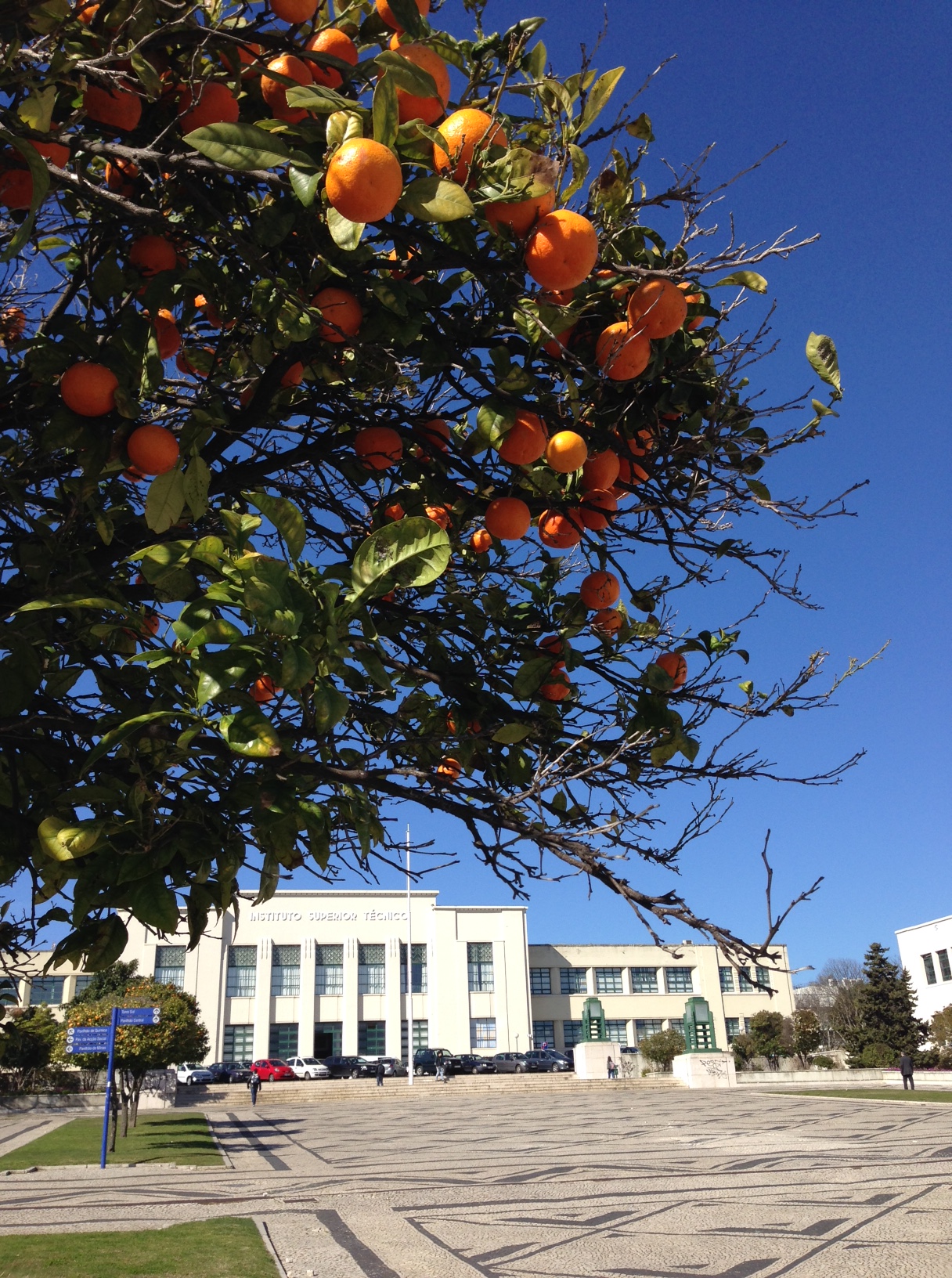
Orange trees along the entry IPS.

Orange trees along the entry IPS.

My Friday visit to the architecture school of the Instituto Superior Técnico (IST) was icing on the cake after a week of engineering interviews, conducted across the bay from Lisbon at Escola Superior de Tecnologia do Barreiro (a branch of the Instituto Politécnico de Setúbal, where I had interviewed students their experiences as engineering students as part of my Marie Curie research project).

You might recall that I delivered workshops at IPS and IST as a Fulbright scholar, back in 2013 (click here for more).

For a little more fun on my last day in Lisbon on this trip, I took the Metro over to IST. There, I visited the first year studio to hear student teams present their urban analyses of Lisbon districts. I toured the 2nd-5th year studios with my gracious faculty hosts and I wrapped up the afternoon discussing recent work with PhD students from the Architecture Research Group who I’d met on my previous trip to Portugal. The doctoral students — Maria Bacharel Carreira, Luisa Cannas da Silva, Mafalda Panheco, and Sajjad Nazidizaji — and thier professor Teresa Valsassina Heitor took me for a beer at the end of the day.

IPS's Escola Superior de Tecnologia do Barreiro

IPS’s Escola Superior de Tecnologia do Barreiro (image from http://www.estbarreiro.ips.pt/)

Many thanks to my colleagues at IPS, Bill Williams and Raquel Barreira, who helped arrange and conduct interviews. Thanks also to the ISP students who provided interviews and the IST teachers and students who shared their work with me. I can’t wait to visit again!

Dublin’s Green Campus at Blanchardstown

IMG_1274
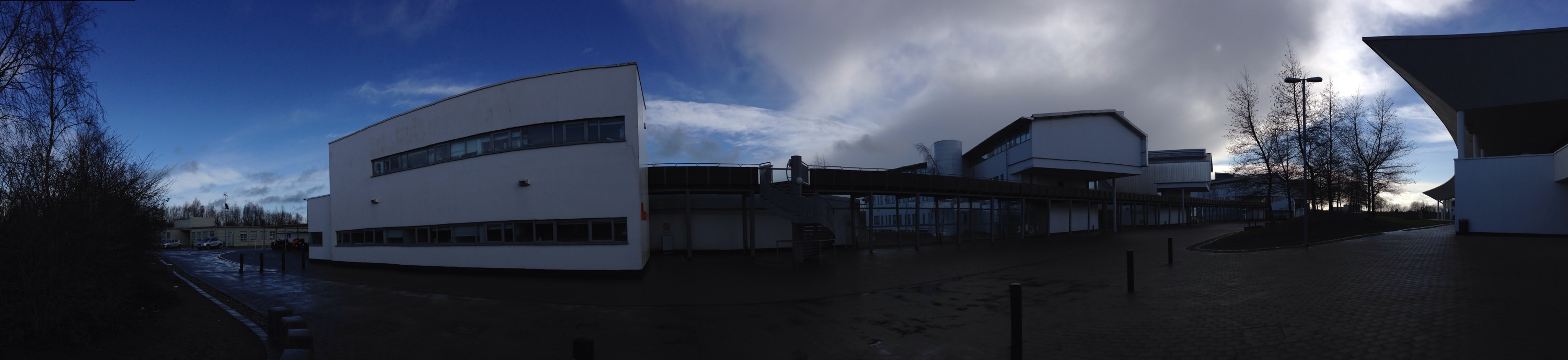
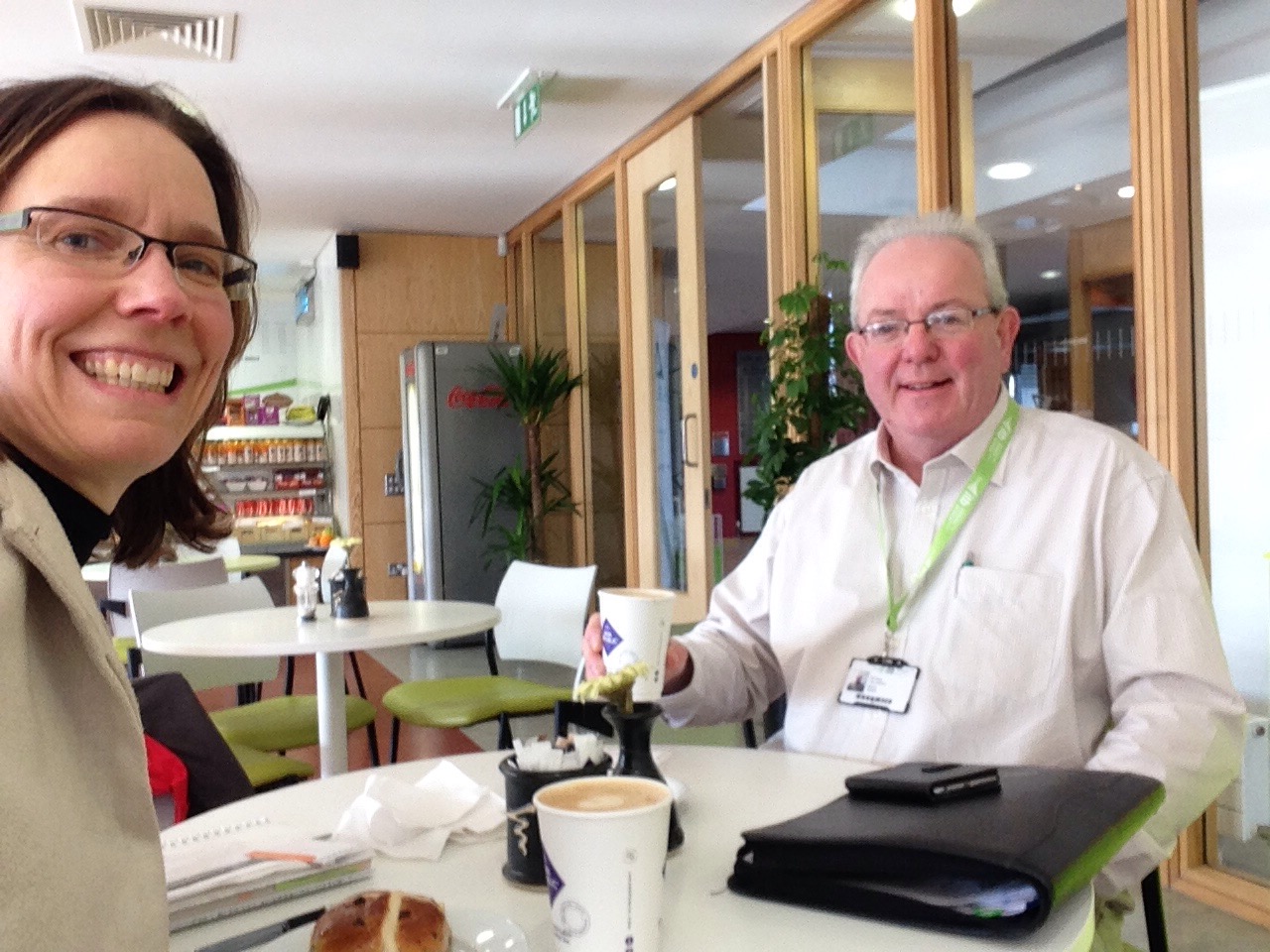
Braving Dublin’s blustery weather today (a mix of winds, snow flurries, and showers that would make my blizard-ravaged friends back in the USA weep–for joy), I made a field trip to northwest side of Dublin to visit Dr. Larry McNutt and the Institute of Technology in Blanchardstown (ITB). Larry has expertise in engineering and education–and he does sociological research to boot.

IMG_1264
ITB, DIT, and the Institute of Technology in Tallah (ITT) are in the process of merging, with the goal of becoming Ireland’s first Technological University (TU). Larry is part of the “TU4Dublin” team that’s managing the merger.

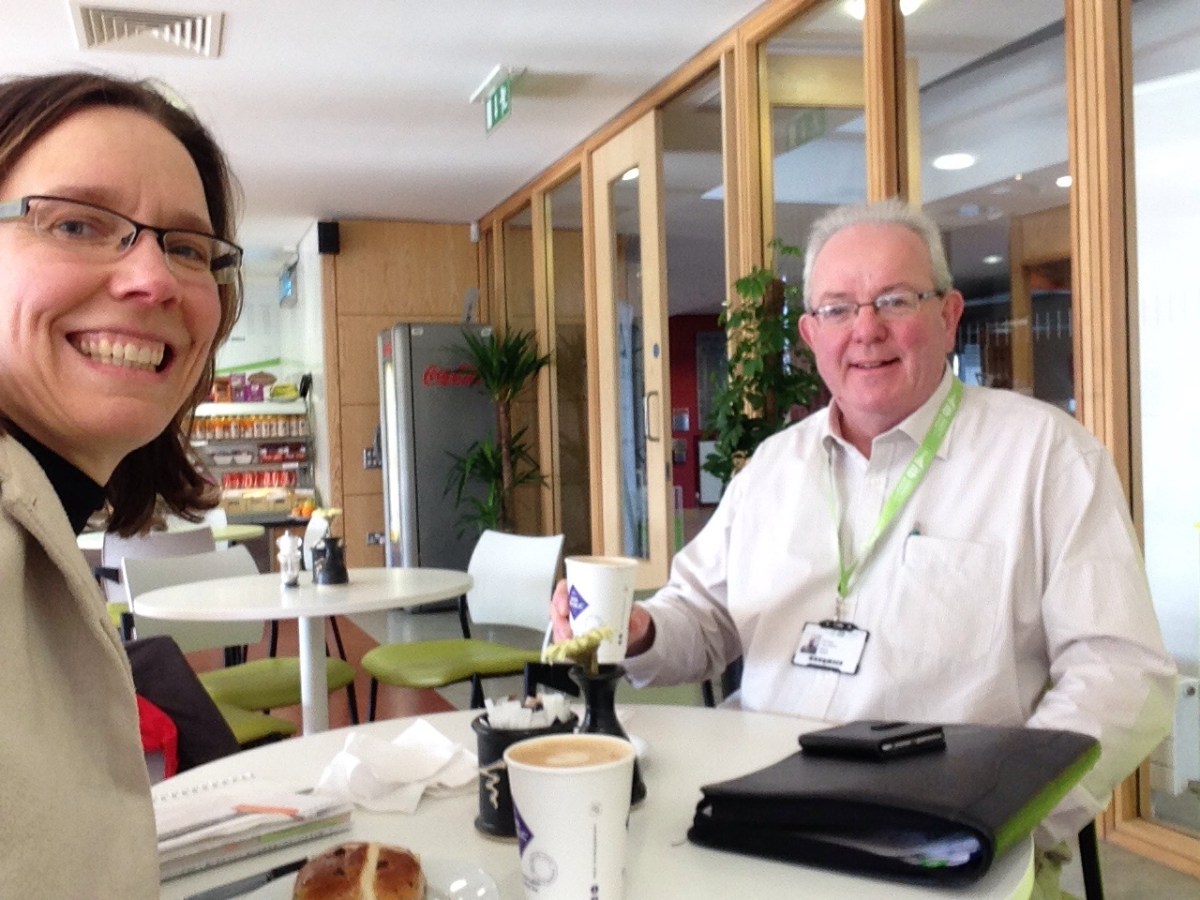
Today, Larry and I spent a couple of hours discussing ways to improve the experience for third-level learners (i.e., college students). We both aim to make higher education more interesting and effective by helping post-secondary teachers hone their skills in teaching.

Before our meeting, Larry gave me a tour of ITB, an energy-efficient campus constructed since 1999. Because the focus of my PhD dissertation was green buildings constructed by post-secondary institutions in the USA, I was quite interested in seeing the design of the ITB campus and its individual buildings.
I also enjoyed discussing:
*educational improvement initiatives Larry is involved with.
*the design of various degree programs for teachers and for students.
*hot cross buns (I’d never seen one before today)

It’s a banner day for me when my interests in sustainable architecture, educational planning, and engineering education (plus food!?!) weave together so nicely. Imagine finding a person who can discuss all these topics with ease.

Larry McNutt is such a person. I look forward to bumping into him around TU-Dublin again soon.

Planning to Make Your School Green?

IMG_1206

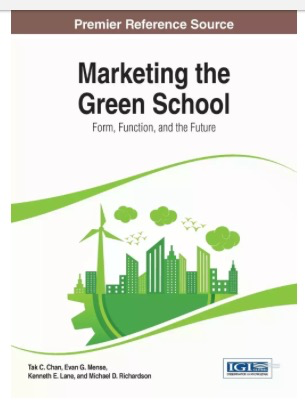
A colleague from Virginia Beach, J. Timothy Cole, and I published a chapter in the recently-released textbook called:

Marketing the Green School: Form, Function, and the Future

Our chapter is called:

Enhancing Building Performance and Environmental Learning: A Case Study of Virginia Beach City Public Schools

This abstract summarizes the article so you can tell if you’d like to read it:

“School buildings directly affect their natural and socio-cultural environments. They do this through their construction, maintenance, operation, and demolition. Most of the school buildings we have in stock today drain natural resources and inadvertently perpetuate a culture of environmental, social, and long-term economic ignorance and misuse. When approached thoughtfully, however, the design of school buildings can help inform and enrich society. Well-designed buildings can impart environmental knowledge and values. They can foster more effective behaviors among the people who learn in and from them. Effectively designed buildings can also conserve natural resources and—at their best—even help replenish the natural environment. For many school leaders today, participation in green certification programs represents one important step toward improved building and learning performance. This chapter provides a case study of successful learning approaches developed by Virginia Beach City Public Schools (VBCPS).”

Here’s the introduction:

“Aimed toward educators and school administrators, this chapter provides a broad overview of design issues related to sustainability. It proffers concrete examples drawn from Virginia Beach City Public Schools (VBCPS) to enhance performance at the level of the building, classroom, district, and region. VBCPS’s environmental approach integrates educational planning with facilities planning. Its facilities department has been driving change in school design, classroom pedagogy, purchasing, transportation, and even regional design standards.

The examples in this chapter provide a snapshot of one moment in an ongoing process. They illustrate how one innovative school system is generating and applying new knowledge for the benefit of its buildings’ users, the local public, the wider education community, and the world. Overall, VBCPS strives to provide the best possible environments for learning teaching and living. Its efforts include:

• Integrating environmental issues throughout the curriculum
• Preparing students to bring new knowledge into the community and share it with their families and employers
• Introducing new construction techniques to the region
• Encouraging architects and builders to reach for higher standards
• Monitoring the division’s environmental performance and continually seeking to improve
• Disseminating their research and techniques for broad adaption
• Monitoring its own (and its community’s) energy and waste flows
• Striving to achieve net-zero carbon emission
In this chapter, we provide rationale and theoretical underpinnings for green school design, and we share successful practices developed by VBCPS. Knowledge in the realm of environmental design and education is continually evolving. As such, any list of “best practices” is in constant flux. In writing this chapter, we seek to provide a description of some of the best practices we have discovered and/or created up to this point in time.

Most environmentalists have adopted the World Commission on Environment and Development’s (1987) definition of sustainable development as that which “meets the needs of the present without compromising the ability of future generations to meet their own needs” (p. 43). The “green building” movement fosters new strategies to help overcome outdated construction practices that require vast material resources and cause tremendous waste and pollution. Today, North America’s over-reliance on cheap energy has reached crisis proportions (Steffen, 2008; Wackernagel & Rees, 1996). All told, buildings consume 65% of the electric power used in the United States (Landsmark, 2008). They use 36% of all energy used and 30% of all raw materials. Buildings are responsible for half of greenhouse emissions from the US (Gifford, n.d.; Udall & Schendler, 2005). Educational facilities have been among the worst, although higher education buildings seem to waste more energy than K-12 because control systems are looser (Leslie & Fretwell, 1996).

Recently, VBCPS analyzed all sources of emissions within its control, using data from 2006-2010. It found that even though its overall energy consumption had steadily declined across the five-year period, its building-related activity still accounted for 65% of VBCPS’s overall emissions. Its second largest source of emissions related to transporting people and goods. Its calculations considered electricity use, combustion from paper/stationary waste, and losses related to the transmission and distribution of electrical power. School leaders are working to address the division’s primary sources of emissions, through integrated strategies that involve enhanced building performance, revised vehicle fleet policies, and more informed commuting habits of students and employees. Leaders are also creating strategies to control the 1% of its green house gas emissions that resulted from solid waste, refrigerants, chemicals, and wastewater.”