Expanding the Engineers’ Box

Fergus Whelan commented that I need to think outside this box....  Thanks to Frank Daly for the fabulous photo.

Fergus Whelan commented on this image that I need to think outside this box!  Many thanks to Frank Daly for the fabulous photo. My students, having sent his look many times before, certainly empathize with you!

In all corners of the globe today, companies are clamoring for skilled engineers. They want a larger pool of applicants who are creative, flexible thinkers prepared to address complex, emerging questions riddled with interrelated unknowns. Like industry, the sectors of healthcare, education, and government also have great need for well-rounded thinkers with strong engineering acumen.

Simply put: the world needs more people who can think across systems and see how things relate at multiple scales. We need people who can identify problems and create new solutions from the ground up. People who aren’t so closely bound to existing systems, ideas, and protocols that they can’t construct entirely new schemes for thinking and behaving.

Today, governmental organizations (like Science Foundation Ireland and the National Science Foundation in the USA) are working hard to address the shortfall in the number of engineers by generously funding education of, as well as research by, engineers and scientists. They seek better ways to teach and think about engineering and science.

The blogs I will be posting in the near future have to do with:

  • the way we think about and conceptualize engineering
  • how I think this needs to change
  • how architects and education researchers can help

Please note: I’m going to be explaining things that I’m trying to work out in my head and do this as if I’m speaking to a friend or relative who knows little about research. That means I may not be “100% right” in every explanation. But as you’ll see, that is a risk that must be taken for the sake of building knowledge. (It’s all part of this new “paradigm” for working and thinking that engineering needs to implement more widely… more on that to come!)

I do hope you’ll follow along on this research adventure, where I’m working to bring qualitative, social science research and design thinking into more facets of engineering education.  Yes, these are gutsy claims I’m making — particularly since I’m new to research and new to engineering.  Let’s see if I can live up to such promises….
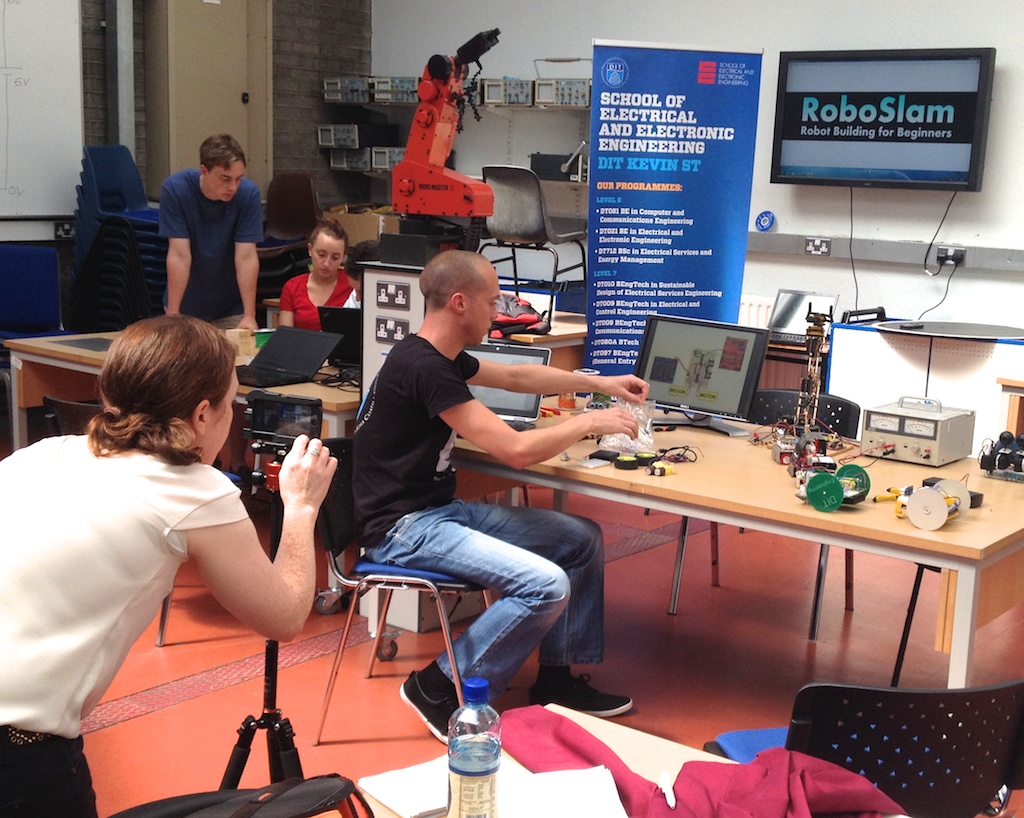
Sinead’s Slammin’ TV Production

RTE's Sinead Morris filming DIT's Ted Burke using a kitted-out iPhone 5.

RTE’s Sinead Morris filming DIT’s Ted Burke using a kitted-out iPhone 5.

TV journalist Sinead Morris came to DIT’s Kevin Street location today to film robot construction in action. Our RoboSlam team leaders — Ted, Damon, Frank, and I — are preparing for the upcoming Dublin Maker event, to be held at Trinity College on Saturday, July 26.  Sinead wanted to capture the activity.

The Dublin Maker event served as the impetus, Sinead explained, but the main intention of her piece is to show what the RoboSlam group is doing with robotics.

Sinead’s production is likely to air on RTE’s digital news channel, News Now.

Ted and Sinead set up for a shot of the robot underworld.

Ted and Sinead set up for a shot of the robot underworld.

Sinead is testing photojournalism innovations. The Irish television company where she works, RTE, wants its journalists to gain experience with spontaneous, low-tech approaches — so staff members can shoot, edit, and post “on the go.”  At the end of this innovation project, RTE staff will have the skills needed to disseminate news on the run… when opportunities arise.

RTE asked its staff to take this challenge: produce interesting and informative pieces wholly on their iPhones.

Hampton University journalism students were learning to do the same when my friend Tony Brown was dean of the program so, for me, watching this process firsthand proved fascinating.  The move toward spontaneous creation of new content aligns with the goals for our RoboSlam project; we want our workshop participants to take their robots home and start creating new “home grown” code for operating the ‘bots.

TV news technology has come a long way in my lifetime. When I was a kid in the ’70s and ’80s, my parents were television journalists. They used 16mm film equipment, and I learned to use the same when I was in college studying architecture.

Today’s capture-edit-and-post culture speeds the process. Mom and Dad used to shoot the footage and put it on a Trailways bus bound for the TV station one hour away. While it was in transit, they’d phone the station to make a voice recording of the text for the station to overlay.

It would appear in its synchronized form on that night’s news.

Now, Viola!, Sinead can do, alone and in moments, what it took dozens of people hours to create in the 1980s.

Robot show down.

Robot show down.

So, I was able to learn quite a bit from Sinead today, about software as well as hardware, and perhaps now I can give her videography techniques a go.

She also inspired me to write up this blog on site, while she’s finishing up her interview with Ted. Moments ago, she asked him what it’s like to work this type of job. He said he loves coming in every day to build robots and work with students.

He didn’t mention that he and his colleagues are currently on vacation and aren’t at all required to be here.  They just can’t keep themselves away!

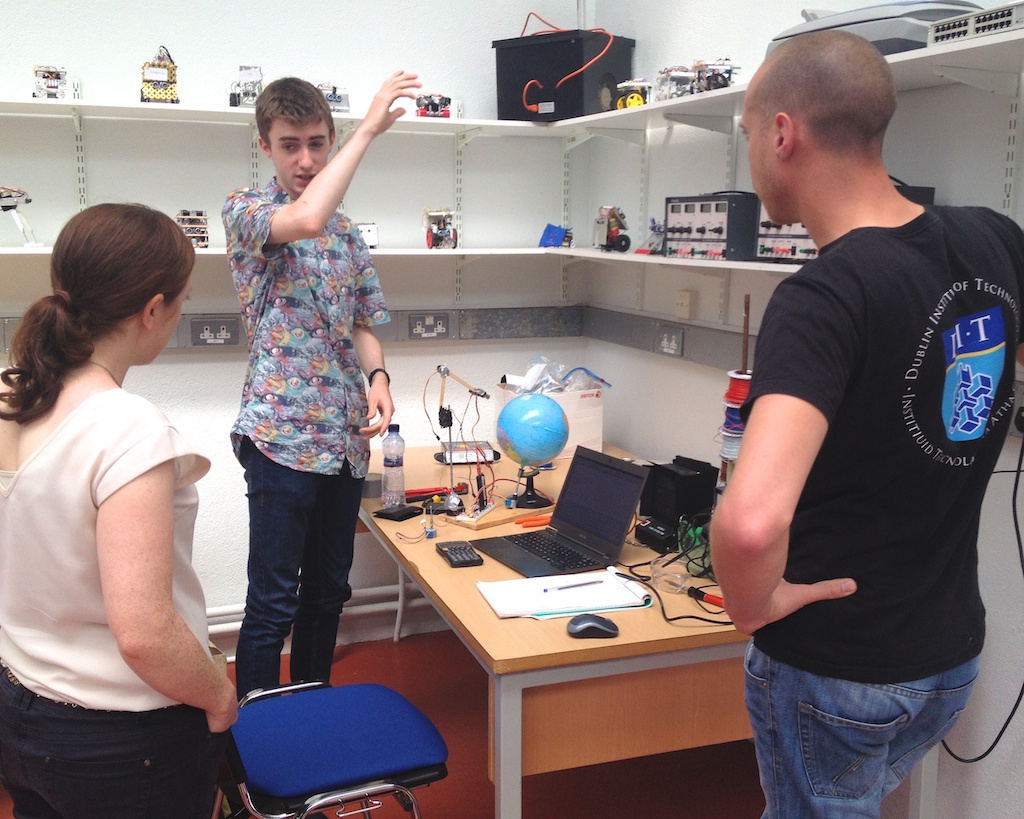
We actually had quite a few interesting projects underway in the lab today while we were filming… a veritable Santa’s workshop of robotics. For instance, one of DIT’s third year students, Shane Ormonde, was here developing a new robot to show at the Dublin Maker event. He just completed a degree in Electrical and Control Engineering (DT009) and will pursue yet another degree in the fall.

Shane is conducting a robotics experiment while on summer holiday.  It’s a nice break, he says, from his call-center job.  (Gotta love that initiative!)

Shane Ormonde's new global robot arm.

Shane Ormonde’s new global robot arm.

Shane is building and programming a robotic system that, using a globe, can show in real time what the International Space Station is actually tracking at the same moment. Eventually, his robot will also be able to point to any location a person requests, using the laser on the end of its moving arm.

The globe itself moves to set the correct longitude and the arm moves to pinpoint the latitude.

He originally wanted people to be able to tune in via internet to ask the robot to identify specific locations and complete other such actions.  Shane’s creation will be featured as one part of our DIT RoboSlam exhibit at the Dublin Maker event.

Come join us next Saturday – near the cricket pitch at Trinity – and see!

Sheryl Sorby Spotlights Spatial Skills

Dr. Sheryl Sorby‘s groundbreaking research on spatial visualization brought awareness of spatial reasoning to engineering education worldwide.  Sheryl’s work highlights the importance of educational research and illustrates how applied research can make a real difference in the way we learn and teach.

Sheryl is a pioneer in engineering education research — the area where I’m now working to establish myself.  She was doing this type of research long before Engineering Education Research (EER) was recognized as a distinct field of study.  As such, she helped pave the way for all of us who are working to understand how people learn engineering and design today.  Today, she’s actively leading research teams on this topic.

Last year, Sheryl served as Ireland’s Fulbright Scholar in Engineering Education (that’s the post I held the year before) and she made noteworthy contributions. Whereas I applied for the Fulbright position when I was a “baby doc” (straight out of grad school), Sheryl brought the wealth of experience of a professor emerita (which essentially means she retired with academic kudos).  Awards she has received include the 2011 Sharon Keillor Award for Women in Engineering Education bestowed by the American Society for Engineering Education (ASEE).

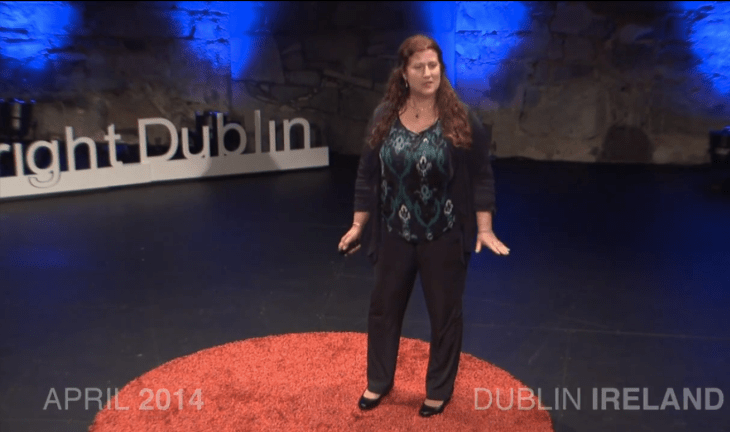
Recently, Sheryl delivered a TED talk at the 2014 TEDxFulbrightDublin event organized by the Fulbright Commission in Ireland, an event pictured above.  The TEDx talk, “Recruiting Women for Science, Engineering, Technology and Maths,” is available on YouTube. YouTube also features her webinar presentation on “The Importance of Spatial Skills.”

Her TEDx talk describes ways spatial-thinking skills correspond to academic performance in engineering. Her research has identified gender-related discrepancies in spatial visualization skills and, as a result, she has developed and implemented programs to help alleviate students’ weaknesses in this area. Her work has made a clear and measurable difference!  (I hope someday, I can say the same of mine!)

Sheryl researches other engineering topics as well.  Michigan Tech’s website explains she “is known for preparing engineering students and middle school students to think like engineers. Her research interests include advanced composite materials for use in civil infrastructure and 3-D computer graphics for visualization of complex behaviors.”

The National Science Foundation has supported many of her projects, and she even worked (or, “did a rotation”) at the NSF headquarters, as Program Director in NSF’s Division of Undergraduate Education.

I’m proud to walk in Sheryl’s footsteps, and thankful for the work she’s done!


If there was no fear… what would you dare to dream?

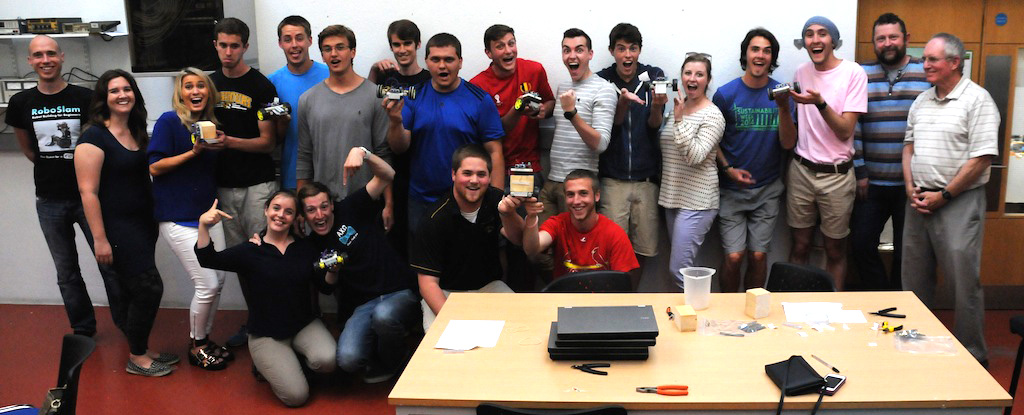
Ted, Damon, and crew conducted a RoboSlam for 18 undergraduate engineering student form the University of Wisconsin last week.  I'll post more photos of the event soon, on our RoboSlam blog.

Ted, Damon, and crew conducted an abbreviated RoboSlam this part week for 18 undergraduate engineering student from the University of Wisconsin last week. They are students of former Fulbright, Bob O’Connell (far right). I’ll post more photos of the event soon, on our RoboSlam website.

Solstice in Dublin!

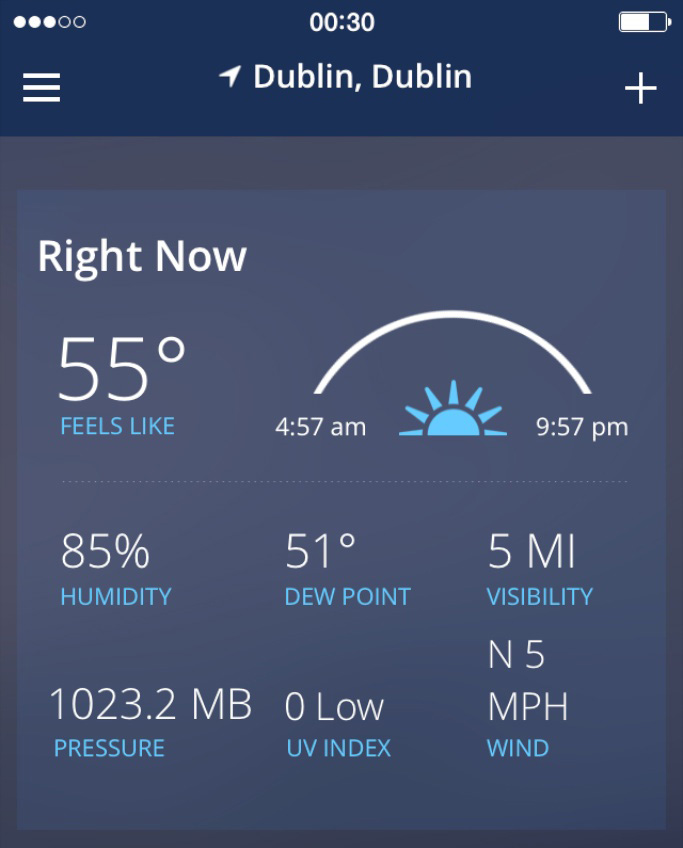
Solstice in Dublin!  It was my first solstice here and I enjoyed every minute of it! Interestingly, there’s indirect sunlight for even longer than 17 hours. The first rays appear before 4 AM and the last disappear after 10 PM.

Dublin is full of sunshine!  Temperatures are topping top out each day at about 65 degrees Fahrenheit and the sun has been staying up for 17 hours each day.  That makes for perfect weather for outdoor yoga.  On the day of the solstice, our yoga instructor, Peter, shared this provocation:  If there was no fear, what positive change would you make in your life?

I mulled the proposition.  I know better than anyone:  There’s good reason to fear what you may lose by chasing outrageous dreams.  But there’s also good reason to seek new knowledge and experience.  I hope someday my work will be a testament to trying hard to live life to the fullest.

This, the second week of my Marie Curie research fellowship, was full of adventures, errands, and learning.  My colleagues and I conducted a RoboSlam and a workshop on Problem-Based Learning at the start of the week.

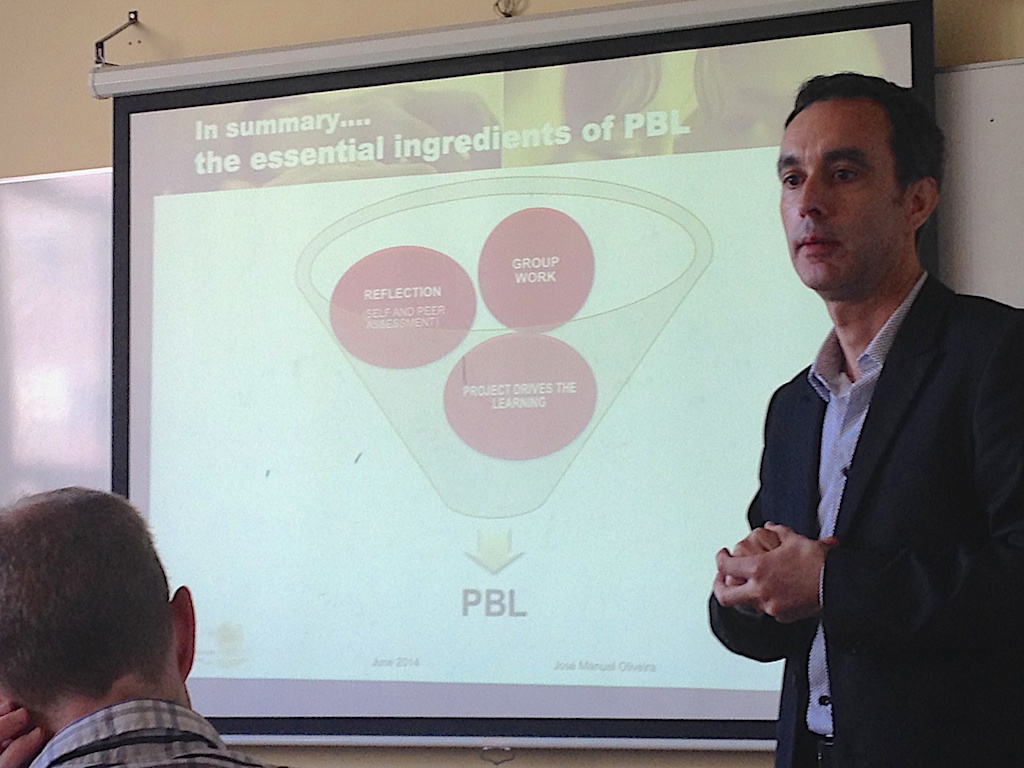
I was honored to be included in a dinner and workshop with a guest from Portugal, José Manuel Nunes de Oliveira, who you may recall from an earlier blog.  Jose shared his work with the faculty of the DT07 electrical engineering program. This group of teachers is considering making the DT07 program more problem-based.

Jose's three essential elements of PBL.

Jose’s three essential elements of PBL.

Jose identified three elements he sees as essential to PBL (Problem- or Project-Based Learning):

  • Project drives learning
  • Group work
  • Reflection (including Self -and Peer-Assessment)

Jose described various aspects of assessment since this is a topic of concern to many of the teachers in the program.

I wish I had time to post details of the workshop, but I really need to get onto “real” work today.  Below, I’ve uploaded a photo journal of many highlights of the week. I hope they inspire you to find a least one new adventure today–however big or small.

Exotic Familiarity

I feared that somehow things wouldn’t seem as new and fresh on my return to Dublin as they were before.  During my Fulbright fellowship, I spent 365 days in this vibrant city — but even a vibrant city can become overtly familiar, I would have thought.

And yet, as I happily rediscovered many familiar comforts this past week (like Beef and Guinness Pie at Pieman in Temple Bar), I also uncovered a plethora of new adventures here.

On Saturday, during Fergus Whelan’s history tour, I met a researcher from Fordham University.  She said how much she’d enjoyed finding this blog while she was preparing for her trip here.  Her words encouraged me to get back to posting.  I hope you find something interesting and informative in my little picture gallery of highlights of the past week.

Well, it’s 10:20 PM and the sun has just set.  It will be up again by 5 AM or so, and I’d best get ready to hit the sack. I’ve another big week ahead!

Marie Curie Fellowship

It’s been a week of new adventures.  Last Monday my plane landed in Dublin and I began a new job at the Dublin Institute of Technology as a Marie Curie Research Fellow.  This is a two-year post funded by a generous grant from the European Union that will allow me to extend the research I began as a Fulbright scholar.  I spent several months last summer going the proposal, and met with success.

Many people helped with the proposal, including my mentor Dr. Nancy Stenson.  She has been a Marie Curie International Incoming Fellow (IIF) for the past two years… she told me of the IIF program, encouraged me to apply, and helped edit and refine my proposal.  Without her, I’d never have succeeded.  Jean Cahil, Jennifer Brennan, and Marek Rebow were also instrumental in the effort.  Colleen Dube, Pamela Eddy, Mike Murphy, John Donovan, and Brian Bowe provided valubale assistance as well.

Brian will be serving as my research supervisor for the next two years. Receiving this grant helped focus efforts in the college on the topic of research in engineering education. It lead to the formal establishment of CREATE (Centre for Research on Engineering, Architecture, and Technology Education, or something similar).

I’ll tell you about my recent adventures in an upcoming post….

Learning about Learning at Virginia Tech

…to a pleasantly large group of colleagues.

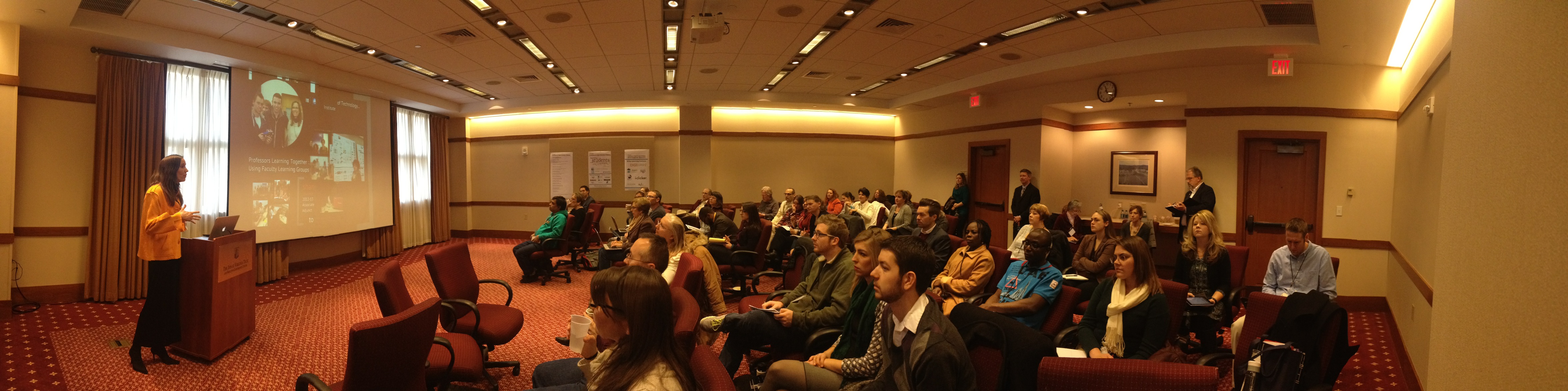
Presenting at the Conference on Higher Education Pedagogy

Virginia Tech just hosted its sixth annual Conference on Higher Education Pedagogy (i.e., college teaching).  It was my second foray into this conference and it just keeps getting better and better.  The organizers manage to get sponsors to cover the entire cost, so there’s no registration fee.  That is truly amazing.

The conference gives me a chance to learn great new ideas (the sessions and keynote presentations were innovative and engaging), catch up with colleagues from around the country and world (with about 47 countries and as many states represented among attendees), visit my alma mater (I earned two architecture degrees from Virginia Tech), and even visit my family and childhood friends (Blacksburg is also my hometown).

I also took a quick jaunt over to Virginia Tech’s School of Engineering Education — one of two such schools in the entire world — to learn and to meet new colleagues.  Dr. Maura Borrego, whose research I’ve been citing in papers and grant proposals, provided a fabulous introduction to the program.  In addition, I got to meet several of her colleagues, including Dr. Marie Patretti who directs the undergraduate components of the engineering educate program, and Dr. Stephanie Adams who is Virginia Tech’s new Head of Engineering Education.  I even got to attend one of the Ph.D. classes in Engineering Education, taught by Dr. Vinod Lohani, and discuss assessment issues with the students.  They were discussing a paper that I’ve frequently cited as justification for continued research on outcomes of Problem-Based Learning.

I was very pleasantly surprised with the level of interest my colleagues had in the talk I delivered.  The audience was attentive and engaged and stayed after with lots of questions.  Thanks to the wonderful moderator who snapped great photos during the talk!

ArchExchange

The Virginia chapter of the America Institute of Architects hosts a conference every November that is called “ArchExchange East.”  It’s a fabulous learning experience for me and my students.  Most of our department attends the event.  I’ve included photos of some highlights.

wiehr

Drawing (on) Gravity

Sometimes gravity is an architect’s friend.

In fact, architects can use gravity to human advantage in all sorts of ways.  In Ecology class today, I showed some diagrams of systems that use “thermosiphoning.”  That’s a fancy word referring to gravitation pull that moves fluids (like air or water).

The idea is that warm air (or water) rises and cold air (or water) sinks… because a  liquid is heavier and more dense when it is cold.

So, we can let gravity do the work if we think a system through.  Sometimes we need to move liquids in directions they don’t naturally want to go, and then we need to add electric pumps or fans to our systems.

Today, I showed my second year architecture students a tromp wall system as well as a diagram of an open loop solar hot water system.  In that type of system, you let the sun heat the same water that you will use to shower, wash dishes, or drink.

I also showed a few diagrams of basic heat exchangers… like the one in a car.  That one takes the heat from the combustion process and uses it to warm the air in the car without bringing in the “smog.”

The students were seeming to “get” the ideas, but they didn’t seem particularly jazzed up about them.  (I knew that because they were fidgeting and clearly wanted to text.)

To get them involved, I turned posed a problem for them to solve.

I asked them to pull out a sketchbook and combine the solar collector and the heat exchange into a single diagram.  They needed to figure out how you could use water with water with glycol (i.e., antifreeze) in it to collect the sun’s heat and then use that same liquid to warm the water for someone’s shower.

The challenge was to transfer the warmth into potable water without tainting it.  A couple of students caught on fast. After everyone had given it a try, I let them help each other.  More and more people got it.

At about the same time, I asked a four of the students who caught on quickly to draw their diagrams on the board and then explain how they worked to the class.  We all put our heads together to analyze the designs.

Gravitational Pull

cabins 2

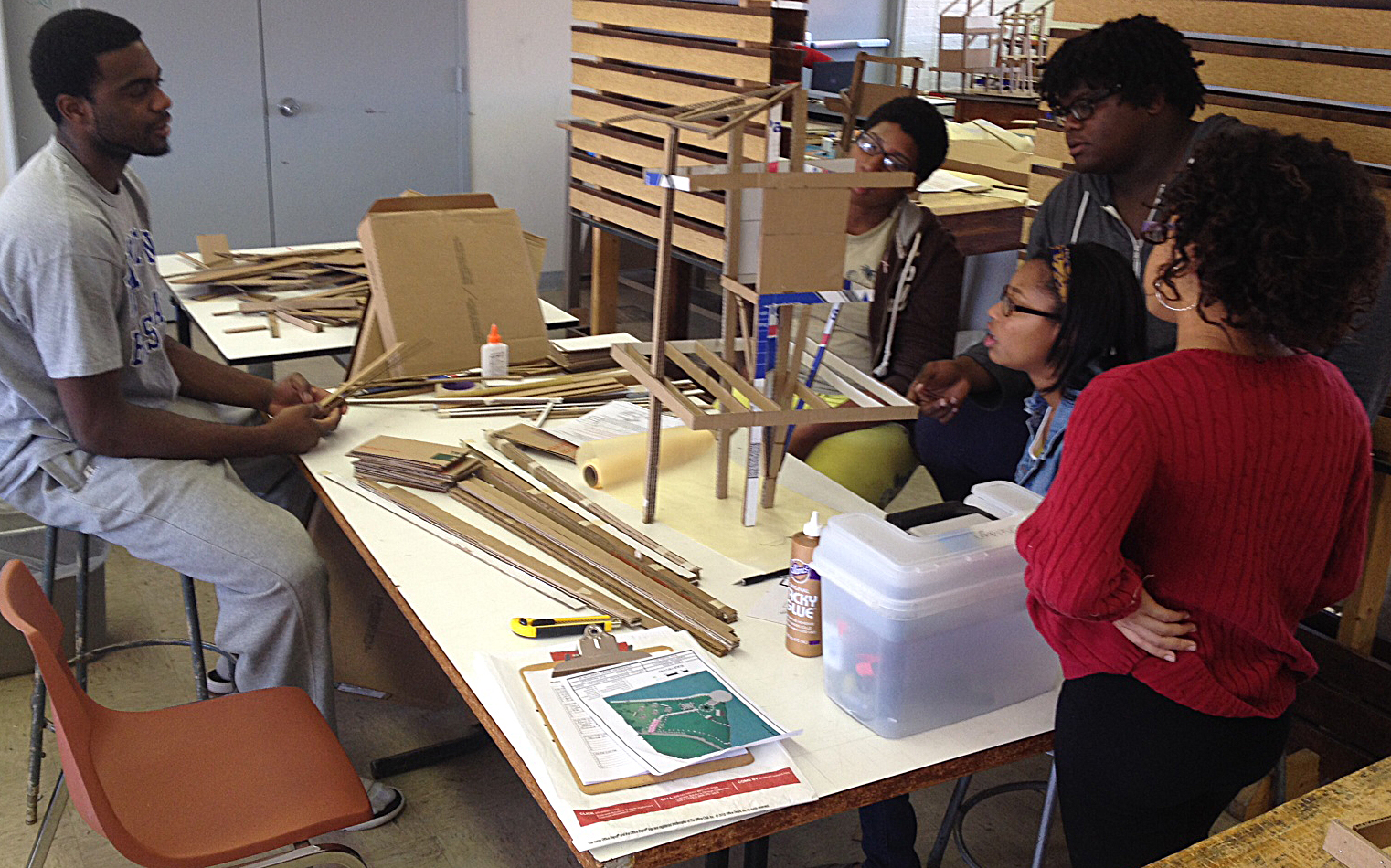
Hampton University’s second year architecture students are learning about gravitational forces and lateral loads by designing post and beam structures using a simple kit of parts (and adhering to a lot of fairly complicated rules).

The intention of the assignment is for students to learn about cantilevering, stacking, and hinging.  They also have to respond to environmental factors and work together in groups to enhance the site design concept developed by another student in the studio.  You can see one of the site design models in the photos below.  The cardboard frames you see represent the structural systems of small cabins that nestle into the site design.

I’ve asked them to build the structures at such a large scale (1″=1′) so they can really get the feel of what the various structural components are capable of doing.  Once they achieve suitable concepts, they will model their frames in wood.

Fingers cross that that will happen by Wednesday!  Thanksgiving is just around the corner… only three weeks of classes left to go this semester… so much to learn, so little time.  They still have to have the interior space, design building skins, and illustrate their designs with diagrams and measured drawings.  All that, in addition to completing their Physics, Architectural Representation, Architecture History, and Architectural Ecology course work.  Whew!