Third Spaces of Smithfield

Browse the bookshelf.

A good “third space” helps fill the gap left between your home (your first space) and your workplace (your second space).  It should be a place where everyone feels welcome and equal–regardless of income or social status.

I learned about third spaces from one of my thesis advisees at Hampton University, Ryan Kendall, who asserted that we lack adequate third spaces in the USA.  He proposed to transform our beautiful (but increasingly vacant) Post Office buildings into vibrant spaces. He wanted them to be used for socializing, learning, developing physically, and yes, mailing things (in old- and new-fashioned ways). Prior to his thesis year, Ryan worked at NASA Langley. That happened the summer after he completed the Comprehensive Design Studio that I taught alongside Robert Easter. Ryan was a smashing success with NASA.  And the NASA folks have kept coming back, asking for more and more HU interns and for our department’s help on various design projects.

Ryan Kendall in his job at NASA Langley.

Ryan’s main point?

In the States we often neglect our third spaces… or fail to create them all together.

I’ve found that fostering “third space” is a core tradition in Ireland.  The pub has long served this purpose.

When Dave and I visited Ireland in 2003, we saw entire families spend their evenings engrossed in meaningful conversations with neighbors and friends at the various pubs we visited.  Kids ran in and out and people of all ages mingled happily and comfortably.  Although pub culture is not as strong today (the smoking ban took a tool on the pubs), it’s something you can still find in many places.

I’m fortunate to have several great third spaces very close to my apartment here in Dublin’s Smithfield neighborhood, a district also known by its postal code, “Dublin 7.”

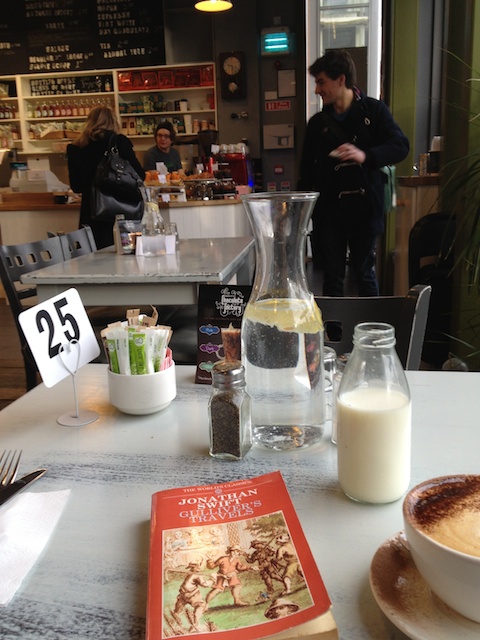
My favorite third space is the Cobblestone pub.  Another–where I’m starting to spend more and more time–is aptly called Third Space.

Third Space: changing the city around the table.
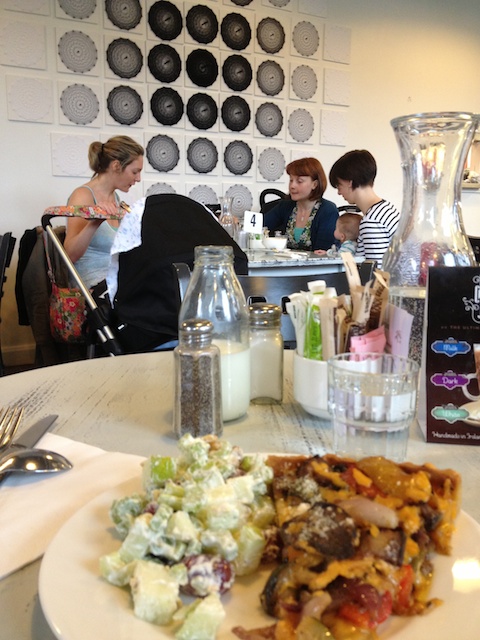
Bring some friends. Enjoy the art.

A webpage for the Third Space restaurant explains:

Our story starts in the changes Dublin saw in the “noughties”. Lots of new apartment blocks, lots of new offices and retail units – no gathering places. Living space and working space but no “third space”.

Third spaces are neighbourhood places where people can gather regularly, easily, informally and inexpensively.

Re-introducing such places into areas that lacked them became a passion for a small group of people. And so was born Third Space. It is a social business venture to open and run eating and meeting places in the areas of Dublin that lack community hubs. With a simple and great menu and an informal friendly environment, they will have a creative buzz that connects into the varied life of a modern Dublin neighborhood.

Third Space 1 opened in Smithfield on February 14th 2012.

I had an interesting encounter at both of my “third spaces” this week.  I’ll post them,  so you can see what I mean. Stay tuned! (Click here to read the sequel.)
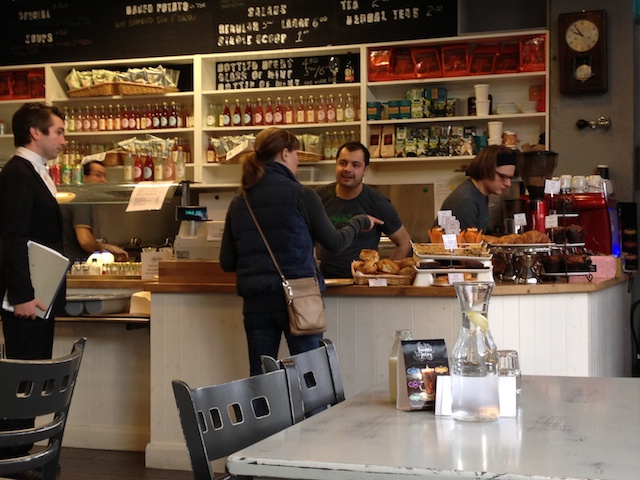
Grab a lunch. Everyone’s welcome and they’ll make you feel at home… even a barrister (i.e., lawyer, shown to the left) can find a quite place to reflect on the day, away form the busy halls of the Four Courts.

We’re Talking Mojo!

The Society of College and University Planners just sent out this email:

In four days there have been more than 500 downloads of this week’s featured Planning for Higher Education article. If you haven’t gotten yours yet, it’s available here for a limited time.We are already seeing some great Mojo discussion and blogging in response to Shannon Chance’s feature article “Learning from LEED & USGBC.” Chance is a registered architect and associate professor of architecture at Hampton University. Chance offers her insights on LEED & USGBC a model systems approach to sustainability for higher education planning. Like many other environmental and design professionals, she also recognizes its limitations.

Arlen Solochek agrees that “LEED and the resultant sustainability movement has been an absolute game changer for everyone.”  But while LEED has definitely “raised environmental consciousness,” it is not necessarily as “nimble and responsive” as it should be.  He also notes that LEED standards are becoming compulsory according to institutional and governmental regulation. Other limits include inflexible point system and the expense of soft costs and certification. Both Solochek and Chance agree that “the bigger issue is not just stopping at more sustainable buildings.  How many of our institutions are trying to infuse sustainable concepts into their academic courses, into their students’ and staff’s lives and habits outside LEED?” (Solochek).

According to Michael Haggans, Chance’s article “…balances criticism of the LEED ‘gaming-for-points’ process that many have seen in practice, with a well documented account of the evolutionary improvements that are now underway.” Alexandria Stankovich offers a student perspective on LEED & USGBC in relation to higher education planning on the Mojo blog.

If you’re going to 2012 GreenBuild, please pass this article around. And, please share in the Mojo what you learn.

Thanks.

Visit SCUP’s Planning for Higher Ed Mojo at: http://mojo.scup.org/?xg_source=msg_mes_network

Is this Coke’s Idea of Targeted Marketing?

Billboard next to the Fresh Market.

Really Coke?

This is what you think will appeal to Dublin?

Because nothing says “Christmas” quite like tractor trailer trucks.

Were you trying to make us think “yum”? Because I’m not.

But then, I guess I don’t represent your target market.

I’ve posted a photo of what I purchased just after walking past your tantalizing billboard in Smithfield plaza.  The produce in the photo was already at my apartment (because I keep a collection of fresh fruits and veggies), but the muesli, aloe, and salmon I bought after passing your ad.

My bounty from Fresh Market, Centra, and several local produce vendors.

Applying for a Fulbright to go to the US

I’ve been promoting the idea of applying for a Fulbright to many people I have met here in Ireland.  Up until now, I wasn’t entirely clear on the specific types of awards available for Irish folks who want to be Fulbright-ers in the USA.  I’ve recently discovered that there are three types of awards offered.

  • Fulbright Student Awards: For up to one academic year for postgraduate study or research in the United States in any discipline, including the arts. Grants are a maximum of $20,000. Applicants may stay to complete their academic program if it is longer than one year.
  • Fulbright Scholar and Professional Awards: Grants available for up to €35,000 (Irish Language) and $20,000 (General Awards) for academics and professionals with more than five years’ experience to research and/or lecture in the US, lasting between and three and twelve months.
  • Fulbright Foreign Language Teaching Assistantship (FLTA) Awards: Ten-month Awards for Irish language teachers to refine their teaching skills in the US by teaching at a US college and taking classes at a post-graduate level. Grants are available for approximately €20,000.

The applications are due tomorrow (November 14) for travel in 2013-14, but this information can help my Irish friends as they plan for the future.  Additional information is available from Fulbright Ireland.

What’s a MOOC? (And can it help us save humanity?)

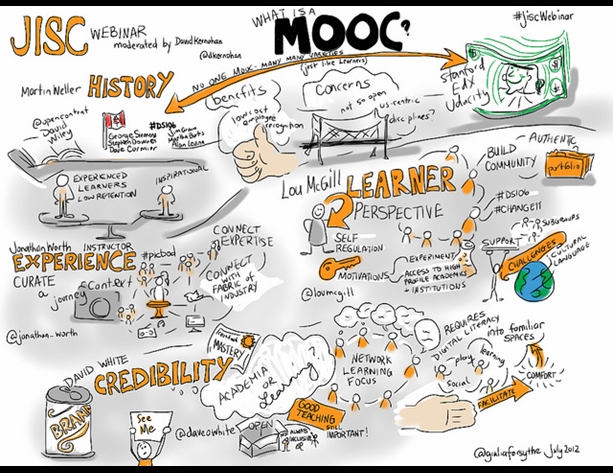
A diagram from Dave Cormier’s video.

I’ve been scratching my head, wondering “what’s a MOOC?”

Someone at SCUP sent me a helpful link to a succinct four-minute video by Dave Cormier that describes MOOCs and explains that the acronym stands for “Massive Open On-line Course.”  I also found a helpful blog posted by Lou Mcgill titled  What is a mooc? Massive Online Open Course and the learner perspective.

SCUP is using a MOOC to facilitate communication among its members.  I’ve been visiting SCUP’s MOOC for weeks now but I haven’t been able to “see the forest for the trees.”  I haven’t understood what’s going on all around me.  I find my way to some places that seem like classrooms and other places where discussion is going on, but I don’t yet understand how to navigate effectively.

Thanks to Dave and Lou I can finally stop scratching my head!  And, once I understand how the platform works, I can start using it to generate knowledge about planning and sustainability — rather that just about how to use MOOCs and the internet more effectively.

In any case, I believe that this on-line communication platform (i.e., SCUP’s MOOC) is the reason that my article got so many downloads so quickly after it went “live” on the internet.  The splash page for the article was viewed 644 times between November 9 and November 12.

To be honest, up until now I didn’t actually think people read the academic articles I’d published.  But now that I think about it, several people did contact me regarding an article I published with SCUP in 2010 titled Strategic by Design: Iterative Approaches to Educational Planning.  So perhaps SCUP’s audience reads and communicates more about its publications than is the case with many other organizations!

MOOCs provide a platform for learning that can help communities develop new knowledge quickly.  SCUP’s is aimed toward generating knowledge about how universities run and how they can improve their approaches over time.

Perhaps humanity will develop viable paths to achieving sustainability by using tools like MOOCs to share and build knowledge.  That’s part of the focus of my article just published by SCUP and something I think society MUST focus on if we are to persist on this planet.

But I’m quite interested in knowing more about how people work together to generate new knowledge.  The research project I’m conducting right now with Gavin Duffy and Brian Bowe (as part of my Fulbright) investigates how a group of teachers here at the DIT (i.e., a learning community) has been able to implement changes in the way DIT teaches Electrical Engineering.  These are topics I learned a lot about in the Ph.D. program I completed at The College of William and Mary on educational policy, planning, and leadership.

And interestingly, so many of the women I’ve bumped into recently–Esther, Joan, Máirtín’s wife, and myself–have been studying topics of leadership and change management.  Now that I’ve joined SCUP’s MOOC, I have found a whole new community discussing change, strategy, and the university’s role in addressing social and environmental issues. I hope we can elicit the types of sweeping change that this world needs, and do it fast enough to save ourselves.

Fulbrighters Sharing Ideas

I just received great news about my article from one of the editors of Planning for Higher Education.  Terry Calhoun left me this comment:  “Shannon, as of this morning, we have 345 article/summary downloads. So, people are reading, even if not yet commenting.”

I have to say: that’s a truly amazing number of downloads.  It’s a testament to the quality of the organization (the Society of College and University Planners) and its new platform for sharing ideas.
——–

Erin Eife and I discussed the ins and outs of applying to grad schools in between programmed sessions at the Fulbright Orientation.

On another note, Fulbright Ireland just posted a piece on taking the GRE in Dublin that was written by Erin Eife who is a recent college graduate who is conducting research on recidivism among females who have been jailed.

Erin and I sat next to each other at the Fulbright Orientation in September.  We got to talking about grad school and I answered some of her questions about degree paths and about selecting and applying to grad schools.
Erin has since written to thank me for the advice and let me know that she’s following through!  I love getting this type of feedback!  It’s not often that you hear you’ve made an important difference simply by sharing your experiences.
 Erin has got big dreams and I have every confidence that she’ll succeed with the applications she’s submitting this fall.

A Welcome Home with Designer Toast

Georgie, Peter, Jox, and Joan enjoying a crisp fall day in their Dublin home.

It’s not often you get the chance to visit other people’s home when you’re traveling the world.

In Ireland, I can recall being in the home of Elish and Con O’Hanlon in 2003 and, more recently, in the home of Glen’s friends Carol and Connor O’Malley (who run a B&B but treated us like family on our September 2012 visit).  I can’t remember visiting anyone else’s home here yet.

Joan’s beautiful entryway.

So today was a rare treat!  I had the pleasure of brunching with architect Joan Cahalin at her favorite cafe in the outskirts of Dublin and then visiting her family’s beautiful home.  I didn’t expect I’d be able to share photos of this visit, but the family didn’t seem to mind at all when I asked if I could take some photos for the blog.

Joan is currently studying business management at University College Dublin and she also has degrees in architecture, philosophy and linguistics (if I remember correctly). Her husband, Peter Twamley, is also an architect.

Their daughter, Georgie, is studying fashion design at the National College of Art and Design (NCAD). Georgie is a remarkably bright young woman who is full of insight into sociology and culture.  As I did every summer when I was in college, Georgie spent the warm months working on the staff of a summer camp in the USA. We’ve had many experiences in common, yet she seems so much wiser about the world than I was at 20. And she’s got a good sense of her many options for the future.

You can view the photo gallery to see Georgie’s method for making grilled cheese sandwiches using a regular toaster.

I really enjoyed discussing Dublin planning with Georgie, her two architect parents, and her younger brother, Jox who is in high school. He’s at the point in his studies where students spend a year learning subjects, in six-week blocks, that they haven’t covered before. In between these blocks, they have three periods where they are required to work in internship positions. With a bit of help from his mom, Jox found an internship at LinkedIn. It sounds like he has a truly outstanding mentor at LinkedIn.

The internship requirement seems like an great idea.  Many of my friends waited until after they earned college degrees to have the type of experience Jox is getting in high school. And unfortunately, so many of my friends discovered, after graduating, that they didn’t actually like the line of work they’d trained for in college!

After discussing Saturday’s edition of the Irish Times, Joan and Georgie and I jumped into the car. They dropped me at the apartment on their way to visit Joan’s mom in what was left of our daylight hours.

Mapping Dublin’s Transport Routes (Thanks a Mil, Colin Broderick!)

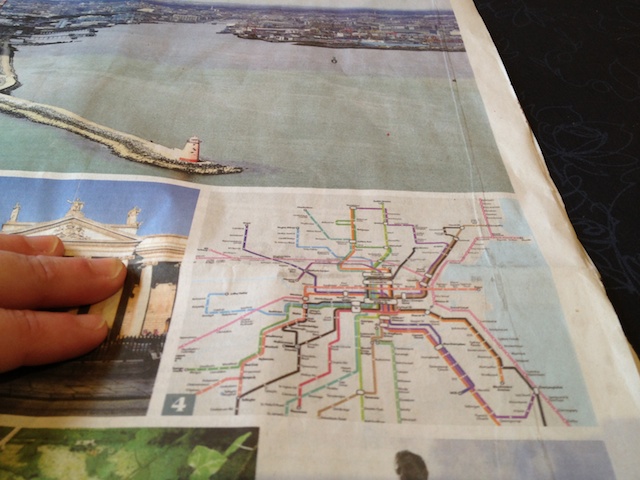
The proposed transportation map, which helps people visualize the links between various systems of public transportation.

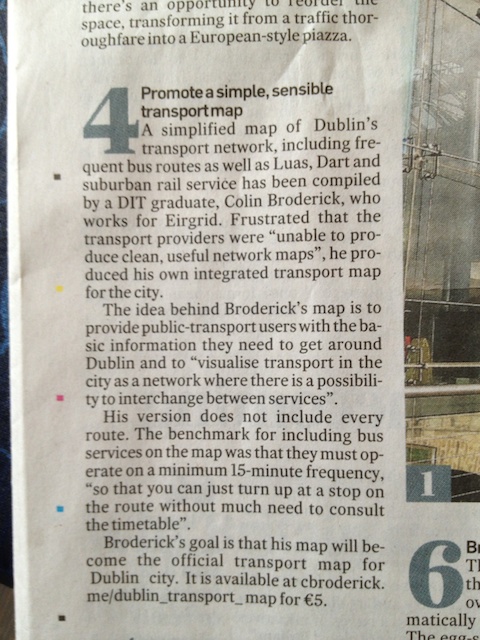
An enterprising recent Dublin Institute of Technology graduate, Colin Broderick, has developed a very helpful map of all of Dublin’s public transport routes.  Colin created a map to help people visualize various transit routes and see how they connect.  And the Irish Times featured his idea yesterday!

This is truly exciting for me (a recent arrival to the city who struggles to navigate a frequently baffling bus system).

For the past three months I’ve longed for a resource like the one Colin has produced.

When my sister, Heather, visited from New York City in September, we collectively bemoaned the lack of such a visualization tool.

Yesterday’s Irish Times listed issue #4 as improving Dublin’s transportation map. YAY!!!!!

There has been, it seems, no comprehensive map of Dublin’s many bus routes published in recent memory.  Heather and I each, individually, trekked to the Dublin Bus headquarters to request one, only to leave empty handed.

The lack of a map was truly a “gap in the existing knowledge base” here in Dublin. And someone fresh out of DIT (my host institution here in Ireland) took it upon himself to fix the situation!

In the past two months, I’ve been toying with the idea of trying to make a map like Colin’s for my own personal use. I even dreamed of sharing it with others, but I also knew I didn’t have adequate time. And I worried that I would misunderstand some of the systems and make mistakes, which would mean I couldn’t share it.

Now, my dream of having such a map will become reality.

I applaud Colin for developing and such a map–and for making it available to the rest of us.

Many thanks to Joan Cahalin, her husband (Peter Twamley), and their awesome kids (Georgie and Jox) for tuning me into this bit of news!

The Irish Times will feature a new issue each day this week.

I snapped a few images of the map while I was with them earlier today, although I haven’t had the opportunity to study Colin’s graphic closely yet. Each day this week, the Irish Times will focus on a separate issue.  Colin’s map will be “front and center” in Tuesday’s paper.  I can’t wait to, as we say in the States, “read all about it.”

Rathfarnham Castle and Other Delights

Dublin is full of architectural gems and Máirtín D’Alton of Gerry Cahill Architects seems to know something about every one of them!  He and his delightful six-year-old son, Thomas, gave Esther and me a tour of several places last Sunday.  I’ve included photos of our attempted walk along Dublin’s historic South Wall and our subsequent visits to Rathfarnham Castle and the Irish National War Memorial Gardens.

Máirtín provided extensive, astute commentary.  I wish you could have been here to hear all the details!

Incidentally, Thomas’ mom was at school this day, studying leadership and administration.  Go mom!!!!!

Esther and I have each earned degrees in this area over the past six years.  We’ve actually become more and more alike in the past decade.  Until this past week, however, Esther and I had no idea the other was studying leadership and educational administration!

South Wall and lighthouse from the air, one of the world’s longest sea walls.  (Image downloaded from groundspeak.com)

We were headed out to see the lighthouse when some nasty weather rolled in.

Máirtín and Thomas astutely determined it was best to turn back rather than hike out the the lighthouse in the rain.

We found a cosy place at Rathfarnham Castle where we could wait out the rain. This picture shows typical Irish weather: sunny with rain.

I really had fun with Thomas. He’s a delightfully precious six-year old!

What a cutie!

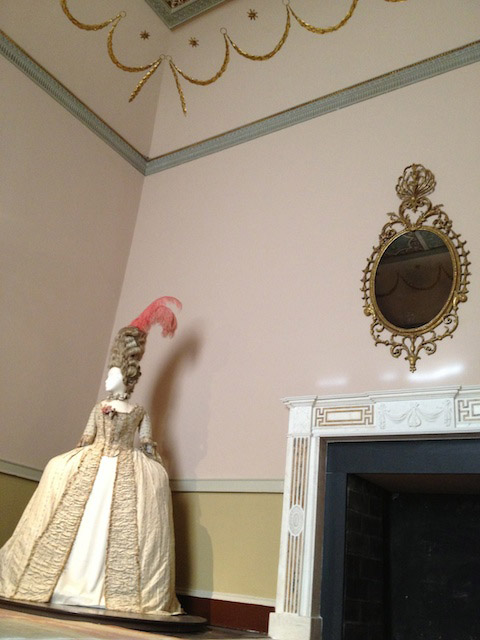
The toy and costume exhibition at Rathfarnham Castle was fascinating.

What women will do for “glamor!”

Hat? Or, umbrella?

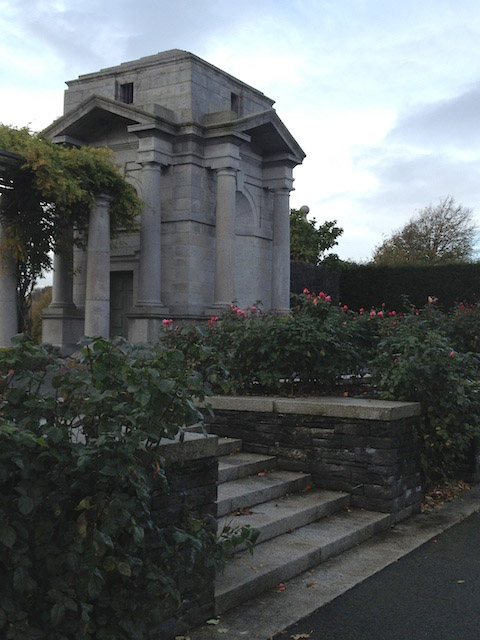
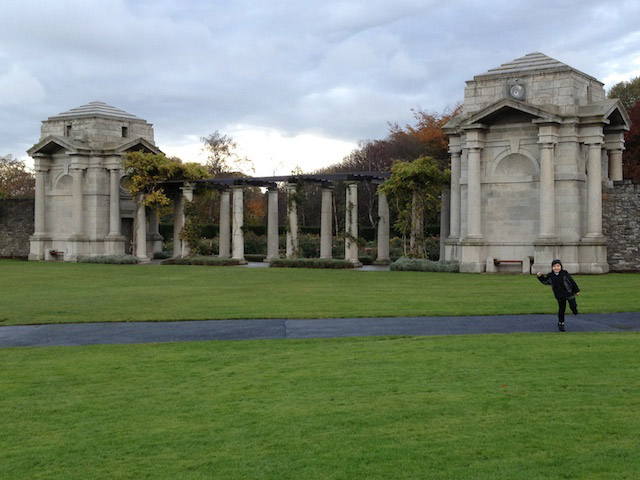
We ended the day at the Irish National War Memorial Gardens.

Irish National War Memorial Gardens is dedicated, one inscription says, “to the memory of the 49,400 Irish soldiers who gave their lives in the Great War, 1914–1918.”  With a farewell wave from Thomas!

Mister Rodgers Remix

I grew up watching Mister Rodgers on TV–in black and white, of course!

The Public Broadcasting Station (better know as PBS) is keeping him up-to-date with this Mister Rodgers Remix.

It shows a true slice of our American Pie.  I’m listing this entry as “Education Research” since Mr. Rodgers was such a big contributor to US education in the 1970s.