I’d like to highlight some creative endeavors of two people I have had the pleasure to teach and/or mentor over the years. They take time to post about their hobbies and/or professional work on WhatsApp or social media, and I benefit from what they share.
I have felt such inspiration due to recent posts by Shane Ormond (who lives in Ireland) and Nikkolas Smith (who lives in the USA).
Shane was previously a student in DIT’s School of Electrical and Electronic Engineering, and he’s been part of our RoboSlam activities for nearly a decade now (see RoboSlam.com and its blog section). DIT has transformed since then into TU Dublin — and RoboSlam has evolved into the Dublin STEM Ensemble. Shane has been a big part of both. He can frequently be seen supporting STEM Ensemble activities, like our annual exhibit at Dublin Maker, or our periodic planning and knowledge-sharing sessions held in the new Granegoreman Central Quad.
Here’s a video Shane shared on our STEM Ensemble WhatsApp thread last week about one of the projects he’s been doing in his spare time:
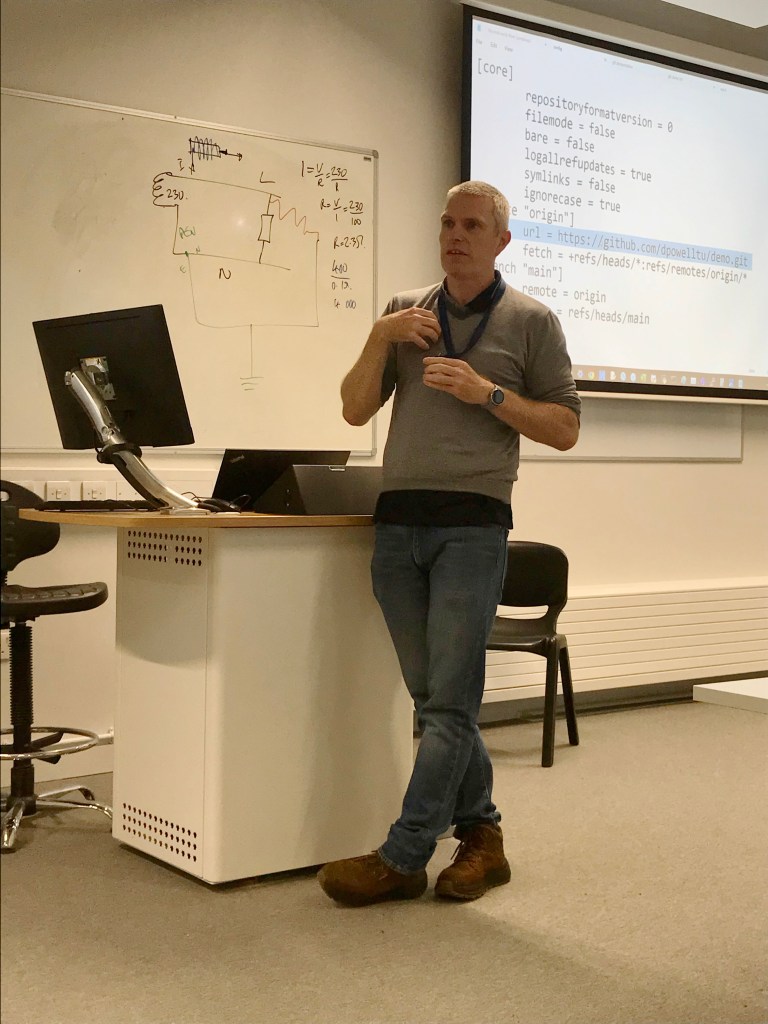
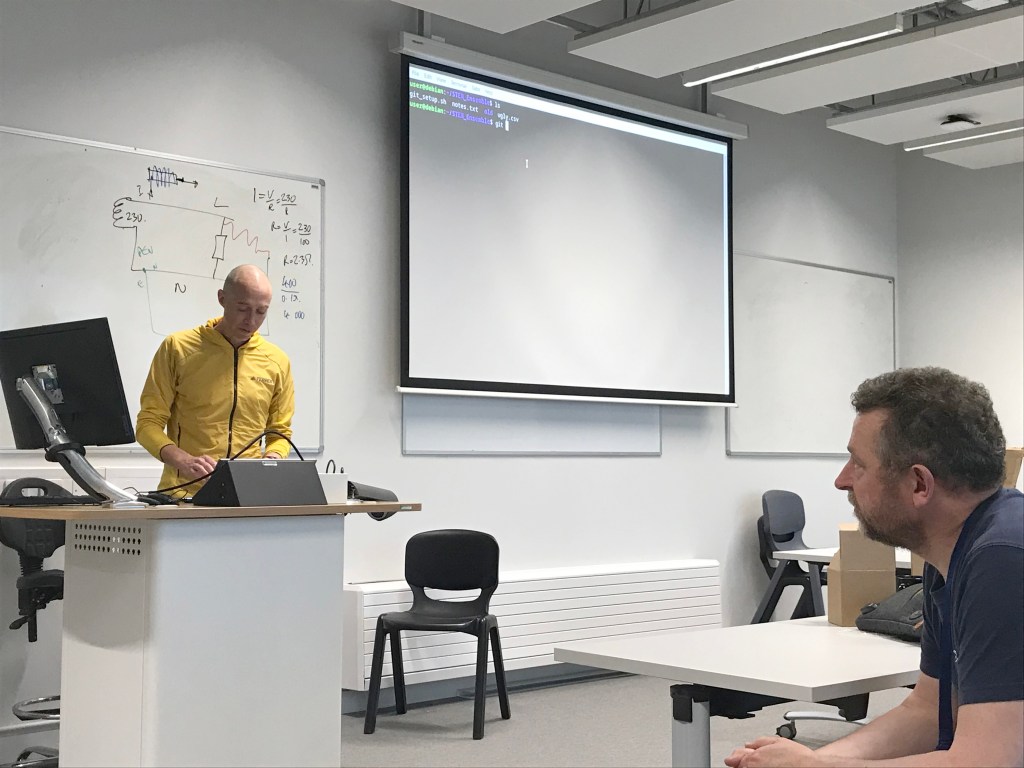
At the end of the video, Shane mentioned GitHub, where he posts his work for others to draw from. STEM Ensemble recently held a seminar on GitHub that Shane and I both attended. (The difference is, he understood a lot more of the presentation than I did!)
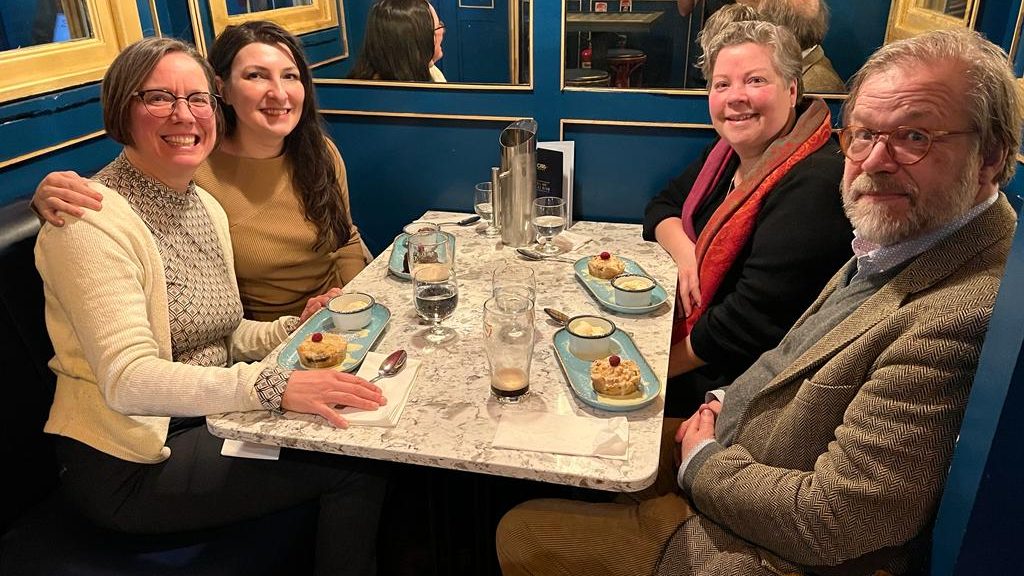
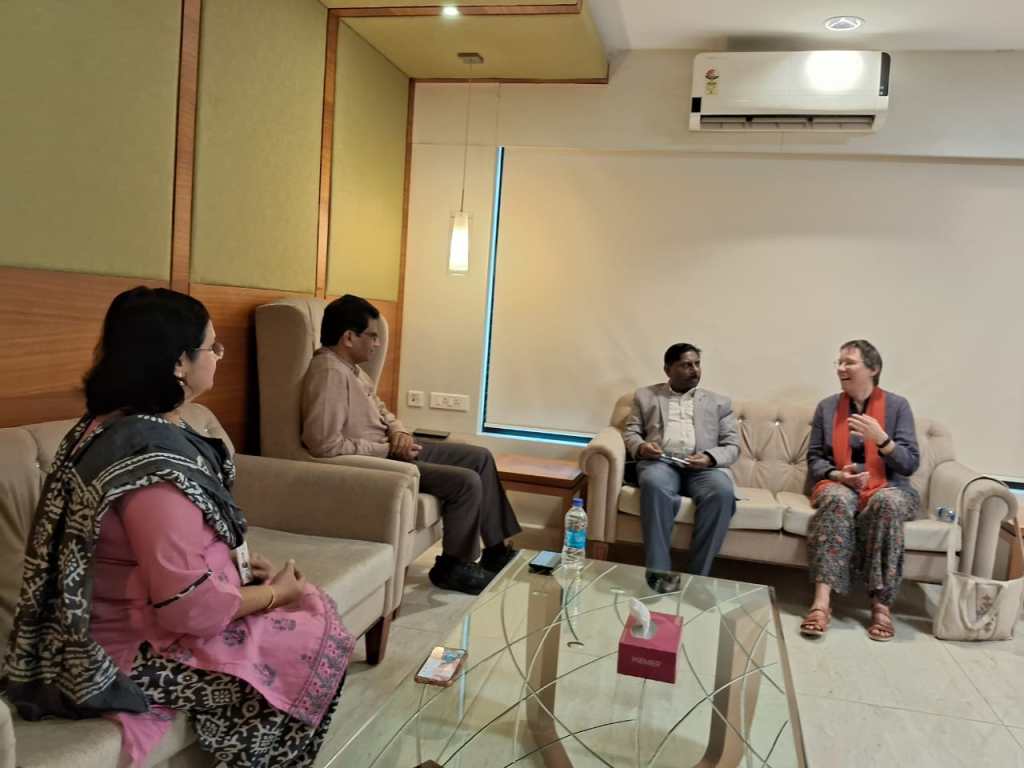
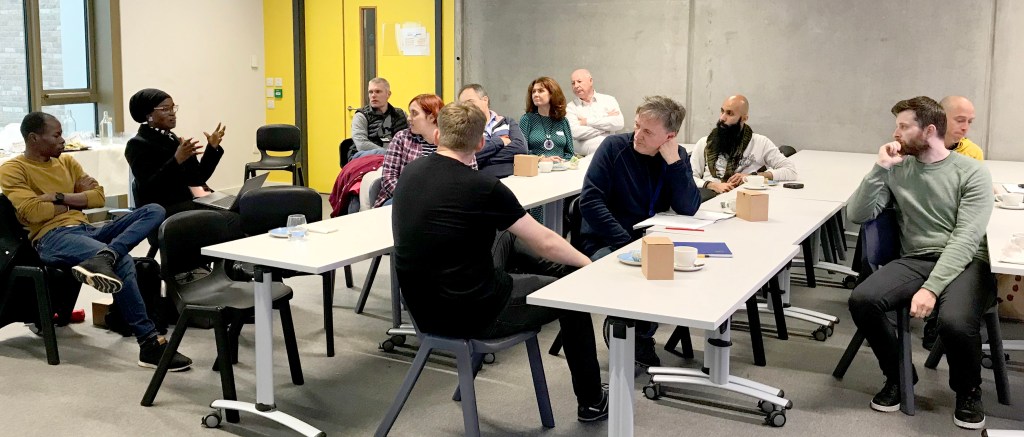
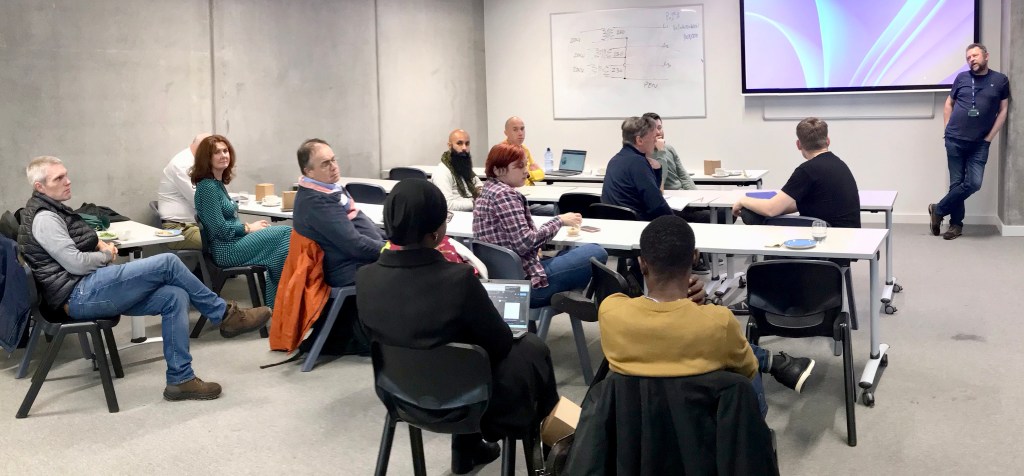
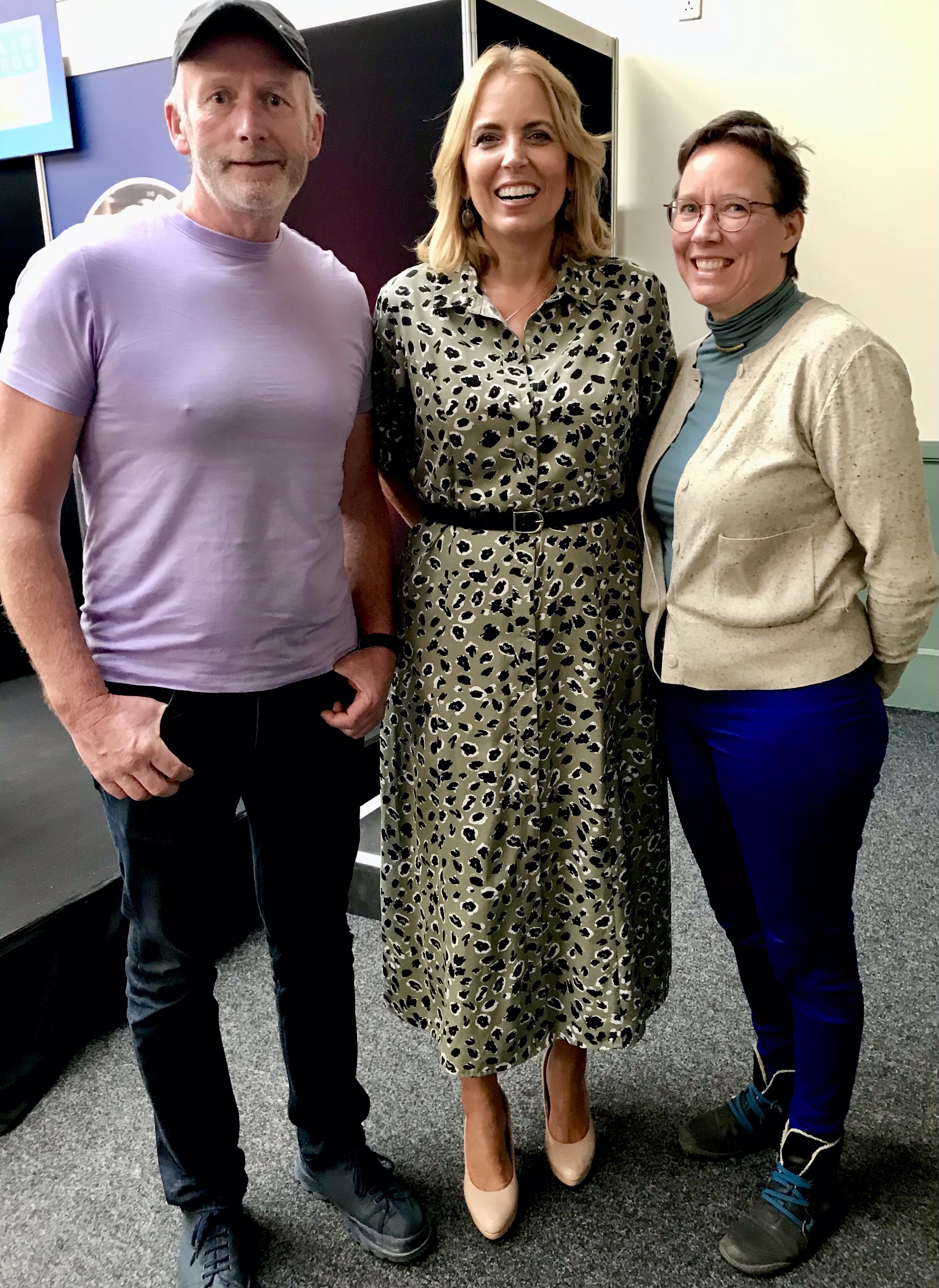
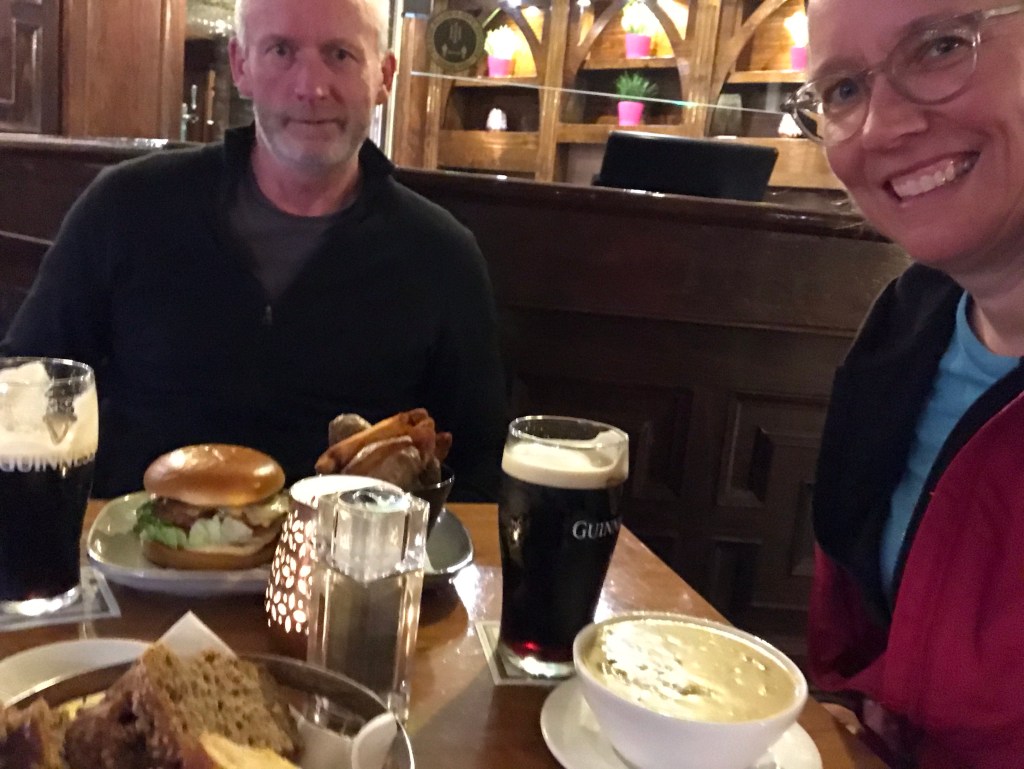
Images from our recent STEM Ensemble meeting that was followed by two presentations on using GitHub and a jaunt to the pub.
I see the video (above) with the blue model car as an evolution of Shane’s earlier work with robotic model cars with cameras on them, which I captured in this March 5, 2020 video. I shot it days before campus ground to a close with Covid lockdown:
Shane does all this as a hobby; at a couple of Dublin Maker faires he developed the technology to power talking heads. This year’s talking head automatically answered spoken questions using ChatGPT.
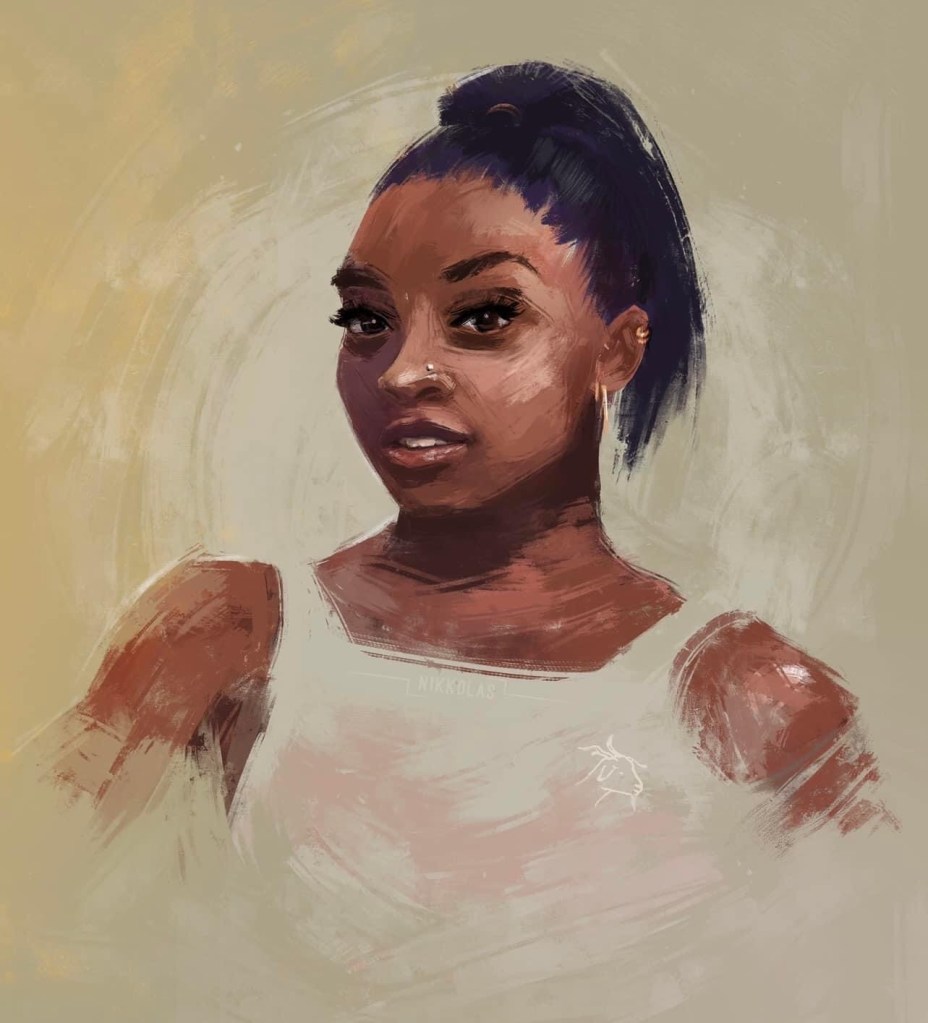
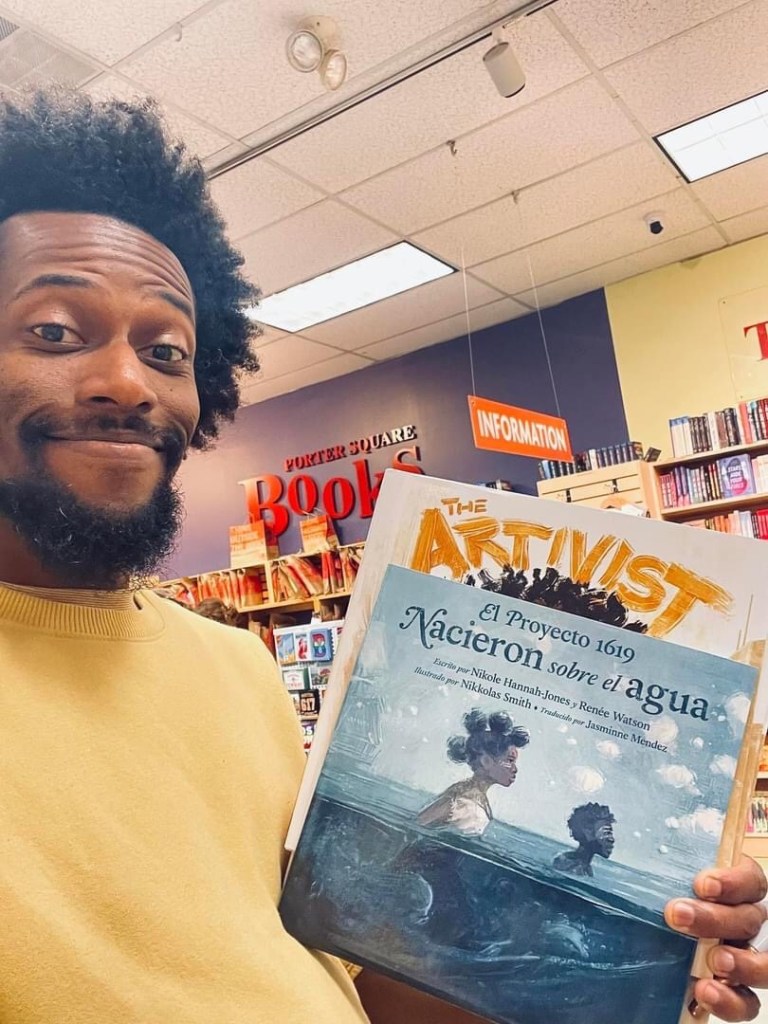
Like Shane, Nikk Smith is internally motivated to create. Nikk was an architecture student of mine at Hampton University, many moons ago. He often posts his “Sunday sketches” on social media. Here are a couple examples:
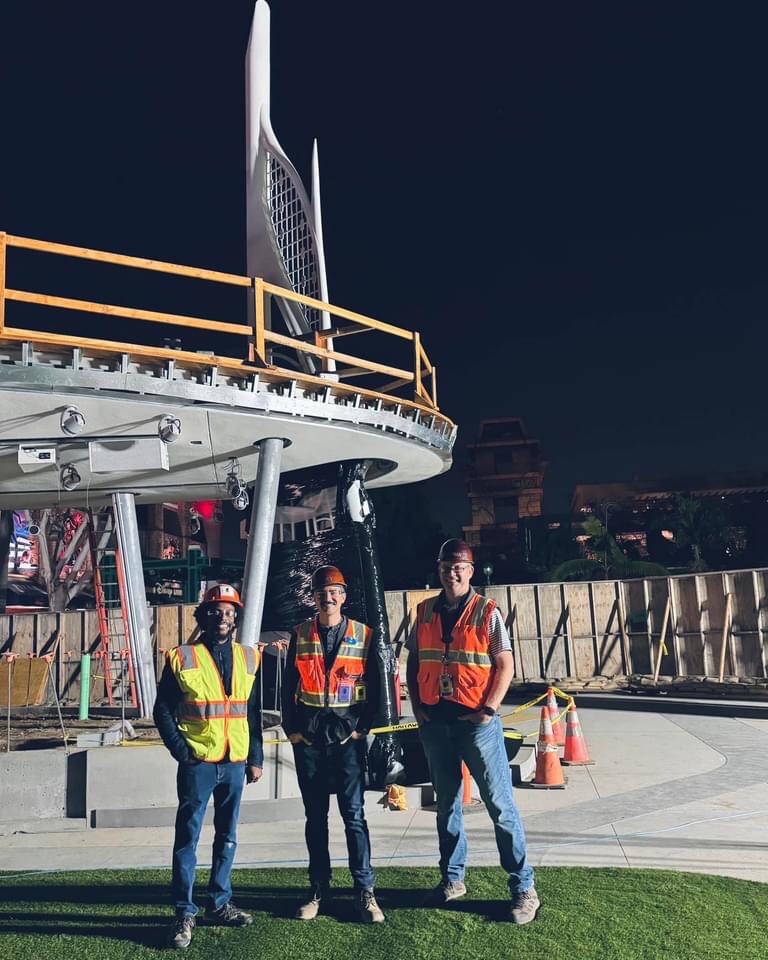
A couple of Nikk SMith’s “Sunday sketches”. One of gymnast Simone Biles, and another of children from Palestine, Sudan, and Congo. His work has socio-political relevance, and he highlights Black causes and heroes.Nikk also illustrates and sometimes also writes books for children. “Born on the Water” has been extremely successful, and has just been published in Spanish. The original is in English. He uses art to support his activism, and coined the term “activist” encouraging others to combine art and activism!Nikk used to work as a full-time Disney Imagineer, but now he works for himself (I think) and does consulting for Disney. A tower he designed for Disney to honor Black architects has just been opened at a Disney park. Nikk also designs movie posters — and I included his most recent poster here.
I am proud beyond compare of the work my former students and mentees are doing in the world — the creativity and passion they bring to the world and the lives they design for themselves.
Shane and Nikk are two outstanding examples, and I hope to feature more of my own personal heroes on this blog in the months to come. Being an academic educator and researcher connects me with many amazing people.
Following an extra-warm couple of weeks here in Dublin, fall set in with a cold, hard thud. Despite low thermometer readings, the sun did peek over the horizon, hanging low in the sky.
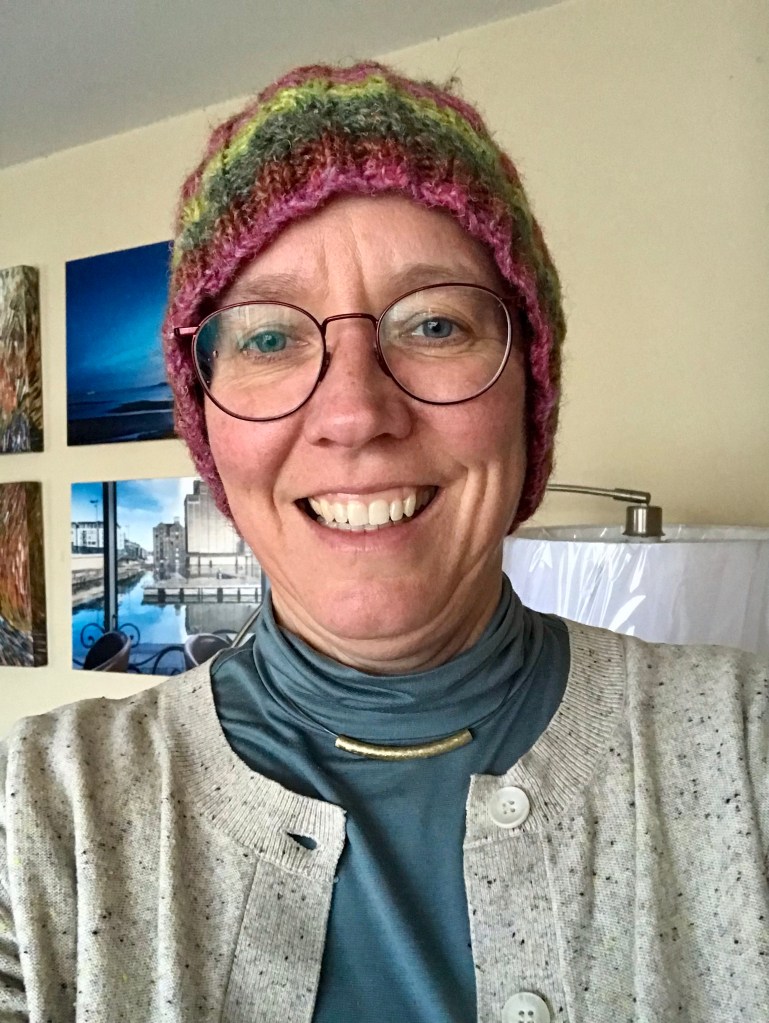
We were blessed with a couple of crisp, cold but gloriously sunny days of weekend. I bundled up in preparation, kitted with a lovely hat my aunt Kitty gifted me this summer.
Kitty has honed her kitting skills to a T, and I’m reaping the benefits of her hard work and loving craft.
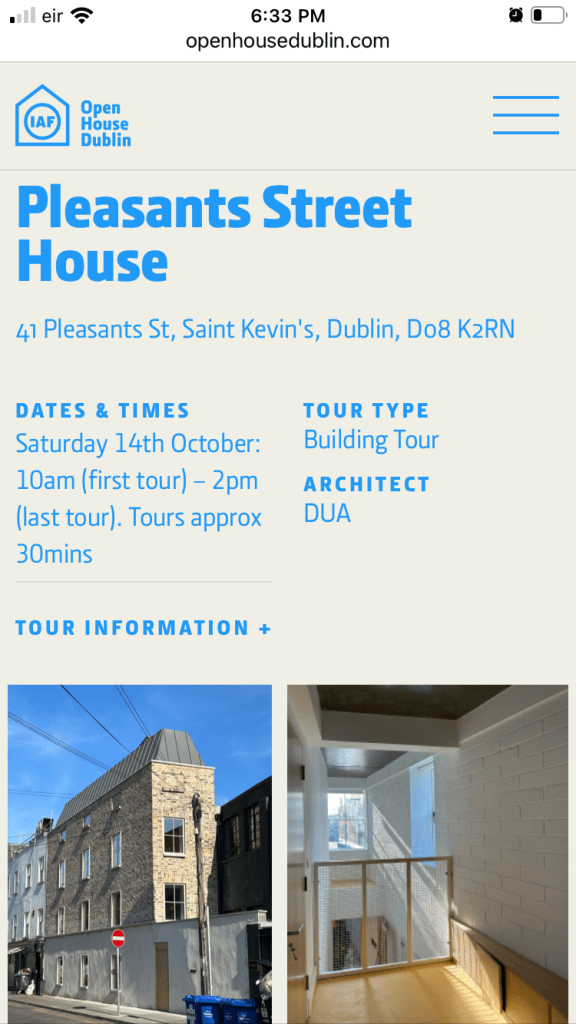
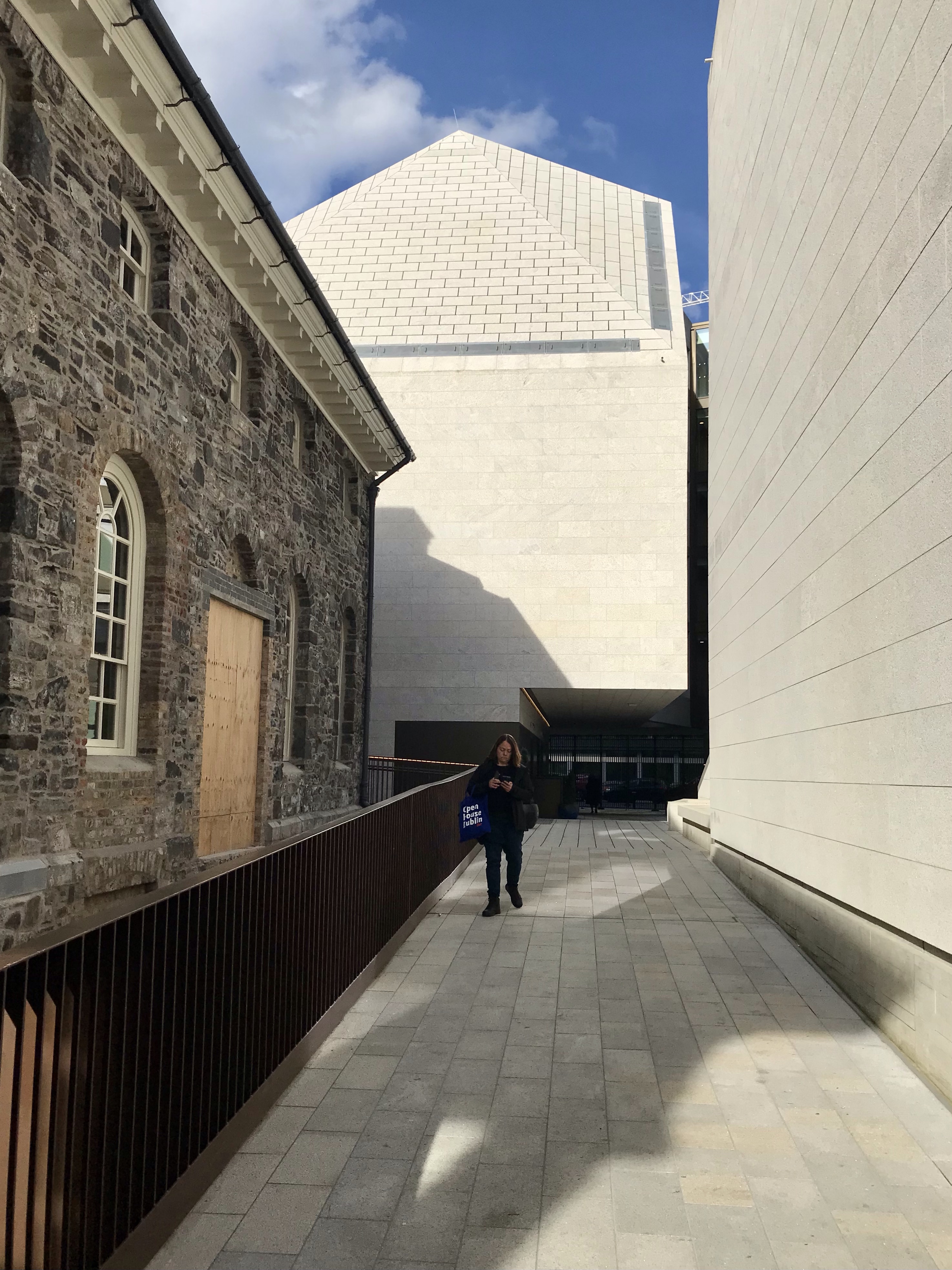
Saturday, Aongus got up early for a gym session then we headed out on our bikes to catch an early tour offered as part of the annual festival called “Open House Dublin”. This event has been a highlight of every year I’ve lived in Dublin and this year did not disappoint. We didn’t manage to snag tickets to many events, but the three we attended were grand!
We started with a single-family house (our favorite type of tour here) on Pleasant Street, near Aongus’ new job site at Kevin Street. The house was designed by DUA and is currently rented to three super-luck Trinity students until the owners move in from abroad.
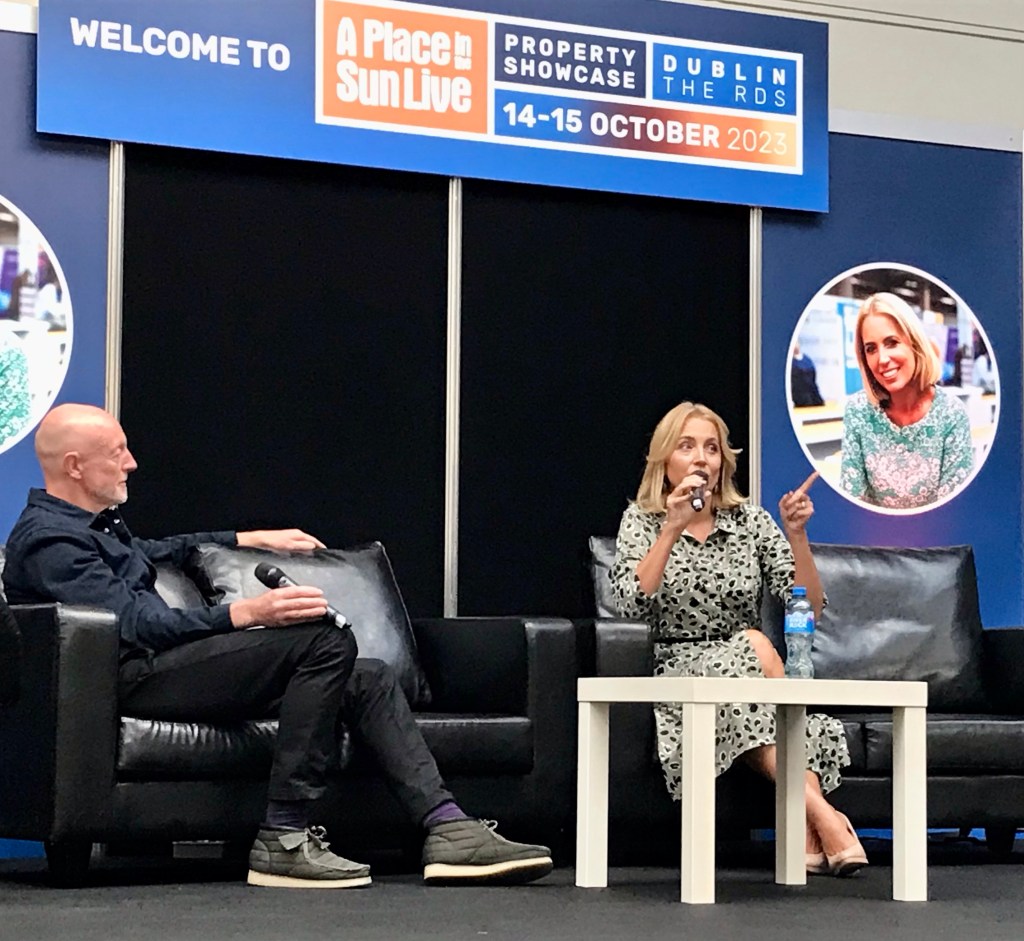
Following that tour, we cycled at top speed over to RDS for the “Place in the Sun” expo. We listened attentively to four panels and got to meet Jasmine Harmon, the TV show’s most active host.
Heading back into town after a full day of sun and star-gazing, we enjoyed lunch and a drink at Opium on Camden Street. Then we were off again, headed to the Lighthouse Cinema for a second Open House event, called “Cities Have Feelings”. We enjoyed a film and poetry reading by LionHeart. We also soaked in a super-intriguing lecture by city architect Finn Williams who has worked in London and now works in Marmö, Sweden. There was a follow-up panel with them both that yielded even more intriguing insights. At the end, I got to catch up with my architecture colleague, Jim Roach, at the drinks reception.
Sunday morning, Aongus and I hit the gym bright and early. He had a personal training session, then we both did spin class before he headed into an abs class. (Maybe you’re getting the drift that I can’t keep up with the man, but I try!). We fueled up with oatmeal and fruit afterward and then jumped on our bikes again for one last Open House tour.
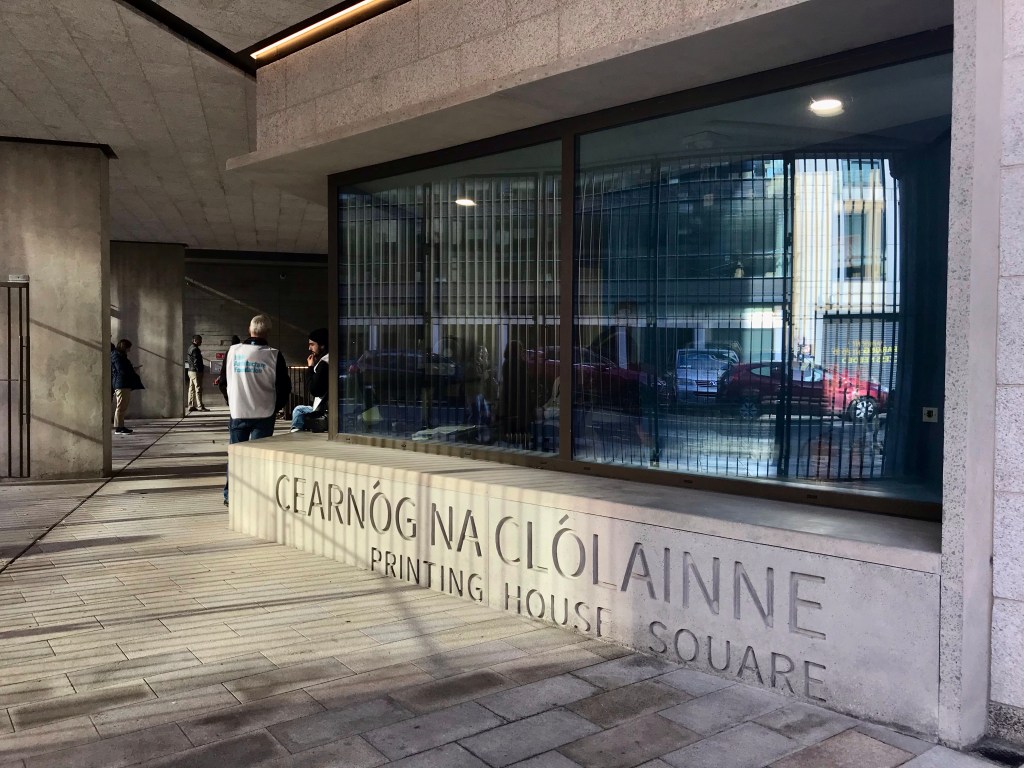
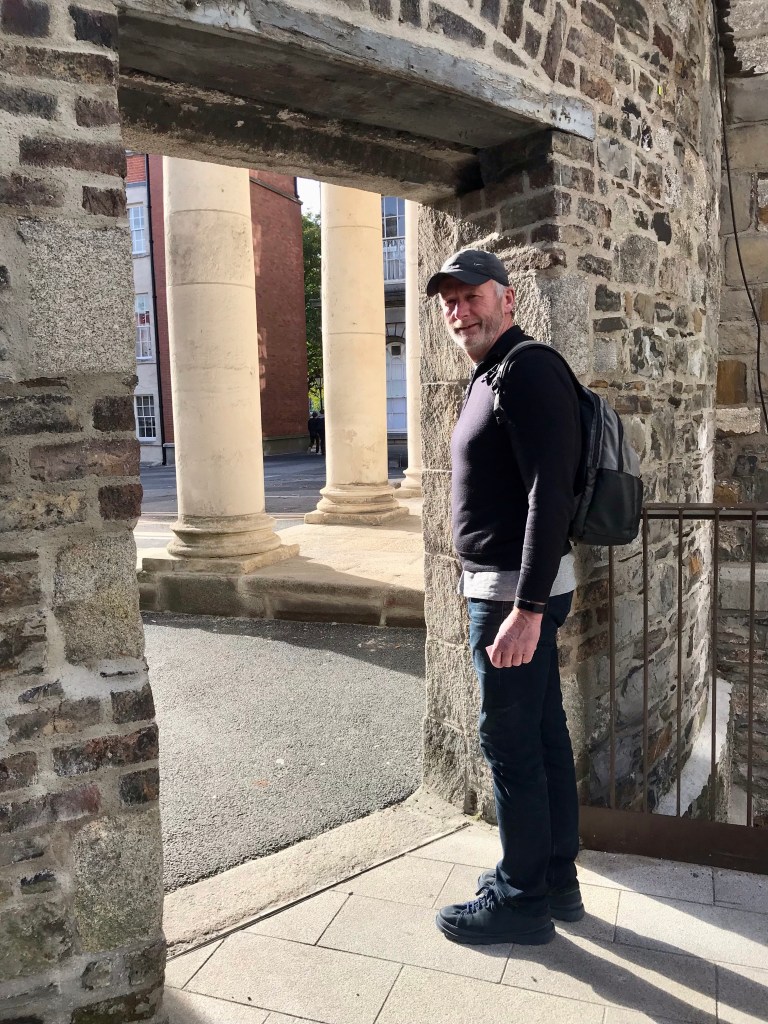
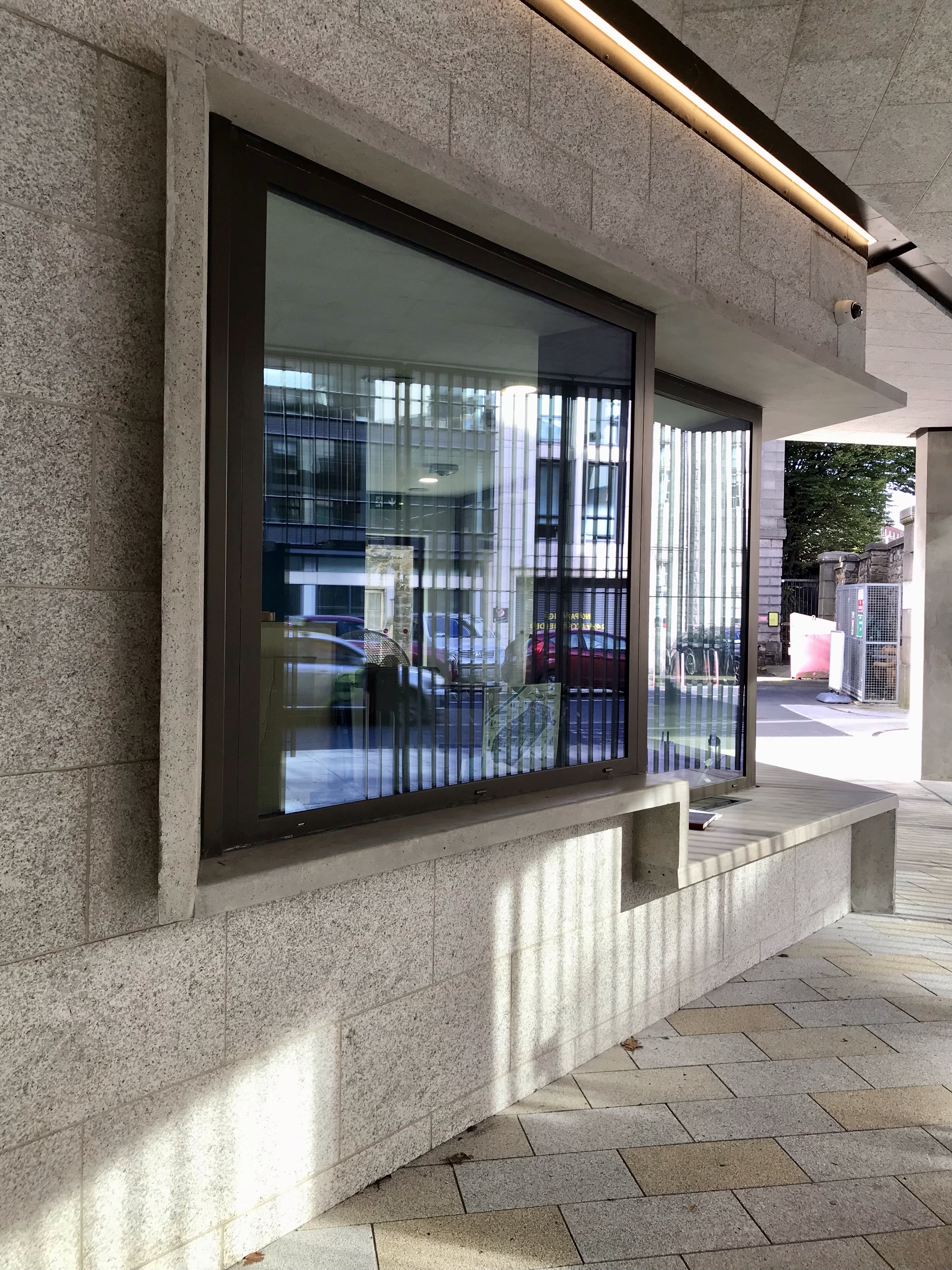
This was a visit to Printing House Square—better known to me as Oisín House—the construction project Aongus has worked on since our return from London. Architect Valerie Mulville delivered the tour and I got to see the fruits of Aongus’ efforts.
The edifice was awarded “Building of the Year” and Aongus’ employer named “Builder of the Year” at a recent event. This was the first time I’d had a chance to see inside. It’s quite an impressive structure and the quality of the finishes and detailing was surprisingly high.
I enjoyed a cycle through the city center while Aongus sped off for visits to his aunt and mum afterward.
Then, I made my way home to field incoming questions from students. They are culminating a sprint course on Research Methods. Last week was a marathon on the topic for the 23 students, my co-teacher Claire Simpson, and me. The students’ final proposals will need grading and feedback in the morning since they’ll start their Dissertation module this Thursday. My sprint hasn’t ended!
In any case, I’m so extremely thankful for sunlight, energy and vibrant health, curiosity, a full set of senses, mobility and freedom to explore, citizenship, warmth and comfort, quality food, an interesting and secure job that I love, and a strong and fit partner to enjoy all this with. Long may these blessings last!
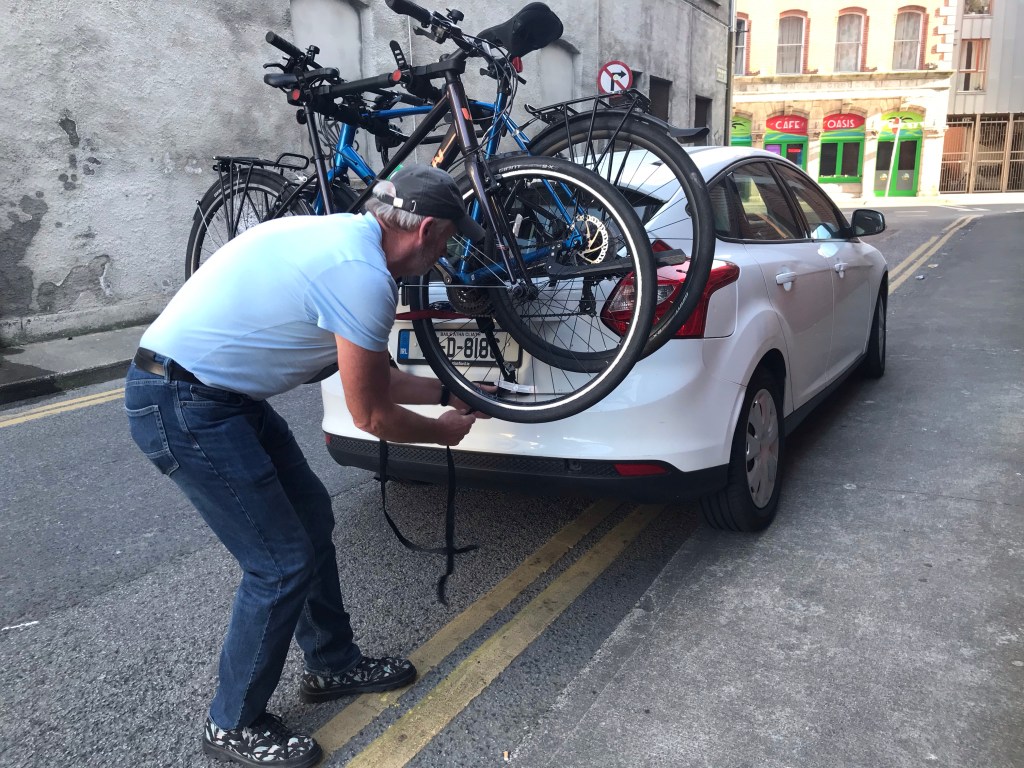
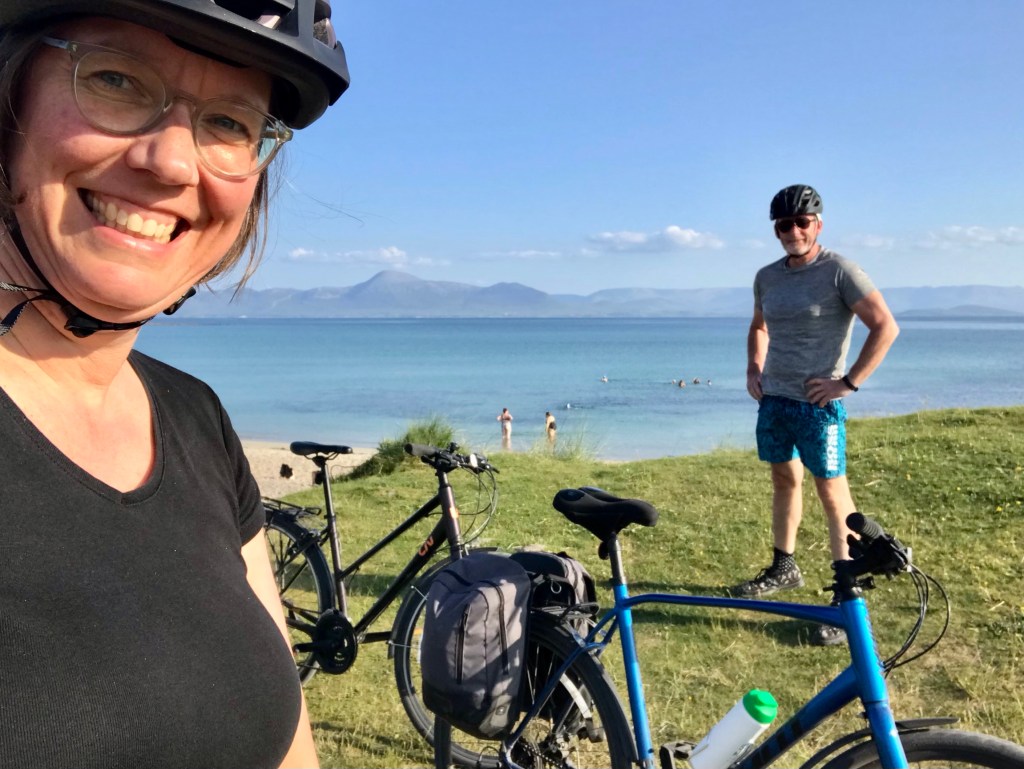
Aongus and I enjoyed an amazingly warm and sunny Bank Holiday weekend, the start of June. We travelled by car with bikes on a rack, cycled parts of the Greenway along the Wild Atlantic Way, and enjoyed beaches and restaurants along the way.
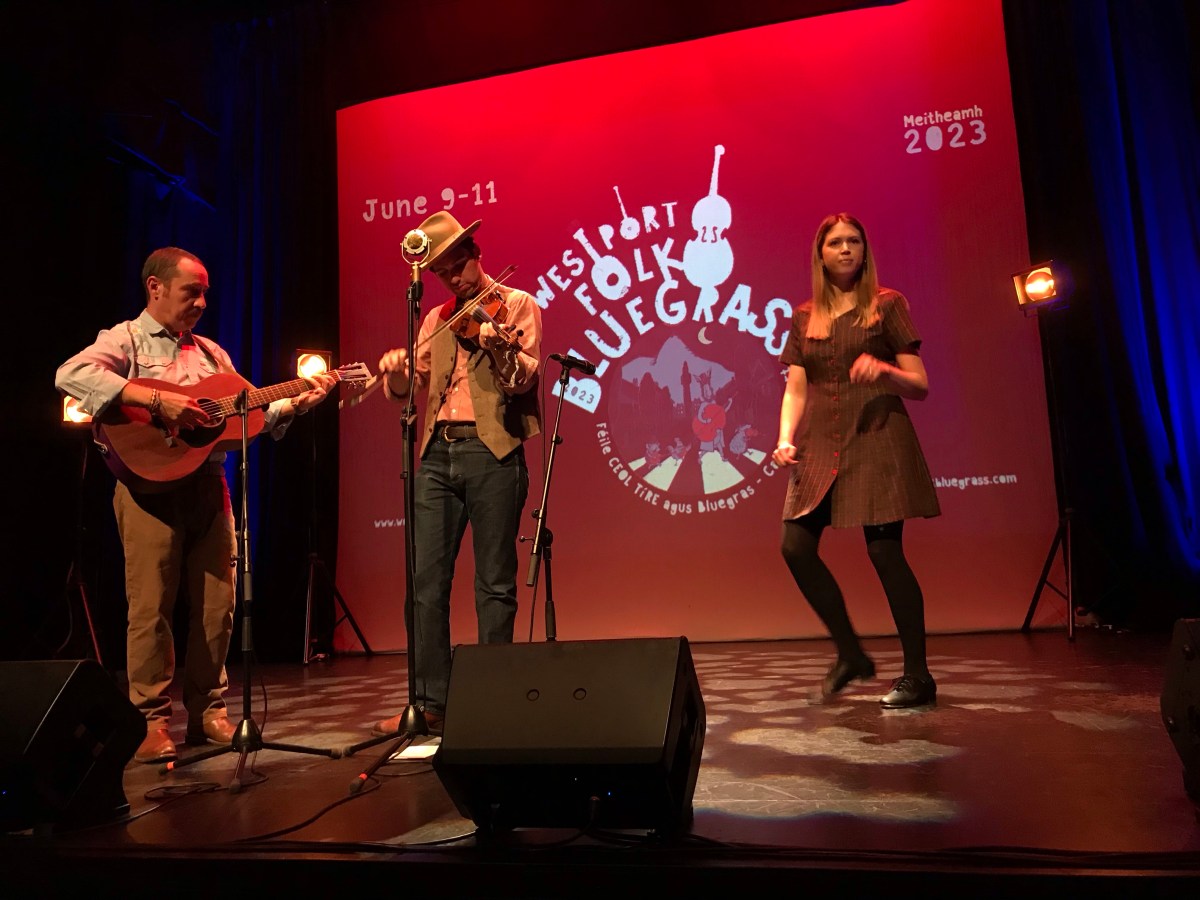
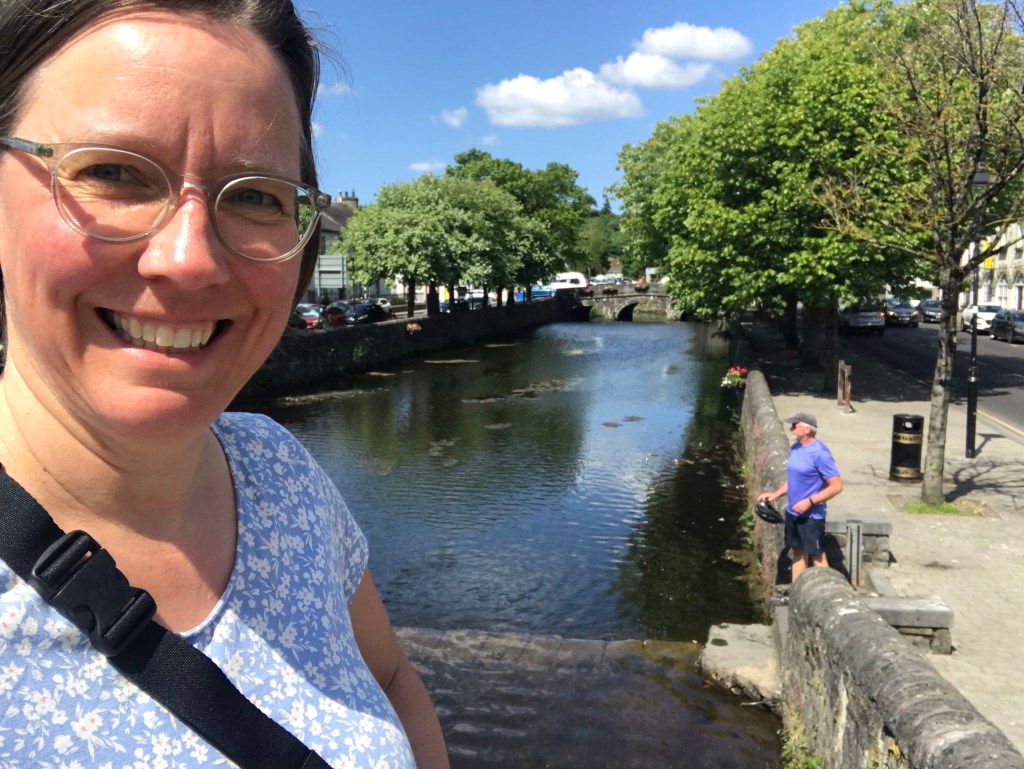
We also found posters for the following weekend’s Westport Folk and Bluegrass Festival, so we booked train tickets and accommodation and headed back out West just four days after motoring home.
And boy, did we enjoy the music festival! We felt part of this small group of folks—a hundred or so musicians and enthusiasts, for the past three days.
The folk and bluegrass tunes from Appalachia sang to my heart and had me longing for days of old, attending Statler Brothers concerts in the park every Fourth of July.
During the country sets this weekend, I relived Saturday nights, sprawled across my grandparents’ den, watching Hee Haw with all its slapstick humor, surrounded by a happy extended family.
This morning’s gospel set, presented aside prayers at Westport’s magestic Anglican (Church of Ireland) church was a highlight. It was standing room only and people also flowed out past the doors. Aongus and I had arrived mare than an hour early, thankfully. So, we enjoyed second-row seats to hear the Kody Norris Show quartet for the second time. They also played at last night’s show, and boy, are they a hit!
I also loved the Derryberries, from Tennessee, Bill and the Bells, Melody Walker & Jacob Groopman, Lunch Special, and Tim Rodger’s gig, among others.
We sat very front at the main stage Friday night, and very back there on Saturday. Westport’s Town Hall Theater has fabulous acoustics and great sight lines throughout.
This intimate three-day music festival is organized by a gent with an amazing Mayo accent, named Uri, who moved to Ireland 19 years ago, I’m told, from Israel. He is clearly now a cornerstone of the community, bringing this annual event to Westport since 2007.
Aongus and I loved both weekends—cycling along the seaside and swaying with the tunes. We’ve already booked to come back again next year. We think Westport is the prettiest town in Ireland and the hospitality can’t be beat. My favorite publican, Tom Mulligan says it’s Ireland’s only panned town. I think Derry, up in Northern Ireland (UK), is another in this island.
All in all, being surrounds by folks with such a passion for music is a treat. And Westport is a gem in Ireland’s green, green crown.
I met my PhD supervisee, Sandra, online just as the sun was coming up this morning. Thankful that she’s well on track, I got down to work, whipped up a conference abstract and got it submitted for tonight’s deadline.
Then I settled in for an intense day of paper editing. I was finalizing my team’s major revisions — our big December 18 deadline will be here far too soon. And with other deadlines looming large overhead, I took the long open stretch on my schedule today to make substantial progress.
I forgot my gym class. I forgot to eat lunch.
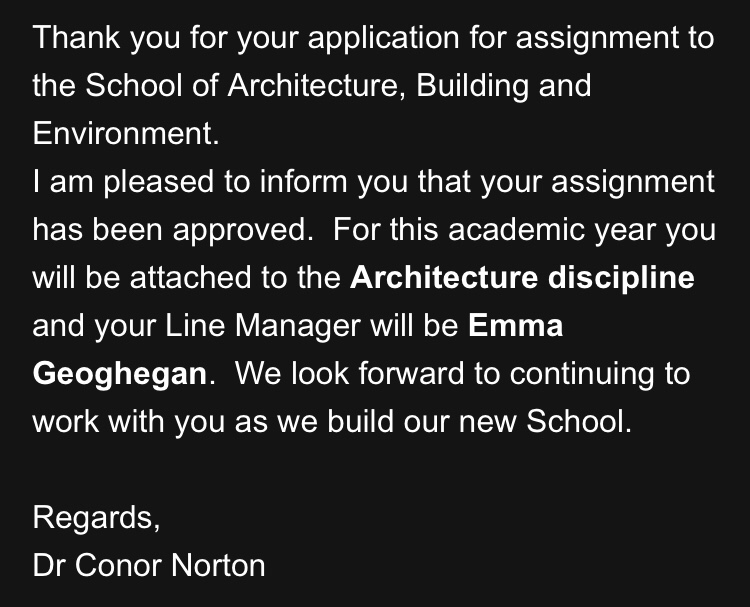
But while my head was under the sand, two very welcome emails landed in my box. The first I’ve been awaiting since last spring, but our university processes are slow. I’ve been assigned to teach in the school where my passion lies (still at TU Dublin, just in a different school as mine was dismantled).
I’ll now be teaching in the School of Architecture, Building and Environment which is great because I really love teaching students architecture. I’ll still teach BIM topics, too, of course.
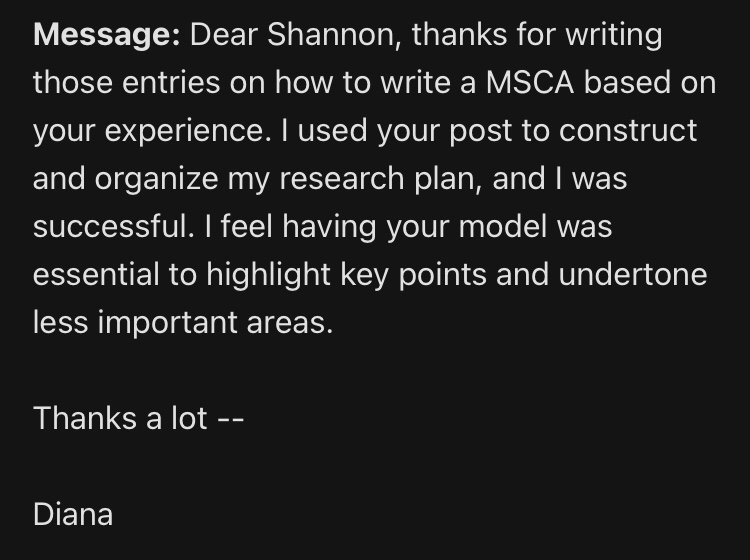
The second incoming message was a bit of thanks from a researcher who used the advice on my blog and won herself an MSCA Marie Curie fellowship this year! I couldn’t be prouder than to help make this type of difference in someone’s life.
So, goals big and small came to fruition today. These emails reported life-changing news for me and for Diana.
With no time to rest on my laurels, I had to wrap up my replies fast, and run out to buy groceries for dinner. We’re having a younger friend over to discuss financial planning, a new hobby of mine.
Life is busy, but full of interesting new challenges. Lots to fill you in on over the coming weeks!
Aongus and I held a vote the other night. Our best day since moving back to Ireland from London? We unanimously agreed:
Our day cycling in Killarney National Park.
This was one of four days we spent in County Kerry, and the 20 or so hours we spent in Dingle ranked a close second (see prior blog posts on Dingle, Slea Head, and stone forts along the Ring of Kerry).
Awakening from Lockdown
When the Irish government said “Lockdown is lifted–go forth and spend your money on domestic tourism”, we readily agreed! “Let’s head for Kerry,” I exclaimed. “It will be a treat to see Killarney when it’s not full of tourists!”
Indeed, Killarney, its National Park, and its famous Muckross House are typically packed to the gills with Americans.
We arrived safely after a 3.5 hour drive from our home in Dublin. As this was right at the end of lockdown #1, we had not yet been able to buy a bike rack for our car.
Arriving in Killarney, we found many people who were delighted to welcome tourists. Those in the hospitality industry have really suffered, financially, during lockdown. Nonetheless, we found one hotelier who was terrified of my accent. “No, I’m not straight off a plane,” I reassured her. “Dublin is my home.”
Hiring bikes
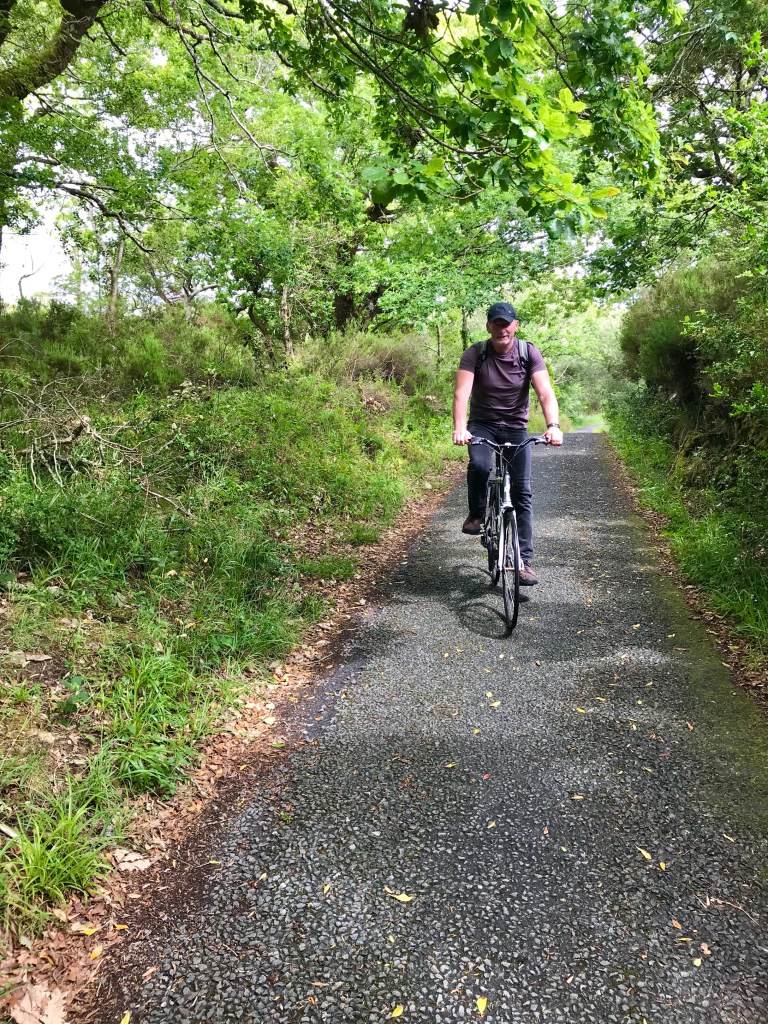
After a fair night’s sleep and breakfast in a nearly vacant cafe, we rented bikes in Killarney town and headed for some scenic routes.
Muckross Abbey
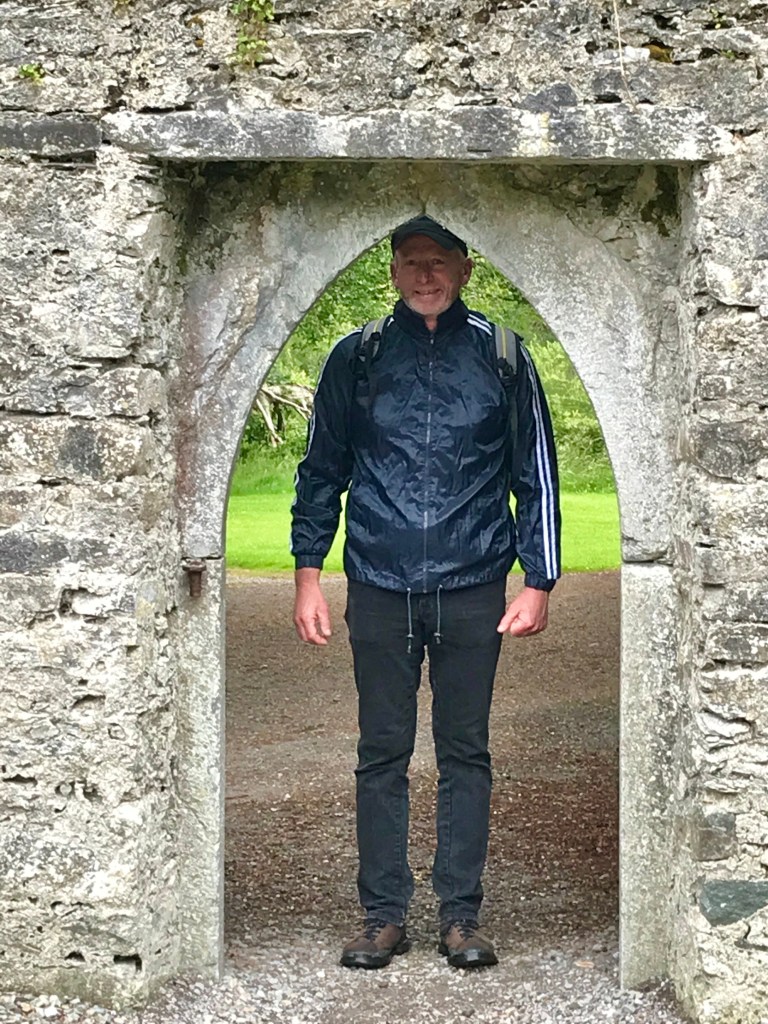
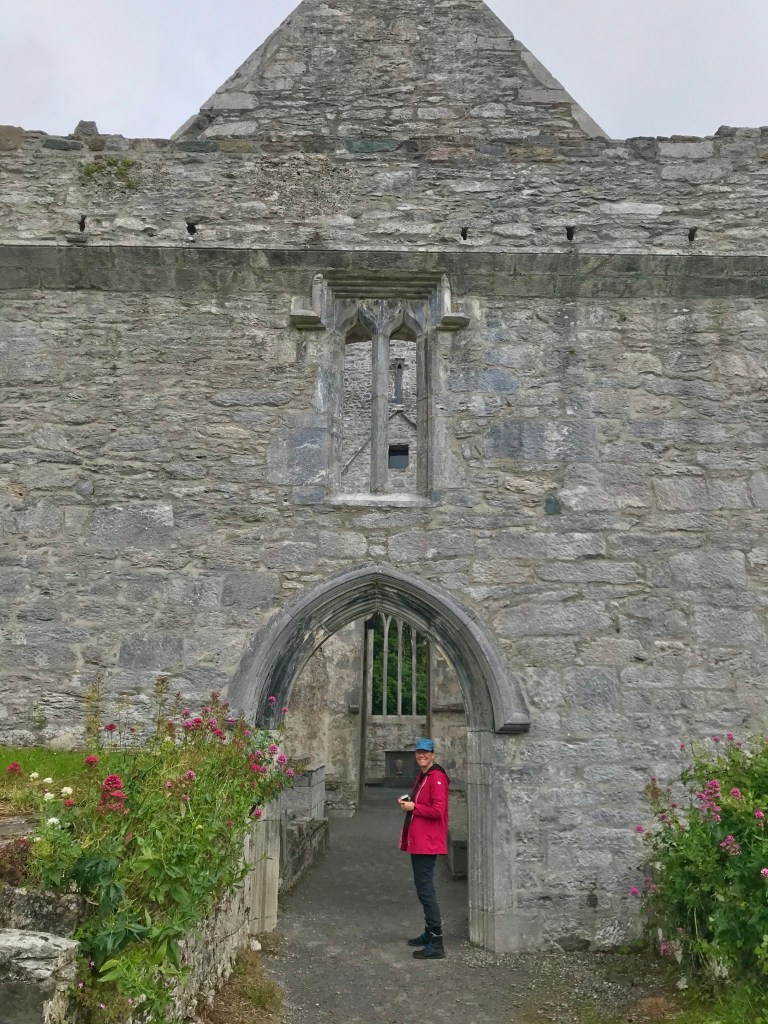
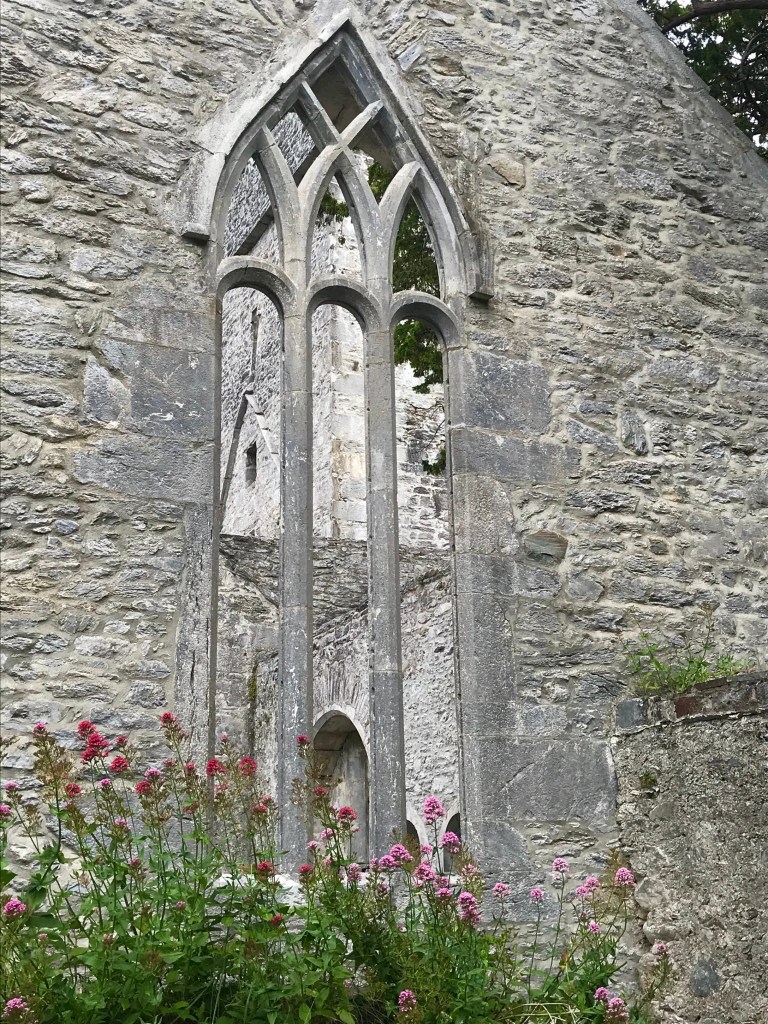
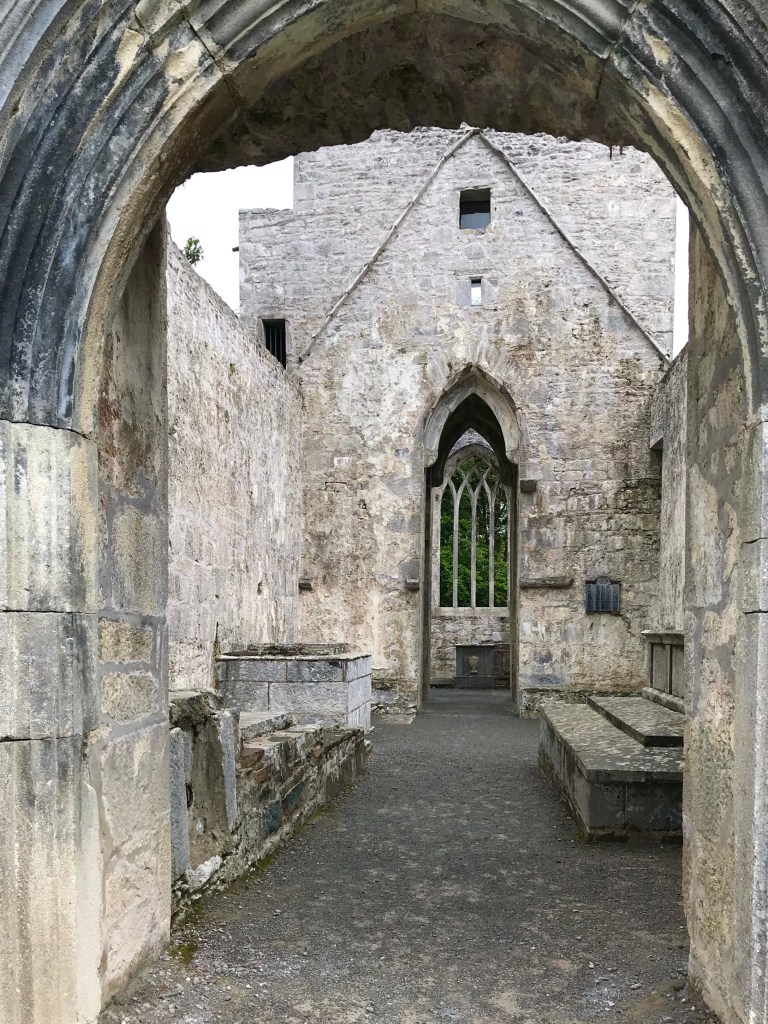
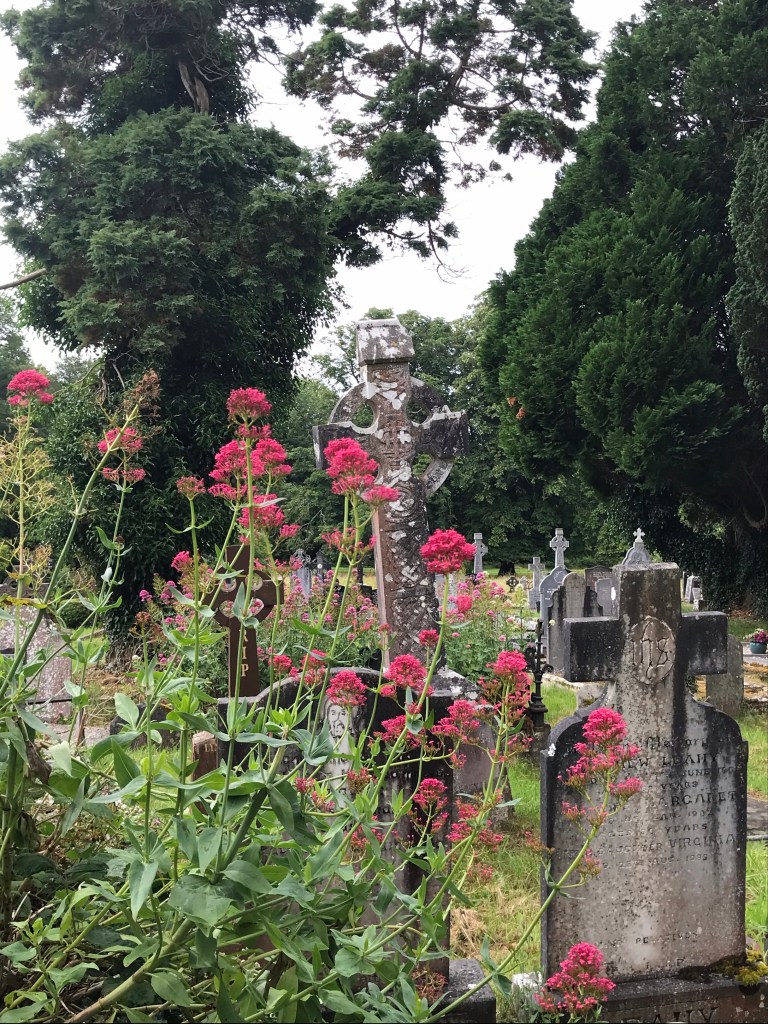
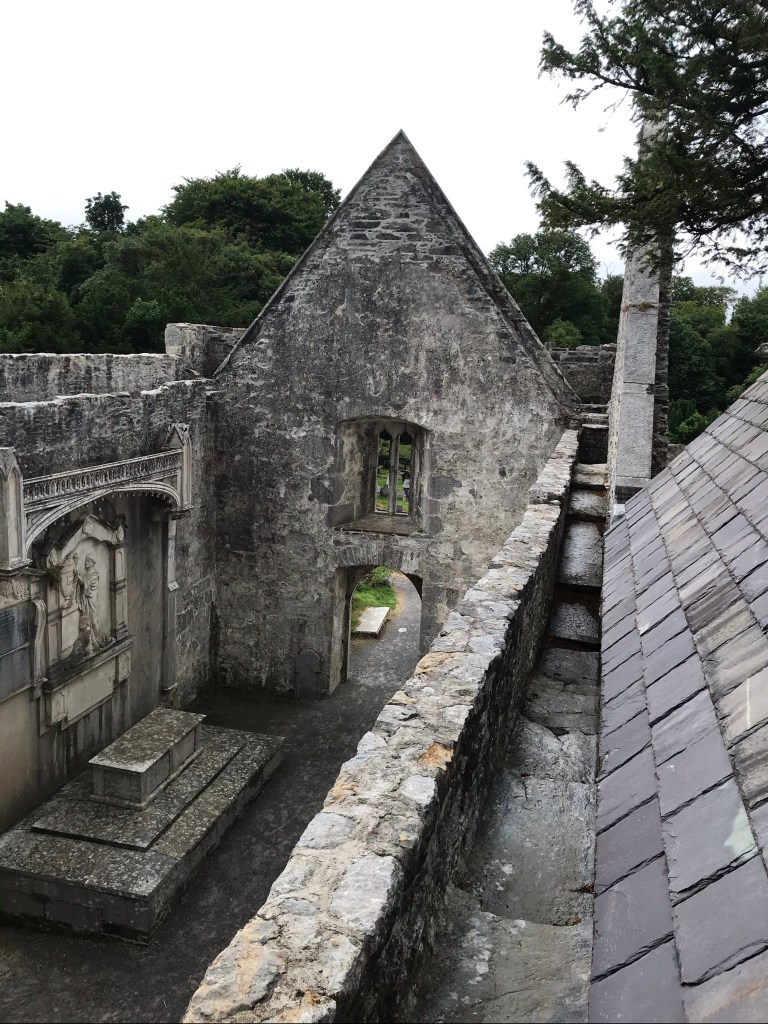
Our first stop of the day was Muckross Abbey, a place I’d never visited before. The stone abbey is absolutely spectacular. It is surrounded by a cemetery, woods, and fields.
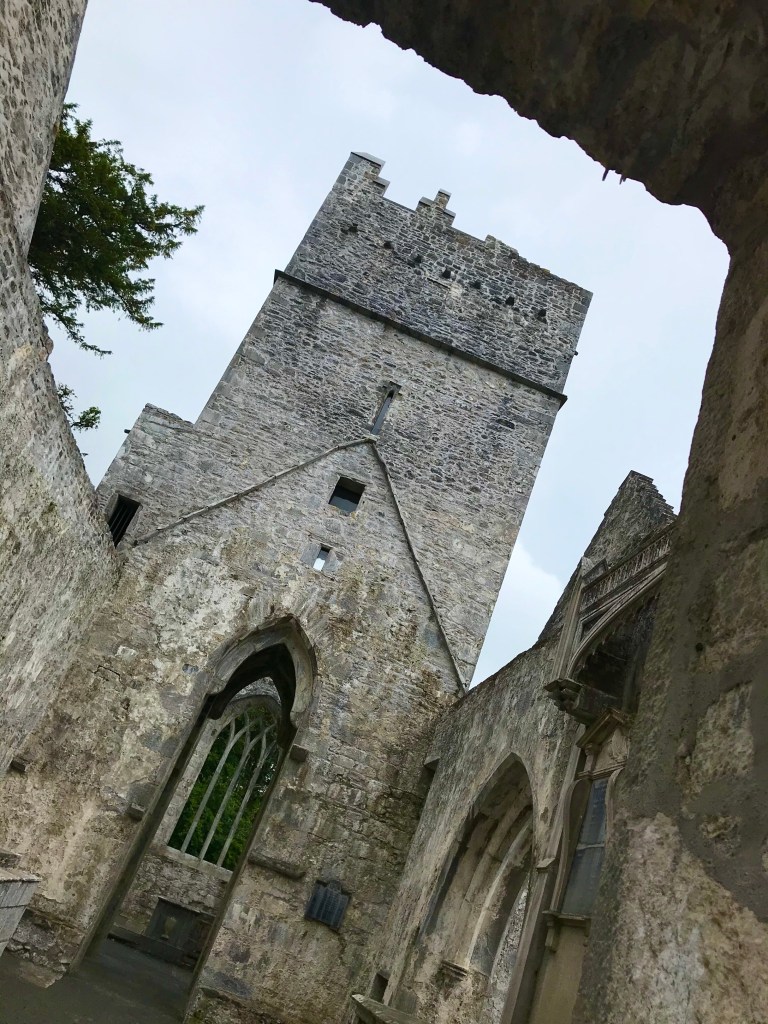
We spent a good hour exploring the Abbey’s multi-story ruins.
Muckross Abbey offers magnificent views at every turn.
Sweeping panoramas abound.
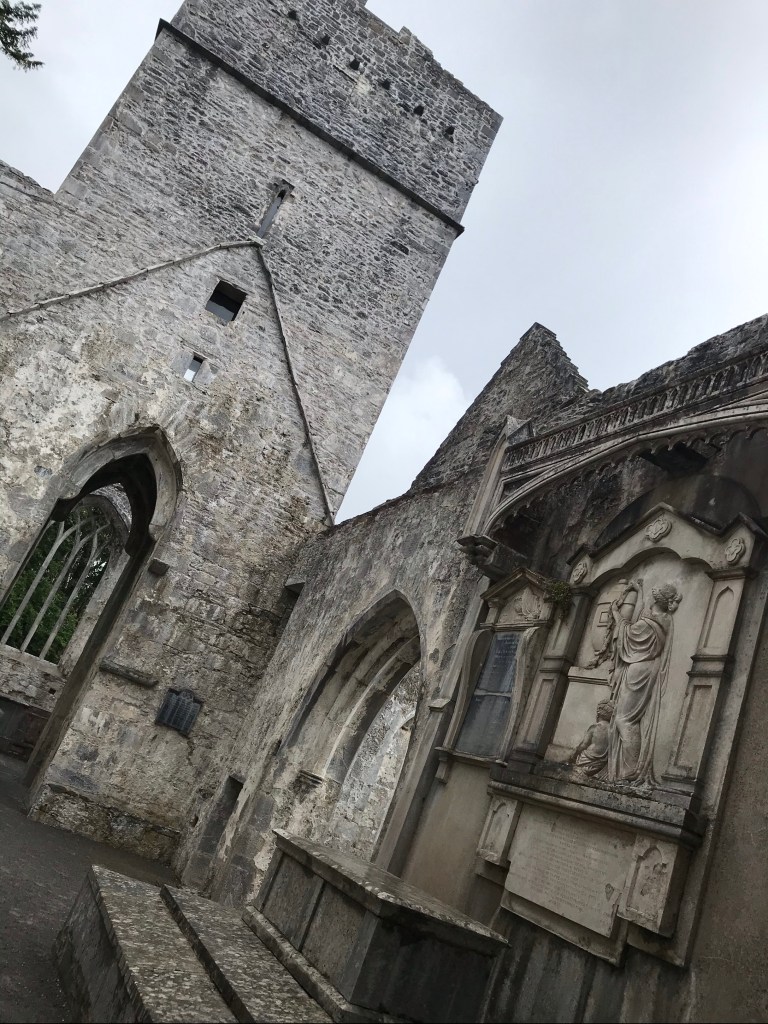
And there are some beautifully preserved details, like this stone relief.
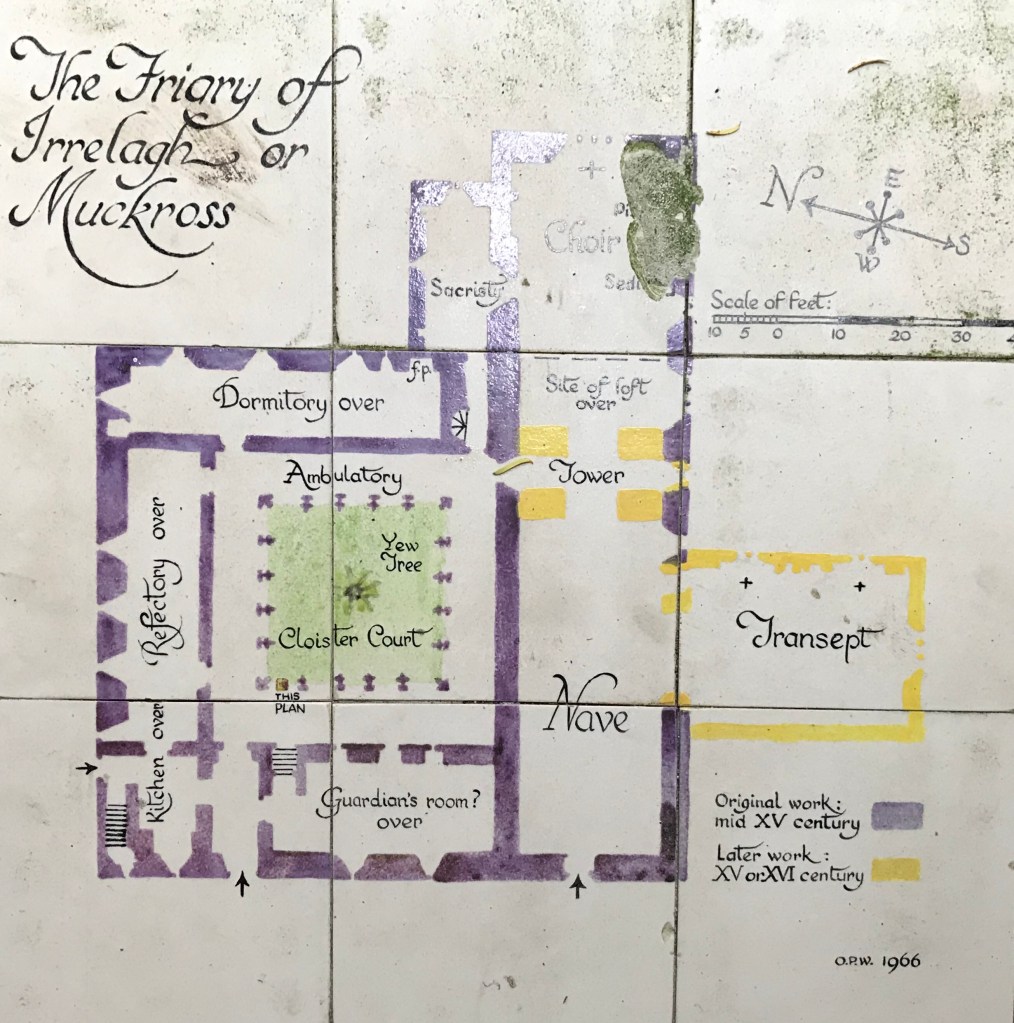
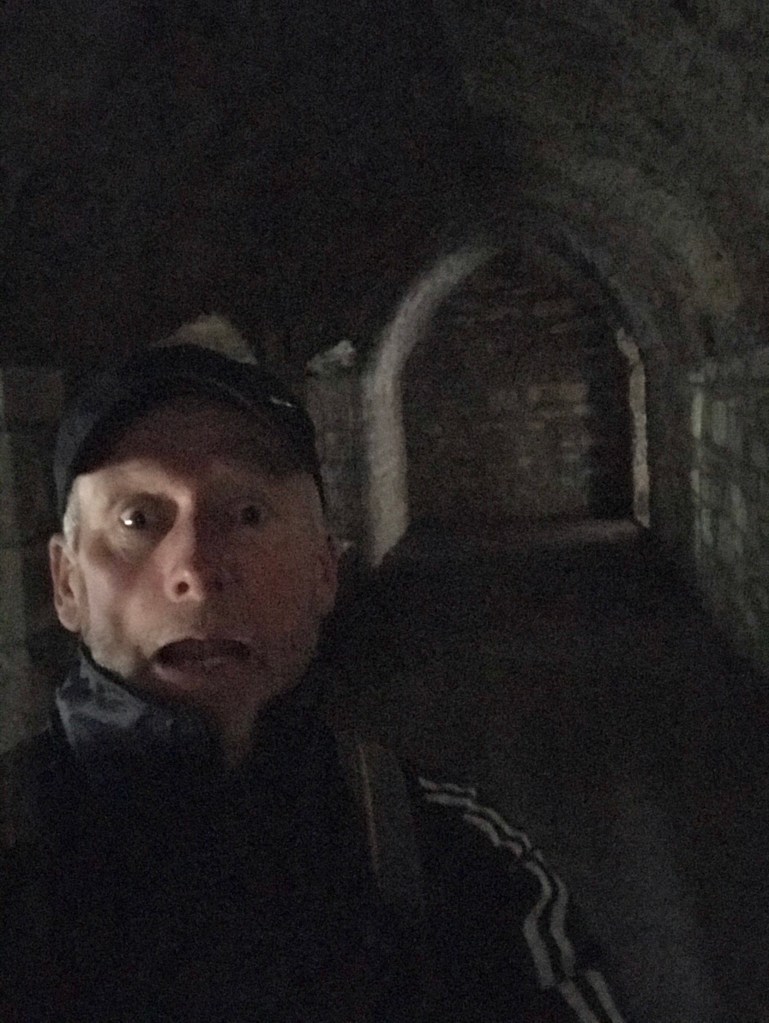
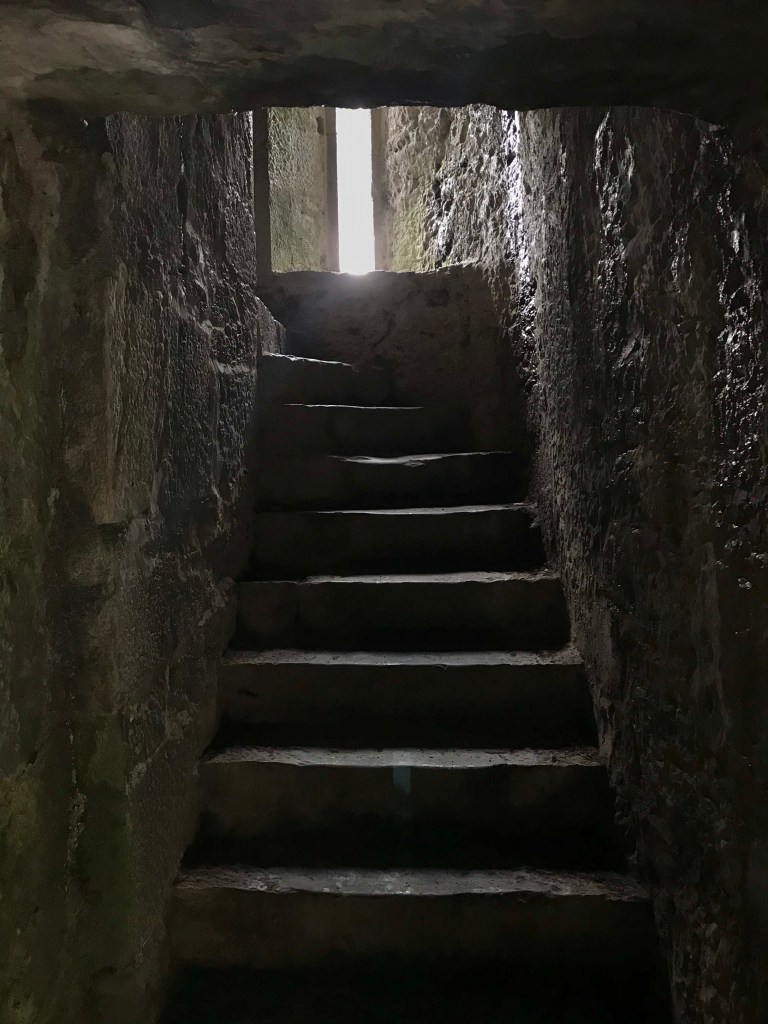
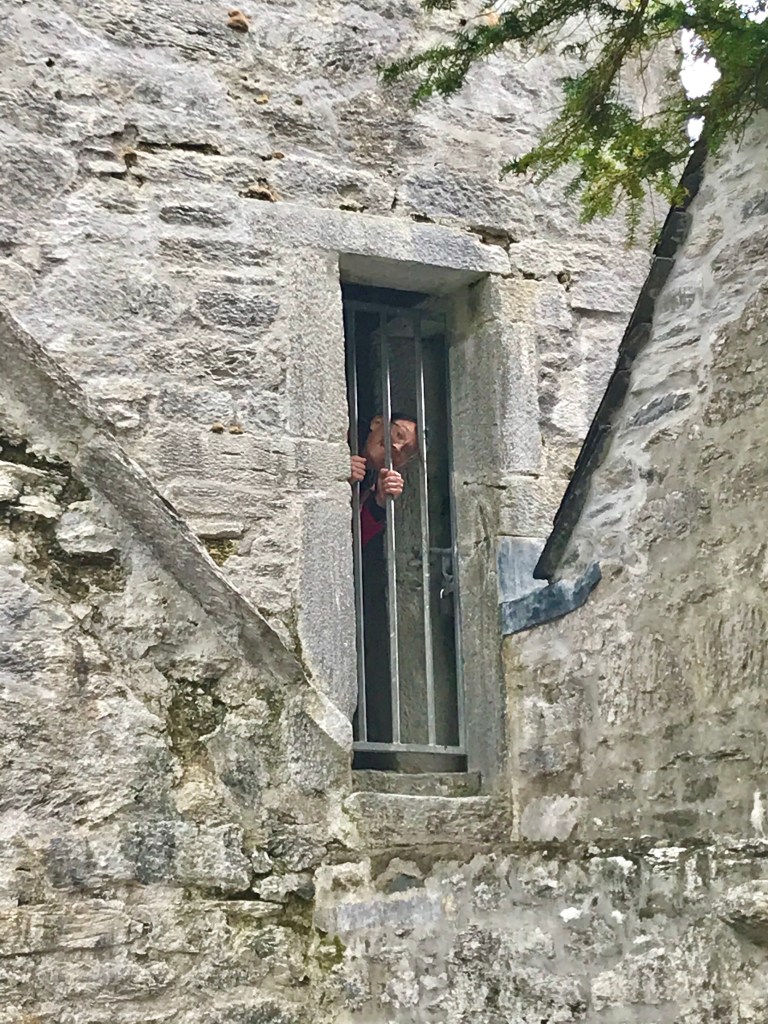
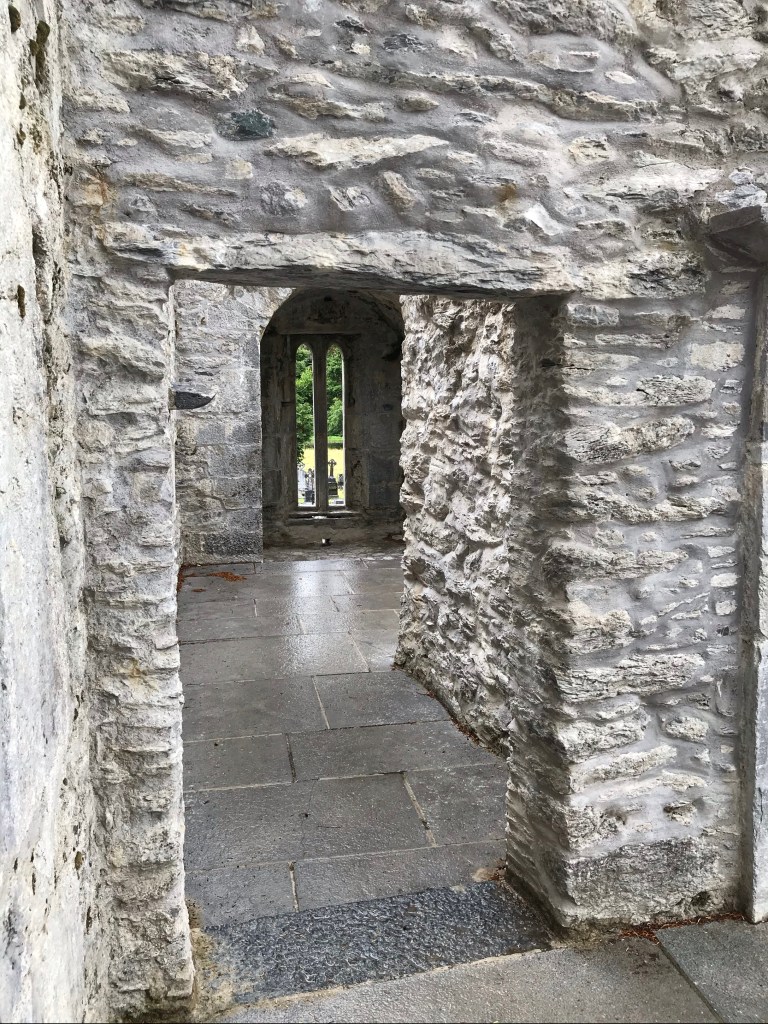
To the side of the worship space is housing for the monks. The plan is straightforward enough, but when exploring it you’ll experience a maze of rooms, passages, and stairs. Delights are tucked away. They reveal themselves, to the persistent traveller, piece by piece. Most rooms are well lit, but Aongus found a dark and spooky one (photo below).
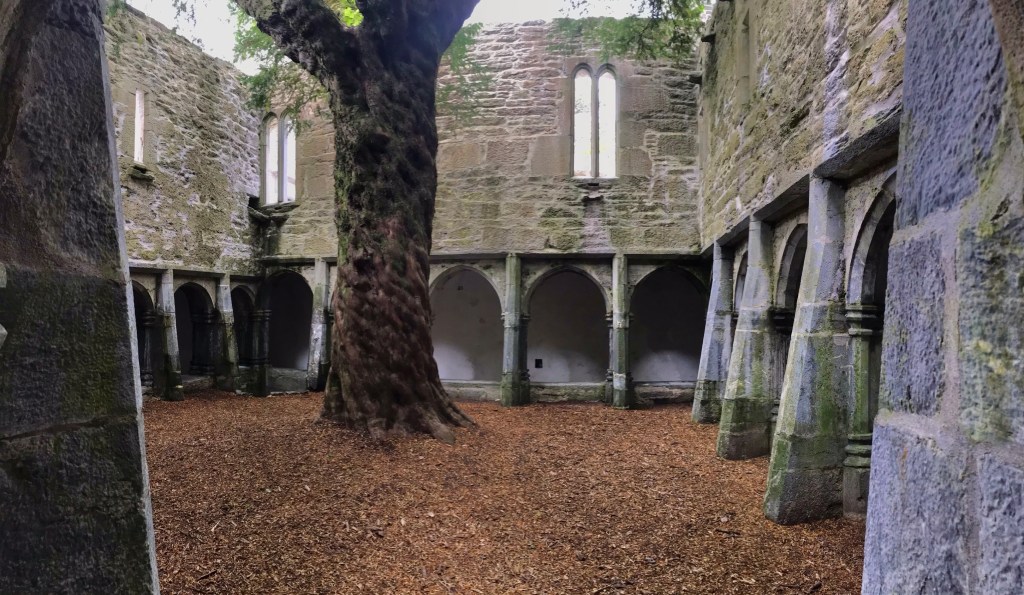
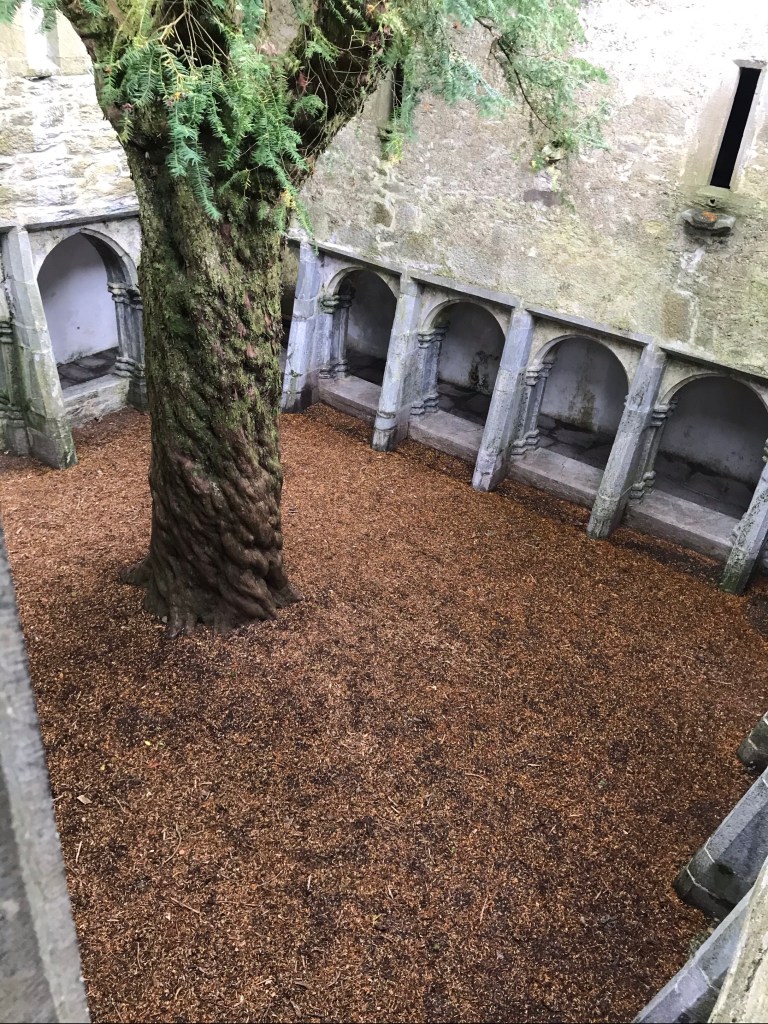
The highlight for me was the central cloister with its ancient Yew tree. Such incredible majesty, reaching up to the Heavens!
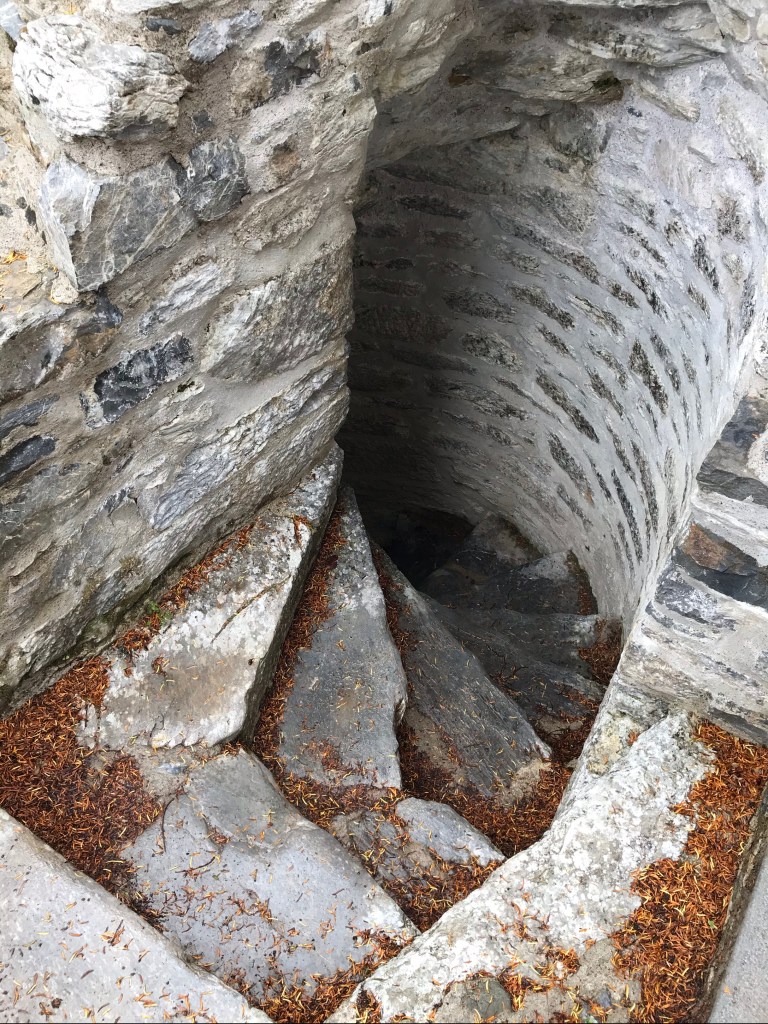
We discovered spiraling stairs to the upper floor…
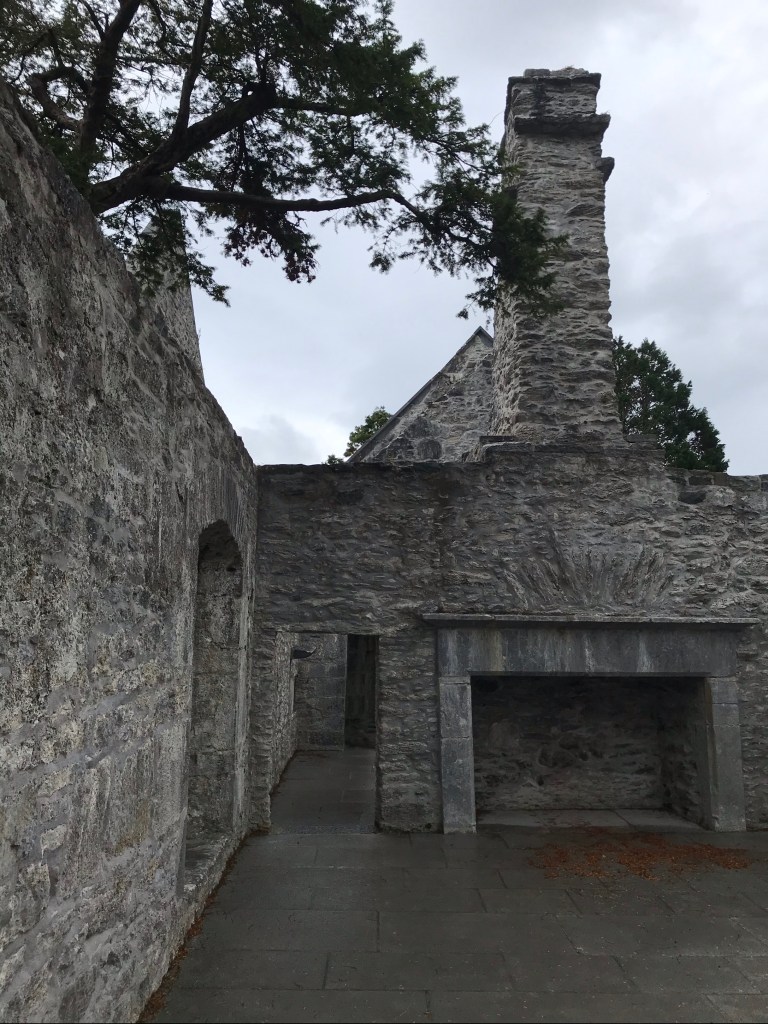
…where I got so mesmerized looking around that I whacked my head on the lintel of a low doorway! I think I was gazing up at the chimney (shown below) when that happened.
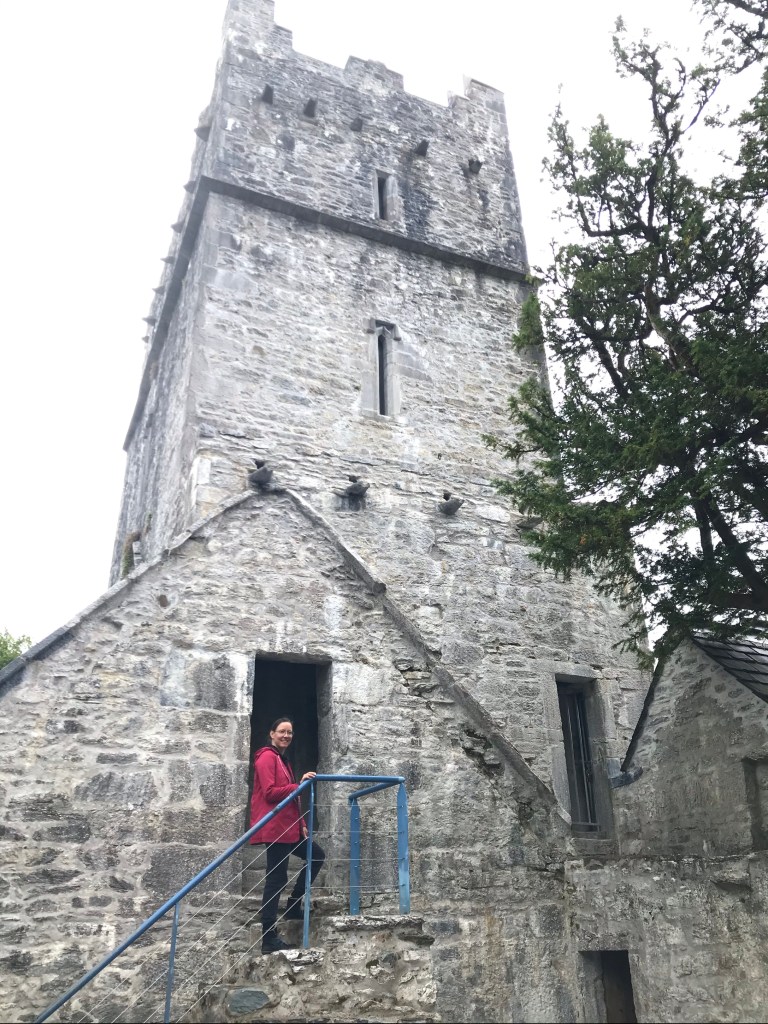
I recovered, though, and discovered the Monks’ sleeping quarters. At the end of the room, we found even more stairs. These went up to the main tower.
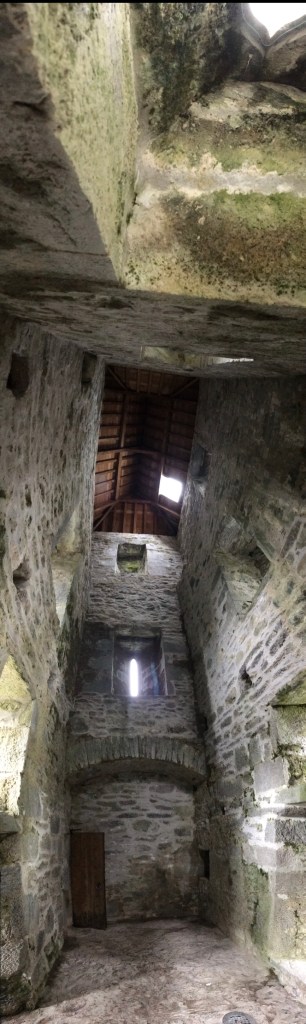
The inside of the tower was architecturally spectacular.
In spaces like these, the iPhone’s panorama feature provides loads of fun.
We had a great time exploring each nook and cranny.
Here’s a view looking back down toward the main entry of the worship space, and the relief we saw earlier.
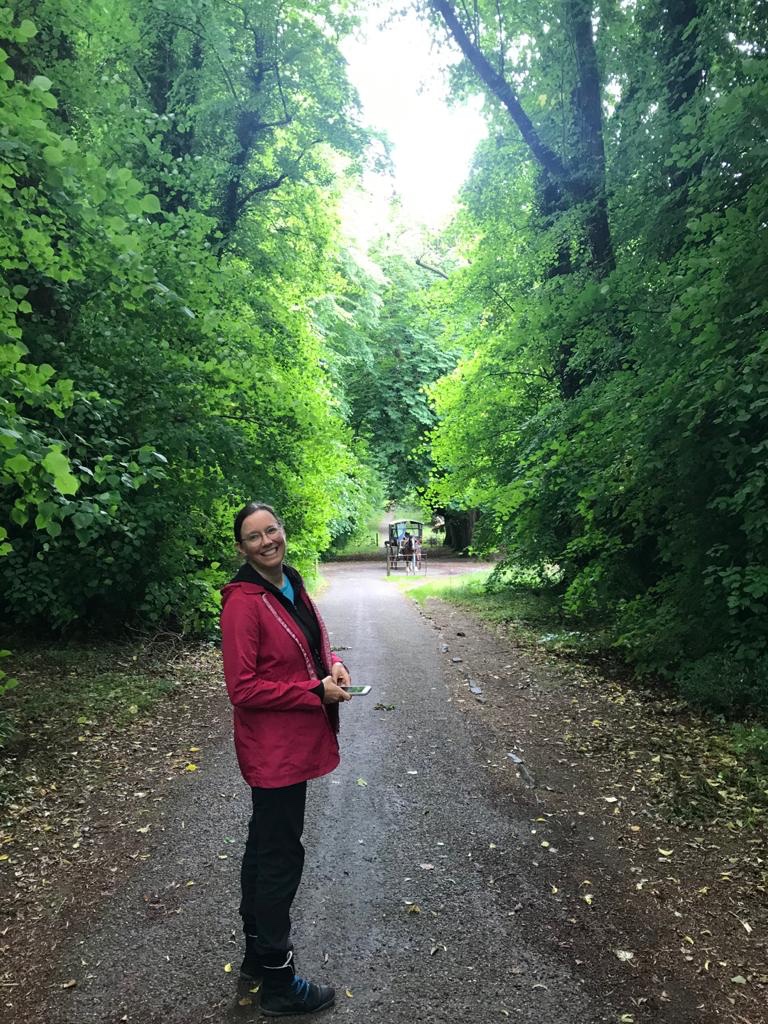
Here I am walking the lane back to the Abbey’s carriage parking area, where we had left our bikes.
When you visit, if you are not on bikes, consider taking a carriage ride out the Abbey.
On this tourist-free day, the horses had little work to do.
Muckross House & Gardens
Muckross House itself was closed, though the gardens and cafe were just opening back up from hibernation.
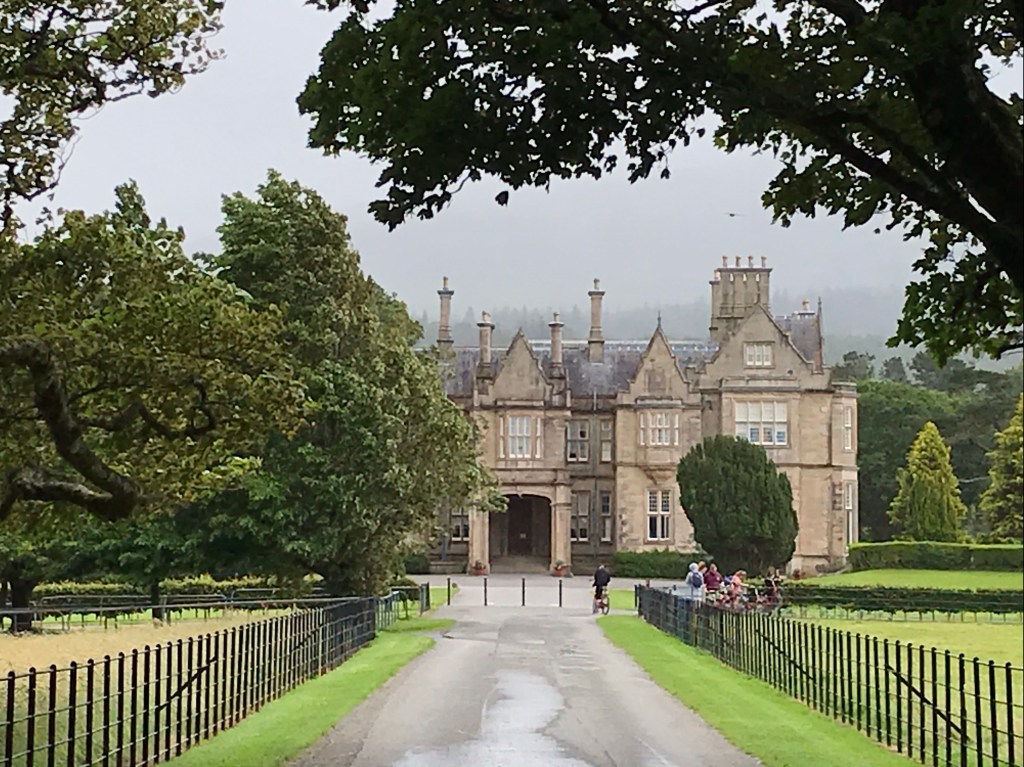
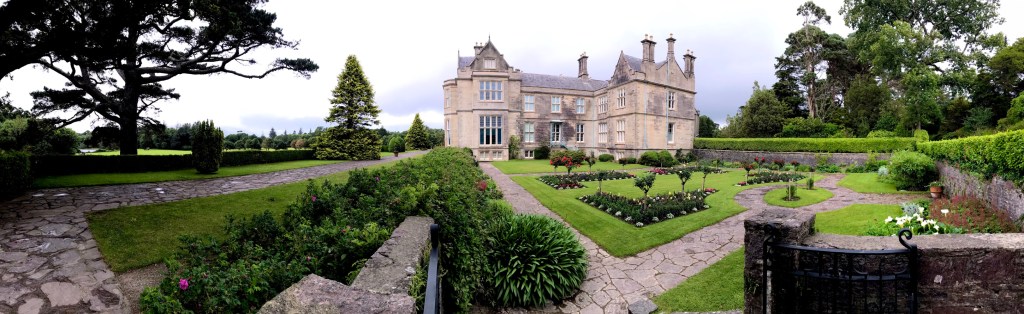
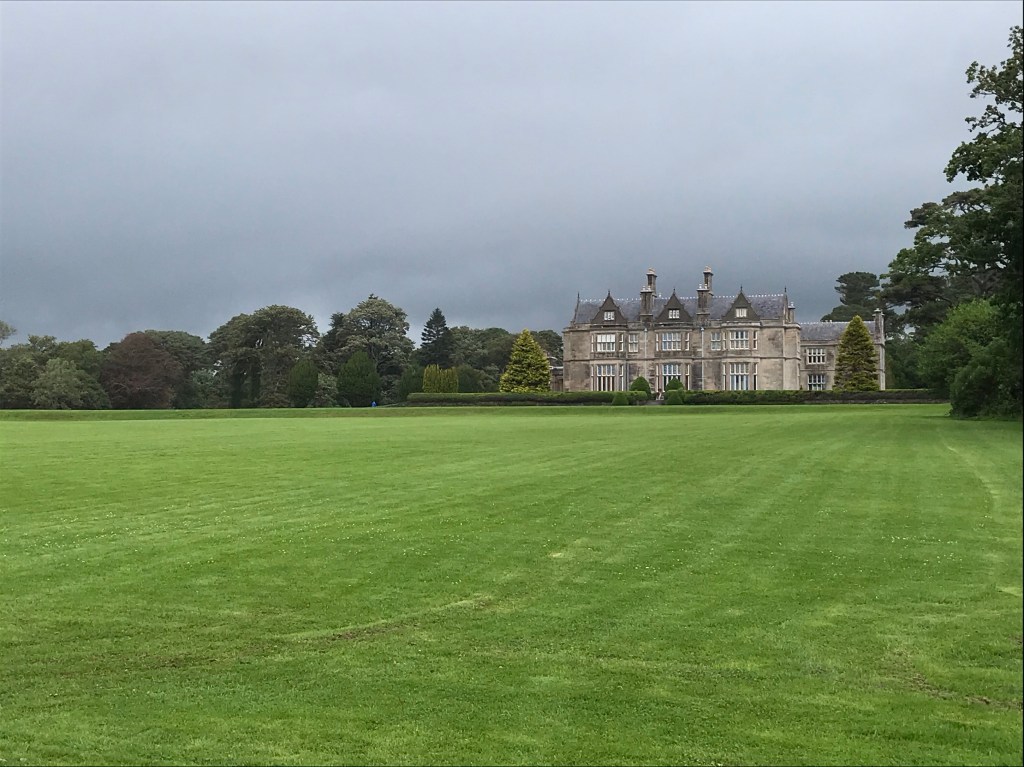
Approaching the house by bike we enjoyed this view:
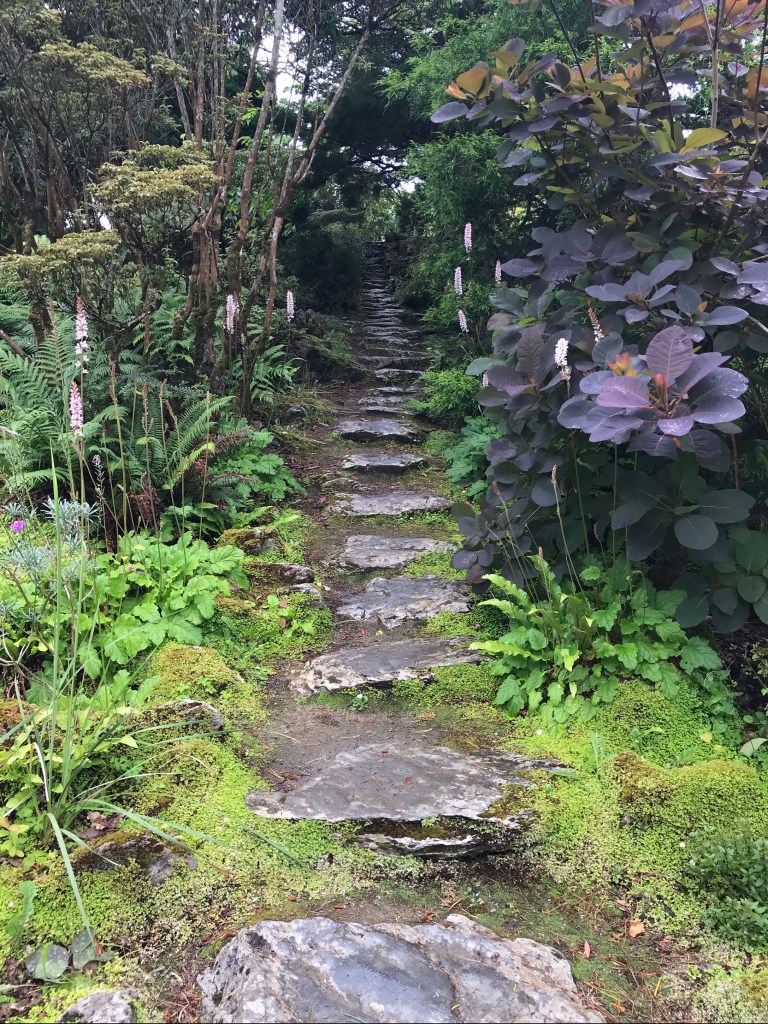
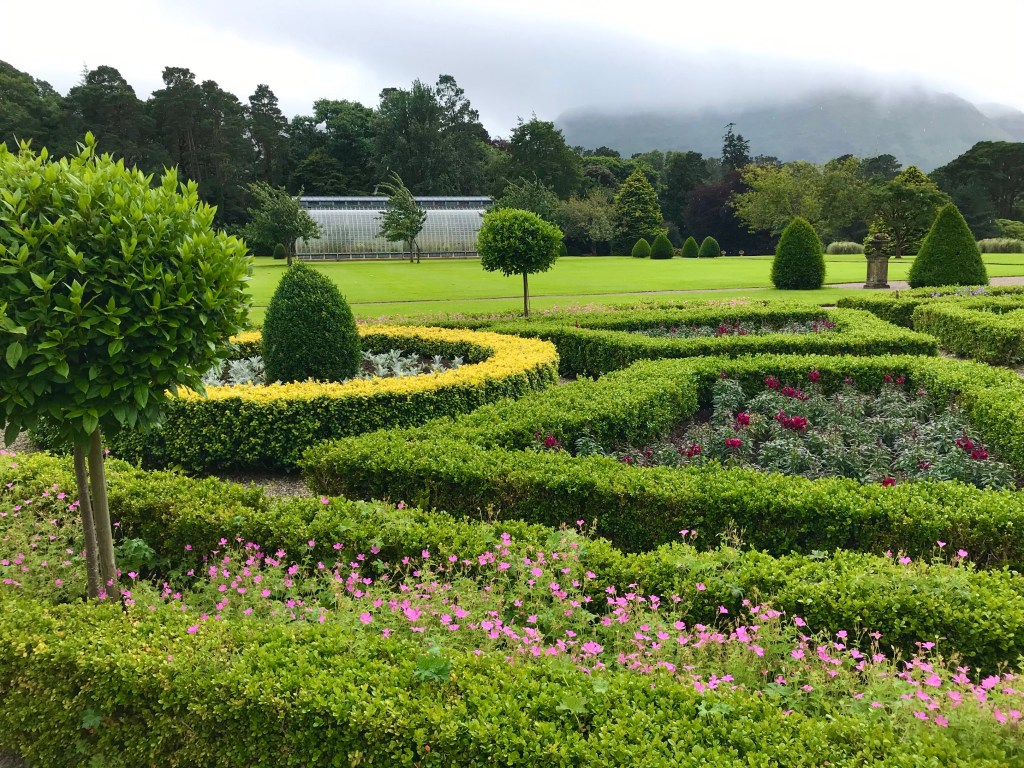
The surrounding landscape was carefully crafted and meticulously cultivated.
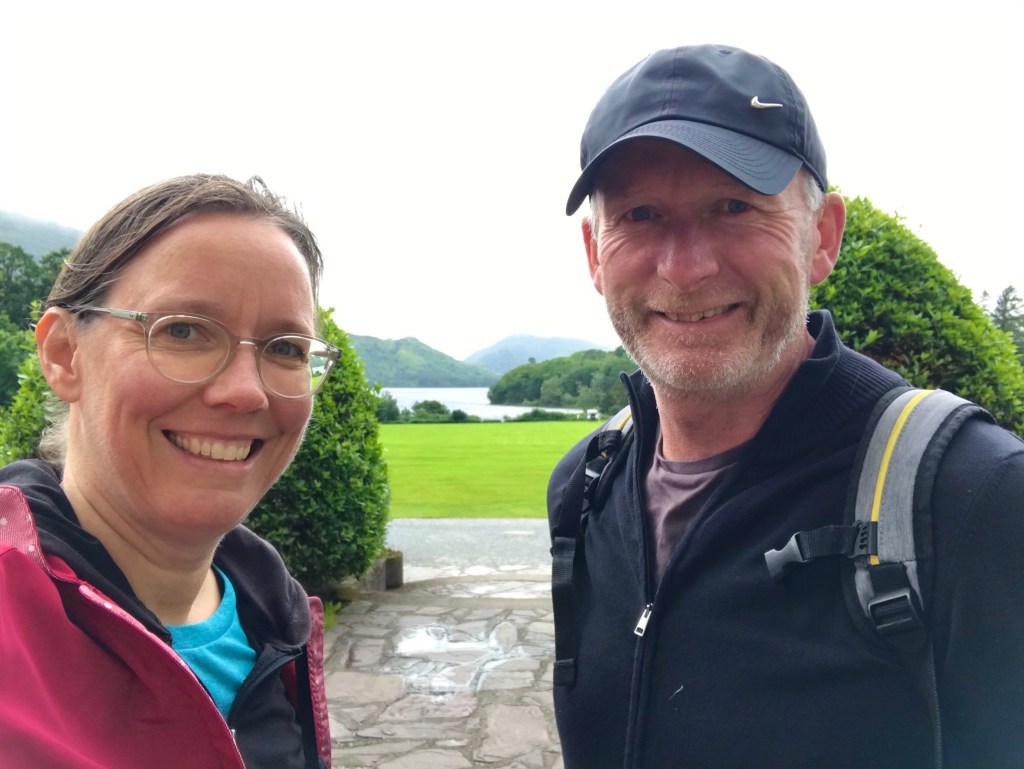
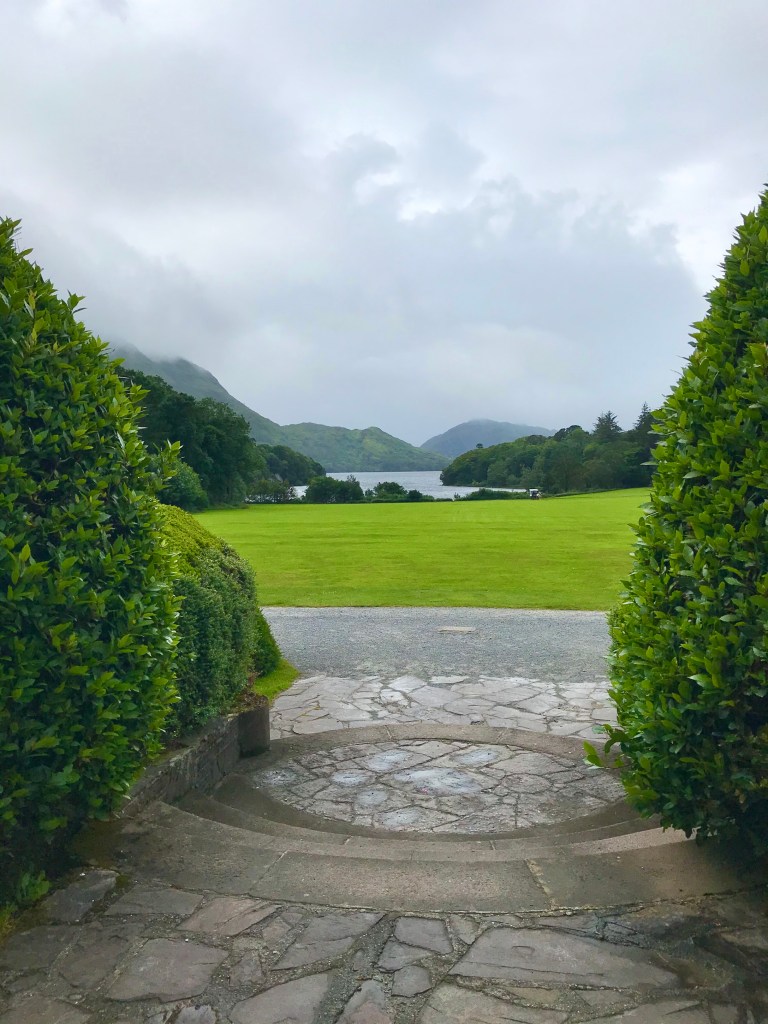
The picturesque view out from the front terrace of the house nearly takes your breath away.
The whole place is a masterful work of art.
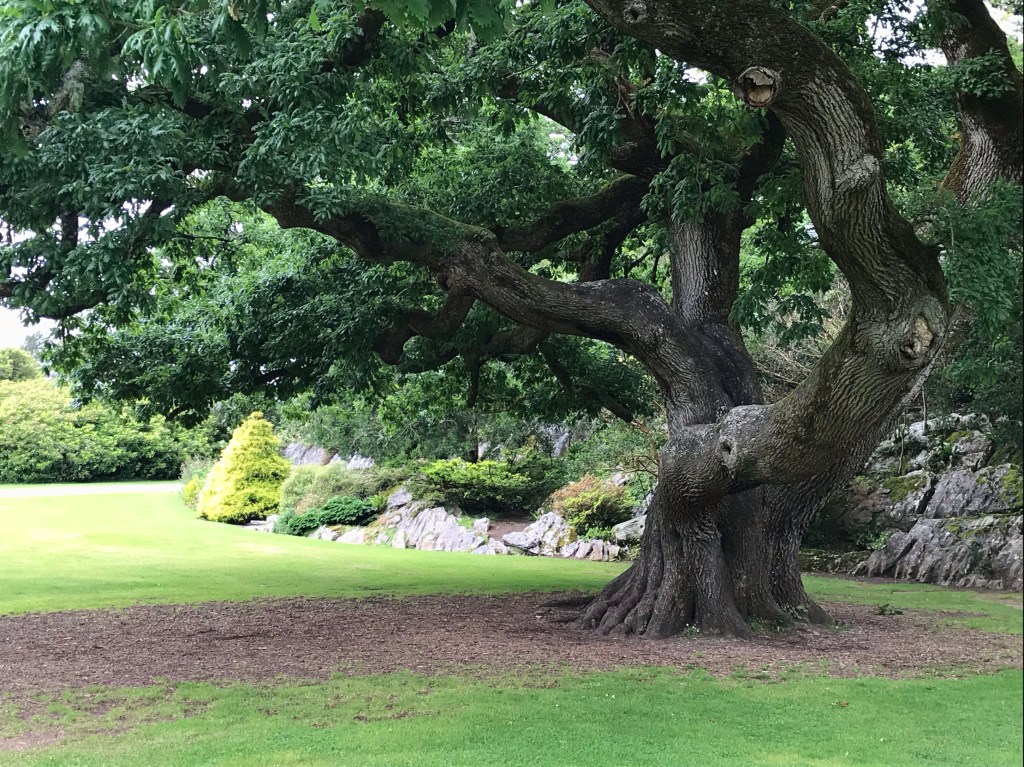
Here’s a Yew tree in the garden:
Leaving the house, we headed out toward the National Park’s stand of ancient Yew trees.
Ancient Forest
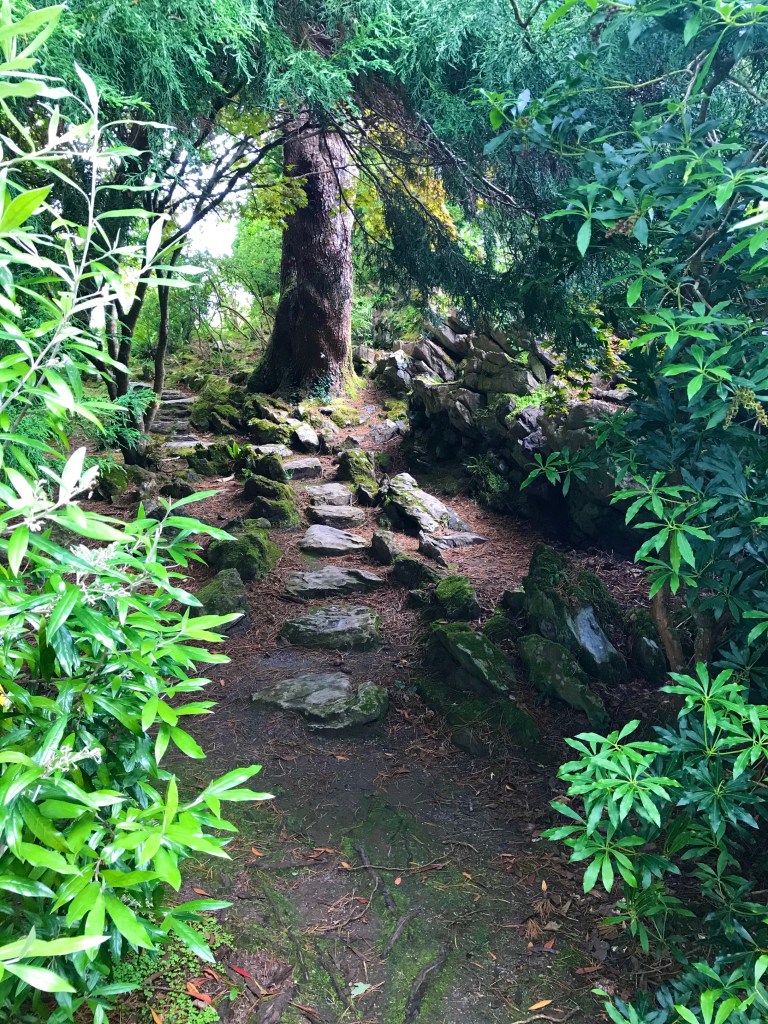
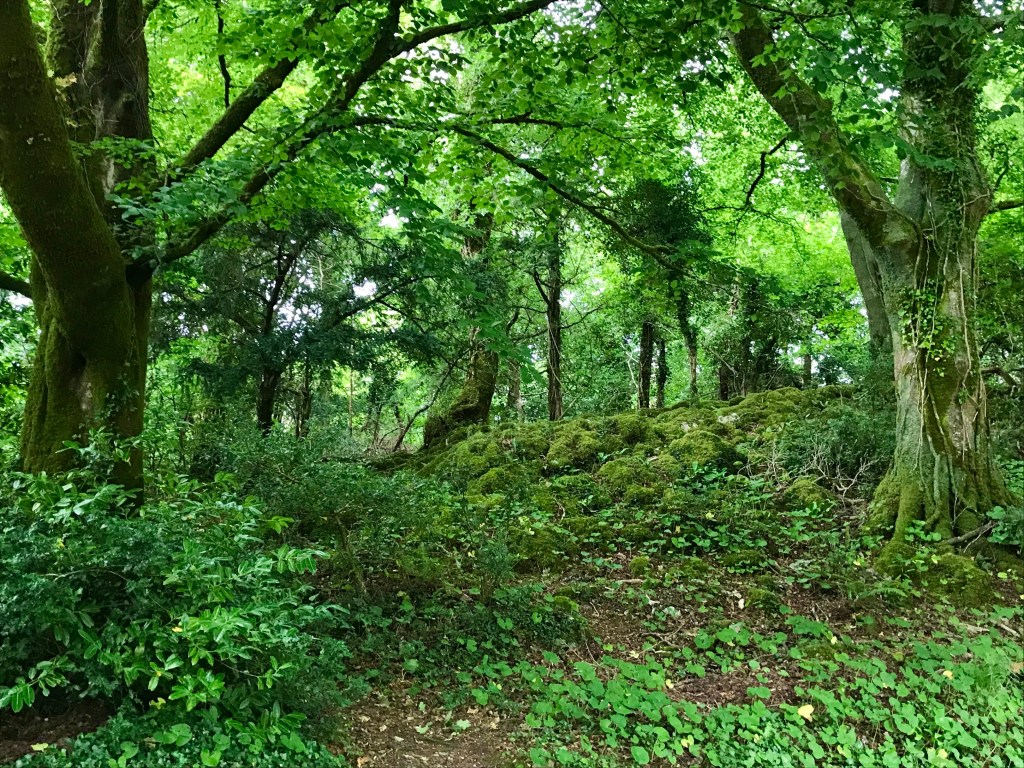
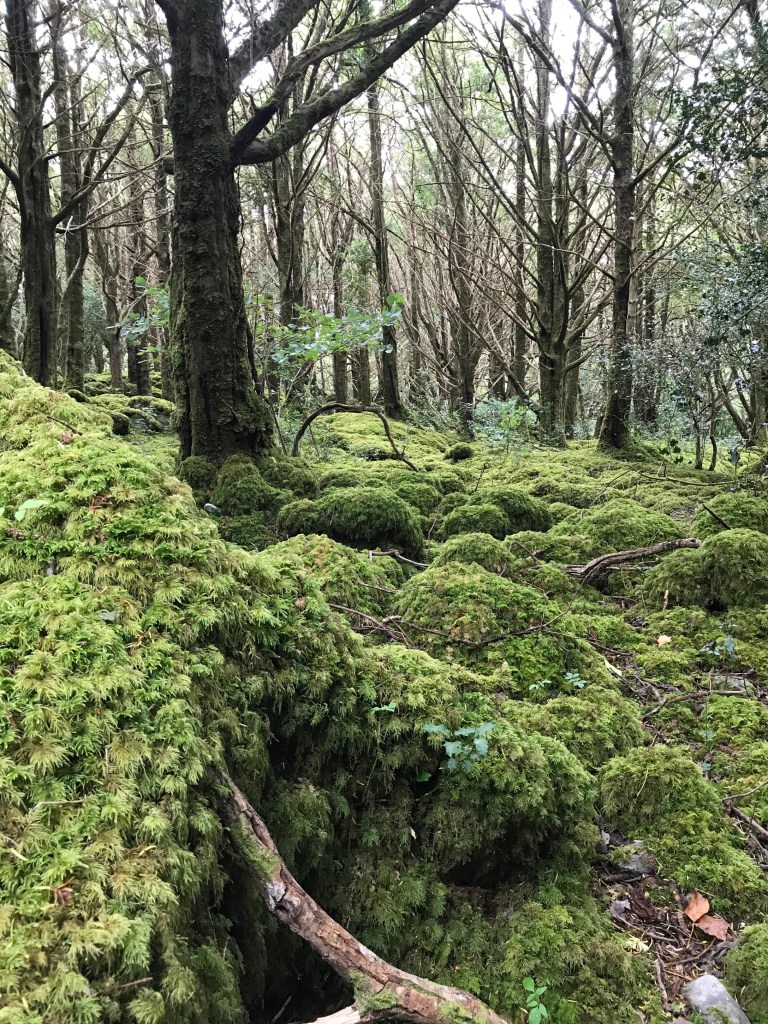
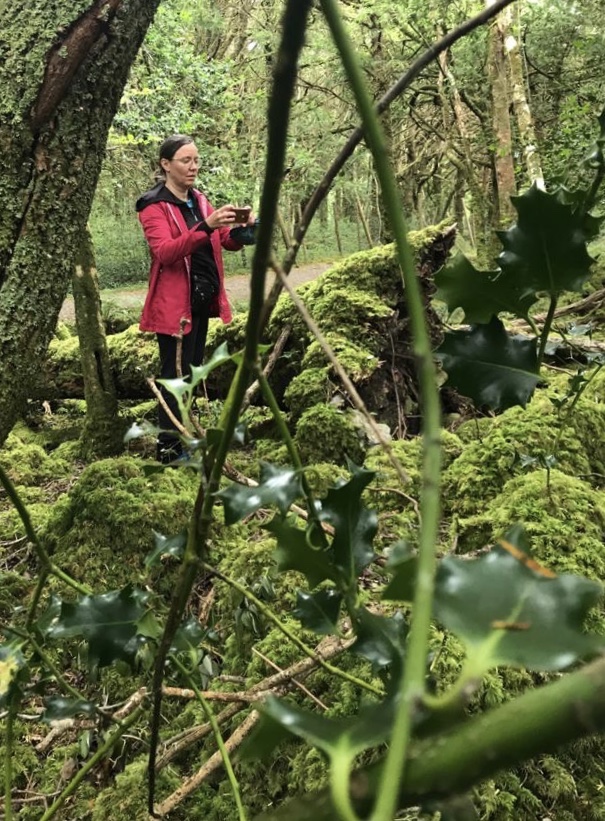
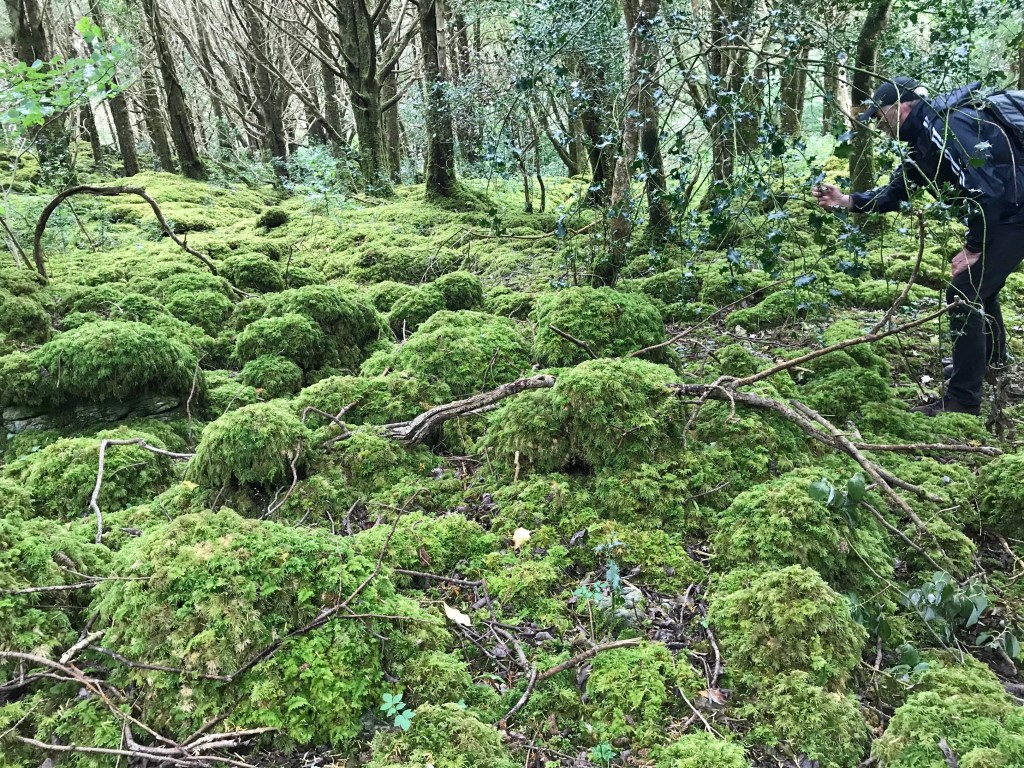
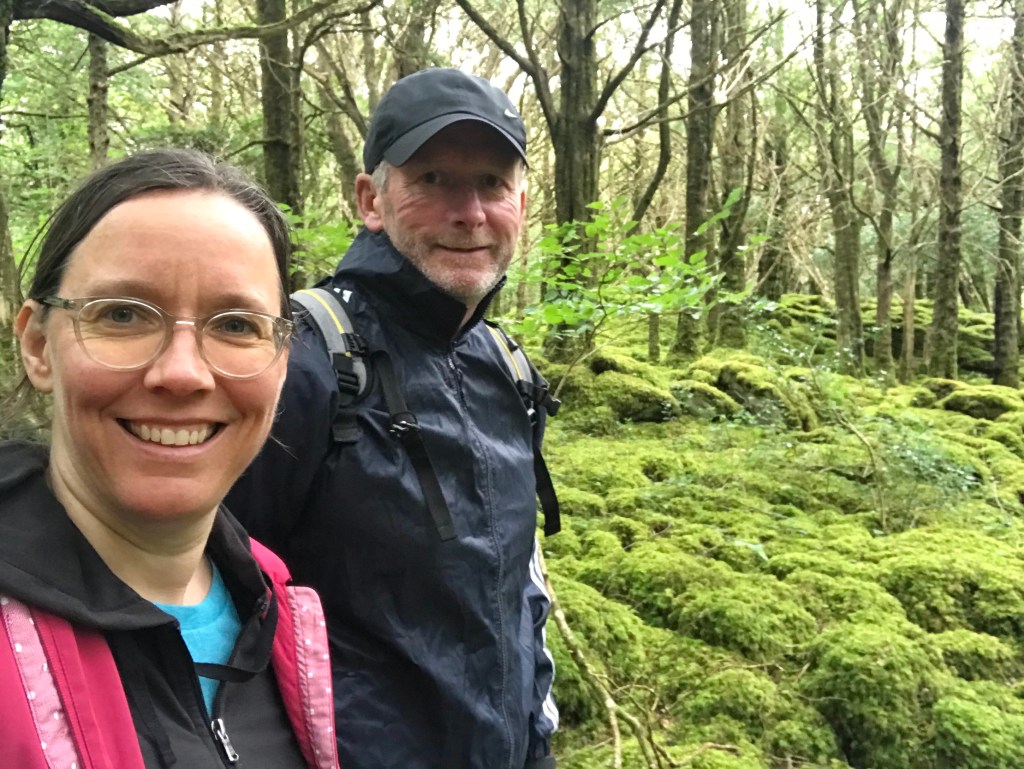
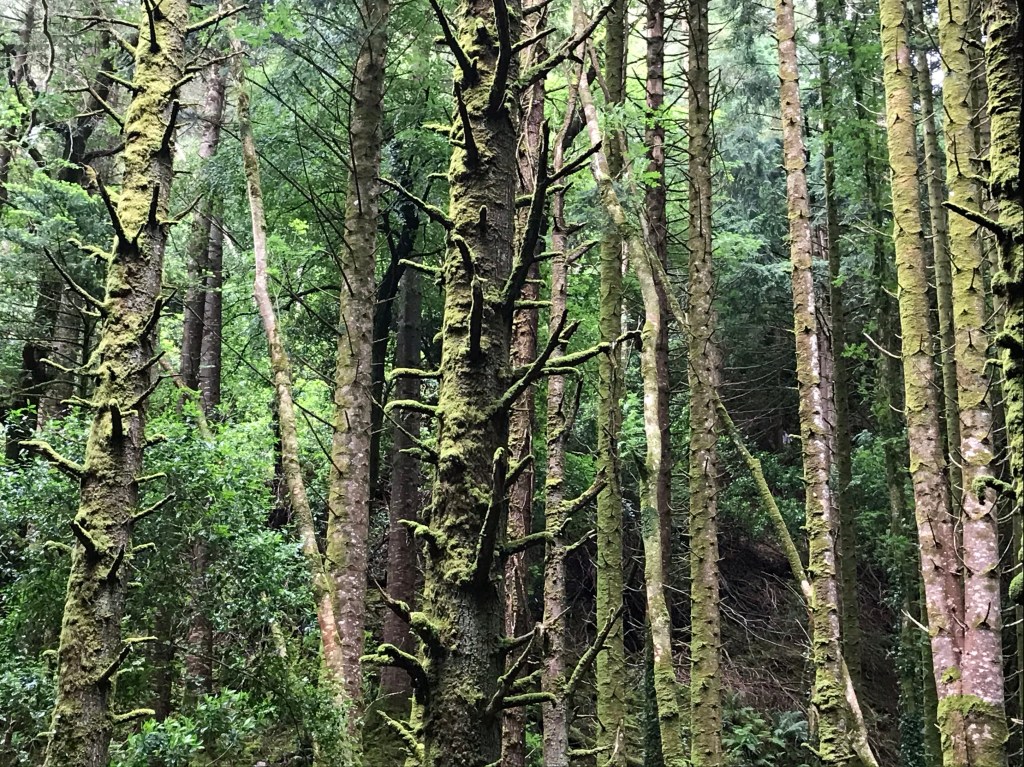
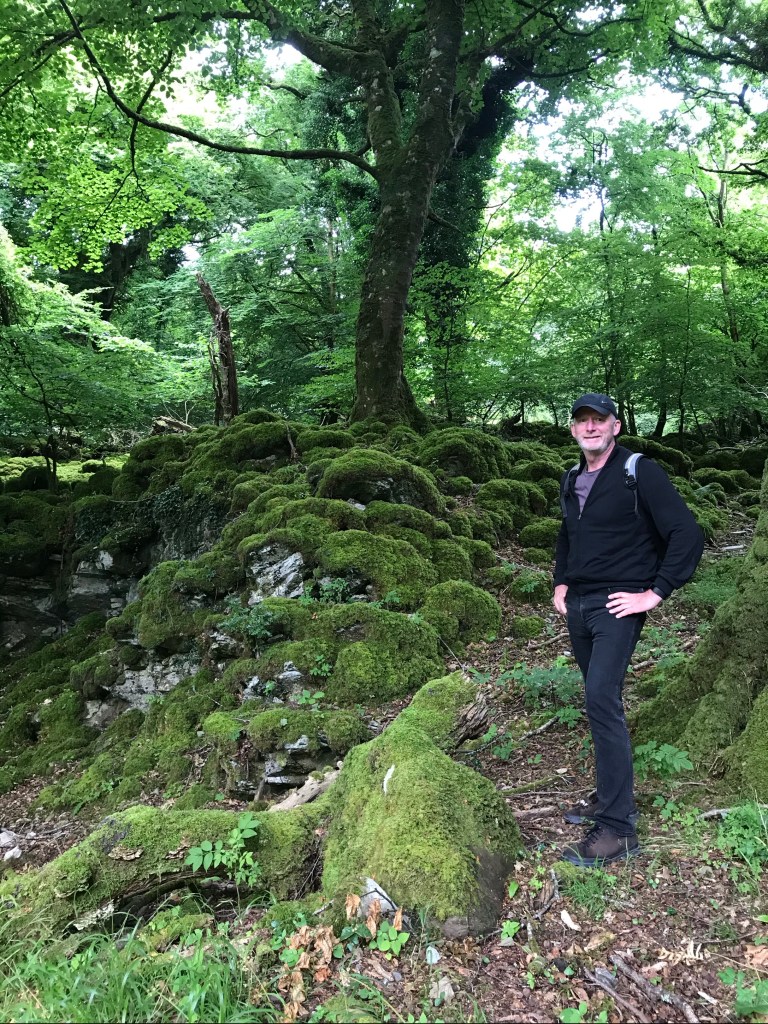
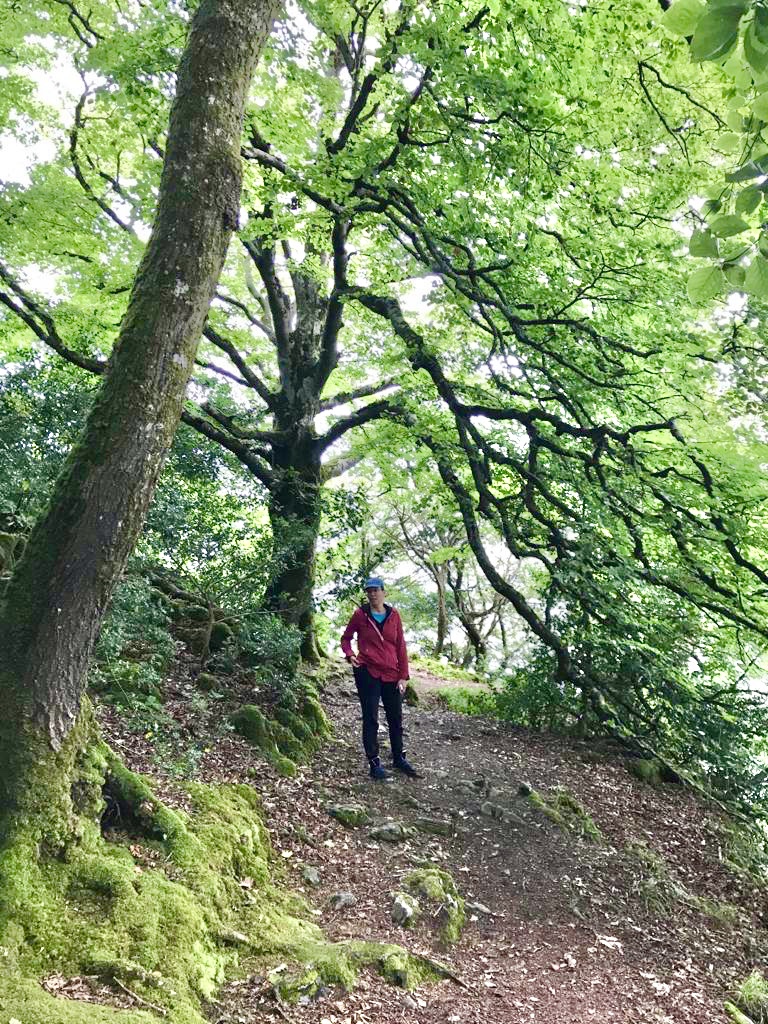
This ancient forest of Yews is simply unforgetable. So lush. Covered in mounds of plush green moss.
It’s hard to do justice to this dramatic landscape.
But suffice to say, I felt like a Hobitt!
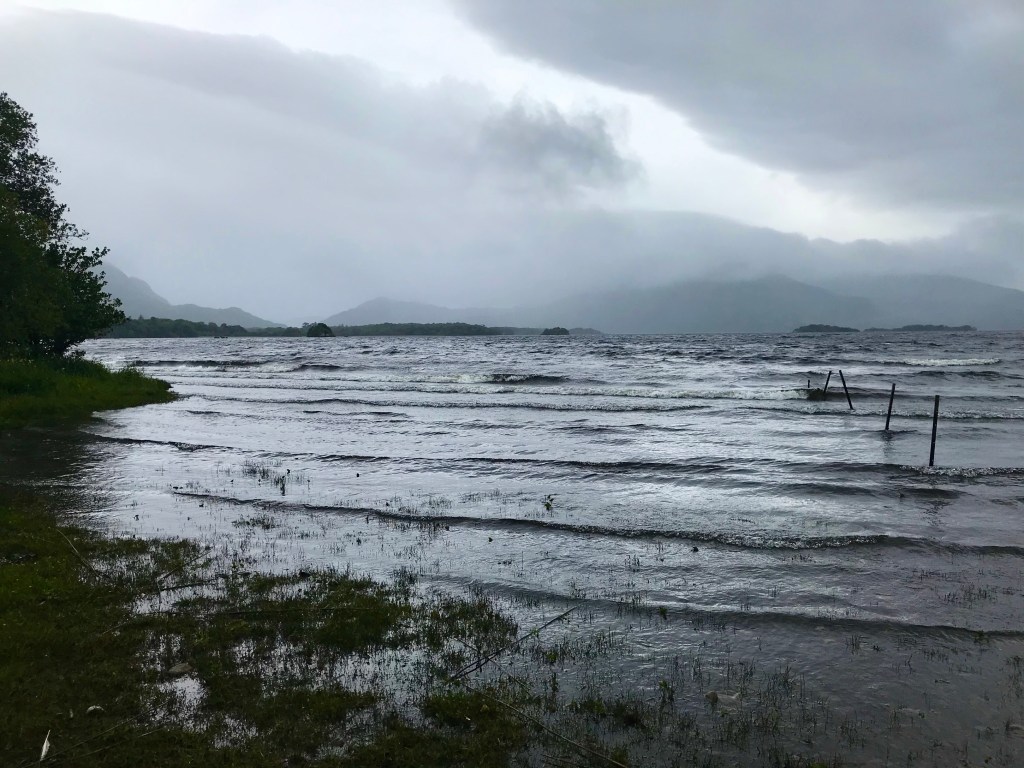
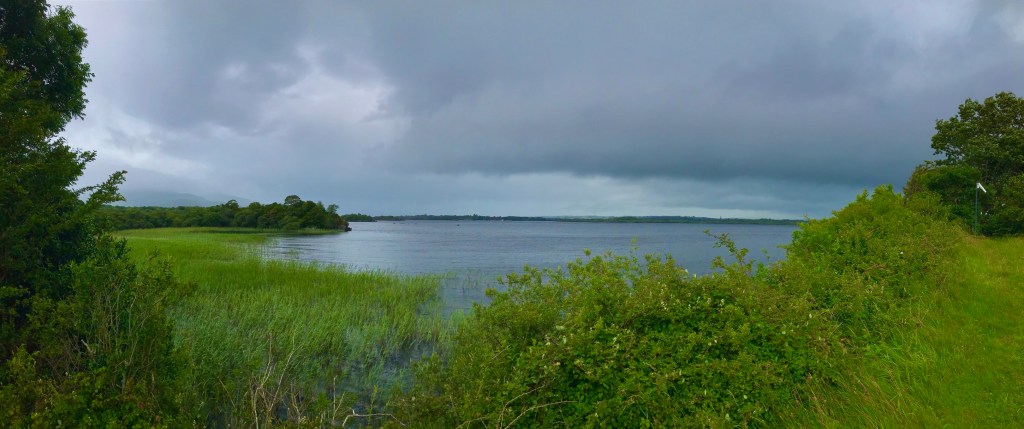
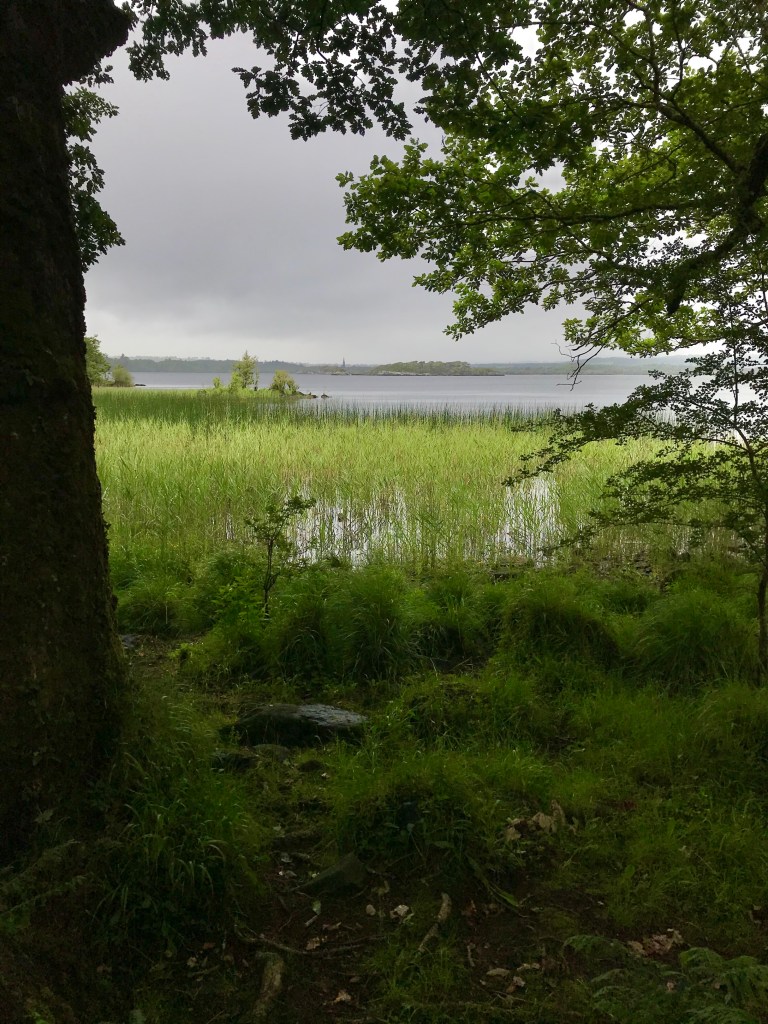
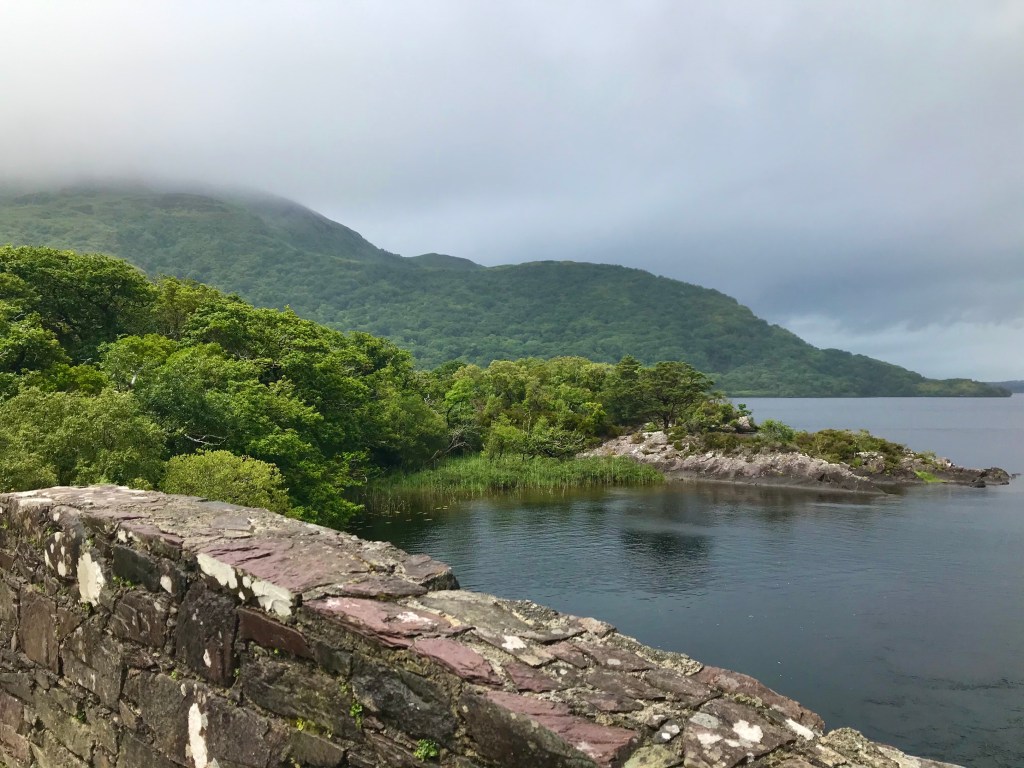
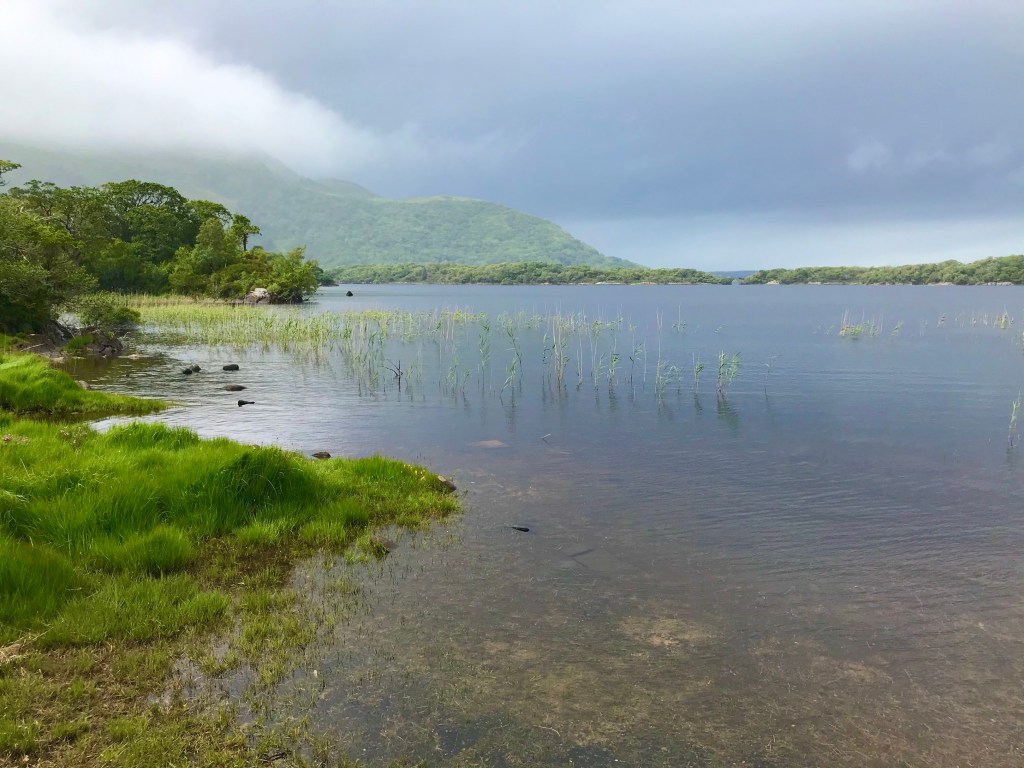
At the edge of the forest we found dramatic views of the northern lake.
Dinis Cafe
Our bike rental guy had shared ideas of where to stop–including important pointers since few spots were going to be open for lunch. Dinis Cafe, he thought, would be open today. It had been shut for lockdown and this was its first day back in action.
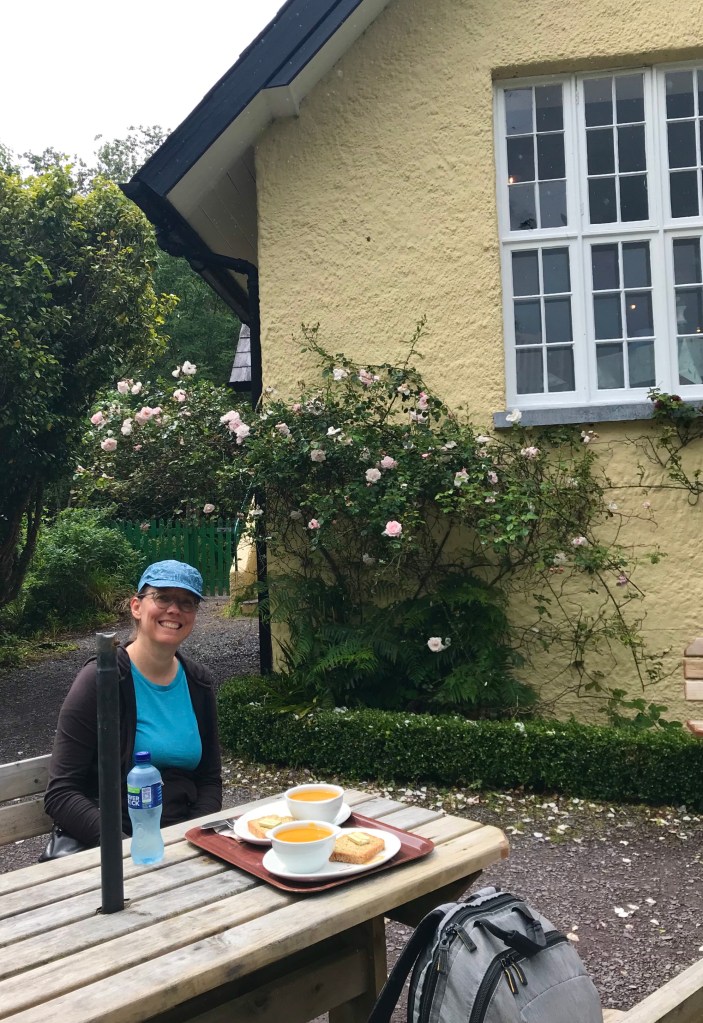
I arrived at Dinis a bit before Aongus:
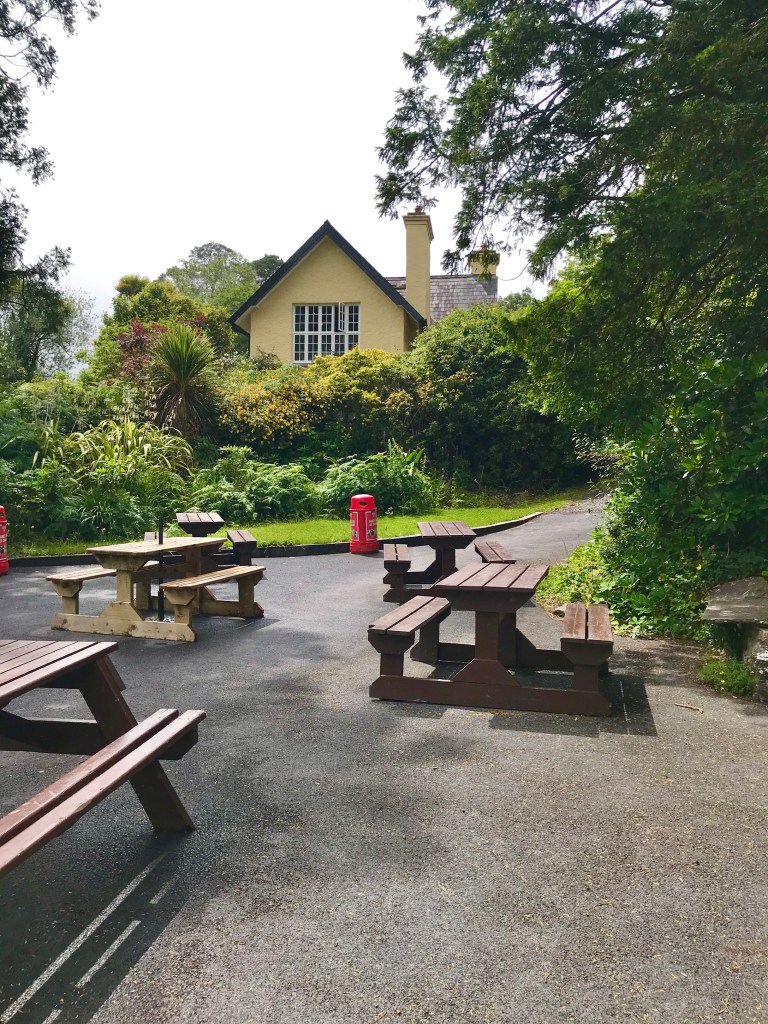
Dinis Cottage is a quaint little house perched on the hillside, overlooking the southern lake from two terraces with picnic tables.
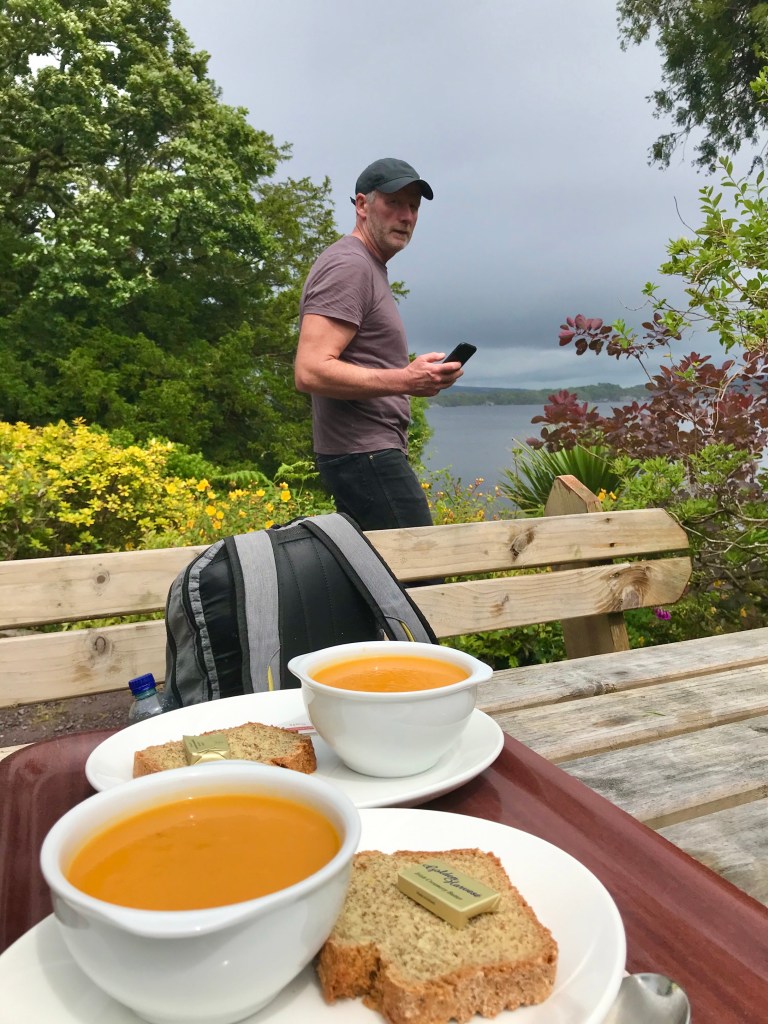
I enjoyed a nice hot bowl of soup and picturesque views (of the lake, and the man).
And then we were off again….
…to explore some more.
Torc Waterfall
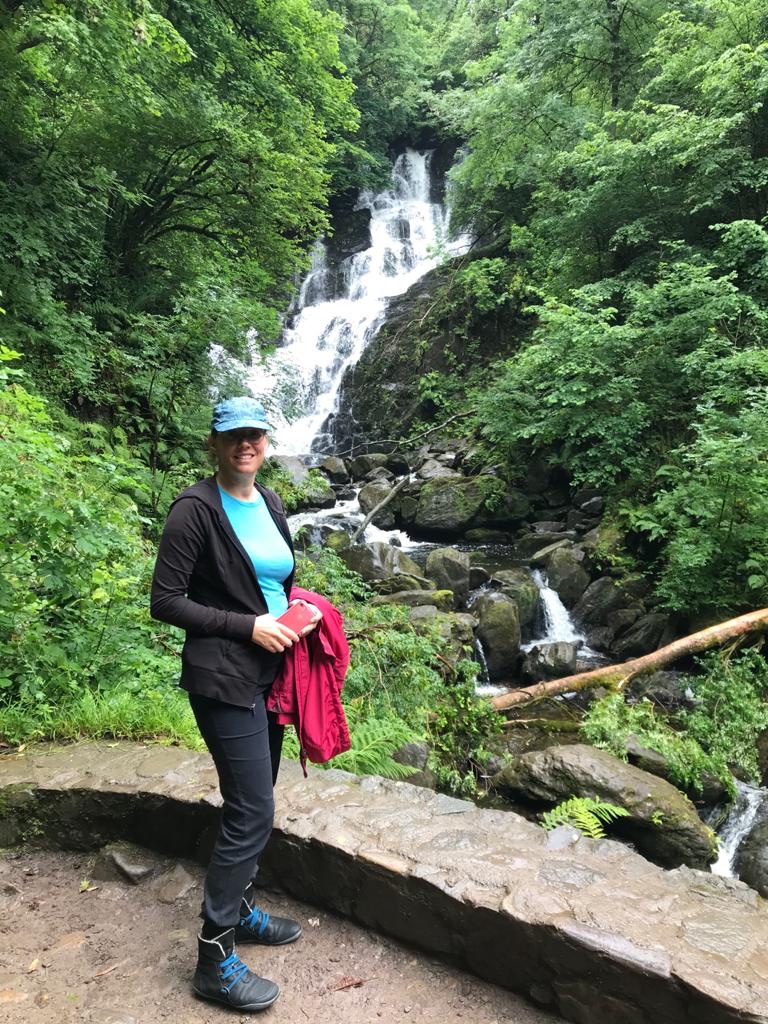
Our next big stop was at Torc Waterfall.
It’s a short walk up hill from the car (and bike) parking area.
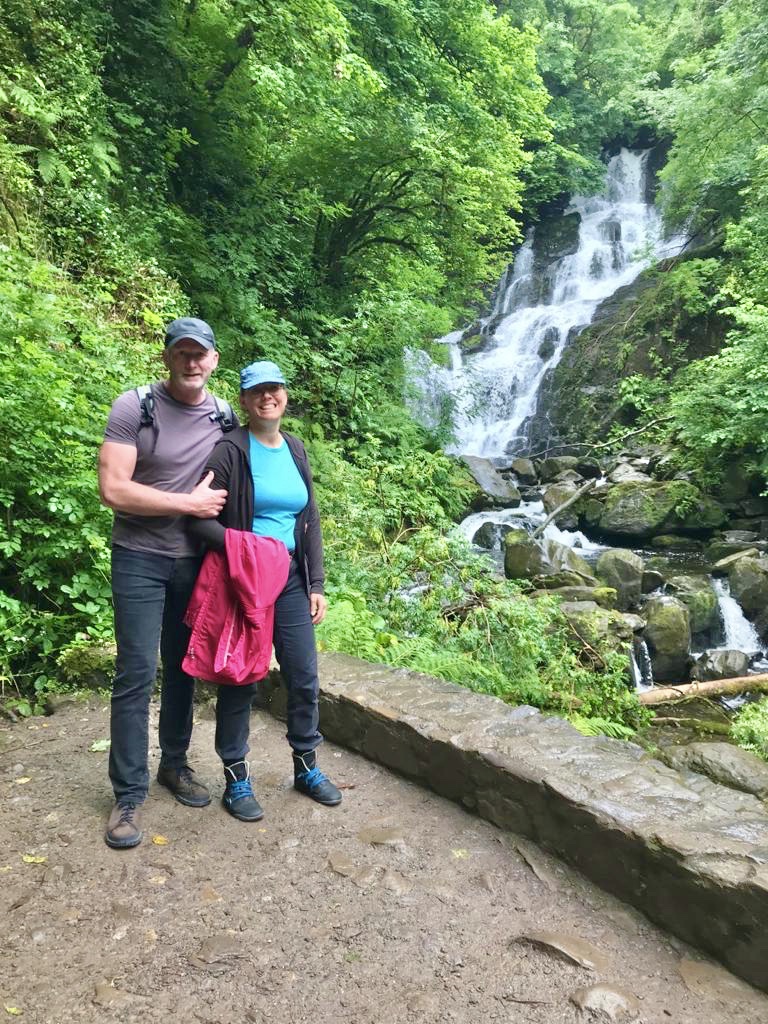
Viola! Here’s the waterfall in all its splendor. Aongus isn’t too keep on heights, so he’s hanging on to ensure I don’t fall over the edge!
Or perhaps he’s considering shoving over the edge? 😉
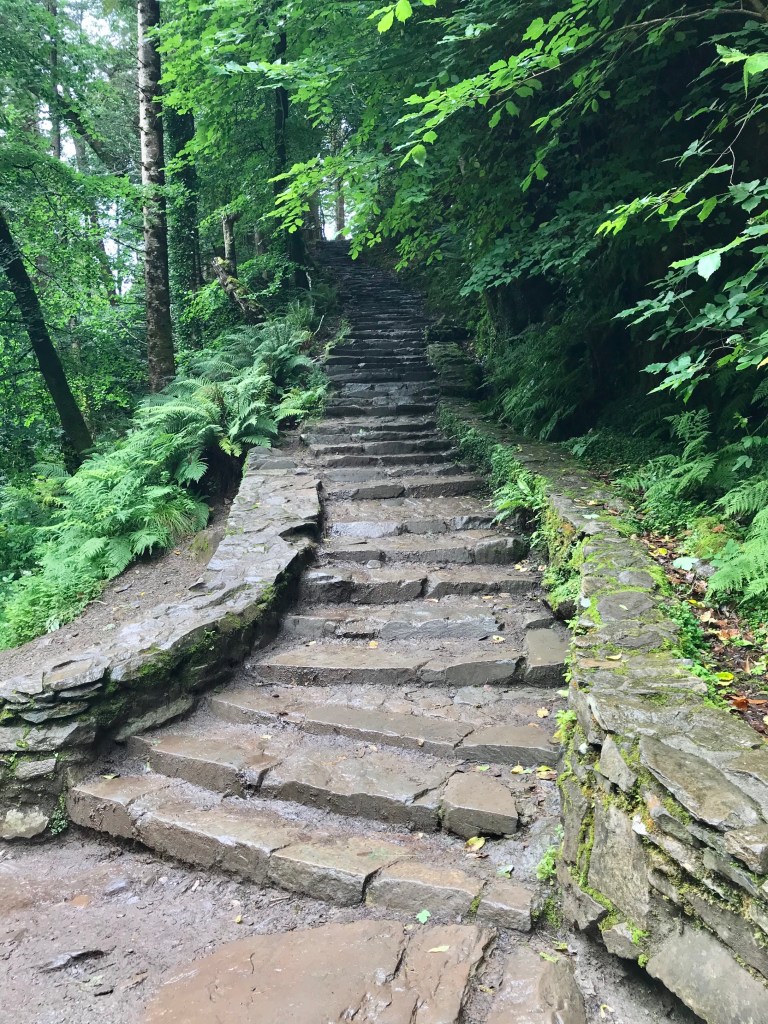
The stairs upward beckoned, promising more adventures, paths, and views. We decided to get going downhill, however, as we had another big adventure in mind.
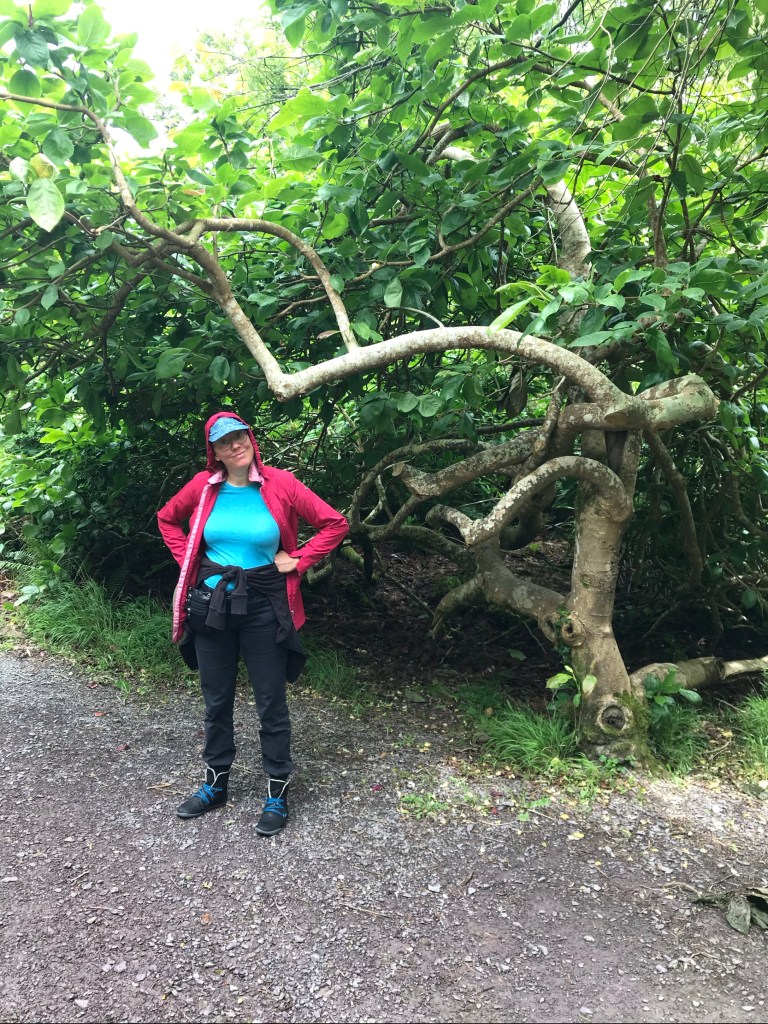
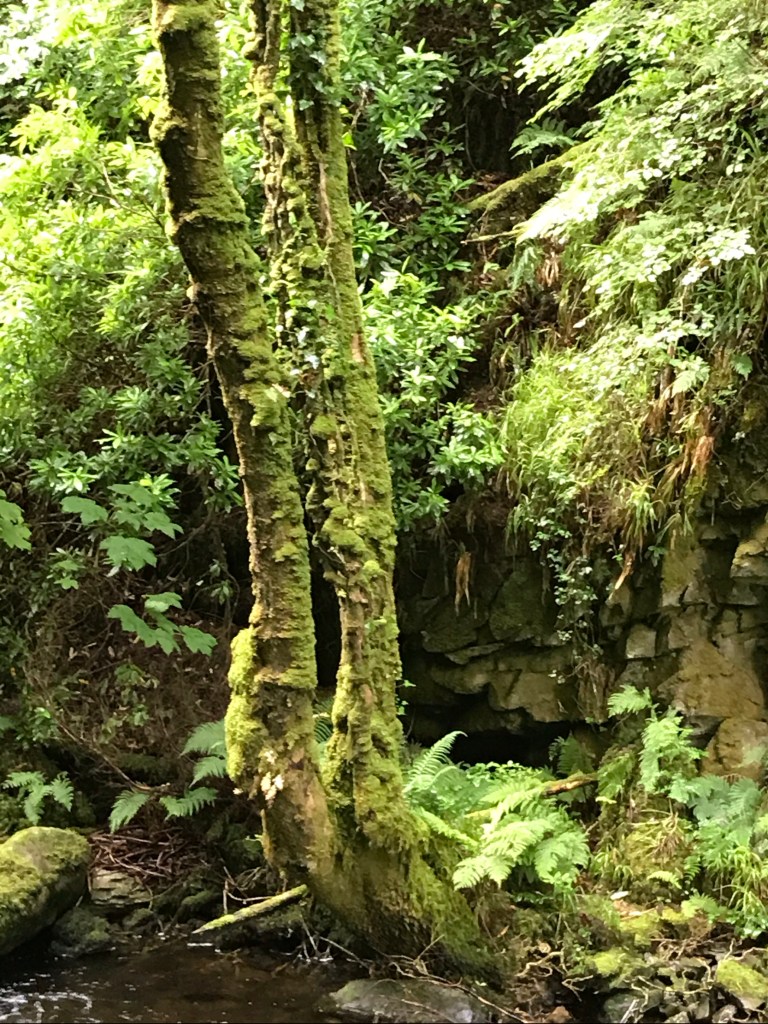
We did take time, though, to marvel at various trees on the way back down to the car park where we’d locked our bikes.
Muckross House to Killarney
Our tour route took us back around, past Muckross House for a second time.
Northern Loop
Returning to Killarney town, we found a second wind and continued on toward the Northern Loop.
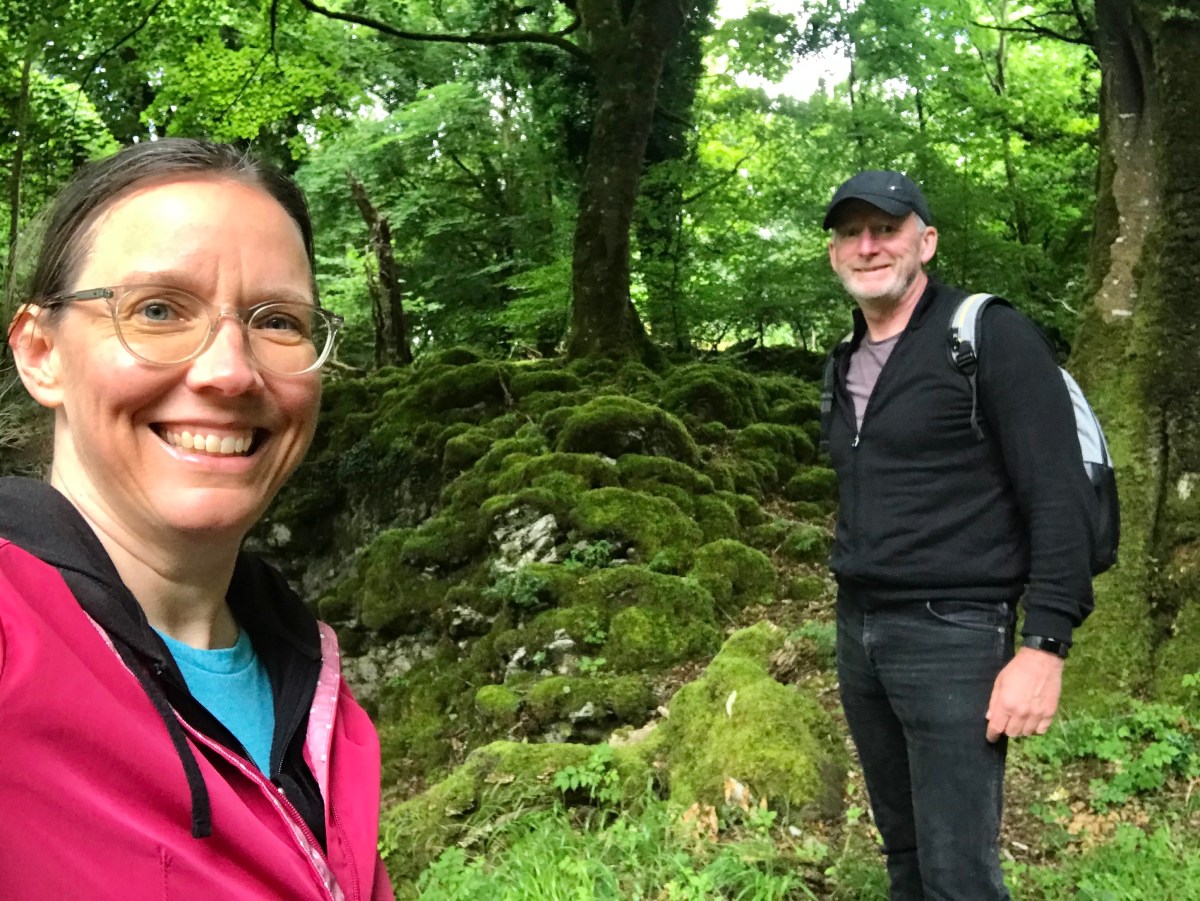
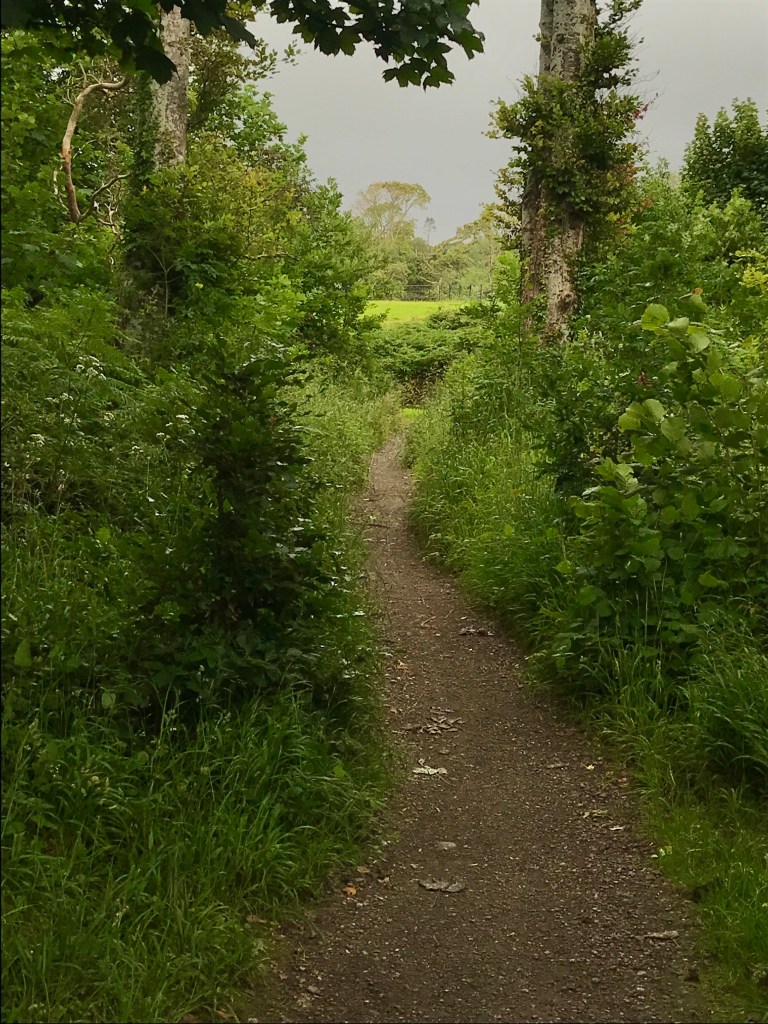
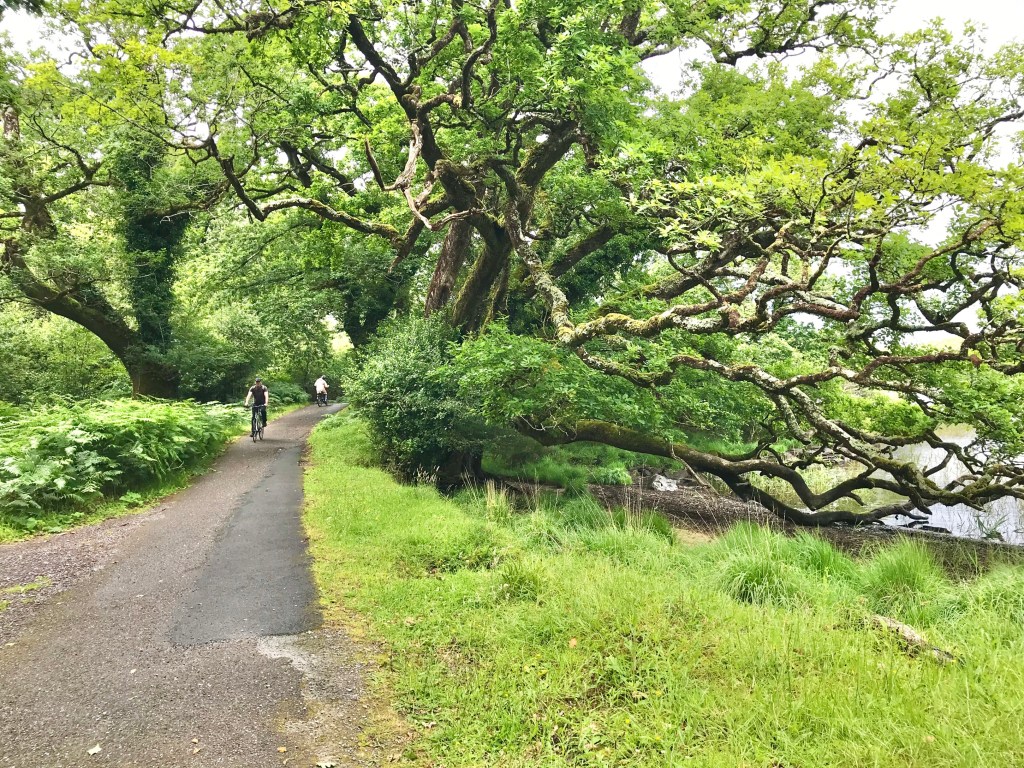
Throughout the day, we set our bikes aside, taking side trips by foot.
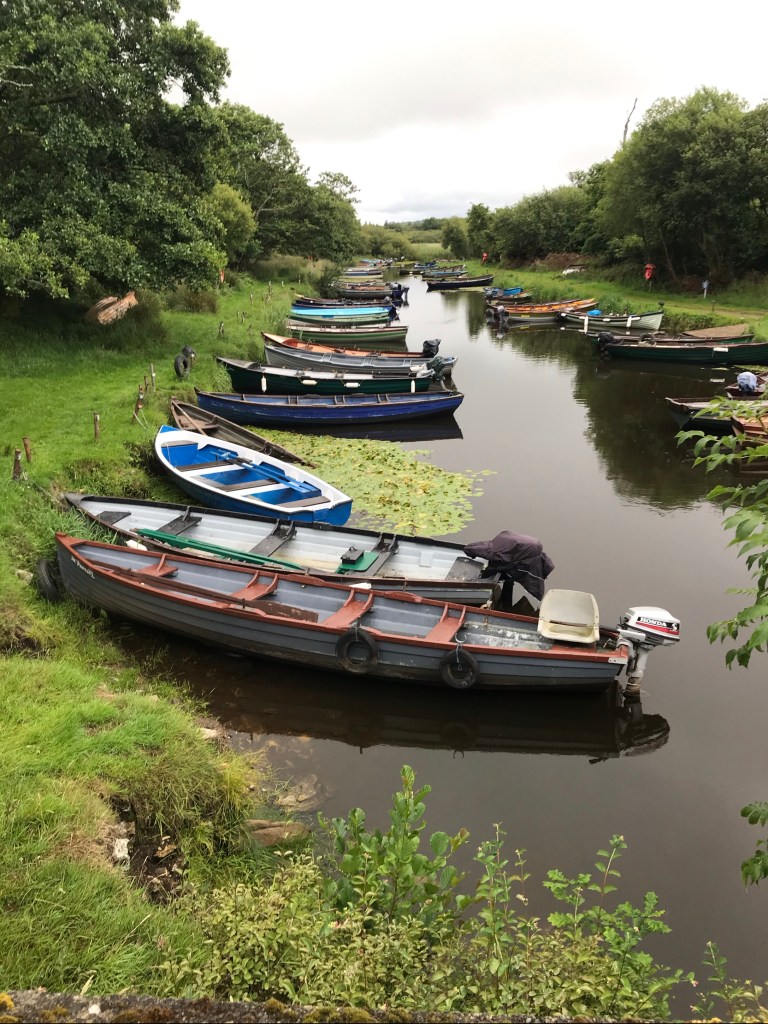
I long to canoe here someday. Canoes are rare here, however. Kayaks and motorboats are far more common. Aongus didn’t even know what a canoe was!?! People here often call kayaks “canoes”.
Isn’t this view inviting? It makes me want to paddle away….
Ross Castle
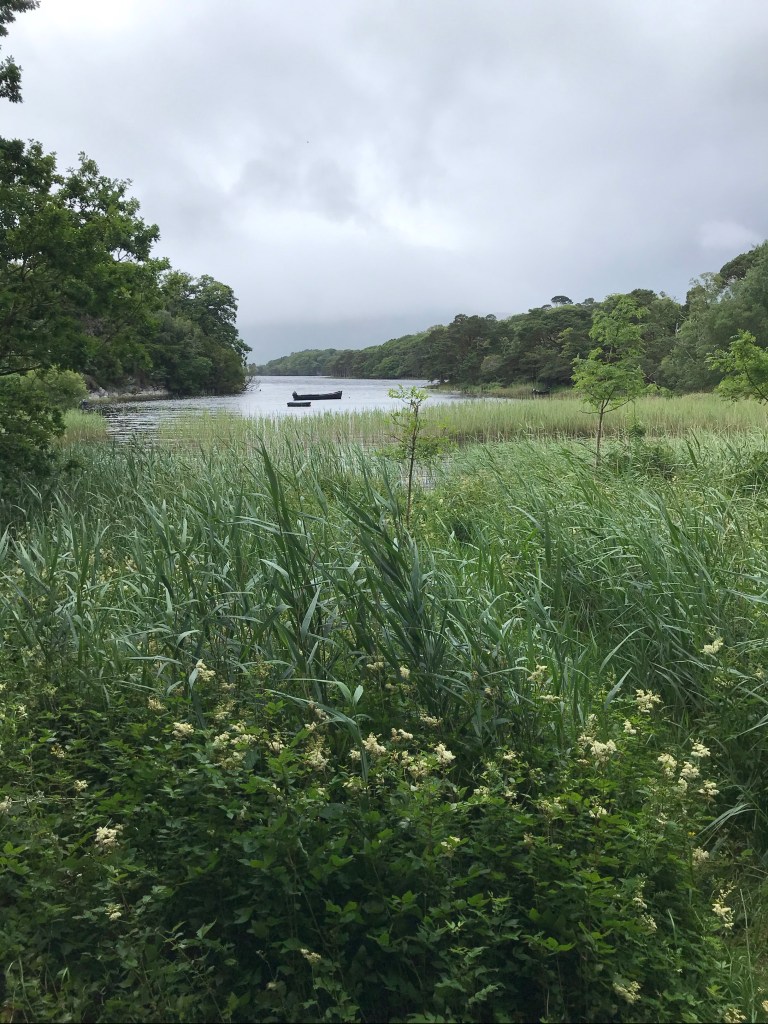
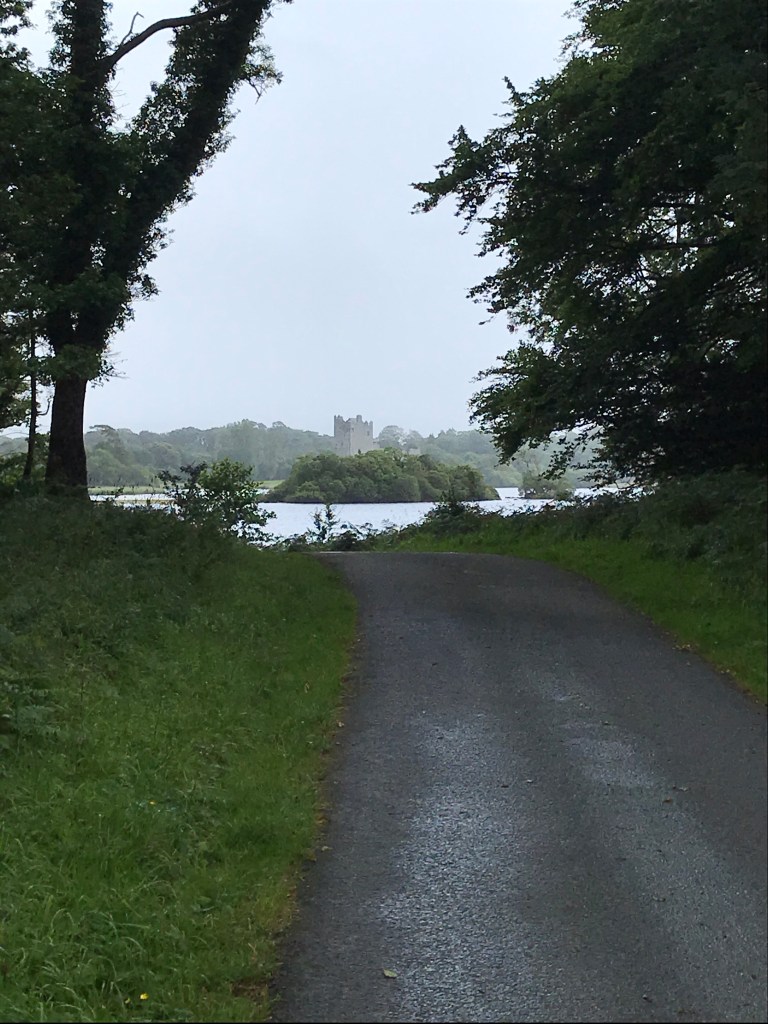
On the road to Ross Castle, we discovered more phenomenal vistas:
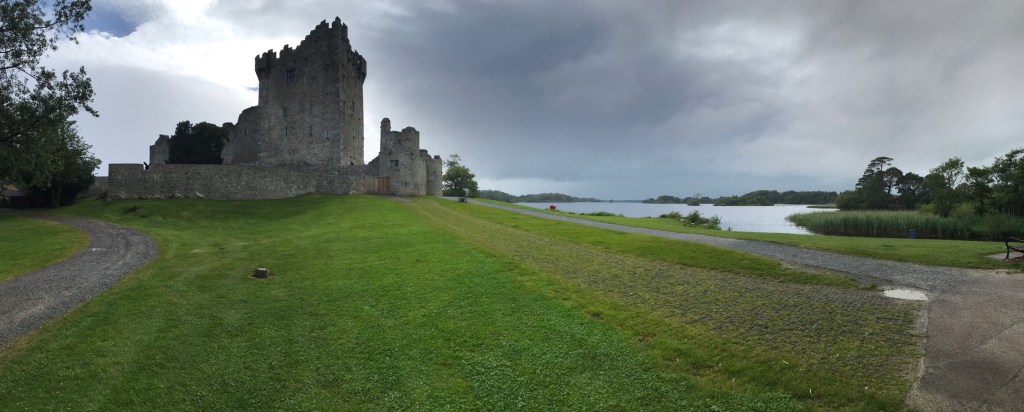
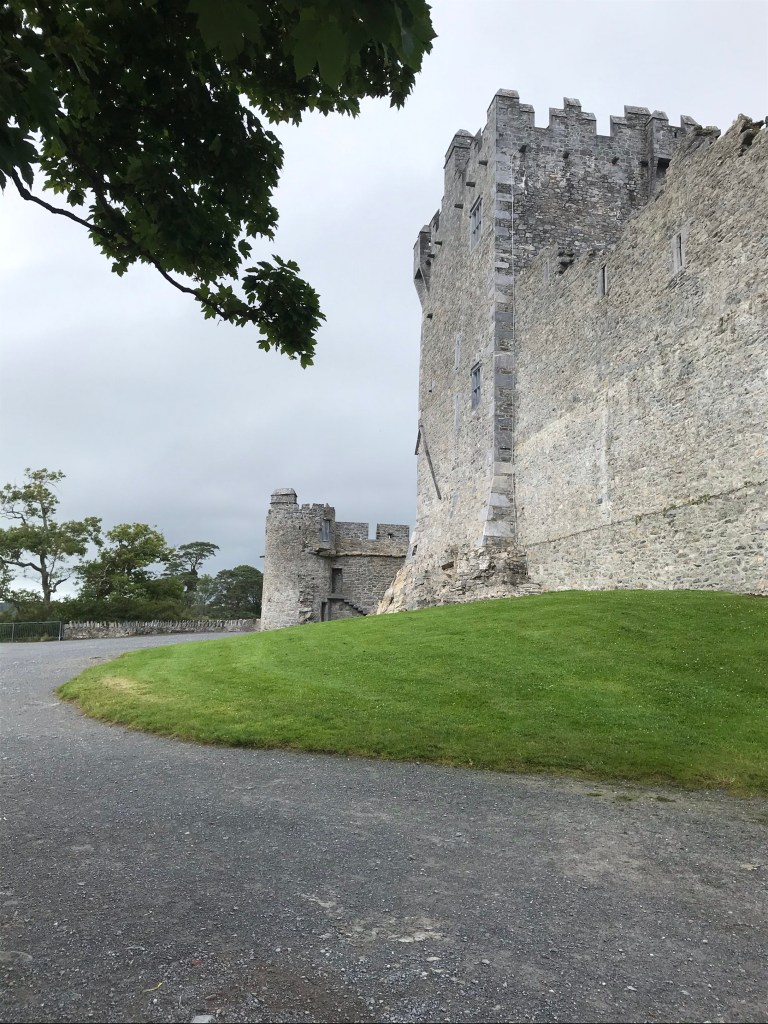
These photos are of Ross Castle, operated by Ireland’s Office of Public Works (OPW), but closed on this Covid-ridden day.
Ross Peninsula
Our tour around the Ross Peninsula rounded out the day so nicely.
Offering more moss, more green, and so much more lush. Here Aongus models a fine Marino wool sweater we brought back from our last trip to New York:
Memories of this place are great fodder for dreams. There’s almost no place I’d rather spend a day.
Overnight in Killarney
After out adventure, we returned to Killarney for a second night.
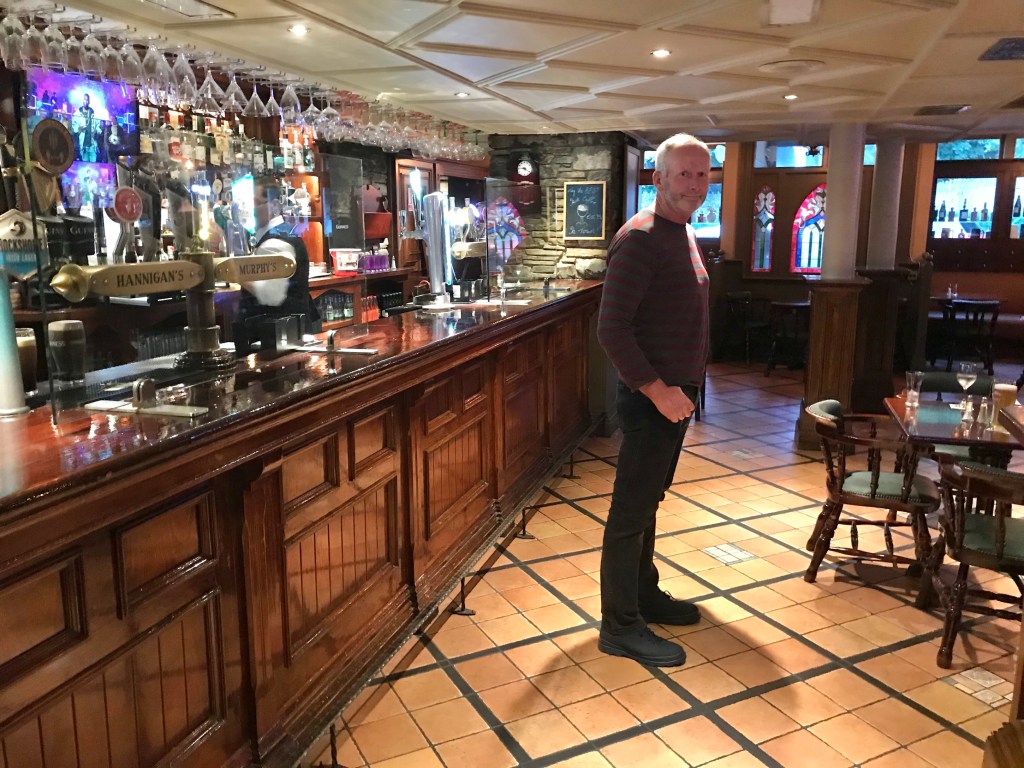
We’d not dined out for all of lockdown, and this was a very welcome treat! Aongus loved his first night’s chicken burger so much that we returned to the same pub for night #2. He’s very serious about his food:
The next morning, he was recharged and ready to roll!
Ladies View
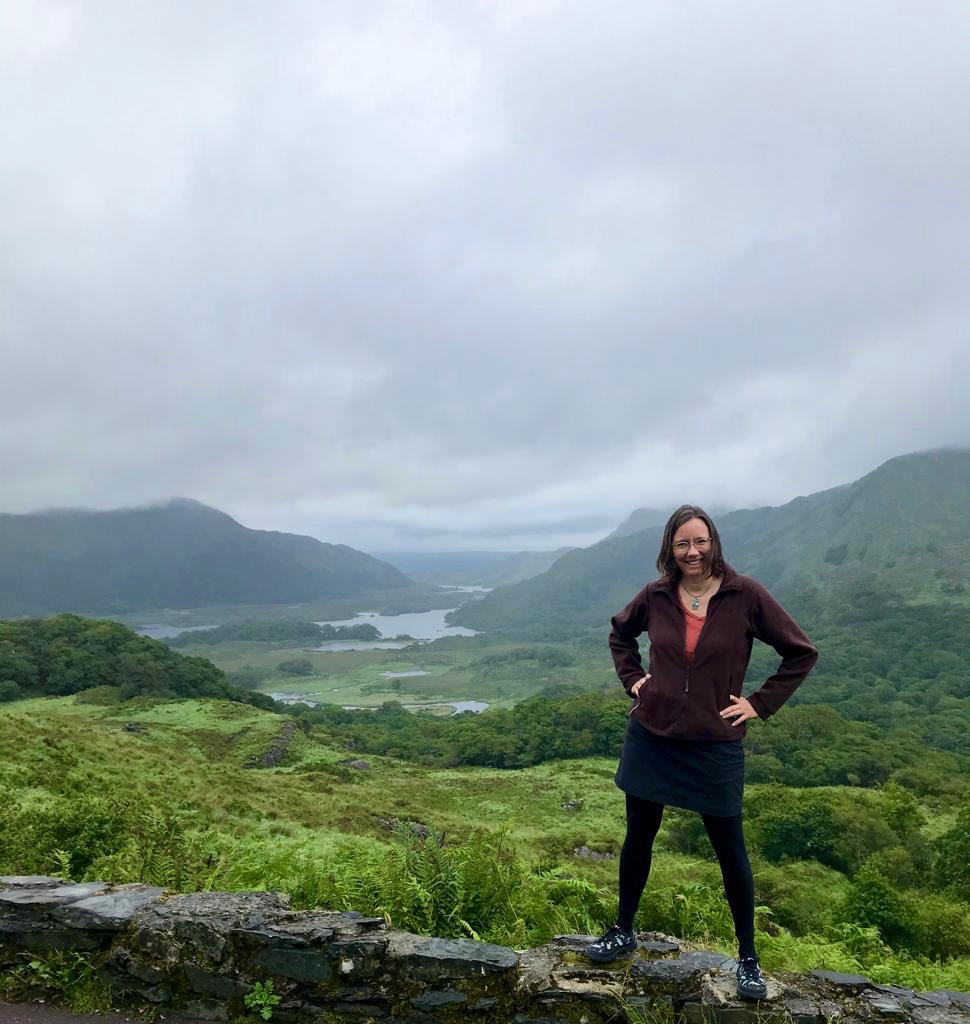
We caught a final view of the Killarney lakes from the famous “Ladies View” on our way westward, toward the Ring of Kerry.
As with many iconic sights of Ireland, Aongus had never seen these places before–it took an American to show him America’s favourite highlights!
We are both delighted we grabbed the opportunity while it existed. Once lockdown #2 lifts, we certainly will return again!
Feeling a bit claustrophobic these days. We’re two weeks and three days into lockdown #2 here in Ireland, and my big outings of the past weeks have involved the fish market across the street and nearby grocers.
In fact, I wrote this blog post on the stone forts in County Kerry for you long ago–just after lockdown #1 lifted and the Irish government encouraged us to travel the country (to spend tourist “dollars”).
Since then, I’ve been so busy with work that I never got around to posting. Maybe it will brighten your autumn day….
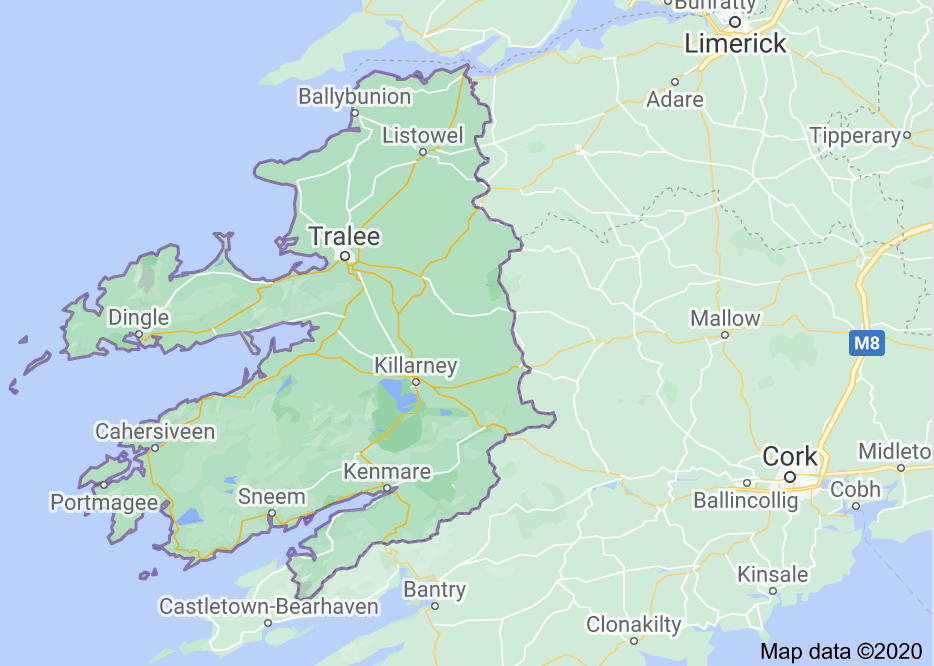
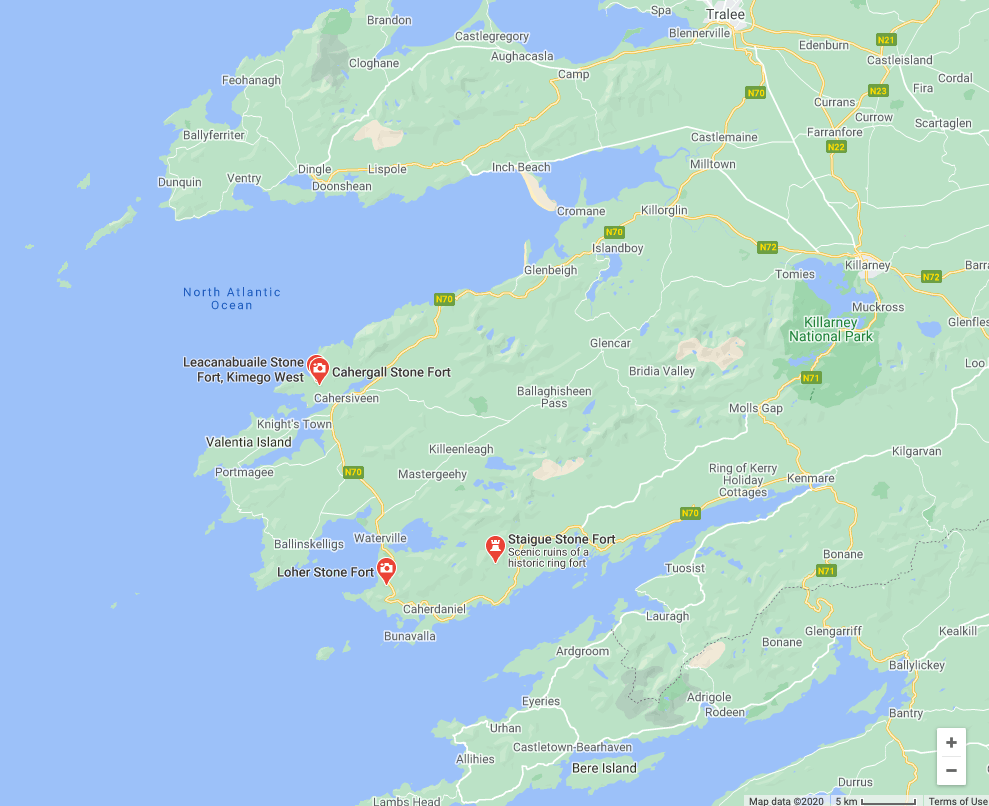
I’d like to introduce you to Staigue, Cathergall and Leacanbuile–three impressive and ancient stone forts. The first of these is on the southern side of Kerry’s famous ring, whereas Cathergall and Leacanbuile are in the northwest corner of the Iveragh peninsula (aka Kerry’s largest peninsula synonymous with “Ring of Kerry”).
Cathergall and Leacanbuile lay just northeast of Valencia Island. If you are visiting by car, you can reach them by driving to Cahersiveen, taking the bridge northward, and following the brown heritage signs. They are clearly marked and open to tourists. Park your car in a lot at the mouth where two paths join. The path to the right lead to the Cathergall stone fort, while the one straight ahead takes you to Leacanbuile.
Google map of the Iveragh peninsula, showing locations of forts.
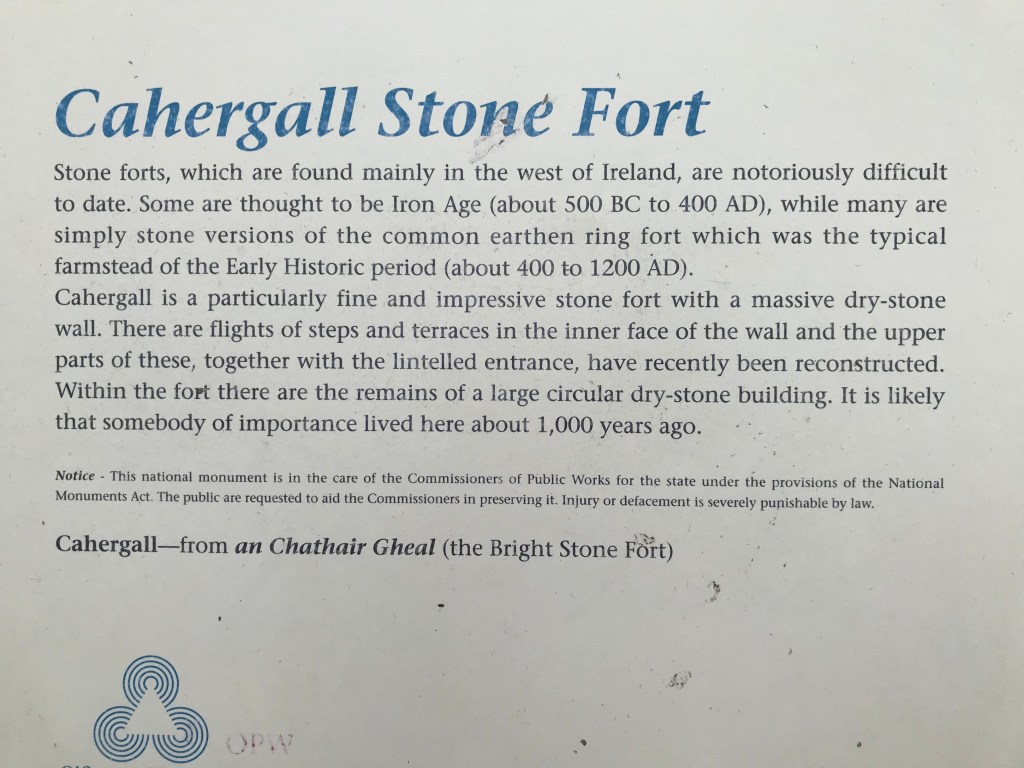
Meagher and Neave (2004) say Cathergall and Leacanbuile date from the 9th or 10th century and were owned by wealthy farmers. On the other hand, Rick Steves says they were all “built sometime between 500 BC and AD 300 without the aid of mortar or cement”. The placard posted at Cathergall resolves this by stating they are “notoriously difficult to date”. (I included a photo of that sign, below.)
To reach Staigue fort, drive to Castlecove and turn northward. Again, the signage is clear.
You may notice other circular mounds covered in green along your journey. Kerry is covered in forts, but many are buried and not accessible—the land where they are is now privately owned.
You’ll find all three of these on Rick Steve’s Kerry tour, although they appear to be missing (or perhaps hidden) in the Michelin Guide. You can find details about them from a book like “Ancient Ireland: An Explorer’s Guide” written by Robert Meagher and Elizabeth Neave, and published by Interlink Books in 2004.
All three forts, according to Rick Steves, are about 2.5 miles off the main drag. It is so very well worth the effort to find them, in my opinion!
Staigue stone fort
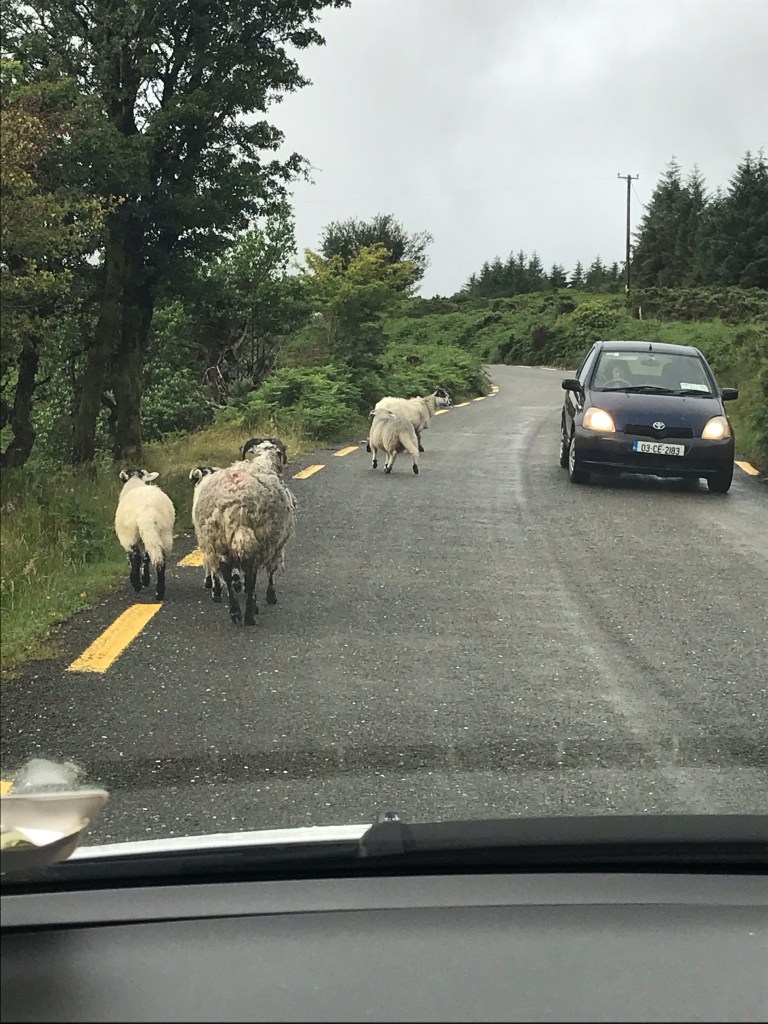
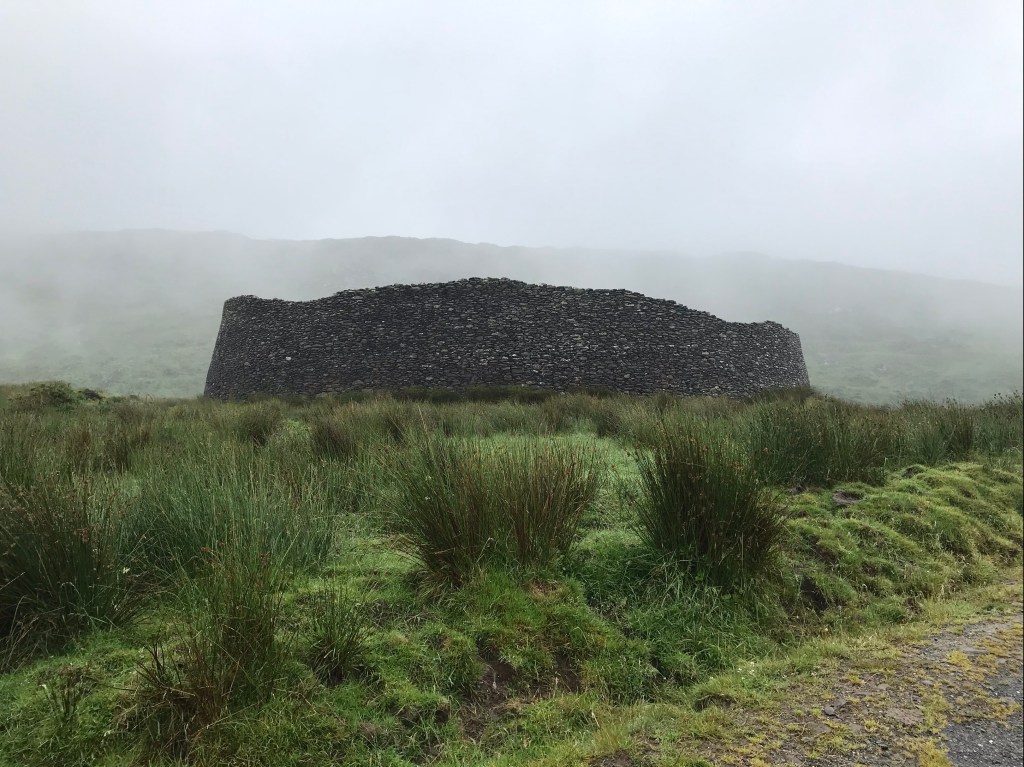
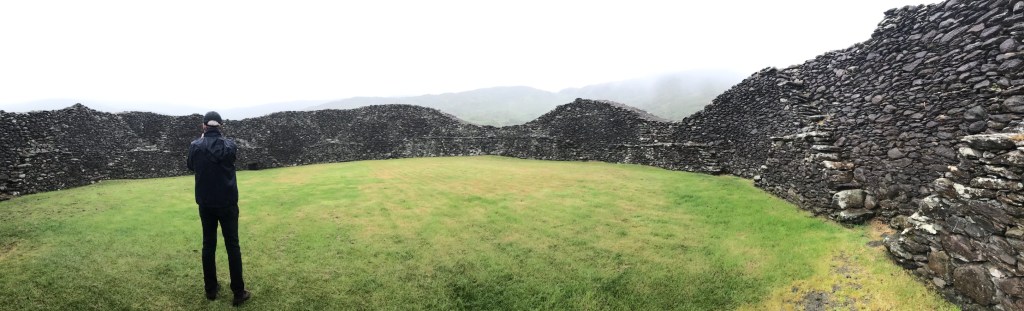
Approaching the fort by car on the rainy day of our visit, we inched past wandering sheep. The stone fort eased into view through thick fog, periodically crystallizing into drizzle….
Then WHAM: the Staigue fort revealed itself in all its wintry glory. (Okay, yeah, it was June, but I assure you that it FELT like winter.)
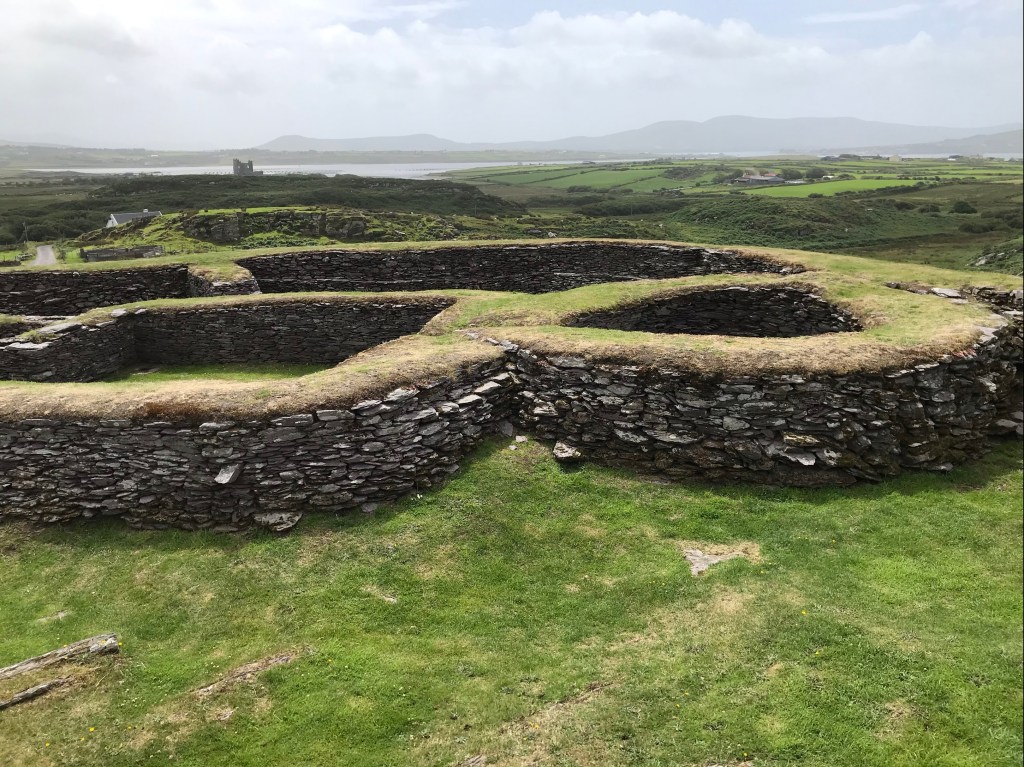
Staigue is a fortress, perched on an elevated plain but surrounded on three sides by hilly slopes, and sheep! It measures 90′ in diameter and the height of the walls varies, reaching 18′ at the highest point (Meagher & Neave, 2004).
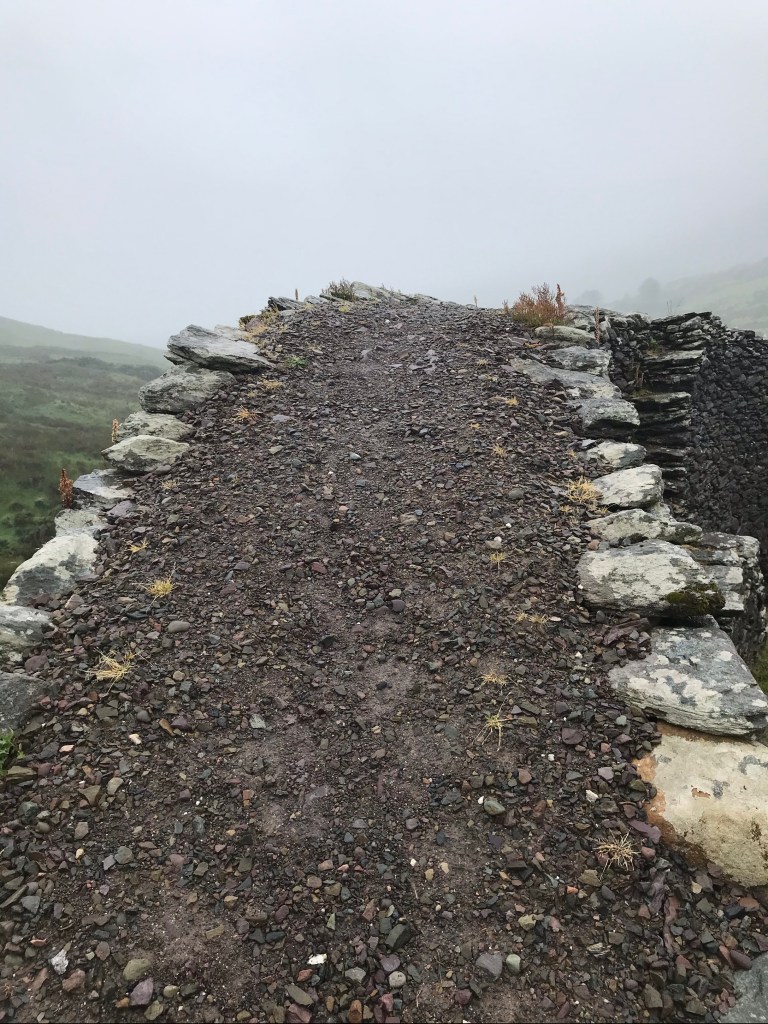
The entry is small and hidden. From the approaching path, it’s off to the right, tucked away behind and below the clumps of grass. At its base, the wall of the fort is 13′ thick. You viscerally feel the weight of the stone and the thickness of this wall when crossing the threshold.
Here, just inside the entry door, Aongus stands:
This is the view you find as you enter through the small passway of a “door”, protected today with a gate. Despite there being a gate to keep sheep out, people are quite welcome. This site is free to visit.
The thick stone walls vary in height, and undulate like the surrounding hills.
The interior is ringed by stairs that would have made the compound easier to defend, I’d say, by allowing many people to scale the inside quickly. The outside wall was designed to be impenetrable.
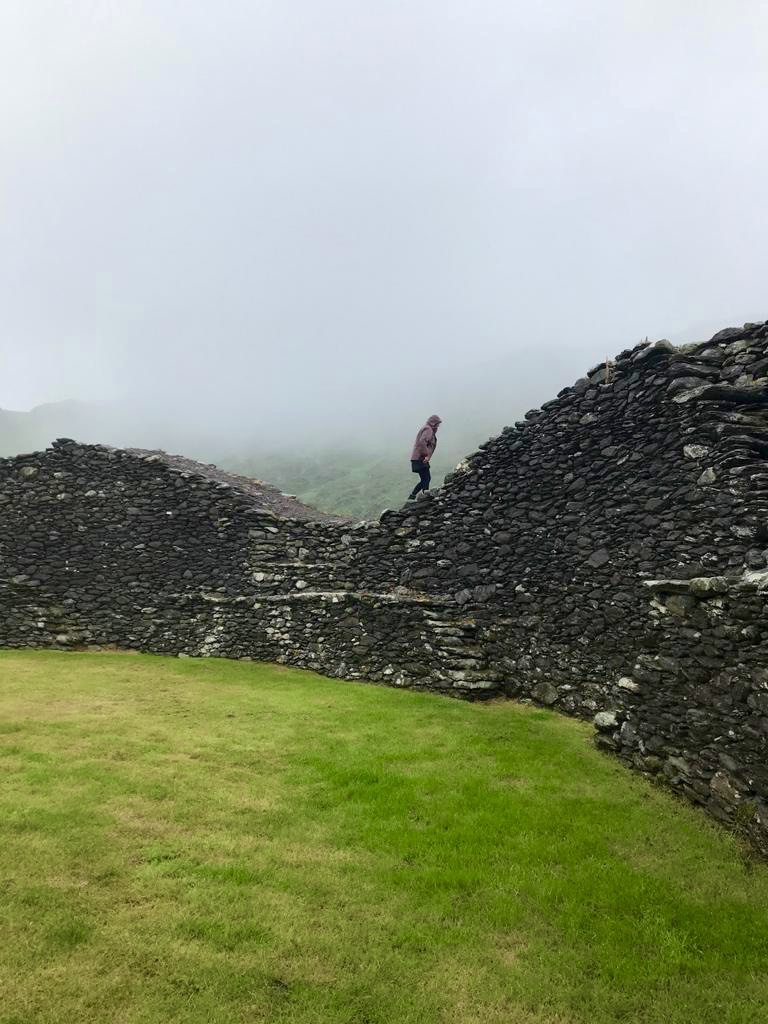
You can scale the interior walls. It takes some care, especially on a rainy day!
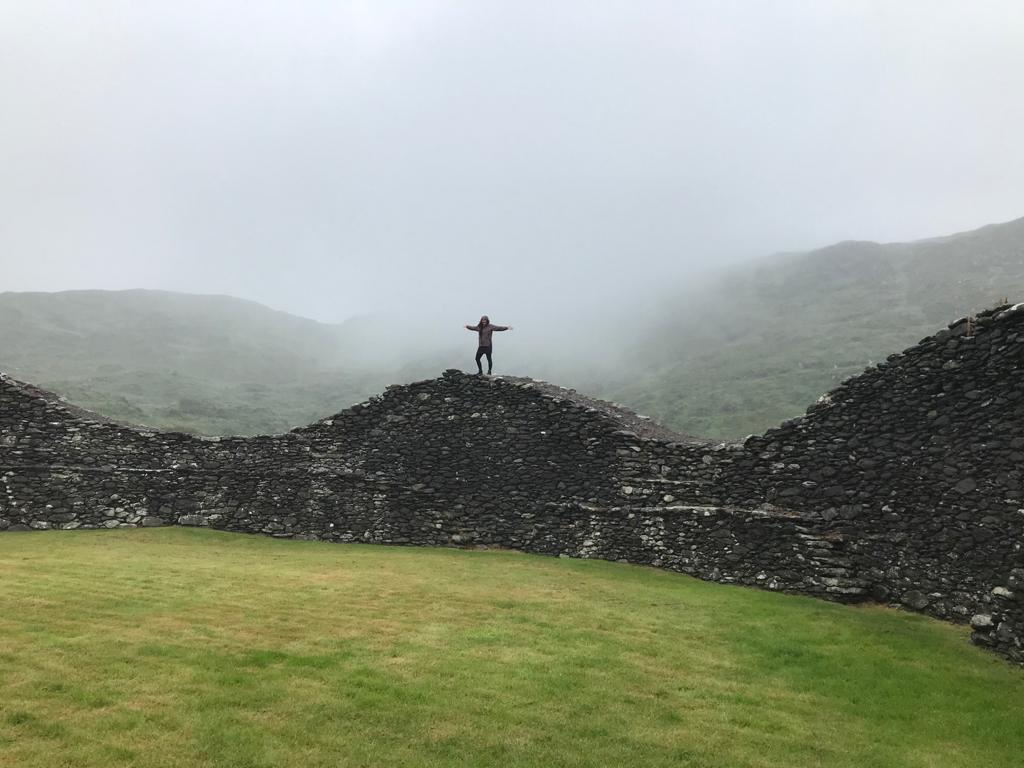
Here, you feel you’re on top of the world….
…yet somehow safe.
Cathergall stone fort
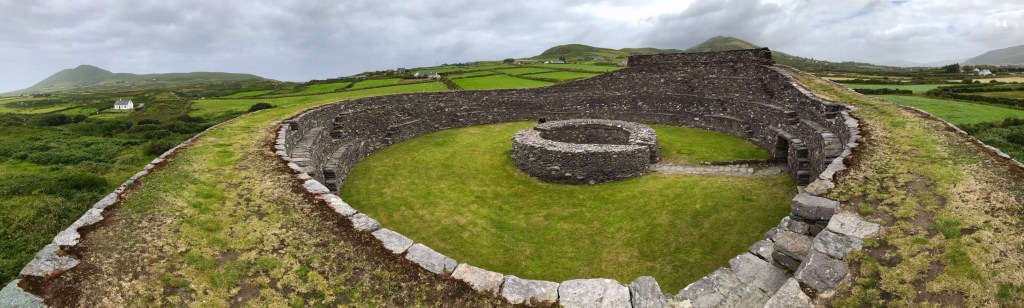
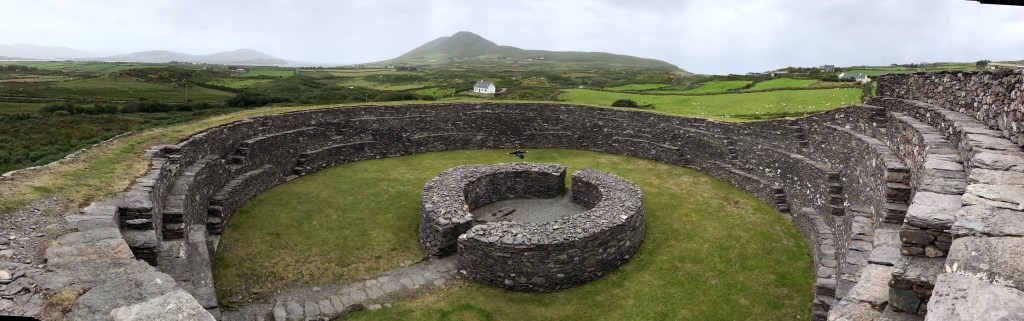
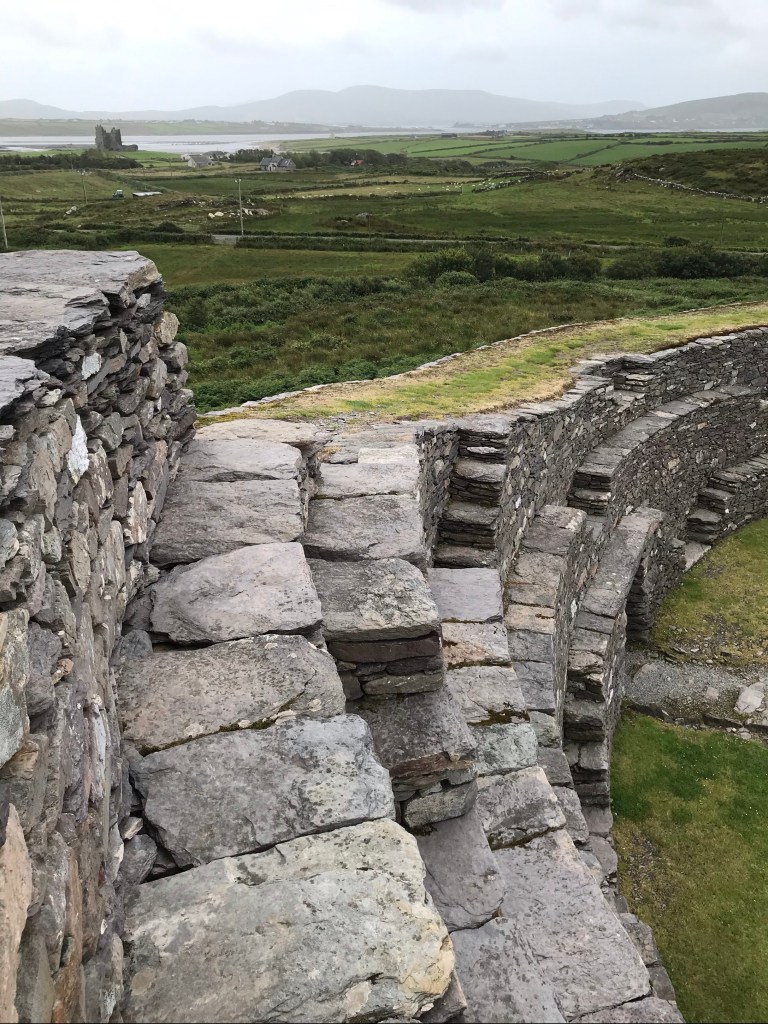
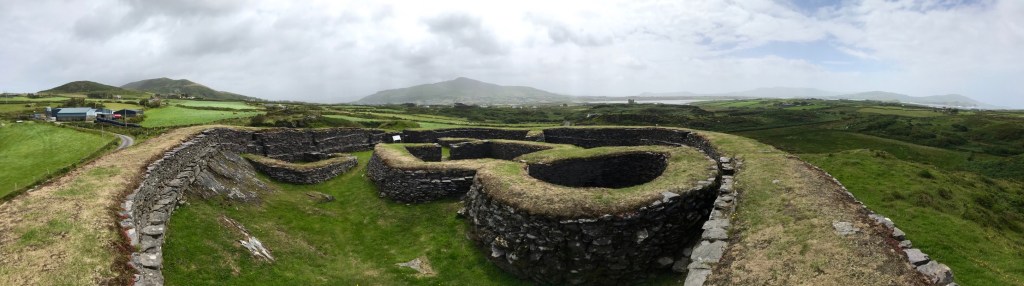
The next day, we discovered the Cathergall fort is even taller, higher, larger, and more dramatic than the Staigue.
I’d actually visited all three back in 2003, and Cathergall is the one that stuck in my mind the most, with its intricate stepped terrace stairs, water views, expansive landscape, and towering presence.
From Cathergall, you can see the Leacanbuile stone fort as well as ruins of a castle called Balleycarberry (built much more recently than the forts, but in worse condition).
You’ll catch glimpses of Cathergall from the road and also the walking path:
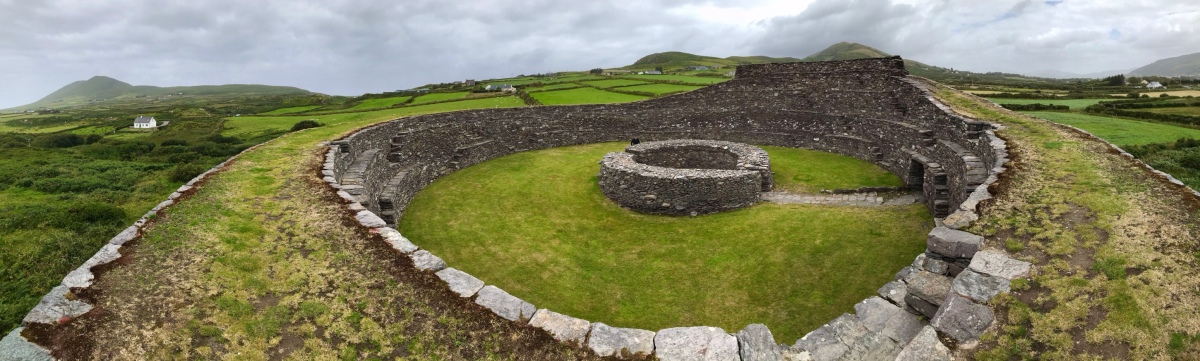
As shown in the panorama below, you see the entryway to the right. You feel the weight of the wall below you and the expansiveness landscape to the east:
Here’s a view looking to the northwest:
The stair system on this fort is even more extensive than on the other forts. It reminds me of the stepwells of India.
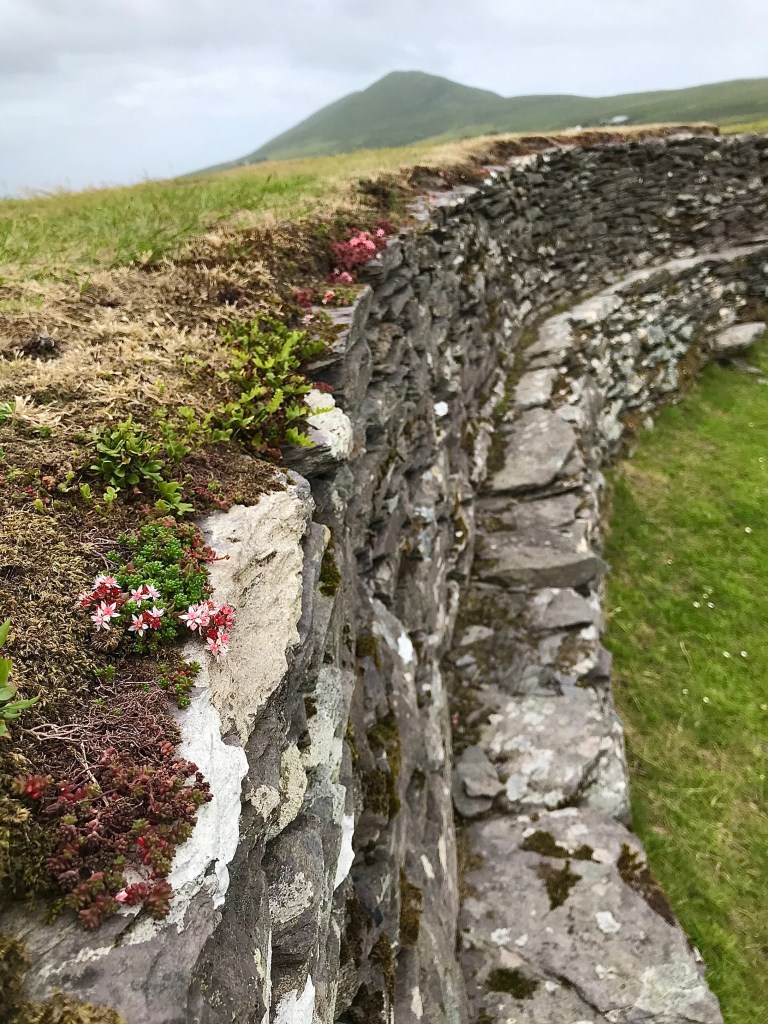
As with the previous fort, it appears there’s an inner core of fill. This one, however, is covered in grass.
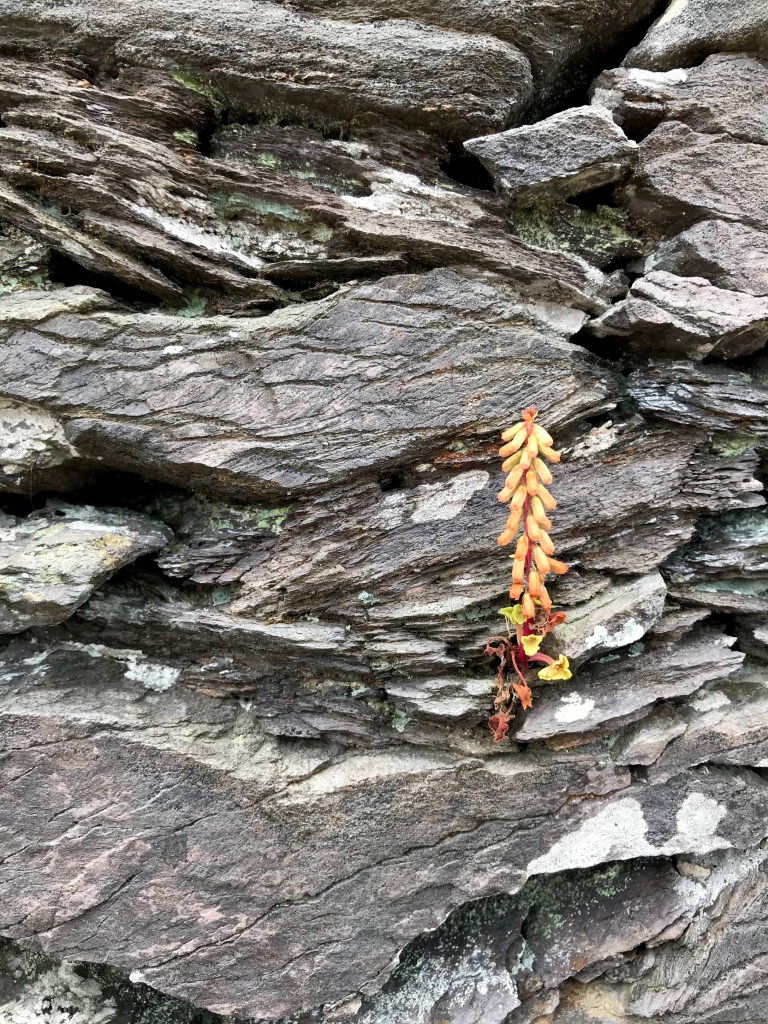
Tiny little plants cling to its sides for life.
Leacanbuile stone fort
From the path up to Cathergall, you can view Leacanbuile across the fields.
We enjoyed watching a farmer and his dog practice herding sheep in the field between the two forts.
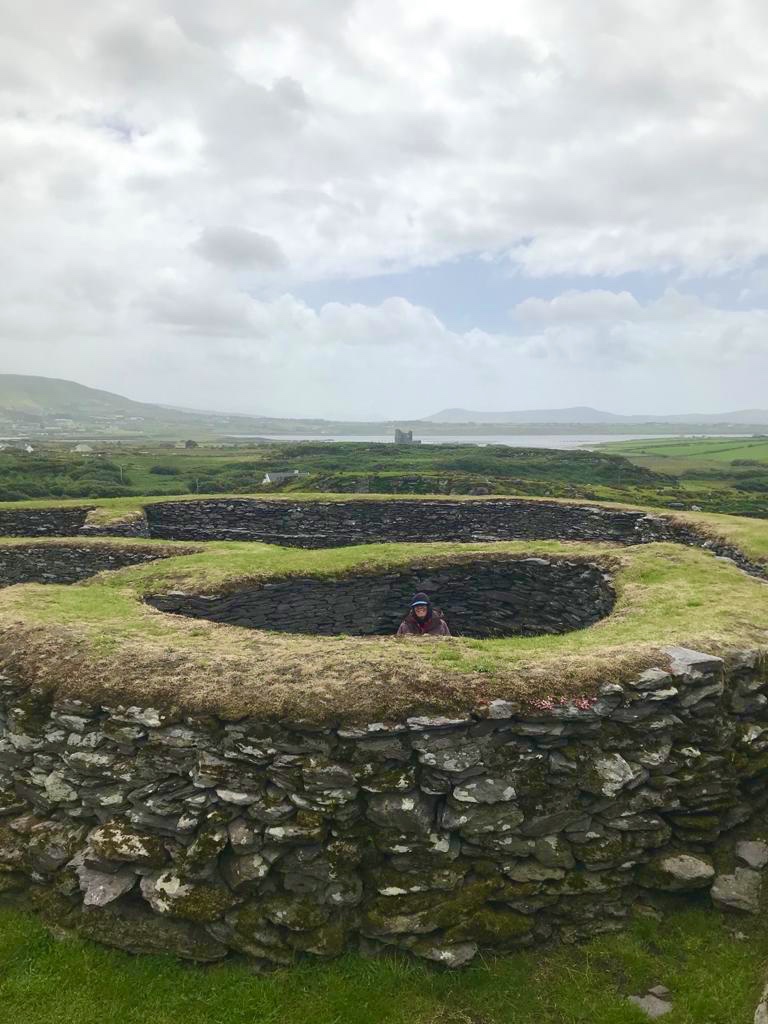
This third fort is the smallest and most intimate of the three publicly-open stone forts on the Ring of Kerry. This one feels the most like a residence, whereas Stiague and Cathergall feel more defensive. In fact, the sign says, there were four houses inside the wall. This handy plaque provides detail:
Below, you see the rooms, as well as the wall covered with grass and tiny little plants. And you can notice my little head popping out the top of “House A”.
This fort feels more like the beehive housing complex, also bounded by a stone ring, that we saw later in our trip, on Slea Head just west of Dingle. Featured in a separate blog on Slea Head.
The floor inside the ring undulates in a way the others don’t, and I’m not sure what the original ground level would have been–perhaps below what it is now?
None of these four Houses have roof coverings today. There are, however, some covered passageways inside the walls and they are shown in the darkest blue hatching on the plaque.
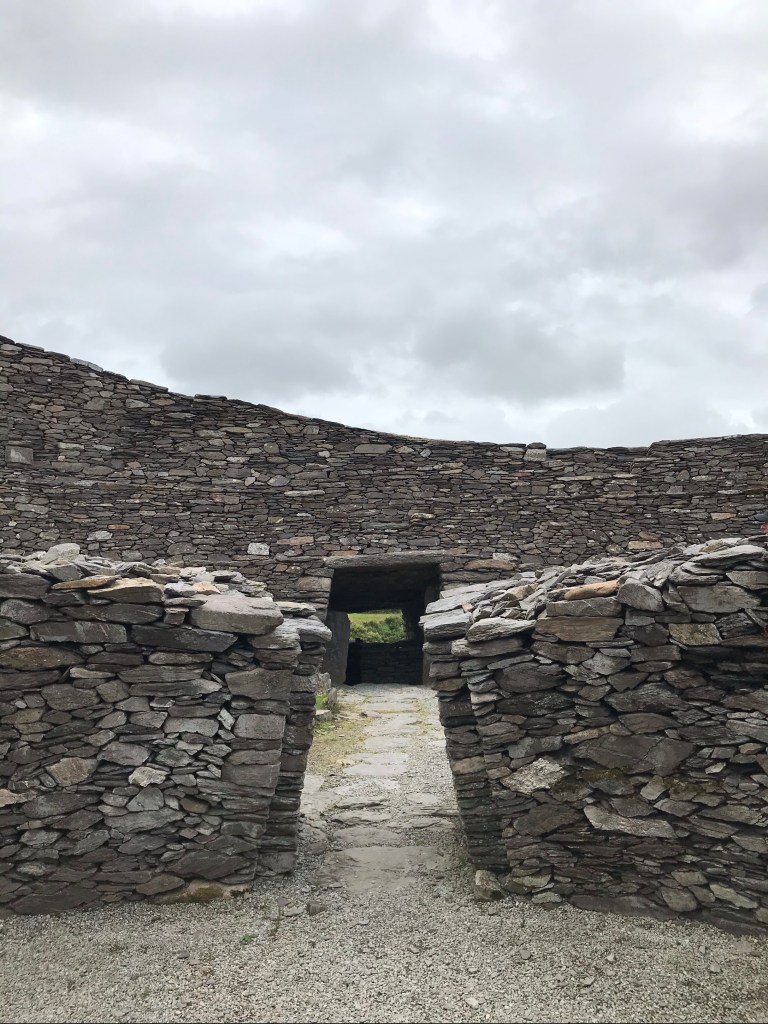
In the photo below, the entry is straight ahead (the white dot is the plaque beside it). In this fort, the entry is not covered, but there is still a gate to keep animals from entering.
As noted above, we visited all the sites the weekend after the Irish government opened the country up for travel from within. As such, there were few visitors and all were residents of the island.
These sites are not guarded.
We were appalled to find one set of families visiting both Cathergall and Leacanbuile that day, letting a half dozen children play tag and run recklessly along the walls of both forts. They left visible damage, with a number of stones loosened or entirely displaced (at the entry where they’d been jumping across from side to side in their game of tag) at Leacanbuile.
As frustrating as this was, it did, however, make for a visually dramatic scene: silhouettes of dancing, laughing and running children wholly engaged in their game, atop these majestic structures.
I hope you’ll show these ancient beauties plenty of respect and due reverence, when you visit for yourself.
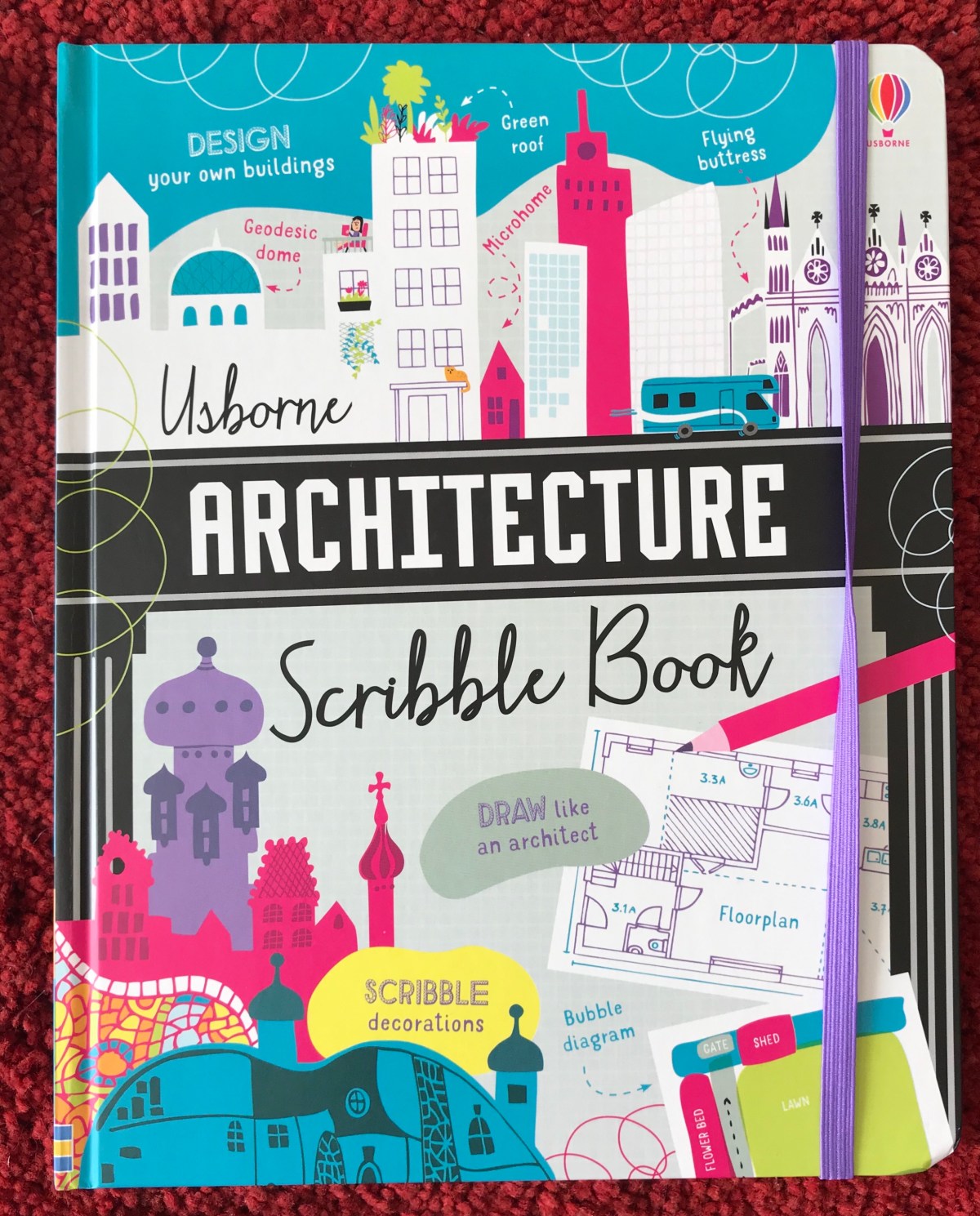
Introducing the “Architecture Scribble Book” — a brand new book from Usborne Publishers.
As with the “Engineering Scribble Book” published in 2018, I served as consultant on the content and presentation for this book project. These are outreach projects I completed during my Marie Curie fellowship at University College London.
The front cover of “Architecture Scribble Book”
The “Architecture Scribble Book” is an activity book for kids, chock full of principles we teach architecture students at university level, presented in a way that is fun and easy-to-understand.
Pages from “Architecture Scribble Book”
Much like the “Engineering Scribble Book”, this “Architecture Scribble Book” aims to give kids a taste of this STEM-oriented career. STEM stands for science, technology, engineering and mathematics. Some people like to add an A to STEM, making it STEAM, to make sure the art and architecture side of things doesn’t get overlooked. These books show that architecture and engineering are both highly creative fields!
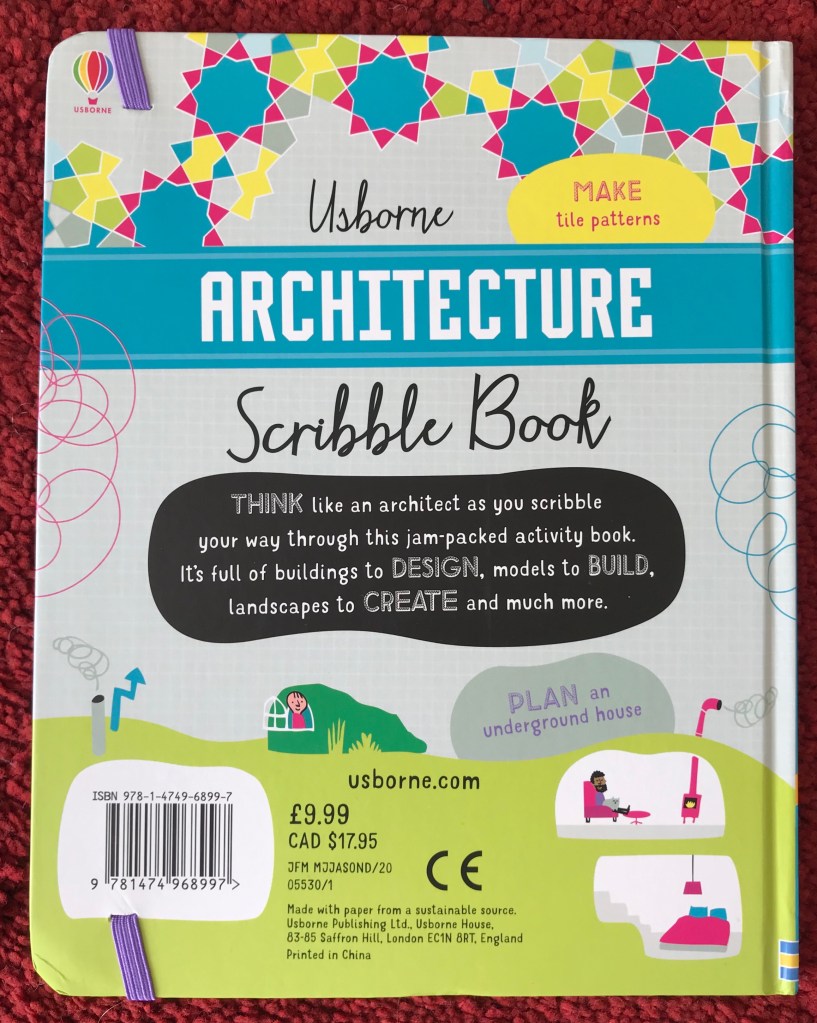
Covers of both “Scribble Architecture” and “Scribble Engineering”
With this architecture activity book, kids get to learn about design and technology as they build skills and understanding, and learn about the values architecture need to hold to do their jobs well.
The credits page of “Scribble Architecture”
Here’s a video by Usborne Publishers on the architecture book:
Lessons include spatial planning, daylighting, geometry, structural properties, material reuse, universal design, effective use of materials, and much more.
Kids also learn basic conventions of representation, such as those used in floor plans, elevations, and perspective drawings.
Pages from “Scribble Engineering”
These concepts are similar in some ways to those covered in the “Engineering Scribble Book”, but the content is unique. Together the make a very nice set.
All said, the “Architecture Scribble Book” is a lovely addition to the Usborne series, and could make a great gift for the children on your Christmas gift list.
Here’s a video by the publisher on the engineering book:
Bernadette Balentine is the host of Engineering Matters, and in podcast 59, she featured guests from Mott MacDonald, Canada’s Corporation of the Seven Wardens, Engineers Without Borders UK, the University of Leeds, the UK’s Institution of Engineering and Technology, and me, a Visiting Professor at UCL. You can find it at this link.
The podcast tells a fascinating story about a catastrophic bridge failure that happened in Canada, explaining how the overall engineering profession there responded by developing and adopting a strict code of ethics.
The overall podcast is 37 minutes, and I’m featured only briefly (around minute 28.5). In this post, I’ll provide a little more detail on the work I’ve been doing that led me to be included.
As you probably know, I was a Marie Curie Research Fellow at UCL for two years, and I still serve as a Visiting Professor there at UCL. I have a keen interest in the built environment and I’m also a registered architect in the States with LEED-AP credentials. My research specialty involves how people learn engineering and architecture.
During the Fellowship, Engineers without Borders UK came to me asking for help with research idea. As a result, my team and I conducted a small-scale qualitative study where we interviewed nine civil/structural engineers practicing in London about their perceptions of ethics and, specifically, of global responsibility—what it means and how they enact global responsibility in their day-to-day work. I reported this research while speaking with Bernadette for the podcast.
Bernadette asked what factors we had identified that prevent engineers from acting on ethical beliefs. Here’s some of what I said:
Even when early career engineers see opportunities to do something in a better, more ethical or responsible way, they often have trouble getting the idea accepted. Cost and time constraints limit their choices. Small and private projects nearly always prioritize cost and over environmental or social sustainability.
Early-career engineers can influence material selection and thus carbon footprint to some degree, but many other decision are out of their scope of work. Crucial decisions were made long before they got involved. They select materials, run calculations, and make more detailed decisions, but they are often involved in a small portion of any given building or infrastructure project. Even when they see an opportunity to do better on a private project, their client usually only accepts it is the idea if it also saves money or time.
That said, larger public projects provide more opportunity to protect the public good—and they hear about public discussions. But it’s other professionals, such as architects and planners, who often drive those discussions. On the other hand, the senior managing engineer we interviewed was quite able to affect things on a large scale; he had quite a lot of sway in decision-making and frequent opportunities to protect public Health and Safety. He took pride in doing so, and he also reached out to help mentor others to develop such skills.
Early-career engineers told us they lack reliable tools for calculating environmental and social impacts of various options. Quite surprisingly, most don’t recall having discussions in university about sustainability. While they say ethics was probably covered in their professional practice classes, none of this was covered in a way that was “sticky” enough for them to recall it. Most learned about this after university, through CPD courses, their own research, and company induction programs on Health & Safety and anti-corruption with an implied focus on anti-bribery.
Overall, the early career engineers in our study expressed:
A lack of tools for demonstrating benefits of environmental or social action
Some degree of shortfall in training/preparation
Feelings of disempowerment due to decisions being made further up the business or by clients who didn’t value sustainability
One of the most important findings of our study was that the engineers felt empowered to act on job-site Health and Safety more than other areas. Job-site Health and Safety was the one thing, they said, that consistently trumps cost. They were also clear on company rules for reporting gifts.
This led me to wonder: Might we use the levers that facilitated sweeping change across job-site H&S and anti-bribery to facilitate quick change in other areas related to ethics—specifically environmental and social aspects of sustainability and justice?
A helpful example was relayed by Malcolm Gladwell. In it, Korean Airlines went from having one of the world’s worst flight safety records to one of the best, and they did this by changing their own culture (with help of consultants) to allow individuals to raise concerns and challenge authority without personal retribution, without fear of reprimand.
I believe engineers need more of this type of empowerment and protection. The narrative Bernadette Ballantyne has woven on “Empowering Ethical Engineering” illustrates how Civil Engineering in Canada did precisely this.
It’s well worth a listen, regardless of whether or not you “engineer” things!
Meanwhile, stay tuned for more details of our study, as we prepare various findings for publication in research journals. Many thanks to my research collaborators Inês Direito, Rob Lawlor, and John Mitchell, and the Advisory Board appointed by EWB-UK to help guide our work. Financial support came from the European Commission via my Marie Curie Individual Fellowship and a grant to EWB-UK from the Royal Academy of Engineers UK.
Is that Architect-cheers or Architectures? Today I’m cheering that my updated license has arrived!
With so many moves across ocean and seas, some of my mail never reached me–including an invoice from the Department of Professional and Occupational Regulation in my home state.
Every two years I pay fees to keep my Architectural Registration current, entitling me to practice in the Commonwealth of Virginia. Every year, I also pay fees to the National Council of Architectural Registration Boards to hold a Council Record, which is a national-level endorsement that makes getting registered in additional states easier.
I don’t stamp architectural drawings, so I don’t really *need* to hold a license, but I like to stay current and support the licensing and professional development system. Plus, it’s been nice chatting with the folks at NCARB and VDPOR who assisted me along the way. I’ve always believed that being licensed with up-to-date knowledge makes me a more effective architecture and engineering teacher.
By holding a license in Virginia, I’m allowed to use RA or Registered Architect after my name. By holding a council record, I can use NCARB as well. And then there’s LEED-AP, which indicates I hold a credential in Energy and Environmental Design, also earned through rigorous testing.
In the States, the designation AIA is probably the most widely recognized architecture tag after one’s name, and although I’ve been admitted to the American Institute of Architects, I am not an active, dues-paying member so I can’t use those letters now. The fees add up too fast! It would be great to get Chartered as an Architect over here, through RIAI (Ireland) or RIBA (Britain). As you can see, this is all very complicated. The standards, codes, and construction practices vary so much from one country to the next, that each of these would require additional study, testing, fees, and ongoing country-specific professional development.
To get this little piece of paper from Virginia back in my hands, I needed to complete a series of training modules and tests to show I have current knowledge of best practices in the States. I used downtime over Christmas and the pandemic–along with NCARB monographs–to study:
Sustainable Design Part I: Green Building Standards and Certification Systems
Sustainable Design Part II: Integrated Design
Sustainable Design Part V: Trends in the Profession, Performance, and Practice
Accommodations for Seniors
The Hidden Risk of Green Buildings
Building Design and Security
Building Envelopes Part I: History and Types
Barrier-Free Design and the 2010 ADA Standards
Improving Building Performance Part I: Building Performance and Post Occupancy
Improving Building Performance Part II: Planning, Conducting, & Applying the POE
Perhaps due to COVID it took a month for the envelope I sent to Virginia with the reinstatement application, check, and proof of CPD to arrive at the office in Richmond. So slow, despite the fact I paid €8.70 (nearly $10) to send registered mail. In the meantime, I’d given up hope, called and found them all in the office and fully caught up with all incoming mail, so I paid by credit card using old-fangled fax technology. Yep, Irish mail is slow, but US use of fax and paper check indicates banking technologies could stand to be updated. The envelope arrive a couple days later, and the folks at Virginia DPOR very conscientiously mailed my paper check back to me. I got it a week ago.
Today, I discovered a new license in my postbox, complete with correct and current address. I’m delighted to have it in safely hand!
It’s been a great start-of-semester and welcome-back here in Dublin. I’ve been settling back in at TU Dublin, since the first of the year. I’ve been learning to juggle a host of new job responsibilities along with my favorite existing projects. There’s so much work to be done!
Images from Dublin (my walking path between TU Dublin buildings), my Tech Graphics class (day 2), and postings in the hallway that remind me of projects led back in the States.
In addition to teaching first-year engineering modules/courses, I have also been helping launch the new MSc in BIM, working on curriculum development (which buys out half my work time), finalizing research projects for publication, and drafting my final report for the 2018-12019 fellowship I had to UCL.
I’ve also attended a host of special events:
The launch of TU Dublin’s new strategic plan
A two-day conference on “Rethinking the Crit” in architecture and design education.
Tech support workshops for staff on Brightspace and Agresso
Personal wellbeing workshops for staff on insurance and personal finance.
A planning sessions with our ever-expanding RoboSlam team preparing for Dublin Maker 2020 (June 2020) and our upcoming Engineering Your Future week (May 2020)
TU Dublin’s new Strategic Plan
The launch of TU Dublin’s strategic plan was held at the Lighthouse Cinema, under Smithfield Plaza.
The unveiling of the strategic plan was quite well organized and inspiring. The speakers and panelists all did a great job explaining the shared aspirations of our academic community. I hope the details are as well done as the vision they presented.
Soon, I’ll read the plan and see how it matches up against the evaluation rubric I published back during my doc studies, which you can download here.
The take-home message of the strategic planning launch was that TU Dublin values diversity and inclusivity. The student voice was clear, strong and impressive. The leaders were well-spoken.
TU Dublin’s workshop on “Rethinking the Crit”
I attended a hands-on conference alongside architecture students from all over Ireland as well as teachers and critics from Ireland and abroad.
The workshop was organized by my College’s office for Learning Development, under the direction of Patrick Flynn, our Head of Learning Development. In many places, his role would be called Vice Dean for Academics, but DIT (the parent of TU Dublin) tended to do things its own unique way.
As I’m part of a team developing a brand new Architectural Engineering curriculum, this conference on how to improve the studio jury system was of great value to me. That Arch Eng course will graduate people ready for architecture licensing.
One of the presenters, Dr. Kathryn Anthony, literally wrote the book that got this conversation rolling: Design Juries on Trial. It was published in 1991 but there’s still a lot more uptake needed of her ideas across the globe. She collected data at Hampton University, where I used to teach, and at HU we used many of the techniques she proposed—with great success.
I hope to use techniques we discussed to help improve architecture education near and far.
The “Rethinking the Crit” symposium included presentations and small-group work sessions with teams of students, lecturers, and outside experts.