A new wave in conferences: Green and Inclusive via online options

This blog post shares ideas from a breakout “coffee chat” at the May 14th 2020 Big EER Meet Up, hosted by UCL with sponsors including REEN and TU Dublin. Our breakout session asked: Can we make future conferences greener and more equitable by providing online participation options?

It may be of use to people planning conferences for engineering education, engineering education research (EER), and beyond.

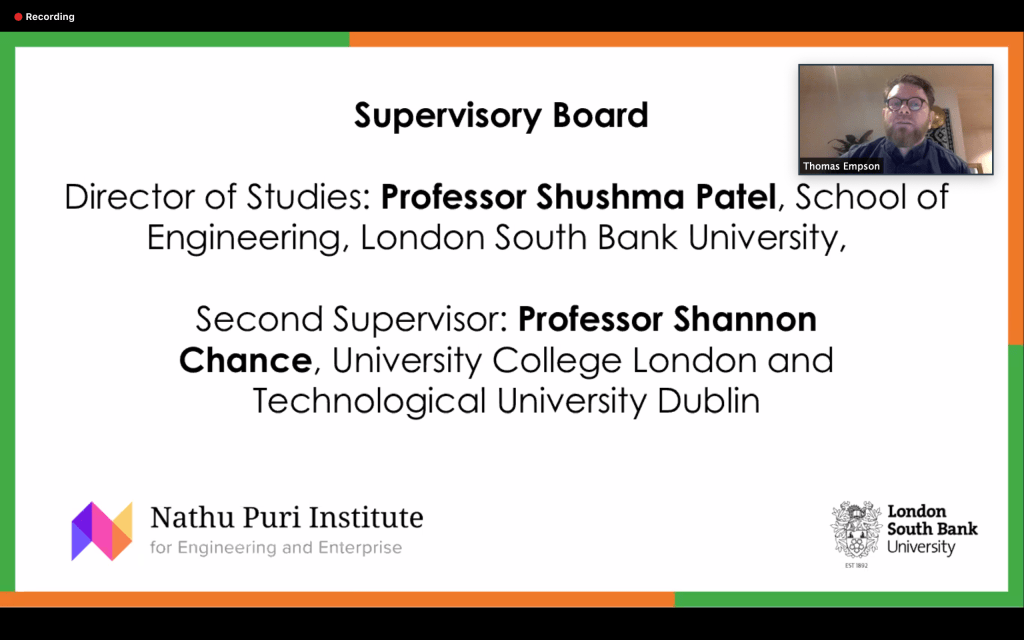
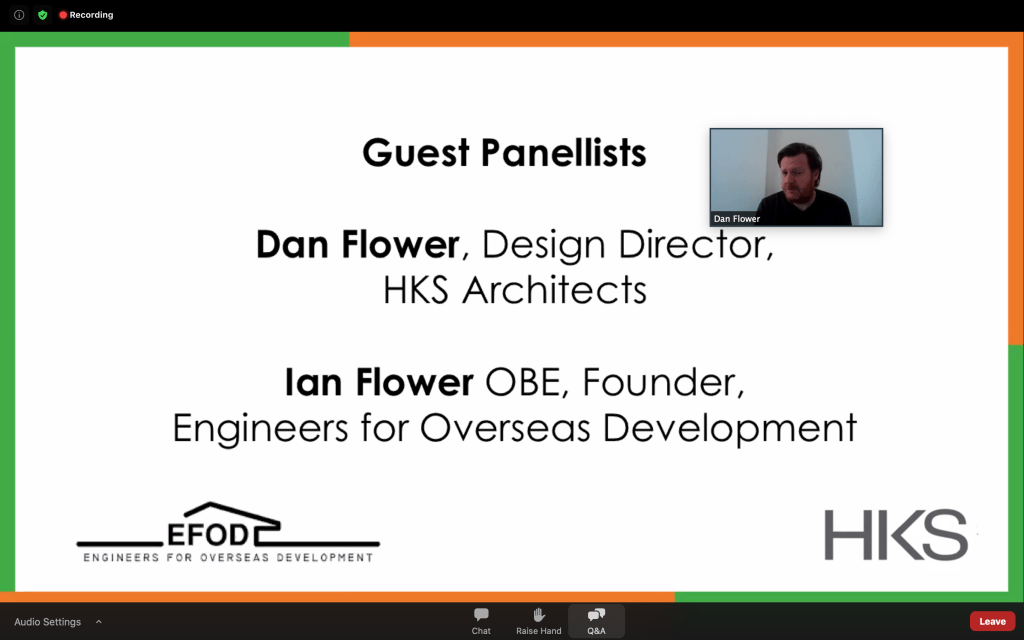
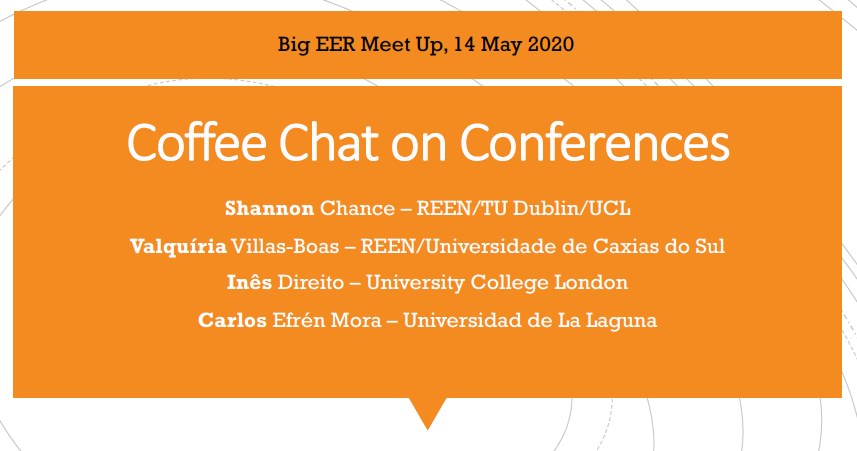
Title slide listing speakers for the coffee chat.

Shannon Chance initiated this coffee chat due to her concern for reducing the environmental impacts of conference attendance. Being part of the Marie Curie network (MCAA-UK) had made her aware of the scholarly paper on “Evaluating features of scientific conferences: A call for improvements” by Sarabipour et al (2020). This paper formed the basis of discussion. Shannon feels particularly compelled to develop viable solutions as she is the Chair of the Research in Engineering Education Network (REEN) that coordinates the bi-annual Research in Engineering Education Symposium (REES). REES 2021 is to be held in Perth, and REES 2023 is scheduled for Hubli, India. Although Shannon is passionate about bringing the global community of engineering education researchers together and helping build EER capacity, she’s concerned that so few can be involved in REES due to cost and distance. She recognizes economic inequality of access to the physical event as well as the environmental toll related to academic travel.

This coffee chat was intended to be informal. It was facilitated by:

  • Dr. Shannon Chance – Chair of REEN, from TU Dublin and UCL
  • Dr. Valquíria Villas-Boas – REEN Board Member, from the Universidade de Caxias do Sul
  • Dr. Inês Direito, from University College London
  • Dr. Carlos Efrén Mora from Universidad de La Laguna

The overall event was globally supported and attended. This graphic lists the co-sponsoring organizations:

Logos.jpg
 (Intense)

The session abstract explained:

Through informal discussion, participants will share experiences of online conference participation, its benefits and drawbacks, and explore how non-pandemic EER conferences could adapt to include rich and rewarding participation for those who can’t physically attend. We will explore recommendations recently published by Sarabipour et al (2020) who believe “Many meetings could still be improved significantly in terms of diversity, inclusivity, promoting early career researcher (ECR) networking and career development, venue accessibility, and more importantly, reducing the meetings’ carbon footprint.” This non-reviewed paper examined “over 260 national and international academic meetings in various disciplines for features of inclusivity and sustainability” and its authors “propose solutions to make conferences more modern, effective, equitable and intellectually productive for the research community and environmentally sustainable for our planet.” With such enthusiastic participation in recent online EER seminars, could EER possible lead the way?

Several resources are available for attendees. Anyone with interest can access them:

A very diverse group attended this coffee chat. We briefly describing introduced ourselves as, for instance:

  • A teacher of engineers
  • I like to work in teams
  • Was on the organizing committee for a conference transitioned to virtual last month
  • I am planning/organizing a conference in pre-college engineering
  • An architect
  • I’m current president of the Student Platform for Engineering Education Development (SPEED) where I found out how passionate I’m about Engineering Education 🙂
  • I consider myself a citizen of the world. I have lived in 4 countries and 7 different cities, and my family has 3 different nationalities.
We had about 17 attendees in all–good turn out for such a serious topic.

We started by asking participants to take a minute to type into the chat about an enjoyable experience you’ve had in EER virtual learning recently, or provide a short reflection about being a “virtual” or a “face-to-face” person.

  • Virtual conferences are great for being able to attend with less time & money commitment. However, we need better ways to meet people at virtual conferences.
  • I love teaching on a chalkboard! I miss being in the classroom with my students. I am enjoying the interactions that I have with students during virtual lectures, but it feels like the balance of control is much more strongly with me, and I have to remember to give students space to contribute the disruptions that are more natural in the classroom.
  • I loved this [online Big EER] conference!
  • Easy access to EER community across the world. I have loved attending session that are open ended questions about how we navigate online teaching and learning, and everyone can share what they have been doing.
  • I find that being a virtual participant is more environmentally friendly by avoiding air travel. it would also be easier to attend more events than I would in person.
  • Current time is forcing us to adapt quite rapidly to the virtual context, it is important to make the most out of this experience.
  • I prefer being a face to face person; I am more of a “face-to-face” person because I like to see people’s reactions and smiles.
  • I’ve enjoyed getting together with architects and engineers for informal chat.
  • I participated od EDUCON 2020 and I had a great experience participating in workshops.
  • I’ve had more productive and enjoyable small group meetings with my pastoral supervises since lockdown – better than when they are physically squashed together in my quite small office.
  • I enjoyed getting to know a larger group of people (and new topics) in EER that otherwise it would not be possible.
  • I enjoyed being able to meet persons from very different backgrounds and cultures.
  • Many of the most positive and engaging online experiences I have had, have been since lockdown.
  • It’s been nice to travel the world from the comfort of my house while enjoying engineering education research.
  • I’ve been very impressed with how smoothly it has run, and how easy to participate.
  • During this Corona crisis period I have had the opportunity to attend conferences, webinars that I would not have been able to attend in person in a normal period.
  • Last Dec the SEFi working group on ethics organized a two day workshop that integrated online participants in all sessions: online presentations from the team of Virginia Tech (Diana Bairaktarova & Tom Sealy), Q&As taking questions from online participants, mixed breakout tables with both in person and online participants. The workshop had 60% in person participants 40% online participants.
  • Easy access to EER community across the world. I have loved attending session that are open ended questions about how we navigate online teaching and learning and everyone can share what they have been doing.
  • This experience today has been great – lovely to feel connected to people and conversations that I would normally be far away from.
  • Also have been thankful for the opportunity to attend conferences/meetings that I wouldn’t otherwise be able to due to my reluctance to be away from home.
  • Yes, you can “attend” many more conferences in the same time and less expense.
  • Also much more awake for conference sessions (sometimes getting a decent night’s sleep can be difficult in hotel rooms).
  • I think though that it is harder to build the connection with people who you don’t already “know”.
  • There was a webinar by the folks who ran LAK 20 online on two weeks’ notice. The policy was to have speakers present at a time appropriate to their timezone and upload immediately afterwards so that people in other timezones could see the talk.
  • And somehow interacting with my normal face-to-face colleagues via online seems almost natural – the connectivity is there.

Then, Shannon presented ideas from Sarabipour et al (2020), who say:

Science is a global endeavour and we as scientists have the responsibility to make conferences more affordable, environmentally sustainable, and accessible to researchers constrained by geographical location, economics, personal circumstances or visa restrictions.

Sarabipour et al (2020)

There’s a need to modernize and to improve: 

  • Diversity
  • Inclusivity
  • Career development and networking, especially for early career researchers (ECRs) 
  • Venue accessibility
  • Environmental impact, carbon footprint (Sarabipour et al, 2020)

Many can’t travel, for example:

  • Early-career researchers
  • Researchers from young labs and low- to middle-income countries 
  • Junior principal investigators (Sarabipour et al, 2020)


There is inequitable access regarding:

  • Gender
  • Ethnicity
  • Socioeconomic status
  • Health and mobility
  • Geographical backgrounds
  • Career stage (Sarabipour et al, 2020)

Geographical inequity:

  • Visa inequity
Maps in the paper by Sarabipour et al (2020) provide a visual comparison of Germany, Iran, Argentina, and South Africa–green you can go without a visa, grey you must purchase a visa.
  • Travel requires resources: time, physical exertion, and family management, as well as funding.
  • “The less wealthy subsidize the expenses of the speakers, who usually attend scientific meetings free of charge.”
  • Registration fees can be steep and “Large conferences are often hosted in expensive cities as there are many accommodation options for large crowds, while conferences in more affordable locations are typically smaller in size.” Food often costs more there, too!
  • “Women and researchers from racial and ethnic groups, who are under-represented in various fields, are the least likely to be offered opportunities to speak at meetings in their discipline”.
  • “The experience of presenting at meetings for early career researchers (ECRs) and minorities who attend has not improved appreciably”.
  • Digital conferences and discussion forums can, in fact, serve to assist communication between early career and senior researchers since writing a comment or question in a forum can feel less intimidating than approaching an established scholar in person.” (Sarabipour et al, 2020)

Environmental Toll: CO2 emissions

  • “Global aviation as a country ranks among the top 10 emitters”
  • “Conference attendance represents 35% of a researcher’s footprint
This was one of four maps provided in Sarabipour et al (2020). For one person, “Flying from Perth, Australia to London, United Kingdom and back for the annual Immuno-Oncology summit 2020 generated about 3,153 kg (3.47 tons) of CO2. There are 109 countries where the average person produces less CO2 in a year”. It’s equal to a full year’s emissions of all the brown areas on this map. This is the same path that Inês and I plan to take to Perth if we are lucky enough to attend REES 2021.

Participants commented:

  • This financial impact will be exacerbated in the current economic climate.
  • That’s a great point @Shannon. We’re teaching Sustainable Development Goals, but attending conferences can have a huge negative impact.

A participant from the US queried:

  • The “environmental impact” from a single conference is miniscule.
  • Of course, this assumes that you believe that CO2 emissions are harmful …
  • We need a better way to “meet” people in online venues.

The last point gained support from other participants:

  • Agree – it’s difficult to do accidental networking/meeting in online conferences – tend to stick to talking to people you already know/recognise.
  • I agree.
  • Absolutely. Many interesting conversations/networking happens in less structured settings – coffee breaks, etc. How can we ‘create’ these opportunities online?

Shannon shared some Recommendations from Sarabipour et al (2020) that could apply in EER:

  • Replace in-person national and international meetings with more ground-based travel to regional meetings
  • Hold small and large meetings fully online or connect regional conference hubs digitally by live-streaming the conference [possibility for REES 2021+EERN-UK/IE]
  • Make research results more accessible globally via virtual access [eg, REEN database] and pre-printing
  • Foster digital networking by investing in relevant, immersive and interactive experiences [do more of these]
  • At physical conferences:
    • Stop generating junk (paper, souvenirs, badges)
    • Organize well-planned networking activities
    • Include public outreach & environmental clean-up (Sarabipour et al, 2020)
Graphic from Sarabipour et al (2020) of key considerations to take into account in planning any conference.

Next we discussed a question posed by Val: Why and how would making EER conferences greener impact you as an EER researcher?

  • Possibility to attend conferences via online would be very helpful for me as a researcher from SA without lots of funds – I would love to attend REEN 2021 but I don’t see how I’ll afford it.
  • Better access to far away and more conferences.
  • It would allow me to attend more conferences, since I wouldn’t normally fly to more than one conference per year for environmental considerations (would prefer not to fly at all).
  • Overall it would make easier to attend conferences if they are virtual. But also, it is easier to make connections in person.
  • Positive impact: more opportunities to attend events and meet people that I wouldn’t otherwise; ‘feel good’ reducing carbon footprint. Negative impact: human interactions are more challenging online.
  • With online conferences might see more female researchers participating, especially mothers with young kids who might find it difficult going away for a longer period of time.
  • I have never been to a REEN conference due to child care considerations, but I would definitely engage online.
  • Online conferences are less disruptive to teaching schedules – you can conduct your teaching and dip in and out of sessions.
  • Sometimes it’s difficult to physically travel to a conference fitting it in around teaching commitments.
  • Is it easier now to justify virtual conferences and meetings? Now we need to do it due to the Covid.
  • But if we want to build networks we have to do that intentionally.
  • I would like for online events to have ‘online dinners’ ‘online coffee breakout rooms’ where people could chat by video in an informal manner or to continue the discussion following a talk.
  • I suspect online conferences would encourage me to take a “chance” on hearing talks from people/projects that I was not aware of before.
  • I think that having online events makes it possible to design smaller, more frequent gatherings rather than trying to do mega-events.
  • When I was in Australia for a year, they told me how much time it took to get anywhere!
  • Some thoughts here on ‘virtual socialising’ at a virtual conference here http://www.parncutt.org/virtualsocializing.html
  • I am certainly more interested in attending a one day event online than I would be to attend a weeklong online event.
  • Totally agree with [above comment]! ASEE, for example, can be overwhelming. The sessions you want to attend have limited places. The colleagues you want to reach/get in touch with are difficult to find in the crowd!
  • I think virtual conferences actually make the physical conference more productive – you can read someone’s research, interact with them online, and if there is traction, you can meet in a physical conference and this will be more productive as you already know each other.
  • Totally agree – mix of virtual & physical is ideal.
  • Yes!
  • I had a glass of wine before talking to Eric Mazur 🙂

Next we discussed the question: How could online participation options work in EER?

  • Can do online collaborative workshops with colleagues at different institutions easily. Definitely easier to attend than in real life but would be my personal preferences to have a hybrid somehow – but unsure if I am at a conference if I would be interested in doing the online version of that….
  • Maybe maintain a certain topic coffee break every x weeks. This way we can meet people with the same topic interests. (Like group writing meetings.)
  • You have to be much more strategic in designing interactions – you just can’t have as many talks in a day, or such quick turnaround between talks, as you would in a physical conference. Large amounts of parallel sessions would be disastrous, I think. Today was a good model – multiple time zones, and everyone speaking was a keynote.
  • The same way works face to face.
  • Combination of keynote sessions, workshops, and less structured formal sessions. Other idea would be to provide the option to join ‘interest’ groups.
  • Would be nice if live streaming/recording of sessions would become common practice. Enabling online participation for in-person conferences. For conferences which are solely online based, including online informal sessions.
  • I went to REES in Bogota, 2017. It was a great experience. The sessions were very interactive. Very different from those conferences where you have 10 minutes to present your paper, nobody asks you a question and that is the end. I think that the way the sessions were run could be done virtually too.
  • Another random idea I would like to share: There are conference apps (Whova at https://whova.com/virtual-conference-platform/, Conference4Me) that have networking features (you can meet other attendees with similar interests). This could easily be extended to online conferences. Also, these apps could be extended to accommodate attending multiple conferences at one time, so you could make up a personal schedule of events from both conferences.
  • Haven’t been to REES either – distance was the reason.
  • I think we need to add ‘bring your own drink session’ to these online events!
    • 🙂
    • BoD
    • Well… this event was, after all, called BEER 😉
    • I agree with you Ines. Also if there were options for people to set up their own private meet-ups within the conference software – just as we would do when we form small groups during tea breaks.
  • Actually the REES format forces you to engage. Perhaps this could be a feature that can be built into an online session.
  • It’s also good to share recordings later – many colleagues couldn’t join due to timezones.
  • If you have a gap between the session and discussion, you might lose people.
  • Based on the number of online attendants today, there is a real need for this type of events.

Shannon posed ideas of holding smaller, regional conferences in alignment to share resources and conversation virtually, for instance:

  • The winter meeting of EERN-UK & Ireland could be aligned with REES 2021 scheduled for December 5-8 in Perth.
  • REES 2021 could broadcast some presentations and virtual attendees (such as those gathered on another site, or in their own homes) could submit questions using, perhaps, Padlet as implemented successfully at REES 2019 in Cape Town.
    • Another alternative to Padlet is Jamboard.
    • Agreed!! I was thinking of Padlet yesterday!
    • @shannon, I agree totally
    • Shannon, its a good idea, I am thinking of two or more research groups in different places meeting, individually, and then sharing their discussions with others.

Shannon noted that we need to implement sliding scales for registration fee, or somehow recognize that people from lower-income countries can’t access many of our events physically. Comments on that included:

  • The conferences that still have big fees are those run by societies that are trying to support their ongoing expenses.  I have seen major conferences where the fee is as low as $30.
  • I’m attending an audio conference coming up virtually but the fee is still $175. Not sure why.
  • Educon2020 had different fees for people from low income countries.
  • ASEE, for example, makes a lot of money at the annual conference to support their headquarters and staff.  Despite the $500 registration fee, they are still taking a hit to their sustaining fund.

By audio, we noted that conferences that had to quickly shift online had made payments out, that would be lost.

  • That point about sunk costs is a good one. The conferences that have paid a lot of up-front fees are mostly this spring and summer. Moving into (northern) autumn, we should see some of the fees come down.
  • Speaking of broadening participation, a virtual conference is a great way to get your students into the academic community at an earlier stage in their education.

One participant said she was new to EER and, in attending this Big EER Meet Up, found this academic community very welcoming. She said she felt much more welcome that in her home/technical discipline. She asked what our experiences were.

  • Shannon described her transition from architecture (teaching in the States) to engineering education in Europe after she attended SEFI 2012 and experienced a very warm welcome.
  • @shannon, I agree with you. I am a physicist and EER community is much, much more receptive than the Physics community.
  • Agreed, also more receptive than Aerospace. Feels like a real community. Inclusive 🙂

The session lasted 1.25 hours, and it drew to a close, participants added:  

  • Great discussions everyone – sorry I can’t stay much longer (it’s supper time in this household) – looking forward to ongoing discussion about moving online!
  • I need to leave now, this was a good conversation. Thank you to everyone for organising and participating.
  • I will also ditch… fake SA winters are hard work! Thanks Shannon, Inês and Carlos 🙂
  • What a great day, and final session. Take care everyone.
    • Bye Diana! Great work!
    • Bye Diana. It was great to see you. And what a fantastic presentation!
    • Thank you ladies! hope we can meet soon. SEFI was also moved online this year.
    • I know. Very sad about that.
  • Diana asked: Why is it so difficult to close this meeting? I enjoyed it too much! If you organize any events or online talks including ethics, drop me an email please so I can include them in the SEFI newsletter!

Vibrant networks producing INGENious results!

Most days, I find myself communicating with colleagues from afar on various projects, proposals, and ideas. On a typical day, I hear from Dr. Inês Direito in London (UK), Dr. Lelanie Smith in Pretoria (South Africa) and Dr. Carlos Efrén Mora Luis in Tenerife (Spain). We have many overlapping interests–one being how to understand student motivations and emotions and how to use this understanding to help students tackle and persist through challenges. I often hear from our co-author Dr. Bill Williams, from outside Lisbon (Portugal) as well.

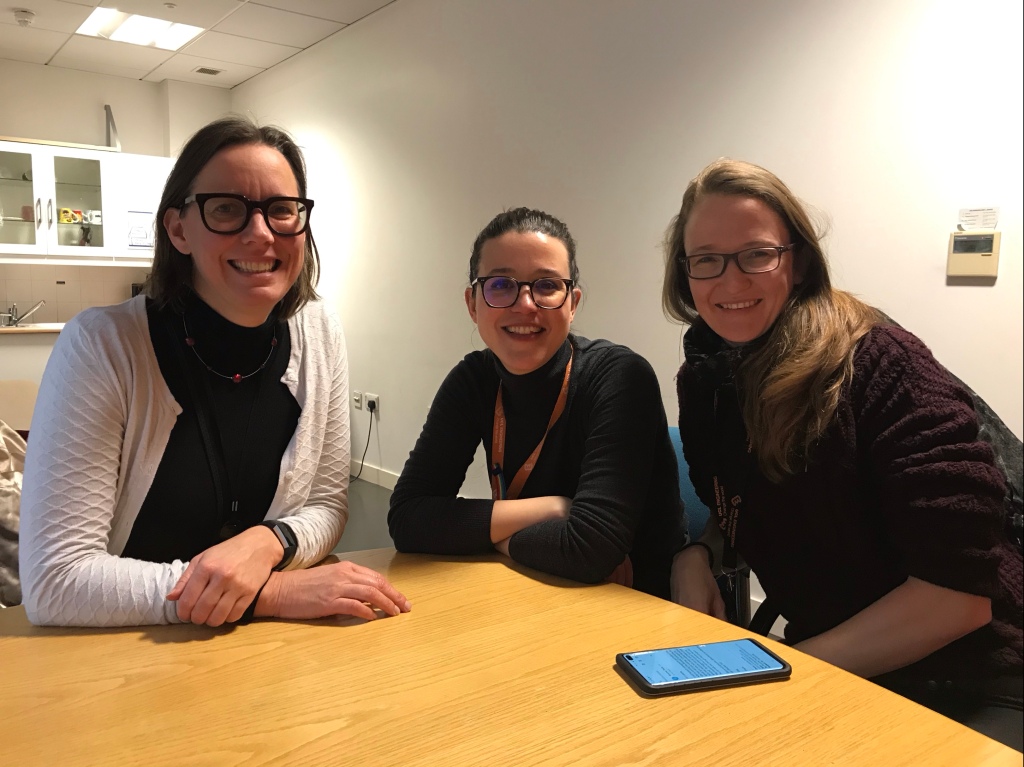
A past meeting of minds among Inês (center), Lelanie (right), and me. These days we can only meet online.

In addition to engineering motivations, we are also all interested in sustainability — environmental, economic and social. So over the past few weeks, WhatsApp and Signal chats have been rich and frequent.

Today alone, Lelanie, Inês, and I discussed research plans. Inês, Bill, and I submitted a conference paper on Brexit (with Inês in the lead and comments from Bill and me). Inês and I refined a journal manuscript on engineering ethics (with me in the lead and verbal input from Inês — she will edit my current version in the morning).

Down in the Spanish Canaries, Carlos has been fighting sand storms, as dust from the Sahara Dessert enveloped the islands. The weekend’s sandstorms were one of a number of challenges he’s faced recently, but he’s never one to give up.

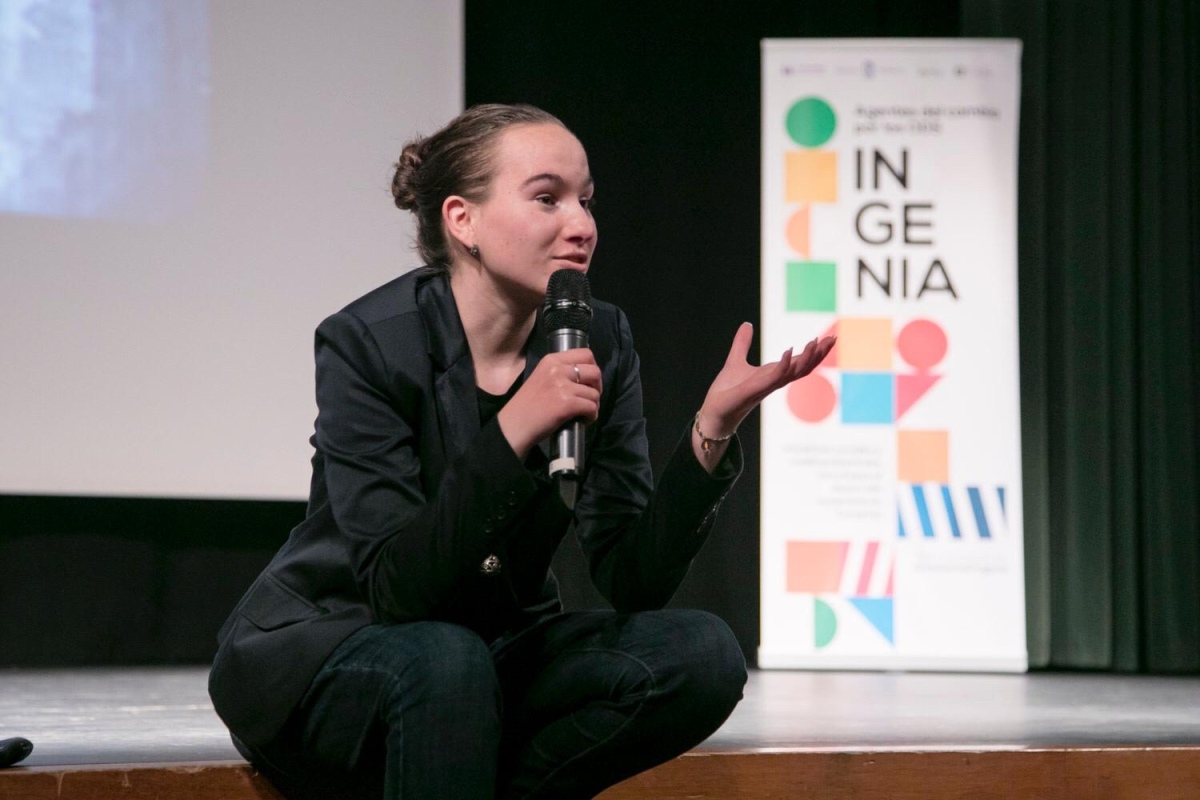
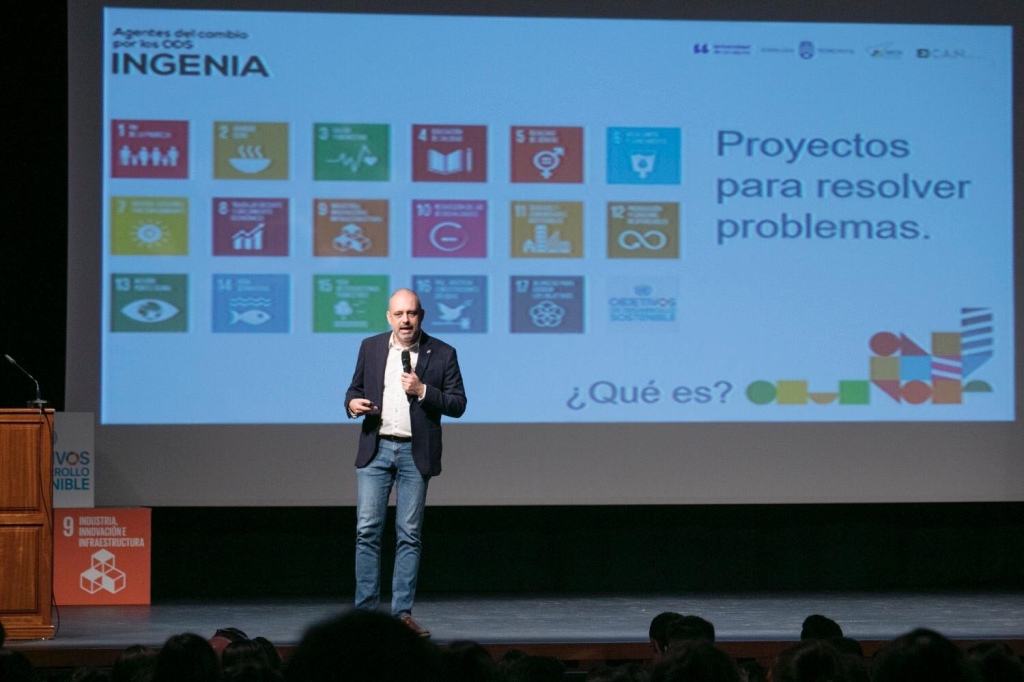
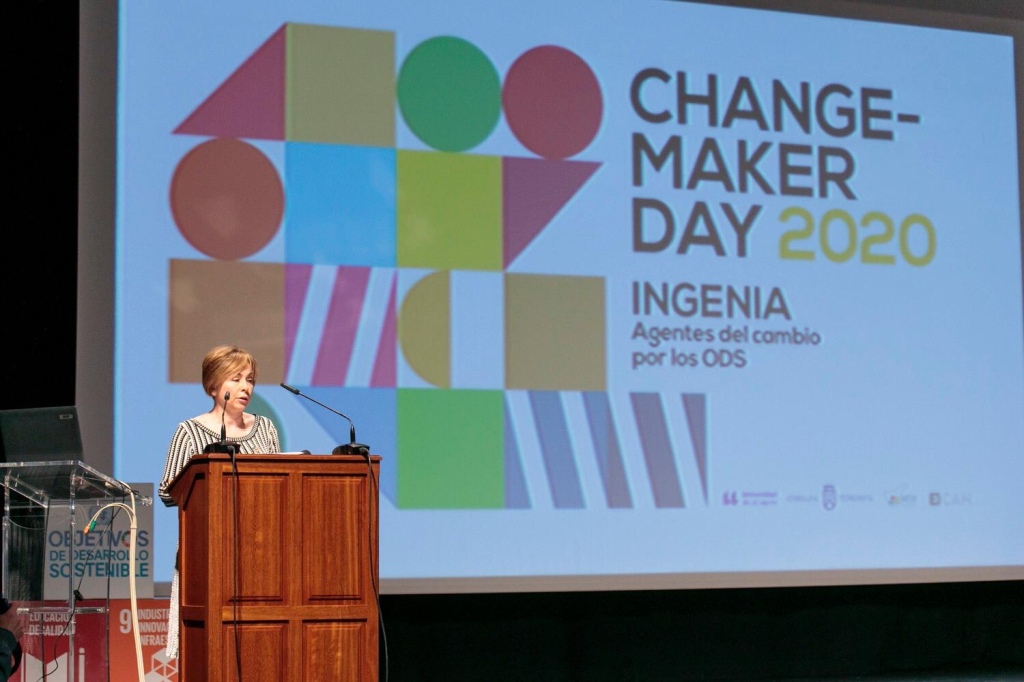
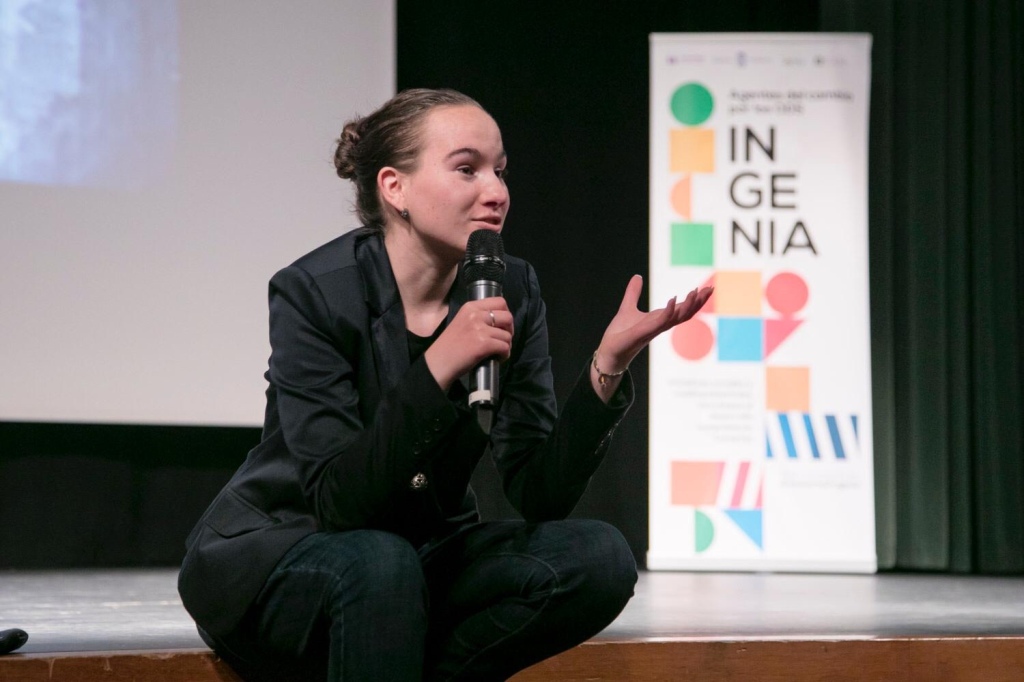
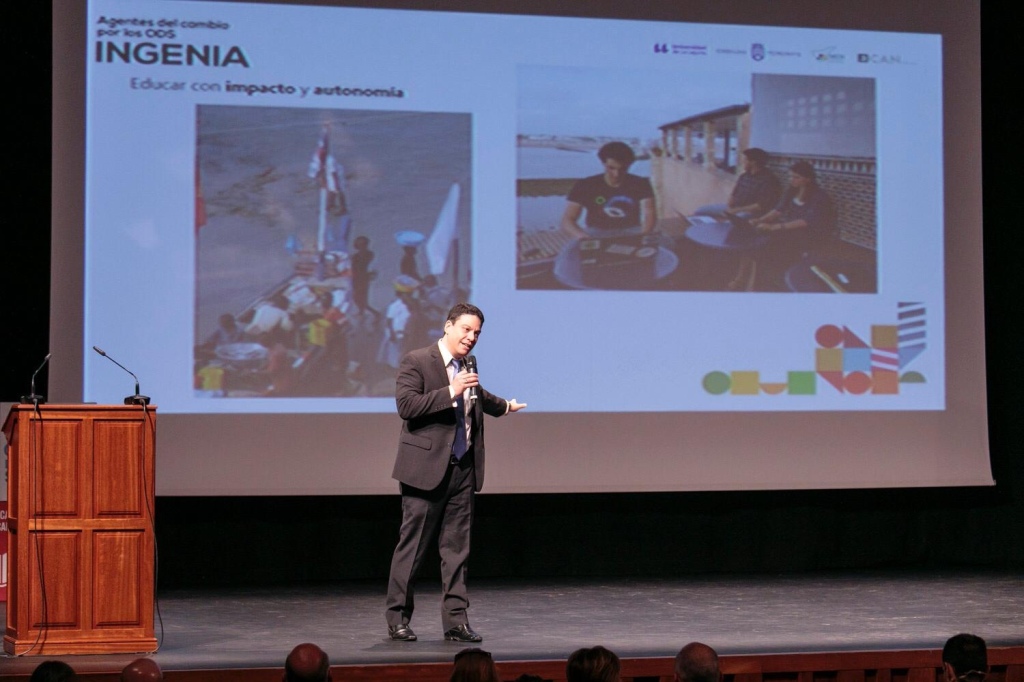
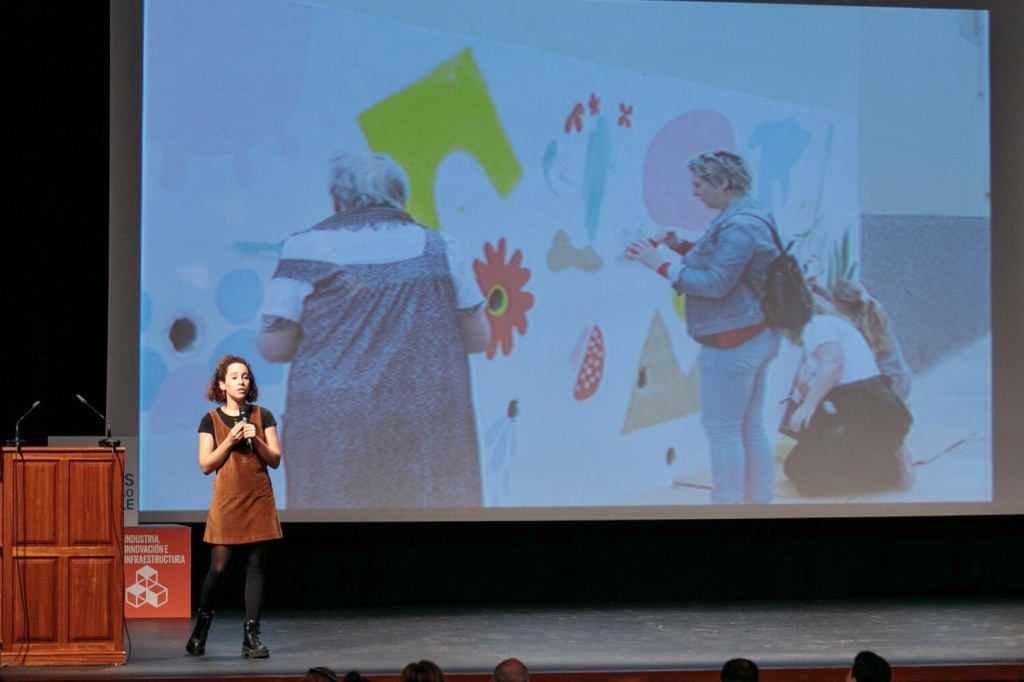
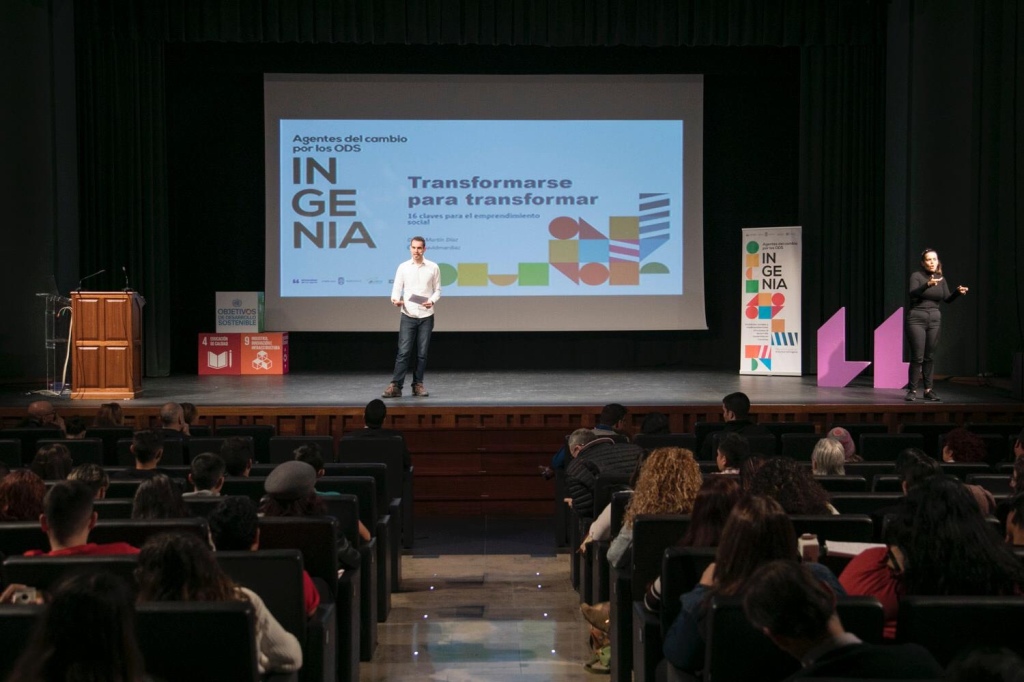
Carlos (Dr. Carlos Mora) speaking at the launch of the INGENIA project. Hundreds of students attended the event, which featured speakers from around the world.

Carlos and I didn’t win the grant we applied for this past September, despite having put months into the proposal. We’ve picked ourselves up, brushed off the disappointment, and developed a plan to perfect and resubmit. I know all too well that resubmitting makes a world of difference! It’s the best way to win funding. Yesterday, I was rallying our troops, gathering support for a new round of work. I am confident that eventually we will succeed.

But we haven’t been sitting around waiting for success to come.

In December, Carlos submitted an additional grant proposal, this one to the Cabildo of Tenerife, Spain, for €56,000. He received funding for the project titled “INGENIA.” Carlos explained to me that the word “Ingenia” comes from “Ingenio,” which is “Ingenuity” in English. So the project is fostering “Ingenuity” to support sustainability education.

I’m honored that (as a result of me coaching him on how to write grant proposals) he included me as a co-PI.

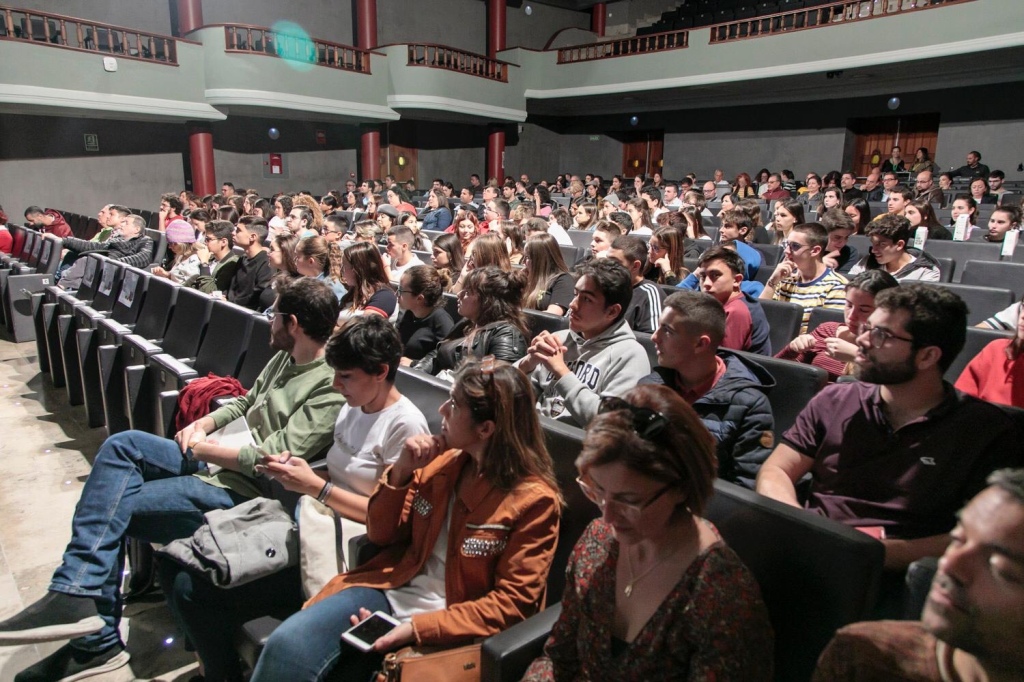
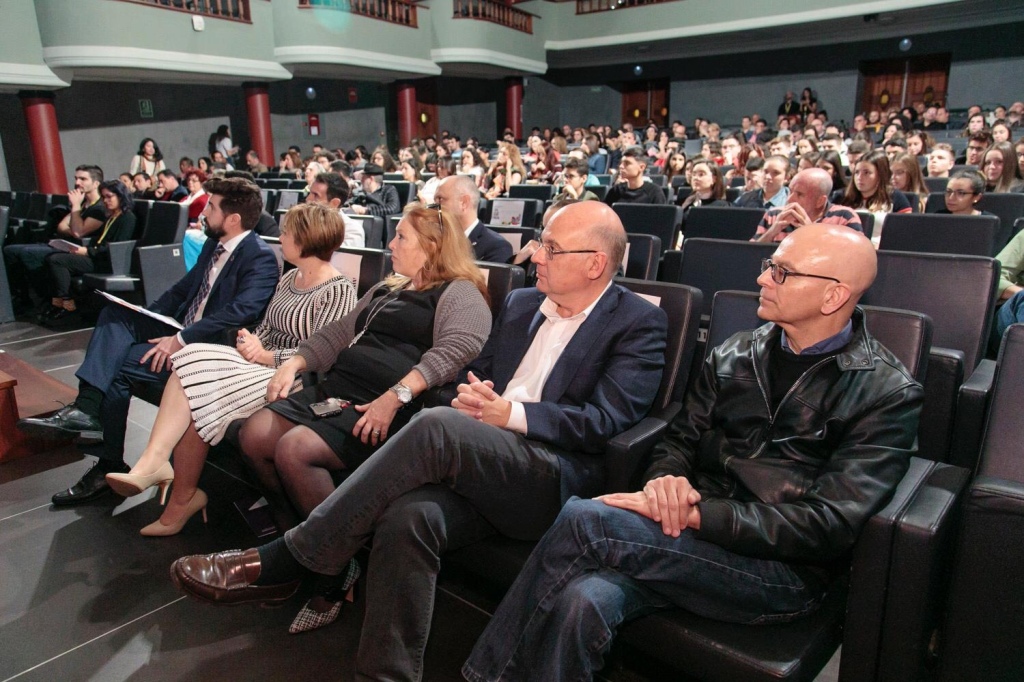
On the 31st of January, Carlos and his colleagues in Tenerife launched his extremely well-designed INGENIA project. It was a true thrill when over 300 people attended his launch that Friday!

Carlos has summarized in English that “INGENIA wants to show that students can find sustainable solutions to real life problems linked to SDGs in Tenerife.” Students will build their own research teams and find a supervisor who will help manage the financial resources for their project.” In other words, the students “will have to find relevant problems and then propose solutions. The final part of the process is selling their solutions to companies and administrative public offices.”

Students will engineer their solutions and compete for funding to realize their projects. Below, I’ve included information that Carlos wrote to described the project, which is being conducted in Spanish. I can understand a bit by reading the Spanish materials he produced, but he was kind enough to translate for me/us!

INGENIA project

The Spanish public universities agreed recently contributing to the 2030 Agenda by building and transferring knowledge and skills to society about the Sustainable Development Goals (SDGs). Universities can contribute with teaching, learning, and student-participation methods to transfer not just the skills, but the motivation needed to face the SDGs. Like other Spanish higher education institutions, University of La Laguna (ULL) endorsed the United Nations (UN) SDGs initiative, and has a detailed understanding of the importance of its local problems linked to the environmental, social, and economical sustainability of the Canary Islands.

INGENIA is a project coordinated by ULL that is focused on the needs of the local society in the Canaries that supports building knowledge and skills on the participating students. INGENIA uses Project-oriented Problem Based Learning (PoPBL) learning strategies to motivate the students to find and propose solutions to real problems linked to the SDGs around their own environment.

Objectives

  • Train university and high school academic staff in using active learning strategies to impulse SDGs.
  • Educate postgraduate students, and academic staff, in facilitating techniques and strategies to guiding students in complex projects linked to SDGs.
  • Develop real student projects with a high potential for positive impact in the Canarian society.

Implementation

INGENIA will be implemented in three stages:

  • Informative and training actions. Informative actions will include a conference to be held at ULL in its theatre showing how students can change the world. Training actions will include workshops with specialists in Engineering Education focused on PBL and the evaluation of the impact of student projects.
    Goal: Get teachers motivated to help students in writing their proposals. Each of these teachers will also serve as guarantors for a team of students, and guarantors will assume the financial responsibility of the projects they back.  
  • Training of facilitators. A group of postgraduate students will receive specific training for PBL, Motivation, Conflict Management, and Project Management. Facilitators will collaborate with guarantors in guiding the student teams.
    Goal: Having at least one facilitator for each wining proposal.
  • Project development: INGENIA will include a call for proposals. Student teams must justify the relevance of the problem and the feasibility of their solutions. Winning teams will receive funding for their projects, and must execute their projects within two months. At the end of this period, each team will write a report to identify the impact of their solutions. Students will participate in a public exhibition in October 2020, and will also have the opportunity to show their solutions to companies and public institutions with the aim of getting additional funding to continue their projects.

The launch was a huge success and reached the press. Noticias Cananias and Eldiario both ran stories.

https://www.noticanarias.com/tenerife-la-universidad-de-la-laguna-inaugura-el-proyecto-ingenia-con-250-asistentes/

https://www.eldiario.es/canariasahora/nekuni/campus/ULL-promueve-emprendimiento-desarrollo-sostenible_0_990751736.html

Carlos explained that the 31st was a day full of feeling. One of the speakers told such a moving story that the audience shed tears of emotion. Specifically, two students described their experiences; the second of these is working with ‘invisible’ people, meaning people who appear in social statistics, but have no work, no home, and thus no address. Carlos said she did an excellent job transmitting her feelings. She said, for instance, “that one day, she cooked rice for homeless people, but she was so busy that she forgot to turn off the cooking plate.” The rice was damaged, but she salvaged and packed up as much rice us she could, and went to give it to people in the street in Tenerife. She gave a portion to one man, and stayed looking at him. As the man was eating that rice, he stopped, looked at her eyes, and said what a lovely smile she had.

When she finished her narrative at the launch, one retired professor raised his hand to say something, but when he tried to start broken into tears. He cited numbers — the number of people invisible to all of us — and then he said that he had lived this experience along with her, and that she had touched his heart. The student walked down from the stage and gave the professor a big embrace. All the assistants, students, and teachers in the audience started to applaud.

It is this sort of change Carlos hopes to inspire among more students, and this is the sort of communication I received from Carlos daily.

After the student’s talk, many people were in tears, including Carlos. But he couldn’t stop to weep: he was next up on the stage.

Carlos needed to explain details of the program and how it will run. He had to explain the schedule and what will be expected of the various people working together in teams — including the student team members as well as the post-graduate and faculty member (e.g., professors) advising each team.

Carlos said the event was so motivating, inspiring them all to go out and find problems to solve. He received oodles of questions from students and academics wanting to participate. He said “Yes, I still can’t believe it, but something positive happened today!”

I have included images that are copyright of the photographer, Emeterio Suárez Guerra, and used with permission of Carlos.

A Public Service Announcement to reduce colds this winter

In the interest of public health, I’m posting a blog to ask, beg, and plead that when you’re sick you STAY AT HOME.

There’s more than one way to tell a story. With a dozen possibilities, I’ve decided to present two. How would you tell this one? What do you make of it all? What would you do?

Empathetic to the carrier

Imagine you’d come to work on a Friday, feeling a bit, ill but coughing and sneezing so violently by the time you arrived at your desk that you couldn’t even settle in right away. You had to leave the office to compose yourself and find some tissues. You trudged through work all day because you were up against deadlines. “Maybe I should have stayed home,” you think, “but I’ve too much to do.” Unfortunately, your desk is adjacent to 23 others in a large open plan, and two colleagues are seated directly in front of you working diligently away. Their jobs don’t permit quite as much work-from-home as yours. They say nothing. On the other hand, another colleague who sits behind you gets up and moves. She’s now sitting in her team leader’s glass-enclosed office right beside your own desk. You see she’s bundled up in a winter coat and gloves—maybe the heat isn’t working in there. “Wonder why she moved in there when it’s cold?” By the end of the day, you decide to make a similar move, as there’s no one in the office’s large, shared conference room. You work in this big room for a couple hours and then you head out, happy to welcome the weekend. By Monday, you’re feeling quite a bit better, and completely fine to head to work.

Empathetic to the victims

I recently witnessed an appalling situation where a colleague came to work in a large open-plan office. Fortunately, only five other people were working in the open-plan portion of the office that day. Also, fortunately, at this university and in this faculty office, we are all very welcome to work from home.

693fe992-78ad-4ab9-a508-2d2cbeec7624-1By the late afternoon, the sick one had moved into a conference room to work, but it was too late.

Unfortunately, within days, the two who face that colleague were very sick.

Why were my colleagues willing to submit themselves to these germs? It appears they didn’t want to seem impolite. (Very British, I think, and not the best choice in this case, in my opinion.)

Now it’s over two weeks later, and one of them is still out of work. The other is clearly struggling to recover and to make it through each day.

Early that day, I had closed myself off in a glass-enclosed room, where I worked with coat and gloves to avoid the flying germs. By some miracle, I escaped unharmed.

I’m not as reservedly polite as my colleagues, but, in this instance, I also did not go against cultural norms here to say, “WHAT THE HECK ARE YOU THINKING?!?” Back in the USA, I surely would. And, as an architect, I’m comfortable openly critiquing the situation. I don’t want to go hunting around or making passive-aggressive gestures.

So, while I can’t change the past, just maybe I can help make other people’s future healthier.

To help others, I’m saying it loud and clear here:

Please, please don’t let this happen to others. Don’t expose colleagues and students to your infections and germs.

This is true everywhere, but is incredibly important in very densely populated areas, like London.

The Many Senses that Matter in Transportation Design

list of senses by nick tyler

Attending the 2019 opening session of “Design of Accessible Transport Systems” reminded me of the need for designers of all sorts to consider a wider array of senses than the five that normally come to mind. This postgraduate course/module is taught by my primary research supervisor, Professor Nick Tyler.

According to Nick, human senses can be psychological, as we normally picture, but they can also be environmental and interpretational.

Psychological

Psychological senses include the main five that we all recognize: sight, hearing, touch, taste, and smell. But the list doesn’t end there. Far from it!

Other psychological aspects involve balance, proprioception (defined on Wikipedia as “the sense of the relative position of one’s own parts of the body and strength of effort being employed in movement), pain, vestibular awareness (having to do with vertigo), embodiment (essentially, seeing a person or thing as a clearly defined whole with clear boundaries), and temperature.

Environmental

Nick identified the following environment-related senses: rhythm, harmony, color, space, direction, pitch, time, and comfort. As an architect, I’m quite familiar with considering all these in the process of design.

Interpretational

Interpretational senses are even more subtle. They include the senses of self, ownership, justice, history, culture, politics, care, emotion, fear, wellbeing, safety, emotion, pride, responsibility, and symbolism. And, all clearly important to understand when designing anything for people.

During the class, meeting, Nick’s students practiced using tools to simulate various impairments, or as Nick calls them, different capacities.

Introducing PEARL

I had attended the class meeting to get another view of Nick’s research center at Tufnell Park, which is named PAMELA. This center will soon have a sister, named PEARL, as described by Nick in an email he distributed to his faculty last November:

November 19, 2018

Dear All,

Last Friday UCL Council approved the investment of £37.8M [37.8 million GBP]  in our PEARL facility (Person-Environment-Activity Research Laboratory), which will be a successor to PAMELA. This investment supplements a £9M [9 million GBP] contribution from BEIS, so the department will have the benefit of a new £47m [47 million GBP] research facility to add to its facilities in Gower Street and Here East. PEARL is the UCL component of the UKCRIC multi-university laboratory complex for research on Infrastructure and Cities.

PEARL will be a 9,500 m2 [square meter] facility, of which 4,000 m2 will be a laboratory space for building 1:1 scale environments and testing them with people — this means that we could have a 100m-long street, or a small town square, or a railway station with 4-carriage trains, station concourses etc. instrumented so that we can study in detail how people interact with such environments. The facility is available for use for transdisciplinary research and teaching where these require the use of big, instrumented, highly configurable space, and it will have a large and significant engagement with the local community.

PEARL will be located in Dagenham.

Huge thanks are due to Nigel Titchener-Hooker, who led the negotiations through UCL to secure this investment.

It is a massive vote of confidence in the department!

Yours,

Nick

Nick Tyler CBE FREng FICE FCIHT FRSA
Chadwick Professor of Civil Engineering
Director, UCL Centre for Transport Studies
UCL, Gower Street, London WC1E 6BT, UK
+44 20 7679 1562
@nicktyler4 @ucl-squared

Nick’s research is really making a difference–globally as well as right here in London– and I’m honored to have a first-hand view on some aspects of his work.

The two photos at the end of the gallery below explain more about PAMELA, and how to get involved as a participant in Nick’s research studies for people who live in or near London.

Supervising Thomas Empson’s Ph.D. Research

thomas-empsonI just had my bi-monthly supervisory meeting with my Ph.D. student from London South Bank University, Thomas Empson. I really enjoy these meetings because Thomas is firing all cylinders and his work in sustainable production is moving full speed ahead.

Today, we discussed three of his current projects.

His Ph.D. thesis/dissertation study is the first, and foremost, of these projects. He’s just received his formal approval to proceed from the university’s ethics committee, so one of the most tedious (but nevertheless crucial) parts of the Ph.D. work is behind him! Two high-profile companies have just agreed to participate in his project–allowing him to study in great detail their cases of sustainable design and production.

Secondly, we discussed a conference abstract that we submitted and got accepted for development into a full paper and presentation at the upcoming the 21st International Conference on Engineering and Product Design Education (EPDE) conference, run each year by the Design Society. Our full paper is due March 4 and the conference will be held at the University of Strathclyde in Glasgow, September 12 & 13, 2019.

Our paper draws together parts of Thomas’ Ph.D. literature review and ties this background research on existing theories and models of sustainability to a project he’s running for the Design Museum, called The Great Competition, which is the third big project we discussed.

“The Great Competition is a new national design challenge for undergraduates for the 2018-19 academic year. It aims to promote greater industrial innovation and multi-disciplinary collaboration between design and engineering, encouraging students to develop innovative solutions to today’s most pressing social and environmental issues.

This year, undergraduate students are invited to respond to an industry-led live brief on sustainable manufacturing, inspired by the UK Government’s Industrial Society. A judging panel of leading experts across design, engineering and related fields will select the short-listed and winning submissions. Short-listed submissions will have the opportunity to take part in a designer-led masterclass and Awards ceremony in May 2019. The winning submission will also receive a cash prize of up to £3000. The Great Competition is delivered through the generous support of The Royal Commission for the Exhibition of 1851”.  —The Great Competition webpage

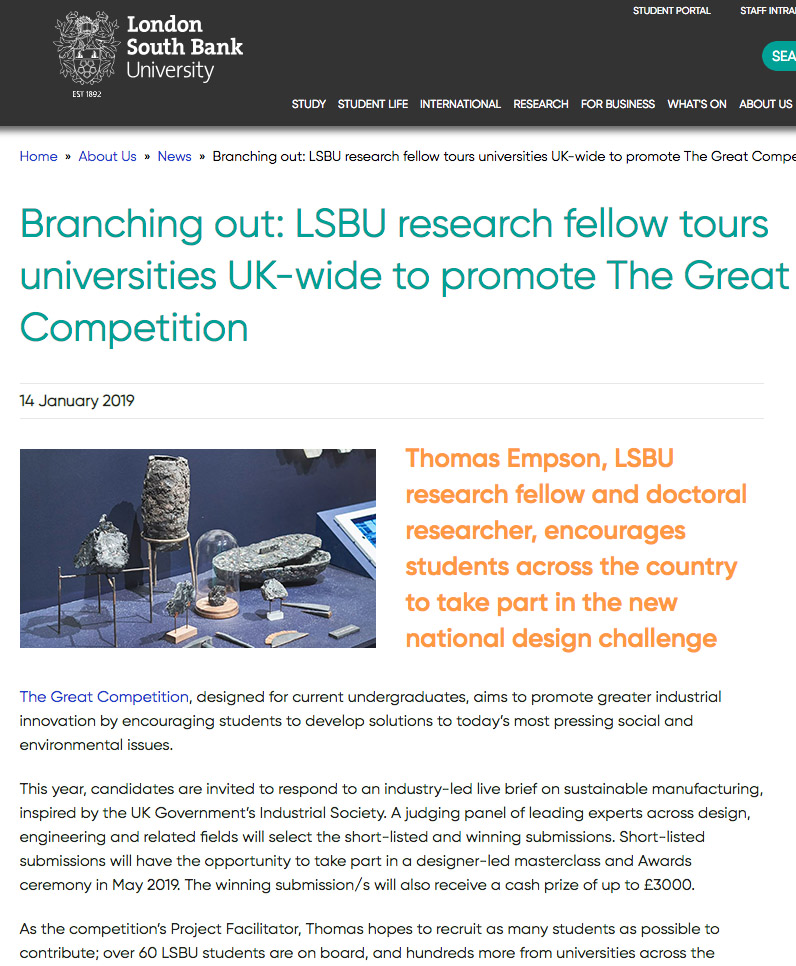
Thomas’ work for The Great Competition was just featured on LSBU’s website, and I hope you’ll take a look at the article:

Branching out: LSBU research fellow tours universities UK-wide to promote The Great Competition

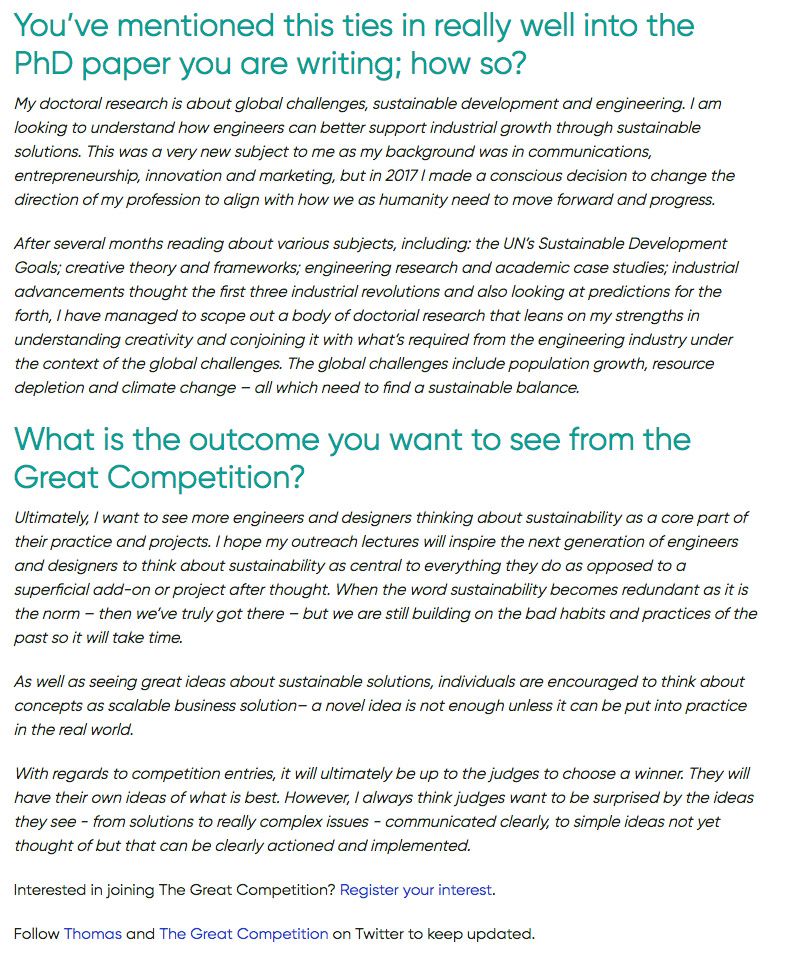
I’ve uploaded screenshots of the web page here, and you can view the original with live links at http://www.lsbu.ac.uk/about-us/news/the-great-competition

thomas lsbu 1

thomas lsbu 2

thomas lsbu 3


Basking Joyfully in Southern France

I’m currently on a writing retreat, working from Dublin and doubling down on my extensive to-write list. I worked straight through two weekends here because my flat here is so peaceful and sunny. Now, I’m taking a day off for good behavior and pausing to post photos.

Here’s a glimpse of two sunny weeks Aongus and I spent in the South of France this past September. Ours was an outdoor adventure full of cycling, river rafting, kayaking, hiking, and swimming. We thoroughly enjoyed the dramatic coastline, the historic coastal cities and remote hill towns, the Gorges du Verdon, and the Cliniques near Cassis.

I’m sharing these pics to give inspiration for your next travel adventure–and ours, too!

Antibes

Saint-Paul de Vence

Castellane

Rougon and La Palud-sur-Verdon

Moustier St. Marie

Roussillon

Le Pont Julien

Bonnieux

Lourmarin

Aix-en-Provence

Cassis

La Cadière-d’Azur

Le Castellet

Sanary-sur-Mer

Hyères

Porquerolles

St. Tropez

La Croix-Valmer & Ramatuelle

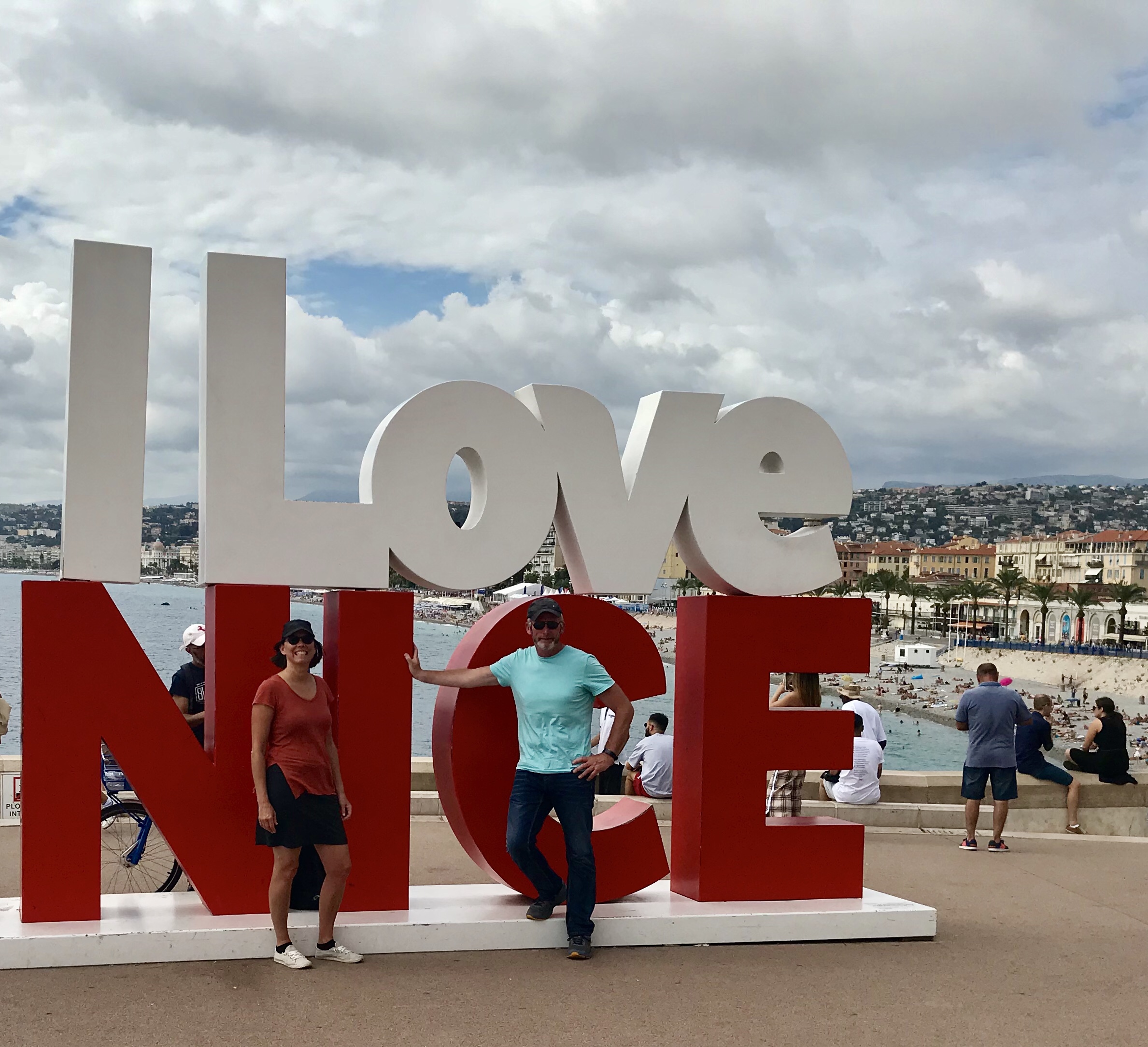
Nice

img_9223

Vieux Nice, Mèdecin, and the Port of Nice

Negresco Hotel

Promenade des Anglais and Ponchettes Beach

Farewell, for now, Nice!

An Evening of Astronauts and Magically Informative Skies


Last night’s sky over Dublin was spectacular, and a magical evening unfolded. I’ve been sequestered in my flat here in Dublin for the past few weeks, on a self-imposed writing retreat away from my current home in London.


img_2124

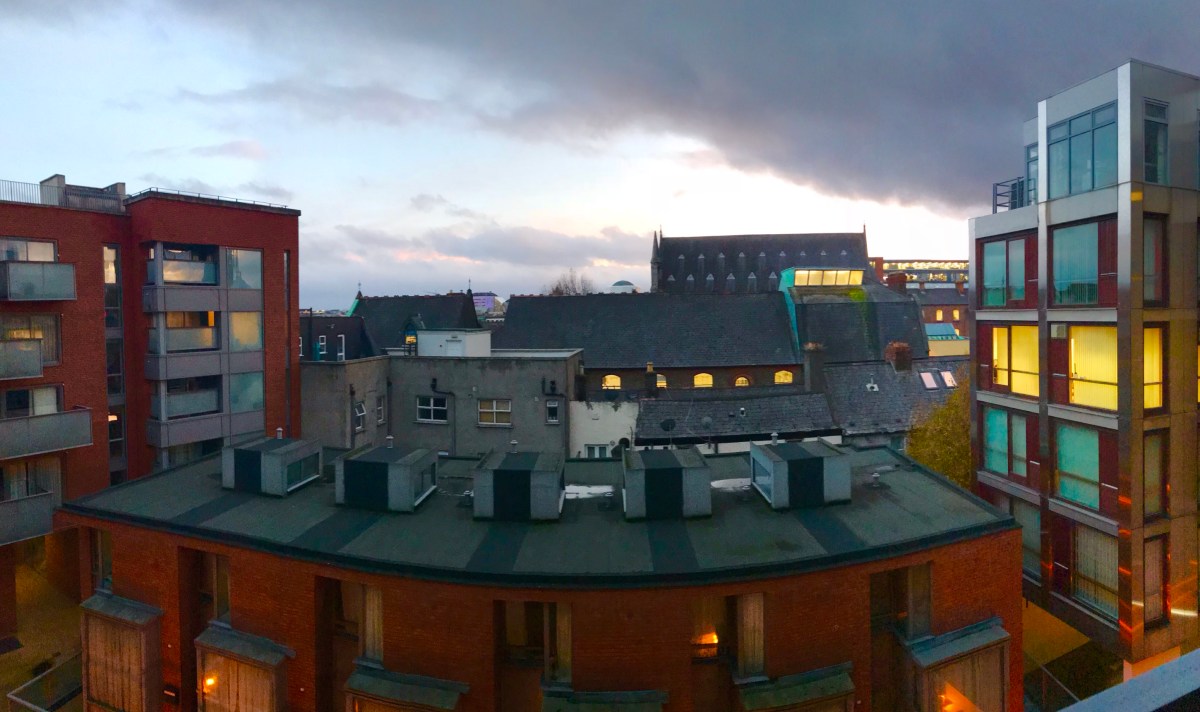
The view from my balcony, looking south toward Four courts, just beyond the roof of the Cappucian Friary and Padre Pio church.

However, my retreat has transformed into a sort of boot camp. The past few weeks have been like the days I was enrolled full-time for my Ph.D. while holding down my full-time teaching job (and somehow still doing well at both). I’ve been so inwardly focused that I’ve thought of calling this time my ‘hermitage.’ Yet, I’ve been so productive I’ve considered making this an annual thing.

After working straight through the weekend and submitting two big projects Tuesday, I was ready for a break Wednesday evening. And the evening didn’t fail to deliver. It was nothing short of magical.

Remarkable moments I enjoyed:

  • Views from my balcony at sunset.
  • Views of the city center from the top of a double-decker Dublin Bus–before realizing I was heading in the wrong direction and getting nowhere fast!
  • Recognizing, just in time, the error in my plan.
  • A fine fair-weather clip across town on a Dublin Bike, with a long haul up the hill to the far end of Phoenix Park to the residence of the US Ambassador.
  • img_2185

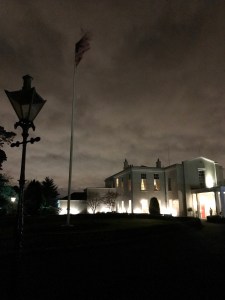
    US Ambassador’s residence in Dublin

    The stunning sight of the Ambassador’s home, tucked under a thick, delightfully-cheerful but ever-so-slightly-ominous blanket of clouds.

  • Clouds lit from the underside by our small but bustling city–a town beaming with holiday cheer and festive lights.
  • Stories of being in orbit from a man who has traveled far above the earth’s surface, in multiple spacecraft.
  • Learning about different types of rockets, and safety procedures that saved the lives of his colleagues in a recent failed mission.
  • Viewing dramatic photos US astronaut Shane Kimbrough captured from space–many from the Russian side of the Space Station, which he says has clearer glass that makes for better pics. img_2158
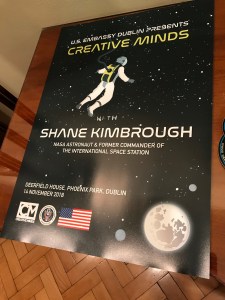
  • Meandering around the ground floor of the residence and enjoying the architectural details, but unfortunately, not recognizing a soul.
  • The delightful sensory experience of cycling back through the park on my way home. (By this time, the weather was starting to cool and I wished I’d donned the jacket that was tucked in my purse.) I pushed onward, not wanting to break the magic.
  • Parking my Dublin Bike at Blackhall Place, wandering through Smithfield Plaza, and enjoying the plaza’s holiday lights.
  • img_2206

    Music session at the Cobblestone, with Mick O’Grady, Pat Goode, Brenda Malloy, Tony Nugent, and others.

    And finally, stepping through the warm and welcoming front door of the Cobblestone pub, and soaking in greetings of musician friends and bartenders–catching some tunes, and sharing stories after the 7-9:30 session.

This fairy-tale set of events unfolded, after a somewhat odd day. I’d dealt with random, miscellaneous tasks, following on the heels of a week of productive writing and editing. Although this day wasn’t particularly productive, I kept trying.

But I had a particularly strange occurrence while working from home during the day:

A guy knocked on my apartment door and I asked through the solid core panel, “Who is it?” He didn’t say who, but rather that he needed something. I asked what. He said, in pained exasperation, that it was too complicated to explain. He sputtered and stuttered that he’d just have to go tell someone else. Fine by me. Look, if you’re bleeding and you need a doctor, say so. If you can’t explain your problem, I’ve no way to assess if and how I can help. My friends at the pub last night said never, ever open the door. Thanks to both God and good judgment that I didn’t.

I’ve been struggling with my vision and waiting for a new pair of multifocal glasses to arrive. Turns out, my far sight has improved, and this has thrown off all the settings on my progressive lenses. As a result, I’ve been fighting headaches from struggling to find a head-tilt position where I can actually see the screen. This has been going on for months, and I’ve only just gotten to the bottom of it all. A temporary pair of reading glasses is helping, but wearing them is disorienting and headaches still crop up.

So yesterday I was quite ready for a break. I wrapped up my work to head out for an event. I blended up a healthy juice of fruits and veggies–apples, carrots, cucumber, spinach, celery, and ginger–to pep me up for the evening.

I noted the stunning view of clouds rolling into Dublin at sunset. I clicked a photo from my balcony to post on Facebook:

img_2125

It’s already feeling like Christmas in Dublin! A bit of a Dickens Christmas, the lighting suggests. 

Such a lovely place to be, in this bright and sunny flat!

I quickly donned a skirt and boots with heels (unusual for me these days) and I zipped out for the bus slightly after 5 PM, en route, I thought, to the US Embassy. I grabbed a seat front and center on the top deck of the bus, and successfully deflected the man-spread in progress in the adjoining seat.

Views from the top deck were lovely! But, a half hour after I’d left home, sitting atop a bus stuck in traffic, I double checked the invite. It was quite clearly sent from the US Embassy, and that’s where I was headed. It’s on the southeast corner of town.

Nevertheless, the event–a public discussion with a highly experienced US Army astronaut–was actually in the other direction!
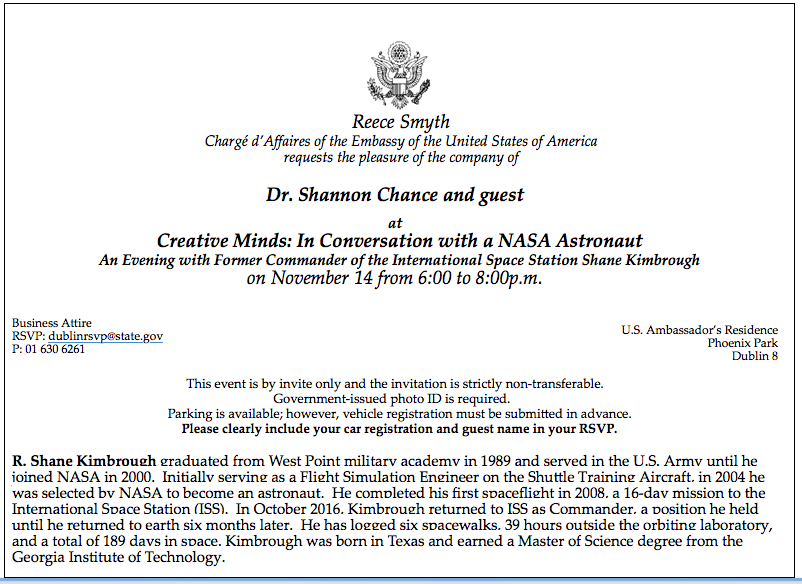
Screen Shot 2018-11-15 at 11.26.01 AM.png

The only way through rush hour traffic and up to the US Ambassador’s residence perched on the hill of Phoenix Park was by bike. It’s touted as the largest city park in Europe (or something of that sort), and the Residence is, as I’d come to discover, at the very northwest corner of the park. On the far opposite corner of town.

I had to wait for the bus’s next stop. It goes all the way from the Liffey, around Trinity College, to the far, far end of Nassau Street–almost to Claire Street, between stops. Quite difficult to see all those buildings pass by while wanting to disembark!

Once the bus finally stopped, by the grace of God, I clambered toward the nearest Dublin Bike dock.

Despite the mini-skirt and tall wedge-heeled boots I’d put on, I managed to make good time. I was up to the Ambassador’s in under a half hour. The cycle ride required great physical exertion, but there was no other viable way to get quickly from Trinity to Heuston Station. From the station, I could have taken a cab up and across the Park, but I persevered. After days sitting at the laptop, I needed the exercise.
img_2131

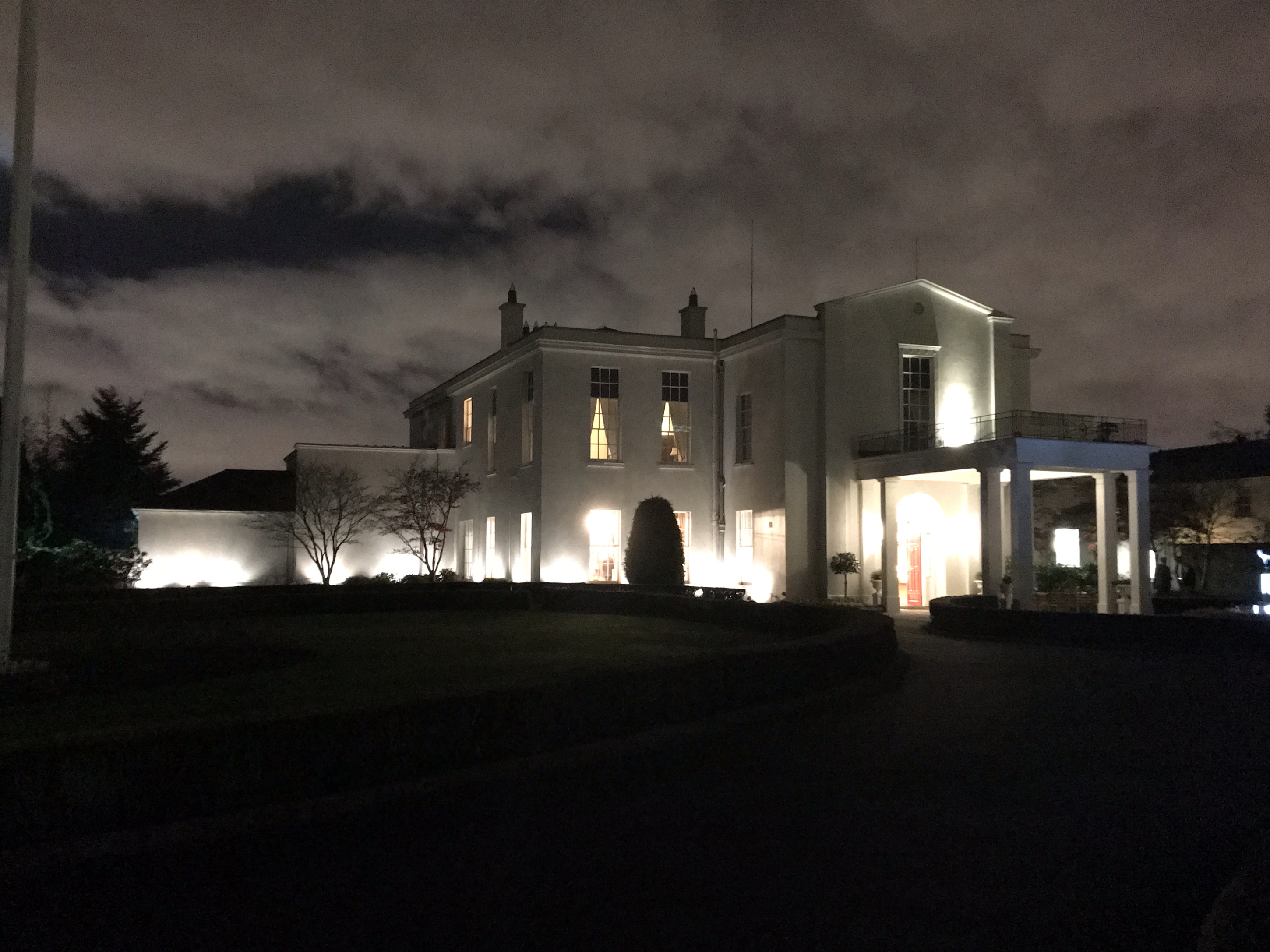
Gusts of wind billowed past, pushing a thick blanket of clouds across the winter sky. But it was warm. What a treat–the feel of cycling through the park in this delightful weather (despite rough paving on the cycle lanes, which appear to be under renovation). I felt a deep sense of joy while approaching the formal gates, to be greeted by the cheerful security officers who quickly found my name on their list. The magic of the evening was reinforced by this delightful setting–the Ambassador’s residence was aglow under a dramatic sky.

img_2159

The US Ambassador’s Residence is architecturally impressive.

I arrived in time to grab a canapé and a glass of wine before finding a seat. My face, flushed with energy, glowed brightly. The crowd filled three rooms, and so I observed through two different sets of doors. What ensued was delightfully informative. The dialogue was well worth the haul!

The speaker, US astronaut Shane Kimbrough, has the rare distinction of having served aboard BOTH the Space Shuttle AND the International Space Station. Once, he was in orbit for a full six months. That mission had been planned for four and a half months. Near the end, he received word that his stay was extended another six weeks.

Such interesting stories! He told of a mission he was on that launched from Russia, of bringing a soccer ball from a Challenger astronaut into space. He said during a spacewalk, you’re essentially in your own little one-person space capsule. He brought the experience of being-in-space alife for us all. img_2139-1

For more on NASA Astronaut and Former Commander of the International Space Station Shane Kimbrough see his webpage.

Shane shared amazing photos of his adventures and talked of cultural exchange, including multiple Thanksgivings spent in space. He described one year where the multi-national group aboard the Space Station celebrated our Christmas (December 25) as well as Russian Christmas (January 7).

He was also on a mission touted as “Home Improvement” since their team delivered and installed new kitchens, bathrooms, technical and exercise equipment and the like. Shane seemed so young and vibrant, yet he’s done all this. And what a remarkably humble guy he seemed to be!

Something he described will stick with me: he emphasized the fragility and beauty of the thin layer of atmosphere that protects, and indeed enables, life on our planet.

Of course, I ‘know about’ the ozone layer. My mom taught me to protect it since I was a kid. But I had never internalized the magic of this layer.  Although I knew about it intellectually, I had trouble ‘feeling’ it.

The scale is immense and the set of variables inconceivably complex. I have always had trouble wrapping my head around the idea of climate change. Shane made it palpable.

With a few words from Shane Kimbrough, I realized I’ve really only been looking up and out. From the International Space Station, he’d been outside, looking in. There, he adopted a more holistic view. He articulated it beautifully.

I’d been looking at all this from our human center, and been rightfully concerned. This astronaut helped me ‘see’ another way, but this also increased my concern. We must do more. I now have a better sense of awe of the beauty, vulnerability, and fragility of this thin veil.
img_2196-1On a night like yester–looking up, looking out–I saw the clouds rolling past. The jet stream pushing them along bound from the Atlantic along toward Scandinavia. img_2212-1

Heading home, I saw clouds. The stars were masked by plumes of water droplets suspended in air. Thick blankets of billowy, puffy clouds–holding us together–keeping us safe.

En route, I was inspired to wander the plaza and soak in the festive holiday lights. Then, I stepped in to see friends at my favorite local pub, the Cobblestone. Inside this pub, I feel love. Love of music and life-long friendships among musicians. I am always treated like family here.

Returning home, I fell into dreams of stars, with a new and deeper sense of awe for this planet we call home.
img_2218I awoke this morning to the ominous political news of Brexit, the pending collapse of the UK government, and then Teresa May’s resignation.

There was a different sort of sky, the sort of rays my friend Glen calls ‘God light’. Dear God, please let this light show us the importance of the atmosphere and of each other. Let it lead us to make better decisions.

Learning London: Science Museum

IMG_7290

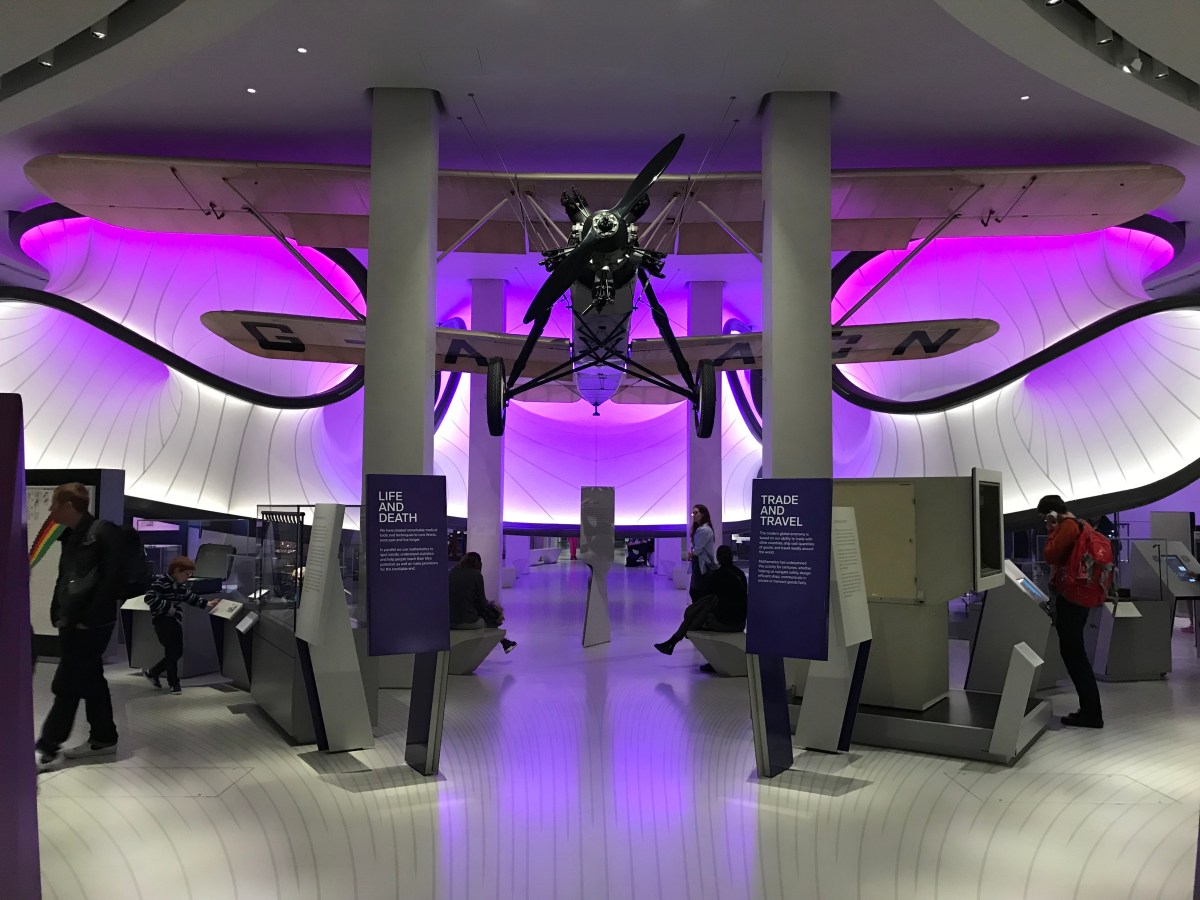
The Mathematics gallery, designed by Zaha Hadid and partners.

London’s Science Museum is so interesting that we went two days in a row. We hadn’t had our fill after just one visit, so we woke up Sunday morning and said “Let’s go back!” Incidentally, entry is by donation, so you can give what you like.

In the photo gallery below, you’ll see the Science Museum’s spacious entry hall and some images on the display about space exploration. You’ll see images from other parts of the museum that cover technological developments over time (related to transportation, homes, and appliances).

There’s special exhibit on Mathematics that includes visualization of air flow around a small aircraft (a display designed by the late/great architect Zaha Hadid) and there are displays about bridge and tower design.

I’ve included a few images from the special exhibition on technology in India–feeding my fascination with step wells. We also visited the exhibit on “Superbugs” to better understand the evolution of bacteria resistant to antibiotics.

Down the Rabbit Hole, from Bath to London

20171028_155655

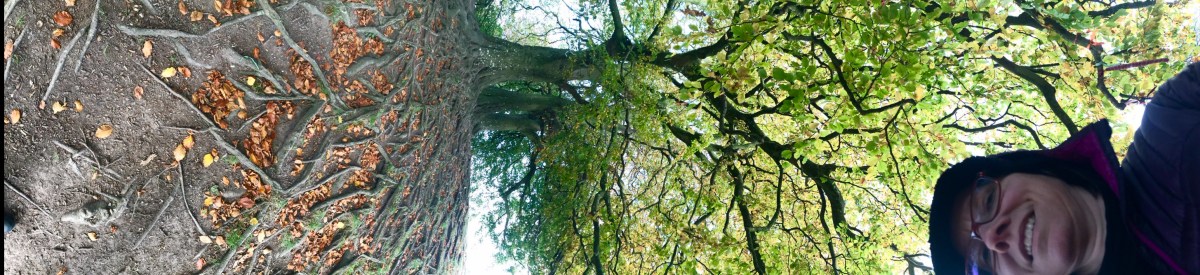
Beautiful “ferry” trees at Avebury in the UK’s Wiltshire region.

Last week I crossed the threshold into a brave new world. I traveled over to the UK, my soon-to-be home, twice to learn more about the place.

First, to celebrate Ireland’s bank holiday weekend, my partner Aongus and I flew to Bath. We rented a car so we could visit Stonehenge, the flight of locks at Devizes (the Caen Hill flight of the Kennet and Avon canal), Avebury which is similar to Stonehenge but larger, and the picturesque village of Castle Combe. In the city of Bath, we toured the ruins of the old Roman baths, the bell tower of Bath Abbey, Royal Crescent and the townhouse museum at One Royal Crescent, and weir and the Putney Bridge, as well as getting Watsu treatments and a night time soak with spectacular views from the rooftop pool at the Thermal Spa.

Stonehenge was spectacular, but Avebury had an even more mystical feel. The majestic old fairy trees with their thick boughs and knotted roots make it feel as if you’re stepping foot into C.S. Lewis’ Narnia or the Wonderland Lewis Carroll created for Alice. (Both of these were English writers, who could well have stood beneath the same magical trees we found here.) Wikipedia provides a quick reference to the meaning of ferry trees: “Many types of trees found in the Celtic nations are considered to be sacred, whether as symbols, or due to medicinal properties, or because they are seen as the abode of particular nature spirits. Historically and in folklore, the respect given to trees varies in different parts of the Celtic world.”

img_5227

Meeting with UCL’s Professor Nick Tyler.

After flying home, I flew back to London on short notice for four meetings on Wednesday–because my new colleagues at University College London had time to meet me and it was “review week” at DIT.

These meetings were in preparation for the start of my new Marie Curie research fellowship in January. The EU is providing funding for me to work at UCL for two years, to further upgrade my skills in educational research. During my short visit, I met with my primary supervisor Professor Nick Tyler who has an amazing record of research in transportation engineering and educational innovation. I also met with my secondary supervisor, Professor John Mitchell, who directs UCL’s Centre for Engineering Education (CEE). I also got to meet with the newest member of CEE’s research team, Dr. Inês Direito, who I’ll get to collaborate with in projects. All this in addition to visiting UCL’s European Office and quick chats with two other colleagues, Emanuela Tilley and Dr. Arnie McKinley, both originally from my own side of the Atlantic.

Overall it was a very productive day, and I even got two grant proposals read in route.

Across the span of the week, I had great experiences at work and at play. I can’t wait to get back to London, Bath, and the Wiltshire region of England for more learning, and more novel adventures.


Inishbofin Island: Picturesque Wonderland off the Western Coast of Ireland

Arriving on Inishbofin by ferry from the coast of Ireland near Clifton, we anticipated a unique combination of rest, relaxation, and outdoor adventure. Aongus and I had spent a weekend here one year ago, and we were blessed with beautiful skies and sunshine then (enough, by the way, to turn my Irishman purple). Early this summer we returned, hoping for a sequel of delightful adventures. And that's exactly what we found.

Now don't get me wrong, our cycling and sunbathing were at times delayed by sprinkles. You'll see from the photos that windbreakers were needed, even in June. But our three days in this little paradise couldn't have been lovelier. The weather and pace of life were just right. And a happily exhausted duo we were by the end of our cycling day, toasting life over pints of Guinness.

Inishbofin island is home to a hundred or so folks and it boasts a few hotels, restaurants, and pubs, along with a couple tiny little stores. It's reached by passenger ferry.

When visiting, it's wise to bring most of what you'll need over from the mainland, and to plan activities and wardrobes around clouds and rain.

If the sun shines, it's a bonus.

Discovering your own little patch of beach and some sunshine is a delight beyond compare. Add in a hike, a bicycling adventure, and some yoga on a cliff overlooking the beach and a normal day becomes shear magic.

The peace and tranquillity you may find on this little island can soothe a weary soul. The sunshine, though fleeting, will call you back again and again.